It’s strange, isn’t it, that at a time when so many of us are being asked to stay home that it feels like we have so little time to do things like read? At least, that is how it’s felt around our neck of the woods of late. But we have been managing to make headway in our ongoing Book Club, featuring the work of Scott Cunningham and focusing on the concept of folk magic in connection to nature and elemental associations.
In the past two regular episodes (on Safe Hex and Dreams) we covered the first few chapters of both Earth Power and Earth, Air, Fire, & Water. Those chapters began unpacking two of the major elements: Earth and Air, as well as sharing a group of spells that Cunningham associated with each of them. We talked about the use of things like sand and dirt in jars as a common folk magical trope for keeping evil at bay, and we still see that in some forms of charm work today with people leaving bottles or jars of rice, beans, pins, or more by their front doors or windows. Sprinkling salt has a similar effect when done at a threshold and that fits well with Cunningham’s ideas. We also chatted about Cunningham’s point that getting out into spaces without urbanization can be very good at connecting us to our landscapes and our planet, but that we should also be mindful that having that access is a privilege and we shouldn’t make others feel bad if they are doing the same work in a big city by going to a park or keeping potted plants.
On the Air side of things, we talked about how odd it was to see a warning in Earth Power specifically saying to be careful with air magic–why is that admonition so strong here, but not with something like earth magic? Does it have to do with the fast-changing nature of wind and storms? That also got us into the point that Cunningham makes about Air as a “twin of Fire,” which we’re still not strongly convinced about but makes for an interesting thought experiment. We noted that a lot of air-based spells have had their own evolution, with sailors likely using knot charms a lot less in an era of non-sailing ships and a recognition that spells involving tying things to trees need to be largely adapted so they don’t damage the tree (Laine and I both suggest the idea of using hair, which works well and biodegrades easily).
In ourPatreon Discord discussion, we also tackled a few more particular questions on these chapters and concepts:
What do you think of the differences in style between the books? For example, we talked about how Earth Power is obviously pulling from a lot of very practical folk magic (such as potato/apple wart curing charms) while EAFW seems to be more focused on rituals (including more incantations and rhymes). Which style works better for you, and why do you think that is?
What do you think the magical “theory” behind some of these spells would be? For example, why does throwing a handful of dirt after someone protect them (or in a similar folk magic tack, why would throwing a handful of salt after them keep them from coming back)? What about those counting spells? Why do witches/vampires/etc. have to do all that counting? (DON’T MAKE ME DO MATH!!!)
What do you think about including knot-magic in “Earth”? Does that make sense to you, or would you put it somewhere else?
Some of these are clearly very short-term spells, but a lot of earth spells are longer-term. Do you prefer to do spells with short, immediate bursts of activity and results, or longer and more sustained spellwork (or do you mix it up a lot)?
Is there a distinct difference between “air” and “wind” as a magical element or force to you? Why or why not, and how do you use air if you’re not also using wind?
Do we also see distinctions between “elements” and “transmission” or “medium” in other forms of magic? So for example I can see water as a medium with waves and tides as transmission methods. With earth, there are the seismic waves, but are there other forms of earth “transmission” that are fairly regular? I am sure mudslides, etc. would count but in terms of the way we can let a leaf go in air or water to carry a spell is burial the earth transmission method? Similarly with fire–is fire the medium and “burning” the method? Or are light and heat the transmission forms (so a spell using light is technically a fire spell then?).
And finally, why are birds so dang smug?
We would love to hear your thoughts on any or all of these points, so feel free to leave a comment below (or you can even shoot us an email if you’d prefer to share your ideas that way).
We’ll be tackling the powers of Fire and Water next, and then hopefully summoning Captain Planet to combat the avian smugness we will inevitably encounter. Or, at the very least, posting more questions and ideas to discuss.
For now, we hope you’re getting by okay, and we wish you happy reading and magic every day!
In a recent discussion on our Patreon Discord channel, we had a really smart question from listener Fergus. He was noting that both Laine and I often mention bits of folk magic we remember from our families and wondered what we did to gather that lore. Broadly speaking, I think both Laine and I have been incredibly lucky in that as we discuss different magical practices and folklore, we are reminded of things from our childhood and upbringing that relate to magical topics at hand.
However, it’s not always an easy process to get at magical folklore from your family or your community. With it being Pride Month, we are often reminded intensely that many people are cut off from their families and from their friends and neighbors by prejudice and bigotry. That means that opening the doors to magical discovery can feel a bit like an impossible quest.
For others, they may have strong family bonds, but figuring out how to ask about magic specifically is hard because any use of that word (or “spells” or “witchcraft” or similar terms) will instantly get shut down due to deeply-held religious convictions or other social stigmas. (Also, please note that while I’m using the term “family,” the term “community” is just as relevant–your local social environment can provide a LOT of lore, as can any chosen family to which you belong).
So what’s a person to do when they want to learn more about their own magical history (which is important, because we often see huge problems arise when people try to nab someone else’s magical history or invent a magical history out of whole cloth)?
(image via Pixabay)
Thankfully, as I’ve been working on my upcoming book for Llewellyn, I’ve also been thinking about that question, and for one of my chapters I came up with some exercises that I think would be extremely valuable to anyone trying to recover community or family lore. The big trick? Don’t focus on the magic and make sure you listen. Here are some practical exercises you might be able to try:
1. Ask for stories. Don’t focus on magical stories, mind you, but instead stories from a person’s life. In particular, you might try spending time with elders from your family or your community, and seeing what stories they have to tell. Get them to tell you about what life was like when they were growing up. Ask about their time at school, and what they remember about friends and neighbors growing up. Get them talking and truly listen to what they have to say. Write it down if you can (record it if they’ll let you, and donate that to a local archive! There’s a magnificent resource for doing this sort of ethnographic interviewing available from the Library of Congress called Folklife & Fieldwork: An Introduction to Cultural Documentation, by Steve Winick and Peter Bartis at the American Folklife Center. The full text of it is available as a PDF here, and they often will mail you a print copy for no more than the cost of postage). Remember that these interviews are about building a relationship. Make it a habit to ask questions and take an interest in them and their life. Even if they say things you don’t always agree with, try to be generous in your listening and pay attention to what emerges from these conversations. Over time, you’re going to find that there are stories that involve “a way of doing things” that doesn’t follow any rational structure, which is frequently an indicator of magical thinking and practice.
When I was growing up, one of the places I often visited with my Dad as part of his church choir duties was a local nursing home, and I found lots of people there who wanted to share their stories. I learned patient listening and got some good tales (and jokes) out of that, as well as making a few good friends, too.
2. Tell your own story. Get someone to interview you. Don’t think about the magical side of it or even focus on that part. Just let them ask questions about your life and the world you grew up in, and see what you say. Get them to record you, and listen back to your words later (I know, no one likes hearing themselves played back, so pretend it’s someone else if you must). Use the same prompts as in suggestion one above and see just where your stories lead. You’ll likely surprise yourself with how many little bits of magic, superstition, and folk belief you uncover with this process. I once did an interview with someone for my Krampuslauf research involving their role as a musical participant. They later told me that my interview opened up a whole cache of experiences, memories, and family connections that they hadn’t been thinking about, and it was a powerful emotional experience. That research involved a parade, but uncovered a good bit of magical and ritual material as well, some of which emerged during interviews without me ever raising those topics.
3. Focus on specific folklore-rich topics. You’ll often find as you do interviews and discuss lore that there are key subjects that generate more magical lore than others (even if, or especially if you don’t actually mention anything about magic). Some of the best topics to ask about include:
These subjects frequently involve subtle forms of folk magic, or point you in the direction of magical lore.
(image via Pixabay)
4. Pay attention to how people in your community respond to issues of stress. While major life events are great fonts of lore for general customs and beliefs, the way people deal with problems often involves a weaving together of rational and non-rational responses. Injuries, even something as small as a scrape on the sidewalk, often makes magic suddenly pop out in the form of a kiss or a gentle blow on the wound after the bandage is applied. How does the community or family around you respond when someone loses a job or faces a sudden loss? Are they turning to prayer? Are those around them doing so? Are they adding them to prayer lists, or giving them foods or objects of comfort? Do people trying to get a job have a lucky token they take with them to interviews? This is not an admonition to suddenly put on your social scientist glasses when you see someone suffering–far from it! Offering succor in times of strain is valuable, so if you can do so I encourage it, but also keep your eyes and mind open to what you can learn about the cosmology and enchantment in the world around you in those moments.
5. Finally, visit your local library! Do some research! Go to the archives! Libraries, and by extension local historical archives, often have absolutely scads of records, documents, diaries, and books of lore tied into the community around you. Remember, your magical practices are not solely about kinship, but community, and your teachers and magical heritage come from the places and people surrounding you. Dig into local lore and legends, and see what they tell you about the landscape you see every day. Are there places reputed to be haunted or cursed? Spots where wonders have been observed, or local legends of people who might have had magical powers? I happen to live in Pennsylvania at the moment, and this state loves its history and archives, which in turn allows for a lot of lore recovery. The lovely Urglaawe community–a regionally-based Pennsylvania German Heathen group–has been able to rebuild an immense amount of its lore and practices through research and interviews. Check into the folklore collections housed at your library, and look for local lore in particular. Does the library have genealogical records you can look into to find more information? Can you visit the places you read about, or even leave some flowers on the grave of an accused witch?
This is hardly a complete list of what you could do, but if you’ve been struggling with the ways you might get in tune with your own ancestral magic, consider giving these methods a try. I’ve been doing interviews for years now and my favorite thing about them is how often I find people want to keep talking long after the mic is turned off–we are a creature of narrative, and we love sharing stories. Remember that in no case should you approach this sort of research as an opportunity to exploit the people you talk to or study, but instead use these interviews and deep-diving inquiries to develop relationships and understand how you fit into your own magical (and cultural) landscape. You may be surprised just how rich it is.
The holly bears the crown. –From “The Holly and the Ivy,” a traditional carol
We’re deep in the Yuletide season, which means not only can you expect an episode of carols and stories from us soon, but that you’re almost guaranteed to hear at least one or two carols mentioning holly, ivy, or both (in fairness, it’s probably a lot better to keep your elf-ears tuned in for those topics than to be hyper-vigilant in your efforts to avoid Wham!ageddon, right?)
The above-mentioned carol, “The Holly and the Ivy,” has been around for at least two hundred years, but likely dates back even further as a folk song, deriving from medieval traditions in England of associating the plants with various winter festivities and customs (see, for example, KIng Henry VIII’s carol “Green Groweth the Holly“).
In North America, we have several species of holly that are native to our continents, but ivy is a different matter. Most of the “ivies” associated with the holiday season are things like English ivy, which are imports and can be very invasive and destructive if not controlled (similar vines like Japanese kudzu are notorious for the damage they do and their proliferation). If you are in North America and using holly and ivy, it might be worth thinking about picking a twining vine native to the continent, like Virginia creeper, especially if you’re planning to plant anything.
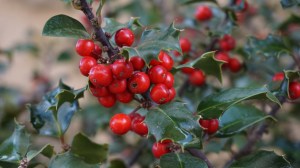
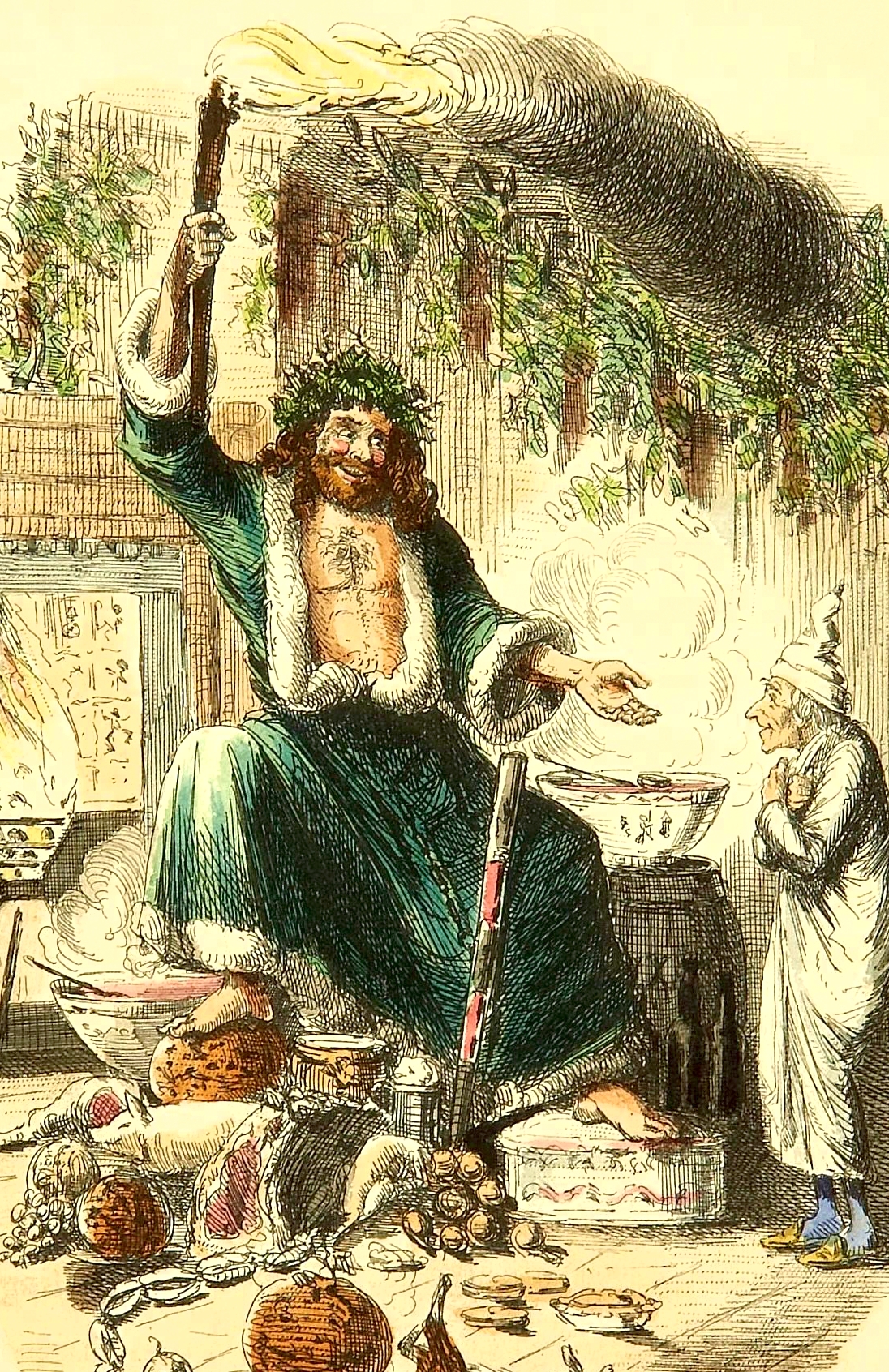
Holly has long been used to decorate for the winter holidays, including in Ancient Rome. Some stories claim that the Christian cross was originally made from holly, which is why its berries are often stained red like blood. Linda Raedisch tells of a hobgoblin named Charlie who haunted an inn in Somerset, England and liked to perch on a holly beam above the fire to warm his feet (when he wasn’t hiding all the dinnerware to annoy the guests). Raedisch also notes several important appearances of holly in the lore and literature of the UK. She points out that in the classic Arthurian tale Sir Gawain and the Green Knight, the titular swain appears at Arthur’s court to issue his challenge bearing an ax in one hand and a sprig of holly in the other. The Blue Hag of Scotland hides her magical staff under a holly bush (which prevents grass from growing beneath holly bushes in general). And of course, when the ghosts of Christmas Past and Present appear to Ebeneezer Scrooge in Dickens’ A Christmas Carol, they both bear holly as well.
While holly is often thought to be a good plant to bring in for the winter holidays, ivy is thought to bring ill fortune if carried indoors for winter festivities. Ivy is also associated with cemeteries and graves, as well as the wheel of St. Catherine, and thus, spinners and fiber workers (although it should be pointed out that St. Catherine’s wheel is NOT a spinning wheel, but a torture device…however it’s nice to see the imagery repurposed for better things). Some English lore says that ivy brought into a sick room will prevent recovery, and that taking ivy leaves from off of a church wall will doom the one who picks them to illness.
According to Judika Illes, medieval Europeans believed holly wood had the power to protect against wild animals. While the spell she references involves throwing a piece of holly at an aggressive beast, a contemporary alternative might be to take a small disk of holly wood and inscribe (paint, carve, or burn) it with the name of an animal friend or protector (a companion pet from your life or even one that you know of from books or stories). When preparing it, speak to the animal friend you have in mind and ask them to intercede with any creature you encounter and grant you safe passage. Wear the disk as a necklace or bracelet when going into wild places (possibly consider adding a couple of small bells to the jewelry, as that will alert wild animals to your presence long before you see them, and thus ensure they skedaddle before you make contact…they are usually far more scared of you, after all, than you are of them).
Holly was also thought to be protective against evil spirits. Churches and cemeteries planted holly around their perimeters in England as a way to deter pesky spirits who would get caught on the prickly leaves (this may also have worked to discourage vandals and some wild animals as well). If you do decide to plant holly, bear in mind that it is best left to grow on its own. It is considered very bad luck to cut down a holly tree.
One of the main uses of holly and ivy is in love work. A holly charm recommended by Judika involves picking nine holly leaves at midnight on a Friday. Without speaking, wrap them in a white cloth (like a handkerchief) and put that under your pillow. You should dream of your true love before daybreak. Ivy can also be used to determine who your lover will be. A Scottish charm involves plucking an ivy leaf in secret (not from a church, please) and uttering the words “Ivy, ivy, I pluck the, In my bosom I lay thee; The first young man who speaks to me, Shall surely my true lover be.”
Men hoping to attract women should carry holly leaves, and women hoping to attract men should carry ivy (those hoping to attract their same gender would carry the plant that most corresponds with their attraction: to attract women carry holly, to attract men, ivy).
You can also use ivy to discern who is working against you by wrapping a candle in ivy and burning it. The identity of your foe will become clear (likely through dreams or other omens). Ivy can help determine future illness, too, as one New Year’s divinatory ritual involves laying leaves of ivy in water on New Year’s Eve, naming each leaf for a loved one, and leaving them there until Twelfth Night (January 6th). Any leaves that are still green indicate health for that person, while leaves with black spots or those that have shriveled up reveal who will suffer great illness in the year to come (it probably helps to mark each leaf in some way, as with a dot of nail polish, to ensure you know whose leaf is whose).
And both holly and ivy can be used for more severe spellwork, too. You can put a token from a target (such as their name, a photo, or even a bit of their hair) into a bottle with twists of ivy and sharp-pointed holly leaves. Fill the bottle with black ink and some swamp water or war water, then seal it and bury it upside down. I can even imagine doing a rather dark and wicked little “sinner’s tree” of your enemies by taking a branch of holly and hanging little glass ornaments filled with your enemies’ names, holly leaves, and ivy, with a bit of black ink (they make fillable ones you can buy at craft stores, or you could just save a few small spice bottles). Tell them they will spend the next year in perdition and torment if they do not change their ways, then burn the tree and the contents of the bottles, and scatter the ashes at a crossroads or in running water.
Of course, if they *do* change their ways, you should probably put them on your “nice” list next year and perform an equally powerful blessing on their behalf.
We’ve added something new over at our YouTube channel! We’re continuing the thread of our Disney Magic episode by starting a series of videos that explore the connections between popular culture, fairy tales, folklore, and folk magic. We’re calling it the Compass & Key Charm School. Our first installment is one of my favorite Disney witches, Ursula, and we look at the differences between Hans Christian Anderson’s classic literary fairy tale and the animated film version. We also discuss some of the ways that seaside witches use their magic (and how you might style your own magical cupboard after Ursula’s). Please feel free to comment, subscribe to the channel, and share the video around! Thanks for watching!
In previous posts in this series, I’ve already looked at some of the ways that history, folklore, and contemporary behavior come together to form what we’ve termed “New World Witchery.” If you’re just starting with this series here, you might want to flip back the pages of this dusty old tome on the bookshelf and read the first of these posts on “What is New World Witchery, Part I (Irrational Pragmatism).” There are other posts that follow, on topics like the moral implications of practical folk magic in North America, and the spiritual entities that seem to hover at the edges of (or stand smack in the center of) New World magical practices, and the physical “things” of North American witchcraft. You can certainly start here, though, and go where you wish, and let your intuition act as a compass for these explorations.
This time, I’m addressing a topic I’ve addressed before in a few different ways: how witches learn to do the magic associated with them. I’m revisiting these points here because the other posts on them all go into more detail on specifics, and I believe that a more general summary of themes and methods is useful here. As you’re digging into this subject, feel free to spend some time in those older posts, too, as they do provide more depth than this one will. As you will likely see early and often through the following examples, witches can gain their magical prowess in a lot of different ways, and so it can be hard to compare one witch to another in folklore and history. At the same time, there are themes that do unite the different stories, or at least themes that overlap with one another, creating a sort of “spectrum.” What is certain, though, is that those who claim magical power develop it in some way to eventually become what people call a “witch.”
Witches Become Witches
In the time I’ve spent reading accounts of witchcraft in books of history and folklore, the time I’ve spent interviewing contemporary practitioners or examining specific magical artifacts, and the time I’ve spent consulting with other people who study this engrossing topic, I’ve learned that over-generalizations are not terribly useful when it comes to witchcraft. By reducing witchcraft into motifs and components, we tend to miss the highly individual experiences of the people actually practicing the magic. At the same time, it helps us a lot to look for patterns, and when it comes to just how witches gain their magical powers, we can see a set of patterns in the New World (or at least, specifically in North America) that point the way towards a better understanding of how these practices move between people. Tradition, as one of my folklore mentors has pointed out, comes from a Latin root having to do with “handing” things over, and witchcraft generally seems to be a “tradition” in that sense—it is handed over from one person (or entity) to another.
The exception to that rule is hereditary witchraft, although in this case I’m not referring to grandiose initiation stories of secret Granny Witches conducting rituals in their kitchens to initiate their grandchildren (looking at you here Alex Sanders). Rather, I’m referring to the wide body of lore that says that witches can often be “marked” from birth with special powers. For example, the presence of a caul around a newborn’s head is frequently noted as a source of spiritual power, and even when detatched the caul retains some magical abilities—sailors paid a pretty penny for dried cauls to stave off drowning, for example. In mountain lore inherited from European traditions, the seventh son of a seventh son is often reputed to have the ability to heal or do certain types of magic, setting him apart. Other birth-related demarcations of magical power include unusual moles, the presence of teeth in a newborn, extra fingers or toes, or a baby who is particularly hairy. One account of witchcraft among Pueblo Native Americans in the American Southwest showed that popular opinions claimed that witches often passed on their abilities to their children (albeit powers of malediction and harm in that example). A West Virginian herbal healer named Dovie Lambert who also “took off” bewitchments from others claimed that the passage of magical power occurred when secret words were transmitted across gender lines in families: father-to-daughter or mother-to-son, or even among aunts, uncles, nieces, and nephews. Dovie believed that if the power didn’t get transmitted before the witch’s death, the power of that line of witchcraft would die out, although she herself believed that was unlikely to happen anytime soon.
Even in cases of a “witch from birth,” which is not always the same thing as these examples of magical “election,” the person has to choose to use their ability, and often develops it during a later point in life. This power was not solely limited to magic, however, but often reputed to impart special gifts to children based on birth order that might include a talent for medicine or a need for expanded education. Vance Randolph recorded some such beliefs in his examination of the Ozarks and their lore:
“If there are seven sons in a family, and no daughters, the seventh son is clearly intended to be a physician. The seventh son of a seventh son is a physician in spite of himself, endowed with healing powers which cannot be denied. Even if such a man does not study or practice medicine, he is very often called “Doc” or “Doctor” by common consent. However, small-time gamblers are often called “Doc” too, just as every backwoods auctioneer becomes a “Colonel.”
If there are ten sons in a family, and no daughters, the tenth son must be a preacher. “God meant it to be that-a-way,” an old woman once told me. “He knows how many preachers we need in this world.” She would not go so far as to say, however, that it is a mistake to call men who are not tenth sons into the ministry.
Many hillfolk believe that a third son is more intelligent than his brothers and should therefore be encouraged to “git more book-larnin’.” Others contend that, other things being equal, the fourth child has the brains of the whole family.”
Frequently the turning point in a “natural” magician’s life is adolescence or young adulthood, when the person’s power fully manifests for the first time and they learn the techniques of healing from someone else in their community, usually a family member. For example, West Virginian folk healer Johnny Arvin Dahmer spoke of inheriting a copy of The Egyptian Secrets of Albertus Magnus from his grandfather, who was also known as a folk magician and charmer. While a person may be predisposed to magical talent, then, their use of that talent comes only with guidance and training.
That instruction forms is very much the “marrow of tradition” that underlies almost all other forms of witches-becoming-witches. Just how involved that training is depends on the type of magic being transmitted, the cultural context in which it is found, and the particular individuals involved. In most cases, magical practitioners do not hang out shingles and advertise their services as instructors in witchcraft, but over the course of a long-standing and developed relationship with another person they may decide to share their secrets. In Dovie Lambert’s case above, that may happen as a matter of survivial of the magical tradition—if it is not transmitted it will “die out.” Lambert’s cross-gender transmission appears in a number of European-derived practices, including those from German-speaking, English-speaking, and French-speaking groups. A detailed study of powwowing magic in Pennsylvania Dutch communities by David W. Kriebel sums up a number of these ideas:
“Training procedures vary greatly, although one rule is nearly universal, namely, that only a woman can teach a man and only a man can teach a woman…training time can take anywhere from a few minutes to a year. The training procedure used by [one informant] and passed on to [two others] consisted of a ten-week program with all information imparted orally. When the initiate returned for the second session he (or she) had to repeat all the incantations and gestures perfectly, as a sign the initiate was meant to become a powwower.”
Kriebel’s account brings up the concept of a “calling” to do magic, which may be an echo of the idea of a hereditary practice or may signify the same kind of “calling” experienced by a religious or political leader. Kriebel also notes that one of his informants draws attention to the “price” of teaching magic, with one informant claiming “that when one powwower trains another the teacher gives up half his power to the student.” Several instances of this sort of transmission appear in folklore about witches who share their secrets or pass on their power only in the moments before their own death. A number of accounts make the claim that magical power can only be taught or transmitted at most three times within a person’s lifespan before the magic “runs out” or the practitioner dies.
Beyond the element of a calling to witchcraft, some witches may seek out their power in various ways. One Northern Mexican informant described the application of a special set of powders to his body, followed by a ritual bath, that gave him the ability to transform into animals. Notably, he learned the process by watching two other witches do the same in secret, and initially failed to do it correctly because he was wearing a scapular (a Catholid object designed to confer the blessings of Saints on the wearer). Only after removing the holy item was he able to begin his transformations. Many such initiations involve a renunciation of Christian practices or beliefs. Several accounts from Hubert Davis’ The Silver Bullet note that witches become witches by “throw[ing] rocks at the moon and cuss[ing] God Almighty” or writing the Lord’s Prayer on a plate in grease paint, then washing it in a river or stream in an act of inverse baptism. Vance Randolph’s informants note that the initiation experience could be “a much more moving spiritual crisis than that which the Christians call conversion,” at least according to his sources.
In some cases of initiation, witches were expected to pay a price similar to the one noted in the accounts Kriebel found among the Pennsylvania Dutch. That price might be an obligation to a specific spirit (most commonly framed in the American traditions as “the Devil,” although specific descriptions and formulations of diabolic initiation vary). It might also involve the death of a relative, or a period of intense sickness or near-death illness. Once initiated, however, a witch retained her power until her death or until she elected to pass it on to someone else. Other magical powers often followed this line of transmission: a calling or marking from birth followed by a powerful experience in young adulthood or adolescence that confirmed magical ability; the transmission of specific knowledge about witchcraft through the passage of oral lore or even the handing over of a book; and finally, the dispersal of that knowledge and power to another generation, often only in very limited quantities.
Contemporary practitioners tend to derive their magical knowledge in similar ways to the ones already outlined, but with some distinctions. For example, the emphasis on learning from books has become a de facto aspect of magical training. In some cases, the same books used in previous generations, like Egyptian Secrets, still hold sway, although in truth there are so many options available the older books are only a small sliver of the greater body of knowledge being used (I’m not complaining here, as I think many fantastic books have been produced in recent years, including some that surpass the older tomes in terms of breadth and depth of magical information). Several correspondents I’ve had have told me they look for “classes” in witchcraft, too, with structure and lesson plans and even homework. Some prefer classes focused on specific skills, as with Becky Beyer’s Appalachian wildcraft workshops, while others follow initiatory magico-religious traditions like Christopher Penczak’s Inner Temple structure. Training from groups directly (either in person or via postal correspondence) was the norm during the heyday of British Traditional Wicca in the 1970s and 1980s, but that is only a singular form of training now among many other forms available. Some practitioners still take on apprentices, especially in traditions like powwow or curanderismo, although both of those traditions are sometimes taught in whole or part within a class environment, too.
The one element that seems to have dissipated over time is the concept of the “price” paid for magical knowledge. The price has become the time and commitment required to learn the skills and magical techniques associated with a particular tradition. There are still some initiatory groups that do extract a price, such as requiring potential initiates to fast or wear special clothing for a certain length of time—something common in Lukumi traditions, for example. Occasionally the idea of the price being a loved one’s death surfaces, too, although that has become increasingly rare. So, too, has the idea of passing on the tradition before death as a matter of continuing a line of magical practice. Instead, practitioners often pass on their knowledge as more of a public service or as an aspect of their calling (some speak of being “called to teach” within a “training coven” structure, for example). Passing knowledge has also moved beyond rules about gender lines, too, instead becoming a more egalitarian and open-access approach.
Given the many roads into witchcraft, however, the road out is still in the transmission, even if the reasoning has changed. Witches become witches, and they do so because other witches make that possible. The stereotype of witches gathering in huge covens on Walpurgisnacht to engage in Satanic rites may be a medieval fabrication and fantasy, but in the act of sharing magical knowledge, there does seem to be a continuity of magical community. Almost like a family.
N.B: I will be doing one more entry in this series on the many and various talents of witches, but I am likely to set aside that post for a bit to cover a few other topics. This series has been rather grander in scope than I think I originally envisioned, but I hope it is useful to some of you. For now, I am so grateful to those of you sticking with me even with the longer gaps between posts.
In previous posts, I’ve already looked at some of the ways that history, folklore, and contemporary behavior come together to form what we’ve termed “New World Witchery.” If you’re just jumping in here, you might want to turn back the hands of time with an enchanted pocketwatch (which seems a very Romantic or Steampunk sort of notion) and read the first of these posts on “What is New World Witchery, Part I (Irrational Pragmatism).” There are other posts that follow, on topics like the moral implications of practical folk magic in North America, and the spiritual entities that seem to hover at the edges of (or stand smack in the center of) New World magical practices. You can certainly start here, though, and go where you wish, and let your intuition act as a compass for these explorations.
Witchcraft Makes Things (Happen): The Physicality of New World Magic
Thinking about witchraft academically is fun (well, for me, at least). Here, however, we turn from the realms of intellect and ether to the dirt-under-the-fingernails side of witchcraft in North America. Magical author Peter Paddon was fond of saying that a good sorcerer can do magic stark naked in a concrete bunker, and I certainly agree that on some level that is true. However, for most people practicing magic in an everyday way, the “stuff” of witchcraft is vitally important. Again and again, we see that the physicality of magic plays a crucial role in how that magic operates, how those who perform the magic perceive the world around them, and how magic shapes the actual spaces around both practitioners and those with whom they have contact. The objects and spaces of magical action, the artifacts of witchcraft as they might be called, are often both a highly attractive element of the practice and one of the ways in which magic reaches beyond the individual and into the broader community. Even those who don’t practice any form of formalized witchcraft might be found carrying a rabbit’s foot in their pocket, or hanging a horseshoe above their door, or even standing a broom in the corner. Witches take these magical actions a step further and combine, amplify, augment, or otherwise expand upon individual talismans or amulets. Witches are the ones who can make the potions or charms needed to guarantee luck or repel evil. They are at a very fundamental level crafters in multiple, layered senses of that word—they overlay a magical craft onto handicrafts, and recognize the process of creation as a form of ritual unto itself.
Often, the process of crafting and creation goes beyond the boundaries of familiar and everyday use. Something used in one way for mundane needs experiences a transformation through magical operation, and becomes an object of power. One of the most readily apparent examples is the humble broom. Whether the broom is used for sealing a marriage (“jumping the broom”) or sweeping luck around the room, it functions as both a mundane tool and a magical one. It can even become the source of magical supplies, as broom straws are used to treat conditions like warts or the evil eye in folk healing rituals.
Broom and Broomstick in Oostende, Belgium (via Wikimedia Commons)
Similarly, we can see other physical objects that jump from their mundane contexts into magical ones, even busting the barriers that separate overt purpose from magical reinterpretation. One practitioner, who follows a generally Druidic path but draws upon folk magical influences, explained via correspondence in 2016 that she had created a “honey jar” type spell, which involves putting select ingredients—sometimes herbs, but frequently paper, images, or even personal objects like hair and fingernails—into a sweet mixture like honey, syrup, or sugar in order to obtain a favorable outcome. She wrote that she had been attempting to secure a mortgage, and decided to do a working on one of the bank officials involved in the approval process. After putting the jar together, she “tracked down his name and a picture and performed the…spell. Guess it tipped things in my favor because the mortgage was approved the very next day!” While not every spell meets with success like this, the physical contact with ingredients and the ability to hold something magical in one’s hands surfaces again and again in practical witchcraft. Even witchcraft-adjacent magic, such as the treasure-finding work that Joseph Smith did before he founded Mormonism, required the use of physical props (in Smith’s case, special stones called “peep stones” that enabled him to find treasure and later decipher angelic writings).
The physical forms used depend on personal preference, traditional background, and local availability. In some cases, folk magicians lean heavily on the exotic or the unusual, even going so far as to procure incenses and herbs from mail-order or internet supply houses that offer things like dragon’s blood resin or frankincense. Just as often, however, a magical worker can find virtually everything she or he needs simply by walking through the doors of the localsupermarket.
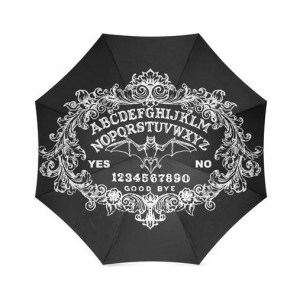
Seriously, who wouldn’t want a ouija board umbrella? (Made by Etsy shop StuffoftheDead)
We can get very drawn into the aesthetics of witchcraft, because they are quite frankly pretty awesome. Who doesn’t want to bedeck themselves in black and silver and bones and fill their house with candles, incense, and stones? That aesthetic, however, is only a surface one, something we have reclaimed from pop culture in many ways (and an aesthetic which continues to inspire even in recent years). The physical manifestations of magical practice are oh-so-frequently a well-stocked spice cabinet, a drawer full of pins and bent nails or old wishbones or loose change, and a broom turned up behind a doorway.
And, if I’m being honest, a library a little overburdened with books of folklore.
The physicality of witchcraft is intimately tied with its effectiveness. Spells done naked in a bunker can be effective, but even Peter Paddon wrote a book on the viscerality of magic because he knew, as most who practice magic do, that spells aren’t pure abstraction or thought experiments. They are fleshy, and dirty, and sexy, and painful, and fun, and scary, and sticky, and…well, physical.
“Tituba and Giles Corey,” by John W. Ehninger. Public Domain. (via Wikimedia Commons)
This post is part of my ongoing series trying to use folklore, history, and contemporary accounts of folk magic to paint a picture of what “New World Witchery” might look like. If you haven’t already done so, you may want to read the previous post, “What is New World Witchery?, Part I (Irrational Pragmatism).” Or don’t. I’m not the boss of you. I have already said there what I will reiterate here: that my attempt to lay out some sort of shape that defines New World Witchcraft practices is likely to satisfy no one (not even me). I undertake this effort largely because I think it gives me a point of reference when I’m developing other articles and trying to see how distinctly “New World” certain practices are. There will always be exceptions, of course. Rules and witchcraft have a murky, complicated relationship, a thought which brings me to the subject of today’s section:
Witchcraft is an Amoral (not Immoral) Act
Despite a common popular conception in parts of early America, most witches are not interested in worshiping a literal Christian Devil or sending random blights over their neighbors’ crops. That doesn’t mean witches do no harm—they seem to do a lot of it, at least in accounts historical and folkloric. For instance, many witches will tie up a rag to an axe handle or fence post in order to steal milk from their neighbors’ cows, thereby stealing directly from the people around them. Seldom are those targeted by witches run into ruin or completely deprived because of the witch’s interference, although it may cause them some anxiety and trouble. The magical theft seems to be an extension of the pragmatism mentioned previously, though, offering the witches involved a way to sustain themselves. There are stories of people being tormented to the point of death, of course, but as in the famous Bell Witch case, much of the lore surrounding such attacks implies that the target has wronged the witch in some way, and that the witch is simply bypassing conventional justice for her own brand (see Keith Thomas’ essay on English witchcraft for a good outline of that argument, which applies equally in a number of Colonial-era witchcraft cases).
Witchcraft is not an act of evil unless it is being labeled that way by those not practicing it, but its applications are often morally ambiguous, verging on unethical. Take for example, the case of Mont and Duck Moore in the Blue Ridge Mountains. Duck would hex livestock within the community, and then Mont would remove the curse…for a fee, of course. This was an act of commerce far more than it was an act of evil. Or at least, it was evil in proportion to its pragmatic approach to earning a living. The case of Betty Booker mentioned previously provides an example with a bit less racketeering. At the far end of the spectrum we have the case of “The Witch of Pungo,” Grace Sherwood, who provided a variety of cures for her community in Virginia, only to end up being “swum” for her troubles (fortunately, she survived the experience). Sherwood reportedly stirred up the ire of some of her neighbors through her witchy ways, but seldom held back in her condemnation of those same neighbors when they leveled accusations against her. Folk magic and witchcraft, as we have seen already, are about meeting needs, and those needs are frequently morally dubious, much more so than the people who perform conjurations to help meet those needs. Cheo Torresnoted that he was once asked what people liked to ask curanderas to do for them by a reporter. He replied: “Well, I said, young men usually want something to help them get sex…[M]idle-aged women usually want something to make their husbands love them again, sine that spark has left their lives. Middle-aged men want something to help them deal with the old aches and pains of their arthritis or their old football injuries. Older women wanted something to help them win at bingo or the lottery. And older men usually wanted something to attract younger women.” Clearly, meeting the needs of those who come to them is what creates moral ambiguity, far more than a witch’s partnership with a particular imp or spirit (although we’ll be getting to that topic soon enough).
Statue of Grace Sherwood on Witchduck Rd., Virginia Beach, VA. By Lago Mar [CC BY-SA 4.0], via Wikimedia CommonsA New World Witch is accountable to herself, and answers to her own sense of morality. Some stories demonstrate a witch paying a price exacted later by a Devil, but for the most part any suffering they find is at the hands of those who work countermagic against them—for example in tales where a hexed butterchurn is used to reverse harm upon the witch who cast the curse in the first place. One informant shared a just such a reversal with me regarding the Evil Eye:
“If your infant is thought to have been given the Evil Eye, it will display tantrums, inexplicable fits, crying, fever, coupled with nausea out of nowhere. If this is determined to be the case, the one suspected of giving the Evil Eye to the child must be confronted in front of said child, and be asked to submit (pass along with their mouth or spit in a glass of water) their saliva to the infant for it to ingest… Giving of themselves a part of them, to queue [quell] its curse.”
The person who gave the Evil Eye was expected to be a person that could be confronted, negotiated with, a part of a community that operated by informal, unofficial, but very potent magical “rules” that could flex and adjust to particular circumstances.
Justice is negotiated in individual encounters rather than through uniform rules. Witches like Sherwood may have had tempestuous personalities but still acted as forces for good in their communities. Milk-stealing witches met their needs through magic, often because they had fallen through any social networks of support that were supposed to exist in their communities, and frequently paid an eventual price for their deeds at the hands of those they’d wronged. Some witches played a system, as in the case of Mont and Duck, and were tolerated by the community at least for a time. No one, it seems, in history or folklore, expects the witch to act in a morally “mainstream” manner, but to operate under her own code of right and wrong (and any shades of gray between).
Next time: Witches Have a Lot of Friends (You Just Can’t See Many of Them).
Thanks for reading!
“Tituba and Giles Corey,” by John W. Ehninger. Public Domain. (via Wikimedia Commons)
It has taken nearly seven years, two hundred articles, over one hundred podcast episodes, and the formation of an interactive community of people all interested in the systems and traditions of various magic-practicing people in North America (and beyond), but now here we are. Based on the title of this post, you may be imagining that I’m about to lay out a complete definition of “New World Witchery.” One that locks down all these various strands we’ve been chasing. Or you may be thinking nothing of the sort, and instead be stumbling upon this article first and trying to decide if the rest of the material here would ever be of interest to you. I think, then, that I am bound to disappoint, because attempting to cage “New World Witchery” in one place, form, or time will never work—it seems that so long as there is still a “New World” with practicing witches in it, that definition is going to have to remain somewhat flexible and fluid.
In one of my last posts, I attempted to answer the question of whether or not I am a witch, and in doing so I covered several key points: practical (although not entirely logical), wondrous (in the sense that the world is full of strange, marvelous, and sometimes terrifying things), and traditional (in the most literal sense of the word). I realize in attempting to create some sort of categorical definition of “New World Witchery,” I’m going to at best satisfy but a very few, but hopefully if you’ve been along for the ride thusfar, you’ll at least come on the journey with me and see what makes sense to you, or what you might change or improve. I will also note that while I am drawing on sources from history and folklore, I will not only be turning to the past. Witchcraft seems to be alive and well today, so I’m inclined to pull from contemporary sources, too. Your mileage with those sources may vary.
This article will be divided into multiple posts, mostly due to length. I’m going to link to material within each part, but the full references will be added retroactively to the posts when they have all been completed, for the sake of practicality. Speaking of which, that takes us to our first major point, and the subject of this initial post.
Hamsa Hand (via Wikimedia Commons)
Irrational Pragmatism: Witchcraft Gets the Job Done (Even if No One Knows How)
I mentioned in the previous article that in many cases, witchcraft seemed to be less about formal religion than “muttering under one’s breath in a time of need, or knowing not to burn sassafras wood.” What I see repeated over and over again in witch tales is a deeply pragmatic approach to problems. A person is marginalized by their community, or denied a favor, or needs to get some milk to keep from going hungry. The only unusual aspect of the problem-solving is that it involves magic, which operates in highly irrational ways. Dorcas Hoar and Bridget Bishop in Salem both existed at the fringes of their town’s social structure, women who needed to survive without adherence to rigid Congregational conformance and who did not have the typical family structure of the community to support them. Dorcas Hoar’s husband had died the year before the trials began, but she had been engaged in acts of divination during the decade before the trials as well, and was reputed to own magical texts. Bishop was known to be strongly opinionated and ran an unofficial tavern out of her home. Hoar managed to escape the trials with a conviction but lived to tell the tale for nearly twenty more years, but Bishop was not so lucky.
Within folkloric cases of witchcraft, those who perform magic may be accomplishing their own ends, but they are also serving a bigger social function, too. I’ve mentioned Betty Booker here previously, and her case shows that a witch can stand in for a judge and jury against those who behave shamefully in a community, as Booker does by “riding” the old skipper after his miserly behavior. In a more contemporary setting, the application of folk magic might be a way to bridge the gap of personal connection (especially in an age where we tend to communicate from behind a screen). One person communicated a bit of lore to me regarding infants and the evil eye that illustrates this point: “My mom said that if someone wants to touch/hold your baby and you don’t let them then there is a chance that person will leave casting ‘mal de ojo’ (evil eye) on your baby causing them a lifetime of bad luck, conversely, she said that letting others hold your baby is good luck.” While it is always a good idea to wash one’s hands before handling a newborn, it’s also important to integrate the new child into a community, which seems to be one of the underlying themes of this lore of baby-passing. Whatever the case, New World witchcraft meets needs, and it meets them where they are without hesitation.
Next time: Witchcraft as an Amoral (not Immoral) Act
I’ve always liked the word “witch.” It carries with it a lot of connotations, sure, but so few words can evoke strong reactions across the spectrum, ranging from fear to excitement to anger to joy. Witches in folklore occupy a strange space; in many stories, they seem to be dangerous and do harm (e.g. “Hansel and Gretel” or “The Witch in the Stone Boat”), but then in so many other tales they are helpers, or benign catalysts for action (as in “Frau Holle” or “Finist the Bright Falcon”). We have tackled the question of “What is a Witch?” from a lot of angles here already: answering the question generally and rhetorically, looking at aspects of a witch’s practice, seeing what it takes to become a witch, and so on. But this weekend brings my birthday, so I’m going to turn that lens inward a bit, and ask the question, “Am I a Witch?” That may seem like a bit of a ridiculous question, coming from someone who talks about using folk magic on a regular basis, but it’s a question worth asking. There are many people from various backgrounds who would likely say I’m not, based on their personal definitions of witchcraft, whether they believe it to be a religion or a practice, or both, or neither. So how do I see it? If you read the articles here, you probably want to know if my own definition of witchcraft jives with yours, right? Today, I thought it might be good to clarify just who I am and what I do that might make someone think of me as a witch of one kind or another. In an upcoming post, I will use this as a bit of a launching pad to take a look at a few ways the figure of the witch appears in North American history and folklore, and see if I can find anything that I can use to create a broad sketch of what a “New World Witchcraft” practice might look like. This is, and must be, my own interpretation, so of course your interpretation may be quite different. But my hope is that by going through this question with some thought, maybe it will open up some doorways (or hedgerows) along the way for myself and others. If you’re interested in traveling this particular crooked road with me, read on.
A section of my personal altar.
Firstly, let me talk a little about the things I do. My basic spiritual practice (and please note I’m setting this apart with fancy italics) involves a few basic rituals: weekly lighting of candles to a mix of saints, ancestors, deities, spirits, and other entities, along with offerings of incense and water and sometimes food and drink. I offer evening prayers directed at a pantheon of spiritual forces, mostly in gratitude and asking for safe passage through the night for myself and my family. Monthly, I light candles representing the new and full moons. When the dark candle is lit, I do divinations with my cards—although I should note this is not the only time I do that, and here we have a practice which may be only quasi-spiritual overlapping with the spiritual ritual of lunar reverence. It’s complicated, right? On the full moon, I offer libations and light other candles, and say prayers to specific spiritual forces I feel are connected with the moon. And that’s the big stuff. Despite recent discussions of sabbats and the Wheel of the Year, I tend to get into holidays in a more community-oriented way, attending parades or local celebrations and not really focusing on the spiritual observance of the days (although that does sometimes happen, especially during the winter months).
Reading my mother’s cards.
My magical practice (again, fancy tilty-letters here) involves the aforementioned carddivination, which I do more frequently in ways dissociated from a particular spiritual observance, but which does involve me calling upon some spiritual aid. I also frequently cast spells for various wants, needs, and wills. Most are incredibly simple spells, such as the creation of a petition paper and the lighting of a candle, perhaps with some anointing oil and the recitation of a psalm or charm. I might create a mojo bag to carry around and draw in a specific need or want (most often, these bags are in the “success” area, although I also do some protection bags and others as well). Periodically, I will brew up batches of condition oils to have on hand for dressing candles and bags, but if I run out of those for some reason I don’t worry, because I can usually substitute something from the kitchen in a pinch—coffee, whiskey, olive oil, etc. If someone gets a sharp bang on their shin or a cut on their finger, I’m usually right there with my little Pow-wow-style charms to ease the pain, along with an ice pack, kiss, or chocolate-chip cookie as appropriate. A few times a year I do house-cleansing and protection work, adding written charms to door lintels and washing down my front door with—well, traditional protective formulae.
Is any of this witchcraft, though? When we look at stories of witches in North America—whether derived from European, African/African American, Native, or other sources—we see witches doing some of these things in one way or another, perhaps. Fortune-telling by cards and other means seems to appear nearly universally. Zora Neale Hurston recorded tales of African American conjure women and men rifling playing cards and seeing the future. Some of the accounts of Salem’s tumultuous sorceries involved tales of divination by “Venus glass,” or through the use of a special cake baked from urine and fed to a dog, or even some evidence that accused persons like Dorcas Hoar owned divination manuals and had practiced fortune-telling for years before the trial outbreak. Other tools, like the dowsing rod or the use of geomantic shells or coins, appear in other areas, and every cultural group in American history has had some means of divination or augury. Even in contemporary times, the Ouija board has become a popular trope of adolescent divinatory rites, and remains a popular “game” among American youth.
Brewing condition oils
Witches also made use of prayers and psalms, sometimes in holy and sometimes in profane ways. Tales of Appalachian witch initiation rites discuss the use of prayers which reverse one’s baptism. In many European-derived traditions, the recitation in reverse of whatever charm had been used to blight someone would remove that curse. In tales where witches work with spirits, they may make contact with faery-creatures (see Emma Wilby’s Cunning Folk & Familiar Spirits for a truly excellent rundown of that subject), or they may keep wee bug in a bottle to talk to (as in one Appalachian story). While we get a sense of their spiritual worldview—which is heavily populated and constantly interacting with the mundane world—we seldom get a sense that witches are denominational. They might act in non-Christian or even anti-Christian ways, up to and including signing pacts with the Devil, but just as often they make use of Christian prayers and charms, and may even be very religions—if a bit unorthodox. Having a rich spiritual life certainly seems to be found in most tales of folkloric witches, but there’s very little definition around that spiritual worldview. Instead, witchcraft seems to be—from the perspective of history and folklore—less about gods and goddesses and much more about muttering under one’s breath in a time of need, or knowing not to burn sassafras wood. It’s a practice and a way of acting which is shaped by spiritual understanding, but not completely defined by it. There’s much more to say on what witches do, based on folklore (and I should also note that I am increasingly aware of the fact folklore is not something from “back then,” but something alive and moving now, so perhaps we should spend some time on contemporary witchcraft from that angle, too). I will leave all of that for another day, however, and return to the question at hand.
Am I a witch? I suppose it depends on who is asking. I have a fairly unorthodox spiritual practice and worldview, especially for someone living after the Modern era of rationalism and scientific inquiry. I think that my spiritual life, however, does not inherently make me a witch. It makes me an animist, perhaps, or put in contemporary economic terms, someone with a diversified spiritual portfolio. That can be a good basis for witchcraft, but it can also be a good basis for a number of practices completely outside of witchcraft. Many Christians, Hindus, and even Buddhists see such a diversity in the spiritual landscape (although they may assign different values to non-deity spirits and might even avoid all but a very few of them). What I do, on the other hand…that is witchcraft. I am a witch in divination, in charming, in meeting my needs through my own actions, and in doing so by working outside of rational methods (and please note I did not say in spite of such methods or even without also using such methods—a proper My Little Pony bandage can be just as important as a magical healing charm and a kiss to a scraped knee). I am a witch in knowing some of the ways that the world around us is constantly in conversation—whether through the growth of certain plants or the movements of certain animals or the scent and taste of the air before a storm. I am a witch in holding in me a certainty that I can do something about my circumstances, and that I am responsible for my own fate—both finding it and bending it.
Yes. I am a witch.
I hope to go a bit further and expand upon some previous discussions of what a witchcraft practice in the New World might look like. I will be turning to folklore, history, and contemporary behaviors and actions to help define that, and in the end, I will probably satisfy no one, but perhaps get into a few good conversations with the points I raise. For now, though, I hope that this article—a little bit of me put out there for you to consider—will clarify my practices a bit. I am not a perfect witch, mind you, possibly not even a very good one. Nor are my practices solely definitive of all witches everywhere. But if this article speaks to you in some way, I’d love to know. I’d love to hear if you are a witch, too.
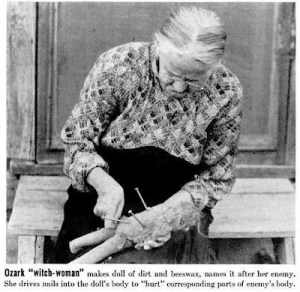
In one of our recent holiday episodes, we discussed the way that toys, dolls in particular, seem to embody the uncanny. Dolls, doll babies, dollies, poppets—whatever you call them, figural toys seem to have the power to evoke fear in people and act as powerful proxies for magical work. I decided to cover the topic in part because several podcasts I frequently download (namely LORE and Stuff You Missed in History) have recently mentioned Robert the Doll in Key West, Florida. Robert’s story is full of creepy twists and turns, but nicely captures how dolls can be both innocent (as Robert is when he acts as a best friend to his young owner, Gene) and terrifying (as Robert is when he shows up on a subsequent owner’s bed, brandishing a kitchen knife). Still, most tales of dolls and magic in the New World are not as spectacular as Robert’s. That doesn’t mean there aren’t some very interesting uses for dolls in American folk magic. There most definitely are, and in this article, we’ll look at some of the ones that I find most interesting.
Robert the Doll, in Key West, Florida. Creepy, right? By Cayobo from Key West, The Conch Republic (Robert The Doll Uploaded by LongLiveRock) [CC BY 2.0 (http://creativecommons.org/licenses/by/2.0)%5D, via Wikimedia CommonsWe can start in Salem, during the famous witchcraft trials of the early 1690s. A slave from Barbados named Candy was the focus of one early investigation (although her fate was not, as far as we know, the gallows). Candy confessed her use of folk magic, including the use of a handkerchief which she transformed into a doll:
“Candy stated that her knowledge of witchcraft came from her experience in Salem and not from her home in Barbados. The magical items possessed by Candy bear closer analysis and provide evidence for a possible connection to African or Afro- Caribbean beliefs. The knotted handkerchief was obviously a doll to stick with pins or to rend to inflict pain on others. The pieces of cloth were possibly shreds of clothing to be used to identify the dolls with a particular victim, as is common in the sympathetic magic which makes up part of voodoo belief” (McMillan 104-5)
Comments about “voodoo belief” aside (here I think McMillian is simply conflating “voodoo” with the folk magic of African Caribbeans), Candy’s use of the knotted handkerchief gets at some of the main reasons that doll magic seems to be popular and widespread. Firstly, it involves easily found or acquired resources—in this case cloth from the intended target, making the materials doubly enticing. Secondly, doll magic is sympathetic magic, and the connection is easy to see. If I make a piece of someone’s long johns look like a person, particularly the person whose backside the doll so recently covered, it seems likely that those two things will share a connection.
This point, that something that looks human but isn’t has uncanny powers, gets echoed in a lot of folklore as well, some of which connects to the folk magical systems of early Americans. Imported stories, such as tales about Anansi, refer to the use of dolls as agents of trickery. One account of Anansi tells how he tricked Tiger, and Tiger avenged himself on Anansi by putting a gumdoll in a field. Anansi gets angry when the doll won’t respond to him, and strikes it, becoming stuck to it. This tale is likely best known by American audiences as the tale of Brer Rabbit and the Tar Baby, of course, which replaces Anansi with the wily trickster rabbit and uses tar in place of tree gum. An Apache tale recasts the narrative as Coyote fighting with a lump of pitch, placed in a field by a “white man” to catch the sneaky food thief. The story keeps reappearing across different cultural backdrops, with new characters but the same basic structure. In all cases, the doll in question does nothing—that is one of the reasons Brer Rabbit and his compatriots dislike the thing—but still manages to get the best of its target.
Illustration of Brer Rabbit & the Tar Baby. A. B. Frost [Public domain], via Wikimedia CommonsDolls, much like the Tar Baby or gumdoll, don’t necessarily have to do anything to be effective in folk magic, either. Jason Miller recounts a story in his Protection & Reversal Magic in which a doll’s effect is clearly psychological, but nonetheless potent:
“A santera I know was having problems with her neighbor being loud and obnoxious at all hours of the night and leaving garbage on her lawn. She asked her madrina (her teacher) what she should do. The madrina told her to make a doll that looked like the neighbor, blindfold it, tie its arms and legs, and nail it to the tree in her yard facing her neighbor’s front door. My friend was a bit shocked and said, “Good Lord! I don’t want to hurt him! What will happen?”
“Nothing” replied her madrina, “but it will scare the living crap out of him!”” (Miller 30)
Miller’s account of the santera’s doll experience resembles other accounts in American folk history. Newbell Niles Puckett references a similar incident in his Folk Beliefs of the Southern Negro. In the cases Puckett describes, the dolls may or may not actually have a magical effect, or they might simply convey the sender’s sentiments about how they wish to see the recipeient suffer: “Very common also was the practice of putting small black caskets, often with skull and crossbones upon the cover, in front of a person’s door. Sometimes these would contain a small doll with pins run through the heart and with a burned-out candle at the head and another at the foot, doubtless a case of sympathetic magic, indicating a desire that the person be “laid out” according to the Catholic rites.” (Puckett 227-8).
Dolls that do nothing, however are not as much fun as dolls that do something. Fairy tales like “Vasalissa the Beautiful” from Russian lore offer dolls that seem to do little, but in fact act as powerful fetishes of protection to those that carry them. Vasilissa is protected by her mother’s doll, which carries a maternal blessing and performs tasks while the young girl and the old witch Baba Yaga are sleeping at night. Baba Yaga is always disappointed by Vasilissa’s completion of her tasks, which she knows must be done by magic but cannot figure out. Eventually the ancient cannibal witch decides not to eat the girl and instead sends her away with a magical gift when she learns that Vasilissa is protected by her mother’s blessing (although she never does puzzle out the secret of the doll).
Just as in fairy tales, dolls can have powerful magical agency, according to folklore. Several authors, including the aforementioned Jason Miller, suggest using dolls or poppets in spells, just as Candy was said to have done in Salem. Miller recommends a mirror box spell using a doll which will turn any harmful magic back on its sender or protect one from magical attack. Dorothy Morrison makes similar suggestions in her book on baneful magic, and even talks about using dollar store Barbie knockoffs stuffed with personal materials or herbs as a way of simplifying the doll-making process.
When it comes to making dolls, however, kids seem to have a knack for doing it with whatever’s at hand, which as I mentioned above, may be part of why dolls are both so ubiquitous and so powerful. Coming from materials which are already familiar to the doll-maker through use and contact, the relationship with the doll itself can be very deep once the figure has been created. Adults do sometimes craft dolls and other toys with what is around, but they are also likely to purchase materials:
“Folk toys are made of any convenient materials, including wood, clay, plants, paper, fabric, metal, sand, or snow. If made by children, they most often utilize recycled or “found” materials (as when rubberbands are saved to make a “Chinese jump rope”). Adults, especially those who make toys for sale, are more likely to purchase new materials as needed. Folk toys come in many varieties: Dolls are common (often made of natural materials such as nuts, apples, or corncobs dressed in scraps of fabric).” (Leeds-Hurwitz 1477)
The fabrication of toys and dolls, including ones used for ritual or magical purposes, is not limited to post-European contact in the New World, either. According to scholar Yvonne Milspaw, Native cultures would create paper-type dolls out of natural materials with magic in mind: ““Other reported uses of paper and bark cutting among Native Americans include carefully worded reports of sorcery and cut-paper dolls among some Mexican people like the Otomi” (MIlspaw 1134). Some of these traditions may have shaped latter-day practices like the creation of skeletal papier mache dolls for Day of the Dead/Dia de Muertos celebrations in Mexican and Mexican American culture.
So dolls can be made from lots of materials, and can be active or passive in the use of magic, as we’ve seen. They also frequently come with their own rules or taboos about how they can be used, deployed, or even simply treated. When it comes to folk magic, African American conjure traditions emphasized the choice of materials as a matter of import. Dolls are often crafted with local flora (and occasionally fauna) for a combination of practical and symbolic reasons. Spanish moss is frequently used to stuff or wrap doll babies in Delta-area conjure practices both because it grows ubiquitously on trees in the region and because as a plant it acts semi-parasitically (it doesn’t actually feed off of the oak trees it grows upon directly, but it can limit their growth), thereby sharing life with a host as a doll is supposed to. Even more potent than Spanish moss, however, are doll components that come directly from the intended target, such as pieces of their clothing, as illustrated by this example from African American folklore:
“My husband was very jealous of me, he was just insane jealous. He was always telling me he was going to put a spell on me. I was afraid of him. I went to a house where he didn’t want me to go, because a man was at that house he was jealous of. He was going away to get work…and told me not to go there. He went and took a piece of my bloomers and made a rag doll out of them, stuff it, worked black eyes like mine with silk thread; then put in the head — a needle, some of my hair, pins, rain water and a shingle nail, then sewed up the head. After that he took a small picture of me and put it on the left side of the rag doll, about where my heart is; then he filled the doll just full of pins and needles all over. He then put it in a pint jar and buried it under that house, where he didn’t want me to go — without anyone knowing it — and left town. I started to getting sick just as soon as he left, was sick all the time, could not find out what was wrong. I would start over to the house, but I could not make it. Something kept me from going. I went on this way for about a month, I was getting weaker and weaker, when one day some children playing around this house, digging, dug up this rag doll. They [the people at the house] knew right away it was to cast a spell over me, because they knew my picture was on the doll, and he was always saying he was going to make me suffer. We took the rag doll, jar and all, put it on the fire and burnt it all up; and I started to getting better right away and got well. And my husband got stab in about a month time; we threw the spell back on him by burning up everything, and he died and I am well.” (Hyatt 456)
A number of writers on conjure similarly describe the use of clothing from the intented target, including Yvonne Chireau, Starr Casas, Denise Alvarado, and Jefferey Anderson. While a doll sculpted from scratch certainly seems to be preferred in many magical practices, it is not the only way to operate. Much as Dorothy Morrison mentions using dollar-store plastic dolls to do work, Zora Neale Hurston records the repurposing of children’s toys for magical purposes in Southern African American hoodoo:
“To Keep a Person Down. Write name on paper with black ink. Rip open back of a doll and put the names in it. Sew it up with black thread. Put aloes, cayenne pepper in doll along with names. Tie the hands of the doll behind her and place her in a kneeling position in a corner, and keep her there where nobody will interrupt. They will be frustrated as long as she is not disturbed. Tie a black veil on her face and knot it in the back, so that the person will be blind and always do the things to keep himself from progressing” (Hurston 384).
In addition to the lore of creepy dolls and the lore about how to use dolls magically, there seem to be a few taboos about dolls which thread through different American cultural landscapes as well. For instance, many Amish communities have strict rules about children’s dolls, insisting that they cannot have faces on them for fear of violating the “graven images” commandment in the Bible (the rule also extends to things like snowmen and usually paintings as well). Hyatt notes that one superstition about dolls involves naming: “If a girl changes the name of her doll, the doll will break.” (Hyatt, p.268). He also records a much more sinister taboo about dolls which I cannot help but share here:
“A little girl died that was three years old, and her mother put a doll and a little horse in the coffin that she always played with. I said to the mother, ‘I would not do that, for there is an old saying, never bury anything with a corpse.’ And in a few weeks this little girl’s mother and sister died.” (Hyatt 374)
This last bit of folklore is fascinating to me simply because it seems to be a powerful impulse in human beings to bury toys with children when they are tragically lost. Many early human graves contain burial goods, and children’s burial goods often seem to be toys. Dolls, though, might have a special exemption from burial because of their close resemblance to a living person, although that does not seem to be a universal taboo.
Dolls today have a lot of the same stigmas attached to them: they are objects of fear and superstition as well as simple objects of play. Magically, they can be used for a number of purposes which resemble and also modify the traditional folk uses I’ve outlined here. One of our readers shared a story with us about a sloth doll she uses to overcome issues with chronic lethargy, letting the doll absorb any feelings of laziness from her (she also shared her very terrifying experiences with an American Girls doll, so that tradition is alive and well, too). The film Toy Story and its many sequels and similar movies all play upon the idea of toys having a “secret life,” which involves humans not being around, but being the prime object of the dolls’ attention. In theaters as of the date of this post, one can also see the film The Boy, about a very Robert the Doll-esque figure which seems to have a (sinister) life of its own.
All of which is to say, dolls are a big part of magical lore and practice, and don’t seem to be going anywhere soon. And they watch you while you sleep. So sweet dreams and all.










 New World Witchery - The Search for American Traditional Witchcraft