As I mentioned last week, we’ve embarked on a 2020 book club looking at two of the books that got Laine and I into witchcraft in the first place: Earth Power and Earth, Air, Fire, and Water by Scott Cunningham. If you haven’t checked that post, make sure to do so and see when we’re reading each segment. We have ongoing discussions and chats with our Patreon supporters who are reading the book through our Discord server, but we also want to open up the conversation more publicly, too. So each month we’ll be posting a brief rundown of some questions and ideas that came up either in the discussion between Laine and me on the show or through the Discord chat.
This month, we tackled: Earth Power – Preface, Introduction, and Part I (Ch. 1-4)
Some questions to ponder as you read or reflect:
Cunningham often refers to what he’s doing as “natural magic,” and Cory thought that he was just using a different phrase to describe folk magic, which makes up the majority of the book. What do you think? Are there distinctions or differences between folk magic and natural magic? Are those differences present in Cunningham’s introduction, or is he using that term interchangeably?
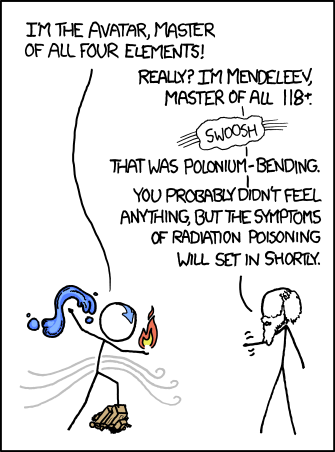
Cory and Laine both discussed the idea of different elemental systems beyond the four-parted (or sometimes five-parted if you are reading Aristotle) Greco-Roman system. For example, Chinese metaphysics recognize a different set of elements (Earth, Fire, Water, Wood, and Metal), and other systems get more into “hot/cold/wet/dry/moving/stable” divisions (one of our Patreon folks pointed out in their tradition they have twelve different elements, and there’s a funny XKCD comic about someone being a “Polonium bender” and thinking of elements by way of the periodic table). What exactly are the elements to you? Are they fundamental building blocks in a very material way, or simply symbolic and thus subject to change based on who’s using them and how? What elemental systems do you work with, if any?
Laine raised the point that a lot of what we see in the introduction has to be seen as a product of its time (not to excuse it, but just to give it context). One of the big points she brought up was the artificial way that elements sometimes get lumped with “masculine” or “feminine” descriptors. How do you deal with these sorts of outdated ideas when you encounter them in a book you like (especially an older one)? Do you simply dismiss the pieces that no longer work and move on, or do you process it another way? Are dichotomies (like gendered elements) even useful in an age where we understand better that gender is a spectrum rather than an either/or situation?
One great discussion that came up on our patron chat was the question of “What books were your starting point for witchcraft?” Laine and I both had several, and Cunningham’s were among our earliest, but does the book (or books) you begin with for witchcraft studies have a defining effect on how and what you study? Or is the other way around, and what you’re interested in will lead you to certain types of books (other, non-dichotomous options are welcome, too!). What was your first book of magic or witchcraft?
Finally, do we do too much idealizing of the past? Cunningham likes to paint rosy pictures at times of some sort of agrarian paradise in which nature and magic were all around the common folk (a bit like in the magic forest in Frozen II). Magic, however, always seems to be very adaptable to new situations and new eras. Some of it falls by the wayside when it’s not useful/appropriate (for example, there are some terribly racist folk charms involving stealing hair from an African American person but I don’t think anyone’s recommending those today….I hope). At the same time, while we can “yeet our woes unto the void” in a contemporary ritual, we also might still have uses for lucky horseshoes, even if we don’t ride horses regularly anymore). So what do you think? How much of the past informs your practice, and how ready are you to adapt your practice to contemporary needs?
(Mendeleev, Polonium-bending Master. Comic by XKCD)
We welcome (civil) discussions and deliberations on these points in the comments, and if you have a question raised by the episode or this post that you’d like to explore further, feel free to comment that as well!
My very weather-beaten copies of Earth Power and Earth, Air, Fire, & Water by Scott Cunningham, which will be our books for the 2020 NWW Book Club
Greetings and salutations!
If you read this blog, then it’s probably safe to assume you like to read in general (and even if you don’t, maybe books of magic are a different story). We’ve hinted a bit at something we’re trying out for 2020 in a few episodes, and with the release of our latest episode (Episode 157 – Evolving Witchery), we began what we’re calling the “New World Witchery Book Club” for 2020. The basic idea is that we’ll pick a book (or a small series of books–we know everyone already has piles of books by their bedside so we don’t want to overburden you) and then read it in sections each month. We’ll discuss the writing, the actual information, historical context, practical applications, folkloric roots, and just about anything we can come up with.
For this year, we’re going back to our own roots and looking at a pair of books that greatly influenced both Laine and I as we were starting out: Scott Cunningham’s Earth Powerand Earth, Air, Fire, & Water. These books are chock full of folk magic, albeit somewhat adapted through Cunningham’s eclectic Wiccan approach. We think we’re going to unpack some really good material here, especially as his focus on what he calls “natural magic” very much overlaps with the sorts of folk magic we find here in North America.
The basic breakdown for reading this book will be as follows:
Reading Plan for Earth Power and Earth, Air, Fire, & Water
January: Earth Power – Preface, Introduction, and Part I (Ch. 1-4)
February: Earth, Air, Fire, & Water – Preface and Part I (Ch. 1-5)
March: Earth Power – Ch. 5 (Earth Magic); Earth, Air, Fire, & Water – Ch. 6 (Earth Power)
April: Earth Power – Ch. 6 (Air Magic); Earth, Air, Fire, & Water – Ch. 7 (Air Power)
May: Earth Power – Ch. 7 (Fire Magic); Earth, Air, Fire, & Water – Ch. 8 (Fire Power)
June: Earth Power – Ch. 8 (Water Magic); Earth, Air, Fire, & Water – Ch. 9 (Water Power)
October: Earth Power – Ch. 16 (Rain, fog, & storm Magic), Ch. 17 (Sea Magic); Earth, Air, Fire, & Water – Ch. 17 (Wishing Well Magic), Ch. 18 (Sea Magic)
November: Earth, Air, Fire & Water – Ch. 15 (Ice Magic), Ch. 14 (Snow Magic)
December: Earth Power – Afterword; Earth, Air, Fire, & Water – Ch. 19 (Creating Your Own Rituals), Afterword
We will also try to put out little reading-related blog posts to offer ways to expand upon whatever we discuss and keep the conversation going each month.
These books were staples on our shelves growing up, but we also know that not everyone has a copy yet, so we’ve got some good news on that front, too! Firstly, Llewellyn Publications has agreed to offer our listeners and readers a 20% discount on any orders of Earth Power or Earth, Air, Fire, & Water you make between now and June 1st, 2020. All you have to do is go to www.llewellyn.com and pick up those books, then use the code “SCOTT20” at checkout for the discount (you must be logged into your Llewellyn account to use the code, but it’s an easy and free signup). They frequently have free shipping and other discounts going on, too, so check them out and stock up on some magic books!
The other way we want to make these available to you is, of course, a contest! We’ve got two copies of each of the two books we’ll be giving away (thanks Llewellyn!), with each winner receiving a copy of both Earth Power and Earth, Air, Fire, & Water. How do you enter?
Support us on Patreon! If you’re already a Patreon supporter, great news, you get an automatic entry in the contest! 🙂
Share this post on your social media (Twitter, Facebook, or Instagram especially) and tag us (or come back and leave a comment with a link where we can see your post)
Share a picture/post showing and/or describing what “natural magic” looks like or means to you on Twitteror Instagram. Tag us if you can, and make sure to use the hashtag #newworldwitchery when you post so we can find what you’ve shared easily.
That’s up to three entries per person! All contest entries must be completed by midnight Eastern Standard Time on January 31st, 2020. We’ll pick two lucky winners on February 1st and send them their copies of the Cunningham books (as well as maybe a bonus item or two).
So that is the basic idea, and even a chance to win some books. Not a bad way to go into the new year!
We hope you’ll join us as we work our way through these books, and share your own thoughts and interpretations of the material as well.
We look back at the past ten years to see how we’ve grown as a show and as practitioners of witchcraft. Then we launch our book club for 2020 with a look at Cunningham’s Earth Power.
Please check out our Patreon page! You can help support the show for as little as a dollar a month, and get some awesome rewards at the same time. Even if you can’t give, spread the word and let others know, and maybe we can make New World Witchery even better than it is now.
Laine brings up the excellent movie Arrivalas part of the discussion, so go check that out if you can!
We also launch our monthly podcast book club, which will focus on Scott Cunningham’s Earth Power and Earth, Air, Fire, & Waterfor 2020. Keep an eye out for our upcoming website post with the full reading plan. You can get 20% off those two books if you order from www.llewellyn.com and use the code SCOTT20 at checkout! Thanks Llewellyn!
Promotional image modified from image via Pixabay, public domain.
If you have feedback you’d like to share, email us or leave a comment. We’d love to hear from you!
Don’t forget to follow us at Twitter! And check out our Facebook page! For those who are interested, we also now have a page on Pinterest you might like, called “The Olde Broom.” You can follow us on Instagram or check out our new YouTube channel with back episodes of the podcast and new “Everyday Magic” videos, too (as well as most of our contest announcements)! Have something you want to say? Leave us a voice mail on our official NWW hotline: (442) 999-4824 (that’s 442-99-WITCH, if it helps).
Promos & Music
Title and closing music are “Woman Blues,” by Paul Avgerinos, and is licensed from Audio Socket.
Please think about checking out our Audible Trial program. Visit Audibletrial.com/newworldwitchery to get your free trial of Audible, where you can download over 180,000 titles (including some narrated by Cory). Your purchases help support this show, and there’s no obligation to continue after the free trial
I like the books to feel cozy and relaxed when I read them
Greetings all, and Happy New Year!
Lately I’ve been doing a good bit of cleaning and organization of my library and my altar spaces (all one in the same room) along with my annual New Year’s cleaning, and that has me in a reflective mood. I’m sure you’ve seen any number of “Best of 2019” lists or “Year/Decade in Review” sorts of posts, but I wanted to take a moment to look at what’s gone on in the past year or so for me in my study of witchcraft (as well as my broader witchy reading trends). I’ll also look a little bit forward to what’s coming this year for us at the end, so if you are sick of retrospectives, feel free to bounce to the last few paragraphs instead. Go on, I won’t mind, I promise!
If you are sticking around for the look back, I will say that many of the books I’ve read are not “new” in 2019, although some are. Some I also was lucky enough to read in advance of 2019, even though they came out this year officially (one of the perks of having lots of great, bookish occultists in my social circle is being asked to do advance readings sometimes). A few of these books I’ll want to review in more depth at some point, and several I’ve reviewed already (I’ll link to those reviews when I mention the books). So let’s pull some of those spines out and dog-ear some pages! (I know, I’m a monster).
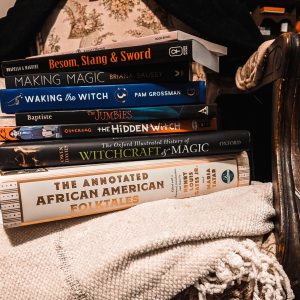
In the category of practical witchy books, there were a few that really stuck with me this year. I got the opportunity to do advance readings for bothBesom, Stang, & Sword, by Chris Orapello & Tara-Love Maguire, andSouthern Cunning, by Aaron Oberon. We did shows and interviews with those authors this year, and I’ve got a full review ofBesom as well (sorry, Aaron! I did mean to review your book, which is excellent, but just haven’t found the time–for those who haven’t read it, if you have any interest in Southern folk magic, it’s one to pick up posthaste!). Both of these books tackle personal systems of folk magic rooted in particular traditions, folklore, and practices. At the same time, the authors all write about these systems in ways that are flexible enough to offer insight into any practical system of witchery or magic a reader might be pursuing. I read several other books that do similar work this year, including Bri Saussy’s Making Magic, Lisa Marie Basile’s Light Magic for Dark Times, and Mallorie Vaudoise’s Honoring Your Ancestors. Saussy’s book takes the idea of magic as a daily practice and wraps that in an enchanted worldview, one informed by fairy tales, to transform personal and domestic spaces. The home becomes a locus of lived enchantment, with doorway altar spaces and connecting a magical kitchen with potential plant helpers and ingredients from the front and back yards. It’s very much written in a self-guided tutorial way, and governed by a retelling of “Goldilocks and the Three Bears” at its heart, which is a charming lens through which to view the work in the book. Basile’sLight Magic was something of a revelation when I read it, pulling from a type of contemporary feminist witchcraft rooted more in the inner world of the practitioner than the old dirt-and-bones magic I usually write about. Yet, I was very much impressed by the way Basile made rituals and spells action-driven rather than purely reflective exercises. Her “Make your own Underworld Spell” is one that will stick with me for a long time to come, I think. Finally, Vaudoise’sAncestorsmay well be one of the best books I’ve read on a lived spiritual practice. I was absolutely thrilled by the combination of research, narrative, and practical work found in her pages. Her framework of ancestral practice is not condescending, but serious and thoughtful. She isn’t afraid to ask the reader to get a little uncomfortable and she doesn’t coddle them, but she also refuses to browbeat anyone for not doing things exactly as she does. Ancestral work happens on the reader’s time (and on their ancestors’ time, presumably), rather than by running through a checklist or exercise worksheet.
In a more historical and research-heavy vein, I also did a good deal of reading as I researched my own book (more on that in a bit), but a few new (or new-to-me) sources are worth mentioning here. Firstly, I should start with the Oxford Illustrated History of Magic & Witchcraft, which is exactly what it purports to be. Edited by one of my scholarly favorites in the field of witchcraft writing, Owen Davies, the book covers (mostly European) witchcraft studies from Antiquity to the twentieth century (it goes just a little bit beyond those markers in both directions, too, but the bulk of the book covers about 2,500 years of history). The material is dense, but useful, and while I quibble with a few specific points here and there (which I will hopefully get into with a fuller review sometime soon), as a handy reference it’s quite good. The “illustrations” are photo reproductions of various engravings, artifacts, and other similar ephemera, and it isn’t particularly heavy on images, but again, there are some real nuggets of gold in there, too. I was also absolutely bowled over by the truly excellent Feathered Serpent, Dark Heart of Sky, by David Bowles (who we interviewed last year about borderlands lore). In this book, Bowles essentially weaves together the Mesoamerican mythology of the Olmecs, Aztecs, Mayans, and others to create a loosely unified story following two rival siblings as they pass from civilization to civilization in different forms. It reminds me a lot of Neil Gaiman’s Norse Mythologyretelling, and while it’s not exactly a direct transcription of the Popol Vuh or any of the other surviving codices, it does a marvelous job of enlivening these often-overlooked myths. I also felt that way about sections of The Annotated African American Folktales, edited by Henry Louis Gates, Jr. and Maria Tatar. This is a collection of several major groups of folklore found in African American sources (both oral and literary) with some excellent notes by African American historian Gates, Jr. and fairy tale scholar Tatar. The section on Boo Hags is absolutely marvelous, and much of the material on Zora Neale Hurston made my heart sing. My only complaint with this book is that I want more of it, and a wider variety of tales, but truly this is essential to African American folklore studies in so many ways.
I’ll also note that I read Sabine Baring-Gould’sCurious Myths of the Middle Ages this year–a very old book dating back to the late nineteenth century and containing a wide variety of myths about everything from dowsing detectives to wandering Jews and hidden crusaders and kings. It was a bit out of my wheelhouse in some ways, and Baring-Gould is delightfully opinionated (one might even say salty) about some of the sources and stories he shares. It’s a fun read, however, and will reveal to a discerning mind just how long certain stories have been in circulation.
Somewhere between the researched witch study and the personal memoir falls Pam Grossman’s Waking the Witch. I’m sure a lot of people know Grossman for her podcast The Witch Wave, and she’s done a lot of good bringing contemporary feminist witchcraft to the forefront along with writers and social media personalities like Kristen Sollee and Bri Luna. Waking is an exploration of the witch as an icon more than any sort of deep historical dive or spellbook, although I definitely liked the way Grossman pulled from historical sources and connected them to literature and popular culture (and folklore at times). I’ll be doing more of a full review of this one at some point, but I can definitely say this book will have some impact and likely be cited and referenced a lot in future conversations on witchcraft.
Bridging to the world of fiction, I had the joy of reading several great pieces this year with an abundance of witchy ambiance. I already mentioned The Hidden Witch, by Molly Ostertag, when I wrote about graphic novels and witchcraft a few months ago, but if you want a brilliant illustrated story to connect folk magic, witchcraft, inclusion, diversity, and empathy (as well as something you can share with kids in your life), I’d highly recommend it. One of the best books I’ve read this year (and I know I’m late to the game here) is Children of Blood & Bone, by Tomi Adeyemi. It’s a fantasy novel, primarily geared at young adults but really for anyone, and it focuses on the quest of a magically gifted young woman named Zelie as she tries to restore magic to the land of Orisha. It’s heavily influenced by African religious, spiritual, and magical traditions, and both the telling and the world are completely engrossing (spells in Yoruban feel incredibly natural the way Adeyemi writes them). The sequel just came out, so I’m excited to continue in this series this year. I also cannot recommend The Jumbies by Tracey Baptiste highly enough. Another work aimed at a younger audience but really ready for anyone to read, Baptiste’s book uses the Haitian tale of “The Magic Orange Tree” as its source, but manages to expand upon that story and make a marvelous story of a girl named Corrine who must defend her island from the local spirit beings known as “jumbies.” In the process, she learns a great deal about just how complicated spirit relationships (and human ones) can be. It’s rife with Caribbean folklore and a thrilling, sometimes even scary, read.
I also wandered into the pages of history with my fictional reading this year, too, and finally dug into Shirley Jackson’sWe Have Always Lived in the Castle. Jackson is probably best-known for writing “The Lottery,” about a small New England town with a hellish secret, but Castle is astounding. I don’t want to open up too much of the story here, because it is so twisted and subtle and strange, but I will say that if you are a fan of folk magic, this book is stuffed with it. The rituals and spells used by the narrator are hauntingly real. This book may well be one of my absolute favorites now.
Weirdo builds book fort. Film at 11.
So that’s the year that was, but what about the year yet to be? Well, we’ve got a lot of good things in store. Most of you probably know that I’ve been writing a book, which is due out from Llewellyn sometime later this year (probably sometime in Fall). I posted a photo of me with my enormous stack of research books on social media (see above), so you can probably guess this one is jam-packed with footnotes, and will be looking at North American folk magic from a folkloric, historical, and practical perspective. If you like the blog and the show, you’ll probably enjoy the book. With that coming, it’s likely I will also be showing up on a few other podcasts as the year wears on, so I’ll try to keep everyone up to date as that happens. We’ve also got a few authors on the docket for interviews in the coming months, ones with newly released books or books that will be released in the near future (and some of them are VERY exciting). I’ve also got a stack of books on my shelf that I plan to plow through in the next couple of months, and at that point I may start seeing if any of the authors are interested in coming on to talk about their work (I’ll put a little hopeful energy and a hint of who I might be asking in a photo of my “to read” stack below).
Finally, Laine and I have decided to add a fun segment to our show this year (it’s our ten-year anniversary of podcasting, so we’ve got a few fun things planned, so stay tuned for more in the coming months). We will be discussing Scott Cunningham’s books of folk magic–Earth Power andEarth, Air, Fire, & Water–and reading through different sections of those books each month. We’ll post up a reading plan in the next week or two so you can join us if you like (and we’ll have a chance to win a copy of both books, plus a discount for ordering them, so definitely keep an eye out for that post). We chose Cunningham because he in many ways represents where Laine and I started, and we each grew in distinctly different but complementary ways from his roots, so looking more closely at his work feels like both a homecoming and a new frontier for us. You’ll hear all about that in our next podcast episode.
That’s a lot of words about things that are already full of words, so I’ll pause for now. We hope you’ve had some great witchy reads over the past year, and if you have any recommendations (or have read some of the ones I mention here), please leave us a comment below and let us know!
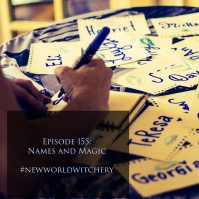
We’re discussing the power of names, both magical and mundane (and if there’s really a difference). We discuss the names we keep, the names thrust upon us, the names we lose, and the power of knowing a “true” name.
Please check out our Patreon page! You can help support the show for as little as a dollar a month, and get some awesome rewards at the same time. Even if you can’t give, spread the word and let others know, and maybe we can make New World Witchery even better than it is now.
Promotional image modified from image via Pixabay, public domain.
If you have feedback you’d like to share, email us or leave a comment. We’d love to hear from you!
Don’t forget to follow us at Twitter! And check out our Facebook page! For those who are interested, we also now have a page on Pinterest you might like, called “The Olde Broom.” You can follow us on Instagram or check out our new YouTube channel with back episodes of the podcast and new “Everyday Magic” videos, too (as well as most of our contest announcements)! Have something you want to say? Leave us a voice mail on our official NWW hotline: (442) 999-4824 (that’s 442-99-WITCH, if it helps).
Promos & Music
Title and closing music is “Homebound,” by Bluesboy Jag, and is used under license from Magnatune.
Please think about checking out our Audible Trial program. Visit Audibletrial.com/newworldwitchery to get your free trial of Audible, where you can download over 180,000 titles (including some narrated by Cory). Your purchases help support this show, and there’s no obligation to continue after the free trial
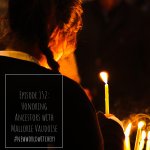
We discuss the power of connecting with ancestors (and just what we mean with that term), as well as finding spirituality while locked in a bathroom, with author, folk magician, and dancer Mallorie Vaudoise.
Please check out our Patreon page! You can help support the show for as little as a dollar a month, and get some awesome rewards at the same time. Even if you can’t give, spread the word and let others know, and maybe we can make New World Witchery even better than it is now.
Promotional image modified from image via Pixabay, public domain.
If you have feedback you’d like to share, email us or leave a comment. We’d love to hear from you!
Don’t forget to follow us at Twitter! And check out our Facebook page! For those who are interested, we also now have a page on Pinterest you might like, called “The Olde Broom.” You can follow us on Instagram or check out our new YouTube channel with back episodes of the podcast and new “Everyday Magic” videos, too (as well as most of our contest announcements)! Have something you want to say? Leave us a voice mail on our official NWW hotline: (442) 999-4824 (that’s 442-99-WITCH, if it helps).
Promos & Music
Title and closing music is “Homebound,” by Bluesboy Jag, and is used under license from Magnatune. Incidental Music is “A River Begins” and “Into Sea” by Kourosh Dini (Magnatune).
Please think about checking out our Audible Trial program. Visit Audibletrial.com/newworldwitchery to get your free trial of Audible, where you can download over 180,000 titles (including some narrated by Cory). Your purchases help support this show, and there’s no obligation to continue after the free trial
We talk about decks, divination, Taoist folk magic, and talismans with author and teacher Benebell Wen.
Please check out our Patreon page! You can help support the show for as little as a dollar a month, and get some awesome rewards at the same time. Even if you can’t give, spread the word and let others know, and maybe we can make New World Witchery even better than it is now.
I read a few passages from the Tao Teh Ching, by Lao Tzu (Trans. by John C. H. Wu) and the I Ching, Trans. by Kerson and Rosemary Huang.
Promotional image modified from image created by Benebell Wen.
If you have feedback you’d like to share, email us or leave a comment. We’d love to hear from you!
Don’t forget to follow us at Twitter! And check out our Facebook page! For those who are interested, we also now have a page on Pinterest you might like, called “The Olde Broom.” You can follow us on Instagram or check out our new YouTube channel with back episodes of the podcast and new “Everyday Magic” videos, too (as well as most of our contest announcements)! Have something you want to say? Leave us a voice mail on our official NWW hotline: (442) 999-4824 (that’s 442-99-WITCH, if it helps).
Promos & Music
Title and closing music is “Homebound,” by Bluesboy Jag, and is used under license from Magnatune. Incidental Music is “Cave,” by Anthony Salvo (Magnatune) and “Ambient Gourd,” by Canton Becker (CC Soundcloud License).
Please think about checking out our Audible Trial program. Visit Audibletrial.com/newworldwitchery to get your free trial of Audible, where you can download over 180,000 titles (including some narrated by Cory). Your purchases help support this show, and there’s no obligation to continue after the free trial
In this episode we talk mermaids and manatees, sexy seashells, and far too many Disney movies. Join us down at the shore as we discuss the magic of (and around) the ocean!
Please check out our Patreon page! You can help support the show for as little as a dollar a month, and get some awesome rewards at the same time. Even if you can’t give, spread the word and let others know, and maybe we can make New World Witchery even better than it is now.
We also have an older blogpost about Seaside Sorcery you might be interested in.
We also mention a great film called Song of the Sea all about Selkies, and Cory mentions that he did the Audible narration for a pair of mermaid/sea dog novels called Tide and Anchored, by Deirdre Riordan Hall. If you’d like to know more about mermaids and other mythic sea folk, you can check out some of the lore on the Library of Congress Folklife Today blog. We also have a video on the connections between Hans Christian Andersen’s “The Little Mermaid” and folklore over at our YouTube channel.
If you have feedback you’d like to share, email us or leave a comment. We’d love to hear from you!
Don’t forget to follow us at Twitter! And check out our Facebook page! For those who are interested, we also now have a page on Pinterest you might like, called “The Olde Broom.” You can follow us on Instagram or check out our new YouTube channel with back episodes of the podcast and new “Everyday Magic” videos, too (as well as most of our contest announcements)! Have something you want to say? Leave us a voice mail on our official NWW hotline: (442) 999-4824 (that’s 442-99-WITCH, if it helps).
Promos & Music
Title and closing music is “Homebound,” by Bluesboy Jag, and is used under license from Magnatune.
Please think about checking out our Audible Trial program. Visit Audibletrial.com/newworldwitchery to get your free trial of Audible, where you can download over 180,000 titles (including some narrated by Cory). Your purchases help support this show, and there’s no obligation to continue after the free trial
We sit down and visit with old friends Chris Orapello and Tara-Love Maguire about the evolution of their Black Tree tradition of magic, the ways folk magic and witchcraft fit into a contemporary world, how natural magic and climate change impact one another, and what being in the witchy publishing world is like.
Please check out our Patreon page! You can help support the show for as little as a dollar a month, and get some awesome rewards at the same time. Even if you can’t give, spread the word and let others know, and maybe we can make New World Witchery even better than it is now.
Their book, Besom, Stang, & Sword, is available from Weiser Books and just about everywhere else. We did a review of it on our site, too.
If you have feedback you’d like to share, email us or leave a comment. We’d love to hear from you!
Don’t forget to follow us at Twitter! And check out our Facebook page! For those who are interested, we also now have a page on Pinterest you might like, called “The Olde Broom.” You can follow us on Instagram or check out our new YouTube channel with back episodes of the podcast and new “Everyday Magic” videos, too (as well as most of our contest announcements)! Have something you want to say? Leave us a voice mail on our official NWW hotline: (442) 999-4824 (that’s 442-99-WITCH, if it helps).
Promos & Music
Title and closing music is “Homebound,” by Bluesboy Jag, and is used under license from Magnatune. Incidental music is “Solitude,” by Julian Blackmore, also licensed through Magnatune. We also feature the song “Ask Me Anything,” by S.J. Tucker (used with artist permission)
Please think about checking out our Audible Trial program. Visit Audibletrial.com/newworldwitchery to get your free trial of Audible, where you can download over 180,000 titles (including some narrated by Cory). Your purchases help support this show, and there’s no obligation to continue after the free trial
In a recent discussion on our Patreon Discord channel, we had a really smart question from listener Fergus. He was noting that both Laine and I often mention bits of folk magic we remember from our families and wondered what we did to gather that lore. Broadly speaking, I think both Laine and I have been incredibly lucky in that as we discuss different magical practices and folklore, we are reminded of things from our childhood and upbringing that relate to magical topics at hand.
However, it’s not always an easy process to get at magical folklore from your family or your community. With it being Pride Month, we are often reminded intensely that many people are cut off from their families and from their friends and neighbors by prejudice and bigotry. That means that opening the doors to magical discovery can feel a bit like an impossible quest.
For others, they may have strong family bonds, but figuring out how to ask about magic specifically is hard because any use of that word (or “spells” or “witchcraft” or similar terms) will instantly get shut down due to deeply-held religious convictions or other social stigmas. (Also, please note that while I’m using the term “family,” the term “community” is just as relevant–your local social environment can provide a LOT of lore, as can any chosen family to which you belong).
So what’s a person to do when they want to learn more about their own magical history (which is important, because we often see huge problems arise when people try to nab someone else’s magical history or invent a magical history out of whole cloth)?
(image via Pixabay)
Thankfully, as I’ve been working on my upcoming book for Llewellyn, I’ve also been thinking about that question, and for one of my chapters I came up with some exercises that I think would be extremely valuable to anyone trying to recover community or family lore. The big trick? Don’t focus on the magic and make sure you listen. Here are some practical exercises you might be able to try:
1. Ask for stories. Don’t focus on magical stories, mind you, but instead stories from a person’s life. In particular, you might try spending time with elders from your family or your community, and seeing what stories they have to tell. Get them to tell you about what life was like when they were growing up. Ask about their time at school, and what they remember about friends and neighbors growing up. Get them talking and truly listen to what they have to say. Write it down if you can (record it if they’ll let you, and donate that to a local archive! There’s a magnificent resource for doing this sort of ethnographic interviewing available from the Library of Congress called Folklife & Fieldwork: An Introduction to Cultural Documentation, by Steve Winick and Peter Bartis at the American Folklife Center. The full text of it is available as a PDF here, and they often will mail you a print copy for no more than the cost of postage). Remember that these interviews are about building a relationship. Make it a habit to ask questions and take an interest in them and their life. Even if they say things you don’t always agree with, try to be generous in your listening and pay attention to what emerges from these conversations. Over time, you’re going to find that there are stories that involve “a way of doing things” that doesn’t follow any rational structure, which is frequently an indicator of magical thinking and practice.
When I was growing up, one of the places I often visited with my Dad as part of his church choir duties was a local nursing home, and I found lots of people there who wanted to share their stories. I learned patient listening and got some good tales (and jokes) out of that, as well as making a few good friends, too.
2. Tell your own story. Get someone to interview you. Don’t think about the magical side of it or even focus on that part. Just let them ask questions about your life and the world you grew up in, and see what you say. Get them to record you, and listen back to your words later (I know, no one likes hearing themselves played back, so pretend it’s someone else if you must). Use the same prompts as in suggestion one above and see just where your stories lead. You’ll likely surprise yourself with how many little bits of magic, superstition, and folk belief you uncover with this process. I once did an interview with someone for my Krampuslauf research involving their role as a musical participant. They later told me that my interview opened up a whole cache of experiences, memories, and family connections that they hadn’t been thinking about, and it was a powerful emotional experience. That research involved a parade, but uncovered a good bit of magical and ritual material as well, some of which emerged during interviews without me ever raising those topics.
3. Focus on specific folklore-rich topics. You’ll often find as you do interviews and discuss lore that there are key subjects that generate more magical lore than others (even if, or especially if you don’t actually mention anything about magic). Some of the best topics to ask about include:
These subjects frequently involve subtle forms of folk magic, or point you in the direction of magical lore.
(image via Pixabay)
4. Pay attention to how people in your community respond to issues of stress. While major life events are great fonts of lore for general customs and beliefs, the way people deal with problems often involves a weaving together of rational and non-rational responses. Injuries, even something as small as a scrape on the sidewalk, often makes magic suddenly pop out in the form of a kiss or a gentle blow on the wound after the bandage is applied. How does the community or family around you respond when someone loses a job or faces a sudden loss? Are they turning to prayer? Are those around them doing so? Are they adding them to prayer lists, or giving them foods or objects of comfort? Do people trying to get a job have a lucky token they take with them to interviews? This is not an admonition to suddenly put on your social scientist glasses when you see someone suffering–far from it! Offering succor in times of strain is valuable, so if you can do so I encourage it, but also keep your eyes and mind open to what you can learn about the cosmology and enchantment in the world around you in those moments.
5. Finally, visit your local library! Do some research! Go to the archives! Libraries, and by extension local historical archives, often have absolutely scads of records, documents, diaries, and books of lore tied into the community around you. Remember, your magical practices are not solely about kinship, but community, and your teachers and magical heritage come from the places and people surrounding you. Dig into local lore and legends, and see what they tell you about the landscape you see every day. Are there places reputed to be haunted or cursed? Spots where wonders have been observed, or local legends of people who might have had magical powers? I happen to live in Pennsylvania at the moment, and this state loves its history and archives, which in turn allows for a lot of lore recovery. The lovely Urglaawe community–a regionally-based Pennsylvania German Heathen group–has been able to rebuild an immense amount of its lore and practices through research and interviews. Check into the folklore collections housed at your library, and look for local lore in particular. Does the library have genealogical records you can look into to find more information? Can you visit the places you read about, or even leave some flowers on the grave of an accused witch?
This is hardly a complete list of what you could do, but if you’ve been struggling with the ways you might get in tune with your own ancestral magic, consider giving these methods a try. I’ve been doing interviews for years now and my favorite thing about them is how often I find people want to keep talking long after the mic is turned off–we are a creature of narrative, and we love sharing stories. Remember that in no case should you approach this sort of research as an opportunity to exploit the people you talk to or study, but instead use these interviews and deep-diving inquiries to develop relationships and understand how you fit into your own magical (and cultural) landscape. You may be surprised just how rich it is.