
-
Earth, Air, Fire, & Water, by Scott Cunningham
New World Witchery – The Search for American Traditional Witchcraft
A show about magic and witchcraft in North America


Summary:
This time we’re looking at a few more of the everyday objects our listeners have sent in and seeing what sorts of magic we can make of them. We talk astrology and wristwatches, trunk-or-treat altar spaces, and aromatherapy necklaces as magical door chimes. We hope you enjoy and share your own everyday objects with us!
Please check out our Patreon page! You can help support the show for as little as a dollar a month, and get some awesome rewards at the same time. Even if you can’t give, spread the word and let others know, and maybe we can make New World Witchery even better than it is now.
Producers for this show: Heather, WisdomQueen, Regina, Jen Rue of Rue & Hyssop, Little Wren, Khristopher, Tanner, Fergus from Queer as Folk Magic, Achija of Spellbound Bookbinding, Johnathan at the ModernSouthernPolytheist, Catherine, Patrick, Carole, Payton, Staci, Debra, Montine, Cynara at The Auburn Skye, WickedScense, Moma Sarah at ConjuredCardea, Jody, Josette, Clarissa, Leslie, Hazel, Amy, Victoria, Sherry, Tarsha, Jennifer, Clever Kim’s Curios, Donald, Bo, Jenni Love of Broom Book & Candle, & AthenaBeth. (if we missed you this episode, we’ll make sure you’re in the next one!). Big thanks to everyone supporting us!
Play:
Download: Episode 147 – Everyday Magical Objects Redux
Play:
–Sources–
This is the third of our Everyday Magical Object episodes, so you might enjoy checking out our first two:
Thanks to listeners Marquita, Emily, Sarah, Jillian, and Chris for your suggestions of magical objects to discuss!
We also mention the episode with Lisa Marie Basile and her Underworld Spell, as well as our post on coins (see the YouTube video we did on them as well). Cory also talks about cars, which were part of his article for the upcoming Oxford Handbook of American Folklore and Folklife Studies.
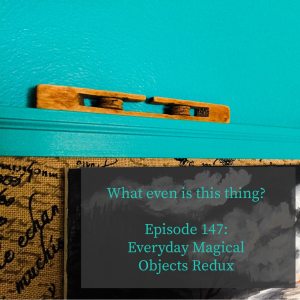
Here’s a pic of that “pulley wheel” we discuss:

We also mention J.K. Rowling’s story “The Warlock’s Hairy Heart” in Tales of Beedle the Bard. And Gravity Falls (seriously it’s worth watching if you like animation).
If you have feedback you’d like to share, email us or leave a comment. We’d love to hear from you!
Don’t forget to follow us at Twitter! And check out our Facebook page! For those who are interested, we also now have a page on Pinterest you might like, called “The Olde Broom.” You can follow us on Instagram or check out our new YouTube channel with back episodes of the podcast and new “Everyday Magic” videos, too (as well as most of our contest announcements)! Have something you want to say? Leave us a voice mail on our official NWW hotline: (442) 999-4824 (that’s 442-99-WITCH, if it helps).
Promos & Music
Title and closing music is “Homebound,” by Bluesboy Jag, and is used under license from Magnatune.
If you like us AND you like Buffy the Vampire Slayer, you will love our new show: Myth Taken: A Buffy the Vampire Slayer Podcast, now available through all the podcatchers!
Please think about checking out our Audible Trial program. Visit Audibletrial.com/newworldwitchery to get your free trial of Audible, where you can download over 180,000 titles (including some narrated by Cory). Your purchases help support this show, and there’s no obligation to continue after the free trial

The holly and the ivy,When they are both full grown,Of all the trees that are in the wood,The holly bears the crown.
–From “The Holly and the Ivy,” a traditional carol
Summary:
We launch our eighth year of podcasting with an episode that looks forward to the coming months through divination. Lots and lots of divination! Laine and Cory try out several different divinatory methods (some they’ve used before, and some they haven’t), then break down what they see in the cards, beans, bones, or stones for the year ahead. Plus we do our Magical Object, which seems like child’s play but also has plenty of magical uses, too!.
Please check out our Patreon page! You can help support the show for as little as a dollar a month, and get some awesome rewards at the same time. Even if you can’t give, spread the word and let others know, and maybe we can make New World Witchery even better than it is now.
Producers for this show: Heather, Achija of Spellbound Bookbinding, Raven Dark Moon, WisdomQueen, Regina, Jen Rue of Rue & Hyssop, Little Wren, Khristopher, Tanner, Johnathan at the ModernSouthernPolytheist, Catherine, Montine, Cynara at The Auburn Skye, Sarah at ConjuredCardea,The Trinket Witch, Victoria, Sherry, & AthenaBeth. (if we missed you this episode, we’ll make sure you’re in the next one!). Big thanks to everyone supporting us!
Play:
Download: Episode 122 – Divining the New Year
Play:
-Sources-
Both of us use Cory’s method of cartomancy for one of our readings. You can find out more about that in his book, 54 Devils, or by reading these posts from our past:
Laine also uses the following methods/tools:
Cory also uses the following methods/tools:


Thank you to listener Maria, who suggested the Everyday Magical Object of marbles for this episode. Please feel free to send in your own suggestions for future objects!
If you have feedback you’d like to share, email us or leave a comment. We’d love to hear from you!
Don’t forget to follow us at Twitter! And check out our Facebook page! For those who are interested, we also now have a page on Pinterest you might like, called “The Olde Broom.” Have something you want to say? Leave us a voice mail on our official NWW hotline: (442) 999-4824 (that’s 442-99-WITCH, if it helps).
Promos & Music
Title and closing music is “Homebound,” by Bluesboy Jag, and is used under license from Magnatune.
Incidental Music is “Laid Ten Dollars Down,” by the Black Twig Pickers, and is used under a Creative Commons License from the Free Music Archive.

Special Episode – The Dumb Supper
Summary:
This is our first 2017 #AllHallowsRead tale, “The Dumb Supper.” A girl and her friends try out a marriage divination ritual, and find out that things don’t always go according to plan.

Play:
Download: Special Episode – The Dumb Supper
-Sources-
This story is loosely based on a version of the tale found in Vance Randolph’s Ozark Magic & Folklore, as well as a number of other versions.
Promos & Music
Intro music is “Grifos Muertos” by Jeffery Luck Lucas, from his album What We Whisper, used under license from Magnatune.com
Incidental music by Olssons (“Ambient One”); DR (“Sedativa I & II”); Byzons (“Apatheia (Or, The Story of a Girl Trapped in a World of Madness)),” all of which are used through Creative Commons license on SoundCloud.
Sound effects are sourced from Creative Commons licensed recordings at Sound Bible.

I’ve always liked the word “witch.” It carries with it a lot of connotations, sure, but so few words can evoke strong reactions across the spectrum, ranging from fear to excitement to anger to joy. Witches in folklore occupy a strange space; in many stories, they seem to be dangerous and do harm (e.g. “Hansel and Gretel” or “The Witch in the Stone Boat”), but then in so many other tales they are helpers, or benign catalysts for action (as in “Frau Holle” or “Finist the Bright Falcon”). We have tackled the question of “What is a Witch?” from a lot of angles here already: answering the question generally and rhetorically, looking at aspects of a witch’s practice, seeing what it takes to become a witch, and so on. But this weekend brings my birthday, so I’m going to turn that lens inward a bit, and ask the question, “Am I a Witch?” That may seem like a bit of a ridiculous question, coming from someone who talks about using folk magic on a regular basis, but it’s a question worth asking. There are many people from various backgrounds who would likely say I’m not, based on their personal definitions of witchcraft, whether they believe it to be a religion or a practice, or both, or neither. So how do I see it? If you read the articles here, you probably want to know if my own definition of witchcraft jives with yours, right? Today, I thought it might be good to clarify just who I am and what I do that might make someone think of me as a witch of one kind or another. In an upcoming post, I will use this as a bit of a launching pad to take a look at a few ways the figure of the witch appears in North American history and folklore, and see if I can find anything that I can use to create a broad sketch of what a “New World Witchcraft” practice might look like. This is, and must be, my own interpretation, so of course your interpretation may be quite different. But my hope is that by going through this question with some thought, maybe it will open up some doorways (or hedgerows) along the way for myself and others. If you’re interested in traveling this particular crooked road with me, read on.

Firstly, let me talk a little about the things I do. My basic spiritual practice (and please note I’m setting this apart with fancy italics) involves a few basic rituals: weekly lighting of candles to a mix of saints, ancestors, deities, spirits, and other entities, along with offerings of incense and water and sometimes food and drink. I offer evening prayers directed at a pantheon of spiritual forces, mostly in gratitude and asking for safe passage through the night for myself and my family. Monthly, I light candles representing the new and full moons. When the dark candle is lit, I do divinations with my cards—although I should note this is not the only time I do that, and here we have a practice which may be only quasi-spiritual overlapping with the spiritual ritual of lunar reverence. It’s complicated, right? On the full moon, I offer libations and light other candles, and say prayers to specific spiritual forces I feel are connected with the moon. And that’s the big stuff. Despite recent discussions of sabbats and the Wheel of the Year, I tend to get into holidays in a more community-oriented way, attending parades or local celebrations and not really focusing on the spiritual observance of the days (although that does sometimes happen, especially during the winter months).

My magical practice (again, fancy tilty-letters here) involves the aforementioned card divination, which I do more frequently in ways dissociated from a particular spiritual observance, but which does involve me calling upon some spiritual aid. I also frequently cast spells for various wants, needs, and wills. Most are incredibly simple spells, such as the creation of a petition paper and the lighting of a candle, perhaps with some anointing oil and the recitation of a psalm or charm. I might create a mojo bag to carry around and draw in a specific need or want (most often, these bags are in the “success” area, although I also do some protection bags and others as well). Periodically, I will brew up batches of condition oils to have on hand for dressing candles and bags, but if I run out of those for some reason I don’t worry, because I can usually substitute something from the kitchen in a pinch—coffee, whiskey, olive oil, etc. If someone gets a sharp bang on their shin or a cut on their finger, I’m usually right there with my little Pow-wow-style charms to ease the pain, along with an ice pack, kiss, or chocolate-chip cookie as appropriate. A few times a year I do house-cleansing and protection work, adding written charms to door lintels and washing down my front door with—well, traditional protective formulae.
Is any of this witchcraft, though? When we look at stories of witches in North America—whether derived from European, African/African American, Native, or other sources—we see witches doing some of these things in one way or another, perhaps. Fortune-telling by cards and other means seems to appear nearly universally. Zora Neale Hurston recorded tales of African American conjure women and men rifling playing cards and seeing the future. Some of the accounts of Salem’s tumultuous sorceries involved tales of divination by “Venus glass,” or through the use of a special cake baked from urine and fed to a dog, or even some evidence that accused persons like Dorcas Hoar owned divination manuals and had practiced fortune-telling for years before the trial outbreak. Other tools, like the dowsing rod or the use of geomantic shells or coins, appear in other areas, and every cultural group in American history has had some means of divination or augury. Even in contemporary times, the Ouija board has become a popular trope of adolescent divinatory rites, and remains a popular “game” among American youth.

Witches also made use of prayers and psalms, sometimes in holy and sometimes in profane ways. Tales of Appalachian witch initiation rites discuss the use of prayers which reverse one’s baptism. In many European-derived traditions, the recitation in reverse of whatever charm had been used to blight someone would remove that curse. In tales where witches work with spirits, they may make contact with faery-creatures (see Emma Wilby’s Cunning Folk & Familiar Spirits for a truly excellent rundown of that subject), or they may keep wee bug in a bottle to talk to (as in one Appalachian story). While we get a sense of their spiritual worldview—which is heavily populated and constantly interacting with the mundane world—we seldom get a sense that witches are denominational. They might act in non-Christian or even anti-Christian ways, up to and including signing pacts with the Devil, but just as often they make use of Christian prayers and charms, and may even be very religions—if a bit unorthodox. Having a rich spiritual life certainly seems to be found in most tales of folkloric witches, but there’s very little definition around that spiritual worldview. Instead, witchcraft seems to be—from the perspective of history and folklore—less about gods and goddesses and much more about muttering under one’s breath in a time of need, or knowing not to burn sassafras wood. It’s a practice and a way of acting which is shaped by spiritual understanding, but not completely defined by it. There’s much more to say on what witches do, based on folklore (and I should also note that I am increasingly aware of the fact folklore is not something from “back then,” but something alive and moving now, so perhaps we should spend some time on contemporary witchcraft from that angle, too). I will leave all of that for another day, however, and return to the question at hand.

Am I a witch? I suppose it depends on who is asking. I have a fairly unorthodox spiritual practice and worldview, especially for someone living after the Modern era of rationalism and scientific inquiry. I think that my spiritual life, however, does not inherently make me a witch. It makes me an animist, perhaps, or put in contemporary economic terms, someone with a diversified spiritual portfolio. That can be a good basis for witchcraft, but it can also be a good basis for a number of practices completely outside of witchcraft. Many Christians, Hindus, and even Buddhists see such a diversity in the spiritual landscape (although they may assign different values to non-deity spirits and might even avoid all but a very few of them). What I do, on the other hand…that is witchcraft. I am a witch in divination, in charming, in meeting my needs through my own actions, and in doing so by working outside of rational methods (and please note I did not say in spite of such methods or even without also using such methods—a proper My Little Pony bandage can be just as important as a magical healing charm and a kiss to a scraped knee). I am a witch in knowing some of the ways that the world around us is constantly in conversation—whether through the growth of certain plants or the movements of certain animals or the scent and taste of the air before a storm. I am a witch in holding in me a certainty that I can do something about my circumstances, and that I am responsible for my own fate—both finding it and bending it.
Yes. I am a witch.
I hope to go a bit further and expand upon some previous discussions of what a witchcraft practice in the New World might look like. I will be turning to folklore, history, and contemporary behaviors and actions to help define that, and in the end, I will probably satisfy no one, but perhaps get into a few good conversations with the points I raise. For now, though, I hope that this article—a little bit of me put out there for you to consider—will clarify my practices a bit. I am not a perfect witch, mind you, possibly not even a very good one. Nor are my practices solely definitive of all witches everywhere. But if this article speaks to you in some way, I’d love to know. I’d love to hear if you are a witch, too.
Thanks for reading,
-Cory

“My ears are burning; who’s talking about me?”
“If your nose is itching, someone wants to kiss you.”
“Your feet itch? You must be about to go somewhere.”
I remember my mother often sharing the little bits of proverbial wisdom throughout my childhood.
Usually they were delivered with a wink or a wry smile, and I don’t think she took them particularly seriously, but then she also wouldn’t have been surprised to find out that any one of these tokens had borne some fruit in the real world. If you think about it, assumptions about the intimate connection between a person’s body and the world around him or her are not anything new or unusual. Plenty of people have an uncle whose bunions predict snowstorms, or a grandmother whose arthritis tells of coming rain, or headaches that detect heatwaves moving in. There are plenty of other ways one’s body might help one prepare for a day outdoors, according to American lore:
Beyond those sorts of weather-related phenomena, however, bodies are reputed to be in touch with all sorts of esoteric information. Of course, obtaining pieces of a person’s body is a primary way of gaining magical control over him or her, but that, I fear, goes beyond the scope of this article. Instead, this brief examination will focus on the body as a giver or receiver of information, rather than a source of spell ingredients. For example, often the physical features of a person imply certain characteristics about their intellect or psychology, according to American lore:
What do all of these sorts of lore have in common, then? They all seem to operate off of the ever-present Doctrine of Signatures, which we’ve seen before, and which fundamentally states that like affects like. By that logic, we can see how things like “broad face” and “big head” can be indicators of abundance with regard to particular character traits (I can only assume that the same sort of logic applies to the “fat person,” in that they have general abundance in their figure and thus must have some in their disposition towards others as well). More interesting are the less direct connections between things like trimming fingernails and later thievery in life. I would suggest that because a baby is supposed to undergo very little “reduction” during the first year or so of life (a period when their hair, body, and in some cases, teeth, are all growing more abundant), that trimming something off of the baby’s hand will make it always look for something to fill the void. That, in turn, might lead the baby to fill it with other people’s things, and thus the fear of thievery is attached to the belief. Makes sense? Coming with me on that one? (It’s fine if you don’t, of course, as these sorts of lore-bits often can have multiple meanings and origins).
Some of my favorite bodily predictors come in the form of love (and lust) lore, because they seem so appropriate to connect to how we experience our fleshly existence. I always heard that if your nose itched, someone wanted to kiss you, as I noted above (which may indicate either a lustful flag of interest if one subscribes to the nose/penis symbolism that some folklorists do, or a simple sense of “rooting out” such a person, as indicated in the paragraph on itching below). Another fairly common bit of folklore says that “a hair in your mouth means someone wants to kiss you.” Hair can have very sexual connotations (which is why it frequently gets associated with sexuality in Abrahamic religions), so its presence in the mouth would be a very reasonable indicator of lustful intent. Another bit of lore deals more with what to do if your paramour wanders off: “Throwing nail parings into a fire is a way to call a lover back to you” (okay, so this is more of a spell, but it does seem as though the nail trimmings are communicating with the other person, so I’m calling it a fit).
Itches or burning sensations on the body are of particular importance, and seem to offer very particular meaning depending on where they occur. Some examples from Kentucky lore:
Again, we see elements of the Doctrine of Signatures, in that ears receive the voice of others in most circumstances, so if they act in an uncharacteristic manner, they must indicate an unheard voice somewhere out in the world. Feet carry us on journies, of course, so the interesting element in that superstition is the association with particular feet and the type of journey. With the long-standing stigma against “sinister” (the original meaning of that word being “left-sided”) use of limbs, the connection between the left foot and an unpleasant journey makes some sense. The less obvious one is the nose, although we may make some guesses about why a nose would be a barometer for upcoming human contact. We might think of proverbial phrases like “sticking one’s nose where it doesn’t belong” or a “nosy person,” and understand that noses are believed to be the body part which roots for information, particularly about the lives of others, and so the nasal connection does have some precedent.
In Mexican-American folklore, bodily functions are often regulated by “hot” or “cold” natures (not dissimilar from Ayurvedic medicine). Because of those temperature associations, people can figure out important information about a person’s state of well-being based on whether small signs on the body indicate larger imbalances within the person. A great example would be hair, which is thought to be “hot” while it grows. A person whose “heat” dies away quickly, however, will likely begin to go gray, as though his or her vitality were turning to ash on his or her head. Having long hair can also help one lose weight in this estimation, because longer hair burns off more energy, thus depleting the body of its energetic fat stores.
Surprisingly few death omens connected to anything body related. This likely reflects an anxiety that bodily warnings are incredibly frequent and common, and that death should be a rare and unusual occurance, rather than anything commonplace. One of the few bits of bodily lore connected to death has to do with the loss of a limb and its disposal. Supposedly, if one loses a limb through combat or other misfortune, and fails to take off any shoes or other vestments on the detatched extension, the person will experience phantom pains so long as the problem is not corrected.
Vance Randolph collected some interesting lore which borders on a divinatory method using the appearance of spots on fingernails:
“White spots on fingernails are supposed to represent lies, and little boys often hide their hands to avoid betraying falsehoods. However, there is a fortunetelling rhyme children use when counting these white spots :
A gift, a ghost, a friend, a foe, A letter to come, a journey to go.
Some people say that a large white spot means a journey.”
These sorts of counting-out rhymes often figure in children’s play, sometimes as a means of selecting play partners and sometimes with more occult connotations, as in the spot-counting rhyme above. Why white spots should indicate lies remains open to interpretation, but if I had to guess I’d assume that the spots are thought to be the actual lies trapped beneath the glass-like surface of the nail, demonstrating that lies always come up for air, sooner or later.
I’ll close today with a little tidbit from a somewhat older book (originally published in England, but likely in circulation throughout the British colonies), which is devoted to divination via dreams and moles on the body. The entire second half of the pamphlet is about moles and their meanings, and often provides startlingly specific and inalienable interpretations of mole size, shape, and position. One such indicator: “If a Mole is on the crown of the head, it shews another on the nape of the neck, and the party witty, and to have good natural parts: but that he will die poor.” I would say that indicates that a pair of moles is a bit of a mixed bag, wouldn’t you? I think I’ll go back to being a bit heavyset and being perceived as friendly, then.
Thanks for reading!
-Cory
Sources:
Summary:
We’re back with our eyes on the sky, talking about the role of the moon in magic. We’ll discuss the divinity, folklore, and practical spellwork we associate with our lovely satellite, and make a plan for kick-starting our witchy engines in the moonlight. Plus, a new contest!
Play:
Download: New World Witchery – Episode 75
-Sources-
Please continue to keep Laine in your thoughts and prayers, as she is dealing with a serious (but thankfully not life-threatening) medical issue.
Books Mentioned:
Friends:
Sindy Todo of Todomojo.com is hosting the Northwest Crossroads Retreat soon. Check it out!
Big thanks again to Atticus Hob, who recently announced that his show is indefinitely off the air, but who did a marvelous job as our co-host last month. Check out his Orphan’s Almanac site for updates.
We talk about the concept of moon calendar names, a subject derived from a recent discussion on Betwixt & Between.
Our apologies for the technical glitch in the middle of the episode. We’ll try harder next time, we promise!
Also, check out the Spring Lore 2015 contest, and win one of three great prizes!
If you have feedback you’d like to share, email us or leave a comment. We’d love to hear from you!
Don’t forget to follow us at Twitter! And check out our Facebook page! For those who are interested, we also now have a page on Pinterest you might like, called “The Olde Broom.”
Promos & Music
Title music: “Homebound,” by Jag, from Cypress Grove Blues. From Magnatune. Incidental music is “Calling the Moon,” by Dar Williams and “Channel Z,” by the B-52’s.
Promos:
Summary:
Tonight we have an interview with the magical Carolina Gonzalez, a curandera based in the Canary Islands. We’ll also have a brief overview of what curanderismo and brujeria are, and we announce a new contest!
Play:
Download: Episode 67 – Curanderismo with Carolina Gonzalez
-Sources-
We definitely think you should check out the Camino de Yara site, home to our guest, Carolina Gonzalez. While you’re there check out her sites on Maria Lionza and her shop, too!
The article I read is Blog Post 134 –Brujeria and Curanderismo: A (Very Brief) Overview. You can find links to all my references there as well.
I’m going to be at the Philadelphia Pagan Pride Day on August 30, 2014, if you care to stop by!
I will also be at the next Pagan Podkin Supermoot, hosted by Fire Lyte in Chicago (in conjunction with the Pagan Pride Day up there).
Please send in contest entries to compassandkey@gmail.com! We are giving away a copy of 54 Devils (my book, in either digital or print form, whichever you prefer) and a digital copy of Carolina Gonzalez’s book on reading the Spanish cards as well. All you have to do is send us your weirdest or most unique piece of personal holiday lore, along with a name we can read on-air and a general location (‘Illinois’ or ‘the Midwest,’ for example).
If you have feedback you’d like to share, email us or leave a comment. We’d love to hear from you!
Don’t forget to follow us at Twitter! And check out our Facebook page!
Promos & Music
Title music: “Homebound,” by Jag, from Cypress Grove Blues. From Magnatune.
Incidental music is “Corrido de Ixtlahuaca,” by Ixtlahuaca and “Arrancame la Vida,” by Chavela Vargas, both from Archive.org.
Promos: