Summary:
We’re back with our eyes on the sky, talking about the role of the moon in magic. We’ll discuss the divinity, folklore, and practical spellwork we associate with our lovely satellite, and make a plan for kick-starting our witchy engines in the moonlight. Plus, a new contest! Play:
Download: New World Witchery – Episode 75
-Sources-
Please continue to keep Laine in your thoughts and prayers, as she is dealing with a serious (but thankfully not life-threatening) medical issue.
Big thanks again to Atticus Hob, who recently announced that his show is indefinitely off the air, but who did a marvelous job as our co-host last month. Check out his Orphan’s Almanac site for updates.
We talk about the concept of moon calendar names, a subject derived from a recent discussion on Betwixt & Between.
Our apologies for the technical glitch in the middle of the episode. We’ll try harder next time, we promise!
Promos & Music
Title music: “Homebound,” by Jag, from Cypress Grove Blues. From Magnatune. Incidental music is “Calling the Moon,” by Dar Williams and “Channel Z,” by the B-52’s.
Tonight we have an interview with the magical Carolina Gonzalez, a curandera based in the Canary Islands. We’ll also have a brief overview of what curanderismo and brujeria are, and we announce a new contest!
We definitely think you should check out the Camino de Yara site, home to our guest, Carolina Gonzalez. While you’re there check out her sites on Maria Lionza and her shop, too!
Please send in contest entries to compassandkey@gmail.com! We are giving away a copy of 54 Devils (my book, in either digital or print form, whichever you prefer) and a digital copy of Carolina Gonzalez’s book on reading the Spanish cards as well. All you have to do is send us your weirdest or most unique piece of personal holiday lore, along with a name we can read on-air and a general location (‘Illinois’ or ‘the Midwest,’ for example).
If you have feedback you’d like to share, email us or leave a comment. We’d love to hear from you!
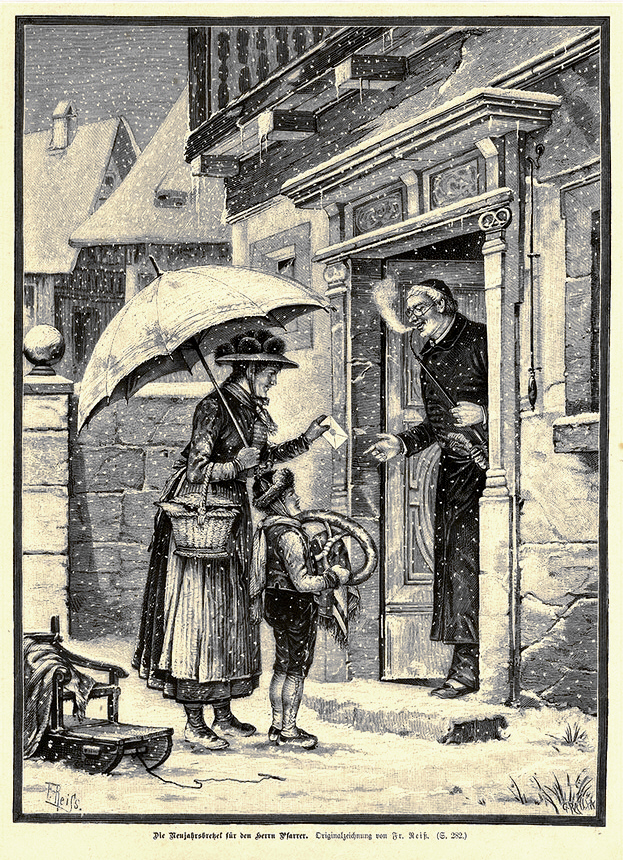
“Die Neujahrsbretzel für den Herrn Pfarrer”, 1884 (via Wikimedia Commons)
I’ve had several people recommend a book to me called The Five Love Languages, by Gary Chapman. It’s a book that looks at the various ways in which people give and receive love. It gets into a lot of psychology and interpersonal communication theories, but in a nutshell it assumes that people tend to give or receive affection via physical touch, loving words, acts of kindness or service, quality time, or gifts. I am definitely a gift-giver when it comes to expressing my feelings—I will work for weeks to handcraft something for someone I care about. When my lovely wife and I were courting, I put hundreds of sticky notes all over her apartment with love messages so that she would constantly find them for months and months afterwords. Even when we ship products out of our Etsy shop, I tend to add layers of Spanish moss to the packing material, as well as little lagniappe touches to the shipment to make it feel magical for the person who opens the box. None of this is to brag, but simply to frame the point that giving gifts is a major part of my connection to others.
Giving gifts has been an important aspect of human relationships for a very lnog time. The Ancient Roman patronage system essentially operated on a large-scale gifting economy. In North America, giving gifts with a magical bent appears time and again. A number of superstitions and rituals surround the acts of gifting and receiving gifts. Possibly one of the gifts most beset by magical rules is the knife:
One must not give a friend a knife or other sharp instrument, as it “cuts love.” (Price 34).
“Giving a knife as a gift is bad luck as it cuts the friendship” (Hines 12).
A present of knives will break the friendship between you (the giver) and the recipient of the gift. (Hines 13)
No hillman would think of giving a steel blade to a friend such a gift is sure to sever their friendship (Randolph 58).
The ‘hillman’described in the last point would have been obliged to pay for a knife if he received it as a gift, in order to abate any potential tragedies:
Whenever a knife changes hands, it must be paid for, even if the sum is merely nominal. I have seen a salesman, a graduate of the University of Missouri, present his son with a valuable hunting knife but he never let it out of his hand till the boy had given him a penny (Randolph 58).
This is a sentiment I’ve seen echoed through other traditions as well, including some Wiccan circles and their beliefs about gifting athames. I have also seen contrary points, insisting that Wiccan ritual blades must never be purchased, but only gifted.
Knives, however, are only scratching the surface of the myriad taboos, beliefs, and customs surrounding giving and receiving. In the following paragraphs, I hope to lay out some of these traditions (though certainly not all of them… The concept of Christmas and birthday gifts is well outside the scope of a single survey article, for example, and the topic is much larger than a 2,000 word synopsis could handle). What I hope that you will see is the sheer humanity of this process. People seem to develop an entire language around gifting (see the Victorians and their flowers, for example), and understanding that language, especially within a magical context, expands the conversation on American folk magic immensely.
Since we’ve started in the domestic realm with knives, let’s continue in that vein. In the Ozarks, even very small gifts can have great significance:
A button received as a gift is always lucky, no matter what the color. Years ago, many an Ozark girl collectedbuttons from her friends and strung them together into a sort of necklace called a charm string. A charm string not only brought good fortune to the owner but also served as a sort of memory book for women who could not read one button recalled a beloved aunt, another a friend’s wedding, still another a dance or a quilting party or an apple-peelin’ or some other pleasant occasion. (Randolph 61)
These little tokens often represent a greater whole. In the example Randolph cites the ‘memory book’ aspect of the charm pushes it out of the realm of luck and into a broader realm of personal narrative. It tells the story of where the girl has been. The luck may then be a cumulative blessing from all those around her, an assembly of good wishes designed to attract further goodness into her life. Similarly, some fairly small gifts can act as predictors or insurance of future blessings, as in these two examples from Louisiana:
A midwife should plant a flower for a baby at its birth.
It is good luck for visitors to place a silver coin in a baby’s hand (Roberts 150).
Here we see blessings which ensure growth and health (the flower) and insurance against poverty (the coin) passed onto a baby, with the hopes that the child will grow and prosper in the future.
Of course, there are just as many taboos on gifting as there are joyous customs. As we saw with knives, some of those can be firmly established and nigh universal at times. Let’s look at another domestic commonplace with strong taboos:
Never borrow salt or you will have bad luck (Hines 12).
Never return salt that has been borrowed (Roberts 178)
Why salt? In my family, we frequently gave salt as a component of a new house blessing for people we knew, which as I understood it derived from Polish traditions (after investigating this a bit, I’m reasonably sure this was adopted from a similar Jewish custom picked up by my family in the area on the border between Lithuania and Poland). We give a jar of salt with some bread and a penny in it, ‘So that the family may never be hungry (bread), never be poor (penny), and their lives may never lack flavor (salt).” The salt, then, can be seen as the experience and cumulative personality of the family, its seasoning or flavor which makes it distinct. Borrowing someone else’s flavor would, in essence, give them power over you, especially when the salt is returned carrying traces of your own eau de familie. It could also be that by taking one family’s wisdom and experience, then returning it, you set off a disruptive cycle whereby your two families will be struggling to rebalance power for a long time, which definitely sounds like bad luck. A similar Louisiana superstition says ‘Don’t give spades, etc., to your neighbors; you will have a fuss if you do (Roberts 174). In that case, the tool is symbolic of a person’s work and labor, and to lend it out cheaply doesn’t bode well for anyone (and makes me think of Homer Simpson borrowing essentially every tool in Ned Flanders’ garage…a very bad neighbor).
The issue of when a gift is given can also impact its significance and magical qualities. While I will avoid holidays and the like here, there are plenty of other occasions when gift-giving is an expectation, such as at baby showers:
At a baby shower, the giver of the seventh gift to be unwrapped will be the next to have a baby (Hines 14).
In this example, the gift-giver receives the magical benefit of a prediction. I suppose that if you are not in the market to start a family, this superstition could seem more like a taboo than a blessing. Another key occasion for giving gifts is after a new family moves into a new home. I mentioned my family’s custom for making a house-blessing from my Polish roots, but it turns out that the general concept of the house-warming may come from the other side of my family tree in the British Isles. The hint of magic behind this tradition comes from the original house-warming present, which actually served to warm a new home:
“As poet John Greenleaf Whittier noted…’The Irish who settled here about the year 1720, they brought indeed with them, among other strange matters, potatoes and fairies.’…The Scots [who were also early settlers in America, particularly in the Mid-Atlantic region and parts of Appalachia]…believed in ‘brownies,’ a more subdued version of the leprechaun. Brownies lived in the kitchen fireplace, and the belief was that the owners of the house had a responsibility to always keep these fairy-creatures warm by keeping a constant fire in the hearth. The Yankees noted that Scots-Americans, when moving from one house to another, would always remove burning embers from the old house to the new, to provide a warm home for the brownies that would move in right along with the family. This was how the tradition of ‘house-warmings’ started” (Cahill 32).
I tend to think this is a bit of fancy on Cahill’s part, and that the giving of gifts to new homeowners is something much older and less literal than a brownie’s ‘house-warming,’ but I would be completely unsurprised to find that the actual practice of moving hearth coals to entice fairy-beings to move houses exists in the Old World or the New.
Marriage also features a number of gift-giving customs, some with superstitious components. For example, in Kansas groups of Russian-German emigrants pin money to the bridal skirt as a way of blessing the bride and groom with prosperity. Additionally, a fun game is made of the best man’s gift, and the “custom of some young buck’s stealing the shoe of the bride. The best man had to redeem the shoe with cash, which went into the household fund” (Tallman 227-8). The best man might contribute some or all of the money, with the remainder raised by good-natured begging of the wedding guests.
A number of tales from Appalachia and New England, including stories from Hubert Davis’ The Silver Bullet and other collections of supernatural American folklore, indicate that magical gifts have particular rules when it comes to witches. For example, a witch might offer a very low price for some livestock or sundries she fancies from a local homestead. If she is refused the gift—which is all such a lowballed agreement could be seen as—she curses whatever it is she wanted, rendering it useless to the family that has it. Often she will curse a cow so it won’t produce milk, or she might even curse an entire herd of pigs or sheep rather than just the one she wanted. On the flip-side, a witch should never be given a present of anything from the household, or she could use it to harm those who dwell within. One story features a housewife who loans the local witch-woman a cup of sugar in a neighborly—if cautious—manner, only to find her butter won’t come when she churns it afterwords. She summons a local witch-doctor who takes a piece of hot silver and drops it in the churn, then spills cream on the fire and whips a pan of the scalded dairy until they hear shrieks from the direction of the witch-woman’s home. She, of course, suffers great pains and bears the marks of a whipping and burning the next day, and everyone knows just what’s what. Oh, and the butter is fine after that, too, of course.
Not all witches or magical practitioners are conniving and dangerous when it comes time to share the wealth, though. For example, many witch-doctors and conjurers in the Southern Mountains will not take direct payment for their work, but only offers of gifts made in-kind, such as foodstuffs, clothing, or other necessities. Vance Randloph noted that one witch woman in the Ozarks did not ask a fee for her work, but would accept such donations: “This woman makes no charge for her services, but if somebody offers her a present, such as a new dress or a side of bacon, she seldom refuses the gift” (Randolph 126).
Lest you think all these magical gifting traditions are limited to the realm of humanity, here’s a bit of lore from John George Hohman’s Long Lost Friend to show otherwise:
A GOOD METHOD OF DESTROYING RATS AND MICE.
Every time you bring grain into your barn, you must, in putting down the three first sheaves, repeat the following words: “Rats and mice, these three sheaves I give to you, in order that you may not destroy any of my wheat.” The name of the kind of grain must also be mentioned. (Hohman 70).
Here we see the old idea of “one for the rabbit, one for the crow, one to rot, and one to sow” extended from nursery rhyme to magical practice. Giving the animals a bit of the household bounty seems to be a way to stave off any thievery on their part, at least in this example.
Finally, I can’t help but offer up a humorous story from Maryland which shows animals getting in on the gift-giving action:
It seems that Mrs. Morison’s uncle and her father went fishing one time and as always they carried their [moonshine] jug along. They came to this water moccasin who was just about ready to swallow a frog. So Mrs. Morison’s father took a forked stick and clamped it down over the snake’s head and took it [the frog] away ‘cause they wanted to use it for bait.
Well, that snake looked so darn downhearted that they gave him a drink of moonshine, and off he went. So they went on with their fishing and about an hour later one of them felt a tug on his leg. He looked down and there was that snake back with another frog. All I can say is, that must have been awful good moonshine” (Carey 31).
I’m not sure if the ‘magic’ in that tale is so much in the moonshine or the moccasin, but I couldn’t resist sharing it with you.
I’m sure there are many other magical giving traditions I’m missing here, so if you have any you want to share, please do!
Summary:
In tonight’s episode (slightly belated, my apologies), we have an excellent discussion of Sacred Artistry and Enchanted Worldviews with the wonderful Bri Saussy. I bookend the interview with a pair of readings on the topic as well. Thanks for your patience, and I hope you enjoy this episode as much as I did!
Shownotes for Podcast 62 – Pregnancy and Birth Lore
Summary:
In this episode we’re trying out the wedding ring test, asking about spicy foods, and trying not to scare any birthmarks onto Laine’s baby as we talk about the lore and folk customs surrounding pregnancy and childbirth.
Cowboy hats for sale in Austin, TX (photo by Nika Vee, via Wikimedia Commons)
There’s a line from the classic (well, sort of) movie Smokey & the Bandit in which Burt Reynolds’s character explains to his lady of the film that he only takes his hat off for one thing, to which his female companion (Sally Field), of course, replies: ‘Take off your hat.’
Costume is frequently a reflection of ceremonial, ritual, or even magical operation, an outer manifestation of inner desire or power. A nun’s habit or a burqa can both represent a commitment to religious life, and inspire reactions from those around them. The ceremonial robes of a Thelemic magician frequently conform to specific standards to enhance invocations and rituals. The Encyclopedia of American Folklore notes:
Folklorists who discuss adornment have concentrated on costume’s socializing force and its relationship to the maintenance of individual and group identities. According to Don Yoder (1972), folk costume expresses identity in a symbolic way; functioning as an outward “badge” of community identity and expressing an individual’s manifold relationships to and within that community (Brunvand 341).
One of the items frequently associated with magicians is the magic hat—whether it’s the shiny tophat of a stage magician concealing a rabbit in its depths or the pointy, star-spangled adornment of a fantasy wizard. In American lore the hat has a special place as a magical item, frequently providing either symbolic guidance, otherworldly taboo, or a method of deployment in spell-casting.
When people think of American hats, possibly the most iconic is the cowboy’s ten-gallon hat (which, of course, does not hold ten gallons, but the galon hatband worn by Southwestern vaqueros). I remember teaching overseas and asking about impressions of America, and the most common response was that we tend to wear cowboy hats and smile a lot.
The cowboy hat—as well as a number of other elements of ‘rugged’ American folk costume—was borrowed from other cultures:
Many specifically American types of costume emerged from the interaction of diverse costume traditions in dialogue with indigenous materials and environments. Recognizable forms in Western regional costume, for example, are creolized forms resulting from the interaction of different traditions of dress. The costume of mountain men who charted new Western territory—fringed buckskin coats, breeches and shirts, fur “coonskin” hats, and thick, colorful blanket jackets—was an adaptation of Native American costume forms suitable for native environments and constructed with indigenous materials. The occupational costume of the American cowboy was also the result of the interaction of various cultural forms in dialogue with the demands of occupation and environment. Many of the recognizable elements of the classic American cowboy costume, such as spurs, hat, boots, and chaps, were the result of cultural exchanges between working Anglo and Mexican cowboys, known as vaqueros. Vaqueros were known by their wide-brimmed hats, short jackets, colorful neckerchiefs, red sashes, elaborate spurs, and protective leather leggings (Brunvand 343)
Given the emblematic nature of the Stetson and its kin and the frequently superstitious nature of life in the Old West, it is hardly surprising that lore has arisen surrounding this headgear. Probably the most common belief surrounding the cowboy hat has to do with what to do when you’re not wearing it. There seems to be an absolute taboo on placing a hat on the bed, which appears in everything from Southwestern rodeo lore to Oregon folk belief.
In both the American South and West, a particular custom of hat-burning following the birth of the first baby (or sometimes only the firstborn son) of a miner prevails. From Vance Randolph’s Ozark Magic & Folklore comes the following account:
In some clans, when a baby boy is born, a sister of the babe’s father comes to the house, looks at the child, and then burns the first hat she finds. No matter whose it is, nor how valuable, she just picks up a hat and throws it into the fireplace. Many people laugh at this and pretend to take it lightly, but it is never omitted in certain families. I know of one case where there was some doubt about the child’s paternity, and the husband’s family were by no means friendly to the young mother, but despite all this one of the sisters came and burned the hat; she did it silently and grudgingly and most ungraciously, but she did it. This practice is never discussed with outsiders, but it is sufficiently known that a series of funny stories has grownup about hats being burned by mistake, strangers’ hats missing, doctors leaving their hats at home, and so on (Randolph 205)
This practice was also found in California by folklorist Wayland Hand, where “[o]n occasion of a miner’s first trip to the mine after the arrival of the firstborn, his comrades simply seize his hat and burn it despite any resistance or protests offered” (Hand 52). This act functions both as an initiatory rite and as a method of preventing bad luck for the child. Hand also notes that the baby was usually made to touch the hat if possible prior to its cremation. A soldier’s hat could also be worn by a woman in labor to give her strength during the birth, furthering the link between children and hats.
A number of traditions from African American folklore have been attached to hats. In most cases, headgear serves as a method for the transference of contagious magic, sometimes almost in a medical sense: “if one borrows a hat from a diseased person, and the wearer sweats round the forehead where the hat rests, he will take the disease” (Steiner 267). Harry Hyatt recorded a string of beliefs among African Americans surrounding hat lore:
9750. If a girl puts a man’s hat on her head, she desires him to kiss her; if a man puts his hat on a girl’s head, he desires to kiss her.
9751. A girl should never put a man’s hat on her head; it will cause quarrels with him.
9752. The girl who tries on a man’s hat will not get him for a husband.
9753. If a woman throws her hat and gloves on a man’s bed, she wants to sleep with him; if a man throws his hat on a woman’s bed, he wants to sleep with her.
9754. A girl can strengthen a sweetheart’s love by laying his hat on her bed when he comes to see her.
9755. The significance of a beau refusing to hand his hat to his girl when he calls on her is love growing cold. 9756. A girl stepping on a man’s hat will soon marry the owner.
9757. “The girls did this when I was young: in the spring stamp with your thumb in the palm of your hand the first twenty-seven straw hats you see and you will meet your beau.”
9758. If a girl takes the bow out of the hat of each man liked, she will marry the owner of the seventh hat.
9759. Let a girl take as many bows as possible from the hats of men liked and wear them on her garter; the bow staying on longest will reveal who among these men loves her best (Hyatt 231)
Clearly some of these are contradictory, as in the piece about one gender wearing the other’s hat breeding either contempt or desire. There does seem to be a very strong connection between hats and sexuality, however, perhaps because the hat sits so close to the brain and retains the warmth of the head, it may be seen to cause ‘feverish’ behavior, such as love, lust, or even fighting. The divinatory rites surrounding hats are also interesting, although I suspect these performances have less to do with any direct effect upon the mind and more to do with other counting rituals related to love forecasting. Several tricks in the practice of old-style hoodoo involve acquiring the band from a man’s chapeau and using it to deploy any number of tricks, mostly designed to influence him in love (or occasionally business).
A bit of lore from the Southern mountains tells about how a person can reverse bad luck caused by unfortunate omens (in particular a fearsome rabbit crossing one’s path): [If a] Rabbit runs cross yur path, turn yur hat ‘roun’. (Wear your hat with the back part in front.)” (Duncan 236). This is not much different from the idea of turning around if a black cat crosses one’s path or even turning a key or coin over in one’s pocket after seeing an unlucky sign. In an era when hats are frequently worn backward (if worn at all), this sort of act is probably much less out of place today than it would have been half a century or so ago.
Hats, then, can be deeply magical objects to those that wear them. It’s hardly surprising that Lyle Lovett sings of his size-7 Stetson, “Well if it’s her you want, I don’t care about that/ You can have my girl, but don’t touch my hat.”
So what about you? Do you have any hat-related lore? What kinds of hats hold particular magic for you? The pointy costume ‘witch’ hat? A trucker’s cap owned by a favorite grandfather? I’d love to hear what makes your hat special and whether you ever ascribe anything magical to it.
There’s a bit of folk superstition about New Year’s Day that says whatever you want to be doing for the next twelve months, make sure you’re doing it on January 1st. You’re also not supposed to start anything you can’t finish, which brings me to this quick-n-dirty little blog post. I intend (dare I say hope?) that I will be doing a tremendous amount of writing over the coming year, including finishing several writing projects I’ve been working on for a while, so I wanted to make sure I wrote something for New World Witchery before midnight tonight. But I also have been using the day to accomplish a dozen other New Year’s magical traditions (cleaning, black-eyed peas, collard greens, etc.) so I thought a short and simple giveaway post might just kill the proverbial twin birds.
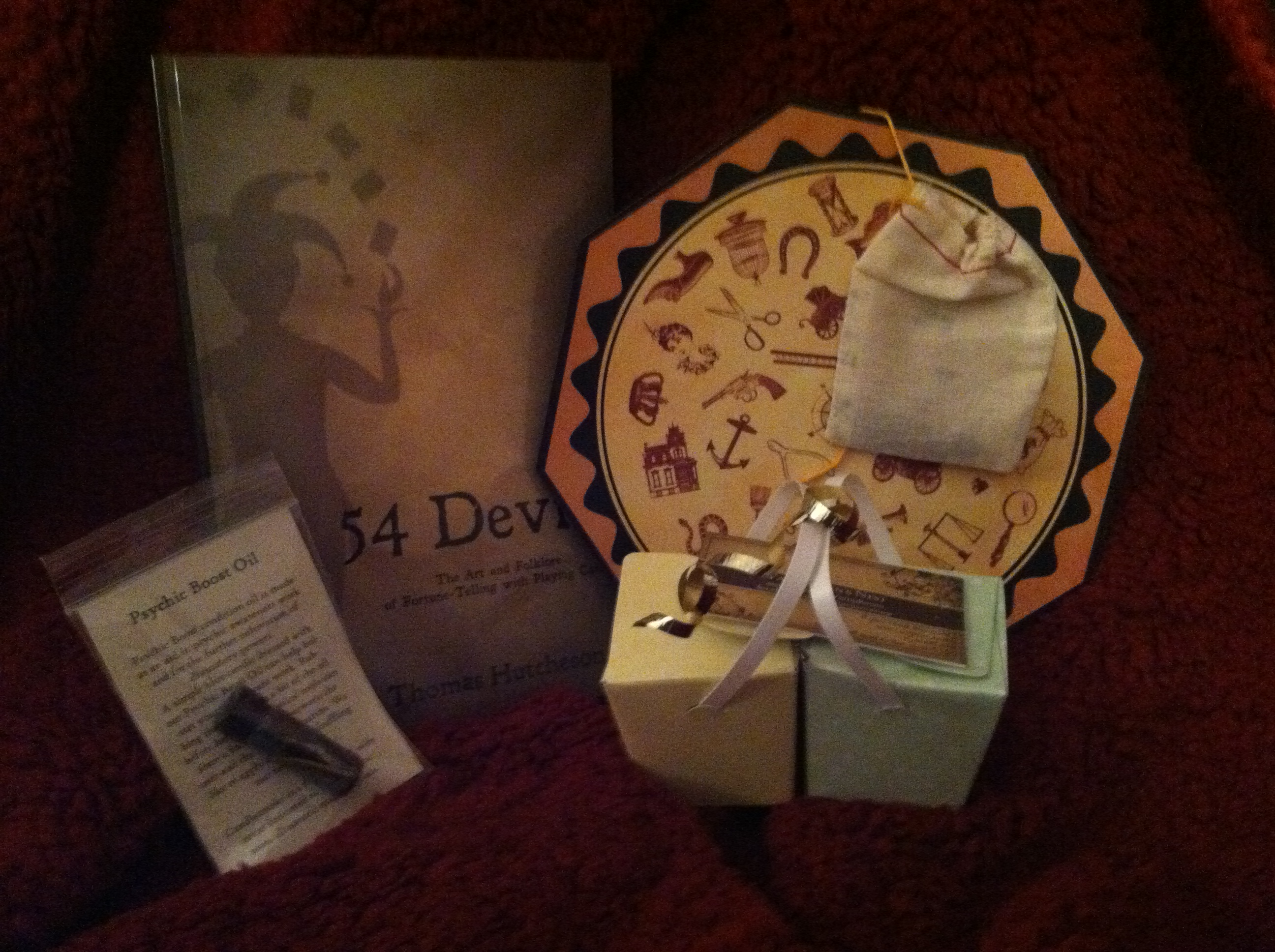
For this giveaway, we’ll be handing out a doozy of a divination prize pack. It includes:
A mini-altar kit and pair of mini-dowsing rods from Franchesca at The Texan Heretics
A bottle of Psychic Boost Oil from the lovely Magnusons of Candlesmoke Chapel
A stunning javamancy board from Chas Bogan of Carnivalia
A five-card email card reading from me, complete with card report
Pretty stellar, huh?
So what do you have to do to get an entry into this contest? It’s incredibly simple! Just answer one or more of the following questions:
What are your magical/witchy/Pagan New Year’s resolutions? What magical projects do you hope to get off the ground? Are there areas you want to learn more about? Are you going to get more involved in the community? Just give us a brief snapshot of what you hope to accomplish from a magical standpoint in the coming year.
What is your favorite magical/witchy/Pagan holiday and why? What do you do for it? Has it always been your favorite? What will you be doing to make it special this year?
What (if any) practices, spells, etc. has New World Witchery been able to add to your cauldron? Are there specific regions of folk magic you’ve begun to explore more (like Conjure or Powwow)? Do you find the info here useful on a practical level or is it more of a general information site for you?
That’s it! All you have to do is write to us at compassandkey@gmail.com and answer a question or two or three. You get one entry per question answered, so you have a chance to get up to three entries just by writing to us (you can combine all answers into a single email, as long as you make it clear you’re answering multiple questions somehow). Make sure to use the subject line “Three Questions Contest” so I know what you’re writing us about.
The deadline for this contest will be Friday, January 31st, so get your answers to us by then!
Also, please check out and/or enter our other current contest for one of three NOLA swag bags, which will be ending January 17th!
Thanks everyone for a great 2013, and here’s looking forward to a very enchanted new year!
The Comet of 1680, by Lieve Verschuier (via Wikimedia Commons)
“Like a comet burn’d That fires the length Ophiuchus huge In the Arctic sky, and from his horrid hair Shakes pestilence and war” (Milton, Paradise Lost)
With the ISON comet drawing eyes to the night sky, I started thinking a lot about the superstitions and magical beliefs surrounding the appearance of comets in the sky. Comets have long inspired people in strange, occasionally beautiful, and sometimes disturbing ways. Mark Twain’s life was framed by the appearance of Haley’s Comet, a point the author himself noted. The Heaven’s Gate cult engaged in a group suicide surrounding the arrival of the Hale-Bopp comet.
Increase Mather, famed early American religious writer, dedicated an entire work to explaining the spiritual importance of comets in his Kometographia of 1683. He was responding to the presence of the Great Comet of 1680, which had captured the attention of most of the Western world, and felt that many people would be afraid at this sign and misunderstand it as a phenomenon which directly influenced the course of events on earth, rather than a sign from God of some important event to come (see more here). Generally speaking, comets have historically been associated with strife and woe to come. My Opie/Tatem Dictionary of Superstitions gives a laundry list of examples of ill-omen presaged by what the Venerable Bede called “long-haired stars”:
A comet as portending a change in governance (Tacitus, Annals)
Famine or pestilence or war or “fearful storms” (Byrhtferth, Manual)
A comet [the Great Comet of 1680] appeared two days before the Duke of Monmouth died, and all over Europe before the death of Charles II (J. Case, Angelical Guide)
An appearance before the plague struck London (Defoe, Journal of a Plague Year)
A wry observation that those who laugh at comets as tokens of disaster will studiously insist on “times and situations proper for intellectual performances” (Johnson, The Idler)
In the New World, comets seem to have retained much of their wicked reputation. In some cases the danger foretold by the comet is vague and ill-defined: “When a comet appears there will be trouble” (Roberts, “Louisiana Superstitions”). In other places, the significance of the hairy star was more direct and its consequences very clearly understood: “A comet is a sign of war” (Thomas, Kentucky Superstitions). Why should these astronomical phenomena, which had been showing up in night skies for ages, have such a bad rap? Considering even Classical authors like Tacitus cite the comet as woeful, the impulse must run deep. The unique cosmological view of Calvinism, though, which influenced much of Atlantic American colonization, both denigrated occult practices like witchcraft and supported an enchanted view of a univers under Divine direction:
“The Calvinism of the colonial awakenings also paralleled important occult ideas. The fatalism inherent in Calvinism’s concept of predestination found an occult equivalent in the idea fundamental to astrology that motions of star and planets revealed a future that individuals could not control. Calvinist evangelists and occult practitioners also explained catastrophes in similar ways. Believers in occult ideas thought the coming of comets and eclipses had inescapable and usually disastrous consequences; not even kings and queens escaped their verdicts. No one escaped judgment by the Calvinist God either. Sometimes He damned seemingly model Christians simply to demonstrate His sovereign” (Butler, “Magic, Astrology, & the Early American Religious Heritage”).
The shared cosmology of the colonists saw the universe as inhabited by spiritual consciousness, and an intelligence that wished to convey its meaning to human beings for one reason or another. Signs, omens, and portents were one such method. Comets, with their placement among the stars, their strange and ill-understood movement, and temporary nature made perfect fodder for prognosticators of all stripes—religious, occult, and both (they did exist, even during the Colonial period).
Lest we make the mistake of thinking that the observation of comets was the purview of only a few dusty old white occultists or a lot of fiery former Englishmen with strong religious convictions, I’d also like to point out that the cosmology which imbued comets with significance stretched across a broad swath of New World denizens, including Native Americans, Spanish and French colonists, and of course, the imported Black slaves.
“English Protestants often read unusual events as evidence of the divine presence in everyday life, acknowledging the activity of a creator deity who operated through omens and portents within the natural order, or signs and wonders in the heavens, philosophy known as Providentialism. “Comets, hailstorms, monster births and apparitions” and other disruptions of the ordinary were demonstrations that foretold God’s will or signaled His displeasure withhumankind. Africans’ understandings of the universe were also inspired by visible manifestations of spiritual forces within nature. They too viewed thunder, lightning, and other elements as heralds of sacred hierophanies,the awesome presence of numerous divine beings.” (Chireau, Black Magic).
The Providentialism Chireau notes fits the cosmology of the English and other European settlers, but it is clearly not unique to them. A world with Divine presence not only innate to its component parts, but in which those component parts act as mediums for communicating with humans, is also very much an African perspective. And while it is tempting to think that such beliefs can be relegated to history’s dustbin, we should also remember that in our time comets stir up a lot of strange excitement. Religious scholar Camile Paglia notes, for example:
“The Children of God, founded in 1968 as Teens for Christ by “Moses” David Berg in Huntington Beach, California, were negligible in number but came to public attention when they loudly prophesied that the us would be destroyed by Comet Kohoutek in January 1974. The group continues under the name “The Family” and is regularly excoriated by conserva tive Christian watchdog groups for its practice of free love (called “Flirty Fishing”) as well as its heretical beliefs that Jesus was sexually active and that God is a woman. (Paglia, “Cults and Cosmic Consciousness”)
Paglia also references the Hale-Bopp comet mentioned earlier, and Marshall Applewhite’s Heaven’s Gate cult. I have, so far, not heard of any particularly distressing phenomena surrounding ISON’s appearance, but if nuclear war breaks out, I may have to blame that particular “long-haired star.”
If you have comet lore you’d like to share, please do so in the comments!
“Jim Hawkins & the Treasure of Treasure Island,” illustration by Georges Roux (via Wikimedia Commons)
A number of modern spells are designed to bring “prosperity” into an individual’s life. In some cases, Wiccan and Wiccan-influenced spellbooks contain workings that either target specific needs and cash amounts, or which seek to generally enhance the financial stability of the magician or his/her designated target (most Wiccan spellbooks also require that the magician have permission from the target even in beneficial magical workings like this). Certainly, magical practices designed to bring a sense of bounty and abundance into one’s life go back quite far—the cults of Fortuna and Tyche in the ancient world appeal to good luck, and the Roman cult of Pomona pursued the ideal of a fruitful life. Folk magic, however, has generally focused less on meeting a generalized prosperity and has drilled down to specific financial problems and advantages. The Wiccan spells which seek a specific sum of money to cope with a specific issue—a medical bill, a broken radiator, etc.—very much mirror the sorts of spells done by people across multiple times and places as they tried to cope with uncertain finances.
Another brand of folk magic, however, did not work towards a specific sum, nor did it seek to bring a vaguely defined sense of wealth into someone’s life. Instead, many spells targeted getting rich—quick! In some cases, the spell’s target would be a gambler who worked to gain the advantage in games of chance (more on that another day, hopefully). A few stories talk of acts of magical extortion, wherein a magician would either try to low-ball the purchase of land/livestock with the threat that failure to accept a paltry offer would result in the destruction of the commodity in question OR a witch might place a curse on a neighbor and only remove the curse for a fee (you can find several examples of such stories in The Silver Bullet, and Other American Witch Stories by Hubert J. Davis).
If someone wanted to get rich really quickly, however, he or she would turn to magical treasure hunting. Plenty of European grimoires had methods for finding lost treasures, usually with the help of spirits. Some grimoire texts which influenced American practices, such as The Black Pullet, spelled out in detail how to summon treasure-seeking daemons to work on one’s behalf:
“This talisman and this ring are not less valuable. They will enable you to discover all the treasures which exist and to ensure you the possession of them. Place the ring on the second finger of your right hand, enclose the talisman with the thumb and little finger of your left hand, and say, Onaim, Perantes, Rasonastos.” I repeated these three words, and seven spirits of a bronze colour appeared, each carrying a large hide bag which they emptied at my feet. They contained gold coins which rolled in the middle of the hail where we were. I had not noticed that one of the spirits had on his shoulder a black bird, its head covered with a kind of hood. “It is this bird,” the old man said to me, “who has made them find all this treasure. Do not think that these are some of what you have seen here. You can assure yourself of this.” I replied, “You are for me the truth itself. My father! Do you believe that I would insult you by doubting?”
He made a sign, and the spirits replaced the gold in the bags and disappeared. “You see, my son, what the virtues of these talismans and rings are. When you know them all, you will be able, without my aid, to perform such miracles as you judge proper” (The Black Pullet, 20-21).
Seals and incantations like these made it into later magical practices, especially in places where grimoire languages like German, Spanish, or French were spoken (to be clear, many grimoires were written in languages like Latin with commentaries in European languages, and these three tongues were hardly the only ones in which grimoires appeared).
Of course, being able to find treasure only helps if treasure is already buried in the earth waiting to be found. In the maritime culture of early New England (as well as the maritimes of other parts of the New World), a widespread belief in hidden golden caches secreted beneath the soil became the basis for a number of magical spells. A Maine man named Daniel Lambert, suddenly flush with money, faced suspicion, for:
Lacking any other apparent explanation, his neighbors attributed Daniel Lambert’s sudden wealth to the discovery of buried pirate treasure. Despite Canaan’s location dozens of miles from navigation, the inhabitants readily believed that Lambert had found a treasure chest because, as Kendall explained, “The settlers of Maine, like all the other settlers in New England indulge an unconquerable expectation of finding money buried in the earth.” Indeed, backcountry folk insisted that troves of pirate treasure guarded by evil spirits pockmarked the New England countryside even in locales far from the coast (Taylor 7).
Since the New World was vast and dangerous, people turned to magic to help find these copious buried (and frequently ‘cursed’) treasures, and to remove any dangers that might arise during the expedition to unearth them. A number of ‘rules’ for enchanted bounty-seeking developed, including:
Treasure hunting teams needed at least three members, as that number ensured magical success
Magical circles should be inscribed around the digging site to prevent any malevolent spirits from attacking the diggers
Implements of silver, such as silver spoons or spades, should be used to dig at least part of the earth to ensure luck in the hunt and to protect the diggers from harm
Blood offerings (animals usually) had to be made to quell the guardian spirits protecting the treasure—a belief related to the idea that a guardian spirit was usually a person who was killed and his blood spilled over the burial ground
In addition to maritime treasures, the idea of “Indian” gold became very popular. Some European colonists and conquerors were sure that entire cities of gold were just waiting to be found in the dense, mysterious interiors of North and South America. Gonzalo Pizzaro and Sir Walter Raleigh both mounted expeditions to find such legendary places, frequently referred to as “El Dorado,” or “the golden one.” In almost every case, however, the site was protected by evil spirits, a curse, ghosts, or some other malevolent force. In some situations, however, the spirit might actually help a seeker find his or her treasure: “There are many tales about ghosts who speak to people, telling them to dig at such-and-such a place to find a buried treasure. The ghost is usually that of some fellow who died without being able to tell anybody where his treasure was concealed, and who cannot rest quietly until someone gets the money and enjoys it” (Randolph 219). How one ensures that the ghost is not simply walking the magician into a trap is anyone’s guess.
One of the best examples of magical treasure hunting led to an entire religious movement in the New World. While the time has not yet come to explore the full magical heritage of the Latter Day Saints, I would be remiss to omit them here. Joseph Smith, prophet and founder of the Mormon faith, used to hunt for treasure using methods derived from alchemy and hermetic science/magic. He followed the rules laid out above, frequently offering “sacrificed either pure white or jet black sheep or dogs to lay out magic circles of blood” prior to discovering his golden plates and having his angelic vision (Taylor 12). Smith’s methods were not deviant or unusual. He used seer or peep stones to help find his hidden treasures, and his activity in the highly spiritually active area of New York known as the Burned-Over District was imitative of earlier seekers and followed by those who did the same. In fact, Smith was following very much in his own father’s footsteps, as Joseph Smith, Sr. was an active treasure seeker in Palmyra, New York. He is recorded to have once described his methods to a neighbor, saying “the best time for digging money was in the heat of the summer, when the heat of the sun caused the chests of money to rise to the top of the ground” (Brooke 31). The tradition the Smiths followed required—like many grimoire traditions do—that the seeker be spiritually pure or else he will fail in his pursuits, a concept brought in from hermetics and alchemy. The fervent spirituality and insistence on saintly behavior left a strong mark on the junior Smith, and helped him feel prepared for his prophetic role in revealing the Book of Mormon (which was inscribed on golden plates).
In some cases, treasures of golden pieces and precious gems are not the target of the magic. I have written previously on the phenomenon of dowsing, which allows a person to magically search for substances like water and oil beneath the earth. In some cases, the dowser might also search for veins of gold or silver or other valuable ores like iron. The method for making such a dowsing tool appears in Hohman’s early nineteenth century text, The Long-Lost Friend:
TO MAKE A WAND FOR SEARCHING FOR IRON, ORE OR WATER.
On the first night of Christmas, between 11 and 12 o’clock, break off from any tree a young twig of one year’s growth, in the three highest names (Father, Son and Holy Ghost), at the same time facing toward sunrise. Whenever you apply this wand in searching for anything, apply it three times. The twig must be forked, and each end of the fork must be held in one hand, so that the third and thickest part of it stands up, but do not hold it too tight. Strike the ground with the thickest end, and that which you desire will appear immediately, if there is any in the ground where you strike. The words to be spoken when the wand is thus applied are as follows: Archangel Gabriel, I conjure thee in the name of God, the Almighty, to tell me, is there any water here or not? do tell me! + + +
If you are searching for Iron or Ore, you have to say the same, only mention the name of what you are searching for.
This version of magical dowsing incorporates high magical elements (such as the invocation of Gabriel) and strong folk magical ones (the clipping of the tree twig at sunrise and the simple dowsing methodology). On the simpler end of the spectrum, one could simply put a bit of whatever was being sought into the tip of the dowsing rod, as in this example from the Ozarks: “Many hillfolk are interested in the search for lost mines and buried treasure, and some of these people have tried to use the witch stick in their quests. If a man is looking for buried gold, he fastens a gold ring to the end of his stick ; if it is silver that he expects to find, he splits the end of the wand and inserts a silver coin. Rayburn says that to locate mixed ores one uses two different metals usually a dime and a penny” (Randolph 88).
The practice of hunting for buried wealth and riches spanned cultural and geographic boundaries. In many cases, very strict rules were followed, regarding purification and protection as well as actual seeking magic. Spirits would guide a magician to the site of a treasure, and in some cases might even be employed to raise it from the earth. In other cases, the spirits associated with the treasure were deeply malevolent and most of the magic employed was to placate or dis-empower any evil that might be lingering about the dig site. The payoff for an effective treasure hunter could be a sack of coins, a buried chest, or even a new branch of a religion, but the work required up front was heavy and intense. While gambling charms might take longer, the success rate was better overall. In the end, getting rich quick via magical means, it seems, has always been a labor-intensive and time-consuming effort, just like any other job.
Laissez les bon temps rouler, y’all! It’s Mardi Gras, which means a last-minute pre-Lenten extravaganza of flesh, fun, and other words starting with the sixth letter of the alphabet. In honor of the Carnival spirit of feasting (another “f” word!), I thought I’d take a brief look at one of the things I most associate with this holiday: cake.
Cake may not have the aesthetic magical impact of a cauldron bubbling over a fire or a bag full of bones scattered in the dirt, but this bakery standby (and some of its culinary cousins) manages to surface in a number of magical practices. Since this is Mardi Gras, let’s start with one of the most obvious, the King Cake. The King Cake originates in Epiphany and Old Christmas celebrations from Catholic countries, but has also become incredibly prominent in Carnival and Mardi Gras celebrations. The one you’re most likely to find in a local bakery (I have found Hispanic bakeries frequently are my best source) will be big, doughy cakes covered in icing and lots of colored sugar—usually gold, green, and purple. Somewhere inside, a small plastic or metal baby lurks, waiting to grant luck on the one fortunate enough to get a slice with the little token in it (or unfortunate enough, if you happen to bite into the baby and chip a tooth before you know what you’re doing). The lucky association of the baby in the King Cake resembles other traditions in which a bean is baked into a cake and the recipient receives blessings, money, or good luck upon finding it. Sometimes the “King” or “Queen” of the feast would be chosen by the finding of a bean or a pea:
Samuel Pepys (whose wife was French) recorded a party in London on Epiphany night, 6 January 1659/1660: “…to my cousin Stradwick, where, after a good supper, there being there my father, mothers, brothers, and sister, my cousin Scott and his wife, Mr. Drawwater and his wife, and her brother, Mr. Stradwick, we had a brave cake brought us, and in the choosing, Pall was Queen and Mr. Stradwick was King. After that my wife and I bid adieu and came home, it being still a great frost.”[1] The choosing of King and Queen from the pie, usually by the inclusion of a bean and a pea, was a traditional English Twelfth Night festivity. (via Wikipedia’s article on “King Cake”)
Most Westerners know about the significance of candles on birthday cakes, as well as the wishing tradition that comes with blowing them all out at once. Some of the other quirky and semi-magical rituals we perform in conjunction with cake:
“Portions of the wedding cake are often saved to eat at anniversary parties (and at christenings) to symbolize that the marriage has lasted and matured” (Brunvand 63).
Brides are not supposed to bake their own wedding cakes, for fear of bad luck.
A newly married couple frequently joins hands to cut the wedding cake and serve the first slice, which can symbolize their union and service to one another, their joint role in serving the community and their families (in some cases members of the family are served first by the bride and groom), or their shared prosperity and a wish that they should never know hunger together.
“The wedding reception provides more folklore, mostly concerning the wedding cake. One popular belief says that if the bride cuts the cake first, with the groom placing his hand over hers, their marriage will be cooperative. This ritual also ensures fertility. Some traditions urge the couple to fast, while others insist that they eat their entire meal for good luck. Trinkets in the shape of rings, horseshoes, and cupids are often baked inside the cake” (Brunvand 1548).
“Let a bride on her wedding-night throw a piece of wedding-cake outdoors and next morning watch how many birds eat the cake; the number of birds will be the number of her children” (Hyatt 54).
“If a slice of the birthday cake tips over on the plate, that person will never marry” (Brunvand 170)
Over-the-Hill celebrations frequently involve black or coffin-shaped cakes to symbolize (humorously, we hope) the ever approaching death of the recipient.
Several cultures celebrate the Passover-and-Easter holidays with special cakes, including the Jewish use of unleavened cakes in Pesach meals, the Dutch use of Paas cakes in the Easter feast, fastnaacht cakes of the Pennsylvania Dutch, and other similar baked treats.
Also from the Germanic tradition: “Years ago it was almost a general custom among Germans in Quincy to bake a coffee-cake and eat it with the family who had a new baby so that the child would become wealthy” (Hyatt 73).
From the files of American History: “Although Election Day is not a legal holiday, the event nonetheless is associated with folk customs. For example, in New England, there is a tradition of preparing Election Day cake. This yeast-raised cake, prepared with spices, raisins, and nuts, dates back to the 1700s in Connecticut. It is tied to an era in which the trip to cast one’s vote was a journey punctuated with visits to friends and family. By the 19th century, polling places were more accessible, and the customs of Election Day cake and callers waned” (Watts 125).
Of course, Western culture hardly has a monopoly on cake-based traditions. Since we’re also entering the Chinese New Year, I can’t help but mention the delicious little mooncakes you can find in a number of Chinese bakeries at this time of year. In some cases, these sorts of little glutinous cakes might be offered to ancestors or deities (as with the tt’ok of Korean origin) or simply consumed as a symbol of prosperity and blessing during the celebrations.
According to American Folklore: An Encyclopedia, “Some American children enjoy baking a ‘thundercake’ when they first hear thunder and starting to eat it when the storm breaks (if the storm allows enough time for baking)” (Brunvand 1553). I’m not entirely sure what the significance of this weather-ritual might be, although I would speculate it brings some kind of protection or prosperity. Harry Hyatt recorded an interesting pregnancy divination based on a baking cake: “’ When I was young, whenever my bread or cake cracked open in the middle, I always was in a family way. It never failed.’ Some say the cracking open is not necessary; a raising-up more than usual in the center is sufficient” (Hyatt 54). A variation on this technique says if the cake breaks open during baking, a baby girl is not far behind.
Cakes also can have a darker (“devil’s food?”) side. Some cakes can be used to cause harm or to undo hurtful magic by sending it back to its origins. The famous “witchcake” made from urine and grains which Tituba allegedly showed the Parris girls how to make in Salem, MA, was supposed to have caused tremendous suffering to whomever was attempting to curse the young ladies. Another rather evil-sounding cake was allegedly used to poison a child: “One instance is given [in an account from 1895] of ‘toad heads, scorpion heads, hair, nine pins and needles baked in a cake and given to a child who became deathly sick’” (“Conjuring and Conjure-Doctors in the Southern United States,” Journal of American Folklore, p. 143). Gruesome.
Still, all in all, cakes tend more towards the “angel food” side of things, and bring luck, prosperity, and joy along with other blessings. After all, it is cake, right?
So enjoy your Mardi Gras celebrations with whatever baked sweetmeat you find most appealing. I will be having pancakes with FROG jam (Fig-Raspberry-Orange-Ginger, made by our local Amish country market and SO delicious!) and hopefully laissez-ing the bon temps rouler all day long! Here’s wishing you a wonderful day!