Blog Post 211 – Holly and Ivy

The holly and the ivy,
When they are both full grown,
Of all the trees that are in the wood,
The holly bears the crown.
From “The Holly and the Ivy,” a traditional carol

We’re deep in the Yuletide season, which means not only can you expect an episode of carols and stories from us soon, but that you’re almost guaranteed to hear at least one or two carols mentioning holly, ivy, or both (in fairness, it’s probably a lot better to keep your elf-ears tuned in for those topics than to be hyper-vigilant in your efforts to avoid Wham!ageddon, right?)

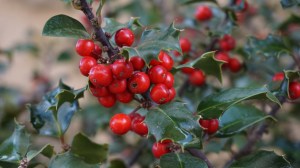
The above-mentioned carol, “The Holly and the Ivy,” has been around for at least two hundred years, but likely dates back even further as a folk song, deriving from medieval traditions in England of associating the plants with various winter festivities and customs (see, for example, KIng Henry VIII’s carol “Green Groweth the Holly“).

In North America, we have several species of holly that are native to our continents, but ivy is a different matter. Most of the “ivies” associated with the holiday season are things like English ivy, which are imports and can be very invasive and destructive if not controlled (similar vines like Japanese kudzu are notorious for the damage they do and their proliferation). If you are in North America and using holly and ivy, it might be worth thinking about picking a twining vine native to the continent, like Virginia creeper, especially if you’re planning to plant anything.

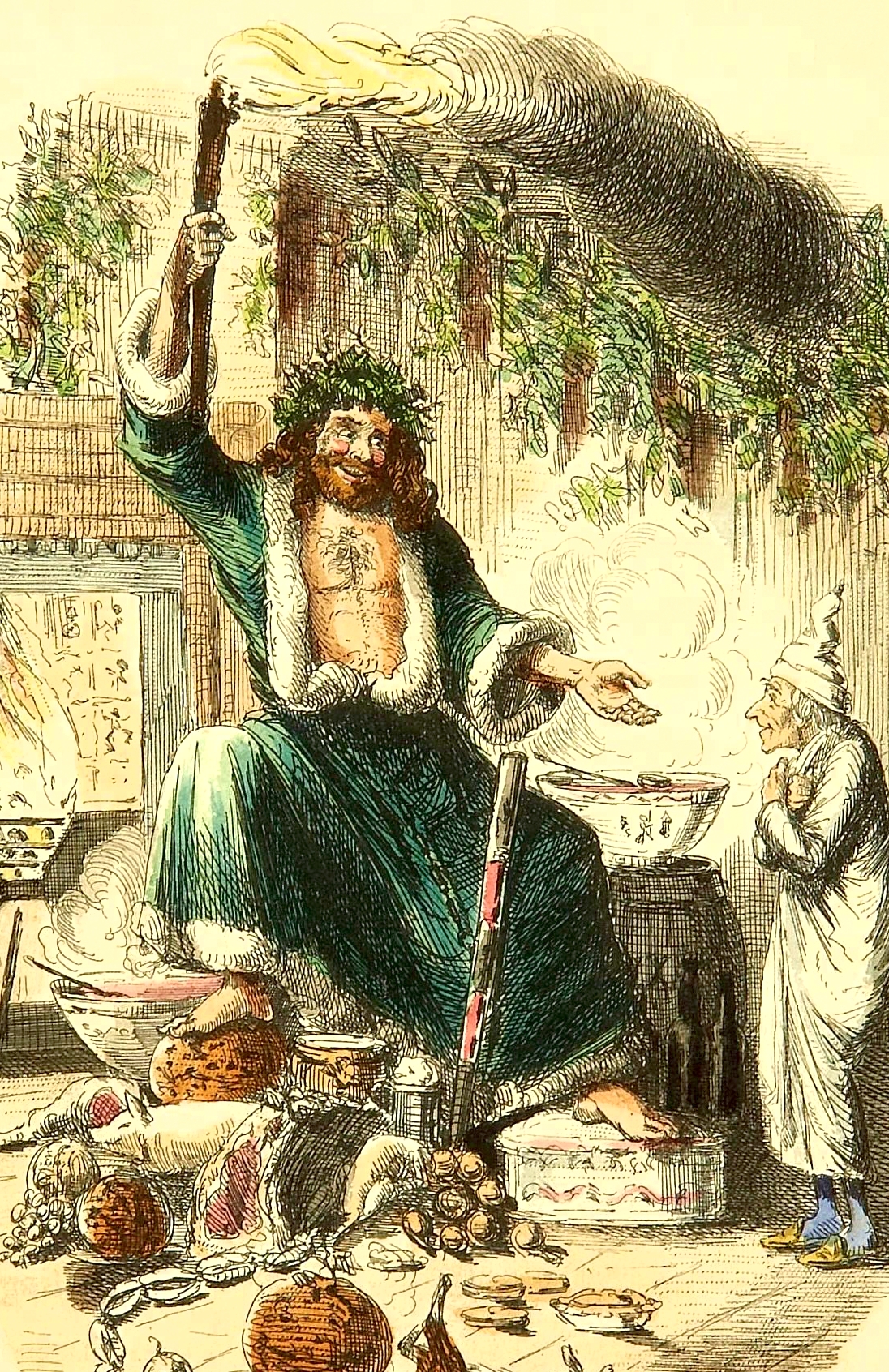
Holly has long been used to decorate for the winter holidays, including in Ancient Rome. Some stories claim that the Christian cross was originally made from holly, which is why its berries are often stained red like blood. Linda Raedisch tells of a hobgoblin named Charlie who haunted an inn in Somerset, England and liked to perch on a holly beam above the fire to warm his feet (when he wasn’t hiding all the dinnerware to annoy the guests). Raedisch also notes several important appearances of holly in the lore and literature of the UK. She points out that in the classic Arthurian tale Sir Gawain and the Green Knight, the titular swain appears at Arthur’s court to issue his challenge bearing an ax in one hand and a sprig of holly in the other. The Blue Hag of Scotland hides her magical staff under a holly bush (which prevents grass from growing beneath holly bushes in general). And of course, when the ghosts of Christmas Past and Present appear to Ebeneezer Scrooge in Dickens’ A Christmas Carol, they both bear holly as well.
While holly is often thought to be a good plant to bring in for the winter holidays, ivy is thought to bring ill fortune if carried indoors for winter festivities. Ivy is also associated with cemeteries and graves, as well as the wheel of St. Catherine, and thus, spinners and fiber workers (although it should be pointed out that St. Catherine’s wheel is NOT a spinning wheel, but a torture device…however it’s nice to see the imagery repurposed for better things). Some English lore says that ivy brought into a sick room will prevent recovery, and that taking ivy leaves from off of a church wall will doom the one who picks them to illness.

According to Judika Illes, medieval Europeans believed holly wood had the power to protect against wild animals. While the spell she references involves throwing a piece of holly at an aggressive beast, a contemporary alternative might be to take a small disk of holly wood and inscribe (paint, carve, or burn) it with the name of an animal friend or protector (a companion pet from your life or even one that you know of from books or stories). When preparing it, speak to the animal friend you have in mind and ask them to intercede with any creature you encounter and grant you safe passage. Wear the disk as a necklace or bracelet when going into wild places (possibly consider adding a couple of small bells to the jewelry, as that will alert wild animals to your presence long before you see them, and thus ensure they skedaddle before you make contact…they are usually far more scared of you, after all, than you are of them).

Holly was also thought to be protective against evil spirits. Churches and cemeteries planted holly around their perimeters in England as a way to deter pesky spirits who would get caught on the prickly leaves (this may also have worked to discourage vandals and some wild animals as well). If you do decide to plant holly, bear in mind that it is best left to grow on its own. It is considered very bad luck to cut down a holly tree.

One of the main uses of holly and ivy is in love work. A holly charm recommended by Judika involves picking nine holly leaves at midnight on a Friday. Without speaking, wrap them in a white cloth (like a handkerchief) and put that under your pillow. You should dream of your true love before daybreak. Ivy can also be used to determine who your lover will be. A Scottish charm involves plucking an ivy leaf in secret (not from a church, please) and uttering the words “Ivy, ivy, I pluck the, In my bosom I lay thee; The first young man who speaks to me, Shall surely my true lover be.”

Men hoping to attract women should carry holly leaves, and women hoping to attract men should carry ivy (those hoping to attract their same gender would carry the plant that most corresponds with their attraction: to attract women carry holly, to attract men, ivy).

You can also use ivy to discern who is working against you by wrapping a candle in ivy and burning it. The identity of your foe will become clear (likely through dreams or other omens). Ivy can help determine future illness, too, as one New Year’s divinatory ritual involves laying leaves of ivy in water on New Year’s Eve, naming each leaf for a loved one, and leaving them there until Twelfth Night (January 6th). Any leaves that are still green indicate health for that person, while leaves with black spots or those that have shriveled up reveal who will suffer great illness in the year to come (it probably helps to mark each leaf in some way, as with a dot of nail polish, to ensure you know whose leaf is whose).

And both holly and ivy can be used for more severe spellwork, too. You can put a token from a target (such as their name, a photo, or even a bit of their hair) into a bottle with twists of ivy and sharp-pointed holly leaves. Fill the bottle with black ink and some swamp water or war water, then seal it and bury it upside down. I can even imagine doing a rather dark and wicked little “sinner’s tree” of your enemies by taking a branch of holly and hanging little glass ornaments filled with your enemies’ names, holly leaves, and ivy, with a bit of black ink (they make fillable ones you can buy at craft stores, or you could just save a few small spice bottles). Tell them they will spend the next year in perdition and torment if they do not change their ways, then burn the tree  and the contents of the bottles, and scatter the ashes at a crossroads or in running water.

Of course, if they *do* change their ways, you should probably put them on your “nice” list next year and perform an equally powerful blessing on their behalf.

Thanks for reading, and a Merry Yuletide to you!
-Cory

Sources
  1. Henderson, Helene, ed. Holidays, Festivals, & Celebrations of the World Dictionary, 3rd ed. Omnigraphics, Detroit: 2005.
  2. Illes, Judika. Encyclopedia of 5,000 Spells. Harper Collins, New York: 2009.
  3. Opie, Iona, and Moira Tatem. A Dictionary of Superstitions. Barnes & Noble Books, New York: 1989.
  4. Raedisch, Linda. The Old Magic of Christmas. Llewellyn Publications, Woodbury, MN: 2013.
  5. Santino, Jack. All Around the Year: Holidays and Celebrations in American Life. Univ. of Illinois Press, Chicago: 1995.

Episode 122 – Divining the New Year

Summary:

We launch our eighth year of podcasting with an episode that looks forward to the coming months through divination. Lots and lots of divination! Laine and Cory try out several different divinatory methods (some they’ve used before, and some they haven’t), then break down what they see in the cards, beans, bones, or stones for the year ahead. Plus we do our Magical Object, which seems like child’s play but also has plenty of magical uses, too!.


Please check out our Patreon page! You can help support the show for as little as a dollar a month, and get some awesome rewards at the same time.  Even if you can’t give, spread the word and let others know, and maybe we can make New World Witchery even better than it is now.


Producers for this show: Heather, Achija of Spellbound Bookbinding, Raven Dark Moon, WisdomQueen, Regina, Jen Rue of Rue & Hyssop, Little Wren, Khristopher, Tanner, Johnathan at the ModernSouthernPolytheist, Catherine, Montine, Cynara at The Auburn Skye, Sarah at ConjuredCardea,The Trinket Witch, Victoria, Sherry, & AthenaBeth. (if we missed you this episode, we’ll make sure you’re in the next one!). Big thanks to everyone supporting us!


Play:

Download: Episode 122 – Divining the New Year

Play: 


 -Sources-

Both of us use Cory’s method of cartomancy for one of our readings. You can find out more about that in his book, 54 Devils, or by reading these posts from our past:


Laine also uses the following methods/tools:


Cory also uses the following methods/tools:

  • Rune Stones given to him as a gift, read using some of the information in Diana Paxton’s Taking Up the Runes
  • The Haindl Tarot pack, by Hermann Haindl (Rachel Pollack’s books are the top recommended interpretation guides)
  • His personal “bones” collection for bone readings. He uses elements of the technique in cat yronwode’s Throwing the Bones, as well as drawing on his experience. Some photos are below:
Cory’s rune from his divination, “Hagalaz”  
Cory’s reading using the Haindl tarot  
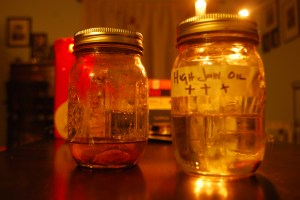
Cory’s “bone” collection for readings  
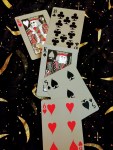
Cory’s playing card divination

Thank you to listener Maria, who suggested the Everyday Magical Object of marbles for this episode. Please feel free to send in your own suggestions for future objects!

If you have feedback you’d like to share, email us or leave a comment. We’d love to hear from you!

Don’t forget to follow us at Twitter! And check out our Facebook page! For those who are interested, we also now have a page on Pinterest you might like, called “The Olde Broom.” Have something you want to say? Leave us a voice mail on our official NWW hotline: (442) 999-4824 (that’s 442-99-WITCH, if it helps).


 Promos & Music

Title and closing music is “Homebound,” by Bluesboy Jag, and is used under license from Magnatune.


Incidental Music is “Laid Ten Dollars Down,” by the Black Twig Pickers, and is used under a Creative Commons License from the Free Music Archive.

Special Episode – The Dumb Supper

Special Episode – The Dumb Supper

Summary:

This is our first 2017 #AllHallowsRead tale, “The Dumb Supper.” A girl and her friends try out a marriage divination ritual, and find out that things don’t always go according to plan.

Play:

Download: Special Episode – The Dumb Supper


 -Sources-

This story is loosely based on a version of the tale found in Vance Randolph’s Ozark Magic & Folklore, as well as a number of other versions.


 Promos & Music

Intro music is “Grifos Muertos” by Jeffery Luck Lucas, from his album What We Whisper, used under license from Magnatune.com


Incidental music by Olssons (“Ambient One”); DR (“Sedativa I & II”); Byzons (“Apatheia (Or, The Story of a Girl Trapped in a World of Madness)),” all of which are used through Creative Commons license on SoundCloud.


Sound effects are sourced from Creative Commons licensed recordings at Sound Bible.

Blog Post 200 – Am I a Witch?

Statue of a Witch, by Gegenbach (Public Domain)
Statue of a Witch, Gegenbach (Public Domain)

I’ve always liked the word “witch.” It carries with it a lot of connotations, sure, but so few words can evoke strong reactions across the spectrum, ranging from fear to excitement to anger to joy. Witches in folklore occupy a strange space; in many stories, they seem to be dangerous and do harm (e.g. “Hansel and Gretel” or “The Witch in the Stone Boat”), but then in so many other tales they are helpers, or benign catalysts for action (as in “Frau Holle” or “Finist the Bright Falcon”). We have tackled the question of “What is a Witch?” from a lot of angles here already: answering the question generally and rhetorically, looking at aspects of a witch’s practice, seeing what it takes to become a witch, and so on. But this weekend brings my birthday, so I’m going to turn that lens inward a bit, and ask the question, “Am I a Witch?” That may seem like a bit of a ridiculous question, coming from someone who talks about using folk magic on a regular basis, but it’s a question worth asking. There are many people from various backgrounds who would likely say I’m not, based on their personal definitions of witchcraft, whether they believe it to be a religion or a practice, or both, or neither. So how do I see it? If you read the articles here, you probably want to know if my own definition of witchcraft jives with yours, right? Today, I thought it might be good to clarify just who I am and what I do that might make someone think of me as a witch of one kind or another. In an upcoming post, I will use this as a bit of a launching pad to take a look at a few ways the figure of the witch appears in North American history and folklore, and see if I can find anything that I can use to create a broad sketch of what a “New World Witchcraft” practice might look like. This is, and must be, my own interpretation, so of course your interpretation may be quite different. But my hope is that by going through this question with some thought, maybe it will open up some doorways (or hedgerows) along the way for myself and others. If you’re interested in traveling this particular crooked road with me, read on.

A section of my personal altar.


Firstly, let me talk a little about the things I do. My basic spiritual practice (and please note I’m setting this apart with fancy italics) involves a few basic rituals: weekly lighting of candles to a mix of saints, ancestors, deities, spirits, and other entities, along with offerings of incense and water and sometimes food and drink. I offer evening prayers directed at a pantheon of spiritual forces, mostly in gratitude and asking for safe passage through the night for myself and my family. Monthly, I light candles representing the new and full moons. When the dark candle is lit, I do divinations with my cards—although I should note this is not the only time I do that, and here we have a practice which may be only quasi-spiritual overlapping with the spiritual ritual of lunar reverence. It’s complicated, right? On the full moon, I offer libations and light other candles, and say prayers to specific spiritual forces I feel are connected with the moon. And that’s the big stuff. Despite recent discussions of sabbats and the Wheel of the Year, I tend to get into holidays in a more community-oriented way, attending parades or local celebrations and not really focusing on the spiritual observance of the days (although that does sometimes happen, especially during the winter months).

Reading my mother's cards.
Reading my mother’s cards.

My magical practice (again, fancy tilty-letters here) involves the aforementioned card divination, which I do more frequently in ways dissociated from a particular spiritual observance, but which does involve me calling upon some spiritual aid. I also frequently cast spells for various wants, needs, and wills. Most are incredibly simple spells, such as the creation of a petition paper and the lighting of a candle, perhaps with some anointing oil and the recitation of a psalm or charm. I might create a mojo bag to carry around and draw in a specific need or want (most often, these bags are in the “success” area, although I also do some protection bags and others as well). Periodically, I will brew up batches of condition oils to have on hand for dressing candles and bags, but if I run out of those for some reason I don’t worry, because I can usually substitute something from the kitchen in a pinch—coffee, whiskey, olive oil, etc. If someone gets a sharp bang on their shin or a cut on their finger, I’m usually right there with my little Pow-wow-style charms to ease the pain, along with an ice pack, kiss, or chocolate-chip cookie as appropriate. A few times a year I do house-cleansing and protection work, adding written charms to door lintels and washing down my front door with—well, traditional protective formulae.


Is any of this witchcraft, though? When we look at stories of witches in North America—whether derived from European, African/African American, Native, or other sources—we see witches doing some of these things in one way or another, perhaps. Fortune-telling by cards and other means seems to appear nearly universally. Zora Neale Hurston recorded tales of African American conjure women and men rifling playing cards and seeing the future. Some of the accounts of Salem’s tumultuous sorceries involved tales of divination by “Venus glass,” or through the use of a special cake baked from urine and fed to a dog, or even some evidence that accused persons like Dorcas Hoar owned divination manuals and had practiced fortune-telling for years before the trial outbreak. Other tools, like the dowsing rod or the use of geomantic shells or coins, appear in other areas, and every cultural group in American history has had some means of divination or augury. Even in contemporary times, the Ouija board has become a popular trope of adolescent divinatory rites, and remains a popular “game” among American youth.

Brewing condition oils

Witches also made use of prayers and psalms, sometimes in holy and sometimes in profane ways. Tales of Appalachian witch initiation rites discuss the use of prayers which reverse one’s baptism. In many European-derived traditions, the recitation in reverse of whatever charm had been used to blight someone would remove that curse. In tales where witches work with spirits, they may make contact with faery-creatures (see Emma Wilby’s Cunning Folk & Familiar Spirits for a truly excellent rundown of that subject), or they may keep wee bug in a bottle to talk to (as in one Appalachian story). While we get a sense of their spiritual worldview—which is heavily populated and constantly interacting with the mundane world—we seldom get a sense that witches are denominational. They might act in non-Christian or even anti-Christian ways, up to and including signing pacts with the Devil, but just as often they make use of Christian prayers and charms, and may even be very religions—if a bit unorthodox. Having a rich spiritual life certainly seems to be found in most tales of folkloric witches, but there’s very little definition around that spiritual worldview. Instead, witchcraft seems to be—from the perspective of history and folklore—less about gods and goddesses and much more about muttering under one’s breath in a time of need, or knowing not to burn sassafras wood. It’s a practice and a way of acting which is shaped by spiritual understanding, but not completely defined by it. There’s much more to say on what witches do, based on folklore (and I should also note that I am increasingly aware of the fact folklore is not something from “back then,” but something alive and moving now, so perhaps we should spend some time on contemporary witchcraft from that angle, too). I will leave all of that for another day, however, and return to the question at hand.

witch-158095_960_720

Am I a witch? I suppose it depends on who is asking. I have a fairly unorthodox spiritual practice and worldview, especially for someone living after the Modern era of rationalism and scientific inquiry. I think that my spiritual life, however, does not inherently make me a witch. It makes me an animist, perhaps, or put in contemporary economic terms, someone with a diversified spiritual portfolio. That can be a good basis for witchcraft, but it can also be a good basis for a number of practices completely outside of witchcraft. Many Christians, Hindus, and even Buddhists see such a diversity in the spiritual landscape (although they may assign different values to non-deity spirits and might even avoid all but a very few of them). What I do, on the other hand…that is witchcraft. I am a witch in divination, in charming, in meeting my needs through my own actions, and in doing so by working outside of rational methods (and please note I did not say in spite of such methods or even without also using such methods—a proper My Little Pony bandage can be just as important as a magical healing charm and a kiss to a scraped knee). I am a witch in knowing some of the ways that the world around us is constantly in conversation—whether through the growth of certain plants or the movements of certain animals or the scent and taste of the air before a storm. I am a witch in holding in me a certainty that I can do something about my circumstances, and that I am responsible for my own fate—both finding it and bending it.


Yes. I am a witch.


I hope to go a bit further and expand upon some previous discussions of what a witchcraft practice in the New World might look like. I will be turning to folklore, history, and contemporary behaviors and actions to help define that, and in the end, I will probably satisfy no one, but perhaps get into a few good conversations with the points I raise. For now, though, I hope that this article—a little bit of me put out there for you to consider—will clarify my practices a bit. I am not a perfect witch, mind you, possibly not even a very good one. Nor are my practices solely definitive of all witches everywhere. But if this article speaks to you in some way, I’d love to know. I’d love to hear if you are a witch, too.


Thanks for reading,

-Cory

Blog Post 196 – Body Lore & Magic

Hans van Hayek, The Fortuneteller, 1892 (via Wikimedia)

“My ears are burning; who’s talking about me?”

“If your nose is itching, someone wants to kiss you.”

“Your feet itch? You must be about to go somewhere.”

I remember my mother often sharing the little bits of proverbial wisdom throughout my childhood.

Usually they were delivered with a wink or a wry smile, and I don’t think she took them particularly seriously, but then she also wouldn’t have been surprised to find out that any one of these tokens had borne some fruit in the real world. If you think about it, assumptions about the intimate connection between a person’s body and the world around him or her are not anything new or unusual. Plenty of people have an uncle whose bunions predict snowstorms, or a grandmother whose arthritis tells of coming rain, or headaches that detect heatwaves moving in. There are plenty of other ways one’s body might help one prepare for a day outdoors, according to American lore:

Beyond those sorts of weather-related phenomena, however, bodies are reputed to be in touch with all sorts of esoteric information. Of course, obtaining pieces of a person’s body is a primary way of gaining magical control over him or her, but that, I fear, goes beyond the scope of this article. Instead, this brief examination will focus on the body as a giver or receiver of information, rather than a source of spell ingredients. For example, often the physical features of a person imply certain characteristics about their intellect or psychology, according to American lore:

  • A fat person is believed to have a good disposition and a friendly nature
  • A big head can be the sign of great intelligence, provided it’s not too big (which would mean a person of no wit whatsoever)
  • A person with a “long head” is thought to be someone of dubious morality and “unscrupulous” character
  • A person with a broad face is thought to be warm and friendly, while a narrow face indicates shrewdness and insensitivity
  • “Dimple on the chin,/ Devil within” – A dimpled chin indicates a troublemaking personality
  • Long arms indicate someone with a “grasping” nature, someone who will do whatever it takes to geth what he or she wants
  • Trimming a baby’s fingernails will turn it into a thief
  • And of course, cold hands mean a warm heart.

What do all of these sorts of lore have in common, then? They all seem to operate off of the ever-present Doctrine of Signatures, which we’ve seen before, and which fundamentally states that like affects like. By that logic, we can see how things like “broad face” and “big head” can be indicators of abundance with regard to particular character traits (I can only assume that the same sort of logic applies to the “fat person,” in that they have general abundance in their figure and thus must have some in their disposition towards others as well). More interesting are the less direct connections between things like trimming fingernails and later thievery in life. I would suggest that because a baby is supposed to undergo very little “reduction” during the first year or so of life (a period when their hair, body, and in some cases, teeth, are all growing more abundant), that trimming something off of the baby’s hand will make it always look for something to fill the void. That, in turn, might lead the baby to fill it with other people’s things, and thus the fear of thievery is attached to the belief. Makes sense? Coming with me on that one? (It’s fine if you don’t, of course, as these sorts of lore-bits often can have multiple meanings and origins).

Some of my favorite bodily predictors come in the form of love (and lust) lore, because they seem so appropriate to connect to how we experience our fleshly existence. I always heard that if your nose itched, someone wanted to kiss you, as I noted above (which may indicate either a lustful flag of interest if one subscribes to the nose/penis symbolism that some folklorists do, or a simple sense of “rooting out” such a person, as indicated in the paragraph on itching below). Another fairly common bit of folklore says that “a hair in your mouth means someone wants to kiss you.” Hair can have very sexual connotations (which is why it frequently gets associated with sexuality in Abrahamic religions), so its presence in the mouth would be a very reasonable indicator of lustful intent. Another bit of lore deals more with what to do if your paramour wanders off: “Throwing nail parings into a fire is a way to call a lover back to you” (okay, so this is more of a spell, but it does seem as though the nail trimmings are communicating with the other person, so I’m calling it a fit).

Itches or burning sensations on the body are of particular importance, and seem to offer very particular meaning depending on where they occur. Some examples from Kentucky lore:

  • If your ears burn some one is talking ill of you, while if your hand itches you will receive a present, or shake hands with a stranger.
  • If your right foot itches, you are to go on a journey; if the left, you are going where you are not wanted.
  • When your nose itches, some one is coming. If it is when you are away from home, you may know you are wanted at home.
  • If your right eye itches, you will cry; if the left, you will laugh.

Again, we see elements of the Doctrine of Signatures, in that ears receive the voice of others in most circumstances, so if they act in an uncharacteristic manner, they must indicate an unheard voice somewhere out in the world. Feet carry us on journies, of course, so the interesting element in that superstition is the association with particular feet and the type of journey. With the long-standing stigma against “sinister” (the original meaning of that word being “left-sided”) use of limbs, the connection between the left foot and an unpleasant journey makes some sense. The less obvious one is the nose, although we may make some guesses about why a nose would be a barometer for upcoming human contact. We might think of proverbial phrases like “sticking one’s nose where it doesn’t belong” or a “nosy person,” and understand that noses are believed to be the body part which roots for information, particularly about the lives of others, and so the nasal connection does have some precedent.

In Mexican-American folklore, bodily functions are often regulated by “hot” or “cold” natures (not dissimilar from Ayurvedic medicine). Because of those temperature associations, people can figure out important information about a person’s state of well-being based on whether small signs on the body indicate larger imbalances within the person. A great example would be hair, which is thought to be “hot” while it grows. A person whose “heat” dies away quickly, however, will likely begin to go gray, as though his or her vitality were turning to ash on his or her head. Having long hair can also help one lose weight in this estimation, because longer hair burns off more energy, thus depleting the body of its energetic fat stores.

Surprisingly few death omens connected to anything body related. This likely reflects an anxiety that bodily warnings are incredibly frequent and common, and that death should be a rare and unusual occurance, rather than anything commonplace. One of the few bits of bodily lore connected to death has to do with the loss of a limb and its disposal. Supposedly, if one loses a limb through combat or other misfortune, and fails to take off any shoes or other vestments on the detatched extension, the person will experience phantom pains so long as the problem is not corrected.

Vance Randolph collected some interesting lore which borders on a divinatory method using the appearance of spots on fingernails:

“White spots on fingernails are supposed to represent lies, and little boys often hide their hands to avoid betraying falsehoods. However, there is a fortunetelling rhyme children use when counting these white spots :

A gift, a ghost, a friend, a foe, A letter to come, a journey to go.

Some people say that a large white spot means a journey.”

These sorts of counting-out rhymes often figure in children’s play, sometimes as a means of selecting play partners and sometimes with more occult connotations, as in the spot-counting rhyme above. Why white spots should indicate lies remains open to interpretation, but if I had to guess I’d assume that the spots are thought to be the actual lies trapped beneath the glass-like surface of the nail, demonstrating that lies always come up for air, sooner or later.

I’ll close today with a little tidbit from a somewhat older book (originally published in England, but likely in circulation throughout the British colonies), which is devoted to divination via dreams and moles on the body. The entire second half of the pamphlet is about moles and their meanings, and often provides startlingly specific and inalienable interpretations of mole size, shape, and position. One such indicator: “If a Mole is on the crown of the head, it shews another on the nape of the neck, and the party witty, and to have good natural parts: but that he will die poor.” I would say that indicates that a pair of moles is a bit of a mixed bag, wouldn’t you? I think I’ll go back to being a bit heavyset and being perceived as friendly, then.

Thanks for reading!

-Cory

Sources:

  1. Bronner, Simon J. Explaining Traditions. 2011.
  2. Bronner, Simon J. American Children’s Folklore. 2006.
  3. “Dreams & Moles, with their Interpretation & Signification.” Published by the Royal Society of London, 1750.
  4. Dundes, Alan. Interpreting Folklore. 1980.
  5. Hyatt, Harry M. Folklore of Adams County, Illinois. 1935.
  6. Ingham, John M. “On Mexican Folk Medicine.” American Anthropologist. 17, (1): 76-87.
  7. Price, Sadie F. “Kentucky Folklore.” The Journal of American Folklore. 14, (52): 30-38.
  8. Randolph, Vance. Ozark Magic & Folklore. 1964.
  9. Smith, Grace. “Folklore from ‘Egypt.’” Hoosier Folklore. 5, (2): 45-70.

Podcast 75 – Moon Magic

Summary:
We’re back with our eyes on the sky, talking about the role of the moon in magic. We’ll discuss the divinity, folklore, and practical spellwork we associate with our lovely satellite, and make a plan for kick-starting our witchy engines in the moonlight. Plus, a new contest!
Play:
Download: New World Witchery – Episode 75

-Sources-
Please continue to keep Laine in your thoughts and prayers, as she is dealing with a serious (but thankfully not life-threatening) medical issue.

Books Mentioned:


Friends:
Sindy Todo of Todomojo.com is hosting the Northwest Crossroads Retreat soon. Check it out!

Big thanks again to Atticus Hob, who recently announced that his show is indefinitely off the air, but who did a marvelous job as our co-host last month. Check out his Orphan’s Almanac site for updates.

We talk about the concept of moon calendar names, a subject derived from a recent discussion on Betwixt & Between.

Our apologies for the technical glitch in the middle of the episode. We’ll try harder next time, we promise!

Also, check out the Spring Lore 2015 contest, and win one of three great prizes!

If you have feedback you’d like to share, email us or leave a comment. We’d love to hear from you!

Don’t forget to follow us at Twitter! And check out our Facebook page! For those who are interested, we also now have a page on Pinterest you might like, called “The Olde Broom.”

Promos & Music
Title music:  “Homebound,” by Jag, from Cypress Grove Blues.  From Magnatune. Incidental music is “Calling the Moon,” by Dar Williams and “Channel Z,” by the B-52’s.

Promos:

  1. The Irish & Celtic Music Podcast
  2. Druidcast

Podcast 67 – Curanderismo with Carolina Gonzalez

Summary:

Tonight we have an interview with the magical Carolina Gonzalez, a curandera based in the Canary Islands. We’ll also have a brief overview of what curanderismo and brujeria are, and we announce a new contest!

Play:

Download: Episode 67 – Curanderismo with Carolina Gonzalez

 -Sources-

We definitely think you should check out the Camino de Yara site, home to our guest, Carolina Gonzalez. While you’re there check out her sites on Maria Lionza and her shop, too!

The article I read is Blog Post 134 –Brujeria and Curanderismo: A (Very Brief) Overview. You can find links to all my references there as well.

I’m going to be at the Philadelphia Pagan Pride Day on August 30, 2014, if you care to stop by!

I will also be at the next Pagan Podkin Supermoot, hosted by Fire Lyte in Chicago (in conjunction with the Pagan Pride Day up there).


Please send in contest entries to compassandkey@gmail.com! We are giving away a copy of 54 Devils (my book, in either digital or print form, whichever you prefer) and a digital copy of Carolina Gonzalez’s book on reading the Spanish cards as well. All you have to do is send us your weirdest or most unique piece of personal holiday lore, along with a name we can read on-air and a general location (‘Illinois’ or ‘the Midwest,’ for example).

If you have feedback you’d like to share, email us or leave a comment. We’d love to hear from you!

Don’t forget to follow us at Twitter! And check out our Facebook page!

 Promos & Music

Title music:  “Homebound,” by Jag, from Cypress Grove Blues.  From Magnatune.

Incidental music is “Corrido de Ixtlahuaca,” by Ixtlahuaca and “Arrancame la Vida,” by Chavela Vargas, both from Archive.org.

Promos:

1.  Gaia Update (with Kathleen Borealis)

Blog Post 190 – Magical Gift Giving

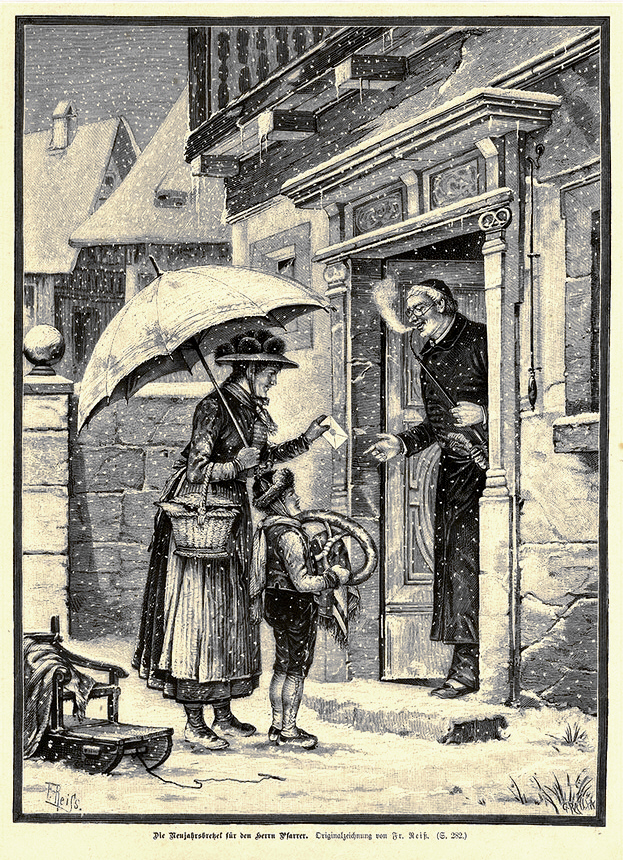
“Die Neujahrsbretzel für den Herrn Pfarrer”, 1884 (via Wikimedia Commons)

I’ve had several people recommend a book to me called The Five Love Languages, by Gary Chapman. It’s a book that looks at the various ways in which people give and receive love. It gets into a lot of psychology and interpersonal communication theories, but in a nutshell it assumes that people tend to give or receive affection via physical touch, loving words, acts of kindness or service, quality time, or gifts. I am definitely a gift-giver when it comes to expressing my feelings—I will work for weeks to handcraft something for someone I care about. When my lovely wife and I were courting, I put hundreds of sticky notes all over her apartment with love messages so that she would constantly find them for months and months afterwords. Even when we ship products out of our Etsy shop, I tend to add layers of Spanish moss to the packing material, as well as little lagniappe touches to the shipment to make it feel magical for the person who opens the box. None of this is to brag, but simply to frame the point that giving gifts is a major part of my connection to others.

Giving gifts has been an important aspect of human relationships for a very lnog time. The Ancient Roman patronage system essentially operated on a large-scale gifting economy. In North America, giving gifts with a magical bent appears time and again. A number of superstitions and rituals surround the acts of gifting and receiving gifts. Possibly one of the gifts most beset by magical rules is the knife:

  • One must not give a friend a knife or other sharp instrument, as it “cuts love.” (Price 34).
  • “Giving a knife as a gift is bad luck as it cuts the friendship” (Hines 12).
  • A present of knives will break the friendship between you (the giver) and the recipient of the gift. (Hines 13)
  • No hillman would think of giving a steel blade to a friend such a gift is sure to sever their friendship (Randolph 58).

The ‘hillman’described in the last point would have been obliged to pay for a knife if he received it as a gift, in order to abate any potential tragedies:

Whenever a knife changes hands, it must be paid for, even if the sum is merely nominal. I have seen a salesman, a graduate of the University of Missouri, present his son with a valuable hunting knife but he never let it out of his hand till the boy had given him a penny (Randolph 58).

This is a sentiment I’ve seen echoed through other traditions as well, including some Wiccan circles and their beliefs about gifting athames. I have also seen contrary points, insisting that Wiccan ritual blades must never be purchased, but only gifted.

Knives, however, are only scratching the surface of the myriad taboos, beliefs, and customs surrounding giving and receiving. In the following paragraphs, I hope to lay out some of these traditions (though certainly not all of them… The concept of Christmas and birthday gifts is well outside the scope of a single survey article, for example, and the topic is much larger than a 2,000 word synopsis could handle). What I hope that you will see is the sheer humanity of this process. People seem to develop an entire language around gifting (see the Victorians and their flowers, for example), and understanding that language, especially within a magical context, expands the conversation on American folk magic immensely.

Since we’ve started in the domestic realm with knives, let’s continue in that vein. In the Ozarks, even very small gifts can have great significance:

A button received as a gift is always lucky, no matter what the color. Years ago, many an Ozark girl collectedbuttons from her friends and strung them together into a sort of necklace called a charm string. A charm string not only brought good fortune to the owner but also served as a sort of memory book for women who could not read one button recalled a beloved aunt, another a friend’s wedding, still another a dance or a quilting party or an apple-peelin’ or some other pleasant occasion. (Randolph 61)

These little tokens often represent a greater whole. In the example Randolph cites the ‘memory book’ aspect of the charm pushes it out of the realm of luck and into a broader realm of personal narrative. It tells the story of where the girl has been. The luck may then be a cumulative blessing from all those around her, an assembly of good wishes designed to attract further goodness into her life. Similarly, some fairly small gifts can act as predictors or insurance of future blessings, as in these two examples from Louisiana:

  • A midwife should plant a flower for a baby at its birth.
  • It is good luck for visitors to place a silver coin in a baby’s hand (Roberts 150).

Here we see blessings which ensure growth and health (the flower) and insurance against poverty (the coin) passed onto a baby, with the hopes that the child will grow and prosper in the future.

Of course, there are just as many taboos on gifting as there are joyous customs. As we saw with knives, some of those can be firmly established and nigh universal at times. Let’s look at another domestic commonplace with strong taboos:

  • Never borrow salt or you will have bad luck (Hines 12).
  • Never return salt that has been borrowed (Roberts 178)

Why salt? In my family, we frequently gave salt as a component of a new house blessing for people we knew, which as I understood it derived from Polish traditions (after investigating this a bit, I’m reasonably sure this was adopted from a similar Jewish custom picked up by my family in the area on the border between Lithuania and Poland). We give a jar of salt with some bread and a penny in it, ‘So that the family may never be hungry (bread), never be poor (penny), and their lives may never lack flavor (salt).” The salt, then, can be seen as the experience and cumulative personality of the family, its seasoning or flavor which makes it distinct. Borrowing someone else’s flavor would, in essence, give them power over you, especially when the salt is returned carrying traces of your own eau de familie. It could also be that by taking one family’s wisdom and experience, then returning it, you set off a disruptive cycle whereby your two families will be struggling to rebalance power for a long time, which definitely sounds like bad luck. A similar Louisiana superstition says ‘Don’t give spades, etc., to your neighbors; you will have a fuss if you do (Roberts 174). In that case, the tool is symbolic of a person’s work and labor, and to lend it out cheaply doesn’t bode well for anyone (and makes me think of Homer Simpson borrowing essentially every tool in Ned Flanders’ garage…a very bad neighbor).

The issue of when a gift is given can also impact its significance and magical qualities. While I will avoid holidays and the like here, there are plenty of other occasions when gift-giving is an expectation, such as at baby showers:

  • At a baby shower, the giver of the seventh gift to be unwrapped will be the next to have a baby (Hines 14).

In this example, the gift-giver receives the magical benefit of a prediction. I suppose that if you are not in the market to start a family, this superstition could seem more like a taboo than a blessing. Another key occasion for giving gifts is after a new family moves into a new home. I mentioned my family’s custom for making a house-blessing from my Polish roots, but it turns out that the general concept of the house-warming may come from the other side of my family tree in the British Isles. The hint of magic behind this tradition comes from the original house-warming present, which actually served to warm a new home:

“As poet John Greenleaf Whittier noted…’The Irish who settled here about the year 1720, they brought indeed with them, among other strange matters, potatoes and fairies.’…The Scots [who were also early settlers in America, particularly in the Mid-Atlantic region and parts of Appalachia]…believed in ‘brownies,’ a more subdued version of the leprechaun. Brownies lived in the kitchen fireplace, and the belief was that the owners of the house had a responsibility to always keep these fairy-creatures warm by keeping a constant fire in the hearth. The Yankees noted that Scots-Americans, when moving from one house to another, would always remove burning embers from the old house to the new, to provide a warm home for the brownies that would move in right along with the family. This was how the tradition of ‘house-warmings’ started” (Cahill 32).

I tend to think this is a bit of fancy on Cahill’s part, and that the giving of gifts to new homeowners is something much older and less literal than a brownie’s ‘house-warming,’ but I would be completely unsurprised to find that the actual practice of moving hearth coals to entice fairy-beings to move houses exists in the Old World or the New.

Marriage also features a number of gift-giving customs, some with superstitious components. For example, in Kansas groups of Russian-German emigrants pin money to the bridal skirt as a way of blessing the bride and groom with prosperity. Additionally, a fun game is made of the best man’s gift, and the “custom of some young buck’s stealing the shoe of the bride. The best man had to redeem the shoe with cash, which went into the household fund” (Tallman 227-8). The best man might contribute some or all of the money, with the remainder raised by good-natured begging of the wedding guests.

A number of tales from Appalachia and New England, including stories from Hubert Davis’ The Silver Bullet and other collections of supernatural American folklore, indicate that magical gifts have particular rules when it comes to witches. For example, a witch might offer a very low price for some livestock or sundries she fancies from a local homestead. If she is refused the gift—which is all such a lowballed agreement could be seen as—she curses whatever it is she wanted, rendering it useless to the family that has it. Often she will curse a cow so it won’t produce milk, or she might even curse an entire herd of pigs or sheep rather than just the one she wanted. On the flip-side, a witch should never be given a present of anything from the household, or she could use it to harm those who dwell within. One story features a housewife who loans the local witch-woman a cup of sugar in a neighborly—if cautious—manner, only to find her butter won’t come when she churns it afterwords. She summons a local witch-doctor who takes a piece of hot silver and drops it in the churn, then spills cream on the fire and whips a pan of the scalded dairy until they hear shrieks from the direction of the witch-woman’s home. She, of course, suffers great pains and bears the marks of a whipping and burning the next day, and everyone knows just what’s what. Oh, and the butter is fine after that, too, of course.

Not all witches or magical practitioners are conniving and dangerous when it comes time to share the wealth, though. For example, many witch-doctors and conjurers in the Southern Mountains will not take direct payment for their work, but only offers of gifts made in-kind, such as foodstuffs, clothing, or other necessities. Vance Randloph noted that one witch woman in the Ozarks did not ask a fee for her work, but would accept such donations: “This woman makes no charge for her services, but if somebody offers her a present, such as a new dress or a side of bacon, she seldom refuses the gift” (Randolph 126).

Lest you think all these magical gifting traditions are limited to the realm of humanity, here’s a bit of lore from John George Hohman’s Long Lost Friend to show otherwise:

A GOOD METHOD OF DESTROYING RATS AND MICE.

Every time you bring grain into your barn, you must, in putting down the three first sheaves, repeat the following words: “Rats and mice, these three sheaves I give to you, in order that you may not destroy any of my wheat.” The name of the kind of grain must also be mentioned. (Hohman 70).

Here we see the old idea of “one for the rabbit, one for the crow, one to rot, and one to sow” extended from nursery rhyme to magical practice. Giving the animals a bit of the household bounty seems to be a way to stave off any thievery on their part, at least in this example.

Finally, I can’t help but offer up a humorous story from Maryland which shows animals getting in on the gift-giving action:

It seems that Mrs. Morison’s uncle and her father went fishing one time and as always they carried their [moonshine] jug along. They came to this water moccasin who was just about ready to swallow a frog. So Mrs. Morison’s father took a forked stick and clamped it down over the snake’s head and took it [the frog] away ‘cause they wanted to use it for bait.

Well, that snake looked so darn downhearted that they gave him a drink of moonshine, and off he went. So they went on with their fishing and about an hour later one of them felt a tug on his leg. He looked down and there was that snake back with another frog. All I can say is, that must have been awful good moonshine” (Carey 31).

I’m not sure if the ‘magic’ in that tale is so much in the moonshine or the moccasin, but I couldn’t resist sharing it with you.

I’m sure there are many other magical giving traditions I’m missing here, so if you have any you want to share, please do!

Thanks for reading,

-Cory

Sources

  1. Cahill, Robert Ellis. Olde New England’s Strange Superstitions (1990).
  2. Carey, George G. Maryland Folklore (Tidewater Pub.: 1989).
  3. Davis, Hubert J. The Silver Bullet, & Other American Witch Stories (Jonathan David Pub.: 1975).
  4. Hines, Donald M. “Superstitions from Oregon,” Western Folklore, Jan. 1965.
  5. Hohman, John George. The Long-Lost Friend (Llewellyn, 2012).
  6. Price, Sadie. “Kentucky Folklore,” Journal of American Folklore, Jan-Mar 1901.
  7. Randolph, Vance. Ozark Magic & Folklore (Dover: 1964).
  8. Roberts, Hilda. “Louisiana Superstitions,” Journal of American Folklore, Apr-Jun 1927.
  9. Tallman, Marjorie. Dictionary of American Folklore (Philosophical Library, NYC: 1959).

Podcast 66 – Sacred Artistry with Bri Saussy

Summary:
In tonight’s episode (slightly belated, my apologies), we have an excellent discussion of Sacred Artistry and Enchanted Worldviews with the wonderful Bri Saussy. I bookend the interview with a pair of readings on the topic as well. Thanks for your patience, and I hope you enjoy this episode as much as I did!

Play: 
Download: New World Witchery – Episode 66
Play: 

-Sources-

  1. Of course, you should check out Bri’s excellent site, Milagro Roots.
  2. While you’re there, consider signing up for one of her courses, such as Star Magic or Diagnostic Tarot.
  3. Bri recommends Terri Windling’s Myth and Moor blog during the interview.
  4. I read from (and highly recommend) Draja Mickaharic’s  Spiritual Cleansing and Suzi Gablik’s Living the Magical Life.

Keep watching for information on the next Pagan Podkin Supermoot, hosted by Fire Lyte in Chicago (in conjunction with the Pagan Pride Day up there).

If you have feedback you’d like to share, email us or leave a comment. We’d love to hear from you!

Don’t forget to follow us at Twitter! And check out our Facebook page!

Promos & Music
Title music:  “Homebound,” by Jag, from Cypress Grove Blues.  From Magnatune.
Promos:
1)      Betwixt and Between

Podcast 62 – Pregnancy and Birth Lore

Shownotes for Podcast 62 – Pregnancy and Birth Lore

Summary:
In this episode we’re trying out the wedding ring test, asking about spicy foods, and trying not to scare any birthmarks onto Laine’s baby as we talk about the lore and folk customs surrounding pregnancy and childbirth.

Play:

Download: New World Witchery – Episode 62

-Sources-

We mostly mention various lore we remember without citing sources, but I do mention a few books:

Pagan Podkin Super Moot 5 is going to be in Chicago! Watch Fire Lyte’s page for more detail to come.

Cory is going to be moving to Pennsylvania in the Fall, which may impact the show and blog a bit (but probably for the better in the long run)

If you have feedback you’d like to share, email us or leave a comment. We’d love to hear from you!

Don’t forget to follow us at Twitter! And check out our Facebook page!

Promos & Music

Title music:  “Homebound,” by Jag, from Cypress Grove Blues.  From Magnatune.

Promos:

  1. Lamplighter Blues
  2. Welcome to Night Vale