Today we’re tackling a hodgepodge of springtime symbols, including rabbits, eggs, maypoles, and flowers. We’ll discuss some of the myths and folklore surrounding these icons of spring, as well as some of the spells and magic that use these elements.
Some springtime symbols in fiction that might be of interest include Louisa May Alcott’s “May Flowers“ and Nathaniel Hawthorne’s “The May-pole of Merry Mount.”
Big thanks again to Atticus Hob, who recently announced that his show is indefinitely off the air, but who did a marvelous job as our co-host last month. Check out his Orphan’s Almanac site for updates.
Kirkridge Shelter sign, Appalachian Trail near Fox Gap, Monroe and Northampton Counties. Photo by Nicholas A. Tonelli (Wikimedia)
Exploring American folk magic means looking under lots of stones, poking about in the weeds on the roadside, and scaring furry little critters out of their hiding spots as we try to discover the methods that have been used to solve problems throughout the years. Whether it’s using potatoes to cure warts or making your spare change break an incoming hex, the techniques of folk magic demonstrate a masterful application of resources at hand to get the results a body needs. Which brings me to the subject of this article, the practice of “plugging” to heal disease.
Largely found in the mountain regions of America, although it also appears in a few other places as well, the basic practice of plugging consists of measuring a person against a tree, boring a hole in the tree, then filling and stuffing the hole (or “plugging” it, obviously). Some folks also call the practice “pegging” rather than “plugging,” since the bored out chunk of tree forms a natural peg (and since the image of a peg may have a more biblical connotation to some practitioners, since a tent peg is used in the Book of Judges to kill an enemy of the Israelites). Once the person measured against the tree grows past the height of the hole, he or she should be cured of the disease. Of course, this means that the person must still be growing, which essentially means this method is used to help children with chronic illness rather than adults. There are a few variants in the practice, which we’ll get to, and some of those provide relief for adults, but for now let’s look at some of the typical examples:
“Drill a hole in a black oak or sourwood tree just above the head of the victim [of asthma], and put a lock of his hair in the hole. When he passes that spot in height, he will be cured. (Another person told us that if the person died, the tree would also.)” –Foxfire Book, p. 231
This is probably the most basic version of the method, although it is more specific about the tree than many versions. For the most part, the remedies simply say “a tree,” although some will indicate a preferred species to affect a cure. One Southern spell says that “chills can be driven away by boring a deep hole in the sunny side of an oak tree, blowing your breath into it, and plugging up the hole, with the result that the tree dies” (Botkin, Treasury of Southern Folklore, p. 630). Variants from the Foxfire 40th Anniversary book also say you can do the remedy with a black gum tree, and interestingly, you can use a detached form of the plugging remedy: “Take a sourwood stick the size [height] of the child when he’s two or three years old. Put it in the top of the house where it won’t get wet. When the child outgrows the stick, the asthma will be gone. This also works for hay fever, and some say it can be done with any “dry stick” by placing it “under the doorstep” (p. 349). The last examples show that the power to heal is not directly tied to a living tree, but simply to the qualities of wood, since the twigs are detached form their trunk before use in the spell.
Plugging is hardly an Appalachian phenomenon, however. A bit of lore from Indiana is very similar to the mountain method: “Measure the baby’s height on a tree and make a hole at this point in the tree. Then cut off a lock of the baby’s hair and put it in the hole. When the bark of the tree grows so as to cover the place, the baby will be well” (Grace Smith, “Folklore from ‘Egypt’,” p. 70). John George Hohman reports a version of plugging which resembles the detached plugging in the sourwood stick example above: “Cut three small twigs from a tree — each to be cut off in one cut — rub one end of each twig in the wound, and wrap them separately in a piece of white paper, and put them in a warm and dry place” (Hohman, Long-lost Friend). One collection of lore from Louisiana is rife with examples of plugging:
379. To cure a child of asthma stand him up by a post and lay a knife on his head and run it into the post. When the child grows above this knife he will no longer have asthma.
380. Negroes cure asthma by taking some of the victim’s hair, tying it up in red flannel, and putting it in the crack of the door.
381. To cure a child of asthma stand him up against a tree and bore a hole just above his head. Into this hole put some of the child’s hair and then stop it up. When the child grows above the hair he will no longer have the asthma.
382. To cure a child of croup stand him up against a tree and run a knife through his hair into the tree burying some of his hair. When the child grows above the hair he will no longer have the croup…
385. A way to cure croup is to bore a hole in the wall behind a door at the height of the child’s head. Put some of the child’s hair into the hole and cork it up. The child will no longer have croup…
389. To keep a child from having whooping-cough take him to a house that is just being built, stand him against the wall, and bore a small hole in it just above his head. Then put some of his hair into it, plug up the hole, and cut the hair off. As he grows above this he will not have the whooping-cough. (Hilda Roberts, “Louisiana Superstitions”)
Many of these are in “Superstitions from Oregon,” by Donald Hines, demonstrating that the practice is hardly a unilocal one. Henry Middleton Hyatt recorded dozens of incidents of plugging in his “Folklore of Adams Co., Illinois” collection. One such example somewhat resembles the practice of plugging without the use of a tree mentioned in the collection above:
“If you have asthma, take and stand the person up against a door — the door must be an outside door — bore a hole in the door at the top of their head, save the sawdust, then put a lock of their hair in this hole, then the sawdust, then the plug. When the person grows above that hole, they will be well. Do you see that hole in the kitchen door over there? Well, that is where we tried this on my niece, and she got well.” (Hyatt).
The use of the wall or door as a substitute for a tree may stem from the fact that—at least in most homes prior to very recent times—these objects would have all been made of wood, and so might have retained the general properties of trees. Since it is unlikely that those doing the boring would know exactly what wood their walls or doors are made of (although in some older cases they might have known), I think this demonstrates the point that the type of tree used for the cure was less important than the fact that it was a tree.
While a number of these techniques do specifically apply to children, in some cases the practice was extended to adult patients as well. In several of Hyatt’s examples, plugging is used to cure excessive bleeding without any relationship to the patient’s growth:
Profuse bleeding in a horse is stopped by boring a hole into a tree, putting in it some of the blood, and plugging up the hole with a wooden peg.”
To check a bleeding caused by a cut, bore a hole into a soft maple tree and plug up in this hole some of the blood”
In this pair of examples, we can see a general sympathetic magical principle at work, since the stopping of the hole represents the stopping of the wound, and the symbolic transfer of the hurt to the tree. In many cases, the plugging action creates a symbiotic enchantment between the patient and the tree. Several accounts claim that if the tree sickens and dies at some point in the future, so will the person healed by its intervention.
Healing is not always the aim of the plugging, either. One Appalachian plugging says, “When you pull a tooth, drive it in an apple tree, and good luck will follow” (Gainer, 125). Likewise, the healing accomplished in some cases may not be physical, but mental. Some Appalachian lore says that putting hair from a recent haircut under a rock will prevent headaches, a sort of form of plugging (probably because birds can’t get the hair and weave it into their nests, which is believed to cause headaches or madness). Surprisingly, plugging has received little attention as a magical practice (although I somewhat suspect that its lack of marketability and a general inclination against drilling holes in things in the modern age have something to do with that). I hope this brief glimpse into the practice gives readers a chance to explore plugging a bit further, as we really only have the very tip of a rather large iceberg here. If you have additional information on plugging you’d like to share, we’d love to hear it!
Summary:
We’re back with our eyes on the sky, talking about the role of the moon in magic. We’ll discuss the divinity, folklore, and practical spellwork we associate with our lovely satellite, and make a plan for kick-starting our witchy engines in the moonlight. Plus, a new contest! Play:
Download: New World Witchery – Episode 75
-Sources-
Please continue to keep Laine in your thoughts and prayers, as she is dealing with a serious (but thankfully not life-threatening) medical issue.
Big thanks again to Atticus Hob, who recently announced that his show is indefinitely off the air, but who did a marvelous job as our co-host last month. Check out his Orphan’s Almanac site for updates.
We talk about the concept of moon calendar names, a subject derived from a recent discussion on Betwixt & Between.
Our apologies for the technical glitch in the middle of the episode. We’ll try harder next time, we promise!
Promos & Music
Title music: “Homebound,” by Jag, from Cypress Grove Blues. From Magnatune. Incidental music is “Calling the Moon,” by Dar Williams and “Channel Z,” by the B-52’s.
You can find Cory’s article on magical books, including Joshua Gordon’s Commonplace Book, in Witches & Pagans magazine. He also mentions Rob Chapman’s Pow-wow Grimoire, and both discuss Grimoires by Owen Davies. We also both recommended the recend Llewellyn edition of Hohman’s Long-lost Friend, edited by Daniel Harms. Hob highly recommends Jim Baker’s Cunning Man’s Handbook.
Please stop by Hob’s current website, the Orphan’s Almanac, which is a wonderful fusion of the esoteric, the poetic, and the curious.
If you have feedback you’d like to share, email us or leave a comment. We’d love to hear from you!
Let me begin by saying I have wanted to review this book for a long time. Primarily, that is because I have wanted to read this book for a long time, at least in something beyond excerpted form, which is the best I’d been able to do. The book itself seems to be out-of-print, and runs upwards of seventy-five dollars on the second-hand market, and I have always just told myself that when I find a copy for less than fifty, I’ll grab it then. Thankfully, my friend Atticus Hob did a sort of book exchange with me, and let me borrow his copy, and so I have finally been able to dive fully inot Gandee’s text and join him on his meandering journey through his mystically charged coming-of-age tale of sexual awakening, spirit contact, and magic.
I knew of this book for a long time before I read it, largely because one of the people whom I consider a teacher and friend, Jack Montgomery, studied with Gandee during the seventies. Jack included stories of his experiences in his own work, American Shamans, which has already been mentioned before (and we interviewed Montgomery in an earlier episode, too). What I knew the most about was Gandee as an adult, living a hexenmeister’s life and dispensing his perspective for an eager grad student. Strange Experience lives up to its title, showing that Gandee’s youth and development—both magically and personally—were extremely unusual, yet not at all unfamiliar to anyone who has struggled with identity at some point in his or her life.
The book is broken into nineteen chapters and an introduction, with titles such as “A Dead Man’s Treasure” and “The Strangest Prayers are Painted.” Each chapter is introduced with a hex sign—a Pennsylvania German art design frequently seen on barns in Lancaster and Berks Counties. Some of the signs are essentially reproductions of old barn signs, but a number of them are Gandee originals, and all have short explanations about their significance and attributed powers (such as “perpetual watchful protection and guidance” or “man’s power to create through mental and spiritual action”) (pp. 27, 115). He begins with his childhood, which launched on a turbulent evening and never seems to have settled down much. He regularly saw his mother in his tender years, but was largely raised by other relatives, mostly his grandmother. The book explains that Lee’s childhood was full of demons, ghosts, hauntings, and apparitions, but that most people he knew simply accepted those as part of the world in which they lived.
Gandee quickly shifts gears into a bit of a sweet if emotionally confounded romance with a boy named Stud, whom Gandee clearly regards as the love of his life, although he goes to great lengths to account for this love as something other than homosexual. The struggle for sexual identity dominates the book, at least as much as any aspect of magic or regional culture, and Gandee eventually recounts a past life in which he was a sort of sacred prostitute named Zaida, and Stud was a sailor with whom she fell in love. The romance was doomed by jealousy in the past, and in their reincarnated state the two boys don’t fare much better.
Much of the book recounts the simply mind-boggling spiritual world of Gandee, which ranges from the native hexenmeister-craft he practices (including the aforementioned chapter on painting prayers through hex signs) to working with Christian Science methods and encountering ferocious ghosts in Mexico (in the chapter “Ni; Uari! Go!; Die!”). Gandee runs a group of spiritual mediums in college, helps find lost things, manifest desires for his friends and neighbors through art, and studies the powers of animal magnetism and hypnosis along the way. He generally tries to rationalize what he experiences in a blithe, worldly tone, although in many spots he is clearly as swept away by circumstances and wonder as any reader might be.
The information on hexerei and Pennsylvania Dutch magic is incredibly interesting, and shows a tremendously syncretic, vibrant faith-based practice. A student of the pow-wow/braucherei culture would gain a great deal from a close study of the many charms and stories shared by the author, and a student of folk magic generally might see some of the potential inner workings of well-known spells in the book, too. When reading Strange Experience, however, any reader would do well to remember that the experiences are only those of Gandee, and do not speak for a larger culture generally. Gandee was certainly a distinct individual, and the things he writes about are connected to very old practices and traditions, but he quite openly acknowledges the changes he has made over time as well.
Because of the paucity of good, first-hand accounts of this sort of folk magic, Gandee’s book stands out in its field. It hardly reads as a dissection of Pennsylvania German religious or magical culture, and Gandee himself is hard to pin down at times (which is largely the point of his text). I feel that the questions about magical ethics, regional distinction, and social dynamics for sorcerors and their communities all make for good intellectual fodder, even if Lee’s conclusions about such things seem, well, strange. I do hope that others will read this book as well and that Gandee’s place in the pantheon of American magicians might receive a restoration of sorts. What he manages to accomplish in this book is far different than any magical how-to manual, because Strange Experience highlights the humanity of a man with feet in two worlds, belonging to none.
Summary:
We begin 2015 wih a look at protection spells, as well as some talismans of interest. We also have an adorable background guest star visitng us. Play:
Download: New World Witchery – Episode 73
Some of the various protective charms and talismans we discuss include: horsehoes, silver (including Mercury dimes), salt, iron, evil eye beads, the ojo de dios/God’s eye, dreamcatchers, gargoyles, the rowan cross, the SATOR and Abracadabra charms, and High John root.
I mention (and recommend) the Sweet Dreams oil from Mrs. Oddly
If you have feedback you’d like to share, email us or leave a comment. We’d love to hear from you!
Don’t forget to follow us at Twitter! And check out our Facebook page! Promos & Music
Title music: “Homebound,” by Jag, from Cypress Grove Blues. From Magnatune.
Salting down pork, Calvert County, Maryland. From Library of Congress.
Since we just passed that high holy day of good fortune, January 1st, luck has been on my mind. We’ve certainly discussed a lot of tradiitons associated with the New Year and good luck before, so this isn’t going to be a particularly in-depth post, but I had the tickling little idea in my head that it might be interesting to round up a number of the different ways in which people “eat their luck,” especially in conjuction with New Year’s Day (be it the January date or an alternative annual commemoration, such as Chinese New Year). I, of course, eat my black-eyed peas every year for good fortune and health in the coming twelvemonth, but since I’ve covered that before, I’ll skip it here and instead start with some of the other staples from the table of Fortuna.
Cakes
I’ve covered cakes more generally in a separate post, but I wanted to mention here the typical Epiphany treat for Mexican and Mexican American families, the rosca de los reyes (or Kings’ Bread, after the three wisemen/kings who visited Jesus on Epiphany according to some Christian lore). The cake would include a number of fruits, nuts, and spices, all of which had connotations of prosperity. According to the book Mexican-American Folklore, “The bread is formed into a ring resembling a crown, and baked into it are a tiny doll representing the Baby Jesus, along with whole almonds and coins…Anyone who weats a piece of the bread with a coin or almond in it is assured of good luck for the coming year; the finder of the Baby Jesus is expected to give a party for the group on the Feast of Candelaria, February 2nd” (p.219).
Cakes also show up in some Gypsy/Romany lore, with a bit more of an emphasis on luck in love. According to A Romany Tapestry, by Michael Hoadley, Gypsy girls would indicate their approval of a potential love-match by tossing him a cake with a coin inside over a hedge (p. 33).
Pork & Cabbage
When I moved to Pennsylvania this past year, I knew I was entering the heart of a highly folk-oriented culture, and during the holiday season a number of folk traditions became near and dear to me. One new tradition we incorporated into our New Year’s festivities was the eating of pork and sauerkraut (athough we actually did roasted cabbage lightly treated with lemon juice, so it wasn’t completely traditional). The lore surrounding the consumption of these dishes on New Year’s in Pennsylvania Dutch culture ties to the need for forward momentum and prosperity in the coming year. According to the American Folklife Center, “Some traditional foods include pork, because the hog roots forward, symbolic of progress (chicken or other fowl is avoided because it scratches backwards).” Don Yoder, the dean of PA-German folklore, devotes an entire chapter to the subject in his book, Discovering American Folklife.
The tradition of eating pork and sauerkraut (or some other variant cabbage dish) has imbued New Year’s with a connection to pigs beyond the handed-down menus of ethnic groups. Jack Santino, in his classic holiday survey All Around the Year, mentions a fabricated event called the Hungry Hog Society dinner, which features a “hog cake” designed to fill and warm those who eat it, and leave them feeling fat and happy as hogs. The holiday, which was developed by the Blaho family of Ohio, now also include pig-shaped cookies and other pig memorabilia as well (p. 27-29). Cabbage can also be substituted for collard greens (at least as far as symbolism goes), in Appalachian areas.
Beans
We know about black-eyed peas (I think, anyway; I’m fairly sure we covered it in our episode on New Year’s traditions). The culinary site Epicurious also notes that other beans and legumes carry a fair load of luck for those who consume them on New Year’s Day. “Legumes including beans, peas, and lentils are also symbolic of money. Their small, seedlike appearance resembles coins that swell when cooked so they are consumed with financial rewards in mind. In Italy, it’s customary to eat cotechino con lenticchie or sausages and green lentils, just after midnight.” Pork shows up again, of course. The site also lists rice as a popular accompaniment to the protein-laden lucky dishes as they have a similar symbolic association with money and abundance (hence the “lucky green rice” sometimes found in curio shops).
Noodles
In Chinese cooking traditions, as well as some other Asian ones, the use of noodles provides an extra boost of luck and longevity to those who consume them. Frequently noodles are served for birthdays, anniversaries, or other festivals marking passages of time. According an article on the Washington Post website, “noodle dishes are a staple for birthdays and Chinese New Year because they signify a long life for whoever is eating them — as long as the noodles are not cut short. The longer they are, the better.” Chinese lore also ascribes longevity to other foods, such as peaches (I won’t be making any dishes that combine noodles and peaches anytime soon, though, if you’re wondering).
There are plenty of other interesting beliefs about food and luck which are not as widely distributed as the ones noted above. A small potpourri of interesting culinary superstitions includes:
It is bad luck to eat peanuts in the dressing rooms of theaters. (Lynell Burns from Muriel Hite) (“Beliefs of New Mexico,” James Penrod, 182).
At automobile races it is unlucky to eat peanuts in the pits. (Florine Hop- kins from Monty Owens) (“Beliefs of New Mexico,” James Penrod, 183)
Some believe that the luckiest food on New Year’s is whatever you have on hand, so long as your pantry is fully stocked. An English proverb states “Empty pokets or an empty cupboard portend a year of poverty” (The Oxford Dictionary of Superstitions, by Opie & Tatem, p. 295).
According to an article in the 2009-2010 Witches’ Almanac, when you make hot chocolate you should whisk it until it’s nice and foamy, then sever, because “Montezuma belived the foam contained the spirit of a god” (p. 42).
These are hardly extensive or even cursory examinations of the many, many foodways associated with luck and good fortune. Do you have food traditions related to luck in your family? If so, I’d be very interested to hear them!
Summary:
In the second holiday episode, we have a short documentary on the annual celebration of Krampuslauf in Philadelphia and an interview with author Linda Raedisch, who the book on Christmas monsters.
-Sources-
Check out the Krampuslauf Philadelphia webpage for more on that celebration. Many thanks to Amber Dorko Stopper and the entire Krampuslauf entourage for making space for me to do this documentary.
You hear Robert Schriewer (who was on a previous episode of our show as well) in the interviews. Please check out his book The First Book of Urglaawe Myths, and see the Urglaawe site for more information on Pennsylvania Deitsch Heathenry.
Big thanks are due to Timothy Essig of the Landis Valley Museum for his help and information as well.
We must recommend The Old Magic of Christmas, by Linda Raedisch, and we thank her highly for being on the show! Also check out her book on Walpurgisnacht as well.
I also highly recommend this little site, which explores several of the critters we discuss.
This episode centers on Cory’s new home, Pennsylvania, and its magical/mystical lore. We have interviews, stories, conversations, and songs to help get a glimpse at the enchantment of the Keystone State.
Chris Orapello was a lovely addition to our conversation (my apologies that the sound quality during his interview was a bit wonky). See his promo link below, too.
Please send in contest entries to compassandkey@gmail.com! We are giving away a copy of 54 Devils (my book, in either digital or print form, whichever you prefer) and a digital copy of Carolina Gonzalez’s book on reading the Spanish cards as well. All you have to do is send us your weirdest or most unique piece of personal holiday lore, along with a name we can read on-air and a general location (‘Illinois’ or ‘the Midwest,’ for example).
If you have feedback you’d like to share, email us or leave a comment. We’d love to hear from you!
Promos & Music
Title music: “Homebound,” by Jag, from Cypress Grove Blues. From Magnatune.
Incidental music The Happy Dutchmen, from Archive.org. Songs include “The Pennsylvania Polka,” “The Beer Barrel Polka,” and “Eidelweiss,” among others.
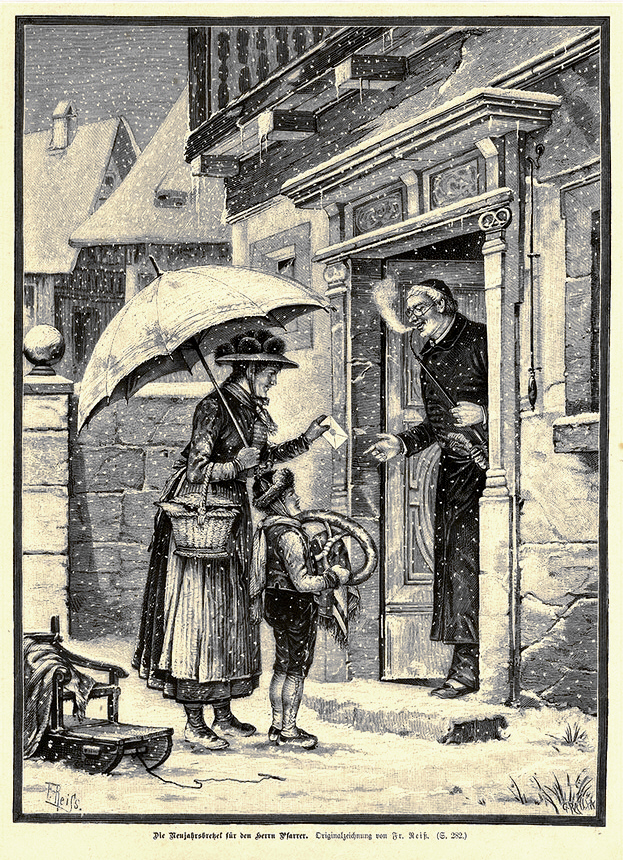
“Die Neujahrsbretzel für den Herrn Pfarrer”, 1884 (via Wikimedia Commons)
I’ve had several people recommend a book to me called The Five Love Languages, by Gary Chapman. It’s a book that looks at the various ways in which people give and receive love. It gets into a lot of psychology and interpersonal communication theories, but in a nutshell it assumes that people tend to give or receive affection via physical touch, loving words, acts of kindness or service, quality time, or gifts. I am definitely a gift-giver when it comes to expressing my feelings—I will work for weeks to handcraft something for someone I care about. When my lovely wife and I were courting, I put hundreds of sticky notes all over her apartment with love messages so that she would constantly find them for months and months afterwords. Even when we ship products out of our Etsy shop, I tend to add layers of Spanish moss to the packing material, as well as little lagniappe touches to the shipment to make it feel magical for the person who opens the box. None of this is to brag, but simply to frame the point that giving gifts is a major part of my connection to others.
Giving gifts has been an important aspect of human relationships for a very lnog time. The Ancient Roman patronage system essentially operated on a large-scale gifting economy. In North America, giving gifts with a magical bent appears time and again. A number of superstitions and rituals surround the acts of gifting and receiving gifts. Possibly one of the gifts most beset by magical rules is the knife:
One must not give a friend a knife or other sharp instrument, as it “cuts love.” (Price 34).
“Giving a knife as a gift is bad luck as it cuts the friendship” (Hines 12).
A present of knives will break the friendship between you (the giver) and the recipient of the gift. (Hines 13)
No hillman would think of giving a steel blade to a friend such a gift is sure to sever their friendship (Randolph 58).
The ‘hillman’described in the last point would have been obliged to pay for a knife if he received it as a gift, in order to abate any potential tragedies:
Whenever a knife changes hands, it must be paid for, even if the sum is merely nominal. I have seen a salesman, a graduate of the University of Missouri, present his son with a valuable hunting knife but he never let it out of his hand till the boy had given him a penny (Randolph 58).
This is a sentiment I’ve seen echoed through other traditions as well, including some Wiccan circles and their beliefs about gifting athames. I have also seen contrary points, insisting that Wiccan ritual blades must never be purchased, but only gifted.
Knives, however, are only scratching the surface of the myriad taboos, beliefs, and customs surrounding giving and receiving. In the following paragraphs, I hope to lay out some of these traditions (though certainly not all of them… The concept of Christmas and birthday gifts is well outside the scope of a single survey article, for example, and the topic is much larger than a 2,000 word synopsis could handle). What I hope that you will see is the sheer humanity of this process. People seem to develop an entire language around gifting (see the Victorians and their flowers, for example), and understanding that language, especially within a magical context, expands the conversation on American folk magic immensely.
Since we’ve started in the domestic realm with knives, let’s continue in that vein. In the Ozarks, even very small gifts can have great significance:
A button received as a gift is always lucky, no matter what the color. Years ago, many an Ozark girl collectedbuttons from her friends and strung them together into a sort of necklace called a charm string. A charm string not only brought good fortune to the owner but also served as a sort of memory book for women who could not read one button recalled a beloved aunt, another a friend’s wedding, still another a dance or a quilting party or an apple-peelin’ or some other pleasant occasion. (Randolph 61)
These little tokens often represent a greater whole. In the example Randolph cites the ‘memory book’ aspect of the charm pushes it out of the realm of luck and into a broader realm of personal narrative. It tells the story of where the girl has been. The luck may then be a cumulative blessing from all those around her, an assembly of good wishes designed to attract further goodness into her life. Similarly, some fairly small gifts can act as predictors or insurance of future blessings, as in these two examples from Louisiana:
A midwife should plant a flower for a baby at its birth.
It is good luck for visitors to place a silver coin in a baby’s hand (Roberts 150).
Here we see blessings which ensure growth and health (the flower) and insurance against poverty (the coin) passed onto a baby, with the hopes that the child will grow and prosper in the future.
Of course, there are just as many taboos on gifting as there are joyous customs. As we saw with knives, some of those can be firmly established and nigh universal at times. Let’s look at another domestic commonplace with strong taboos:
Never borrow salt or you will have bad luck (Hines 12).
Never return salt that has been borrowed (Roberts 178)
Why salt? In my family, we frequently gave salt as a component of a new house blessing for people we knew, which as I understood it derived from Polish traditions (after investigating this a bit, I’m reasonably sure this was adopted from a similar Jewish custom picked up by my family in the area on the border between Lithuania and Poland). We give a jar of salt with some bread and a penny in it, ‘So that the family may never be hungry (bread), never be poor (penny), and their lives may never lack flavor (salt).” The salt, then, can be seen as the experience and cumulative personality of the family, its seasoning or flavor which makes it distinct. Borrowing someone else’s flavor would, in essence, give them power over you, especially when the salt is returned carrying traces of your own eau de familie. It could also be that by taking one family’s wisdom and experience, then returning it, you set off a disruptive cycle whereby your two families will be struggling to rebalance power for a long time, which definitely sounds like bad luck. A similar Louisiana superstition says ‘Don’t give spades, etc., to your neighbors; you will have a fuss if you do (Roberts 174). In that case, the tool is symbolic of a person’s work and labor, and to lend it out cheaply doesn’t bode well for anyone (and makes me think of Homer Simpson borrowing essentially every tool in Ned Flanders’ garage…a very bad neighbor).
The issue of when a gift is given can also impact its significance and magical qualities. While I will avoid holidays and the like here, there are plenty of other occasions when gift-giving is an expectation, such as at baby showers:
At a baby shower, the giver of the seventh gift to be unwrapped will be the next to have a baby (Hines 14).
In this example, the gift-giver receives the magical benefit of a prediction. I suppose that if you are not in the market to start a family, this superstition could seem more like a taboo than a blessing. Another key occasion for giving gifts is after a new family moves into a new home. I mentioned my family’s custom for making a house-blessing from my Polish roots, but it turns out that the general concept of the house-warming may come from the other side of my family tree in the British Isles. The hint of magic behind this tradition comes from the original house-warming present, which actually served to warm a new home:
“As poet John Greenleaf Whittier noted…’The Irish who settled here about the year 1720, they brought indeed with them, among other strange matters, potatoes and fairies.’…The Scots [who were also early settlers in America, particularly in the Mid-Atlantic region and parts of Appalachia]…believed in ‘brownies,’ a more subdued version of the leprechaun. Brownies lived in the kitchen fireplace, and the belief was that the owners of the house had a responsibility to always keep these fairy-creatures warm by keeping a constant fire in the hearth. The Yankees noted that Scots-Americans, when moving from one house to another, would always remove burning embers from the old house to the new, to provide a warm home for the brownies that would move in right along with the family. This was how the tradition of ‘house-warmings’ started” (Cahill 32).
I tend to think this is a bit of fancy on Cahill’s part, and that the giving of gifts to new homeowners is something much older and less literal than a brownie’s ‘house-warming,’ but I would be completely unsurprised to find that the actual practice of moving hearth coals to entice fairy-beings to move houses exists in the Old World or the New.
Marriage also features a number of gift-giving customs, some with superstitious components. For example, in Kansas groups of Russian-German emigrants pin money to the bridal skirt as a way of blessing the bride and groom with prosperity. Additionally, a fun game is made of the best man’s gift, and the “custom of some young buck’s stealing the shoe of the bride. The best man had to redeem the shoe with cash, which went into the household fund” (Tallman 227-8). The best man might contribute some or all of the money, with the remainder raised by good-natured begging of the wedding guests.
A number of tales from Appalachia and New England, including stories from Hubert Davis’ The Silver Bullet and other collections of supernatural American folklore, indicate that magical gifts have particular rules when it comes to witches. For example, a witch might offer a very low price for some livestock or sundries she fancies from a local homestead. If she is refused the gift—which is all such a lowballed agreement could be seen as—she curses whatever it is she wanted, rendering it useless to the family that has it. Often she will curse a cow so it won’t produce milk, or she might even curse an entire herd of pigs or sheep rather than just the one she wanted. On the flip-side, a witch should never be given a present of anything from the household, or she could use it to harm those who dwell within. One story features a housewife who loans the local witch-woman a cup of sugar in a neighborly—if cautious—manner, only to find her butter won’t come when she churns it afterwords. She summons a local witch-doctor who takes a piece of hot silver and drops it in the churn, then spills cream on the fire and whips a pan of the scalded dairy until they hear shrieks from the direction of the witch-woman’s home. She, of course, suffers great pains and bears the marks of a whipping and burning the next day, and everyone knows just what’s what. Oh, and the butter is fine after that, too, of course.
Not all witches or magical practitioners are conniving and dangerous when it comes time to share the wealth, though. For example, many witch-doctors and conjurers in the Southern Mountains will not take direct payment for their work, but only offers of gifts made in-kind, such as foodstuffs, clothing, or other necessities. Vance Randloph noted that one witch woman in the Ozarks did not ask a fee for her work, but would accept such donations: “This woman makes no charge for her services, but if somebody offers her a present, such as a new dress or a side of bacon, she seldom refuses the gift” (Randolph 126).
Lest you think all these magical gifting traditions are limited to the realm of humanity, here’s a bit of lore from John George Hohman’s Long Lost Friend to show otherwise:
A GOOD METHOD OF DESTROYING RATS AND MICE.
Every time you bring grain into your barn, you must, in putting down the three first sheaves, repeat the following words: “Rats and mice, these three sheaves I give to you, in order that you may not destroy any of my wheat.” The name of the kind of grain must also be mentioned. (Hohman 70).
Here we see the old idea of “one for the rabbit, one for the crow, one to rot, and one to sow” extended from nursery rhyme to magical practice. Giving the animals a bit of the household bounty seems to be a way to stave off any thievery on their part, at least in this example.
Finally, I can’t help but offer up a humorous story from Maryland which shows animals getting in on the gift-giving action:
It seems that Mrs. Morison’s uncle and her father went fishing one time and as always they carried their [moonshine] jug along. They came to this water moccasin who was just about ready to swallow a frog. So Mrs. Morison’s father took a forked stick and clamped it down over the snake’s head and took it [the frog] away ‘cause they wanted to use it for bait.
Well, that snake looked so darn downhearted that they gave him a drink of moonshine, and off he went. So they went on with their fishing and about an hour later one of them felt a tug on his leg. He looked down and there was that snake back with another frog. All I can say is, that must have been awful good moonshine” (Carey 31).
I’m not sure if the ‘magic’ in that tale is so much in the moonshine or the moccasin, but I couldn’t resist sharing it with you.
I’m sure there are many other magical giving traditions I’m missing here, so if you have any you want to share, please do!


 New World Witchery - The Search for American Traditional Witchcraft