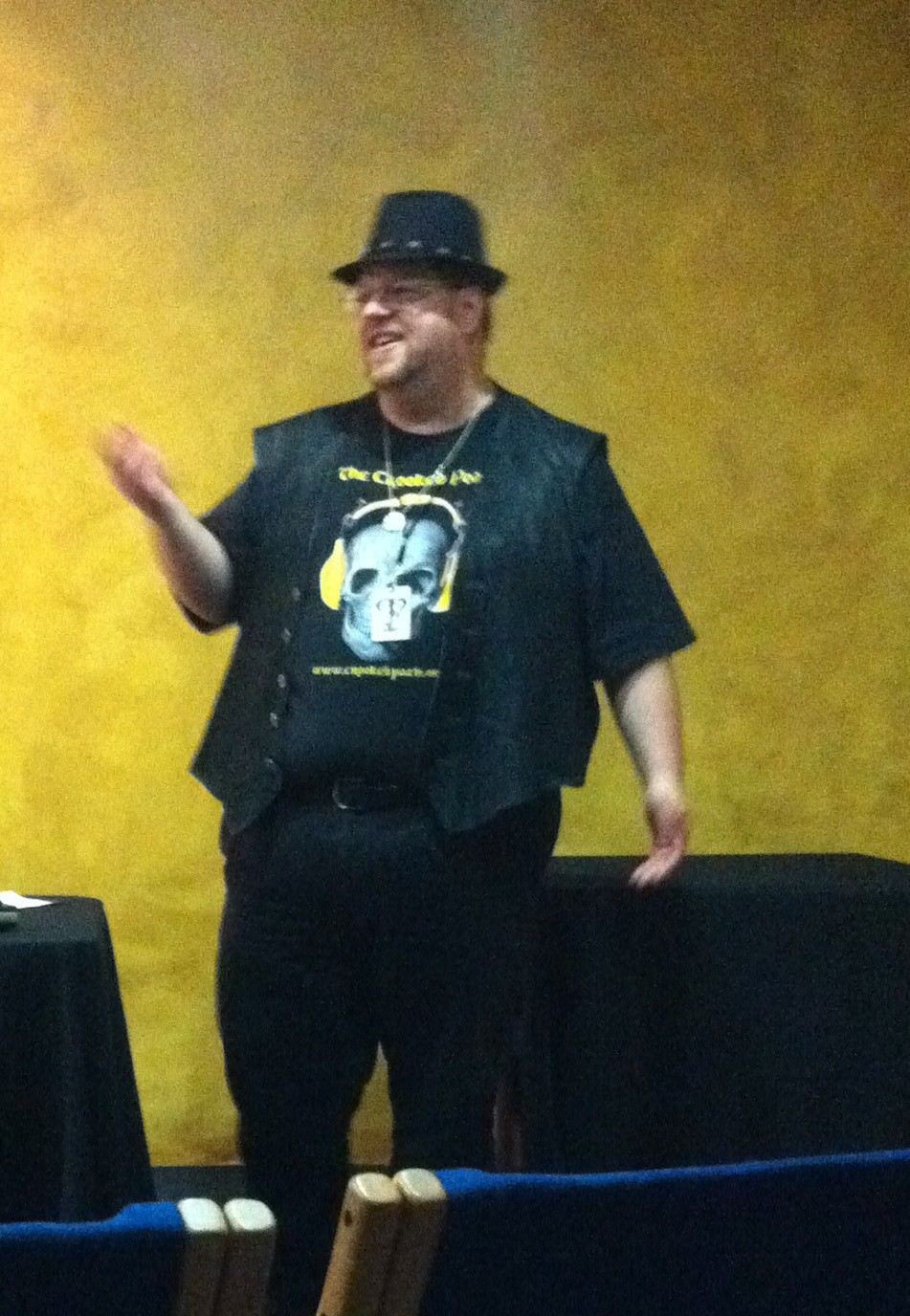
If you have not heard yet, last Thursday morning the news came that good friend, teacher, and cunning man Peter Paddon had passed away in his sleep during the night. You can read his full obituary at the Wild Hunt, which presents a small sampling of the many, many people his loss has left grieving (not least his wonderful wife Linda and his children). I am unsure of the future trajectory of the numerous projects to which he had put his industrious and enchanted hands (a fancy way of saying I don’t know what will happen next with things like the Crooked Path, Pendraig Publishing, and other things he was working on). But I do know that like many others, my heart breaks to think of a world without him in it. I recognize that he is with us still as an ancestor, but I will very much miss seeing him in person for the remainder of my time here in the mortal realm.
I’m working on several memorial projects at the moment, as Peter was a major influence on me and on what I do. I expect that you’ll see those appear in the future through our site here. For now, I know that his family will need support and assistance. To that end, I’ve posted a button on the top right of the page which you can click to offer some financial support to the family. Or you can just click here. I am going to be donating this week, and I have decided to donate all proceeds from October to December 2014 from sales of my bookFifty-four Devilsto Peter’s family or a fund of their choosing as well. I encourage anyone who can to help.
As I learn more about the legacy Peter leaves, and what will happen with his many projects in the future, I’ll keep you posted. Until then, as Peter would say, Bendith.
Summary Tonight’s spooky set of stories are based on (urban) legends from the American Southwest and parts unknown. The theme tonight? How to get a-“head” in life.
[Author’s disclaimer: I received this book as a review copy from Red Wheel/Weiser Books. They have neither paid nor coerced me in any way to write this review, and the opinions stated herein are my own, and do not reflect the position of the publisher.]
I am absolutely certain that a number of people will see the title of Denise Alvarado’s latest title from Red Wheel/Weiser Books and simply ignore its existence. That is a downright shame, because the book proves to be a personal and anthropological tour through an area of magic that can be very easy to misunderstand, work with dolls and effigies. Alvarado confronts the issue of the ‘Voodoo doll’ early in her text, laying its negative cultural cache at the feet of “Hollywood and the media” and noting that despite its origins as a “fusion of folk-lore with science fiction…the image of the pin-stuck doll is so embedded in the collective psyche of the general public that the thought of using a Voodoo doll any differently seems to defy all logic” (p. 2). Alvarado’s book is a repository of doll magic, some of it very interesting and useful, some merely edifying or even occasionally confusing, but it certainly deserves consideration beyond its titular associations.
The book is broken up into twenty-one chapters, generally grouping spells by expected outcome, not much different than other spellbooks in the genre, really. There are chapters on “Money Spells,” “Spells for Good Luck, Success, & Gambling,” and of course, “Spells for Love & Romance.” Alvarado really sets herself apart with the amount of space she devotes to the less savory workings of doll magic, with chapters like “Bend-Over Spells,” “Binding Spells,” “Break Up Spells,” and most especially an extensive chapter on “Curses, Hexes & Spells for Revenge.” Her work draws upon myriad traditions, not solely Vodoun, hoodoo, or Southern Conjure—the fields she clearly connects with best, at least personally. She also brings in chapters on doll magic from the Ancient world, such as dream dolls drawn from Greco-Egyptian magical papyri. One of the truly standout chapters is a section called “Japanese Voodoo Spells,” which actually looks at two types of effigy magic found in Japanese practice, even connecting them to the popular youth culture there: “Aggressive marketing campaigns advertising Ushi no Koku Mairi [Japanese cursing dolls] kits that contain a straw doll, a hammer, a couple of candles, and fifteen-centimeter-long nails are targeted to the young Japanese demographic” and she notes an increasing presence of these dolls in “anime episodes, online games, and videos that promote cyber cursing” on sites like YouTube (p. 172). Alvarado brings in Goetic spells involving dolls, and influences from Christian magical practice via Catholic and Psalm workings. She even includes a doll spell to prevent pets from getting lost.
Sources for The Voodoo Doll Spellbook range from the scholarly to the questionable (ghost hunting websites and a book on Mexican magic which tenuously reframes Hispanic folk ceremonies in a Wiccan context, for example), but generally speaking, Alvarado speaks authoritatively and presents her material well. Several spells are guest-contributed by conjure worker Carolina Dean, which prove to be some of the high points in the text. In some cases, the reason for lumping some spells into separate chapters is unclear, as in the “Binding Spells” section, of which a reprint of Psalm 94 takes up a full twenty percent of the pages. Still, when she is on-target, as with her two Mississippi cursing dolls (pp. 36-38), the quality of the work is apparent, and the spells make a useful compendium of doll magic.
The relatively few other doll-baby work books available (Starr Casas’ slim-but-potent one comes to mind, which seems to be out of print, sadly) mean that Alvarado’s book fills a major niche in practical magical writing. In many ways, what she accomplishes with The Voodoo Doll Spellbook is quite similar to work done by Judika Illes in her books—this is the notebook of a collector of spells. What plagues the text the most is its title, which seems to relegate it to a very specific subcategory of magical work, and which undermines its authority in the minds of educated readers. The material contained within is useful, if occasionally uneven (I’m currently working with one of her money doll spells, for example—I’ll let you know how that goes). While I could consider this book neither a definitive text nor a weak entry in the field, I can certainly point to its utility and some of its unusual offerings as a recommendation to read it and be satisfied.
If you’ve read this book, or have others to recommend on the topic of doll magic, I’d love to hear them!
This episode centers on Cory’s new home, Pennsylvania, and its magical/mystical lore. We have interviews, stories, conversations, and songs to help get a glimpse at the enchantment of the Keystone State.
Chris Orapello was a lovely addition to our conversation (my apologies that the sound quality during his interview was a bit wonky). See his promo link below, too.
Please send in contest entries to compassandkey@gmail.com! We are giving away a copy of 54 Devils (my book, in either digital or print form, whichever you prefer) and a digital copy of Carolina Gonzalez’s book on reading the Spanish cards as well. All you have to do is send us your weirdest or most unique piece of personal holiday lore, along with a name we can read on-air and a general location (‘Illinois’ or ‘the Midwest,’ for example).
If you have feedback you’d like to share, email us or leave a comment. We’d love to hear from you!
Promos & Music
Title music: “Homebound,” by Jag, from Cypress Grove Blues. From Magnatune.
Incidental music The Happy Dutchmen, from Archive.org. Songs include “The Pennsylvania Polka,” “The Beer Barrel Polka,” and “Eidelweiss,” among others.
Tonight we have an interview with the magical Carolina Gonzalez, a curandera based in the Canary Islands. We’ll also have a brief overview of what curanderismo and brujeria are, and we announce a new contest!
We definitely think you should check out the Camino de Yara site, home to our guest, Carolina Gonzalez. While you’re there check out her sites on Maria Lionza and her shop, too!
Please send in contest entries to compassandkey@gmail.com! We are giving away a copy of 54 Devils (my book, in either digital or print form, whichever you prefer) and a digital copy of Carolina Gonzalez’s book on reading the Spanish cards as well. All you have to do is send us your weirdest or most unique piece of personal holiday lore, along with a name we can read on-air and a general location (‘Illinois’ or ‘the Midwest,’ for example).
If you have feedback you’d like to share, email us or leave a comment. We’d love to hear from you!
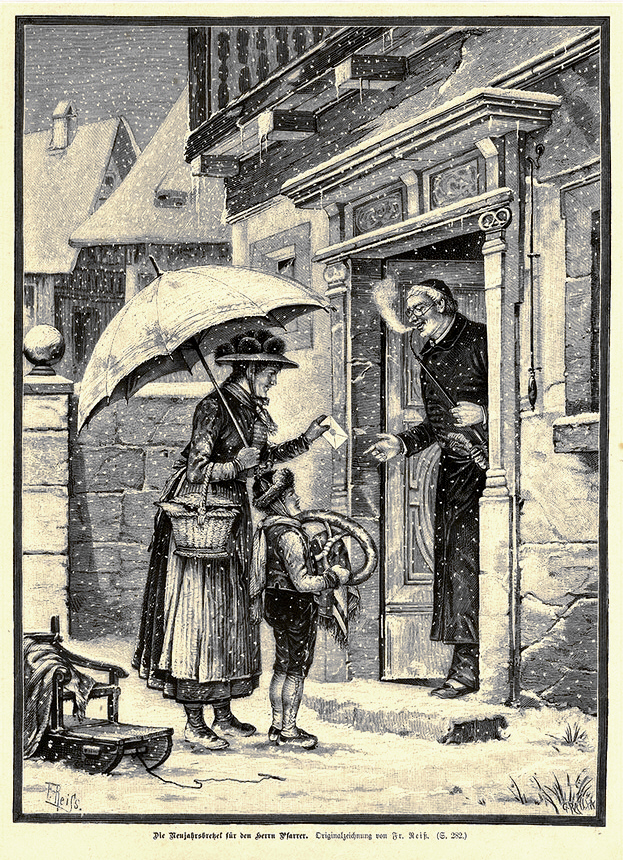
“Die Neujahrsbretzel für den Herrn Pfarrer”, 1884 (via Wikimedia Commons)
I’ve had several people recommend a book to me called The Five Love Languages, by Gary Chapman. It’s a book that looks at the various ways in which people give and receive love. It gets into a lot of psychology and interpersonal communication theories, but in a nutshell it assumes that people tend to give or receive affection via physical touch, loving words, acts of kindness or service, quality time, or gifts. I am definitely a gift-giver when it comes to expressing my feelings—I will work for weeks to handcraft something for someone I care about. When my lovely wife and I were courting, I put hundreds of sticky notes all over her apartment with love messages so that she would constantly find them for months and months afterwords. Even when we ship products out of our Etsy shop, I tend to add layers of Spanish moss to the packing material, as well as little lagniappe touches to the shipment to make it feel magical for the person who opens the box. None of this is to brag, but simply to frame the point that giving gifts is a major part of my connection to others.
Giving gifts has been an important aspect of human relationships for a very lnog time. The Ancient Roman patronage system essentially operated on a large-scale gifting economy. In North America, giving gifts with a magical bent appears time and again. A number of superstitions and rituals surround the acts of gifting and receiving gifts. Possibly one of the gifts most beset by magical rules is the knife:
One must not give a friend a knife or other sharp instrument, as it “cuts love.” (Price 34).
“Giving a knife as a gift is bad luck as it cuts the friendship” (Hines 12).
A present of knives will break the friendship between you (the giver) and the recipient of the gift. (Hines 13)
No hillman would think of giving a steel blade to a friend such a gift is sure to sever their friendship (Randolph 58).
The ‘hillman’described in the last point would have been obliged to pay for a knife if he received it as a gift, in order to abate any potential tragedies:
Whenever a knife changes hands, it must be paid for, even if the sum is merely nominal. I have seen a salesman, a graduate of the University of Missouri, present his son with a valuable hunting knife but he never let it out of his hand till the boy had given him a penny (Randolph 58).
This is a sentiment I’ve seen echoed through other traditions as well, including some Wiccan circles and their beliefs about gifting athames. I have also seen contrary points, insisting that Wiccan ritual blades must never be purchased, but only gifted.
Knives, however, are only scratching the surface of the myriad taboos, beliefs, and customs surrounding giving and receiving. In the following paragraphs, I hope to lay out some of these traditions (though certainly not all of them… The concept of Christmas and birthday gifts is well outside the scope of a single survey article, for example, and the topic is much larger than a 2,000 word synopsis could handle). What I hope that you will see is the sheer humanity of this process. People seem to develop an entire language around gifting (see the Victorians and their flowers, for example), and understanding that language, especially within a magical context, expands the conversation on American folk magic immensely.
Since we’ve started in the domestic realm with knives, let’s continue in that vein. In the Ozarks, even very small gifts can have great significance:
A button received as a gift is always lucky, no matter what the color. Years ago, many an Ozark girl collectedbuttons from her friends and strung them together into a sort of necklace called a charm string. A charm string not only brought good fortune to the owner but also served as a sort of memory book for women who could not read one button recalled a beloved aunt, another a friend’s wedding, still another a dance or a quilting party or an apple-peelin’ or some other pleasant occasion. (Randolph 61)
These little tokens often represent a greater whole. In the example Randolph cites the ‘memory book’ aspect of the charm pushes it out of the realm of luck and into a broader realm of personal narrative. It tells the story of where the girl has been. The luck may then be a cumulative blessing from all those around her, an assembly of good wishes designed to attract further goodness into her life. Similarly, some fairly small gifts can act as predictors or insurance of future blessings, as in these two examples from Louisiana:
A midwife should plant a flower for a baby at its birth.
It is good luck for visitors to place a silver coin in a baby’s hand (Roberts 150).
Here we see blessings which ensure growth and health (the flower) and insurance against poverty (the coin) passed onto a baby, with the hopes that the child will grow and prosper in the future.
Of course, there are just as many taboos on gifting as there are joyous customs. As we saw with knives, some of those can be firmly established and nigh universal at times. Let’s look at another domestic commonplace with strong taboos:
Never borrow salt or you will have bad luck (Hines 12).
Never return salt that has been borrowed (Roberts 178)
Why salt? In my family, we frequently gave salt as a component of a new house blessing for people we knew, which as I understood it derived from Polish traditions (after investigating this a bit, I’m reasonably sure this was adopted from a similar Jewish custom picked up by my family in the area on the border between Lithuania and Poland). We give a jar of salt with some bread and a penny in it, ‘So that the family may never be hungry (bread), never be poor (penny), and their lives may never lack flavor (salt).” The salt, then, can be seen as the experience and cumulative personality of the family, its seasoning or flavor which makes it distinct. Borrowing someone else’s flavor would, in essence, give them power over you, especially when the salt is returned carrying traces of your own eau de familie. It could also be that by taking one family’s wisdom and experience, then returning it, you set off a disruptive cycle whereby your two families will be struggling to rebalance power for a long time, which definitely sounds like bad luck. A similar Louisiana superstition says ‘Don’t give spades, etc., to your neighbors; you will have a fuss if you do (Roberts 174). In that case, the tool is symbolic of a person’s work and labor, and to lend it out cheaply doesn’t bode well for anyone (and makes me think of Homer Simpson borrowing essentially every tool in Ned Flanders’ garage…a very bad neighbor).
The issue of when a gift is given can also impact its significance and magical qualities. While I will avoid holidays and the like here, there are plenty of other occasions when gift-giving is an expectation, such as at baby showers:
At a baby shower, the giver of the seventh gift to be unwrapped will be the next to have a baby (Hines 14).
In this example, the gift-giver receives the magical benefit of a prediction. I suppose that if you are not in the market to start a family, this superstition could seem more like a taboo than a blessing. Another key occasion for giving gifts is after a new family moves into a new home. I mentioned my family’s custom for making a house-blessing from my Polish roots, but it turns out that the general concept of the house-warming may come from the other side of my family tree in the British Isles. The hint of magic behind this tradition comes from the original house-warming present, which actually served to warm a new home:
“As poet John Greenleaf Whittier noted…’The Irish who settled here about the year 1720, they brought indeed with them, among other strange matters, potatoes and fairies.’…The Scots [who were also early settlers in America, particularly in the Mid-Atlantic region and parts of Appalachia]…believed in ‘brownies,’ a more subdued version of the leprechaun. Brownies lived in the kitchen fireplace, and the belief was that the owners of the house had a responsibility to always keep these fairy-creatures warm by keeping a constant fire in the hearth. The Yankees noted that Scots-Americans, when moving from one house to another, would always remove burning embers from the old house to the new, to provide a warm home for the brownies that would move in right along with the family. This was how the tradition of ‘house-warmings’ started” (Cahill 32).
I tend to think this is a bit of fancy on Cahill’s part, and that the giving of gifts to new homeowners is something much older and less literal than a brownie’s ‘house-warming,’ but I would be completely unsurprised to find that the actual practice of moving hearth coals to entice fairy-beings to move houses exists in the Old World or the New.
Marriage also features a number of gift-giving customs, some with superstitious components. For example, in Kansas groups of Russian-German emigrants pin money to the bridal skirt as a way of blessing the bride and groom with prosperity. Additionally, a fun game is made of the best man’s gift, and the “custom of some young buck’s stealing the shoe of the bride. The best man had to redeem the shoe with cash, which went into the household fund” (Tallman 227-8). The best man might contribute some or all of the money, with the remainder raised by good-natured begging of the wedding guests.
A number of tales from Appalachia and New England, including stories from Hubert Davis’ The Silver Bullet and other collections of supernatural American folklore, indicate that magical gifts have particular rules when it comes to witches. For example, a witch might offer a very low price for some livestock or sundries she fancies from a local homestead. If she is refused the gift—which is all such a lowballed agreement could be seen as—she curses whatever it is she wanted, rendering it useless to the family that has it. Often she will curse a cow so it won’t produce milk, or she might even curse an entire herd of pigs or sheep rather than just the one she wanted. On the flip-side, a witch should never be given a present of anything from the household, or she could use it to harm those who dwell within. One story features a housewife who loans the local witch-woman a cup of sugar in a neighborly—if cautious—manner, only to find her butter won’t come when she churns it afterwords. She summons a local witch-doctor who takes a piece of hot silver and drops it in the churn, then spills cream on the fire and whips a pan of the scalded dairy until they hear shrieks from the direction of the witch-woman’s home. She, of course, suffers great pains and bears the marks of a whipping and burning the next day, and everyone knows just what’s what. Oh, and the butter is fine after that, too, of course.
Not all witches or magical practitioners are conniving and dangerous when it comes time to share the wealth, though. For example, many witch-doctors and conjurers in the Southern Mountains will not take direct payment for their work, but only offers of gifts made in-kind, such as foodstuffs, clothing, or other necessities. Vance Randloph noted that one witch woman in the Ozarks did not ask a fee for her work, but would accept such donations: “This woman makes no charge for her services, but if somebody offers her a present, such as a new dress or a side of bacon, she seldom refuses the gift” (Randolph 126).
Lest you think all these magical gifting traditions are limited to the realm of humanity, here’s a bit of lore from John George Hohman’s Long Lost Friend to show otherwise:
A GOOD METHOD OF DESTROYING RATS AND MICE.
Every time you bring grain into your barn, you must, in putting down the three first sheaves, repeat the following words: “Rats and mice, these three sheaves I give to you, in order that you may not destroy any of my wheat.” The name of the kind of grain must also be mentioned. (Hohman 70).
Here we see the old idea of “one for the rabbit, one for the crow, one to rot, and one to sow” extended from nursery rhyme to magical practice. Giving the animals a bit of the household bounty seems to be a way to stave off any thievery on their part, at least in this example.
Finally, I can’t help but offer up a humorous story from Maryland which shows animals getting in on the gift-giving action:
It seems that Mrs. Morison’s uncle and her father went fishing one time and as always they carried their [moonshine] jug along. They came to this water moccasin who was just about ready to swallow a frog. So Mrs. Morison’s father took a forked stick and clamped it down over the snake’s head and took it [the frog] away ‘cause they wanted to use it for bait.
Well, that snake looked so darn downhearted that they gave him a drink of moonshine, and off he went. So they went on with their fishing and about an hour later one of them felt a tug on his leg. He looked down and there was that snake back with another frog. All I can say is, that must have been awful good moonshine” (Carey 31).
I’m not sure if the ‘magic’ in that tale is so much in the moonshine or the moccasin, but I couldn’t resist sharing it with you.
I’m sure there are many other magical giving traditions I’m missing here, so if you have any you want to share, please do!
I just wanted to let you all know I’ve got posts coming, really I do (about 1800 words on one post, plus some book reviews and another post in the draft stage). However, I’ve also got lots of other things going on, including editing the August episode, which I hope you’ll enjoy, and getting started with the Ph.D. program. Laine is also very busy baking another human being in her proverbial oven, so please forgive her if she’s not around for a bit (she still gets emails and appreciates them greatly!).
I also wanted to let you all know about some upcoming events where you’ll be able to vent your frustrations with my slow blogging directly to me, in person! I’ll be at two upcoming events in late August/early September for those who want to come see me.
First, I’ll have a booth at thePhiladelphia Pagan Pride Day on August 30th (see website for location and details). This event is going to be lovely, with classes on Manx folklore, playing card reading (no, not me teaching, though I’d love to attend), children’s activities, and lots more. My booth will (hopefully) have a small traveling museum of North American magical artifacts I’ve pieced together, and I’d love to chat with anyone about folk magic or other such things. Plus, I’ll be trying to collect some area folklore as well, so if you stop by please take a moment to speak into the mic (though you are not obligated to do so, of course). This year’s PPPD is benefiting the Mazzoni Center Food Bank, Forgotten Cats, Books Through Bars, and In-Reach Heathen Prison Services, so please bring donations for any of those fine organizations.
Next, I’m tentatively planning to be at the upcoming Pagan Podkin Super Moot #5 in Chicago! Fire Lyte, who is hosting the PPSM event this year, has generously offered to share his booth at the Chicago Pagan Pride Day on Sunday, September 14th, in Oak Park, Illinois, and I may try to bring that traveling museum along with me for that trip, too. I’m still waiting for a few pieces to fall into place for this even to be a go for me, but right now it looks very likely that I’ll be attending. Other podkin attending include Fire Lyte, Velma Nightshade, Peter Paddon, Dr. Hob & Dean from Lamplighter Blues, Faelyn from the Kindle Witch. A few other folks are tentative as well, so this is a good chance to meet folks if you live anywhere near Chicago.
So, that’s our current situation. If I get invitations for other events or chances to come out and meet fans and friends of the show, I’ll definitely keep you posted! For now, please stop by if you’re near either of those events, and I’ll look forward to seeing you soon!
Summary:
In tonight’s episode (slightly belated, my apologies), we have an excellent discussion of Sacred Artistry and Enchanted Worldviews with the wonderful Bri Saussy. I bookend the interview with a pair of readings on the topic as well. Thanks for your patience, and I hope you enjoy this episode as much as I did!
Summary:
This episode features an extended discussion with Fire Lyte of Inciting a Riot about the recent Slender Man stabbing incident, mental health and treatment, folk belief, and faith-directed action in the magical spirituality community.
-Sources-
While the discussion ranges widely, here are some highlights:
If you don’t already listen to Fire Lyte’s show, Inciting a Riot, you should check it out
The primary story we’re discussing is the Slender Man stabbing incident. While I cannot guarantee every subsection of the NBC news feed on the subject protects the rights of the minors involved, at least at a high level it doesn’t seem to broadcast names, so I’m linking there if you want more on that incident.
If you want to know more about Slender Man, I’d recommend the Wikipedia page, the Something Awful form (NSFW), and/or Creepypasta. Just please remember, this is an internet meme/netlore. Please DO NOT take these sites as gospel or hurt anyone because of what you find on them. They are ENTERTAINMENT ONLY.
Cory talks about auto-flaggelation and self-immolation (specifically Thich Quang Duc) as an aspect of darker faith-based action which complicates our understanding of ‘right’ and ‘wrong’ action.
In this show, we discuss the use of sex as a magical tool (as well as magical tools that can be used for sex), and the ethics of mixing sex and magic from our points of view.
The discussion of sex and scent brings up bay rum scented items, Bourbon French Parfums in New Orleans, and vanilla (oh, and you should also check out the scent-and-sex heavy book Jitterbug Perfume by Tom Robbins)
The Crowley quote about masturbation comes from his book Magick.
Cory mentions he’s been watching the occult series called Salem on WGN, and that our previous guest Papa Toad Bone may have a role on it at some point.
Promos & Music
Title music: “Homebound,” by Jag, from Cypress Grove Blues. From Magnatune. Alternate title music was “Love Warrior,” from FOB, and can be found on MusicAlley.com.