Episode 94 – The Wheel of the Year

Summary:

This time around (get it? Puns!) we look at the Neo-Pagan wheel of the year. We also discuss the importance of cycles in magical and spiritual practice, and we announce our latest contest winner.

Please check out our Patreon page! You can help support the show for as little as a dollar a month, and get some awesome rewards at the same time.  Even if you can’t give, spread the word and let others know, and maybe we can make New World Witchery even better than it is now.

Producers for this show: Corvus, Diana Garino, Renee Odders, Ye Olde Magic Shoppe, Raven Dark Moon, Ivory, The Witches View Podcast,  Sarah, Molly, Corvus, Catherine, AthenaBeth, Jen Rue of Rue & Hyssop, and Jessica (if we missed you this episode, we’ll make sure you’re in the next one!). Big thanks to everyone supporting us!

Play:

Download: Episode 94 – The Wheel of the Year


 -Sources-

For our “Looking Back” segment, we turned to Episode 44 – American Holidays for our inspiration. We’d also like to mention Jason Mankey’s article “The Eight Great American Sabbats,” which prompted that discussion originally and influenced this one somewhat.

Laine mentions she’ll be trying an upcoming WitchBox to see if it sparks her practice a bit.

You can read a lot about the history of the Neo-Pagan holidays in Margaret Atwood Margot Adler’s Drawing Down the Moon, Aidan Kelley’s A Tapestry of Witches, and Ronald Hutton’s Stations of the Sun.

We’ll be attempting a live broadcast via Periscope in late June, so stay tuned for details on that!

Also, we should be launching our newest podcast effort, Chasing Foxfire, in the next few months as well.

If you have feedback you’d like to share, email us or leave a comment. We’d love to hear from you!

Don’t forget to follow us at Twitter! And check out our Facebook page! For those who are interested, we also now have a page on Pinterest you might like, called “The Olde Broom.” Have something you want to say? Leave us a voice mail on our official NWW hotline: (442) 999-4824 (that’s 442-99-WITCH, if it helps).


 Promos & Music

Title and closing music is “Pig Ankle Rag,” by The Joy Drops, and is used under a Creative Commons License (available at Soundcloud.com).

Additional music is “Happy at the Wheel,” by The Twin Atlas, found at the Free Music Archive and used under a Creative Commons License.

Episode 92 – Sabbats and Esbats

NWWLogoUpdated2015small

Summary:

In this episode, we look at witch gatherings under full moons and around bonfires, from tales in folklore to what we do when we get together with other witches.


Please check out our Patreon page! You can help support the show for as little as a dollar a month, and get some awesome rewards at the same time.  Even if you can’t give, spread the word and let others know, and maybe we can make New World Witchery even better than it is now.


Producers for this show: Corvus, Diana Garino, Renee Odders, Ye Olde Magic Shoppe, Raven Dark Moon, Ivory, The Witches View Podcast,  Sarah, Molly, Corvus, Catherine, AthenaBeth, Jen Rue of Rue & Hyssop, and our newest Producer, Jessica (if we missed you this episode, we’ll make sure you’re in the next one!). Big thanks to everyone supporting us!


CONTEST ANNOUNCEMENT! It’s the last month to enter! We want to do a second round of our Audio Spellbook, so all you have to do is send us the sound of *you* describing your favorite spell which uses everyday ingredients (things you could find in a spice cabinet, grocery store, or backyard, for example). You can either record your spell and email it to us at compassandkey@gmail.com or call us and leave us a voice mail on our official NWW hotline: (442) 999-4824 (that’s 442-99-WITCH, if it helps).  You can also get an extra entry by sharing either our Patreon page or our Contest Announcement via your favorite social media (make sure to tag us or get a screen capture you can email to us). What will you be entered to get? Well, you’ll get a NWW Annual Mailer (who can’t use an extra one of those, right?), a couple of bottles of our personally handmade condition oils, a folk charm or two, and a book or two to make it all even better!

Play:

Download: Episode 92 – Sabbats and Esbats


 -Sources-

Our “Looking Back” segment is Episode 43 – Solitary, Partner, or Coven. You may also want to check out our Special Episode – The Horned Women, which features a fairy tale version of a witch gathering.

We’ve got several book and media sources we mention in this episode:

We discuss several different mail-order Sabbat kits. We haven’t ever used any of them, so these aren’t recommendations, but the ones we’ve looked at a little bit are:

You may also want to check out Sarah Lawless’ episode on Sabbats from her old show, Hedgefolk Tales, which has an account by Robert Cochrane on it.

If you have feedback you’d like to share, email us or leave a comment. We’d love to hear from you!

Don’t forget to follow us at Twitter! And check out our Facebook page! For those who are interested, we also now have a page on Pinterest you might like, called “The Olde Broom.”


 Promos & Music

Title and closing music is “Pig Ankle Rag,” by The Joy Drops, and is used under a Creative Commons License (available at Soundcloud.com).

Podcast 72 – Yuletide Cheer! 2014 (Part Three)

Podcast 72 – Yuletide Cheer! 2014 (Part Three)

Summary:
Our last holiday show is chock-full of new-old-fashioned-way music to put you in the holiday spirit. I keep the talking to a minimum this year and focus on Christmas carols, winter songs about birds, and of course, wassails!

Play:
Download: New World Witchery – Episode 72

-Sources-
See below for a complete track listing.

If you have feedback you’d like to share, email us or leave a comment. We’d love to hear from you!

Don’t forget to follow us at Twitter! And check out our Facebook page!

Promos & Music
The following songs are used through Creative Commons Licenses and distributed as podsafe media, or presented with the permission of the artist. Please see the distribution sites for additional information on the artists, their works, and how to purchase more of their music.


  1. A’Soalin – The Bird Sings/Lisa Goettel (Soundcloud)
  2. In the Bleak Midwinter – Richmondie (Soundcloud)
  3. All Hayle to the Days/Drive the Cold Winter Away – Harper’s Hamper (Magnatune)
  4. Fum Fum Fum – UnToupoutou/Army Men’s Chorale (Christmas Chorus, 2012 – Soundcloud)
  5. Nou is Yole Comen – Shira Kammen (In the Castle of the Holly King – Magnatune)
  6. Wren’s Carol – Shira Kammen (In the Castle of the Holly King – Magnatune)
  7. The Darkling Thrush – Brooms of Destruction (2012 – Soundcloud)
  8. Carol of the Birds – Broceliande (Magnatune)
  9. Children Go Where I Send Thee – The Bird Sings/Lisa Goettel (2013 – Soundcloud)
  10. Holy Night – Ronny Matthes (2012 – Jamendo)
  11. Hail Mary – UnToupoutou/Army Men’s Chorale (Christmas Chorus, 2012 – Soundcloud)
  12. Stille Nacht – Kat 330 (2013 – Soundcloud)
  13. Wassail Song – James Edwards (Christmas Bells, 2009 – Jamendo)
  14. Gower Wassail – Shira Kammen (Magnatune)
  15. Wassail Wassail – The Bird Sings/Lisa Goettel (2013 – Soundcloud)
  16. The Boar’s Head Carol – The Bird Sings/Lisa Goettel (2013 – Soundcloud)
  17. Coventry Carol – UnToupoutou/Army Men’s Chorale (Christmas Chorus, 2012 – Soundcloud)
  18. Deck the Halls – Harper’s Hamper (Magnatune)
  19. The First Noel – Tuba Chick (Composing and Arranging, 2011 – Soundcloud)
  20. Da Day Dawn – Samantha Gillogly (With Artist Permission)


Incidental music isMidden in de winternacht” by Ralph Rousseau (2009 – Jamendo).

Podcast 71 – Yuletide Cheer! 2014 (Part Two)

Podcast 71 – Yuletide Cheer! 2014 (Part Two)

Summary:
In the second holiday episode, we have a short documentary on the annual celebration of Krampuslauf in Philadelphia and an interview with author Linda Raedisch, who the book on Christmas monsters.

Play:
Download: New World Witchery – Episode 71

-Sources-
Check out the Krampuslauf Philadelphia webpage for more on that celebration. Many thanks to Amber Dorko Stopper and the entire Krampuslauf entourage for making space for me to do this documentary.

You hear Robert Schriewer (who was on a previous episode of our show as well) in the interviews. Please check out his book The First Book of Urglaawe Myths, and see the Urglaawe site for more information on Pennsylvania Deitsch Heathenry.

Big thanks are due to Timothy Essig of the Landis Valley Museum for his help and information as well.

We must recommend The Old Magic of Christmas, by Linda Raedisch, and we thank her highly for being on the show! Also check out her book on Walpurgisnacht as well.

I also highly recommend this little site, which explores several of the critters we discuss.

For information on the Belsnickel, I point you to Alfred Shoemaker’s Christmas in Pennsylvania and Earl Haag’s Pennsyvaanisch Deitsche, as well as Gerald C. Milnes’ Signs, Cures, & Witchery. Chris Bilardi’s Red Church and Jack Santino’s All Around the Year also informed this episode.

If you have feedback you’d like to share, email us or leave a comment. We’d love to hear from you!

Don’t forget to follow us at Twitter! And check out our Facebook page!

Promos & Music
Title music:  “Homebound,” by Jag, from Cypress Grove Blues.  From Magnatune.

Promos:

  1. Welcome to Night Vale

Down at the Crossroads

Podcast 70 – Yuletide Cheer! 2014 (Part One)

Podcast 70 – Yuletide Cheer! 2014 (Part One)

Summary:
Our first holiday episode features Cory & Laine discussing the general theme of ‘Christmas monsters,’ or the scary side of the winter season.

Play:

Download: New World Witchery – Episode 70

-Sources-

Most of the beasties we mention in this episode can be found in The Old Magic of Christmas, by Linda Raedisch (she’ll be in our second holiday show, by the way).

I also highly recommend this little site, which explores several of the critters we discuss.

For information on the Belsnickel, I point you to Alfred Shoemaker’s Christmas in Pennsylvania and Earl Haag’s Pennsyvaanisch Deitsche (all of this will also show up in Podcast 71 as well).

If you have feedback you’d like to share, email us or leave a comment. We’d love to hear from you!

Don’t forget to follow us at Twitter! And check out our Facebook page!

Promos & Music
Title music:  “Homebound,” by Jag, from Cypress Grove Blues.  From Magnatune.

Promos:

  1. The Pagan Widow Podcast

Podcast 58 – Yuletide Cheer! 2013

-SHOWNOTES FOR EPISODE 58

Summary

Our annual fruitcake of wintery music, poetry, & other holiday goodies!

 Play:

Download: New World Witchery – Episode 58

-Sources-

Stories & Poetry:

  1. Noel,” by Katherine Porter
  2. “Christmas,” (two versions) and “Winter,” from The Real Mother Goose
  3. Christmas Trees,” by Robert Frost
  4. A selection from “The Snow Queen,” by Hans Christian Andersen
  5. Santa’s Traveling Companions,” adapted from information at the Saint Nicholas Center

Don’t forget to follow us at Twitter! And at Facebook!

Also, please enter our current contest!

Promos & Music

All songs used with permission/license, from Magnatune, SoundCloud, Creative Commons, and MusicAlley, except as noted.

Playlist:

  1. “Nou is Yole Comen,” Shira Kammen
  2. “Swete was the Song,” by Artsy Honker
  3. “Good King Wenceslas,” US Army Chorus
  4. “Candelight Carol,” Kathmandu Chorale
  5. “Lo How a Rose E’er Blooming,” Annie Hiller
  6. “Carol of the Birds,” by Broceliande*
  7. “The Holly, Witches Dance,” Harper’s Hamper
  8. “Broome, Bonny Broome,” Harper’s Hamper
  9. “Patapan,” Fugli
  10. “Cherry Tree Carol,” Rose & Thistle Band (independent artist)
  11. “This Endris Night,” US Army Chorus
  12. “Cold Blows the Wind,” Music for a Winter’s Eve
  13. “Deck the Halls,” Harper’s Hamper
  14. “Green Grows the Holly,” Shira Kammen
  15. “O Christmas Tree,” Tubachick
  16. “O Tannenbaum,” Kellianna (f. Jenna Greene)*
  17.  “Winter’s Ritual,” SJ Tucker (from Ember Days soundtrack)*
  18. “Wassail Song,” Music for a Winter’s Eve
  19. “Come Landlord fill the Flowing Bowl,” The Limeybirds (independent artist)
  20. “Boar’s Head Carol,” The Pagan Carolers
  21. “O Come Emmanuel,” Mary Ellen Kirk
  22. “Ave Maria,” Kellianna*
  23. “Da Day Dawn,” Samantha Gillogly*

*Used with artist permission

Underscoring music is “Nu Zit Wellekome,” Ralph Rousseau Meulenbroeks, and “Courdian,” Music for a Winter’s Eve, both from Magnatune.

Podcast 56 – Harvest Home

Summary:

This episode looks at various harvest festivals, including Michaelmas, Mid-Autumn Festival, and Thanksgiving. It includes poems, songs, stories, and a pair of essays. Enjoy!

Play:
Download: New World Witchery – Episode 56

 -Sources-
Poems

Stories & Essays

If you have feedback you’d like to share, email us or leave a comment. We’d love to hear from you!

Don’t forget to follow us at Twitter! And check out our Facebook page!

Keep an eye out for more info on the New Orleans Magical Meetup on Novemer 8-10, 2013! You can follow the official Facebook page, or watch the website for more details!

 Promos & Music
Title music:  “Homebound,” by Jag, from Cypress Grove Blues.  From Magnatune.

Song List:

Promos:

Podcast 47 – Yultide Greetings! 2012

-SHOWNOTES FOR EPISODE 47

Summary

This is our annual holiday special, featuring music, poetry, stories, and recipes! Here’s wishing you all the best for your holiday season and a happy new year to come!

Play:

Download: Episode 47 – Yuletide Greetings 2012

-Sources-

Stories & Poetry:

Susie’s Letter from Santa Claus,” by Samuel Clemens (Mark Twain)
The Goblins Who Stole a Sexton,” by Charles Dickens
The Boy Who Laughed at Santa Claus,” by Ogden Nash
A history of the Christmas candle in the window, from Fantasy-Ireland.com

Recipes (All cocktails this year):
After Five – Cory
Amber Dream/Winterbeer – Cory
Egg Nog, extra fancy – Laine

Don’t forget to follow us at Twitter!

Promos & Music

All songs used with permission/license, from Magnatune and MusicAlley, except as noted.

Playlist:

  1. “All Hayle to the Days, To Drive the Cold Winter Away,” Harper’s Hamper
  2. “Dancing Day I – A Virgin Most Pure,” Steven Potvin & Con Brio Choir
  3. “O Come Emmanuel,” Mary Ellen Kirk
  4.  “A v Jerusalime,” Kitka
  5. “Rise Up Bright Sun,” Leslie Fish*
  6. “The Huron Carol,” Tracy Helen
  7. “Green Grow’th the Holly,” Pagan Carolers
  8. “The Holly Bears a Berry,” Shira Kamen
  9. “The Holly/Witches Dance,” Harper’s Hamper
  10.  “I Saw Three Ships,” Dusty Hughes
  11. “Tapster Drynker,” Shira Kamen
  12. “Wassail,” In Nova Cantica
  13. “Tsarko Momche…,” Kitka
  14. “Chestnut, Daphne, Scotch Cap,” Music for a Winter’s Eve
  15.  “The Blood-red Rose at Yule,” Music for a Winter’s Eve
  16. “Nu zit Wellekome,” Ralph Rousseau Muelenbroeks
  17. “We Three Kings,” Jennifer Avalon
  18. “The Wheel of the Year,” Shira Kamen
  19.  “Patapan,” Fugli
  20. “Twelfth Eve, Christmas Cheer, Chestnut Vagary,” Harper’s Hamper
  21. “Le Brandevin,” Shira Kamen
  22. “Da Day Dawn,” Samantha Gillogly*

Underscoring music is “We Three Kings,” by Two Harps, and “Ding Dong Merrily on High,” by Tracy Helen, both from MusicAlley.

*Used by permission of the artist.

Podcast 44 – American Holidays

Summary
Today we’re looking at the “American wheel of the year” and at developing your own magical calendar.

Play:
Download: Episode 44 – American Holidays

 -Sources-
Our two main sources are the article “The Eight Great American Sabbats,” by Jason Mankey (at Patheos.com) and Jack Santino’s book All Around the Year.

Some other neat holiday-centered items:

Also check out the Holidays page at New World Witchery to explore this topic further, including episodes on Groundhog Day, Walpurgisnacht, and St. John’s Eve.

Cory will have a horror story about rabbits (of course) coming out through Misanthrope Press and their magazine Title Goes Here in the Fall (that’s sort of Halloween and Easter, right?).

And definitely check out all the details on Pagan Podkin Super Moot no. 3, happening in San Francisco on Oct. 6th!

Don’t forget to follow us at Twitter!

 Promos & Music
Title music:  “Homebound,” by Jag, from Cypress Grove Blues.  From Magnatune.

Promo 1 – Eat My Pagan A$$ Podcast
Promo 2 – HP Lovecraft Live Podcast
Promo 3 – Iron Powoqa Radio

Blog Post 161 – Summer Saints, part II (St. John’s Eve)

Hi all!
I realize this is rather late, and that I’ve taken a long time to get it out. I’m still working on papers and projects for the graduate seminar, which wound up being incredibly time-consuming, so I had very little time to devote to my work here. However, I hope you’ll forgive me and enjoy the articles I do manage to put out when I manage to get them up.

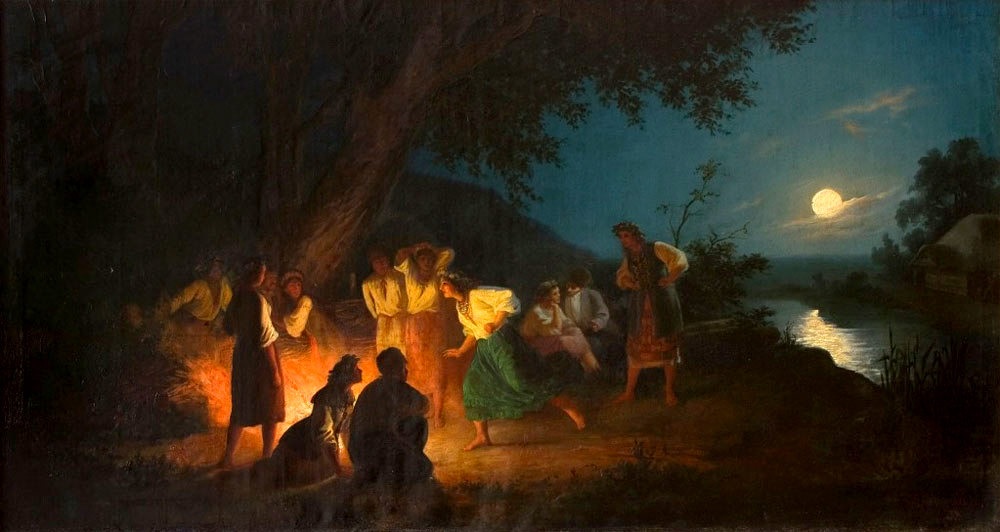
Today, let’s continue working on those summer saints I started in the last post. While there are plenty of saints remaining in the calendar for the season, I thought that one saint’s feast day deserved some particular attention. St. John’s Eve, which is June 23rd, is ostensibly a celebration of the life and times of John the Baptist. It falls remarkably close to Midsummer, however, and so its connotations and meanings have absorbed a good bit of the lore associated with that holiday, too. It features prominently in accounts of New Orleans Voodoo from the nineteenth century, and functions as a day of tremendous power for working all sorts of quasi-magical operations. Let’s look at two from (quasi-)anthropological perpsectives. The first is an account found in Robert Tallant’s Voodoo in New Orleans, taken from a newspaper report contemporary to the events described (allegedly 28 June 1872):

“On Monday morning (St. John’s Day) I went to the French Market for the express purpose of finding out…the exact spot where the Voudou Festival would be held this year…I took the 8 o’clock train on the Ponchartrain Railroad. Arriving at the lake I fooled around a little; saw great crowds…I hired a skiff and pulled to the mouth of Bayou St. John—the best way of getting there from the lake end—the festival took place near Bayou Tchoupitoulas. Upon arriving at the shanty I found congregated about two hundred persons of mixed colors—white, black, and mulattoes…Soon there arrived a skiff containing ten persons, among wich was the Voudou Queen, Marie Lavaux [sic]. She was hailed with hurrahs.

The people were about equally divided male and female—a few more females. The larger portion of the crowd Negroes [sic] and quadroons, but about one hundred whites, say thirty or forty men, the remainder women.

Upon the arrival of Marie Lavaux, she made a few remarks in Gumbo French [Creole, I presume the reporter means], and ended them by singing, “Saiya ma coupe ca,” to which all hands joined in the chorus of “Mamzelle marie chauffez ca.” [reporter’s itallics, not mine]…The song ended, orders were given by the queen to build a fire as near the edge of the lake as possible, which was ‘did,’ every one being compelled to furnish a piece of wood for the fire, making a wish as they threw it on. Then a large caldron [sic] was put on the fire; it was filled with water brought in a beer barrel; then salt was put in by an old man, who jabbered something in Creole; then black pepper was put in by a young quadroon girl; she sang while putting in the pepper; then a box was brought up to the fire, from which was taken a black snake; he was cut into three pieces (the Trinity), one piece was put in by Marie Lavaux, one piece by the old man who put in the salt, and one piece by the young girl who put in the pepper; then al ljoined in chorus of the same song: “Mamzelle Marie chauffez ca;” then the queen called for a ‘cat,’ it was brought, she cut its throat, and put it into the kettle.

Another repetition of the same chorus, then a black rooster was brought to the queen. She tied its feet and head together and put it in the pot alive. Reptition of the chorus. Then came an order from the queen for every one to undress, which all did, amid songs and yells. The queen then took from her pocket a shot bag full of white and colored powders. She gave orders for every one to joino hands and circle around the pot. Then she poured the powders into the pot, sang a verse of some oracle song, to which all joined in a chorus while dancing around the pot, “C’es l’amour, oui Maman c’est l’amour, etc.”…everybody went into the lake, remained in the bath about half an hour…in half an hour the horn was blown (a sea shell), and all hand shurried back to the queen, and set up another chorus to a verse she sang to the same tune as the first one.

After the song she said ‘You can now eat’” (Tallant 80-81).

A long account (even with my editing), and likely a pretty sensationalized one. Certain aspects—communal feeding, dancing, music, memorized choruses, and the direction of a guiding presence like Marie Laveau—all ring somewhat true to accounts of African Traditional Religious practices in other places, such as the thorough examination of Brooklyn Vodoun in Mama Lola. Yet other features seem glaringly off, such as the complete lack of lwa, or the insistence on nudity (a common embellishment which appeared in several accounts and which essentially exists to exoticize and sexualize an entire race—even in the 1920’s stage shows at The Cotton Club in New York featured nude Black dancers with spears and tribal makeup because white patrons enjoyed “primitive” Black culture). The St. John’s dances, however, were highly popular affairs, and I see no reason to doubt that they truly happened. In many cases, it seems whites saw what they wanted to see—or what they were directed to see, and missed a great deal of the spiritual side of the events.

In Mules & Men, Zora Neale Hurston recounts her apprenticeship with Laveau’s alleged nephew, Luke Turner, who gives a somewhat more mystical (and significantly shorter) version of events:

“Out on Lake Ponchartrain at Bayou St. John she hold a grat feast every year on the Eve of St. John’s, June 24th. It is Midsummer Eve, and the Sun give special benefits then and need great honor. The special drum be played then. It is a cowhide stretched over a half-barrel. Beat with a jaw-bone. Some say a man but I think they do not know. I think the jawbone of an ass or a cow. She hold the feast of St. John’s partly because she is a Catholic and partly because of hoodoo.

The ones around her alter fix everything for the feast. Nobody see Marie Leveau [sic] for nine days before the feast. But when the great crowd of people at the feast call upon her, she would rise out of the waters of the lake with a great communion candle burning upon her head and another in each one of her hands. She walked upon the waters to the shore. As a little boy I saw her myself. When the feast was over, she went back into the lake, and nobody saw her for nine days again” (Hurston 193).

Again, I am a bit skeptical about Turner’s claims in some ways, but he seems to get at the heart of the event in a more profound way. Laveau becomes a demi-goddess in his account, a precursor to the lwa which she would eventually become. Certain aspects of both accounts agree: the presence of music, particularly drum music; the great communal feast; the crowd chanting and calling for her to arrive. For a celebration of St. John, the focus in these accounts tends to be awfully heavy on Marie Laveau, no?

However, that is not to say that St. John should be completely left out of his own holiday. Even one of Tallant’s informants recognizes the role the saint plays in the New Orleans frenzy on his feast day:

“Alexander Augustin remembered some of the tales of old people which dated to the era of the Widow Paris [another name for Marie Laveau].

‘They would thank St. John for not meddlin’ wit’ the powers the devil gave ‘em,’ he said. ‘They had one funny way of doin’ this when they all stood up to their knees in the water and threw food in the middle of ‘em. You see, they always stood in a big circle. Then they would hold hands and sing. The food was for Papa La Bas, who was the devil. Oldtime Voodoos always talked about Papa La Bas” (Tallant 65-6).

So does that mean that John’s role—and I should here clarify that the John honored on St. John’s Eve is St. John the Baptist, who was written about in the New Testament, but who was not the author of the Gospel of St. John (different saints entirely)—is always sublimated to another spiritual force, be it Marie Laveau or Papa Le Bas (also frequently called Papa Lebat, and sometimes seen as an alternate identity for Papa Legba, although he may also be named after a New Orleans priest who tried to eradicate Voodoo only to become a lwa after his death)?

Let us briefly look at the saint behind the day, then. Since we’ve already spent so much time in New Orleans, I’ll pause to crack open my copy of Denise Alvarado’s Voodoo Hoodoo Spellbook, which says that St. John is aligned with Ogun, Agonme, and Tonne in the lwa/orisha traditions, and that he has patronage over silence, slander, bridges, and running water. While Alvarado does note that the eve of June 23rd involves observations in honor of Marie Laveau, she does a lovely job looking at the current understanding of the saint’s feast day on the 24th:

“[The] holiday coincides with summer solstice, celebrated in New Orleans every year by Mambo Sallie Ann glassman at St. John’s Bayou. To celebrate the summer, the warmth, fire, and nourishment from the sun. For opportunities, good luck, and to realign with cosmic forces” (Alvarado 74).

Both Hurston and Alvarado have noted the strong connection to the sun with this day, not surprising given its proximity to the summer solstice. Within Christian cosmology, the desert-dwelling St. John recognized Jesus before most others had, and spoke of baptizing people with fire. He saw the heavens open up, and the holy spirit—sometimes represented by fire, though in this case in the form of a radiant dove—descend to earth to acknowledge Jesus as God incarnate. A number of solar symbols appear in this myth—deserts, fire, heavens opening up, descending light, and even the metaphorical light of understanding which enables John to see Jesus’ true nature. And since Midsummer forms the balance point for the winter holidays, which included the feast of Sol Invictus (the Unconquered Sun), it makes a great deal of sense to have the fiery and solarly-aligned John the focus of such a major holiday. Plus, they guy lived off of locusts, so I think we can spare him a day on the calendar.

Turning to NWW favorite Judika Illes, we find that St. John is associated with the color red, love spells, herbs, marriage, fertility, and, of course, beheading (the method of his death). She notes that he “has dominion over healing and magical plants in general,” which makes sense as one of the famous magical herbs bears his name: St. John’s wort. A bevvy of rituals surround the acquisition and deployment  of this enchanted plant, the most famous of which Illes shares in her book:

“If you rise at dawn on Midsummer’s Day and pick a sprig of St. John’s Wort with the dew still clinging to it, tradition says you will marry within the year—but only if you do not speak, eat, or drink from the time of rising until after the plant is picked. A second part to this spell claims that if you slip the plant benath your pillow and go back to sleep—still without eating, drinking, or speaking—your true love will appear in your dream” (Illes 381).

The Encyclopedia of Mystics, Saints, & Sages also points out that in a number of European cultures, any herb gathered on St. John’s Day before dawn is inherently imbued with intense magical qualities.

Finally, let’s finish up our (rather long) snapshot of St. John with a smattering of magical lore surrounding him and his feast day from around the world:

  • “Wear a mugwort wreath around your brow on Midsummer’s Eve to banish headaches for a year” (Illes 381).
  • “Gather blossoming St. John’s Wort at midnight on St. John’s Eve. If the blossoms remain fresh in the morning, this is an auspicious sign that the rest of the year will be happy; if the blossoms have wilted, magical protective measures may be in order” (Illes 381).
  • To return an wandering lover, gather three roses on St. John’s Eve, bury two secretly  before sunrise in a grave and under a yew tree, and put the third under your pillow. Leave it for three nights, then burn it, and your lover won’t be able to stop thinking about you (Illes 381).
  • St. John is the patron of conversion/baptism and tailors, and can be petitioned for “good luck, good crops, fertility, & protection from enemies” (Malbrough 29).
  • In Russian, a priest would visit local farms on St. John’s day and make a cross of fresh tar on the fence posts while reciting a prayer to keep away witches “who were liable to go around in the shape of dogs and steal milk from the cows” (Ryan 43).
  • A Russian spell from the Enisei region of Siberia notes that gathering twelve magical herbs (unspecified) on St. John’s Eve and placing them under the pillow would induce prophetic dreaming (Ryan 47).
  • St. John could be invoked in a charm with St. Peter to diminish fevers, according to English cunning man William Kerrow (Wilby 11-12).
  • English cunning woman Ursula Kemp “recommended three leaves each of sage and St. John’s wort steeped in ale,” as a powerful potion against witchcraft (Davies 110).

So that’s a little look at St. John. And his day. That was worth the wait, right?

One thing I did learn in my long absence is that I should be careful about setting expectations with some of these posts. I originally intended to make a 3-to-5-part series on the “summer saints,” but at this point it will probably be a while before I return to the saints I had planned to cover in the remaining posts. I still will be addressing magical saints in various articles and from a few different perspectives, but I think for the moment I want to move on to other topics here. My reading and research have me exploring a number of topics, and I’d prefer to get those covered here while they’re fresh in my mind, so forgive me if I get a little bit more scattershot in terms of what gets posted here. I’ve also had requests for topics to be covered that I may essay given a bit of time and the proper resources. So, in other words, I’ve got lots to do, and the saints of summer may just have to wait a bit. I hope that’s okay with y’all.

With all of that being said, thank you so much for hanging in there with me. I’ll do my best to keep work coming your way, but I hope that what is here already is proving useful to you. I’m not going away anytime soon, even if I do seem quiet from time to time. I really love getting emails and comments, too, and I apologize for the delays in response  to those, but thank you to everyone who has written in.

I really appreciate your patience, and thanks so much for being friends to us here at New World Witchery!

Thanks for reading,

-Cory