This episode, we turn our attention to the Potterverse and J.K. Rowling’s North American school of magic, Ilvermorny. We talk about the school house divisions, the mascots, and some of the differences between the Old World and the New that caught our interest.
Please check out our Patreon page! You can help support the show for as little as a dollar a month, and get some awesome rewards at the same time. Even if you can’t give, spread the word and let others know, and maybe we can make New World Witchery even better than it is now.
Producers for this show: Corvus, Diana Garino, Renee Odders, Ye Olde Magic Shoppe, Raven Dark Moon, Ivory, The Witches View Podcast, Sarah, Molly, Corvus, Catherine, AthenaBeth, Jen Rue of Rue & Hyssop, Shannon, Little Wren, Michael M. and Jessica (if we missed you this episode, we’ll make sure you’re in the next one!). Big thanks to everyone supporting us!
The main source for the show is, of course, J.K. Rowling’s work, including the Harry Potter novels and specifically the Pottermore site. You can find the Ilvermorny backstory here.
For a background on some of the various creatures and folklore in the episode, we drew from the following books:
We should be launching our newest podcast effort, Chasing Foxfire, in the next month or so. If you like folklore, this show will be connecting the dots between folk tales, science, nature, pop culture, literature, and more.
If you have feedback you’d like to share, email us or leave a comment. We’d love to hear from you!
Don’t forget to follow us at Twitter! And check out our Facebook page! For those who are interested, we also now have a page on Pinterest you might like, called “The Olde Broom.” Have something you want to say? Leave us a voice mail on our official NWW hotline: (442) 999-4824 (that’s 442-99-WITCH, if it helps).
Promos & Music
Title and closing music is “Pig Ankle Rag,” by The Joy Drops, and is used under a Creative Commons License (available at Soundcloud.com).
Today’s episode is all about the traditional Hispanic-American healing system known as curanderismo. We speak with University of New Mexico Professor Eliseo “Cheo” Torres on the topic, hear about one of the folk saints form the tradition, and enjoy a bit of lore and music as well. NOTE: THIS EPISODE IS NOT INTENDED AS MEDICAL OR LEGAL ADVICE. Please consult a physician or medical professional if you have medical needs.
Please check out our Patreon page! You can help support the show for as little as a dollar a month, and get some awesome rewards at the same time. Even if you can’t give, spread the word and let others know, and maybe we can make New World Witchery even better than it is now.
Producers for this show: Corvus, Diana Garino, Renee Odders, Ye Olde Magic Shoppe, Raven Dark Moon, Ivory, The Witches View Podcast, Sarah, Molly, Corvus, Catherine, AthenaBeth, Jen Rue of Rue & Hyssop, Shannon, Little Wren, and Jessica (if we missed you this episode, we’ll make sure you’re in the next one!). Big thanks to everyone supporting us!
We should be launching our newest podcast effort, Chasing Foxfire, in the next few months as well.
If you have feedback you’d like to share, email us or leave a comment. We’d love to hear from you!
Don’t forget to follow us at Twitter! And check out our Facebook page! For those who are interested, we also now have a page on Pinterest you might like, called “The Olde Broom.” Have something you want to say? Leave us a voice mail on our official NWW hotline: (442) 999-4824 (that’s 442-99-WITCH, if it helps).
Promos & Music
Title and closing music is “Pig Ankle Rag,” by The Joy Drops, and is used under a Creative Commons License (available at Soundcloud.com).
Additional music:
La Tab – “Fuego Fatal”
Sergei Cheriminsky – “Mother’s Hands”
Turtle – “Grow Grotesque”
Maria Pien – “Por me que lleva” and “Fruto prohibido”
The above songs can found at the Free Music Archive and Soundcloud and are used under a Creative Commons License. The song “Mariachi Dote” by Armando Palomas is from Archive.org, and used in the Public Domain.
I’ve always liked the word “witch.” It carries with it a lot of connotations, sure, but so few words can evoke strong reactions across the spectrum, ranging from fear to excitement to anger to joy. Witches in folklore occupy a strange space; in many stories, they seem to be dangerous and do harm (e.g. “Hansel and Gretel” or “The Witch in the Stone Boat”), but then in so many other tales they are helpers, or benign catalysts for action (as in “Frau Holle” or “Finist the Bright Falcon”). We have tackled the question of “What is a Witch?” from a lot of angles here already: answering the question generally and rhetorically, looking at aspects of a witch’s practice, seeing what it takes to become a witch, and so on. But this weekend brings my birthday, so I’m going to turn that lens inward a bit, and ask the question, “Am I a Witch?” That may seem like a bit of a ridiculous question, coming from someone who talks about using folk magic on a regular basis, but it’s a question worth asking. There are many people from various backgrounds who would likely say I’m not, based on their personal definitions of witchcraft, whether they believe it to be a religion or a practice, or both, or neither. So how do I see it? If you read the articles here, you probably want to know if my own definition of witchcraft jives with yours, right? Today, I thought it might be good to clarify just who I am and what I do that might make someone think of me as a witch of one kind or another. In an upcoming post, I will use this as a bit of a launching pad to take a look at a few ways the figure of the witch appears in North American history and folklore, and see if I can find anything that I can use to create a broad sketch of what a “New World Witchcraft” practice might look like. This is, and must be, my own interpretation, so of course your interpretation may be quite different. But my hope is that by going through this question with some thought, maybe it will open up some doorways (or hedgerows) along the way for myself and others. If you’re interested in traveling this particular crooked road with me, read on.
A section of my personal altar.
Firstly, let me talk a little about the things I do. My basic spiritual practice (and please note I’m setting this apart with fancy italics) involves a few basic rituals: weekly lighting of candles to a mix of saints, ancestors, deities, spirits, and other entities, along with offerings of incense and water and sometimes food and drink. I offer evening prayers directed at a pantheon of spiritual forces, mostly in gratitude and asking for safe passage through the night for myself and my family. Monthly, I light candles representing the new and full moons. When the dark candle is lit, I do divinations with my cards—although I should note this is not the only time I do that, and here we have a practice which may be only quasi-spiritual overlapping with the spiritual ritual of lunar reverence. It’s complicated, right? On the full moon, I offer libations and light other candles, and say prayers to specific spiritual forces I feel are connected with the moon. And that’s the big stuff. Despite recent discussions of sabbats and the Wheel of the Year, I tend to get into holidays in a more community-oriented way, attending parades or local celebrations and not really focusing on the spiritual observance of the days (although that does sometimes happen, especially during the winter months).
Reading my mother’s cards.
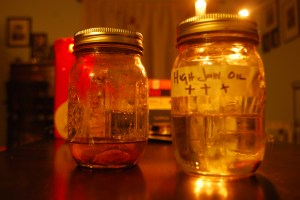
My magical practice (again, fancy tilty-letters here) involves the aforementioned carddivination, which I do more frequently in ways dissociated from a particular spiritual observance, but which does involve me calling upon some spiritual aid. I also frequently cast spells for various wants, needs, and wills. Most are incredibly simple spells, such as the creation of a petition paper and the lighting of a candle, perhaps with some anointing oil and the recitation of a psalm or charm. I might create a mojo bag to carry around and draw in a specific need or want (most often, these bags are in the “success” area, although I also do some protection bags and others as well). Periodically, I will brew up batches of condition oils to have on hand for dressing candles and bags, but if I run out of those for some reason I don’t worry, because I can usually substitute something from the kitchen in a pinch—coffee, whiskey, olive oil, etc. If someone gets a sharp bang on their shin or a cut on their finger, I’m usually right there with my little Pow-wow-style charms to ease the pain, along with an ice pack, kiss, or chocolate-chip cookie as appropriate. A few times a year I do house-cleansing and protection work, adding written charms to door lintels and washing down my front door with—well, traditional protective formulae.
Is any of this witchcraft, though? When we look at stories of witches in North America—whether derived from European, African/African American, Native, or other sources—we see witches doing some of these things in one way or another, perhaps. Fortune-telling by cards and other means seems to appear nearly universally. Zora Neale Hurston recorded tales of African American conjure women and men rifling playing cards and seeing the future. Some of the accounts of Salem’s tumultuous sorceries involved tales of divination by “Venus glass,” or through the use of a special cake baked from urine and fed to a dog, or even some evidence that accused persons like Dorcas Hoar owned divination manuals and had practiced fortune-telling for years before the trial outbreak. Other tools, like the dowsing rod or the use of geomantic shells or coins, appear in other areas, and every cultural group in American history has had some means of divination or augury. Even in contemporary times, the Ouija board has become a popular trope of adolescent divinatory rites, and remains a popular “game” among American youth.
Brewing condition oils
Witches also made use of prayers and psalms, sometimes in holy and sometimes in profane ways. Tales of Appalachian witch initiation rites discuss the use of prayers which reverse one’s baptism. In many European-derived traditions, the recitation in reverse of whatever charm had been used to blight someone would remove that curse. In tales where witches work with spirits, they may make contact with faery-creatures (see Emma Wilby’s Cunning Folk & Familiar Spirits for a truly excellent rundown of that subject), or they may keep wee bug in a bottle to talk to (as in one Appalachian story). While we get a sense of their spiritual worldview—which is heavily populated and constantly interacting with the mundane world—we seldom get a sense that witches are denominational. They might act in non-Christian or even anti-Christian ways, up to and including signing pacts with the Devil, but just as often they make use of Christian prayers and charms, and may even be very religions—if a bit unorthodox. Having a rich spiritual life certainly seems to be found in most tales of folkloric witches, but there’s very little definition around that spiritual worldview. Instead, witchcraft seems to be—from the perspective of history and folklore—less about gods and goddesses and much more about muttering under one’s breath in a time of need, or knowing not to burn sassafras wood. It’s a practice and a way of acting which is shaped by spiritual understanding, but not completely defined by it. There’s much more to say on what witches do, based on folklore (and I should also note that I am increasingly aware of the fact folklore is not something from “back then,” but something alive and moving now, so perhaps we should spend some time on contemporary witchcraft from that angle, too). I will leave all of that for another day, however, and return to the question at hand.
Am I a witch? I suppose it depends on who is asking. I have a fairly unorthodox spiritual practice and worldview, especially for someone living after the Modern era of rationalism and scientific inquiry. I think that my spiritual life, however, does not inherently make me a witch. It makes me an animist, perhaps, or put in contemporary economic terms, someone with a diversified spiritual portfolio. That can be a good basis for witchcraft, but it can also be a good basis for a number of practices completely outside of witchcraft. Many Christians, Hindus, and even Buddhists see such a diversity in the spiritual landscape (although they may assign different values to non-deity spirits and might even avoid all but a very few of them). What I do, on the other hand…that is witchcraft. I am a witch in divination, in charming, in meeting my needs through my own actions, and in doing so by working outside of rational methods (and please note I did not say in spite of such methods or even without also using such methods—a proper My Little Pony bandage can be just as important as a magical healing charm and a kiss to a scraped knee). I am a witch in knowing some of the ways that the world around us is constantly in conversation—whether through the growth of certain plants or the movements of certain animals or the scent and taste of the air before a storm. I am a witch in holding in me a certainty that I can do something about my circumstances, and that I am responsible for my own fate—both finding it and bending it.
Yes. I am a witch.
I hope to go a bit further and expand upon some previous discussions of what a witchcraft practice in the New World might look like. I will be turning to folklore, history, and contemporary behaviors and actions to help define that, and in the end, I will probably satisfy no one, but perhaps get into a few good conversations with the points I raise. For now, though, I hope that this article—a little bit of me put out there for you to consider—will clarify my practices a bit. I am not a perfect witch, mind you, possibly not even a very good one. Nor are my practices solely definitive of all witches everywhere. But if this article speaks to you in some way, I’d love to know. I’d love to hear if you are a witch, too.
EDIT: We’ve had a very informative and respectful email from a listener that pointed out a few errors in my retelling of the Haitian tale about Obatala, Yemoja, and Shango. I would like to note that Yemoja is not historically associated with Haitian spiritual practices, and that the selections from Teish’s book are not reflective of African Traditional Religious practice as done by initiates from those traditions (like Lukumi or Candomble). The tale of Obatala’s Yams is from Courlander’s book, which has come under critical fire at times for inaccuracies. I am leaving the story as-is and in the context of the episode because I think it does fit the overall theme and has some grounding in folk narrative from Haiti, but please do not take it as solid evidence of Haitian traditions and practices. The listener also noted that Haitian Lwa and Lukumi Orishas are not “goddesses,” which is a good point to reiterate. They are not. Nor are White Buffalo Woman or La Virgen de Guadalupe. They are “goddess figures” in an anthropological sense, but I am using a very blunt instrument in categorizing these three tales together. I hope that I have not misled anyone into thinking that the Western concept of a “goddess” is universal or fits cultural material from non-Western sources without some severe oversimplification. Again, this episode is designed as a way of looking at the “lighter” side of the Feminine Divine, and is made in a spirit of appreciation. If I’ve reduced anyone’s spiritual beliefs in any way through this material, I apologize, as that was certainly not my intention. -Cory
We spend sometime with mothers bright and beautiful, the Queens of Heaven, in lore and practice. Hear some folktales from the New World, as well as some spells, music, and other fun stuff all devoted to the Bright Mother.
Please check out our Patreon page! You can help support the show for as little as a dollar a month, and get some awesome rewards at the same time. Even if you can’t give, spread the word and let others know, and maybe we can make New World Witchery even better than it is now.
Producers for this show: Corvus, Diana Garino, Renee Odders, Ye Olde Magic Shoppe, Raven Dark Moon, Ivory, The Witches View Podcast, Sarah, Molly, Corvus, Catherine, AthenaBeth, Jen Rue of Rue & Hyssop, and Jessica (if we missed you this episode, we’ll make sure you’re in the next one!). Big thanks to everyone supporting us!
The idea to do this episode is related to our previous show, Episode 63 – The Dark Mother (although obviously we’re sort of looking at the divine feminine from the other side this time).
Folklore for this episode comes from several sources:
If you have feedback you’d like to share, email us or leave a comment. We’d love to hear from you!
Don’t forget to follow us at Twitter! And check out our Facebook page! For those who are interested, we also now have a page on Pinterest you might like, called “The Olde Broom.” Have something you want to say? Leave us a voice mail on our official NWW hotline: (442) 999-4824 (that’s 442-99-WITCH, if it helps).
Promos & Music
Title and closing music is “Pig Ankle Rag,” by The Joy Drops, and is used under a Creative Commons License (available at Soundcloud.com).
Incidental Music (from FreeMusicArchive, used under a Creative Commons License):
Paul Messing, “Lakota Prayer (Edited)”
Laurent Danis, “Lakota Prayer”
L’Horrible Passion, “Lucidique”
Mild Maynard, “Migrant Mother”
Canton, “Ambient Gourd”
Advent Chamber Orchestra, “Serenade for Strings (Dvorak)”
Sergei Chereminisov, “Mother’s Hands”
Additional music used by permission: “Treachery is Afoot” (Ember Days Soundtrack) and “La Sirene,” by S.J. Tucker.
This episode is all about witchcraft in New England. We speak to folklorist Peter Muise and review the new folk horror film, The Witch, which is set in Colonial New England. Lots of spooky, witchy goings-on this time around! We hope you enjoy!
Please check out our Patreon page! You can help support the show for as little as a dollar a month, and get some awesome rewards at the same time. Even if you can’t give, spread the word and let others know, and maybe we can make New World Witchery even better than it is now.
Producers for this show: Corvus, Diana Garino, Renee Odders, Ye Olde Magic Shoppe, Raven Dark Moon, Ivory, The Witches View Podcast, Sarah, Molly, Corvus, Catherine, AthenaBeth, & Jen Rue of Rue & Hyssop (if we missed you this episode, we’ll make sure you’re in the next one!). Big thanks to everyone supporting us!
CONTEST ANNOUNCEMENT! It’s been a while, so we want to do a second round of our Audio Spellbook, so all you have to do is send us the sound of *you* describing your favorite spell which uses everyday ingredients (things you could find in a spice cabinet, grocery store, or backyard, for example). You can either record your spell and email it to us at compassandkey@gmail.com or call us and leave us a voice mail on our official NWW hotline: (442) 999-4824 (that’s 442-99-WITCH, if it helps). You can also get an extra entry by sharing either our Patreon page or our Contest Announcement via your favorite social media (make sure to tag us or get a screen capture you can email to us). What will you be entered to get? Well, you’ll get a NWW Annual Mailer (who can’t use an extra one of those, right?), a couple of bottles of our personally handmade condition oils, a folk charm or two, and a book or two to make it all even better!
Please definitely check out Peter Muise’s blog, New England Folklore, which is full of excellent material for anyone interested in the supernatural and New England. You can also check out his book, Legends & Lore of the North Shore.
We’ve got several previous episodes and website articles that inform this episode and which might be of interest to you if you like this topic:
The review has a number of resources listed at the end, but a couple of books worth checking out on the subject of magic & witchcraft in Colonial New England would be:
Title and closing music is “Pig Ankle Rag,” by The Joy Drops, and is used under a Creative Commons License (available at Soundcloud.com).
The incidental musical selections are hymns from the Congregational/Puritan tradition, called “He Leadeth Me,” and “On the Lamb Our Souls are Resting.” Songs are via Archive.org, used under Creative Commons license. Audio selections from The Witch are used according to Fair Use conditions of copyright.
I am sure I am not the only person in the witchcraft blogosphere who will be venturing an opinion on Robert Eggers’ New England folk horror film, The Witch. The movie’s stylistic and narrative gravity has been pulling critics from many backgrounds into its orbit to venture commentary. It is a fine film, to be sure, and if you are looking for a recommendation, I am among dozens of others who will give one—the film currently seems to be holding a mid-to-upper-80s percentage and “Certified Fresh” rating on movie review amalgamator RottenTomatoes.com. If you’re a fan of horror movies (or at least can stomach horror genre frights), the movie is beautiful to look at and riveting from its first moment until its surprising finish. For visual impact alone, it is worth seeing in the theater. Other critics with a deeper background in film studies can and have said much more about Eggers’ diretorial debut as an artistic work, and so I will leave my simple recommendation here in the first paragraph.
Instead, I would like to comment on the elements of the film upon which I may be more uniquely qualified to offer an opinion. As a student of folklore and history, as well as someone with a more-than-passing interest in witchcraft as a particular subject, I will take a couple of paragraphs to talk about how the film uses those elements to tell a story that lingers long after a viewer departs the theater. Fair warning: while I do not wish to spoil anything, I won’t be able to discuss how history and folklore shape the narrative without referencing very specific moments in the movie. So, that is to say, many potential spoilers ahead.
Title page woodcut (via Wikimedia Commons)One of the most widely acclaimed elements of the film is its historical accuracy. Director Eggers spent four years doing intensive research, drawing upon primary source documents from the 17th century to build up the authenticity of his world. The film’s coda notes that the themes, some narrative elements, and much of the dialogue is taken directly from diaries, pamphlets, and other period materials, and that attention to detail shows. The film’s language has an immersive quality. Its costumes and physical spaces do as well, from the community plantation abandoned by the Separatist family at the beginning of the film (filmed at Plimoth Plantation) to the wild wood which hems in the clearing where they attempt to build a farm and a life. The family, led by father William (Ralph Ineson), manage to eke out a first season’s crop of corn only to have it struck by blight. Soon after, eldest daughter Thomasin (Anna Taylor-Joy) loses the youngest child to something which mysteriously—and with uncanny swiftness—appears from and disappears into the woods. William attempts to comfort his wife, Katherine (Kate Dickie), by reminding her how lucky they are to have so many children survive in the capricious Early Modern period, and that the loss of one is tragic, but understandable in a world where God must continually test his children’s faith. Katherine is broken, however, fearing her infant has been taken to Hell since William refused to have it baptized in the plantation church due to his disagreements with its less rigid brand of Puritanism. The pre-adolescent boy of the family, Caleb (Harvey Scrimshaw), receives religious lessons from his father in the woods as they attempt to set traps to catch wild game for the winter, lessons about his corrupt and sinful nature. Caleb finds himself caught in a moral compromise after his father reveals that he sold a family heirloom without telling Katherine, a crime for which Thomasin receives the blame until the boy steps in with a protective lie, and imprecating all of them in violations of Calvinist theology.
All of this is not to spoil the film’s plot elements—these fragments do not reveal anything terribly important, and most happen within the first third of the film. I bring these details up to make the point that the film has an air of authenticity about it, both historically and psychologically. That is not to say that the historicity of The Witch is somehow above reproach. It is not. As Peter Muise of the blog New England Folklore has pointed out, “many of the film’s later images are drawn not from New England witch narratives but instead from continental European myths and narratives, which had more sexual content. Continental witch stories were quite lurid, full of orgies, infanticide and cannibalism. The New England witches, malevolent though they were, were demure Puritans at heart.” So Puritan were 17th-century witches, in fact, that their notorious leader—the Devil—frequently wore the guise of a Puritan minister. Historian Richard Godbeer notes that the inversion of specifically religious images had nothing to do with Puritanical obsessions with chastity, but with the intentional choices of the accused in connecting their religious leaders with satanic influences:
“The subversive equation of godly and diabolical communities in descriptions of witchcraft at Salem explains the almost complete absence of sex from those accounts. That absence was not due to Puritan success in ridding New England of sexual license, or any reluctance on the part of townsfolk to mention such transgression as did occur. The court records of early New England contain thousands of cases relating to sex crimes…Had deponents in 1692 wanted to fill their descriptions of witch gatherings with illicit sex, they could have drawn on the local reports and gossip…That deponents did not include sex in their descrptions of the diabolical community at Salem was, therefore, a matter of choice…[and] give the impression that layfolk in New England were imprisoned by the covenantal discourse of Puritan theology” (Godbeer 69).
That Puritan theology is something the film gets very right. At one point, William leads his son out into the woods to check some game traps, and leads him through a Calvinist catechism of sorts, which has the child confessing his debased and sinful nature and the failure of anything but God’s grace to save him. William also has to explain that Caleb’s younger brother may very well be in Hell, because only God can know the ultimate disposition of someone’s soul. William’s disagreement with his local church’s theology is very much based on this world-view, and like many Puritans, he believes the wilderness and all its trials are a godly sign of righteousness. The wilderness, and the things dwelling within it, sorely test the goodness of the family, and find it wanting.
Yet it is not just in the wild places where dangers pursue Thomasin and her kin. Even on the little farm, corrupting influences creep in. The twins, Mercy (Ellie Grainger) and Jonas (Lucas Dawson), display remarkably little regard for their parents or older siblings. They play strange games with the family’s dark-hued goat, Black Phillip, and are visited by spectral fits during an attempt to exorcise the influence of witchcraft on one of the family members. Thomasin’s budding sexuality threatens the family’s stability, too, very much putting her in the line of fire for witchcraft accusations. Women were seen as particularly susceptible to witchcraft and the Devil—one part of the famous witch-hunting manual known as Malleus Maleficarum contains a section entitled “Why It is That Women Are Chiefly Addicted to Evil Superstitions.” Thankfully, the film does not oversimplify the accusations into pure psychosexual drama, but instead shows how the family begins to devour itself from the inside, with the twins just as suspect for diabolical malfeasance as their older siblings.
All of that is to say that the historical aspects of the film generally ring true, even if they muddle a bit of the Old World into the New. The language particularly crackles, immersing the audience without dumbing it down for them (and it is taken directly from trial records and journals, as mentioned above, which Eggers had to sift and stitch together into something cohesive). If the film were called Accursed Little House on the Damnéd Prairie, however, I likely would not be examining it here (although I’d still absolutely watch it). The history in the film is heavily served by its reliance on folklore, which is what makes it truly terrifying.
Almost from the very beginning, the folk world of The Witch absorbs its audience. The titular witch seems like a potential allegory or psychological symbol for only the briefest of moments, and then suddenly becomes very real within the story. To be clear, this witch is NOT an herbal healer or midwife living at the edge of a village who gets accused of crimes in some land-grab or out of fear over her quirky and peculiar ways. When Eggers gives his audience a witch, he gives them exactly what that word meant to a 17th-century audience: a wicked, dangerous, wild woman (yes, okay, sometimes witches were men, too), bent on doing harm and destruction to those that threatened her. Or, you know, just for fun, since the film is not completely clear on why the witch singles out this family for her torments beyond the possible encroachment upon her space.
So just what folkloric signs of witchcraft pepper the film? As a wise man once asked, “How do you know she’s a witch?” Well, as the answer goes, she looks like one—wild and disheveled, crone-like (except when she isn’t), and often working naked under the cover of darkness. She uses a wild-caught animal—of sorts—and turns its fat into a flying ointment, with which she anoints a staff and rides before a full moon. While much of this lore betrays the more European-style lore which Eggers admits influenced him significantly, there are a number of pieces here that absolutely get echoed in American magical and witchcraft practices. The animal-fat ointment, for example, has several parallels, including a story of “Greasy Witches,” from Roan Mountain on the Tennessee/Carolina border, and the Appalachian folkways series, Foxfire, has references to rendering all kinds of animal fat into useful cures, ointments, and greases.
As the film is a horror movie of sorts, blood is also in the mix. Animals give bloody milk as a sign of bewitchment, a theme paralleled in a number of stories from New England and the mid-Atlantic. Sadly, the family does not seem to know any of the traditional curesagainst witchcraft, such as scalding the milk in the fire or beating it with brambles to reverse the harm upon the witch. But then, as they are devout in their Puritan faith, they likely would agree with Cotton Mather that “[W]e ought not to practice Witchcraft to discover Witches, nor may we make use of a White healing Witch (as they call them) to find out a Black and Bloody one” (Mather 265). Black and bloody this witch can be, almost vampirically draining blood and life from the livestock and even people on the little farmstead, and leaving sickness and madness in her wake. While a more modern interpretation of this sort of story might be tempted to associate illness with a natural cause and leave witchcraft as a psychological function, Eggers resists that urge, and clearly implies the uncanny in the family’s woes. During a particularly eerie moment, a family member suffering from the witch’s influence coughs up a bloody, partially gnawed crabapple as a sign of his malefic infection, not unlike cases in which pins or stones are vomited in folk tales.
The animals in the story also play a significant role in the witchcraft. A wild-eyed hare seems to taunt the family. William’s attempt to kill the thing results in a misfire of his rifle, which in turn causes him injury. Stories of bewitched guns are found in a number of tales in collections like Patrick Gainer’sWitches, Ghosts, & Signs or Hubert Davis’s The Silver Bullet. The animal form of the witch—a hare—seems more in line with British and Scottish lore, but the concept of shapeshifting is hardly unknown on American soil (we did a pair of shows and an article on the topic recently, in fact). The other eerie beast in the film is Black Phillip, the family billy goat, with whom the twins cavort and make up rather diabolical stories. The goat seems harangued by the children, and the father struggles to catch and pen him at one point, demonstrating his tremendous physical strength. Black Phillip nearly steals the show when he’s on screen, with his strange dancing and bucking when the members of the family get too close. Animal familiars also appear in the film, such as a raven which pecks at one person’s breast, drinking blood as recorded in some of the testimonies of 17th-century witches. The deposition of New Hampshire witch Eunice Cole, for example, accused of nursing her familiar with a witch’s teat: “[L]ookeing upon hir brests under one of hir brests (I thinke hir left brest) I saw a blew thing like unto a teate hanging downeward about three quarters of an inche longe not very thick” (Demos 485). Stories from Salem also spoke of witches suckling animals, such as hairless cats.
Perhaps the darkest and finest connection to folklore is the presence of both the Devil and the Devil’s book, in which a person might sign her or his name and gain diabolical power at the cost of her or his soul. The trope of this infernal deal appears in European records, too, but became a major feature of witchcraft legends, tales, and trials in the North American colonies and states. Folklore from Maine down into Virginia and the Carolinas made mention of these dealings (which is not to exclude points outside of that range—Canada had some similar legends, as did areas south and west of the New England/Mid-Atlantic corridor). These books would frequently be signed in blood, and in the case of an illiterate person, an “X” in her or his blood would suffice for a compact. We’ve written about the subject here before, but these “Devil’s Books” and their contractual bond with Satan (or at least with a “man in black,” who often looked a great deal like a Puritan minister) made concrete the fears of Puritans—the Devil was really out to get them, and was ready and waiting to enlist any human into his service who did not keep constant vigilance. What did people hope to gain from signing on with the Devil? One witch, Mary Marston, found release from pain and grief after her mother’s death by signing the book and becoming a witch, while accused witch Mary Lacey “confessed that the Devil told her ‘we should have happy days and then it would be bett’r times for me’” (Hall 145). One witch, Mary Barker, even believed that compacting with the Devil for a witch’s powers would earn her pardon from her sins (ibid.). Frequently, witches compacted for the sole and deeply personal purpose of vengeance upon enemies whom they could not defeat through legal or licit means. Accused Salem witch Rebecca Eames explained that the Devil agreed to give her “powr to avenge her selfe on them that offended her” (Hall 192).
Witchcraft: a white-faced witch meeting a black-faced witch
Credit: Wellcome Library, London. Wellcome Woodcut, 1720. (via Wikimedia Commons)
All of these reasons come into play through the course of Eggers’ The Witch, as tragedy turns into motivation and the fallen family comes to grips with its graceless state. When piety has been exhausted, power becomes a deeply motivating incentive. Crucially, the film does not linger on any sexual compacts with the Devil, although the witches in the film are generally nude or sexualized in other ways. Instead, the embrace of witchcraft becomes a choice, indeed an almost entirely reasonable one, given the circumstances of the collapse of Puritan morality in the face of a wilderness clearly beyond the control of any Calvinist God.
Eggers has invested in this film, emotionally and intellectually, and he asks that his audience do so as well. While he is attracting a lot of attention for his detail-oriented and historical approach, the feelings conveyed by the filim have as much or more authenticity as the choice to use period costume or building materials. The folk elements of the film—which is subtitled “A New England Folk Tale”—connect it to the raw nerve of the cultures in which witches seemed to be under every dark bush or tree. As a specimen of American folk horror, the movie packs a punch, and does not attempt to explain away its terrifying elements through a single lens, like psychology or the supernatural. Instead, it lets all the pieces come together to support a story that can break your heart as easily as it makes you jump out of your seat.
If you’re interested in finding out more about the historical or folk elements which shaped The Witch, please check out the bibliography at the end of this article.
Thanks for reading,
-Cory
References
Barden, Thomas E. Virginia Folk Legends (Charlottesville, VA: Univ. of Virginia Press, 1991).
Demos, John. “Underlying Themes in the Witchcraft of Seventeenth-Century New England,” in Witches of the Atlantic World, Elaine Breslaw, ed. (New York: NYU Press, 2000).
Godbeer, Richard. “Chaste & Unchaste Covenants: Witchcraft & Sex in Early Modern Culture,” in Wonders of the Invisible World: 1600-1900, Peter Benes, ed. (Boston: Boston University/Dublin Seminar for New England Folklife, 1992).
We look back at the subject of broom closets this time around, and then dive into the uses of everyday and household ingredients in folk magic.
Please check out our Patreon page! You can help support the show for as little as a dollar a month, and get some awesome rewards at the same time. Even if you can’t give, spread the word and let others know, and maybe we can make New World Witchery even better than it is now.
Producers for this show: Corvus, Diana Garino, Renee Odders, Ye Olde Magic Shoppe, Raven Dark Moon, Ivory, The Witches View Podcast, Sarah, Molly, Corvus, Catherine, AthenaBeth, & Jen Rue of Rue & Hyssop (if we missed you this episode, we’ll make sure you’re in the next one!). Big thanks to everyone supporting us!
CONTEST ANNOUNCEMENT! It’s been a while, so we want to do a second round of our Audio Spellbook, so all you have to do is send us the sound of *you* describing your favorite spell which uses everyday ingredients (things you could find in a spice cabinet, grocery store, or backyard, for example). You can either record your spell and email it to us at compassandkey@gmail.com or call us and leave us a voice mail on our official NWW hotline: (442) 999-4824 (that’s 442-99-WITCH, if it helps). You can also get an extra entry by sharing either our Patreon page or our Contest Announcement via your favorite social media (make sure to tag us or get a screen capture you can email to us). What will you be entered to get? Well, you’ll get a NWW Annual Mailer (who can’t use an extra one of those, right?), a couple of bottles of our personally handmade condition oils, a folk charm or two, and a book or two to make it all even better!
In one of our recent holiday episodes, we discussed the way that toys, dolls in particular, seem to embody the uncanny. Dolls, doll babies, dollies, poppets—whatever you call them, figural toys seem to have the power to evoke fear in people and act as powerful proxies for magical work. I decided to cover the topic in part because several podcasts I frequently download (namely LORE and Stuff You Missed in History) have recently mentioned Robert the Doll in Key West, Florida. Robert’s story is full of creepy twists and turns, but nicely captures how dolls can be both innocent (as Robert is when he acts as a best friend to his young owner, Gene) and terrifying (as Robert is when he shows up on a subsequent owner’s bed, brandishing a kitchen knife). Still, most tales of dolls and magic in the New World are not as spectacular as Robert’s. That doesn’t mean there aren’t some very interesting uses for dolls in American folk magic. There most definitely are, and in this article, we’ll look at some of the ones that I find most interesting.
Robert the Doll, in Key West, Florida. Creepy, right? By Cayobo from Key West, The Conch Republic (Robert The Doll Uploaded by LongLiveRock) [CC BY 2.0 (http://creativecommons.org/licenses/by/2.0)%5D, via Wikimedia CommonsWe can start in Salem, during the famous witchcraft trials of the early 1690s. A slave from Barbados named Candy was the focus of one early investigation (although her fate was not, as far as we know, the gallows). Candy confessed her use of folk magic, including the use of a handkerchief which she transformed into a doll:
“Candy stated that her knowledge of witchcraft came from her experience in Salem and not from her home in Barbados. The magical items possessed by Candy bear closer analysis and provide evidence for a possible connection to African or Afro- Caribbean beliefs. The knotted handkerchief was obviously a doll to stick with pins or to rend to inflict pain on others. The pieces of cloth were possibly shreds of clothing to be used to identify the dolls with a particular victim, as is common in the sympathetic magic which makes up part of voodoo belief” (McMillan 104-5)
Comments about “voodoo belief” aside (here I think McMillian is simply conflating “voodoo” with the folk magic of African Caribbeans), Candy’s use of the knotted handkerchief gets at some of the main reasons that doll magic seems to be popular and widespread. Firstly, it involves easily found or acquired resources—in this case cloth from the intended target, making the materials doubly enticing. Secondly, doll magic is sympathetic magic, and the connection is easy to see. If I make a piece of someone’s long johns look like a person, particularly the person whose backside the doll so recently covered, it seems likely that those two things will share a connection.
This point, that something that looks human but isn’t has uncanny powers, gets echoed in a lot of folklore as well, some of which connects to the folk magical systems of early Americans. Imported stories, such as tales about Anansi, refer to the use of dolls as agents of trickery. One account of Anansi tells how he tricked Tiger, and Tiger avenged himself on Anansi by putting a gumdoll in a field. Anansi gets angry when the doll won’t respond to him, and strikes it, becoming stuck to it. This tale is likely best known by American audiences as the tale of Brer Rabbit and the Tar Baby, of course, which replaces Anansi with the wily trickster rabbit and uses tar in place of tree gum. An Apache tale recasts the narrative as Coyote fighting with a lump of pitch, placed in a field by a “white man” to catch the sneaky food thief. The story keeps reappearing across different cultural backdrops, with new characters but the same basic structure. In all cases, the doll in question does nothing—that is one of the reasons Brer Rabbit and his compatriots dislike the thing—but still manages to get the best of its target.
Illustration of Brer Rabbit & the Tar Baby. A. B. Frost [Public domain], via Wikimedia CommonsDolls, much like the Tar Baby or gumdoll, don’t necessarily have to do anything to be effective in folk magic, either. Jason Miller recounts a story in his Protection & Reversal Magic in which a doll’s effect is clearly psychological, but nonetheless potent:
“A santera I know was having problems with her neighbor being loud and obnoxious at all hours of the night and leaving garbage on her lawn. She asked her madrina (her teacher) what she should do. The madrina told her to make a doll that looked like the neighbor, blindfold it, tie its arms and legs, and nail it to the tree in her yard facing her neighbor’s front door. My friend was a bit shocked and said, “Good Lord! I don’t want to hurt him! What will happen?”
“Nothing” replied her madrina, “but it will scare the living crap out of him!”” (Miller 30)
Miller’s account of the santera’s doll experience resembles other accounts in American folk history. Newbell Niles Puckett references a similar incident in his Folk Beliefs of the Southern Negro. In the cases Puckett describes, the dolls may or may not actually have a magical effect, or they might simply convey the sender’s sentiments about how they wish to see the recipeient suffer: “Very common also was the practice of putting small black caskets, often with skull and crossbones upon the cover, in front of a person’s door. Sometimes these would contain a small doll with pins run through the heart and with a burned-out candle at the head and another at the foot, doubtless a case of sympathetic magic, indicating a desire that the person be “laid out” according to the Catholic rites.” (Puckett 227-8).
Dolls that do nothing, however are not as much fun as dolls that do something. Fairy tales like “Vasalissa the Beautiful” from Russian lore offer dolls that seem to do little, but in fact act as powerful fetishes of protection to those that carry them. Vasilissa is protected by her mother’s doll, which carries a maternal blessing and performs tasks while the young girl and the old witch Baba Yaga are sleeping at night. Baba Yaga is always disappointed by Vasilissa’s completion of her tasks, which she knows must be done by magic but cannot figure out. Eventually the ancient cannibal witch decides not to eat the girl and instead sends her away with a magical gift when she learns that Vasilissa is protected by her mother’s blessing (although she never does puzzle out the secret of the doll).
Just as in fairy tales, dolls can have powerful magical agency, according to folklore. Several authors, including the aforementioned Jason Miller, suggest using dolls or poppets in spells, just as Candy was said to have done in Salem. Miller recommends a mirror box spell using a doll which will turn any harmful magic back on its sender or protect one from magical attack. Dorothy Morrison makes similar suggestions in her book on baneful magic, and even talks about using dollar store Barbie knockoffs stuffed with personal materials or herbs as a way of simplifying the doll-making process.
When it comes to making dolls, however, kids seem to have a knack for doing it with whatever’s at hand, which as I mentioned above, may be part of why dolls are both so ubiquitous and so powerful. Coming from materials which are already familiar to the doll-maker through use and contact, the relationship with the doll itself can be very deep once the figure has been created. Adults do sometimes craft dolls and other toys with what is around, but they are also likely to purchase materials:
“Folk toys are made of any convenient materials, including wood, clay, plants, paper, fabric, metal, sand, or snow. If made by children, they most often utilize recycled or “found” materials (as when rubberbands are saved to make a “Chinese jump rope”). Adults, especially those who make toys for sale, are more likely to purchase new materials as needed. Folk toys come in many varieties: Dolls are common (often made of natural materials such as nuts, apples, or corncobs dressed in scraps of fabric).” (Leeds-Hurwitz 1477)
The fabrication of toys and dolls, including ones used for ritual or magical purposes, is not limited to post-European contact in the New World, either. According to scholar Yvonne Milspaw, Native cultures would create paper-type dolls out of natural materials with magic in mind: ““Other reported uses of paper and bark cutting among Native Americans include carefully worded reports of sorcery and cut-paper dolls among some Mexican people like the Otomi” (MIlspaw 1134). Some of these traditions may have shaped latter-day practices like the creation of skeletal papier mache dolls for Day of the Dead/Dia de Muertos celebrations in Mexican and Mexican American culture.
So dolls can be made from lots of materials, and can be active or passive in the use of magic, as we’ve seen. They also frequently come with their own rules or taboos about how they can be used, deployed, or even simply treated. When it comes to folk magic, African American conjure traditions emphasized the choice of materials as a matter of import. Dolls are often crafted with local flora (and occasionally fauna) for a combination of practical and symbolic reasons. Spanish moss is frequently used to stuff or wrap doll babies in Delta-area conjure practices both because it grows ubiquitously on trees in the region and because as a plant it acts semi-parasitically (it doesn’t actually feed off of the oak trees it grows upon directly, but it can limit their growth), thereby sharing life with a host as a doll is supposed to. Even more potent than Spanish moss, however, are doll components that come directly from the intended target, such as pieces of their clothing, as illustrated by this example from African American folklore:
“My husband was very jealous of me, he was just insane jealous. He was always telling me he was going to put a spell on me. I was afraid of him. I went to a house where he didn’t want me to go, because a man was at that house he was jealous of. He was going away to get work…and told me not to go there. He went and took a piece of my bloomers and made a rag doll out of them, stuff it, worked black eyes like mine with silk thread; then put in the head — a needle, some of my hair, pins, rain water and a shingle nail, then sewed up the head. After that he took a small picture of me and put it on the left side of the rag doll, about where my heart is; then he filled the doll just full of pins and needles all over. He then put it in a pint jar and buried it under that house, where he didn’t want me to go — without anyone knowing it — and left town. I started to getting sick just as soon as he left, was sick all the time, could not find out what was wrong. I would start over to the house, but I could not make it. Something kept me from going. I went on this way for about a month, I was getting weaker and weaker, when one day some children playing around this house, digging, dug up this rag doll. They [the people at the house] knew right away it was to cast a spell over me, because they knew my picture was on the doll, and he was always saying he was going to make me suffer. We took the rag doll, jar and all, put it on the fire and burnt it all up; and I started to getting better right away and got well. And my husband got stab in about a month time; we threw the spell back on him by burning up everything, and he died and I am well.” (Hyatt 456)
A number of writers on conjure similarly describe the use of clothing from the intented target, including Yvonne Chireau, Starr Casas, Denise Alvarado, and Jefferey Anderson. While a doll sculpted from scratch certainly seems to be preferred in many magical practices, it is not the only way to operate. Much as Dorothy Morrison mentions using dollar-store plastic dolls to do work, Zora Neale Hurston records the repurposing of children’s toys for magical purposes in Southern African American hoodoo:
“To Keep a Person Down. Write name on paper with black ink. Rip open back of a doll and put the names in it. Sew it up with black thread. Put aloes, cayenne pepper in doll along with names. Tie the hands of the doll behind her and place her in a kneeling position in a corner, and keep her there where nobody will interrupt. They will be frustrated as long as she is not disturbed. Tie a black veil on her face and knot it in the back, so that the person will be blind and always do the things to keep himself from progressing” (Hurston 384).
In addition to the lore of creepy dolls and the lore about how to use dolls magically, there seem to be a few taboos about dolls which thread through different American cultural landscapes as well. For instance, many Amish communities have strict rules about children’s dolls, insisting that they cannot have faces on them for fear of violating the “graven images” commandment in the Bible (the rule also extends to things like snowmen and usually paintings as well). Hyatt notes that one superstition about dolls involves naming: “If a girl changes the name of her doll, the doll will break.” (Hyatt, p.268). He also records a much more sinister taboo about dolls which I cannot help but share here:
“A little girl died that was three years old, and her mother put a doll and a little horse in the coffin that she always played with. I said to the mother, ‘I would not do that, for there is an old saying, never bury anything with a corpse.’ And in a few weeks this little girl’s mother and sister died.” (Hyatt 374)
This last bit of folklore is fascinating to me simply because it seems to be a powerful impulse in human beings to bury toys with children when they are tragically lost. Many early human graves contain burial goods, and children’s burial goods often seem to be toys. Dolls, though, might have a special exemption from burial because of their close resemblance to a living person, although that does not seem to be a universal taboo.
Dolls today have a lot of the same stigmas attached to them: they are objects of fear and superstition as well as simple objects of play. Magically, they can be used for a number of purposes which resemble and also modify the traditional folk uses I’ve outlined here. One of our readers shared a story with us about a sloth doll she uses to overcome issues with chronic lethargy, letting the doll absorb any feelings of laziness from her (she also shared her very terrifying experiences with an American Girls doll, so that tradition is alive and well, too). The film Toy Story and its many sequels and similar movies all play upon the idea of toys having a “secret life,” which involves humans not being around, but being the prime object of the dolls’ attention. In theaters as of the date of this post, one can also see the film The Boy, about a very Robert the Doll-esque figure which seems to have a (sinister) life of its own.
All of which is to say, dolls are a big part of magical lore and practice, and don’t seem to be going anywhere soon. And they watch you while you sleep. So sweet dreams and all.
Tonight we have a special guest with us to discuss shapeshifting once more. Plus we’ll hear an Appalachian folktale and a few shapeshifting spells, too!
Please check out our Patreon page! You can help support the show for as little as a dollar a month, and get some awesome rewards at the same time. Even if you can’t give, spread the word and let others know, and maybe we can make New World Witchery even better than it is now.
Producers for this show: Diana Garino, Renee Odders, Ye Olde Magic Shoppe, Raven Dark Moon, Ivory, The Witches View Podcast, Sarah, Molly, AthenaBeth, & Jen Rue of Rue & Hyssop (if we missed you this episode, we’ll make sure you’re in the next one!). Big thanks to everyone supporting us!
Our friend Achija Branvin Sionnach of Spellbound Bookbinding is our special guest this evening, and he’s also offering a special service to all of our listeners: If you have a paperback book you want leatherbound, he will do it for you for the costs of materials and shipping! Just mention you heard him on our show.
Cory also mentions the short film Foxes, which involves shapeshifting. Our guest tells the story of “Cat & Mouse,” an Appalachian Jack tale. And we also mention the story of Nebuchadnezzar from the biblical book of Daniel.
If you have feedback you’d like to share, email us or leave a comment. We’d love to hear from you!
Title music: “Homebound,” by Jag, from Cypress Grove Blues. From Magnatune.
Music: “Werewolves 2.0,” by Moi, le voisin, from Soundcloud (used under the Creative Commons license). Incidental music is “Ambient 1,” by Olssons, also from Soundcloud.
Podcast recommendation: Check out the latest episode of Infinite Beliefs, which features our friend (and sometime shapeshifting witch) Sarah Anne Lawless!
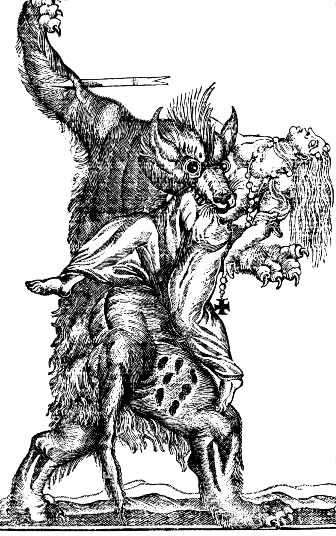
One of the talents attributed to witches in a number of cultures is self-transformation. If you’ve plunged more than ankle-deep into witchcraft research, you’ve likely run across famed Scottish witch Isobel Gowdie’s charm, which she reputedly used to transform into a hare, which begins “An I shall go into a hare, with sorrow and sighing in mickle care…” Gowdie was not alone in her belief that through the force of her magic and her will (and perhaps some psychoactive botanical substances or a judicious application of rendered animal fat), she could change her form to that of an animal. Perhaps the most famous example of this power is the werewolf, which sometimes changes of its own volition, but more often is a victim of the shiny moonlight’s powers.
In the New World, plenty of witches also had the power of transformation. This article will look at a few key tales of shapeshifting from New World lore, and ask questions about what the stories could mean for a magically inclined person with an interest in exchanging human form for an animal’s.
Perhaps the best-known and most widespread incarnation of the shapeshifting legend east of the Mississippi is the story of the loup-garou (sometimes also rou-garou, rugaru, or a similar variation). The beast can be found just about anywhere which saw frequent contact with French Colonial influences, such as in Canadian border zones or Louisiana. Often the loup-garou is essentially a werewolf, a human being who can—through magical means often diabolical in nature—become a wolf-like beast. Some versions of the story, recorded by University of Louisiana professor Barry Ancelet, describe the beast as more of a thief than a predator for humans, stealing fishermen’s clams while they sleep. The exact nature of the creature is also indeterminate, since depending on one’s location, it can “range from the rougarou as a headless horseman to a wolf that prowls the forest at night” (Lugibihl). The actual transformation may be permanent (or even ghostly, as some accounts tell of the beast as the remnant of a cruel old man), or may only last for 101 days, after which time the loup-garou transfers its curse to another person through a bite or drinking his or her blood. A person under the curse seems to know whether he or she is suffering from the transformation, and becomes rather wan and unhealthy, but usually remains silent about the condition with others. A major variation on the loup-garou is the bearwalker, about which Richard Dorson recorded several stories in Michigan’s Upper Peninsula during the mid-20th century. As you can probably guess, the assumption of a bear form (or at least an animal form which resembles a bear more than a wolf) is more common in the lore of the borderlands on the north of the Great Lakes.
In the mid-section of the United States, particularly from the mid-Atlantic down to the upland South and across into the Midwest, the power of transformation is far less canine in nature. While the loup-garou certainly fell into the purview of New World magical lore (albeit lore largely imported from Europe), the tales of transformation one finds in places like Appalachia skew distinctly witchy in flavor. Several stories, including one which we’ve recorded here before called “The Black Cat Murders,” talk about witches transforming into cats in order to visit harm on prospective victims. Patrick Gainer recorded his version of the tale in West Virginia from Mrs. Robert Pettry, whose account included a man with a pet bear that struck off the witch-cat’s paw only to have it transform into a human hand once it was severed. This is a very common feature of witch transformation tales, and often once a witch has been injured in her animal state, she bears the marks of her injury in human form as well (which proves helpful to neighbors in identifying her). One of the remarkable points about these transformations remains that in many cases the witch has a physical human body in one place and a spectral body (with some corporeal aspects, as in the case with the bear above) that can travel around at her behest while remaining deeply linked with her. That trait appears throughout North America (again, with some Old World antecedents, including Africa as well as Europe). A tale from Virginia recorded in The Silver Bullet, by Hubert J. Davis, tells of women who turns into a cat only to have her hand whacked off with a knife. The next day, when the man who did the whacking tries to shake hands with the suspected witch, she refuses because her hand is now missing. Davis also reports a tale of a witch who becomes a cat only to be caught by a lonely mountain man, and transformed back into a woman, she marries him and bears him two children. When he begins drunkenly telling someone how they met, she turns herself and the kids into cats and kittens and they disappear forever through a hole in the wall.
Of course, not all witches turn into cats, and not al were-cats are witches, exactly, either. In Utica, New York, Davis found a tale of a witch who turned herself into a black colt that would appear in neighbors’ fields and graze among their horses. When a man sneakily catches the colt and has it shod at the blacksmith’s (I’d note the importance of iron to this story, by the way), the colt then gets put into a pasture, then disappears. However, a neighbor-woman is seen with bandages on all her hands and feet the next day. New York is also the home of famed witch Aunty Greenleaf, who reportedly would turn herself into a white deer rather than a cat or a horse. She managed to elude hunters constantly until one hunter got the idea to use melted silver for bullets and struck her in her transformed state. She, of course, took ill and died (Schlosser 2005). Another famed shapeshifting creature, however, is not a witch at all, but a Native woman who has been cursed into cat form known as the Wampus Cat (Schlosser 2004). Lest you think that all those who are animagi (to steal a term from Harry Potter) are female, an African American tale speaks of a male witch whose form is that of a boarhog, and who uses his powers of magic and transformation to gain a pretty wife with lots of land. Interestingly, a little boy in the story—often called the “Old Witch Boy”—knows the boarhog witch’s secret and reveals it to the girl’s father, resulting in the death of the hog-witch (Leeming & Page).
Some of the most pervasive and powerful witch-stories of transformation come from the American Southwest. Navajo skinwalker tales abound with narratives about evil witches who could use the pelts of animals to take on different shapes, usually to terrorize outsiders or those they did not like on the reservations. Some accounts claim that the witch who could take on the skin of another creature was the most powerful type of witch, and had mastered what was known as “The Witchery Way.” Such a creature was to be greatly feared, and trade in certain skins and furs was severely limited within Navajo culture. Skinwalkers could be recognized by some of their supernatural abilities, but more especially by their eyes: in animal form, their eyes looked human, and vice versa when in their human form. Nasario Garcia recorded many tales in New Mexico, Colorado, Texas, and California from people in the late 20th and early 21st centuries who reported knowing about or having seen witches that had taken on animal forms, just as skinwalkers do. One story related by a a man who recalled the events of the tale from when he was eight years old told of how his father had been driving an oxcart on a dark night with his son (the narrator) and a few farmhands along with him. Suddenly, two sheep appeared alongside the cart, one white and one black, and simply followed them, always matching pace with the cart. Eventually, they simply disappeared. Many others recorded by Garcia spoke of witches taking on owl forms to travel out by night, or occasionally coyote or dog forms, in which case they seemed to want to bite errant travelers (although never in such a way as to cause permanent injury or death, although most who see these creatures report being terrified).
So just what do witches do once they are transformed? In many of the stories, they seem to be up to no good. The tales of witch-cats often speak of numerous murders or unexplained deaths attributed to the shapeshifting sorcerers in the area. In some tales, witches take on cat forms to sneak into the houses of children and steal their breath (which is obviously related to the superstition about cats stealing babies’ breath). In some cases, the witches seem to be up to mischief, as in the case of Aunty Greenleaf, who likes to lead hunters on wild chases and get them lost, or cause their guns to fail. The loup-garous steals food, or worse, passes its curse on to others, sometimes even drinking the blood of another person to accomplish its nefarious task. The near-universal terror of skinwalkers in the Southwest is attributed to their powers to cause sickness and death as witches, although they seldom seem to kill or even severely maim while in animal form (although there are often reports of animal mutilation later connected to them). Richard Dorson records one tale from the Southwest in which shapeshifting witches seem to threaten each other more than the average person. He speaks of a pair of witches who make a bet about which one is faster in horse form. The loser has to stay a horse, which is accomplished by means of a magical halter. The winning witch sells the loser to a man, whose son accidentally removes the halter, and the witch transforms into a fish and swims away in a nearby river, then continues to transform until he’s a coyote. The coyote is tracked and killed by dogs in the end, and notably the witches have done no harm to anyone but themselves.
Why do shapeshifting witches get a bad rap, then? I would like to suggest that the real uneasiness among those who tell the stories is a fear that witches can be anywhere, and anyone, and just about anything. You never know when you might offend a hidden witch, who could be the cat twitching its tail by the fire or a horse in a pasture across the road. A healthy show of respect (even one tinged with fear) makes for a good insurance policy against the witch’s other fearful talents. Of course, being able to take on animal forms also means that the witch knows just how well you treat the lower orders of species, which might also inspire one to act a little better around the flocks and fields, or to pass an extra dog biscuit to the pooch curled up at your feet. Who knows, that might just be all that stands between you and a rather nasty hex, right?






 New World Witchery - The Search for American Traditional Witchcraft