EDIT: We’ve had a very informative and respectful email from a listener that pointed out a few errors in my retelling of the Haitian tale about Obatala, Yemoja, and Shango. I would like to note that Yemoja is not historically associated with Haitian spiritual practices, and that the selections from Teish’s book are not reflective of African Traditional Religious practice as done by initiates from those traditions (like Lukumi or Candomble). The tale of Obatala’s Yams is from Courlander’s book, which has come under critical fire at times for inaccuracies. I am leaving the story as-is and in the context of the episode because I think it does fit the overall theme and has some grounding in folk narrative from Haiti, but please do not take it as solid evidence of Haitian traditions and practices. The listener also noted that Haitian Lwa and Lukumi Orishas are not “goddesses,” which is a good point to reiterate. They are not. Nor are White Buffalo Woman or La Virgen de Guadalupe. They are “goddess figures” in an anthropological sense, but I am using a very blunt instrument in categorizing these three tales together. I hope that I have not misled anyone into thinking that the Western concept of a “goddess” is universal or fits cultural material from non-Western sources without some severe oversimplification. Again, this episode is designed as a way of looking at the “lighter” side of the Feminine Divine, and is made in a spirit of appreciation. If I’ve reduced anyone’s spiritual beliefs in any way through this material, I apologize, as that was certainly not my intention. -Cory
We spend sometime with mothers bright and beautiful, the Queens of Heaven, in lore and practice. Hear some folktales from the New World, as well as some spells, music, and other fun stuff all devoted to the Bright Mother.
Please check out our Patreon page! You can help support the show for as little as a dollar a month, and get some awesome rewards at the same time. Even if you can’t give, spread the word and let others know, and maybe we can make New World Witchery even better than it is now.
Producers for this show: Corvus, Diana Garino, Renee Odders, Ye Olde Magic Shoppe, Raven Dark Moon, Ivory, The Witches View Podcast, Sarah, Molly, Corvus, Catherine, AthenaBeth, Jen Rue of Rue & Hyssop, and Jessica (if we missed you this episode, we’ll make sure you’re in the next one!). Big thanks to everyone supporting us!
The idea to do this episode is related to our previous show, Episode 63 – The Dark Mother (although obviously we’re sort of looking at the divine feminine from the other side this time).
Folklore for this episode comes from several sources:
If you have feedback you’d like to share, email us or leave a comment. We’d love to hear from you!
Don’t forget to follow us at Twitter! And check out our Facebook page! For those who are interested, we also now have a page on Pinterest you might like, called “The Olde Broom.” Have something you want to say? Leave us a voice mail on our official NWW hotline: (442) 999-4824 (that’s 442-99-WITCH, if it helps).
Promos & Music
Title and closing music is “Pig Ankle Rag,” by The Joy Drops, and is used under a Creative Commons License (available at Soundcloud.com).
Incidental Music (from FreeMusicArchive, used under a Creative Commons License):
Paul Messing, “Lakota Prayer (Edited)”
Laurent Danis, “Lakota Prayer”
L’Horrible Passion, “Lucidique”
Mild Maynard, “Migrant Mother”
Canton, “Ambient Gourd”
Advent Chamber Orchestra, “Serenade for Strings (Dvorak)”
Sergei Chereminisov, “Mother’s Hands”
Additional music used by permission: “Treachery is Afoot” (Ember Days Soundtrack) and “La Sirene,” by S.J. Tucker.
I am sure I am not the only person in the witchcraft blogosphere who will be venturing an opinion on Robert Eggers’ New England folk horror film, The Witch. The movie’s stylistic and narrative gravity has been pulling critics from many backgrounds into its orbit to venture commentary. It is a fine film, to be sure, and if you are looking for a recommendation, I am among dozens of others who will give one—the film currently seems to be holding a mid-to-upper-80s percentage and “Certified Fresh” rating on movie review amalgamator RottenTomatoes.com. If you’re a fan of horror movies (or at least can stomach horror genre frights), the movie is beautiful to look at and riveting from its first moment until its surprising finish. For visual impact alone, it is worth seeing in the theater. Other critics with a deeper background in film studies can and have said much more about Eggers’ diretorial debut as an artistic work, and so I will leave my simple recommendation here in the first paragraph.
Instead, I would like to comment on the elements of the film upon which I may be more uniquely qualified to offer an opinion. As a student of folklore and history, as well as someone with a more-than-passing interest in witchcraft as a particular subject, I will take a couple of paragraphs to talk about how the film uses those elements to tell a story that lingers long after a viewer departs the theater. Fair warning: while I do not wish to spoil anything, I won’t be able to discuss how history and folklore shape the narrative without referencing very specific moments in the movie. So, that is to say, many potential spoilers ahead.
Title page woodcut (via Wikimedia Commons)One of the most widely acclaimed elements of the film is its historical accuracy. Director Eggers spent four years doing intensive research, drawing upon primary source documents from the 17th century to build up the authenticity of his world. The film’s coda notes that the themes, some narrative elements, and much of the dialogue is taken directly from diaries, pamphlets, and other period materials, and that attention to detail shows. The film’s language has an immersive quality. Its costumes and physical spaces do as well, from the community plantation abandoned by the Separatist family at the beginning of the film (filmed at Plimoth Plantation) to the wild wood which hems in the clearing where they attempt to build a farm and a life. The family, led by father William (Ralph Ineson), manage to eke out a first season’s crop of corn only to have it struck by blight. Soon after, eldest daughter Thomasin (Anna Taylor-Joy) loses the youngest child to something which mysteriously—and with uncanny swiftness—appears from and disappears into the woods. William attempts to comfort his wife, Katherine (Kate Dickie), by reminding her how lucky they are to have so many children survive in the capricious Early Modern period, and that the loss of one is tragic, but understandable in a world where God must continually test his children’s faith. Katherine is broken, however, fearing her infant has been taken to Hell since William refused to have it baptized in the plantation church due to his disagreements with its less rigid brand of Puritanism. The pre-adolescent boy of the family, Caleb (Harvey Scrimshaw), receives religious lessons from his father in the woods as they attempt to set traps to catch wild game for the winter, lessons about his corrupt and sinful nature. Caleb finds himself caught in a moral compromise after his father reveals that he sold a family heirloom without telling Katherine, a crime for which Thomasin receives the blame until the boy steps in with a protective lie, and imprecating all of them in violations of Calvinist theology.
All of this is not to spoil the film’s plot elements—these fragments do not reveal anything terribly important, and most happen within the first third of the film. I bring these details up to make the point that the film has an air of authenticity about it, both historically and psychologically. That is not to say that the historicity of The Witch is somehow above reproach. It is not. As Peter Muise of the blog New England Folklore has pointed out, “many of the film’s later images are drawn not from New England witch narratives but instead from continental European myths and narratives, which had more sexual content. Continental witch stories were quite lurid, full of orgies, infanticide and cannibalism. The New England witches, malevolent though they were, were demure Puritans at heart.” So Puritan were 17th-century witches, in fact, that their notorious leader—the Devil—frequently wore the guise of a Puritan minister. Historian Richard Godbeer notes that the inversion of specifically religious images had nothing to do with Puritanical obsessions with chastity, but with the intentional choices of the accused in connecting their religious leaders with satanic influences:
“The subversive equation of godly and diabolical communities in descriptions of witchcraft at Salem explains the almost complete absence of sex from those accounts. That absence was not due to Puritan success in ridding New England of sexual license, or any reluctance on the part of townsfolk to mention such transgression as did occur. The court records of early New England contain thousands of cases relating to sex crimes…Had deponents in 1692 wanted to fill their descriptions of witch gatherings with illicit sex, they could have drawn on the local reports and gossip…That deponents did not include sex in their descrptions of the diabolical community at Salem was, therefore, a matter of choice…[and] give the impression that layfolk in New England were imprisoned by the covenantal discourse of Puritan theology” (Godbeer 69).
That Puritan theology is something the film gets very right. At one point, William leads his son out into the woods to check some game traps, and leads him through a Calvinist catechism of sorts, which has the child confessing his debased and sinful nature and the failure of anything but God’s grace to save him. William also has to explain that Caleb’s younger brother may very well be in Hell, because only God can know the ultimate disposition of someone’s soul. William’s disagreement with his local church’s theology is very much based on this world-view, and like many Puritans, he believes the wilderness and all its trials are a godly sign of righteousness. The wilderness, and the things dwelling within it, sorely test the goodness of the family, and find it wanting.
Yet it is not just in the wild places where dangers pursue Thomasin and her kin. Even on the little farm, corrupting influences creep in. The twins, Mercy (Ellie Grainger) and Jonas (Lucas Dawson), display remarkably little regard for their parents or older siblings. They play strange games with the family’s dark-hued goat, Black Phillip, and are visited by spectral fits during an attempt to exorcise the influence of witchcraft on one of the family members. Thomasin’s budding sexuality threatens the family’s stability, too, very much putting her in the line of fire for witchcraft accusations. Women were seen as particularly susceptible to witchcraft and the Devil—one part of the famous witch-hunting manual known as Malleus Maleficarum contains a section entitled “Why It is That Women Are Chiefly Addicted to Evil Superstitions.” Thankfully, the film does not oversimplify the accusations into pure psychosexual drama, but instead shows how the family begins to devour itself from the inside, with the twins just as suspect for diabolical malfeasance as their older siblings.
All of that is to say that the historical aspects of the film generally ring true, even if they muddle a bit of the Old World into the New. The language particularly crackles, immersing the audience without dumbing it down for them (and it is taken directly from trial records and journals, as mentioned above, which Eggers had to sift and stitch together into something cohesive). If the film were called Accursed Little House on the Damnéd Prairie, however, I likely would not be examining it here (although I’d still absolutely watch it). The history in the film is heavily served by its reliance on folklore, which is what makes it truly terrifying.
Almost from the very beginning, the folk world of The Witch absorbs its audience. The titular witch seems like a potential allegory or psychological symbol for only the briefest of moments, and then suddenly becomes very real within the story. To be clear, this witch is NOT an herbal healer or midwife living at the edge of a village who gets accused of crimes in some land-grab or out of fear over her quirky and peculiar ways. When Eggers gives his audience a witch, he gives them exactly what that word meant to a 17th-century audience: a wicked, dangerous, wild woman (yes, okay, sometimes witches were men, too), bent on doing harm and destruction to those that threatened her. Or, you know, just for fun, since the film is not completely clear on why the witch singles out this family for her torments beyond the possible encroachment upon her space.
So just what folkloric signs of witchcraft pepper the film? As a wise man once asked, “How do you know she’s a witch?” Well, as the answer goes, she looks like one—wild and disheveled, crone-like (except when she isn’t), and often working naked under the cover of darkness. She uses a wild-caught animal—of sorts—and turns its fat into a flying ointment, with which she anoints a staff and rides before a full moon. While much of this lore betrays the more European-style lore which Eggers admits influenced him significantly, there are a number of pieces here that absolutely get echoed in American magical and witchcraft practices. The animal-fat ointment, for example, has several parallels, including a story of “Greasy Witches,” from Roan Mountain on the Tennessee/Carolina border, and the Appalachian folkways series, Foxfire, has references to rendering all kinds of animal fat into useful cures, ointments, and greases.
As the film is a horror movie of sorts, blood is also in the mix. Animals give bloody milk as a sign of bewitchment, a theme paralleled in a number of stories from New England and the mid-Atlantic. Sadly, the family does not seem to know any of the traditional curesagainst witchcraft, such as scalding the milk in the fire or beating it with brambles to reverse the harm upon the witch. But then, as they are devout in their Puritan faith, they likely would agree with Cotton Mather that “[W]e ought not to practice Witchcraft to discover Witches, nor may we make use of a White healing Witch (as they call them) to find out a Black and Bloody one” (Mather 265). Black and bloody this witch can be, almost vampirically draining blood and life from the livestock and even people on the little farmstead, and leaving sickness and madness in her wake. While a more modern interpretation of this sort of story might be tempted to associate illness with a natural cause and leave witchcraft as a psychological function, Eggers resists that urge, and clearly implies the uncanny in the family’s woes. During a particularly eerie moment, a family member suffering from the witch’s influence coughs up a bloody, partially gnawed crabapple as a sign of his malefic infection, not unlike cases in which pins or stones are vomited in folk tales.
The animals in the story also play a significant role in the witchcraft. A wild-eyed hare seems to taunt the family. William’s attempt to kill the thing results in a misfire of his rifle, which in turn causes him injury. Stories of bewitched guns are found in a number of tales in collections like Patrick Gainer’sWitches, Ghosts, & Signs or Hubert Davis’s The Silver Bullet. The animal form of the witch—a hare—seems more in line with British and Scottish lore, but the concept of shapeshifting is hardly unknown on American soil (we did a pair of shows and an article on the topic recently, in fact). The other eerie beast in the film is Black Phillip, the family billy goat, with whom the twins cavort and make up rather diabolical stories. The goat seems harangued by the children, and the father struggles to catch and pen him at one point, demonstrating his tremendous physical strength. Black Phillip nearly steals the show when he’s on screen, with his strange dancing and bucking when the members of the family get too close. Animal familiars also appear in the film, such as a raven which pecks at one person’s breast, drinking blood as recorded in some of the testimonies of 17th-century witches. The deposition of New Hampshire witch Eunice Cole, for example, accused of nursing her familiar with a witch’s teat: “[L]ookeing upon hir brests under one of hir brests (I thinke hir left brest) I saw a blew thing like unto a teate hanging downeward about three quarters of an inche longe not very thick” (Demos 485). Stories from Salem also spoke of witches suckling animals, such as hairless cats.
Perhaps the darkest and finest connection to folklore is the presence of both the Devil and the Devil’s book, in which a person might sign her or his name and gain diabolical power at the cost of her or his soul. The trope of this infernal deal appears in European records, too, but became a major feature of witchcraft legends, tales, and trials in the North American colonies and states. Folklore from Maine down into Virginia and the Carolinas made mention of these dealings (which is not to exclude points outside of that range—Canada had some similar legends, as did areas south and west of the New England/Mid-Atlantic corridor). These books would frequently be signed in blood, and in the case of an illiterate person, an “X” in her or his blood would suffice for a compact. We’ve written about the subject here before, but these “Devil’s Books” and their contractual bond with Satan (or at least with a “man in black,” who often looked a great deal like a Puritan minister) made concrete the fears of Puritans—the Devil was really out to get them, and was ready and waiting to enlist any human into his service who did not keep constant vigilance. What did people hope to gain from signing on with the Devil? One witch, Mary Marston, found release from pain and grief after her mother’s death by signing the book and becoming a witch, while accused witch Mary Lacey “confessed that the Devil told her ‘we should have happy days and then it would be bett’r times for me’” (Hall 145). One witch, Mary Barker, even believed that compacting with the Devil for a witch’s powers would earn her pardon from her sins (ibid.). Frequently, witches compacted for the sole and deeply personal purpose of vengeance upon enemies whom they could not defeat through legal or licit means. Accused Salem witch Rebecca Eames explained that the Devil agreed to give her “powr to avenge her selfe on them that offended her” (Hall 192).
Witchcraft: a white-faced witch meeting a black-faced witch
Credit: Wellcome Library, London. Wellcome Woodcut, 1720. (via Wikimedia Commons)
All of these reasons come into play through the course of Eggers’ The Witch, as tragedy turns into motivation and the fallen family comes to grips with its graceless state. When piety has been exhausted, power becomes a deeply motivating incentive. Crucially, the film does not linger on any sexual compacts with the Devil, although the witches in the film are generally nude or sexualized in other ways. Instead, the embrace of witchcraft becomes a choice, indeed an almost entirely reasonable one, given the circumstances of the collapse of Puritan morality in the face of a wilderness clearly beyond the control of any Calvinist God.
Eggers has invested in this film, emotionally and intellectually, and he asks that his audience do so as well. While he is attracting a lot of attention for his detail-oriented and historical approach, the feelings conveyed by the filim have as much or more authenticity as the choice to use period costume or building materials. The folk elements of the film—which is subtitled “A New England Folk Tale”—connect it to the raw nerve of the cultures in which witches seemed to be under every dark bush or tree. As a specimen of American folk horror, the movie packs a punch, and does not attempt to explain away its terrifying elements through a single lens, like psychology or the supernatural. Instead, it lets all the pieces come together to support a story that can break your heart as easily as it makes you jump out of your seat.
If you’re interested in finding out more about the historical or folk elements which shaped The Witch, please check out the bibliography at the end of this article.
Thanks for reading,
-Cory
References
Barden, Thomas E. Virginia Folk Legends (Charlottesville, VA: Univ. of Virginia Press, 1991).
Demos, John. “Underlying Themes in the Witchcraft of Seventeenth-Century New England,” in Witches of the Atlantic World, Elaine Breslaw, ed. (New York: NYU Press, 2000).
Godbeer, Richard. “Chaste & Unchaste Covenants: Witchcraft & Sex in Early Modern Culture,” in Wonders of the Invisible World: 1600-1900, Peter Benes, ed. (Boston: Boston University/Dublin Seminar for New England Folklife, 1992).
Tonight we have a special guest with us to discuss shapeshifting once more. Plus we’ll hear an Appalachian folktale and a few shapeshifting spells, too!
Please check out our Patreon page! You can help support the show for as little as a dollar a month, and get some awesome rewards at the same time. Even if you can’t give, spread the word and let others know, and maybe we can make New World Witchery even better than it is now.
Producers for this show: Diana Garino, Renee Odders, Ye Olde Magic Shoppe, Raven Dark Moon, Ivory, The Witches View Podcast, Sarah, Molly, AthenaBeth, & Jen Rue of Rue & Hyssop (if we missed you this episode, we’ll make sure you’re in the next one!). Big thanks to everyone supporting us!
Our friend Achija Branvin Sionnach of Spellbound Bookbinding is our special guest this evening, and he’s also offering a special service to all of our listeners: If you have a paperback book you want leatherbound, he will do it for you for the costs of materials and shipping! Just mention you heard him on our show.
Cory also mentions the short film Foxes, which involves shapeshifting. Our guest tells the story of “Cat & Mouse,” an Appalachian Jack tale. And we also mention the story of Nebuchadnezzar from the biblical book of Daniel.
If you have feedback you’d like to share, email us or leave a comment. We’d love to hear from you!
Title music: “Homebound,” by Jag, from Cypress Grove Blues. From Magnatune.
Music: “Werewolves 2.0,” by Moi, le voisin, from Soundcloud (used under the Creative Commons license). Incidental music is “Ambient 1,” by Olssons, also from Soundcloud.
Podcast recommendation: Check out the latest episode of Infinite Beliefs, which features our friend (and sometime shapeshifting witch) Sarah Anne Lawless!
Come pull up a chair by the fireside with Daddy Splitfoot and listen to some devilish folklore submitted by listeners (and expanded upon by your sinister host). This time we visit the American West, particularly the Mormon cultural region, for our lore and legends.
The source for most of this episode is YOU! Our wonderful listeners, who supplied us with this lore back in the Spring during our contest. The legend of Bigfoot in Mormon country can be found lots of places, but this one makes a good starting point (and links to many of the others): MormonThink – Bigfoot
Come pull up a chair by the fireside with Daddy Splitfoot and listen to some devilish folklore submitted by listeners (and expanded upon by your sinister host).
The source for most of this episode is YOU! Our wonderful listeners, who supplied us with this lore back in the Spring during our contest. I also augment two of the pieces of lore with outside sources: 1) The story of Spring-Heeled Jack, adapted from Daniel Cohen’s Encyclopedia of Monsters, and 2) The Wendigo, told from Alvin Schwartz’s collection Scary Stories to Tell in the Dark.
Incidental music by So I’m an Islander (“Quiet Storm Surge”), Canton (“Ambient Gourd”), & Olssons (“Ambient1”). All tracks are used through Creative Commons license on SoundCloud.
The song between acts is “Me & the Devil Blues,” by Robert Johnson, and is available at archive.org.
Title & end music: “Grifos Muertos” by Jeffery Luck Lucas, from his album What We Whisper, on Magnatune.com Incidental music by Genomic Sequence (“Energy and Nothing”) and So I’m an Islander (“Quiet Storm Surge”, used through Creative Commons license on SoundCloud.
John Henry Fuseli, “The Nightmare” (1781 – via Wikimedia)
Author’s Note: This post is largely based on material I gathered for an entry in the upcoming ABC-CLIO three-volume series, American Myths, Legends, & Tall Tales: An Encyclopedia of American Folklore. The views and lore presented here, however, do not explicitly reflect the views of that publisher, and are entirely my own.
American history—and more generally, legend—contains its share of witches. In most cases, we hear or read about a witch at the receiving end of a lot of harsh accusations: milk stealing, poisoning livestock, and so forth. Not infrequently, however, a witch’s story takes a slightly different turn, and she becomes something more like a protagonist than a villain, albeit one with shades of gray around her morals. One of the best examples of just such a story is from rural nineteenth-century Maine, and it tells of a woman named “Old Betty Booker,” who gets a bit of a raw deal from a local captain and brings the full brunt of her witchcraft to bear on him for a bit of gleeful justice. The account below is found in Benjamin Botkin’s collection, A Treasury of New England Folklore:
HOW OLD BETTY BOOKER RODE SKIPPER PERKINS DOWN TO YORK
These two skippers, Mitchell and Perkins, were both Kittery salts, but of the two Skipper Perkins was the worst curried. Old Betty Booker wanted some fish, and she suggested her need to the skipper, “Bring me a bit o’ hal’but, skipper, when you git in—.”
“Show me your sixpence, ma’am,” was the thrifty reply.
And with an ill-boding scowl, and a shake of—
“Her wicked head, with its wild gray hair,
And nose of a hawk, and eyes like a snake,”
She watched the skipper sail away. The sea beat him up and down. The gale tore his sails, and the fish sheered away from his trawls. His men got sick, and his schooner came home poorer than she went. Then it got bruited about that Betty Booker was making a witch-bridle for the skipper, and was going to ride him down to York some wild night, whereat, the skipper, when it came to his ears, got into a mortal terror. He was sure to be at home, always, before dusk; and his doors were barred double, and he quaked and shivered and shook until the sun came up. Finally Betty sent the skipper word that the first stormy night she would ride him to York…
[H]e waited for Betty Booker; nor was she long in coming. An unearthly wail came down the wind, and there was a scratching of a hundred witch-claws on his door, and above all sounded the cracked notes of Betty Booker’s voice—
“Bring me a bit o’ hal’but, skipper!”…
With the cry of the hag, the gale rose higher, and with rougher buffetings it smote the old door that was built to look out on the sea; and then it began to open so the skipper felt a spatter of rain on his face. He heard the wild chatter of the witches, but he still held to his pushing, until he felt himself sliding along the rough floor. He made a leap for his bed, winding himself about in its coverings; the door flew open and in trooped the witches. They pounced upon the skipper, and stripped him to his skin; and while he cowered in his fear, old Betty bridled him and got upon his back, while the other witches climbed upon hers, and off they raced through the gale to York Harbor. When he lagged, they pricked him with their claws to make him go faster; and so they rode him as long as they wished, to get him back to Kittery before cock-crow, more dead than alive.
“Don’t say sixpence, skipper, to a poor old woman again,” was Betty booker’s parting admonition, as she and her familiars vanished into the mists of the darkest part of the night.
After that the skipper took to his bed, where for three weeks he nursed his wounds and told his story to his neighbors.
Botkin reports that the legend of Old Betty Booker may have been in some part based in real witchcraft performed in the York area, or at least in the practice of regional and maritime folk magic. He notes that one of the Kittery houses was torn down and inside a “witch-bridle” was found, composed of horsehair, tow, and yellow birch. Witch-bridles were thought to be a tool essentially similar in design a horse’s bridle, which a witch could slip over the head and into the mouth of a person or animal to force it to do her bidding. Accounts from both sides of the Atlantic describe situations in which witches use the bridles to force someone (or in some instances, a neighbor’s horse or other livestock) to become a mode of transport for the witch. Belief in witch-bridling was widespread during the Colonial era, and the phenomenon even appeared during the infamous witch trials of Salem. As a mode of transportation, they are coequal to flying ointments and broomsticks in most accounts. In the collection of Irish folktales assembled by Lady Gregory and William Butler Yeats, similar stories of spectral bridling pepper legends of witches. George Lyman Kittredge’s Witchcraft in Old and New England contains an account of a man bridled in the same way as Skipper Perkins. In almost all instances, the victim remains aware of what is happening throughout the ride, but his or her memories of the event quickly fade in the morning, leaving only bruises and a battered, weary body as proof of any supernatural occurrence. The folk phenomenon of “hag riding,” which has been linked to sleep apnea and sleep paralysis in modern medical diagnosis, may offer some explanations to the stories behind the malady, if one is inclined to make such connections (I personally tend to keep the two ideas only loosely connected for my purposes, and try not to make assumptions about medical conditions two centuries hence without at least entertaining the supernatural explanation with equal credence). A person under the influence of the witch-bridle felt no control of his or her body, but remained lucid and felt the pressure of someone on top of him or her. In the medical phenomenon of sleep paralysis, sufferers report a feeling like a great weight on their bodies and an inability to control their limbs, which very much resembles the conditions described in the folklore (see Baughman motif G241.2 “Witch rides a person”).
Possibly my favorite element of the Betty Booker story is its clear assumption that Booker is not out of order for her treatment of Perkins. The story seems to recognize that Booker is in a vulnerable position in the community, and that Perkins is not doing his duty by acting in such a miserly way. Women like Old Betty provided social good in some ways, selling outbound sailors magical charms to raise winds or prevent drowning. For example, cords with knots tied in them could be used to raise winds on a becalmed ship, and dried cauls (amniotic sacs which sometimes surround a baby’s head after birth) taken from newborn infants were alleged to protect sailors from drowning. Widowed women and social outcasts were particularly susceptible to suspicions of witchcraft. In stories like that of Old Betty, witches were seen as a form of moral enforcement. The sailor’s miserly behavior goes counter to acceptable standards, and even the structure of the narrative seems to blame him for the misfortunes that follow. Maine witches in other stories often have righteous retribution as motivation for their occult activities. In one tale, a witch named Emma Alley gets slighted by a fish boat skipper in much the same way as Old Betty Booker, and curses him for his stinginess, which results in him not catching anything else for the remainder of the season.
Old Betty is associated with several other witches who lived in the “Brimstone Hill” area of Kittery, namely Mary Greenland and a woman named “Aunt” Polly Belknap. She may also have taken on other names during her tenure as resident witch, including Betsy Booker, Easter Booker (who is also referred to as Esther Booker and associated with a woman named Betty Potter, further adding to the confusion) or a character called “Black Dinah,” who reputedly used weather-pans in her magic and dowsed for buried treasure. According to George Alexander Emery, Old Betty’s home was on the land between Kittery and York, marked by “a stone wall extending north-west and south-east,” on which she and a companion raised a meager patch of vegetables and some chickens. An 1896 newspaper account from the Boston Evening Transcript recounts the Skipper Perkins story, but attributes the storm-raising and subsequent torments directed against the captain to a witch named Hetty Moye, and relocates the narrative to within fifty miles of Boston (to be fair, Maine was a part of Massachusetts until 1820, so the fine line between one state and the other can be muddled in tales from the early-to-mid nineteenth century).
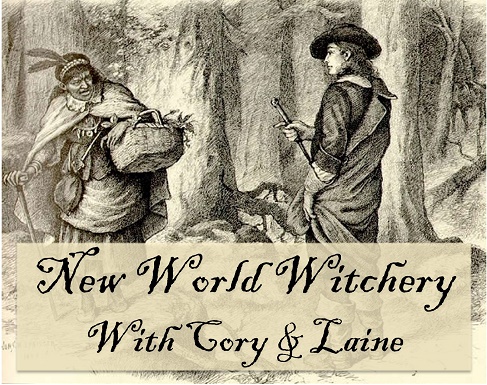
Witch Woodcut (via Wikimedia Commons)
None of this is to say that Old Betty comes out with a completely clean nose in all narratives. Other tales associate her firmly with diabolical activities. In one story, she allegedly dances with the devil out on the village green to fiddle music on moonlit nights. Additionally, witches were believed to have control over weather and storms by using devices such as “weather-pans,” which a sorceress would heat up over a fire to release a tempest out at sea.
In at least one account, however, I find it extremely heartening that a witch comes out very well, even dispensing a bit of needed justice without doing too much serious harm in the process. That seems much better than days spent stealing milk or blighting cattle, in my opinion, which are often ways in which a witch might express her ire in folklore. What do you make of Old Betty? Is she the sort of witch you would include in your spiritual ancestry as an American witch? Or do you see her story as just another sensational portrayal with a slightly positive twist?
Emery, George Alexander. 1873. The Ancient City of Georgiana and the Modern Town of York (Maine) from its Earliest Settlement to the Present Time. Boston: G.A. Emery.
In this fun diversion from serious witchcraft, Laine and Cory discuss their favorite films in the supernatural and folk horror genres. We also kick off a “Halloween in July” storytelling series (albeit somewhat by accident).
You can also check out George A. Romero’s classic zombie film, Night of the Living Dead, for free at the internet Archive.
There is also a segment near the end which involves Ambrose Bierce’s “An Inhabitant of Carcosa,” which you can find in the book, The Weiser Book of Horror and the Occult.
Upcoming Appearances
Cory will be at two upcoming events, and will likely be holding talks/discussions at both of them, which you might find interesting:
Title music: “Homebound,” by Jag, from Cypress Grove Blues. From Magnatune. Additional Music: “She Moved Through the Faire,” by Kellianna, from Traditions. Incidental music by Disparition.
Summary:
In the second holiday episode, we have a short documentary on the annual celebration of Krampuslauf in Philadelphia and an interview with author Linda Raedisch, who the book on Christmas monsters.
-Sources-
Check out the Krampuslauf Philadelphia webpage for more on that celebration. Many thanks to Amber Dorko Stopper and the entire Krampuslauf entourage for making space for me to do this documentary.
You hear Robert Schriewer (who was on a previous episode of our show as well) in the interviews. Please check out his book The First Book of Urglaawe Myths, and see the Urglaawe site for more information on Pennsylvania Deitsch Heathenry.
Big thanks are due to Timothy Essig of the Landis Valley Museum for his help and information as well.
We must recommend The Old Magic of Christmas, by Linda Raedisch, and we thank her highly for being on the show! Also check out her book on Walpurgisnacht as well.
I also highly recommend this little site, which explores several of the critters we discuss.



 Witch Woodcut (via Wikimedia Commons)
