In this extended episode, we revisit our recent trip to the magical city of New Orleans. We’ll discuss the most recent Pagan Podkin Super Moot, places to see in the Crescent City, and hear some music, travelogues, and even a tea leaf reading or two!
CONTEST!
We announced a new contest in this episode! Details are coming in a separate post, but the basic rules are: 1) Buy something, anything, from one of the sponsors in the list below; 2) Take a picture with that item (or a a picture/screengrab of the receipt); 3) Send your picture to compassandkey@gmail.com and let us know to enter you in the contest. You could win one of three fully-stuffed PPSM Swag Bags, full of items from these great sponsors!
PPSM Sponsors! (We love them!!!)
(We’ll be posting more on these items in other places, but here’s a short list of the swag items and sponsors)
Last time, I looked at a few of the standard products found in a typical supermarket which could be easily used within a folk magical context. I’m continuing that theme today, and while I’ll still be doing my best to stay out of the ubiquitous enchanted spice aisle, I will be touching on a few ingestibles. Please note, however, that as I frequently say: THIS IS NOT A MEDICAL BLOG, AND NO INFORMATION PRESENTED HERE SHOULD BE TAKEN AS MEDICAL OR LEGAL ADVICE. Before you start popping things into your mouth or rubbing them on your skin, you should make sure with your doctor that doing so will not lead to genetic mutation, pestilence, plague, or ennui of any kind.
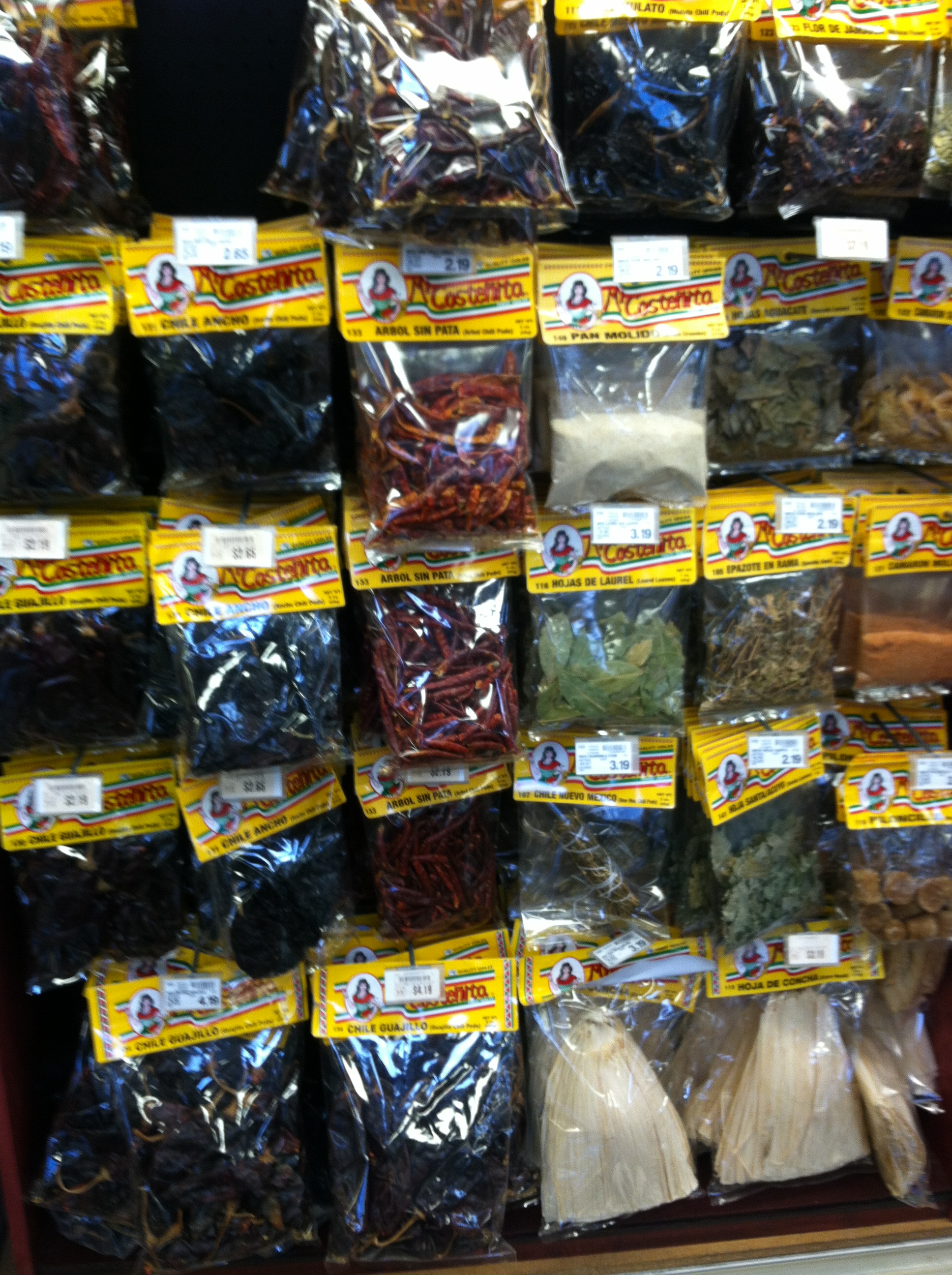
I’m going to start in what my part of the country likes to think of as the “ethnic foods” section, which generally speaking involves a portion of the produce area and an aisle with Asian, Hispanic, and perhaps Italian meal ingredients. It’s where I found the candles I showed in the previous post, but in most of the grocery stores around here, despite the obviously oblivious marginalization that comes with a label like “ethnic” or “international” cuisine, the diversity of the consumer population has made a lot of once-rare items much easier to find. The section of these stores directed at Hispanic consumers provides a number of tools for folk magic that fall under the practices of curanderismo and/or brujeria. I’ve covered supermarket staples like eggs already, so today I thought I’d look at three somewhat more distinctive items: corn husks, hot peppers, and coconuts.
Corn Husks
The papery, stiff-but-pliant corn husk is absolutely essential for making really good tamales. Usually these come in huge packs (because if you’re going to go to the trouble of making tamales, you may as well make a lot of them), and they’re often dirt cheap. In fact, in the late summer, I frequently fine freshly stripped corn husks in buckets next to the corn displays, and few grocery store managers care if you grab a sackful to take home with you for free. So what sorts of magical mischief can you get up to with all those husks?
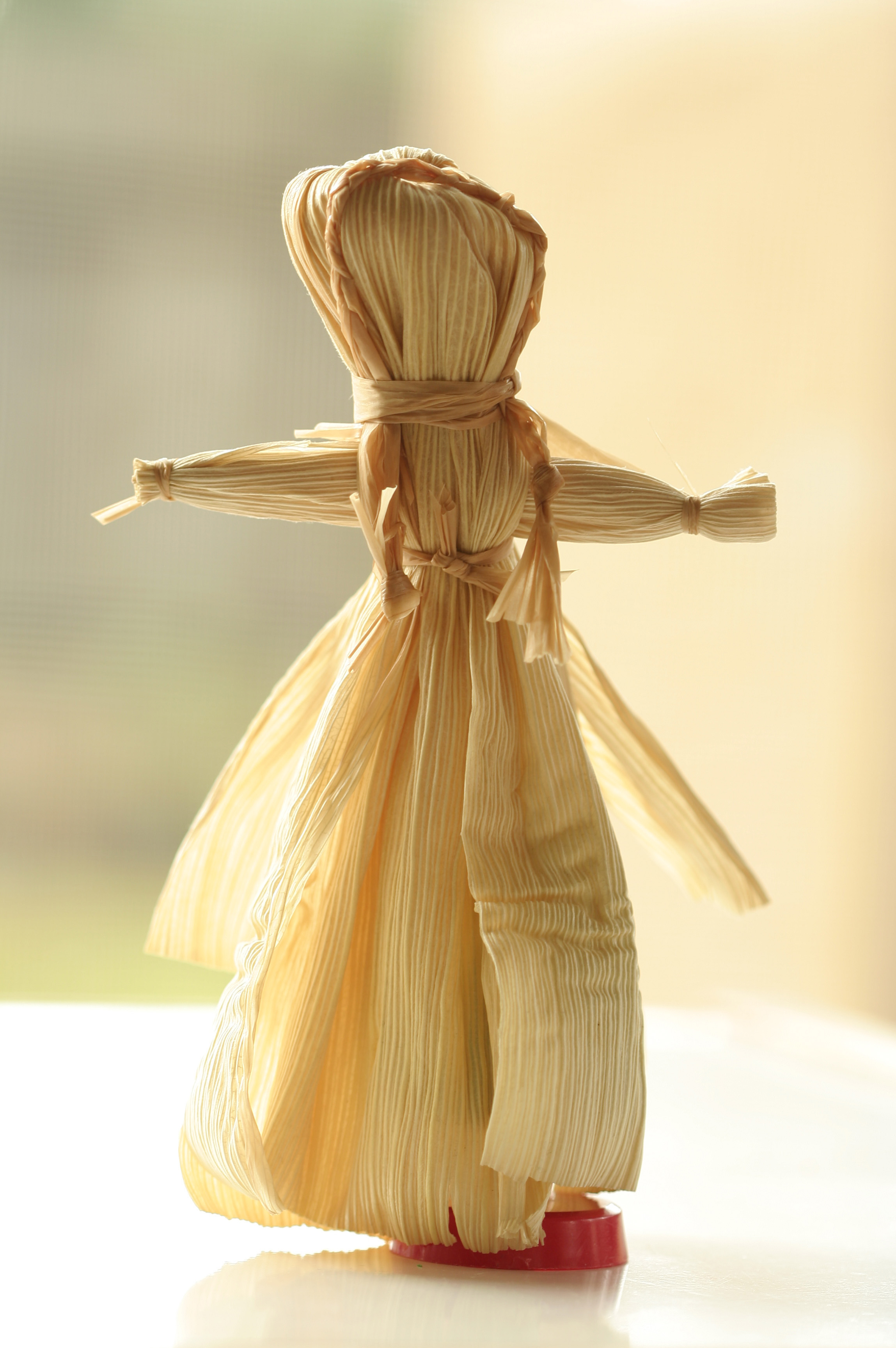
Corn dolly folk art (via Wikimedia Commons)
If you’re not making ensorcelled tamales, you might consider saving a few husks and turning them into doll babies for working various kinds of poppet magic. In some cases, the husks would be bound to the cob, along with various herbs and things like hair or clothing from the intended target to work a spell on them. Texan rootworker Starr Casas describes one such baby in The Conjure Workbook, vol. 1:
“When I was caring my daughter [sic] I was very ill. I was put on bed rest for five months. My Grandma knew this lady and asked her to come to my house and help me during the week. She treated people who were ill. I think that due to her efforts my daughter is alive today. I trusted her because my Grandma trusted her…She prayed over me every day; one day she asked if she could have some of my hair. She could have just taken the hair from my brush, at this time my hair was very long. She told me the hair needed to come from the crown of my head.
A few days later she came with this Dollie. This was the first time I had ever seen a doll like this. The body of the doll was a corn cob and the doll was covered in corn husk. When I asked her what it was for all she told me was to keep me and my baby safe. After I had my daughter the Dollie disappeared. When I asked her about the missing doll she told me the doll wasn’t needed anymore. I have never seen another Conjure doll like that one again” (Casas 246-7).
Starr’s encounter with this type of doll is not typical of conjure practice, something even she notes, but the use of doll baby magic is fairly common and corn husks make a simple, cheap, easy-to-make-and-destroy sort of doll. One reason that Starr may not have seen them since is that they are less directly associated with hoodoo and more directly associated with mountain crafts, particularly the crafts of the Appalachians. In fact, you can find wonderfully detailed instructions and step-by-step photos on constructing corn dollies in Foxfire 3, which records the folk practices of the southern Appalachians (a later compendium called The Foxfire Book of Appalachian Toys & Games also discusses the corn dolls, but doesn’t give the detail the actual anthology book does). That’s not to say that such dolls are not found in any version of conjure—Dr. E mentions them in his article on doll making, found in The Black Folder, for example—but that they very likely drifted in from non-African sources. Their provenance matters not, though, because they are incredibly useful magical tools in any case.
Hot Peppers
Have you ever seen the sheer plethora of peppers available in a bodega? Even at the chain supermarkets, you can now find dozens of choices, ranging from fresh jalapenos and big, fat Anaheims to the huge sacks of tiny dried japones peppers and the small-but-potent habaneros. So what to do with all those peppers?
Of course, the obvious answer would be hot-foot work in hoodoo, but you can also get a little more creative than that. Using the peppers as a vessel, it takes very little effort (but a good bit of practice and caution) to slit open a habanero, stuff someone’s name inside and bind it back up. Doing that works sort of like a vinegar jar cranked up to eleven, in that it puts a lot of unpleasantness into someone’s life. Peppers don’t have to be all bad, either, as cooking them with something like chocolate creates a very different effect—a good hot cocoa with a hint of chili pepper makes an enlivening winter beverage, and a heck of an aphrodisiac! A little rum in that latter option helps, too, of course.
Speaking of rum, one of the more interesting uses for all those hot peppers in magic—and here I’m stretching the term to incorporate a certain degree of magical religion—is to soak the peppers into an alcohol like rum until it is nigh undrinkable. Why would you do that, you ask? Maya Deren explains the use of the drink during a Vodoun rite in her book, Divine Horsemen: The Living Gods of Haiti:
“As Lord of Eroticism, he [Ghede] embarrasses men with his lascivious sensual gestures; but as God of the Grave he terrifies them with the evidence of the absolutely insensate: he will not blink even when the most fiery liquid is sprayed into his eyes, and only Ghede can swallow his own drink—a crude rum steeped in twenty-one of the hottest spices known. Thus he may alternately remind men that he is their past, their present and their future, that he is master of their compulsive drive to life and the inevitability of their death” (Deren 104).
Deren also notes that anyone claiming possession by Ghede is subject to both of the tests she mentions: having the hot rum sprayed in their eyes and being told to drink it. A truly possessed devotee will have no problem doing so (and likely be able to down the entire bottle of rum and show no effects after the possession ends).
Coconuts
If you ever need to pretend to ride a horse, you will probably automatically feel the need to buy a coconut and bang the two empty halves together to simulate the sound. At least if you grew up watching a lot of Monty Python that’s probably what you’d do. The coconut is good for more than equine simulations, however, and you can use the whole fruit/nut and its liquid for several magical functions.
“Retrato de una señora principal con su negra esclava,” by Vicete Alban (via Wikimedia Commons)
Drilling holes in the coconut will allow you to do two things: firstly you can get at the precious liquid, coconut milk, inside. It’s delicious and a wonderfully refreshing drink, but if you can resist the urge to down it all in one go, save some for later. Now that you have a semi-empty coconut with holes in it, why not stuff it full of name papers, sweet things like raw turbinado sugar (also available in the Hispanic section usually) and create a natural honey-jar spell? This sort of spell will, of course, not last as long as an actual honey-jar, but it has the advantage of being very quick and due to the sympathetic magic connected to the coconut’s skull-like density and shape, it works right on the minds of the folks targeted with the spell.
Speaking of heads, if you saved that liquid, you can turn that into a powerful magical formula as well. An African-derived magical practice known alternately as “feeding the head,” or in Vodoun as a lave tet ceremony (literally “head washing”) involves using a coconut wash on the head and hair during a ritual setting in order to fill it up with good spiritual forces. The feeding usually follows a simple head washing, either with natural water (sea water, spring water, etc.) or a number of aqueous formulae found in various traditions. Then comes the feeding:
“The process of feeding the head is simplicity itself. The coconut milk or cream is scrubbed into the head, just like the head-washing compound or a shampoo. Once the compound has been worked into the head, the hair may be combed out again. However, unlike a head-washing compound, the coconut compound should be left to dry on the head—preferably, overnight. A scarf or towel may be wrapped around the person’s head to insure this…In the morning, the coconut compound may be rinsed out and the person’s hair washed with a shampoo and dried, as it would normally be” (Mickaharic, Spiritual Cleansing, 101).
The richness of the coconut milk causes the spirits which guard a person (frequently though to be connected to a person’s head in African tradition) to be refreshed and take a renewed interest in the person’s well-being. It’s sort of like bribing a guardian angel with a good pina colada, which would be another fun way to use that coconut milk if you’re so inclined.
Of course, you don’t even have to open the coconut up to use it magically. I’ve seen a house cleansing method which involves simply kicking a coconut around a new home, through every room from top to bottom and back to front. You might say a psalm as you go, or repeat the Lord’s Prayer or the Apostles’ Creed. Other traditions use other incantations, songs, or words, but the point is the same: get the coconut all over the house, kicking it as you go, letting it soak up bad vibes like a sponge. When you finish you can either pick it up in your left hand and take it to a far away tree, where you crack it open and leave it at the roots, or you can drop it into running water heading away from your home. It essentially functions as an egg cleansing for a domicile, but coconuts tend to be less messy than eggs when kicked (Mickaharic has a variant on this practice using a head of lettuce in his Spiritual Worker’s Spellbook).
There’s an entire pharmacopeia in a well-stocked bodega, with everything from aloe vera gel (and the live plants) to nopales (prickly pear cactus, sometimes used in curanderismo for treating diabetes) to chicken feet and cattle tongues (both edible, but also both used in various hoodoo spells as well) available to an informed shopper. I mention these three ingredients solely as a way to begin to see the shelves as stocked with more than marketing gimmicks and high-fructose-corn-syrup-laden beverages. While having a good local witch shop is invaluable for many reasons, the grocery store may be your best friend when it comes to simple, practical magic.
I know this article barely scratches the surface of the subject, and I highly encourage you to look at some other sources on making the most of a grocery store’s shelves for your spell work. As I said before, much of my own inspiration came from Sarah Lawless’ post on the topic and Cat Yronwode’s compilation The Black Folder, which features not only an article on grocery store magic (covering things like onions and lemons) by Cat herself, but other useful tidbits such as Norwegian bread charms (from Dr. Johannes Gardback) and an article on “kitchen witchery” by Sister Robin Petersen. Of course there are probably dozens of books on this subject, many of which I’ve sadly neglected here. Do you know of any good grocery-store spells? If so, please feel free to post them to the comments below!
I may eventually come back to this topic another time, but for now I hope this has been a useful glimpse beneath the barcodes into the magic of the market.
Customer making purchase in WWII grocery (via Wikimedia Commons)
If you have that song by the Clash in your head now, congratulations, that was my primary purpose in writing this article. Kidding.
Last time I took you on a quick but fun tour of my home to show how I’ve applied some of the folk magic I’ve picked up over the years in my personal life. Today, I’m drawing some inspiration from Sarah Lawless, whose article on “Pantry Folk Magic” is one of the finest pieces on using what’s at hand for practical spellwork that I’ve ever read. I’m also inspired by an article on “Grocery Store Magic,” in The Black Folder, a compilation of workshop notes by Cat Yronwode (which I recently reviewed), and I’ll be citing both of these sources as well as several others in the coming few paragraphs.
There are plenty of articles out there on doing magic from the grocery store, but I wanted to go beyond the spice aisle a bit and look at the vast number of folk magical items that may go a little under the radar in a standard shopping trip.
Before we go much further, I do want to mention that I don’t think the grocery store is the end-all be-all of magical supply houses. I prefer by far to grow or wildcraft my own botanicals, use hand-crafted incenses from a local occult shop, and carry talismans picked up at the nearby Catholic bookstore in a lot of cases. Supporting community commerce and doing work oneself fits in as well or better with most magical practices than grabbing a mass-produced box of incense from a five-and-dime shelf, but there are always going to be cases where magic must be done on short notice or with supplies not readily purchased at the witchy store. In some of the cases below, it should also be noted that the grocery stores where one can find these ingredients are not the big chains, but rather local bodegas or international markets. You are far more likely to find chewing john (galangal root) in an Asian market than in a big chain one, for example. Now, on to the tour!
Candles
One of the big resources that frequently gets missed in grocery store magical item lists is the cornucopia of candles that can sometimes be found. Of course, a lot of stores carry scented jar candles and those are reasonable enough for doing some workings, but if you look in the Latin American or Hispanic section you can often find a number of saint candles as well. I’ve found everything from the standard Virgen de Guadalupe to Santa Muerte, Seven African Powers, Just Judge/Justo Juez, and even a Lucky Lotto Numbers candle just by browsing a little. Below you can see a pair of very cute candles which look like children’s novenas for working with Guadalupe or St. Jude, found at a mid-level chain grocery store.
The novena candles are also frequently available unlabeled and sometimes in multiple colors. It’s fairly easy to customize them to your own needs and do extended spellwork using these tools.
The candles don’t stop there, though. Say you want to do a quick-and-easy candle spell, but you know you won’t have time to burn a candle 1-2 hours per night for nine nights. Stop by the baking section and grab birthday candles, which are small and burn very quickly. Will it change the potency? Perhaps, but you’ll be able to at least do what you want to do. They also frequently have letter or number shaped candles, so you might be able to use those to target a specific goal or person with the spell (especially if you’re knowledgeable about numerology and can figure out the right number(s) for the job).
If your grocery also has a Jewish section with kosher options, check to see if they sell Shabbat candles. They frequently come in boxes at a very reasonable price, and are specifically designed to be used for spiritual purposes (albeit non-magical ones in most cases). These burn longer than the birthday candles but much more quickly than novenas, and so would be good for mid-range spell work.
Cleaners
We’ve mentioned these a bit in our previous post on Spiritual House Cleaning, but here I mean less of the whole-herb types and more of the mass-produced stuff. Harshly-scented cleaning solutions with abrasive chemicals and artificial odors may not seem like a particularly likely place to find folk magic, but it’s there if you look for it. One of the most common of household cleaning agents, ammonia, acts as a substitute for urine in some spells. Cat Yronwode suggests in her Hoodoo Herb & Root Magic that ammonia can be used in spells focusing on protection and spells designed to improve sales, either at a business or of a home (Yronwode 29). In Spiritual Cleansing, Draja Mickaharic mentions ammonia’s great psychic cleaning powers and notes that putting a little bit down the drain after a house blessing & cleansing will help finish the job.
In a similar vein, we find plenty of uses for that old pantry/laundry/cleaning-closet standby, vinegar. Sarah plainly mentions vinegar as one of her grocery store finds for the working magician. All vinegars can be good for simple crossing work, according to Southern folk magic, and it would be very easy to turn cider or wine vinegars into a variety of Four Thieves Vinegar for both aggressive protection and subtle cursing. I mentioned on our Spell Failures episode that I had attempted to work a vinegar jar with poor results (mostly due to my lack of dedication). I found an interesting hexing combination of both vinegar and ammonia in Zora Neale Hurston’s article on “Hoodoo in America,” too:
i. To Punish.
When you want a person who is indited punished, write the name of the person in jail on a slip of paper and put it in a sugar bowl, or some other receptacle of the kind. Put in red pepper, black pepper, one penny nail, fifteen cents of ammonia and two keys. Drop one key down in the bowl and lean the other against the side of the bowl. Go to the bowl every day at twelve and turn the key that is standing against the side of the bowl to keep the person locked in jail. Every time you turn the key, add a little vinegar (Hurston 382).
I find it interesting that both ammonia and vinegar seem to be able to perform cleansing functions in a household, but applied to an individual their corrosive nature seems to become destructive. I think this illustrates the principle of the two-sided coin of magic nicely, though, as the same ingredient that can save you from nasty spirits might also be turned around to damn an enemy.
Before I move off of cleaners, I want to mention a couple of the commercial products out there that have some magical history and applications. First, the famous Pine-Sol cleaner, which has been found in grocery stores for almost 60 years. The product was born in Mississipi, and even today contains pine oil to give it cleaning power and its trademark scent (along with a hefty dose of chemical salts and alcohols). Pine oil is another spiritual cleanser and refresher, in addition to having some mundane cleaning properties as an antibacterial and antiseptic disinfectant. It works a lot like lemon does in spiritual cleansing—so much so that one of Pine-Sol’s first offshoot scents was lemon, although now they have half-a-dozen different aromas to choose from. While I’d never suggest using a commercial pine cleaner on the body (or in the body especially…that’s a big no-no!), some folk magical traditions have used pine oil-based treatments for medical ailments (there’s a fine example in Hohman’s Long Lost Friend, for instance). So the presence of lemon and pine has the power to cut through spiritual ailments as well as the nasty germs lingering on your kitchen floor. You can make a variant of your own pine oil cleaner by simply adding pine oil to some salted water with some castile soap dissolved in it. It won’t be as strong as Pine-Sol, but it also won’t be quite as harsh. You could even add a bit of lemon juice or lemon oil to that, too, for extra kick (both spiritually and microbially speaking).
Since we’re talking of lemons and soap, I can’t help but at least briefly mention Murphy Oil Soap, which has been treating hardwood floors for over a century (although only in a mass market for about half that time). The cintronella oil in Murphy’s has a citrusy, lemony scent, and is both a lucky and cleansing ingredient in spiritual work (it’s one of the oils used in Van Van Formula). Queen of Pentacles Conjure notes that both Murphy’s and Pine-Sol make great additions to the spirit worker’s cleaning closet. Citronella keeps away mosquitoes, too, which makes me love it even more.
I’m going to pause here before continuing through the aisles, as this article is already quite long. There is plenty more to see as we make our way through the store, though, so stay tuned!
This episode looks at various harvest festivals, including Michaelmas, Mid-Autumn Festival, and Thanksgiving. It includes poems, songs, stories, and a pair of essays. Enjoy!
I’m taking a cue today from a recent blog post by the excellent Jen at Rue & Hyssop entitled “Little Witcheries,” which focuses on the small, everyday enchantments in her life. She and several other bloggers have been sharing their daily practices, household charms, and domestic talismans so I thought I would offer a bit of the same. I know I don’t tend to make posts entirely personal here, but I do frequently talk about the “secrets in plain sight” that accompany practical witchcraft and folk magic, so it seems like now is a good time to do a quick tour of my home and see how I apply what I have learned in the course of my studies to my real life. I hope you won’t mind the diversion from the more general and academic examinations of folk magic. You’ll still likely get a good feel for folk magic, and I’ll reference any previous posts or sources that might explain further, so hopefully this won’t feel too indulgent.
I’ll mostly be cataloging what sorts of “little witcheries” I have around, rather than giving a lot of expository detail. Basically, I’m treating myself and my home as a folklorist’s test case, because nothing’s more fun than turning the microscope on yourself, right? And so, on with the tour! Come on in!
Exterior
Garden friends
Plant guardians – I have a number of magical plants in my front garden, but my rosemary and rue plants act as my primary sentries. The rosemary started as a pair of six-inch cuttings, and now it’s easily a three-foot-tall shrub. Theswallowtail caterpillar in the pictures is one that seems to particularly like our rue plant, but it doesn’t do any real harm to it, so we let it alone.
Witch bottle – Buried somewhere along your way to the front door (exactly where is my little secret).
Washes – The door is washed with protective mixture (which Laine has indicated she would rather not touch) and I use a protective foot-wash derived from Irish lore on the porch.
Interior
Entrance – Door has salt & red brick dust lines, plus several paper charms wedged in the lintel.
Cleaning – We have a mostly carpeted space, so instead of floor washes, I sometimes make floor sprinkles with powdered herbs & salts to affect the various rooms. I also use vinegar (including Four Thieves Vinegar) for cleaning & breaking up bad energy. Most of what I do to dress doors, windows, etc. can be found in our posts on magical house cleaning.
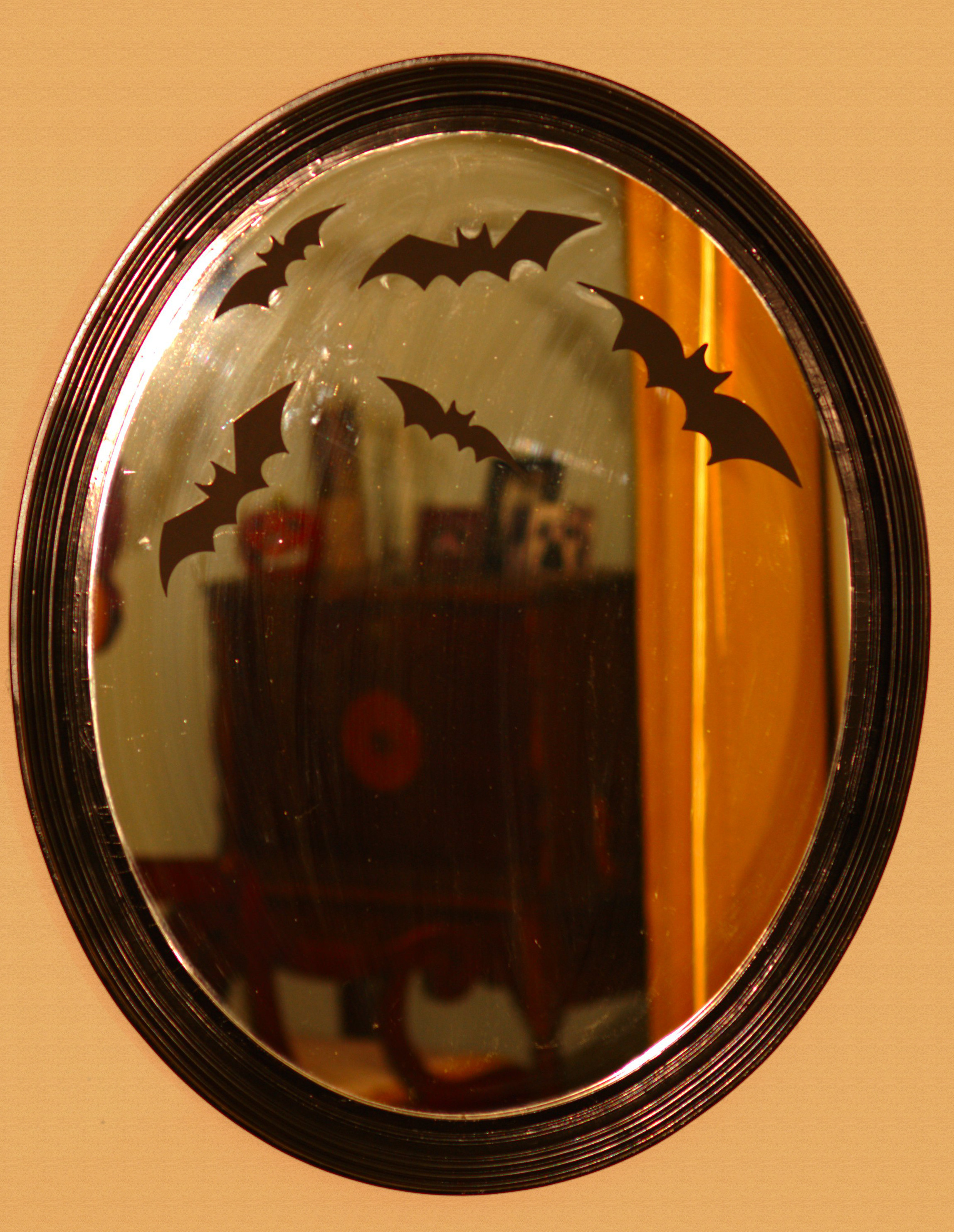
Mirrors – We keep a mirror behind the door to deflect anything spiritually harmful (currently decorated for Halloween with some bats).
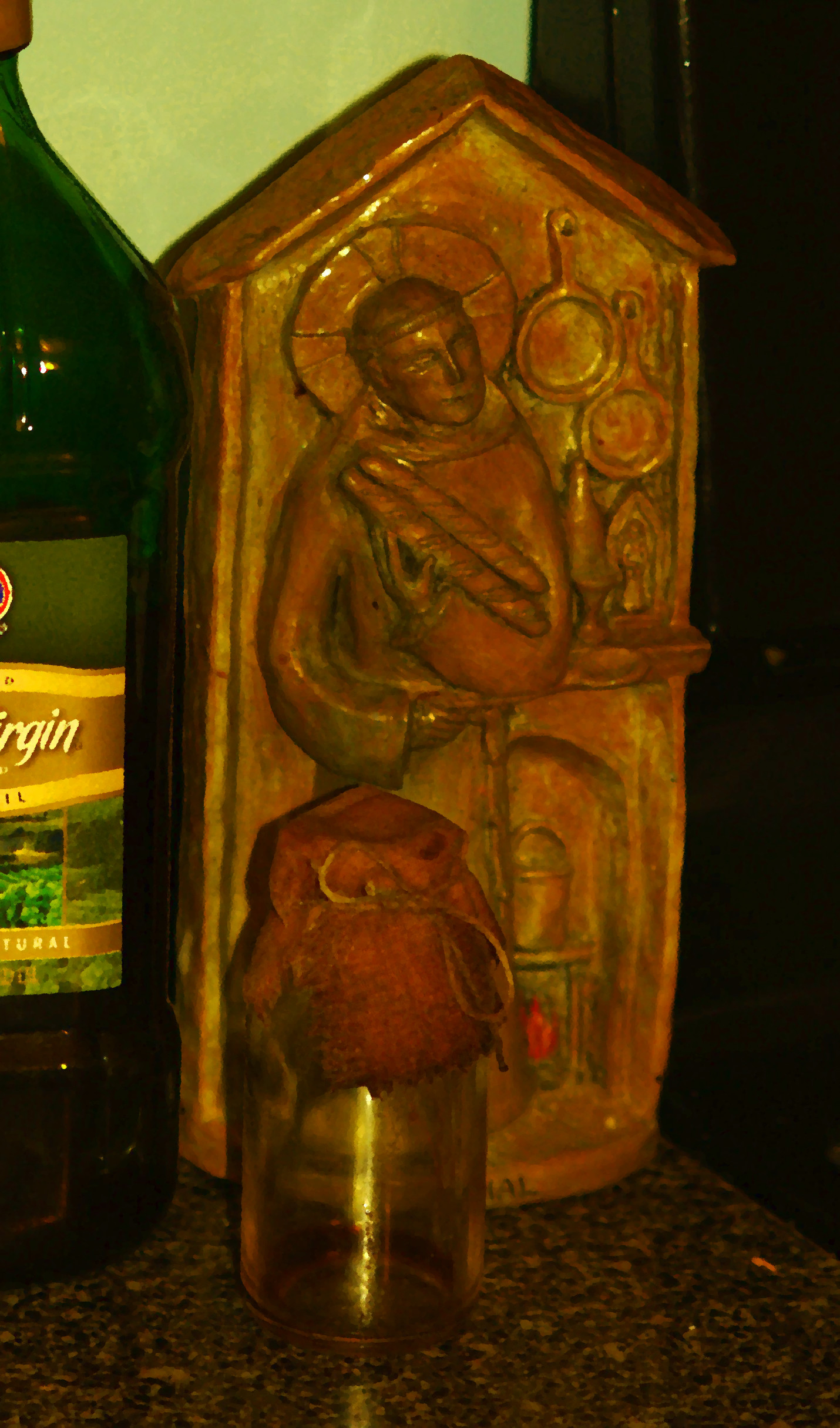
St Paschal & a spirit bottleBundles drying in the kitchen window
Tincture of Rue, Four Thieves Vinegar, & Four Thieves Pickles
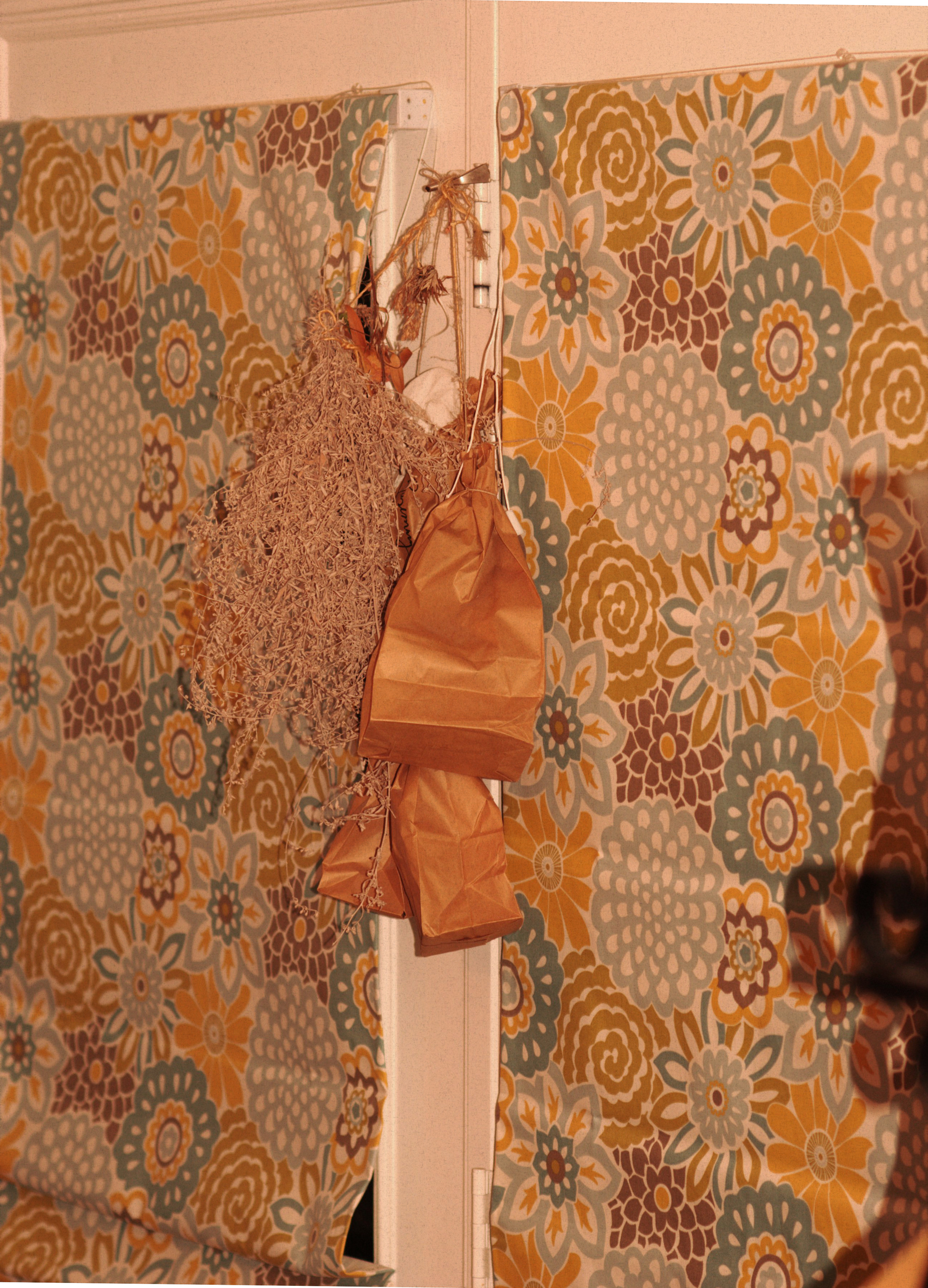
Kitchen – I’ve always got something brewing. Right now I’ve got some tinctures going (some magical, but most multipurpose, used in magic or cocktails equally), a few herbs drying in bags by the windows, and of course, my Four Thieves Vinegar in the pantry (plus a couple of jars of Four Thieves Pickles, which I put up each year). The kitchen is also home to a few of my spirit helpers, including St. Pascal and my resident house spirit (his bottle may look a bit strange, but he’s been with us almost since we moved in, so I don’t mind his scruffy appearance).
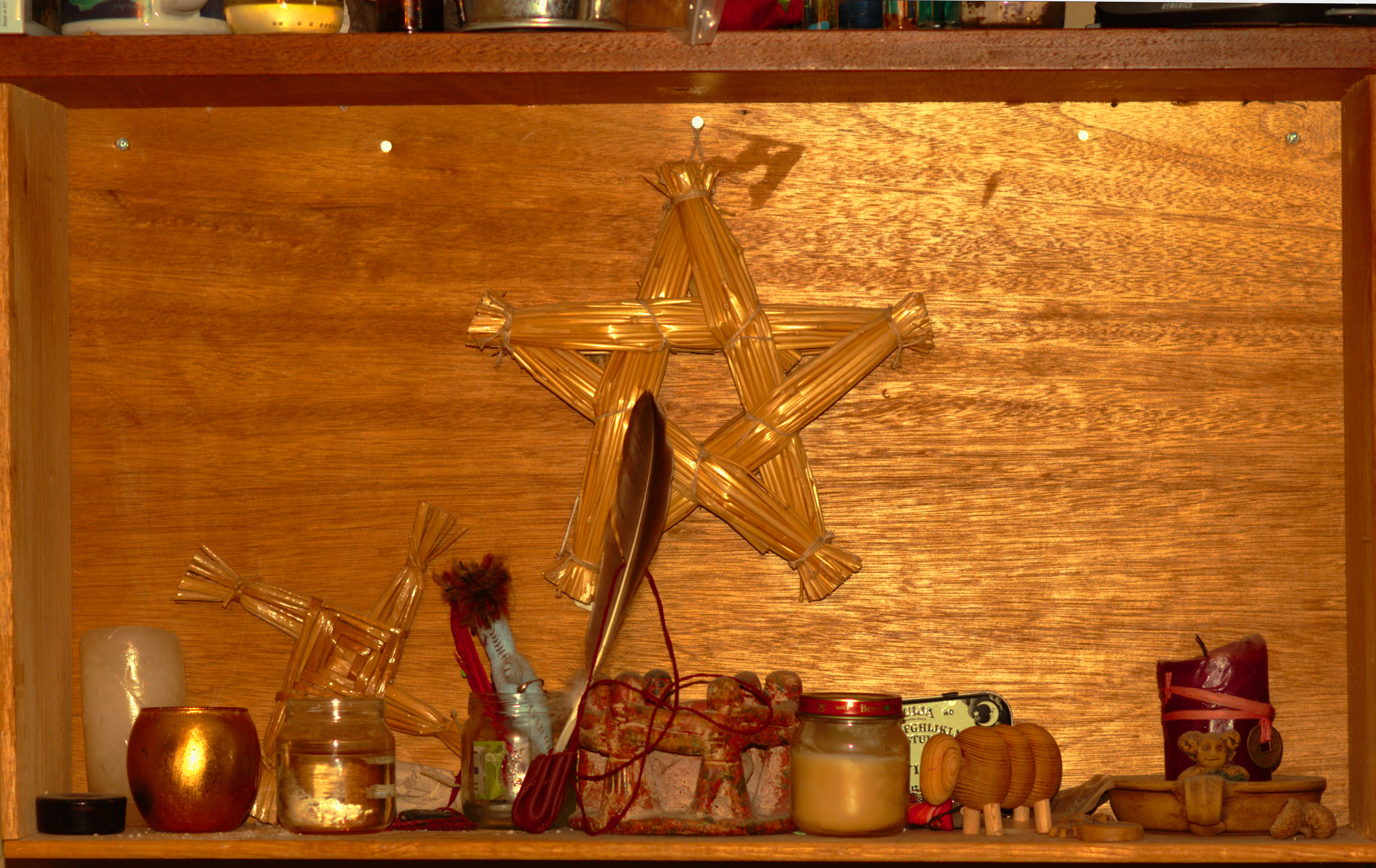
Bedroom AltarTop of Main AltarInterior of Main Altar
Altars – I’ve got altars throughout the house. I have a personal altar in the bedroom where I do daily devotionals, and then the main altar in my upstairs office for my weekly communion with my spirit friends and family.
Brooms – I keep brooms near our main entrance doors, bristles up to ward off unwanted visitors.
Cards – Are just everywhere in the house. I collect different decks that interest me, though I have a few favorites for divination.
Hamsa Hands, via Wikimedia Commons
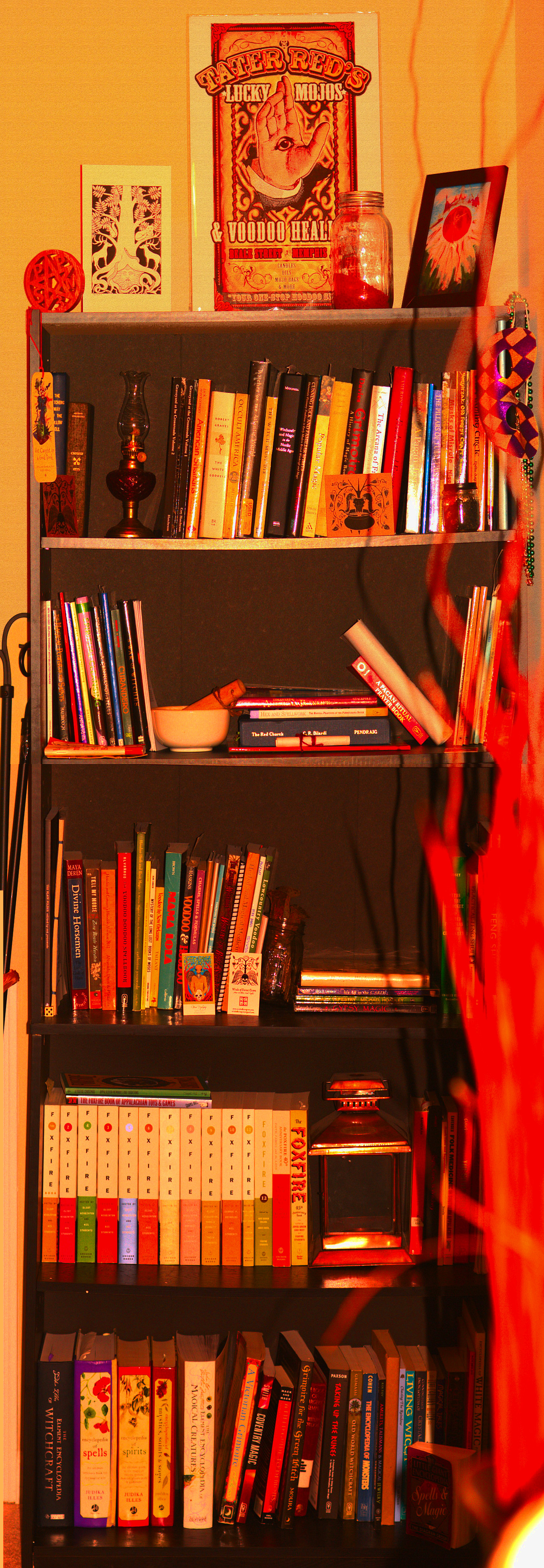
Talismans – I keep a hamsa hand on one of my windows, iron railroad spikes throughout the house (some are visible in the picture of the library shelves), and I will sometimes place small talismans like evil eye beads or saint medallions near the office and the children’s room to ward off any harsh or unwelcome spirits. I’ve also got an Ojo de Dios my mother acquired in New Mexico which acts as a protective charm in the nursery.
Library Shelf
Library – Not a lot of folk magic, per se, but lots of information on it. I tend to collect chapbooks as well as full print editions. I also keep my herbal & gardening library in here (not visible from this angle), along with most of my dried herbs. I usually have something hanging to dry in here as well. A few small charms are floating around, as well as many of the spell ingredients I turn to frequently (oils, herbs, etc.). I keep most of my folklore and fairy tale library near this one, as well.
So that’s the tour for the day. I hope it wasn’t too distracting of a diversion from the typical examination of folk magic, but I was so enticed by the series of posts I saw emerging from Jen’s topic that I couldn’t resist. I will likely be using my next post to do a similar “tour,” but of a non-personal space in the interest of showing how many folk magicians acquire ingredients without necessarily having a “witchy shop” nearby.
Until next time, thanks for visiting, er, reading!
Summary
This episode features a special one-hour interview with the cast of Conjure Crossroads, discussing the state of conjure in the US. We’ll hear about art, magic, New Orleans, and what conjure looks like today among current practitioners.
Folks, I’m really and truly happy to announce I’ve finished the expansion of the old cartomancy guide and it is officially released for your purchase and perusal!
“Ye are twenty-five cards.
Become twenty-five devils
Enter into the body, into the blood, into the soul .”
So begins a nineteenth century Italian charm making use of a small deck of playing cards. This brief-but-richly drawn book explores the practice of divination by playing cards—known as cartomancy. It reveals the “secrets in plain sight” which hide within the pips, kings, queens, and jokers of a standard deck. Explore one method of divination in-depth as you meet the “fifty-four devils”—the symbolic spirits of each card—and learn about invoking ancestral blessings for card readings, the folklore of playing cards, and how to relate fairy tales to a spread along the way.
How is it different from its previous incarnation? For starters, it’s longer, coming in around 108 printed pages. It also has loads of new sections and subjects to cover, including:
Preparing your cards for divination
The use and inclusion of the Jokers in readings
An easy-to-use table which puts keywords related to each card on a single page
A widely expanded set of sample readings
An entirely new type of spread, the Grand Tableau or Full Deck Spread, which uses all 54 devi…er, cards
Two of my favorite new elements—and I am obviously a bit biased—are the section about how to relate fairy and folk tales to card readings to enhance divination and the 20-page appendix which contains a wide variety of folklore on card reading (including short commentaries and even a little historical fiction by yours truly). I also really love the cover, which was designed by my lovely wife!
If you’re a fan of cartomancy or divination, I think you’ll like this book. And if you’re a fan of this show/site, I think the same will be true for you. This also gives you an opportunity to support the show as well, and at $6 or less a pop, you can’t go wrong, right?
I’ve made it available in print and e-book format, and you can get a copy at any of the sites below:
On a related note, the sidebar of the blog/website now contains a button showing the cover of Fifty-Four Devils which will take you to our digital Book Shop, where you can currently find all the purchase information on this book. Over time I’ll be adding other books there as well. Hopefully some will be more of my own books, but I’ll also link to works I cite frequently and to books by authors who have appeared on the show or contributed to the blog. Any purchase you make helps us out just a little bit, so it’s a great way to support us while getting great books!
I’m very happy to be able to share this book with you all! Please let me know what you think of it, and happy reading!
This seems to be a great time to work with American folk magic. Not only have a number of people begun working with the systems that have evolved here (like hoodoo, pow-wow, and all the other flavors of North American magic you probably come to this site to investigate), but the vast amount of information on the various branches has become legion. Thanks very much to author-teachers like Cat Yronwode, Conjureman Ali, and Denise Alvarado, the opportunity to learn folk magic has expanded beyond a few internet sites and hard-to-find instructors to entire shelves of books and even folk magic festivals where students can gather together and learn from a bevy of the brightest minds in practical magic today.
Keeping up with the tremendous reading list available to someone interested in folk magic is no easy task. My current pace is roughly a book a week to a book every two weeks, and that includes the books I review for the Journal of American Folklore, texts on folk magic, books on literature and criticism, science writing, etc. Occasionally I manage to squeeze one in for fun, too!
That’s not to say that my ‘required’ reading list can’t be fun, too, of course. Two recent entries into the pile of texts on folk magic that have been absolute pleasures to read are The Black Folder, compiled by Cat Yronwode and The Conjure Workbook, v. 1: Working the Root, by Starr Casas.
The Black Folder is the assembly of a number of workshop handouts from a variety of events and educational opportunities presented by Yronwode’s Lucky Mojo Curio Company and Missionary Independent Spiritual Church over the past decade or so. Many of the entries, particularly the early ones, are by Yronwode herself. Her section on working hoodoo based on items you can pick up at the grocery store or pull from your pantry is first-rate, and doesn’t simply focus on the spice rack but includes work with onions and other produce as well. Other top-notch contributors include Conjureman Ali, Sindy Todo, Robin York, Dr. E, Starr Casas, and many others. Topics range from the oft-covered bottle spells and honey jars to very detailed and unique pieces on foot-washing, the use of skulls in magic, and even some Swedish troll-magic courtesy of Dr. Johannes Gardback. The design of the book really looks like a collection of newsletters that have been bound up in a black cover (it is, however, a trade paperback version of the original Black Folder, which Yronwode used to keep up with all the informational pamphlets used by teachers in Lucky Mojo’s courses). Reading through this book provides a bit of a biography of Lucky Mojo as well, as the evolution of the company and its teaching role can be seen in the more-or-less chronological progression of the pamphlets. The work provided varies in quality according to the author, with some authors giving standout spells and methods, and some which focus more on theory than technique. I found a few entries that seemed more conjectural and less based on inherited practices or research, but for the most part the book is an absolute treasure-trove of information. While it does not replace the opportunity to learn from these folks in person, it certainly does a phenomenal job of feeling like field notes from working magicians. It is published by Lucky Mojo, so you can buy it directly from them or through Amazon and other booksellers. Because of the difficult layout work that must be required to piece together all those pamphlets, it seems like the kind of text that will not likely ever appear in eBook format, so a physical copy is the only way to go, but highly worth the purchase price.
In The Conjure Workbook, Casas—who contributed to The Black Folder as well, noted above—also does a tremendous amount of assembly, piecing together essentially an entire lifetime of conjure knowledge in a little under 300 pages. Casas has been teaching and writing for several years, and has formerly produced texts on doll baby work, money magic, basic Southern conjure, and Blackhawk independently. For this endeavor, however, she has joined up with Pendraig Publishing (Peter Paddon’s company). At the very outset, I will say the biggest problem with the book has nothing to do with the work presented, but rather the frequent typos, spelling errors, and odd edits that plague the text. Hopefully future volumes and editions will corret those issues, though, because this book is highly valuable and informative. Starr’s workbook reads like a master class with a highly skilled and practiced conjure worker. She makes no bones about the type of work she does, which she labels as specifically Southern conjure and ties to working with the Bible (please note, she does not say one must be a Christian to do this work, but that one must be comfortable with the Bible as a source of spellwork and power—this point frequently gets misunderstood in her writing). She has been practicing within a Catholic strain of the work for many years, so the Saints make a strong entry into this book. She doesn’t shy away from the darker side of saints like St. Lucy and St. Ramon, and includes work with Mary and several of the prophets, too—which are spirits that receive relatively little attention in other works on Biblically-framed folk magic despite their powerful natures. Casas puts the work first in this book, and if you’re looking for actual spells to do, this is certainly the kind of text to keep handy. She also does not regurgitate anyone else’s spellwork (at least as far as I can see) and gives the reader a piece of her own history and philosophy in between the spells. More than anything, this book reads like a conversation with her, and provides loads of new conjure projects to an aspiring worker, including doll babies made with shrunken apple heads, medicine bottle spells, and even a good reason to invest in getting a box of chalk from the dollar store to keep handy. Starr has put together a book that, despite its proofreading issues, manages to be absolutely invaluable to anyone who likes to get their hands a little dirty in folk magic.
Both of these books are born from years of practical experience, and they both have more of a classroom feel than most titles on folk magic do, which may make them more accessible than other texts on similar subjects. It is highly likely both books will be the initial entries into multi-volume series as well, which hopefully means that classes will continue, so to speak, for a long time to come.
Yronwode and Lucky Mojo have also begun producing a number of smaller books, like The Art of Hoodoo Candle Magic in Rootwork (by Ms. Cat) and Hoodoo Honey & Sugar Spells (by Deacon Millet), but I’ve yet to read most of those. Casas also has released a small book on reading “conjure cards,” and she’s put out a deck and a special deluxe set that includes the cards, book, and blessing oil through Pendraig. They look absolutely stellar, though I’ve not laid hands on a set yet, only seen the online previews. I mention these because both Pendraig and Lucky Mojo seem to be strong contenders in terms of putting out useful texts on folk magic now, and I’m very happy to see them expanding their offerings. Hopefully that means an ever-growing source of knowledge and spellwork for all of us.
There are plenty of other texts I’d love to explore (including one that I’ll try to get to with a bit of fanfare soon, called Fifty-Four Devils, by Cory Thomas Hutcheson, who seems a rather promising fellow, if a bit silly at times), but for now I hope you’ll check out The Black Folder and Working the Root and let me know what you think.
A beautiful and gentle film about living with magical companions is Hiyao Miyazaki’s My Neighbor Totoro. You can see a (shaky) clip of the “umbrella dance” I mentioned here.
Laine didn’t mention it, but her magical childhood was heavily influenced by F. H. Burnett’s The Secret Garden.
There are some great magical & craft-based children’s activity ideas in the Waldorf educational style found at the blog Alina’s Adventures in Homemaking.
I would definitely recommend scouting as a good introduction to nature & wonder for kids. Check out Spiral Scouts, the Pagan-friendly scouting group, or the more mainstream alternatives of the Boy Scouts and Girl Scouts of America.
And of course, Laine takes much parenting inspiration from the aunts in Practical Magic.








 New World Witchery - The Search for American Traditional Witchcraft