Blog Post 158 – The Doctrine of Signatures

Greetings everyone!

In this entry, I want to talk a little bit about a concept that can get very sticky, and which may very well put me at the outer limits of credibility. Before I dig into the meat of the subject, however, I think I should remind everyone that THIS IS NOT A MEDICAL BLOG. NO INFORMATION PRESENTED HERE IS INTENDED TO DIAGNOSE, TREAT, OR OTHERWISE PROVIDE MEDICAL ADVICE FOR ANY ILLNESS, AILMENT, OR CONDITION. IF YOU HAVE A MEDICAL NEED, PLEASE SEE YOUR PHYSICIAN OR QUALIFIED HEALTH PROVIDER. ALL INFORMATION CONTAINED HEREIN IS STRICTLY IN THE INTEREST OF PRESENTING FOLKLORE AND PERSONAL OPINION.

Now that the big, scary, all-caps part of the post is done, let’s talk about the Doctrine of Signatures. I was actually rather surprised after our last episode to hear from several people that the concept of the DOS was unfamiliar to them. I realized at some point that the ideas founding the DOS were so internalized, and I was assuming that most people who worked with herbs had heard of those concepts. Now I’m thinking that I may have just been sort of lucky to have picked that information up early on (I know my mother shared a bit of that with me based on herbs she grew and I learned a lot of it from my first few years as a practicing neo-Pagan hanging around rock and herb shops).

So what is the Doctrine of Signatures? In this case, I think I’ll leave the general explanation to better folklorists than myself. First, I’m going to quote a somewhat neutral (though erring on the side of skepticism) article by folklorist Wayland D. Hand:

“Advocates of nature’s way in natural and organically grown foods, probably still have a lingering belief in the doctrine that for every illness with which man is afflicted God himself has provided a healing agent. All one has to do is to learn to seek out these wondrous plants. It was on this essential premise that the Doctrine of Signatures was enunciated by Paracelsus, Giambattista Porta and the early botanists. This theory is most ably stated by William Turner, an English botanist, who in his The New Herbal of 1551, wrote: ‘God hath imprinted upon plants, herbs, and flowers, as it were, a hieroglyphic, the very  signature of their vertues, as on the nutmeg, which, being cut, resembles the brain.’ Writing a half a century later, Johannes Franck, one of the leading German botanists of his day, compiled a book which  he called Signature, that is, a Basic and True Description of Plants Created by God and Nature. This doctrine went somewhat beyond the shape and color of plants to their activity and function. One of the earliest examples of this kind of sympathetic connection is found in the writings of Pliny the Elder who flourished in the first century, A.D. Calcifrage was recommended to combat the stone. This prescription  comes form the fact that this hardy plant which could penetrate the fissures of the hardest face of a cliff, would certainly be able to break up kidney and gallstones, as the name of the plant itself suggests:  calci-frage, ‘stone breaking.’” (Hand, “Magical Medicine,” Western Folklore)

Next, let’s look at a much older (and much more cynical) opinion about this idea, from plant folk-lorist T.F. Thiselton-Dyer, whose Folk Lore of Plants is something of a classic:

“The old medical theory, which supposed that plants by their external character indicated the particular diseases for which Nature had intended them as remedies, was simply a development of the much older notion of a real connection between object and image. Thus, on this principle, it was asserted that the properties of substances were frequently denoted by their colour; hence, white was regarded as refrigerant, and red as hot. In the same way, for disorders of the blood, burnt purple, pomegranate seeds, mulberries, and other red ingredients were dissolved in the patient’s drink; and for liver complaints yellow substances were recommended. But this fanciful and erroneous notion ‘led to serious errors in practice,’ and was occasionally productive of the most fatal results.” (Dyer, TFLOP, Chapter XVI)

The idea of plants bearing the divine mark which indicated their use is a very old concept. Hand notes that Pliny the Elder recorded such an idea, and it was debated even in his time with question to the validity of this method.  The idea—in one form or another—appears in herbal medicinal systems throughout the world, including Chinese traditional herbalism and Indian Ayurvedic medicine.  Many people swear by it, and a number of ‘yarb doctors’ have treated ailments with it for centuries with relative success. Yet at the same time, the doctrine has been misused, misapplied, or just plain wrong in some cases and has caused an increase in illness or injury.

I bring up the DOS at all because it’s so fundamental to New World magical concepts. The idea that God, the Creator, or some other spiritual force has set in motion a world which bears hallmarks of its design seems to have been taken as de facto truth among many early settlers in America, particularly poor folks with limited access to medical treatment. An entire profession of folk herbalism, or “yarb doctors” arose in the Appalachians, and similar practices (such as curanderismo in the Southwest) appeared elsewhere. In most cases, these medicine men and women did not make their primary living off of their knowledge of herbs and plants, but rather in many cases refused payment for such services, feeling that it was their God-given duty to render help when help was needed. Of course, such high-mindedness was not universal, but even in cases where money or goods changed hands, yarb doctors cost less than a typical doctor in most instances.

Determining which plants have which signatures is a strange and murky process. For instance, an herb with heart-shaped leaves might be good for treating a physical heart problem, an emotional disorder, working a love charm, etc. The hairy stems of mint might indicate that it has the ability to ‘prickle’ the lungs and stimulate respiration, or they might signal that rubbing mint on one’s scalp would stimulate hair growth. The tall and showy joe pye weed, which has the nickname ‘gravel root,’ is used to treat kidney stones—frequently referred to as ‘gravel’—but its hollow stems might signal a use in treating sore throats as well as problems of the urinary tract, which both feature hollow tubes leading to external orifices. In this latter case, we can see another important aspect of the Doctrine, in which many plants receive their folk names based on their folk medical uses (boneset, feverfew, eyebright, etc.). Critics of the DOS sometimes point out that the retroactive ascription of signs to the plants, such as noticing that joe pye weed has hollow stems and therefore would be good for urinary problems, does not indicate a heavenly marking of use, but rather makes for an easy mnemonic device for remembering what plants are good for what ailments.  Further complicating the matter, some signatures are not visual markings, but rather based on sounds the plant makes when shaken, for example, or perhaps on a specific odor the plant emits.

There are also potential problems separating out a ‘signature’ from a legendary or mythical ascription of plant demarcation. Passionflower, which I’ve written about previously, is a good example of layered interpretation, with the numerical and color symbology of the plant being so closely linked to Christian mythology that the flower essentially contains a sermon. Was passionflower marked, given its unusual structure by a Creator to illustrate a story? Likewise, a number of plants are reputed to have some tie to the Crucifixion in Christian myth, such as the holly berry. Thiselton-Dyer also records a similar blood-staining myth related to poppies, in which they have been dyed by the blood of St. Margaret. In these cases, the plants are ‘marked,’ but not necessarily for use. They bear the signs of an interested and involved divine power, but are not strictly Doctrine of Signatures material since those signs illustrate a story and not a practical application. Yet, by a stretch of imagination, one could link the poppy’s use as an opiate and intoxicant to the story of St. Margaret, who famously battled a dragon. Since the use of poppy-derived-opium (and its relative, heroin) was known for a time as “chasing the dragon,” the connection does, by a bizarre happenstance, make some degree of sense. But was the flower marked with foreknowledge of the phrase, and thus was it pre-figurative? Or is all of this just strange coincidence?

It’s probably time for me to come clean, as I’ve been sort of dancing around my opinion on the Doctrine of Signatures. I’m a believer. Not a hard-and-fast, every-plant-bears-a-signature-and-medical-science-is-quackery kind of believer, but I tend to think that the DOS has some validity. My personal work with herbs and plants has led me to see the connections between their form and their functions. I don’t think that we necessarily understand every signature in every plant, and I do think that we frequently misinterpret the signs we see, but I do think that there’s an element of deliberate design within most flora that has to do with its use. This probably hedges a bit close to the Intelligent Design argument for some folks, and I don’t want to get bogged down in that discussion. I don’t make claims as to who marked the plants—perhaps they mark themselves in some way, for all I know. And I don’t necessarily think that I could wander into a meadow, find a foot-shaped plant, and use it to treat bunions and corns. I tend to agree with the skeptics about the retro ascription of plant signatures that human understanding of the plant signatures comes after we figure out what they are used for. But that does not diminish—to me—the idea that the design is implicitly connected to the use. It only emphasizes that we should be paying much more attention to what plants have to teach us, and to the hidden language of the world working around us.

So that’s my nutshell version of the Doctrine of Signatures. There are many authors who discuss this concept more handily than I have here, so please do some research and see what you think of the whole thing. Have you ever noticed signatures in plants (or even in animals, weather phenomena, etc., which are sometimes included in an extended version of this doctrine)?

Thanks for reading!

-Cory

Podcast 42 – Plants and Witchcraft

Summary
On this episode of New World Witchery, we look at the world of plants and how it affects the world of witchcraft. We talk about sourcing herbs and roots, wild vs. cultivated plants, and whether you need to work with them at all.

Play:
Download: New World Witchery – Episode 42

 -Sources-
We don’t cite a whole lot of sources, so I’m just going to list a few of the herbal books/resources we discuss or which I turn to regularly:

The Encyclopedia of Magical Herbs, by Scott Cunningham
Hoodoo Herb & Root Magic, by Cat Yronwode
The Folk-lore of Plants, by T. F. Thiselton-Dyer
Jude’s Herbal Home Remedies, by Jude C. Todd, M.H
The Complete Book of Herbs, by Lesley Bremness
Complete Herbal, by Nicholas Culpepper
A Modern Herbal, by Mrs. M. Grieve (also known as botanical.com)

We mention Mountain Rose Herbs as a great source for buying herbs, and we make several failing attempts to recommend our shop, the Compass & Key Apothecary. You should also check out Sarah Lawless’s great herbal supply shop, Forest Grove Botanica.

You can now request Card Readings from Cory via email, if you are so inclined.

Don’t forget to follow us at Twitter!

 Promos & Music
Title music:  “Homebound,” by Jag, from Cypress Grove Blues.  From Magnatune.

Promo 1 – Inciting a Riot
Promo 2 – The Infinite & the Beyond
Promo 3 – The Pagan Homesteader

Blog Post 157 – Peaches

I love a good summer peach. Or peach cobbler. Or homemade peach ice cream. And I can’t tell you how much I miss my mother’s homemade brandied peaches (which were amazing over some hand-churned vanilla). If you live in North America, it’s likely you’ve encountered peaches everywhere from grocery stores to roadside stands to neighbors’ backyards. They’re ubiquitous, which also means they’ve been a major player in the foodways of America.

Today I’m going to briefly look at the peach from another folkloric perspective, focusing on its relevance in magical lore as opposed to its purely culinary uses (though I imagine the two are not ever to be completely disentangled from one another).

The flesh of the peach is frequently regarded as a nearly sacred food in its homeland of China, where it is thought to aid immortality. The lore of the peach is extensive there, with every part of the tree and fruit making an appearance. Peach pits are worn as amulets to ward off demons, while blossoms are used to enhance love, luck, & beauty. Peaches are left in family shrines, and feature prominently in the literature and art of China. You can read a good deal more about the role of the peach in Chinese lore here and here.

Peaches were highly valued in places like the Appalachian Mountains, too.  According to the third Foxfire book, one of the most common varieties was the Indian peach, a shrubby variety with small, firm peaches:

“Indian peaches are small trees, spreading with scraggly branches, said to be descendants of those trees planted by the Cherokees around their villages…The fruit of the Indian peach is white with a rosy cheek, white-meated with a red heart…All have a most delicious flavor, raw or cooked. Peaches are rich in iron, and peach leaf tea was a medicine for bladder troubles or used as a sedative” (Foxfire 3 303)

In North American folklore, all parts of the peach have their value as well. In Folk Medicine in Southern Appalachia, one of the author’s informants says this of the peach tree:  “The peach tree was justifiably described by herbalist Tommie Bass of northern Alabama as ‘a drugstore on its own’ in recognition of its many medicinal uses” (Cavender 64-5). Below you’ll see a sampling of the many different magical and/or medicinal uses of the peach and its parts:

Tree/Wood

  • “A baby that refuses to come can be brought at once and the labor pains will stop, if the woman drinks tea made from bark scraped downwards off a young peach tree.” (Hyatt #2972) Hyatt also states in several other places that peach branches were used to help bring a baby into the world by magical means.
  • “Peach tree root or bark was also commonly used [to treat diarrhea]” (Cavender 88)
  • Peach wood can be used in a magical cure for warts by cutting as many notches in a peach branch as one has warts (Thomas #1493) (see also “Leaves”)
  • Peach wood is one of the reputed choices for making dowsing forks, according to many sources (Thomas #105; Brunvand 432, Steiner 271, Randolph 83)
  • Ozark lore specifies that peach bark scraped upward prevents vomiting and/or diarrhea, but scraped downward it is a strong emetic (Randolph 95)
  • “A mess of peach roots, ground up and mixed with lard, is said to cure the seven-year itch” (Randolph 109)

Fruit

  • A piece of Kentucky lore states that twinned peaches found together indicate that you will be married soon (Thomas #593)
  • Eating a peach pecked by a bird is said to lead to poisoning (Steiner 267)

Pit

  • John George Hohman mentions the use of “peach-stones” as a cure for “gravel” (kidney stones). He attests to it especially because it cured him of his own gravel (Long-Lost Friend #84)
  • Hohman attests that peach pits can also be taken to remedy drunkenness (#185)
  • The seeds reputedly can help stimulate hair growth in some people (Todd 55)
  • Vance Randolph describes an Ozark love charm consisting of a carved peach stone filled with “some pinkish, soap-like material” which he could not identify (Randolph 166)
  • Both Randolph and Newbell Niles Puckett mention the peach-pit charm as a powerful one, akin to the lucky rabbit’s foot charm (Puckett 437)

Leaves

  • Peach leaves were thought to be a Colonial-era cure for worms (Black 199)
  • Cat Yronwode mentions using dried peach leaves in wisdom oil blends to help students focus on studies (HHRM 143)
  • Kentucky lore says that rubbing warts with peach-leaves, then burying them will remove warts (Thomas #1492)
  • The leaves were frequently made into a poultice, which could be used to treat headaches, bruises, and “pumpknots (bumps caused by a blow or knock to the head)” (Cavender 98, 109)
  • One of the Foxfire informants recommended a peach leave poultice mixed with salt and cornmeal to treat an abscessed tooth (Foxfire 9 70).
  • Herbalist Jude C. Todd recommends the use of peach leaves as a part of a dandruff treatment (Todd 53)

Flowers

  • Hohman says that “The flowers of the peach-tree, prepared like salad, opens the bowels, and is of use in the dropsy” (Long-Lost Friend #185)
  • Hohman also recommends the use of the flowers as a cure for worms and constipation (#185)
  • Girls in the Ozarks pierce their ears when peaches are in bloom, believing that piercing them any other time will lead to infection (Randolph 164)

Vance Randolph has a great bit of lore regarding the planting of peaches as well:

“In planting peach trees, it is always well to bury old shoes or boots near the roots. Not far from Little  Rock, Arkansas, I have known farmers to drive into town and search the refuse piles for old shoes to be buried in peach orchards. The older and more decayed the leather, the better it works as fertilizer” (Randolph 39)

From my own perspective, I really like the dowsing power of the peach, but I also have a great fondness for the carved peach pit charms. They seem like they would be beautiful and incognito ways of carrying natural amulets about on one’s person. I can also easily see using the flesh of a peach like the flesh of an apple, carving things into it before eating to absorb those qualities. The peachy pulp, which bears such a strong resemblance in so many ways to human flesh, also suggests a use as a makeshift dolly. When the “heart” of the peach, its stone, is considered, this is likely a very apt application of magic to the rosy-golden fruit.

I thought I’d finish up today with something non-magical, but which certainly has an enchanting power: brandied peaches like my mother used to make (I sadly do not have her exact recipe anymore, so the one I’m sharing is adapted from the excellent Putting Food By, by Greene, Herzberg, & Vaughan). We used to have a spoonful of these over ice cream after dinner sometimes, and they were simply otherworldly. They’re not as sweet as you might think, but that’s part of their charm. Plus, you can’t go wrong with a little booze in your dessert. I hope you enjoy!

Ingredients:
Peaches (1 lb.)
1 cup sugar
1 cup water
Good brandy
Whole cloves (optional)
Whole cinnamon sticks (optional)

Clean & dry your one-pint canning jars. Score skin of peaches, then blanch them in boiling water and dunk them into an ice bath. Slip the skins off and slice the peaches into halves and quarters (removing stones).

Make a simple syrup by boiling the cup of sugar with the water. Cook the peaches in the sugar syrup for about 5 minutes, then transfer peaches into individual jars. To each jar add 1-3 cloves  (optional), 1 cinnamon stick (optional), and 2-3 tablespoons of brandy. Seal jars and process in a hot water bath for about 20-25 minutes, then carefully remove the jars and allow them to seal.

I hope you’ve enjoyed this look at peaches. If you have any other ideas about using peaches in magic, please leave them in here or drop us a line.

Thanks for reading!

-Cory

Tales from the Witching Hour No. 3

Shownotes
A short episode in which we do a pre- and post- discussion of our Walpurgisnacht 2012 celebration.

Listen: Tales from the Witching Hour No. 3

Play: 

Music
“Serenade,” by Schubert. From http://www.archive.org/

Podcast Special – Memphis Mojo

-SHOWNOTES FOR PODCAST SPECIAL – MEMPHIS MOJO

Summary
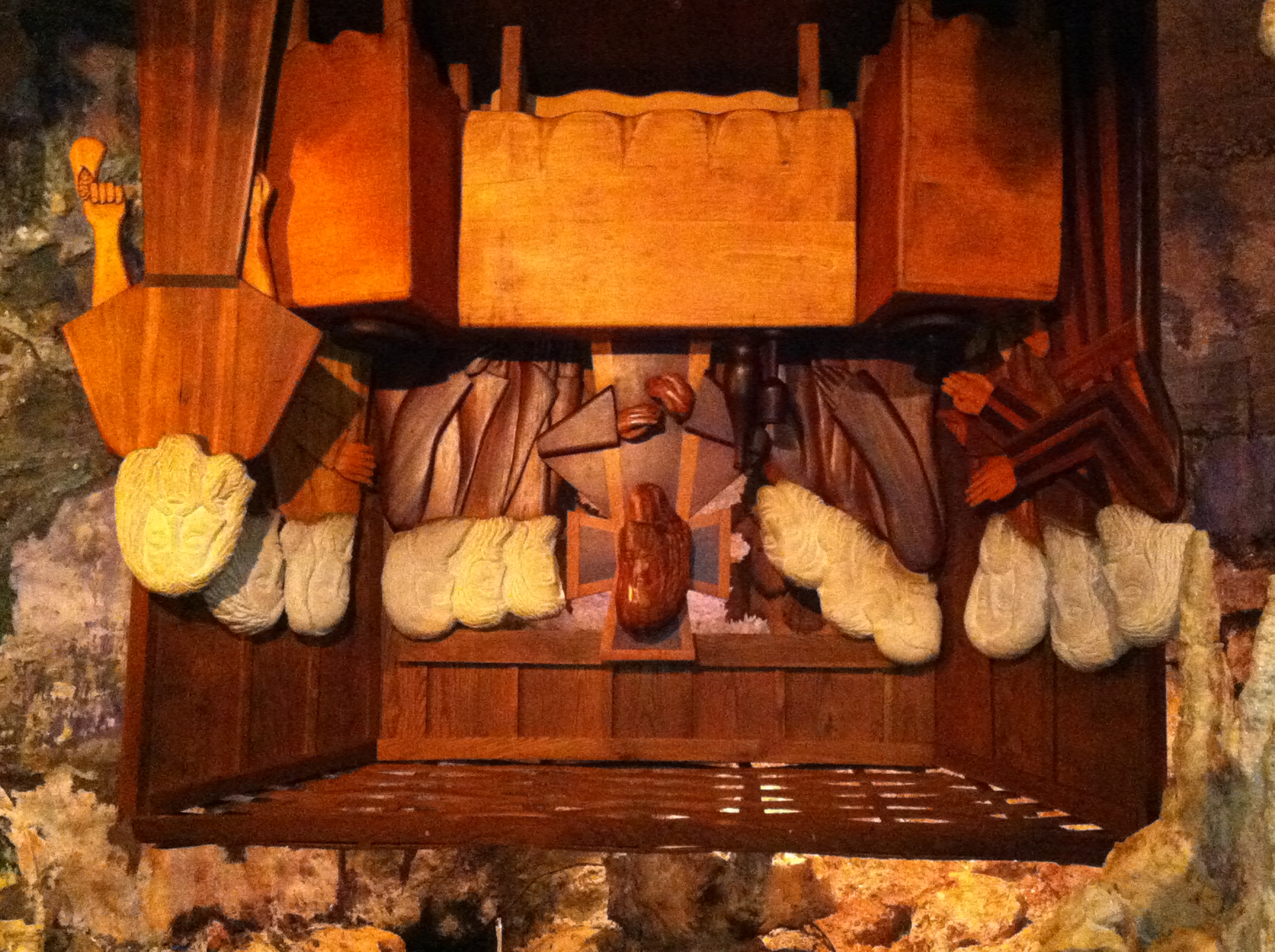
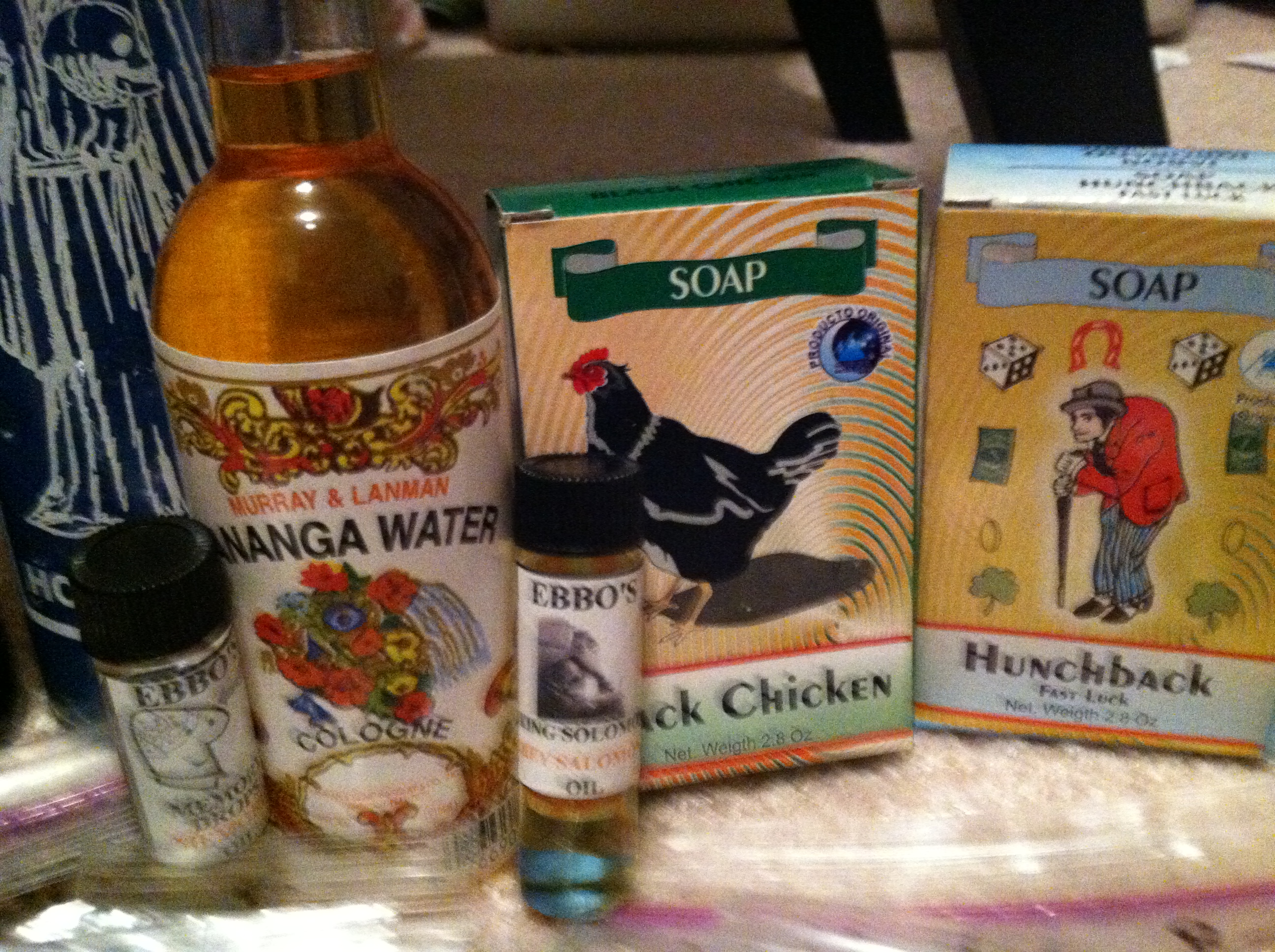
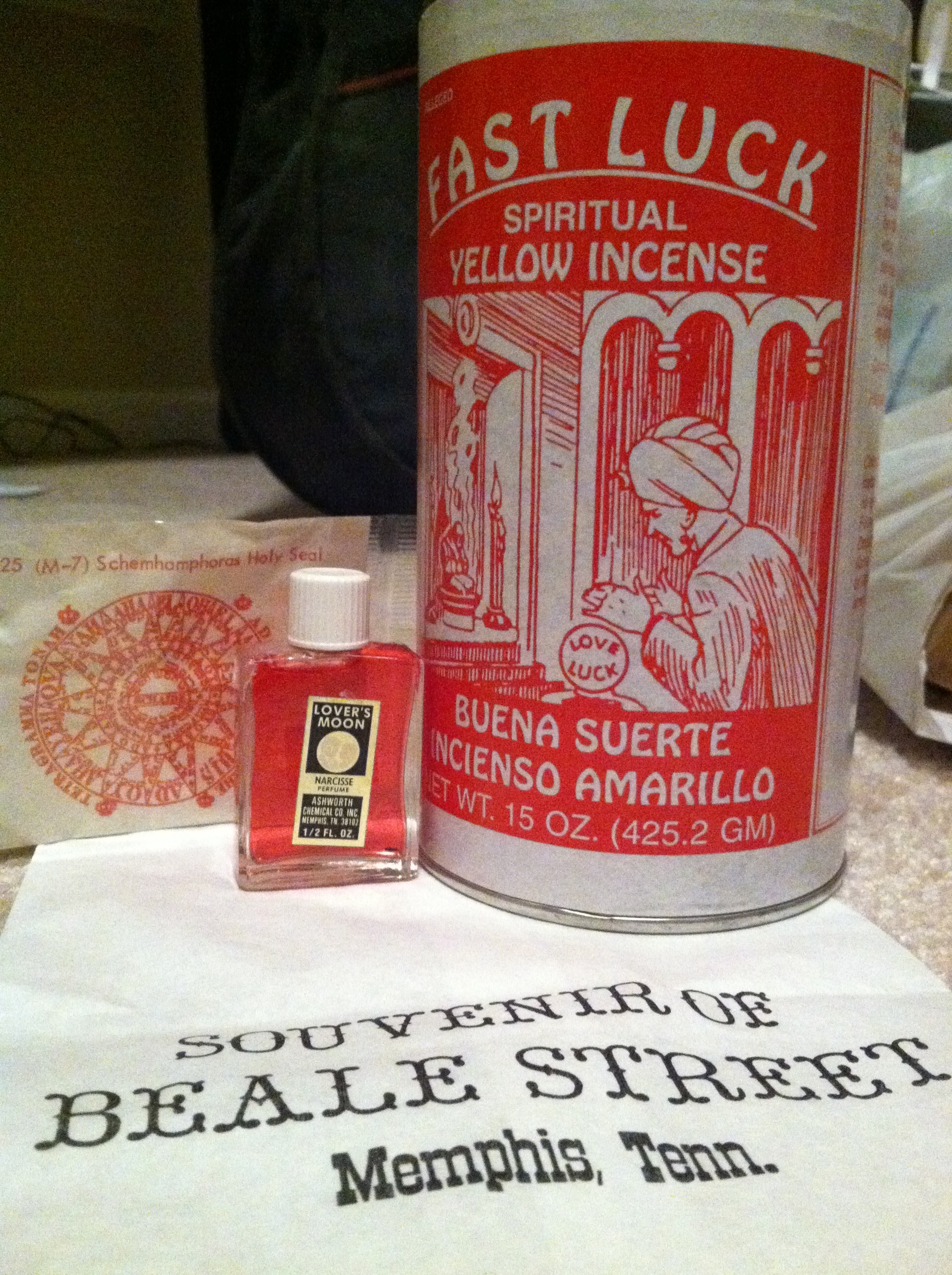
In this episode, Cory takes you along with him on a trip to Memphis, Tennessee, to discover that city’s magical and mystical side.

Play:
Download: New World Witchery Special – Memphis Mojo

-Sources-
Places:
Ebbo Spiritual Supply
Tater Red’s on Beale St.
A. Schwab’s on Beale St.
The Center for Southern Folklore
The Crystal Grotto at the Memorial Park Cemetery

Information:
Nation Sack” from Lucky Mojo Curio Co. by Catherine Yronwode
Voodoo Village” from Haunted America Tours

You can now request Card Readings from Cory via email, if you are so inclined.

Don’t forget to follow us at Twitter!

-Music-
Memphis Minnie: “Hoodoo Lady Blues
Robert Johnson: “Come on in My Kitchen
Marideth Sisco & Blackberry Winter: “Cold, Rain, & Snow,” and “On a Hill Lone & Gray
Blind Mississippi Morris: “Mysterious Woman Blues

Blog Post 157 – Weekend in Pictures

Bonus! Answer the following (very easy) question and get your name in the hat for a prize! One lucky winner will get a Lucky Bundle from Compass & Key Curiosities with a few bottles of our best lucky oils and a lucky curio or two. Leave your answer in the comments section below by MIDNIGHT TONIGHT (4/25/12) to enter!

The Question: Where was I?

Told you it was easy! Good luck!

Blog Post 156 – Passionflower

Greetings blog subscribers (and casual readers, too)!

When I first stumbled on today’s gorgeous botanical subject in the hilly areas around Chattanooga, I couldn’t believe what I was seeing. The passionflower is one of the most outlandish, garish, over-the-top, and beautiful blooms I’ve encountered in the wild. It looks as thought it would be more at home in a tropical nursery than growing in the foothills of the Appalachians, and yet this clinging vine with big, showy blossoms is right at home among sweetgum trees, sassafras, and tulip poplars.

The flower is sort of ‘leveled,’ with a base of beautiful petals which come in vibrant colors like purple and pink upon which rest elevated pistils and soaring stamens in a delicate (and highly symbolic) pattern. The passionflower goes by several names, including the maypop, herb of the Cross, and maracuja. The latter name comes from Spanish-speaking localities in which the twining vine blooms, and the flower has definitely found a home in the folklife of Hispanic herbalists. But before I get ahead of myself with all of that, let’s look briefly at some of the Old World lore about this lovely bit of flora.
Here’s a description of how the passionflower got its name, from perennial (pardon the pun) favorite, T. F. Thiselton-Dyer’s The Folk-lore of Plants:

“The passion-flower has been termed Holy Rood flower, and it is the ecclesiastical emblem of Holy Cross Day, for, according to the familiar couplet:—

‘The passion-flower long has blow’d
To betoken us signs of the Holy Rood.’ (CH XVII)”

“A plant closely connected by tradition with the crucifixion is the passion-flower. As soon as the early Spanish settlers in South America first glanced on it, they fancied they had discovered not only a marvellous symbol of Christ’s passion, but received an assurance of the ultimate triumph of Christianity. Jacomo Bosio, who obtained his knowledge of it from certain Mexican Jesuits, speaks of it as ‘the flower of the five wounds,’ and has given a very minute description of it, showing how exactly every part is a picture of the mysteries of the Passion. ‘It would seem,’ he adds, ‘as if the Creator of the world had chosen it to represent the principal emblems of His Son’s Passion; so that in due season it might assist, when its marvels should be explained to them, in the condition of the heathen people, in whose country it grew.’” [21] (CH XIX)

The passionflower naturally fits into a schema of religious botany, then, and would seem to be a sort of pinnacle representation of the Doctrine of Signatures, which essentially states that every plant (or creatrure, for that matter) bears certain visual, olfactory, or other cues indicating what the divine intends us to do with it.

Medicinally, this plant has a powerful sedative effect, though not one so strong as something like valerian root. This can be seen as a sort of ‘peace,’ bestowed by the plant as its creator would bestow divine peace. You can read a good bit about its medicinal qualities here and here, where they are able to get much more into the hows and whys of passionflower’s sedative effects. [Though I will note here, as I always do, THIS IS NOT A MEDICAL BLOG, AND I DO NOT PROVIDE MEDICAL ADVICE. PLEASE CONSULT YOUR PHYSICIAN FOR MEDICAL INFORMATION ABOUT HERBS, SUPPLEMENTS, OR ANY OTHER TREATMENTS YOU ARE CONSIDERING].

Moving into passionflower’s magical side, there is surprisingly little to do with its ability to inspire religious faith, offer any kind of divine protection, or even be used as a decoration on altars to holy saints, which greatly surprises me. I would think those uses would be nearly the first use I’d put them to, but wiser workers than I would note that passionflower’s real power is not just in its blossom, but in its less showy bits: the tangly and highly clinging vine which supports the gorgeous floral display.

Cat Yronwode describes the passionflower as an ingredient in the Chuparrosa (or “hummingbird” in Spanish) charm, which is used to foster feelings of love and attachment (hence the clinging-vine quality):

“Dried Passion Flower leaves or pieces of the root may be carried in a red flannel bag dressed with Love Me Oil. Mexicans are known to add such a bag a charm to the Divine Hummingbird, or Chuparrosa. In the old days this would have been dried hummingbird heart, but it is illegal to kill hummingbirds or to possess their body parts in some states now—and with good reason, as the birds are under tremendous habitat destruction pressure from human beings. A metal charm of a hummingbird sewn to the bag or carried inside will do just as well” (Hoodoo Herb & Root Magic, 142)

Beyond its love-bringing and binding qualities, the flower also seems to bring feelings of peace and contentment between lovers and members of a household, likely due to its soporific effects in its medical applications.

In Latin American countries, the passionflower has similar applications, including use as a love-binder and spiritual sedative. It’s also used in a Brazilian floral horoscope, where it represents the month of June. Again, I’m surprised at its limited appeal as a holy or divine flower, as I think it would likely be an excellent addition to offering altars to Marian incarnations or to do work with Jesus in various forms. But that’s merely speculation on my part, so I digress.

If you’ve had any experiences, magical or otherwise, with this amazing bloom, we’d love to hear about them! Feel free to leave a comment below or email us if you know more about this beautiful, intriguing addition to American flora.

Thanks for reading!

-Cory

Blog Post 155 – Radiolab and Robert Johnson at the Crossroads

Hi all!

I know this isn’t the botanical lore I was promising for the month of April, but don’t worry, there’s more of that coming. I just had to share something that my very dear and wonderful friend Kathleen alerted me to. One of my favorite non-magical podcasts in the world, Radiolab, just did a really interesting mini-show on a topic which intersects with our work here!

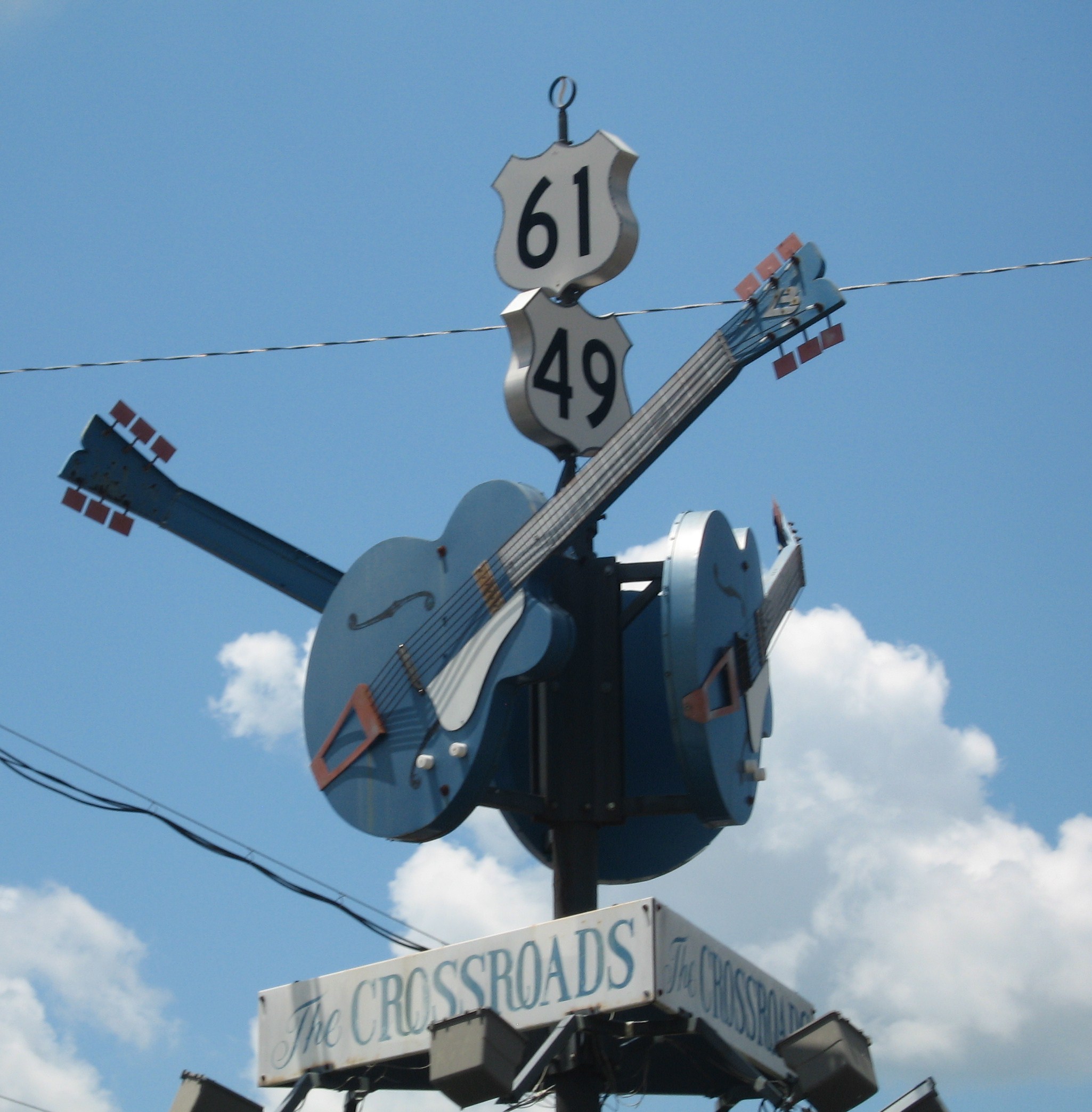
Please hop over and check out the 30 minute Radiolab short on the Crossroads, specifically the tangled crossroads legend surrounding blues players Robert Johnson (to whom the myth of selling his soul to become a great blues player is frequently ascribed) and Tommy Johnson (who may actually have done the crossroads ritual). There are fantastic interviews with music historians, blues experts, and even Tommy Johnson’s brother, all of which help shed light on the strange and gorgeous African American folk tale about gaining new power at the crossroads.

I should point out that they come at this from a scientific and historical perspective, and really are pursuing the true story about the musicians rather than doing much to get at the folkloric roots of the crossroads phenomenon. They specifically wind up ignoring the existence of the story in other African American literary and folklore sources, such as these:

  • The multiple incidents of crossoroads conjure recorded by Harry M. Hyatt between 1935-1939 (found at the bottom of the Lucky Mojo page linked above), which would have pre-dated the “creation” of this story as described in the Radiolab short
  • The numerous incidences of crossroads as places of healing, particularly trading things like a wart or a sty to a mysterious stranger, in Southern and African American folklore (which can be found in Hyatt’s work, the work of Vance Randolph, and Newbell Niles Puckett).
  • Puckett’s description of the crossroads ritual as an origin for folk hero Jack, which was published in 1926 and states:

Various legends are in vogue among the Negroes to account for the origin of this creature.  One illustrating the common theme, was told me by a root-doctor last summer.  Jack sold himself to the devil at the crossroads one night at twelve o’clock. For seven years all power was given to him to do as he pleased, but at the end of that period his soul belonged to the devil. [This eventually goes on to tell the story of Jack-o-Lantern, but the crossroads portion of it is given here as illustration of my particular point]

  • Zora Neale Hurston’s 1931 article on African American folk magic, which has the following item in it:

How to Have a Slick Hand with People.

On the dark moon of any Friday night, dress yourself in black. Sit flat in the fork of a cross road at exactly twelve o’clock and sell yourself out to the devil. After which you shall have power to do anything you wish to do (“Hoodoo in America,” 392)

  • The appearance of crossroads in European folk magic (such as that found in Charles Leland’s Gypsy Sorcery & Fortune-telling, published in 1891, long before the legends being described in the blues tales)

There are so many other appearances of crossroads in folklore that it would be daunting to tackle them here (though I will probably try to do a bigger article on them some day). My real point is just to say that while I love the Radiolab story, they definitely overlooked a large amount of crossroads material so that they could focus more on the story of two real blues musicians, which is understandable.

I really do hope you’ll give this particular show a listen. It’s great, especially in its ability to untangle the two legends from one another, and you get to hear some really hauntingly good blues, too.  Let me know what you think of it!

All the best, thanks for reading, and see you down at the crossroads…

-Cory

Podcast 41 – Spring Lore Spectacular!

-SHOWNOTES FOR EPISODE 41

Summary
This episode is all about the various springtime lore we received for our recent contest. It’s lots of bunnies, eggs, and the occasional swat on the behind in this show! Plus we have our contest winners announced.

Play:
DownloadNew World Witchery – Episode 41

-Sources-

Almost all the lore was listener submitted, but we do have a few links to share:

1. We received some great lore from Peter M, who runs a stellar blog on New England folklore. Check it out!
2. You should also check out folklore submitter Jen’s blog, Rue & Hyssop, which is delightful!
3. If you want to know more about gardening and astrology, we did several posts on the topic: Blog Posts 18, 19, & 20.
4. We mentioned two books: Old Wives’ Lore for Gardeners by Maureen & Brigit Boland, and Grimoire for the Apprentice Wizard by Oberon Zell-Ravenheart
5. In case you can’t get enough of Cory, he was also on the March episode of Inciting a Brewhaha
6. You should definitely also listen to the 2012 episode of Between the Earth and Stars by Oraia Helene. It’s amazing!

Congratulations to our Spring Lore Contest winners!

1. Jen at Rue & Hyssop won the Card Reading from Cory
2. Kelly won the copy of Etched Offerings: Voices from the Cauldron of Story
3. StarRider won the Compass & Key Apothecary prize pack

Many thanks to all who entered! We think this was a great show and couldn’t have done it without you!

You can now request Card Readings from Cory via email, if you are so inclined.

Don’t forget to follow us at Twitter!

Promos & Music
Title music:  “Homebound,” by Jag, from Cypress Grove Blues.  From Magnatune.

Promo 1 – Between the Earth & Stars
Promo 2 – Lakefront Pagan Voice
Promo 3 – Pagan in Portland

Blog Post 154 – Buckeyes

I imagine that I’ll get a sharp increase in visitors from Ohio with this article. Today’s featured botanical is the buckeye, which is both the name of the tree and the fruit (or nut) of that tree. It grows in a wide variety of locations, including all over Europe and North America, and is also frequently referred to as a “horse chestnut” (which is actually a very specific species within the bigger buckeye family). Since you can find a great deal of botanical information on the tree elsewhere (like at the USDA Plants database), I’ll narrow my focus here to the folklore and magical uses of the nut.

T.F. Thiselton-Dyer, author of the botanical mythography classic The Folk-lore of Plants, makes the following observations about the horse-chestnut:

“A Worcestershire name for a horse-chestnut is the ‘oblionker tree.’ According to a correspondent of Notes and Queries (5th Ser. x. 177), in the autumn, when the chestnuts are falling from their trunks, boys thread them on string and play a ‘cob-nut’ game with them. When the striker is taking aim, and preparing for a shot at his adversary’s nut, he says:—

‘Oblionker!

My first conker (conquer).’

The word oblionker apparently being a meaningless invention to rhyme with the word conquer, which has by degrees become applied to the fruit itself.” (CH XVIII)

Already I love this plant, don’t you? Essentially they seem to be used as marbles in children’s games (give them one point for that), and they also have a nice phonetic connection to the powerful hoodoo charm, John the Conqueror root, which is frequently called John de Conker (and that’s another point to the buckeye!). They actually look llike smoother versions of High John roots in some ways, so it doesn’t surprise me to find that they sometimes get substituted in for their powerful underground counterpart:

“Buckeye nuts are believed by some hoodoo “doctors” to increase a man’s sexual power. Shaped like miniature testicles, they are sometimes carried in the pants pockets as charms to bring men “good fortune in sexual matters.” In the southern and eastern regions of the United States, buckeyes are carried in mojo bags to cure or prevent such ailments as arthritis, rheumatism, and migraine headaches” (Gerina Dunwich, Herbal Magic, 86).

Cat Yronwode similarly cites buckeyes as charms for increasing male potency. Both Yronwode and Dunwitch, however, make it clear that a buckeye’s primary powers are to aid as a gambling charm and to help stave off aches and pains—particularly rheumatism and headaches. This view is heavily supported by a number of folklore sources:

From Newbell Niles Puckett, Folk Beliefs of the Southern Negro

  • Where the left hind foot of a graveyard rabbit, a buckeye, a horse chestnut, and a luck bone from a pig ham are put together for good luck [A charm for good luck] (316)
  • A buckeye carried in the pocket will surely bring one good luck (314)
  • A buckeye carried in the left pocket is generally supposed to work a cure for rheumatism as well as for piles, a belief apparently English (360)
  • Red pepper rubbed up and down the back ‘warms up de system,’ as does also a new domestic sack half full of salt into which nine grains of red pepper and four buckeyes have been put. Wear this around your waist and you will never again be bothered with chills (366)
  • In Mississippi and Alabama it is believed that if one carries buckeyes in the pocket he will have no chills through the year (366)

From Harry M. Hyatt, Folklore of Adams Co., Illinois

  • 1328. “My brother always carries a buckeye in his pocket to get money.” (28)
  • 1329. “I always carry three buckeyes in my pocket to always have money. My grandfather did this through the Civil War, my mother did this, and I am carrying three buckeyes too.” (28)
  • 4534. The person who carries a buckeye in the pocket never becomes sick. (99)
  • 4688. The person who carries a buckeye in the pocket never suffers from backache. (103)
  • 5233. A buckeye carried in your pocket or the band of your hat prevents headache. (118)
  • 5588. As a treatment for piles, a buckeye is worn: in the pocket (usually the left), or one in each pocket, or one pinned to the underclothes, or one round the neck, or one rolled in the top of each stocking. (126)
  • 5684. One buckeye is worn in one of several places as a rheumatism remedy: about the neck, on the breast, in a pocket (especially a hip pocket), round the waist, and under the bend of the knee.  Sometimes, they say buckeyes are ineffective for rheumatism, unless you begin by using an unripe one. Moreover, it is occasionally said, to lose this nut in the process of curing yourself brings bad luck. And finally, because a buckeye is also called a horse chestnut, the real chestnut is worn as a substitute, but this seems to be rare. (129)
  • 5685. Buckeyes used for curing rheumatism should always be carried in pairs. This also makes you lucky at the same time. (129)
  • 5686. “If you carry three buckeyes in a sack so they will be on your skin, good for rheumatism; if the buckeyes dry all up when wearing, then they are doing you good; but if they don’t dry all up, they are doing you no good.” (129)
  • 11073. It is lucky to keep a buckeye in your purse, on your person, or in your house. (262)
  • 13443. Keep a buckeye in your pocket while playing baseball and you will have good luck. (310)
  • 13984. You obtain good luck for a card game, if a buckeye is worn in your right pocket. (319)

From Daniel & Lucy Thomas, Kentucky Superstitions:

  • 1224 – One subject to a headache may prevent it by carrying a buckeye in his pocket (105)
  • 1288 – Carry a horse chestnut [another name for a buckeye] in the pocket, to avert piles (110)
  • 1299 – To avert rheumatism, carry a horse-chestnut in the pocket (111)
  • 2887 – You will have good luck if you carry a horse-chestnut (219)

Kentucky Superstitions also has this rather fantastic bit of lore about the good ole horse-chestnut:

  • 2889 – If one eats a buckeye, his head will turn around (219)

Vance Randolph devotes a sizeable amount of space to the folklore of buckeyes among the hillfolk of the Ozarks, also pointing out their strong associations with healing and protection from painful diseases. He relates an excellent story about just how deeply ingrained the belief in buckeye powers was in the mountains:

There is an old saying that no man was ever found dead with a buckeye in his pocket, but this is not to be taken seriously. Most people who carry buckeyes regard them as a protection against rheumatism, or hemorrhoids. One of the most successful physicians in southwest Missouri always carries a buckeye ; when it was mislaid once he was very much disturbed and let an officeful of patients wait until his pocket piece was recovered. It is very bad luck to lose a buckeye. I asked this doctor about it once. “No, I’m not superstitious,” he said grinning, “I just don’t want to get the rheumatism!” (Ozark Magic & Folklore, 153)

There is some excellent lore about the buckeye and just why it became the namesake for Ohio from the Ohio Department of Natural Resources website. They mention the lucky association, likening it to a four-leaf clover or rabbit’s foot, and links the state nickname to William Henry Harrison or alternatively to Col. Ebenezer Sproat (a simply fantastic name), both Ohioans of historic and heroic stature.

Probably my favorite bit of folklore concerning the lovely horse-chestnut comes from an online forum I found while researching this topic. You can read the full thread here, but I simply cannot fail to mention this fantastic tidbit:

There is a belief by some that only half the buckeye is poisonous, and that only squirrels know which half that might be in a particular nut. Squirrels do sometimes eat a part of the nut.

There you have it: squirrels are smarter than we are. But I’ve known that for a while (at least in my case it’s true).

At any rate, the buckeye can be carried as a lucky charm or worked into other magical preparations, and it has a huge body of lore associated with it. So much, in fact, that I’ve barely (prepare for pun) cracked the shell here. If you know of great buckeye lore and magic, I’d love to hear about it! Or if you just want to pelt me with horse-chestnuts for making bad puns, I’ll be here all day.

Thanks for reading!

-Cory