We are joined by author and world-traveler Gwion Raven as we discuss the ways in which food, cooking, and sharing a meal add some enchantment to the world.
Please check out our Patreon page! You can help support the show for as little as a dollar a month, and get some awesome rewards at the same time. Even if you can’t give, spread the word and let others know, and maybe we can make New World Witchery even better than it is now.
If you have feedback you’d like to share, email us or leave a comment. We’d love to hear from you!
Don’t forget to follow us at Twitter! And check out our Facebook page! For those who are interested, we also now have a page on Pinterest you might like, called “The Olde Broom.” You can follow us on Instagram or check out our new YouTube channel with back episodes of the podcast and new “Everyday Magic” videos, too (as well as most of our contest announcements)! Have something you want to say? Leave us a voice mail on our official NWW hotline: (442) 999-4824 (that’s 442-99-WITCH, if it helps).
Want to buy some New World Witchery merch, including face masks, tee shirts, and more? Visit our Artist Shop on Threadless!
Promos & Music
Title and closing music are “Woman Blues,” by Paul Avgerinos, and is licensed from Audio Socket. Incidental music is “In Memoriam Soproni Tendl Pal,” by Meta & Kalman Balough; and “NYC,” by Wolfram Gruss, licensed from Audio Socket.
Please think about checking out our Audible Trial program. Visit Audibletrial.com/newworldwitchery to get your free trial of Audible, where you can download over 180,000 titles (including some narrated by Cory). Your purchases help support this show, and there’s no obligation to continue after the free trial
The madness continues (both the madness of the world in general and our own strange little plot to keep revisiting Scott Cunningham’s two “Natural Magic” books, Earth Power and Earth, Air, Fire, & Water). We’ve fallen a teensy bit behind on discussing the books on the show (just by a month or so), but we’re also a bit behind on catching up with the blog posts that let everyone participate in the discussion. Back in Book Club Discussion #3, we combined our questions and comments on two sections: Air and Earth. This time we’re doing the same for questions on the sections for Fire and Water (which balances quite nicely).
Some of the questions we wound up asking of ourselves and our Patreon supporters are below, and we’d highly welcome any feedback or responses (civil, please please please!) in the comments.
Fire
What form of fire magic do you practice most often? Is it candle magic? Do you use fire as a “cleansing” force in ritual, or does it serve more of an “animating” role in your spellwork?
Where do you think incense falls in the big picture of spells? Is it just Air? Is it also Fire? Do all spell elements inherently draw upon multiple elemental energies?
Have you ever done a purification spell like the one Cunningham mentions (the ritual burning)? Did it work for you? (Feel free to share juicy details of burning an ex-boyfriend’s stuff if you like!)
Do you ever do any fire-based divination practices (like scrying)? Have you tried his “fire writing” method with bark or paper?
Cunningham warns about the potential destructive forces of Air and Fire, but is less concerned with that problem in the Earth/Water chapters. Why do you think that is? Do you work with “both sides” (or “many sides” if you prefer to be nondualistic about it) of the elements?
So many myths have fire stolen from the sky, and Cunningham also connects fire magic with solar magic. Do you do this as well? Why or why not?
Water
Cunningham warns that we should “beware the tricks of the conscious mind” when doing things like water scrying. Do you treat the conscious mind as something that works against magic, or something that has a place in the magical process?
What forms of water magic do you do most often? Spiritual baths? Wishing well magic? Water gazing/scrying?
Do you consider any weather magic to be within the realm of water magic? Why or why not?
Have you ever heard of/used the “crossing water” folklore that supposedly puts a barrier between you and evil/ghosts?
When making offerings to elemental spirits, is it more appropriate to bring something of your own or use what you find in the area? (Thinking here of Cunningham’s use of the coin to pay the tree for leaves to use in a ritual).
Should you always “pay” for the natural materials you use in magic? Can you ever simply use something and assume it’s okay/a gift/expected to be used for magic?
Have you ever taken a “water vow” as Cunningham describes it? What was it for/about, and did it feel like it was more potent because of water’s role in the vow?
We obviously get into a good bit more detail in both of our discussions (and we even have a few questions here we didn’t really cover). We would really love to hear/read your answers on some of these, though, if you’re interested in responding!
We’ll be back talking about things like Stone magic in the next book club discussion, and moving into the more detailed, “smaller” elements of magic. We hope you’re enjoying the chance to read along with us and that you’ll share your thoughts!
This time we ramble a bit about how we have used our time during the past few months of pandemic life, both to keep ourselves safe and sane and also to try a few new things. We talk tarot, baking, knitting, and art. Plus we discuss the elemental magic of Water in our Cunningham book club. (Also, apologies for the occasional sound glitch this time–mostly we were able to work around it but there are a few little hiccups here and there).
Please check out our Patreon page! You can help support the show for as little as a dollar a month, and get some awesome rewards at the same time. Even if you can’t give, spread the word and let others know, and maybe we can make New World Witchery even better than it is now.
A lot of what we discuss comes down to our personal experiences, but we do mention a few magical notes as well. Cory says he’s been taking up the tarot a bit more, primarily using the Five Cent Tarot and Seventy-Eight Degrees of Wisdom, by Rachel Pollack. He’s also been learning a good bit from watching a few folks like Benebell Wen on her YouTube channel.
He also mentions working on a lot of witchy art, much of which you can find on our promotional items in the New World Witchery Threadless shop. (There are also several examples all around our main webpage, too).
Laine discusses several of her favorite fiber arts, and also the power of the Tetris Effect.
If you have feedback you’d like to share, email us or leave a comment. We’d love to hear from you!
Don’t forget to follow us at Twitter! And check out our Facebook page! For those who are interested, we also now have a page on Pinterest you might like, called “The Olde Broom.” You can follow us on Instagram or check out our new YouTube channel with back episodes of the podcast and new “Everyday Magic” videos, too (as well as most of our contest announcements)! Have something you want to say? Leave us a voice mail on our official NWW hotline: (442) 999-4824 (that’s 442-99-WITCH, if it helps).
Promos & Music
Title and closing music are “Woman Blues,” by Paul Avgerinos, and is licensed from Audio Socket.
Please think about checking out our Audible Trial program. Visit Audibletrial.com/newworldwitchery to get your free trial of Audible, where you can download over 180,000 titles (including some narrated by Cory). Your purchases help support this show, and there’s no obligation to continue after the free trial
Neolithic stone figure of woman making bread. Louvre. (Wikimedia)
I have to admit something slightly shameful about my time during the pandemic. I have not undertaken the task of making my own sourdough starter. Now, before you judge me too harshly, I should note that it’s not as though I haven’t been baking anything, just that I tend to do most of my baking using store bought yeast, eggs, or leavening agents like baking soda or baking powder. Our area did run out of yeast in the stores for a while, but somehow I’ve managed to back-stock just enough of it to last us for the few months it took for yeast to begin appearing on our shelves again. I’ve made starter-based breads before (yummy Amish friendship bread that lasted a few loaves before I failed miserably as a fermentation parent, for example), but I just haven’t needed to do the sourdough yet so it remains off of my “pandemic skills checklist.”
However, the popularity of bread baking did spark one of my other skills: research! I have been looking into a few of the folklore collections I have access to and finding all sorts of doughy, yeasty, yummy notes about the uses of bread in North American folk magic. So I thought today I’d share a few of the notes I’ve gleaned with all of you! Hopefully if you’ve been doing some resting, rising, and toasting of your own you’ll see some things here that spark your witchy senses and maybe make the act of bread-baking a little more magical the next time you go to top up that bottle of starter in the corner of your pantry.
I’ve already written a bit on things like the magic of cakes before, but I’ll start here by mentioning a cake of a sort. This is the “witch cake” used during the Salem Witch trials (and also occasionally found in other places, as it seems to derive from some English antecedents). The basic idea, as found in historical accounts such as town church documents from the trial period and reprinted in George L. Burr’s Narratives of the Witchcraft Cases, 1648-1706, is that a bewitched person’s “water” (urine, as it always seems to come back to collecting someone’s pee here at New World Witchery) is added to a rough loaf of rye or barley, then baked and fed to a dog. If the dog grows ill, convulses, or dies, it indicates witchcraft, or alternatively may be able to reverse harm, causing the witch to suffer visibly and thus identifying them. Mary Sibley, the neighbor of the Parris family who recommended the magical loaf cure, was later intimidated into confessing that the cake was diabolical in nature, a sort of “using witchcraft to fight witchcraft” approach that was found throughout Colonial New England folk practices (see the excellent book Worlds of Wonder, Days of Judgement by David Hall for more on these sorts of folk magical practices in wide circulation).
A witch cake could be fed to a dog to either diagnose or reverse harmful witchcraft. This dog seems particularly suspicious, probably because the cake is baked with the victim’s urine. [Image by Cory Thomas Hutcheson, 2020]These sorts of curative bread recipes, even if they are a bit unappetizing to us today, were widely known across traditions in North America. Oftentimes, bread was used as a delivery method for a variety of unsavory magico-medical treatments, creating rolled “bread pills” to treat ailments using herbs, medicinal mixtures, or even insects like lice and spiders to fend off sickness (Brown v.6 #806). A similar remedy could be used when treating animals, feeding them medicine or folk remedies along with bread to ensure they took them, as evidenced by an entry in Hohman’s Pennsylvania Deitsch tome, The Long-lost Friend:
#91 – For vomiting and diarrhoea [sp] – Take pulverized cloves and eat them together with bread soaked in red wine, and you will soon find relief. The cloves may be put upon the bread.
Hohman also mentions a similar method of delivering a chickweed based rabies cure in that book.
While baking a magical loaf of dark bread is certainly an intense way to mingle witchcraft and daily baking, many other beliefs and rituals surrounding meal, dough, and a warm oven could be found throughout the continent and across a wide range of people. In terms of superstitions, a massive number exist surrounding everything from baking the bread to burning it to taking a piece of it:
Preparing
Set bread to rise before the sun rises (Brown v.6 #2771)
Make a cross in bread dough to make it rise right (Brown v. 6 #2772) (This ritual is also mentioned in Robert Herrick’s Charmes and cited in Kittredge’s book on witchcraft. Rhyme: “This Ile [I’ll] tell ye by the way,/ Maidens when ye leavens lay:/ Cross your dow [dough] and your dispatch/ Will be better for your batch.” In the US this was also done to keep “witches from dancing over the dough” and thus cursing it and keeping it from rising.)
Cutting an unbaked loaf of bread is bad luck (Brown v.6 #2774)
Baking
Bread that cracks down the middle while baking is a sign of bad luck (Appalachian Magazine)
Burning your bread is a sign of bad luck, especially because it is likely to cause a quarrel. Beliefs from North Carolina, Tennessee, and even California all have similar variations. Many say that if a girl burns her bread or biscuits, it’s a sign she’ll fight with her sweetheart, for example, while a married person who burns bread is likely to fight with neighbors (Brown, Randolph).
Burning bread can also mean the preacher is coming to visit soon (which may or may not be bad luck or the sign of a quarrel about to start, I suppose) (Brown v.6 #4000). Intentionally burning bread by throwing it into the fire will result in punishment, as the Devil will make you pick out every piece from the coals of hellfire later, according to Kentucky lore (Thomas).
Eating
You should never turn bread upside down once it’s baked, or you will bring bad luck (Brown, Randolph, Hines)
It’s bad luck to take the last piece of bread (Brown, Hyatt). Taking the last piece has a number of folkloric meanings, as well. For example, there’s a very gender-biased set of beliefs that a girl who takes the last piece of bread will be an “old maid,” while a boy is simply obligated to kiss the cook! (Which makes me think it was a clever ploy by many a mother to get a kiss from a child when giving the last piece away, but that’s simply my supposition). One variation also says that a woman who takes the last piece will also marry rich, so I guess one rolls the dice and takes their chances? (Brown v.6 #4735–a Nebraskan tidbit of lore)
Taking bread while you have bread on your plate already will also cause someone to go hungry (usually the person who has done the taking, but sometimes it is treated more as a portent for someone else) (Brown, Randolph)
A bit of Ozark lore says “I know of several families near Big Flat, Arkansas, who have a strange notion that one should never allow a piece of bread to fall upon the ground–the idea is that to do so will somehow injure the next crop of corn” (Randolph 62).
Another bit of Ozark folklore says that eating bread crusts makes one a better hunter or fisherman, and that it leads to curly hair! (Randolph).
This last bit about the curly hair is one of the strangest but most pervasive beliefs about bread I found while researching loaf-lore. A number of sources indicate that if a person eats bread crusts, it will cause the person’s hair to curl, which is usually presented as a desirable outcome (Brown, Randolph, Farr). Sometimes those curls are ringlets, and at other times more like curly bangs or forelocks. In other cases, the curly hair actually predicts something about the bread, as in one North Carolina belief that says a baby with two curls of hair on its forehead will eventually “break bread on two continents,” indicating a life of travel (Brown v.6 #259). This may have something to do with the fact that the crust is the outermost part of the bread and often what visually draws us in (although the smell is certainly a factor, too, as many realtors know). Similarly, the hair or outer appearance of a person could be linked to this visual enticement through the bread. Or, it could simply be a way for a frugal parent to convince a child to eat the crusts, too!
When good bread goes bad. (Image from A Little Book for a Little Cook by L.P. Hubbard (1905), Wikimedia)
Continuing the theme of good looks and good bread, several wart or blemish cures are connected to a well-baked loaf. Most of these depend upon the use of cornbread rather than other forms of grains, with cornbread “sweat” being invoked most frequently as a curative for things like warts, pimples, and freckles (for those that don’t know, “sweat” is the condensation layer that settles on top of cornbread as it cools). Cornbread factors into several other cures and rituals as well. An Ozark cure for bewitched cattle involves feeding the cow a combination of burnt cornbread, soot, and salt (Randolph). In parts of Appalachia, there are superstitions that say a person should never break cornbread from both ends, or else there will be bad luck (Brown). A Georgia folk ritual says to feed a dog cornbread that has been rubbed on his left hind-foot in order to get him to follow you or stay loyal to you (Steiner).
Bread features in a number of magical rituals beyond ensuring canine companionship, too. One of the better-known rites is probably the Dumb Supper, which we’ve covered a few times and even done as a story episode during our annual All Hallows Read. A specific version of the working from Watauga County, North Carolina, involved even baking the bread backwards:
“Cook bread backwards, by sifting with the flour sifter behind you, and the like; also eat it with your back toward the table, and you’ll dream of whom you will marry” (Brown v.6 #4296).
The “reversal” power of the Dumb Supper works magically by inverting the typical order of things, allowing the user of the spell to see an end result (a future partner) earlier in their life. However, there are also consequences to that working in many cases (as you hear in our spooky retelling of the tale). It may also be that the Supper works to sort of ‘short circuit’ the brain by making it do a rote task in an unfamiliar way, thus causing a sort of distorted reality reaction and an altered state of consciousness, which might make a person much more susceptible to things like visions. Bread, as a staple ingredient and something so ordinary and frequently made, would be a perfect base for that kind of rite. It also has long-standing associations with strength and body, which could be another reason it gets used to call forth a corporeal image of a future lover. This body association also makes bread a key component of the modern Traditional Witchcraft rite of the Housle or “Red Meal.” In that rite, dark bread is presented as part of a ceremonial meal shared with Otherworldy spirits or the Dead (Artisson). That association of bread with the land of the dead also plays out in many customs and folkways from cultures that have ancestral reverence as a part of their practice. For example, in Mexican American traditions, a sweet bread flavored with orange essence and anise seed called “pan muerto”/”pan de muerto,” or “bread of the dead” is offered to ancestors during holidays like Dia de Muertos (Fernandez Kelly).
Bread’s association with the strength also leads to a curious bit of lore from Georgia, which says that a knife with a “soft” blade can be strengthened by simply putting it into hot cornbread, then into hot water (Steiner).
Bread also features in a variety of other folklore as well, even metaphorically. For example, many people almost instinctively say the phrase “bread and butter” when passing someone on the street with a light pole or other object between them. This is thought to ward off bad luck (another variation has one party say “bread and butter” while the other says “come to supper,” as well) (Brown, Randolph). A Pennsylvania Deitsch idiom says that a person who can use braucherei magic or other supernatural gifts is someone that “Hot meh du kenne wie Brod esse,” or that “he knows how to do more than eat bread!” (Dorson 112n1). Even in dreams, bread can have significance, as evidenced by this interpretation from the well-known and widely available Aunt Sally’s Policy Players Dream-book from the early twentieth century: “To eat wheaten bread, gives great gain to the rich, but loss to the poor; to eat rye bread is the reverse” (9). The commonness of the bread seems to be underlying most of its metaphorical value in these folk beliefs, sayings, and symbols–a person who can do more than eat bread can do more than the ordinary, and a rich person who eats the sort of bread only available to rich people (the more expensive and finer-milled “wheaten” bread) will see their gains continue.
A simple house blessing spell/ritual using bread, salt, and a coin. (Illustration by Cory Thomas Hutcheson, 2020).
A House Blessing Charm (with bread!)
Perhaps my favorite bread-based magical working is one that I’ve done for a lot of folks when they move into a new home. It’s a little house blessing that I learned from my mother, who claimed it derived from Polish customs (we have a section of our family who all come from the Baltic states of Latvia, Lithuania, and Estonia as well as the Bialystok region of Poland). I’ve also seen this represented as a Jewish house blessing, as well as a few other ethnicities, but thus far I’ve not found a single “source” for it. My guess is that it builds upon some fairly widespread Central and Eastern European symbols, and may even have been widely distributed throughout the Mediterranean through the influence of the Roman Catholic Church (which still uses house blessings today). The basic practice involves taking a small jar and filling it partly with salt, then adding a piece of homemade bread (just a small, crouton-sized cube would be enough), and a single coin. You can say a blessing over this (such as the Catholic rite of house blessing or Psalm 122:7, “Peace be in thy walls, and prosperity in thy dwelling”), simply explain the symbolism when you give the gift, as well. The individual components each have a meaning:
Bread – that those who dwell in the house may never know hunger
A Coin – that they may never know poverty
Salt – that their lives may never lack for flavor (i.e. good experiences)
There are lots of magical variations you could make here, too, including selecting specific kinds of coins (or ones with significant minting years printed on them). A silver “Mercury” dime would be a very protective one to include. You might also make a special kind of bread using herbs that convey specific blessings (although you do want to make sure the bread is somewhat dry when fully baked–it will essentially “mummify” in the salt over time so it won’t spoil, but only if it’s not a particularly moist bread to begin with…no zucchini bread, please!). You might even mix in spices or herbs with the salt, or consider using black salt as a way to specifically repel evil.
Loaves of homemade bread (Image by Cory Thomas Hutcheson, 2020)
However you slice it, there’s a lot of magic in the lore of bread! If you’re baking up a storm during these mad, mad days of plague and pandemic, I hope that this post will inspire you to mix in a little magic along with your leaven, and add some enchantment to your bread basket!
We welcome back author, anthropologist, priestess, and absolute delight of a human being Lilith Dorsey. We discuss her latest book, African Traditional Religions, the Divine Feminine, so much water, and what it’s like to write for a modern witchy marketplace.
Please check out our Patreon page! You can help support the show for as little as a dollar a month, and get some awesome rewards at the same time. Even if you can’t give, spread the word and let others know, and maybe we can make New World Witchery even better than it is now.
If you have feedback you’d like to share, email us or leave a comment. We’d love to hear from you!
Don’t forget to follow us at Twitter! And check out our Facebook page! For those who are interested, we also now have a page on Pinterest you might like, called “The Olde Broom.” You can follow us on Instagram or check out our new YouTube channel with back episodes of the podcast and new “Everyday Magic” videos, too (as well as most of our contest announcements)! Have something you want to say? Leave us a voice mail on our official NWW hotline: (442) 999-4824 (that’s 442-99-WITCH, if it helps).
Consider picking up some New World Witchery tees, pillows, rugs, or mugs with art by Cory at our new Threadless Shop!
Promos & Music
Title and closing music are “Woman Blues,” by Paul Avgerinos, and is licensed from Audio Socket. Incidental music is “La Sirene,” by SJ Tucker (used with artist permission) and “Rampart St.,” by Joe Smith and the Spicy Pickles (licensed from Audio Socket.)
Please think about checking out our Audible Trial program. Visit Audibletrial.com/newworldwitchery to get your free trial of Audible, where you can download over 180,000 titles (including some narrated by Cory). Your purchases help support this show, and there’s no obligation to continue after the free trial
We open the pages of literary witchcraft one more time, but this time we look at magic and literature from the author’s point of view. We talk with urban supernatural mystery writer Victoria Raschke about how she weaves magic into her words, and how her magical experiences in real life influence what winds up on the page.
Please check out our Patreon page! You can help support the show for as little as a dollar a month, and get some awesome rewards at the same time. Even if you can’t give, spread the word and let others know, and maybe we can make New World Witchery even better than it is now.
We are discussing Victoria Raschke’s books in this episode, particularly her Voices of the Dead series. She reads an excerpt from Our Lady of Various Sorrows. You can also visit her publication company, 1000 Volt Press, for more information.
Image courtesy Victoria Raschke/1000 Volt Press (used with permission).
If you have feedback you’d like to share, email us or leave a comment. We’d love to hear from you!
Don’t forget to follow us at Twitter! And check out our Facebook page! For those who are interested, we also now have a page on Pinterest you might like, called “The Olde Broom.” You can follow us on Instagram or check out our new YouTube channel with back episodes of the podcast and new “Everyday Magic” videos, too (as well as most of our contest announcements)! Have something you want to say? Leave us a voice mail on our official NWW hotline: (442) 999-4824 (that’s 442-99-WITCH, if it helps).
Promos & Music
Title and closing music are “Woman Blues,” by Paul Avgerinos, and is licensed from Audio Socket. Incidental music is “NYC” from Wolfram Gruss and “In Memoriam Soproni Tendal Pal,” by Meta & Kalman Balog, licensed from Audio Socket.
Please think about checking out our Audible Trial program. Visit Audibletrial.com/newworldwitchery to get your free trial of Audible, where you can download over 180,000 titles (including some narrated by Cory). Your purchases help support this show, and there’s no obligation to continue after the free trial
We rekindle (see what I did there) our monthly Cunningham book club and talk about fire magic, where we see candles and incense fitting in, way too many pop culture references, and the connections between fire and the sun.
Please check out our Patreon page! You can help support the show for as little as a dollar a month, and get some awesome rewards at the same time. Even if you can’t give, spread the word and let others know, and maybe we can make New World Witchery even better than it is now.
This is our discussion of the Cunningham books Earth Power and Earth, Air, Fire, & Water. If you’re interested in participating in the book club, check out the post introducing it. We didn’t get to it in this episode but will have another mini-episode soon about the book club!
Image via Pixabay (Public Domain/CC 2.0 License).
If you have feedback you’d like to share, email us or leave a comment. We’d love to hear from you!
Don’t forget to follow us at Twitter! And check out our Facebook page! For those who are interested, we also now have a page on Pinterest you might like, called “The Olde Broom.” You can follow us on Instagram or check out our new YouTube channel with back episodes of the podcast and new “Everyday Magic” videos, too (as well as most of our contest announcements)! Have something you want to say? Leave us a voice mail on our official NWW hotline: (442) 999-4824 (that’s 442-99-WITCH, if it helps).
Promos & Music
Title and closing music are “Woman Blues,” by Paul Avgerinos, and is licensed from Audio Socket.
Please think about checking out our Audible Trial program. Visit Audibletrial.com/newworldwitchery to get your free trial of Audible, where you can download over 180,000 titles (including some narrated by Cory). Your purchases help support this show, and there’s no obligation to continue after the free trial
A short list of Black-owned bookstores from which to buy some of these suggestions
Black Lives Matter. I say that first, because it is the most important component of what I write today. To all those standing up for Black lives right now, thank you.
In our recent Patreon newsletter, which we made public, we issued our position about valuing Black lives and Black contributions to our world. One of the points we made was this:
“To us, Black Lives Matter. Frankly, we wouldn’t exist without the numerous contributions and creations of myriad Black and Brown minds throughout our history, and we have sought to highlight those figures on the show and on our site when possible, and we know we can do even better in the future, too. We must. We will. American folk magic does not exist, does not thrive and grow, without People of Color. So again we say, Black Lives Matter.”
Today, I’m going to highlight a small number of the figures from Black magical history (particularly in the U.S.) that prove that statement true. American folk magic does not exist without the contributions made by these individuals, and in many cases it has thrived and grown only because of the efforts made by People of Color. I’ll be mentioning only a small handful of what could easily be a MASSIVE list, and I’ll be sharing resources and information where you can learn more about them (as often as possible in their own voices or from non-white sources). I also showcase several contemporary Black magical figures because it is important not only to see the foundations of American folk magic as rooted in African American soil, but to see what continues to grow and thrive here. I recommend listening to them, hearing their perspectives, buying their books, or supporting them in any way you can. (Note: Where possible, all books are linked to a Bookshop.org page, and I encourage you to order these books from one of the many excellent Black-owned bookshops throughout the U.S.; Amazon links are used ONLY when the book is not available through Bookshop).
So let’s get started.
Zora Neale Hurston. Illustration by Cory Thomas Hutcheson (2020)
Zora Neale Hurston
To me, Zora Neale Hurston is the grande-dame of North American folk magic in so many ways. I know that’s a controversial opinion, but Hurston herself was no stranger to controversy. She was a key piece of the Harlem Renaissance, working on plays with the likes of Langston Hughes, while also doing advanced anthropological work at Columbia University. Hurston was prompted by her mentor, Franz Boas, to go out and document her own culture, to see it as equally valid and important, and through that she produced both fiction and non-fiction texts that are absolutely essential reading for anyone interested in folk magic. She documented Vodun and Obeah in Haiti and Jamaica, and produced a quintessential collection of stories and material on hoodoo by researching in her hometown of Eatonville, Florida, as well as other parts of the Gulf Coastal South. She was sometimes accused of being accommodating to white folks (like one of her patrons, the paternalistically racist Charlotte Osgood Mason) or of embellishing her work, but it rings with poetry and life and as Hurston herself might say, “the boiled down juice” of living. She died in relative obscurity until her literary reputation was resurrected by Black scholar Alice Walker a decade-and-a-half later.
She was known as the seer of Newport, Arkansas, and received visitors from hundreds of miles away. She was the subject of several blues songs, and was reputed to be able to find any lost or stolen object with her powers. When she died, it was said she had literally thousands of dollars hidden away on her property, making her one of the wealthiest women around. During the peak of her popularity and power, it was said that more Black folks knew her name than President Woodrow Wilson’s.
Also see: “St. Louis Blues” (blues song considered by some to be about Dye); “Hoodoo Women” (blues song about Dye)
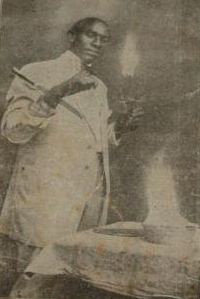
Black Herman / Public domain photograph (via Wikimedia Commons)
Black Herman
Black Herman was both a stage magician and a practitioner of mystical and magical arts when the spotlights were off. He was born Benjamin Rucker in the late nineteenth century, but he took the name “Black Herman” to honor his teacher and partner, a stage magician named “Prince Herman,” when the latter died. Black Herman took over the show and toured it with incredible success from the time he was seventeen until his untimely death nearly thirty years later. He was best known for his legerdemain and escapist tricks in his act, including a stunt that saw him buried alive then miraculously resurrected days later (when he’d continue with his show). Herman also folded in a number of African American folk magical elements, too, including the curing of patients with “live things” in them like snakes or the expulsion of evil spirits.
Stephany Robinson, known to most around St. Helena Island, South Carolina, often gets painted as a sort of villain or foil in the stories about him. He was well-known as a rootworker and conjurer in an area connected with the Gullah culture, specializing in “chewing the root,” which involved visiting a courthouse where a client was expecting a trial, sitting in the audience, and slowly chewing a “Little John” root (galangal) while spitting the juices on the floor. He would fix a judge with his gaze and in many cases get his clients off from their accusations just by showing up. He also provided medications to young Black men who were being drafted into military service that would make them fail qualifying draft tests. Eventually, his success ran him afoul of local law enforcement, particularly Jim E. McTeer, a sheriff who decided to start using rootwork on his own to combat Dr. Buzzard. The conjure war between them escalated for a few years until Buzzard’s son was killed in a car crash, devastating him. He soon after called a truce with the sheriff. I’ll admit that I often think of this more from McTeer’s perspective than Buzzard’s, but in truth Buzzard’s clients likely faced incredibly unfair circumstances and his roots and magic were invaluable to his community, while McTeer’s use of conjure was almost play-acting at times as he engaged in a form of psychological combat with the respected local root doctor.
Frank Schneider, based on a (now lost?) painting by George Catlin. / Public domain (via Wikimedia Commons)
Marie Laveau
So much is written about Marie Laveau it’s hard to separate fact and fiction, but we do know that she existed and that she was one of the most powerful Black women of her day. She’s mostly associated with New Orleans Voodoo, although she likely also incorporated elements of hoodoo at times while maintaining a strongly Catholic public presence. I won’t belabor her story here, because of all the people on this list you’re probably going to be able to find the most information about Laveau, but she’s absolutely one of the core figures in North American magical history.
Less well-known than Laveau, but deeply influential in the Brooklyn community where she lived (and beyond), Mama Lola was a Haitian mambo overseeing a number of rituals for the immigrant community around her and acting as a social pillar for her neighborhood. One biographer gives her full name as Marie Therese Alourdes Macena Margaux Kowalski, but everyone knew her as Mama Lola or Alourdes. While New Orleans Voodoo may have captured the imagination of many, in Brooklyn Alourdes/Lola kept the living spirit (and spirits) of her tradition going. She acted as a spiritual and social counselor for those around her, as well as providing childcare for her daughter and helping to financially support members of her community. She would meet with clients almost daily, stage elaborate birthday parties for the lwa spirits she honored, and offer initiation and teaching to talented students.
For some, Katrina Hazzard-Donald is controversial, because she insists that Hoodoo is its own traditional spiritual system, a religion that was essentially quashed during the late nineteenth century and which has only been revived as a commercial enterprise in the intervening years. Hazard-Donald’s scholarship on the subject, built on her years as a professor of sociology, anthropology, and criminal justice at Rutgers University, is frequently compelling and points out that the specific rituals of Hoodoo as a religious phenomenon include things that derived from or mirrored existing African spirituality. She points to things like ritual dancing, water immersion, and divination as reflective of the African roots of the tradition. Her work shows that once the religion left its home soil in particular regional zones, it became nationalized and easily coopted and marketed by outsiders, including white and Jewish merchants in big cities. While I don’t always agree with every point she makes, her analysis of Hoodoo is absolutely mind-expanding and thought-provoking. Additionally, she also practices African Traditional Religion as an Ogun Olorisha in the Lukumi tradition. I had the absolute pleasure of getting to hear her speak at an academic conference a few years ago, and she is fiery, eloquent, and moving when she talks about African and African American spirituality.
To read: Mojo Workin’(her seminal work on “Old Black Belt” Hoodoo)
Luisah Teish
The author of the deeply influential book Jambalaya: The Natural Women’s Book, Luisah Teish has been working with African and African American spiritual traditions for decades and connecting her knowledge of spirituality with healing for issues of both race and gender. She makes feminism a crucial part of her spiritual practice, and was advocating for self-care as a radical form of spiritual action back in 1985. She continues to act as a guide and teacher to people, particularly women, who know her as Yeye Teish. She’s an initiate (Iyanifa) and chief in the Yoruban spiritual tradition, and hosts workshops and international trips to places like Jamaica to connect with living African-derived spiritual and magical traditions.
If you haven’t heard of Lilith Dorsey, you’re doing yourself a disservice. She’s an incredibly cogent writer on the subject of a number of diasporic practices, especially Vodun, witchcraft, and Afro-Caribbean spirituality. She recently put out a magnificent-looking book on Orishas, and has written books looking at love magic and African American cooking as a form of spellcraft, too. Her blog over at Patheos is always thoughtful and points toward new sources and new ideas while also bringing in her anthropological background and rooting what she discusses in that field.To pile talent upon talent (which she has in abundance), she’s also a filmmaker, who made the documentary Bodies of Water: Voodoo Identity and Tranceformation.
Lisa Jade is a Canadian witch with a keen eye for issues of environmentalism, social justice, and–of course–witchcraft. She’s also a Patheos blogger (like Lilith Dorsey above) who shares her insights into issues like locavore lifestyle witchcraft and the deep problems with capitalism for those who walk a crooked path. She also produced an EXCELLENT reading list of Black witchy authors a few years back including Black writers and magical workers that aren’t on this list (including people like the brilliant Khi Armand).
To read: Her reading list, 100% for sure, because it will offer you a lot of new options to discover
See also: Her website (which also produces material for Patheos)
Juju Bae
The A Little Juju podcast is something I’ve only recently found, but it’s been going strong for a while now. It also has one of the best and catchiest theme songs I’ve heard on a magical podcast, and Juju Bae covers a wide range of topics that intersect with Black magical spirituality. She’s talked astrology, money magic (which she takes VERY seriously), reiki, and even why masturbation is a healthy expression of spiritual self. She offers a line of hoodoo-related oils and products as well as divinatory readings (including ancestral readings), and she teaches online courses as well.
She’s a prolific author who shares her knowledge of hoodoo readily in her books, but who also writes about health and wellness as a Woman of Color and even has a debut novel in the works! She’s generous and supportive while also providing rigorous and careful instructions in her books, and she looks at places where magical practices and spiritualities overlap with a thoughtful eye. The ecological side of her writing runs deep, and she situates the hoodoo she knows and does within the framework of natural cycles and seasons, while also making it contemporary and accessible for anyone.
My final member of the thirteen-person coven assembled here is someone that I think everyone should know. Via Hedera is one of my favorite writers on North American folk spirituality. She looks to the folklore and scours collections and practices to better understand and share a deeply-rooted, deeply-felt sense of folk magic here. She comes at the topic as someone who lives intersectionality, bringing a multi-ethnic perspective and elevating practices from a wide range of sources, connecting sources such as Indigenous and African American magical practices through her work. She’s a delight to read, and her forthcoming book is one that I’ve been lucky enough to preview and I will say it should be at the top of any New World Witchery fan’s reading list. Plus, she’s a crazy talented artist who makes gorgeous plant-spirit sculptures that will melt your brain with their beauty.
This is truly just a sampling of the hundreds (of thousands) of Black/POC figures that have informed, shaped, guided, and continue to influence the magic of North America. There are no shortage of people I skipped or missed here, ones that I think deserve just as much praise and recognition as the ones I’ve highlighted. To that end, if you have figures that you think should be on this list, please feel free to share them in the comments (along with any links to relevant information).
A note: any racist, misogynistic, or otherwise heinous comments will not be approved and may be reported as harassment. Please use the comments to lift up and elevate Black magic.
We’re diving into the pages of some of our favorite (non-witchy) fiction today to discuss how we draw inspiration from literature and popular culture in magical practices.
Please check out our Patreon page! You can help support the show for as little as a dollar a month, and get some awesome rewards at the same time. Even if you can’t give, spread the word and let others know, and maybe we can make New World Witchery even better than it is now.
If you’re interested in participating in the book club, check out the post introducing it. We didn’t get to it in this episode but will have another mini-episode soon about the book club!
Image via Pixabay (Public Domain/CC 2.0 License).
If you have feedback you’d like to share, email us or leave a comment. We’d love to hear from you!
Don’t forget to follow us at Twitter! And check out our Facebook page! For those who are interested, we also now have a page on Pinterest you might like, called “The Olde Broom.” You can follow us on Instagram or check out our new YouTube channel with back episodes of the podcast and new “Everyday Magic” videos, too (as well as most of our contest announcements)! Have something you want to say? Leave us a voice mail on our official NWW hotline: (442) 999-4824 (that’s 442-99-WITCH, if it helps).
Promos & Music
Title and closing music are “Woman Blues,” by Paul Avgerinos, and is licensed from Audio Socket.
Please think about checking out our Audible Trial program. Visit Audibletrial.com/newworldwitchery to get your free trial of Audible, where you can download over 180,000 titles (including some narrated by Cory). Your purchases help support this show, and there’s no obligation to continue after the free trial
Picking up a button you find as you leave your home allows you to make a wish…One variation from North Carolina also says throwing a found button over your left shoulder will offer you a wish. (image by Cory Thomas Hutcheson)
Or, Notions of Magic.
We often mention that magic–folk magic, especially–is an everyday sort of affair. It lives in places like loose change and decks of playing cards, and we find spells using eggs or walnuts tucked into the corners of North American witchery.
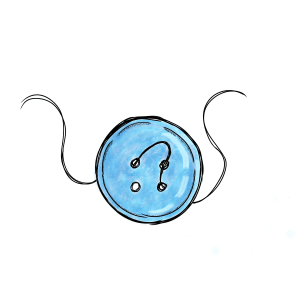
Recently, I received a gift from a friend in the form of the Five Cent Tarot (thank you Heather!). It has fast become one of my absolute favorite decks to read with, as it has a number of symbols to draw from (and keywords pointing to meanings woven into the images, which helps with those of us who don’t do tarot quite as often as we do other systems). In this deck, the minor arcana are essentially the objects you might find in a junk drawer: sewing needles for swords, matches for clubs, buttons for discs, and teacups for, well, cups. We have already put up a post on the use of pins and needles, and matches are really more suited to their own post or one dealing with other aspects of fire magic. I’m so enamored of this deck, however, that I had to take some inspiration from it, and so the remaining suits put the idea in my head that I should look at some of the folk magic around buttons, thimbles, and other sewing notions. Given the burst of sewing going on as people make masks and other vital items during the COVID-19 pandemic, it also seemed like at least a semi-relevant topic. So let’s take the lid off grandma’s old butter cookie tin and see what sorts of lore and spells we find!
We start with buttons, which have a great deal of luck folklore associated with them. Widespread folk belief says that finding a button brings good luck to follow, somewhat similar to finding a lucky penny or other coin. In fact, one variant of this belief from North Carolina indicates that any button found and carried for luck should be smaller than a penny (or other lucky coin) (Brown). The kind of button found can also have magical significance. A button with two eyes is good luck, while a button with five eyes is bad (ibid.). A button from a coat might indicate that a letter is forthcoming soon, while a white button foretells a lawsuit (so maybe leave those where they are) (Daniels & Stevans). In the Ozarks, finding a black button indicates misfortune to follow (Steele).
A number of other notions like thimbles and ribbons have similar lore associated with them:
To find a collar signifies that you will make an enemy…
To find a piece of lace, signifies that you will be ill…
To find a darning needle, signifies a disappointment in love…
To find a hat-pin signifies a quarrel…
To find a ribbon, a string, piece of silk or anything with color, especially if it be new and fresh will portend, signifies if red, good fortune, prosperity, successful love
To find scissors or knives, signifies that you should beware of enemies (ibid.)
Buttons are also the focus of a number of folk spells and rituals, such as these found in Henry Middleton Hyatt’s collection Folklore from Adams County, Illinois:
Buttons strung on a thread can be put around a baby’s neck to aid in teething. Some say the buttons should be cut from a man’s shirt for this purpose (NOTE: DO NOT PUT ANYTHING LIKE THIS AROUND A BABY’S NECK!).
You can “sell” your wart to someone for a button, and as long as you keep the button the wart will go away
Picking up a button you find as you leave your home allows you to make a wish. Other sources also indicate that you can do this ritual with any button you find so long as you pick up the button and place it in your shoe (which would be most comfortable if you were wearing penny loafers, I imagine). One variation from North Carolina also says throwing a found button over your left shoulder will offer you a wish (Brown).
Buttons made of animal horn (photo by Tyranny Sue / CC BY-SA via Wikimedia Commons)
One particularly neat divination found in Hyatt’s collection is similar to the “calling circle” sometimes performed to discern a baby’s future on its first birthday. This time, however, the button is one of a set of objects that can be used to determine your future at any age:
“Into a pan of water on the table drop a button, coin, nut, ring and stone; then blindfold yourself and with a spoon attempt to scoop out one of the articles from the pan — three trials being allowed: if you lift out the button, you will live in single blessedness; if the coin, you will acquire wealth; if the nut, you will toil for a living; if the ring, you will marry; and if the stone, you will travel a rocky road. Halloween is the usual time for this divination.”
This sort of divination game is similar to other party games, and the Halloween setting of this ties it to similar occult play such as the use of “nutcrack night” fire rituals or even the slightly more spin-the-bottle-esque game of snap apple (or, in a similar vein, bobbing for apples).
Thread is another good source of folklore and folk magic. Most people reading this likely know about the general idea of “knot magic,” (something we’ll be covering through our Cunnigham Book Club in the show as well). Using threads for magical work is something both old and incredibly contemporary, as even children are frequently doing magic like this. Just think of the many friendship bracelets young kids make for one another, and the way those are designed to “bind” them together in the bonds of friendship forever. One of my favorite presentations of this is in the Hayao Miyazaki film Spirited Away, where Chihiro/Sen’s friends make her a little friendship bracelet-like hair tie, the only physical object she gets to keep when she exits the spirit world later.
One long-standing superstition that I personally hold to is trying to save all my trimmed thread ends. I keep them in a jar in the top-most room of my house (which also happens to be my library room where I’m writing this at the moment. The tangles in the jar are thought to help prevent harm from coming to a household, much in the way that “counting objects” like beans or salt scattered by a door might. Since my wife is a knitter and I do a good bit of sewing and darning there are few weeks in a year I don’t add to the jar, yet somehow it never quite gets full. Almost like magic.
Jar full of thread and yarn ends to protect family and house from harm. Photo by Cory Thomas Hutcheson. Image in background by Rima Staines.
Knotting thread, especially red thread, around someone’s wrist with a certain number of knots–usually seven–was used as a magical ward against headaches and other ills (Hand) (Randolph). Cunning folk traditions from England also suggest using bits of rope from a hangman’s noose can alleviate these sorts of aches and pains (Baker). We also see the use of knots and threads in the form of a “witch’s measure,” a concept adopted in a number of occult systems like Wicca (where it is often called a cingulum and can be used to “bind” an initiate to their coven). In Hoodoo, a similar use of a measure involves taking red thread or yarn and measuring a partner’s genitals, then wetting them with sexual fluids and knotting them to prevent a partner from straying (Hurston). A similar principle was used when taking two pieces of clothing, one from each partner (preferably worn and unwashed), then knotting them together to ensure fidelity.
Untying knots also has occult power in several bits of folklore. For example, in the Appalachians and Ozarks, women were sometimes advised to unbind their hair as a way to ease birthing pains (during birth, not necessarily all the time) (Illes). Sailors heading out to sea might acquire a cord made by a local witch with a series of knots in it. If their ship were becalmed and unable to move, they could untie each knot to raise a different degree of wind. One knot could bring about a light breeze, while all the knots might summon a hurricane. This is somewhat similar to the concept of “buying the wind” using coins thrown overboard (Dorson).
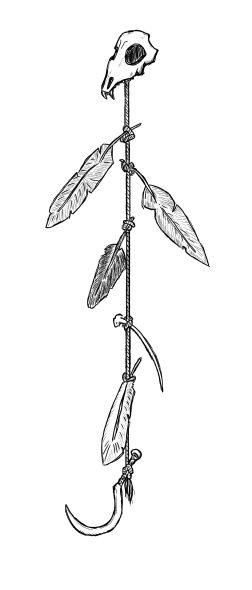
The Witch’s Ladder is a charm made from rope or thread knotted around objects, usually including feathers, as a way to create a long-term curse or spell on a person (Illustration by Cory Thomas Hutcheson, 2020)
And, of course, how could we talk about threads and strings and witchcraft without mentioning the popular (and often nefarious) witch’s ladder? This is a magical talisman made by braiding three cords together and knotting them nine times while placing an object into each knot. Usually, these objects were bones or feathers from birds, often geese, which may connect the charm mythologically to figures like Frau Holle. While each knot was tied, the witch would curse the intended target, then hang the ladder secretly in the home of their victim with the intent of causing them to suffer and eventually die unless the knots are unbound or the ladder is destroyed somehow. Late twentieth-century Wiccan author Scott Cunningham (mentioned above as part of our book club) revised the witch’s ladder a bit for more positive purposes, turning it into the “wishing ladder,” which uses similar magical structures to create charms that get a witch what she wants out of life.
There are so many other magical crafts and lore associated with things like strings, buttons, thimbles, and ribbons, too. Crafts like the ojo de dios or the oft-appropriated Ojibwe dreamcatcher use the concepts of threads and knots to create talismanic spells, for example. I’ve also been delighted to see the enthusiasm for needlecraft among contemporary feminist witchcraft practitioners, who cross-stitch their intentions into spell-like wall hangings with phrases like “hex the patriarchy” on them. As someone who frequently darns my own clothes and does a good bit of sewing on the side to repair the damage done to clothes by growing children (and frankly, we adults are not terribly careful either), the eager embrace of sewing and knot magic and a jar full of magical buttons makes me quite happy (you can tell I’m the life of every party, can’t you?). There’s even a new book recently released that I’m hoping to check out at some point all about contemporary needlework-and-button-bound magic called Sew Witchy, by Raechel Henderson (if you’ve read it or tried out any of the crafts in it, I’d love to hear about those below in the comments, along with any other notion-based magical work you do!).
That’s only a small bit of a much bigger line of magical work. Weaving has its own spell associations, and I’m not even touching prayer shawls at the moment, which can have an intense magical protective connection. Still, in this time when we see people making dozens or hundreds of cloth masks for public health and safety or needing to stretch their clothing’s lifespan a bit longer due to newly-tightened economic belts, it’s good to know we can still find magic and witchcraft in the very stitches, thimbles, measures, and buttons we’ve been hiding in butter cookie tins the whole time.








 New World Witchery - The Search for American Traditional Witchcraft