Blog Post 225 – Button Button

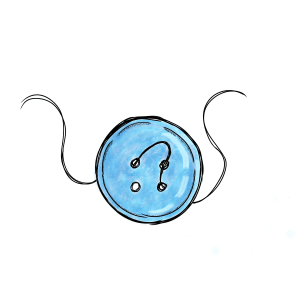
Picking up a button you find as you leave your home allows you to make a wish…One variation from North Carolina also says throwing a found button over your left shoulder will offer you a wish. (image by Cory Thomas Hutcheson)

Or, Notions of Magic.

We often mention that magic–folk magic, especially–is an everyday sort of affair. It lives in places like loose change and decks of playing cards, and we find spells using eggs or walnuts tucked into the corners of North American witchery.

Recently, I received a gift from a friend in the form of the Five Cent Tarot (thank you Heather!). It has fast become one of my absolute favorite decks to read with, as it has a number of symbols to draw from (and keywords pointing to meanings woven into the images, which helps with those of us who don’t do tarot quite as often as we do other systems). In this deck, the minor arcana are essentially the objects you might find in a junk drawer: sewing needles for swords, matches for clubs, buttons for discs, and teacups for, well, cups. We have already put up a post on the use of pins and needles, and matches are really more suited to their own post or one dealing with other aspects of fire magic. I’m so enamored of this deck, however, that I had to take some inspiration from it, and so the remaining suits put the idea in my head that I should look at some of the folk magic around buttons, thimbles, and other sewing notions. Given the burst of sewing going on as people make masks and other vital items during the COVID-19 pandemic, it also seemed like at least a semi-relevant topic. So let’s take the lid off grandma’s old butter cookie tin and see what sorts of lore and spells we find!

We start with buttons, which have a great deal of luck folklore associated with them. Widespread folk belief says that finding a button brings good luck to follow, somewhat similar to finding a lucky penny or other coin. In fact, one variant of this belief from North Carolina indicates that any button found and carried for luck should be smaller than a penny (or other lucky coin) (Brown). The kind of button found can also have magical significance. A button with two eyes is good luck, while a button with five eyes is bad (ibid.). A button from a coat might indicate that a letter is forthcoming soon, while a white button foretells a lawsuit (so maybe leave those where they are) (Daniels & Stevans). In the Ozarks, finding a black button indicates misfortune to follow (Steele).

A number of other notions like thimbles and ribbons have similar lore associated with them:

  • To find  a collar signifies that you will make an enemy…
  • To find a piece of lace, signifies that you will be ill…
  • To find a darning needle, signifies a disappointment in love…
  • To find a hat-pin signifies a quarrel…
  • To find a ribbon, a string, piece of silk or anything with color, especially if it be new and fresh will portend, signifies if red, good fortune, prosperity, successful love
  • To find scissors or knives, signifies that you should beware of enemies (ibid.)

Buttons are also the focus of a number of folk spells and rituals, such as these found in Henry Middleton Hyatt’s collection Folklore from Adams County, Illinois:

  • Buttons strung on a thread can be put around a baby’s neck to aid in teething. Some say the buttons should be cut from a man’s shirt for this purpose (NOTE: DO NOT PUT ANYTHING LIKE THIS AROUND A BABY’S NECK!). 
  • You can “sell” your wart to someone for a button, and as long as you keep the button the wart will go away
  • Picking up a button you find as you leave your home allows you to make a wish. Other sources also indicate that you can do this ritual with any button you find so long as you pick up the button and place it in your shoe (which would be most comfortable if you were wearing penny loafers, I imagine). One variation from North Carolina also says throwing a found button over your left shoulder will offer you a wish (Brown).
Horn 'hunting' buttons with shanks
Buttons made of animal horn (photo by Tyranny Sue / CC BY-SA via Wikimedia Commons)

One particularly neat divination found in Hyatt’s collection is similar to the “calling circle” sometimes performed to discern a baby’s future on its first birthday. This time, however, the button is one of a set of objects that can be used to determine your future at any age:

“Into a pan of water on the table drop a button, coin, nut, ring and stone; then blindfold yourself and with a spoon attempt to scoop out one of the articles from the pan — three trials being allowed: if you lift out the button, you will live in single blessedness; if the coin, you will acquire wealth; if the nut, you will toil for a living; if the ring, you will marry; and if the stone, you will travel a rocky road. Halloween is the usual time for this divination.”

This sort of divination game is similar to other party games, and the Halloween setting of this ties it to similar occult play such as the use of “nutcrack night” fire rituals or even the slightly more spin-the-bottle-esque game of snap apple (or, in a similar vein, bobbing for apples).

Thread is another good source of folklore and folk magic. Most people reading this likely know about the general idea of “knot magic,” (something we’ll be covering through our Cunnigham Book Club in the show as well). Using threads for magical work is something both old and incredibly contemporary, as even children are frequently doing magic like this. Just think of the many friendship bracelets young kids make for one another, and the way those are designed to “bind” them together in the bonds of friendship forever. One of my favorite presentations of this is in the Hayao Miyazaki film Spirited Away, where Chihiro/Sen’s friends make her a little friendship bracelet-like hair tie, the only physical object she gets to keep when she exits the spirit world later.

One long-standing superstition that I personally hold to is trying to save all my trimmed thread ends. I keep them in a jar in the top-most room of my house (which also happens to be my library room where I’m writing this at the moment. The tangles in the jar are thought to help prevent harm from coming to a household, much in the way that “counting objects” like beans or salt scattered by a door might. Since my wife is a knitter and I do a good bit of sewing and darning there are few weeks in a year I don’t add to the jar, yet somehow it never quite gets full. Almost like magic.

Jar full of thread and yarn ends to protect family and house from harm. Photo by Cory Thomas Hutcheson. Image in background by Rima Staines.

Knotting thread, especially red thread, around someone’s wrist with a certain number of knots–usually seven–was used as a magical ward against headaches and other ills (Hand) (Randolph). Cunning folk traditions from England also suggest using bits of rope from a hangman’s noose can alleviate these sorts of aches and pains (Baker). We also see the use of knots and threads in the form of a “witch’s measure,” a concept adopted in a number of occult systems like Wicca (where it is often called a cingulum and can be used to “bind” an initiate to their coven). In Hoodoo, a similar use of a measure involves taking red thread or yarn and measuring a partner’s genitals, then wetting them with sexual fluids and knotting them to prevent a partner from straying (Hurston). A similar principle was used when taking two pieces of clothing, one from each partner (preferably worn and unwashed), then knotting them together to ensure fidelity.

Untying knots also has occult power in several bits of folklore. For example, in the Appalachians and Ozarks, women were sometimes advised to unbind their hair as a way to ease birthing pains (during birth, not necessarily all the time) (Illes). Sailors heading out to sea might acquire a cord made by a local witch with a series of knots in it. If their ship were becalmed and unable to move, they could untie each knot to raise a different degree of wind. One knot could bring about a light breeze, while all the knots might summon a hurricane. This is somewhat similar to the concept of “buying the wind” using coins thrown overboard (Dorson). 

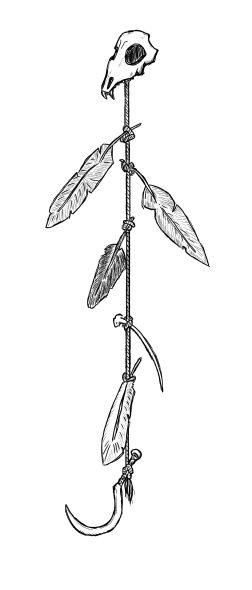
The Witch’s Ladder is a charm made from rope or thread knotted around objects, usually including feathers, as a way to create a long-term curse or spell on a person (Illustration by Cory Thomas Hutcheson, 2020)

And, of course, how could we talk about threads and strings and witchcraft without mentioning the popular (and often nefarious) witch’s ladder? This is a magical talisman made by braiding three cords together and knotting them nine times while placing an object into each knot. Usually, these objects were bones or feathers from birds, often geese, which may connect the charm mythologically to figures like Frau Holle. While each knot was tied, the witch would curse the intended target, then hang the ladder secretly in the home of their victim with the intent of causing them to suffer and eventually die unless the knots are unbound or the ladder is destroyed somehow. Late twentieth-century Wiccan author Scott Cunningham (mentioned above as part of our book club) revised the witch’s ladder a bit for more positive purposes, turning it into the “wishing ladder,” which uses similar magical structures to create charms that get a witch what she wants out of life.

There are so many other magical crafts and lore associated with things like strings, buttons, thimbles, and ribbons, too. Crafts like the ojo de dios or the oft-appropriated Ojibwe dreamcatcher use the concepts of threads and knots to create talismanic spells, for example. I’ve also been delighted to see the enthusiasm for needlecraft among contemporary feminist witchcraft practitioners, who cross-stitch their intentions into spell-like wall hangings with phrases like “hex the patriarchy” on them. As someone who frequently darns my own clothes and does a good bit of sewing on the side to repair the damage done to clothes by growing children (and frankly, we adults are not terribly careful either), the eager embrace of sewing and knot magic and a jar full of magical buttons makes me quite happy (you can tell I’m the life of every party, can’t you?). There’s even a new book recently released that I’m hoping to check out at some point all about contemporary needlework-and-button-bound magic called Sew Witchy, by Raechel Henderson (if you’ve read it or tried out any of the crafts in it, I’d love to hear about those below in the comments, along with any other notion-based magical work you do!). 

That’s only a small bit of a much bigger line of magical work. Weaving has its own spell associations, and I’m not even touching prayer shawls at the moment, which can have an intense magical protective connection. Still, in this time when we see people making dozens or hundreds of cloth masks for public health and safety or needing to stretch their clothing’s lifespan a bit longer due to newly-tightened economic belts, it’s good to know we can still find magic and witchcraft in the very stitches, thimbles, measures, and buttons we’ve been hiding in butter cookie tins the whole time.

Thanks for reading!

-Cory

References:

  1. Baker, Jim. The Cunning Man’s Handbook (Avalonia, 2018)
  2. Brown, Frank C. The Frank C. Brown Collection of North Carolina Folklore, Newman I. White, ed. Vol. 6 (Duke Univ. Press, 1961)
  3. Daniels, Cora L., and C.M. Stevans. The Encyclopedia of Superstitions, Folklore, & Occult Sciences of the World (J.H. Yewdale & Sons, 1903)
  4. Hand, Wayland D. Popular Superstitions from North Carolina (Duke Univ. Press. 1961)
  5. Hurston, Zora Neale. “Hoodoo in America,” Journal of American Folklore, v. 44, no. 174, 1931, p. 361-62.
  6. Hyatt, Harry M. Folklore from Adams County, Illinois (Forgotten Books, 2018).
  7. Illes, Judika. Encyclopedia of 5,000 Spells (HarperOne, 2009).
  8. Randolph, Vance. Ozark Magic & Folklore (Dover, 1964).
  9. Steele, Phillip W. Ozark Tales & Superstitions (Pelican Publishing, 1983).

Blog Post 224 – Book Club Discussion #3

Our books for the 2020 NWW Book Club

It’s strange, isn’t it, that at a time when so many of us are being asked to stay home that it feels like we have so little time to do things like read? At least, that is how it’s felt around our neck of the woods of late. But we have been managing to make headway in our ongoing  Book Club, featuring the work of Scott Cunningham and focusing on the concept of folk magic in connection to nature and elemental associations. 

In the past two regular episodes (on Safe Hex and Dreams) we covered the first few chapters of both Earth Power and  Earth, Air, Fire, & Water. Those chapters began unpacking two of the major elements: Earth and Air, as well as sharing a group of spells that Cunningham associated with each of them. We talked about the use of things like sand and dirt in jars as a common folk magical trope for keeping evil at bay, and we still see that in some forms of charm work today with people leaving bottles or jars of rice, beans, pins, or more by their front doors or windows. Sprinkling salt has a similar effect when done at a threshold and that fits well with Cunningham’s ideas. We also chatted about Cunningham’s point that getting out into spaces without urbanization can be very good at connecting us to our landscapes and our planet, but that we should also be mindful that having that access is a privilege and we shouldn’t make others feel bad if they are doing the same work in a big city by going to a park or keeping potted plants. 

On the Air side of things, we talked about how odd it was to see a warning in Earth Power specifically saying to be careful with air magic–why is that admonition so strong here, but not with something like earth magic? Does it have to do with the fast-changing nature of wind and storms? That also got us into the point that Cunningham makes about Air as a “twin of Fire,” which we’re still not strongly convinced about but makes for an interesting thought experiment. We noted that a lot of air-based spells have had their own evolution, with sailors likely using knot charms a lot less in an era of non-sailing ships and a recognition that spells involving tying things to trees need to be largely adapted so they don’t damage the tree (Laine and I both suggest the idea of using hair, which works well and biodegrades easily). 

In our Patreon Discord discussion, we also tackled a few more particular questions on these chapters and concepts:

  1. What do you think of the differences in style between the books? For example, we talked about how Earth Power is obviously pulling from a lot of very practical folk magic (such as potato/apple wart curing charms) while EAFW seems to be more focused on rituals (including more incantations and rhymes). Which style works better for you, and why do you think that is?
  2. What do you think the magical “theory” behind some of these spells would be? For example, why does throwing a handful of dirt after someone protect them (or in a similar folk magic tack, why would throwing a handful of salt after them keep them from coming back)? What about those counting spells? Why do witches/vampires/etc. have to do all that counting? (DON’T MAKE ME DO MATH!!!)
  3. What do you think about including knot-magic in “Earth”? Does that make sense to you, or would you put it somewhere else?
  4. Some of these are clearly very short-term spells, but a lot of earth spells are longer-term. Do you prefer to do spells with short, immediate bursts of activity and results, or longer and more sustained spellwork (or do you mix it up a lot)?
  5. Is there a distinct difference between “air” and “wind” as a magical element or force to you? Why or why not, and how do you use air if you’re not also using wind?
  6. Do we also see distinctions between “elements” and “transmission” or “medium” in other forms of magic? So for example I can see water as a medium with waves and tides as transmission methods. With earth, there are the seismic waves, but are there other forms of earth “transmission” that are fairly regular? I am sure mudslides, etc. would count but in terms of the way we can let a leaf go in air or water to carry a spell is burial the earth transmission method? Similarly with fire–is fire the medium and “burning” the method? Or are light and heat the transmission forms (so a spell using light is technically a fire spell then?). 
  7. And finally, why are birds so dang smug?

We would love to hear your thoughts on any or all of these points, so feel free to leave a comment below (or you can even shoot us an email if you’d prefer to share your ideas that way).

We’ll be tackling the powers of Fire and Water next, and then hopefully summoning Captain Planet to combat the avian smugness we will inevitably encounter. Or, at the very least, posting  more questions and ideas to discuss.

For now, we hope you’re getting by okay, and we wish you happy reading and magic every day!

-C&L

Episode 164 – Irish Folklore and Magic with Morgan Daimler

Summary:
We settle in by a good turf fire to chat with Morgan Daimler, author of numerous books on folklore, magic, and fairies. We discuss the role of Irish belief systems and folkways on North American magical traditions, as well as the way that fairies have evolved over time. (Content Warning: Child abduction, death, or abuse as related to fairy lore).
Please check out our Patreon page! You can help support the show for as little as a dollar a month, and get some awesome rewards at the same time. Even if you can’t give, spread the word and let others know, and maybe we can make New World Witchery even better than it is now.
Producers for this show: Heather, WisdomQueen, Jenni Love of Broom Book & Candle, Jennifer, Jen Rue of Rue & Hyssop, Little Wren, Khristopher, Tanner, Fergus from Queer as Folk Magic, Achija of Spellbound Bookbinding, Johnathan at the ModernSouthernPolytheist, Catherine, Payton, Carole, Payton, Staci, Montine, WickedScense, Moma Sarah at ConjuredCardea, Jody, AthenaBeth, Bo, Scarlet Pirate, Tim, Leslie, Sherry, Jenna, Jess, Laura, & Clever Kim’s Curios (if we missed you this episode, we’ll make sure you’re in the next one!). Big thanks to everyone supporting us!
Play:
-Sources-
You should absolutely check out Morgan’s author page over at Moon Books, where you can find tons of their work on magical systems, fairies, and more! Their latest book is A New Dictionary of Fairies.
We also mention several books that would be worth checking out as well:
We’re also both big fans of folklorist, ethnographer, and filmmaker Michael Fortune, who has a number of short films on Irish folklore available to stream through his website.
Image via Pixabay (used under Public Domain).
If you have feedback you’d like to share, email us or leave a comment. We’d love to hear from you!
Don’t forget to follow us at Twitter! And check out our Facebook page! For those who are interested, we also now have a page on Pinterest you might like, called “The Olde Broom.” You can follow us on Instagram or check out our new YouTube channel with back episodes of the podcast and new “Everyday Magic” videos, too (as well as most of our contest announcements)! Have something you want to say? Leave us a voice mail on our official NWW hotline: (442) 999-4824 (that’s 442-99-WITCH, if it helps).
Promos & Music
Title and closing music are “Woman Blues,” by Paul Avgerinos, and “Belgrave Square,” by Galway Bay. Both are licensed from Audio Socket.
If you like us AND you like Buffy the Vampire Slayer, you will love our new show: Myth Taken: A Buffy the Vampire Slayer Podcast, now available through all the podcatchers!
Please think about checking out our Audible Trial program. Visit Audibletrial.com/newworldwitchery to get your free trial of Audible, where you can download over 180,000 titles (including some narrated by Cory). Your purchases help support this show, and there’s no obligation to continue after the free trial

Episode 163 – Dreams

Summary:
This time we’re looking at dreamscapes and discussing sleep-based magic and folklore. We talk about lucid dreaming, dream interpretation, mara/nightmares, and ways to boost dreaming. We also discuss Air in our Cunningham Book Club (as well as the smugness of birds).
Please check out our Patreon page! You can help support the show for as little as a dollar a month, and get some awesome rewards at the same time. Even if you can’t give, spread the word and let others know, and maybe we can make New World Witchery even better than it is now.
Producers for this show: Heather, WisdomQueen, Jenni Love of Broom Book & Candle, Jennifer, Jen Rue of Rue & Hyssop, Little Wren, Khristopher, Tanner, Fergus from Queer as Folk Magic, Achija of Spellbound Bookbinding, Johnathan at the ModernSouthernPolytheist, Catherine, Payton, Carole, Payton, Staci, Montine, WickedScense, Moma Sarah at ConjuredCardea, Jody, AthenaBeth, Bo, Scarlet Pirate, Tim, Leslie, Sherry, Jenna, Jess, Laura, & Clever Kim’s Curios (if we missed you this episode, we’ll make sure you’re in the next one!). Big thanks to everyone supporting us!
Play:
-Sources-
Much of our discussion comes from personal experiences, but we do discuss dreams a bit in one of our posts on Signs and Omens.
We also mention the phenomenon of lottery “Dream Books” in African American communities, and you can read more about those in Jeffrey Anderson’s Hoodoo, Voodoo, and Conjure: A Handbook and Yvonne Chireau’s Black Magic: Religion & the African American Conjuring Tradition. You can also download a copy of one of the better known dream books, Aunt Sally’s Policy Players Dream Book for free.
We discuss nightmares and the phenomenon of the mara/hag riding, which is the subject of a great book by David Hufford called The Terror that Comes in the Night. The lucid dreaming tips Cory mentions come from a great digital graphic project on Chaos Magick called The Psychonaut Field Manual (HIGHLY Recommended!).
Oh! And shout-out to the excellent Cursed! Podcast, who partly inspired this topic.
If you’re interested in participating in the book club, check out the post introducing it.
Image by Cory Thomas Hutcheson (2019 – CC 2.0 License).
If you have feedback you’d like to share, email us or leave a comment. We’d love to hear from you!
Don’t forget to follow us at Twitter! And check out our Facebook page! For those who are interested, we also now have a page on Pinterest you might like, called “The Olde Broom.” You can follow us on Instagram or check out our new YouTube channel with back episodes of the podcast and new “Everyday Magic” videos, too (as well as most of our contest announcements)! Have something you want to say? Leave us a voice mail on our official NWW hotline: (442) 999-4824 (that’s 442-99-WITCH, if it helps).
Promos & Music
Title and closing music are “Woman Blues,” by Paul Avgerinos, and is licensed from Audio Socket.
If you like us AND you like Buffy the Vampire Slayer, you will love our new show: Myth Taken: A Buffy the Vampire Slayer Podcast, now available through all the podcatchers!
Please think about checking out our Audible Trial program. Visit Audibletrial.com/newworldwitchery to get your free trial of Audible, where you can download over 180,000 titles (including some narrated by Cory). Your purchases help support this show, and there’s no obligation to continue after the free trial

Blog Post 223 – Magic in the Time of Plague

A look at the uses of folk magic and folklore in times of plague and epidemic.

Untitled2

It’s hard to be in crisis mode all the time. For many of us right now, just making it through the day can be overwhelming, and accomplishing our daily tasks is a daunting proposition. I’m not sure if it is cold comfort to say that we are not the first and likely not the last to experience such “interesting times” as these, but we are not alone in this. While the burgeoning COVID-19 viral pandemic makes its way through our world, a number of us are developing rituals to help us cope with the stresses of getting by, whether those are digital social circles with glasses of wine cyber-clinked through webcams or making sure we get outside (at six feet of distance from other people) to just be around physical, natural things.

Folklore responds to crisis. People come together and create, believe, act, think, do without any other impetus than their drive to connect and share with one another. They can also do some truly terrible things, too, and not all folklore and folk culture are positive things. There’s a great article that we often read in folklore studies called “Baseball Magic,” by George Gmelch, which talks about how the relationship between folk magic and belief has to do with risk and reward. Gmelch parallels baseball players with island fishermen, and points out that the higher risk a particular “job”–whether that is going out in a canoe on the open ocean or playing shortstop–the more likely one is to develop rituals and belief around those risks. High risk means magic, because magic is a way to mitigate or control risk.

Today I want to talk about times of great risk–plague times–and the magical responses they spark. Please note that absolutely NOTHING here should be taken as medical advice, and that you should continue to take any and all precautions recommended by physicians and epidemiologists to prevent the spread of COVID-19 and any other potential diseases.

Great plague of london-1665
Print of Plague in 1665, via Wikimedia

Plague times are not new. We know of a number of ancient plagues, including the absolutely decimating Antonine Plague of Ancient Rome. Little wildfire-like plagues pop up throughout the historical records like this, devastating regions and nations. Then you get to the big grandaddy of pandemics, the Black Death, which wiped out something like a third of the European population when it hit in the mid-fourteenth century. (I will also note that this was hardly a “European” plague, as it had dramatic impacts on Asia as well). The bubonic bacteria that caused the plague continued to hound the world for centuries to come, including during the mid-1600s in London, where it wiped out a hundred thousand people. Well-known diarist Samuel Pepys described life during the London Plague thusly:

“This day, much against my Will, I did in Drury-lane see two or three houses marked with a red cross upon the doors, and “Lord have mercy upon us” writ there – which was a sad sight to me, being the first of that kind that to my remembrance I ever saw. It put me into an ill conception of myself and my smell, so that I was forced to buy some roll tobacco to smell to and chaw – which took away the apprehension.”

The red cross on the door was a requirement made of all houses infected by plague to alert anyone nearby to maintain safe distance. Pepys mentions tobacco not just because he wants a nicotine fix to soothe his pandemic-jangled nerves (although I’m sure that’s part of it), but because the tobacco had value as a medicinal smoke that many believed helped fumigate or stymie the “bad air” of the plague.

The Black Death also inspired the folklore surrounding the formula known as “Four Thieves’ Vinegar,” which was thought to be a topical preparation that repelled the Plague. The story goes that a group of four thieves each contributed an ingredient–garlic, peppercorns, mustard seeds, and vinegar–to make a solution that kept them safe when they raided the houses of plague victims to steal from the corpses. When they were caught, they were offered the chance at clemency if they revealed their formula, which of course they did. The story is likely apocryphal (much like the folklore surrounding the rhyme about “Ring Around the Rosie,” which is not definitively about the plague but is often referenced as such). 

Four Theives Vinegar makes another plague appearance during an outbreak of smallpox in Philadelphia during the 1790s, when a number of refugees fleeing the revolution in Santo Domingo (now Haiti) came through the city. It is possible these refugees brought in a similar recipe to Four Thieves’ Vinegar, or that European American residents of the city were already well-aware of the mixture, but it appears to have been deployed as a preventative measure against catching smallpox by some.

Other outbreaks of disease in North America prompted folk medical and magical responses, as well. Martha Ballard, a midwife in the region of Hallowell, Maine, kept a diary from 1785 to 1812 in which she recorded many of the daily activities of the era (making it an immensely valuable and fascinating read), but she also witnessed instances of contagion, too. One series of entries from August of 1787 describes what historian Laurel Thatcher Ulrich believes to be an instance of scarlet fever, for which Ballard offered treatments including “cold water tincture” made from what was likely either purple aster root or marsh rosemary (also known as sea lavender) (p. 45). Ulrich also notes that in administering to her patients and going from sick bed to sick bed (all the while also delivering babies), Martha Ballard may have been a vector for transmitting the disease, although she also notes that the mortality rate for Hallowell was relatively low. 

Knowing who was responsible for an epidemic became a central concern for many communities, and some turned to magical or supernatural explanations. Yvonne Chireau describes an outbreak of smallpox in an African American community on St. Helena Island off the coast of Georgia and notes that for many people there, treating the illness was viewed as “going against God,” since the disease’s virulence seemed to be almost a biblical plague executing some form of divine justice or retribution (p. 99-100). A similar mindset is seen in one of my favorite passages in all of literature, from Toni Morrison’s Sula, in which the return of an accursed member of the community brings about a “plague” of dead robins: 

“[E]vil must be avoided, they felt, and precautions must naturally be taken to protect themselves from it. But they let it run its course, fulfill itself, and never invented ways to either alter it, to annihilate it or to prevent its happening again. So also were they with people.

What was taken by outsiders to be a slackness, slovenliness or even generosity was in fact a full recognition of the legitimacy of forces other than good ones. They did not believe doctors could heal—for them, none ever had done so. They did not believe death was accidental—life might be, but death was deliberate. They did not believe Nature was ever askew—only inconvenient. Plague and drought were as ‘natural’ as springtime. If milk could curdle, God knows that robins could fall” (pp. 89-90).

Divine intervention was one thing, however. In some cases, a plague’s presence could be ascribed to a single individual. That person, unlike the wrath of God, could be dealt with. We see stories of such persecutions all the time among outbreaks of diseases like tuberculosis, which likely sparked the New England Vampire panic in the nineteenth century. 

A similar outbreak of disease and subsequent blame targeted an individual woman–Moll Dyer–as its cause, with deadly results:

“Once settled outside Leonardtown [Maryland], she lived very much to herself in a remote cottage, and her reputation as a witch began to take hold when she was seen out gathering herbs and simples. Soon tales began to be told about the spells she was able to cast on animals and people alike, and it wasn’t long before any misfortune in the region was set on her head. Finally when an epidemic swept through the county, the residents had had enough. One winter night they gathered themselves some torches and set fire to Moll Dyer’s cottage hoping to catch her inside. But the poor woman learned beforehand of their intentions and fled into the woods. There she knelt on a stone and issued a curse upon the land and her persecutors. Several days later a child found Moll frozen to death on the rock, still in that supplicant position…to this day the rock where Moll reportedly knelt still shows the imprint of her knees.” (Carey 50-51)

The story continues that the curse left behind by Dyer left the land around her cabin completely barren, and several of the people who had set fire to her house later suffered their own conflagrations (with a few of them dying in their burning homes just as they had intended for Dyer). The spell she cast, then, was a sort of epidemic of its own, but one that targeted only the guilty rather than the indiscriminate plagues of smallpox or scarlet fever were wont to do. A similar case appears in the American Southwest, where a supposed witch named Zuni Nick was believed to be behind a double-whammy combo of smallpox and drought winds that threatened the food supply. He was convicted of witchcraft by the locals (who already were not fond of him, as he was the adopted son of a white trader who didn’t believe in the traditions of his community) and hung in the church by his thumbs from a rafter. He would have died there, but his agonized cries stirred pity in one man’s heart. He freed Zuni Nick, pistol in hand, and the two ran off to the local U.S. Army fort. (Simmons, p. 119-20). These accusations have an eerie similarity to some of the racially-motivated attacks that have targeted people of Asian descent and background in the current viral outbreak (the sorts of hate crimes for which curses like Dyer’s seem especially apt). 

Combatting plague was also a role for the magician, one that they sometimes shared with the local medicos. Tony Kail outlines a yellow fever outbreak in the Memphis, Tennessee region in 1878 that killed over five thousand people and sent thousands more fleeing the city (NOTE: Do NOT flee to the countryside during an epidemic, as that will only spread the infection). Remarkably, both the local rootworkers and more “professional” medical doctors were called upon to cure the fever, and they did so using a shared local flora pharmacopoeia: 

“Many of the remedies used by white doctors used many of the same herbs and roots used by African American rootworkers. One remedy used by a Dr. Alexander from Clinton, Mississippi, included herbs such as bayberry, catnip and African ginger. Mandrake root was used to help bowel movements in those suffering with the fever. Snakeroot, a common hoodoo root, was recommended to be used in a tea.” (p. 61).

This rather echoes other examples in which local, often indigenous, knowledge provides solutions to difficult problems, particularly when it comes to disease. One of the best examples is in the case of malaria, a disease carried by mosquitoes but which stymied and frustrated European medical doctors for years. In Peru, however, local natives had used a bark from the quina-quina tree (the “bark of barks,” now better known as the cinchona tree) to brew a tonic that seemed to help with the disease. Eventually, of course, this became the basis for the drug quinine, which was used to treat malaria more effectively than previous drugs (although better treatments are available now that we have a better understanding of the disease). Historian Elaine Breslaw points out that this pattern in the era of pre-modern medicine was essentially normal, and that for most of Colonial America, folk healers were actually less deadly than physicians, and that most folk healers were as effective and knowledgeable, but lacked formal education (p. 4). 

None of which is to say that you shouldn’t be checking in with your doctor if you exhibit symptoms of illness. You should. Modern medicine does amazing things, and folklore and folk magic should not be thought to take its place. 

So where does that leave us in light of the COVID-19 outbreak? Are there magical responses we can see, or other forms of epidemic folklore? There are, of course, and probably more than we can count, so I will just highlight two here and invite you to share any folk magical responses you have seen (especially ones that complement actual medical advice rather than replace it, as I think folklore can be a powerful tool to augment our experiences, but as I have said often, it does not replace actual doctors’ advice).

Higo Amabie
Image of Amabie yokai from Edo Newspaper (1846) via Wikimedia

First, I have to say I have been utterly charmed by the response coming out of Japanese social media, which has seen a resurgence of the yokai (local spirit) known as “Amabie,” who resembles a beaked mermaid with a number of fins and who is associated with healing epidemics and plagues. The beak resembles a hospital mask and many people have taken to sharing their drawings and images of Amabie on social media as a way to help tamp down the coronavirus outbreak. You can find hundreds of these pictures on Twitter, Facebook, or Instagram.

Second, I have very much appreciated the community bonding and support spurred on by this epidemic, even as bad news seems to pour in from all sides. I know that times are incredibly hard for so many of us, but we also seem to be pulling together to make it through these difficult days. In terms of magic, I see that embodied in the sigil artwork of people like Laura Tempest Zakroff, who has been sharing several of her works online much as the Amabie pictures are being shared. The hope is that by sharing and spreading sigils for Boosting Immunity, Meeting Individual/Collective Needs, Managing Panic, and Feeding Body and Soul. Sharing these images and building their collective steampower feels like a solid folk magical response that can help add to the practical steps of hand-washing, social distancing, and regular exercise.

managingpanic-color
Sigil for Managing Panic, designed by Laura Tempest Zakroff (2020)

These are truly strange and interesting times, awful and aweful in turn for many of us. Whatever spells you are casting or stories you are turning to in these times, I wish you health and safety.

Thank you for reading.

Be well,

-Cory

Episode 162 – Urban Witchery with Diana Rajchel

NWW_2017_Logo_Update_v1

Summary:
This episode features an interview with author Diana Rajchel about folk magic in the big city! We discuss the spirits of a city, ways to gather urban spell ingredients, and getting to know the difference between the land and the place of an urban witch’s environment.
Please check out our Patreon page! You can help support the show for as little as a dollar a month, and get some awesome rewards at the same time. Even if you can’t give, spread the word and let others know, and maybe we can make New World Witchery even better than it is now.
Producers for this show: Heather, WisdomQueen, Jenni Love of Broom Book & Candle, Jennifer, Jen Rue of Rue & Hyssop, Little Wren, Khristopher, Tanner, Fergus from Queer as Folk Magic, Achija of Spellbound Bookbinding, Johnathan at the ModernSouthernPolytheist, Catherine, Payton, Carole, Payton, Staci, Montine, WickedScense, Moma Sarah at ConjuredCardea, Jody, AthenaBeth, Bo, Scarlet Pirate, Tim, Leslie, Sherry, Jenna, Jess, Laura, & Clever Kim’s Curios (if we missed you this episode, we’ll make sure you’re in the next one!). Big thanks to everyone supporting us!
urbanmagickthumbnail
Play:
-Sources-
We are so glad to have Diana Rajchel on our show! You can check out her new book, Urban Magick, out now from Llewellyn, along with either of her Sabbat series entries, Mabon and Samhain. You can find her at her website, dianarajchel.com, or on her Facebook author page as well.
If you like Cory’s train metaphor, you may also want to check out his post Blog Post 64 – City Spirits.
Image sourced courtesy of Llewellyn Publications.
If you have feedback you’d like to share, email us or leave a comment. We’d love to hear from you!
Don’t forget to follow us at Twitter! And check out our Facebook page! For those who are interested, we also now have a page on Pinterest you might like, called “The Olde Broom.” You can follow us on Instagram or check out our new YouTube channel with back episodes of the podcast and new “Everyday Magic” videos, too (as well as most of our contest announcements)! Have something you want to say? Leave us a voice mail on our official NWW hotline: (442) 999-4824 (that’s 442-99-WITCH, if it helps).
Promos & Music
Title and closing music are “Woman Blues,” by Paul Avgerinos, and is licensed from Audio Socket. Incidental music is “Painting at the Train Station,” by Chris Welch, and is licensed from Audio Socket. Ambient effects are “Ambience, London Waterloo Train Station.wav” by InspectorJ (www.jshaw.co.uk)  of Freesound.org.
If you like us AND you like Buffy the Vampire Slayer, you will love our new show: Myth Taken: A Buffy the Vampire Slayer Podcast, now available through all the podcatchers!
Please think about checking out our Audible Trial program. Visit Audibletrial.com/newworldwitchery to get your free trial of Audible, where you can download over 180,000 titles (including some narrated by Cory). Your purchases help support this show, and there’s no obligation to continue after the free trial

Episode 161 – Practicing Safe Hex

We discuss the (apparently very large) issue of magical safety practices. We talk about how to avoid burning down your favorite home or familiar, as well as making sure to close out your Ouija board properly. Plus we discuss earth spells in our Cunningham Natural Magic book club.

NWW_2017_Logo_Update_v1

Summary:

We discuss the (apparently very large) issue of magical safety practices. We talk about how to avoid burning down your favorite home or familiar, as well as making sure to close out your Ouija board properly. Plus we discuss earth spells in our Cunningham Natural Magic book club.

Please check out our Patreon page! You can help support the show for as little as a dollar a month, and get some awesome rewards at the same time. Even if you can’t give, spread the word and let others know, and maybe we can make New World Witchery even better than it is now.

Producers for this show: Heather, WisdomQueen, Jenni Love of Broom Book & Candle, Jennifer, Jen Rue of Rue & Hyssop, Little Wren, Khristopher, Tanner, Fergus from Queer as Folk Magic, Achija of Spellbound Bookbinding, Johnathan at the ModernSouthernPolytheist, Catherine, Payton, Carole, Payton, Staci, Montine, WickedScense, Moma Sarah at ConjuredCardea, Jody, AthenaBeth, Bo, Scarlet Pirate, Tim, Leslie, Sherry, Jenna, Jess, Laura, & Clever Kim’s Curios (if we missed you this episode, we’ll make sure you’re in the next one!). Big thanks to everyone supporting us!

PSX_20200310_130852

Play:

Download: Episode 161 – Practicing Safe Hex

Play:

-Sources-

We mention a few previous episodes that you might be interested in, especially our one on Spell Failures and our episode featuring wilderness wise woman Becky Beyer.

For First Aid and practical safety, we definitely recommend finding a local Red Cross affiliate near you.

For some crucial outdoor safety guidance, check out the Wilderness Awareness School.

And here are some links if you want to know more about Z*Zo or the Three Kings Rite.

If you’re interested in participating in the book club, check out the post introducing it.

Image sourced from Pixabay.

If you have feedback you’d like to share, email us or leave a comment. We’d love to hear from you!

Don’t forget to follow us at Twitter! And check out our Facebook page! For those who are interested, we also now have a page on Pinterest you might like, called “The Olde Broom.” You can follow us on Instagram or check out our new YouTube channel with back episodes of the podcast and new “Everyday Magic” videos, too (as well as most of our contest announcements)! Have something you want to say? Leave us a voice mail on our official NWW hotline: (442) 999-4824 (that’s 442-99-WITCH, if it helps).

Promos & Music

Title and closing music are “Woman Blues,” by Paul Avgerinos, and is licensed from Audio Socket.

If you like us AND you like Buffy the Vampire Slayer, you will love our new show: Myth Taken: A Buffy the Vampire Slayer Podcast, now available through all the podcatchers!

Please think about checking out our Audible Trial program. Visit Audibletrial.com/newworldwitchery to get your free trial of Audible, where you can download over 180,000 titles (including some narrated by Cory). Your purchases help support this show, and there’s no obligation to continue after the free trial

Blog Post 222 – Book Club Discussion #2


Time to open the dusty and ancient tomes once more! We continue with our Book Club, featuring the work of Scott Cunningham.

We’ve had a busy couple of weeks so our apologies that we haven’t gotten this up sooner, but we thought it would be better late than never to get some of the questions we had in our book club discussion onto the website.

This time around we were talking about Earth, Air, Fire, & Water – Preface and Part I (Ch. 1-5), which pretty much covers the background and introduction of the book. Cory brought up a few points, noting for example, the very strong distinction Cunningham makes between a purely internal, “personal power” type magic and something that is channeled through these outside elements/objects/actions. This sort of ties into the recent interview with Mat Auryn, who works largely with what he calls Psychic Witchcraft. In EAFW we see something different, something gritty and earthed and a good bit messier and lived in than trying to operate solely in that “inner space” of the psyche (not that there’s a problem with that–just not Cory’s style). We’d love to know if you see that distinction, or if we are maybe missing some of the ways that Cunningham blends these two sides of witchery?

Laine let a friend borrow her copy, and got a really interesting note on the role of the moon in witchcraft versus that of the sun. The note says “perhaps the night holds a power/feeling because the sun is not present and we aren’t saturated by its power. We at night can feel our own power because the embodiment of the sun is reduced.” What do you think? Is the moon carrying the sun’s power in a different way, or do you feel it as something totally separate?

We also threw some questions out to our Patreon supporters and have had some good discussions circulating there, too. We thought we’d put a few of those questions here for you to ponder (and respond to in the comments if you want), too!

I wanted to throw out some questions for this second round of the book club, too, before I post up anything on the website. I’d love to hear about any of the following from anyone interested in discussing (as well as any topics you might want to bring up, too):
1. How do you feel about the “Akasha” thing? Does that enter into your practice at all? Does the idea of “cosmicness” play into your magical work somehow?
2. Do objects (esp. natural ones) help you to do magic, or is most of your magic internally driven? Are you more attuned to what Cunningham describes as “Natural Magic(k)” or more to what Mat Auryn describes as “Psychic Witchcraft” or both or neither or some other alternative?
3. How do you feel about his admonitions about evil and doing negative workings? Do you think those are a product of the time? How do you handle the idea of curses/hexes or similar magic?

Would love to hear what you have to say! Join in and discuss below!

And, as always, thanks for reading!
-Cory

Episode 160 – Turtle Island Folk Magic with Via Hedera

NWW_2017_Logo_Update_v1

Summary:

We talk with the Riverton Witch Via Hedera in this episode about folk magic on Turtle Island (North America), intersectional magic, what folk traditions we keep alive and which ones we leave behind, and how to weave magic into the things we make.

Please check out our Patreon page! You can help support the show for as little as a dollar a month, and get some awesome rewards at the same time. Even if you can’t give, spread the word and let others know, and maybe we can make New World Witchery even better than it is now.

Producers for this show: Heather, WisdomQueen, Jenni Love of Broom Book & Candle, Jennifer, Jen Rue of Rue & Hyssop, Little Wren, Khristopher, Tanner, Fergus from Queer as Folk Magic, Achija of Spellbound Bookbinding, Johnathan at the ModernSouthernPolytheist, Catherine, Payton, Carole, Payton, Staci, Montine, WickedScense, Moma Sarah at ConjuredCardea, Jody, AthenaBeth, Bo, Scarlet Pirate, Leslie, Bagga, Stephanie, Sherry, Jenna, Jess, Laura, & Clever Kim’s Curios (if we missed you this episode, we’ll make sure you’re in the next one!). Big thanks to everyone supporting us!

PSX_20200225_155423

Play:

Download: Episode 160 – Turtle Island Folk Magic with Via Hedera

Play:

-Sources-

The main spot to check out is Via Hedera’s amazing website, full of articles on everything from “Rat Letters” to erotic apples, tarot reviews, book resources, and more! Also be on the lookout for her book, Folkloric American Witchcraft and the Multicultural Experience:  A Crucible at the Crossroads, coming later this year from Moon Books.

We also mention a few folklore collections, such as the Frank C. Brown collection of North Carolina lore and American Regional Folklore, edited by Terry Ann Mood-Leopold that you might be interested in.

Image sourced from Via Hedera (copyright Via Hedera).

If you have feedback you’d like to share, email us or leave a comment. We’d love to hear from you!

Don’t forget to follow us at Twitter! And check out our Facebook page! For those who are interested, we also now have a page on Pinterest you might like, called “The Olde Broom.” You can follow us on Instagram or check out our new YouTube channel with back episodes of the podcast and new “Everyday Magic” videos, too (as well as most of our contest announcements)! Have something you want to say? Leave us a voice mail on our official NWW hotline: (442) 999-4824 (that’s 442-99-WITCH, if it helps).

Promos & Music

Title and closing music are “Woman Blues,” by Paul Avgerinos, and is licensed from Audio Socket. Incidental music is “Danse Morialta” by Kevin MacLeod (Free Music Archive).

If you like us AND you like Buffy the Vampire Slayer, you will love our new show: Myth Taken: A Buffy the Vampire Slayer Podcast, now available through all the podcatchers!

Please think about checking out our Audible Trial program. Visit Audibletrial.com/newworldwitchery to get your free trial of Audible, where you can download over 180,000 titles (including some narrated by Cory). Your purchases help support this show, and there’s no obligation to continue after the free trial

Blog Post 221 – Magic Seen a Second Time

I know that many people come here for articles on folk magic with historical footnotes and sources, and don’t worry–more of those are in the works. But today I wanted to share a more personal post about my own family life and the magic we share. If that’s not your cuppa mugwort tea, though, I completely understand, and I will not be hurt if you wait for the next post reviewing books of magic or sharing a bit of lore from North America. If you are interested in the personal stuff, though, please read on.
* * *
Over the past few years, one of the aspects of parenthood that I’ve enjoyed most is seeing both how my children reflect their parents and how they are different. We’ve done a few episodes on the idea of magical families and raising children within a magic-inflected world, but largely I have only been able to offer a bit of the magic I experience in abstract ways–nature walks and discussions of the spirits of plants or rivers we pass, small charms to help ward off nightmares, or a steady diet of Studio Ghibli films, for example. As they have come into their personalities and selves more and more, though, I’ve started to see them take up bits of magic on their own, or to seek it out from me in new ways that transcend the “kiss on a boo-boo” level of enchantment (not that a boo-boo kiss isn’t magical; I’d hate to be pitted against that level of magic unprepared, frankly!).
img_20190617_091819_5232251571693651307162.jpg
Picking mulberries by our little creek
Some of this has coincided with an increasing awareness of the world around them, and some subtle and wonderful influences that have led them to magic. Today, I want to pause for a moment of personal reflection and look at the influences at play in my kids’ lives. I know this probably seems self-indulgent (“hey look at these pictures of my kiiiiiiids!!!”) but I also think that there’s a lot of pressure on parents with magical inclinations to somehow “raise” their kids in specific ways. I’m hoping that by illustrating the meandering magical path my children have followed–both with and without my direct involvement–it might help ease some of that strain. It’s also helpful to remember that as children grow, the nature of how we all relate to magic in our household has changed as well.
We have often said on the show that we believe in everyday magic, and that includes magic that exists apart from and outside of ourselves. Children are really good at tracking that magic back in the house with them (along with occasional muddy shoes). Those who know me know I’m a big fan of folklore (obviously), and my kids have certainly been marinated in a vast variety of folk tales and other lore from a very young age. Up until very recently, I read to my children every night, ranging from collections of fairy tales and folklore like Perrault’s eighteenth century assemblage to Jane Yolen’s masterful world lore tome and even individual retellings like Zora Neale Hurston’s The Six Fools. And, of course, all of Harry Potter and a great deal of Roald Dahl (both of which have some lovely embedded folk materials). They have listened to some of our All Hallows Read shows, too, during car trips, along with podcasts like Two Girls One Ghost and Spooked!. They have a great fondness for Neil Gaiman’s retelling of the Norse myths (and several of his other books, too). Lately, though, the flow has been slowly reversing. They bring me tales of strange creatures and legends they hear from other kids, and keep an eye out for all things sasquatch related (because he reminds them of me, for reasons both flattering and unflattering). They share digital legend lore, too, telling me stories of the mythic Herobrine of Minecraft’s lands, and helping to expand my “landscape” of magic into spaces I hadn’t considered. I’ve also been making an effort to read the books that they select for me, too, as a way to understand their inner worlds, and in doing that they’ve given me Tracey Baptiste’s The Jumbies and Raina Telgemeier’s Ghosts, both of which are rich in lore.
We can’t deny the importance of other media as well. The Harry Potter movies (and one of my personal favorites, Willow) have certainly been in our world for a while now, and while the unrealistic flash-bang magic of Hollywood films isn’t an accurate presentation of how magic works, those are also not the ones they are most drawn to for magic. Instead, my daughter is deeply enamored of the film Song of the Sea, which retells Irish mythology and folklore of selkies in gorgeous ways (she often thinks of herself as a selkie, too). I mentioned the Ghibli films above, and many of their understandings of spirit-world interactions are shaped by films like Spirited Away. They see a little whirlwind carrying leaves down the street and make space for that spirit to go through, for example. YouTube has also provided surprising connection points to magic for them. Two of our family favorite channels, Illymation and Rebecca Parham’s Let Me Explain Studios, have recently done videos on magic-adjacent topics like using tarot as a form of therapy and seeing how slumber parties are like witch gatherings. It helps to normalize their own experiences of magic, and gets them interested in exploring on their own, too.
psx_20200208_1951173146571044620483627.jpg
My daughter turning tarot cards as a therapeutic practice (this deck is the Majors-only Steven Universe deck)
Some of those explorations are directions different than my own. My daughter’s fascination with selkies has also led her to take an interest in other creatures like mermaids and unicorns, to the point where she is learning worldwide folklore about both that are beyond my own scope (which is more focused on North America, of course). My son is getting fascinated by hypnotism (thanks in part to the amazing Uncle Pedro character in the Big Nate book series, who uses hypnosis to help the titular Nate with one of his problems). The Illymation video on tarot sparked an interest for both of them in reading cards. My daughter–who has anxiety and emotional control conditions–uses tarot as a way to talk about her inner life with me and for herself (the therapeutic nature of the cards is one reason that my wife–an Evangelical Christian–has been open to them, in fact). My son’s interest has been more on the “fortune-telling” side, but he still sees some value in thinking of them as patterns he can detect and put together, too. I couldn’t resist, of course, and got them each their own decks (with their input, of course)–the Kawaii Tarot for my daughter and the Happy Tarot for my son (both great and very easy to read).
Additionally, I see the way that magic is infusing their lives in exterior ways as well. I mentioned making way for wind spirits earlier, and an extension of that is the reverence my kids feel for our local spring-fed creek. We make a point as a family to go pick the mulberries on its banks in early summer, thanking the trees for their generosity. The kids love to make sure the birds along the creek trails are fed, and so we bring homemade bird cakes of seeds and nuts out to leave for them (although I think we’re just as likely feeding the squirrels as the birds). They have befriended the gang of local ducks, too, who follow them around and eat from their hands. They recognize that the creek and its denizens are connected and alive, and we do things like trash pick-ups along its banks to show our appreciation. To them, the world is very animistically alive. My son has developed a deeply animistic relationship with a whole bevy of succulents and cacti on his own, too, spending his allowance on new ones or better pots for them. He names and labels each one, talking to them, calling them his “children,” and has even gotten a reputation as the “plant dad” at one of our local shops.
Seeing them find these tendrils of magic in their world, especially on their own, has been its own sort of enchantment. There’s a line in a Brandi Carlile song called “The Mother,” in which she notes that all her friends are out doing things they want to do, but that her daughter allows her the chance to experience magic, twice, saying “All the wonders I have seen, I will see a second time, inside of the ages through your eyes.” That has been my own experience as well. New World Witchery–folk magic–lives because we pass it on, but we also pass it up, and around, and between. I learn new magic through my children, and offer them the magic I have to give as well. That magic changes over time, and it may not always be this way, but for the moment I am deeply grateful to share wonder with them.
Thanks for reading,
-Cory