By Dennis Hill from The OC, So. Cal. (via Wikimedia Commons)
Hello everyone!
We have another live broadcast coming up, and we’d love for YOU to be a part of it!
We’ll be doing our live broadcast on Sunday evening (October 30th), and we’ll be starting around 9pm or so Central Time. The theme this time around is “Ghost Stories.” Share your personal ghostly encounters and spooky goings-on with us via chat, email, or even call in! We will be talking to both Patreon supporters and all other listeners for this one, so don’t be shy!
Make sure you go to our Mixlr site page to listen and chat with us. You can download the Mixlr app on your phone or tablet, too, if that’s easier for you.
If the whole thing goes according to plan, we’ll also try to release the conversation and stories as a podcast, too.
The episode enclosed is not a New World Witchery episode. Not exactly. It exists because our wonderful listeners have been supportive and kind and generous over the years, and provided me with a way to make something new and different. But the magic in the podcast herein is not quite the same magic you’ve grown used to hearing over the years on our show. Instead, the magic of this show is simple wonder.
What you’ve got here is a sneak preview of our first episode of the new show, “Chasing Foxfire,” which is a show about where folklore and life intersect. If you’ve been listening to us for much time, you’ll know that I’ve been working on this show for a few months, and that it is something separate from New World Witchery. It will be going up on its own site (www.chasingfoxfire.com) by next week, but I wanted to let our NWW listeners have a chance to hear it before it goes out to the general public. It may not be your cup of tea, especially if you come to this show for discussions of mojo bags, honey jars, and flying ointments. Those things may show up from time to time in Chasing Foxfire, but they aren’t its main subject matter.
However, if you’re a listener who likes folklore generally, and also perhaps likes things like stories about glowing Civil War soldiers, musically inclined bugs, overlaps in the poetry of Robert Frost and H.P. Lovecraft, and the films of Pixar, then this first episode will be right up your alley. You’ll find all of those stories and more in “Episode 1 – Glow.” Future episodes will have everything from Colonial American dessert recipes, barefoot preachers, and Bugs Bunny to cowboy hats, lumberjack-based viral marketing, and pirate treasure. It is a show that will see where folklore intersects with science, nature, popular culture, literature, art, medicine, history, and whatever else we find. Basically, we follow folklore wherever it goes.
I hope you enjoy this episode, and will join me once a month (for now) to hear new tales, and follow new lights into dark places.
A special thanks to our Patreon supporters, without whom this new show wouldn’t be possible.
And to all our listeners, thanks for all you’ve done for us and been to us over the years. (And don’t worry, New World Witchery isn’t going anywhere).
Thanks for listening,
-Cory
Abbreviated Shownotes and Episode Below
Episode 1 – Glow
Summary
In our first episode, we hear tales of glowing Civil War soldiers, a Pixar princess, and musical bugs.
By Dennis Hill from The OC, So. Cal. (via Wikimedia Commons)
Hello everyone!
I have an announcement or two that I thought you might need to know.
Firstly, we’ll be doing our live broadcast next Sunday evening (June 26th), and I believe we’ll be starting around 9pm or so Central Time (we’ll try to firm that up for you in the next couple of days via social media). We will be fielding live questions from our Patreon supporters over the phone, and we’ll also have a live chat running for all listeners as well.
We originally said we were doing this live chat via Periscope, but we’ve run into some issues with that platform and so we’re switching to a service called Mixlr. The upshot to that service is that you will be able to listen live via Facebook or Twitter instead of having a specific app on your phone or tablet. You can also use our Mixlr site page to listen and chat with us. Sorry for the change-up, but hopefully this just means listening and participating will be easier for you. We’ll also be using the recorded version of the live broadcast/chat as a Patreon-only podcast episode, which will be released after the actual live discussion.
Also, it’s worth noting that since we’ve passed our second milestone goal on Patreon (THANK YOU!), we needed to put up some new goals. We’ve done that now, and you’ll see two new milestone levels: The Devil’s Book ($1000/mo.) and The Witch’s Bridle ($3000/mo.). Each will allow us to do some new things for the show, and also will unlock some interesting rewards for you as well. Head on over to our Patreon page to check it out, and spread the word about us if you can and it will help us get there faster.
I’ve always liked the word “witch.” It carries with it a lot of connotations, sure, but so few words can evoke strong reactions across the spectrum, ranging from fear to excitement to anger to joy. Witches in folklore occupy a strange space; in many stories, they seem to be dangerous and do harm (e.g. “Hansel and Gretel” or “The Witch in the Stone Boat”), but then in so many other tales they are helpers, or benign catalysts for action (as in “Frau Holle” or “Finist the Bright Falcon”). We have tackled the question of “What is a Witch?” from a lot of angles here already: answering the question generally and rhetorically, looking at aspects of a witch’s practice, seeing what it takes to become a witch, and so on. But this weekend brings my birthday, so I’m going to turn that lens inward a bit, and ask the question, “Am I a Witch?” That may seem like a bit of a ridiculous question, coming from someone who talks about using folk magic on a regular basis, but it’s a question worth asking. There are many people from various backgrounds who would likely say I’m not, based on their personal definitions of witchcraft, whether they believe it to be a religion or a practice, or both, or neither. So how do I see it? If you read the articles here, you probably want to know if my own definition of witchcraft jives with yours, right? Today, I thought it might be good to clarify just who I am and what I do that might make someone think of me as a witch of one kind or another. In an upcoming post, I will use this as a bit of a launching pad to take a look at a few ways the figure of the witch appears in North American history and folklore, and see if I can find anything that I can use to create a broad sketch of what a “New World Witchcraft” practice might look like. This is, and must be, my own interpretation, so of course your interpretation may be quite different. But my hope is that by going through this question with some thought, maybe it will open up some doorways (or hedgerows) along the way for myself and others. If you’re interested in traveling this particular crooked road with me, read on.
A section of my personal altar.
Firstly, let me talk a little about the things I do. My basic spiritual practice (and please note I’m setting this apart with fancy italics) involves a few basic rituals: weekly lighting of candles to a mix of saints, ancestors, deities, spirits, and other entities, along with offerings of incense and water and sometimes food and drink. I offer evening prayers directed at a pantheon of spiritual forces, mostly in gratitude and asking for safe passage through the night for myself and my family. Monthly, I light candles representing the new and full moons. When the dark candle is lit, I do divinations with my cards—although I should note this is not the only time I do that, and here we have a practice which may be only quasi-spiritual overlapping with the spiritual ritual of lunar reverence. It’s complicated, right? On the full moon, I offer libations and light other candles, and say prayers to specific spiritual forces I feel are connected with the moon. And that’s the big stuff. Despite recent discussions of sabbats and the Wheel of the Year, I tend to get into holidays in a more community-oriented way, attending parades or local celebrations and not really focusing on the spiritual observance of the days (although that does sometimes happen, especially during the winter months).
Reading my mother’s cards.
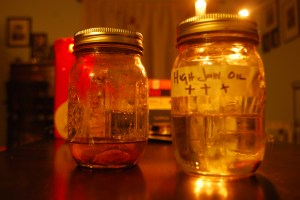
My magical practice (again, fancy tilty-letters here) involves the aforementioned carddivination, which I do more frequently in ways dissociated from a particular spiritual observance, but which does involve me calling upon some spiritual aid. I also frequently cast spells for various wants, needs, and wills. Most are incredibly simple spells, such as the creation of a petition paper and the lighting of a candle, perhaps with some anointing oil and the recitation of a psalm or charm. I might create a mojo bag to carry around and draw in a specific need or want (most often, these bags are in the “success” area, although I also do some protection bags and others as well). Periodically, I will brew up batches of condition oils to have on hand for dressing candles and bags, but if I run out of those for some reason I don’t worry, because I can usually substitute something from the kitchen in a pinch—coffee, whiskey, olive oil, etc. If someone gets a sharp bang on their shin or a cut on their finger, I’m usually right there with my little Pow-wow-style charms to ease the pain, along with an ice pack, kiss, or chocolate-chip cookie as appropriate. A few times a year I do house-cleansing and protection work, adding written charms to door lintels and washing down my front door with—well, traditional protective formulae.
Is any of this witchcraft, though? When we look at stories of witches in North America—whether derived from European, African/African American, Native, or other sources—we see witches doing some of these things in one way or another, perhaps. Fortune-telling by cards and other means seems to appear nearly universally. Zora Neale Hurston recorded tales of African American conjure women and men rifling playing cards and seeing the future. Some of the accounts of Salem’s tumultuous sorceries involved tales of divination by “Venus glass,” or through the use of a special cake baked from urine and fed to a dog, or even some evidence that accused persons like Dorcas Hoar owned divination manuals and had practiced fortune-telling for years before the trial outbreak. Other tools, like the dowsing rod or the use of geomantic shells or coins, appear in other areas, and every cultural group in American history has had some means of divination or augury. Even in contemporary times, the Ouija board has become a popular trope of adolescent divinatory rites, and remains a popular “game” among American youth.
Brewing condition oils
Witches also made use of prayers and psalms, sometimes in holy and sometimes in profane ways. Tales of Appalachian witch initiation rites discuss the use of prayers which reverse one’s baptism. In many European-derived traditions, the recitation in reverse of whatever charm had been used to blight someone would remove that curse. In tales where witches work with spirits, they may make contact with faery-creatures (see Emma Wilby’s Cunning Folk & Familiar Spirits for a truly excellent rundown of that subject), or they may keep wee bug in a bottle to talk to (as in one Appalachian story). While we get a sense of their spiritual worldview—which is heavily populated and constantly interacting with the mundane world—we seldom get a sense that witches are denominational. They might act in non-Christian or even anti-Christian ways, up to and including signing pacts with the Devil, but just as often they make use of Christian prayers and charms, and may even be very religions—if a bit unorthodox. Having a rich spiritual life certainly seems to be found in most tales of folkloric witches, but there’s very little definition around that spiritual worldview. Instead, witchcraft seems to be—from the perspective of history and folklore—less about gods and goddesses and much more about muttering under one’s breath in a time of need, or knowing not to burn sassafras wood. It’s a practice and a way of acting which is shaped by spiritual understanding, but not completely defined by it. There’s much more to say on what witches do, based on folklore (and I should also note that I am increasingly aware of the fact folklore is not something from “back then,” but something alive and moving now, so perhaps we should spend some time on contemporary witchcraft from that angle, too). I will leave all of that for another day, however, and return to the question at hand.
Am I a witch? I suppose it depends on who is asking. I have a fairly unorthodox spiritual practice and worldview, especially for someone living after the Modern era of rationalism and scientific inquiry. I think that my spiritual life, however, does not inherently make me a witch. It makes me an animist, perhaps, or put in contemporary economic terms, someone with a diversified spiritual portfolio. That can be a good basis for witchcraft, but it can also be a good basis for a number of practices completely outside of witchcraft. Many Christians, Hindus, and even Buddhists see such a diversity in the spiritual landscape (although they may assign different values to non-deity spirits and might even avoid all but a very few of them). What I do, on the other hand…that is witchcraft. I am a witch in divination, in charming, in meeting my needs through my own actions, and in doing so by working outside of rational methods (and please note I did not say in spite of such methods or even without also using such methods—a proper My Little Pony bandage can be just as important as a magical healing charm and a kiss to a scraped knee). I am a witch in knowing some of the ways that the world around us is constantly in conversation—whether through the growth of certain plants or the movements of certain animals or the scent and taste of the air before a storm. I am a witch in holding in me a certainty that I can do something about my circumstances, and that I am responsible for my own fate—both finding it and bending it.
Yes. I am a witch.
I hope to go a bit further and expand upon some previous discussions of what a witchcraft practice in the New World might look like. I will be turning to folklore, history, and contemporary behaviors and actions to help define that, and in the end, I will probably satisfy no one, but perhaps get into a few good conversations with the points I raise. For now, though, I hope that this article—a little bit of me put out there for you to consider—will clarify my practices a bit. I am not a perfect witch, mind you, possibly not even a very good one. Nor are my practices solely definitive of all witches everywhere. But if this article speaks to you in some way, I’d love to know. I’d love to hear if you are a witch, too.
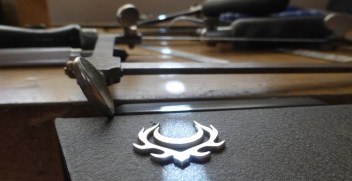
If you haven’t seen Aidan Wachter Talismanic Jeweler‘s magnificent Pagan- and magical-themed creations in silver (http://www.aidanwachter.com/), you should absolutely look at what he’s got to offer. The jewelry is hand-made in his workshop, and he’s constantly working on new designs from a variety of magical sources, including angelic work, grimoires, folk magic, and runestaves. He also does work to empower and enchant his creations, which is right up our alley.
He’s even offered a special sale (his first ever!!!) to our supporters and listeners. Simply use the code “Witchery” (without the quotation marks) when you check out at his site and get 10% off of your order. Do be aware that since this is work of a highly personalized nature he is currently turning orders around to ship in about 8 weeks.
A big Thank You to Aidan for making this available to our listeners!
March month of ‘many weathers’ wildly comes In hail and snow and rain and threatning hums And floods: while often at his cottage door The shepherd stands to hear the distant roar… The ploughman mawls along the doughy sloughs And often stop their songs to clean their ploughs From teazing twitch that in the spongy soil Clings round the colter terryfying toil The sower striding oer his dirty way Sinks anckle deep in pudgy sloughs and clay And oer his heavy hopper stoutly leans Strewing wi swinging arms the pattering beans Which soon as aprils milder weather gleams Will shoot up green between the furroed seams ~John Clare, The Shepherd’s Calendar: “March”
Dear Listeners and Readers,
Here we are in the lovely springtime, knee-deep in the grime of new life, planting seeds to bear fruit under other moons than this one. In a few days, we will (hopefully) be releasing our March episode, which deals with that selfsame celestial sphere, and on that show we’ll be announcing our latest contest. Since you are a dedicated and devoted fan of our work, however, you get a little advance warning and some extra time to work on your entries.
So what do you have to do for this contest? We’re looking for family, regional, or local folklore on two topics. Send in your lore about:
Anything related to the sun, moon, and stars. Did your family tell stories about specific stars or constellations? Did they hold moon-gazing parties or eat moon cakes? Were there special things you were supposed to do during an equinox? Share your heavenly lore with us and get an entry into the drawing!
-OR –
Share your lore about devils, demons, and “bad” spirits. Was there some spot supposed to be haunted by the devil near where you grew up? Were you forbidden to play Ouija boards because of demon possession? Share your most diabolical tales and enter that way as well.
You can even enter in each category! (Only one entry per category per person, please. You can share as much lore as you want, though). Simply email us with the subject line “Spring 2015 Contest” at compassandkey@gmail.com, and you’ll get your entry (or entries). Make sure to let us know where you’re from/family background, and what name (if any) you’d want us to use if we read your entry on the show.
Deadline: Midnight, April 30th (Walpurgisnacht), 2015.
Prizes:
So what is up for grabs if you decide to share a bit of your devilish or stellar side? We’ve got three potential prize packages we’re offering for this event:
Prize Package The FIrst – Grimoires Old: A copy of The Long Lost Friend (Hohman, Daniel Harms, ed.) & The Black Pullet (anonymous but very important grimoire in the New World)
Prize Package The Third – Get Lucky: A bottle of our Crown of Success oil, a lucky charm or two, and a copy of 54 Devils thrown in for fun (you know, lucky at cards…)
If those are appealing to you (or even if they’re not and you just want to participate), please send in your lore to compassandkey@gmail.com and know we’ll be absolutely thrilled to hear from you. Questions about the contest or lore are welcome at that address, too. Good luck!
If you have not heard yet, last Thursday morning the news came that good friend, teacher, and cunning man Peter Paddon had passed away in his sleep during the night. You can read his full obituary at the Wild Hunt, which presents a small sampling of the many, many people his loss has left grieving (not least his wonderful wife Linda and his children). I am unsure of the future trajectory of the numerous projects to which he had put his industrious and enchanted hands (a fancy way of saying I don’t know what will happen next with things like the Crooked Path, Pendraig Publishing, and other things he was working on). But I do know that like many others, my heart breaks to think of a world without him in it. I recognize that he is with us still as an ancestor, but I will very much miss seeing him in person for the remainder of my time here in the mortal realm.
I’m working on several memorial projects at the moment, as Peter was a major influence on me and on what I do. I expect that you’ll see those appear in the future through our site here. For now, I know that his family will need support and assistance. To that end, I’ve posted a button on the top right of the page which you can click to offer some financial support to the family. Or you can just click here. I am going to be donating this week, and I have decided to donate all proceeds from October to December 2014 from sales of my bookFifty-four Devilsto Peter’s family or a fund of their choosing as well. I encourage anyone who can to help.
As I learn more about the legacy Peter leaves, and what will happen with his many projects in the future, I’ll keep you posted. Until then, as Peter would say, Bendith.
Laine has had her baby!!! We really appreciate your support over the past few months, and are so excited to welcome the new New World Witchery witchlet to our fold! I know Laine is enjoying her time with her family right now, and both mama and baby are happy and healthy (and freakin’ adorable, let me tell you).
Thanks so much for all your love, and three cheers for new mama Laine as she begins this big and magical adventure!!!
I just wanted to let you all know I’ve got posts coming, really I do (about 1800 words on one post, plus some book reviews and another post in the draft stage). However, I’ve also got lots of other things going on, including editing the August episode, which I hope you’ll enjoy, and getting started with the Ph.D. program. Laine is also very busy baking another human being in her proverbial oven, so please forgive her if she’s not around for a bit (she still gets emails and appreciates them greatly!).
I also wanted to let you all know about some upcoming events where you’ll be able to vent your frustrations with my slow blogging directly to me, in person! I’ll be at two upcoming events in late August/early September for those who want to come see me.
First, I’ll have a booth at thePhiladelphia Pagan Pride Day on August 30th (see website for location and details). This event is going to be lovely, with classes on Manx folklore, playing card reading (no, not me teaching, though I’d love to attend), children’s activities, and lots more. My booth will (hopefully) have a small traveling museum of North American magical artifacts I’ve pieced together, and I’d love to chat with anyone about folk magic or other such things. Plus, I’ll be trying to collect some area folklore as well, so if you stop by please take a moment to speak into the mic (though you are not obligated to do so, of course). This year’s PPPD is benefiting the Mazzoni Center Food Bank, Forgotten Cats, Books Through Bars, and In-Reach Heathen Prison Services, so please bring donations for any of those fine organizations.
Next, I’m tentatively planning to be at the upcoming Pagan Podkin Super Moot #5 in Chicago! Fire Lyte, who is hosting the PPSM event this year, has generously offered to share his booth at the Chicago Pagan Pride Day on Sunday, September 14th, in Oak Park, Illinois, and I may try to bring that traveling museum along with me for that trip, too. I’m still waiting for a few pieces to fall into place for this even to be a go for me, but right now it looks very likely that I’ll be attending. Other podkin attending include Fire Lyte, Velma Nightshade, Peter Paddon, Dr. Hob & Dean from Lamplighter Blues, Faelyn from the Kindle Witch. A few other folks are tentative as well, so this is a good chance to meet folks if you live anywhere near Chicago.
So, that’s our current situation. If I get invitations for other events or chances to come out and meet fans and friends of the show, I’ll definitely keep you posted! For now, please stop by if you’re near either of those events, and I’ll look forward to seeing you soon!
Borrowed from Pinterest user shuttlecock (click for link)
Or, “Myrtle Snow is my Power Animal.”
[NOTE: The original version of this article contained a phrase that, used in this context, is insensitive and appropriative towards several Native cultural traditions. I leave the original above with a strikethrough to indicate that such use was a mistake. My mistake. I regret the choice of phrase and I apologize for any discomfort or harm it causes to anyone. I don’t want to completely erase the original because I worry that doing so will look like I’m trying to hide the mistake, which I’m not trying to do. I want others to see and know this was not a good choice on my part, and that I am sorry for it.]
(A few AHS: Coven spoilers below, but no major plot points)
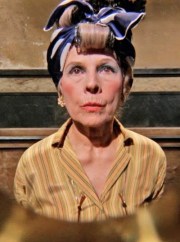
For those who, like me, spent the past four months or so riveted to the meandering and bizarre plots of the American Horror Story: Coven television series, the ride is now over and we’re all left sorting out wheat from chaff from eyeballs from axe-murdering ghosts living in knotty pine hell. One of the most interesting and unusual characters in this season was Myrtle Snow (portrayed by the luminous Frances Conroy), a complicated, artistic, eccentric witch that is just about everything you could dream of having in a crazy aunt who can cast spells and is willing to melon-ball out the eyes of her enemies to restore your own sight. Myrtle plays the theremin, knows fashion inside and out (one of the best moments in the series was her screaming “Balenciaga!” at a crucial moment in the final episode), and has a palate for classic French and continental cuisine. She is, in short, a child of the seventies. More importantly, she is a child of the seventies witch.
Today I wanted to briefly look at that decade (which I’m treating as a “long” decade, starting in around 1965 and going through the very early 80s), which spawned a very particular witchy aesthetic. It was the decade of Stevie Nicks (another AHS trope) and saw a marked growth in the popularity of occult themes across all sectors of American—and international—society. This is not going to be comprehensive, of course, and I know this is not exactly folk magic drawn from a weather-beaten nineteenth-century almanac, but I think that we should be cognizant of the role of recent (well, as recent as almost half-a-century ago, anyway) history in the development of modern magic and witchcraft. If the Victorian era was the early bloom of occultism, the seventies was the springtime explosion of color, dripping nectar, and bloody thorns which allowed a lot of the witchcraft we have today to re-surge, and it even helped fuel some of the studies of folk magic which have been so crucial to us in contemporary times.
In 1958, the film Bell, Book, & Candle featuring Kim Novak, James Stewart, and Jack Lemmon appeared in movie houses following a popular run of the play on Broadway. The sympathetic witch, played by Novak, and her hep-cat brother Nicky (Lemmon) mark some of the earliest American pop-culture portrayals of sorcerers who are not scary and evil, but hip, cool, and attractive. The success of the film eventually fed into the production of the classic television show Bewitched, which ran from 1964 to 1972, which starred Elizabeth Montgomery as the beautiful and charming Samantha. These portrayals are occasionally problematic—the film requires Novak’s character to give up witchcraft in the name of love, and the show was centered around Samantha’s struggles to sublimate her magic so that her husband could lead a comfortable suburban life (although that magic frequently saves his proverbial bacon)—but these glowing women brought glamor to the popular American experience of witchcraft, and the occult looked a lot less intimidating.
Knock, knock!
Then, in 1967, Ira Levin published his book Rosemary’s Baby. The following year, Roman Polanski adapted the book into a film the following year, and the eerie occult was back, with full-on Satanic conspiracies lurking behind Manhattan closet doors. Even in Rosemary’s Baby, however, the glamor persisted—the eccentric but resplendent witches-next-door, Roman and Minnie Castavet (played by Ruth Gordon and Sidney Blackmer), were magnetic, and served frosty cocktails in their spacious New York flat. There Satanic witch-cult even seems more like an anarchy art clique than a sinister magical lodge for the most part. The film put the fear of witches back into the American mind, however, with a new twist—witches were spooky, but spooky was cool. Incidentally, another classic occult film, The Devil Rides Out, appeared in theaters the same year as Rosemary, and lit its own subtle fires under the cauldron.
With this new-found social capital, witchcraft and the occult took the world by storm in the seventies. Some of the occult films which appeared during the decade were hallmarks of art and cult cinema: Simon, King of the Witches(1971); The Devil’s Daughter (1973); The Exorcist (1973—not a true ‘witch’ film, but one with strong occult ties and influence); The Wicker Man(1973); Season of the Witch (1973, directed by zombie-genre great George A. Romero); Lisa & the Devil(1974); and the highly glamorous Suspira (1977), a veritable precursor to 2010’s creepy art-dance film Black Swan. In essentially all of these films, the presence of the occult is a trope, and does not have any of the benign or jovial qualities of Bell, Book, & Candle or Bewitched. Yet each film features a mixture of eroticism, fashion, and allure layered over the tale of black magic driving the story. Liberation, sexual empowerment, and countercultural energy augment the horror of the films, and the gray space between forbidden occultism and fashionable society becomes a gulf.
Art and music also experienced an occult florescence during the seventies. The aforementioned Stevie Nicks—the “White Witch” of music—joined the group Fleetwood Mac along with boyfriend Lindsey Buckingham in 1974, and in 1975 the group experienced mainstream success with an album featuring witchy hits like “Rhiannon.” Her flowing shawls, black gowns, and stage twirls bewitched audiences, and her fashion became a standard of young, hip women seeking to look a little out of the mainstream—a little “witchy.” The occult music craze started well before Nicks, of course, and bands like Coven and Black Widow had experienced some chart success with their Satanic/witchy black rock during the late 60s. In 1970, Santana recorded and released Fleetwood Mac’s song “Black Magic Woman,” on their (fairly occult-named album) Abraxas, taking it to no. 1 on the pop music charts. In 1972, the Eagles released “Witchy Woman,” another big hit glamorizing witches, and in 1974 Cher released “Dark Lady,” about a love triangle involving a witchy fortune teller. Cher herself cultivated a glam-witch look throughout the decade, further expanding the cultural capital of witchcraft fashion. Other rockers who adopted elements of the occult into their songs, performances, and fashions include David Bowie, Jimmy Page, and, of course, Jim Morrison. Patti Smith notes the heavy influence of the occult on the Greenwich Village music scene in her memoir Just Kids, and especially the huge artistic influence that it had on artists like Robert Mapplethorpe. Penthouse magazine did erotic spreads centered on occult themes as well, such as this one featuring Babetta Lanzilli from 1974.
In the ‘real-world’ of witchcraft, a number of stars were aligning to add fuel to the magical fire. Chas Clifton outlines a number of the groups which were exploding onto the scene in his book Her Hidden Children, including the Psychedelic Venus Church and Anton LaVey’s Satanic Church, which also released a film called Satanis in 1970 (there are some great pictures of a 1969 LaVey here). Alex Sanders, the progenitor of Alexandrian Wicca, released an album revealing some of the workings of Wicca called A Witch is Born in 1970. Wicca had arrived stateside with Raymond Buckland in 1968 (although it may have had some early seeds from other sources, too). Buckland expanded on witchcraft religion through books like Witchcraft Ancient & Modern and Witchcraft from the Inside. The hugely influential publication of Robert Heinlein’s Stranger in a Strange Land in 1967 led to the foundation of The Church of All Worlds (CAW) and shaped practices in other groups as well (such as the aforementioned Psychedelic Venus Church). The mass-marketing of witchcraft became a staple of the 70s, with sales of “black magic ritual kits” hitting store shelves and a variety of occult-inspired board games. The Ouija game was purchased by Parker Bros. in 1966, and they began to push it as a party game rather than a spiritual tool. There was also a push towards legitimacy. Journalist Hans Holzer published his mainstream apologetic (and sensationalist at times) text The Truth About Witchcraftand opened the door to public discussions of its practices as legitimate, if fringe, activities done by regular people. Wicca and neo-Paganism in general underwent a rapid expansion and transformation, and the end of the decade saw the journalistic survey of new witchcraft (and other alternative) faiths in Margot Adler’s Drawing Down the Moon (1979). That same year, Starhawk published The Spiral Dance, which crystallized the evolving feminist Wicca movement. A busy, busy decade for witchcraft.
I should point out that these different aspects of witchcraft may have occasionally interacted with one another, but they were not in strict conversation through the decade. Instead, the popular conception of the occult and witchcraft grew in one direction—often sensational and glamorous—and the nature-based religions that were gaining momentum in fringe spiritual culture. Yet there does seem to be a shared zeitgeist from that era that drove ever more people into the black-robed arms and beshawled shoulders of witches. For a number of people, the ecological spiritualism which was fueling part of the neo-Pagan segment was a complete non-starter. Instead, the sex, drugs, & rock-and-roll aspects of witchery worked as an artistic medium of self-expression. Both segments were connected to counterculture, but with different aims and methods. Following this decade, with its chaos and beauty, the occult got heavily mired in a number of problems, most notably the “Satanic panic” of the 80s. With the recent popularity of witchcraft in media, I’d be hardly surprised to find a resurgence of people claiming to have been harmed or attacked by evil cults over the next two decades or so. Let’s hope there’s been some growth on that front and that the information age will keep it in check, but I somehow doubt the ripples aren’t already in motion for the next “panic.”
So what does all this have to do with Myrtle Snow and the Diane von Furstenburg wrap dress (“the greatest invention of the century,” according to dear Auntie Myrtle)? I think that it can be very easy to lose sight of just how diverse witches are, for one thing. Dressing in black (despite AHS:Coven’s edict that “On Wednesdays we wear black”) may be a statement, but so is sporting a pair of black-and-red Pleasers for ritual sex, and there’s nothing wrong with a Pier 1 altar and a little P90X before ritual. I don’t want this to devolve into a post on there being no one type of witch, or on what witches should or shouldn’t look or act like, but I do think that the recent witchcraft revival in pop culture means that there’s room for some real glamor in witchery again. Folk magic performed with embedded style and power—a flair for the dramatic—could be a very refreshing thing. I’d like to see witches embracing their own high-fashion spins on tried and true witchcrafts—not so much glitter in conjure oils, but a really knowledgeable mixologist of a witch brewing enchanted herb rinses for bewitching cocktail hours, for example. I certainly don’t want to see the folk magic I study and practice cheapened by commercial interests, of course, but I would love to see a few more Myrtles playing the theremin around bonfires, while our cultural capital is so ascendant.
What about you? Is there a place for glamor and high fashion in your witchcraft? Are the seventies still alive in your spells?









 New World Witchery - The Search for American Traditional Witchcraft