Episode 50 – Mountain Magic
This episode features a discussion on mountain magic, plus some folklore and music from the Appalachians.
(complete shownotes at http://www.newworldwitchery.com)
Author: newworldwitchery
Quick Update – Contest Ending This Weekend!
Hi everyone!
First of all, sorry for the long silence on both the podcasting and blogging fronts. I’ve had a busy couple of weeks covering an extra workload while my boss is out on maternity leave and I’ve had writing for school that I had to finish up as well. I’ve got several things in the works, including a new episode of the show and some new material for the blog, but I may have to beg your indulgence and patience for a little longer, so please bear with us.
I have NOT, however, forgotten about our current contest, and I hope you haven’t either! We’ve received a number of excellent contest entries so far, but there’s still time to get your name in the hat! You can read the complete contest description at Blog Post 169 – A New Year, A New Contest, but in brief we’re looking for your magical folklore. It can be on any number of topics: love, money, luck, etc. We are asking that you submit the lore using a specific format, like this:
[Name – preferably one we can use in the show, but let us know if you’d rather us keep it anonymous]
[Region/Location – as localized as possible; we don’t need an address, but “Southern Illinois” or “Foothills of the Rockies” would be lovely]
[Ethnic/Cultural Association – if applicable; such as “Italian-American” or “based on something my Lakota Sioux grandmother told me”]
[Type of Lore – love, luck, money, etc.]
[Your bit of lore]
You can send in as many pieces of lore as you like, and each piece gets your name entered in the hat. So if you send in ten pieces of lore, you’ve got your name in our kitty ten times and your odds improve.
We do have a few rules, of course:
- You can only win one prize.
- No entering under multiple names/emails.
- While we are looking primarily for North American lore, we welcome lore from around the world as well.
And I’m sure you remember the prizes:
- The Braucher Basket – featuring a copy of Hex & Spellwork by Karl Herr, a copy of the new translation of The Long Lost Friend by Daniel Harms, a small folio of hand-written/painted charms, and a few other little goodies.
- Granny’s Gunny-Sack – featuring a copy of Ozark Magic & Folklore, by Vance Randolph, a copy of The Candle & the Crossroads by Orion Foxwood, and a little sack full of curios, herbs, and magical charms from the Appalachians.
- The Hoodoo Hamper – featuring Hoodoo Herb & Root Magic by Catherine Yronwode, The Master Book of Candle Burning by Henri Gamache, a candle or two, a lucky rabbit’s foot, and a selection of oils from our Compass & Key Apothecary.
So if you haven’t entered (or heck, if you have and want to up your chances of winning), send us your folklore and get yourself in the mix for these lovely prize packages!
We’re closing the contest at midnight on Sunday, March 31st, 2013. Entries received after that time won’t count. We’ll be drawing names on the next episode recorded after that date (sometime in mid-April, though prize winners may be notified earlier for addresses).
Here’s wishing you good luck! Thanks for all your entries so far, and best wishes to you all!
-Cory
Podcast 49 – Powwow and Braucherei
Summary
Today we’re taking a brief look at the folk magical system of the Pennsylvania German (or “Dutch”) community, known as Powwow or Braucherei. We’ve got an interview with braucher Robert Schreiwer, several readings on the topic, and some charms, spells, and songs, too.
Play:
Download: Episode 49 – Powwow and Braucherei
Play:
-Sources-
Books mentioned within the show
- Discovering American Folklife: Essays on Folk Culture & the Pennsylvania Dutch, by Don Yoder
- The Long Lost Friend, or The Pow-wow Book, by John George Hohman
- American Shamans: Journeys with Traditional Healers, by Jack Montgomery
- The Red Church, or The Art of Pennsylvania German Braucherei, by Chris Bilardi
- Hex and Spellwork, by Karl Herr
- Buying the Wind, by Richard Dorson
- Strange Experience: The Autobiography of a Hexenmeister, by Lee R. Gandee
Additional Sources
- Signs, Cures, & Witchery, by Gerald C. Milne
- Ozark Magic & Folklore, by Vance Randolph (section: “Power Doctors”)
- Powwowing Among the Pennsylvania Dutch, David W. Kriebel
- Hex Signs: Pennsylvania Dutch Barn Symbols, by Don Yoder
- New World Witchery Podcast 29 featured an interview with author Jack Montgomery, who presented some good information on powwowing
Websites
- Urglaawe – Braucher Rob Schreiwer’s site on Heathen braucherei
- Three Sisters Center for the Healing Arts – A place to learn more about braucherei & associated practices
- Braucher.webs – Braucher Rob Chapman’s site for powwow and braucherei
- New World Witchery posts on Braucherei: Intro Part I, Part II, and Part III (also see our page Resources: Magical Systems, under the heading “Braucherei, Hexenmeisters, & Pow-wow”)
- We have a great written interview with braucher Chris Bilardi here: Part I & Part II
- An online essay on Powwow by David W. Kreibel is available here
If you have feedback you’d like to share, email us or leave a comment. We’d love to hear from you!
Don’t forget to follow us at Twitter!
Promos & Music
Title music: “Homebound,” by Jag, from Cypress Grove Blues. From Magnatune.
German folk songs came from the site Mamalisa.com. The songs played in this episode were:
- Winter, Ade!
- Taler, Taler du musst wander
- Meine Hande sind verschwunden
- Rolle, Rolle, Rolle
- Handewaschen
- Guten Morgen ruft die Sonne
Incidental music was Johannes Brahams, Symphony No. 4, found at Archive.org
Promo 1- Lamplighter Blues
Episode 49 – Powwow and Braucherei
Episode 49 – Powwow and Braucherei
A brief look at the folk magical practices of the Pennsylvania Germans, commonly known as powwow or braucherei.
(complete shownotes at http://www.newworldwitchery.com)
Blog Post 173 – Spring Tonics
Ah! Spring is in the air! The warm breezes, the crisp blue skies, the flowers poking their heads from beneath the stiff and frosty soil…wait, never mind. It’s still winter, isn’t it? But I did see a few daffodils showing their buttery yellow tops recently, so spring can’t be too far away. That brings me to the topic of the day: spring tonics. These are potions, concoctions, teas, tisanes, and other preparations which are taken not to react to a medical problem (although some do claim to treat a specific disorder) but to provide general or specific proactive health support. I make the standard disclaimer before we begin that this is not a medical blog and nothing herein should be construed as medical advice; it is provided in a historical and folkloric context only and any medical treatments should only be undertaken with the advice of a trained physician.
Tonics of one kind or another can be found in many places, but I will specifically be looking at the mountain traditions of eastern North America today (the Ozarks and Appalachians). This region has a long history with tonics as part of its medical culture, and even in its economy (which we’ll get to in a bit). Just what is a spring tonic, though? Let’s look to the sourcebook series on Appalachia, The Foxfire Books for a definition:
“After a long winter, spring was the time to refresh the spirit and tone up the system with a tonic. The mountain people used teas and beverages as tonics. They would gather the roots or barks in the proper season, dry them, store them in a dry place, and use them as they wanted them. People used sugar, honey, or syrup to sweeten the teas. Common spring tonics were sassafras, spice bush, and sweet birch” (Foxfire 2, 49).
The book says they were used to treat everything from digestive disorders to gout, sore eyes, skin problems, and liver ailments. They were usually used by making a strong tea (or tisane) and sweetening to taste. Spring greens could also have a tonic/purifying effect, such as wild asparagus, dandelions, dock, poke, wild onion, ramps, and nettles. So the simple answer is that a tonic is a plant based, preventative medical remedy aimed at improving overall health. They are frequently taken in the spring, but in some cases might be used throughout the year.
What kind of tonics were—and in some cases are—common in the mountains. One of the most widely used was sassafrass, which we’ve looked at before. According to Appalachian healer Emogene Nicholas Slaughter:
“We always have a spring tonic of sassafras tea. The red is the best. It makes the best tea. It’s the same thing but in different localities the roots are different because of the soil. I get mine generally over here along the river, and it’s the red roots but I can go back up here against the mountain on the north side of the hill and it’s the white roots. The old people always say that it (spring tonic) thins your blood after the wintertime you know. Cleared out the blood stream. Just makes you feel better. I really feel that it does” (Milne 94)
As you can see, even the specific location from which the roots were dug could have an impact on the healing quality of the tonic. Folklorist Vance Randolph recorded the use of sassafras and similar roots in Ozark tonics:
“Many Ozark people make a tea from the bark of the spicebush (Benzoin aestivale) in March and April. They drink this just as they do sassafras tea and regard it as a tonic and blood thinner. It tastes quite as good as sassafras, I think. Some old folks say that in pioneer days the spicebush was used to season game it softened the wild taste of venison and bear meat. Spicebush twigs are still used as a mat beneath a possum, when the Ozark housewife bakes the animal in a covered pan or a Dutch oven. Choctaw-root or dogbane (Apocynum) is also made into a tea, mildly laxative, which is said to “thin the blood an’ tone up the system.” I have never tasted this but have met men who say that it is better than either sassafras or spicebush. Some yarb doctors fortify their choctaw-root with wild-cherry bark and ‘anvil dust,’ whatever that may be” (Randolph 105)
Randolph also identifies wild-cherry preparations which would be used to make “bitters,” similar to those used in making cocktails but specifically focused on health benefits. He also mentions the purple coneflower (Echinacea), which has been touted in contemporary times as an immunity booster.
Sassafras and spicebush were far from the only spring tonic taken regularly in the mountains. Here are some other examples of spring tonics:
- Seventy-seven willow leaves boiled down in water to a pint of liquid is a good chills tonic (Hyatt 109)
- Ginseng, which we’ve covered in another post, was reputed to have a number of tonic properties
- To regulate the flow in menstruation, boil the inside bark of a sweet- apple tree and use as a tonic: if flowing too much, the bark must be scraped upwards from the tree; if too little, downwards (Hyatt 111)
- “An amateur herbalist at Pineville, Missouri, told me that a tonic mixture of whiskey, tansy, and ragweed leaves was indicated in all such cases ; “I take it every day myself,” said he, “an* it agrees with me fine. I aint had the hiccoughs but once in fourteen year!” (Randolph 100)
- A strong tea of red-clover blossoms is highly regarded in some quarters as a blood purifier and general tonic. It is used in the treatment of whooping cough, too, but if the whooping cough is really bad nothing will help it but mare’s milk. Many a father has been routed out in the night to ride to some farm where a mare has lately foaled (Randolph 105)
- “Bloodroot or red puccoon (Sanguinaria) is also supposed to be a great blood remedy, apparently because it has bloodred sap. By the same token a leaf shaped like a kidney, or a liver, or an ovary, or what not is supposed to designate a remedy for disorders of the organ which it resembles. The yarb doctors are all familiar with this principle, but they don’t seem to take it very seriously or follow it consistently.” (Randolph 105-6)
- “Ginseng plus black cherry and yellowroot made a potent tonic, especially with the addition of some home made whiskey” (Foxfire 3, 247)
- “Corn whiskey was a common cure for many ailments, many of which were feigned, people say. A mixture of whiskey and honey was used to treat toothaches, sore throats, and minor stomach ailments” (Montell 103)
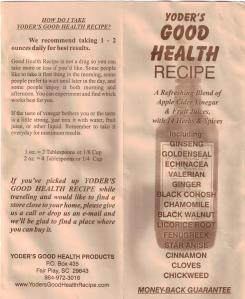
Whiskey played a major role in the decoction of tonics, as you can see in some of the above examples. Likewise strong solvents like vinegar could be used to draw out the wonderful properties of plants and create a powerful tonic. We touched on this in our post on Four Thieves Vinegar, for example. At the top of this article you can see an example of a brochure for a vinegar-based tonic (I picked this up at a nearby Amish market). The inside portion is below:

Several of the tonics we’ve mentioned so far specifically speak of their effect on the blood, either as “blood-thinners” or “blood toners.” These preparations were supposed to help undo the sluggishness and thickening that occurred during the winter within the body.
“Tonics known as ‘blood toners’ or ‘blood builders’ were used mainly in the spring to restore vital properties to the blood. One of the most popular was sulfur and molasses. ‘Blood purifiers’ or ‘blood thinners’ were also used in the spring and during episodes of sickness to clear the blood and organs of toxic waste, or what Southern Appalachians termed ‘pizins’” (Cavendar 65)
They also made herbal bitters which helped digestion and purified the blood. Eventually, tonics were commercialized and turned into wonder pills and patent medicines. Some examples of the many patent medicines available throughout the early twentieth century: Dr. Enuf, Peuna, Dr. Simmons’ Liver Regulator, Dr. Thatcher’s Liver & Blood Syrup, Dr. Taylor’s Family Cordial, and Thedford’s Black Draught. Some, like Dr. Enuf, were essentially caffeine and sugar energy pills claiming marvelous properties. Some legitimately helped. Most were made not in the mountains, but in St. Louis, Philadelphia, New York, or Baltimore. The Chattanooga Medicine Company made two successful medicines, however: Wine of Cardui for ‘female complaints,’ and the laxative Black Draught (Cavendar 72-3). These patent medicines (which I may cover in another post at some point) had a huge impact on Appalachian economies, especially for people trying to get out of the farming life:
“The J.R. Watkins Medical Company, founded in 1868 in Winona, Minnesota…enjoyed great success in selling their medicines in Southern Appalachia…[They] offered men, and later women, the opportunity to have their own business by becoming local sales representatives. For many, it was a way to escape farming life and become prosperous. A 1916 issue of the Watkins Almanac has a picture of a man in a hat and overalls standing beside a horse-drawn plow. His head is turned toward a Watkins truck rolling down a road in the distance. Beneath the picture is the caption ‘I wish I were a Watkins Man.’ The company’s recruitment efforts were successful, for in 1911 it had over 2,500 sales representatives across the nation. Sales representatives not only operated in towns and cities but also served the remote rural communities on horseback. Families in the rural communities often provided food and lodging for the ‘Watkins man’…Watkins Blood and Skin Purifier, for example, was recommended [in their almanacs, another source of revenue and advertisement as well as a pharmacopeia for the rural Appalachian] as a curative or preventative for influenza, catarrh, headache, boils, acne, blackheads, ‘change of life’ (menopause), languor, and diarrhea because these disorders were all thought to be caused or complicated by defiled or weak blood” (Cavendar 74-5)
As medicine became restricted and patent medicines came under increasing scientific and legal scrutiny, these “Watkins men” and their ilk slowly disappeared, but the tonics have remained popular up to the present day (as illustrated by the Yoder’s Good Health brochure above).
Some tonics also got administered to animals for their general benefit, too: “Ordinary soft soap made with wood ashes is regarded as a sort of universal tonic for hogs, so the hillman just mixes a little soap with the hog feed occasionally. ‘Soap will cure a hog no matter what ails him, if you git it to him in time,” said one of my neighbors’”(Randolph 50). In some cases, plant materials were completely unnecessary and a tonic could be made by simply using water from a natural mineral spring. I hope to cover the many miracle curing hot springs at some point in the future, but I’ll briefly mention one such spring due to its connection to tonics:
“The unique sulphur spring was promoted as a cure for a variety of illnesses, but especially for influenza…promoters boasted that one could drink the waters and bathe in them for a few weeks each summer and thus prevent catching the dreaded disease during the winter months. The water was even bottled for a while and distributed throughout the nation as a cure-all” (Steele, 63)
If you’re already seeing the word “tonic” connected to the spring water and you’re thinking cocktails, you’re in good company. Tonic water, the kind you mix with really good Old Tom gin (am I showing a bias there?), comes out of the tonic-brewing tradition. Happy hour for your health, anyone?
I hope this has been a nice—if brief—look at spring tonics in their various forms. If you know of tonic recipes or variations I’ve missed, feel free to post them in the comments section below!
Thanks for reading,
-Cory
Sources
- Cavendar, Anthony. Folk Medicine in Southern Appalachia (2003).
- Hyatt, Harry M. Folklore of Adams Co., Illinois (1935, 1965).
- Milne, Gerald C. Signs, Cures, & Witchery (2007).
- Montell, William L .Upper Cumberland Country (1993).
- Randolph, Vance. Ozark Magic & Folklore (1964).
- Steele, Phillip.Ozark Tales & Superstitions (1983).
- Wigginton, Eliot, ed. Foxfire 2 (1973).
- Wigginton, Eliot, ed. Foxfire 3 (1975).
Blog Post 172 – Ashes

On Wednesday, I attended the Ash Wednesday mass at a Catholic church near my workplace, which begins the Lenten season. The pull of tradition sometimes brings me back to the church rituals of my childhood, and while I’m spiritually aligned else wise now, I take comfort in some of these practices, too. The ashes used in Ash Wednesday services are a powerful ritual tool, made from the palms left from the previous year’s Palm Sunday, mixed with incense and holy water, and blessed by the priest. They mark the bearer as a member of the church, a mortal person living in a mortal world, and someone aware of death’s role in our lives. The ashes, which serve as a spiritual tool for unification with divinity and with mortality, got me to thinking about some of the other ways in which ashes can be used in folk religious or magical practices.
And so today, I thought we’d explore the very rich traditions of magical work which incorporate ashes. I shall endeavor to stay focused on the practical application of ashes, rather than the mere presence of ashes in a spell, but in some cases that line blurs (or smudges) a bit. In researching the topic, I was astounded to see how many different methods for working with ashes I found: banishing, cursing, healing, money work, omens about bad luck and loss, and even some quasi-magical gardening tips. This, to me, is an example of how an extraordinarily normal item—ashes—can be a useful magical tool if a practitioner knows a little about what to do with them. Truly, a clever witch or magical worker can read his or her environment and see it loaded with enchantment and possibility, but I digress. On to the ash spells!
One of the most common ways to counteract bewitchment was to burn the affected object—usually a cow, butter-churn, etc.—“to ashes” which would render the witch who cast the enchantment powerless or cause her tremendous pain. Often the ashes would have to be dispersed even more extensively by being scattered to the four winds to render the spellcaster completely impotent and/or destroyed. Similarly, feathers from black fowls could be burned and the ashes sprinkled or blown over a bewitched person to remove the bewitchment.
An account of a Bell Witch-style haunting in Wiltshire, North Carolina, noted that the wicked spirit “sprinkled ashes in the beds” (Cross 243). Some hoodoo spells deploy the ashes of particularly nasty spells in the way one might lay a magical powder, sprinkling at someone’s doorstep so that they must step in the baneful trick.
Cat Yronwode mentions rubbing alfalfa ashes on one’s money to improve business, especially if the money is in a cash register. She also has this excellent and interesting recipe for a floorwash designed to bring clientele to a cathouse:
To Draw Trade to a Whorehouse: On a Friday morning, build a fire outdoors and burn a man’s worn-out left SHOE with a pinch of SUGAR in it. Put the SHOE ashes, a tablespoonful each of AMMONIA, SALT, and SUGAR, plus your own URINE, into a bucketful of water. Mop from the sidewalk inward, to attract men (Yronwode 29).
Ashes can also be used in hoodoo love charms (perhaps in conjunction with the above business charm?), as in this method from Zora Neale Hurston:
Cut some hair from under your left arm-pit and some from the right side of the groin. Then cut some from the right arm-pit and from the left side of the groin. Burn this hair with a wish for this man to love you. Put the ashes – made into fine dust – in his food secretly and he will love you and do as you wish (Hurston 361-2).
A magical charm called the “Chinese Snake Stone” from an account of North Carolina witchcraft tells how the amulet could be used to draw poison and how ashes were used to re-charge it after its work was done:
Directions for using The Chinese Snake Stone. Scarify the wound before applying the Stone-take it off every morning and evening-put the Stone at each time, when taken off, into a glass of milk-warm water, and let it remain a few minutes, until it discharges itself of the poison-wash the wound in a strong solution of salt water, and scarify again, if necessary. After taking the Stone from the water, rub it dry in moderately warm ashes, and apply as before. This course should be repeated for the space of nine days, when a cure will be effected (Cross 264)
In some cases, ashes have to be handled carefully in order to prevent illness from getting worse. When someone in a family is sick, for example, removing the ashes from the fireplace and taking them out of the building is said to be very bad luck, possibly even fatal to the ailing person.
A Pow-wow hair removal charm taken from older European sources recommends burning a frog to ashes and mixing them with water to make an ointment “that will, if put on any place covered with hair, destroy the hair and prevent it from growing again” (Hohman 14). I also found the same cure echoed in witchcraft practices from North Carolina.
Curandera recipes sometimes call for white ashes, which are powdery and fine and must be sifted from the gray and black ashes. Mrs. Mercedes Castorena of Sonoma gave the following recipe for dealing with empacho, a stomach and intestinal ailment:
“You crack an egg and get the yolk, being very careful not to break the yolk, because it has to be all in one piece. Then lay the sick person on the bed, put the egg on his stomach and let the egg slide all over the stomach. Wherever the spot is (where the food is stuck), the egg yolk will break. You leave the egg here. Then you take some herb called rosa de castilla, and some ashes-just the white part of the ashes-and put this on the stomach and wrap a bandage around the stomach to keep it on. Then you give them a dose of Baby Percy (a patent medicine)” (Neighbors 251).
Mrs. Castorena also mentioned a cure involving mixing avocado seed ashes with oil to treat indigestion. Ashes are also used in other home remedies from other traditions: “To cure toothache, place a bag of warm wood ashes on the side of the face where the tooth is aching” (Farr 327). Vance Randolph mentions the Ozark method of treating an itch using a mix of gunpowder, wood ashes, and sweet cream. He also talks about a method of staunching a wound using the ashes of a man’s shoe.
In the garden, ashes can be mixed into soil around fruit trees to improve their growth. My mother used to have me take our fireplace ashes and put them around our blueberry bushes at the beginning of the spring to promote big, juicy berries later on. Supposedly, doing this on Ash Wednesday ensured a pest-free garden all year long (I don’t recall if I was usually enjoined to this particular chore in conjunction with the holiday or not, but our plants were not bug-free).
Harry M. Hyatt recorded a number of beliefs about sprinkling ashes around a hen-house to prevent lice on the birds (and he also mentions the Ash Wednesday ritual for gardening success). Some of the other magical ash-lore he shared includes:
- “Epileptic attacks are checked, if you remove the person’s undershirt immediately after an attack, let it smolder on live coals, mix a teaspoonful of these ashes in a glass of holy water, and say In the Name of the Father, Son and Holy Ghost. These ashes in holy water must be administered three times a day.”
- “An old shoe should be burned and the ashes used in washing out the mouth of a child with thrush.”
- Several of his informants recommended burying objects that have touched a wart in ashes in order to cure the growth
- Dreaming about ashes is very bad luck, usually foretelling a significant loss or a death in the near future
Strangely, dreaming of fire is frequently a good sign, but the ashes tend to be a bad-luck indicator.
As you can see, even the lowly ashes from your fireplace can become useful magical aids if you know what to do with them. I hope this little exploration is useful to you! Please feel free to share your own ash lore in the comments below.
Thanks for reading,
-Cory
Sources
- Bivens, N.D.P. Black & White Magic of Marie Laveau (1994, new ed.)
- Cross, Tom. “Witchcraft in North Carolina.” Studies in Philology (Jul. 1919).
- Farr, T. J. “Riddles & Superstitions of Middle Tennessee.” Journal of American Folklore (Dec. 1935)
- Hohman, John George. The Long Lost Friend (1820).
- Hurston, Zora Neale. “Hoodoo in America.” Journal of American Folklore (Dec. 1931).
- Hyatt, Harry M. Folklore of Adams Co., Illinois (1935, 1965).
- Neighbors, Keith A. “Mexican-American Folk Disease.” Western Folklore (Oct. 1969).
- Randolph, Vance. Ozark Magic & Folklore (1964).
- Snow, Loudell F. “Mail Order Magic: The Commercial Exploitation of Folk Belief.” Journal of the Folklore Institute (Aug. 1979)
- Yronwode, Catherine. Hoodoo Herb & Root Magic (2002).
Blog Post 171 – Magical Cakes

Laissez les bon temps rouler, y’all! It’s Mardi Gras, which means a last-minute pre-Lenten extravaganza of flesh, fun, and other words starting with the sixth letter of the alphabet. In honor of the Carnival spirit of feasting (another “f” word!), I thought I’d take a brief look at one of the things I most associate with this holiday: cake.
Cake may not have the aesthetic magical impact of a cauldron bubbling over a fire or a bag full of bones scattered in the dirt, but this bakery standby (and some of its culinary cousins) manages to surface in a number of magical practices. Since this is Mardi Gras, let’s start with one of the most obvious, the King Cake. The King Cake originates in Epiphany and Old Christmas celebrations from Catholic countries, but has also become incredibly prominent in Carnival and Mardi Gras celebrations. The one you’re most likely to find in a local bakery (I have found Hispanic bakeries frequently are my best source) will be big, doughy cakes covered in icing and lots of colored sugar—usually gold, green, and purple. Somewhere inside, a small plastic or metal baby lurks, waiting to grant luck on the one fortunate enough to get a slice with the little token in it (or unfortunate enough, if you happen to bite into the baby and chip a tooth before you know what you’re doing). The lucky association of the baby in the King Cake resembles other traditions in which a bean is baked into a cake and the recipient receives blessings, money, or good luck upon finding it. Sometimes the “King” or “Queen” of the feast would be chosen by the finding of a bean or a pea:
Samuel Pepys (whose wife was French) recorded a party in London on Epiphany night, 6 January 1659/1660: “…to my cousin Stradwick, where, after a good supper, there being there my father, mothers, brothers, and sister, my cousin Scott and his wife, Mr. Drawwater and his wife, and her brother, Mr. Stradwick, we had a brave cake brought us, and in the choosing, Pall was Queen and Mr. Stradwick was King. After that my wife and I bid adieu and came home, it being still a great frost.”[1] The choosing of King and Queen from the pie, usually by the inclusion of a bean and a pea, was a traditional English Twelfth Night festivity. (via Wikipedia’s article on “King Cake”)
Most Westerners know about the significance of candles on birthday cakes, as well as the wishing tradition that comes with blowing them all out at once. Some of the other quirky and semi-magical rituals we perform in conjunction with cake:
- “Portions of the wedding cake are often saved to eat at anniversary parties (and at christenings) to symbolize that the marriage has lasted and matured” (Brunvand 63).
- Brides are not supposed to bake their own wedding cakes, for fear of bad luck.
- A newly married couple frequently joins hands to cut the wedding cake and serve the first slice, which can symbolize their union and service to one another, their joint role in serving the community and their families (in some cases members of the family are served first by the bride and groom), or their shared prosperity and a wish that they should never know hunger together.
- “The wedding reception provides more folklore, mostly concerning the wedding cake. One popular belief says that if the bride cuts the cake first, with the groom placing his hand over hers, their marriage will be cooperative. This ritual also ensures fertility. Some traditions urge the couple to fast, while others insist that they eat their entire meal for good luck. Trinkets in the shape of rings, horseshoes, and cupids are often baked inside the cake” (Brunvand 1548).
- “Let a bride on her wedding-night throw a piece of wedding-cake outdoors and next morning watch how many birds eat the cake; the number of birds will be the number of her children” (Hyatt 54).
- “If a slice of the birthday cake tips over on the plate, that person will never marry” (Brunvand 170)
- Over-the-Hill celebrations frequently involve black or coffin-shaped cakes to symbolize (humorously, we hope) the ever approaching death of the recipient.
- Several cultures celebrate the Passover-and-Easter holidays with special cakes, including the Jewish use of unleavened cakes in Pesach meals, the Dutch use of Paas cakes in the Easter feast, fastnaacht cakes of the Pennsylvania Dutch, and other similar baked treats.
- Also from the Germanic tradition: “Years ago it was almost a general custom among Germans in Quincy to bake a coffee-cake and eat it with the family who had a new baby so that the child would become wealthy” (Hyatt 73).
- From the files of American History: “Although Election Day is not a legal holiday, the event nonetheless is associated with folk customs. For example, in New England, there is a tradition of preparing Election Day cake. This yeast-raised cake, prepared with spices, raisins, and nuts, dates back to the 1700s in Connecticut. It is tied to an era in which the trip to cast one’s vote was a journey punctuated with visits to friends and family. By the 19th century, polling places were more accessible, and the customs of Election Day cake and callers waned” (Watts 125).
Of course, Western culture hardly has a monopoly on cake-based traditions. Since we’re also entering the Chinese New Year, I can’t help but mention the delicious little mooncakes you can find in a number of Chinese bakeries at this time of year. In some cases, these sorts of little glutinous cakes might be offered to ancestors or deities (as with the tt’ok of Korean origin) or simply consumed as a symbol of prosperity and blessing during the celebrations.
According to American Folklore: An Encyclopedia, “Some American children enjoy baking a ‘thundercake’ when they first hear thunder and starting to eat it when the storm breaks (if the storm allows enough time for baking)” (Brunvand 1553). I’m not entirely sure what the significance of this weather-ritual might be, although I would speculate it brings some kind of protection or prosperity. Harry Hyatt recorded an interesting pregnancy divination based on a baking cake: “’ When I was young, whenever my bread or cake cracked open in the middle, I always was in a family way. It never failed.’ Some say the cracking open is not necessary; a raising-up more than usual in the center is sufficient” (Hyatt 54). A variation on this technique says if the cake breaks open during baking, a baby girl is not far behind.
Cakes also can have a darker (“devil’s food?”) side. Some cakes can be used to cause harm or to undo hurtful magic by sending it back to its origins. The famous “witchcake” made from urine and grains which Tituba allegedly showed the Parris girls how to make in Salem, MA, was supposed to have caused tremendous suffering to whomever was attempting to curse the young ladies. Another rather evil-sounding cake was allegedly used to poison a child: “One instance is given [in an account from 1895] of ‘toad heads, scorpion heads, hair, nine pins and needles baked in a cake and given to a child who became deathly sick’” (“Conjuring and Conjure-Doctors in the Southern United States,” Journal of American Folklore, p. 143). Gruesome.
Still, all in all, cakes tend more towards the “angel food” side of things, and bring luck, prosperity, and joy along with other blessings. After all, it is cake, right?
So enjoy your Mardi Gras celebrations with whatever baked sweetmeat you find most appealing. I will be having pancakes with FROG jam (Fig-Raspberry-Orange-Ginger, made by our local Amish country market and SO delicious!) and hopefully laissez-ing the bon temps rouler all day long! Here’s wishing you a wonderful day!
Thanks for reading,
-Cory
Sources
- Brunvand, Jan. American Folklore: An Encyclopedia (1998).
- “Conjuring and Conjure-Doctors in the Southern United States,” Journal of American Folklore (1896).
- Hyatt, Harry M. Folklore of Adams Co., Illinois (1935, 1965).
- “King Cake.” Wikipedia (2013).
- Milne, Gerald C. Signs, Cures, & Witchery (2007).
- “Tituba.” Famous American Trials: Salem Witchcraft Trials 1692. Univ. of Missouri (Kansas City, 2012).
- Watts, Linda S.The Encyclopedia of American Folklore (2006).
Podcast 48 – Healing Magic
Summary
In this episode we’re discussing magic, medicine, & healing. We’ll look at holistic therapies as well as why Laine & Cory don’t grab a spellbook or a pill bottle when they get a headache.
Play:
Download: Episode 48 – Healing Magic
-Sources-
- Cory mentions Hands of Light by Barbara Ann Brennan, and while he doesn’t mention it, there’s a sequel called Light Emerging as well.
- Make sure to visit our post about our current contest! You could win one of three amazing prizes!
If you have feedback you’d like to share, email us or leave a comment. We’d love to hear from you!
Don’t forget to follow us at Twitter!
Promos & Music
Title music: “Homebound,” by Jag, from Cypress Grove Blues. From Magnatune.
Promo 1- Cosmophilia
Promo 2 – Between the Earth & Stars
Episode 48 – Healing Magic
Episode 48 – Healing Magic
We discuss healing, magic, and medicine.
(complete shownotes at http://www.newworldwitchery.com)
Blog Post 170 – A Little Gift
Hi everyone!
I hope you’ve all had a festive holiday season and are looking forward to a fantastic 2013! I’m working hard on a number of projects at the moment, including new posts for the blog, getting new show topics and guests lined up, starting a New World Witchery contest, finishing a school project and an assignment for an academic journal, finding PhD programs, continuing work on any of the books I’ve got in the works (and looking for publishers for those books), planning out some second-half-of-the-year classes for my local magical group, keeping up with my reading list, learning a couple new languages (and refreshing my Spanish, too). Not to mention working a day job, being a father to two brilliant kids, and a husband to a very patient and very loving wife.
All of which is to say that life is very busy, but not so busy that I don’t decide to take on MORE crazy projects! (As a Gemini, having too many irons in the fire is par for the course, apparently). During the latter part of last year, I was listening to a conversation between Fire Lyte and Velma Nightshade on their joint podcast about the lack of witchy apps out there, and specifically how there isn’t anything that can integrate with their calendars like an almanac app. Well, I’m not a programmer of any kind, but I do know how to go through and use Outlook to generate iCal files, so I started working on something to fill that need. And here it is!
A Witch’s Calendar – iCal version for 2013 (Q1).
The calendar includes witchy holidays with lore, links, recipes, etc. I’ve included a number of the days I personally observe, and the full and new moons. Many of the links will bring you to the New World Witchery site for posts on the topics highlighted in the calendar alert, and some will send you to book recommendations, other sites with related lore and/or products, and so forth. For example, the calendar entry on New Year’s Day (which is when the whole thing starts…sorry for the delay in releasing it) includes a link to our entry on that day’s practices, a link to Sarah Lawless’ post on Hogmany, and a click-through to Lucky Mojo’s Chinese Wash, so you can start your year with a clean and lucky house.
It’s in a zip file, so please make sure that you can open those and that you know how to add an iCal file to your favorite calendar (a quick Google search will probably help you figure out how to do that).
I should point out a few caveats:
- This is only for the first quarter of 2013. I’ll be working on getting other quarters up as soon as I can, but I wanted to get at least the first three months out there.
- There may be one or two of these dates that have an entry with no links, or which are blank in some way. I’ll be correcting those in future versions.
- It’s totally free and you can share it as much as you like, but please let folks know where you found it.
It’s sort of a New Year’s/Twelfth Night gift to y’all for being so spectacular, so I hope it’s useful to some folks out there. If someone out there is more technically gifted than I am and wants to undertake any improvements that integrate with this calendar, I’m a-okay with that. Just send me an email and let me know! And if you find this useful and all that, we’d certainly welcome donations to help support future work.
Here’s wishing you a very happy New Year! Thanks for all you’ve done for the show, and for being a spectacular audience!
-Cory

