Quick Update – Spring Lore Contest!

Howdy everyone!

We’ve got a Spring Lore Contest going on until March 21, 2012! We’re looking for Springtime Lore this time around: seed planting rituals & customs, fertility charms, spring cleaning spells, etc. Anything and everything related to Easter eggs, baby animals, April showers, and (shudder) bunnies. We’re trying to put together an episode featuring folklore, ritual, and practice from all over the country and the world relating to rebirth, green grass, renewal, etc. and we need your help to do it! But because we like you an awful lot, we also want to give you the chance to win shiny and wonderful things from us when you send us your lore!

The Prizes

  • A copy of Etched Offerings: Voices from the Cauldron of Story from Misanthrope press (an anthology of pagan fiction featuring stories from several podcasters like Oraia Helene, Saturn Darkhope, & me!)
  • An email card reading from Cory, with a 1-2 page card report featuring a 2-card split and 7-card layout, plus interpretations and a fairy-tale recommendation to connect your reading to a story you can turn to for more inspiration.
  • A goody box from Compass & Key Apothecary featuring several of our oils, curios, and mojo bags. While actual contents of the box are subject to change, they will likely have at least 2 oils, 2 mojo bags, 1-2 curios (like rabbits’ feet, gator paws, or Mercury dimes), and 3-4 herbal samples.

How to Enter

Send your entries to compassandkey@gmail.com to enter, and be sure to put “Spring Lore” in your subject line.

We hope to hear from you soon! Remember, the deadline is midnight on March 21st, 2012, so get those entries in before then!

All the best, and thanks for everything you do!

-Cory

Podcast 39 – Feedback, Newbies, and News

-SHOWNOTES FOR EPISODE 39

Summary
On this episode, we go through a lot of listener feedback, share a few thoughts on being new to a magical path, and give a few updates about what’s coming up for New World Witchery.

Play:

Download: New World Witchery – Episode 39

-Sources-

  1. From the feedback question about altars, some good books might be The Encyclopedia of Spirits and The Encycolpedia of Mystics, Saints, & Sages, both by Judika Illes
  2. From the question about divination, Aeclectic Tarot has wonderful comparisons and reviews of different tarot and oracle decks. You can also check out the Rabbit Tarot that Laine mentions, and our free Cartomancy Guide if you’re interested in playing cards.
  3. We had a question related to spinning wheel magic, which was based on our discussion from Podcast 25.
  4. Velma Nightshade asked a question about the Biblical Magic episode. Cory mentioned the Book of Pagan Prayer (though I intended to refer to the Pagan Ritual Prayer Book), both by Ceisiwr Smith.
  5. We mention Oraia Helene as a great resource for information on the martial arts and magic.
  6. We answered some questions in regard to our Secrecy & Silence posts.
  7. Check out the Book Reviews post mentioned as part of the “learning hoodoo” discussion.
  8. The “learning hoodoo” discussion also mentions a series of posts from us (starting at Blog Post 29), and several books that can help a person get started:
    1. Spiritual Cleansing and A Century of Spells, by Draja Mickaharic
    2. Mules & Men, by Zora Neale Hurston
    3. Hoodoo Herb & Root Magic, by catherine yronwode
    4. The Voodoo Hoodoo Spellbook, by Denise Alvarado
    5. Conjure in African American Society, by Jeffery Anderson
    6. Black Magic, by Yvonne P. Chireau
    7. Master Book of Candle Burning, by Henri Gamache
    8. Secrets of the Psalms, by Godfrey Selig
  9. We also used an email from VII at Magic & Mundane to jump into a discussion of being new to a particular path.
  10. You can now request Card Readings from Cory via email, if you are so inclined.

We’ve got a Spring Lore Contest going on until March 21, 2012! We’re looking for Springtime Lore this time around: seed planting rituals & customs, fertility charms, spring cleaning spells, etc. Anything and everything related to Easter eggs, baby animals, April showers, and (shudder) bunnies. Send your entries to compassandkey@gmail.com to enter, and be sure to put “Spring Lore” in your subject line.  Three participants will win one of three prizes: a copy of Etched Offerings: Voices from the Cauldron of Story from Misanthrope press (an anthology of pagan fiction featuring stories from several podcasters like Oraia Helene, Saturn Darkhope, & me!), an email card reading from Cory, and a goody box from Compass & Key Apothecary featuring several of our oils, curios, and mojo bags. More details coming soon!

Don’t forget to follow us at Twitter!

Promos & Music
Title music:  “Homebound,” by Jag, from Cypress Grove Blues.  From Magnatune.

Promo 1 – Between the Earth & Stars
Promo 2 – The Pagan Homesteader
Promo 3 – The Texan Heretics

Blog Post 146 – Dowsing

Today’s entry deals with a very specific type of magic, one which has been associated with the word “witch” in a positive way even within deeply Christian communities for a century or more. The practice of dowsing, or “water witching” as it is sometimes called, essentially deals with the use of divination instruments to find something. Most frequently, that something is water, but on occasion it might be oil, precious metals, lost objects, or even lost people. The phenomenon of water witching is one of the most accepted mystical practices in the West today, and there are organizations devoted to its study from both scientific and metaphysical perspectives. A person can be a dowser and still be a respected member of his or her community, even a highly valued one if he or she is effective at it, though magic or divination of any other kind might be frowned upon by the neighbors. But just what is dowsing and how does it work? Here is an excellent description taken from a folklore handbook on a specific area of the Appalachian foothills:

Almost without exception, dowsers were used to ‘witch’ wells dug in the region [the Upper Cumberland area of TN/KY] before the 1930s. A dowser, or water witch, is a person perceived to have a skill for discovering underground water with the use of a divining rod, usually a small, forked limb cut from virtually any fruit-bearing tree or willow. Because a water witch’s method is not scientifically proven, reliance on this technique is considered a folk practice. However, there were at least 25,000 active diviners in the United States as late as the mid-1950s, according to folklorist Trudy Balcom, and the results of their predictions have proven as successful as those of hydrologists and geologists.

Dowsers were often called in before a new home was built, so that the house could be located near a well. To find the water, the dowser typically holds the free ends of the forked prongs, wrists turned upward. Thumbs are pointed horizontally outwards so that the loose ends of the prongs extend three to four inches beyond the thumbs. (There are variations on the manner in which the switch is held.) The dowser walks slowly toward the desired location of the well. When the witch comes upon a subterranean stream immediately below, the vertex of the fork turns toward the ground; the stronger the stream, the more forceful the downward pull. The fork often twists in the dowser’s hands when a strong stream of water is discovered. Some say that the bark will even twist off into the dowser’s hands, and a few people claim that the forked limb often begins to nod, one time for each foot of dirt and rock that will have to be excavated before water is reached (from Upper Cumberland Country, by William Lynwood Montell, 37-8).

This summary of water witching covers most of the basics: a forked rod, used to find water before digging a well, the power in the dowser, and the nodding to indicate well depth. It also addresses the issue of scientific verification, which is a sticking point for a lot of professional dowsers. Some argue that they can produce repeatable results with their methods, even going so far as to get large mining companies to acknowledge their findings. Yet many scientific studies are at best inconclusive when it comes to water witching, or even outright disprove the phenomenon (on paper, anyhow). I’m not here to argue the merits of scientific proof of spiritual phenomena, so I’ll just say that both sides have evidence of some kind, and both seem to be firmly convinced of their interpretation of that evidence. Getting back to the folklore of dowsing, I found a rather interesting footnote explaining the dowser’s use of the forked branch in the book Kentucky Superstitions, which seemed to indicate that the forked shape is related to lightning in some way (292).

Water witches proved to be incredibly valuable members of their communities, and were not only popular but highly regarded for their skill, with no diabolical associations. From Vance Randolph’s Ozark Magic & Folklore:

Nearly all of the old settlers in the Ozark country believe that certain persons can locate underground streams by ‘cunjurin’ round’ with forked sticks. These characters are called water witches or witch wigglers, and the forked switches they carry are known as witch sticks. Despite this sinister terminology, the waterfinder has no dealings with the Devil, is not regarded as dangerous by his neighbors, and has nothing to do with witchcraft proper (83)

Randolph himself takes it very seriously, indicating that it’s not something that he has seen scientifically proven, but which he has seen demonstrated over and over again, which is a fairly sharp contrast to his usual bemused skepticism with regard to the folk beliefs of those he studied. He also makes several other observations on the powers of water witches:

  • He says that the power is in the dowser, not the stick itself, but that he felt a distinct sensation upon holding a witch stick in his hands ( 84)
  • He discusses the societies built around the practice of water witching or dowsing, including ‘Water Surveyors’ Club’ of Butler, MO (86)
  • He gives the story of Fred Goudy of Everton, MO, who dowsed using copper wire instead of tree branches, and gained great fame by doing so (87)

Of note, however, is his doubt about water witches who claim to find mineral deposits or oil. He does not put stock in the ability to find anything other than water with this method, at least as far as the Ozarks are concerned:

Many hillfolk are interested in the search for lost mines and buried treasure, and some of these people have tried to use the witch stick in their quests. If a man is looking for buried gold, he fastens a gold ring to the end of his stick ; if it is silver that he expects to find, he splits the end of the wand and inserts a silver coin. Rayburn says that to locate mixed ores one uses two different metals usually a dime and a penny. Witch sticks thus equipped for treasure hunting are sometimes called ‘doodlebugs,’ but I don’t know if this is an old backwoods term or a recent importation. I have seen perhaps a dozen doodlebugs in operation but have yet to hear of any treasure being found by the doodlebuggers in the Ozarks. It is said that a switch loaded with metal will not react to water, or to any other substance save the particular metal which is attached to the stick (88)

Richard Dorson records the presence and commonality of ‘water witches’ in Illinois in his book Buying the Wind, saying that (in the early 20th century), most farmers had dowsers find wells for them, often for only a dollar or two in payment. He also reports that dowsing for oil had lately (the book was published in 1964 for a sense of temporality) become more common and profitable than dowsing for water (321-22). Veering momentarily into recent history, in a letter dated December 8, 1993, the Chevron Oil Company told Welsh dowser J.P. Taylor that “you opened our eyes to the world of dowsing…it certainly made us think there is more to it than we had previously known.”  The letter goes on to highlight how Taylor, with no prior knowledge of the specific geology of two regions, had been able to accurately identify subterranean oil and gas reservoirs. This is hardly proof positive of dowsing’s power, but it should put into perspective the acceptance with which water witching has been met, even in the past quarter-century or so.

I’d like to conclude today by going back in time and abandoning the present-day (not that it’s not a nice place to visit, but let’s go where the history is hanging out) and looking back at dowsing in the Colonial period. Peter M.’s New England Folklore blog tells a humorous and interesting story about the “Rod Men” of Middletown, VT. He also mentions a few of the late 18th-century powers ascribed to dowsers:

  • Determining lifespans
  • Finding wild plants to cure illnesses
  • Treasure-finding
  • Receiving divine messages
  • And my favorite: “Tell young women their clothes had the Devil in them, and should be removed”

So that’s it for this cursory examination of water witching. There are probably far more qualified folks to write on this phenomenon than me, so consider this a fleeting glimpse into a fascinating subject. My own experiences with dowsing have been limited to using bent copper rods and attempting it (unsuccessfully) with a broken tree branch (which was not taken from a living tree, so that might explain the problem). If you’ve had experience with water witching or treasure/mineral/oil dowsing, I’d love to hear about it! Please leave a comment below! Otherwise, here’s hoping you find what you seek in life!

Thanks for reading,

-Cory

Quick Update – New Products and Card Readings

Hi everyone!

I just wanted to let you know about some things going on in our Etsy shop, Compass & Key Apothecary. We’ve got a new mojo hand and a new bundle available:

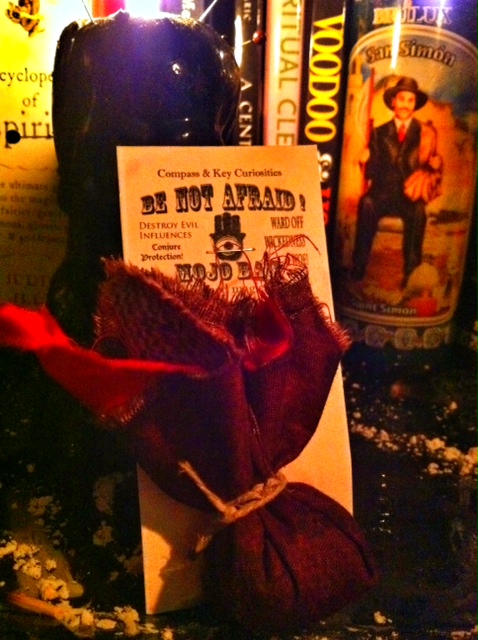
Be Not Afraid! Mojo Bag
The Be Not Afraid! Mojo Bag is designed to provide spiritual protection to those who carry it on their person. The combination of herbs, roots, and other curios in this handmade mojo all have powerful protective qualities according to folklore. The rue used in this bag, for example, has been reputed by Italian magicians to fend of baneful sorcery for centuries. It is thought that carrying a bag like this can boost one’s confidence, repel enemies, and turn harmful enchantments back on their senders. Best fed with our Wall of Flame Oil or with rum in which hot peppers have been soaked.
Cost: $6.00 + Shipping

The Fearless Bundle
The Fearless Bundle includes one (1) Be Not Afraid! custom-made mojo bag and one (1) bottle of our Wall of Flame oil. Together, these constitute a powerful spiritual defense which repels harmful forces and turns wicked spells back on their senders. The oil can be used to feed the mojo bag and on its own. You can save $2 off the total cost (plus a little bit on shipping) by buying these items in this bundle
Cost: $10.00 + Shipping

All products sold as novelties only. Not intended for internal use. Please consult a health professional for medical conditions.

We’re also knocking $2.00 off of the shipping cost of any purchase made in December. I tried to set it up to do this automatically through the Etsy site, but if that doesn’t work I will refund the $2.00 to you after your purchase, so either way you’ll definitely get a discount on shipping.  If you’ve never ordered from our shop, you should know that every order winds up with some extra free goodies thrown in with it, which can range from little bags of herbs to handmade spells and charms to talismans and amulets.

I’ve wanted to make more products available, but it takes a good bit of time to develop each one, plus I usually like to “guinea-pig” my stuff first by sending samples of new things out to customers in the hopes of getting feedback, and that can be very time-consuming. So apologies if a product you want isn’t on the Etsy site yet, but maybe it will be soon. You can always email us and request something and we usually are willing to accommodate.

Speaking of emailing us, I’m also looking to start offering some card readings to folks. At first, I’ll only be doing it by email due to time constraints, but I may branch out into Skype if there’s enough interest. The cost? How about pay-what-you-can? For right now, I’m doing this on a donations-only basis, so as long as you’re willing to donate something to the site (using the PayPal button located in our main page side bar, or you can do it here, too), I’ll read for you. Ideally, I’d love to get at least $5.00 for it, but hey, a buck’s a buck, and if all you can afford is $1.00, that’ll do.

Here’s how the card-reading works:

1)      You email me your question (subject: “Card Reading”) and make your donation (in whichever order you prefer—please make sure to include your real name and astrological sign so I can get a lock on reading for you).
2)      I will do a two-card split reading and an extended five-card reading, recording the cards drawn.
3)      I will write an approximately 1-page report for you on the reading and send it back to you.
4)      You can ask one follow-up question as well, which I will pull 1-3 cards for. I’ll send you an email response with those cards and a summary of their meaning.

I’m using my own system of cartomancy with regular playing cards inherited from my mother, so don’t be surprised if the cards and their meanings are a little different than what you’re used to.

So why all this commercial activity? No, it’s not because of the holidays. Rather, I’m trying to raise money to fund the next year of the site and podcast’s hosting service and there are some magical courses and books that I’m looking at as well. The more I know, the more I can add to the site and show, so it’s a win-win for all of us, right? Plus (and this is a big reason), I’m trying to do a lot more practical work with folk magic, and making new things while offering card readings seems like a good way to do that. So if you enjoy the show or site and want to help contribute to it, please check out our Etsy shop and/or get a card reading!

Okay, thanks everyone for all your support! We really appreciate all you do for us, and hope you’re having a great holiday season!

All the best,

-Cory

Blog Post 144 – Walnuts

“As soft as silk,
As white as milk,
As bitter as gall,
A strong wall,
And a green coat covers me all”
Walnut riddle from H.M. Hyatt, Adams Co., Entry No. 14379

Continuing with the Thanksgiving ingredient theme (i.e. Apples), I thought today it would be good to look at a fairly common tree and nut that has been woven into magic for hundreds of years. I’m speaking of course of the unassuming but delicious walnut which tops brownies, finds its way into salads, and makes a delicious candied treat. Don’t worry, though, my next topic will not be mayonnaise and I am not subtly leading up to any kind of enchanted Waldorf salad.

I’d like to briefly start in the Old World and mention a legend which had some influence on 19th-century occult folklorist Charles Leland. In “Neopolitan Witchcraft” by J.B. Andrews and James Frazer, a rhyme appears which translates roughly:

Beneath the water and beneath the wind,
Beneath the walnut trees of Benevento,
Lucibello bring me where I need to go.

This charm would help a witch magically fly to her Sabbat, supposedly. The idea of witches gathering beneath a walnut tree in Benevento, Italy clearly impacted Leland, who includes a tale in his “witch gospel” Aradia called “The House of the Wind” (which is what Benevento means in English). [EDIT: See comments below for a correction on this translation] Myth Woodling, who runs a marvelous set of pages on Italian folk magic and witchcraft, has this to say about the walnut:

Walnut shells, in Italian fairy tales, were often used to contain something precious or magical. A walnut branch was said to protect one from lightening. There were stories of witches and spirits gathering under walnut trees”

In the New World, walnuts gained a number of powers and attributes, while the lore about walnuts and lightning becomes reversed, as found in Vance Randolph’s Ozark Magic & Folklore, where he tells how black walnuts are now thought to draw lightning and hillfolk refuse to plant these trees near their homes for that reason (72). Some of Randolph’s other interesting tidbits about walnuts are here:

  • “A big crop of walnuts indicates cold weather to come” (26)
  • A good season for tomatoes is a bad season for walnuts (39)
  • Fresh walnut leaves scattered about the house can deter insects (68)
  • Walnut shells must not be burned, or bad luck will come (71)
  • The juice of a green walnut can help cure ringworm (110)
  • “The shell of a black walnut is supposed to represent the human skull, and the meat is said to resemble  the brain, therefore people who show signs of mental aberration are encouraged to eat walnuts. I know of one case in which an entire family devoted most of the winter to cracking walnuts for a feebleminded boy. They kept it up for years, and I believe the poor fellow ate literally bushels of walnut goodies” (114)
  • “A mountain girl of my acquaintance placed a lock of her hair under a stone in a running stream,  believing that the water would make her hair glossy and attractive. Another way to promote the growth of hair is to bury a “twist” of it under the roots of a white walnut tree, in the light of the moon” (165)

Similar lore exists in the Bluegrass State of Kentucky, with the addition of magical wart charming ascribed to the humble walnut. Daniel & Lucy Thomas, in their Kentucky Superstitions, say that green walnuts can be rubbed on warts, then buried to charm the wart away. This makes for an interesting variant on the standard wart-charming method of cutting a fruit or vegetable in half before using it to cure the wart (but I’ll address those ideas in a different post entirely). Heading into Illinois, Henry Hyatt reports a mix of magical and medical uses for walnuts:

  • Thin walnut shells mean a light winter, while thick shells mean a heavy one
  • A black walnut carried at all times prevents headaches
  • A mixture of boiled walnut leaves, water, and sulphur makes a powerful anti-itch wash
  • Dreaming of opening or eating walnuts means money is coming soon

In this latter example, we can see the walnut being used as a divinatory aid, which makes sense when we think of the strong ‘brain’ association with the little wrinkled nut (since it has a brain, it must know something, so why not the future, right?). Hyatt also shares a lovely little love divination with walnuts:

9033. Her future husband’s occupation can be learned by a girl who grates three nuts — a hazelnut, nutmeg and walnut — mixes these grated nuts with butter and sugar, makes pills of this paste, and swallows nine of them on going to bed: if she dreams of wealth, she will marry a gentleman; of white linen, a clergyman; of darkness, a lawyer; of noises, a tradesman or laborer; of thunder and lightning, a soldier or sailor; and of rain, a servant

This sense of a walnut as a ‘knowing’ curio seems to be tied again to its brain-like appearance, but also with the idea of the little nut containing some special knowledge the way it contained magical charms in an Old World context. The tree even seems to know what is growing around it in some cases. Patrick Gainer says that the presence of a white walnut tree indicates ginseng growing underneath it (120).

Another key use of the walnut in magic has to do—or at least I think it does—with its bitterness and perhaps the deep blackness of the flesh surrounding the nut. Walnuts can strip away negativity nearly as well as eggs, lemons, salt, or any of the other major magical cleansing agents. Draja Mickaharic includes a cleansing bath which uses walnuts in order to sever ties with an unwanted person or influence. He warns that it can only be used once, and that going back to the person after ties are severed will have dire results. The basic formula involves boiling six unshelled walnuts in a pot for three hours, adding water if needed. After that time, there will be a black broth that should be added to a bathtub, and the person using the bath should immerse themselves seven times in it, saying prayers as appropriate (Spiritual Cleansing 58).The dark color absorbs all negativity, and the galling nature of the fruit works the way a lemon does to sever evil from one’s person. Cat Yronwode suggests a similar bath to Mickaharic, adding the important step of disposing of the used bathwater at a crossroads. She also indicates that walnut leaves can be used in a spell to hurt an enemy’s luck (Hoodoo Herb & Root Magic 205).

One use for a walnut I’ve never seen but which I really think would be interesting to try would be as a head for a doll baby working. Considering the brain associations and the fleshiness of the fruit, I’m not sure why this is not a common-place use of the walnut, but c’est la vie. If you happen to know why they’re not used in doll magic, I’d love to hear it! Or if you have any other uses of walnuts in New World folk magic, please feel free to share!

Thanks for reading!

-Cory

Blog Post 143 – Apples

Inside a red barn,
A white star…
-Part of a riddle, the solution to which is “an apple”

Do you remember that moment in Snow White & the Seven Dwarves when the evil Queen is using all manner of occult ephemera to poison a single apple which she will use to kill Snow White? What about all those baroque and medieval paintings of the Garden of Eden showing a dispassionate Eve holding a bitten apple in one hand? Or the Greek myth of the golden apple given to Prince Paris of Troy that he might award it to the fairest of the goddesses (thus sparking the Trojan War).

Apples appear throughout folklore and myth as symbols of magical power, sacred knowledge, and intoxicating sweetness. American lore has its own apple-toting legend in the form of John Chapman, a.k.a. Johnny Appleseed, who crossed the upper Midwest planting apple orchards as he went (Michael Pollan’s excellent book The Botany of Desire explores how Chapman—a mystical Christian practicing a philosophy called Swedenborgianism—actually planted orchards not for eating apples, but for making hard cider, thus linking him to the magical practice of brewing as well).  Today I thought I’d look at some of the magical manifestations of this ubiquitous fruit. After all, it is as American as, well, apple pie.

I’d like to start with some of the apple lore and superstitions found in Vance Randolph’s Ozark Magic & Folklore, primarily because I love one of the first tidbits I found:

  • “A bad woman can’t make good applesauce” (65)

I have no idea about the veracity, implications, or thought processes behind this statement, but it was just too wonderful to pass up. So if you can’t make good applesauce, you should clearly consider it a moral failing of some kind. Randolph also lists a number of other bits of common apple lore:

  • A goiter can be removed or reduced by rubbing it with half an apple, burying it in the cemetery, then eating the other half (148)
  • Two apple seeds, named for a boy and a girl, dropped onto a hot shovel can predict love. If they move closer together, they will marry; if they part, the love will not last (184)

I’ve covered a bit of the love magic involving apples in another post and podcast episode, but this latter method is one I’d not seen before, and has a very ‘country’ feel to it. Listener and fellow folk-magic blogger Claire shared that instead of peeling the apple in one strip, she and her childhood playmates would twist the stem, saying a letter with each twist, until the thing came loose revealing the initial of one’s future beau.

Many of Randolph’s recorded superstitions can be found in other places as well, such as these wonderful examples from Kentucky folklore:

  • Breaking an apple in two means luck in love (especially if you “name” the apple for someone special)
  • An apple peel removed in a single strip then tossed over the shoulder will land in the shape of a lover’s initial
  • Apple seeds can be counted like flower petals in the “loves me, loves me not” style
  • Apple seeds are used to tell which direction a lover will come from by spitting them in the air, or can be used to divine how long it will take before one sees a sweetheart again by slapping a handful against one’s forehead—the number that stick are the days until the lover arrives.
  • Naming apples on Halloween and then bobbing or playing ‘snap-apple’ for them predicts a future mate
  • Finding twinned apples (or any fruit really) on a tree means a marriage soon
  • Warts can be cured with apples, either by burying an apple and saying ‘As this apple decays, so let my wart go away,” or by scarring an apple tree’s bark—when the bark grows over, the wart will disappear
  • Apples gathered in moonlight will not bruise or rot
  • “If you can break an apple with your hands, you will always be your own boss”

(from Kentucky Superstitions, by Daniel & Lucy Thomas)

Vance Randolph also references the wart-removal charm which involves cutting notches in an apple tree, although in this case it’s a stranger’s apple tree and done in secret, as ‘stolen’ things have tremendous magical curing power (130).

Henry Middleton Hyatt also has several pieces of folklore about apples, some of which contradict the Kentucky beliefs above:

  • Apples which fall in moonlight get ‘soft-rot,’ while apples falling during a dark moon get ‘dry-rot’
  • If you want your next calf to be a female, bury the placenta from the most recent calf birth under an apple tree
  • Girls eat the first apple of June and count the seeds to see how many children they will have
  • Eating ‘twinned’ apples is said to cause twin births
  • Rubbing a piece of apple over a newborn’s tongue ensures that they will have a beautiful singing voice
  • Apple peels, especially those in June, can be rubbed on the face to improve complexion
  • Eating an apple on an empty stomach on Easter ensures good health
  • Menstrual flow can be regulated by boiling the inner bark (or cambium) of an apple tree
  • If you always burn your apple peelings you will never have cancer

Hyatt also reiterates the wart cures involving rubbing sliced apples over the wart and burying them, usually under the eaves of a house (Folklore of Adams County, 146).

In New England, apples also have a love association, as well as some rather more foreboding connotations. The excellent blog New England Folklore provides a wonderful rhyme for counting apple seeds here. The blog author, Peter M., also shares a bit of the darker lore of apples, including the strange coincidence of deaths with apples in New England lore. And what could be creepier than an apple tree eating a person?

Finally, looking towards the deep South and the folk magic of hoodoo, I found that the apple can be used for a variety of purposes. Cat Yronwode suggests using the apple as an agent in sweetening spells, especially those for love. She points out that it can be used as a receptacle for sweetening agents like honey or sugar and it provides sweetness itself in the spell (Hoodoo Herb & Root Magic, 32-3). Denise Alvarado mentions that the Voodoo lwa known as Papa Guede appears as a skeletal figure with a tophat and an apple in one hand in her Voodoo Hoodoo Spellbook. And then there’s this very interesting spell involving apples and court-case work:

Take green and yellow candles, enough to last for nine days, and with a sharp object write on them the names of the chief prosecution witness, the judge, and the district attorney, in that order. Burn the candles upside down to ‘upset the heads’ of these people. Bore a hole in each of three apples and put the name of each of the three above-mentioned persons in the apples. Set them before the candles while they burn the requisite nine days. At the end of nine days take the apples to the vicinity of the jail. Roll one from the entrance, one from the right side, and one from the left side, thereby rolling the prisoner out of jail (Haskins, Voodoo & Hoodoo, 185).

This spell is supposed to be used during an appeals process or after a new trial has been ordered. Perhaps it is tied to the sweetening effect mentioned by Yronwode as a way of urging a new judge or jury to look upon your case favorably?

In any case, the apple has certainly earned its place in American magical lore. If you know of other magical uses for the apple, feel free to post them here. And next time you’re eating an apple, do as the wicked queen suggests—make a wish, take a bite.

Thanks for reading!

-Cory

Blog Post 139 – Eggs

In marble walls as white as milk,
Lined with skin as soft as silk,
Within a crystal fountain clear,
A golden apple doth appear.
No doors there are to this stronghold
Yet thieves break in to steal the gold (from “Riddles,” American Folklore: An Encyclopedia, p. 1318)

This riddle (a variant of which appears in Tolkien’s The Hobbit during Bilbo’s riddle-game with Gollum) probably isn’t very hard to figure out.  Eggs are one of the food staples which exist nearly worldwide, and almost every culture has traditions dealing with eggs. They are cooked, painted, dyed, emptied and filled with dioramas, and the shells are even ground up and added to the soil to prevent garden pests.

Today we’re going to look a little at some of the magical traditions surrounding eggs, particularly the ones we find in the New World.

Much of the lore about eggs has to do with their production or bewitchment, such as these tidbits (from Folklore of Adams Co. Illinois, by Harry M. Hyatt):

  • 1772. Hit a hen on the back and she will lay an egg.
  • 1773. A hen never lays eggs near a potato patch.
  • 1774. Eggs are not laid by hens on a windy day.
  • 1823. If you set a hen in the dark of the moon, half of the chicks hatched will be deformed.
  • 1824. Set a hen at sunrise in the light of the moon and all the eggs will hatch.
  • 1825. If you set a hen to hatch in the light of the moon, more of the eggs will be hatched.
  • 1848. To procure chickens of different colors, set the eggs on Sunday morning as the congregation leaves church; the various colors in the clothing of the church-goers produces this result.
  • 1849. Chickens of various colors are procured by setting the eggs on Ash Wednesday.
  • 1892. For white diarrhea among chickens [sometimes believed to be caused by witchcraft], drop a piece of iron into their drinking water and also let them eat corn saturated with urine.

Eggs are frequently used to heal magical illnesses or to help with prophetic work. John George Hohman records several uses of eggs in magic among the Pennsylvania Dutch, including a method for curing “falling away,” a folk sickness characterized by physical weakness, by boiling an egg, putting three holes in the shell, and then leaving it on an anthill to be devoured. A common belief among several traditions says that eggs left in the hands of a murder victim will compel the murder to return and be caught before the eggs rot. A bit of folklore related to Midsummer festivals (which may be from Latin American or Slavic sources, as the book is unclear to which culture it is referring): “In one divination, a girl seeks her betrothed by reading the shape of a  egg white in a glass of water; in another, the index is a wreath floated on a stream” (“Solstices,” Amer. Folklore: An Encyclopedia, p. 1412). This seems to be related to a more general set of European folklore focused on St. John’s Day and Midsummer Eve, such as this ritual from Madeira:

On St. John’s eve at ‘Ave Maria’ the village maidens in Madeira try  their fortunes in various ways. They take a newly laid egg, break  it in a tumbler of cold water, and  place it out of doors in a secluded  place. Should the white rise in lines  that in any way represent a ship,  they will soon take a voyage. If it  at all resembles a house, it means  marriage and settling down. If a coffin or tombstone, it means death (Ecyc. of Superstitions, Folklore & the Occult Sciences, by Cora L.M. Daniels, p. 1551)

This practice may sound familiar, as it is very similar to the curandero method of egg reading done during a limpia, or spiritual cleansing. In that process (which I touched on briefly in Blog Post 137 – Curandero Spells, part I), an egg is used to rub and mark a person’s body in order to cleanse them of curses, witchcraft, bad luck, and general spiritual illness. An Ozark superstition says that if a man eats owl eggs it will cure him of alcoholism (this is not recommended, especially due to the potential environmental damage it could cause).

Eggs can also be used to cause harm as well as to cleanse it. Newbell N. Puckett records that among Southern African Americans eggs put into a couple’s bed will cause them to quarrel and fight (perhaps because they smash the eggs and get into a row about who’s going to clean it up?).  A curious German method recorded by Harry M. Hyatt uses “a glass of salt water that will hold an egg up”and a picture of a person (usually a former lover). The egg is floated in the glass, the picture put upside down over it, and the water swirled around while making a wish for ill (or good, if the conjurer is so inclined) fortune for the person (Folklore of Adams Co., 16006). Hyatt also records that a witch can give a person a ‘gift’ of three eggs in order to curse them. In his extensive masterwork on folk magic (Hoodoo-Conjuration-Witchcraft-Rootwork), Hyatt records a number of other curses using eggs, including using buzzard’s eggs to cause someone harm or this spell, which allegedly forces a straying spouse to be faithful:

WRITE YOUR HUSBAND’S NAME
AND THE NAME OF THE WOMAN HE’S FOOLING AROUND WITH
ON AN EGG.
THROW THE EGG AWAY FROM YOU
IN THE NAME OF THE FATHER,
AGAINST THE EAST CORNER OF YOUR HOUSE.
DO THIS FOR NINE CONSECUTIVE MORNINGS,
AND THAT AFFAIR WILL BE OVER.

Yes, ah learnt dis on chicken aigs.  Yo’ take a aig, if a woman is runnin’ wit yore husband, an’ yo’ git chew a aig an’ bust a aig fo’ nine mawnin’s – an’ write dere names on dat aig – an’ bust de aig in [the] east fo’ nine mawnin’s.  Throw it away from yo’ “In the Name of the Father” in de east – in de cornah of de house fo’ nine mawnin’s.  Dat bust ’em up an’ yo’ nevah will be bothahed wit ’em no mo’ – yo’ won’t have tuh worry.  Jes’ write dere names on dose aigs an’ bust ’em fo’ nine mawnin’s – yeah one each mawnin’.

(Whose house do you bust that on, your own house?)
Yore own house, yeah.
(Despite the ‘on’ of my question, these eggs are broken inside the house.  This is a rite to separate a man and woman, not to make someone move from a house.  The eggs are busted against the wall, thrown away from you so that the dangerous substance will not spatter on you.)
[Memphis, TN; A lady who once worked in Louisiana; Informant #1419. D15:3-D23:6 = 2698-2706.] (Vol. 2, p.1581)

Eggshells also have magical uses completely on their own and apart from their high-protein filling. A curious southern tradition involves using eggs as a method to deter predators from killing young chickens on a farm: “Hawks may be kept from catching your chickens by sticking a poker in the fire; by threading eggshells, from which chickens have recently hatched, on a piece of straw (or putting them in a covered tin bucket) and hanging them in the chimney” (Puckett, Folk Beliefs, p.323). Vance Randolph records that a tea made from “toasted egg shells in water” was taken by a girl near Forsyth, Missouri, for ailments unknown, but likely related to stomach issues. And I would be much remiss if I didn’t mention the magical ingredient of cascarilla, or powdered eggshell, which is used in Santeria/Lukumi as well as a few other traditions. It is usually sold in little paper cups (though it is not hard to produce yourself if you just wash and save your eggshells from a few breakfasts), and used to ward off evil and occasionally to draw sigils for ritual work.

Dreaming of eggs is supposed to be good luck, indicating everything from monetary gain to a wedding or children on the horizon. Traditions conflict about whether the eggs must be whole or broken to indicate good news, with convincing arguments presented on both sides (a fragile relationship situation—such as one affected by a lover’s quarrel–could be deemed finished by dreaming of broken eggs, or the possession of whole eggs might mean wealth, for instance). Randolph records this tidbit about the use of eggs to produce prophetic dreams:

Sometimes a mountain damsel boils an egg very hard, then removes the yolk and fills the cavity with salt. Just before bedtime she eats this salted egg. In the night, according to the old story, she will dream that somebody fetches her a gourd filled with water. The man who brings her the water is destined to be her husband. It is surprising how many young women have tried this, and how many feel that there may be something in it (Ozark Magic & Folkore, p. 174)

While this method seems popular, I think it would probably not be good for anyone’s blood pressure.

Wow, that’s a lot of material about eggs! And I’ve only scratched the surface here. There are so many more superstitions, spells, and sayings about eggs that I couldn’t begin to cover them all. So I’ll just recommend that if you want a good, easily available household tool for magic, you just can’t beat the humble egg.  Hm, speaking of beaten eggs, I wonder if there are any magical meringues out there?

Thanks for reading!

-Cory

Blog Post 134 – Brujeria and Curanderismo: A (Very Brief) Overview

I’ve been combing back through a number of different posts lately, and seeing what areas we’ve covered in some detail (hoodoo, rootwork, and Pow-wow, mostly), which ones we’ve done some basic delving into (mountain magic and general witchcraft), and which ones we’ve only just barely touched upon (pretty much everything else). I was very surprised that I’d not covered today’s topic more, as it’s one of the topics with which I have a good bit of practical experience. But for some reason, I’ve only mentioned curanderismo and its ‘darker’ sister brujeria a few times.

And so today, I thought it might be good to remedy that deficiency somewhat. We’ll be giving these traditions only the most basic of examinations, as a deeper exploration of either could easily fill several dozen books and websites. Yet there are relatively few texts or webpages which look at these practices. Partly this may be a linguistic barrier (my Spanish is intermediate-level at best), but honestly I think this may just be an area where research is thin on the ground. I’d love to be proven wrong in that, though, so if you know of some good research on these traditions, please leave a comment and/or link.

To begin, let’s look a bit at curanderismo. This is a system of magical healing, blessing, and cleansing largely centered around Catholic prayers and rituals, with a heavy infusion of folk religion and magic and a bit of herb lore in some cases. A male practitioner is a curandero, while a female practitioner is a curandera. Many of the rituals within this tradition have to do with detecting and undoing evil witchcraft (which is called brujeria by curanderos, which gets a bit confusing…more on that later). In Mexico, where this practice is centered—though there are ever-increasing numbers of practitioners in other Central and North American locations, a person might call upon a curandero if a family member seems to be plagued with some uncommon illness, or if their house seems to be exhibiting symptoms of a haunting, or if they are feeling as though a general run of bad luck has settled onto them. One of the best resources on curanderismo on the internet is Dona Concha of the Curious Curandera website. In the introductory material for one of her many excellent courses, she includes this summary of the practice:

Curanderismo is not only a form of folk healing, it also includes the practice white magic, ritual, cleansings, energy work, spirit contact, divination, and a vast amount of prayer just to name a few. While some practitioners prefer to engage only in one area, others work in all areas.
Curanderismo is a very spiritual practice with strong religious faith. Practitioners use a variety of objects including herbs, spices, eggs, lemons, limes, Holy Water, Saints, Crucifixes, prayer, candles, incense, oils and divination tools. Most include spirit assistance. Not all practitioners work in the same way. For example, one person may perform a spiritual cleansing with a raw unbroken egg while another may employ a bundle of herbs for the cleansing tool.

While a curandera might perform rituals that help remove bad luck or might contact specific spirits (usually angelic or “holy” ones), they tend to shy away from any ‘dark’ magics.

Brujeria, on the other hand, means literally “witchcraft,” and is frequently perceived in a negative light. This system, however, is not entirely dissimilar from hoodoo, with a focus on practical, earthier types of magic: love, money, sex, etc. What gives brujeria its bad reputation is its association with “magia negra” or “black magic.” While both curanderismo and brujeria can work with “magia blanca” (“white magic”) to provide cures, healing, and good luck, only brujeria works with things like spirit summoning and necromancy to achieve its aims. Brujo Negro, who runs a fantastic site on brujeria (and whose name means “black witch”), explains magia negra as an extension of the grimoire magic imported by the Spaniards during the 16th century. He also points out that the native peoples of Mexico—the Nahua, the Xolotl, etc.—did not particularly have concepts of “good” and “evil,” and so the concept of a branch of magic entirely in the service of evil would have been alien to them. Instead, the “healer physician” figure (anthropologically referred to as a “shaman” in many circles) would use his or her knowledge of natural materials and forces—herbs, roots, stones, and animal parts—to craft specialized remedies for community members struck with strange illnesses. The Spaniards did not always understand what the natives were doing, and viewed them and their practices warily.

The use of grimoire magic, talismans, spirit invocations, and other spells which did not explicitly call upon Christian paradigms to accomplish their goals led to opposition between the brujos and the curanderos. This is not all that different than the supposed wars between the benandanti and the witches of Italy, which Carlo Ginzburg has catalogued incredibly well in his book The Night Battles. In truth, both groups were likely working—in general—for the good of their communities, though the brujos might occasionally use more aggressive magic to do their work and likely were a little saltier about the spiritual side of their practice. Another group of magical practitioners (which may be the equivalent of fairy-tale witches or malevolent wizards or folklore) may well have engaged in exclusively cursing practices and malevolent magic, in which case either a brujo or curandero might be called in to do battle with the wicked sorcerer, again demonstrating that the line between the two camps is a fuzzy one at best.

The historical presence of folk magic among Hispanic communities goes back centuries, and while it shares certain commonalities with the European colonial experience along the Atlantic, it also strongly resembles the African experience in America. Contact between native peoples and the new arrivals was relatively high, and cultural exchange was fluid, if not officially indulged:

New Mexico witchcraft cases reveal a variety of features of colonial life in New Mexico that did not exist in other colonized areas of North America. For example, they show the physical proximity in which the Indians and Europeans lived and the increasingly intertwined beliefs they shared—about power, about magic, about healing, and about witches. These characteristics of New Mexico society were especially pronounced after the Spanish returned to the colony in 1706. Witchcraft was so much a part of New Mexico in the eighteenth century that Ramon A. Gutierrez has suggested that it was one of the three main issues that affected life there…Nothing comparable exists among the surviving records in British or French North America, at least as far as indigenous people are concerned” (Games 34-5).

This is not to say that relations were necessarily sunny between the natives and the conquering Spaniards, but the level of integration between Old World and New World beliefs seemed to flow both ways, with people like the Xolotl eventually adapting to the Catholic pantheon of saints and the rituals of the church, while the Spaniards sought out community healers for their ethereal gifts. Witch trials can and did erupt, but seldom with the vigor found in New England (or even old England). The veneer of Catholicism covered a variety of magical practices and set them in an ‘appropriate’ religious context, though in practice healings were still being done through the agency of plants, spirits, and other magical tools.

So just what does a curandero or bruja do nowadays? Much of what brujos and curanderas do resembles another magical practice heavily rooted in Catholicism, that of stregheria (or, more specifically, the cousin tradition of streghoneria), which come from Italy. I hope to dig into this question a bit more in other posts, but it might be good to look at some earmark practices common to one or both traditions, so that you can recognize it when you see it. In both, you are likely to find:

  • Divinatory practices – Sometimes by cards, but just as often by very specific items like eggs broken into a glass of water or the ashes left by a smoldering cigar.
  • Saint magic – Calling upon the intercessory power of saints to accomplish specific tasks. This is usually accompanied by rituals such as candle-burning and prayer.
  • Statuary or charms – This goes hand-in-hand with saint magic for the most part, though other types of charms like milagros (little pewter, silver, or gold charms shaped like hearts, body parts, animals, etc. and used as devotional offerings) are also frequently used.
  • Ritual cleansing – Especially using holy water or natural elements, like eggs, limes, lemons, etc. This can be done on a person or on a specific place.
  • Liturgical prayers – These are used outside of the orthodox liturgy, and are usually repeated several times to gain their benefit in magical settings. Examples include the “Our Father,” or “Ave Maria” prayers.
  • Novena candles – These are easily found in places with large Hispanic populations, and usually have a pillar candle encased by glass with a picture of a saint, angel, or other holy being on them. On the back they typically have short prayers (often in Spanish and English) which are recited while burning the candle.

In the individual practices, the magic may lean more heavily towards one or another of these categories. Certain folk saints are deeply revered by one group and not the other, or sometimes revered by both groups in different ways. A great example of this different-but-the-same relationship is Santa Muerte (“Holy Death”), a powerful spirit both loved and feared throughout Mexico. She’s a big enough topic for her own post at some point, so I’ll just leave that mention as a tease for the moment. As I mentioned earlier, brujeria resembles hoodoo fairly strongly, so there are lots of roots, bones, and rusty nails found in it, while herbal preparations for healing and cleansing tend to be more heavily emphasized in curanderismo.

All of this is simply the lightest scratch across the surface of a very deep subject. I hope to provide more and more information through other posts at other times, and even then I’ll only really be getting at a fairly superficial understanding of this incredible set of traditions and practices. For now, though, I hope this has been a useful magical appetizer.

Thanks for reading!

-Cory
Blog Post 122 – Bibliomancy

I thought today we would take a look at one of the many divinatory systems found in the New World, and one which has remained popular through the centuries:  bibliomancy.  We discussed this topic during our most recent episode, but I have wanted to expand upon it a bit.  The practice of bibliomancy as a form of divination is common enough in the New World that many folks who wouldn’t touch any other type of magical practice might be persuaded to do at least one of the methods below.

Probably the most commonly used book for bibliomancy is the Christian (or in some cases, Hebrew) Bible.  Other texts can be used, however, and it would not be out of place to turn to a favorite book of poetry, a dictionary, an encyclopedia, or any other piece of writing.  The overarching control factor seems to be that the inquiring party must feel the book has some kind of power.  Whether that power is religious/spiritual or simply the force of knowledge or even a fondness born of favoritism does not seem to matter much; just the reverence offered the text is enough to imbue it with oracular power.

The methods for bibliomancy break down into roughly three categories:  scanning the text (either at random or specifically), using interpretive devices such as dice, and a very particular technique involving a key.

Scanning

This is probably the most familiar method, and the one which is least likely to raise eyebrows among laity.  People frequently look for signs from God or at least from somewhere else to help point them towards good decisions in times of doubt (or they like to have signs that affirm their choices, depending on your perspective).  I’ve known even the most skeptical and non-magically inclined folks to flop open a Bible and point at the page without looking in order to find what will hopefully be a relevant quote.  For those who want a little more magic in the process, however, it might help to get into a ritual mindset before posing questions to the Divine.  In Draja Mickaharic’s Magical Spells of the Minor Prophets, he notes:

“When selecting a verse that is pertinent to the situation the person finds themselves in, it is generally necessary that the person looking for the verse compose themselves and place a bible before them, either on their lap or on a table.  They then are to concentrate upon the matter that troubles them.  Once the true question is firmly in the mind of the person seeking an answer, the bible is opened randomly, and without looking at the pages, a finger is set upon some part of the page.  The verse so indicated by the person’s finger would then reveal some advice, or lead to a solution to the question that has been poised, or even reveal a solution to the problem at hand” (p.125)

There are other ways to consult a holy book for heavenly guidance, too.  Jewish folklore and magical practice interprets scriptural passages incidentally, rather than just directly, for instance.  From Jewish Magic & Superstition by Joshua Trachtenberg:

“The familiar use of Scripture in divining (Bibliomancy) was not unknown to Jews. The Romans had thus employed Vergil [sic]; the Bible was already put to this use by Christians before the eight century; in medieval Germany hymn- and prayer-books served the same purpose. But Jews did not have to borrow this device from their neighbors.  In Talmudic times it was common practice to ask children what verses they had studied that day in school, and to accept them as good or bad omens, an expedient that persisted throughout the Middle Ages.  The more usual procedure of opening the Bible at random and taking the first word or sentence that strikes the eye as a portent, was also followed.  Similarly, ‘if, upon awakening, one recalls a Biblical verses, this passage is to be regarded as a”minor prophecy,” and if it is an ominous passage, one should fast.’” [footnoted to   Pa’aneah Raza on Leviticus and Perles’ Beitrege] (p. 216)

Trachtenberg goes on to say that no special skills were required for bibliomancy and anyone can do it, and that it is also connected to the act of sortilege/casting lots (much like the Dice Method).

One of the more peculiar and interesting methods of scanning a text for magical guidance comes from New World Witchery standby Vance Randolph:

“Many hillfolk tell fortunes and predict marriages by means of certain quotations from the Bible.  For example, the twenty-first and thirty-first chapters of Proverbs have thirty-one verses each.  Chapter 21 is the man’s birthday chapter; chapter 31 is the woman’s birthday chapter.  A boy looks up his proper verse in the man’s chapter, according to the date of his birth.  A man born on the twenty-third of any month, for example, reads Proverbs 21:23—the content of this verse is supposed to be equally significant to him” (OM&F, p. 184)

In my case, the Proverb says, “The plans of the diligent lead surely to plenty, /But those of everyone who is hasty, surely to poverty.”  Patience has been a long-standing goal of mine, even from when I was very young, so I do think this method may hold some merit.  Or it may be a strange coincidence.  Either way, I really like it for its unique spin on a traditional method.

Dice

I mentioned this method in Podcast 25, too, but I thought it would be good to write it out here for those who are interested.  Connected to one of the few methods of divination not condemned by the New Testement—casting lots—the use of dice in conjunction with the Bible might raise eyebrows now, but it actually makes a great deal of sense.  And when you consider that dice were (and are) often made of bone, the vaguely necromantic side of this method begins to surface.  The method cited here comes from Judika Illes’ Encyclopedia of 5000 Spells:

Lord Thoth’s Trio

Thoth, Egyptian lunar god, is given credit for inventing books, magic, and dice.  All are combined in the following method.

  1. Formulate your question, while holding dice.
  2. Close your eyes and flip open the book.
  3. Gently, with eyes remaining closed, toss the dice onto the open book.

Read the passage indicated by the location of the fallen dice.  An alternative is to read the passage indicated by the numbers shown on the dice—thus you might begin on the sixth line, third word or similar.  If using numeral coordination, it’s not necessary for the dice to actually land on the page, although both methods can be integrated.

There’s no reason other interpretive items could not be used similarly, though the precedent doesn’t exist to my knowledge.  I can imagine, however, that a deck of cards could be likewise consulted in conjunction with the holy book of choice, and the number or value of the card taken as a guidepost in determining which verse to read.

Keys

Arrow over at the Wandering Arrow blog actually mentioned this a while ago, and it’s her post (and an email she sent me) which really sparked my entire research bender into the subject.  The overall method seems to derive from a folk Catholic practice which was outlined in Reginald Scot’s 1584 treatise on magic, The Discoverie of Witchcraft.  In this book, Scot lampoons the “popish” superstitions of the Catholics, and cites an example of their folk magic involving a scriptural text (a psalter) and a skeleton key:

“Popish preests (saith he) as the Chaldceans used the divination by sive & sheeres for the detection of theft, doo practise with a psalter and a keie fastned upon the 49. psalme, to discover a theefe. And  when the names of the suspected persons are orderlie put into the  pipe of the keie, at the reading of these words of the psalme (If thou  sawest a theefe thou diddest consent unto him) the booke will wagge, and fall out of the fingers of them that hold it, and he whose name remaineth in the keie must be the theefe.” (Ch. 5)

The Psalm cited, the 49th, is full of memento mori imagery, reminding the singer that death comes to all, and none escapes God’s eye.  The connection between this method and the sieve and shears method—both of which involve tenuously suspending something and asking questions until it begins to move—is also interesting, as the sieve and shears appear in witch folklore, too (see “The Horned Women” tale from Ireland).  Scot’s mention of this form of bibliomancy is brief, though, and a a more thorough description of the method can be found in Draja Mickaharic’s Magical Spells of the Minor Prophets:

“In the second method of divining using the bible, a key, one of those old fashioned ‘skeleton keys,’ is used in addition to the bible.  The key is placed somewhere in the bible, keyed end first, so that the turning end protrudes, sticking out of the wide end of the bible.  To keep the key in the bible in this manner, the bible must be tied closed.  This may be done with rubber bands or with string, however the person desiring to read in this manner chooses.  Irregardless of how the bible is held closed, it is important that it be tied or held tightly, as the bible will be suspended from the key when this work of divination is being done.  Once the key when this work of divination is being done.  Once the key is fixed in the bible in this manner, the bible is suspended from the fingers of both hands, usually one finger under each of the keys turning end.  In that precarious position, a question is asked, either having a yes or no answer, or several questions.” (p. 125)

In this method, the person reading must determine what yes and no are before asking the question, whether it turns or wobbles one way or the other.  Mickaharic says this is very effective, and that “the first time I did this, the bible actually jumped from my fingers when the question was answered with a no.”

This method is also backed up by practices within the hexenmeister community.  In Chris Bilardi’s Red Church, he provides an almost identical system for inserting a key into the Bible, binding it, and suspending it while asking questions.  He is more specific about which books to use, however:  “Take the key and place it into the Bible.  Some traditional places to put it are the Book of Ruth (Chapter 1), the Gospel of John (any of the Four Gospels, really), and the Epistle of James” (Red Church, p. 303).  It’s very interesting to me that the Book of Ruth shows up repeatedly in magical bible study.  That might be a topic for another day, though.

So that’s it for basic bibliomancy!  I hope this has been informative and useful to you.  If you have any other examples of this method, or stories to share about using this or similar techniques, we’d love to hear them!

Thanks for reading!

-Cory

Podcast 25 – Divination and Destiny

-SHOWNOTES FOR EPISODE 25-

Summary
In this episode, we look at different divination systems from the New World.  We have a conversation about Destiny, and Laine talks about spinning wheels as magical tools. Cory discusses bibliomancy at the end of the show.

Play:

Download:  New World Witchery – Episode 25

-Sources-
New World Witchery Guide to Cartomancy
It’s All in the Cards by Chita St. Lawrence
A great collection of links on the History of Tarot at Aeclectic.net
We mentioned the “Portable Fortitude” Mojo cards which Laine bought for Cory (also on Etsy)
Cory mentioned the I Ching
Laine mentioned the fortune-telling poem, “One for Sorrow
You can read about the history of the Ouija board and the Magic 8-ball at Wikipedia
We highly recommend Juniper’s divination system at Walking the Hedge
Laine got a bit of her lore from the “Start Spinning” video with Maggie Casey
Arrow has a great series of posts on magical keys and bibliomancy at her Wandering Arrow blog

Promos & Music
Title music:  “Homebound,” by Jag, from Cypress Grove Blues.  From Magnatune.
Promo 1 – Inciting a Riot
Promo 2 – Lakefront Pagan Voice