Podcast 37 – The Audio Spellbook

-SHOWNOTES FOR EPISODE 36

Summary
This is our long-in-the-making audio spellbook episode! Listener contributions abound, as well as a few spells from your New World Witchery Hosts. Plus we announce the contest winners from our Speak-a-Spell giveaway.

Play:

Download: New World WItchery – Episode 37

-Sources-
All the spells come from listeners this time. Here’s a list of what you can hear:

1. Odom of the Evil Eye – Gambling Charm
2. Baron Chatdelamort – Chicken Foot Spell
3. Cory Hutcheson – Academic Crown of Success Mojo
4. Leathra (read by Laine) – Safe Travel Spell
5. Scarlet Page – Employment Spell
6. Nashoba – Cicada Creativity Charm
7. Jaina (read by Laine) – Prosperity Spell
8. Leathra (read by Cory) – Lost Object Teacup Spell
9. Ro – Matchbox Spell
10. Jessica – Warding and Protection Spell
11. Bev (read by Cory) – Coral Anti-Negativity Spell
12. Mama Fortuna – Cleansing Ritual Bath
13. Cory Hutcheson – Feet Water Charm
14. Cedar – Socializing Spell
15. Laine – Get a Job! Spell
16. Cory Hutcheson – Addled Brain Curse
17. John from MN – Icelandic Staves Curse

Here’s the photo from John’s Icelandic Staves spell:

Congratulations to our contest winners!

Don’t forget to follow us at Twitter!

Promos & Music

Title music:  “Homebound,” by Jag, from Cypress Grove Blues.  From Magnatune.

Additional Music from Musicalley.com (all podsafe):

1. Armand van Helden – “Witch Doctor”
2. Michael & Spider – “Enchanted”
3. Dreamline – “The Day the World Stood Still”
4. Todd Parker & the Witches – “Greetings from the Star Chamber”
5. Witcher – “Astral Phantasm”
6. Clouseaux – “Jungle Witch”
7. Witcher – “Kuin Metsaan Huuta”

Episode 37 – The Audio Spellbook

New World WItchery – Episode 37
The Audio Spellbook.
(complete shownotes at http://www.newworldwitchery.com)

Blog Post 146 – Dowsing

Today’s entry deals with a very specific type of magic, one which has been associated with the word “witch” in a positive way even within deeply Christian communities for a century or more. The practice of dowsing, or “water witching” as it is sometimes called, essentially deals with the use of divination instruments to find something. Most frequently, that something is water, but on occasion it might be oil, precious metals, lost objects, or even lost people. The phenomenon of water witching is one of the most accepted mystical practices in the West today, and there are organizations devoted to its study from both scientific and metaphysical perspectives. A person can be a dowser and still be a respected member of his or her community, even a highly valued one if he or she is effective at it, though magic or divination of any other kind might be frowned upon by the neighbors. But just what is dowsing and how does it work? Here is an excellent description taken from a folklore handbook on a specific area of the Appalachian foothills:

Almost without exception, dowsers were used to ‘witch’ wells dug in the region [the Upper Cumberland area of TN/KY] before the 1930s. A dowser, or water witch, is a person perceived to have a skill for discovering underground water with the use of a divining rod, usually a small, forked limb cut from virtually any fruit-bearing tree or willow. Because a water witch’s method is not scientifically proven, reliance on this technique is considered a folk practice. However, there were at least 25,000 active diviners in the United States as late as the mid-1950s, according to folklorist Trudy Balcom, and the results of their predictions have proven as successful as those of hydrologists and geologists.

Dowsers were often called in before a new home was built, so that the house could be located near a well. To find the water, the dowser typically holds the free ends of the forked prongs, wrists turned upward. Thumbs are pointed horizontally outwards so that the loose ends of the prongs extend three to four inches beyond the thumbs. (There are variations on the manner in which the switch is held.) The dowser walks slowly toward the desired location of the well. When the witch comes upon a subterranean stream immediately below, the vertex of the fork turns toward the ground; the stronger the stream, the more forceful the downward pull. The fork often twists in the dowser’s hands when a strong stream of water is discovered. Some say that the bark will even twist off into the dowser’s hands, and a few people claim that the forked limb often begins to nod, one time for each foot of dirt and rock that will have to be excavated before water is reached (from Upper Cumberland Country, by William Lynwood Montell, 37-8).

This summary of water witching covers most of the basics: a forked rod, used to find water before digging a well, the power in the dowser, and the nodding to indicate well depth. It also addresses the issue of scientific verification, which is a sticking point for a lot of professional dowsers. Some argue that they can produce repeatable results with their methods, even going so far as to get large mining companies to acknowledge their findings. Yet many scientific studies are at best inconclusive when it comes to water witching, or even outright disprove the phenomenon (on paper, anyhow). I’m not here to argue the merits of scientific proof of spiritual phenomena, so I’ll just say that both sides have evidence of some kind, and both seem to be firmly convinced of their interpretation of that evidence. Getting back to the folklore of dowsing, I found a rather interesting footnote explaining the dowser’s use of the forked branch in the book Kentucky Superstitions, which seemed to indicate that the forked shape is related to lightning in some way (292).

Water witches proved to be incredibly valuable members of their communities, and were not only popular but highly regarded for their skill, with no diabolical associations. From Vance Randolph’s Ozark Magic & Folklore:

Nearly all of the old settlers in the Ozark country believe that certain persons can locate underground streams by ‘cunjurin’ round’ with forked sticks. These characters are called water witches or witch wigglers, and the forked switches they carry are known as witch sticks. Despite this sinister terminology, the waterfinder has no dealings with the Devil, is not regarded as dangerous by his neighbors, and has nothing to do with witchcraft proper (83)

Randolph himself takes it very seriously, indicating that it’s not something that he has seen scientifically proven, but which he has seen demonstrated over and over again, which is a fairly sharp contrast to his usual bemused skepticism with regard to the folk beliefs of those he studied. He also makes several other observations on the powers of water witches:

  • He says that the power is in the dowser, not the stick itself, but that he felt a distinct sensation upon holding a witch stick in his hands ( 84)
  • He discusses the societies built around the practice of water witching or dowsing, including ‘Water Surveyors’ Club’ of Butler, MO (86)
  • He gives the story of Fred Goudy of Everton, MO, who dowsed using copper wire instead of tree branches, and gained great fame by doing so (87)

Of note, however, is his doubt about water witches who claim to find mineral deposits or oil. He does not put stock in the ability to find anything other than water with this method, at least as far as the Ozarks are concerned:

Many hillfolk are interested in the search for lost mines and buried treasure, and some of these people have tried to use the witch stick in their quests. If a man is looking for buried gold, he fastens a gold ring to the end of his stick ; if it is silver that he expects to find, he splits the end of the wand and inserts a silver coin. Rayburn says that to locate mixed ores one uses two different metals usually a dime and a penny. Witch sticks thus equipped for treasure hunting are sometimes called ‘doodlebugs,’ but I don’t know if this is an old backwoods term or a recent importation. I have seen perhaps a dozen doodlebugs in operation but have yet to hear of any treasure being found by the doodlebuggers in the Ozarks. It is said that a switch loaded with metal will not react to water, or to any other substance save the particular metal which is attached to the stick (88)

Richard Dorson records the presence and commonality of ‘water witches’ in Illinois in his book Buying the Wind, saying that (in the early 20th century), most farmers had dowsers find wells for them, often for only a dollar or two in payment. He also reports that dowsing for oil had lately (the book was published in 1964 for a sense of temporality) become more common and profitable than dowsing for water (321-22). Veering momentarily into recent history, in a letter dated December 8, 1993, the Chevron Oil Company told Welsh dowser J.P. Taylor that “you opened our eyes to the world of dowsing…it certainly made us think there is more to it than we had previously known.”  The letter goes on to highlight how Taylor, with no prior knowledge of the specific geology of two regions, had been able to accurately identify subterranean oil and gas reservoirs. This is hardly proof positive of dowsing’s power, but it should put into perspective the acceptance with which water witching has been met, even in the past quarter-century or so.

I’d like to conclude today by going back in time and abandoning the present-day (not that it’s not a nice place to visit, but let’s go where the history is hanging out) and looking back at dowsing in the Colonial period. Peter M.’s New England Folklore blog tells a humorous and interesting story about the “Rod Men” of Middletown, VT. He also mentions a few of the late 18th-century powers ascribed to dowsers:

  • Determining lifespans
  • Finding wild plants to cure illnesses
  • Treasure-finding
  • Receiving divine messages
  • And my favorite: “Tell young women their clothes had the Devil in them, and should be removed”

So that’s it for this cursory examination of water witching. There are probably far more qualified folks to write on this phenomenon than me, so consider this a fleeting glimpse into a fascinating subject. My own experiences with dowsing have been limited to using bent copper rods and attempting it (unsuccessfully) with a broken tree branch (which was not taken from a living tree, so that might explain the problem). If you’ve had experience with water witching or treasure/mineral/oil dowsing, I’d love to hear about it! Please leave a comment below! Otherwise, here’s hoping you find what you seek in life!

Thanks for reading,

-Cory

Quick Update – New Products and Card Readings

Hi everyone!

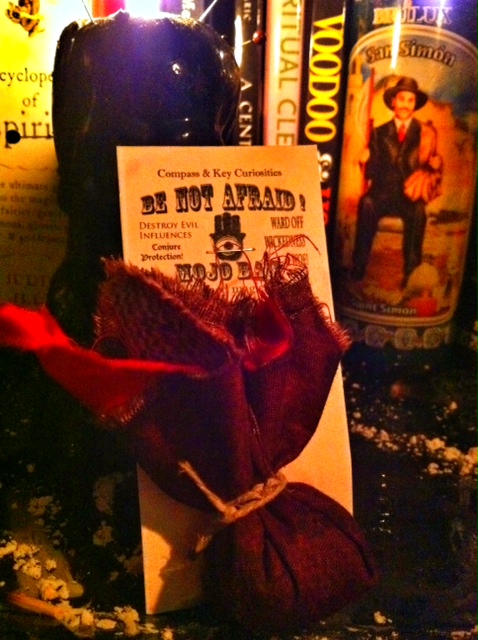
I just wanted to let you know about some things going on in our Etsy shop, Compass & Key Apothecary. We’ve got a new mojo hand and a new bundle available:

Be Not Afraid! Mojo Bag
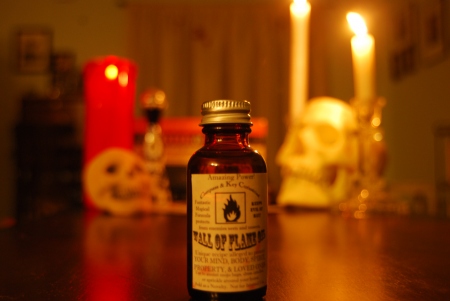
The Be Not Afraid! Mojo Bag is designed to provide spiritual protection to those who carry it on their person. The combination of herbs, roots, and other curios in this handmade mojo all have powerful protective qualities according to folklore. The rue used in this bag, for example, has been reputed by Italian magicians to fend of baneful sorcery for centuries. It is thought that carrying a bag like this can boost one’s confidence, repel enemies, and turn harmful enchantments back on their senders. Best fed with our Wall of Flame Oil or with rum in which hot peppers have been soaked.
Cost: $6.00 + Shipping

The Fearless Bundle
The Fearless Bundle includes one (1) Be Not Afraid! custom-made mojo bag and one (1) bottle of our Wall of Flame oil. Together, these constitute a powerful spiritual defense which repels harmful forces and turns wicked spells back on their senders. The oil can be used to feed the mojo bag and on its own. You can save $2 off the total cost (plus a little bit on shipping) by buying these items in this bundle
Cost: $10.00 + Shipping

All products sold as novelties only. Not intended for internal use. Please consult a health professional for medical conditions.

We’re also knocking $2.00 off of the shipping cost of any purchase made in December. I tried to set it up to do this automatically through the Etsy site, but if that doesn’t work I will refund the $2.00 to you after your purchase, so either way you’ll definitely get a discount on shipping.  If you’ve never ordered from our shop, you should know that every order winds up with some extra free goodies thrown in with it, which can range from little bags of herbs to handmade spells and charms to talismans and amulets.

I’ve wanted to make more products available, but it takes a good bit of time to develop each one, plus I usually like to “guinea-pig” my stuff first by sending samples of new things out to customers in the hopes of getting feedback, and that can be very time-consuming. So apologies if a product you want isn’t on the Etsy site yet, but maybe it will be soon. You can always email us and request something and we usually are willing to accommodate.

Speaking of emailing us, I’m also looking to start offering some card readings to folks. At first, I’ll only be doing it by email due to time constraints, but I may branch out into Skype if there’s enough interest. The cost? How about pay-what-you-can? For right now, I’m doing this on a donations-only basis, so as long as you’re willing to donate something to the site (using the PayPal button located in our main page side bar, or you can do it here, too), I’ll read for you. Ideally, I’d love to get at least $5.00 for it, but hey, a buck’s a buck, and if all you can afford is $1.00, that’ll do.

Here’s how the card-reading works:

1)      You email me your question (subject: “Card Reading”) and make your donation (in whichever order you prefer—please make sure to include your real name and astrological sign so I can get a lock on reading for you).
2)      I will do a two-card split reading and an extended five-card reading, recording the cards drawn.
3)      I will write an approximately 1-page report for you on the reading and send it back to you.
4)      You can ask one follow-up question as well, which I will pull 1-3 cards for. I’ll send you an email response with those cards and a summary of their meaning.

I’m using my own system of cartomancy with regular playing cards inherited from my mother, so don’t be surprised if the cards and their meanings are a little different than what you’re used to.

So why all this commercial activity? No, it’s not because of the holidays. Rather, I’m trying to raise money to fund the next year of the site and podcast’s hosting service and there are some magical courses and books that I’m looking at as well. The more I know, the more I can add to the site and show, so it’s a win-win for all of us, right? Plus (and this is a big reason), I’m trying to do a lot more practical work with folk magic, and making new things while offering card readings seems like a good way to do that. So if you enjoy the show or site and want to help contribute to it, please check out our Etsy shop and/or get a card reading!

Okay, thanks everyone for all your support! We really appreciate all you do for us, and hope you’re having a great holiday season!

All the best,

-Cory

Blog Post 145 – Wart Charming

The image of the fairy-tale witch often comes complete with a big, nasty wart perched at the end of her nose. The association of witches with warts could come from a variety of folk beliefs and superstitions: the close ties between warty toads and witches, the idea of a ‘devil’s mark’ which the witch uses to suckle her familiar, or even just a desire to make a something ugly out of something ‘evil.’ The association is not always a purely negative one, however. Folk magicians in the New World (as well as those in the old, though I’ll not be addressing them here) have a long-standing history of curing warts through magical means. In fact, that is frequently one of the most commonly found magical services provided by a community magician (or faith-healer, traiteur, pow-wow, etc.).

Today I thought it would be good to look at a few different methods, stories, and charms associated with wart-removal in American folk magic. I’d like to start in Pennsyvlania-Dutch country, with some of the wart charms found in Chris Bilardi’s The Red Church:

WARTS, CORNS (GEWECKS, GEWEX, WARZ)

[Do whole body Brauche treatment to eliminate any root causes of warts. Bilardi then gives an extensive treatment involving the mimicking of cutting the wart off using an imaginary knife, a process I will refrain from detailing here as it is somewhat lengthy and I’d rather encourage you to buy his book by leaving a little mystery to it…]

To remove warts using the moon: instruct the patient to go somewhere s/he can observe the moon. This is one of the very few wart charms that utilize the waxing moon. Once the moon in in sight, the afflicted wil say:

‘Was ich raib, nem ab; was ich sen, nem tsu.’
English, ‘What I rub, decrease; what I see, increase.’

The Brauche is done three nights in a row. This is begun two nights prior to the moon being full (251).

In the braucherei tradition, then, there is a sense that warts have a spiritual side, hence the full-body treatment before the specific attempt to cure the wart and the influence of lunar cycles on wart growth or removal. Yet they are also a practical matter, dealt with by simple folk magic and a relatively unassuming charm. Other methods listed in The Red Church:

  • Rubbing warts with cloths that have touched a dead body
  • Scratching a wart with a coffin nail
  • Rubbing the wart with a freshly killed eel or rooster, then burying the body part under the eaves of one’s house
  • Rubbing the wart with pebbles which are then thrown into a grave
  • Using a red string with as many knots as there are warts, rubbing each wart with a knot, then burying the string under the house’s eaves (252-3):

Moving down into the Appalachians, there are a number of variant methods for dealing with warts that parallel—if they don’t exactly duplicate—the methods described by Bilardi. In the hills of West Vriginia, we find these wart cures from Patrick W. Gainer’s Witches, Ghosts, & Signs:

  • To cure warts, wash your hands in stump water.
  • A ninth son can remove warts.
  • Drop dirt from a newly-made grave on a wart and the wart will disappear.
  • To cure warts, pick them with a pin and bury the pin.
  • To cure warts, take a hair from the tail of a gray horse and wind the hair around the warts.
  • To cure warts, steal a dishrag and rub it on the warts, then bury the dishrag. When it rots, the wart will disappear.
  • To cure warts, cut as many notches in a stick as there are warts, throw the stick in a swamp, then bury the dishrag.
  • To cure warts, rub a rock ovr the warts, wrap it in a neat package and throw it away. Whoever finds the package will get the warts.

Already we can see some patterns developing in wart cures. There are essentially three methods which appear over and over again: 1) Rubbing the wart with something and burying it to decay the wart, 2) Scratching or pricking the wart and disposing of either the scratching implement or something marked with blood from the wart, and 3) Passing the warts to someone else in a variant of magical commerce. There are exceptions or variations in each of these, of course. The corpse-touching method might be seen as a way of passing the wart to the corpse, but it may also be seen as symbolically burying it. The stump water method doesn’t fit neatly into any of these categories. And the notion of a ninth son removing warts is strange, as it does not indicate exactly how they are able to do this (I mentioned in the post on Coins that my brother-in-law’s grandfather could charm warts using pennies because he was the seventh son of a seventh son, but that may be more specific to our region).  From these three methods, most other treatments become variants, though exceptions do still occur.

Exchanging the Appalachians for the Ozarks, we find more variants of this type, and a few new tricks. From Vance Randolph’s Ozark Magic & Folklore:

  • He mentions the notched stick method referenced above, but also adds “bury the stick on the north side of the cabin and never mention it to a living soul”
  • Suggests using an onion for a wart cure: cut the onion in half, rub the wart with one half and bury it, then eat the other half. When the onion rots, the wart disappears.
  • Spitting on a hot stovelid, once for each wart, gets rid of them
  • Letting a grasshopper or katydid bite a wart will make it go away
  • Touching a wart with the hand of a corpse will remove them

Here again we have the burial method, the pricking/bleeding method (with the grasshoppers), and the transference method (with the corpse). But we also have the novel stove-top method, which is interesting to me because of the mixture of sympathetic and contagious magic it contains: the spittle on the hot stove looks like a wart sizzling away into nothingness (sympathetic) and it is the spit of the person with the wart which is evaporated (a sort of inverted contagious magic).  Randolph also includes an interesting charm associated with the corpse method:

At the funeral of a close friend, a ‘warty feller’ is supposed to touch his warts and repeat the following jingle:

They are ringing the funeral bell,
What I now grasp will soon be well,
What ill I have do take away
Like jn the grave does lay.

This is believed to benefit tumors, sores, boils, and even cancers as well as warts. (131)

In my Apples post, I cited some Kentucky lore about using that fruit to do the rubbing-and-burial method. A reader mentioned that they had heard something similar to that technique, only using potatoes (which I’ve also heard as well, especially in relation to Irish folk magic or some Appalachian charms). The book I cited, Kentucky Superstitions, mentions the potato method, and also has these interesting variants on wart charming:

  • There are a number of ‘burying’ charms, involving the interment of things like beans, steak, bacon, peach tree leaves, potatoes, walnuts, etc.
  • ‘Picking’ cures are also popular, in which a wart is bled by puncturing it with a brass pin, corn kernels, needles, etc.
  • A variety of substances, including cat’s blood, coffee grounds, dandelion juice, eggs, fish, goose feathers, chicken gizzards, etc. are also rubbed on warts to remove them
  • One of the most popular and common cures involves bleeding the wart, dabbing the blood on corn kernels, then feeding those to chickens—especially a neighbor’s hens—to remove the offending blemish
  • Lemon juice or milkweed are supposed to be good cures for warts
  • Warts can be charmed off by some people with a gift for doing so; some are able to ‘count’ warts off, others can pray them off, and still others ‘buy’ the warts off of someone
  • Warts can be magically passed to another person by leaving them at a crossroads; simply leave a paper spotted with blood from the wart in the middle of the crossing, and walk away without looking back; whoever picks up the paper picks up the warts
  • The stick-notch method or knotted cord method are two popular remedies for warts in which the number of warts is counted by notching a stick or tying a cord, then the burying it or dropping it into running water (121-30)

The corn method is something I found in several places, including Harry M. Hyatt’s Folklore of Adams County. In many cases, the corn must be fed to a neighbor’s chicken, which makes me think it is another technique for passing the warts to someone else, just in a very roundabout way. Hyatt also mentions many of these cures in his books, and offers an interesting addition to the bark-notch method of curing: “I know this works, for my daughter had a wart. She tried several things, and this took her wart away: walk up to a young apple tree — if you have a wart — walk around to the opposite side and cut two notches in the bark, then rub your wart over the two notches, then walk back the same way you came; when the bark grows over the cut places, your wart will be gone” (146).

As always, there’s much more to say on the subject of charming warts, but hopefully this gives a nice broad look at the subject. I need to be very clear, of course, that none of the charms, lore, techniques, or superstitions here are presented as medical advice—a good doctor can freeze a wart off without making you go through the trouble of finding an eel to kill or figuring out which of your neighbors might have some hungry chickens around. But for those interested, wart charming seems to be a simple way to get into traditional folk magic, and who knows, you might just have a knack for it. At the very least, hopefully the warts on that old witch’s nose in the storybook won’t seem so scary anymore.

Thanks for reading!

-Cory
Blog Post 144 – Walnuts

“As soft as silk,
As white as milk,
As bitter as gall,
A strong wall,
And a green coat covers me all”
Walnut riddle from H.M. Hyatt, Adams Co., Entry No. 14379

Continuing with the Thanksgiving ingredient theme (i.e. Apples), I thought today it would be good to look at a fairly common tree and nut that has been woven into magic for hundreds of years. I’m speaking of course of the unassuming but delicious walnut which tops brownies, finds its way into salads, and makes a delicious candied treat. Don’t worry, though, my next topic will not be mayonnaise and I am not subtly leading up to any kind of enchanted Waldorf salad.

I’d like to briefly start in the Old World and mention a legend which had some influence on 19th-century occult folklorist Charles Leland. In “Neopolitan Witchcraft” by J.B. Andrews and James Frazer, a rhyme appears which translates roughly:

Beneath the water and beneath the wind,
Beneath the walnut trees of Benevento,
Lucibello bring me where I need to go.

This charm would help a witch magically fly to her Sabbat, supposedly. The idea of witches gathering beneath a walnut tree in Benevento, Italy clearly impacted Leland, who includes a tale in his “witch gospel” Aradia called “The House of the Wind” (which is what Benevento means in English). [EDIT: See comments below for a correction on this translation] Myth Woodling, who runs a marvelous set of pages on Italian folk magic and witchcraft, has this to say about the walnut:

Walnut shells, in Italian fairy tales, were often used to contain something precious or magical. A walnut branch was said to protect one from lightening. There were stories of witches and spirits gathering under walnut trees”

In the New World, walnuts gained a number of powers and attributes, while the lore about walnuts and lightning becomes reversed, as found in Vance Randolph’s Ozark Magic & Folklore, where he tells how black walnuts are now thought to draw lightning and hillfolk refuse to plant these trees near their homes for that reason (72). Some of Randolph’s other interesting tidbits about walnuts are here:

  • “A big crop of walnuts indicates cold weather to come” (26)
  • A good season for tomatoes is a bad season for walnuts (39)
  • Fresh walnut leaves scattered about the house can deter insects (68)
  • Walnut shells must not be burned, or bad luck will come (71)
  • The juice of a green walnut can help cure ringworm (110)
  • “The shell of a black walnut is supposed to represent the human skull, and the meat is said to resemble  the brain, therefore people who show signs of mental aberration are encouraged to eat walnuts. I know of one case in which an entire family devoted most of the winter to cracking walnuts for a feebleminded boy. They kept it up for years, and I believe the poor fellow ate literally bushels of walnut goodies” (114)
  • “A mountain girl of my acquaintance placed a lock of her hair under a stone in a running stream,  believing that the water would make her hair glossy and attractive. Another way to promote the growth of hair is to bury a “twist” of it under the roots of a white walnut tree, in the light of the moon” (165)

Similar lore exists in the Bluegrass State of Kentucky, with the addition of magical wart charming ascribed to the humble walnut. Daniel & Lucy Thomas, in their Kentucky Superstitions, say that green walnuts can be rubbed on warts, then buried to charm the wart away. This makes for an interesting variant on the standard wart-charming method of cutting a fruit or vegetable in half before using it to cure the wart (but I’ll address those ideas in a different post entirely). Heading into Illinois, Henry Hyatt reports a mix of magical and medical uses for walnuts:

  • Thin walnut shells mean a light winter, while thick shells mean a heavy one
  • A black walnut carried at all times prevents headaches
  • A mixture of boiled walnut leaves, water, and sulphur makes a powerful anti-itch wash
  • Dreaming of opening or eating walnuts means money is coming soon

In this latter example, we can see the walnut being used as a divinatory aid, which makes sense when we think of the strong ‘brain’ association with the little wrinkled nut (since it has a brain, it must know something, so why not the future, right?). Hyatt also shares a lovely little love divination with walnuts:

9033. Her future husband’s occupation can be learned by a girl who grates three nuts — a hazelnut, nutmeg and walnut — mixes these grated nuts with butter and sugar, makes pills of this paste, and swallows nine of them on going to bed: if she dreams of wealth, she will marry a gentleman; of white linen, a clergyman; of darkness, a lawyer; of noises, a tradesman or laborer; of thunder and lightning, a soldier or sailor; and of rain, a servant

This sense of a walnut as a ‘knowing’ curio seems to be tied again to its brain-like appearance, but also with the idea of the little nut containing some special knowledge the way it contained magical charms in an Old World context. The tree even seems to know what is growing around it in some cases. Patrick Gainer says that the presence of a white walnut tree indicates ginseng growing underneath it (120).

Another key use of the walnut in magic has to do—or at least I think it does—with its bitterness and perhaps the deep blackness of the flesh surrounding the nut. Walnuts can strip away negativity nearly as well as eggs, lemons, salt, or any of the other major magical cleansing agents. Draja Mickaharic includes a cleansing bath which uses walnuts in order to sever ties with an unwanted person or influence. He warns that it can only be used once, and that going back to the person after ties are severed will have dire results. The basic formula involves boiling six unshelled walnuts in a pot for three hours, adding water if needed. After that time, there will be a black broth that should be added to a bathtub, and the person using the bath should immerse themselves seven times in it, saying prayers as appropriate (Spiritual Cleansing 58).The dark color absorbs all negativity, and the galling nature of the fruit works the way a lemon does to sever evil from one’s person. Cat Yronwode suggests a similar bath to Mickaharic, adding the important step of disposing of the used bathwater at a crossroads. She also indicates that walnut leaves can be used in a spell to hurt an enemy’s luck (Hoodoo Herb & Root Magic 205).

One use for a walnut I’ve never seen but which I really think would be interesting to try would be as a head for a doll baby working. Considering the brain associations and the fleshiness of the fruit, I’m not sure why this is not a common-place use of the walnut, but c’est la vie. If you happen to know why they’re not used in doll magic, I’d love to hear it! Or if you have any other uses of walnuts in New World folk magic, please feel free to share!

Thanks for reading!

-Cory

Reminder – Speak-a-Spell Contest Ending Tonight!

Hi everyone,

This is just a friendly reminder that the deadline to enter our Speak-a-Spell Contest is midnight tonight! If you’ve been thinking about submitting but haven’t done so yet, there’s no time like the present. We’ll be compiling all the recordings into a sort of ‘audio spellbook’ when we’re done, so keep that in mind when submitting.

A quick summary of the rules:

  • Share a favorite spell that you’ve used and which works for you
  • Files <5 minutes in length, in .mp3, .m4a, AAC, or .wav format
  • Tell us who you are and where you’re from, generally
  • Please tell us all spell components and describe actions carefully
  • Send us your file at compassandkey@gmail.com , subject line: “Audio Spell Contest”
  • Deadline November 18th, 2011 (THAT’S TONIGHT!)

If there’s absolutely no way for you to record your spell in your own voice, you can submit it as a written spell, and Laine and/or I will read it for the show in your stead.

The prizes up for grabs are three books by New World Witchery guests:

Prizes and winners will be picked at random, but any of these books would be a great addition to a magical library.

If you’ve already submitted and want to do another entry, feel free! Every submission gets you an entry into the contest.

Thanks to all those who’ve sent in spells and to those who have been spreading the word! This should be a pretty neat project when it’s all done.
Best wishes!

-Cory

Blog Post 143 – Apples

Inside a red barn,
A white star…
-Part of a riddle, the solution to which is “an apple”

Do you remember that moment in Snow White & the Seven Dwarves when the evil Queen is using all manner of occult ephemera to poison a single apple which she will use to kill Snow White? What about all those baroque and medieval paintings of the Garden of Eden showing a dispassionate Eve holding a bitten apple in one hand? Or the Greek myth of the golden apple given to Prince Paris of Troy that he might award it to the fairest of the goddesses (thus sparking the Trojan War).

Apples appear throughout folklore and myth as symbols of magical power, sacred knowledge, and intoxicating sweetness. American lore has its own apple-toting legend in the form of John Chapman, a.k.a. Johnny Appleseed, who crossed the upper Midwest planting apple orchards as he went (Michael Pollan’s excellent book The Botany of Desire explores how Chapman—a mystical Christian practicing a philosophy called Swedenborgianism—actually planted orchards not for eating apples, but for making hard cider, thus linking him to the magical practice of brewing as well).  Today I thought I’d look at some of the magical manifestations of this ubiquitous fruit. After all, it is as American as, well, apple pie.

I’d like to start with some of the apple lore and superstitions found in Vance Randolph’s Ozark Magic & Folklore, primarily because I love one of the first tidbits I found:

  • “A bad woman can’t make good applesauce” (65)

I have no idea about the veracity, implications, or thought processes behind this statement, but it was just too wonderful to pass up. So if you can’t make good applesauce, you should clearly consider it a moral failing of some kind. Randolph also lists a number of other bits of common apple lore:

  • A goiter can be removed or reduced by rubbing it with half an apple, burying it in the cemetery, then eating the other half (148)
  • Two apple seeds, named for a boy and a girl, dropped onto a hot shovel can predict love. If they move closer together, they will marry; if they part, the love will not last (184)

I’ve covered a bit of the love magic involving apples in another post and podcast episode, but this latter method is one I’d not seen before, and has a very ‘country’ feel to it. Listener and fellow folk-magic blogger Claire shared that instead of peeling the apple in one strip, she and her childhood playmates would twist the stem, saying a letter with each twist, until the thing came loose revealing the initial of one’s future beau.

Many of Randolph’s recorded superstitions can be found in other places as well, such as these wonderful examples from Kentucky folklore:

  • Breaking an apple in two means luck in love (especially if you “name” the apple for someone special)
  • An apple peel removed in a single strip then tossed over the shoulder will land in the shape of a lover’s initial
  • Apple seeds can be counted like flower petals in the “loves me, loves me not” style
  • Apple seeds are used to tell which direction a lover will come from by spitting them in the air, or can be used to divine how long it will take before one sees a sweetheart again by slapping a handful against one’s forehead—the number that stick are the days until the lover arrives.
  • Naming apples on Halloween and then bobbing or playing ‘snap-apple’ for them predicts a future mate
  • Finding twinned apples (or any fruit really) on a tree means a marriage soon
  • Warts can be cured with apples, either by burying an apple and saying ‘As this apple decays, so let my wart go away,” or by scarring an apple tree’s bark—when the bark grows over, the wart will disappear
  • Apples gathered in moonlight will not bruise or rot
  • “If you can break an apple with your hands, you will always be your own boss”

(from Kentucky Superstitions, by Daniel & Lucy Thomas)

Vance Randolph also references the wart-removal charm which involves cutting notches in an apple tree, although in this case it’s a stranger’s apple tree and done in secret, as ‘stolen’ things have tremendous magical curing power (130).

Henry Middleton Hyatt also has several pieces of folklore about apples, some of which contradict the Kentucky beliefs above:

  • Apples which fall in moonlight get ‘soft-rot,’ while apples falling during a dark moon get ‘dry-rot’
  • If you want your next calf to be a female, bury the placenta from the most recent calf birth under an apple tree
  • Girls eat the first apple of June and count the seeds to see how many children they will have
  • Eating ‘twinned’ apples is said to cause twin births
  • Rubbing a piece of apple over a newborn’s tongue ensures that they will have a beautiful singing voice
  • Apple peels, especially those in June, can be rubbed on the face to improve complexion
  • Eating an apple on an empty stomach on Easter ensures good health
  • Menstrual flow can be regulated by boiling the inner bark (or cambium) of an apple tree
  • If you always burn your apple peelings you will never have cancer

Hyatt also reiterates the wart cures involving rubbing sliced apples over the wart and burying them, usually under the eaves of a house (Folklore of Adams County, 146).

In New England, apples also have a love association, as well as some rather more foreboding connotations. The excellent blog New England Folklore provides a wonderful rhyme for counting apple seeds here. The blog author, Peter M., also shares a bit of the darker lore of apples, including the strange coincidence of deaths with apples in New England lore. And what could be creepier than an apple tree eating a person?

Finally, looking towards the deep South and the folk magic of hoodoo, I found that the apple can be used for a variety of purposes. Cat Yronwode suggests using the apple as an agent in sweetening spells, especially those for love. She points out that it can be used as a receptacle for sweetening agents like honey or sugar and it provides sweetness itself in the spell (Hoodoo Herb & Root Magic, 32-3). Denise Alvarado mentions that the Voodoo lwa known as Papa Guede appears as a skeletal figure with a tophat and an apple in one hand in her Voodoo Hoodoo Spellbook. And then there’s this very interesting spell involving apples and court-case work:

Take green and yellow candles, enough to last for nine days, and with a sharp object write on them the names of the chief prosecution witness, the judge, and the district attorney, in that order. Burn the candles upside down to ‘upset the heads’ of these people. Bore a hole in each of three apples and put the name of each of the three above-mentioned persons in the apples. Set them before the candles while they burn the requisite nine days. At the end of nine days take the apples to the vicinity of the jail. Roll one from the entrance, one from the right side, and one from the left side, thereby rolling the prisoner out of jail (Haskins, Voodoo & Hoodoo, 185).

This spell is supposed to be used during an appeals process or after a new trial has been ordered. Perhaps it is tied to the sweetening effect mentioned by Yronwode as a way of urging a new judge or jury to look upon your case favorably?

In any case, the apple has certainly earned its place in American magical lore. If you know of other magical uses for the apple, feel free to post them here. And next time you’re eating an apple, do as the wicked queen suggests—make a wish, take a bite.

Thanks for reading!

-Cory

Podcast 36 – Dealing with Spirits

-SHOWNOTES FOR EPISODE 36

Summary
In this episode we’re looking at rules for magical etiquette when dealing with spirits. We take on summoning, banishing, and what to do if you just happen to run into a spirit on accident.

Play:

Download: New World Witchery – Episode 36

-Sources-
We draw upon a number of folk tales, fairy tales, legends, and myths to illustrate our points about magical etiquette, including:

We reference a few of our past shows or blog posts, like:

We also mention our rue charms given to us by Scarlet of Lakefront Pagan Voice. Check out Scarlet’s Etsy Shop for more goodies!

We’ve got a contest going on! Check out the details of our Share-A-Spell contest on our blog, and contribute today!

Don’t forget to follow us at Twitter!

Promos & Music
Title music:  “Homebound,” by Jag, from Cypress Grove Blues.  From Magnatune.
Promo 1 – Media Astra ac Terra
Promo 2 – Iron Powaqa
Promo 3 – The Infinite & the Beyond
Promo 4 – Dr. E’s Conjure Doctor shop

Episode 36 – Dealing with Spirits

New World Witchery – Episode 36
Dealing with Spirits. Magical etiquette for summoning, dismissing, and encountering spirits.
(complete shownotes at http://www.newworldwitchery.com)