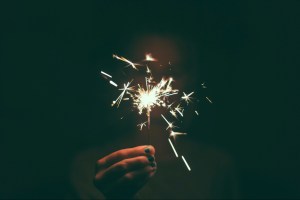
It’s hard to miss the sounds of constant explosions overhead near a number of U.S. cities during the first week of July. The Independence Day celebrations are loud, full of the sounds of wailing guitars at outdoor concerts, screams at amusement parks, and of course, the smoky shrieks and bangs of fireworks overhead. Canada Day, celebrated July 1st, is also a reason to break out the big bangs and send rockets into the sky. The substance fueling much of the fun at these celebrations is gunpowder. A volatile but useful blend of potassium nitrate (or “saltpeter”), charcoal, and sulphur, gunpowder was first developed by the Chinese in the Sung Dynasty over a thousand years ago, when rulers quickly found celebratory and military applications for the new alchemical mixture.
While incredibly dangerous in the wrong hands, gunpowder has also become a ubiquitous part of human life for better or worse, and that includes in the realms of folk magic. Today I’m sharing a few examples of the way that folk magicians in North America have found uses for gunpowder that rely upon its explosive properties to create uncanny results. A NOTE: Please do not take anything in this post as advice. Messing with gunpowder is, as already stated, DANGEROUS. Everything presented here is offered as folklore and history, and not as any sort of endorsement of the behavior described.
So how have practitioners historically put gunpowder to use? As you might have guessed, the destructive qualities of black powder have been a major part of its magical applications. According to several variations of folk spells in the regions running from the northern Appalachian Mountains down into the Gulf of Mexico delta and a bit west of the Mississippi, it has several uses. Gunpowder combined with lodestone and red pepper can be turned into a mojo that will increase business. Added to foods, it also has the power to increase potency, as one hoodoo recommendation involves feeding gunpowder to a guard dog to make him vicious (DON’T DO THIS). One Pennsylvania pow-wow remedy for treating urinary disease in horses involves mixing gunpowder with flour, gentian, and calamus and feeding it to the animal until the disease clears. Perhaps one of the most surprising applications is in the area of women’s reproductive health, where gunpowder was once believed to stimulate expulsive contractions, with results varying depending on when the woman used the remedy. Harry M. Hyatt found that gunpowder was used as an abortifacient to induce miscarriage in Adams County, Illinois, including a topical remedy that required a woman to rub her breasts with it every night until the desired outcome occurred. A belief from the mountainous area of eastern Kentucky says that a small dose of gunpowder given right before birth will help to ease the labor, as well.
Most hoodoo and Southern conjure-based magical applications incorporate the magical properties of the particular ingredients, especially the bad luck-breaking power of sulphur, as a component of the spell. Mixed with ingredients like salt and sugar, it can be turned into bathing scrubs that take off negative effects in hurry. In some cases, only the ingredients (usually sulphur but sometimes saltpeter as well) would be added to a bath, and in other accounts, gunpowder itself would be added to other components to actively destroy the harmful effects of a curse, as in this example from Hyatt’s five-volume collection of (mostly) African American magical practices [dialect left mostly intact from Hyatt’s transcriptions]:
Mah husband , he wus witchcraft heah a little before Christmas , an’ when he begin , he begin as a chills-an’ fevah. An’ course I didn’t know, you know, right then…an’ I had [the] doctor…They say he had the flu. An’ so he wusn’t whut you call real, you know, sick like a medical doctor [says], you know. The medicine he give ‘im—he give ‘im medicine an’ it didn’t seem to do him no good. So his mind led’ im that he knew it wusn’t pure sickness. So I had my fortune told an’ it…wusn’t pure natural. So they fixed ‘im—a root doctor fixed him some medicine. An’ it holp him, too; but you see, jis’ like they put [something] down for yah, all the medicine you take it won’t cure you. So I had someone to come to pick it [an object she found] up. I don’t know exac’ly wut it wus, but it was down under the—kin’a in the south part of the house an’ right in the middle, jis’ like you walk over it. An’ this filth, of course you have to step in it. An’ they [the root doctor] taken it up, an’ after takin’ it up, you know, they kill it. They kill it with salt. An’ then I had to—after takin’ it up they put salt on it, wash it off, an’ put it in a paper an’ let it dry. Then I had to take it an’ put lye, an’ sulphur, red pepper, an’ gunpowder, put it in a quart up an’ put a quart of water in it an’ boil it [every] bit of the water out it, right dry, an’ then take an’ [carry] it to a runn’ water an’, you know, put it in. That’s called, that’s turnin’ back on the one that did it.
One of the best (and most explosive applications) involves mixing gunpowder and other ingredients with an enemy’s footprint, then lighting the mixture on fire and watching it explode. This supposedly causes them to leave town in a hurry (possibly due to the strange explosions they keep hearing). Because it contains sulphur, variations on the hexing compound known as “Goopher Dust” can also have gunpowder mixed in. Mixed with other repelling herbs like asafetida the gunpowder could be worn in shoes or carried in a pouch around a person’s neck to ward off harm. Jason Miller’s Protection and Reversal Magick mentions a “jinx-breaker” mojo bag a person can carry which has sulpher and saltpeter (and thus everything but the charcoal in gunpowder) as well as lemongrass. Miller doesn’t specifically mention using gunpowder, but it is likely that some extant variations of the hand would use it as a necessary substitution.

Of course, gunpowder’s application in celebrations can also have a magical or spiritual significance. Spinning fire-wheels powered by gunpowder fireworks are often used in ceremonies honoring the dead or unseen spirits. The Urglaawe Heathen tradition uses such a “Catherine Wheel” in its Sunneraad (Yuletide) celebrations, and similar wheels can be found in Mexican Dia de los Muertos festivities. Similarly, many Appalachian people would celebrate the arrival of the New Year by “shooting in” the day with live ammunition fired into the air, which was also thought to induce good luck or scare away bad luck. Shooting in also happened in cities, where it could pose a significant safety threat, and often those not directly participating would sequester themselves indoors to avoid the “Calithumpian” revelries which also included costumes, masks, and a lot of heavy drinking. In some Vodoun rituals, celebrants may make the veve designs of a particular loa out of gunpowder, especially if that loa is “hot” in nature, such as the Petro spirits. In other cases, gunpowder may be specifically avoided to prevent inciting spirits to become destructive or to avoid any potential spiritual insults.
Gunpower was also sometimes employed to spark a sudden or rapid change in less personal conditions as well, for example in weather magic. In American Folklore: An Encyclopedia, the author notes that out in the frequently dry prairie areas of North America such as Nebraska and Kansas, “professional ‘rainmakers’ sought to earn their pay by firing explosions from balloons, building large, smoky fires, or setting off gunpowder explosions from high peaks” during the nineteenth and early twentieth centuries.
In most cases, the essential magical nature of gunpowder is driven by one of two factors: its ability to explode on ignition or its ingredients’ magical properties. Many applications, such as the jinx-breaking in the hoodoo examples, rely on a mixture of both aspects: a symbolic rapid change and the physical presence or properties of the sulphur and saltpeter (the charcoal seldom gets a mention, but its “neutralizing” nature seems to be a good fit, too). The abortifacient uses of gunpowder also could be an extension of these characteristics. One of the most interesting things about gunpowder is its relative predicatibility for an explosive substance (as opposed to say, nitroglycerin, which can be incredibly volatile). Gunpowder is even used to create artworks in seriously cool ways because it can be controlled. At the same time, this substance continues to be dangerous, causing more than a few lost digits or limbs every year during July celebrations and fueling firearms that can do immense damage to life and property. In some ways, gunpowder is almost a perfect metaphor for folk magic more generally—deployed with intention and thought, it can do wonderful things, but carelessly handled it can cause irreparable harm.
So as the fireworks are booming overhead during this first week of July in North America, I hope you will look up at the bright and beautiful patterns and think about some of the magic in them that goes beyond the visual awe and glamor. Although, if you prefer to “ooh” and “aah” at them instead, I can hardly blame you.
Thanks for reading!
-Cory
References and Further Reading
- Brunvand, Jan, ed. American Folklore: An Encyclopedia. New York: Garland Press, 1996.
- Davis, Susan G. Parades and Power: Street Theatre in Nineteenth Century Pennsylvania. Philadelphia: Temple Univ. Press, 1986.
- Corbett, Bob. “Eshin-Fun Answers: African Religion Syncretism.” Webster University Website (http://faculty.webster.edu/corbetre/haiti/voodoo/syncretism.htm).
- Hohman, John George, and Daniel Harms, ed. The Long-Lost Friend: A 19th-Century American Grimoire, Llewellyn, 2012.
- Hyatt, Harry M. The Folklore of Adams County, Illinois. New York: Alma Egan Hyatt Foundation, 1935.
- —. Hoodoo, Conjuration, Witchcraft, Rootwork (5 Vols.). New York: Alma Egan Hyatt Foundation, 1970.
- Miller, Jason. Protection and Reversal Magick. Franklin Lakes, NJ: New Page Books, 2006.
- Milnes, Gerald C. Signs, Cures, & Witchery. Knoxville, Univ. of Tennessee Press, 2007.
- Randolph, Vance. Ozark Magic and Folklore. Dover Publications, 1964.
- Schreiwer, Robert L. “Yuletide Sunneraad 2017.” Urglaawe: Deitsch-Pennsylvania German Heathenry Website. (http://urglaawe.blogspot.com/2017/12/yuletide-sunneraad-2017.html).
- Thomas, Daniel, and Lindsey Thomas. Kentucky Superstitions. Charleston, SC: Nabu Press, 2012 (reprint).
- yronwode, catherine. Hoodoo Herb and Root Magic. Forestville, CA: Lucky Mojo Curio Co., 2002.

 New World Witchery - The Search for American Traditional Witchcraft