Blog Post 117 – Favorite Non-magical New Media

Hi everyone!

Today’s post is actually not much concerned with witchcraft or magic, so if you usually read for those reasons, you might want to skip it.  Instead, I thought I’d share a few of the things I’m listening to or reading when I’m not focused on purely magical pursuits.  It’s no secret I have a deep love for folklore and Americana, but I’m also deeply interested in science and history as well.  I think they’re very important because they are two of the best references for understanding the world and our place in it we have available.  They are balanced by folklore and magic, I think, and so I tend to get very into them.  So here are some of my top new media (i.e. blog and podcast) sites:

History

The History of Rome – Podcast – Mike Duncan’s magnificent podcast has been going on for well over two years now, and shows no signs of slowing down.  Each episode, which can range from 15 to 35 minutes long, covers a segment of Roman history, from the mythical origins to the military victories to the day-to-day life Romans endured or enjoyed depending on their station.  I’ve learned so much from this show.  Of particular interest to those who read this blog might be episodes 86, 87, and 88, which touch on the daily life of Romans, including their religious doings.  I cannot recommend it highly enough.
12 Byzantine Rulers – Podcast – This series from Lars Brownworth, a noted historian and also the voice behind the Norman Centuries podcast, is a wonderful overview of the Byzantine Empire.  Brownworth covers the rise and fall of one of the most interesting and oft-misunderstood empires in history with depth and narrative enthusiasm.  If all history were this interesting, we’d have a lot more historians around.  I also recommend his excellent book on Byzantium, Lost to the West.
Appalachian History – Podcast & Blog – This is a wonderful site and show which has the feel of an audio newsletter, complete with short tales, historical notes, and anecdotes about life in Appalachia, particularly during the Depression.  The production is quite nice, with little filmstrip-soundtrack bells between each segment, and a brief overview of the topics covered in audio abstract format at the top of the episode.  The site is updated more frequently than the podcast, but both are well worthwhile, and even occasionally touch on magical topics, as in the post on the Blood Verse.
The Blind Pig & the Acorn – Blog – This is a lovely and well done blog which looks at not only historical Appalachia, but modern-day mountain life, too.  There are a number of topics covered, from gardening and self-sufficiency to medicine to music to storytelling.  There’s even a wonderful series of posts about planting by the signs, which might be of interest to folks here.
Backstory with the American History Guys – Podcast – This NPR-produced show features three professors of history with different specialties (18th, 19th, and 20th centuries) tracing the course of particular topics throughout American history.  Topics have included a history of courtship and romance, a history of ghosts and the supernatural, and even a history of climate control and air conditioning!  The rapport between the hosts is stellar, and the information is always fascinating.  If you have any interest in American history, give them a listen.

Science

RadioLab – Podcast – This deeply fascinating WNYC/NPR show features two hosts with a lot of good questions tackling some very big topics in science.  For instance, shows cover topics like dreams and Sleep, conceptions of the Afterlife, the nature of Words and language, finding Limits of human performance, the wonderful world of Parasites, and Stochasticity (I’ll let you look that one up).  Jad and Robert make the universe seem like a playground, albeit a big, terrifying one sometimes, and their probing show really unearths a lot of new questions for the curious listener.  The production values are phenomenal, too!  Plus they often have great music (this is where I discovered the amazing cellist Zoe Keating, and They Might Be Giants are apparently fans of the show, too).
Earth & Sky – Podcast & Blog – This is a wonderful short series on the many different aspects of physical science that influence our daily lives.  They cover everything from asteroids and space dust to the shifting coastlines of major continents to the influence of rare earth elements on our economy.  You can subscribe to particular feeds following particular topics, or get your fill of the whole shebang if you prefer.
The Naked Scientists – Podcast – This show, which also features offshoot programs on Africa, Archaeology, Engineering, etc. is loaded with lots of short, fun, interesting segments.  It primarily deals with the basic processes of science and how they relate to understanding our world today, but there are occasional segments related to historical science as well which are quite fascinating.  They feature guests, field reports, and lecture-style deliveries on a wide range of topics, which should certainly whet the appetite of any eager science aficionados.
Nature – Podcast – A group of scientists connected with the journal of the same name host this very informative show which doesn’t focus on current events in science, but rather spends a lot of time looking at the natural world and trying to understand it.  It gets some criticism because it is definitely aimed at scientists, but usually it’s not that hard to follow and the more difficult stuff just makes me more curious.  Give it a listen if you have an interest in natural science!
Borealis Meditation – Podcast – Okay, okay, this IS a pagan podcast from one of our own, Kathleen.  But let me be frank here in saying I get a huge education in earth science every time I tune into the show, and actually find myself listening more for that angle than any other.  Great science, great host, very enjoyable show!

Folklore

The Moonlit Road – Podcast – A delightful podcast which tackles individual tales from American folklore in every episode.  Master storytellers recount these famous stories, like “Taily-po” and “The Blue Girl.”  It has relatively high production values, and always makes me happy when I see a new episode available (though I could do without the cricket noises on the webpage).  A great listen!
To the Best of Our Knowledge – Podcast – This one is not strictly folklore, but also covers things like science, sociology, literature, etc.  However, I’ll be honest, I don’t always listen to the episodes on topics I’m not interested in, so I primarily hear the information on literature and folklore.  Some of the great episodes in that vein have been the episodes on Magic and Fairy Tales.
Librivox – Audio Archive – I’m a huge fan of this project, which aims to take all public domain literature and provide volunteer-created audio recordings of it to everyone.  I’m working on getting a few tales together myself for this site, and I love listening to all sorts of folklore, including the Grimm’s Fairy Tales and the Arabian Nights.  As it is volunteer-based, the quality of the audio varies a bit, but overall it seems to be audible and there are a variety of voices to experience, which is very nice in my opinion.
Hometown Tales – Podcast – This show really focuses on listener-submitted lore, and as such, doesn’t get a whole lot of scholarly points.  However, as far as fun and interest go, this podcast is really solid.  The hosts have a good chemistry together, and the stories are presented with a little bit of humor and a sense of combined belief/unbelief that makes each topic more intriguing.  If nothing else, it usually sends me scrambling for a pen so I can look up some of the lore they present and find out more about it, which is always a good thing.
The Moth – Podcast – Another show from NPR which isn’t so much about folklore as it is about storytelling.  As such, I can’t really say it’s folklore in the way I usually mean it, but it still fits as storytelling is a major folk art and one I particularly love.  And the stories are often very fun, funny, or poignant, with occasional forays into the magical.  It’s a grab bag, really, but I think it’s worth listening to.

Religion

Speaking of Faith – Podcast – Host Krista Tippett discusses religion with some of the most fascinating religious figures out there.  If you’re into comparative religion, I highly recommend this show.  Some highlights have included episodes on ethical eating, a discussion on Ojibwe language and story, and a wonderful show about Haitian Vodou.
The SaintCast – Podcast – Dr. Paul Camerata does a marvelous job exploring the Catholic faith through the lives of the saints.  While he would probably not be thrilled to see his show linked from this particular site, I personally love his show, which features “Saint Jeopardy!” and a weekly saints calendar.  You get historical information as well as the lore surrounding the saint, often from primary sources, and it’s a lot of fun to listen to, if you happen to like saints.

I listen to a lot of podcasts, if you can’t tell, but I also have a heck of a commute to work every day.   And I’m not even including things like my foreign-language podcasts which I use to help improve my Spanish and German vocabulary!  I don’t know if this post will turn anyone on to some new listening material, but if it does, that’s great!  Of course, I’m really hoping none of these shows will replace New World Witchery on your mp3 player…but that would be impossible, right?  Right?

Thanks for reading!

-Cory

Blog Post 107 – More Winter Lore

Greetings everyone!

I’m putting the rest of my series on Magic Books in the American Colonies on hold, temporarily.  Partly this is because I’ve decided to get working on the Resources page I have been planning to do for a while, which means that even if the posts themselves are weeks or months apart, they will be easy to read in succession because of their indexing on that page.  But mostly it’s because I’m in a holiday mood, and that means I really want to write about winter lore.

Let me start by sharing some of the links and information I missed in our show notes from the contest entries our listeners submitted.  For example, Kathleen of Borealis Meditation sent me a lovely batch of pictures featuring the fireweed (Epilobium angustifolium) from her lore submission:

In case you haven’t heard the related yuletide tale on the show, the folk wisdom goes that these shrubs, which grow after a wildfire has spread through a landscape, bloom from the bottom up.  They also go to seed from the bottom up, turning into “fluff” as they go.  When the fluff hits the top of the stalks, the first snow will fall, so the story says.

I also failed to put a link to listener and blogger Nathalie’s “24 Posts to Christmas.”  If you remember, Nathalie shared the lore about the Kuppelchen, a type of house-spirit responsible for taking care of a household and which often appears in families where magical folk are present.  In addition to this great bit of lore, Nathalie gives lots of holiday tidbits, tales, and recipes, including one for Grog—a very warming and bracing adult beverage for those cold winter days.  She also talks about things like Christmas Markets, St. Nicholas, and lead casting (which we also mentioned on the show, I think).

December is full of magical holidays, not just the mid-to-late month festivities that everyone knows about.  I’d like to throw two Catholic holidays out there (don’t worry, there won’t be any dogma, just a few of the more magical traditions associated with them).

First, there’s St. Nicholas’s Day, which is December 6th.   The night beforehand, children leave out their shoes near the door or fireplace, and in the morning, find them full of toys, candy, nuts, and fruit.  This custom, which seems to be Northern European in origin, is one I grew up with in my house.  St. Nicholas is also usually accompanied by a darker traveling companion, too, such as Ruprecht, Belsnickel, or Krampus.  This “anti-Santa” leaves punishments for naughty children, but can also be fairly benign and simply serve to balance out the whole “jolly old elf” side of the season.  I remember seeing lots of people dressed as either an angel or a devil on St. Nicholas’s Day while living in Prague, so the tradition of masking also ties into this holiday.  There is also an Appalachian tradition called “Belsnicking” which involves making masked visits to one’s neighbors during the holiday season (you can find a lot about that in Gerald Milne’s Signs, Cures, & Witchery).

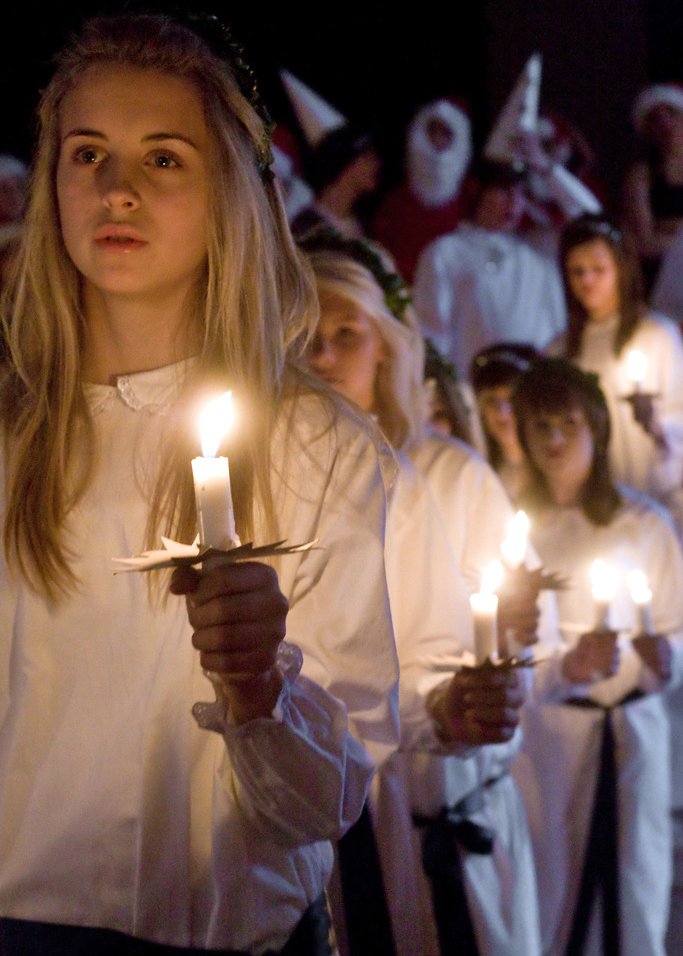
One thing I really wanted to mention, but for some reason didn’t, was St. Lucy (or Santa Lucia).  Lucy (whose name is deeply connected to the Latin “luce” or “light”) was a saint who tore out her own eyes as a demonstration of fidelity to her faith.  It’s a pretty gruesome thought, and much Christian art depicts this saint as carrying her own eyes on a silver platter.  Not exactly the type of story we think of while baking gingerbread men, right?  But St. Lucy’s Day, which falls on December 13th, is incredibly popular in Scandinavian countries.  Rather than focusing on the awful self-blinding, instead little girls wear crowns of candles and evergreens on their heads as they perform holiday parades dressed in all white gowns.  The girls then hand out sweets like gingerbread (pepparkakor) and chocolate to the people they pass, all the while, singing carols.  There’s a special type of pastry, the St. Lucia Bun, which is also made on this holiday.  In Italy, children leave out coffee or chocolate for Lucia, as well as bread and grain for her donkey.

There are still so many wonderful holiday traditions, customs, and magics out there to mention, but I’ll pause here for today.  I hope you’re enjoying the spirit of the season!

Thanks for reading!

-Cory

Blog Post 103 – The Chapbook Tradition

My ambitions got ahead of my time last week, so I am behind in posting about magical books in American traditions.  I thought today, though, I’d start at the cheap and plentiful end of the spectrum in the hopes that I might make up for any lack of posting.

Chapbooks—small, cheaply made books usually containing no more than a hundred pages or so—have been a part of the New World landscape since Colonial times.  Many of the most important texts leading up to the Revolutionary War were published in chapbook format, such as Thomas Paine’s Common Sense.  These booklets, which were also frequently referred to as “tracts” or “pamphlets,” were cheap to make and cheap to buy, and could often be found in the stock of travelling peddlars (also known as “chapmen,” where the term chapbook comes from).

In addition to political messages, these little books frequently served as repositories for folklore and folk music, fairy tales, religious information, poetry, fiction, almanacs, and most importantly to us, magic.  I’ll be addressing the topic of almanacs separately, as they have had a tremendous influence on the occult in America, so in this post I’ll focus primarily on the booklets of magic which circulated in North America from the 1600’s until modern times.

Early occult chapbooks generally originated in places like London or Scotland, and bore titles such as Dreams and Moles with Their Interpretation and Signification (London, 1750), The Fortune Teller & Experienced Farrier (Exeter, 1794) or the Spaewife, or Universal Fortune-teller (Scotland, 1860’s).  They contained advice on interpreting signs, reading palms and other body parts, and performing basic divination such as taseomancy (tea-leaf reading).  Some examples of the esoteric knowledge they contained:

  • When a woman dreams she is a man, and is not married, she will have a husband; or if she’s without children, she’ll have a son, but if married ‘twill be ill to have a son; and to a maid-servant, much incumbrance [sic]; ‘tis very fortunate to a harlot, because she will forsake her evil ways. (Dreams & moles)
  • Either he or she that has a mole on the upper part of the ear, and on the right side of his belly, shews the party guilty of such crimes as may endanger their life. (Dreams & moles)
  • [On Palmistry:]  The liver line, if it be straight and crossed by other lines, shews the person to be of sound judgement. (Fortune Teller)
  • To dream you are pleasantly sailing on calm water, denotes a peaceable and quiet life. (Fortune Teller)
  • A Mole on the hip, shows that the person will have many children. (Spaewife)
  • A face naturally pale denotes the person very amorous. (Spaewife)
  • He that hath a great and broad mouth is shameless, a great babbler and liar, proud to an excess, and ever abounding in quarrelsome words. (Spaewife)
  • He that hath a decent beard, handsome and thick of hair, is good-natured and reasonable. (Spaewife)

Some of these books gave medical advice as well, and instructions for livestock management.  In The Fortune Teller & Experience Farrier, author Ezra Pater tells anyone with a horse suffering from a cough to “take five or six eggs, and lay them in a sharp white-wine vinegar, till the shells be somewhat soft, then fling them down his [the horse’s] throat and it will cure forthwith.”   Such remedies would go on to be de rigueur for magical practitioners in rural locations, and especially in the New World.  The reasons for the popularity of such simple guides probably stems from their low cost, but also may have something to do with the rough medicine of frontier life.  In many cases, settlers lived days away from good medical or veterinary care, and so a small practical guide would be indispensible to a rural family.  As for magic’s entanglement with practical medicine, I can only reiterate that until very recently (the mid-to-late twentieth century really) there was no separation between the two, especially not in rural communities.  Not everyone used every remedy, and not everyone used magic, but they were not at odds with each other, either.  I find the best analogy here is a cookbook:  just because you have one hundred recipes doesn’t mean you cook all of them.  In most cases, you specialize and repeat the recipes you like or are best at, and those become your signature dishes.

Over time, other chapbooks emerged and became more and more popular.  In rural and farm communities, such as the Pennsylvania Dutch areas of the middle Appalachians and the Ohio Valley, little books like Hohman’s Long Lost Friend became household texts.  Individual families would also compile their own books, not unlike family recipe books, which might be kept on the same shelf as the family Bible.  In many cases, these chapbooks would be the only texts in the home other than the Bible and perhaps a cherished tome or two of literature like Shakespeare.  In more urban areas, cheap editions of Grimoires found their way into chapbooks, with publishers like Chicago’s William Delaurence producing a number of pirated works in reduced pamphlet form, including The Egyptian Secrets of Albertus Magnus, The Sixth & Seventh Books of Moses, and Hindu Magic and Indian Occultism. In Owen Davies’ excellent history of magical books entitled Grimoires, he explores the influence of the occult in Chicago:

Chicago may have an image as a grim, grey industrial city, but in the early twentieth century it was also a hotbed of mystical, magical, and prophetic activity.  Rural Pennsylvania may have been the cetre of pow wow and New Orleans the home of hoodoo, but Chciago was the undoubted centre of organized occultism and grimoire publication…[it] proved fertile ground for mystical and magical groups. (p.210-11)

Other cities, like Chicago, also began producing quantities of occult chapbooks.  Detroit—which had and continues to have a strong tie to hoodoo—was home to countelss candle shops with shelves full of pamphlets on luck, love, and money magic.  In Harlem, stores like the Hindu Mysterious Store were selling racks of booklets on occult topics into the mid-to-late twentieth century.  Some of the many titles included:

Books like these, especially the dream books (which purported to interpret dream symbols into lucky numbers to be used in lotteries), were tremendously popular.  While the number of shops carrying such literature has diminished recently, the occult pamphlet remains popular and can still be found in many urban magical retailers.

Today, chapbooks still exist and continue to be published, though in two distinct veins.  Some occultists (myself included) like to produce very limited runs of such booklets as artisan items.  The publishing company responsible for the marvelous Witches’ Almanac also issues lovely chapbooks such as Spells & Incantations, Magical Creatures, and Magic Charms from A to Z.  I’m still working on the illustrations and additional material for our New World Witchery cartomancy chapbook, which will eventually be sold through our Etsy shop.  Many classic chapbooks are also still available, such as Henri Gamache’s Master Book of Candle Burning.

The other form in which one can find modern chapbooks will likely lead to scowls from some readers.  If you’re ever standing in line at the grocery store, however, look over at the racks of gum and magazines, and usually near the top there will be small, palm-sized books of cheap newsprint paper and glossy stock covers.  Some of them are all about alleged dieting secrets and pop psychology, but occasionally you can find little tomes of herbal lore, astrological information, and even love spells.  While it may seem unsavory to think of magical literature as an impulse buy in the checkout lane, I would recommend perusing them.  They’re often incredibly cheap and sometimes have good information in them, as well as guideposts to other resources that might be even more worthwhile.  Of course, you may also find all you can do is line your familiar’s cage with them, too, so browse before buying.

I hope this has been useful to you!  If you have any favorite chapbooks or magical booklets, I’d love to know about them!  Please leave a comment or send an email and share them with us.

Thanks for reading!

-Cory

Blog Post 102 – 15 Books

Hello everyone!

I recently saw a rather interesting post from a friend on a social networking site in which she listed her “Top 15 Most Influential Books” when it comes to witchcraft.  Since I posted a book review last week (and since most book reviews going forward will likely be shared between this site and the Pagan Bookworm site), I thought that continuing that “bookish” trend might be good.  So this week I will be posting about various texts which have a place North American magical traditions.  Some will be of the grimoire type, and others may just be good reads, but hopefully all of them will be tomes you get much pleasure and use from if you crack the spines and turn the pages.

To start with, however, I’m going to re-use that meme and list my own Top 15 Most Influential (Witchcraft) Books.  These are not necessarily books that I think of as “great,” or even in some cases “good” books.  Many have erroneous information or are, at best, a good starting place for further exploration.  All of them, however, have help shape my study of magic, folklore, and witchcraft in some way, and that’s what this list is really all about.  I’m presenting them in a (roughly) chronological order, since that’s how I best remember them.

TOP 15 MOST INFLUENTIAL (WITCHCRAFT) BOOKS
(2010 Edition)

  1. The Encyclopedia of White Magic by Paddy Slade.  This book was the first book of “real” magic I ever procured.  I’ve talked about it on the show, but the short version is that I was about 11 or so, and I pestered my mother into buying it for me.  Since then, I’ve definitely grown away from its ideas, though I periodically return to it for nostalgic reasons.  It also got me thinking about magic as a folklore-based thing, rather than a sci-fi/fantasy phenomenon.
  2. Earth Power/Earth, Air, Fire & Water by Scott Cunningham.  I know there are lots of folks who regard Cunningham with disdain, but I’m not one of them.   His two books of folk magic, focused on practical spellwork using natural elements, absolutely cemented my interest in spellwork as something more than an esoteric psychological tool.  I still find some of his spells useful, though I’m no longer in tune with his particular worldview or ethical stance.  Moreover, I think that there are far worse books with which one could begin one’s magical studies.  I’ve found over the years that many folkloric sources bear out the techniques described by Cunningham, and I still regard his work fondly.  There are certainly weak points in these books, but winnowing the chaff away is fairly easy with a little work.
  3. Cunningham’s Encyclopedia of Magical Herbs by Scott Cunningham.  I’ll not launch into another defense of the author, but instead say that this book (and to a lesser extent, his Complete Book of Incense, Oils, & Brews) augmented my practice of magic again and helped me to start making my own spell ingredients.  It also helped me to cultivate an interest in gardening, for which I am most grateful.  This book also has one other great thing going for it: an amazing bibliography.  While it obviously pulls from sources like Culpepper’s Herbal, it also contained references to things like Vance Randolph’s Ozark Magic & Folklore (which is also on this list).  So I am quite thankful to this book, and this author.
  4. Jude’s Herbal Home Remedies by Jude C. Todd.  This was an impulse buy to augment my growing interest in herbs after I had eagerly devoured the Cunningham tomes.  It’s not a magical book, per se, but focuses mostly on the physical properties of herbs and their applications as health and beauty aids.  It provided a wonderful resource for learning how to interact with various herbs and brew potions, ointments, tinctures, etc. at home.  I still turn to it sometimes for home remedies, and it also has a place because later encounters with books like J.G. Hohman’s Long Lost Friend reminded me that most magical workers had plenty of practical, non-magical herbal info at their fingertips, too.  Jude’s book filled that role for me.
  5. Magical Tales: The Storytelling Tradition by R.J. Stewart.  In my sophomore year of university, I participated in a storytelling class that changed my life.  It took fairy and folktales off of the written page and showed me something deeply vital about them emerges when they are shared with others.  I also happened to be taking classes in things like fairy and folklore interpretation using academic studies like Bruno Bettelheim’s The Uses of Enchantment and Mary Louise von Franz’s The Interpretation of Fairy Tales.  Into this mix came R.J. Stewart’s book, which looked at the phenomenon of storytelling from the point of view of a magical practitioner.  I know a lot of folks were influenced by Stewart’s The Underworld Initiation, and I think that book is absolutely wonderful.  As far as my own personal influence goes, though, this is the one I’d say really connected to me.   It convinced me that stories contain more than just helpful magical tidbits, but sometimes are magical rituals in disguise, if you’re willing to work through them.
  6. Treasury of Irish Myth, Legend, & Folklore by Lady Gregory & William Butler Yeats.  I couldn’t have really appreciated this book prior to encountering book no. 5 on this list (and going through the courses I did at the same time).  I actually had picked up this text years before because of a passing interest in Ireland which I inherited from my mother (we have family ties back to County Mayo).  After I began to understand fairy tales as something more than fanciful stories, however, this book became an absolute mother lode of good magical material.  I’ve since discovered many of the tales have parallels or retellings in Appalachian and Southern folklore, too, which makes me feel even closer to it.
  7. The Complete Fairy Tales of the Brothers Grimm by Jacob & Wilhelm Grimm, Jack Zipes trans.  I actually borrowed this specific collection from a girlfriend, and its completeness stuck with me.  It included a number of tales often omitted, and several tale fragments I’ve not seen in most editions.  Particular variants aside, this collection falls into the same category as nos. 5 & 6 on the list.  Again, I didn’t know what I had until long after I had it, and now I don’t think I could live without it.
  8. The Marriage of Cadmus & Harmony by Roberto Calasso.  At some point, I became a bit of a mythology junkie, particularly Greek myths.  I read and re-read Edith Hamilton, Bulfinch, and the textbooks from my college classes on the topic.  I went to source material by Hesiod, Homer, Euripides, Aeschylus, and anyone else I could find.  I’m definitely not an expert, but as enthusiastic amateurs go, I foment with glee when I encounter new Hellenic tales.  When I got to Calasso’s book, however, I was taking an advanced course on mythology at school, and everything completely changed.  It was this book that taught me one fundamental thing about mythology (and likewise storytelling and therefore magic):  it changes.  More importantly, there is no “true” or “right” version of any story, but simply the stories themselves.  Mythology isn’t linear, but a web of tales—sometimes they contradict each other, sometimes they conflict with what we think about the culture, and sometimes they don’t make much sense to us.  In all cases, though, the tales are true at a level not related to cross-referencing and documentation, but someplace deeply human.  Calasso showed me that by bombarding me with the stories over and over again in his book, every time a little different, but all connected together, until I got it.  I really do need to send him a thank-you note for that.
  9. Aradia, or The Gospel of the Witches, by Charles Godfrey Leland.  Encountering Leland, for me, was like having someone splash very cold water on my face by the bucketful.  I devoured his work Etruscan Roman Remains and his Gypsy Sorcery & Fortune-Telling, of course, with all the tenacity of a budding folklorist.  It was Aradia, however, that really sent me sailing when I read it.  At the time, I was studying with the outer court of a Gardenerian coven, and had to read things like Gardener, Dion Fortune, and other modern occult classics.  When I got to Leland’s book, though, it felt so different, so authentic that I refused to believe its wild claims and actually got angry at it for deceiving me so well.  I’ve since, however, learned that this book is something special—neither entirely true nor entirely false.  More importantly, it is useful, and its mythos grips me in a very strange way.  I can’t come down in favor of Aradia as a piece of unsullied witchlore, historical to its last printed letter.  But I can say that figuratively, it’s as close to a witch’s gospel as I’ve seen yet.  In short, it just “feels” witchy, and makes me feel the same every time I read it.
  10. Call of the Horned Piper by Nigel A. Jackson.  As I branched out and away from Wicca, looking for something I could connect with better, I began to find a lot about something called “Traditional Witchcraft.”  There were dozens of websites, letters (mostly from Robert Cochrane), and books which I suddenly had to read, and in a very brief period I managed to get through most of them.  While there have been a number of very influential and powerful works in the Trad Craft vein that I love, one stands out to me.  Nigel Jackson’s tome is slim, barely the width of a pencil.  It’s a chapbook, really, yet it contains so much information that I can’t imagine life without it (much less because finding a copy is becoming harder and harder to do).  This book is probably more responsible for my religious magical practices than any other, and encapsulates in about 150 pages what many books cannot in 300 or more.
  11. Ozark Magic & Folklore by Vance Randolph.  This is a book that I found first by accident while seeking information on weather lore, then again by chance looking for an herbal reference.  Finally, I was browsing one of Cunningham’s books and saw this title again in the bibliography, and realized I needed to seek it out.  I’ve since read it many times, and it always offers up a plethora of magical information to me.  Randoph’s book is not a how-to, but one could build a complete magical system out of his work.  Yet it also guides one to several other magical books and traditions as well.  This is the book that made me realize North America is full of occult power and lore, if I was only willing to dig for it a bit.
  12. Hoodoo Herb & Root Magic by Catherine Yronwode.  I’ve referenced this book and the accompanying website (Lucky Mojo Co.) so much on this blog and in the show you probably don’t need me to tell you it’s been an influence.  I’ll just reiterate what a valuable piece of work it is and suggest that without it, I’d probably be fairly lost when it comes to making hoodoo charms, mojos, potions, and formulae.
  13. The Silver Bullet by Hubert J. Davis.  Following the ideas gleaned from Vance Randolph, I began looking for other folklore collections from America which might contain a few sprinklings of witchcraft.  A friend suggested I look into The Silver Bullet, and it truly was a revelatory experience.  In the pages of Davis’ book, the complete repertoire of the American witch dances out.  The book’s segments on what witches do, how to become a witch, and what to do to counter curse read like thinly veiled instructions on American witchery taken right out of a cauldron.  Like Randolph, a person could likely develop a complete magical system based on what this book contains.  It is a marvelous book, and one I turn to repeatedly for witchlore.
  14. The Encyclopedia of 5000 Spells by Judika Illes.  This is another one I constantly reference.  Its real influence on me lies in the fact that I share a love of it with Laine.  We both get so much out of it that it acts as a sort of magical bridge between us.  The Secret Garden likewise strengthens that bond—it’s one of her favorite books and another example of magic buried in storytelling which appeals to me—but Judika’s wonderful book (books really—they’re all quite good—but I decided to go with this one as we use it the most) really is our default grimoire at this point.
  15. The Bible.  This one is the last on my list because I’ve only been able to really understand it as a book of magic recently.  I’ve known that certain metaphorical elements of the Bible have always had parallels in world mythology, but it’s only since working with things like Psalms, the Blood Verse (Ezekiel 16:6), and folk Catholic prayers that I’ve come to understand it as a sort of grimoire.  Magic pervades the text, though it often must be disentangled from a lot of theology, history, folklore, etc.  And while I do use the Bible as a sourcebook for magic, I also am not a monotheist, so I have to struggle with certain elements of it.  This is rewarding in its own way, though, and I tend to think of the Bible as a “family” book—since most of my immediate predecessors were Christian (and mostly Catholic), my use of that magic ties me to them, even though I’m not worshiping the same deities they did, exactly.    I also prefer to work with some of the deuterocanonical books, such as the Book of Wisdom found in the Catholic Bible, or the Book of Enoch which is mostly found in the Coptic or Ethiopian Orthodox Bible.  But that’s just a personal preference.

So that’s my list!  Long, I know, and probably way too much commentary, but maybe it will give you some insight into the places I’ve come from and the type of magical person I am.  Or maybe it will give you a reason to catalogue your own influences.  If you do that, I’d love to see them!  Please let me know what books influenced your path, and feel free to post your lists (or a link to your blog if you do a list there) on the comments.

Thanks so much for reading!

-Cory

Blog Post 101 – Book Review

(This review is also posted at The Pagan Bookworm, which hosts many great reviews and booklists of interest to magical folk)

Occult America: White House Seances, Ouija Circles, Masons, and the Secret Mystic History of Our Nation by Mitch Horowitz
Bantam Books, 2009 (304 pages)

This popular history of metaphysical thought in the United States has brought mainstream attention to many of the esoteric underpinnings of American culture.  Fueled by films such as National Treasure, the “secret history” trend seems to have greatly informed Horowitz’s Occult America.  In this text, the author traces several key lines of occult thought through the pages of American history, starting primarily in New York and working his way south and west across the landscape.  He spends a good deal of time examining the “Burned Over District” near the Erie Canal, which spawned a number of new religious and spiritual movements during the eighteenth and nineteenth centuries.  Mormonism, the Shakers, and even Spiritualism all have roots in this particular region, according to Horowitz, who treats the area as an incubator for esoteric thought.

The author then follows these nascent movements and some of their most visible members as they impact and shape American culture during the formative years of the new republic.  Joseph Smith, Henry Steel Olcott, Jemima Wilkinson (aka the “Publick Universal Friend”), Helena Blavatsky, Andrew Jackson Davis, and Edgar Cayce are just some of the myriad personalities Horowitz examines in his whirlwind tour of historic America’s spiritual scene.   He devotes pages to hoodoo mail order merchants and Voodoo worshipers in New Orleans.  He introduces the phenomenon of correspondence-course religions, such as Paul Foster Case’s Builders of the Adytum, which saw a flurry of popularity in the nineteenth and early twentieth centuries.  Horowitz also does all of his examining with an infectious enthusiasm which keeps the reader turning pages to see the next dizzying connection between occult America’s disparate streams.

Occult America has its faults, too.  Horowitz so enthusiastically pursues the movements eminating from the Burned Over District that he neglects other key influences on magical and spiritual thought.  For instance, he spends little time looking into the Appalachian Mountains and the many religious and folk magical traditions which stemmed from the Pennsylvania-to-Georgia portion of that range (a subject wich is explored very well in Gerald C. Milne’s Signs, Cures, & Witchery).   He also gives short shrift to the occult legacy of places like Chicago, and devotes a relatively small amont of text to New Orleans—though that may be because it could be a book unto itself.   He focuses more keenly on new philosophical movements and areas which might be classified as “New Age” rather than looking at the on-the-ground practical elements of American occultism.  Even with all of that being said, however, the areas in which his focus is sharpest are often quite marvelous.  His chapter on Manly P. Hall, author of the profoundly world-shaking The Secret Teachings of All Ages, is worth reading and re-reading for any student of esoteric thought.    His chapter on the Ouija board is a delight as well.

Mitch Horowitz’s Occult America makes a good starting point for understanding the wide-ranging influences which have fed American spirituality since before the Declaration of Independence existed.  While its net is broad and therefore sometimes it only shallowly explores major topics, it can easily provide a reader with enough good questions and resources to explore those topics on his or her own.  It is far from comprehensive, but it is accessible and energetic, and will likely whet the intellectual appetite of any curious occultist.

Thanks for reading!

-Cory

Blog Post 97 – Shop Recommendations

While we get our Etsy shop slowly up to speed (there are more products on the way soon, I promise!), I thought I’d take today to recommend a couple of sites where you can find fantastically witchy supplies.  I’ve had good, long conversations with both shop owners and found them to be incredibly knowledgeable about their products and about magic in general.  Without further ado, here they are:

Forest Grove Botanica – The store of Sarah, the Witch of Forest Grove, whom we’ve had on our show before.  Now, I’ve linked to her shop in the past, but as of yesterday, she launched her site independently, so it no longer relies on Etsy to provide transactions and listings.  And it looks like she has really been expanding her wares, too.  She’s including all sorts of wonderful products, like Witches’ Salves, herbal smokes, oils, potions, and incenses.   I’ve already placed my first order, and I’m sure I’ll be getting lots more from her in the future (especially once she gets her Art section up and running).

Alchemy Arts – This is the store I mentioned from the Chicago-land area in Podcast 17 (and which I incorrectly called “Alchemy Works,” sorry!).  I seriously spent a lot of time and money in this shop, and I wish I could have spent more of both there.  This was a phenomenal place, and the owner really knows his stuff.   If you’re in the area, stop by.  Or you can call him and he’ll help you get exactly what you need at a fair price.

If you have favorite shops you’d like to recommend, please comment and do so (if you can provide links, that’s helpful, too)!

Thanks for reading!

-Cory

Blog Post 91 – Some Weekend Reading

Hi all!

I’ve not got a long or involved post to share today, just some links to articles of interest.  The first two are about a recently excavated site in Maryland which turned up a football-sized “spirit bundle” with some very clear African magical paraphernalia inside of it.  Finds like this are not exactly rare, but neither are they well documented at this point, so it’s fun to see American magic (or rather, African magic in America) getting some attention from the scientific press.  As a bonus, the location of the burial was once apparently a crossroads!  Neat!

http://www.sciencedaily.com/releases/2008/10/081021120755.htm
http://www.archaeology.org/0005/newsbriefs/hoodoo.html

The last link I have for you today is about Brice House, an historical site (also in Maryland) in which a number of interesting magical and spiritual artifacts have been found.  Known as a “hoodoo cache,” the dig revealed a bottle and several pierced coins buried in an “X” pattern near a bricked up doorway.  It’s pretty cool stuff!

http://www.bsos.umd.edu/anth/aia/james_brice_house.htm

Special thanks to Rebecca on the Traditional Witchcraft Yahoo! Group for passing those links along!

Enjoy your weekend, and thanks for reading!

-Cory

Blog Post 89 – The New World Witchery Guide to Cartomancy

Click to Download

Greetings everyone!

I know that I’ve been a bit scanty on blogging lately, for which I apologize most profusely.  Unfortunately, I’m likely to stay busy with many irons in many fires for quite some time to come, but I feel like you readers are wonderfully patient with me when the blog and podcast have dry spells and I want to reward that.  And so, I have put something together for those of you who have been taking an active interest in the recent cartomancy posts.

I’ve put together those posts with some additional material in an e-book, which I’m making available for download free from the site:

The New World Witchery Guide to Cartomancy

It’s a PDF and should be easily readable with Adobe Reader.  Like I said, it’s totally free.  Feel free to save it, copy from it, distribute it, etc.   Please do attribute any citations, excerpts, or references back to me, but otherwise, I hope you enjoy it!  And if you do like the book, consider making a donation here, or with the button on the sidebar.

I’m also planning to revise this material, with some additional sample readings, expanded information, a quick-reference chart, and improved graphics and release it as a chapbook sometime in the near future.  The printed chapbook will have a cost of some kind (and will probably be sold through our Compass & Key Etsy shop, which I’m hoping to revamp and relaunch soon), but I’ll try to keep it very reasonable.  The e-book will remain available through the site, however, and I intend to keep it free/donations-only for all to download.

I know it’s nothing spectacular, but I hope it is useful to some of you.  Thank you all so much again for your patience and your patronage of New World Witchery, both blog and podcast.  We really appreciate your support!

Thanks for reading, and be well!

-Cory

Blog Post 87 – Podcast Recommendation

Hi everyone!

I promise I will eventually get the rest of the cartomancy thread and look at how to do an actual reading, but I’ve not had time to take the photos I want to use for that yet.  So today, I wanted to recommend something I only found last week.  It’s a podcast called “5-Star Spells” and it’s found on BlogTalk Radio.  For those who don’t know about BlogTalk, it’s a phone-in format open radio site that lets people broadcast their shows without having podcasting equipment.  The radio shows go out live at specific times, then get recorded and transferred to a podcast feed for posterity (and for those of us who just prefer podcasts).

5-Star Spells is a show with a group of some of the most talented and knowledgeable root workers and readers around.  I’ll get into them individually in a moment, but as a whole they represent some of the best minds, hearts, and hands in the conjure business today.  What’s even better, they all interact like family, with a tremendous amount of positivity towards each other, even when it’s clear they aren’t exactly alike.  They pass on lots of useful information, a good bit of personal philosophy (anecdotally, which is my favorite way to get philosophy), and a lot of laughter, which is pretty refreshing, actually.  Oraia Sphinx actually tipped me off to them at almost the exact same time I had downloaded their first episode, so that was serendipitious, I thought.  The show’s most frequent callers are:

Rev. Mother Susan Asselin – The show’s primary host, she operates out of a Little Italy-style neighborhood in Providence, RI.  She and Sindy Todo refer to each other as “cousins” as they recently discovered they share some branches on their family trees.  I’ll be honest and say I probably know the least about Mother Asselin, but from what I hear on the show, she’s knowledgeable, spirit-filled, and wise.  Her website is called MotherMystic.

Dara Anzlowar – The owner of HoodooRoots.com, and the owner and manufacturer of Hoodoo Roots and Folk-Magic Traditional Spiritual Supplies.  She also runs two Yahoo groups, Hyatt Spells and Conjure.  I’ve followed Dara’s posts in those groups for a while now, and having a voice to put with the brilliant insights is very nice.  She works in a very traditional style, and provides a strong traditionalist viewpoint in the discussions that come up on the show, though she is also immensely cordial and kind in conversation.

Susan Diamond – She owns the Serpents Kiss occult shop and co-owns the 2Hoodoos site with Orion Foxwood.  She has a very sweet disposition on the show, but also provides a lot of interesting information (listen for her contributions in the Family Folklore episode).  She and Orion provide the most “pagan” voices on the program, but they also have some very traditional leanings as well.  She offers a wide variety of services and products, so check her out.  She’s also a member of the Association of Independent Readers and Rootworkers (AIRR).

Orion Foxwood – I know many folks already know who Orion is, but there are probably a number of people who don’t.  The sole regular male voice on the show, Orion grew up in the southern Appalachian Mountains surrounded by the magical and mystical traditions of the area.  He says he was born with a caul (also called a “veil” sometimes) which is commonly associated with having second sight or visions.  He’s published several books on his Faery Seership tradition, and has a bevy of websites including the aforementioned 2Hoodoos, the House of Brigh, and the Foxwood Temple of the Old Religion.

“Auntie” Sindy Todo – One of my favorite voices on the show, Sindy Todo provides sass, humor, warmth, and a heckuva lot of good information on 5-Star Spells.  She always has something nice to say, blessings to pass out, and good news to share.  She is based in Seattle, and has a website called Todo Mojo which offers her magical services.  She’s also a member of AIRR, and seems like one of the most genuinely likeable people I’ve ever heard.

Starr – A Texas based conjure woman working in the old-style tradition, Starr is another favorite voice of mine (they’re all wonderful in their own ways, of course!  I just have a thing for sassy women with southern accents).  She specializes in spiritual cleansings and also is one of the foremost experts on working with the Native American spirit Black Hawk.  She doesn’t appear on every show, but when she’s on, she’s a great participant and a wonderful resource for good, solid hoodoo information.  She’s a member of AIRR, too, and operates a website called Old Style Conjure.

One of the most amazing things about this group of folks is that they all get on so well.  Well enough, in fact, that they’re all getting together in November for a weekend of conjure classes and socializing!  I’m hoping to provide more info about this sometimes oon, but for now you can read all about it at the Traditional Folk Magic Festival website.   And you can hear all about it on 5-Star Spells, which, again, I highly recommend.

Okay, that’s it for my recommendation today!  I hope you can forgive the delay in the cartomancy finale, but I’ll have that soon.  Until then, thanks for reading!

-Cory

Blog Post 86 – StrowlerFest

Those of you who’ve listened to Podcast 14 already know about this, but over the coming months there will be a series of concerts/events taking place across the nation called Strowlers.  These are part musical concert, part sideshow, part pagan festival, and sound like they will be all fun!  What are Strowlers, you might ask?  According to the Dictionary of Theiving Slang, 1737 cited on the event website, they are:

“n. Vagabonds, Itinerants, Men of no settled Abode, of a precarious Life, Wanderers of Fortune, such as Gypsies, Beggars, Pedlars, Hawkers, Mountebanks, Fidlers, Country-Players, Rope-dancers, Jugglers, Tumblers, Shewers of Tricks, and Raree-show-men.”

There’s a whole fictionalized back story associated with the event in which America never won the Revolutionary War and thus is still subject to the whims of the English king, but I’ll leave the storytelling to the professionals.  You can read more about it here.

The series of festivals is sponsored in part by bestselling author Laurell K. Hamilton and folk-rocker SJ Tucker.  The actual events will contain performances by a variety of artists, writers, and performers, including:

  • Musical performances from SJ Tucker, Tricky Pixie, Gypsy Nomads, Wendy Rule, Heather Dale, Traveling Fates, Sharon Knight, Alexander James Adams, and more!
  • Workshops on Astrology, Poi Dancing, Juggling, Arthurian Bardic Singing, Aromatherapy, and other topics, too!
  • A History of Fencing (with just a touch of magic)
  • A Maker showcase featuring “inventors and tinkerers and artists that work in physical, touchable media, as well as traditional art media”

Strowler events will take place in:

These events sound like a great time, and offer a good bit more than a standard Pagan festival in terms of diversion and community.  If you’ve listened to our most recent podcast, you know that we’ve got a special promotion going on that will get you 10% off tickets when you use our passcode.  If you can’t listen to the podcast for some reason, simply email us with the subject line “Strowlers” and we’ll supply you with the discount code that way.

Please do go and see these events if you’re anywhere near them!  They are going to be a lot of fun, I know, plus you’ll be supporting the Pagan entertainment community.

Thanks for reading!

-Cory