Summary:
In tonight’s episode (slightly belated, my apologies), we have an excellent discussion of Sacred Artistry and Enchanted Worldviews with the wonderful Bri Saussy. I bookend the interview with a pair of readings on the topic as well. Thanks for your patience, and I hope you enjoy this episode as much as I did!
It’s been almost five months since my last cartulary post, so I thought I’d touch base a bit on the various magical, folkloric, and otherwise quirky corners of the world that have caught my attention (and my be of interest to my readers).
I’ll start with a little shameless self-promotion and note that the upcoming Three Hands Press anthology, Hands of Apostasy, will have my essay on witchcraft initiation rituals of the Southern mountains in it. It’s edited by Daniel A. Schulke (Magister of the Cultus Sabbati) and Mike Howard (editor of The Cauldron), and contains eighteen essays on historical and traditional witchcraft, both from a practical and scholarly perspective. Some of the phenomenal authors contributing to this tome include David Rankine, Cecil Williamson, and even a posthumous essay by Andrew Chumbley. There will likely be more information on the Three Hands Press website as the release date approaches (sometime in the next few months).
As a side-note, I’ve been placing essays with The Cauldron for some time now, covering a variety of topics in North American folk magic, and frequently alongside art and articles by some top-notch folks (the aforementioned Howard, Chris Bilardi, Sarah Lawless, and Emma Wilby, for example). If you have any interest in folklore, magic, and little-or-big-P paganism, it’s worth subscribing.
Moving on from shameless self-promotion to the fine work of others, I’ve recently been getting very into botany and horticulture (I can’t have a garden this year since we’re moving, so that might explain it). I completed a really lovely little book called The Drunken Botanist, which looks at the plant kingdom through a shot glass, providing history, growing tips, and drink recipes along the way. I’ve also been reading The Founding Gardeners, a book which places Washington, Adams, Madison, Jefferson, and other notable American patriarchs in the context of their horticultural interests, which were plentiful and various. It turns out Washington was an excellent farmer (in no small part due to slave labor, it should be noted), and Jefferson was more theoretical (and also extensively used slave labor). I also read Bill Bryson’s At Home, a microhistory of Anglo-American culture as seen through a series of rooms in his house, which featured a nice chapter on the garden—it put me on the scent of Wulf’s Founding Gardeners, in fact. And if you can’t get enough botany, I’m going to very highly recommend a favorite book entitled Botany in a Day, which is a wonderful introduction to plant taxonomy and identification that teaches you how to build an understanding of plants intuitively based on stem and leaf shape, color, size, petal count, etc. If you are at all interested in identifying wild plants, this is a great foundational text.
Since we’re already in the garden, I’m also going to recommend you stop and smell the roses with my dear friend Jen Rue on the latest episode of Lamplighter Blues, where Hob, Dean, and Jen talk about working with what’s around and growing your own supplies. Sarah Lawless also recently (well, as recently as possible considering she did just have a baby and all) looked at the idea of what’s immediately available to magical and shamanic practitioner in an extensive article on ‘Bioregional Animism’ which I highly recommend.
In the world of gratuitous pop-culture witch-fluff, the Season of Witch continues. A recent, if unnecessary, television remake of Rosemary’s Baby aired over a few weeks recently, which I’ve not seen but which is on my watch list. I won’t say I’m particularly excited about it, as I love the original Polanski film, but if this one turns out all right, I may change my tune. A decadently dark and occult series called Salem has been airing on WGN, and while I cannot recommend it for historical accuracy (of which there’s none), its tone and deep-and-dark witchy atmosphere is just very hard to turn away from. It will do absolutely nothing to improve the image of witches, folk magicians, or really anyone, but if you want to get a little jolt of wickedness it is a lot of fun. The second season of Witches of East End will also be airing starting in July on Lifetime—the first season was another fun and guilty pleasure like Salem, so I imagine I’ll give round two a try. Oh, and Maleficent is coming out, apparently (if I’m being honest, it’s one of the few magical enchantress stories I’m not interested in, but I’ll probably see it anyway).
Moving away from the inaccuracies of popular television and back to the realm of folklore, I had a listener recently write in to ask about why our Dark Mother tribute episode featured the somewhat more docile version of the fairy tale, “The Juniper Tree,” from the Brothers Grimm. In truth, I mostly chose that version because it was at hand and fit the time frame of the show nicely, but I am absolutely at fault for not pointing out that there is a much darker (and possibly more enjoyable because of it) version of the tale. You can read it at the Sur La Lune fairy tale site if you want to get a glimpse of a very Dark Mother. While you are there, you should also check out their versions of a few of the other tales I considered for that episode, but ultimately decided against due to time, including “Snow White & Rose Red,” and “Hansel & Gretel.”
Finally, I generally try to keep these cartularies more centered on things I’m reading, doing, and so forth, but I do want to take a moment to forward a request from a friend of our site and show, Mrs. Oddly, who is dealing with some difficult legal and financial situations centering on a custody battle. She’s set up a crowdfunding campaign which needs support, so if you have a few dollars you can spare, please consider helping her out. She’s brought some real magic to my world, and she is asking for whatever help we can give.
We’ve got a number of guests lined up for upcoming shows, and I’ve got a few one-off shows I’m hoping to do as well that might be fun, too, so stay tuned to the podcast! I’ll do my best to keep adding things to the website as well, for those that like reading the articles on folk magic here.
Borrowed from Pinterest user shuttlecock (click for link)
Or, “Myrtle Snow is my Power Animal.”
[NOTE: The original version of this article contained a phrase that, used in this context, is insensitive and appropriative towards several Native cultural traditions. I leave the original above with a strikethrough to indicate that such use was a mistake. My mistake. I regret the choice of phrase and I apologize for any discomfort or harm it causes to anyone. I don’t want to completely erase the original because I worry that doing so will look like I’m trying to hide the mistake, which I’m not trying to do. I want others to see and know this was not a good choice on my part, and that I am sorry for it.]
(A few AHS: Coven spoilers below, but no major plot points)
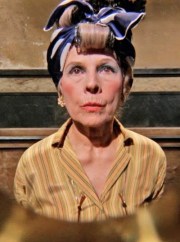
For those who, like me, spent the past four months or so riveted to the meandering and bizarre plots of the American Horror Story: Coven television series, the ride is now over and we’re all left sorting out wheat from chaff from eyeballs from axe-murdering ghosts living in knotty pine hell. One of the most interesting and unusual characters in this season was Myrtle Snow (portrayed by the luminous Frances Conroy), a complicated, artistic, eccentric witch that is just about everything you could dream of having in a crazy aunt who can cast spells and is willing to melon-ball out the eyes of her enemies to restore your own sight. Myrtle plays the theremin, knows fashion inside and out (one of the best moments in the series was her screaming “Balenciaga!” at a crucial moment in the final episode), and has a palate for classic French and continental cuisine. She is, in short, a child of the seventies. More importantly, she is a child of the seventies witch.
Today I wanted to briefly look at that decade (which I’m treating as a “long” decade, starting in around 1965 and going through the very early 80s), which spawned a very particular witchy aesthetic. It was the decade of Stevie Nicks (another AHS trope) and saw a marked growth in the popularity of occult themes across all sectors of American—and international—society. This is not going to be comprehensive, of course, and I know this is not exactly folk magic drawn from a weather-beaten nineteenth-century almanac, but I think that we should be cognizant of the role of recent (well, as recent as almost half-a-century ago, anyway) history in the development of modern magic and witchcraft. If the Victorian era was the early bloom of occultism, the seventies was the springtime explosion of color, dripping nectar, and bloody thorns which allowed a lot of the witchcraft we have today to re-surge, and it even helped fuel some of the studies of folk magic which have been so crucial to us in contemporary times.
In 1958, the film Bell, Book, & Candle featuring Kim Novak, James Stewart, and Jack Lemmon appeared in movie houses following a popular run of the play on Broadway. The sympathetic witch, played by Novak, and her hep-cat brother Nicky (Lemmon) mark some of the earliest American pop-culture portrayals of sorcerers who are not scary and evil, but hip, cool, and attractive. The success of the film eventually fed into the production of the classic television show Bewitched, which ran from 1964 to 1972, which starred Elizabeth Montgomery as the beautiful and charming Samantha. These portrayals are occasionally problematic—the film requires Novak’s character to give up witchcraft in the name of love, and the show was centered around Samantha’s struggles to sublimate her magic so that her husband could lead a comfortable suburban life (although that magic frequently saves his proverbial bacon)—but these glowing women brought glamor to the popular American experience of witchcraft, and the occult looked a lot less intimidating.
Knock, knock!
Then, in 1967, Ira Levin published his book Rosemary’s Baby. The following year, Roman Polanski adapted the book into a film the following year, and the eerie occult was back, with full-on Satanic conspiracies lurking behind Manhattan closet doors. Even in Rosemary’s Baby, however, the glamor persisted—the eccentric but resplendent witches-next-door, Roman and Minnie Castavet (played by Ruth Gordon and Sidney Blackmer), were magnetic, and served frosty cocktails in their spacious New York flat. There Satanic witch-cult even seems more like an anarchy art clique than a sinister magical lodge for the most part. The film put the fear of witches back into the American mind, however, with a new twist—witches were spooky, but spooky was cool. Incidentally, another classic occult film, The Devil Rides Out, appeared in theaters the same year as Rosemary, and lit its own subtle fires under the cauldron.
With this new-found social capital, witchcraft and the occult took the world by storm in the seventies. Some of the occult films which appeared during the decade were hallmarks of art and cult cinema: Simon, King of the Witches(1971); The Devil’s Daughter (1973); The Exorcist (1973—not a true ‘witch’ film, but one with strong occult ties and influence); The Wicker Man(1973); Season of the Witch (1973, directed by zombie-genre great George A. Romero); Lisa & the Devil(1974); and the highly glamorous Suspira (1977), a veritable precursor to 2010’s creepy art-dance film Black Swan. In essentially all of these films, the presence of the occult is a trope, and does not have any of the benign or jovial qualities of Bell, Book, & Candle or Bewitched. Yet each film features a mixture of eroticism, fashion, and allure layered over the tale of black magic driving the story. Liberation, sexual empowerment, and countercultural energy augment the horror of the films, and the gray space between forbidden occultism and fashionable society becomes a gulf.
Art and music also experienced an occult florescence during the seventies. The aforementioned Stevie Nicks—the “White Witch” of music—joined the group Fleetwood Mac along with boyfriend Lindsey Buckingham in 1974, and in 1975 the group experienced mainstream success with an album featuring witchy hits like “Rhiannon.” Her flowing shawls, black gowns, and stage twirls bewitched audiences, and her fashion became a standard of young, hip women seeking to look a little out of the mainstream—a little “witchy.” The occult music craze started well before Nicks, of course, and bands like Coven and Black Widow had experienced some chart success with their Satanic/witchy black rock during the late 60s. In 1970, Santana recorded and released Fleetwood Mac’s song “Black Magic Woman,” on their (fairly occult-named album) Abraxas, taking it to no. 1 on the pop music charts. In 1972, the Eagles released “Witchy Woman,” another big hit glamorizing witches, and in 1974 Cher released “Dark Lady,” about a love triangle involving a witchy fortune teller. Cher herself cultivated a glam-witch look throughout the decade, further expanding the cultural capital of witchcraft fashion. Other rockers who adopted elements of the occult into their songs, performances, and fashions include David Bowie, Jimmy Page, and, of course, Jim Morrison. Patti Smith notes the heavy influence of the occult on the Greenwich Village music scene in her memoir Just Kids, and especially the huge artistic influence that it had on artists like Robert Mapplethorpe. Penthouse magazine did erotic spreads centered on occult themes as well, such as this one featuring Babetta Lanzilli from 1974.
In the ‘real-world’ of witchcraft, a number of stars were aligning to add fuel to the magical fire. Chas Clifton outlines a number of the groups which were exploding onto the scene in his book Her Hidden Children, including the Psychedelic Venus Church and Anton LaVey’s Satanic Church, which also released a film called Satanis in 1970 (there are some great pictures of a 1969 LaVey here). Alex Sanders, the progenitor of Alexandrian Wicca, released an album revealing some of the workings of Wicca called A Witch is Born in 1970. Wicca had arrived stateside with Raymond Buckland in 1968 (although it may have had some early seeds from other sources, too). Buckland expanded on witchcraft religion through books like Witchcraft Ancient & Modern and Witchcraft from the Inside. The hugely influential publication of Robert Heinlein’s Stranger in a Strange Land in 1967 led to the foundation of The Church of All Worlds (CAW) and shaped practices in other groups as well (such as the aforementioned Psychedelic Venus Church). The mass-marketing of witchcraft became a staple of the 70s, with sales of “black magic ritual kits” hitting store shelves and a variety of occult-inspired board games. The Ouija game was purchased by Parker Bros. in 1966, and they began to push it as a party game rather than a spiritual tool. There was also a push towards legitimacy. Journalist Hans Holzer published his mainstream apologetic (and sensationalist at times) text The Truth About Witchcraftand opened the door to public discussions of its practices as legitimate, if fringe, activities done by regular people. Wicca and neo-Paganism in general underwent a rapid expansion and transformation, and the end of the decade saw the journalistic survey of new witchcraft (and other alternative) faiths in Margot Adler’s Drawing Down the Moon (1979). That same year, Starhawk published The Spiral Dance, which crystallized the evolving feminist Wicca movement. A busy, busy decade for witchcraft.
I should point out that these different aspects of witchcraft may have occasionally interacted with one another, but they were not in strict conversation through the decade. Instead, the popular conception of the occult and witchcraft grew in one direction—often sensational and glamorous—and the nature-based religions that were gaining momentum in fringe spiritual culture. Yet there does seem to be a shared zeitgeist from that era that drove ever more people into the black-robed arms and beshawled shoulders of witches. For a number of people, the ecological spiritualism which was fueling part of the neo-Pagan segment was a complete non-starter. Instead, the sex, drugs, & rock-and-roll aspects of witchery worked as an artistic medium of self-expression. Both segments were connected to counterculture, but with different aims and methods. Following this decade, with its chaos and beauty, the occult got heavily mired in a number of problems, most notably the “Satanic panic” of the 80s. With the recent popularity of witchcraft in media, I’d be hardly surprised to find a resurgence of people claiming to have been harmed or attacked by evil cults over the next two decades or so. Let’s hope there’s been some growth on that front and that the information age will keep it in check, but I somehow doubt the ripples aren’t already in motion for the next “panic.”
So what does all this have to do with Myrtle Snow and the Diane von Furstenburg wrap dress (“the greatest invention of the century,” according to dear Auntie Myrtle)? I think that it can be very easy to lose sight of just how diverse witches are, for one thing. Dressing in black (despite AHS:Coven’s edict that “On Wednesdays we wear black”) may be a statement, but so is sporting a pair of black-and-red Pleasers for ritual sex, and there’s nothing wrong with a Pier 1 altar and a little P90X before ritual. I don’t want this to devolve into a post on there being no one type of witch, or on what witches should or shouldn’t look or act like, but I do think that the recent witchcraft revival in pop culture means that there’s room for some real glamor in witchery again. Folk magic performed with embedded style and power—a flair for the dramatic—could be a very refreshing thing. I’d like to see witches embracing their own high-fashion spins on tried and true witchcrafts—not so much glitter in conjure oils, but a really knowledgeable mixologist of a witch brewing enchanted herb rinses for bewitching cocktail hours, for example. I certainly don’t want to see the folk magic I study and practice cheapened by commercial interests, of course, but I would love to see a few more Myrtles playing the theremin around bonfires, while our cultural capital is so ascendant.
What about you? Is there a place for glamor and high fashion in your witchcraft? Are the seventies still alive in your spells?
Today I thought I might share a few of the things from my holiday stocking, as well as other treats and delights I’ve been enjoying lately. I got a very lovely and eclectic selection of books & music, some of which might be of interest to folks here, so if you find something among the pile that you like, I’d love to know!
The first thing I want to mention is a beautiful copy of Crossway’s Four Holy Gospels. It’s the English Standard Version (ESV) of the books of Matthew, Mark, Luke, & John illuminated using contemporary art by Makoto Fujimura. It’s a big, gorgeous clothbound edition and conveys a great deal of the mystical nature of these texts. I know it’s a bit odd to recommend a Bible of sorts on a site with so much magic and all, but if you’ve been around us for a while you know that we’re equal opportunity when it comes to mysticism and magic. So if you’re looking for a good heirloom version of the gospels with a little artistic magic, this is a good one to have.
In addition to the gospels, I got a copy of an excellent book called Kanaval: Vodou, Politics, & Revolution on the Streets of Haiti. It’s a photojournalistic look at the Haitian carnival costumes, parades, and traditions, and it will be of extreme interest to anyone captivated by the rituals of Vodou(n) or other African Traditional Religions. A number of lesser-known loa show up in the text, and there are oral histories from participants in the celebrations that are simply unmatched in recent history. In addition to the book and its magnificent photos, there are two accompanying CDs (one of which I received along with the gospels from my in-laws—I have an amazing family). One is called Spirits of Life, which has a number of ritual songs, and the other is Rara in Haiti and plays some of the more celebratory carnival jazz-style music. I also bought myself a simply wonderful new magical psalter from Troy Books: The Charmer’s Psalter, by Cornish witch Gemma Gary. It has fast become one of my favorite magical books and travels with me everywhere now.
Shifting from the authentic to the entertaining, I’ve been very much enjoying this year’s run of American Horror Story, subtitled Coven and set in a world of New Orleans Voodoo and witchcraft. I actually introduced Laine to the show, and she’s taken off running with it, consuming the first two seasons as well (subtitled Murder House and Asylum). I’m sure we’ll wind up discussing it more elsewhere, and it’s generating some controversy around the Pagan blogosphere, but if you’ve not checked it out and enjoy good, immersive horror, it’s fun to watch, in my opinion.
In that same vein, I’ve also been enjoying the kitschy-but-witchy antics of Witches of East End on Lifetime. I can’t say it’s a must-see, but the episodes I’ve seen have been enjoyable and if you’re a fan of things like Charmed, this might be fun, too. Might.
A lot has been going on in the podcasting universe lately, too. I’ve been tuning in to a couple of new shows, including The Kindle Witchwith Faelyn, Pagan Life Radiowith Brent/Raven, and one called Disney Story Origins. The first two offer some nice new elements to the Pagan podcasting world. Faelyn uses her show to explore books in a sort of book-club format, while also sharing a lot of neat moments from her own practice. Brent/Raven uses his show to create a really neat community space for talking to Pagans working on specific goals, or just get into good discussions about the role of Paganism in contemporary society. The Disney origins podcast is a gem, where the host compares and contrasts the stories that inspired Disney movies to the films and explores how that translation happens. The most recent episode gets into the excellent recent film Frozen and its inspiration, “The Snow Queen,” by Hans Christian Andersen (a section of which was included in our Yule show this year).
I’m also sad to say we’re losing at least one of our podkin for a while. Gillian at Iron Powaqa recently announced she’s taking an open-ended break from recording to focus on other projects. I completely understand her reasons, but she will definitely be missed. I fear this will be a trend, as several podcasters have disappeared this year. On a happier podkin note, Fire Lyte has published his first book of poetry, The Playground, which is available in several formats now. If you’re a fan of his poetry, this is definitely a book to get (plus it supports Pagan podcasting, which is always a noble cause). Finally, if you’ve not been listening to Peter Paddon’s revitalized podcast, do so! It’s the reason New World Witchery even exists, and he’s an absolutely charming fellow (all puns intended).
That’s all the news that’s fit to print for me this week! What was under your tree this year?
Don’t forget to enter our contests! We’ve got a NOLA Swag Bag contest finishing this Friday, and a Three Questions contest which will finish up next week. Give ‘em a go, and maybe win something fun!
In this extended episode, we revisit our recent trip to the magical city of New Orleans. We’ll discuss the most recent Pagan Podkin Super Moot, places to see in the Crescent City, and hear some music, travelogues, and even a tea leaf reading or two!
CONTEST!
We announced a new contest in this episode! Details are coming in a separate post, but the basic rules are: 1) Buy something, anything, from one of the sponsors in the list below; 2) Take a picture with that item (or a a picture/screengrab of the receipt); 3) Send your picture to compassandkey@gmail.com and let us know to enter you in the contest. You could win one of three fully-stuffed PPSM Swag Bags, full of items from these great sponsors!
PPSM Sponsors! (We love them!!!)
(We’ll be posting more on these items in other places, but here’s a short list of the swag items and sponsors)
Summary In this episode, we experience some witchy radio drama and NIGHT VALE NIGHT VALE. NIGHT VALE NIGHT VALE NIGHT VALE.
Sources
NIGHT VALE. NIGHT VALE NIGHT. VALE NIGHT VALE NIGHT VALE NIGHT VALE. NIGHT VALE. NIGHT VALE NIGHT VALE NIGHT VALE NIGHT. NIGHT VALE NIGHT VALE NIGHT VALE NIGHT VALE. NIGHT. VALE. NIGHT VALE. NIGHT VALE NIGHT VALE NIGHT VALE NIGHT VALE NIGHT VALE NIGHT. VALE. NIGHT VALE NIGHT VALE NIGHT VALE NIGHT VALE NIGHT VALE NIGHT VALE NIGHT VALE NIGHT VALE NIGHT. VALE NIGHT VALE NIGHT VALE. NIGHT VALE NIGHT VALE NIGHT VALE NIGHT VALE. NIGHT VALE.
Summary
This episode features a special one-hour interview with the cast of Conjure Crossroads, discussing the state of conjure in the US. We’ll hear about art, magic, New Orleans, and what conjure looks like today among current practitioners.
Greetings and salutations! It has been a phenomenally busy end-of-summer around here. We’ve got a show in the works, and I’ve got articles brewing for the website, the Witches & Pagans site, and several print publications as well, so keep an eye out for those. Today I thought it would be good to have a brief cartulary post, though, so that while you’re waiting on tenterhooks for more New World Witchery (and you are waiting on those tenterhooks, aren’t you?), you won’t get too bored.
First of all, it’s the birthday of Howard Phillips Lovecraft, the noted author of some of the best weird and horror fiction of the twentieth century. If you’ve ever heard of Cthulhu or the Necronomicon, those are Lovecraft’s brainchildren, as are so many modern horror elements. What makes him of interest here is that he blends the occult with the scientific, creating a strange but wonderful mythology that is very easy to get sucked into. Much of his work has entered the public domain, and you can frequently find good collections of it cheaply, such as this Kindle collection of his work for less than a dollar. If you want to spend a little more, pick up the truly excellent Library of America collection, which also contains a chronology of Lovecraft’s life and a thorough annotation to the stories. If you’re a podcast listener, you should also definitely check out the HP Lovecraft Literary Podcast, who record dramatized versions of the author’s eerie tales.
I recently reviewed a couple of books on conjure, both of which fall into the non-fiction camp, but since we’re talking about weird tales, I think a few recommendations of conjure fiction would be worthwhile. First, I have to recommend the collection Mojo: Conjure Stories, edited by the wonderful Nalo Hopkinson. I’ve reviewed this book before, so I won’t say more than it is definitely worth a read. Fire Lyte sent me a wonderful collection of late 19th and early 20th century conjure tales called Voodoo: Strange & Fascinating Tales & Lore, edited by John Richard Stephens. The editor unfortunately bowdlerized a number of the stories, but you can find a number of great tales in here anyway, by authors like H.G. Wells and Charles Chesnutt. If you’re looking for a great collection of hoodoo stories just by Chesnutt, I received the marvelous Norton Critical Edition of his Conjure Stories back at Christmas, and it definitely rewards a reader with an interest in folkways , magic, and good literary storytelling.
I can’t recall if I mentioned it or not, but I recently watched a few classic “voodoo” films via Netflix and/or Amazon Instant that may be of interest to folks here. The classic White Zombie stars Bela Lugosi and features all sorts of ridiculous fun. The 1988 film The Serpent and the Rainbow was more enjoyable than I thought it would be at first. It’s based on a book of the same name by anthropologist Wade Davis, who theorized that the “zombie powders” of Vodoun might be a form of bufotoxin or tetradotoxin found in poisonous animals which induced corpse-like comas in victims. The movie obviously mangles the research a bit in the name of good storytelling (well, storytelling of some kind, anyway), but it still makes for a harrowing look at the political and spiritual life of Haiti under the dictatorship of Papa Doc and Baby Doc Duvalier.
Finally, I wanted to mention a few musical items of interest. Firstly, I picked up a really fun compilation CD put out by the Lucky Mojo Company called cat yronwode’s Hoodoo Jukebox. It’s part of a 2-CD set which includes a CD-ROM full of hoodoo-related graphics (mostly in the Lucky Mojo style). The music CD is basically a collection of old country or backwoods blues tunes by the likes of the Memphis Jug Band, Johnnie Temple, and Blind Willie McTell. It’s essentially all tunes coming from public domain sources, so I’m not sure if any of the proceeds go to the artists’ families, but I imagine with Yronwode’s usually ardent position on intellectual property and copyrights she’s found some way to do good things with the funds. Most of these songs you could find by digging around in archives or on the internet long enough, but Cat has done a marvelous job assembling them in one place and providing a really rich commentary on them in the liner notes. If you like blues or even just music about magical things (and I’m looking at you and your upcoming Halloween episode, Velma Nightshade), this is a good collection to have.
I also cannot help but shamelessly plug a friend of mine’s latest release. If you’ve not heard of Amanda Shires, you probably will, and soon. Her new CD, Down Fell the Doves, is the deeply haunting sort of alt-country record I can’t resist. It’s relevant here because several of the tracks have deeply folkloric elements. “Bulletproof” talks about animal curios given to Shires by a man named “Tiger Bill” with the assurance “That’ll make you bulletproof.” The song “Deep Dark Below” speaks of a devil who plays a fiddle with a bow made of bone that “sounds like your deepest desires.” If you like good, spooky music touched by rock, blues, country, and folk influences (somewhat similar to the marvelous band Devil Makes Three, which Sarah Lawless introduced me to), give Down Fell the Doves a listen.
Folks, I’m really and truly happy to announce I’ve finished the expansion of the old cartomancy guide and it is officially released for your purchase and perusal!
“Ye are twenty-five cards.
Become twenty-five devils
Enter into the body, into the blood, into the soul .”
So begins a nineteenth century Italian charm making use of a small deck of playing cards. This brief-but-richly drawn book explores the practice of divination by playing cards—known as cartomancy. It reveals the “secrets in plain sight” which hide within the pips, kings, queens, and jokers of a standard deck. Explore one method of divination in-depth as you meet the “fifty-four devils”—the symbolic spirits of each card—and learn about invoking ancestral blessings for card readings, the folklore of playing cards, and how to relate fairy tales to a spread along the way.
How is it different from its previous incarnation? For starters, it’s longer, coming in around 108 printed pages. It also has loads of new sections and subjects to cover, including:
Preparing your cards for divination
The use and inclusion of the Jokers in readings
An easy-to-use table which puts keywords related to each card on a single page
A widely expanded set of sample readings
An entirely new type of spread, the Grand Tableau or Full Deck Spread, which uses all 54 devi…er, cards
Two of my favorite new elements—and I am obviously a bit biased—are the section about how to relate fairy and folk tales to card readings to enhance divination and the 20-page appendix which contains a wide variety of folklore on card reading (including short commentaries and even a little historical fiction by yours truly). I also really love the cover, which was designed by my lovely wife!
If you’re a fan of cartomancy or divination, I think you’ll like this book. And if you’re a fan of this show/site, I think the same will be true for you. This also gives you an opportunity to support the show as well, and at $6 or less a pop, you can’t go wrong, right?
I’ve made it available in print and e-book format, and you can get a copy at any of the sites below:
On a related note, the sidebar of the blog/website now contains a button showing the cover of Fifty-Four Devils which will take you to our digital Book Shop, where you can currently find all the purchase information on this book. Over time I’ll be adding other books there as well. Hopefully some will be more of my own books, but I’ll also link to works I cite frequently and to books by authors who have appeared on the show or contributed to the blog. Any purchase you make helps us out just a little bit, so it’s a great way to support us while getting great books!
I’m very happy to be able to share this book with you all! Please let me know what you think of it, and happy reading!
A beautiful and gentle film about living with magical companions is Hiyao Miyazaki’s My Neighbor Totoro. You can see a (shaky) clip of the “umbrella dance” I mentioned here.
Laine didn’t mention it, but her magical childhood was heavily influenced by F. H. Burnett’s The Secret Garden.
There are some great magical & craft-based children’s activity ideas in the Waldorf educational style found at the blog Alina’s Adventures in Homemaking.
I would definitely recommend scouting as a good introduction to nature & wonder for kids. Check out Spiral Scouts, the Pagan-friendly scouting group, or the more mainstream alternatives of the Boy Scouts and Girl Scouts of America.
And of course, Laine takes much parenting inspiration from the aunts in Practical Magic.




 New World Witchery - The Search for American Traditional Witchcraft