Entry 240 – Mosses and Ferns

From stuffing dolls to invisibility spells

You can blame this one on the book club. We recently finished reading and discussing Robin Wall Kimmerer’s Braiding Sweetgrass for our Patreon book club, which is a beautiful series of essays on ecology, indigeneity, motherhood, science, spirit, and stewardship that I thoroughly recommend. Kimmerer is a botanist by trade, and a bryologist by specific discipline, which means she specializes in the study of mosses. I listened to a fascinating interview with her on the podcast Ologies with Allie Ward in which she describes the miniscule rain forests that exist within the carpeted world of mosses and their cousins, lichens. 

Spending the time with Kimmerer through her work and her hypnotic voice (seriously, go listen to her interviews or essays) must have put me in a receptive mood, because I’ve been noticing mosses and lichens popping up in my folklore texts a lot recently. So today I thought I’d share a bit about that folklore from a more magical perspective. I’m also rolling in ferns, since both can be found together in forests, as well. It also helps that ferns have a good deal of magical lore, too. I should also note that my aim here is not a strict botanical examination of these plants, so there are going to be some “mosses” and “fern” related items that might not strictly fit the scientific classifications. 

I will, however, start with a scientific note. One of the first points to address is some of the most common lore about mosses: that you can always figure out what direction north is since moss always grows on the north side of trees. Strictly speaking, this is not universally true. What mosses like is moisture, and moisture lingers longest in shady spots rather than sunny ones. As Tristan Gooley puts it in his excellent guide to observing the natural landscape entitled The Lost Art of Reading Nature’s Signs, “[m]osses need water to reproduce and so are a dependable indicator of places that retain moisture…shady places are moister than sunny ones; these are more common on north-facing surface and so, if you have eliminated other causes of moisture, then mosses can point the way north” (my emphasis). So yes, if you’re lost in the woods, moss is better than nothing, but remember there’s potentially a lot of moisture around and the moss should be only one tool in your natural-compass arsenal. An interesting bit of lore from Harry M. Hyatt’s Folklore from Adams County, Illinois inverts the north-growing moss trope and says that “A hard winter always follows the appearance of moss on the South side of trees in autumn.” Moss also helped predict weather based upon its own moisture content, at least in this snippet of lore: “When the mountain moss is soft and limpid, expect rain. When mountain moss is dry and brittle, expect clear weather” (Daniels, p. 819)

Moss is also used as folk medicine by some. In Pennsylvania German folk practices, one remedy for diarrhea recommends boiling tree moss in red wine and drinking it to relieve the problem (Harms/Hohman, p. 68). Its soft, spongy nature also made it useful for dressing wounds in some situations, as well. That texture also makes it a popular filling for dolls and poppets, too. One of the best known applications of this is the use of Spanish moss in the creation of doll baby spells in Southern folk magic. Strictly speaking, Spanish moss isn’t actually a moss, but a flowering plant, but in folk thought if it looks like a moss and squishes like a moss, well…I mean just look at the name! (Of course, it’s also not Spanish in origin, so maybe don’t look too closely at the name). 

(Spanish Moss draped from trees. Photo by Huron H. Smith, 1908. via Wikimedia Commons)

One of the more interesting magical connections is between moss and the dead. Several bits of folklore describe gathering “skull moss,” which is simply moss or lichen scraped off of a gravestone or human remains. Scott Cunningham recommends carrying moss scraped from a gravestone for good luck, “especially financial luck” (p. 156). This lore is echoed in The Encyclopedia of Superstitions and the Occult as well, which also notes that An old superstition says that when a robin redbreast finds a dead body, it will cover up at least the face, with leaves or moss” (p. 687). Moss softens and blankets, which may contribute to this lore, and offering the dead a bit of comfort in the form of moss may be where the luck aspect of this comes from. Stranger still is a fragment of North Carolina folklore that notes “White moss from the skull of a murdered man, picked in a graveyard at the full o the moon, and tied in a piece of blue cotton cloth around the neck, will win any man” (Brown, p. 574). 

(Image (c) Cory Thomas Hutcheson, CC 2.0 License)

Moss also shows up in the famed “Language of Flowers,” and is used to encode messages to recipients who understood the meaning of different kinds of moss in a bouquet or arrangement:

  • Iceland moss represented health 
  • Wood moss represented maternal love or ennui
  • Lichen represented dejection and solitude (Daniels, p. 794-95)

The widely varying range of meanings here may have something to do with the many varieties of moss, but it could also be rooted in the way moss appears to interact with its environment–the green lushness of moss could signify health for many people, for example, while the way lichens can “hide” on trees and rocks could connect to the solitude meaning. The clinging nature of moss also makes it fit the feelings of connection and love. We’ve already mentioned that Irish moss is sometimes put in the corners of shops to make them more prosperous in our post on occupational folk magic, largely because of the way Irish moss feels abundant.

(Ferns are often associated with fairy folklore, especially around Midsummer. Photo: Antoni Piotrowski, Public domain, via Wikimedia Commons)

Ferns are also richly folkloric, and connect to the Otherworld, although more through the realms of Faerie than the dead specifically. In renowned folklorist Katherine Briggs’ work, Pale Hecate’s Team which examines fairy lore in England, she notes that “fern-seed” was considered to be a powerful magical ingredient: “A famous herb[…] was fern-seed, which, gathered at the right time and with the right ceremonies, made the man who wore some about him invisible.” She also points out that its power came with risks, because  “It seems to have been almost as difficult to secure fern-seed as to draw up a mandrake from the ground, a herb even more renowned than fern-seed” (p. 169-70). Anyone who knows about ferns knows that they don’t actually have seeds, though. Instead they reproduce using spores released from the undersides of their leaves, which may be what “fern-seed” refers to. Possessing fern-seed offered you a number of powers. Invisibility, as mentioned above, was one of the most common, and is even mentioned as common lore in Shakespeare’s Henry IV, Part I. Other lore indicated that it would allow you to understand the language of fairies. In much lore, the fern-seed had to be procured specifically at midnight on Midsummer’s Eve (the night before the Summer Solstice, although it is also popularly celebrated on June 23rd). One bit of lore also said that this magical supply, when brought by the Devil for the price of one human soul on Christmas night, would make ap person as strong as “twenty or thirty men” (Daniels, p. 784). One should be careful when gathering fern, however, as plucking it at times other than prescribed will invite thunderstorms in Polish lore, or even cause one to be pursued by snakes and serpents.

Fern could also be used to ward off witchcraft and evil. One superstition says that “It was formerly customary for waggoners to place a bunch of fern over the horse’s ears or on the horse-collar, to ‘keep the devil away’ and to ‘baffle witches’” (Opie & Tatem, p. 147). Cunningham notes that “Ferns can be planted inside or outside the home for protection, thrown on hot coals to exorcize evil spirits or worn to guide the bearer to treasure” (p. 102). Ferns, despite their association with fairies and devils, can also be used to drive them away, and kept on one’s person can break illusion spells and render incantations powerless, too.

(Ferns were thought to be useful for everything from warding off witches to enhancing beauty to improving dental health. Image (c) Cory Thomas Hutcheson, CC 2.0 License)

Maidenhair fern has its own unique lore associated with beauty, likely owing to its name and appearance. Cunningham describes putting maidenhair fern in water, then using the water as a sprinkle to endow one with grace, beauty and charm. It could also be turned into a rinse for hair to make it silkier and more lustrous. 

One of the better-known ferns is the popular Rose of Jericho (also known as the Resurrection Plant). This fern can dry out completely and curl itself into a tight brown ball, almost like a tumbleweed. Then, when given water, it will bloom over the course of a day or so and become verdant and lively again. Using the water from a Rose of Jericho–which would symbolically be infused with vivacity and not a little bit of the miraculous what with the resurrecting bit–is thought to boost prosperity when sprinkled around cash registers or shop doors. Catherine yronwode notes that the water should be added to the plant on Fridays, and then used throughout the week.

(The Rose of Jericho fern is also known as the Resurrection Plant and can survive long periods without water. Image (c) Cory Thomas Hutcheson, CC 2.0 License)

One final bit of lore about fern strangely connects it with teeth. A piece of Tyrolean superstition says that placing fern over one’s door ensures that you will have good dental health all year. Cornish lore states that “if you bite with your teeth from the ground the first fern you see in the spring, you will have no toothache all the year” (Daniels, p. 784).

I’ll close with a little rhyme that doesn’t seem to be directly related to any fern lore, but which is too charming to resist:

“When the fern is as high as a spoon

You may sleep an hour at noon,

When the fern is as high as a ladle,

You may sleep as long as you’re able,

When the fern begins to look red,

Then milk is good with brown bread.”

(Daniels, p. 784)

So if you head out into the forest for a hike this summer (or visit a moss-grown graveyard), keep your eyes peeled for ferns and mosses. You never know what kind of magic you’ll find, even in the humblest of plants.

Thanks for reading!

-Cory

References

Special Episode – Folk Magician’s Notebook – June 2024

Of Hermits and Horse Moons

Hermits and Horse Moons

Summary:
We talk about planetary arcs, Hermit cards, St. John’s Eve revels in New Orleans, and flower crowns this time!
 
Please check out our Patreon page! You can help support the show for as little as a dollar a month, and get some awesome rewards at the same time. Even if you can’t give, spread the word and let others know, and maybe we can make New World Witchery even better than it is now.
 
Producers for this show:
Elle, Bree, Victoria & Keifel of 1000 Volt Press, Lauren, Cate, Sierra, Lisa, Donna, Liz, Meg, Vee, Mark, Kels, Benjamin, AromaG’s Botanica, DanielKnits, Abbi of Morningstar Coven, Stephanie, Jenna, Donna, Jennifer, Fergus, Heather, Christopher, Ralph of the Holle’s Haven Podcast, Jamie, Catherine, Achija Branvin Sionach, Jen Rue of Rue & Hyssop, AthenaBeth, and Conjured Cardea
Our sincere thanks to everyone supporting us!
 
Play:
 
-Sources-

We highly recommend that you find an almanac or lunar-oriented datebook to help you with planning out your own magical year. Some we can recommend:

You can find a transcript of this episode at our Transcripts page.

Our folk tale this month is two accounts of the St. John’s Eve celebration in New Orleans featuring Marie Laveau. The accounts come from:

Voodoo in New Orleans by Robert Tallant

Mules and Men by Zora Neale Hurston

See more on weaving flower crowns at this post from Creative Green Living

In our cartomancy section, Laine will read for Cory, and Cory for Laine, but we’ll also share general information on the cards we pull, too. If you are interested in playing card divination, you can check out our Cartomancy post or pick up Cory’s book, 54 Devils.

You can now buy Cory’s book, New World Witchery: A Trove of North American Folk Magic! (also available from Amazon). We also have a new book, Conjuring the Commonplace: A Guide to Everyday Enchantment and Junk Drawer Magic (1000Volt Press) (also available from Amazon).

Image via Pixabay (CC 2.0)

If you have feedback you’d like to share, email us at compassandkey@gmail.com or newworldwitcherypodcast@gmail.com or leave a comment at the website: www.newworldwitchery.com . We’d love to hear from you!

Don’t forget to follow us at Twitter! And check out our Facebook page! For those who are interested, we are also on TikTok now. You can follow us on Instagram (main account, or you can follow Laine as well) or check out our new YouTube channel with back episodes of the podcast and new “Everyday Magic” videos, too (as well as most of our contest announcements)! 

Promos and Music:

Title and closing music are “Runaround (AM Radio),” by Aaron Solomon, and is licensed from Audio Socket. (License #1273). Additional incidental music Kevin Macleod, from Free Music Archive and used under a CC 2.0 license.

Sound effects from Freesound.org and in the Public Domain. Additional “rooster” sound effect from Darina Evstafeva from Pixabay.

Please consider supporting us by purchasing our promotional items in the New World Witchery Threadless shop or by joining our Patreon supporters.

If you like us AND you like Buffy the Vampire Slayer, you will love our new show: Myth Taken: A Buffy the Vampire Slayer Podcast, now available through all the podcatchers! You can also check out Cory’s folklore show, Chasing Foxfire, where he explores the intersection of folklore and topics like history, medicine, science, nature, literature, pop culture, and more!

Please think about checking out our Audible Trial program. Visit Audibletrial.com/newworldwitchery to get your free trial of Audible, where you can download over 180,000 titles (including some narrated by Cory). Your purchases help support this show, and there’s no obligation to continue after the free trial

Special Episode – Folk Magician’s Notebook – June 2023

Strawberry Moons, the Origins of Elves, and Birthday Divinations

Strawberry Moons, the Origins of Elves, and Birthday Divinations

Summary:
This time we read our cards, share some astro info on lunar astrology, tell some tales about elves, do birthday divinations, and discuss making a personal candle for magic!
 
Please check out our Patreon page! You can help support the show for as little as a dollar a month, and get some awesome rewards at the same time. Even if you can’t give, spread the word and let others know, and maybe we can make New World Witchery even better than it is now.
 
Producers for this show:
ConjuredCardea, AthenaBeth, Jen Rue of Rue & Hyssop, Achija Branvin Sionach, Catherine, Jamie, Ralph of the Holle’s Haven Podcast, Christopher, Montine of Book of My Shadows, Victoria & Keifel of 1000 Volt Press, Heather, Sherry, Fergus, Jennifer, Donna, Stephanie, AromaG’s Botanica, Benjamin, Matthew Venus of Spiritus Arcanum, Mark, Vee, Meg, Liz, Donna, Lisa, Jacob, Sierra, and Jen!
Our sincere thanks to everyone supporting us!
 
Play:
 
-Sources-

We highly recommend that you find an almanac or lunar-oriented datebook to help you with planning out your own magical year. Some we can recommend:

You can find a transcript of this episode at our Transcripts page.

This episode’s story is a trio of tales from the North Lands:

“The Origins of the Hidden Folk” – Three Northlands Tales

  1. The Origin of the Elves (Iceland)
  2. Eve’s Hidden Children (Iceland)
  3. The Tusse and Lilith (Norway)

https://sites.pitt.edu/~dash/originunder.html#arnason20

In our cartomancy section, Laine will read for Cory, and Cory for Laine, but we’ll also share general information on the cards we pull, too. If you are interested in playing card divination, you can check out our Cartomancy post or pick up Cory’s book, 54 Devils.

You can now buy Cory’s book, New World Witchery: A Trove of North American Folk Magic! (also available from Amazon)

Image via Pixabay (CC 2.0)

If you have feedback you’d like to share, email us at compassandkey@gmail.com or newworldwitcherypodcast@gmail.com or leave a comment at the website: www.newworldwitchery.com . We’d love to hear from you!

Don’t forget to follow us at Twitter! And check out our Facebook page! For those who are interested, we are also on TikTok now. You can follow us on Instagram (main account, or you can follow Laine as well) or check out our new YouTube channel with back episodes of the podcast and new “Everyday Magic” videos, too (as well as most of our contest announcements)! Have something you want to say? Leave us a voice mail on our official NWW hotline: (442) 999-4824 (that’s 442-99-WITCH, if it helps).

Promos and Music:

Title and closing music are “Runaround (AM Radio),” by Aaron Solomon, and is licensed from Audio Socket. (License #1273). Additional incidental music Kevin Macleod, from Free Music Archive and used under a CC 2.0 license.

Sound effects from Freesound.org and in the Public Domain.

Please consider supporting us by purchasing our promotional items in the New World Witchery Threadless shop or by joining our Patreon supporters.

If you like us AND you like Buffy the Vampire Slayer, you will love our new show: Myth Taken: A Buffy the Vampire Slayer Podcast, now available through all the podcatchers! You can also check out Cory’s folklore show, Chasing Foxfire, where he explores the intersection of folklore and topics like history, medicine, science, nature, literature, pop culture, and more!

Please think about checking out our Audible Trial program. Visit Audibletrial.com/newworldwitchery to get your free trial of Audible, where you can download over 180,000 titles (including some narrated by Cory). Your purchases help support this show, and there’s no obligation to continue after the free trial

Blog Post 161 – Summer Saints, part II (St. John’s Eve)

Hi all!
I realize this is rather late, and that I’ve taken a long time to get it out. I’m still working on papers and projects for the graduate seminar, which wound up being incredibly time-consuming, so I had very little time to devote to my work here. However, I hope you’ll forgive me and enjoy the articles I do manage to put out when I manage to get them up.

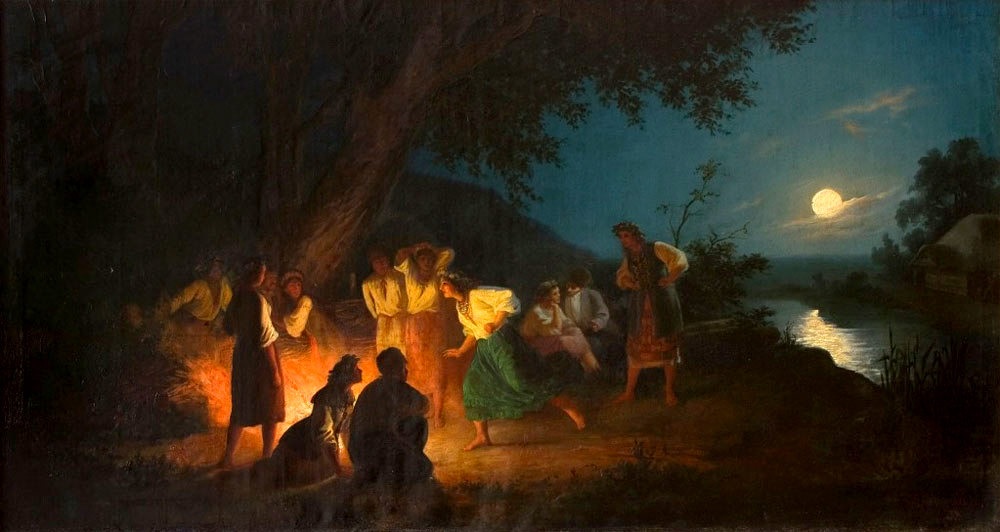
Today, let’s continue working on those summer saints I started in the last post. While there are plenty of saints remaining in the calendar for the season, I thought that one saint’s feast day deserved some particular attention. St. John’s Eve, which is June 23rd, is ostensibly a celebration of the life and times of John the Baptist. It falls remarkably close to Midsummer, however, and so its connotations and meanings have absorbed a good bit of the lore associated with that holiday, too. It features prominently in accounts of New Orleans Voodoo from the nineteenth century, and functions as a day of tremendous power for working all sorts of quasi-magical operations. Let’s look at two from (quasi-)anthropological perpsectives. The first is an account found in Robert Tallant’s Voodoo in New Orleans, taken from a newspaper report contemporary to the events described (allegedly 28 June 1872):

“On Monday morning (St. John’s Day) I went to the French Market for the express purpose of finding out…the exact spot where the Voudou Festival would be held this year…I took the 8 o’clock train on the Ponchartrain Railroad. Arriving at the lake I fooled around a little; saw great crowds…I hired a skiff and pulled to the mouth of Bayou St. John—the best way of getting there from the lake end—the festival took place near Bayou Tchoupitoulas. Upon arriving at the shanty I found congregated about two hundred persons of mixed colors—white, black, and mulattoes…Soon there arrived a skiff containing ten persons, among wich was the Voudou Queen, Marie Lavaux [sic]. She was hailed with hurrahs.

The people were about equally divided male and female—a few more females. The larger portion of the crowd Negroes [sic] and quadroons, but about one hundred whites, say thirty or forty men, the remainder women.

Upon the arrival of Marie Lavaux, she made a few remarks in Gumbo French [Creole, I presume the reporter means], and ended them by singing, “Saiya ma coupe ca,” to which all hands joined in the chorus of “Mamzelle marie chauffez ca.” [reporter’s itallics, not mine]…The song ended, orders were given by the queen to build a fire as near the edge of the lake as possible, which was ‘did,’ every one being compelled to furnish a piece of wood for the fire, making a wish as they threw it on. Then a large caldron [sic] was put on the fire; it was filled with water brought in a beer barrel; then salt was put in by an old man, who jabbered something in Creole; then black pepper was put in by a young quadroon girl; she sang while putting in the pepper; then a box was brought up to the fire, from which was taken a black snake; he was cut into three pieces (the Trinity), one piece was put in by Marie Lavaux, one piece by the old man who put in the salt, and one piece by the young girl who put in the pepper; then al ljoined in chorus of the same song: “Mamzelle Marie chauffez ca;” then the queen called for a ‘cat,’ it was brought, she cut its throat, and put it into the kettle.

Another repetition of the same chorus, then a black rooster was brought to the queen. She tied its feet and head together and put it in the pot alive. Reptition of the chorus. Then came an order from the queen for every one to undress, which all did, amid songs and yells. The queen then took from her pocket a shot bag full of white and colored powders. She gave orders for every one to joino hands and circle around the pot. Then she poured the powders into the pot, sang a verse of some oracle song, to which all joined in a chorus while dancing around the pot, “C’es l’amour, oui Maman c’est l’amour, etc.”…everybody went into the lake, remained in the bath about half an hour…in half an hour the horn was blown (a sea shell), and all hand shurried back to the queen, and set up another chorus to a verse she sang to the same tune as the first one.

After the song she said ‘You can now eat’” (Tallant 80-81).

A long account (even with my editing), and likely a pretty sensationalized one. Certain aspects—communal feeding, dancing, music, memorized choruses, and the direction of a guiding presence like Marie Laveau—all ring somewhat true to accounts of African Traditional Religious practices in other places, such as the thorough examination of Brooklyn Vodoun in Mama Lola. Yet other features seem glaringly off, such as the complete lack of lwa, or the insistence on nudity (a common embellishment which appeared in several accounts and which essentially exists to exoticize and sexualize an entire race—even in the 1920’s stage shows at The Cotton Club in New York featured nude Black dancers with spears and tribal makeup because white patrons enjoyed “primitive” Black culture). The St. John’s dances, however, were highly popular affairs, and I see no reason to doubt that they truly happened. In many cases, it seems whites saw what they wanted to see—or what they were directed to see, and missed a great deal of the spiritual side of the events.

In Mules & Men, Zora Neale Hurston recounts her apprenticeship with Laveau’s alleged nephew, Luke Turner, who gives a somewhat more mystical (and significantly shorter) version of events:

“Out on Lake Ponchartrain at Bayou St. John she hold a grat feast every year on the Eve of St. John’s, June 24th. It is Midsummer Eve, and the Sun give special benefits then and need great honor. The special drum be played then. It is a cowhide stretched over a half-barrel. Beat with a jaw-bone. Some say a man but I think they do not know. I think the jawbone of an ass or a cow. She hold the feast of St. John’s partly because she is a Catholic and partly because of hoodoo.

The ones around her alter fix everything for the feast. Nobody see Marie Leveau [sic] for nine days before the feast. But when the great crowd of people at the feast call upon her, she would rise out of the waters of the lake with a great communion candle burning upon her head and another in each one of her hands. She walked upon the waters to the shore. As a little boy I saw her myself. When the feast was over, she went back into the lake, and nobody saw her for nine days again” (Hurston 193).

Again, I am a bit skeptical about Turner’s claims in some ways, but he seems to get at the heart of the event in a more profound way. Laveau becomes a demi-goddess in his account, a precursor to the lwa which she would eventually become. Certain aspects of both accounts agree: the presence of music, particularly drum music; the great communal feast; the crowd chanting and calling for her to arrive. For a celebration of St. John, the focus in these accounts tends to be awfully heavy on Marie Laveau, no?

However, that is not to say that St. John should be completely left out of his own holiday. Even one of Tallant’s informants recognizes the role the saint plays in the New Orleans frenzy on his feast day:

“Alexander Augustin remembered some of the tales of old people which dated to the era of the Widow Paris [another name for Marie Laveau].

‘They would thank St. John for not meddlin’ wit’ the powers the devil gave ‘em,’ he said. ‘They had one funny way of doin’ this when they all stood up to their knees in the water and threw food in the middle of ‘em. You see, they always stood in a big circle. Then they would hold hands and sing. The food was for Papa La Bas, who was the devil. Oldtime Voodoos always talked about Papa La Bas” (Tallant 65-6).

So does that mean that John’s role—and I should here clarify that the John honored on St. John’s Eve is St. John the Baptist, who was written about in the New Testament, but who was not the author of the Gospel of St. John (different saints entirely)—is always sublimated to another spiritual force, be it Marie Laveau or Papa Le Bas (also frequently called Papa Lebat, and sometimes seen as an alternate identity for Papa Legba, although he may also be named after a New Orleans priest who tried to eradicate Voodoo only to become a lwa after his death)?

Let us briefly look at the saint behind the day, then. Since we’ve already spent so much time in New Orleans, I’ll pause to crack open my copy of Denise Alvarado’s Voodoo Hoodoo Spellbook, which says that St. John is aligned with Ogun, Agonme, and Tonne in the lwa/orisha traditions, and that he has patronage over silence, slander, bridges, and running water. While Alvarado does note that the eve of June 23rd involves observations in honor of Marie Laveau, she does a lovely job looking at the current understanding of the saint’s feast day on the 24th:

“[The] holiday coincides with summer solstice, celebrated in New Orleans every year by Mambo Sallie Ann glassman at St. John’s Bayou. To celebrate the summer, the warmth, fire, and nourishment from the sun. For opportunities, good luck, and to realign with cosmic forces” (Alvarado 74).

Both Hurston and Alvarado have noted the strong connection to the sun with this day, not surprising given its proximity to the summer solstice. Within Christian cosmology, the desert-dwelling St. John recognized Jesus before most others had, and spoke of baptizing people with fire. He saw the heavens open up, and the holy spirit—sometimes represented by fire, though in this case in the form of a radiant dove—descend to earth to acknowledge Jesus as God incarnate. A number of solar symbols appear in this myth—deserts, fire, heavens opening up, descending light, and even the metaphorical light of understanding which enables John to see Jesus’ true nature. And since Midsummer forms the balance point for the winter holidays, which included the feast of Sol Invictus (the Unconquered Sun), it makes a great deal of sense to have the fiery and solarly-aligned John the focus of such a major holiday. Plus, they guy lived off of locusts, so I think we can spare him a day on the calendar.

Turning to NWW favorite Judika Illes, we find that St. John is associated with the color red, love spells, herbs, marriage, fertility, and, of course, beheading (the method of his death). She notes that he “has dominion over healing and magical plants in general,” which makes sense as one of the famous magical herbs bears his name: St. John’s wort. A bevvy of rituals surround the acquisition and deployment  of this enchanted plant, the most famous of which Illes shares in her book:

“If you rise at dawn on Midsummer’s Day and pick a sprig of St. John’s Wort with the dew still clinging to it, tradition says you will marry within the year—but only if you do not speak, eat, or drink from the time of rising until after the plant is picked. A second part to this spell claims that if you slip the plant benath your pillow and go back to sleep—still without eating, drinking, or speaking—your true love will appear in your dream” (Illes 381).

The Encyclopedia of Mystics, Saints, & Sages also points out that in a number of European cultures, any herb gathered on St. John’s Day before dawn is inherently imbued with intense magical qualities.

Finally, let’s finish up our (rather long) snapshot of St. John with a smattering of magical lore surrounding him and his feast day from around the world:

  • “Wear a mugwort wreath around your brow on Midsummer’s Eve to banish headaches for a year” (Illes 381).
  • “Gather blossoming St. John’s Wort at midnight on St. John’s Eve. If the blossoms remain fresh in the morning, this is an auspicious sign that the rest of the year will be happy; if the blossoms have wilted, magical protective measures may be in order” (Illes 381).
  • To return an wandering lover, gather three roses on St. John’s Eve, bury two secretly  before sunrise in a grave and under a yew tree, and put the third under your pillow. Leave it for three nights, then burn it, and your lover won’t be able to stop thinking about you (Illes 381).
  • St. John is the patron of conversion/baptism and tailors, and can be petitioned for “good luck, good crops, fertility, & protection from enemies” (Malbrough 29).
  • In Russian, a priest would visit local farms on St. John’s day and make a cross of fresh tar on the fence posts while reciting a prayer to keep away witches “who were liable to go around in the shape of dogs and steal milk from the cows” (Ryan 43).
  • A Russian spell from the Enisei region of Siberia notes that gathering twelve magical herbs (unspecified) on St. John’s Eve and placing them under the pillow would induce prophetic dreaming (Ryan 47).
  • St. John could be invoked in a charm with St. Peter to diminish fevers, according to English cunning man William Kerrow (Wilby 11-12).
  • English cunning woman Ursula Kemp “recommended three leaves each of sage and St. John’s wort steeped in ale,” as a powerful potion against witchcraft (Davies 110).

So that’s a little look at St. John. And his day. That was worth the wait, right?

One thing I did learn in my long absence is that I should be careful about setting expectations with some of these posts. I originally intended to make a 3-to-5-part series on the “summer saints,” but at this point it will probably be a while before I return to the saints I had planned to cover in the remaining posts. I still will be addressing magical saints in various articles and from a few different perspectives, but I think for the moment I want to move on to other topics here. My reading and research have me exploring a number of topics, and I’d prefer to get those covered here while they’re fresh in my mind, so forgive me if I get a little bit more scattershot in terms of what gets posted here. I’ve also had requests for topics to be covered that I may essay given a bit of time and the proper resources. So, in other words, I’ve got lots to do, and the saints of summer may just have to wait a bit. I hope that’s okay with y’all.

With all of that being said, thank you so much for hanging in there with me. I’ll do my best to keep work coming your way, but I hope that what is here already is proving useful to you. I’m not going away anytime soon, even if I do seem quiet from time to time. I really love getting emails and comments, too, and I apologize for the delays in response  to those, but thank you to everyone who has written in.

I really appreciate your patience, and thanks so much for being friends to us here at New World Witchery!

Thanks for reading,

-Cory

Podcast Special – Magical Saints

-SHOWNOTES FOR PODCAST SPECIAL-

Summary
In our only June 2012 episode (sorry! I’ll be back from school soon!) Cory tells a few tales of magical saints. The saints range from canonical choices to folk tales to at least one very American folk saint.

Play:

Download:  Special Episode – Magical Saints

-Sources-

The sources today come mostly from the following books:

Promos & Music
“Grifos Muertos” by Jeffery Luck Lucas, from his album What We Whisper, on Magnatune.com

All incidental music comes from the group Zephyrus, on Magnatune (except for one incidental bumper which I sampled from YouTube)

(also, I used Audacity instead of GarageBand for this episode, so the sound may be a bit different)