Blog Post 132 – The Value of Silence

It’s been a while, hasn’t it? But it’s good to see you all again, to get the chance to rejoin the conversation. Except that today, I’m going to be talking about silence, which makes for a rather one-sided discussion, right?

I thought this would be an appropriate topic as I’ve been away for over a month at this point, with very little feedback flowing towards our listeners and readers and almost no new material on the blog or podcast. We’ve been in a realm of silence here at New World Witchery, but maybe that’s not such a bad thing. After all, silence has its uses.

The famous “Witch’s Pyramid,” for example, contains the four sides of a (Wiccan) witch’s code of conduct: To know, to will, to dare, and to keep silent. That’s a fairly modern code, of course, but because it is a complex system expressed in simple language, it taps into some fairly old ideas, including the keeping silent part. There are lots of interpretations of this idea; some say it means one should not discuss one’s magic after the working (one of Shivian Balaris’s interesting Twitter #WitchTips said “never sharing what magick you’ve done is felt to protect the spell so that it can complete properly; plus keeps ego in check,” for example-July 25, 2011). Others think that the silence is designed to insulate practitioners of the “Old Ways” from the persecutions they might suffer if their practices were openly discussed. Still more maintain that the silence in magical practice forms a core component of its spiritual nature; in other words, the silence maintains the mystery, which is very important in a Mystery tradition. I personally think elements of all three positions can be present in a magical practice, though not everyone agrees, of course (fellow podcaster Fire Lyte has mentioned on several shows that he does not like the secrecy and cloak-and-dagger-style mystery that accompanies some of these practices, as they create elitism and insulate seekers from knowledge, for example).

Turning to folklore (as you knew I would), there are several examples of silence serving one of the aforementioned functions. Of course there’s the common practice of observing a “moment of silence” in honor of a fallen hero or a significant event. Folk tales abound in quiet characters. In the story of “The Yellow Ribbon” from Minnesota (which I’ve also heard as “The Black Ribbon”), a woman’s silence guards a mystery that literally means life or death to her. An Old World fairy tale called “The Dwarfs’ Tailor” tells the story of a foolish and loquatious young tailor who must serve a group of dwarves in their enchanted mountain forest home in order to win the love of his old master’s daughter. The dwarves beat the tailor every time he tries to speak or ask questions, and so he learns to serve them in silence, and thus cures his foolish tongue-wagging and becomes a master tailor in his own right. And in the classic Grimm’s tale “The Six Swans,” a young princess must sew six shirts for her six brothers—enchanted into the shape of swans—during a six-year silence in order to release her brothers from the spell upon them. Other stories contain themes of silence, of course, from “The Little Mermaid” to “The Silent Princess” to the (creepy and captivating) episode of Buffy the Vampire Slayer entitled “Hush.”

Within the magical continuum, calls for silence or secrecy appear in several traditions. In the Pow Wow practice, you can find this spell:

A GOOD REMEDY FOR THE FEVER.
Good morning, dear Thursday! Take away from [name] the 77-fold fevers. Oh! thou dear Lord Jesus Christ, take them away from him! + + + [here make the sign of the cross three times]

This must be used on Thursday for the first time, on Friday for the second time, and on Saturday for the third time; and each time thrice. The prayer of faith has also to be said each time, and not a word dare be spoken to anyone until the sun has risen. Neither dare the sick person speak to anyone till after sunrise; nor eat pork, nor drink milk, nor cross a running water, for nine days. (from The Long-Lost Friend by J.G. Hohman)

Here the silence seems to be an integrated part of the spell, a purification of the operator in the same way avoiding pork or milk might work (as they are foods often associated with unclean spirits and witchcraft).  It might then be comparable to fasting, a way of conditioning the body to respond to magic, or of preparing it for magical action. Other spells use magical silence to maintain a solemness and help maintain focus, as in this one from the Ozarks:

Some hillfolk say that a girl can call up a phantom of the man she is to marry by wrapping a lock of hair with some of her fingernail clippings in a green leaf and thrusting them into the ashes in the fireplace. Then she sits down before the fire. When the hair and fingernails begin to get warm, the ghostly appearance of her future husband is supposed to rescue them from the fire. Sometimes several girls try this at once. The door must be left open, and everyone must maintain absolute silence (Randolph, OM&F, p. 177-8)

This particular spell is rather reminiscent of the Dumb Supper, of course, though much simplified. The Dumb Supper itself is fascinating as a ritual of silence, but is a topic too big to tackle here. And since I’ve already given a good overview of it in my Halloween article from last year, I’ll leave it be for now.

Still other magical performances use silence as a cipher for secrecy, maintaining that certain things must not be spoken of, or at least, not spoken of frequently. Another Ozark account describes the passing of a specific sorcerous power—fire-drawing (or burn healing)—as a ritual wrapped in secrecy:

A gentleman near Crane, Missouri, has enjoyed a great success in relieving the pain from superficial burns. He just blows gently upon the burned place, touches it with his finger tips, and whispers a little prayer. The prayer may be told to persons of the other sex, but never imparted to one of the same sex. This man said he had learned the magic from Mrs. Molly Maxwell, an old woman who lived in Galena, Missouri. Since he could not tell me, I asked a young woman to get the secret words from him. This is what she heard : ‘One little Indian, two little Indians, One named East, one named West, The Son and the Father and the Holy Ghost, In goes the frost, out comes the fire, Ask it all in Jesus’ name, Amen.’ In teaching this prayer to a member of the opposite sex, the healer said, one should whisper it three times and no more. If a person cannot learn the prayer after hearing three repetitions, I was told, “he aint fit to draw out fire nohow !” (Randolph, OM&F, p. 121-2).

This idea of passing on magical powers in secrecy, carefully revealing them only to the chosen, the initiated, or those otherwise deemed “right” by the magician (or whatever higher power is in charge of the spell/tradition) is central to some practices. Others disavow the entire idea of such secrecy, preferring to work almost entirely in the open. Both seem to have their reasons, and both seem to do effective magic, though I will say that as folk magic goes the rule of silence shows up too often for me to ignore it entirely. I prefer to circumvent it by the time-honored technique of trickery, so that if I pass on secret magical knowledge I do so not by telling a person, but by speaking to an object in the room in such a way that anyone who happens to be in the room might well eavesdrop in on the “secret.”

From what I understand, whoever is in charge of magic seems to appreciate trickery as much as he or she appreciates silence. So that works out well.

Thanks for reading!

-Cory

Podcast 32 – Voodoo Hoodoo with Denise Alvarado

-SHOWNOTES FOR EPISODE 32-

Summary
This episode looks at the particular practices of Voodoo and Hoodoo around New Orleans. We have an interview with spellbook author Denise Alvarado, several excerpts from folkloric and magical texts, and even some music.

Play:

Download:  New World Witchery – Episode 32

-Sources-
First, my apologies for the sudden cut-off in the interview. That was a technical difficulty on my end, but we still got almost a full 30 minutes of discussion with a stellar guest, so enjoy!

Books
Mules & Men, by Zora Neale Hurston
Voodoo in New Orleans, by Robert Tallant
Black & White Magic of Marie Laveau, by NDP Bivens
Music
All songs were taken from the Florida Folklife collection, and are available here: http://www.floridamemory.com/collections/folklife
The songs were “Crow Dance” and “Oh Mr. Brown,” both sung by Zora Neale Hurston, and “Sissy in the Barn,” sung by the children of Carver Elementary School in 1954.

Guest & Announcements
Denise Alvarado can be found at her website, Mystic Voodoo.

Please also check out her books, The Voodoo Hoodoo Spellbook (soon to be released in an expanded edition by Weiser Books), Voodoo Dolls in Magic & Ritual, and The Voodoo Doll Spellbook. You should also subscribe to her journal, Hoodoo & Conjure Quarterly.

Don’t forget about the Second Annual Pagan Podkin Supermoot in Salem, MA, on the weekend of Sept. 17th, 2011.  Find out more details about the event and opportunities to come meet us in person at the PPSM2 Website. [Laine respectfully asks that she not be in any photographs, due to privacy concerns—Cory will be happy to wear a wig and pretend to be Laine, however].

I’ll also be at the West KY Hoodoo Rootworker Heritage Festival (event site) teaching a course on “Biblical Magic & Sorcery.”

Promos & Music
Title music:  “Homebound,” by Jag, from Cypress Grove Blues.  From Magnatune.
Promo 1 – Conjure Doctor Magical Supplies
Promo 2 – Lakefront Pagan Voice
Promo 3 – Druidcast

Podcast 31 – Watching the Witches

-SHOWNOTES FOR EPISODE 31-

Summary
Today we’re talking about the presentation of witches and other magical folks in popular media (this is NOT a re-do of our Media Mania episode, I promise!)

Play:

Download:  New World Witchery – Episode 31

-Sources-

This show mostly comes out of our own fevered brains, though we do mention a number of movies and TV shows, such as:

Disney Movies
Aladdin
Cinderella
Beauty & the Beast
The Little Mermaid
Snow White
Pocahontas
The Lion King

Other Films
The Wicker Man (old one, please)
Sorcerer’s Apprentice
Season of the Witch (boy, waaaay too much Nicholas Cage going on here)
Thor
Secret of Kells
Agora
Burn, Witch, Burn!
Witchfinder General
Suspira
The Craft
Practical Magic
Bell, Book, & Candle

TV
Bewitched
Charmed
Sabrina the Teenaged Witch
Buffy the Vampire Slayer
Supernatural
True Blood
X-Files
The Simpsons (The “Wicca” episode)

Please also consider donating to the Red Cross Disaster Relief Fund, which is currently helping victims of severe weather across the country.

Don’t forget about the Second Annual Pagan Podkin Supermoot in Salem, MA, on the weekend of Sept. 17th, 2011.  Find out more details about the event and opportunities to come meet us in person at the PPSM2 Website. [Laine respectfully asks that she not be in any photographs, due to privacy concerns—Cory will be happy to wear a wig and pretend to be Laine, however].

Promos & Music
Title music:  “Homebound,” by Jag, from Cypress Grove Blues.  From Magnatune.
Promo 1 – Inciting a Riot
Promo 2 – Iron Powaqa

Blog Post 130 – War Water

In my Spelled Out section of Podcast 30, I gave the recipe and basic uses of a conjure formula called War Water. For those who didn’t have a pen handy, I thought now would be a good time to provide a little of the provenance, process, and practice surrounding this mixture.

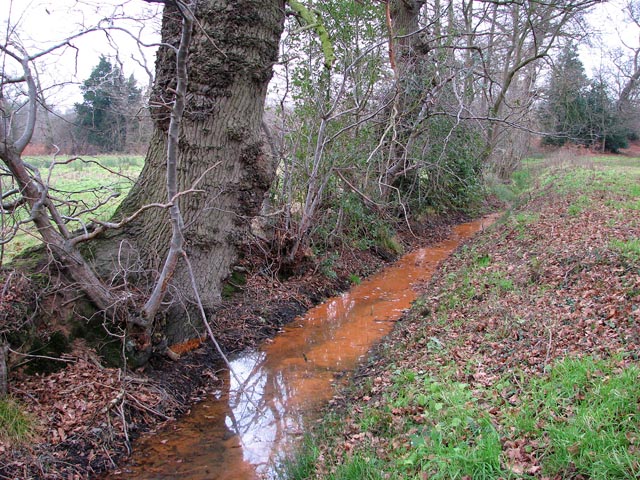
War Water, which is also commonly called Mars Water or Iron Water, is in its most essential form, simply water in which iron has been allowed to rust. The presence of iron in the water gives it a reddish-brown hue, looking a bit like blood even in some cases. Draja Mickaharic makes a good case for why iron’s presence in the water empowers it:

“Iron is the metal of the planet Mars, the planet astrologers credit with ruling warfare and combat, as well as sex. Used either for defense or attack, war water is a strong carrier of the negative emotional energy used in magical battles” (Century of Spells, p. 27).

Mickaharic also points out that the formula was originally used to treat anemia (an iron deficiency in the blood), though far better treatments are now available. Cat Yronwode notes on her site that the Martian association indicates that it is not originally an African recipe: “Since the Roman god Mars was the god of war and his symbolic metal was iron, it seems pretty clear that War Water is a European contribution to hoodoo” (“War Water” par. 1). Despite its origins, however, this particular magical mixture is firmly planted in hoodoo and conjure practice now.

So how does a person make War Water? Almost every source—except one—agree that the basic recipe involves putting cut iron of some type into a container, covering it with a bit of water, and letting it rust. There are plenty of variations, sometimes depending on the intent, and sometimes just depending on who’s telling you how to make it. Judika Illes breaks down the formula by intent:

Protective War Water

  • Iron nails (cut iron), ones that rust easily
  • Enough water to cover nails in a mason jar
  • Let rust for about 7-10 days (open periodically to allow oxidation)
  • Keep adding water as the rust builds
  • Strain and use as needed (but discard if bacteria form)

Malevolent War Water

  • Thunderstorm water in a jar
  • Rusty nails, sulfur, and urine

(Encylopedia of 5000 Spells, p. 1080)

This formulation is essentially the same as the one found in Draja Mickaharic’s Century of Spells, though Mickaharic’s version is a bit looser, calling for about 3/4 pound of cut iron nails in a 2 quart bottle. These are covered with tap water and allowed to rust. After the rust begins, more water is added, and the bottle is covered (though occasionally uncovered for rusting purposes).

The alternative recipe comes from the normally quite reputable Zora Neale Hurston’s “Hoodoo in America,” in which she describes War Water as “Oil of Tar in water (filtered)” (p. 412). Oil of Tar is essentially a thick distillate of creosote or burned pine resin—which is carcinogenic and dangerous. A reasonable substitution for Oil of Tar would be turpentine, another pine distillate with slightly less caustic properties. However, almost every formulary I found other than Hurston’s had separate distinctions for War Water and a formula called “Tar Water,” which is much more like Hurston’s recipe and which is used to remove psychic sludge from one’s life. I would then conclude that Hurston recorded the Tar Water recipe as a War Water recipe in error, or quite possibly an editor inserted this formula without knowing the difference (which commonly happened to Hurston’s work).

There are also additional ingredients that you can add to the water to help “flavor” it for your magical purposes. One of the most common additions is Spanish moss, a dense vegetal beard which covers trees in the Deep South. Once it begins to rot in the liquid, it turns the mixture black and gives it a decaying scent. Adding sulphur or gunpowder would also give it a powerfully aggressive and dangerous vibe. My teacher, Stephanie Palm, makes a formula that basically takes Mississippi River water and turns it into War Water with these sorts of additions in it, which she calls “Swamp Water.”

Once you have War Water, how do you use it? There are several methods for deploying this water, depending on just what your final intent might be. If you only intend to use the most basic rust-water formula for protective purposes, here are some ways you might apply it:

  • As an addition to a spiritual bath
  • As a wash for the outside of your home or business
  • As a sprinkle for any letters or papers you might be sending out to someone hostile to you (such as legal papers)

The most common use of War Water, however, is as a component of psychic warfare. Cat Yronwode says of it:

“To use it, you shake a bottle up and hurl it at the doorstep of your enemy, where it should break, leaving a rusty, dangerously sharp mess for him or her to step in. When i was a young woman coming up in the East Bay in the 1960s, War Water was used by fractious root workers to declare occult war on each other. Since these folks were already at odds to the extent that they could not simply walk into each other’s yards and smash the glass bottle on the doorstep, they would make “drive by” attacks, rumbling through the residential streets of Oakland in the midnight hour and tossing bottles of War Water into the yards of their enemies, like occult Molotov cocktails. Ah, those were the days …” (“War Water” par. 4).

In Jim Haskins’ Voodoo & Hoodoo, he says that to use War Water you should “obtain the nest of a dirt dauber, break it apart and mix it with graveyard dirt. Put the mixture in a bottle with War Water and shake it up. Smash it on the person’s walkway” (p. 130).  Hurston does not mention smashing the bottle, but she does call for sprinkling it in front of an enemy’s house. She also provides a secondary method which requires that you “take a fresh black hen’s egg, make a hole big enough to get the egg out and take the names, pepper sauce and mustard and fill the egg up and soak it in War Water for nine days and throw ito ver the house, and it will cross the house and they will have to move away” (“Hoodoo in America,” p. 375).

As a final note, if you are considering starting a psychic war, Draja Mickaharic makes a good case for having sturdy defenses in place before beginning any attack:

“If you are going to declare psychic war on someone you should mop your stairs, porch, doorway, and any outside surfaces of your home on which anything can be cast or thrown before you begin the war. This ensures that you will be protected when the other person’s inevitable counterattack comes. In most cases War Water will cause any spell which is placed on your doorstep to rebound instantly to the sender.” (Century of Spells, p. 28)

So that’s War Water. My own personal inclinations with this water would be to use a railroad spike, coffin nails, and urine in a jar for defensive and protective magic, while perhaps using coffin nails, goofer dust, red pepper, sulphur/gunpowder, and Spanish moss for a more aggressive formula. But that’s just me, and quite frankly I have yet to need either of these formulas. My only real experience with War Water thusfar is as a spiritual bath for protection, and in that case only in it’s iron-and-water form. It seemed to work fine, so unless the need for a more advanced concoction presents itself, that’s probably as far as I’d take it.

If you have used this formula or one like it and want to share, please do.

Thanks for reading!

-Cory

Blog Post 129 – Upcoming Events

Good news everyone!

Today I have some very fun events to share with y’all about events coming up later in the year.  These will be opportunities to meet with one or both of your New World Witchery hosts, as well as to meet and greet other great people as well.

The Second Annual Pagan Podkin Supermoot
We mentioned this in our last episode, but both Laine and Cory will be attending the Second Annual Pagan Podkin Supermoot in Salem, MA, on the weekend of Sept. 17th, 2011.  This is a gathering of Pagan and witchy podcasters from across the continent (we even have Canadians coming!), and there will be a big meet-and-greet on Saturday, Sept. 17th, at the Omen store. Fans are encouraged to come out and meet us, ask questions, be horribly disappointed in how boring we really are, etc. Some of the other podcasters who will be there include:

Other podcasters may come, too, though they haven’t been able to confirm yet. There may be workshops and classes as well, though details are still being worked out at this point. We will probably also have a group lunch that day which fans will be able to attend, too.  If you want to stay up to date on happenings with this event, check out the PPSM2 Website, and watch for tags like #ppsm2 on Twitter and Facebook.

A note on this event: While we both want to meet our fans and get to know you all, we do please ask that you not take any photos of Laine—she is still in the broom closet and can’t risk exposure. We’ll try to come up with something clever to allow you to still get a photo (maybe Cory in a wig or a sock puppet of some kind), but we hope you’ll understand about this issue.

West KY Hoodoo Rootworker Heritage Festival
This event will be taking place the weekend following PPSM2, from Sept. 23-25, 2011. It’s going to be focused on Southern Conjure practices, with an emphasis on hoodoo, rootwork, Pow-wow, granny magic, Vodoun, and Santeria/Lukumi. Some of the guest presenters will be:

  • Jack Montgomery, author of American Shamans, NWW friend & interviewee
  • Stephanie Palm, owner of Music City Mojo and Cory’s conjure teacher
  • Temperance, owner of Temperance Alchemy and magician, healer, & interfaith minister extraordinaire
  • Cory, from New World Witchery (hey, that’s me!…still not sure what I’m going to teach, but I’ll post that as soon as I figure it out)
  • Telling Point, a musical act featuring a deep tribal rock sound

This festival is still in its early planning stages, but it will likely be growing and adding new guests, performers, and workshops between now and the end of summer.

The Heritage Festival is put on by the Spirit of the Earth Church and will take place near Hopkinsville, KY. It’s a multi-day camp-out type of festival, so be aware that you’ll need to bring your own tent or find a hotel nearby.  Cory will definitely be attending at least part of the weekend.  For more information, check out the event website. Updates will likely be made frequently, and we’ll try to mention it again as time gets closer for it.

There may be other events we mention or post as time goes on, but for now these are the two places you will be able to find at least one of us in person.

Hope to see you all soon!  As always, thanks for reading!

-Cory

Podcast 30: Magical Professions

-SHOWNOTES FOR EPISODE 30-

Summary
This episode is all about the magical professions found in folk and fairy tales. Laine discusses weaving in WitchCraft, and Cory looks at iron and War Water in Spelled Out.

Play:

Download:  New World Witchery: Episode 30

-Sources-
The Element Encyclopedia of Witches & Witchcraft, by Judika Illes

Some of the fairy tales and folklore we reference are:

We’d like to ask our listeners to consider giving to funds like the Tuscaloosa Disaster Relief Fund or the Heart of Missouri United Way in light of recent natural disasters in those areas.

Please also consider donating to the Red Cross Disaster Relief Fund, which is currently helping victims of severe weather across the country.

Finally, both Laine and Cory will be attending the Second Annual Pagan Podkin Supermoot in Salem, MA, on the weekend of Sept. 17th, 2011.  Find out more details about the event and opportunities to come meet us in person at the PPSM2 Website. [Laine respectfully asks that she not be in any photographs, due to privacy concerns—Cory will be happy to wear a wig and pretend to be Laine, however].

Promos & Music
Title music:  “Homebound,” by Jag, from Cypress Grove Blues.  From Magnatune.
Promo 1 – The Infinite & the Beyond
Promo 2 – Lakefront Pagan Voice
Promo 3 – Pennies in the Well

Blog Post 128 – Iron

North American history has a funny relationship with iron.  On the one hand, iron is largely behind the early expansion that allowed Europeans to dominate the continent so completely with weapons, locomotives, and durable goods and architecture.  On the other hand, it has also been a curse used to inflict injury and death on undeserving people and leading others to rip the very soil of the land apart in search of it.  So maybe it’s not so much of a “funny” relationship as it is one fraught with difficulty and complexity.

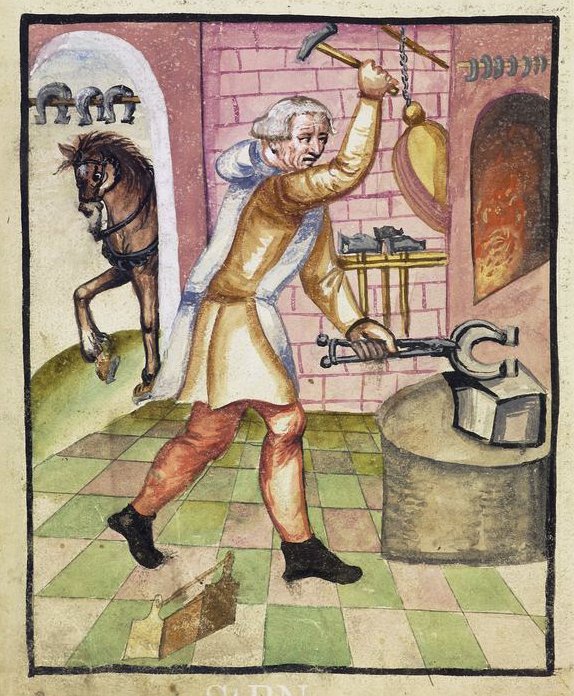
American folklore, however, has largely good things to say about iron.  It’s a powerful anti-witchcraft charm and can be used to repel things like wicked fairies attempting to replace a baby with a changeling.  It can come in the form of nails, railroad spikes, horseshoes, or even just random flakes falling as refuse from a blacksmith’s anvil.

Today I thought I’d look at a few of the bits of folklore regarding iron.  Before we look at the New World side of things, though, let’s look at iron in a slightly older context: Roman superstition.

“The taboo on iron dates from the beginning of the Iron Age when religious conservatism forbade the use of the strange new material in place of the usual bronze. It has been suggested that the magic significance of iron arose from its susceptibility to magnetism which, as the superstitious Romans often believed, it derived from witchcraft” (from Taboo, Magic, Spirits, by E.E. Burriss)

Here we see that iron is associated with witchcraft and has a somewhat negative reputation.  Even the Romans, though, were not averse to using witchcraft to fight witchcraft, and so iron became a de facto tool for combating wicked witchery, and by extension, any other harmful supernatural force (ghosts, demons, fairies, etc.).

Other cultures picked up the thread (or started their own threads), seeing iron as a powerful magical tool.  African, pan-Celtic, and Northern European cultures all had particular beliefs about iron and its more enchanted properties, so it probably surprises no one that the Old World traditions regarding iron became the standard beliefs in the New World.

So what are those New World beliefs?  Let’s look at some examples from a few different areas:

From the Colonial Period, South Carolina
In the Joshua Gordon “Witchcraft Book,” (also sometimes called a Commonplace Book) dated from 1784, there is an example of the type of charm typically imported to the colonies from places like England and Ireland in which a heated iron is used to scald milk from a bewitched cow in order to undo witchcraft:

“A cow losing milk could be cured if its owners would ‘take a heather belonging to a box Iron, put it in the fire, and make it Red hot [and then] take the milk of the cows thats hurt [and] power [i.e., pour] on the hot iron repeating the names of the blessed trinity’” (from “ Magic, Astrology, and the Early American Religious Heritage, 1600-1760,” by Jon Butler in The American Historical Review).

This method is commonly found in folktales from Appalachia, such as the next entry.

From the late 19th- or early 20th-century, Tennessee (Appalachian foothills)
Again, a hot iron is used to scald milk and thus undo bewitchment:

“Another case of the use of heat, combined with iron and steel, is shown in the following account, also resulting in injury to the witch and her exorcism. Lewis Hopkins, formerly of Big Creek just beyond the park bounds [The Great Smoky Mountains National Park] told this unusual tale:
My grandmother’s folk had a cow and she give bloody milk.  An old lady, a Phillips, was accused of being a witch. So they got to talkin’ to Sam Evans who said he was a witch doctor and knowed about witches. The witch doctor told the folks to put a baker lid [i.e., the lid of a Dutch oven] in the fire. So they pecked it on with a reap hook [like a scythe or sickle]. So this old women Phillips come to this old man Evans and raised a fuss with him about tellin’ him what to do. They got into a fight and this old man pulled her dress up and they saw the pecks where they was a reap hook a-hackin’ at her. [But] she jumped out and got away from him” (from A Tennessee Folklore Sampler, by Ted Olson, et al).

Other cases of heated irons being used to procure magical results also abound, as we shall see momentarily.

From the 19th-century, Mississippi
In some places, iron implements are not so much valued as remnants of iron from a blacksmith’s shop.  Here is one account of “anvil dust” as it relates to Southern conjure practices:

“Anvil dust is also greatly valued as conjure material. One educated blacksmith of Columbus, Miss., tells me that people are constantly coming into his shop to get the black flakes that fall from the hot iron when it is pounded, although they always look ashamed and give a fictitious reason as to why they want it” (from Folk Beliefs of the Southern Negro by Newbell N. Puckett).

This anvil dust is basically iron filings or flakes, and can be found in hoodoo practice as food for magically empowered lodestones.  Or it can be used to help create a cursing formula known as War Water (I’ll hopefully address the creation of this product in a separate post).  Interestingly, these two uses would seem diametrically opposed, with one being the food for an attracting magical fetish, and the other being an ingredient in a banishing potion. I would assert, however, that in these cases the iron serves a similar function on a magical level—with the lodestone it helps broaden the field of attraction for the stone while simultaneously running bad luck away, and in the War Water it’s repelling evil.  So in both cases, there is an element of something being turned away.  That is simply a way for me to reconcile these differences, however, and my come down to rationalization.

From the 19th– or 20th– Century, Ozark Mountains
Old favorite of New World Witchery, Vance Randolph, lists several methods for using iron as a magical tool (I omit the horseshoe lore which I have previously covered in another post, however):

  • “Nails taken from a gallows are supposed to protect a man against venereal disease and death by violence. Country blacksmiths used to secure these nails and hammer them out into finger rings”
  • “A little iron wire worn as a necklace, according to some power doctors, will protect a child from whooping cough”
  • “The water in which a blacksmith cools his irons is supposed to be good for witched cattle and is  sometimes given to human beings also, particularly children” (from Ozark Magic & Folklore, by Vance Randolph)

The last method mentioned is one I found repeated in several sources.  The power and provenance of “anvil water” or “slack water” seems to be well known across several cultures.

From the 20th-century, Illinois
To illustrate my point from the last section, I thought I’d share a bit of folklore from the Midwest, collected by ethnographer Harry M. Hyatt (who famously collected much of the lore about Southern conjure and hoodoo practices):

  • “A piece of old iron hung over the front and back door prevents the spirit of the recent dead from haunting you”
  • “Five nails driven into the trunk prevent the fruit from falling off the tree.  ‘My father did this when fruit was dropping off: drive those old- fashion square iron nails in the tree to hold the fruit on the tree. Never use wire nails; it must be the old iron nails’”
  • “Water from the tub in which a blacksmith cools hot iron is a good wash for the sore udders of a cow”
  • “A broken-winded horse (a horse with heaves) becomes well, if given water in which a blacksmith cools hot iron”
  • “Your looks will be improved if you wash your face frequently with the water in which a blacksmith cools hot iron”
  • “Slack-water, the water in which a blacksmith cools hot iron, is a good wash for poison ivy” (from Folklore of Adams County, by Harry M. Hyatt).

The first two bits are interesting, especially with the death connection, but the last four show that the slack water was considered a sort of cure-all magical formula.  I don’t know about you, but I think I need to make friends with a blacksmith, and quickly!

That’s it for iron, for now at least.  What I’ve written here is only the tip of a very large and ferrous iceberg.  As I said, I didn’t get into the related topic of War Water in the hopes it will appear in another post at a later date.  And I also didn’t touch on the lore of blacksmiths, specifically, as I hope to cover that in some depth later (our next podcast will have a bit about them, in fact).

If you have any local or family lore regarding iron and its magical properties, I would love to hear them!

Thanks for reading,

-Cory

Podcast 29 – An American Shaman

-SHOWNOTES FOR EPISODE 29-

Summary
Today we talk with author and American folk magician/shaman Jack Montgomery.  Then we have some listener feedback and a few announcements.

Play:

Download:  New World Witchery – Episode 29

-Sources-
American Shamans, by Jack Montgomery
Strange Experience: The Autobiography of a Hexenmeister, by Lee Gandee
Fifty Years as a Low Country Witch Doctor, by Sheriff J. E. McTeer
High Sheriff of the Low Country, by Sheriff J. E. McTeer

If you would like to donate to the Japanese relief effort, here is the Peter Dybing page we mentioned in the show.
Please also consider donating to the Red Cross Disaster Relief Fund, which is currently helping victims of the Alabama Tornado.

Promos & Music
Title music:  “Homebound,” by Jag, from Cypress Grove Blues.  From Magnatune.
Promo 1 – Irish & Celtic Music Podcast
Promo 2 – Dr. E’s Conjure Doctor Products
Promo 3 – Magick & Mundane
Promo 4 – Forest Grove Botanica

Blog Post 127 – Summoning Devils

In Blog Post 126 we looked a little bit at the Devil as a folkloric figure in American witchcraft.  One of the questions I received in response to that post was, “but how do I meet him?”  Is the Devil an entity anyone can just summon up?  Do you have to be careful to call the “right” devil so as not to wind up with more on your plate than you can handle?  And if you do meet the Devil, how do you come away with your soul intact (assuming you want to)?

Today I thought I’d look at some of the ways, folklorically speaking, that people have been known to get into contact with the Devil or other “dark” spirits.  Some of these are based on old European folk traditions, and some call a figure which may or may not be the Devil, but which certainly shares traits with him (trickster nature, otherworldly knowledge, granting of gifts, etc.).  A word of warning before we dive in, though: Do NOT attempt any spiritual summoning work or diabolical contact without the proper precautions—while dark spirits can be powerful allies, they also can have a dangerous side and should be treated with respect and caution.

So, with that being said, let’s look at some of the main ways to meet your devil.

Invocation & High Magic

If you’ve ever read Christopher Marlowe’s Faustus, you’ll be quite familiar with this method.  In this late 16th century play, Dr. Faustus (quite possibly based on a real person), learns the art of high magic and uses a magic circle to call forth a devil named Mephistopholes, who will act as his servitor on Earth in exchange for his soul.  He seals his pact with blood, and pretty much gets what he wants for a while (including Helen of Troy), then gets dragged off to hell for his final punishment.

In Marlowe’s version, the imp is a distinct entity, and in some versions of the legend he takes on the form of a dog or other animal to serve Faustus as a familiar.  Shakespeare, contemporary to Marlowe, also knew a bit about diabolic invocation through high magic.  In his Henry VI, part 2, Shakespeare demonstrates a different version of how such a meeting might go.  In Act I, scene iv, a conjurer named Bolingbroke summons the spirit of a devil named Asmath into a witch named Margaret Jourdain (based on a real woman and accused witch named Margery Jourdayne), then proceeds to interrogate the demon for information.  He dismisses the devil just before royal authorities break in and arrest everyone present for heresy and treason.

So here we have two methods inherited from the grimoire traditions of old Europe: direct appearance and possession.  Owen Davies gives an excellent overview of these traditions in his appropriately titled Grimoires: a history of magic books.  These late-antiquity and medieval methods of making contact with nefarious forces also found popularity in the New World, mostly through grimoires like the Grimoire Verum, Albertus Magnus’ Egyptian Secrets, and derivative texts drawn from such sources.  These tomes influenced magical systems like Pow-wow and hoodoo, though the specifically diabolic elements were often highly diminished by the time they reached the hands of folk practitioners.  The exception to this is that the seals found in the Sixth and Seventh Books of Moses were still used for magical purposes, and several of those seals are specifically designed to invoke diabolic aid from entities like Mephistopholes and Leviathan.

Should you get the urge to perform any of these types of invocations—and I reiterate my warning about being prepared and knowing what you’re doing first—here are several rituals you might try:

  • The Grimoire Verum – This text says that America is ruled by the devil Astaroth, whose sigils are included for your invocational purposes.  Please note that you should probably learn a little bit about basic Solomonic invocation and banishing from the Key of Solomon first, though the Grimoire Verum does give a little instruction in these areas as well.
  • The Sixth & Seventh Books of Moses – There is a lot less instruction here than you would find in some of the other grimoires, so if you’re not versed in summoning and dispelling, you may need to look elsewhere.
  • Dr. Faustus – Here is the text used by Marlowe for his Faustian invocation.  Bear in mind that this was designed to be staged, so use it more as a guide than a rote ritual to be followed.
  • Henry VI, part 2 – Shakespeare’s text for invocation and bansishment.  Take with the same grain of salt you used with Marlowe’s work.

Meeting the Devil

On the more folkloric side of things, the common method for contacting a devil of some kind involves a journey to a liminal or wild place where he is thought to reside.  In most cases, the Devil can be found either at a crossroads or in a forest of some kind, though there are exceptions (many modern stories of meeting the Devil involve transportation or big cities, e.g. Robert Bloch’s Hell-Bound Train, Ray Bradbury’s Something Wicked this Way Comes, and the cult film Rosemary’s Baby).  Probably the most famous ritual is the crossroads ritual, which I’ve mentioned here before.  As I’m planning to do an article on the crossroads as an independent magical space, I won’t go into great detail, but rather just say that Cat Yronwode has a great entry on the crossroads for those who are interested.

The forest or wild place meeting is a common folkloric theme across many cultures.  There are, of course, the Teutonic tales of meeting various wild spirits or devils in the forest, as in the Grimms’ tales of the Devil (see “The Devil’s Sooty Brother,” or “The Devil’s Grandmother”).  There are biblical precedents for these sorts of meetings as well—Moses encounters the burning bush in the desert, which is at least terrifying if not outright diabolic.  Three of the gospels also recount the story of Jesus being tempted in the desert (an analog for wilderness in biblical terms).  American folklore picks up this thread, and stories of meeting the devil in wilderness are quite common.  “Young Goodman Brown,” by Nathaniel Hawthorne, features such a meeting, and at least one scholar has brought the idea into the twentieth century by suggesting that “Men in Black” sightings associated with UFO’s in rural areas may be connected to devil lore.

The other alternative to the forest meeting is the graveyard meeting.  Usually in this version of the story, the person meeting the Devil must also do battle with him.  It can be a battle of wits, but just as often it is a physical wrestling match which parallels the interior struggle of the person confronting his or her fears by meeting the Devil in a graveyard in the firstplace.

So how does someone put this kind of meeting into practice?  Will devils always show up in graveyards after dark?  Will someone wandering in the forest or through a crossroads inevitably meet a Man in Black of some kind?  Sadly, I have no answers here.  All I can say is that if you’re truly moved to attempt these sorts of rituals, the Devil tends to show up in some form or fashion.  So if you’re interested in pursuing this line of contact, you could:

  • Attempt the Toad’s Bone ritual, which terminates with a graveyard wrestling session or a bout in a river
  • Give the Greased Plate method a try (mentioned in Blog Post 50 and found in The Silver Bullet, p.24)
  • See what happens if you do a Crossroads Ritual for a certain amount of time
  • Or, just wander to any of these kinds of places, swear yourself to the Devil (or in many cases, against God), and call out to the Devil to come and offer you terms of some kind—a new skill, riches, knowledge, etc. in exchange for service or something intangible like, oh, say, your soul.

One final thing I should mention is that the best-case scenario in many of these stories usually involves a person quick-witted enough to outsmart the Devil.  So always be aware of just what you say to any devil you meet, and make sure you leave loopholes for yourself if you promise them anything.  They seem to enjoy a good trick, so it’s a win-win if you can outsmart them.

Again, please be careful with this sort of magic. It has the potential to be dangerous, and at the very least it’s a little intense and can run you afoul of the law if you’re not cautious (loitering at crossroads or in graveyards tends to get the police rather grumpy).  If you do have any good experiences with this sort of work, though, please share!  I’d love to hear it!

Thanks for reading,

-Cory

Blog Post 126 – Walpurgisnacht 2011

A Hornie Fellow

Stones and bones, brooms and fire.  In the olden days, the night before May 1st was spent burning brooms or effigies of witches in big bonfires to ward off evil.  Witches were thought to gather at the Brocken, a mountain in Germany where they held their strange revels around infernal fires of their own.  Dead things might come galloping up out of their graves to follow the witches and join in their wicked revelry.  Wild storms preceded and followed the witches and the Wild Hunt on their nighttime gallivants.

It’s terrifying stuff, but like most fairy tales, people don’t really believe in it anymore.  But maybe they should.

I’ve loved Walpurgisnacht since I first started observing it as a complementary holiday to the more often observed Beltane or May Day.  I even did a post on it last year, which has been one of my most popular posts to date, actually.  This year, the group I do my social witchcraft with celebrated Walpurgisnacht together, and it may have been one of my favorite gatherings to date.

It started with a bonfire in a park about 500 feet from a big Boy Scout campout.  Or, rather, it really started the day before when I am sure I piqued the curiosity of a few neighbors by hiking into our local woods, dropping handfuls of something powdery and muttering to myself at certain locations on the forest perimeter, then emerged moments later with a big, heavy object under my arm.  I spent the rest of the day piecing together all of the elements I would need to fulfill my duties at Walpurgisnacht—sorting candles, making magical gifts for my co-coveners, bringing the appropriate skulls and bones and broom and stang down to my car under cover of darkness so I wouldn’t have to drag them out the next day while the neighbors looked on (they already had enough reason to look at me funny, why add to that?).

When I pulled into the camp, the scouts were swarming.  As I struggled to gather some firewood from a rather flooded site, a number of the boys approached, waving glo-sticks and flashlights and demanding (in a charmingly pirates-and-lost-boys way) “Who goes there?!”  Apparently some older kids had been running around trying to scare them earlier, so I had to vouch that I was not, in fact, a “robber” as they put it.

New Brooms Against an Old Tree

By the time our leader  had arrived, the scouts had pretty much removed themselves to the far side of the camp and were engaged in what looked like a snipe hunt (bless ‘em). We  got the fire going and arranged everything we would need for the night.

I can’t say too much about what happened next, but I will say that the following things may have been involved:

  • Black-strap Molasses Rum offerings
  • Leaping the fire on a broom
  • Hedge-Crosser’s Smoke from Forest Grove Botanica
  • An exchange of several magical gifts
  • I may have worn lipstick at one point
Because it's just not a party until someone breaks out the ram's skull...

Walpurgisnacht proved to be a great night for a few witches to gather around a bonfire, calling upon the dead, riding brooms, leaping through flame, and generally doing all the things the fairy tales say.  We may not have had storms on the Brocken, but the winds definitely started rising before all was said and done.  At one point, I very seriously had to say, “If you hear the sound of horses’ hooves, drop to the ground and don’t look up.”  Maybe it was just my imagination at that point, but the air certainly seemed ripe with witchery.

So, what did you do on Old May Eve? (Or the next day, for that matter.)

-Cory