Blog Post 26 – Gravel Root/Joe Pye Weed

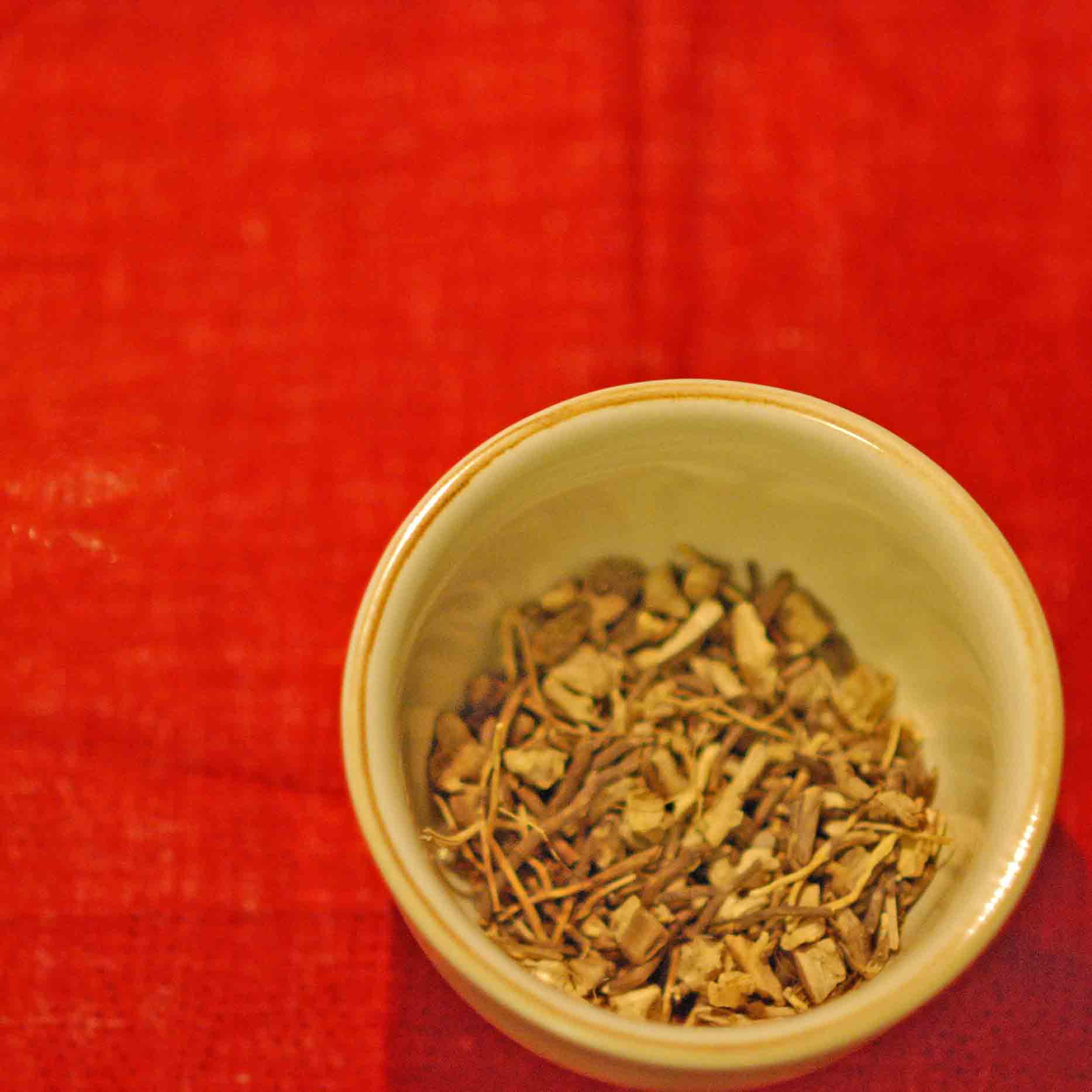
Today I’d like to discuss an ingredient found in both Native American medicinal practices and Southern conjure and root work.  The flowering herb known as both Gravel Root and Joe Pye Weed can be found throughout most of the eastern half of North America, including portions of Canada, Texas, and Florida.  Its botanical name is Eupatorium purpureum, and it is also sometimes known as Purple Boneset or Queen of the Meadow.

The story behind Joe Pye Weed stems back to a Native American named, aptly enough, Joe Pye, who used the root to heal typhus.  It’s been used in tisane form—both root and flower—to help with kidney problems (though I will recommend here that if you are considering drinking ANY tea made from an herb to consult with a health professional and be SURE you know what you’re drinking).  Foxfire 11 gives some good information on the traditional medicinal use of this wild herb.

The plant itself is often found as a wildflower in fields and “waste” spaces like construction zones (though it doesn’t last as long here).  It’s a perennial so if you cultivate it instead of wildcrafting you should see it coming back regularly.  Joe Pye can reach heights around four feet, so take that into account when planting it.  It can also reseed, so you might want to thin them occasionally.  It has flowers which range from white to pinkish to lavender and purple, and butterflies love it.

Its magical uses tend to be split depending on what part of the plant you’re using.  The leaves and flowers are considered “Queen of the Meadow,” and are not particularly used in traditional hoodoo, though I’ve seen it show up in a spell for success.  Catherine Yronwode mentions putting the flowers in a glass of water next to a burning candle to attract spirits and visions.  The root, which is often the most sought-after part of the plant, is a fantastic help in job-search, success, and luck magic.  I recently used a bit of Gravel Root in a mojo hand along with High John and a copy of Psalm 65 in order to help procure some magical aid with an academic pursuit, which turned out very well.

Joe Pye Root

You can find more on this herb/root in Catherine Yronwode’s Hoodoo Herb and Root Magic, as well as the websites listed below.

Thanks for reading!

-Cory

More information:

Medicinal and identification information – http://www.altnature.com/gallery/joe_pye_weed.htm

Cultivation and propagation information – http://oldfashionedliving.com/joe-pye-weed.html

Folklore and Appalachian history – http://appalachianhistory.blogspot.com/2007/08/queen-of-meadow-cures-all.html

Blog Post 24 – Book Review

Hello everyone,

So today I’d like to offer a review of a book I’ve cited several times on the blog already, Richard Dorson’s Buying the Wind.  It’s a book of folklore divided by region and focusing on the different stories, beliefs, and practices of those who inhabit those regions.  The regions he covers are broken down as follows:

  • Maine Down-Easters
  • Pennsylvania Dutchmen
  • Southern Mountaineers
  • Louisiana Cajuns
  • Illinois Egyptians
  • Southwest Mexicans
  • Utah Mormons

Each section then goes into further detail regarding the specific folklore of the regional group examined.  For example, under Southwest Mexicans, there is a section called “Proverbios” which contains the bits of folk wisdom like:

Dar atole con el dedo.

“To give gruel with the finger.”  (To deceive with words or acts, especially to deceive one’s husband).

Entre menos burros, mas olotes.

“The fewer donkeys, the more cobs.”  (The fewer, the better…corncobs, dried as well as green, are given burros to eat).

And under Louisiana Cajuns, in the section “Riddles,” we find:

What has a tongue and does not speak?  A shoe

What has teeth but does not bite?  A comb

If a man can lift two hundred and fifty barrels of rice when it is not raining, what can he lift during a rain?  An umbrella

Each section has its own unique attributes.  Some have the songs and proverbs of their region, some have stories and even some loose versions of “spells.”  I say loose because they aren’t exactly how-to’s on spellcraft, but provide some information that could be turned into a how-to pretty easily.  For example, the Louisiana Cajuns section has information on Hoodoo, including a tale from one informant who described a luck mojo bag that “was a little bag of linen and it had like nerves and then bones.”  The nerves are from a vulture, and the bones from a snake, which both could be used in a lucky mojo hand (though I’ve never heard of nerves being used, per se, but that’s what makes these accounts so interesting—their variety).

The entire book is loaded with bits of magic like this, as well as stories of witchcraft and magic which, while more fanciful, give insight into what the occult practices of those areas might be.  In the Southern Mountaineers section, for instance, there’s an interesting account of a “witch-ball,” which is a bit of hair, wax, and other substances rolled into a ball and “shot” at a victim to curse them.  I’ve seen similar stories in other books of American folklore, especially based in the Appalachian areas, so it’s interesting to me to see how prominent such a magical tool seems to be in that area, though it is largely forgotten elsewhere.

I learned a great deal from this book—the entire section on Illinois Egyptians, for example, was a revelation to me, and has opened up a whole new area of interest for me regarding New World Witchery.  And the stories, songs, and proverbs are fantastic!  I can’t get enough of the Southern “Jack” tales!

I should point out that Dorson uses the Aarne-Thompson system of folklore classification, which divides tales into various types for ease of cross-referencing.  It is definitely a book aimed at folklorists and not particularly at a wide audience, but I think anyone can get a great deal from reading it.  And it may open up a whole new love of folklore as a field of study for some folks.

I’ve been reading a borrowed copy from my public library, and it’s just about due to go back there, which was going to be a sad loss, as I still find myself referencing Buying the Wind frequently.  But thanks to a generous donation from reader/listener Amber (many, many thanks to her!), we’ll be able to procure a copy for future reference now.  So hooray for Amber!

That’s all for now!  Thanks for reading!

-Cory

Blog Post 21– Final Call for Contest Entries!

Hi everyone!

Only a little less than three days left in our first-ever contest!  We’re giving a copy of Cat Yronwode’s Hoodoo Root & Herb Magic to one randomly chosen reader/listener who provides us with a little bit of weather folk lore from his or her family or region.  All you have to do is email us or leave a comment on Blog Post 10 – Weather Work with your general area (you can say “South” or “East Coast” if you like) and a tidbit about what folks say about the weather in your neck of the woods.  The deadline is February 28th at midnight, Central Time, so please get your submissions in before then.  We’ll be using these entries for a podcast on weather magic and folklore, so please write in!

Good luck!

Thanks for reading!

-Cory

Blog Post 17 – Contest Reminder

Hi everyone!

Just a quick reminder that there’s only a little over a week left in our first giveaway.  We’re offering a copy of Cat Yronwode’s Hoodoo Root & Herb Magic to one randomly chosen reader/listener.  All you have to do is email us or leave a comment on Blog Post 10 – Weather Work with some weather lore, preferably from your area or family.  The deadline is February 28th at midnight, Central Time, so please get your submissions in before then.  We’ll likely be putting together a show on weather lore soon and we’d love to have some field reports from out there in the wider magical community.

So good luck, and we look forward to hearing from you!

Thanks for reading!

-Cory

Blog Post 16 – An Introduction to Pow-wow, Part III

Hi folks!  Here is the final installment in my introductory Pow-wow series.  I hope you’re enjoying them!  Now, on to the magic!

Where can I find out more about Pow-wow?

There are many phenomenal resources on this subject.  Here are some of the books I like:

The Red Church, by Chris Bilardi
American Shamans, by Jack Montgomery
Signs, Cures, & Witchery, by Gerald C. Milne
Buying the Wind, by Richard M. Dorson (chapter on “Pennsylvania Dutchmen”)

And, of course, Pow-wows; or The Long Lost Friend, by John George Hohman (also available free at sacred-texts.com).

Additionally, I like this website and its accompanying newsletter:
Three Sisters Center for the Healing Arts

There are other books and resources which I’ve encountered either by proxy or by reputation which I’d also recommend seeking out, though I cannot give a strong opinion on their validity myself, yet:

Strange Experience: The Autobiography of a Hexenmeister, by Lee R. Gandee
Hex and Spellwork, by Karl Herr
The Pennsylvania German Broadside, by Don Yoder
The Pennsylvania German Society

Some Pow-wow Charms & Proverbs

Finally, as promised, here are some Pow-wow charms you can try out yourself.  I’d love to hear how they work for you, so please feel free to leave comments or email us about your results!  Please also note that I provide these for cultural, spiritual, and magical value.  They do not replace conventional medical or legal advice; please see a professional if you have needs in those areas.

First, a few from Hohman’s book:

HOW TO BANISH THE FEVER.

Write the following words upon a paper and wrap it up in knot-grass, and then tie it upon the body of the person who has the fever:

Potmat sineat,
Potmat sineat,
Potmat sineat.

TO STOP BLEEDING.

I walk through a green forest;
There I find three wells, cool and cold;
The first is called courage,
The second is called good,
And the third is called stop the blood

TO REMOVE BRUISES AND PAINS.

Bruise, thou shalt not heat;
Bruise, thou shalt not sweat;
Bruise, thou shalt not run,
No-more than Virgin Mary shall bring forth another son.
+ + +

(The three “+” signs at the end indicate making three crosses in the air over the patient or afflicted area, also sometimes saying the three High Names of the Father, the Son, and the Holy Ghost)

ANOTHER WAY TO STILL-BIND THIEVES.

Ye thieves, I conjure you, to be obedient like Jesus Christ, who obeyed his Heavenly Father unto the cross, and to stand without moving out of my sight, in the name of the Trinity. I command you by the power of God and the incarnation of Jesus Christ, not to move out of my sight, + + + like Jesus Christ was standing on Jordan’s stormy banks to be baptized by John. And furthermore, I conjure you, horse and rider, to stand still and not to move out of my sight, like Jesus Christ did stand when he was about to be nailed to the cross to release the fathers of the church from the bonds of hell.. Ye thieves, I bind you with the same bonds with which Jesus our Lord has bound hell; and thus ye shall be bound; + + + and the same words that bind you shall also release you.

(The conventional wisdom on releasing the thief is that the entire spell must be read backwards.  It’s nice to hold all the cards sometimes.  This charm is almost entirely lifted from entry #22 of the Romanus Buchlein, or Little Book of the Roma, a late 18th century grimoire and prayer book).

Here is a pair of charms which I am citing from Jack Montgomery’s American Shamans, but which he cites from an article entitled “Magical Medical Practice in South Carolina,” from Popular Science Monthly, 1907:

TO HEAL A SPRAIN

Christian Version

“Our Lord rode, his foal’s foot slade [slid],
Down he lighted, his foal’s foot righted,
Bone to bone,
Sinew to sinew,
Flesh to flesh,
Heal, in the name of the Father, the Son, and the Holy Ghost.  Amen”

Pagan Version

“Phol and Woden went to the wood, there was Balder’s colt his foot wrenched,
Then Sinthgunt charmed it and Sunna her sister,
Then Frua charmed it and Volla her sister, then Woden charmed it as he well could,
As well the bone-wrench,
As the blood-wrench,
Bone to bone,
Blood to blood,
Joint to joint,
As if they were glued together.”

(Montgomery, American Shamans, p. 102)

A classic Pow-wow blood-stopping charm, also from Jack Montgomery (and derived from a passage in Ezekiel, I believe):

And when I passed by thee and saw thee polluted in thine own blood, I said unto thee when thou wast in thy blood, Live; yea, I said unto thee when thou wast in thy blood, Live. (p. 253)

Here’s a more modern charm for protection during automobile travel:

“This is a written prayer that is used for protecting cars and other vehicles.  It can be simply folded and placed in the glovebox.

Our Heavenly Father, we ask this day a particular blessing.  As we take the wheel of our car, grant us safe passage through all the perils of trouble.  Shelter those who accompany us and provide us from harm by Thy mercy.  Steady our hands and quicken our eyes that we may never take another’s life.  Guide us to our destination safely, confident in the knowledge that Thy blessing be with us through darkness and light, sunshine and showers, forever and ever.  Amen.” (Bilardi, The Red Church, p. 284)

And I’ll conclude with a few proverbs from the Pennsylvania Dutch, as recorded in Buying the Wind, by Richard M. Dorson (pp.138-141).  Note that “German” here connotes the Pennsylvania-German dialect, not necessarily European German.

-German:  D’r hammer wert aus faerm ambos.
-English:  The anvil outlasts the hammer.

-German:  Waers erscht in di mil kummt grikt’s erscht gimale.
-English:  He that cometh first to the mill, grindeth first.

-German:  En blini sau finnt a alsemol en echel.
-English:  Even a blind pig will sometimes find an acorn.

I hope this series has been informative to you!  This won’t be the last time Pow-wow comes up here, of course, but I think it may be enough to get your feet wet on the subject.  If you try out any of these charms and have results to report or have any thoughts on the different folklore and opinions recorded here, I hope you will leave a comment or send an email and share them with us.

Thanks for reading!

-Cory

Blog Post 13 – Crown of Success

One of the things I hope to do on this blog is provide information on specific tools, formulae, ingredients, and objects used in American folk magic.  I hope that these blogs and podcasts will help the eager American witch to develop his or her practice by incorporating these components, or at the very least educate him or her about the different products available in the folk magic marketplace.

Today, I thought I’d focus on the hoodoo formula known as Crown of Success.  I’ve been using that one a lot lately, and it’s one of the ones I almost always have on hand or steeping in my pantry.  I’m sure many people could use a bit more success in their lives, so it’s a good one to have around for quick spellwork.

The recipe varies a bit from maker to maker, but almost all have a few ingredients in common:

  • Bay (as in bay laurel, not the bay which provides Jamaican bay rum)
  • Frankincense
  • Iron pyrite (“fool’s gold”)

There are several ingredients I’ve seen used interchangeably with key ingredients; lodestone can be used instead of pyrite, for example, since it acts as an “attractant” curio.  Likewise, some folks add gold flakes or glitter to the formula because of the association between gold and money/glory/success.  Additional herbs, roots, and curios can include things like master-of-the-woods, deer’s tongue, cinquefoil (also known as five-finger grass), sandalwood, vetiver, dragon’s-blood, etc.

Harry M. Hyatt records an informant in his Hoodoo – Conjuration – Witchcraft – Rootwork compendium who describes a mojo bag for success containing a lodestone, liquid mercury/quicksilver, iron filings, and a black cat bone (Volume 2, p. 1506).  WARNING!  Do NOT use liquid mercury under any circumstances—it is highly toxic and will cause damage or death if handled.  The black cat bone referred to is likely the magical talisman obtained (rather cruelly) by boiling a black cat alive in a magical ceremony and then collecting the bone in a special ritual.  I do NOT advise this, merely present it as a piece of folklore.  The modern formulae for Crown of Success do not depend on either deadly mercury or ritualized animal slaughter.

As far as how to use this particular formula, Lucky Mojo has an excellent page on Crown of Success formula at their site so I won’t go into much detail here.  Very generally, anything that involves gaining favor or accomplishing a goal—things like acing job interviews, applying for loans or grants, or mastering a new skill—can benefit from the inclusion of this product.

My own personal formulation of this recipe (for the oil version of it)  includes the following:

  • Bay leaves & oil
  • Cinquefoil
  • Frankincense tears & oil
  • Sandalwood chips & oil
  • Vetivert (herb & oil, if available)

In the master jar I also keep a rolled piece of paper with this line from Psalm 65 on it:

“Thou crownest the year with thy goodness; And thy paths drop fatness.” (Ps. 65:11)

There are several reliable sources for this oil out there.  I have to plug our shop, Compass & Key Apothecary, of course (forgive the rather paltry site, we’ll be revamping it soon, but you can certainly order any of our oils there).  But I would also heartily recommend Lucky Mojo’s Crown of Success products and Music City Mojo’s oils or mojo hands.  Based on the reputation of the root workers (as opposed to the individual products which I’ve used in the previous two examples), I would also go out on a limb and say that Toad’s Bone Apotheca and Forest Grove Botanica could both mix up a good blend of success formula if you ask them nicely.

One product I will recommend avoiding is Anna Riva’s Crown of Success.  It doesn’t smell “right,” and I’ve never had much luck using her oils in general.  Your mileage may vary, of course, and if you’ve had good luck with her products, I’d love to know about it.

That’s about it for this root work formula.  If you’d like to share your stories about working with it, we’re always happy to hear them.

Thanks for reading!

-Cory

Blog Post 10 – Weather Work

We recently received a nice blanketing of snow here (which is somewhat rare for our area), and it got me to thinking about weather magic.   When I was little, before we moved to the farm, I used to go out to the dirt hill near our house with a big staff in my hands and shout at the wind, seeing if I could get it to gust up or gentle down.  I remember feeling like I always had a strong connection to weather, particularly those winds.  When we moved out to the farm, my understanding of weather changed dramatically.  Our house was on a hill at the top of our acreage, and we were exposed to a number of tempests, some of which were quite severe.  When we had snow, 4-foot drifts piled up off of our back porch, deep enough that when I jumped into them I was buried up to my chest.  And  I still remember waking up one morning and looking out the window only to see a tornado receding back into the clouds after having passed but a quarter-of-a-mile or so from the house and uprooting a number of trees.  Being a teenager, I had slept through it, of course.

What I learned on that farm was that weather was wild, and would always be wild.  It’s something we can react to, prepare for, run from, or attempt to block out, but we can never really control it the way we like to think we control so many other things—the cleanliness of our water or where our next meal comes from, for example.  Magic seems to have the advantage over empirical science here, as many magicians swear by inherited techniques that allow them to control or predict the weather to one degree or another.

Today I thought it might be worthwhile to take a look at a few techniques, charms, and proverbs regarding the weather from various North American sources.

From Nova Scotia (in Folklore of Nova Scotia, by Mary L. Fraser):

“An Acadian boy would not dare to kill a toad or a spider, for his outdoor pleasure would then be spoiled by the downpour of rain that was sure to follow. A boy of Scotch or Irish descent would be deterred from doing so because it would bring him bad luck.

‘If you wish to live, not die,

Let the spider go alive.’”

I’ve heard this before as an admonition not to harm toads (and for some reason, I always assumed lizards) when out of doors, for fear of bringing on bad weather.  The spider is a new twist for me, but I generally try not to disturb any of the bite-ier creatures out in the wild world.

Mary Fraser also reports a weather-predicting system I’ve seen in a couple of places.  She mentions that the twelve nights between Christmas and Epiphany represent the coming twelve months of the year.  In other words, if you have cold, wet weather on the third day after Christmas, you can expect a rather clammy and dismal March.

From the Pennsylvania Dutch (in The Long-Lost Friend, by J. G. Hohman):

For protection of one’s home against storms, say “Beneath thy guardianship I am safe against all tempests and all enemies, J. J. J.”  (These three Js signify Jesus three times.)

Chris Bilardi, in his excellent book on PA-Dutch braucherei, The Red Church, suggests the following Psalms for weather-work:

  • Psalm 2 – For danger at sea (storms); also for headache
  • Psalm 21 – For dangerous storms at sea
  • Psalms 24 and 25 – For dangers of nature—especially the danger of floods
  • Psalm 76 – For averting danger from water

From the Appalachians (in the Foxfire series of books):

It will be a bad winter if –

  • Squirrels’ tails grow bushier
  • Crows gather together
  • The wooly worm has a heavy coat
  • Onions grow more layers
  • Blackberry blooms are especially heavy

It will rain –

  • Within three days if the horns of the moon point down
  • If  leaves show their backs
  • If cows are lying down in the pasture
  • If there is a ring around the moon (count the stars in the ring and it will rain within that many days)

The weather will be fair if –

  • You hear a screech owl
  • Smoke rises
  • Crickets holler (the temperature will rise)

Additionally, here are some bits of lore from the Appalachians:

  • If it’s cloudy and smoke rises, there’s a chance of snow
  • The number of days old the moon is at the first snow tells how many snows there will be that winter
  • For every frost or fog in August, there will be a snowy day in winter
  • A late frost means a bad winter
  • The darker green the grass is during the summer, the harder the winter
  • If it rains on Easter Sunday, it will rain every Sunday for seven weeks
  • If it rains on ‘Blasting Days’ (the three longest days of the year, there won’t be any ‘mast’ (acorns, chestnuts, etc.) for animals like hogs to feed on

From the Ozarks (in Ozark Superstitions and Ozark Magic and Folklore, by Vance Randolph):

Rain will come –

  • If the tall grass is bone dry in the morning, or if there is heavy dew
  • If rabbits play in a dusty road
  • If dogs start eating grass
  • If sheep turn their backs to the wind
  • If cats sneeze, wash behind their ears, or lick their fur against the grain

Signs of dry weather –

  • A red sunset promises at least twenty-four hours of dry weather
  • A rainbow in the evening means clear weather (but a rainbow at morning tells of a storm in the next twenty-four hours)
  • A ‘sundog,’ or a circle around the sun, indicates prolonged dry weather, or at least a radical change in weather soon
  • When the crescent moon travels ‘horns up,’ there will be no rain for some time

And finally, one of the most interesting weather-predictors around, also from the Ozarks:

“The blood of a murdered man—bloodstains on a floor or garments—will liquefy on even dry sunshiny days, as a sign that a big rain is coming”

This is only a small sampling of everything out there.  I’ve used many of these predictors (leaves turning their backs or cattle lying in a pasture) to prepare for bad weather, and there are many I’ve never even thought to pay mind to (rabbits in a dusty road, for example).  So what about you, dear readers?  Do you have any family or local lore regarding the weather you’d like to share?  If so, please post a comment or send us an email, and indicate roughly what part of the world you’re in and what your weather charm or proverb is.  We may do a show on these if we get enough interest!

I’d also like to issue a friendly challenge to you:  make mental note of a few of these and start paying attention to them.  See if they actually do predict or cause weather patterns for you in your area.  Report your findings back here and share your observations with the rest of us.  Who knows, we may read your results on the podcast, or something better (he said slyly).

I hope wherever you are, the weather’s treating you fair.  If it’s not, you can always contact your neighborhood witch.

Thanks for reading!

-Cory

Podcast 2 – Broom Closets and an Interview with Sarah Lawless

-SHOWNOTES FOR EPISODE 2-

Summary

On this, the second episode of New World Witchery, Laine and Cory discuss the ins and outs of broom closets.  In the second segment, we hear from the lovely Sarah Lawless, proprietress of the Forest Grove Botanica and keeper of many irons in many fires.  Then, we wrap up with a call for comments and emails from our listeners.

Play:

Download:  New World Witchery – Episode 02

-Sources-

Websites

From our guest, Sarah Lawless:

Forest Grove Botanica – a top-notch source for hand-crafted witchy and rootworking goods.

The Witch of Forest Grove – Sarah’s amazingly informative blog

Hedgefolk Tales – Sarah’s podcast on storytelling and lore with a witch-oriented slant

Lilith’s Lantern – A good overview of the Vicia branch of the Andersons’ Feri Tradition

Promos & Music

Title music:  “Homebound,” by Jag, from Cypress Grove Blues.  From Magnatune.

Promo 1-The Celtic Myth Podshow

Promo 2-Witchery of One

Promo 3- Pagan Parents on the Edge

Blog Post 7 – Into the Woods

I don’t get out into the woods as often as I like anymore.  I have an infant son to help care for, and a steady 9-to-5 job that eats up most of the best time for tramping through the forest.  Still, when I have the opportunity, I love to put on some old shoes and jeans (and a heavy coat in our current weather) and wander out into the thickest parts of the brush.  In summer, I have to carry a walking stick, as we are in rattlesnake country here (a rake works even better but is a bit more unwieldy), but in winter I can just bring a satchel for collecting things that I find out there.

I generally don’t go out expecting to find anything, though I do bring offerings and hand shears in case anything strikes my fancy.  Sometimes I get lucky and find a good set of fir or juniper branches for making incense or smudge sticks.  Often, I simply find animal trails and follow those to see where they lead.  Lately, I’ve been seeing a lot of interesting wildlife near our home, including bobcats, wild pigs, turkeys, deer, and—on one memorable occasion—a gorgeous smoke-colored owl.  It’s a great way to spend a day, getting lost in the winding trails and then finding my way home again when I can feel the sun starting to set.

Forests can be frightening, too, though.  Nature, red in tooth and claw, as Tennyson wrote, is not a gentle place.  There are many stories from around the world which use the forest motif to represent a “dark night of the soul” or a period of primal self-transformation, from which the heroes of the tales emerge stronger and wiser than before:  Little Red Riding Hood, Hansel & Gretel, Gawain and Dame Ragnell (itself based on the “Wife of Bath’s Tale” from Chaucer).  From even a simply physical standpoint, the woods can be frightening simply because there are truly wild animals there, some of which are very hungry.

Part of being a witch, in my opinion, is overcoming fear.  If a person fears the woods, that is fine, because a little fear is healthy and may keep him or her alive for another day.  But a witch should know that taking a deep breath and stepping off the path and into the woods is an act of fearlessness that can be rewarded by gifts greater than mere survival.  I’m not advocating that everyone must immediately go out into the forest and start poking at badgers with sticks, mind you—wisdom should temper boldness.  If one has no experience in traipsing about the wild places of the world, then hiking the nature trails in the local national park is a good place to start; at least, it’s a better place than wandering off into a bobcat’s den and surprising the rather toothy and claw-y beast unawares.

However, for the witch who can walk the wilds and follow an animal trail, there are often rewards for that fearlessness if he or she keeps eyes wide open.  This past weekend, while following a deer trail in the woods near my home, I was given a little gift for my efforts:

I found the skull and bones of what looks like a juvenile deer (I can’t tell the species exactly because some of the bone has been chewed away and there are no antler buds to go by either).  The bones were picked clean, likely at least 6 months old, and had only been partially buried by leaf litter.  I said a prayer of thanks to the spirits there, and poured out an offering before proceeding.  I had brought plastic bags in my satchel, so I used those to pick up and wrap the skull, some leg bones, what appears to be a piece of the sternum, and some vertebrae.  They were muddy, but partially sun-bleached, and when I got them home I managed to clean them off with a mild soap-and-water combination.  They still need to be set to soak in a peroxide solution to finish the bleaching, and then I will have to decide if I want to seal them or carve them first.  I’m thinking I may use the skull for some Otherworld workings, and I will probably try to carve the two leg bones into tools of some kind.  The vertebrae will likely be used for candle-holders.

I should note I wore gloves during the cleaning process, and until I have bleached them in peroxide, I probably won’t touch the actual bones—bacteria can be present for a long time in a dead animal’s remains.

I have deep reverence for the animal which has been gifted to me, and a fine appreciation of the wild place in which I found its bones.  I have to keep this respect front and center, because there’s always a chance that one day my own bones will be out there, buried in leaves and picked clean by wild things.  I can certainly think of worse fates than that, but for now I’ll be bold only so far as it is wise.

Thanks for reading!

-Cory

Blog Post 6 – More Colonial Witchcraft

I couldn’t resist the urge to share a few more witchy stories and spells from the early American period.  Let’s start with a little history.  Most folks know about the famous Salem, MA (or rather, Danvers, MA to be more accurate) witch trials.  While these were certainly a major phenomenon in our collective history, Massachusetts was only one colony among thirteen.  So what about witchcraft in the other colonies?

Generally speaking, witchcraft was not treated with such a hard nose nor such an iron fist in other parts of Colonial America.  Witchcraft was generally frowned upon, true, but only in that the term “witchcraft” meant intentional magical malfeasance against one’s neighbors.  Any such bad behavior—stealing, slandering, etc.—was met with equal disdain.  There were witchcraft trials, but these were mostly settled with civil penalties rather than criminal punishments, and religious insurrection did not seem to enter into the argument.  Gerald C. Milne, in his tome, Signs, Cures, & Witchery, describes one a Pennsylvania witch trial as overseen by state founder William Penn himself:

“Penn dismissed the charge of bewitching cattle…and suggested (tongue in cheek)that there was no law against ‘riding a broom’ in Pennsylvania.  He found her guilty onlyof having a ‘witch’s reputation’ and ordered her to practice good behavior.”

In Pennsylvania, the growing tradition of Pow-wow meant that most settlers in that area were at least familiar with the idea of magic, and recognized that it could be used to heal as well as harm.  Chris Bilardi, in his excellent book The Red Church, discusses braucheri, or German-American folk magic and healing.  He makes the point that in many communities, a braucher was an essential part of local life, and would no more have been thought of as a “witch” than a country doctor or veterinarian.

In Virginia, by 1706 it was a crime to accuse someone of being a witch at all, as it was a form of slander to a person’s character.  No acts of witchcraft after that time were brought to capital trial in that state.  In North Carolina, a similar legal precedent was set when a case was dismissed against a woman in 1712, despite her clear confession to the practice of witchcraft.  More is available on these incidents here and here.

Still, despite the leniency of most colonies, the chief impressions of American witchcraft from the early days of the Republic have been drawn from those dark days in Salem.  To that end, I thought it would be worth looking at a literary example of witch-lore.

Young Goodman Brown, by Nathaniel Hawthorne (I like this version myself, as it is a PDF, but a quick Google search of the title will yield webpage versions of the tale).

I’ll not reprint the entire story here, but I do recommend reading this chilling—and weirdly funny at times—tale of witchcraft in a Puritan village.  Hawthorne had a conflicted relationship with witches (his great-great grandfather was a judge at the Salem trials, a fact young Nathaniel would do his best to overcome).  The entire tale portrays the spectral encounter of its title character with a town full of occult and devilish witches, and doesn’t make the witches particularly sympathetic at first glance—in fact, the witches seem to be primarily interested in corrupting Goodman Brown and turning him into a diabolical reveler.  However, I tend to take the story’s “wicked witch” bent as being critical of the Puritan society to which Hawthorne was so embarrassed to have been connected.  There are MANY elements of traditional witchcraft embedded in this piece of fiction, including:

  • Meeting a fetch-self/”devil” on a crooked road
  • Crossing thresholds (forest boundaries or doorways, for example)
  • A serpentine staff, not entirely unlike a stang
  • A “flying ointment” recipe, of sorts
  • “Staff-riding” to travel great distances quickly
  • A Witches’ Sabbath, and an initiation (sort of)

In the end, Goodman Brown is unsure if his encounter was a dream or reality, but it leaves him changed anyway, which can be said for many witches and their experiences between the worlds, I think.

Finally, I thought another witchy (and somewhat less grave) story set in those early days might be a good way to end this post.  This one is from Rhode Island, and is recorded in In Old Narraganset, by  Alice Morse Earle-1898 (a word of warning, this tale is recorded from an earlier time, and the author clearly did not have a problem portraying racial stereotypes in the broadest and most demeaning fashion…I present the tale here because its magical significance is real, not because its characters or authorial tone are worthy of emulation).  From archive.org:

“The Witch Sheep” by Alice Morse Earle.

There are a few things I like about this story.  Firstly, that the magical aspects of the tale are fully integrated with daily life—no one questions Tuggie’s abilities, and her occult power doesn’t lead others to shun her unless she’s actually doing a working against them.  That the wife actually likes to have Tuggie around during soap-making because she can charm the project and make it work is particularly noteworthy to me.  Secondly, I think it’s interesting that “Voodoo” (which sounds more like hoodoo in this story) was a part of the magical landscape up in Rhode Island at this point, and that there are several types of spells with good hints as to how they might be executed in this tale.  The rabbit’s foot that Tuggie boils in the pot to work her “project” on Mum Amey makes me think that she was trying to cause her lots of little accidents and stumbles, but nothing seriously harmful.  Well, that or there was some kind of Fatal Attraction thing going on.  And the final thing I enjoy about this tale is that it is funny.  For all the magic in the story, and the hexing and witchery and other toil-an-trouble, in the end it’s a story about a sheep in drag, and that’s downright amusing.  At least to me.

Thanks for reading!

-Cory