Today I thought I might share a few of the things from my holiday stocking, as well as other treats and delights I’ve been enjoying lately. I got a very lovely and eclectic selection of books & music, some of which might be of interest to folks here, so if you find something among the pile that you like, I’d love to know!
The first thing I want to mention is a beautiful copy of Crossway’s Four Holy Gospels. It’s the English Standard Version (ESV) of the books of Matthew, Mark, Luke, & John illuminated using contemporary art by Makoto Fujimura. It’s a big, gorgeous clothbound edition and conveys a great deal of the mystical nature of these texts. I know it’s a bit odd to recommend a Bible of sorts on a site with so much magic and all, but if you’ve been around us for a while you know that we’re equal opportunity when it comes to mysticism and magic. So if you’re looking for a good heirloom version of the gospels with a little artistic magic, this is a good one to have.
In addition to the gospels, I got a copy of an excellent book called Kanaval: Vodou, Politics, & Revolution on the Streets of Haiti. It’s a photojournalistic look at the Haitian carnival costumes, parades, and traditions, and it will be of extreme interest to anyone captivated by the rituals of Vodou(n) or other African Traditional Religions. A number of lesser-known loa show up in the text, and there are oral histories from participants in the celebrations that are simply unmatched in recent history. In addition to the book and its magnificent photos, there are two accompanying CDs (one of which I received along with the gospels from my in-laws—I have an amazing family). One is called Spirits of Life, which has a number of ritual songs, and the other is Rara in Haiti and plays some of the more celebratory carnival jazz-style music. I also bought myself a simply wonderful new magical psalter from Troy Books: The Charmer’s Psalter, by Cornish witch Gemma Gary. It has fast become one of my favorite magical books and travels with me everywhere now.
Shifting from the authentic to the entertaining, I’ve been very much enjoying this year’s run of American Horror Story, subtitled Coven and set in a world of New Orleans Voodoo and witchcraft. I actually introduced Laine to the show, and she’s taken off running with it, consuming the first two seasons as well (subtitled Murder House and Asylum). I’m sure we’ll wind up discussing it more elsewhere, and it’s generating some controversy around the Pagan blogosphere, but if you’ve not checked it out and enjoy good, immersive horror, it’s fun to watch, in my opinion.
In that same vein, I’ve also been enjoying the kitschy-but-witchy antics of Witches of East End on Lifetime. I can’t say it’s a must-see, but the episodes I’ve seen have been enjoyable and if you’re a fan of things like Charmed, this might be fun, too. Might.
A lot has been going on in the podcasting universe lately, too. I’ve been tuning in to a couple of new shows, including The Kindle Witchwith Faelyn, Pagan Life Radiowith Brent/Raven, and one called Disney Story Origins. The first two offer some nice new elements to the Pagan podcasting world. Faelyn uses her show to explore books in a sort of book-club format, while also sharing a lot of neat moments from her own practice. Brent/Raven uses his show to create a really neat community space for talking to Pagans working on specific goals, or just get into good discussions about the role of Paganism in contemporary society. The Disney origins podcast is a gem, where the host compares and contrasts the stories that inspired Disney movies to the films and explores how that translation happens. The most recent episode gets into the excellent recent film Frozen and its inspiration, “The Snow Queen,” by Hans Christian Andersen (a section of which was included in our Yule show this year).
I’m also sad to say we’re losing at least one of our podkin for a while. Gillian at Iron Powaqa recently announced she’s taking an open-ended break from recording to focus on other projects. I completely understand her reasons, but she will definitely be missed. I fear this will be a trend, as several podcasters have disappeared this year. On a happier podkin note, Fire Lyte has published his first book of poetry, The Playground, which is available in several formats now. If you’re a fan of his poetry, this is definitely a book to get (plus it supports Pagan podcasting, which is always a noble cause). Finally, if you’ve not been listening to Peter Paddon’s revitalized podcast, do so! It’s the reason New World Witchery even exists, and he’s an absolutely charming fellow (all puns intended).
That’s all the news that’s fit to print for me this week! What was under your tree this year?
Don’t forget to enter our contests! We’ve got a NOLA Swag Bag contest finishing this Friday, and a Three Questions contest which will finish up next week. Give ‘em a go, and maybe win something fun!
There’s a bit of folk superstition about New Year’s Day that says whatever you want to be doing for the next twelve months, make sure you’re doing it on January 1st. You’re also not supposed to start anything you can’t finish, which brings me to this quick-n-dirty little blog post. I intend (dare I say hope?) that I will be doing a tremendous amount of writing over the coming year, including finishing several writing projects I’ve been working on for a while, so I wanted to make sure I wrote something for New World Witchery before midnight tonight. But I also have been using the day to accomplish a dozen other New Year’s magical traditions (cleaning, black-eyed peas, collard greens, etc.) so I thought a short and simple giveaway post might just kill the proverbial twin birds.
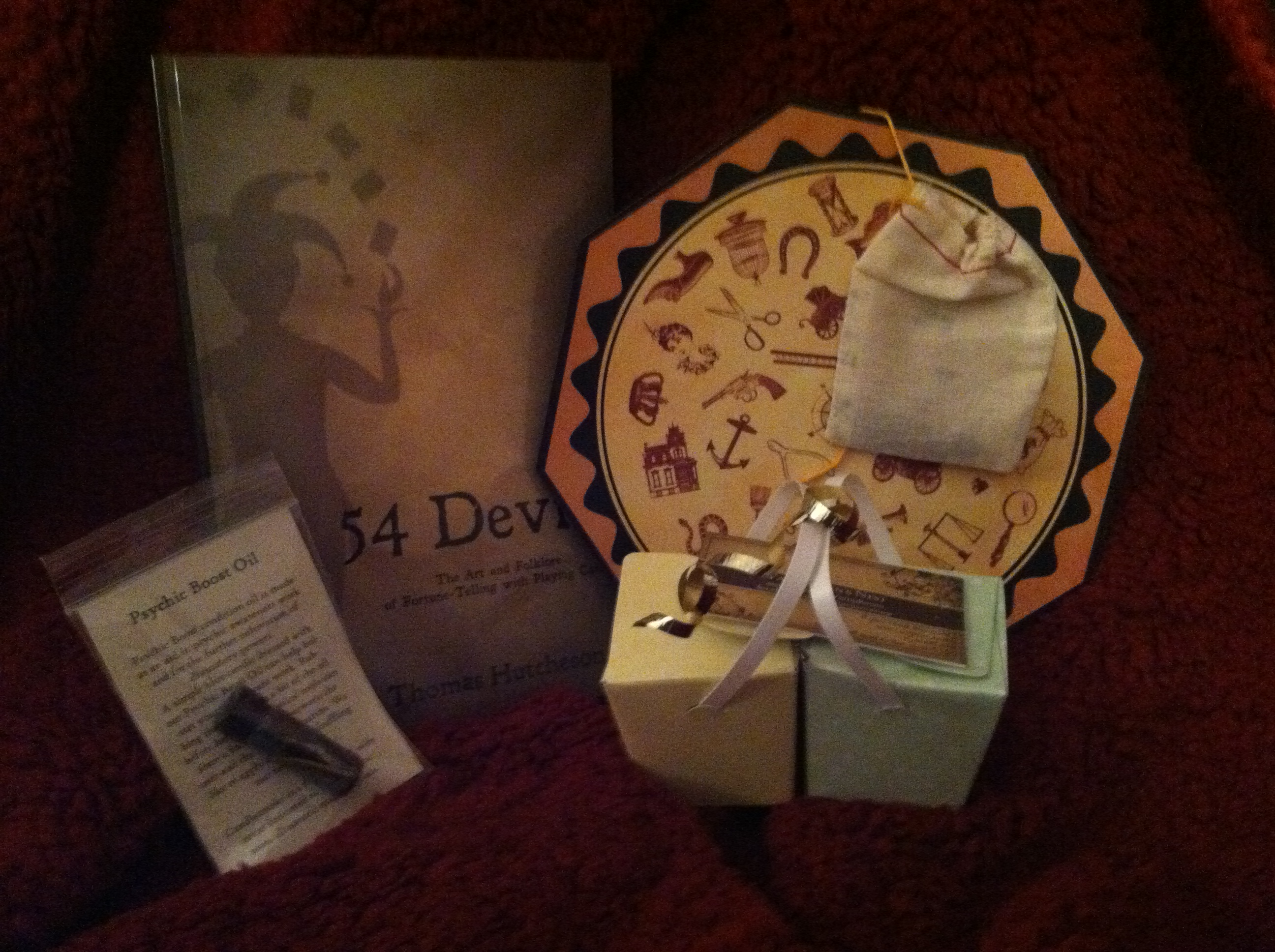
For this giveaway, we’ll be handing out a doozy of a divination prize pack. It includes:
A mini-altar kit and pair of mini-dowsing rods from Franchesca at The Texan Heretics
A bottle of Psychic Boost Oil from the lovely Magnusons of Candlesmoke Chapel
A stunning javamancy board from Chas Bogan of Carnivalia
A five-card email card reading from me, complete with card report
Pretty stellar, huh?
So what do you have to do to get an entry into this contest? It’s incredibly simple! Just answer one or more of the following questions:
What are your magical/witchy/Pagan New Year’s resolutions? What magical projects do you hope to get off the ground? Are there areas you want to learn more about? Are you going to get more involved in the community? Just give us a brief snapshot of what you hope to accomplish from a magical standpoint in the coming year.
What is your favorite magical/witchy/Pagan holiday and why? What do you do for it? Has it always been your favorite? What will you be doing to make it special this year?
What (if any) practices, spells, etc. has New World Witchery been able to add to your cauldron? Are there specific regions of folk magic you’ve begun to explore more (like Conjure or Powwow)? Do you find the info here useful on a practical level or is it more of a general information site for you?
That’s it! All you have to do is write to us at compassandkey@gmail.com and answer a question or two or three. You get one entry per question answered, so you have a chance to get up to three entries just by writing to us (you can combine all answers into a single email, as long as you make it clear you’re answering multiple questions somehow). Make sure to use the subject line “Three Questions Contest” so I know what you’re writing us about.
The deadline for this contest will be Friday, January 31st, so get your answers to us by then!
Also, please check out and/or enter our other current contest for one of three NOLA swag bags, which will be ending January 17th!
Thanks everyone for a great 2013, and here’s looking forward to a very enchanted new year!
The Comet of 1680, by Lieve Verschuier (via Wikimedia Commons)
“Like a comet burn’d That fires the length Ophiuchus huge In the Arctic sky, and from his horrid hair Shakes pestilence and war” (Milton, Paradise Lost)
With the ISON comet drawing eyes to the night sky, I started thinking a lot about the superstitions and magical beliefs surrounding the appearance of comets in the sky. Comets have long inspired people in strange, occasionally beautiful, and sometimes disturbing ways. Mark Twain’s life was framed by the appearance of Haley’s Comet, a point the author himself noted. The Heaven’s Gate cult engaged in a group suicide surrounding the arrival of the Hale-Bopp comet.
Increase Mather, famed early American religious writer, dedicated an entire work to explaining the spiritual importance of comets in his Kometographia of 1683. He was responding to the presence of the Great Comet of 1680, which had captured the attention of most of the Western world, and felt that many people would be afraid at this sign and misunderstand it as a phenomenon which directly influenced the course of events on earth, rather than a sign from God of some important event to come (see more here). Generally speaking, comets have historically been associated with strife and woe to come. My Opie/Tatem Dictionary of Superstitions gives a laundry list of examples of ill-omen presaged by what the Venerable Bede called “long-haired stars”:
A comet as portending a change in governance (Tacitus, Annals)
Famine or pestilence or war or “fearful storms” (Byrhtferth, Manual)
A comet [the Great Comet of 1680] appeared two days before the Duke of Monmouth died, and all over Europe before the death of Charles II (J. Case, Angelical Guide)
An appearance before the plague struck London (Defoe, Journal of a Plague Year)
A wry observation that those who laugh at comets as tokens of disaster will studiously insist on “times and situations proper for intellectual performances” (Johnson, The Idler)
In the New World, comets seem to have retained much of their wicked reputation. In some cases the danger foretold by the comet is vague and ill-defined: “When a comet appears there will be trouble” (Roberts, “Louisiana Superstitions”). In other places, the significance of the hairy star was more direct and its consequences very clearly understood: “A comet is a sign of war” (Thomas, Kentucky Superstitions). Why should these astronomical phenomena, which had been showing up in night skies for ages, have such a bad rap? Considering even Classical authors like Tacitus cite the comet as woeful, the impulse must run deep. The unique cosmological view of Calvinism, though, which influenced much of Atlantic American colonization, both denigrated occult practices like witchcraft and supported an enchanted view of a univers under Divine direction:
“The Calvinism of the colonial awakenings also paralleled important occult ideas. The fatalism inherent in Calvinism’s concept of predestination found an occult equivalent in the idea fundamental to astrology that motions of star and planets revealed a future that individuals could not control. Calvinist evangelists and occult practitioners also explained catastrophes in similar ways. Believers in occult ideas thought the coming of comets and eclipses had inescapable and usually disastrous consequences; not even kings and queens escaped their verdicts. No one escaped judgment by the Calvinist God either. Sometimes He damned seemingly model Christians simply to demonstrate His sovereign” (Butler, “Magic, Astrology, & the Early American Religious Heritage”).
The shared cosmology of the colonists saw the universe as inhabited by spiritual consciousness, and an intelligence that wished to convey its meaning to human beings for one reason or another. Signs, omens, and portents were one such method. Comets, with their placement among the stars, their strange and ill-understood movement, and temporary nature made perfect fodder for prognosticators of all stripes—religious, occult, and both (they did exist, even during the Colonial period).
Lest we make the mistake of thinking that the observation of comets was the purview of only a few dusty old white occultists or a lot of fiery former Englishmen with strong religious convictions, I’d also like to point out that the cosmology which imbued comets with significance stretched across a broad swath of New World denizens, including Native Americans, Spanish and French colonists, and of course, the imported Black slaves.
“English Protestants often read unusual events as evidence of the divine presence in everyday life, acknowledging the activity of a creator deity who operated through omens and portents within the natural order, or signs and wonders in the heavens, philosophy known as Providentialism. “Comets, hailstorms, monster births and apparitions” and other disruptions of the ordinary were demonstrations that foretold God’s will or signaled His displeasure withhumankind. Africans’ understandings of the universe were also inspired by visible manifestations of spiritual forces within nature. They too viewed thunder, lightning, and other elements as heralds of sacred hierophanies,the awesome presence of numerous divine beings.” (Chireau, Black Magic).
The Providentialism Chireau notes fits the cosmology of the English and other European settlers, but it is clearly not unique to them. A world with Divine presence not only innate to its component parts, but in which those component parts act as mediums for communicating with humans, is also very much an African perspective. And while it is tempting to think that such beliefs can be relegated to history’s dustbin, we should also remember that in our time comets stir up a lot of strange excitement. Religious scholar Camile Paglia notes, for example:
“The Children of God, founded in 1968 as Teens for Christ by “Moses” David Berg in Huntington Beach, California, were negligible in number but came to public attention when they loudly prophesied that the us would be destroyed by Comet Kohoutek in January 1974. The group continues under the name “The Family” and is regularly excoriated by conserva tive Christian watchdog groups for its practice of free love (called “Flirty Fishing”) as well as its heretical beliefs that Jesus was sexually active and that God is a woman. (Paglia, “Cults and Cosmic Consciousness”)
Paglia also references the Hale-Bopp comet mentioned earlier, and Marshall Applewhite’s Heaven’s Gate cult. I have, so far, not heard of any particularly distressing phenomena surrounding ISON’s appearance, but if nuclear war breaks out, I may have to blame that particular “long-haired star.”
If you have comet lore you’d like to share, please do so in the comments!
If you’ve listened to the latest episode, you know we’re having another big contest right now. We had such generous sponsors this year we were able to put together a few extra swag bags for fan giveaways, so you have the opportunity to win one of these stuffed full of magical goodies!
What’s in the bag, you ask? Well, specific contents will vary a bit (due to the personalized nature of the sponsor items in some cases), but I can tell you about our fantastic sponsors and what they sent along to give you a good idea what would be in there:
Javamancy Kit – Carnavalia/The Mystic Dream – Chas Bogan and Storm Faerywolf created a fun and clever play on geomantic divination with a Victorian flair.
Three Venezuelan Powers Holy Card Sets – Camino de Yara– The lovely Carolina Gonzalez shares a beautiful bit of South American folk magic with us.
Stay with ME Bath – The Curio & Candle Shop – Ms. Melanie made these simply beautiful (and wonderfully scented) magical herbal baths.
Lucky Green Rice Sachets – Draconis Arcanum – Rebecca sends you luck and good fortune, and invites you to share the promo code attached to her samples with your listeners (and use it yourself if you like!)
Handcrafted Conjure Condition Oils – Candlesmoke Chapel– The Magnusons (Sara & Joseph) are sharing some of their incredible and all-natural hoodoo oils.
2014 Witches’ Companion – Llewellyn Publications – This almanac/annual magical compendium has oodles of lunar dates, spells, and articles.
Horsetamer CD – Julia Ecklar & Prometheus Music – This lovely CD crosses Pagan, folk, and pop genres. Music can be used in podcasts, and especially recommended are tracks “With the Trees” & “The Troll King’s Dream.”
Traditions Download Card – Kellianna – A beautiful new record with an old soul! Feel free to listen and use the songs from this excellent album in your shows. Features many fabulous duets, including Wendy Rule, and a number of great old songs with Kellianna’s gorgeous vocal updates.
Enchantment – Pendraig Publishing– Peter Paddon (in attendance with us this year) sent his latest excellent book, all about the use of physical movement and beguiling in witchcraft. I bet he’d even sign it for you if you ask him.
Banshees, Werewolves, Vampires, & Other Creatures of the Night – Red Wheel/Weiser Books– Weiser supplied this Varla Ventura title all about the beasties of darkness which is sure to keep you up late at night!
The Candle & the Crossroads – Red Wheel/Weiser Books– Weiser also supplied this energetic look at Southern folk magic written by Orion Foxwood (who is one of the teachers at the Folk Magic Festival this year).
Fifty-four DevilsCartomancy Kit – New World Witchery – Cory & Laine give you his book on cartomancy, a fun deck of playing cards to try it out, and Laine’s hand-made card pouches to keep your fortune-telling deck safe!
Witches & Pagans Magazine – BBI Media – Anne Newkirk Niven & her team at BBI are providing us with the premier magazine in Paganism today.
Herbal Healing Salve – Rue & Hyssop/Three Brooms & a Cat – Jen sadly couldn’t make it this year due to last-minute problems, but sent along these gorgeous hand-made herbal salves in her place.
Magical Miscellany Oil & Incense – Magical Miscellany– The lovely Velma Nightshade (also in attendance this year) has provided us with a sampling of her magical wares from her newly launched business venture, Magical Miscellany.
Coconut Oil & Obsidian – Kathleen Borealis/Borealis Meditations – Raw coconut oil and hand-selected obsidian chips from our brilliant globe-trotter, Kathleen!
Mini-Altar Kits/Dowsing Rods – Franchesca/VampRaven’s Nest– These super-cute little boxes contain a complete miniature altar set with candles, matches, incense, etc., plus a second box with little custom-made dowsing rods!
Scarlet’s Deck – Scarlet’s Treasures/Lakefront Pagan Voice– Scarlet surprised us with copies of her own very special and highly limited-edition tarot deck! These aren’t available for purchase anywhere, so only a few people, including us lucky podkin, have a copy!
And let’s also do our best to say thanks to Anna, owner of Erzulie’s Voodoo in New Orleans, who hosted us for our event (even if we were our own meet-and-greet, it was still nice of her to let us have the space for a couple hours).
A pretty fabulous haul, eh? There’s definitely at least $100 worth of stuff inside, but really the money side of it doesn’t begin to cover the quality, thought, and love in these items.
So now that you’re eagerly clawing at your scroll button, eyes big as saucers as you see all these amazing things that *you* can win, how do you go about getting your name in the hat?
Official Rules
Purchase something, anything really, from one of the sponsors (preferably from one other than us, and preferably your purchase would have come after November 1st, but we’re not going to be incredibly rigid on those points). You could buy a wanga doll from Erzulie’s, or a copy of one of Peter Paddon’s books from Amazon, or pick up a copy of Witches & Pagans at your local bookstore…pretty much anything you want to buy. It can be for you, it can be a holiday gift, it doesn’t matter. Really we just want you to support our sponsors! [Edit: Dutiful listener Jasmine noted that requiring a purchase could land us in hot legal water. While the spirit of the contest is to encourage business with our sponsors, we will, of course, allow entries from folks who cannot purchase a product. No purchase necessary, simply email us and state you’d like to enter the contest and we’ll put your name in the hat.)
Once you’ve purchased your item, take a photo of you with your purchase (or a copy of the receipt, or a screengrab of your digital receipt, etc.). Send that picture and a brief message asking to enter the contest and saying what you bought to compassandkey@gmail.com (or tweet it to us @NWWitchery).
EVERY item you purchase gets you a new entry (as long as you send us a picture & message), so enter as much as you like!
Contest ends at midnight, Central Time, on Friday, January 17th, 2014! Get us your picture(s) before then!
We will draw three names at random from all the entries, and each of those three names will win a swag bag!
Due to some of the items in this bag and potential international restrictions (as well as international shipping costs), this contest will only be open to listeners in North America. Sorry! 😦
Winners will be announced in the late January show (our 4th pod-iversary!).
Not too complicated, I hope! If you happen to let the sponsors know you found them through New World Witchery, we’d love that, too!
So that’s the basics of this contest. We’ll keep some reminders going throughout the next month and a half, but entering early and often can’t hurt! We’ll also have a few other small contests running between now and then for books and extra swag items, and most of that will happen via Twitter and Facebook, so make sure you’re watching us at those places, too.
In this extended episode, we revisit our recent trip to the magical city of New Orleans. We’ll discuss the most recent Pagan Podkin Super Moot, places to see in the Crescent City, and hear some music, travelogues, and even a tea leaf reading or two!
CONTEST!
We announced a new contest in this episode! Details are coming in a separate post, but the basic rules are: 1) Buy something, anything, from one of the sponsors in the list below; 2) Take a picture with that item (or a a picture/screengrab of the receipt); 3) Send your picture to compassandkey@gmail.com and let us know to enter you in the contest. You could win one of three fully-stuffed PPSM Swag Bags, full of items from these great sponsors!
PPSM Sponsors! (We love them!!!)
(We’ll be posting more on these items in other places, but here’s a short list of the swag items and sponsors)
Last time, I looked at a few of the standard products found in a typical supermarket which could be easily used within a folk magical context. I’m continuing that theme today, and while I’ll still be doing my best to stay out of the ubiquitous enchanted spice aisle, I will be touching on a few ingestibles. Please note, however, that as I frequently say: THIS IS NOT A MEDICAL BLOG, AND NO INFORMATION PRESENTED HERE SHOULD BE TAKEN AS MEDICAL OR LEGAL ADVICE. Before you start popping things into your mouth or rubbing them on your skin, you should make sure with your doctor that doing so will not lead to genetic mutation, pestilence, plague, or ennui of any kind.
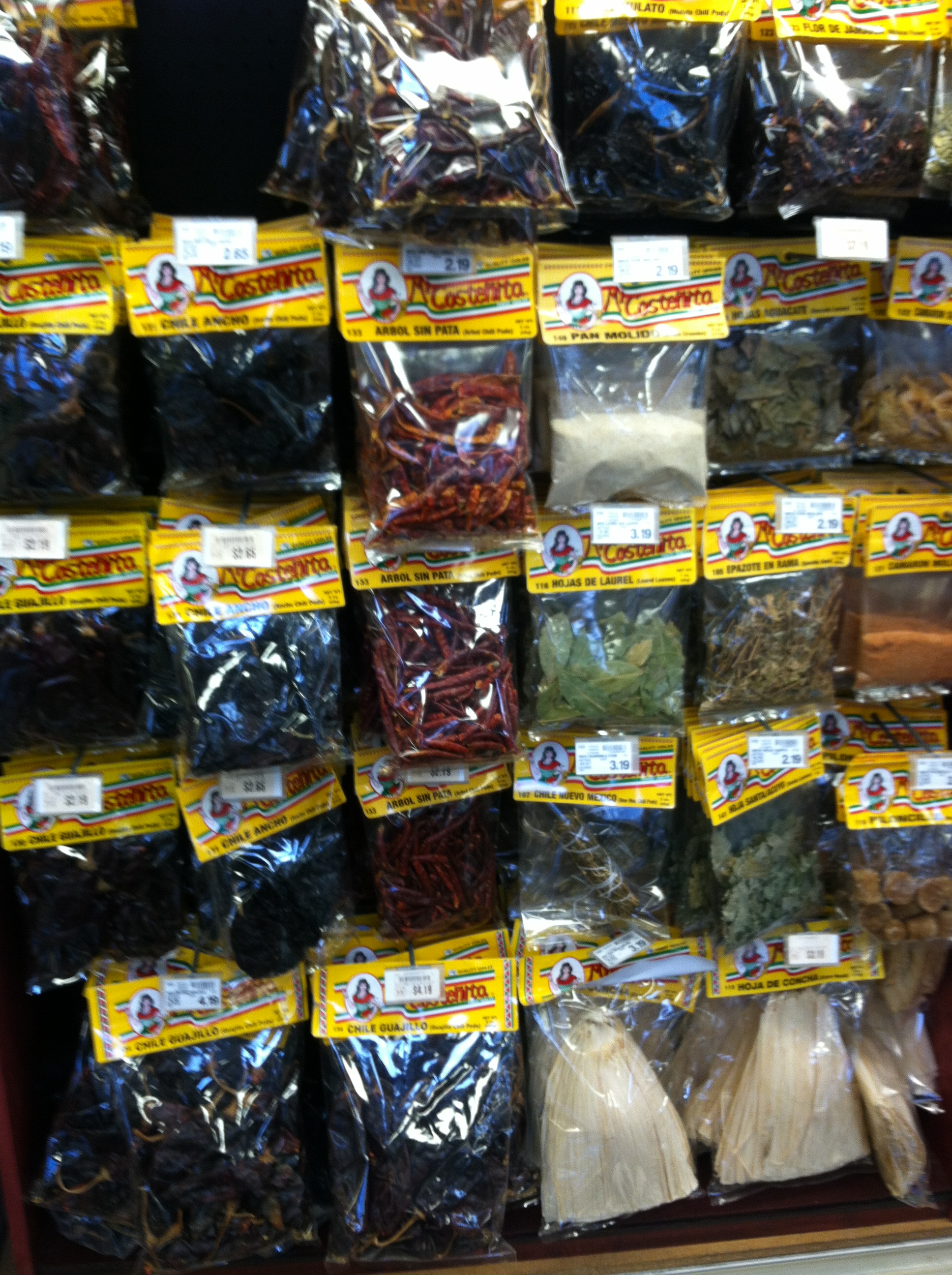
I’m going to start in what my part of the country likes to think of as the “ethnic foods” section, which generally speaking involves a portion of the produce area and an aisle with Asian, Hispanic, and perhaps Italian meal ingredients. It’s where I found the candles I showed in the previous post, but in most of the grocery stores around here, despite the obviously oblivious marginalization that comes with a label like “ethnic” or “international” cuisine, the diversity of the consumer population has made a lot of once-rare items much easier to find. The section of these stores directed at Hispanic consumers provides a number of tools for folk magic that fall under the practices of curanderismo and/or brujeria. I’ve covered supermarket staples like eggs already, so today I thought I’d look at three somewhat more distinctive items: corn husks, hot peppers, and coconuts.
Corn Husks
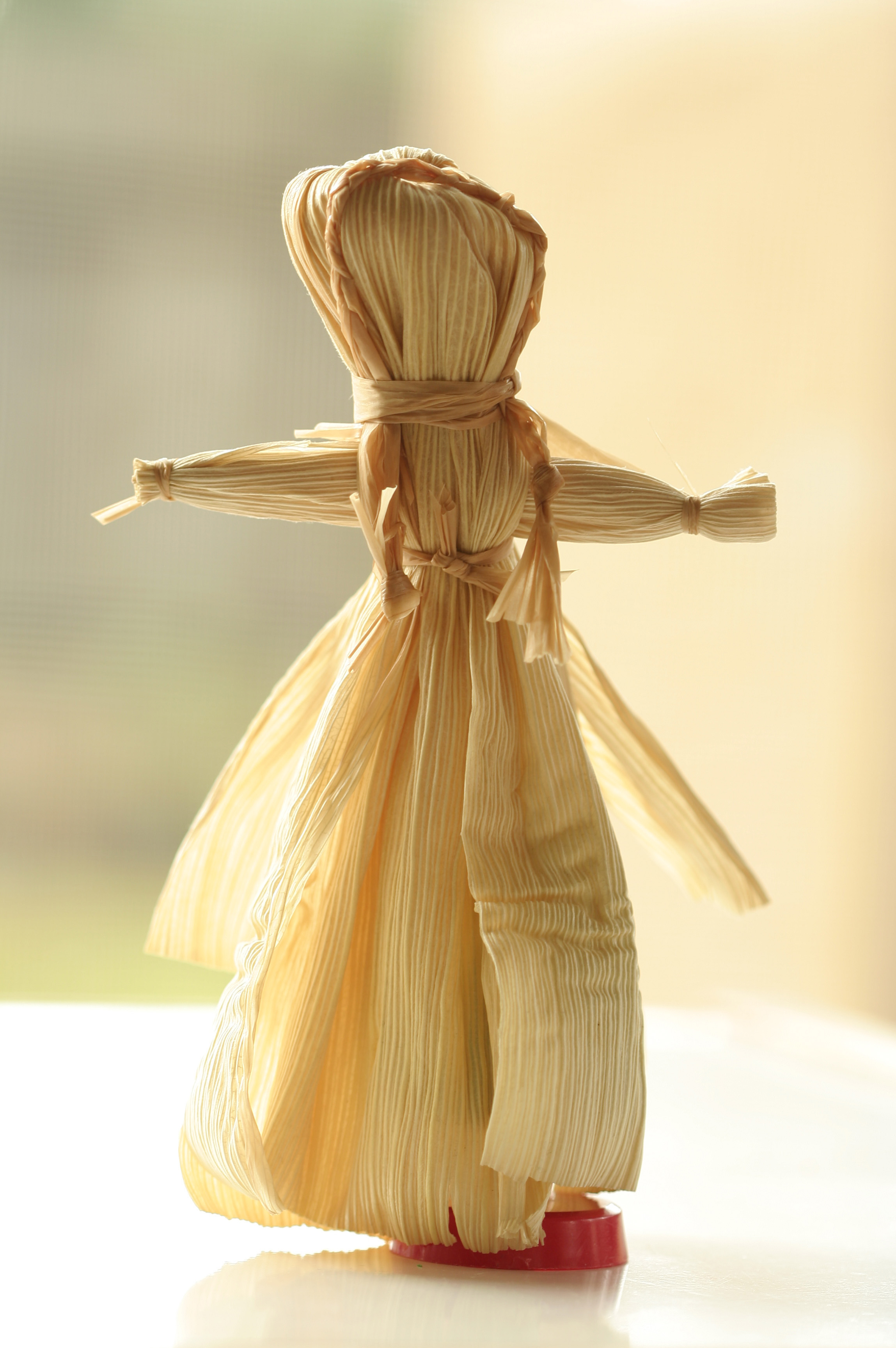
The papery, stiff-but-pliant corn husk is absolutely essential for making really good tamales. Usually these come in huge packs (because if you’re going to go to the trouble of making tamales, you may as well make a lot of them), and they’re often dirt cheap. In fact, in the late summer, I frequently fine freshly stripped corn husks in buckets next to the corn displays, and few grocery store managers care if you grab a sackful to take home with you for free. So what sorts of magical mischief can you get up to with all those husks?
Corn dolly folk art (via Wikimedia Commons)
If you’re not making ensorcelled tamales, you might consider saving a few husks and turning them into doll babies for working various kinds of poppet magic. In some cases, the husks would be bound to the cob, along with various herbs and things like hair or clothing from the intended target to work a spell on them. Texan rootworker Starr Casas describes one such baby in The Conjure Workbook, vol. 1:
“When I was caring my daughter [sic] I was very ill. I was put on bed rest for five months. My Grandma knew this lady and asked her to come to my house and help me during the week. She treated people who were ill. I think that due to her efforts my daughter is alive today. I trusted her because my Grandma trusted her…She prayed over me every day; one day she asked if she could have some of my hair. She could have just taken the hair from my brush, at this time my hair was very long. She told me the hair needed to come from the crown of my head.
A few days later she came with this Dollie. This was the first time I had ever seen a doll like this. The body of the doll was a corn cob and the doll was covered in corn husk. When I asked her what it was for all she told me was to keep me and my baby safe. After I had my daughter the Dollie disappeared. When I asked her about the missing doll she told me the doll wasn’t needed anymore. I have never seen another Conjure doll like that one again” (Casas 246-7).
Starr’s encounter with this type of doll is not typical of conjure practice, something even she notes, but the use of doll baby magic is fairly common and corn husks make a simple, cheap, easy-to-make-and-destroy sort of doll. One reason that Starr may not have seen them since is that they are less directly associated with hoodoo and more directly associated with mountain crafts, particularly the crafts of the Appalachians. In fact, you can find wonderfully detailed instructions and step-by-step photos on constructing corn dollies in Foxfire 3, which records the folk practices of the southern Appalachians (a later compendium called The Foxfire Book of Appalachian Toys & Games also discusses the corn dolls, but doesn’t give the detail the actual anthology book does). That’s not to say that such dolls are not found in any version of conjure—Dr. E mentions them in his article on doll making, found in The Black Folder, for example—but that they very likely drifted in from non-African sources. Their provenance matters not, though, because they are incredibly useful magical tools in any case.
Hot Peppers
Have you ever seen the sheer plethora of peppers available in a bodega? Even at the chain supermarkets, you can now find dozens of choices, ranging from fresh jalapenos and big, fat Anaheims to the huge sacks of tiny dried japones peppers and the small-but-potent habaneros. So what to do with all those peppers?
Of course, the obvious answer would be hot-foot work in hoodoo, but you can also get a little more creative than that. Using the peppers as a vessel, it takes very little effort (but a good bit of practice and caution) to slit open a habanero, stuff someone’s name inside and bind it back up. Doing that works sort of like a vinegar jar cranked up to eleven, in that it puts a lot of unpleasantness into someone’s life. Peppers don’t have to be all bad, either, as cooking them with something like chocolate creates a very different effect—a good hot cocoa with a hint of chili pepper makes an enlivening winter beverage, and a heck of an aphrodisiac! A little rum in that latter option helps, too, of course.
Speaking of rum, one of the more interesting uses for all those hot peppers in magic—and here I’m stretching the term to incorporate a certain degree of magical religion—is to soak the peppers into an alcohol like rum until it is nigh undrinkable. Why would you do that, you ask? Maya Deren explains the use of the drink during a Vodoun rite in her book, Divine Horsemen: The Living Gods of Haiti:
“As Lord of Eroticism, he [Ghede] embarrasses men with his lascivious sensual gestures; but as God of the Grave he terrifies them with the evidence of the absolutely insensate: he will not blink even when the most fiery liquid is sprayed into his eyes, and only Ghede can swallow his own drink—a crude rum steeped in twenty-one of the hottest spices known. Thus he may alternately remind men that he is their past, their present and their future, that he is master of their compulsive drive to life and the inevitability of their death” (Deren 104).
Deren also notes that anyone claiming possession by Ghede is subject to both of the tests she mentions: having the hot rum sprayed in their eyes and being told to drink it. A truly possessed devotee will have no problem doing so (and likely be able to down the entire bottle of rum and show no effects after the possession ends).
Coconuts
If you ever need to pretend to ride a horse, you will probably automatically feel the need to buy a coconut and bang the two empty halves together to simulate the sound. At least if you grew up watching a lot of Monty Python that’s probably what you’d do. The coconut is good for more than equine simulations, however, and you can use the whole fruit/nut and its liquid for several magical functions.
“Retrato de una señora principal con su negra esclava,” by Vicete Alban (via Wikimedia Commons)
Drilling holes in the coconut will allow you to do two things: firstly you can get at the precious liquid, coconut milk, inside. It’s delicious and a wonderfully refreshing drink, but if you can resist the urge to down it all in one go, save some for later. Now that you have a semi-empty coconut with holes in it, why not stuff it full of name papers, sweet things like raw turbinado sugar (also available in the Hispanic section usually) and create a natural honey-jar spell? This sort of spell will, of course, not last as long as an actual honey-jar, but it has the advantage of being very quick and due to the sympathetic magic connected to the coconut’s skull-like density and shape, it works right on the minds of the folks targeted with the spell.
Speaking of heads, if you saved that liquid, you can turn that into a powerful magical formula as well. An African-derived magical practice known alternately as “feeding the head,” or in Vodoun as a lave tet ceremony (literally “head washing”) involves using a coconut wash on the head and hair during a ritual setting in order to fill it up with good spiritual forces. The feeding usually follows a simple head washing, either with natural water (sea water, spring water, etc.) or a number of aqueous formulae found in various traditions. Then comes the feeding:
“The process of feeding the head is simplicity itself. The coconut milk or cream is scrubbed into the head, just like the head-washing compound or a shampoo. Once the compound has been worked into the head, the hair may be combed out again. However, unlike a head-washing compound, the coconut compound should be left to dry on the head—preferably, overnight. A scarf or towel may be wrapped around the person’s head to insure this…In the morning, the coconut compound may be rinsed out and the person’s hair washed with a shampoo and dried, as it would normally be” (Mickaharic, Spiritual Cleansing, 101).
The richness of the coconut milk causes the spirits which guard a person (frequently though to be connected to a person’s head in African tradition) to be refreshed and take a renewed interest in the person’s well-being. It’s sort of like bribing a guardian angel with a good pina colada, which would be another fun way to use that coconut milk if you’re so inclined.
Of course, you don’t even have to open the coconut up to use it magically. I’ve seen a house cleansing method which involves simply kicking a coconut around a new home, through every room from top to bottom and back to front. You might say a psalm as you go, or repeat the Lord’s Prayer or the Apostles’ Creed. Other traditions use other incantations, songs, or words, but the point is the same: get the coconut all over the house, kicking it as you go, letting it soak up bad vibes like a sponge. When you finish you can either pick it up in your left hand and take it to a far away tree, where you crack it open and leave it at the roots, or you can drop it into running water heading away from your home. It essentially functions as an egg cleansing for a domicile, but coconuts tend to be less messy than eggs when kicked (Mickaharic has a variant on this practice using a head of lettuce in his Spiritual Worker’s Spellbook).
There’s an entire pharmacopeia in a well-stocked bodega, with everything from aloe vera gel (and the live plants) to nopales (prickly pear cactus, sometimes used in curanderismo for treating diabetes) to chicken feet and cattle tongues (both edible, but also both used in various hoodoo spells as well) available to an informed shopper. I mention these three ingredients solely as a way to begin to see the shelves as stocked with more than marketing gimmicks and high-fructose-corn-syrup-laden beverages. While having a good local witch shop is invaluable for many reasons, the grocery store may be your best friend when it comes to simple, practical magic.
I know this article barely scratches the surface of the subject, and I highly encourage you to look at some other sources on making the most of a grocery store’s shelves for your spell work. As I said before, much of my own inspiration came from Sarah Lawless’ post on the topic and Cat Yronwode’s compilation The Black Folder, which features not only an article on grocery store magic (covering things like onions and lemons) by Cat herself, but other useful tidbits such as Norwegian bread charms (from Dr. Johannes Gardback) and an article on “kitchen witchery” by Sister Robin Petersen. Of course there are probably dozens of books on this subject, many of which I’ve sadly neglected here. Do you know of any good grocery-store spells? If so, please feel free to post them to the comments below!
I may eventually come back to this topic another time, but for now I hope this has been a useful glimpse beneath the barcodes into the magic of the market.
Customer making purchase in WWII grocery (via Wikimedia Commons)
If you have that song by the Clash in your head now, congratulations, that was my primary purpose in writing this article. Kidding.
Last time I took you on a quick but fun tour of my home to show how I’ve applied some of the folk magic I’ve picked up over the years in my personal life. Today, I’m drawing some inspiration from Sarah Lawless, whose article on “Pantry Folk Magic” is one of the finest pieces on using what’s at hand for practical spellwork that I’ve ever read. I’m also inspired by an article on “Grocery Store Magic,” in The Black Folder, a compilation of workshop notes by Cat Yronwode (which I recently reviewed), and I’ll be citing both of these sources as well as several others in the coming few paragraphs.
There are plenty of articles out there on doing magic from the grocery store, but I wanted to go beyond the spice aisle a bit and look at the vast number of folk magical items that may go a little under the radar in a standard shopping trip.
Before we go much further, I do want to mention that I don’t think the grocery store is the end-all be-all of magical supply houses. I prefer by far to grow or wildcraft my own botanicals, use hand-crafted incenses from a local occult shop, and carry talismans picked up at the nearby Catholic bookstore in a lot of cases. Supporting community commerce and doing work oneself fits in as well or better with most magical practices than grabbing a mass-produced box of incense from a five-and-dime shelf, but there are always going to be cases where magic must be done on short notice or with supplies not readily purchased at the witchy store. In some of the cases below, it should also be noted that the grocery stores where one can find these ingredients are not the big chains, but rather local bodegas or international markets. You are far more likely to find chewing john (galangal root) in an Asian market than in a big chain one, for example. Now, on to the tour!
Candles
One of the big resources that frequently gets missed in grocery store magical item lists is the cornucopia of candles that can sometimes be found. Of course, a lot of stores carry scented jar candles and those are reasonable enough for doing some workings, but if you look in the Latin American or Hispanic section you can often find a number of saint candles as well. I’ve found everything from the standard Virgen de Guadalupe to Santa Muerte, Seven African Powers, Just Judge/Justo Juez, and even a Lucky Lotto Numbers candle just by browsing a little. Below you can see a pair of very cute candles which look like children’s novenas for working with Guadalupe or St. Jude, found at a mid-level chain grocery store.
The novena candles are also frequently available unlabeled and sometimes in multiple colors. It’s fairly easy to customize them to your own needs and do extended spellwork using these tools.
The candles don’t stop there, though. Say you want to do a quick-and-easy candle spell, but you know you won’t have time to burn a candle 1-2 hours per night for nine nights. Stop by the baking section and grab birthday candles, which are small and burn very quickly. Will it change the potency? Perhaps, but you’ll be able to at least do what you want to do. They also frequently have letter or number shaped candles, so you might be able to use those to target a specific goal or person with the spell (especially if you’re knowledgeable about numerology and can figure out the right number(s) for the job).
If your grocery also has a Jewish section with kosher options, check to see if they sell Shabbat candles. They frequently come in boxes at a very reasonable price, and are specifically designed to be used for spiritual purposes (albeit non-magical ones in most cases). These burn longer than the birthday candles but much more quickly than novenas, and so would be good for mid-range spell work.
Cleaners
We’ve mentioned these a bit in our previous post on Spiritual House Cleaning, but here I mean less of the whole-herb types and more of the mass-produced stuff. Harshly-scented cleaning solutions with abrasive chemicals and artificial odors may not seem like a particularly likely place to find folk magic, but it’s there if you look for it. One of the most common of household cleaning agents, ammonia, acts as a substitute for urine in some spells. Cat Yronwode suggests in her Hoodoo Herb & Root Magic that ammonia can be used in spells focusing on protection and spells designed to improve sales, either at a business or of a home (Yronwode 29). In Spiritual Cleansing, Draja Mickaharic mentions ammonia’s great psychic cleaning powers and notes that putting a little bit down the drain after a house blessing & cleansing will help finish the job.
In a similar vein, we find plenty of uses for that old pantry/laundry/cleaning-closet standby, vinegar. Sarah plainly mentions vinegar as one of her grocery store finds for the working magician. All vinegars can be good for simple crossing work, according to Southern folk magic, and it would be very easy to turn cider or wine vinegars into a variety of Four Thieves Vinegar for both aggressive protection and subtle cursing. I mentioned on our Spell Failures episode that I had attempted to work a vinegar jar with poor results (mostly due to my lack of dedication). I found an interesting hexing combination of both vinegar and ammonia in Zora Neale Hurston’s article on “Hoodoo in America,” too:
i. To Punish.
When you want a person who is indited punished, write the name of the person in jail on a slip of paper and put it in a sugar bowl, or some other receptacle of the kind. Put in red pepper, black pepper, one penny nail, fifteen cents of ammonia and two keys. Drop one key down in the bowl and lean the other against the side of the bowl. Go to the bowl every day at twelve and turn the key that is standing against the side of the bowl to keep the person locked in jail. Every time you turn the key, add a little vinegar (Hurston 382).
I find it interesting that both ammonia and vinegar seem to be able to perform cleansing functions in a household, but applied to an individual their corrosive nature seems to become destructive. I think this illustrates the principle of the two-sided coin of magic nicely, though, as the same ingredient that can save you from nasty spirits might also be turned around to damn an enemy.
Before I move off of cleaners, I want to mention a couple of the commercial products out there that have some magical history and applications. First, the famous Pine-Sol cleaner, which has been found in grocery stores for almost 60 years. The product was born in Mississipi, and even today contains pine oil to give it cleaning power and its trademark scent (along with a hefty dose of chemical salts and alcohols). Pine oil is another spiritual cleanser and refresher, in addition to having some mundane cleaning properties as an antibacterial and antiseptic disinfectant. It works a lot like lemon does in spiritual cleansing—so much so that one of Pine-Sol’s first offshoot scents was lemon, although now they have half-a-dozen different aromas to choose from. While I’d never suggest using a commercial pine cleaner on the body (or in the body especially…that’s a big no-no!), some folk magical traditions have used pine oil-based treatments for medical ailments (there’s a fine example in Hohman’s Long Lost Friend, for instance). So the presence of lemon and pine has the power to cut through spiritual ailments as well as the nasty germs lingering on your kitchen floor. You can make a variant of your own pine oil cleaner by simply adding pine oil to some salted water with some castile soap dissolved in it. It won’t be as strong as Pine-Sol, but it also won’t be quite as harsh. You could even add a bit of lemon juice or lemon oil to that, too, for extra kick (both spiritually and microbially speaking).
Since we’re talking of lemons and soap, I can’t help but at least briefly mention Murphy Oil Soap, which has been treating hardwood floors for over a century (although only in a mass market for about half that time). The cintronella oil in Murphy’s has a citrusy, lemony scent, and is both a lucky and cleansing ingredient in spiritual work (it’s one of the oils used in Van Van Formula). Queen of Pentacles Conjure notes that both Murphy’s and Pine-Sol make great additions to the spirit worker’s cleaning closet. Citronella keeps away mosquitoes, too, which makes me love it even more.
I’m going to pause here before continuing through the aisles, as this article is already quite long. There is plenty more to see as we make our way through the store, though, so stay tuned!
Summary In this episode, we experience some witchy radio drama and NIGHT VALE NIGHT VALE. NIGHT VALE NIGHT VALE NIGHT VALE.
Sources
NIGHT VALE. NIGHT VALE NIGHT. VALE NIGHT VALE NIGHT VALE NIGHT VALE. NIGHT VALE. NIGHT VALE NIGHT VALE NIGHT VALE NIGHT. NIGHT VALE NIGHT VALE NIGHT VALE NIGHT VALE. NIGHT. VALE. NIGHT VALE. NIGHT VALE NIGHT VALE NIGHT VALE NIGHT VALE NIGHT VALE NIGHT. VALE. NIGHT VALE NIGHT VALE NIGHT VALE NIGHT VALE NIGHT VALE NIGHT VALE NIGHT VALE NIGHT VALE NIGHT. VALE NIGHT VALE NIGHT VALE. NIGHT VALE NIGHT VALE NIGHT VALE NIGHT VALE. NIGHT VALE.



 New World Witchery - The Search for American Traditional Witchcraft