[Author’s disclaimer: I received this book as a review copy from Red Wheel/Weiser Books. They have neither paid nor coerced me in any way to write this review, and the opinions stated herein are my own, and do not reflect the position of the publisher.]
I am absolutely certain that a number of people will see the title of Denise Alvarado’s latest title from Red Wheel/Weiser Books and simply ignore its existence. That is a downright shame, because the book proves to be a personal and anthropological tour through an area of magic that can be very easy to misunderstand, work with dolls and effigies. Alvarado confronts the issue of the ‘Voodoo doll’ early in her text, laying its negative cultural cache at the feet of “Hollywood and the media” and noting that despite its origins as a “fusion of folk-lore with science fiction…the image of the pin-stuck doll is so embedded in the collective psyche of the general public that the thought of using a Voodoo doll any differently seems to defy all logic” (p. 2). Alvarado’s book is a repository of doll magic, some of it very interesting and useful, some merely edifying or even occasionally confusing, but it certainly deserves consideration beyond its titular associations.
The book is broken up into twenty-one chapters, generally grouping spells by expected outcome, not much different than other spellbooks in the genre, really. There are chapters on “Money Spells,” “Spells for Good Luck, Success, & Gambling,” and of course, “Spells for Love & Romance.” Alvarado really sets herself apart with the amount of space she devotes to the less savory workings of doll magic, with chapters like “Bend-Over Spells,” “Binding Spells,” “Break Up Spells,” and most especially an extensive chapter on “Curses, Hexes & Spells for Revenge.” Her work draws upon myriad traditions, not solely Vodoun, hoodoo, or Southern Conjure—the fields she clearly connects with best, at least personally. She also brings in chapters on doll magic from the Ancient world, such as dream dolls drawn from Greco-Egyptian magical papyri. One of the truly standout chapters is a section called “Japanese Voodoo Spells,” which actually looks at two types of effigy magic found in Japanese practice, even connecting them to the popular youth culture there: “Aggressive marketing campaigns advertising Ushi no Koku Mairi [Japanese cursing dolls] kits that contain a straw doll, a hammer, a couple of candles, and fifteen-centimeter-long nails are targeted to the young Japanese demographic” and she notes an increasing presence of these dolls in “anime episodes, online games, and videos that promote cyber cursing” on sites like YouTube (p. 172). Alvarado brings in Goetic spells involving dolls, and influences from Christian magical practice via Catholic and Psalm workings. She even includes a doll spell to prevent pets from getting lost.
Sources for The Voodoo Doll Spellbook range from the scholarly to the questionable (ghost hunting websites and a book on Mexican magic which tenuously reframes Hispanic folk ceremonies in a Wiccan context, for example), but generally speaking, Alvarado speaks authoritatively and presents her material well. Several spells are guest-contributed by conjure worker Carolina Dean, which prove to be some of the high points in the text. In some cases, the reason for lumping some spells into separate chapters is unclear, as in the “Binding Spells” section, of which a reprint of Psalm 94 takes up a full twenty percent of the pages. Still, when she is on-target, as with her two Mississippi cursing dolls (pp. 36-38), the quality of the work is apparent, and the spells make a useful compendium of doll magic.
The relatively few other doll-baby work books available (Starr Casas’ slim-but-potent one comes to mind, which seems to be out of print, sadly) mean that Alvarado’s book fills a major niche in practical magical writing. In many ways, what she accomplishes with The Voodoo Doll Spellbook is quite similar to work done by Judika Illes in her books—this is the notebook of a collector of spells. What plagues the text the most is its title, which seems to relegate it to a very specific subcategory of magical work, and which undermines its authority in the minds of educated readers. The material contained within is useful, if occasionally uneven (I’m currently working with one of her money doll spells, for example—I’ll let you know how that goes). While I could consider this book neither a definitive text nor a weak entry in the field, I can certainly point to its utility and some of its unusual offerings as a recommendation to read it and be satisfied.
If you’ve read this book, or have others to recommend on the topic of doll magic, I’d love to hear them!
Tonight we have an interview with the magical Carolina Gonzalez, a curandera based in the Canary Islands. We’ll also have a brief overview of what curanderismo and brujeria are, and we announce a new contest!
We definitely think you should check out the Camino de Yara site, home to our guest, Carolina Gonzalez. While you’re there check out her sites on Maria Lionza and her shop, too!
Please send in contest entries to compassandkey@gmail.com! We are giving away a copy of 54 Devils (my book, in either digital or print form, whichever you prefer) and a digital copy of Carolina Gonzalez’s book on reading the Spanish cards as well. All you have to do is send us your weirdest or most unique piece of personal holiday lore, along with a name we can read on-air and a general location (‘Illinois’ or ‘the Midwest,’ for example).
If you have feedback you’d like to share, email us or leave a comment. We’d love to hear from you!
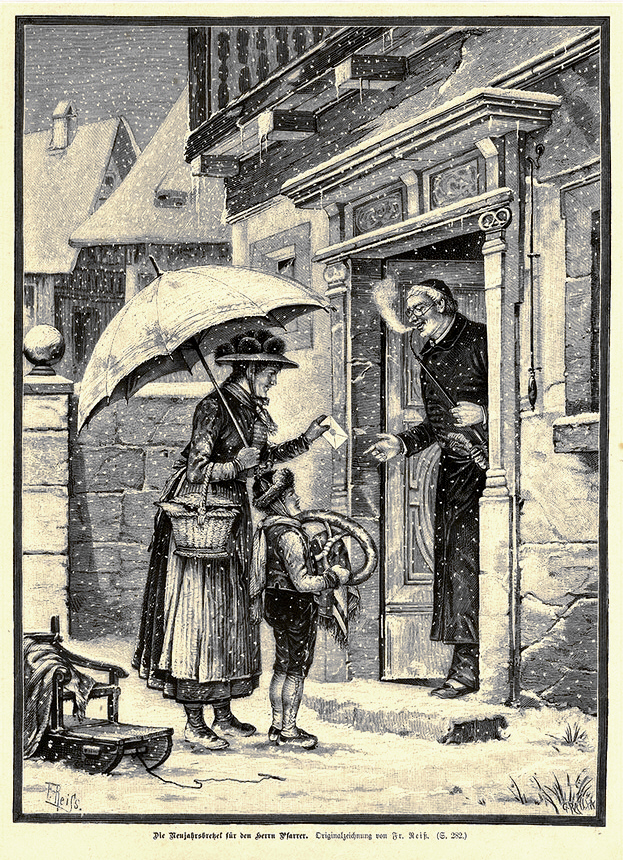
“Die Neujahrsbretzel für den Herrn Pfarrer”, 1884 (via Wikimedia Commons)
I’ve had several people recommend a book to me called The Five Love Languages, by Gary Chapman. It’s a book that looks at the various ways in which people give and receive love. It gets into a lot of psychology and interpersonal communication theories, but in a nutshell it assumes that people tend to give or receive affection via physical touch, loving words, acts of kindness or service, quality time, or gifts. I am definitely a gift-giver when it comes to expressing my feelings—I will work for weeks to handcraft something for someone I care about. When my lovely wife and I were courting, I put hundreds of sticky notes all over her apartment with love messages so that she would constantly find them for months and months afterwords. Even when we ship products out of our Etsy shop, I tend to add layers of Spanish moss to the packing material, as well as little lagniappe touches to the shipment to make it feel magical for the person who opens the box. None of this is to brag, but simply to frame the point that giving gifts is a major part of my connection to others.
Giving gifts has been an important aspect of human relationships for a very lnog time. The Ancient Roman patronage system essentially operated on a large-scale gifting economy. In North America, giving gifts with a magical bent appears time and again. A number of superstitions and rituals surround the acts of gifting and receiving gifts. Possibly one of the gifts most beset by magical rules is the knife:
One must not give a friend a knife or other sharp instrument, as it “cuts love.” (Price 34).
“Giving a knife as a gift is bad luck as it cuts the friendship” (Hines 12).
A present of knives will break the friendship between you (the giver) and the recipient of the gift. (Hines 13)
No hillman would think of giving a steel blade to a friend such a gift is sure to sever their friendship (Randolph 58).
The ‘hillman’described in the last point would have been obliged to pay for a knife if he received it as a gift, in order to abate any potential tragedies:
Whenever a knife changes hands, it must be paid for, even if the sum is merely nominal. I have seen a salesman, a graduate of the University of Missouri, present his son with a valuable hunting knife but he never let it out of his hand till the boy had given him a penny (Randolph 58).
This is a sentiment I’ve seen echoed through other traditions as well, including some Wiccan circles and their beliefs about gifting athames. I have also seen contrary points, insisting that Wiccan ritual blades must never be purchased, but only gifted.
Knives, however, are only scratching the surface of the myriad taboos, beliefs, and customs surrounding giving and receiving. In the following paragraphs, I hope to lay out some of these traditions (though certainly not all of them… The concept of Christmas and birthday gifts is well outside the scope of a single survey article, for example, and the topic is much larger than a 2,000 word synopsis could handle). What I hope that you will see is the sheer humanity of this process. People seem to develop an entire language around gifting (see the Victorians and their flowers, for example), and understanding that language, especially within a magical context, expands the conversation on American folk magic immensely.
Since we’ve started in the domestic realm with knives, let’s continue in that vein. In the Ozarks, even very small gifts can have great significance:
A button received as a gift is always lucky, no matter what the color. Years ago, many an Ozark girl collectedbuttons from her friends and strung them together into a sort of necklace called a charm string. A charm string not only brought good fortune to the owner but also served as a sort of memory book for women who could not read one button recalled a beloved aunt, another a friend’s wedding, still another a dance or a quilting party or an apple-peelin’ or some other pleasant occasion. (Randolph 61)
These little tokens often represent a greater whole. In the example Randolph cites the ‘memory book’ aspect of the charm pushes it out of the realm of luck and into a broader realm of personal narrative. It tells the story of where the girl has been. The luck may then be a cumulative blessing from all those around her, an assembly of good wishes designed to attract further goodness into her life. Similarly, some fairly small gifts can act as predictors or insurance of future blessings, as in these two examples from Louisiana:
A midwife should plant a flower for a baby at its birth.
It is good luck for visitors to place a silver coin in a baby’s hand (Roberts 150).
Here we see blessings which ensure growth and health (the flower) and insurance against poverty (the coin) passed onto a baby, with the hopes that the child will grow and prosper in the future.
Of course, there are just as many taboos on gifting as there are joyous customs. As we saw with knives, some of those can be firmly established and nigh universal at times. Let’s look at another domestic commonplace with strong taboos:
Never borrow salt or you will have bad luck (Hines 12).
Never return salt that has been borrowed (Roberts 178)
Why salt? In my family, we frequently gave salt as a component of a new house blessing for people we knew, which as I understood it derived from Polish traditions (after investigating this a bit, I’m reasonably sure this was adopted from a similar Jewish custom picked up by my family in the area on the border between Lithuania and Poland). We give a jar of salt with some bread and a penny in it, ‘So that the family may never be hungry (bread), never be poor (penny), and their lives may never lack flavor (salt).” The salt, then, can be seen as the experience and cumulative personality of the family, its seasoning or flavor which makes it distinct. Borrowing someone else’s flavor would, in essence, give them power over you, especially when the salt is returned carrying traces of your own eau de familie. It could also be that by taking one family’s wisdom and experience, then returning it, you set off a disruptive cycle whereby your two families will be struggling to rebalance power for a long time, which definitely sounds like bad luck. A similar Louisiana superstition says ‘Don’t give spades, etc., to your neighbors; you will have a fuss if you do (Roberts 174). In that case, the tool is symbolic of a person’s work and labor, and to lend it out cheaply doesn’t bode well for anyone (and makes me think of Homer Simpson borrowing essentially every tool in Ned Flanders’ garage…a very bad neighbor).
The issue of when a gift is given can also impact its significance and magical qualities. While I will avoid holidays and the like here, there are plenty of other occasions when gift-giving is an expectation, such as at baby showers:
At a baby shower, the giver of the seventh gift to be unwrapped will be the next to have a baby (Hines 14).
In this example, the gift-giver receives the magical benefit of a prediction. I suppose that if you are not in the market to start a family, this superstition could seem more like a taboo than a blessing. Another key occasion for giving gifts is after a new family moves into a new home. I mentioned my family’s custom for making a house-blessing from my Polish roots, but it turns out that the general concept of the house-warming may come from the other side of my family tree in the British Isles. The hint of magic behind this tradition comes from the original house-warming present, which actually served to warm a new home:
“As poet John Greenleaf Whittier noted…’The Irish who settled here about the year 1720, they brought indeed with them, among other strange matters, potatoes and fairies.’…The Scots [who were also early settlers in America, particularly in the Mid-Atlantic region and parts of Appalachia]…believed in ‘brownies,’ a more subdued version of the leprechaun. Brownies lived in the kitchen fireplace, and the belief was that the owners of the house had a responsibility to always keep these fairy-creatures warm by keeping a constant fire in the hearth. The Yankees noted that Scots-Americans, when moving from one house to another, would always remove burning embers from the old house to the new, to provide a warm home for the brownies that would move in right along with the family. This was how the tradition of ‘house-warmings’ started” (Cahill 32).
I tend to think this is a bit of fancy on Cahill’s part, and that the giving of gifts to new homeowners is something much older and less literal than a brownie’s ‘house-warming,’ but I would be completely unsurprised to find that the actual practice of moving hearth coals to entice fairy-beings to move houses exists in the Old World or the New.
Marriage also features a number of gift-giving customs, some with superstitious components. For example, in Kansas groups of Russian-German emigrants pin money to the bridal skirt as a way of blessing the bride and groom with prosperity. Additionally, a fun game is made of the best man’s gift, and the “custom of some young buck’s stealing the shoe of the bride. The best man had to redeem the shoe with cash, which went into the household fund” (Tallman 227-8). The best man might contribute some or all of the money, with the remainder raised by good-natured begging of the wedding guests.
A number of tales from Appalachia and New England, including stories from Hubert Davis’ The Silver Bullet and other collections of supernatural American folklore, indicate that magical gifts have particular rules when it comes to witches. For example, a witch might offer a very low price for some livestock or sundries she fancies from a local homestead. If she is refused the gift—which is all such a lowballed agreement could be seen as—she curses whatever it is she wanted, rendering it useless to the family that has it. Often she will curse a cow so it won’t produce milk, or she might even curse an entire herd of pigs or sheep rather than just the one she wanted. On the flip-side, a witch should never be given a present of anything from the household, or she could use it to harm those who dwell within. One story features a housewife who loans the local witch-woman a cup of sugar in a neighborly—if cautious—manner, only to find her butter won’t come when she churns it afterwords. She summons a local witch-doctor who takes a piece of hot silver and drops it in the churn, then spills cream on the fire and whips a pan of the scalded dairy until they hear shrieks from the direction of the witch-woman’s home. She, of course, suffers great pains and bears the marks of a whipping and burning the next day, and everyone knows just what’s what. Oh, and the butter is fine after that, too, of course.
Not all witches or magical practitioners are conniving and dangerous when it comes time to share the wealth, though. For example, many witch-doctors and conjurers in the Southern Mountains will not take direct payment for their work, but only offers of gifts made in-kind, such as foodstuffs, clothing, or other necessities. Vance Randloph noted that one witch woman in the Ozarks did not ask a fee for her work, but would accept such donations: “This woman makes no charge for her services, but if somebody offers her a present, such as a new dress or a side of bacon, she seldom refuses the gift” (Randolph 126).
Lest you think all these magical gifting traditions are limited to the realm of humanity, here’s a bit of lore from John George Hohman’s Long Lost Friend to show otherwise:
A GOOD METHOD OF DESTROYING RATS AND MICE.
Every time you bring grain into your barn, you must, in putting down the three first sheaves, repeat the following words: “Rats and mice, these three sheaves I give to you, in order that you may not destroy any of my wheat.” The name of the kind of grain must also be mentioned. (Hohman 70).
Here we see the old idea of “one for the rabbit, one for the crow, one to rot, and one to sow” extended from nursery rhyme to magical practice. Giving the animals a bit of the household bounty seems to be a way to stave off any thievery on their part, at least in this example.
Finally, I can’t help but offer up a humorous story from Maryland which shows animals getting in on the gift-giving action:
It seems that Mrs. Morison’s uncle and her father went fishing one time and as always they carried their [moonshine] jug along. They came to this water moccasin who was just about ready to swallow a frog. So Mrs. Morison’s father took a forked stick and clamped it down over the snake’s head and took it [the frog] away ‘cause they wanted to use it for bait.
Well, that snake looked so darn downhearted that they gave him a drink of moonshine, and off he went. So they went on with their fishing and about an hour later one of them felt a tug on his leg. He looked down and there was that snake back with another frog. All I can say is, that must have been awful good moonshine” (Carey 31).
I’m not sure if the ‘magic’ in that tale is so much in the moonshine or the moccasin, but I couldn’t resist sharing it with you.
I’m sure there are many other magical giving traditions I’m missing here, so if you have any you want to share, please do!
In this show, we discuss the use of sex as a magical tool (as well as magical tools that can be used for sex), and the ethics of mixing sex and magic from our points of view.
The discussion of sex and scent brings up bay rum scented items, Bourbon French Parfums in New Orleans, and vanilla (oh, and you should also check out the scent-and-sex heavy book Jitterbug Perfume by Tom Robbins)
The Crowley quote about masturbation comes from his book Magick.
Cory mentions he’s been watching the occult series called Salem on WGN, and that our previous guest Papa Toad Bone may have a role on it at some point.
Promos & Music
Title music: “Homebound,” by Jag, from Cypress Grove Blues. From Magnatune. Alternate title music was “Love Warrior,” from FOB, and can be found on MusicAlley.com.
“Jubilant American soldier hugs motherly English woman,” PFC Melvin Weiss (via the National Archives)
With the timing of Memorial Day (for those reading in the U.S., that is) and my brother’s recent entry into the American Armed Forces (he’s been in for just under a year), I thought it might be worthwhile to highlight a few of the superstitions surrounding life as a soldier, sailor, pilot, or marine. Some of these practices are magical in nature, and some simply traditional or an interesting way of adding a layer of significance to the world from folks who already make significant contributions to it. I will not attempt to paint any glossy pictures of military service, nor will I touch on some of the lore which might be construed as highly disrespectful in light of the holiday. I also doubt I’ll cover even a fraction of the total lore around these branches of service, as that could easily fill volumes, and I’m going to attempt to keep this under two thousand words.
For the sake of simplicity, I will look at the beliefs more or less by branch, although in fact it will essentially be by domain—land, sea, and sky. The Marines, while ostensibly a seafaring force and part of the Naval Department, are for all intents and purposes the force that crosses those three boundaries (although I should note that in the modern military, an Air Force pilot on a Naval carrier would not be unusual, and other service members work across branches frequently). I will basically be looking at lore for soldiers, sailors, and pilots, and cross-pollination of belief can be inferred as appropriate.
Soldier Lore
Some of the chief superstitions surrounding life in the Army focus on protection in battle, naturally. Protection from bullets, mortars, bombs, and any of the other myriad dangers on the battlefield is essential, and here are some of the magical methods used:
Soldiers would often wear bibles “tucked or pinned over the portion of a uniform covering the soldier’s heart” to fend off bullets (Watts 419).
Soldiers in World War I would sew black cats onto their uniforms for good luck (contrary to the traditional ‘bad luck’ association with the animal)
Mistletoe could provide protection for a solder, when pinned inside his or her uniform
“[S]hells etched with the soldier’s name” were considered lucky amulets (Brunvand 766)
The 91st Psalm would be carried or worn inside a uniform for luck and protection
Hair, clothing, or jewelry from a loved one back home would sometimes offer some safety from harm
A bit of clothing from a personal or national hero could be worn to provide vigor, courage, and insulation from battle damage
A soldier should always eat all the food on his plate before battle to ensure he survives it
In addition to tokens and talismans, a number of stories circulated surrounding apparitions which portended good or bad fortune for soldiers during wartime. For example:
“Legends about folk saints defending soldiers and citizens abounded. Variations include the saint appearing as an old man before or during battle, prayers by the soldier or a family member resulting in miracles, the saint healing injuries and aiding prisoners of war to survive or escape, or the saint appearing in a dream. Saints were also credited with disabling enemy weapons and altering the direction of enemy planes and missiles” (Brunvand 766).
Some of the saints to whom a soldier might appeal would include Saint Michael Archangel, for victory in battle, or Saint Christopher, for a safe journey back home. A Cross of Caravaca might also be worn to symbolize such divine protection.
One of the entities who seemed to travel everywhere the soldiers did was the astounding Kilroy. With his eyes, nose, and fingers peeping over the top of a fence, he was always first on the scene, and became something of a traditional bit of graffiti for soldiers:
“Kilroy lore calls for GIs to place drawings of the character in the most remote and unlikely locations, signifying the power and reach of the U.S. military. It is also customary for soldiers to claim that the marking was discovered rather than placed, making Kilroy always the first to arrive at a host of sites. He is rumored to adorn a range of places from the Statue of Liberty’s torch to the surface of the Moon” (Watts 237).
In addition to protective and comical apparitions (or drawings, in Kilroy’s case), there were also the less pleasant ‘death tokens’ which precluded a loss in battle or the death of a soldier. One such creature is the Ghost Dog of Flordia Island in Guadalcanal, essentially a derivation of the ‘Black Shuck’ figure of British lore, a demond dog who spells doom for those who see him.
A good bit of lore sprang up around soldiers who wanted to get a quick discharge from their unit, including such strange techniques as “eating a large stack of pancakes or sleeping with soap under both armpits” (Brunvand 767). Often, these were essentially hazing techniques other soldiers would use on those with cold feet rather than rituals that could actually earn a fast pass out of service.
Civilians could aslo help soldiers in their efforts in some cases, using magical methods. Children during World War II would jump on cracks in the belief that every time they did so, a Nazi soldier would fall. Wives of soldiers were told not to ask about missions, including ones the soldier had survived, and to refrain from watching their soldiers as they left for their tour of duty. Even the symbolic act of saluting or showing a ‘V for Victory’ with the hands and fingers was thought to bolster the soldier’s strength (and his or her morale).
Perhaps the saddest lore surrounding soldiers involves the fallen ones. There are many stories of ghost soldiers and even entire ghost units still fighting battles long after the wars are over (I had a personal experience with a group of Civil War soldiers, which I believe I mentioned on the show, for example). Akira Kurosawa’s film Dreams, features a vignette of just such an occurance, where a lone soldier returning from battle meets his entire platoon of fallen comrades and tries to explain what happened to them.
Finally, I can’t resist mentioning the story of the “Soldier’s Almanack & Prayer Book,” in which a soldier accused of keeping gambling accessories (i.e. playing cards) defends himself by demonstrating that the deck actually functions as an almanac of sorts and a reminder of biblical stories and prayers. There’s a full account of it in the appendix of my book, 54 Devils, and you can find a slightly longer description of it with links to additional material in the short version of that book, “The New World Witchery Guide to Cartomancy.”
Sailor Lore
There are so many superstitions and customs surrounding the life of a sailor, it’s hard to know where to begin. We’ve covered a few of these in previous articles, notably the post on “Seaside Sorcery,” so I’ll try to mostly stick with new material here, but if I repeat myself please pardon the gaffe.
I will start with one reiterated bit of lore on cauls, the thin membrane which surrounds the head of some newborn babies. I did discuss these items briefly in the above-mentioned post, but I found a bit of expanded lore on them which I thought would be appropriate here:
“Many captains and crews would not leave port unless a cawl from a recently born baby was aboard the ship they were to be sailing on. Cawls were often traded from one vessel to another, as one ship came home and another sailed off to distant lands. Having a cawl aboard was a guarantee that the ship wouldn’t sink, and they were often sold to sea captains and shipowners for large sums of money” (Cahill 15).
The part that most interested me in this was the trading from one ship to another, a sort of ‘passing of luck’ from one boat to another. I imagine that to those who used such tools, a caul which had kept a crew safe through one set of voyages would seem doubly powerful to the next crew to inherit it. The enormous cost of the cauls is also worth noting, especially in the context of it being a captain’s purchase—I can imagine some sailors taking it as a bad sign that a captain was too stingy to purchase such an elementary piece of luck for their ship.
Among some of the other pertinent bits of folk belief for life onboard ship we find a similar theme to the soldiers—protection—with the added need for charms which allow a ship stuck in the doldrums to make its way out before the crew starve or go mad. Some of the most popular beliefs:
Perhaps the best known bit of sailor lore: Shooting an albatross as bad luck (see Coleridge’s “Rime of the Ancient Mariner”).
A bucket lost at sea was a bad omen of impending drowning
A broom or a mop would likewise have been an ill omen if lost
Eggs have a bad luck connotation to them, as they are reputed to conjure up bad storms and winds. The taboo is so strong that in some cases, sailors might not even say the word ‘egg,’ but instead use a euphemism, such as calling it a ‘roundabout.’
Other taboo words: Knife, salt, rat, mouse, salmon, and rabbit or hare.
Speaking of knives, a knife stuck in the main mast would summon a wind leading whichever direction the handle of the knife pointed
Pigs were sometimes kept on old ships because it was believed that a pig in water would always swim directly to the nearest land, even if it couldn’t see it. A ship off its navigational course would toss a pig overboard and follow the pig.
Animals on a ship have much lore surrounding them. Many people probably know about the idea of rats fleeing a sinking ship (sometimes even before that ship left port), but what about cats? There is a strange mix of lore surrounding cats, with some sailors claiming that you could raise a wind (or storm) by throwing a cat overboard (which might be good news for a becalmed ship during the days of sail power) and the somewhat more broadly accepted belief that a cat who drowned portended very bad luck for an entire voyage.
The weather was and is a major consideration for those out to sea, and sailors developed an extensive body of lore around buying wind (see the Seaside Sorcery post for more on that) and raising or quelling storms and predicting the weather. Whistling on board a ship was very bad most of the time, because it would stir up the wind and storms. However, if a ship were unable to move, whistling might be turned to as a way of encouraging the sea to offer up some wind. The best and luckiest day to go to sea was on a Sunday, especially if you could wait until after the morning service to embark. In fact, a counterpart to the famous ‘Red skies at morning…’ rhyme is the less-known but far more interesting: Sunday sail, never fail; Friday sail, bad luck and gales” (Cahill 14).
The final bit of lore concerns mermaids:
“It may be for this reason [mermaids acting as sirens to lure sailors to their doom] that a mermaid sighting is frequently regarded as a portent of imminent danger. The mermaid’s influence is not always unfortunate, however, and in some cases she holds the power and disposition to grant the sailor wishes” (Watts 266)
All of these superstitions barely begin to scratch the surface of maritime lore, and the sheer volume of traditions, practices, and omens observed by sailors throughout history fills a number of books.
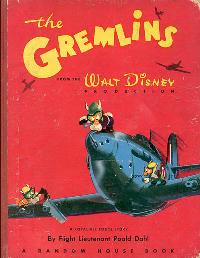
The Gremlins, by Roald Dahl (picture via Wikimedia Commons)
Aviator Lore
Since the Air Force has been around significantly less time than the Army, Navy, or Marines, its body of lore is somewhat less robust in terms of sheer volume. What it lacks in quantity, however, it certainly makes up for in quality, as some of the most ritualistic performances of folk belief appear in Air Force stories. Some of the best ones:
Like soldiers, a pilot frequently keeps a bible or verse on his person as a protective talisman
“Aviators wore mismatched socks and shoes from successful missions, but they avoided apparel from fliers who had been shot down” (Brunvand 766)
A pilot would not allow a photograph to be taken of him immediately before flying a mission
The pre-flight toast or drink glass should always be tossed in the fire or smashed prior to take-off to ensure safe return
Carrying a silver dollar from a year with numbers adding up to thirteen (e.g. a 1903 silver dollar, as 1+9+0+3 = 13) would prevent harm from befalling an aviator
A plane with the word ‘boomerang’ somewhere in its name would always fly home safely (e.g. the B-29 Boomerang)
Perhaps one of the most interesting bits of Air Force lore is the ‘clinker’ plane—an aircraft in such bad shape it seems destined to crash right after liftoff. Any pilot who can safely get the plane out on a mission and back again would have been thought to be charmed for life and a safe bet to fly with.
A number of superstitions for airmen and women are more highly personal—a piece of clothing they might insist upon wearing every mission, or a standard phrase or action done immediately before takeoff (similar to the smashing of the glass).
And I would be remiss, of course, if I didn’t mention my favorite bit of superstition and otherworldly interference for pilots: gremlins. No, not the ones from the 1980s movie, but the ones described by numerous air force pilots as intentionally climbing out over moving aircraft parts to destroy and sabotage them midflight. Children’s author Roald Dahl served as a member of the Royal Air Force in Britain and wrote a book about the little creatures (at one time the book was to be made into a Disney cartoon, but in the end its designs and general gist wound up as part of a Bugs Bunny short). The gremlins are sometimes thought to be monsters, and sometimes thought to be aliens, but almost always they are not of earthly realms.
I should also say that if I were to branch off from the magical side of the Air Force superstitions and into the alien-and-UFO side of things, there would be no shortage of material to share. If that’s something you’re interested in, I highly encourage you to look into it further!
So how’d I do? Let’s see, about 2,400 words, so I think that’s enough for this time around. But what about you? Do you know any interesting lore from the Armed Forces? Have you served in the military and heard any of these superstitions, or any ones not included here? I would love to hear them!
Shownotes for Podcast 62 – Pregnancy and Birth Lore
Summary:
In this episode we’re trying out the wedding ring test, asking about spicy foods, and trying not to scare any birthmarks onto Laine’s baby as we talk about the lore and folk customs surrounding pregnancy and childbirth.
Cowboy hats for sale in Austin, TX (photo by Nika Vee, via Wikimedia Commons)
There’s a line from the classic (well, sort of) movie Smokey & the Bandit in which Burt Reynolds’s character explains to his lady of the film that he only takes his hat off for one thing, to which his female companion (Sally Field), of course, replies: ‘Take off your hat.’
Costume is frequently a reflection of ceremonial, ritual, or even magical operation, an outer manifestation of inner desire or power. A nun’s habit or a burqa can both represent a commitment to religious life, and inspire reactions from those around them. The ceremonial robes of a Thelemic magician frequently conform to specific standards to enhance invocations and rituals. The Encyclopedia of American Folklore notes:
Folklorists who discuss adornment have concentrated on costume’s socializing force and its relationship to the maintenance of individual and group identities. According to Don Yoder (1972), folk costume expresses identity in a symbolic way; functioning as an outward “badge” of community identity and expressing an individual’s manifold relationships to and within that community (Brunvand 341).
One of the items frequently associated with magicians is the magic hat—whether it’s the shiny tophat of a stage magician concealing a rabbit in its depths or the pointy, star-spangled adornment of a fantasy wizard. In American lore the hat has a special place as a magical item, frequently providing either symbolic guidance, otherworldly taboo, or a method of deployment in spell-casting.
When people think of American hats, possibly the most iconic is the cowboy’s ten-gallon hat (which, of course, does not hold ten gallons, but the galon hatband worn by Southwestern vaqueros). I remember teaching overseas and asking about impressions of America, and the most common response was that we tend to wear cowboy hats and smile a lot.
The cowboy hat—as well as a number of other elements of ‘rugged’ American folk costume—was borrowed from other cultures:
Many specifically American types of costume emerged from the interaction of diverse costume traditions in dialogue with indigenous materials and environments. Recognizable forms in Western regional costume, for example, are creolized forms resulting from the interaction of different traditions of dress. The costume of mountain men who charted new Western territory—fringed buckskin coats, breeches and shirts, fur “coonskin” hats, and thick, colorful blanket jackets—was an adaptation of Native American costume forms suitable for native environments and constructed with indigenous materials. The occupational costume of the American cowboy was also the result of the interaction of various cultural forms in dialogue with the demands of occupation and environment. Many of the recognizable elements of the classic American cowboy costume, such as spurs, hat, boots, and chaps, were the result of cultural exchanges between working Anglo and Mexican cowboys, known as vaqueros. Vaqueros were known by their wide-brimmed hats, short jackets, colorful neckerchiefs, red sashes, elaborate spurs, and protective leather leggings (Brunvand 343)
Given the emblematic nature of the Stetson and its kin and the frequently superstitious nature of life in the Old West, it is hardly surprising that lore has arisen surrounding this headgear. Probably the most common belief surrounding the cowboy hat has to do with what to do when you’re not wearing it. There seems to be an absolute taboo on placing a hat on the bed, which appears in everything from Southwestern rodeo lore to Oregon folk belief.
In both the American South and West, a particular custom of hat-burning following the birth of the first baby (or sometimes only the firstborn son) of a miner prevails. From Vance Randolph’s Ozark Magic & Folklore comes the following account:
In some clans, when a baby boy is born, a sister of the babe’s father comes to the house, looks at the child, and then burns the first hat she finds. No matter whose it is, nor how valuable, she just picks up a hat and throws it into the fireplace. Many people laugh at this and pretend to take it lightly, but it is never omitted in certain families. I know of one case where there was some doubt about the child’s paternity, and the husband’s family were by no means friendly to the young mother, but despite all this one of the sisters came and burned the hat; she did it silently and grudgingly and most ungraciously, but she did it. This practice is never discussed with outsiders, but it is sufficiently known that a series of funny stories has grownup about hats being burned by mistake, strangers’ hats missing, doctors leaving their hats at home, and so on (Randolph 205)
This practice was also found in California by folklorist Wayland Hand, where “[o]n occasion of a miner’s first trip to the mine after the arrival of the firstborn, his comrades simply seize his hat and burn it despite any resistance or protests offered” (Hand 52). This act functions both as an initiatory rite and as a method of preventing bad luck for the child. Hand also notes that the baby was usually made to touch the hat if possible prior to its cremation. A soldier’s hat could also be worn by a woman in labor to give her strength during the birth, furthering the link between children and hats.
A number of traditions from African American folklore have been attached to hats. In most cases, headgear serves as a method for the transference of contagious magic, sometimes almost in a medical sense: “if one borrows a hat from a diseased person, and the wearer sweats round the forehead where the hat rests, he will take the disease” (Steiner 267). Harry Hyatt recorded a string of beliefs among African Americans surrounding hat lore:
9750. If a girl puts a man’s hat on her head, she desires him to kiss her; if a man puts his hat on a girl’s head, he desires to kiss her.
9751. A girl should never put a man’s hat on her head; it will cause quarrels with him.
9752. The girl who tries on a man’s hat will not get him for a husband.
9753. If a woman throws her hat and gloves on a man’s bed, she wants to sleep with him; if a man throws his hat on a woman’s bed, he wants to sleep with her.
9754. A girl can strengthen a sweetheart’s love by laying his hat on her bed when he comes to see her.
9755. The significance of a beau refusing to hand his hat to his girl when he calls on her is love growing cold. 9756. A girl stepping on a man’s hat will soon marry the owner.
9757. “The girls did this when I was young: in the spring stamp with your thumb in the palm of your hand the first twenty-seven straw hats you see and you will meet your beau.”
9758. If a girl takes the bow out of the hat of each man liked, she will marry the owner of the seventh hat.
9759. Let a girl take as many bows as possible from the hats of men liked and wear them on her garter; the bow staying on longest will reveal who among these men loves her best (Hyatt 231)
Clearly some of these are contradictory, as in the piece about one gender wearing the other’s hat breeding either contempt or desire. There does seem to be a very strong connection between hats and sexuality, however, perhaps because the hat sits so close to the brain and retains the warmth of the head, it may be seen to cause ‘feverish’ behavior, such as love, lust, or even fighting. The divinatory rites surrounding hats are also interesting, although I suspect these performances have less to do with any direct effect upon the mind and more to do with other counting rituals related to love forecasting. Several tricks in the practice of old-style hoodoo involve acquiring the band from a man’s chapeau and using it to deploy any number of tricks, mostly designed to influence him in love (or occasionally business).
A bit of lore from the Southern mountains tells about how a person can reverse bad luck caused by unfortunate omens (in particular a fearsome rabbit crossing one’s path): [If a] Rabbit runs cross yur path, turn yur hat ‘roun’. (Wear your hat with the back part in front.)” (Duncan 236). This is not much different from the idea of turning around if a black cat crosses one’s path or even turning a key or coin over in one’s pocket after seeing an unlucky sign. In an era when hats are frequently worn backward (if worn at all), this sort of act is probably much less out of place today than it would have been half a century or so ago.
Hats, then, can be deeply magical objects to those that wear them. It’s hardly surprising that Lyle Lovett sings of his size-7 Stetson, “Well if it’s her you want, I don’t care about that/ You can have my girl, but don’t touch my hat.”
So what about you? Do you have any hat-related lore? What kinds of hats hold particular magic for you? The pointy costume ‘witch’ hat? A trucker’s cap owned by a favorite grandfather? I’d love to hear what makes your hat special and whether you ever ascribe anything magical to it.
We look at the various traditions, festivities, and delights of Mardi Gras and Carnival, and then explore Lent with a special guest. We’ve got articles, cocktail recipes, conversation, and music! Laissez les bon temps rouler, y’all!
Summary:
Tonight we’re responding to a pair of conversations from other shows on witchy aesthetics and the mechanics of magic. First, we’ll look at some ideas about fashion and self-image brought up by Scarlet’s Lakefront Pagan Voice show, then touch on the functional structures of folk magic with reference to a recent Inciting a Brewhaha episode.
Cory mentions the recent Star Magic course he took with the lovely Bri Saussy as part of his “What’s in Your Cauldron?” He also mentions the New Orleans Wish Dog he’s using as part of a sweetening work.
We are highly encouraging listeners to go check out Heather Dale’s Celtic Avalon campaign and help her to bring her music to the world!
We also announced the winner of our Three Questions contest.
If you have feedback you’d like to share, email us or leave a comment. We’d love to hear from you!
Borrowed from Pinterest user shuttlecock (click for link)
Or, “Myrtle Snow is my Power Animal.”
[NOTE: The original version of this article contained a phrase that, used in this context, is insensitive and appropriative towards several Native cultural traditions. I leave the original above with a strikethrough to indicate that such use was a mistake. My mistake. I regret the choice of phrase and I apologize for any discomfort or harm it causes to anyone. I don’t want to completely erase the original because I worry that doing so will look like I’m trying to hide the mistake, which I’m not trying to do. I want others to see and know this was not a good choice on my part, and that I am sorry for it.]
(A few AHS: Coven spoilers below, but no major plot points)
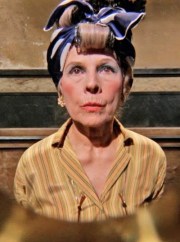
For those who, like me, spent the past four months or so riveted to the meandering and bizarre plots of the American Horror Story: Coven television series, the ride is now over and we’re all left sorting out wheat from chaff from eyeballs from axe-murdering ghosts living in knotty pine hell. One of the most interesting and unusual characters in this season was Myrtle Snow (portrayed by the luminous Frances Conroy), a complicated, artistic, eccentric witch that is just about everything you could dream of having in a crazy aunt who can cast spells and is willing to melon-ball out the eyes of her enemies to restore your own sight. Myrtle plays the theremin, knows fashion inside and out (one of the best moments in the series was her screaming “Balenciaga!” at a crucial moment in the final episode), and has a palate for classic French and continental cuisine. She is, in short, a child of the seventies. More importantly, she is a child of the seventies witch.
Today I wanted to briefly look at that decade (which I’m treating as a “long” decade, starting in around 1965 and going through the very early 80s), which spawned a very particular witchy aesthetic. It was the decade of Stevie Nicks (another AHS trope) and saw a marked growth in the popularity of occult themes across all sectors of American—and international—society. This is not going to be comprehensive, of course, and I know this is not exactly folk magic drawn from a weather-beaten nineteenth-century almanac, but I think that we should be cognizant of the role of recent (well, as recent as almost half-a-century ago, anyway) history in the development of modern magic and witchcraft. If the Victorian era was the early bloom of occultism, the seventies was the springtime explosion of color, dripping nectar, and bloody thorns which allowed a lot of the witchcraft we have today to re-surge, and it even helped fuel some of the studies of folk magic which have been so crucial to us in contemporary times.
In 1958, the film Bell, Book, & Candle featuring Kim Novak, James Stewart, and Jack Lemmon appeared in movie houses following a popular run of the play on Broadway. The sympathetic witch, played by Novak, and her hep-cat brother Nicky (Lemmon) mark some of the earliest American pop-culture portrayals of sorcerers who are not scary and evil, but hip, cool, and attractive. The success of the film eventually fed into the production of the classic television show Bewitched, which ran from 1964 to 1972, which starred Elizabeth Montgomery as the beautiful and charming Samantha. These portrayals are occasionally problematic—the film requires Novak’s character to give up witchcraft in the name of love, and the show was centered around Samantha’s struggles to sublimate her magic so that her husband could lead a comfortable suburban life (although that magic frequently saves his proverbial bacon)—but these glowing women brought glamor to the popular American experience of witchcraft, and the occult looked a lot less intimidating.
Knock, knock!
Then, in 1967, Ira Levin published his book Rosemary’s Baby. The following year, Roman Polanski adapted the book into a film the following year, and the eerie occult was back, with full-on Satanic conspiracies lurking behind Manhattan closet doors. Even in Rosemary’s Baby, however, the glamor persisted—the eccentric but resplendent witches-next-door, Roman and Minnie Castavet (played by Ruth Gordon and Sidney Blackmer), were magnetic, and served frosty cocktails in their spacious New York flat. There Satanic witch-cult even seems more like an anarchy art clique than a sinister magical lodge for the most part. The film put the fear of witches back into the American mind, however, with a new twist—witches were spooky, but spooky was cool. Incidentally, another classic occult film, The Devil Rides Out, appeared in theaters the same year as Rosemary, and lit its own subtle fires under the cauldron.
With this new-found social capital, witchcraft and the occult took the world by storm in the seventies. Some of the occult films which appeared during the decade were hallmarks of art and cult cinema: Simon, King of the Witches(1971); The Devil’s Daughter (1973); The Exorcist (1973—not a true ‘witch’ film, but one with strong occult ties and influence); The Wicker Man(1973); Season of the Witch (1973, directed by zombie-genre great George A. Romero); Lisa & the Devil(1974); and the highly glamorous Suspira (1977), a veritable precursor to 2010’s creepy art-dance film Black Swan. In essentially all of these films, the presence of the occult is a trope, and does not have any of the benign or jovial qualities of Bell, Book, & Candle or Bewitched. Yet each film features a mixture of eroticism, fashion, and allure layered over the tale of black magic driving the story. Liberation, sexual empowerment, and countercultural energy augment the horror of the films, and the gray space between forbidden occultism and fashionable society becomes a gulf.
Art and music also experienced an occult florescence during the seventies. The aforementioned Stevie Nicks—the “White Witch” of music—joined the group Fleetwood Mac along with boyfriend Lindsey Buckingham in 1974, and in 1975 the group experienced mainstream success with an album featuring witchy hits like “Rhiannon.” Her flowing shawls, black gowns, and stage twirls bewitched audiences, and her fashion became a standard of young, hip women seeking to look a little out of the mainstream—a little “witchy.” The occult music craze started well before Nicks, of course, and bands like Coven and Black Widow had experienced some chart success with their Satanic/witchy black rock during the late 60s. In 1970, Santana recorded and released Fleetwood Mac’s song “Black Magic Woman,” on their (fairly occult-named album) Abraxas, taking it to no. 1 on the pop music charts. In 1972, the Eagles released “Witchy Woman,” another big hit glamorizing witches, and in 1974 Cher released “Dark Lady,” about a love triangle involving a witchy fortune teller. Cher herself cultivated a glam-witch look throughout the decade, further expanding the cultural capital of witchcraft fashion. Other rockers who adopted elements of the occult into their songs, performances, and fashions include David Bowie, Jimmy Page, and, of course, Jim Morrison. Patti Smith notes the heavy influence of the occult on the Greenwich Village music scene in her memoir Just Kids, and especially the huge artistic influence that it had on artists like Robert Mapplethorpe. Penthouse magazine did erotic spreads centered on occult themes as well, such as this one featuring Babetta Lanzilli from 1974.
In the ‘real-world’ of witchcraft, a number of stars were aligning to add fuel to the magical fire. Chas Clifton outlines a number of the groups which were exploding onto the scene in his book Her Hidden Children, including the Psychedelic Venus Church and Anton LaVey’s Satanic Church, which also released a film called Satanis in 1970 (there are some great pictures of a 1969 LaVey here). Alex Sanders, the progenitor of Alexandrian Wicca, released an album revealing some of the workings of Wicca called A Witch is Born in 1970. Wicca had arrived stateside with Raymond Buckland in 1968 (although it may have had some early seeds from other sources, too). Buckland expanded on witchcraft religion through books like Witchcraft Ancient & Modern and Witchcraft from the Inside. The hugely influential publication of Robert Heinlein’s Stranger in a Strange Land in 1967 led to the foundation of The Church of All Worlds (CAW) and shaped practices in other groups as well (such as the aforementioned Psychedelic Venus Church). The mass-marketing of witchcraft became a staple of the 70s, with sales of “black magic ritual kits” hitting store shelves and a variety of occult-inspired board games. The Ouija game was purchased by Parker Bros. in 1966, and they began to push it as a party game rather than a spiritual tool. There was also a push towards legitimacy. Journalist Hans Holzer published his mainstream apologetic (and sensationalist at times) text The Truth About Witchcraftand opened the door to public discussions of its practices as legitimate, if fringe, activities done by regular people. Wicca and neo-Paganism in general underwent a rapid expansion and transformation, and the end of the decade saw the journalistic survey of new witchcraft (and other alternative) faiths in Margot Adler’s Drawing Down the Moon (1979). That same year, Starhawk published The Spiral Dance, which crystallized the evolving feminist Wicca movement. A busy, busy decade for witchcraft.
I should point out that these different aspects of witchcraft may have occasionally interacted with one another, but they were not in strict conversation through the decade. Instead, the popular conception of the occult and witchcraft grew in one direction—often sensational and glamorous—and the nature-based religions that were gaining momentum in fringe spiritual culture. Yet there does seem to be a shared zeitgeist from that era that drove ever more people into the black-robed arms and beshawled shoulders of witches. For a number of people, the ecological spiritualism which was fueling part of the neo-Pagan segment was a complete non-starter. Instead, the sex, drugs, & rock-and-roll aspects of witchery worked as an artistic medium of self-expression. Both segments were connected to counterculture, but with different aims and methods. Following this decade, with its chaos and beauty, the occult got heavily mired in a number of problems, most notably the “Satanic panic” of the 80s. With the recent popularity of witchcraft in media, I’d be hardly surprised to find a resurgence of people claiming to have been harmed or attacked by evil cults over the next two decades or so. Let’s hope there’s been some growth on that front and that the information age will keep it in check, but I somehow doubt the ripples aren’t already in motion for the next “panic.”
So what does all this have to do with Myrtle Snow and the Diane von Furstenburg wrap dress (“the greatest invention of the century,” according to dear Auntie Myrtle)? I think that it can be very easy to lose sight of just how diverse witches are, for one thing. Dressing in black (despite AHS:Coven’s edict that “On Wednesdays we wear black”) may be a statement, but so is sporting a pair of black-and-red Pleasers for ritual sex, and there’s nothing wrong with a Pier 1 altar and a little P90X before ritual. I don’t want this to devolve into a post on there being no one type of witch, or on what witches should or shouldn’t look or act like, but I do think that the recent witchcraft revival in pop culture means that there’s room for some real glamor in witchery again. Folk magic performed with embedded style and power—a flair for the dramatic—could be a very refreshing thing. I’d like to see witches embracing their own high-fashion spins on tried and true witchcrafts—not so much glitter in conjure oils, but a really knowledgeable mixologist of a witch brewing enchanted herb rinses for bewitching cocktail hours, for example. I certainly don’t want to see the folk magic I study and practice cheapened by commercial interests, of course, but I would love to see a few more Myrtles playing the theremin around bonfires, while our cultural capital is so ascendant.
What about you? Is there a place for glamor and high fashion in your witchcraft? Are the seventies still alive in your spells?






 New World Witchery - The Search for American Traditional Witchcraft