Blog Post 184 – Comets

The Comet of 1680, by Lieve Verschuier (via Wikimedia Commons)

“Like a comet burn’d
That fires the length Ophiuchus huge
In the Arctic sky, and from his horrid hair
Shakes pestilence and war” (Milton, Paradise Lost)

With the ISON comet drawing eyes to the night sky, I started thinking a lot about the superstitions and magical beliefs surrounding the appearance of comets in the sky. Comets have long inspired people in strange, occasionally beautiful, and sometimes disturbing ways. Mark Twain’s life was framed by the appearance of Haley’s Comet, a point the author himself noted. The Heaven’s Gate cult engaged in a group suicide surrounding the arrival of the Hale-Bopp comet.

Increase Mather, famed early American religious writer, dedicated an entire work to explaining the spiritual importance of comets in his Kometographia of 1683. He was responding to the presence of the Great Comet of 1680, which had captured the attention of most of the Western world, and felt that many people would be afraid at this sign and misunderstand it as a phenomenon which directly influenced the course of events on earth, rather than a sign from God of some important event to come (see more here). Generally speaking, comets have historically been associated with strife and woe to come. My Opie/Tatem Dictionary of Superstitions gives a laundry list of examples of ill-omen presaged by what the Venerable Bede called “long-haired stars”:

  • A comet as portending a change in governance (Tacitus, Annals)
  • Famine or pestilence or war or “fearful storms” (Byrhtferth, Manual)
  • A comet [the Great Comet of 1680] appeared two days before the Duke of Monmouth died, and all over Europe before the death of Charles II (J. Case, Angelical Guide)
  • An appearance before the plague struck London (Defoe, Journal of a Plague Year)
  • A wry observation that those who laugh at comets as tokens of disaster will studiously insist on “times and situations proper for intellectual performances” (Johnson, The Idler)

In the New World, comets seem to have retained much of their wicked reputation. In some cases the danger foretold by the comet is vague and ill-defined: “When a comet appears there will be trouble” (Roberts, “Louisiana Superstitions”). In other places, the significance of the hairy star was more direct and its consequences very  clearly understood: “A comet is a sign of war” (Thomas, Kentucky Superstitions).  Why should these astronomical phenomena, which had been showing up in night skies for ages, have such a bad rap? Considering even Classical authors like Tacitus cite the comet as woeful, the impulse must run deep. The unique cosmological view of Calvinism, though, which influenced much of Atlantic American colonization, both denigrated occult practices like witchcraft and supported an enchanted view of a univers under Divine direction:

“The Calvinism of the colonial awakenings also paralleled important occult ideas. The fatalism inherent in Calvinism’s concept of predestination found an occult equivalent in the idea fundamental to astrology that motions of star and planets revealed a future that individuals could not control. Calvinist evangelists and occult practitioners also explained catastrophes in similar ways. Believers in occult ideas thought the coming of comets and eclipses had inescapable and usually disastrous consequences; not even kings and queens escaped their verdicts. No one escaped judgment by the Calvinist God either. Sometimes He damned seemingly model Christians simply to demonstrate His sovereign” (Butler, “Magic, Astrology, & the Early American Religious Heritage”).

The shared cosmology of the colonists saw the universe as inhabited by spiritual consciousness, and an intelligence that wished to convey its meaning to human beings for one reason or another. Signs, omens, and portents were one such method. Comets, with their placement among the stars, their strange and ill-understood movement, and temporary nature made perfect fodder for prognosticators of all stripes—religious, occult, and both (they did exist, even during the Colonial period).

Lest we make the mistake of thinking that the observation of comets was the purview of only a few dusty old white occultists or a lot of fiery former Englishmen with strong religious convictions, I’d also like to point out that the cosmology which imbued comets with significance stretched across a broad swath of New World denizens, including Native Americans, Spanish and French colonists, and of course, the imported Black slaves.

“English Protestants often read unusual events as evidence of the divine presence in everyday life, acknowledging the activity of a creator deity who operated through omens and portents within the natural order, or signs and wonders in the heavens, philosophy known as Providentialism. “Comets, hailstorms, monster births and apparitions” and other disruptions of the ordinary were demonstrations that foretold God’s will or signaled His displeasure withhumankind. Africans’ understandings of the universe were also inspired by visible manifestations of spiritual forces within nature. They too viewed thunder, lightning, and other elements as heralds of sacred hierophanies,the awesome presence of numerous divine beings.” (Chireau, Black Magic).

The Providentialism Chireau notes fits the cosmology of the English and other European settlers, but it is clearly not unique to them. A world with Divine presence not only innate to its component parts, but in which those component parts act as mediums for communicating with humans, is also very much an African perspective. And while it is tempting to think that such beliefs can be relegated to history’s dustbin, we should also remember that in our time comets stir up a lot of strange excitement. Religious scholar Camile Paglia notes, for example:

“The Children of God, founded in 1968 as Teens for Christ by “Moses” David Berg in Huntington Beach, California, were negligible in number but came to public attention when they loudly prophesied that the us would be destroyed by Comet Kohoutek in January 1974. The group continues under the name “The Family” and is regularly excoriated by conserva tive Christian watchdog groups for its practice of free love (called “Flirty Fishing”) as well as its heretical beliefs that Jesus was sexually active and that God is a woman. (Paglia, “Cults and Cosmic Consciousness”)

Paglia also references the Hale-Bopp comet mentioned earlier, and Marshall Applewhite’s Heaven’s Gate cult. I have, so far, not heard of any particularly distressing phenomena surrounding ISON’s appearance, but if nuclear war breaks out, I may have to blame that particular “long-haired star.”

If you have comet lore you’d like to share, please do so in the comments!

As always, thanks for reading!

-Cory

Blog Post 177 – Treasure Hunting

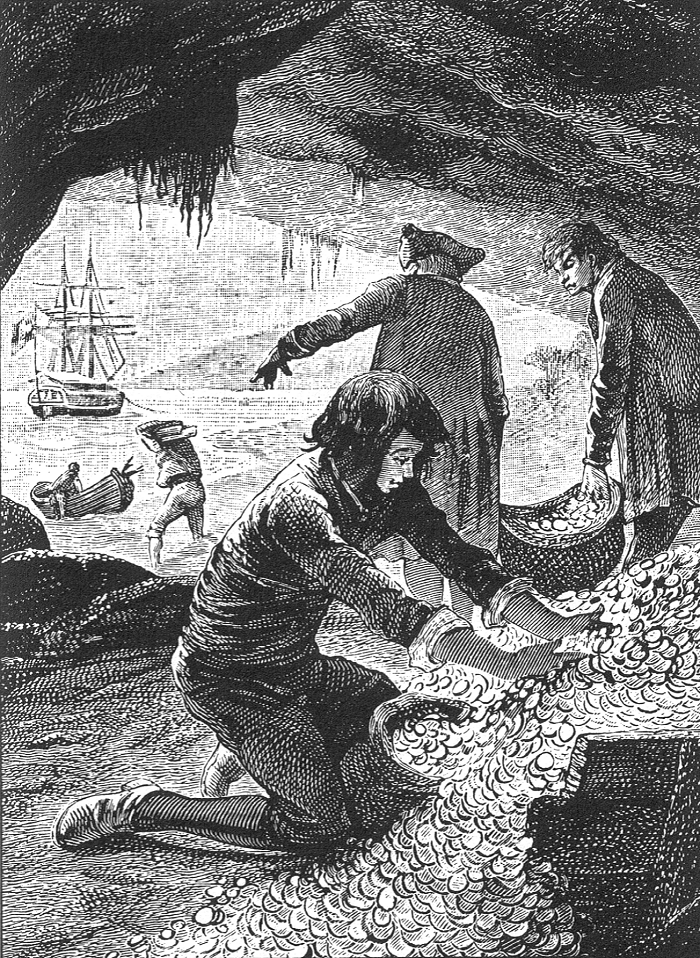
“Jim Hawkins & the Treasure of Treasure Island,” illustration by Georges Roux (via Wikimedia Commons)

A number of modern spells are designed to bring “prosperity” into an individual’s life.  In some cases, Wiccan and Wiccan-influenced spellbooks contain workings that either target specific needs and cash amounts, or which seek to generally enhance the financial stability of the magician or his/her designated target (most Wiccan spellbooks also require that the magician have permission from the target even in beneficial magical workings like this). Certainly, magical practices designed to bring a sense of bounty and abundance into one’s life go back quite far—the cults of Fortuna and Tyche in the ancient world appeal to good luck, and the Roman cult of Pomona pursued the ideal of a fruitful life. Folk magic, however, has generally focused less on meeting a generalized prosperity and has drilled down to specific financial problems and advantages. The Wiccan spells which seek a specific sum of money to cope with a specific issue—a medical bill, a broken radiator, etc.—very much mirror the sorts of spells done by people across multiple times and places as they tried to cope with uncertain finances.

Another brand of folk magic, however, did not work towards a specific sum, nor did it seek to bring a vaguely defined sense of wealth into someone’s life. Instead, many spells targeted getting rich—quick! In some cases, the spell’s target would be a gambler who worked to gain the advantage in games of chance (more on that another day, hopefully). A few stories talk of acts of magical extortion, wherein a magician would either try to low-ball the purchase of land/livestock with the threat that failure to accept a paltry offer would result in the destruction of the commodity in question OR a witch might place a curse on a neighbor and only remove the curse for a fee (you can find several examples of such stories in The Silver Bullet, and Other American Witch Stories by Hubert J. Davis).

If someone wanted to get rich really quickly, however, he or she would turn to magical treasure hunting. Plenty of European grimoires had methods for finding lost treasures, usually with the help of spirits. Some grimoire texts which influenced American practices, such as The Black Pullet, spelled out in detail how to summon treasure-seeking daemons to work on one’s behalf:

Seal4BlackPullet

“This talisman and this ring are not less valuable. They will enable you to discover all the treasures which exist and to ensure you the possession of them. Place the ring on the second finger of your right hand, enclose the talisman with the thumb and little finger of your left hand, and say, Onaim, Perantes, Rasonastos.” I repeated these three words, and seven spirits of a bronze colour appeared, each carrying a large hide bag which they emptied at my feet. They contained gold coins which rolled in the middle of the hail where we were. I had not noticed that one of the spirits had on his shoulder a black bird, its head covered with a kind of hood. “It is this bird,” the old man said to me, “who has made them find all this treasure. Do not think that these are some of what you have seen here. You can assure yourself of this.” I replied, “You are for me the truth itself. My father! Do you believe that I would insult you by doubting?”

He made a sign, and the spirits replaced the gold in the bags and disappeared. “You see, my son, what the virtues of these talismans and rings are. When you know them all, you will be able, without my aid, to perform such miracles as you judge proper” (The Black Pullet, 20-21).

Seals and incantations like these made it into later magical practices, especially in places where grimoire languages like German, Spanish, or French were spoken (to be clear, many grimoires were written in languages like Latin with commentaries in European languages, and these three tongues were hardly the only ones in which grimoires appeared).

Of course, being able to find treasure only helps if treasure is already buried in the earth waiting to be found. In the maritime culture of early New England (as well as the maritimes of other parts of the New World), a widespread belief in hidden golden caches secreted beneath the soil became the basis for a number of magical spells. A Maine man named Daniel Lambert, suddenly flush with money, faced suspicion, for:

Lacking any other apparent explanation, his neighbors attributed Daniel Lambert’s sudden wealth to the discovery of buried pirate treasure. Despite Canaan’s location dozens of miles from navigation, the inhabitants readily believed that Lambert had found a treasure chest because, as Kendall explained, “The settlers of Maine, like all the other settlers in New England indulge an unconquerable expectation of finding money buried in the earth.” Indeed, backcountry folk insisted that troves of pirate treasure guarded by evil spirits pockmarked the New England countryside even in locales far from the coast (Taylor 7).

Since the New World was vast and dangerous, people turned to magic to help find these copious buried (and frequently ‘cursed’) treasures, and to remove any dangers that might arise during the expedition to unearth them. A number of ‘rules’ for enchanted bounty-seeking developed, including:

  • Treasure hunting teams needed at least three members, as that number ensured magical success
  • Magical circles should be inscribed around the digging site to prevent any malevolent spirits from attacking the diggers
  • Implements of silver, such as silver spoons or spades, should be used to dig at least part of the earth to ensure luck in the hunt and to protect the diggers from harm
  • Blood offerings (animals usually) had to be made to quell the guardian spirits protecting the treasure—a belief related to the idea that a guardian spirit was usually a person who was killed and his blood spilled over the burial ground

In addition to maritime treasures, the idea of “Indian” gold became very popular. Some European colonists and conquerors were sure that entire cities of gold were just waiting to be found in the dense, mysterious interiors of North and South America. Gonzalo Pizzaro and Sir Walter Raleigh both mounted expeditions to find such legendary places, frequently referred to as “El Dorado,” or “the golden one.”  In almost every case, however, the site was protected by evil spirits, a curse, ghosts, or some other malevolent force. In some situations, however, the spirit might actually help a seeker find his or her treasure:  “There are many tales about ghosts who speak to people, telling them to dig at such-and-such a place to find a buried treasure. The ghost is usually that of some fellow who died without being able to tell anybody where his treasure was concealed, and who cannot rest quietly until someone gets the money and enjoys it” (Randolph 219). How one ensures that the ghost is not simply walking the magician into a trap is anyone’s guess.

One of the best examples of magical treasure hunting led to an entire religious movement in the New World. While the time has not yet come to explore the full magical heritage of the Latter Day Saints, I would be remiss to omit them here.  Joseph Smith, prophet and founder of the Mormon faith, used to hunt for treasure using methods derived from alchemy and hermetic science/magic. He followed the rules laid out above, frequently offering “sacrificed either pure white or jet black sheep or dogs to lay out magic circles of blood” prior to discovering his golden plates and having his angelic vision (Taylor 12). Smith’s methods were not deviant or unusual. He used seer or peep stones to help find his hidden treasures, and his activity in the highly spiritually active area of New York known as the Burned-Over District was imitative of earlier seekers and followed by those who did the same. In fact, Smith was following very much in his own father’s footsteps, as Joseph Smith, Sr. was an active treasure seeker in Palmyra, New York. He is recorded to have once described his methods to a neighbor, saying “the best time for digging money was in the heat of the summer, when the heat of the sun caused the chests of money to rise to the top of the ground” (Brooke 31). The tradition the Smiths followed required—like many grimoire traditions do—that the seeker be spiritually pure or else he will fail in his pursuits, a concept brought in from hermetics and alchemy. The fervent spirituality and insistence on saintly behavior left a strong mark on the junior Smith, and helped him feel prepared for his prophetic role in revealing the Book of Mormon (which was inscribed on golden plates).

In some cases, treasures of golden pieces and precious gems are not the target of the magic. I have written previously on the phenomenon of dowsing, which allows a person to magically search for substances like water and oil beneath the earth. In some cases, the dowser might also search for veins of gold or silver or other valuable ores like iron. The method for making such a dowsing tool appears in Hohman’s early nineteenth century text, The Long-Lost Friend:

TO MAKE A WAND FOR SEARCHING FOR IRON, ORE OR WATER.

On the first night of Christmas, between 11 and 12 o’clock, break off from any tree a young twig of one year’s growth, in the three highest names (Father, Son and Holy Ghost), at the same time facing toward sunrise. Whenever you apply this wand in searching for anything, apply it three times. The twig must be forked, and each end of the fork must be held in one hand, so that the third and thickest part of it stands up, but do not hold it too tight. Strike the ground with the thickest end, and that which you desire will appear immediately, if there is any in the ground where you strike. The words to be spoken when the wand is thus applied are as follows: Archangel Gabriel, I conjure thee in the name of God, the Almighty, to tell me, is there any water here or not? do tell me! + + +

If you are searching for Iron or Ore, you have to say the same, only mention the name of what you are searching for.

This version of magical dowsing incorporates high magical elements (such as the invocation of Gabriel) and strong folk magical ones (the clipping of the tree twig at sunrise and the simple dowsing methodology).  On the simpler end of the spectrum, one could simply put a bit of whatever was being sought into the tip of the dowsing rod, as in this example from the Ozarks: “Many hillfolk are interested in the search for lost mines and buried treasure, and some of these people have tried to use the witch stick in their quests. If a man is looking for buried gold, he fastens a gold ring to the end of his stick ; if it  is silver that he expects to find, he splits the end of the wand and inserts a silver coin. Rayburn says that to locate mixed ores one uses two different metals usually a dime and a penny” (Randolph 88).

The practice of hunting for buried wealth and riches spanned cultural and geographic boundaries. In many cases, very strict rules were followed, regarding purification and protection as well as actual seeking magic. Spirits would guide a magician to the site of a treasure, and in some cases might even be employed to raise it from the earth. In other cases, the spirits associated with the treasure were deeply malevolent and most of the magic employed was to placate or dis-empower any evil that might be lingering about the dig site. The payoff for an effective treasure hunter could be a sack of coins, a buried chest, or even a new branch of a religion, but the work required up front was heavy and intense. While gambling charms might take longer, the success rate was better overall. In the end, getting rich quick via magical means, it seems, has always been a labor-intensive and time-consuming effort, just like any other job.

Thanks for reading!

-Cory

SOURCES

  1. Anonymous. The Black Pullet (Red Wheel/Weiser, 2007).
  2. Brooke, John L. The Refiner’s Fire: The Making of Mormon Cosmology, 1644-1844 (Cambridge UP, 1996).
  3. Davies, Owen. Grimoires: A History of Magic Books (Oxford UP, 2010).
  4. Davis, Hubert J. The Silver Bullet, and Other American Witch Stories (Jonathan David Pub., 1975).
  5. El Dorado,” Wikipedia (2013).
  6. Gainer, Patrick W. Witches, Ghosts, & Signs: Folklore of the Southern Appalachians (Vandalia Press, 2008).
  7. Hohman, John George. The Long-Lost Friend: A 19th Century American Grimoire, ed. Daniel Harms (Llewellyn, 2012).
  8. Horowitz, Mitch. Occult America: White House Seances, Ouija Circles, Masons, & the Secret Mystic History of Our Nation (Bantam, 2010 reprint).
  9. Hutcheson, Cory. “Blog Post 146 – Dowsing,” New World Witchery, 2011.
  10. Milnes, Gerald C. Signs, Cures, & Witchery (Univ. of Tenn. Press, 2009).
  11. Randolph, Vance. Ozark Magic & Folklore (Dover, 1964).

Taylor, Alan. “The Early Republic’s Supernatural Economy: Treasure Seeking in the American Northeast, 1780-1830.” American Quarterly (Spring, 1986).

Blog Post 171 – Magical Cakes

King Cake Bagel, via Wikimedia Commons

Laissez les bon temps rouler, y’all! It’s Mardi Gras, which means a last-minute pre-Lenten extravaganza of flesh, fun, and other words starting with the sixth letter of the alphabet. In honor of the Carnival spirit of feasting (another “f” word!), I thought I’d take  a brief look at one of the things I most associate with this holiday: cake.

Cake may not have the aesthetic magical impact of a cauldron bubbling over a fire or a bag full of bones scattered in the dirt, but this bakery standby (and some of its culinary cousins) manages to surface in a number of magical practices. Since this is Mardi Gras, let’s start with one of the most obvious, the King Cake. The King Cake originates in Epiphany and Old Christmas celebrations from Catholic countries, but has also become incredibly prominent in Carnival and Mardi Gras celebrations. The one you’re most likely to find in a local bakery (I have found Hispanic bakeries frequently are my best source) will be big, doughy cakes covered in icing and lots of colored sugar—usually gold, green, and purple. Somewhere inside, a small plastic or metal baby lurks, waiting to grant luck on the one fortunate enough to get a slice with the little token in it (or unfortunate enough, if you happen to bite into the baby and chip a tooth before you know what you’re doing). The lucky association of the baby in the King Cake resembles other traditions in which a bean is baked into a cake and the recipient receives blessings, money, or good luck upon finding it. Sometimes the “King” or “Queen” of the feast would be chosen by the finding of a bean or a pea:

Samuel Pepys (whose wife was French) recorded a party in London on Epiphany night, 6 January 1659/1660: “…to my cousin Stradwick, where, after a good supper, there being there my father, mothers, brothers, and sister, my cousin Scott and his wife, Mr. Drawwater and his wife, and her brother, Mr. Stradwick, we had a brave cake brought us, and in the choosing, Pall was Queen and Mr. Stradwick was King. After that my wife and I bid adieu and came home, it being still a great frost.”[1] The choosing of King and Queen from the pie, usually by the inclusion of a bean and a pea, was a traditional English Twelfth Night festivity. (via Wikipedia’s article on “King Cake”)

Most Westerners know about the significance of candles on birthday cakes, as well as the wishing tradition that comes with blowing them all out at once. Some of the other quirky and semi-magical rituals we perform in conjunction with cake:

  • “Portions of the wedding cake are often saved to eat at anniversary parties (and at christenings) to symbolize that the marriage has lasted and matured” (Brunvand 63).
  • Brides are not supposed to bake their own wedding cakes, for fear of bad luck.
  • A newly married couple frequently joins hands to cut the wedding cake and serve the first slice, which can symbolize their union and service to one another, their joint role in serving the community and their families (in some cases members of the family are served first by the bride and groom),  or their shared prosperity and a wish that they should never know hunger together.
  • “The wedding reception provides more folklore, mostly concerning the wedding cake. One popular belief says that if the bride cuts the cake first, with the groom placing his hand over hers, their marriage will be cooperative. This ritual also ensures fertility. Some traditions urge the couple to fast, while others insist that they eat their entire meal for good luck. Trinkets in the shape of rings, horseshoes, and cupids are often baked inside the cake” (Brunvand 1548).
  • “Let a bride on her wedding-night throw a piece of wedding-cake outdoors and next morning watch how many birds eat the cake; the number of birds will be the number of her children” (Hyatt 54).
  • “If a slice of the birthday cake tips over on the plate, that person will never marry” (Brunvand 170)
  • Over-the-Hill celebrations frequently involve black or coffin-shaped cakes to symbolize (humorously, we hope) the ever approaching death of the recipient.
  • Several cultures celebrate the Passover-and-Easter holidays with special cakes, including the Jewish use of unleavened cakes in Pesach meals, the Dutch use of Paas cakes in the Easter feast, fastnaacht cakes of the Pennsylvania Dutch, and other similar baked treats.
  • Also from the Germanic tradition: “Years ago it was almost a general custom among Germans in Quincy to bake a coffee-cake and eat it with the family who had a new baby so that the child would become wealthy” (Hyatt 73).
  • From the files of American History: “Although Election Day is not a legal holiday, the event  nonetheless is associated with folk customs. For example, in New England, there is a tradition of preparing Election Day cake. This yeast-raised cake, prepared with spices, raisins, and nuts, dates back to the 1700s in Connecticut. It is tied to an era in which the trip to cast one’s vote was a journey punctuated with visits to friends and family. By the 19th century, polling places were more accessible, and the customs of Election Day cake and callers waned” (Watts 125).

Of course, Western culture hardly has a monopoly on cake-based traditions. Since we’re also entering the Chinese New Year, I can’t help but mention the delicious little mooncakes you can find in a number of Chinese bakeries at this time of year. In some cases, these sorts of little glutinous cakes might be offered to ancestors or deities (as with the tt’ok of Korean origin) or simply consumed as a symbol of prosperity and blessing during the celebrations.

According to American Folklore: An Encyclopedia, “Some American children enjoy baking a ‘thundercake’ when they first hear thunder and starting to eat it when the storm breaks (if the storm allows enough time for baking)” (Brunvand 1553). I’m not entirely sure what the significance of this weather-ritual might be, although I would speculate it brings some kind of protection or prosperity. Harry Hyatt recorded an interesting pregnancy divination based on a baking cake: “’ When I was young, whenever my bread or cake cracked open in the middle, I always was in a family way. It never failed.’ Some say the cracking open is not necessary; a raising-up more than usual in the center is sufficient”  (Hyatt 54). A variation on this technique says if the cake breaks open during baking, a baby girl is not far behind.

Cakes also can have a darker (“devil’s food?”) side. Some cakes can be used to cause harm or to undo hurtful magic by sending it back to its origins. The famous “witchcake” made from urine and grains which Tituba allegedly showed the Parris girls how to make in Salem, MA, was supposed to have caused tremendous suffering to whomever was attempting to curse the young ladies. Another rather evil-sounding cake was allegedly used to poison a child: “One instance is given [in an account from 1895] of ‘toad heads, scorpion heads, hair, nine pins and needles baked in a cake and given to a child who became deathly sick’” (“Conjuring and Conjure-Doctors in the Southern United States,” Journal of American Folklore, p. 143). Gruesome.

Still, all in all, cakes tend more towards the “angel food” side of things, and bring luck, prosperity, and joy along with other blessings. After all, it is cake, right?

So enjoy your Mardi Gras celebrations with whatever baked sweetmeat you find most appealing. I will be having pancakes with FROG jam (Fig-Raspberry-Orange-Ginger, made by our local Amish country market and SO delicious!) and hopefully laissez-ing the bon temps rouler all day long! Here’s wishing you a wonderful day!

Thanks for reading,

-Cory

Sources

  1. Brunvand, Jan. American Folklore: An Encyclopedia (1998).
  2. “Conjuring and Conjure-Doctors in the Southern United States,” Journal of American Folklore (1896).
  3. Hyatt, Harry M. Folklore of Adams Co., Illinois (1935, 1965).
  4. King Cake.” Wikipedia (2013).
  5. Milne, Gerald C. Signs, Cures, & Witchery (2007).
  6. “Tituba.” Famous American Trials: Salem Witchcraft Trials 1692. Univ. of Missouri (Kansas City, 2012).
  7. Watts, Linda S.The Encyclopedia of American Folklore (2006).

Blog Post 167 – Corpses

To get everyone in the holiday spirit, today I thought we might head down the gruesome path to the graveyard and see what we can dig up (figuratively, of course). That’s festive, right? Deck the halls and all that? While I’ve talked recently about bones and their uses in magic, and we’ve touched on the idea of working with the dead in magical practice, too, you may not know that there is a very long and widely spread habit of using corpses—in whole and in macabre part—as magical tools in their own right. Of course, there are many societies, including some Native American tribes, with strong taboos against contact with dead bodies, yet even this geis reflects a sense of respect and awe at the power of the deceased. Sometimes the spirit of the dead person is the fuel behind the magic—in which case it can be seen as a form of necromancy—and sometimes it is simply the body voided of life—any body, really—which empowers the charm.

Probably one of the most famous and nefarious examples of corpse magic is the Hand of Glory, a special candle made from the severed and pickled hand of an executed criminal which supposedly had intense magical properties. One of its talents was its reputed ability to render anyone in a house near where it was lit unconscious, thus making them easy to rob and explaining why the Hand of Glory might have been sought after by eager thieves. Here is one of the brief-but-to-the-point recorded recipes for making a Hand of Glory, from one of my favorite spooky little tomes, Kathryn Paulsen’s Witches’ Potions & Spells (WARNING! THIS IS PROVIDED AS A FOLKLORIC EXAMPLE ONLY! DO NOT DESECRATE CORPSES—IT IS HIGHLY ILLEGAL!):

During an eclipse of the moon, sever the right hand of a corpse, preferably that of an executed murderer. Dry it and preserve it in a jar to which you have added foul smelling herbs. If you light the fingers of this hand as candles, the light can only be seen by yourself and other witches, and the light will not go out until you wish it. If you bring it into a house, sleep will reign over those within.  But you must let no one know that you posses the Hand of Glory. Use this hand to give light whenever you wish to obtain something from a graveyard (Paulsen 40).

Paulsen also mentions a variation on this spell which involves filling a human shin bone with tallow and carrying it as a candle to cause enchanted sleep. The Hand of Glory and its variants date back to at least the early Modern period, showing up in 18th century texts like the Petit Albert.

Across the Atlantic and on North American soil, corpses remained a morbid part of folk magic. Here they were granted powers of healing, crime-detection, secret-keeping, and other occult traits. The bodies of the dead figure into magical systems spanning multiple cultures, including those of Native Americans, the Pennsylvania Dutch, African Americans, and mountain folk in the Appalachians and Ozarks. First Nations practices vary between tribes, with alternating levels of prohibition and interaction when it comes to handling the dead. Randolph notes that “Some hillfolk of Indian descent insist upon sprinkling a little cornmeal over a corpse, just before the burial. This is done unobtrusively, without any noise or ceremony, and many whites have attended funerals where the rite was carried out without eve* noticing it. As the mourners shuffle past the body, here and there you see one drop a tiny pinch of meal into the coffin” (Randolph 316). Such a practice more rightly belongs to burial customs than necromancy, however. In general, contact with the dead can be a powerful—but frequently fearful—thing in Native societies. For example, “[o]ne of the most remarkable of Indian sacrifices was that practised by the Hurons in the case of a person drowned or frozen to death. The flesh of the deceased was cut off and thrown into a fire made for the purpose, as an offering of propitiation to the spirits of the air or water. What remained of the body was then buried near the fire” (Parkman 4). In the Pacific Northwest, there are accounts of tribes with magical groups that engaged in highly taboo behaviors to perform their roles as community sorcerors:  “There were also a number of secret societies—for example the Cannibal Society of the Kwakiutl, whose induction ceremony was believed to involve eating parts of a corpse” (Lowenstein 120). South American Natives have their own legends about how a group of witch-monsters from Chiloe, an archipelago south of the mainland, use a fearsome object called a macun. This is a leather bowl made from human skin taken from the corpse of a virgin which reveals the presence of human victims and can be used in some stories as a mode of transportation.  It can also help the evil brujos turn into animals, open locked doors, and become invisible.

Turning from the cultural backdrop of Native Americans, whose varied practices I have only skimmed in the previous paragraph, let us now look more at the specific applications of corpse magic in some of the non-Native societies of North America. In general, what follows is broken down by magical purpose into categories (legal work, divination, cures, and curses), with a few tidbits at the end. This is a far from complete examination of the topic, however, so I hope this provides an entryway into further study for those interested.

Legal Work
Fundamentally, these sorts of spells are either somewhat divinatory—helping to provide insight into crimes which remain unsolved, for instance—or make use of the dead body to provide legal aid. To this latter end, we can look in Hohman’s Long Lost Friend to find at least one instance in which the figure of the corpse is invoked to help in court-case work:

“TO RETAIN THE RIGHT IN COURT AND COUNCIL.
Jesus Nazarenus, Rex Judeorum.
First carry these characters with you, written on paper, and then repeat the following words: “I (name) appear before the house of the Judge. Three dead men look out of the window; one having no tongue, the other having no lungs, and the third was sick, blind and dumb.” This is intended to be used when you are standing before a court in your right, and the judge not being favorably disposed toward you. While on your way to the court you must repeat the benediction already given above.” (Hohman #147)”

The use of actual corpses in legal work tends to be more in crime-detection, however. One piece of lore spread across several cultures describes leaving an egg in the hand of a murdered man when he is buried. The murderer will be compelled to some action, depending on the story, ranging from returning to the scene of the crime to confessing guilt to suffering illness and death himself. Sometimes the body will perform its own divination, unaided by other witnesses or participants. Kentucky lore says “If a corpse’s nose bleeds, it is a sign that the murderer is in the room” (Thomas #745). Puckett notes in African American lore that “the common Negro belief [is] that If you put your hand on the corpse the ghost will not harm you (or you will be afraid of no more dead people). This may be the remnant of an old ordeal, since the wounds are supposed to bleed if the murderer touches the corpse” (Puckett 88).

Dead bodies can predict a number of situations and conditions it seems, as we shall see in the next section.

Divination
A number of sources on African American lore mention that a corpse that “limber” corpses predict a death to follow them, and insist that mirrors and clocks be covered with cloth as soon as someone dies to prevent anyone else in the house from dying. Like Puckett’s note above about touching the body to prevent fear of dead people, the corpse can intrude upon the living. Touching the body can prevent both bad dreams and visits from an unruly spirit. Likewise, the suggestion of something corpse-like can announce important information (usually another death). Harry Hyatt had an informant who related a tale of ‘death-scent,’ for example:

“I started to eat my breakfast last week. I happened to put my hand to my face; it smelled like a corpse. I said, ‘I wonder who’s going to die.’ And the smell left right away; that is a sudden death. If the smell  stays, it will be longer. That day I had a call. My cousin died when I was eating my breakfast. If it is the left hand that smells, it’s a lady; right hand, a man” (Hyatt #8313).

The dead seem to know a lot about the affairs of the living, but they can also be entreated to hold their tongues. Zora Neale Hurston recorded a spell used for keeping secrets which required a corpse: “If you want a secret kept, put it in the care of the dead by writing it on a piece of paper and folding it small and slipping it into the hand of the corpse, of whispering it in the ear” (Hurston 361). In addition to catching criminals and revealing impending doom, corpses can also be employed in a variety of happier magics, such as healings.

Cures
The volume of cures ascribed to dead bodies is too voluminous to include in any book, so I will only briefly touch on it here.  One of the most popular healings ascribed to the dead is wart-charming, which we’ve looked at before.  In the Ozarks, “[t]here is a widespread belief that warts can be ‘charmed off’ by touching them with the hand of a corpse. I have seen this tried several times. The warts disappeared after a while, just as they generally do under any other treatment, or with no treatment at all. On the other side of the balance, I have met an undertaker who handles many bodies every year, and both his hands are covered with warts!” (Randolph 131). Similar to Randolph’s bit about wart-removal, this charm comes from Kentucky: “You may remove birth-marks by rubbing them with the hand of a corpse.” (Thomas #1067). It can supposedly treat other skin disorders like eczema as well. A variation on the birthmark-removal from Illinois contains a little verbal charm to accompany the act of touching the corpse: “A girl should visit the corpse of a boy and move his hand over her birthmark as she says What I have, take with you; In the Name of the Father, Son and Holy Ghost. A boy with a birthmark does this at the corpse of a girl.” (Hyatt #2685). Sometimes merely rubbing the mark or blemish with a rag and placing the rag in the coffin of a dead man is enough to remove the problem. Placing clothes and other objects from a sick person in the casket of the deceased supposedly removes everything from skin disorders to contagious diseases. Clothes taken from the corpse can also be healing: “To remove a swelling on the leg, bandage it with a piece of linen taken from a corpse” (Hyatt #5145).

Some of the other cures attributed to the dead:

  • “In other localities the body is placed on a ‘coolin’-board’ and covered with an arrangement of sheets, the one over the face being raised when the mourners address the corpse. Mourners may talk to the body to this effect: ‘Mandy, you gone an’ lef me. … I may be nex’ . . . Po’ Mandy! . . . Po’ John! .’ A plateful of salt and ashes is placed under the coolin’-board . . . whatever disease the body has goes into the ashes and salt. ‘Ashes takes up from de body de disease.’ These ashes are carried to the grave; and at the words, ‘Ashes to ashes and dust to dust,’ they are thrown into the grave.’” (Puckett 87)
  • “When in pain get some of this graveyard dirt from the breast of the corpse, cook it with lard, and make into a sort of pancake. Sprinkle this with turpentine and bind like a mustard plaster to the place that pains you. You will surely be cured.” (Puckett 287)
  • “Place in a coffin three lice from your head and the corpse will carry away the others.” (Hyatt #1438)
  • One of the more desecration-y methods for solving home problems with a little help from the dead comes from Harry Hyatt: “Pour some of the child’s urine into a bottle, hide this with a coffined corpse, and the child will stop wetting the bed. Sometimes a hole is punched through the stopper so that the urine can drip out — the cure being effected after the bottle becomes empty.” (Hyatt #6298)

In addition to being powerful curatives, bodies of the deceased can also cause tremendous harm.

Curses
It probably comes as no surprise that the use of dead bodies in magical rituals and spells generally gets a fairly negative portrayal. In the previous three sections, the spells were all designed to enact some positive change—albeit messy or sacrosanct in some cases—but now we shall look at a few of the nastier ways in which our dead friends can be used for magic. I’ll begin with a love spell, not because I inherently think love spells are evil curses (I don’t think that at all, actually), but rather because this one is exactly the kind of spell you could make a horror movie out of. It’s obsessive, possessive, and a little mean:

“A girl can take a needle which has been stuck into a dead body, cover it with dirt in which a corpse has been laid, and wrap the whole thing in a cloth cut from a winding sheet ; this is supposed to be a very powerful love charm, and a woman who owns such a thing can make any man fall in love with her. A needle which has been used to make a shroud is useful, too. If a girl thrusts such a needle into her lover’s footprint in her own dooryard, he is forced to remain with her whether he wants to or not. If he leaves the neighborhood he will get sick, and if he stays away long enough he will die.” (Randolph 169)

Randolph also examines witchcraft which falls in line with storybook expectations, harmful stuff perpetrated by willfully malevolent magical practitioners:

“Some witches are said to kill people with graveyard dirt, which is dust scraped from a grave with the left forefinger at midnight. This is mixed with the blood of a black bird; a raven or crow is best, but a black chicken will do in a pinch. The witch ties this mixture up in a rag which has touched a corpse and buries it under the doorstep of the person who is to be liquidated. The practice of burying conjure stuff under houses and doorsteps is well known. I have heard it said of a sick woman that she ‘must have stepped on somethin’ ‘ meaning that she was bewitched.” (Randolph 272)

Sometimes the negative effects of the corpse are inadvertent, however, and cursing is incidental. Several sources mentioned that pregnant women should not look upon a corpse, lest their child be marred in some way. Ozark lore says that using the comb of a dead person, particularly a comb that touched the deceased’s hair, will cause your own pate to go bald. Still other corpse curses seem related to harming the spirit of the departed him or herself. Kentucky lore says that you should “Put a lock of hair of a corpse into a hole in a tree to localize the spirit. If you remove the hair, the spirit will haunt you” (Thomas #741). Trapping a spirit seems like a dangerous game to me, but then, I’m not doing that particular spell anytime soon anyway. One of the quirkier ways of messing with the soul of the departed comes from Illinois: “As long as the funeral bill remains unpaid, the corpse will not rest in its grave” (Hyatt #15193).

In addition to the main methods discussed above, corpses also seem to have other magical uses. Here are a final pair from Hurston and Randolph involving some of the more unusual magic connected to the dead and their bodies:

“I. To Gain All Power. Go to the graveyard the night of All Saints at twelve o’clock. All of the blessed are gone from the cemetery at that time and only the damned are left. Go to a sinner’s grave1 and get nine hairs from his head and give the spirit in there a drink of whiskey. (They’ll do anything for a drink of whiskey.) Just leave a pint of liquor in there with the stopper out. Go home and burn nine red candles and the spirit will do anything you want.” (Hurston 361)

“When a backwoodsman dies, in certain sections of the Ozarks, it sometimes happens that one of his male relatives cuts a hickory stick just the length of the corpse. I have seen a hill farmer carrying one of these sticks on the day of his brother’s death, and I have seen one tied to the wagon which conveyed a corpse to the graveyard, but I have never been able to find out what became of them, or what their significance was. I first thought that the stick was simply to measure the body for a coffin, but it is something more complicated than that, and there is some sort of superstition connected with it.” (Randolph 314)

I hope this has been a worthwhile spin through the old boneyard to look at the dead from a more corporeal angle than we usually do in magic. None of this is to advocate any sort of desecration or anything illegal. While I imagine slipping a pinch of cornmeal into a coffin or wiping a handkerchief over a deceased family member’s hand before the casket is closed would at most raise some eyebrows, just about anything involving messing with the dead means legal problems. If you want to get a little help from the dearly departed, developing a relationship with them as spiritual beings is a much smarter way to go (I wrote about it recently on my other blog over at Witches & Pagans, if you’re interested).  If you have lore about dead bodies and the ways they have been used in magic, I’d love to hear them!

Thanks so much for reading!

-Cory

REFERENCES & SOURCES

  1. Gainer, Patrick W. Witches, Ghosts, & Signs. (Vandalia Press, 2008).
  2. Hohman, John George, ed. Daniel Harms. The Long Lost Friend. (Llewellyn, 2012).
  3. Hurston, Zora Neale. “Hoodoo in America.” Journal of American Folklore (Amer. Folklore Soc., 1931).
  4. Hyatt, Harry M. Folklore from Adams County, Illinois.  (Univ. of Ill. Press, 1935).
  5. Lowenstein, Tom & Piers Vitebsky. Native American Myths & Beliefs (Rosen Pub. Group, 2011).
  6. Paulsen, Kathryn. Witches’ Potions & Spells. (Peter Pauper Press, 1971).
  7. Parkman, Francis. “Indian Superstitions.” North American Review (Univ. of Northern Iowa Press, 1866).
  8. Pinckney, Roger. Blue Roots: African-American Folk Magic of the Gullah People. (Sandlapper Pub., 2003).
  9. Puckett, Newbell Niles. Folk Beliefs of the Southern Negro. (Univ. of North Carolina Press, 1926).
  10. Randolph, Vance. Ozark Magic & Folklore. (Dover, 1964).
  11. Yronwode, Catherine. Hoodoo Herb & Root Magic. (Lucky Mojo Press, 2002).
Blog Post 165 – Dem Bones, part I

Dem bones, dem bones, dem dry bones.
Now hear the word of the Lord.
-from “Dem Dry Bones,” Traditional Spiritual based on Ezekiel 37

From the Ossuary in Sedlec, Czech Republic. My wife took the photo! Isn’t it cool?!

With Halloween just past, I thought it might be a good day to briefly look at one of the most commonly used magical tools in folk sorcery: bones (and their companion skulls as well). I recently received a letter asking specifically about the practice of “Tapping the Bone,” which I will touch on briefly here or in another post, though I will likely not delve too deeply into it as that ritual performed under that name belongs to the general heading of “Traditional Witchcraft.” There are many better resources on that topic than this website, so I’ll stick primarily to the magical folk practices of North America here.

Bones as magical tools have been around for at least 12,000 years, and likely longer than that. In the Paleolithic era (‘Old’ Stone Age), figures carved out of animal bone were likely used in religious ceremonies designed to ensure a good hunt, survival in adverse circumstances, tribal fertility, or any number of other goals. The people making such carvings were hardly ignorant of natural processes, as Alexander Marshack’s discovery of lunar calendars etched into animal bones in the late twentieth century demonstrates. Some estimates place such carvings at around 30,000 years old, so people have been using bones for magic for a while now, to say the least.

Instead of spending several paragraphs exploring the history of bones in magic—which would be easy to do, but would essentially involve me repeating over and over again that skeletal remains have been a part of sorcerous operations for a very long time and are still used today—let’s instead look at how these tools were put to use in the New World. In a very broad sense, bones serve a few very specific  (and sometimes overlapping) magical functions: spirit vessels, divinatory tools, healing specimens, and charm curios.

Spirit Vessels
The use of bones and skulls as a gateway to the land of the dead, or even in some cases to underworlds not inhabited solely by the dead, seems like a natural place to start a discussion. This is very much what “Tapping the Bone” is about, in that a witch or sorcerer can use a skull to summon up a dead person’s spirit or to travel into the otherworld and gain insight or information. A number of good examples can be drawn for this practice. Mexican American families, for instance, use sugar skulls as a way of interacting with their deceased loved ones during Dia de (los) Muertos celebrations. While such a celebration is hardly necromantic, it does seem to be a popular way to facilitate a relationship with the departed. The idea that bones harbor a connection to the dead and their realms also appears in Palo Mayombe, with the phenomenon of the nganga. This is essentially a pot filled with a variety of natural objects including bones which serves as a home for a patron spirit (nkisi). In Native American traditions of the Arikara, musical instruments made from human arm bones are used as a method for summoning the fearsome ancestral spirits known as Buffalo People (James Howard, “The Arikara Buffalo Society Medicine Bundle,” Plains Anthropologist (1974)).  I have also seen references to the need to keep a skull on the altar of a working houngan, or Vodoun priest.

Whatever the specific application, the theory behind bones as gateways to the otherworld seems generally clear: they are the last remaining physical link between someone or something that has died and the world of the living. Using bones to house spirits also makes a great deal of sense, as their liminal nature (caught between life and death) makes them a comfortable space for the two worlds. The bones do not have to be human to facilitate communication, either. In The War of the Witches, narrator Timothy Knab mentions one of the curanderos with whom he is training bringing out a reed box full of “patches of fur, buzzard beaks, and claws from different animals,” which represent ancestral connections of various types, and which could be employed for divinatory and protective purposes (91).

If the remains of dead things are houses for the long-gone, keeping house is very important. Bones treated irreverently can cause all sorts of spiritual havoc. In Roger Pinckney’s Blue Roots, he mentions how African burial practices involved two funerals: one right after the death, and one several years later when bones would be disinterred, lovingly reverenced by the family of the departed, then put to a final rest to give them peace. When slaves could not perform the required funerary rites due to white sensibilities about the exhumation of the dead, it resulted in a lot of “trabblin’ spirits,” or ghosts roaming the land—which may explain why the South is so haunted (59-60).

With so many traditions recognizing the connection between ancestral and unseen spiritual forces and a pile of femurs, tibia, and clavicles, it should hardly be a surprise that the use of bones to communicate with the dead frequently leaves the altar and enters the hands of thesoothsayer.

Divinatory Tools
If you’ve ever heard of someone “throwing the bones,” you know already that a little bundle of claws, teeth, and bones can be scattered to read events of the past, present, and future. If you’ve heard of the slight variation in phrase which goes “rolling the bones,” you may instead associate the items tossed with dice and not perceive anything divinatory, but rather a game of chance played for money, like craps. Yet the two different practices and phrases are very closely related. Both rely on fate to reveal an outcome, for example. The “bones” of the dice phrase is not metaphorical, either, as dice were frequently carved from bone until the twentieth century presented cheaper alternatives like plastic.  The ankle-bones of sheep have a naturally dice-like shape, and were frequently used as substitute dice in medieval times. Likewise, dominoes were once carved from bones and can also be used for both gambling and fortune-telling purposes. Raymond Buckland, for example, alleges that Travelers (essentially the UK variant of “Gypsies,” though they are not always ethnically linked) had a domino oracle used for fun and divination.

One of the finest books on the use of bones in divination only came out in the past year or so. Cat Yronwode, who runs the Lucky Mojo Curio Company, put out a small chapbook-sized work called Throwing the Bones, which provides a brief survey of bone-based divination practices ranging from dominoes to dice to Sangoma-style bone casting. Yronwode makes a good case for understanding “bones” as including things like coins, buckeyes, doll hands, and even a stone or two. You can even buy a set of “starter bones” with the book as a kit, and learn some basics of bone-throwing that way. Another book with a good reputation (I’ve not read it myself, but have seen it recommended by a few reputable diviners) is Carlos G. Poenna’s Yoruba Domino Oracle.  Juniper over at Walking the Hedge also has a great article on crafting your own “bone” system using a variety of objects (including, of course, bones).

Using bones for divination is a very old practice—it almost certainly was done in Ancient Greece and Rome, and may have been done even in Ancient Egypt. The “casting lots” found in the Bible (as in Psalm 22 or during the crucifixion of Jesus) would likely have been done with bone dice or something similar. While doing bone-based divination may seem to be a fairly simple way to work, it can also take on complex methodologies. An article published in the Journal of Experiential Education describes a Native American system called “The Bone Game,” which was used to settle disputes between warring tribes without resorting to outright violence. In this “game,” each tribe would establish high stakes (like potentially a large number of horses or weapons), then form teams which would circulate different bones (here used in Yronwode’s sense to mean small, deeply personal natural objects, including things like nuts or seeds in some cases). Each team would try to determine which object best represented them, and then engage in a very elaborate geocaching/hide-and-seek/scavenger-hunt like ritual which resulted in one team having a victory and claiming all the stakes.

And of course, how can I talk about rolling bones without mentioning the lovely Dolly Parton song about a bone-casting hill witch called “These Old Bones,” from her album Halos & Horns?

I’ll pause here for today, and next time (hopefully) we’ll look at some of the healing methods and simple charms based on bones. I do hope that this very brief look at bones in their spirit-contact/divinatory capacity is useful. I’m sure there’s much more I could write on the topic (I have not addressed systems like runes, which may involve inscribing symbols on bone or antler pieces for fortune-telling purposes, for example), but for now I will just hope that this short article sparks your own curiosity on the subject of magical bone-picking.

Thanks for reading!
-Cory

Blog Post 162 – Broom Lore

I recently helped out on a project for a local folklorist looking for information on broom lore, and wound up with easily twenty pages of notes on the topic from a wide variety of sources. I thought that today I would share a few of the commonly held beliefs regarding brooms, as well as look at some of the most unusual practices surrounding this wonderful household item.

Of course there are many instances of witches riding broomsticks in art and media, but of course brooms were only one of the preferred methods for nocturnal transportation to Sabbat rites. Other mounts included pitchforks, stangs, goats, and eggshells (and even the occasional human being fitted with a magical bridle, in the cases of alleged ‘hag-riding’) (The Historical Dictionary of Witchcraft, Bailey: 23-4). Brooms served magical folk for more than hobby-horses and transport, though. In European culture, broom magic goes back at least as far as Ancient Rome. In that culture, the broom’s sweeping function translated into a purification rite. Eli Edward Burriss notes in his Taboo, Magic, Spirits that the Romans believed a new baby and its mother were in danger of being tormented by woodland spirits—particularly one called Silvanus—and goes on to quote St. Augustine about a three-part, three-tool ritual in which several spirits were invoked to provide protection. Let’s see what the good saint himself says on the subject (from Burriss’ book, and his translation of Augustine):

‘. . . After the birth of the child, three protecting divinities are summoned lest the god Silvanus enter during the night and harass mother and child; and to give tokens of those guardian divinities three men by night surround the threshold of the house and first strike it with an ax and a pestle; then they sweep it off with a broom, that, by giving these signs of worship, the god Silvanus may be kept from entering. For trees are not cut nor pruned without iron; nor is spelt powdered without a pestle; nor is grain piled up without a broom. Now from these three objects are named three divinities: Intercidona from the intercisio of the ax; Pilumnus from the pilum; Deverra from the sweeping (verrere) of the broom; and by the protection of these divinities new-born babies are preserved against the violence of Silvanus.’ (Burriss 28)

Burriss goes on to note that the iron in several of the implements provide the expected protection from evil, but the ceremonial sweeping is what actually drives away the wicked spirit. He also notes that Sir James Frazer observed something similar in his book The Golden Bough, which included sweeping salt out of a dwelling and disposing of it in a churchyard to remove any vengeful souls of the dead from the premises (Frazer 144, Burriss 35). Charles Leland noted that Gypsies used broom straws in spells to protect a mother during childbirth (echoing St. Augustine’s writings) and also says that Romanian Gypsies would use iron and broomstraws interchangeably as protective wards placed beneath pillows at night (Gypsy Sorcery & Fortune Telling, Leland: 47-48, 136).

In the New World, brooms retain much of their old purifying & protective power, but also begin to adopt new abilities within the new culture. African American folk practices show a strong connection to brooms and domestic bonds. African American cultural tradition (as well as other cultures) have a wedding practice of “jumping the broom” to seal the ceremony. It’s common enough that in 2011 a romantic comedy film about an African American wedding was entitled Jumping the Broom. This connection to marriage and the household also involves a number of superstitions and folk spells centered on weddings and love in association with brooms. Here’s a short collection of such beliefs:

From Harry M. Hyatt’s Folklore of Adams County, Illinois

  • 9614. To sweep under the feet of someone sitting on a table signifies that person will marry before the year ends.
  • 9615. Do not let anyone sweep entirely around the chair on which you are sitting; you will remain single seven years longer.
  • 9616. The person under whose chair you sweep will marry once say some, twice say others — soon after his or her mate dies.
  • 9617. If you sweep your own feet, you will never get married.
  • 9618. Whoever breaks a broom handle will soon break someone’s heart.
  • 9619. For luck in love, a woman may wet the bushy part of her broom and sprinkle the water about the house.
  • 9935. The significance of an engaged girl dropping a broom is as follows: if the handle points to the north, she or her fiancee will break the engagement; if to the south, she will marry him and live a happy life.
  • 10129. It is very unlucky for a bride to see a broom on her wedding day before she goes to church.

From Kentucky Superstitions, by Daniel & Lindsey Thomas

  • 1614. If you let some one sweep under your feet, you will never be married.
  • 1615. If you sweep your feet with a broom, you will never be married.
  • 1619. If the broom falls across the doorway, someone will call.
  • 1620. If two people sweep a floor together, they may expect bad luck.
  • 1621. If you sweep after dark, you will bring sorrow to your heart.
  • 1625. If you sweep the house after the sun goes down, you may expect a man caller.

I should note that these are only a very small handful of the superstitions associated with brooms in these two texts. Hyatt’s book alone has easily five hundred individual entries featuring various examples of broom magic and lore.

Of course, the broom’s protective power and its association with witches also become increasingly complex in the New World. Many sources (Hyatt, Thomas, Randolph, Puckett, etc.) all say that witches will not cross over a broom, and so it can be a powerful protective charm to put one across your doorway. Similarly, one could reverse a jinx or witchcraft by stepping backwards over a broom. Brooms can also be a component of spells to reverse the evil eye, according to curandero lore:

A treatment for mal ojo (the evil eye) – “She got some kind of herb from the garden. I don’t know what kind it was. She made signs of the cross with the herb by his head and all over his body, and his feet. All this time she was saying something in Spanish, but I couldn’t understand what it was. Then she turned  him over and did the same thing on the other side. She got an egg and did the same thing with the egg, holding the egg and making signs of the cross all the way down his body and across. She told me to get a cup with some water. She cracked open the egg and put it in the water in the cup. Then she had me get a broom straw, which she cut, and made a little sign of the cross that she put on top of the egg. She told me to put the egg under his crib at night while he slept, under his head, and the next day he would be O.K. I looked at the egg the next day, and, my God, it was cooked! I was so surprised! The yolk and the white were hard and cooked like a hard-boiled egg. She told me to bring the egg to her and she could tell if it was a man or woman who had done it. If the cross went one way it was a male, and if it went the other way it was a female” (“Mexican American Folk Disease,” Keith Neighbors, Western Folklore, Vol. 28, No. 4 (Oct., 1969): 254).

Here again we have a connection to magical protection, especially for children, much as we saw in the European lore. Brooms can also cure physical ailments, like warts, as well.

One of the most interesting themes in broom lore has to do with relocating a household. If one is moving, for example, one should not take the old broom along. Likewise, when you are moving, you should break your old broom and burn it before leaving the house. The superstitious believe that a new broom should be one for the first things you bring into a new home:

  • 11288. You will be lucky, if before moving out of the old house you send a broom and a loaf of bread to your new home.
  • 11289. To have luck in the new house, take in the broom and a loaf of bread before anything else; the broom first, the bread next. Then sweep with the broom.
  • 11290. A broom and a dish pan should be the first things taken into your new home for luck.
  • 11291. A broom and a dish towel should be the first things taken into your new home for luck.
  • 11292. The woman who takes a broom and a dust pan into her new home first will always be lucky there. (Folklore of Adams County, Hyatt)

A number of superstitions also note that the first thing a person does in his or her new home should be to sweep it with a broom, then throw the ashes out the door to ensure that all bad luck is swept clean of the house before anyone sleeps there. Likewise, a new home can be blessed with good luck by throwing a broom over it.

While there’s much, much more that could be said on the topic of brooms, I’ll finish up today with a small grab-bag of the more unusual beliefs and practices involving these wonderful magical tools:

  • If a bunch of straw comes out of a broom when sweeping, name it and place it over the door, and the person named will call (“Kentucky Folk-lore,” Sadie F. Price, The Journal of American Folklore, Vol. 14, No. 52 (Jan. – Mar., 1901), 34).
  • 12368. If you sweep on New Year’s Day, your house will be dirty all year; but if you leave the dirt in a pile on the floor until the next day, clean all year.
  • 12369. To sweep on Monday causes bad luck; all week say some.
  • 12370. The bad luck that comes from sweeping on Monday can be warded off by keeping the dirt in the house until the following day.
  • 12371. The bad luck that comes from sweeping on Monday can be warded off by sprinkling salt over the dirt and burning it.
  • 12372. Sweep on Monday and you are sweeping away all your company that week. (previous five from Hyatt)
  • To draw your enemies to you (so that you may know who they are), clean out your stove, all the time keeping your wish in your mind, but don’t speak it. Then break a stick into four pieces, all of them the  Same length, and pin them together in the middle like this and set them afire in the middle. Then go to the four corners of the room, with your wish in your heart and mind, (but don’t say it), and sprinkle salt. Then, when you see your enemies coming, go outside your door and throw your broom down careless and step over it into the house and talk to them across it and they can’t come in, but they can’t help  from coming to your gate. (“Hoodoo in America,” Hurston:  393).
  • It is bad luck to sweep the dirt out of a house at night; sweep it up into a corner and sweep out in the daytime. If obliged to sweep it out at night, take a coal of fire and throw it first in front of you (“Superstitions & Beliefs of Central Georgia,” Roland Steiner, The Journal of American Folklore, Vol. 12, No. 47 (Oct. – Dec., 1899), pp. 261-271).
  • To make a guest leave, place a broom upside down behind the door (Puckett 317).
  • If a very young child, without being told, picks up a broom and starts sweeping the house, you might as well prepare for a visitor, the idea apparently being that an innocent child can see things in the future that grown-ups cannot, and knows that the house must be tidied up for the company. (Puckett 444).

And just for fun, you should listen to blues legend Robert Johnson singing “I Believe I’ll Dust My Broom.”

Some of our own NWW posts which have featured other broom lore:

Blog Post 113 – Spiritual House Cleaning
Blog Post 126 – Walpurgisnacht 2011
Blog Post 137 – Curandero Spells, part I

So there’s my brief take on magical brooms. The short, sweet version is that they’re not just for riding up to unholy Sabbats upon anymore. I hope this information is useful to you! Until next time, thanks for reading!

-Cory

Blog Post 159 – Birthday Superstitions

Hi all! No, this is not a shameless effort to harvest as many birthday wishes as I can, but today happens to be my birthday and I remembered a bit of magical lore that says it is particularly good luck to receive white flowers on one’s birthday.  That got me to thinking about some of the other fun birthday folklore and little bits of magic, and so I thought I’d do a little compilation post on the topic. Some of this has likely been covered in our show on New Year’s, Anniversaries, & Birthdays, but I think I’ll get into some new material, too, so I hope you enjoy!

Starting with probably the most unpleasant aspect of birthday folklore, the birthday spanking, let’s look at a fairly detailed explanation of this superstition, which I am pulling from Kentucky Superstitions, by Daniel & Lindsey Thomas:

“On a child’s birthday, he should receive a blow with a switch or other instrument of pain for each year of his life. Each blow should be accompanied by the pronouncing of one line of the following or a similar incantation, adapted to fit the age of the child:

One to live on;

One to grow on ;

One to eat on;

One to be happy on;

One to get married on” (#96)

Building on the “instrument of pain” idea, Thomas also records this rather morbid tidbit:

“If you let your birthday pass without thinking of it, you will die before the next birthday” (Thomas #2854)

Here are several bits of birthday lore in the form of admonitions about what not to do on your birthday, from Europe and the Caucasus regions:

  • One should not celebrate one’s birthday before the actual date of one’s birth. It will bring bad luck.
  • It is bad luck to be wished a happy birthday if one is over the age of 40 (instead, many people will have parties on their ‘name day’ instead, which is the feast day of the Saint with whom they share a name).
  • If you stumble with your right leg, and your birthday is an odd day, it is good luck. If you stumble with the left and your birthday is an even day, it is good luck. But stumbling with the wrong combination (right leg, even day or left leg, odd day) is very bad luck.
  • You should always have an odd number of candles on the cake or pie for a birthday, even if you have to add an extra candle.

Of course, almost everyone knows that blowing out your candles brings you good luck and wishes, but they can also be divinatory tools. In an article which probably has my favorite title of any folklore article (“Signs & Superstitions Collected from American College Girls,” by Martha W. Beckwith), I found this bit of birthday augury:

“Blowing out the candles on a birthday cake will tell you how many years it will be before you are married:

(a) By the number of times you have to blow to put them all out.

(b) By the number of candles left lighted after the first blow.”

This latter belief is supported by superstition from Kentucky as well (Thomas #246, #247), so perhaps the birthday folklore from Kentucky isn’t all bad news. Vance Randolph notes that Ozark natives regard birthdays as powerfully divinatory days, especially in terms of determining bad luck:

“The typical hillman is upset by any trifling piece of ill luck which happens on his birthday, knowing that  one who is unfortunate on this particular day is likely to have bad luck all year” (Randolph 66).

Randolph also records a wonderful method of bibliomancy related to one’s birthday:

“Many hillfolk tell fortunes and predict marriages by means of certain quotations from the Bible. For example, the twentyfirst and thirty-first chapters of Proverbs have thirty-one verses each. Chapter 21 is man’s birthday chapter; chapter 31 is woman’s birthday chapter. A boy looks up his proper verse in the man’s chapter, according to the date of his birth. A man born on the twenty-third of any month, for example, reads Proverbs 21 : 23 the content of this verse is supposed to be especially significant to him” (Randolph 184).

My particular verse using this method (and the King James) is: “The thoughts of the diligent tend only to plenteousness; but of every one that is hasty only to want.” So apparently, I should spend some time in diligent thought, today? Hmm, I’ll need to think on that a bit.

A fairly common divination performed for young children is to place a number of items around them on their first birthday and see which one they pick up. That will determine their future occupation. Harry M. Hyatt records this belief in several forms:

“3529. On a boy’s first birthday lay before him on the floor a deck of cards, a bottle, a Bible and a piece of money: if the deck of cards is selected, he will be a gambler; if the bottle, a drunkard; if the Bible, a  preacher; and if the money, a hard worker.

3530. The day a boy is a year old put down before him on the floor a pocket- book, a whiskey bottle and a deck of cards: if he reaches for the pocketbook, he will be opulent; if for the bottle, a drunkard; and if for the cards, a gambler.

3531. A boy’s future can be discovered on his first birthday by laying in front of him on the floor a book, a dollar and a hat: if he clutches the book, he will be a good learner; if the dollar, a miser; and if the hat, a stylish dresser” (Folklore from Adams Co.)

Hyatt also records an interesting variation on the birthday-candle-wish belief, saying “The person whose candle burns out first at a birthday party may make a wish,” which indicates that perhaps each party guest lights one of the birthday candles on the cake (Hyatt #8715).

Mixing the good with the bad, American Folklore: An Encyclopedia shares these pieces of birthday folk belief:

  • The best day to start a business is on your birthday
  • If a slice of birthday cake tips over on your plate, you will not marry
  • You should put a pat of butter on your nose on your birthday for good luck (Brunvand 170-2)

The book also mentions the carnival-esque atmosphere of birthdays, in which an ordinary person might become “Queen” or “Boss” for the day—echoing the elevation of the Fool during Carnival and Mardi Gras celebrations, and the idea of baking a birthday cake with little divinatory charms inside echoes the “King Cake.”

So there’s a bit of fun birthday lore for you. I don’t know which of these I’ll try out this year, though I might just secretly be hoping for that birthday spanking. One to grow on and all that. It’s all in the name of folklore, I promise.

Thanks for reading!

-Cory

Blog Post 157 – Peaches

I love a good summer peach. Or peach cobbler. Or homemade peach ice cream. And I can’t tell you how much I miss my mother’s homemade brandied peaches (which were amazing over some hand-churned vanilla). If you live in North America, it’s likely you’ve encountered peaches everywhere from grocery stores to roadside stands to neighbors’ backyards. They’re ubiquitous, which also means they’ve been a major player in the foodways of America.

Today I’m going to briefly look at the peach from another folkloric perspective, focusing on its relevance in magical lore as opposed to its purely culinary uses (though I imagine the two are not ever to be completely disentangled from one another).

The flesh of the peach is frequently regarded as a nearly sacred food in its homeland of China, where it is thought to aid immortality. The lore of the peach is extensive there, with every part of the tree and fruit making an appearance. Peach pits are worn as amulets to ward off demons, while blossoms are used to enhance love, luck, & beauty. Peaches are left in family shrines, and feature prominently in the literature and art of China. You can read a good deal more about the role of the peach in Chinese lore here and here.

Peaches were highly valued in places like the Appalachian Mountains, too.  According to the third Foxfire book, one of the most common varieties was the Indian peach, a shrubby variety with small, firm peaches:

“Indian peaches are small trees, spreading with scraggly branches, said to be descendants of those trees planted by the Cherokees around their villages…The fruit of the Indian peach is white with a rosy cheek, white-meated with a red heart…All have a most delicious flavor, raw or cooked. Peaches are rich in iron, and peach leaf tea was a medicine for bladder troubles or used as a sedative” (Foxfire 3 303)

In North American folklore, all parts of the peach have their value as well. In Folk Medicine in Southern Appalachia, one of the author’s informants says this of the peach tree:  “The peach tree was justifiably described by herbalist Tommie Bass of northern Alabama as ‘a drugstore on its own’ in recognition of its many medicinal uses” (Cavender 64-5). Below you’ll see a sampling of the many different magical and/or medicinal uses of the peach and its parts:

Tree/Wood

  • “A baby that refuses to come can be brought at once and the labor pains will stop, if the woman drinks tea made from bark scraped downwards off a young peach tree.” (Hyatt #2972) Hyatt also states in several other places that peach branches were used to help bring a baby into the world by magical means.
  • “Peach tree root or bark was also commonly used [to treat diarrhea]” (Cavender 88)
  • Peach wood can be used in a magical cure for warts by cutting as many notches in a peach branch as one has warts (Thomas #1493) (see also “Leaves”)
  • Peach wood is one of the reputed choices for making dowsing forks, according to many sources (Thomas #105; Brunvand 432, Steiner 271, Randolph 83)
  • Ozark lore specifies that peach bark scraped upward prevents vomiting and/or diarrhea, but scraped downward it is a strong emetic (Randolph 95)
  • “A mess of peach roots, ground up and mixed with lard, is said to cure the seven-year itch” (Randolph 109)

Fruit

  • A piece of Kentucky lore states that twinned peaches found together indicate that you will be married soon (Thomas #593)
  • Eating a peach pecked by a bird is said to lead to poisoning (Steiner 267)

Pit

  • John George Hohman mentions the use of “peach-stones” as a cure for “gravel” (kidney stones). He attests to it especially because it cured him of his own gravel (Long-Lost Friend #84)
  • Hohman attests that peach pits can also be taken to remedy drunkenness (#185)
  • The seeds reputedly can help stimulate hair growth in some people (Todd 55)
  • Vance Randolph describes an Ozark love charm consisting of a carved peach stone filled with “some pinkish, soap-like material” which he could not identify (Randolph 166)
  • Both Randolph and Newbell Niles Puckett mention the peach-pit charm as a powerful one, akin to the lucky rabbit’s foot charm (Puckett 437)

Leaves

  • Peach leaves were thought to be a Colonial-era cure for worms (Black 199)
  • Cat Yronwode mentions using dried peach leaves in wisdom oil blends to help students focus on studies (HHRM 143)
  • Kentucky lore says that rubbing warts with peach-leaves, then burying them will remove warts (Thomas #1492)
  • The leaves were frequently made into a poultice, which could be used to treat headaches, bruises, and “pumpknots (bumps caused by a blow or knock to the head)” (Cavender 98, 109)
  • One of the Foxfire informants recommended a peach leave poultice mixed with salt and cornmeal to treat an abscessed tooth (Foxfire 9 70).
  • Herbalist Jude C. Todd recommends the use of peach leaves as a part of a dandruff treatment (Todd 53)

Flowers

  • Hohman says that “The flowers of the peach-tree, prepared like salad, opens the bowels, and is of use in the dropsy” (Long-Lost Friend #185)
  • Hohman also recommends the use of the flowers as a cure for worms and constipation (#185)
  • Girls in the Ozarks pierce their ears when peaches are in bloom, believing that piercing them any other time will lead to infection (Randolph 164)

Vance Randolph has a great bit of lore regarding the planting of peaches as well:

“In planting peach trees, it is always well to bury old shoes or boots near the roots. Not far from Little  Rock, Arkansas, I have known farmers to drive into town and search the refuse piles for old shoes to be buried in peach orchards. The older and more decayed the leather, the better it works as fertilizer” (Randolph 39)

From my own perspective, I really like the dowsing power of the peach, but I also have a great fondness for the carved peach pit charms. They seem like they would be beautiful and incognito ways of carrying natural amulets about on one’s person. I can also easily see using the flesh of a peach like the flesh of an apple, carving things into it before eating to absorb those qualities. The peachy pulp, which bears such a strong resemblance in so many ways to human flesh, also suggests a use as a makeshift dolly. When the “heart” of the peach, its stone, is considered, this is likely a very apt application of magic to the rosy-golden fruit.

I thought I’d finish up today with something non-magical, but which certainly has an enchanting power: brandied peaches like my mother used to make (I sadly do not have her exact recipe anymore, so the one I’m sharing is adapted from the excellent Putting Food By, by Greene, Herzberg, & Vaughan). We used to have a spoonful of these over ice cream after dinner sometimes, and they were simply otherworldly. They’re not as sweet as you might think, but that’s part of their charm. Plus, you can’t go wrong with a little booze in your dessert. I hope you enjoy!

Ingredients:
Peaches (1 lb.)
1 cup sugar
1 cup water
Good brandy
Whole cloves (optional)
Whole cinnamon sticks (optional)

Clean & dry your one-pint canning jars. Score skin of peaches, then blanch them in boiling water and dunk them into an ice bath. Slip the skins off and slice the peaches into halves and quarters (removing stones).

Make a simple syrup by boiling the cup of sugar with the water. Cook the peaches in the sugar syrup for about 5 minutes, then transfer peaches into individual jars. To each jar add 1-3 cloves  (optional), 1 cinnamon stick (optional), and 2-3 tablespoons of brandy. Seal jars and process in a hot water bath for about 20-25 minutes, then carefully remove the jars and allow them to seal.

I hope you’ve enjoyed this look at peaches. If you have any other ideas about using peaches in magic, please leave them in here or drop us a line.

Thanks for reading!

-Cory

Quick Update! – Spring Lore Contest Reminder

Hi folks!

This is just a reminder that if you want to get into the drawing for our Spring Lore Contest, there’s never been a better time than now!  You’ve only got five days left—until March 21, 2012! We’re looking for Springtime Lore this time around: seed planting rituals & customs, fertility charms, spring cleaning spells, etc. Anything and everything related to Easter eggs, baby animals, April showers, and (shudder) bunnies. We’re trying to put together an episode featuring folklore, ritual, and practice from all over the country and the world relating to rebirth, green grass, renewal, etc. and we need your help to do it! So if you’ve been hanging on to a killer magical gardening tip, a clever and enchanted use for chocolate rabbits, or a story about dancing naked around a maypole, fire up your email and send it in!

So what’s in it for you if you send us lore? Prizes!

The Prizes

  • A copy of Etched Offerings: Voices from the Cauldron of Story from Misanthrope press (an anthology of pagan fiction featuring stories from several podcasters like Oraia Helene, Saturn Darkhope, & me!)
  • An email card reading from Cory, with a 1-2 page card report featuring a 2-card split and 7-card layout, plus interpretations and a fairy-tale recommendation to connect your reading to a story you can turn to for more inspiration.
  • A goody box from Compass & Key Apothecary featuring several of our oils, curios, and mojo bags. While actual contents of the box are subject to change, they will likely have at least 2 oils, 2 mojo bags, 1-2 curios (like rabbits’ feet, gator paws, or Mercury dimes), and 3-4 herbal samples.

How to Enter

Send your entries to compassandkey@gmail.com to enter, and be sure to put “Spring Lore” in your subject line.

We hope to hear from you soon! Remember, the deadline is midnight on March 21st, 2012, so get those entries in before then!

All the best, and thanks for everything you do!

-Cory

Podcast 40 – Rhymes, Games, and Riddles

-SHOWNOTES FOR EPISODE 40

Summary
Today we look at a toychest full of children’s nursery rhymes, playground games, and riddles. We talk about how these sing-song verses can sometimes hide bits and pieces of valuable witch lore, as well as how they can be incorporated into one’s practice.

Play:

Download: New World Witchery – Episode 40

-Sources-

  • The book I used for many of the rhymes herein contained is my son’s copy of Mother Goose by Tomie dePaola (the illustrations are excellent and very folk-arty). Some of the rhymes you hear are “The Crooked Sixpence,” “Old Mother Goose,” “Rabbit and Crow,” “Jack and Jill,” and “Two Blackbirds”
  • I mention The White Goddess by Robert Graves as a source of witchy riddle lore.
  • I also pull several riddles from Buying the Wind by Richard Dorson.
  • We have several posts on our blog focused on these topics. Check out “Blog Post 53 – Riddle Me This,” “Blog Post 54 – The Devil’s Nine Questions,” and “Blog Post 55 – Games” for more info.
  • I also highly recommend checking out Peter Paddon’s Crooked Path site, as he frequently discusses riddles and rhymes as a part of witchcraft practice.
  • The excellent article that kicked off this whole topic was “Rhyming Witchcraft,” by Elizabeth Yetter, submitted by listener Anastasia. Thanks!

We’ve got a Spring Lore Contest going on until March 21, 2012! We’re looking for Springtime Lore this time around: seed planting rituals & customs, fertility charms, spring cleaning spells, etc. Anything and everything related to Easter eggs, baby animals, April showers, and (shudder) bunnies. Send your entries to compassandkey@gmail.com to enter, and be sure to put “Spring Lore” in your subject line.  Three participants will win one of three prizes: a copy of Etched Offerings: Voices from the Cauldron of Story from Misanthrope press (an anthology of pagan fiction featuring stories from several podcasters like Oraia Helene, Saturn Darkhope, & me!), an email card reading from Cory, and a goody box from Compass & Key Apothecary featuring several of our oils, curios, and mojo bags. More details coming soon!

You can now request Card Readings from Cory via email, if you are so inclined.

Don’t forget to follow us at Twitter!

Promos & Music
Title music:  “Homebound,” by Jag, from Cypress Grove Blues.  From Magnatune.

Incidental songs and rhymes are from the Alan Lomax folk recording collection at the Library of Congress.

Promo 1 – Forest Grove Botanica
Promo 2 – The iPod Witch
Promo 3 – Druidcast