Greetings and salutations! It has been a phenomenally busy end-of-summer around here. We’ve got a show in the works, and I’ve got articles brewing for the website, the Witches & Pagans site, and several print publications as well, so keep an eye out for those. Today I thought it would be good to have a brief cartulary post, though, so that while you’re waiting on tenterhooks for more New World Witchery (and you are waiting on those tenterhooks, aren’t you?), you won’t get too bored.
First of all, it’s the birthday of Howard Phillips Lovecraft, the noted author of some of the best weird and horror fiction of the twentieth century. If you’ve ever heard of Cthulhu or the Necronomicon, those are Lovecraft’s brainchildren, as are so many modern horror elements. What makes him of interest here is that he blends the occult with the scientific, creating a strange but wonderful mythology that is very easy to get sucked into. Much of his work has entered the public domain, and you can frequently find good collections of it cheaply, such as this Kindle collection of his work for less than a dollar. If you want to spend a little more, pick up the truly excellent Library of America collection, which also contains a chronology of Lovecraft’s life and a thorough annotation to the stories. If you’re a podcast listener, you should also definitely check out the HP Lovecraft Literary Podcast, who record dramatized versions of the author’s eerie tales.
I recently reviewed a couple of books on conjure, both of which fall into the non-fiction camp, but since we’re talking about weird tales, I think a few recommendations of conjure fiction would be worthwhile. First, I have to recommend the collection Mojo: Conjure Stories, edited by the wonderful Nalo Hopkinson. I’ve reviewed this book before, so I won’t say more than it is definitely worth a read. Fire Lyte sent me a wonderful collection of late 19th and early 20th century conjure tales called Voodoo: Strange & Fascinating Tales & Lore, edited by John Richard Stephens. The editor unfortunately bowdlerized a number of the stories, but you can find a number of great tales in here anyway, by authors like H.G. Wells and Charles Chesnutt. If you’re looking for a great collection of hoodoo stories just by Chesnutt, I received the marvelous Norton Critical Edition of his Conjure Stories back at Christmas, and it definitely rewards a reader with an interest in folkways , magic, and good literary storytelling.
I can’t recall if I mentioned it or not, but I recently watched a few classic “voodoo” films via Netflix and/or Amazon Instant that may be of interest to folks here. The classic White Zombie stars Bela Lugosi and features all sorts of ridiculous fun. The 1988 film The Serpent and the Rainbow was more enjoyable than I thought it would be at first. It’s based on a book of the same name by anthropologist Wade Davis, who theorized that the “zombie powders” of Vodoun might be a form of bufotoxin or tetradotoxin found in poisonous animals which induced corpse-like comas in victims. The movie obviously mangles the research a bit in the name of good storytelling (well, storytelling of some kind, anyway), but it still makes for a harrowing look at the political and spiritual life of Haiti under the dictatorship of Papa Doc and Baby Doc Duvalier.
Finally, I wanted to mention a few musical items of interest. Firstly, I picked up a really fun compilation CD put out by the Lucky Mojo Company called cat yronwode’s Hoodoo Jukebox. It’s part of a 2-CD set which includes a CD-ROM full of hoodoo-related graphics (mostly in the Lucky Mojo style). The music CD is basically a collection of old country or backwoods blues tunes by the likes of the Memphis Jug Band, Johnnie Temple, and Blind Willie McTell. It’s essentially all tunes coming from public domain sources, so I’m not sure if any of the proceeds go to the artists’ families, but I imagine with Yronwode’s usually ardent position on intellectual property and copyrights she’s found some way to do good things with the funds. Most of these songs you could find by digging around in archives or on the internet long enough, but Cat has done a marvelous job assembling them in one place and providing a really rich commentary on them in the liner notes. If you like blues or even just music about magical things (and I’m looking at you and your upcoming Halloween episode, Velma Nightshade), this is a good collection to have.
I also cannot help but shamelessly plug a friend of mine’s latest release. If you’ve not heard of Amanda Shires, you probably will, and soon. Her new CD, Down Fell the Doves, is the deeply haunting sort of alt-country record I can’t resist. It’s relevant here because several of the tracks have deeply folkloric elements. “Bulletproof” talks about animal curios given to Shires by a man named “Tiger Bill” with the assurance “That’ll make you bulletproof.” The song “Deep Dark Below” speaks of a devil who plays a fiddle with a bow made of bone that “sounds like your deepest desires.” If you like good, spooky music touched by rock, blues, country, and folk influences (somewhat similar to the marvelous band Devil Makes Three, which Sarah Lawless introduced me to), give Down Fell the Doves a listen.
This seems to be a great time to work with American folk magic. Not only have a number of people begun working with the systems that have evolved here (like hoodoo, pow-wow, and all the other flavors of North American magic you probably come to this site to investigate), but the vast amount of information on the various branches has become legion. Thanks very much to author-teachers like Cat Yronwode, Conjureman Ali, and Denise Alvarado, the opportunity to learn folk magic has expanded beyond a few internet sites and hard-to-find instructors to entire shelves of books and even folk magic festivals where students can gather together and learn from a bevy of the brightest minds in practical magic today.
Keeping up with the tremendous reading list available to someone interested in folk magic is no easy task. My current pace is roughly a book a week to a book every two weeks, and that includes the books I review for the Journal of American Folklore, texts on folk magic, books on literature and criticism, science writing, etc. Occasionally I manage to squeeze one in for fun, too!
That’s not to say that my ‘required’ reading list can’t be fun, too, of course. Two recent entries into the pile of texts on folk magic that have been absolute pleasures to read are The Black Folder, compiled by Cat Yronwode and The Conjure Workbook, v. 1: Working the Root, by Starr Casas.
The Black Folder is the assembly of a number of workshop handouts from a variety of events and educational opportunities presented by Yronwode’s Lucky Mojo Curio Company and Missionary Independent Spiritual Church over the past decade or so. Many of the entries, particularly the early ones, are by Yronwode herself. Her section on working hoodoo based on items you can pick up at the grocery store or pull from your pantry is first-rate, and doesn’t simply focus on the spice rack but includes work with onions and other produce as well. Other top-notch contributors include Conjureman Ali, Sindy Todo, Robin York, Dr. E, Starr Casas, and many others. Topics range from the oft-covered bottle spells and honey jars to very detailed and unique pieces on foot-washing, the use of skulls in magic, and even some Swedish troll-magic courtesy of Dr. Johannes Gardback. The design of the book really looks like a collection of newsletters that have been bound up in a black cover (it is, however, a trade paperback version of the original Black Folder, which Yronwode used to keep up with all the informational pamphlets used by teachers in Lucky Mojo’s courses). Reading through this book provides a bit of a biography of Lucky Mojo as well, as the evolution of the company and its teaching role can be seen in the more-or-less chronological progression of the pamphlets. The work provided varies in quality according to the author, with some authors giving standout spells and methods, and some which focus more on theory than technique. I found a few entries that seemed more conjectural and less based on inherited practices or research, but for the most part the book is an absolute treasure-trove of information. While it does not replace the opportunity to learn from these folks in person, it certainly does a phenomenal job of feeling like field notes from working magicians. It is published by Lucky Mojo, so you can buy it directly from them or through Amazon and other booksellers. Because of the difficult layout work that must be required to piece together all those pamphlets, it seems like the kind of text that will not likely ever appear in eBook format, so a physical copy is the only way to go, but highly worth the purchase price.
In The Conjure Workbook, Casas—who contributed to The Black Folder as well, noted above—also does a tremendous amount of assembly, piecing together essentially an entire lifetime of conjure knowledge in a little under 300 pages. Casas has been teaching and writing for several years, and has formerly produced texts on doll baby work, money magic, basic Southern conjure, and Blackhawk independently. For this endeavor, however, she has joined up with Pendraig Publishing (Peter Paddon’s company). At the very outset, I will say the biggest problem with the book has nothing to do with the work presented, but rather the frequent typos, spelling errors, and odd edits that plague the text. Hopefully future volumes and editions will corret those issues, though, because this book is highly valuable and informative. Starr’s workbook reads like a master class with a highly skilled and practiced conjure worker. She makes no bones about the type of work she does, which she labels as specifically Southern conjure and ties to working with the Bible (please note, she does not say one must be a Christian to do this work, but that one must be comfortable with the Bible as a source of spellwork and power—this point frequently gets misunderstood in her writing). She has been practicing within a Catholic strain of the work for many years, so the Saints make a strong entry into this book. She doesn’t shy away from the darker side of saints like St. Lucy and St. Ramon, and includes work with Mary and several of the prophets, too—which are spirits that receive relatively little attention in other works on Biblically-framed folk magic despite their powerful natures. Casas puts the work first in this book, and if you’re looking for actual spells to do, this is certainly the kind of text to keep handy. She also does not regurgitate anyone else’s spellwork (at least as far as I can see) and gives the reader a piece of her own history and philosophy in between the spells. More than anything, this book reads like a conversation with her, and provides loads of new conjure projects to an aspiring worker, including doll babies made with shrunken apple heads, medicine bottle spells, and even a good reason to invest in getting a box of chalk from the dollar store to keep handy. Starr has put together a book that, despite its proofreading issues, manages to be absolutely invaluable to anyone who likes to get their hands a little dirty in folk magic.
Both of these books are born from years of practical experience, and they both have more of a classroom feel than most titles on folk magic do, which may make them more accessible than other texts on similar subjects. It is highly likely both books will be the initial entries into multi-volume series as well, which hopefully means that classes will continue, so to speak, for a long time to come.
Yronwode and Lucky Mojo have also begun producing a number of smaller books, like The Art of Hoodoo Candle Magic in Rootwork (by Ms. Cat) and Hoodoo Honey & Sugar Spells (by Deacon Millet), but I’ve yet to read most of those. Casas also has released a small book on reading “conjure cards,” and she’s put out a deck and a special deluxe set that includes the cards, book, and blessing oil through Pendraig. They look absolutely stellar, though I’ve not laid hands on a set yet, only seen the online previews. I mention these because both Pendraig and Lucky Mojo seem to be strong contenders in terms of putting out useful texts on folk magic now, and I’m very happy to see them expanding their offerings. Hopefully that means an ever-growing source of knowledge and spellwork for all of us.
There are plenty of other texts I’d love to explore (including one that I’ll try to get to with a bit of fanfare soon, called Fifty-Four Devils, by Cory Thomas Hutcheson, who seems a rather promising fellow, if a bit silly at times), but for now I hope you’ll check out The Black Folder and Working the Root and let me know what you think.
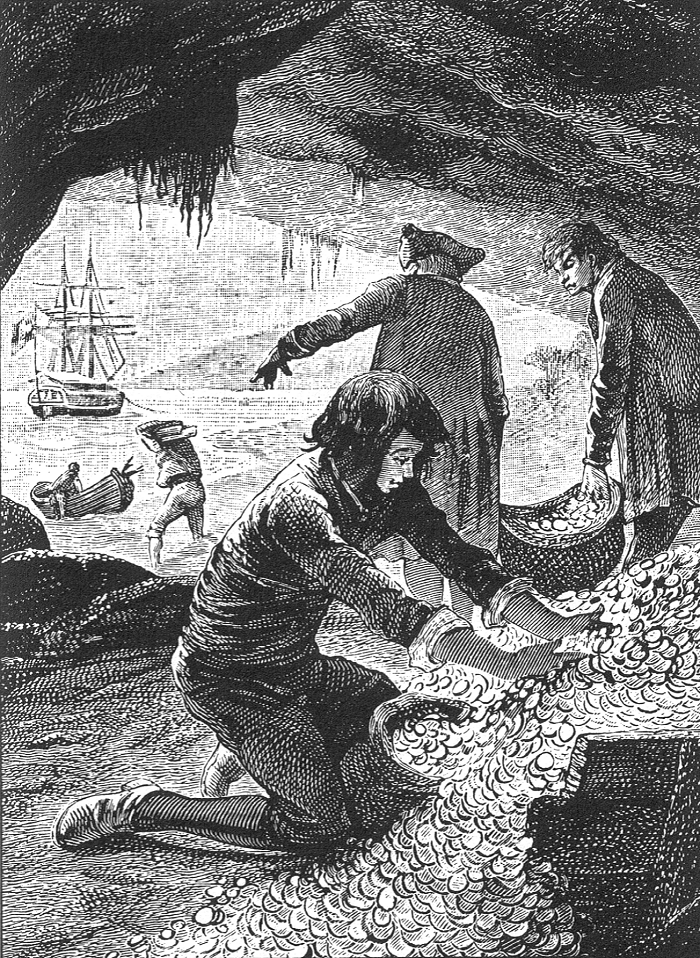
“Jim Hawkins & the Treasure of Treasure Island,” illustration by Georges Roux (via Wikimedia Commons)
A number of modern spells are designed to bring “prosperity” into an individual’s life. In some cases, Wiccan and Wiccan-influenced spellbooks contain workings that either target specific needs and cash amounts, or which seek to generally enhance the financial stability of the magician or his/her designated target (most Wiccan spellbooks also require that the magician have permission from the target even in beneficial magical workings like this). Certainly, magical practices designed to bring a sense of bounty and abundance into one’s life go back quite far—the cults of Fortuna and Tyche in the ancient world appeal to good luck, and the Roman cult of Pomona pursued the ideal of a fruitful life. Folk magic, however, has generally focused less on meeting a generalized prosperity and has drilled down to specific financial problems and advantages. The Wiccan spells which seek a specific sum of money to cope with a specific issue—a medical bill, a broken radiator, etc.—very much mirror the sorts of spells done by people across multiple times and places as they tried to cope with uncertain finances.
Another brand of folk magic, however, did not work towards a specific sum, nor did it seek to bring a vaguely defined sense of wealth into someone’s life. Instead, many spells targeted getting rich—quick! In some cases, the spell’s target would be a gambler who worked to gain the advantage in games of chance (more on that another day, hopefully). A few stories talk of acts of magical extortion, wherein a magician would either try to low-ball the purchase of land/livestock with the threat that failure to accept a paltry offer would result in the destruction of the commodity in question OR a witch might place a curse on a neighbor and only remove the curse for a fee (you can find several examples of such stories in The Silver Bullet, and Other American Witch Stories by Hubert J. Davis).
If someone wanted to get rich really quickly, however, he or she would turn to magical treasure hunting. Plenty of European grimoires had methods for finding lost treasures, usually with the help of spirits. Some grimoire texts which influenced American practices, such as The Black Pullet, spelled out in detail how to summon treasure-seeking daemons to work on one’s behalf:
“This talisman and this ring are not less valuable. They will enable you to discover all the treasures which exist and to ensure you the possession of them. Place the ring on the second finger of your right hand, enclose the talisman with the thumb and little finger of your left hand, and say, Onaim, Perantes, Rasonastos.” I repeated these three words, and seven spirits of a bronze colour appeared, each carrying a large hide bag which they emptied at my feet. They contained gold coins which rolled in the middle of the hail where we were. I had not noticed that one of the spirits had on his shoulder a black bird, its head covered with a kind of hood. “It is this bird,” the old man said to me, “who has made them find all this treasure. Do not think that these are some of what you have seen here. You can assure yourself of this.” I replied, “You are for me the truth itself. My father! Do you believe that I would insult you by doubting?”
He made a sign, and the spirits replaced the gold in the bags and disappeared. “You see, my son, what the virtues of these talismans and rings are. When you know them all, you will be able, without my aid, to perform such miracles as you judge proper” (The Black Pullet, 20-21).
Seals and incantations like these made it into later magical practices, especially in places where grimoire languages like German, Spanish, or French were spoken (to be clear, many grimoires were written in languages like Latin with commentaries in European languages, and these three tongues were hardly the only ones in which grimoires appeared).
Of course, being able to find treasure only helps if treasure is already buried in the earth waiting to be found. In the maritime culture of early New England (as well as the maritimes of other parts of the New World), a widespread belief in hidden golden caches secreted beneath the soil became the basis for a number of magical spells. A Maine man named Daniel Lambert, suddenly flush with money, faced suspicion, for:
Lacking any other apparent explanation, his neighbors attributed Daniel Lambert’s sudden wealth to the discovery of buried pirate treasure. Despite Canaan’s location dozens of miles from navigation, the inhabitants readily believed that Lambert had found a treasure chest because, as Kendall explained, “The settlers of Maine, like all the other settlers in New England indulge an unconquerable expectation of finding money buried in the earth.” Indeed, backcountry folk insisted that troves of pirate treasure guarded by evil spirits pockmarked the New England countryside even in locales far from the coast (Taylor 7).
Since the New World was vast and dangerous, people turned to magic to help find these copious buried (and frequently ‘cursed’) treasures, and to remove any dangers that might arise during the expedition to unearth them. A number of ‘rules’ for enchanted bounty-seeking developed, including:
Treasure hunting teams needed at least three members, as that number ensured magical success
Magical circles should be inscribed around the digging site to prevent any malevolent spirits from attacking the diggers
Implements of silver, such as silver spoons or spades, should be used to dig at least part of the earth to ensure luck in the hunt and to protect the diggers from harm
Blood offerings (animals usually) had to be made to quell the guardian spirits protecting the treasure—a belief related to the idea that a guardian spirit was usually a person who was killed and his blood spilled over the burial ground
In addition to maritime treasures, the idea of “Indian” gold became very popular. Some European colonists and conquerors were sure that entire cities of gold were just waiting to be found in the dense, mysterious interiors of North and South America. Gonzalo Pizzaro and Sir Walter Raleigh both mounted expeditions to find such legendary places, frequently referred to as “El Dorado,” or “the golden one.” In almost every case, however, the site was protected by evil spirits, a curse, ghosts, or some other malevolent force. In some situations, however, the spirit might actually help a seeker find his or her treasure: “There are many tales about ghosts who speak to people, telling them to dig at such-and-such a place to find a buried treasure. The ghost is usually that of some fellow who died without being able to tell anybody where his treasure was concealed, and who cannot rest quietly until someone gets the money and enjoys it” (Randolph 219). How one ensures that the ghost is not simply walking the magician into a trap is anyone’s guess.
One of the best examples of magical treasure hunting led to an entire religious movement in the New World. While the time has not yet come to explore the full magical heritage of the Latter Day Saints, I would be remiss to omit them here. Joseph Smith, prophet and founder of the Mormon faith, used to hunt for treasure using methods derived from alchemy and hermetic science/magic. He followed the rules laid out above, frequently offering “sacrificed either pure white or jet black sheep or dogs to lay out magic circles of blood” prior to discovering his golden plates and having his angelic vision (Taylor 12). Smith’s methods were not deviant or unusual. He used seer or peep stones to help find his hidden treasures, and his activity in the highly spiritually active area of New York known as the Burned-Over District was imitative of earlier seekers and followed by those who did the same. In fact, Smith was following very much in his own father’s footsteps, as Joseph Smith, Sr. was an active treasure seeker in Palmyra, New York. He is recorded to have once described his methods to a neighbor, saying “the best time for digging money was in the heat of the summer, when the heat of the sun caused the chests of money to rise to the top of the ground” (Brooke 31). The tradition the Smiths followed required—like many grimoire traditions do—that the seeker be spiritually pure or else he will fail in his pursuits, a concept brought in from hermetics and alchemy. The fervent spirituality and insistence on saintly behavior left a strong mark on the junior Smith, and helped him feel prepared for his prophetic role in revealing the Book of Mormon (which was inscribed on golden plates).
In some cases, treasures of golden pieces and precious gems are not the target of the magic. I have written previously on the phenomenon of dowsing, which allows a person to magically search for substances like water and oil beneath the earth. In some cases, the dowser might also search for veins of gold or silver or other valuable ores like iron. The method for making such a dowsing tool appears in Hohman’s early nineteenth century text, The Long-Lost Friend:
TO MAKE A WAND FOR SEARCHING FOR IRON, ORE OR WATER.
On the first night of Christmas, between 11 and 12 o’clock, break off from any tree a young twig of one year’s growth, in the three highest names (Father, Son and Holy Ghost), at the same time facing toward sunrise. Whenever you apply this wand in searching for anything, apply it three times. The twig must be forked, and each end of the fork must be held in one hand, so that the third and thickest part of it stands up, but do not hold it too tight. Strike the ground with the thickest end, and that which you desire will appear immediately, if there is any in the ground where you strike. The words to be spoken when the wand is thus applied are as follows: Archangel Gabriel, I conjure thee in the name of God, the Almighty, to tell me, is there any water here or not? do tell me! + + +
If you are searching for Iron or Ore, you have to say the same, only mention the name of what you are searching for.
This version of magical dowsing incorporates high magical elements (such as the invocation of Gabriel) and strong folk magical ones (the clipping of the tree twig at sunrise and the simple dowsing methodology). On the simpler end of the spectrum, one could simply put a bit of whatever was being sought into the tip of the dowsing rod, as in this example from the Ozarks: “Many hillfolk are interested in the search for lost mines and buried treasure, and some of these people have tried to use the witch stick in their quests. If a man is looking for buried gold, he fastens a gold ring to the end of his stick ; if it is silver that he expects to find, he splits the end of the wand and inserts a silver coin. Rayburn says that to locate mixed ores one uses two different metals usually a dime and a penny” (Randolph 88).
The practice of hunting for buried wealth and riches spanned cultural and geographic boundaries. In many cases, very strict rules were followed, regarding purification and protection as well as actual seeking magic. Spirits would guide a magician to the site of a treasure, and in some cases might even be employed to raise it from the earth. In other cases, the spirits associated with the treasure were deeply malevolent and most of the magic employed was to placate or dis-empower any evil that might be lingering about the dig site. The payoff for an effective treasure hunter could be a sack of coins, a buried chest, or even a new branch of a religion, but the work required up front was heavy and intense. While gambling charms might take longer, the success rate was better overall. In the end, getting rich quick via magical means, it seems, has always been a labor-intensive and time-consuming effort, just like any other job.
Tonight we’re looking at the concept of “magical Catholicism,” or folk magic using Catholic symbols. We’ll have a couple of saint stories, a brief history of the traditions, and a bevy of practical applications.
(All of these can be easily found by navigating to the “Magical Systems” resource page of the NWW site, then looking at the subheadings of ‘Curanderismo & Brujeria’ and ‘Other Magical Systems’)
I didn’t mention it in the episode, but I’d HIGHLY recommend the new release The Conjure Workbook: Working the Root, vol.1, by Starr Casas—it’s conjure and rootwork, but heavily influenced by the author’s Catholicism and very useful stuff, to boot!
The site fisheaters.com which has several pieces of information that veer towards the esoteric which are worth checking out (such as “St. Anthony’s Brief” or “Holy Oils”) [A warning: this site is very traditional, and thus its viewpoints may be controversial; browse at your own risk]
I would highly recommend the Library Page of the Curious Curandera website, where you’ll find a number of free titles on magical Catholicism, including “How to Pray the Rosary,” “Saints and their Patronage,” and “Prayers for Different Needs.” There are a few (very good) pay titles, too, but it’s hard to beat the wonderful free texts. Her courses are marvelous, too!
First of all, sorry for the long silence on both the podcasting and blogging fronts. I’ve had a busy couple of weeks covering an extra workload while my boss is out on maternity leave and I’ve had writing for school that I had to finish up as well. I’ve got several things in the works, including a new episode of the show and some new material for the blog, but I may have to beg your indulgence and patience for a little longer, so please bear with us.
I have NOT, however, forgotten about our current contest, and I hope you haven’t either! We’ve received a number of excellent contest entries so far, but there’s still time to get your name in the hat! You can read the complete contest description at Blog Post 169 – A New Year, A New Contest, but in brief we’re looking for your magical folklore. It can be on any number of topics: love, money, luck, etc. We are asking that you submit the lore using a specific format, like this:
[Name – preferably one we can use in the show, but let us know if you’d rather us keep it anonymous]
[Region/Location – as localized as possible; we don’t need an address, but “Southern Illinois” or “Foothills of the Rockies” would be lovely]
[Ethnic/Cultural Association – if applicable; such as “Italian-American” or “based on something my Lakota Sioux grandmother told me”]
[Type of Lore – love, luck, money, etc.]
[Your bit of lore]
You can send in as many pieces of lore as you like, and each piece gets your name entered in the hat. So if you send in ten pieces of lore, you’ve got your name in our kitty ten times and your odds improve.
We do have a few rules, of course:
You can only win one prize.
No entering under multiple names/emails.
While we are looking primarily for North American lore, we welcome lore from around the world as well.
And I’m sure you remember the prizes:
The Braucher Basket – featuring a copy of Hex & Spellworkby Karl Herr, a copy of the new translation of The Long Lost Friend by Daniel Harms, a small folio of hand-written/painted charms, and a few other little goodies.
Granny’s Gunny-Sack – featuring a copy of Ozark Magic & Folklore, by Vance Randolph, a copy of The Candle & the Crossroads by Orion Foxwood, and a little sack full of curios, herbs, and magical charms from the Appalachians.
So if you haven’t entered (or heck, if you have and want to up your chances of winning), send us your folklore and get yourself in the mix for these lovely prize packages!
We’re closing the contest at midnight on Sunday, March 31st, 2013. Entries received after that time won’t count. We’ll be drawing names on the next episode recorded after that date (sometime in mid-April, though prize winners may be notified earlier for addresses).
Here’s wishing you good luck! Thanks for all your entries so far, and best wishes to you all!
“Remember, man, that thou art dust, and unto dust thou shalt return.” –Priest’s admonition during Ash Wednesday liturgy, based on Genesis 3:19.
On Wednesday, I attended the Ash Wednesday mass at a Catholic church near my workplace, which begins the Lenten season. The pull of tradition sometimes brings me back to the church rituals of my childhood, and while I’m spiritually aligned else wise now, I take comfort in some of these practices, too. The ashes used in Ash Wednesday services are a powerful ritual tool, made from the palms left from the previous year’s Palm Sunday, mixed with incense and holy water, and blessed by the priest. They mark the bearer as a member of the church, a mortal person living in a mortal world, and someone aware of death’s role in our lives. The ashes, which serve as a spiritual tool for unification with divinity and with mortality, got me to thinking about some of the other ways in which ashes can be used in folk religious or magical practices.
And so today, I thought we’d explore the very rich traditions of magical work which incorporate ashes. I shall endeavor to stay focused on the practical application of ashes, rather than the mere presence of ashes in a spell, but in some cases that line blurs (or smudges) a bit. In researching the topic, I was astounded to see how many different methods for working with ashes I found: banishing, cursing, healing, money work, omens about bad luck and loss, and even some quasi-magical gardening tips. This, to me, is an example of how an extraordinarily normal item—ashes—can be a useful magical tool if a practitioner knows a little about what to do with them. Truly, a clever witch or magical worker can read his or her environment and see it loaded with enchantment and possibility, but I digress. On to the ash spells!
One of the most common ways to counteract bewitchment was to burn the affected object—usually a cow, butter-churn, etc.—“to ashes” which would render the witch who cast the enchantment powerless or cause her tremendous pain. Often the ashes would have to be dispersed even more extensively by being scattered to the four winds to render the spellcaster completely impotent and/or destroyed. Similarly, feathers from black fowls could be burned and the ashes sprinkled or blown over a bewitched person to remove the bewitchment.
An account of a Bell Witch-style haunting in Wiltshire, North Carolina, noted that the wicked spirit “sprinkled ashes in the beds” (Cross 243). Some hoodoo spells deploy the ashes of particularly nasty spells in the way one might lay a magical powder, sprinkling at someone’s doorstep so that they must step in the baneful trick.
Cat Yronwode mentions rubbing alfalfa ashes on one’s money to improve business, especially if the money is in a cash register. She also has this excellent and interesting recipe for a floorwash designed to bring clientele to a cathouse:
To Draw Trade to a Whorehouse: On a Friday morning, build a fire outdoors and burn a man’s worn-out left SHOE with a pinch of SUGAR in it. Put the SHOE ashes, a tablespoonful each of AMMONIA, SALT, and SUGAR, plus your own URINE, into a bucketful of water. Mop from the sidewalk inward, to attract men (Yronwode 29).
Ashes can also be used in hoodoo love charms (perhaps in conjunction with the above business charm?), as in this method from Zora Neale Hurston:
Cut some hair from under your left arm-pit and some from the right side of the groin. Then cut some from the right arm-pit and from the left side of the groin. Burn this hair with a wish for this man to love you. Put the ashes – made into fine dust – in his food secretly and he will love you and do as you wish (Hurston 361-2).
A magical charm called the “Chinese Snake Stone” from an account of North Carolina witchcraft tells how the amulet could be used to draw poison and how ashes were used to re-charge it after its work was done:
Directions for using The Chinese Snake Stone. Scarify the wound before applying the Stone-take it off every morning and evening-put the Stone at each time, when taken off, into a glass of milk-warm water, and let it remain a few minutes, until it discharges itself of the poison-wash the wound in a strong solution of salt water, and scarify again, if necessary. After taking the Stone from the water, rub it dry in moderately warm ashes, and apply as before. This course should be repeated for the space of nine days, when a cure will be effected (Cross 264)
In some cases, ashes have to be handled carefully in order to prevent illness from getting worse. When someone in a family is sick, for example, removing the ashes from the fireplace and taking them out of the building is said to be very bad luck, possibly even fatal to the ailing person.
A Pow-wow hair removal charm taken from older European sources recommends burning a frog to ashes and mixing them with water to make an ointment “that will, if put on any place covered with hair, destroy the hair and prevent it from growing again” (Hohman 14). I also found the same cure echoed in witchcraft practices from North Carolina.
Curandera recipes sometimes call for white ashes, which are powdery and fine and must be sifted from the gray and black ashes. Mrs. Mercedes Castorena of Sonoma gave the following recipe for dealing with empacho, a stomach and intestinal ailment:
“You crack an egg and get the yolk, being very careful not to break the yolk, because it has to be all in one piece. Then lay the sick person on the bed, put the egg on his stomach and let the egg slide all over the stomach. Wherever the spot is (where the food is stuck), the egg yolk will break. You leave the egg here. Then you take some herb called rosa de castilla, and some ashes-just the white part of the ashes-and put this on the stomach and wrap a bandage around the stomach to keep it on. Then you give them a dose of Baby Percy (a patent medicine)” (Neighbors 251).
Mrs. Castorena also mentioned a cure involving mixing avocado seed ashes with oil to treat indigestion. Ashes are also used in other home remedies from other traditions: “To cure toothache, place a bag of warm wood ashes on the side of the face where the tooth is aching” (Farr 327). Vance Randolph mentions the Ozark method of treating an itch using a mix of gunpowder, wood ashes, and sweet cream. He also talks about a method of staunching a wound using the ashes of a man’s shoe.
In the garden, ashes can be mixed into soil around fruit trees to improve their growth. My mother used to have me take our fireplace ashes and put them around our blueberry bushes at the beginning of the spring to promote big, juicy berries later on. Supposedly, doing this on Ash Wednesday ensured a pest-free garden all year long (I don’t recall if I was usually enjoined to this particular chore in conjunction with the holiday or not, but our plants were not bug-free).
Harry M. Hyatt recorded a number of beliefs about sprinkling ashes around a hen-house to prevent lice on the birds (and he also mentions the Ash Wednesday ritual for gardening success). Some of the other magical ash-lore he shared includes:
“Epileptic attacks are checked, if you remove the person’s undershirt immediately after an attack, let it smolder on live coals, mix a teaspoonful of these ashes in a glass of holy water, and say In the Name of the Father, Son and Holy Ghost. These ashes in holy water must be administered three times a day.”
“An old shoe should be burned and the ashes used in washing out the mouth of a child with thrush.”
Several of his informants recommended burying objects that have touched a wart in ashes in order to cure the growth
Dreaming about ashes is very bad luck, usually foretelling a significant loss or a death in the near future
Strangely, dreaming of fire is frequently a good sign, but the ashes tend to be a bad-luck indicator.
As you can see, even the lowly ashes from your fireplace can become useful magical aids if you know what to do with them. I hope this little exploration is useful to you! Please feel free to share your own ash lore in the comments below.
Thanks for reading,
I hope you’ve all had a festive holiday season and are looking forward to a fantastic 2013! I’m working hard on a number of projects at the moment, including new posts for the blog, getting new show topics and guests lined up, starting a New World Witchery contest, finishing a school project and an assignment for an academic journal, finding PhD programs, continuing work on any of the books I’ve got in the works (and looking for publishers for those books), planning out some second-half-of-the-year classes for my local magical group, keeping up with my reading list, learning a couple new languages (and refreshing my Spanish, too). Not to mention working a day job, being a father to two brilliant kids, and a husband to a very patient and very loving wife.
All of which is to say that life is very busy, but not so busy that I don’t decide to take on MORE crazy projects! (As a Gemini, having too many irons in the fire is par for the course, apparently). During the latter part of last year, I was listening to a conversation between Fire Lyte and Velma Nightshade on their joint podcast about the lack of witchy apps out there, and specifically how there isn’t anything that can integrate with their calendars like an almanac app. Well, I’m not a programmer of any kind, but I do know how to go through and use Outlook to generate iCal files, so I started working on something to fill that need. And here it is!
The calendar includes witchy holidays with lore, links, recipes, etc. I’ve included a number of the days I personally observe, and the full and new moons. Many of the links will bring you to the New World Witchery site for posts on the topics highlighted in the calendar alert, and some will send you to book recommendations, other sites with related lore and/or products, and so forth. For example, the calendar entry on New Year’s Day (which is when the whole thing starts…sorry for the delay in releasing it) includes a link to our entry on that day’s practices, a link to Sarah Lawless’ post on Hogmany, and a click-through to Lucky Mojo’s Chinese Wash, so you can start your year with a clean and lucky house.
It’s in a zip file, so please make sure that you can open those and that you know how to add an iCal file to your favorite calendar (a quick Google search will probably help you figure out how to do that).
I should point out a few caveats:
This is only for the first quarter of 2013. I’ll be working on getting other quarters up as soon as I can, but I wanted to get at least the first three months out there.
There may be one or two of these dates that have an entry with no links, or which are blank in some way. I’ll be correcting those in future versions.
It’s totally free and you can share it as much as you like, but please let folks know where you found it.
It’s sort of a New Year’s/Twelfth Night gift to y’all for being so spectacular, so I hope it’s useful to some folks out there. If someone out there is more technically gifted than I am and wants to undertake any improvements that integrate with this calendar, I’m a-okay with that. Just send me an email and let me know! And if you find this useful and all that, we’d certainly welcome donations to help support future work.
Here’s wishing you a very happy New Year! Thanks for all you’ve done for the show, and for being a spectacular audience!
If you’ve been following us on Twitter, you know we’ve passed some milestones recently and have been thinking of fun ways to celebrate. So what are we excited about?
We just passed 666 followers on Twitter. Who doesn’t get excited about nefarious numbers?
We’ve received over 100 reviews on iTunes, making us one of the top-reviewed magical/pagan shows there. Can we just say how much y’all rock for that?!?
We’re entering our 4th season, which means we’ve got three years of New World Witchery under our belts!
It’s a new year! Lucky 2013! What’s not to celebrate about that?!?
Laine recently taught my wife and I how to play Cards Against Humanity. It’s sort of the cherry on the sundae of celebration we’ve got going on.
With all that cause for excitement, we thought it would be high time for a contest. We’re going to have a somewhat broader focus this year, and hopefully spend some time looking at spiritual and magical paths from places across the country, so in order to do that, we want some of your lore and magic! We’ve done this before for holiday lore, but this time around we want lore related to the following categories:
Love (example: “When your nose itches, someone wants to kiss you”)
Luck (example: “Babies born at 12:12 on 12/12/12 are considered extra lucky”)
Money (example: “An itch in your left palm means money’s coming your way soon”)
Health & Healing (example: “Putting a wad of chewing tobacco on a bee sting will stop the pain and heal it faster”)
Fortune-telling/Predicting the Future (example: “Monday’s child is fair of face…”)
Protection from Harm: (example: “Putting a piece of lightning-struck wood in your rafters will prevent storm damage and fires”)
Now, obviously, don’t use any of the ones from that list, but otherwise, it’s pretty much fair game what you want to send in. Each bit of lore gets you an entry in the contest. Just make sure that if you send multiple entries in the same email, you number them separately (i.e. in a numbered list, if possible).
When you do send your entry in, please use the following format guide:
[Name – preferably one we can use in the show, but let us know if you’d rather us keep it anonymous]
[Region/Location – as localized as possible; we don’t need an address, but “Southern Illinois” or “Foothills of the Rockies” would be lovely]
[Ethnic/Cultural Association – if applicable; such as “Italian-American” or “based on something my Lakota Sioux grandmother told me”]
[Type of Lore – love, luck, money, etc.]
[Your bit of lore]
So a sample entry might look like this:
Nigel Aloysius Gimmelschtump (but call me “Smackdown” on the show, please)
Western Kentucky
Something from my German-English grandfather’s family
Money
“You should always hold on to the first dollar you make at any job. As long as you have it, you cannot be fired from that job.”
That might seem a little complicated, but it will be enormously helpful if you can follow that format. And, hey, free contest, right? Also, my apologies to Nigel Aloysius Gimmeschtump, wherever he may be. And to anyone calling themselves “Smackdown,” for any reason at all.
So what’s in it for you? Good question! Well, we’re putting together three prizes, based on three areas of North American folk magic:
The Braucher Basket – featuring a copy of Hex & Spellworkby Karl Herr, a copy of the new translation of The Long Lost Friend by Daniel Harms, a small folio of hand-written/painted charms, and a few other little goodies.
Granny’s Gunny-Sack – featuring a copy of Ozark Magic & Folklore, by Vance Randolph, a copy of The Candle & the Crossroads by Orion Foxwood, and a little sack full of curios, herbs, and magical charms from the Appalachians.
See? Good stuff! Send us a couple of emails and you could win one of these awesome prizes! Just because I’m nitpicking, here are some other rules though:
You can only win one prize. If your name comes up after you’ve already won once, we’ll pull another name for the next prize. Let’s not get greedy.
No entering under multiple names/emails. If we catch you doing that, you get no prizes. Possibly we will also curse you. Or sell your name to telemarketers. Sort of the same thing.
While we are looking primarily for North American lore, we welcome lore from around the world as well.
This contest is going to have a deadline of March 31st 2013, so please get your entries in by then!
Thank you all so much for three great years of New World Witchery! We love y’all to bits and pieces, so good luck in the contest!
Summary
This episode is a grab-bag of different items: a recap of PPSM3, some music from artist Leslie Fish, a recording of a mini-class, and listener feedback. Think “Mary Poppins’ traveling bag,” but full of NWW goodies.
You can read more about the crossroads legend mentioned in the feedback section at Lucky Mojo’s website
An author list of suggested witchy reading, sent in by a listener: Patricia A. McKillip, Cecelia Dart-Thornton, Jim Butcher, Diana Wynne Jones, Juliet Marillier, & Jan Siegel
If you have feedback you’d like to share, email us or leave a comment. We’d love to hear from you!
Today we’re rounding up another group of links that readers of this blog might find interesting or enjoyable and sending them out into the world. I’ve not had as much time to write for the blog or record for the show as I’m knee-deep in the process of thesis-writing and researching places for PhD research, but I do continually find myself reading new posts, articles, and information that pertain to the various branches of folk lore, folk magic, and folk belief. Here’s a brief list that will hopefully give you some things to peruse while you’re waiting upon tenterhooks for the next riveting New World Witchery post or show.
I’ll start today in the realm of Pennsylvania-Dutch magic. There’s a brand new edition of the pow-wow classic The Long Lost Friend available from Llewellyn, edited and annotated by Daniel Harms. Hohman’s text is presented here in several formats, including the original 1820 edition (with the German language version) and in an expanded 1856 English translation. Many of the spells are pulled from a third edition, the 1837 “Skippacksville” version. It’s a surprisingly stuffed text with a tremendous amount of folkloric value, and if you have any interest in American folk magic at all I highly recommend getting it.
In the same vein, if you enjoy braucherei, hexerei, and pow-wow, but want to explore it in a Pagan/Heathen context, I cannot recommend enough that you hurry over to Urglaawe. This is Rob Schreiwer & Co.’s site which helps collect—in English and PA-German—the vast stores of Germanic magic which exist on both sides of the Atlantic (with a heavy emphasis on the beliefs and practices of the Pennsylvania-Dutch in America). Schreiwer will be part of an upcoming episode of the show, and he’s a brilliant mind with a tremendous amount of information in his head, so please take a look at the work he’s doing. If you’re a schuler of things Deitsch, you won’t regret it.
In a final nod to the Germanic cultures of America, I was recently introduced by SilverShadow and Dr. Hob to the fascinating phenomenon of courting candles. These little spiral-shaped candle holders would be lit and adjusted to provide light for suitors to visit their sweethearts. When the candle burned out, the beau had to leave. If a father liked a suitor, he’d adjust the candle to provide more time in the light; if not, he’d move the little key to make the candle burn out more quickly. I’m always fascinated by things like this, as I can see plenty of ways they can be used magically in addition to their more mundane applications.
You should also check out the fun and informative show he and SilverShadow are doing together, called Lamplighter Blues.
I’m reading Midnight in the Garden of Good and Evil for the first time as part of a book club, and if you haven’t read it, it’s worth the time. The story gives you a wonderful portrait of the strange, beautiful, and eerie city of Savannah, Georgia, as well as a specific murder trial that occurred there in the 1980s. A major portion of the story takes place in cemeteries, and a conjure woman whom the author names “Minerva” becomes somewhat crucial in the narrative. This is essentially a non-fiction book, though, and Minerva is actually Valerie Fennel Boles, widow to one of the Dr. Buzzards of Beaufort, South Carolina. Boles carried on Buzzard’s conjure work until her death in 2009, and the portrayals of her practice in the book—despite the appellate of “voodoo” which author John Berendt uses to describe what she does—are incredibly vivid and authentic. You can read more about Dr. Buzzard in Jack Montgomery’s American Shamans, too, which we’ve mentioned here before.
If you haven’t seen it yet, Sarah Lawless’ latest venture has gone live. Go take a peek at the Poisoner’s Apothecary, and check out some of the projects she’s working on. I’m particularly excited about the range of pipes she’s carving for smoking rituals.
I think that will just about do it for today. If you enjoy these links, let them know who sent you and let us know what you like best in the comments section. And feel free to share what you’re reading/writing/learning these days, too!




 New World Witchery - The Search for American Traditional Witchcraft