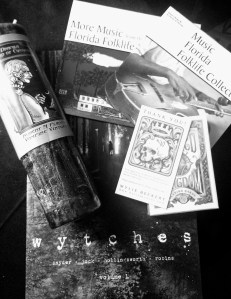
Folks, I’m really and truly happy to announce I’ve finished the expansion of the old cartomancy guide and it is officially released for your purchase and perusal!
“Ye are twenty-five cards.
Become twenty-five devils
Enter into the body, into the blood, into the soul .”
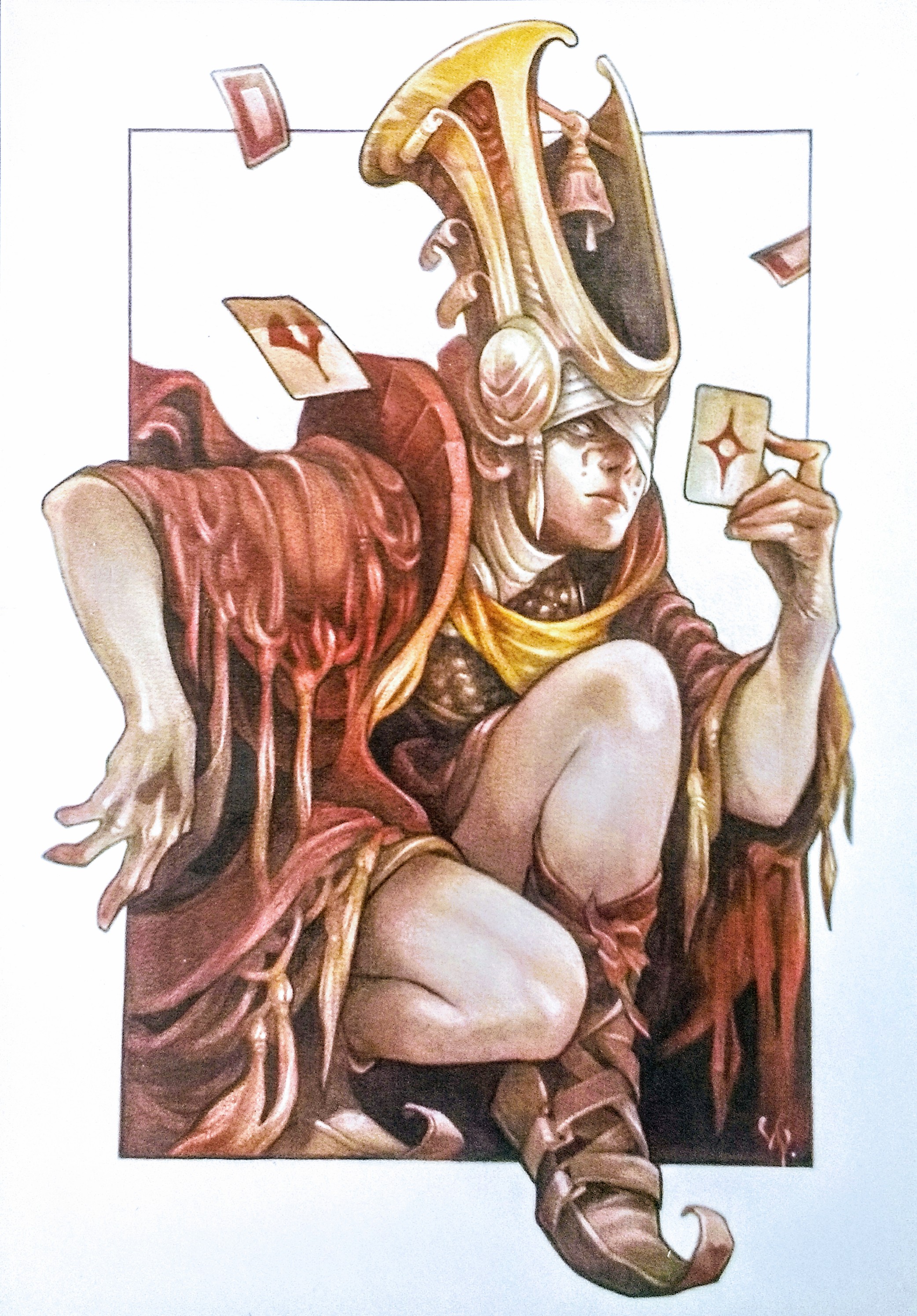
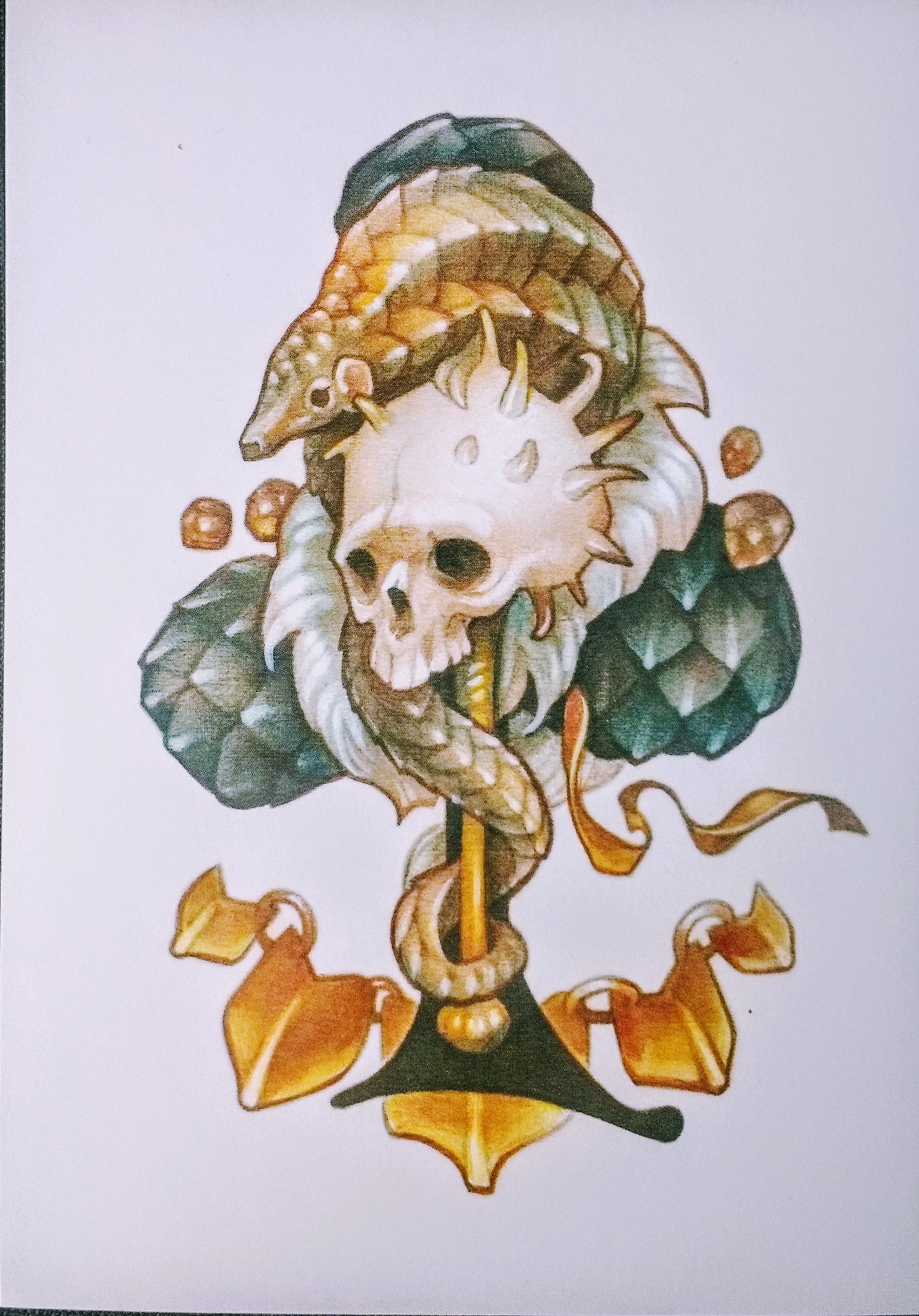
So begins a nineteenth century Italian charm making use of a small deck of playing cards. This brief-but-richly drawn book explores the practice of divination by playing cards—known as cartomancy. It reveals the “secrets in plain sight” which hide within the pips, kings, queens, and jokers of a standard deck. Explore one method of divination in-depth as you meet the “fifty-four devils”—the symbolic spirits of each card—and learn about invoking ancestral blessings for card readings, the folklore of playing cards, and how to relate fairy tales to a spread along the way.
How is it different from its previous incarnation? For starters, it’s longer, coming in around 108 printed pages. It also has loads of new sections and subjects to cover, including:
Preparing your cards for divination
The use and inclusion of the Jokers in readings
An easy-to-use table which puts keywords related to each card on a single page
A widely expanded set of sample readings
An entirely new type of spread, the Grand Tableau or Full Deck Spread, which uses all 54 devi…er, cards
Two of my favorite new elements—and I am obviously a bit biased—are the section about how to relate fairy and folk tales to card readings to enhance divination and the 20-page appendix which contains a wide variety of folklore on card reading (including short commentaries and even a little historical fiction by yours truly). I also really love the cover, which was designed by my lovely wife!
If you’re a fan of cartomancy or divination, I think you’ll like this book. And if you’re a fan of this show/site, I think the same will be true for you. This also gives you an opportunity to support the show as well, and at $6 or less a pop, you can’t go wrong, right?
I’ve made it available in print and e-book format, and you can get a copy at any of the sites below:
On a related note, the sidebar of the blog/website now contains a button showing the cover of Fifty-Four Devils which will take you to our digital Book Shop, where you can currently find all the purchase information on this book. Over time I’ll be adding other books there as well. Hopefully some will be more of my own books, but I’ll also link to works I cite frequently and to books by authors who have appeared on the show or contributed to the blog. Any purchase you make helps us out just a little bit, so it’s a great way to support us while getting great books!
I’m very happy to be able to share this book with you all! Please let me know what you think of it, and happy reading!
First of all, despite the fact that I have the little tag on the side of the blog that says “Blogging Without Obligation,” I would like to apologize for the incredibly slow past couple of weeks. I keep convincing myself that I have time hiding somewhere in my days and I just have to find it, but I’ve yet to find it and use it to keep posts up regularly. This month, it’s been particularly bad, and I know I haven’t been providing you with much content (other than our recent episode, which I hope was fun for everyone), so I apologize for that. I also haven’t gotten my blog up at Witches & Pagans yet for April, so if you follow me there, my apologies as well. Hopefully things will be returning to normal soon, but until they do, please know that when I do produce content at New World Witchery, I will try to make it the best it can be everytime. Thank you all for being patient.
I think I should share a few items with you that may or may not be of interest to friends of NWW. You’ve probably noticed that the Compass & Key Etsy store has been down lately (and it appears that the Hex Folk Market has also shut down as well). I’ve been struggling a lot with whether to reopen the Etsy shop, because it provides a good way for people to support the show and site, but it is also a bit labor-intensive. While I was finishing my schoolwork, I had a good reason not to keep it open, but I recently made an order for someone who contacted me independently of the Etsy site and remembered how much I love doing that work. However, I’m also aware that there are a lot of sites out there offering similar goods, and too many cooks may be in the conjure kitchen at the moment. So I’m working on some new product ideas, things you probably won’t find everywhere. So basically, I’m saying keep your eyes open, and we will hopefully have *something* available there soon.
In the same vein, I’m also going to suggest you keep your eyes open when it comes to the Cartomancy Guide we posted a few years ago. I’m not saying something is definitely going to happen with that soon, but something is definitely going to happen with that soon.
Also, apologies that the Witches’ Calendar is not yet updated. I will hope to have something up soon, but I do apologize it’s not up to date yet.
Now that all the shamefaced apologetics and shameless self-promotion are out of the way, I thought I’d share a few things that have come across my sightlines lately. Most of these are interesting items I’ve read, and things I would love to hear from you about.
First of all, Fire Lyte recently wrote a post in response to listener Mimi’s question, “Has the era of Pagan Podcasting ended?” I’d be interested to know the thoughts of those out there who listen to podcasts and read blogs geared towards the magical community. My understanding is that there are certainly a number of folks who are trickling away from regular production (we’ve been posting less frequently here, obviously), but that there still exists both a demand and a supply of such shows. The Lucky Mojo Hour, Conjure Crossroads, Lamplighter Blues, and Old Style Conjure podcasts have all produced shows somewhat regularly over the past six months or so (although the only one on a highly regular schedule is the Lucky Mojo show). Likewise a number of more directly Pagan podcasts have been producing somewhat steadily: Lakefront Pagan Voice, Ariel’s Druidic Craft of the Wise, the charming iPod Witch, the venerable and popular Wigglian Way, & Modern Witch Online, for example. A few have never wavered, like DruidCast. And I see new shows starting to rise to the surface, like New York Pagan. Yes, there are definitely shows that are disappearing or fading away, and there will always be shows that explode with potential and then vanish without a trace. And I think Fire Lyte makes a great point about breathing room—it seems that a number of folks have needed it lately, so perhaps we’ll see some of the old hats diving in and doing new work soon. Oh, and in case you’re wondering, New World Witchery isn’t planning on going anywhere for a while. But what do you think? Has the era of podcasting come to a close? Should we all just close up shop and go home, or is there a better way for us to present our content?
My current bookshelf has had a nice little group of texts that might be of interest to our readers. I’m finishing up Vernacular Religion in Everyday Life, edited by Marion Bowman and Ulo Valk. It essentially addresses the concept of religious performance as it is done by people in their day-to-day lives. There are essays about how saint stories influence the behavior of a woman living on the Russian borderlands, a look at how the layout of a house can become a sun-clock tied to the performance of work in the home, and the importance of angels to the royal family of Norway. I’ve also been working through Alan Dundes’ excellent look at biblical folklore, Holy Writ as Oral Lit. If you’ve ever wanted to see how many different people killed Goliath (or his brother), this is a book to pick up. I’ve also got a book on my “in” pile called Witchcraft and Magic in the Nordic Middle Ages, by Stephen A. Mitchell, which looks quite promising.
With the lovley spring weather moving in (between the bouts of intense storms), it’s gardening time again. One of my favorite folklife blogs, The Blind Pig & The Acorn, has a couple of excellent posts on some gardening practices which bridge distinctly Appalachian culture with a sensible, fun personal narrative. Her post “How Does My Garden Grow” and the post on “Patch Farming” are particularly nice. She also goes through each month of planting by the signs, usually posting around the first of the month. If you incorporate gardening into your magical or folk life, check out her blog.
For those who have been wondering, the Pagan Podkin Super Moot will be in New Orleans this year, and while I’m still working on dates and locations, it will likely be sometime in early October. I’ll be posting info at the main Pagan Podkin page, and here as well. I’m hoping to make things coincide with the New Orleans Folk Magic Festival in some way, too, but I can’t promise anything yet.
Finally, a happy birthday to Fire Lyte (a bit early, but better that than late, right?).
Thanks to everyone again for their patience, and for sticking with us!
This is just a reminder that if you want to get into the drawing for our Spring Lore Contest, there’s never been a better time than now! You’ve only got five days left—until March 21, 2012! We’re looking for Springtime Lore this time around: seed planting rituals & customs, fertility charms, spring cleaning spells, etc. Anything and everything related to Easter eggs, baby animals, April showers, and (shudder) bunnies. We’re trying to put together an episode featuring folklore, ritual, and practice from all over the country and the world relating to rebirth, green grass, renewal, etc. and we need your help to do it! So if you’ve been hanging on to a killer magical gardening tip, a clever and enchanted use for chocolate rabbits, or a story about dancing naked around a maypole, fire up your email and send it in!
So what’s in it for you if you send us lore? Prizes!
An email card reading from Cory, with a 1-2 page card report featuring a 2-card split and 7-card layout, plus interpretations and a fairy-tale recommendation to connect your reading to a story you can turn to for more inspiration.
A goody box from Compass & Key Apothecary featuring several of our oils, curios, and mojo bags. While actual contents of the box are subject to change, they will likely have at least 2 oils, 2 mojo bags, 1-2 curios (like rabbits’ feet, gator paws, or Mercury dimes), and 3-4 herbal samples.
How to Enter
Send your entries to compassandkey@gmail.com to enter, and be sure to put “Spring Lore” in your subject line.
We hope to hear from you soon! Remember, the deadline is midnight on March 21st, 2012, so get those entries in before then!
We’ve got a Spring Lore Contest going on until March 21, 2012! We’re looking for Springtime Lore this time around: seed planting rituals & customs, fertility charms, spring cleaning spells, etc. Anything and everything related to Easter eggs, baby animals, April showers, and (shudder) bunnies. We’re trying to put together an episode featuring folklore, ritual, and practice from all over the country and the world relating to rebirth, green grass, renewal, etc. and we need your help to do it! But because we like you an awful lot, we also want to give you the chance to win shiny and wonderful things from us when you send us your lore!
An email card reading from Cory, with a 1-2 page card report featuring a 2-card split and 7-card layout, plus interpretations and a fairy-tale recommendation to connect your reading to a story you can turn to for more inspiration.
A goody box from Compass & Key Apothecary featuring several of our oils, curios, and mojo bags. While actual contents of the box are subject to change, they will likely have at least 2 oils, 2 mojo bags, 1-2 curios (like rabbits’ feet, gator paws, or Mercury dimes), and 3-4 herbal samples.
How to Enter
Send your entries to compassandkey@gmail.com to enter, and be sure to put “Spring Lore” in your subject line.
We hope to hear from you soon! Remember, the deadline is midnight on March 21st, 2012, so get those entries in before then!
Summary
On this episode, we go through a lot of listener feedback, share a few thoughts on being new to a magical path, and give a few updates about what’s coming up for New World Witchery.
From the question about divination, Aeclectic Tarot has wonderful comparisons and reviews of different tarot and oracle decks. You can also check out the Rabbit Tarot that Laine mentions, and our free Cartomancy Guide if you’re interested in playing cards.
We had a question related to spinning wheel magic, which was based on our discussion from Podcast 25.
We mention Oraia Helene as a great resource for information on the martial arts and magic.
We answered some questions in regard to our Secrecy & Silence posts.
Check out the Book Reviews post mentioned as part of the “learning hoodoo” discussion.
The “learning hoodoo” discussion also mentions a series of posts from us (starting at Blog Post 29), and several books that can help a person get started:
We’ve got a Spring Lore Contest going on until March 21, 2012! We’re looking for Springtime Lore this time around: seed planting rituals & customs, fertility charms, spring cleaning spells, etc. Anything and everything related to Easter eggs, baby animals, April showers, and (shudder) bunnies. Send your entries to compassandkey@gmail.com to enter, and be sure to put “Spring Lore” in your subject line. Three participants will win one of three prizes: a copy of Etched Offerings: Voices from the Cauldron of Story from Misanthrope press (an anthology of pagan fiction featuring stories from several podcasters like Oraia Helene, Saturn Darkhope, & me!), an email card reading from Cory, and a goody box from Compass & Key Apothecary featuring several of our oils, curios, and mojo bags. More details coming soon!
I just wanted to let you know about some things going on in our Etsy shop, Compass & Key Apothecary. We’ve got a new mojo hand and a new bundle available:
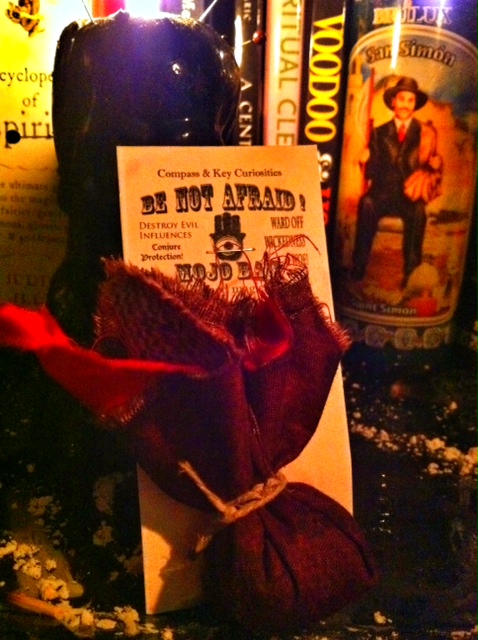
Be Not Afraid! Mojo Bag
The Be Not Afraid! Mojo Bag is designed to provide spiritual protection to those who carry it on their person. The combination of herbs, roots, and other curios in this handmade mojo all have powerful protective qualities according to folklore. The rue used in this bag, for example, has been reputed by Italian magicians to fend of baneful sorcery for centuries. It is thought that carrying a bag like this can boost one’s confidence, repel enemies, and turn harmful enchantments back on their senders. Best fed with our Wall of Flame Oil or with rum in which hot peppers have been soaked. Cost: $6.00 + Shipping
The Fearless Bundle
The Fearless Bundle includes one (1) Be Not Afraid! custom-made mojo bag and one (1) bottle of our Wall of Flame oil. Together, these constitute a powerful spiritual defense which repels harmful forces and turns wicked spells back on their senders. The oil can be used to feed the mojo bag and on its own. You can save $2 off the total cost (plus a little bit on shipping) by buying these items in this bundle Cost: $10.00 + Shipping
All products sold as novelties only. Not intended for internal use. Please consult a health professional for medical conditions.
We’re also knocking $2.00 off of the shipping cost of any purchase made in December. I tried to set it up to do this automatically through the Etsy site, but if that doesn’t work I will refund the $2.00 to you after your purchase, so either way you’ll definitely get a discount on shipping. If you’ve never ordered from our shop, you should know that every order winds up with some extra free goodies thrown in with it, which can range from little bags of herbs to handmade spells and charms to talismans and amulets.
I’ve wanted to make more products available, but it takes a good bit of time to develop each one, plus I usually like to “guinea-pig” my stuff first by sending samples of new things out to customers in the hopes of getting feedback, and that can be very time-consuming. So apologies if a product you want isn’t on the Etsy site yet, but maybe it will be soon. You can always email us and request something and we usually are willing to accommodate.
Speaking of emailing us, I’m also looking to start offering some card readings to folks. At first, I’ll only be doing it by email due to time constraints, but I may branch out into Skype if there’s enough interest. The cost? How about pay-what-you-can? For right now, I’m doing this on a donations-only basis, so as long as you’re willing to donate something to the site (using the PayPal button located in our main page side bar, or you can do it here, too), I’ll read for you. Ideally, I’d love to get at least $5.00 for it, but hey, a buck’s a buck, and if all you can afford is $1.00, that’ll do.
Here’s how the card-reading works:
1) You email me your question (subject: “Card Reading”) and make your donation (in whichever order you prefer—please make sure to include your real name and astrological sign so I can get a lock on reading for you).
2) I will do a two-card split reading and an extended five-card reading, recording the cards drawn.
3) I will write an approximately 1-page report for you on the reading and send it back to you.
4) You can ask one follow-up question as well, which I will pull 1-3 cards for. I’ll send you an email response with those cards and a summary of their meaning.
I’m using my own system of cartomancy with regular playing cards inherited from my mother, so don’t be surprised if the cards and their meanings are a little different than what you’re used to.
So why all this commercial activity? No, it’s not because of the holidays. Rather, I’m trying to raise money to fund the next year of the site and podcast’s hosting service and there are some magical courses and books that I’m looking at as well. The more I know, the more I can add to the site and show, so it’s a win-win for all of us, right? Plus (and this is a big reason), I’m trying to do a lot more practical work with folk magic, and making new things while offering card readings seems like a good way to do that. So if you enjoy the show or site and want to help contribute to it, please check out our Etsy shop and/or get a card reading!
Okay, thanks everyone for all your support! We really appreciate all you do for us, and hope you’re having a great holiday season!
Summary
In this episode, we look at different divination systems from the New World. We have a conversation about Destiny, and Laine talks about spinning wheels as magical tools. Cory discusses bibliomancy at the end of the show.
First of all, sorry for the complete absence of posts last week. I got a little swamped and didn’t get as much research time as I wanted, but hopefully today’s rather long article will make up for it.
We’re going to be looking over the next few posts at divination, fortune-telling, and other methods of forecasting fate. Before we dive into details, though, I thought it might be good to tackle the topic generally and look at the types of divination which have been historically popular in the New World, as well as some more modern methods. . Some of these systems are ones which I can only cover cursorily, as my experience is relatively shallow with them. I hope to cover each of these in more detail with time, or at least provide references to help anyone wanting to learn more about them, eventually.
So what are the most popular divinatory methods in the New World?
Arithmetic Methods – Probably the most common divinatory methods used in the modern New World are astrology and numerology. Almost anyone can tell you his or her sun sign. A Harris Poll from 2009 shows that about 26% of adult Americans believe in astrology. Horoscopes related to these sun signs are printed in a majority of national newspapers in the United States, and a surprising number of folks know their ideal romantic compatibility as far as sun signs are concerned. Less well-known but still fairly prevalent is numerology, particularly the form of numerology known as alphabetic numerology. This is closely related to Gematrian numerology—a kabbalistic practice which uses Hebrew letters as symbols for numerals to understand a sort of universal mathematics arranged by G-d for the wise to know the world. Another arithmetic method of divination which has found a certain degree of New World success is geomancy, which depends upon mapping energetic lines upon the earth and determining information based on their patterns and intersections. The most commonly found version of geomancy in North America is the practice of dowsing, which seeks to uncover hidden water, mineral, oil, or other deposits within the earth using surface-based detection methods. Science generally frowns upon all of these fields, despite their incredibly intricate mathematical structures, though there have been a few efforts to validate the powers of geomancy, and some large oil companies consult dowsers periodically to help determine ideal drilling locations.
Natural Objects & Phenomena – We’ve covered this a bit already, particularly the signs & omens which seem to pervade much of American folklore, but it is worth examining a few of the other natural-object-based divinatory systems, too. For example, in many parts of the New World, some system of augury (divination based on birds) has been practiced. One of the most interesting versions of this can be found in a practice known as alectromancy, which studies the patterns scratched by a rooster when grain is strewn for him. Traces of this practice can be found in one of the primary influences on later hoodoo, The Black Pullet. Other objects commonly used in various New World magical systems are cowrie shells (small whitish shells which bear a strong resemblance to the female genitalia) and chamalongos (ritually prepared and polished pieces of coconut shells). These can both be “cast” in the same manner as dice might be (see “Games” below), and the resulting patterns interpreted to provide answers to specific questions. Another method which has fallen out of favor in modern times—though it was tremendously popular in ancient Rome—is haruspicsy, or the reading of livers or entrails from sacrificed animals. A modern version of this, however, lives on in the wishbone ritual from the Thanksgiving turkey. Luck is afforded whoever takes the biggest part of a wishbone snapped in twain between two people when the bird has been cooked and eaten. Of course, there are a vast number of natural phenomena which are interpreted as portents of the future in traditional folklore—everything from weather to insect behavior to the color of certain animals can have deep meaning to the right person. Since we’ve touched on that idea in other places, however, I’ll simply leave it at that.
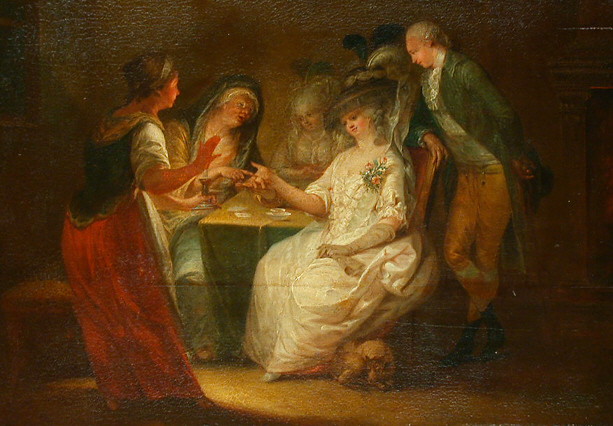
“Gypsy” Methods – I will admit I don’t like the title I’m giving this section, but please understand that by “gypsy” methods I’m not referring necessarily to Romany traditional practices. Instead, I’m really evoking the Hollywood and fictional version of the Gypsy so often mistaken for the real thing. But, since the methods employed by those characters are actually relevant, I thought this might be the best category in which to assemble them. Some of the best known methods are palmistry, cartomancy, and crystal gazing. Each of these, despite its Hollywood glamorization, is actually a legitimate method. Palmistry uses the lines on the palm of a person’s hand to determine the overall trajectory of his or her life. It’s been popular as a parlor entertainment for over a century in America, and likely has been on New World soil for much longer than that. Cartomancy is probably the best known fortune-telling method in the New World other than astrology, though a much smaller number of people seem to put stock in it. One of the fun twists to cartomancy is that while tarot is a popular method (even immortalized in American poet Sylvia Plath’s poem, “Daddy,” as a “Taroc pack” and associated with Jewishness), it has long been common for root workers in America to use simple playing cards to get answers to difficult questions. Crystal gazing, a type of scrying which uses highly polished spheres of minerals like quartz or amethyst to relax the mind and allow visions to enter the mind of the seer, is another popularly seen method, though it is often ridiculed in modern society—poked fun at in cartoons like Bugs Bunny, Scooby Doo, and The Simpsons, for example. Other methods which commonly get attributed to Gypsies are candle reading—though this is a bit controversial because of something known as the “Gypsy candle scam”—and tasseomancy, which involves reading the patterns left in a cup after someone has drunk tea from it. In this latter method, coffee is also fairly popular. The reputation of these methods has suffered a bit due to public ridicule, but they also have their staunch supporters, and in many cases are the methods magical practitioners learn first.
Games – This is a peculiar but fascinating branch of divination which has been surprisingly prevalent in the United States. I’ve already mentioned the use of playing cards as divinatory aids, and they certainly straddle this category nicely. Dice and dominoes have also been used to predict the future in several magical systems, particularly those originating from Africa, a practice known as cleromancy which is also referred to as “casting lots.” It seems to be related to older methods of throwing bones—such as knuckle bones from sacrificial offerings—and interpreting the resulting patterns. A version of cleromancy is likely the primary version of divination condoned in the Bible (hence all the references to “casting lots” for things in Joshua, I Samuel, Proverbs, Jonah, and Acts (in the last case, lots are cast to determine who the replacement apostle for Judas Iscariot will be). Famed Wiccan author Raymond Buckland has a book on domino divination for those interested entitled, appropriately enough, Buckland’s Domino Divination. One of the methods for divination which took off rapidly in the United States after its introduction was the Ouija board. This system, based on the automatic writing device called the planchette and a special board containing letters, numbers, and symbols, became a central method for communicating with the other world in movements like Spiritism. Mitch Horowitz’s Occult Americadevotes an entire chapter to the “talking board” and its impact on American metaphysics, not to mention its economic impact (it outsold leading board games like Monopoly at times). Other games have brought fortune-telling to the masses through clever marketing, as well. The Magic 8 Ball which was created by Alabe Crafts in the mid-twentieth century, combined elements of the Ouija board and the crystal ball, and despite its novelty was actually inspired by the clairvoyant mother of one of the inventors. We spoke a bit on our previous show about “cootie catchers,” the finger-mounted puppet-like devices used by young children to predict future happiness and misfortune. There are several games played by children in this vein, including MASH (which stands for Mansion, Alley, Shack, House) and a plethora of predictive skip-rope rhymes. Children, it seems, know a lot about divination and incorporate it into their play regularly.
Text-based Fortune-telling – This isn’t a particularly diverse branch of divination in the Americas, but it does seem to be important. A recent correspondence sent to me by Arrow of the Wandering Arrow blog outlined a form of bibliomancy, which is the use of the Bible (or other important book) to determine things like marital candidates and the identity of thieves. Bibliomancy is still practiced in many places, and the techniques involved can be as simple as opening to a random passage in a book and seeing if it has any relevance to the question at hand. Methods can also be quite complex, involving for example a key placed at a passage in the book of Ruth while the Bible is held between the hands of two people standing opposite each other as they name people they know until the key moves on its own to reveal the perfect marriage partner. Less prevalent in North America but still quite important is the Chinese predictive system of the I Ching, or Book of Changes. This method, which combines elements of the “Natural Objects” casting in the form of yarrow stalks with significant markings on them that get thrown to reveal patterns, relies heavily on a book of short hexagrams. These six-line poems match up to the patterns revealed by the yarrow stalks and provide insight into a particular problem. The I Ching has become increasingly popular in the West, largely due to Asian immigration into population centers.
Other Methods – Plenty of other methods for determining the future exist which don’t quite fit one category or another (or which I have arbitrarily decided to lump in this “Other” category because, well, I’m the one writing this article). One bit of outdated but once profoundly influential methods of determining someone’s fate is phrenology, the study of the bumps, divots, and ridges of the scalp. During the late 19th century there were a number of scientists who supported phrenology as a way of understanding psychology. It has since fallen much out of favor (partly due to its connection to eugenics—the “science” of building a better person which often involved rather racist and callous methods), but still may hold a bit of interest for those who like old-fashioned divinatory techniques. Oneiromancy remains popular, and dream-interpretation guides are readily available in most bookstores. Many folks who do hoodoo also keep dream-interpretation books around to help predict winning lottery numbers. The biblical precedent (see the stories of Joseph or Daniel interpreting dreams) may have a lot to do with why this technique has stayed more or less legitimate even among conservative audiences. Necromancy is a word that conjures up (pardon the pun) specters of horror for some, but which had tremendous impact on the American spiritual landscape through Spiritist séances and mediumship. The practice of talking to the dead is common in a number of religions, and guidance from deceased ancestors is highly valued in Vodoun, Santeria, and Obeah traditions. On the flip-side, the practice of cold reading takes the idea of necromancy and removes the dead from the equation completely, instead allowing “psychics” to use broad statements, on-the-spot observation, and leading questions to “interpret” messages which are fraudulent, but often quite comforting (I can’t help but think of the South Park episode on this subject, which I highly recommend). There are other great techniques being generated on New World soil all the time, too. For instance, Juniper from Walking the Hedge has adapted the old “stones and bones” casting technique to include other objects from her life and has developed a unique and beautiful divinatory system.
There are so many methods of forecasting the future that I haven’t even touched upon here, so please don’t feel left out if I omitted your personal favorite (in fact, feel free to share a little about it in the comments section!). Many of these methods fall in and out of favor depending on the fashion of the time—phrenology was once almost regarded as fact, but is regarded by many diviners today as at best a quaint and outdated method of uncovering information. Some of them seem outright silly on the surface or are utter fakery (the Magic 8 Ball for the former, cold reading for the latter). A number of these techniques, however, still hang on. The popularity of astrology remains strong, and bibliomancy seems to be indulged quite openly, as proven by the publication of things like The Book of Answers, which I’ve seen in not only bookstores but also in greeting card shops and trendy furniture outlets. Of course, plenty of these methods are practiced just under the radar of mainstream society, too.
Whatever your preferred method of fortune-telling, I wish you well and hope this article has been useful to you. More will be coming on specific subcategories within this list…but you probably knew that already.
I know that I’ve been a bit scanty on blogging lately, for which I apologize most profusely. Unfortunately, I’m likely to stay busy with many irons in many fires for quite some time to come, but I feel like you readers are wonderfully patient with me when the blog and podcast have dry spells and I want to reward that. And so, I have put something together for those of you who have been taking an active interest in the recent cartomancy posts.
I’ve put together those posts with some additional material in an e-book, which I’m making available for download free from the site:
It’s a PDF and should be easily readable with Adobe Reader. Like I said, it’s totally free. Feel free to save it, copy from it, distribute it, etc. Please do attribute any citations, excerpts, or references back to me, but otherwise, I hope you enjoy it! And if you do like the book, consider making a donation here, or with the button on the sidebar.
I’m also planning to revise this material, with some additional sample readings, expanded information, a quick-reference chart, and improved graphics and release it as a chapbook sometime in the near future. The printed chapbook will have a cost of some kind (and will probably be sold through our Compass & Key Etsy shop, which I’m hoping to revamp and relaunch soon), but I’ll try to keep it very reasonable. The e-book will remain available through the site, however, and I intend to keep it free/donations-only for all to download.
I know it’s nothing spectacular, but I hope it is useful to some of you. Thank you all so much again for your patience and your patronage of New World Witchery, both blog and podcast. We really appreciate your support!
My sincere apologies for the lateness of this post, and because this may well be the only post I get out this week. However, it should tidy up the card reading series and it comes with photo illustrations, so that’s exciting, right?
Basically, there are a few different readings you can do:
A one-card yes/no reading
A three card time-based spread (past/present/future, morning/noon/night, etc.)
An extended “five-card” spread (though this is a bit of a misnomer, as you’ll see in a moment)
I’m sure other people have other methods, but these are the ones I work with so I’ll be explaining from my point of view only.
Before you do any spread, contact spirit(s) if you like. If you don’t know how to do that or don’t feel like that will help your reading, you can bypass this step. In the illustrations below, you’ll be seeing candles and a ram’s skull in the picture. While these are a part of my Ancestral contact work, I’d like to be up front in saying they are in these pictures more for show than anything else. I do sometimes contact Ancestors via the cards (mostly because my cards are handed down from my mother, so if I want to speak to her they’re a great medium for that), but generally speaking I don’t have a lot of paraphernalia during a cartomancy session. Part of the charm of reading with playing cards is their ubiquitous and unassuming nature, so getting all the trappings and trimmings of a full Ancestor contact working out is a bit overkill. But it looks nice in pictures.
Often, a short prayer to the effect of “Spirit(s), guide my hands as I shuffle these cards, my eyes as I read them, and my mind as I speak their meaning” will suffice. A glass of water and maybe a candle will add to it, if you are so inclined. But don’t feel compelled to twist yourself into knots before you’ve even begun.
Okay, onto the spreads.
One-Card Reading
Figure 1
This is the simplest kind of reading, and can be done in a minute or two. The questioner posits a yes/no query, and the reader cuts the deck and shows the card at the split (see Fig. 1). If it’s a red card, the answer is “yes,” and a black card means “no.” The actual card itself can add a little more meaning to the reading, if you care to discuss it with the client, but it won’t tell you much. For instance, in the photo, I’ve got the Eight of Diamonds. So if the querent asked something like “Will I meet a new romantic partner soon?” the answer would be “yes,” with a slight augmentation indicating that perhaps they will meet their lover due to some office gossip, or that perhaps their new paramour will be a gossip him/herself.
This type of reading is not particularly good for deep questions. The new love question probably is about as profound as it can get with such a cursory effort.
Three-Card Reading
Figure 2
This sort of spread is a little fuller, but it is usually linked to a period of time. Make sure to establish that time-frame before doing the reading, asking the cards to show you yesterday/today/tomorrow, tomorrow morning/noon/night, etc. You can be very vague and say past/present/future, but the answers will likely be equally vague. You can also be very specific and say 1pm/2pm/3pm, but that may also short-circuit the reading. I generally find morning/noon/night readings are my favorites with this type of spread. In fact, I often do them in the evenings as part of staying in practice. They take about 5-10 minutes and they help me to pay attention to different things throughout the day.
In Fig. 2, you can see a three-card spread displayed in front of the nifty ram skull (I apologize if the pips are hard to read). The deck is shuffled, and the top three cards are laid out in a line. Cards are read left to right, with the left-most card being the “oldest” or “earliest” card (the past or the morning, etc.). For the sake of easy explanation, let’s say this is a typical morning/noon/night reading. That means you’ve got:
Morning – Four of Diamonds: The purse/money bag; No news.
Noon – Five of Spades: Illness; A corpse.
Night – Ten of Diamonds: A treasure chest; Sunlight; Joy.
So for this particular reading, the morning would be fairly stagnant, especially financially. As the day progressed, things would feel like they were getting worse, or perhaps some real effort would be needed to “bury” those monetary woes. But by the end of the day, everything’s working out, and finances are secure. So perhaps the client will have a money scare (an overdraft charge or something like that) which they spend a good bit of time dealing with, but by the end of the day, it all works out in their favor. Or, it could be that the actual workday (assuming a 9-to-5 schedule) will be awful, going from bad to worse, but that the evening will redeem the day, perhaps by allowing some small luxury time with friends or loved ones.
Five-Card Reading
Figure 3
This is the reading most people want, and the most detailed one I personally give (there is another type of reading where you spread out almost every card before you’re done, but I find that to be excessive, so I’ve never worked with it). It’s called a five-card spread because in its basic completed form, five cards are displayed (as in Fig. 3). I mentioned, though, that this is a misnomer. In fact, you’ll actually read at least seven cards in this layout, with the potential for several more on top of that.
I start by “clearing” the deck, which is just a highly ritualized shuffle while I attempt to keep my mind blank in order to “neutralize” the cards for the client. Then, I let the client shuffle the cards while asking and focusing on his or her question. Queries here can be as simple or complex as the subject wants. I know there are folks who do not like others touching their cards, so if you’re not comfortable with that, feel free to just hold hands with the client before shuffling the deck yourself. That should at least allow you to get a bit of the client into the cards for the reading. Once the client feels the deck has been shuffled enough (or you, if you do it that way), stop and stack the deck into a single pile. Then the client (or you) will cut the deck (Fig. 4) and put the top half of the pile facing up on the reader’s left. The bottom half is flipped over so that the bottom card is face up on the reader’s right (Fig. 5). This is the “quick read” of the situation, which will examine internal and external influences on the subject.
Figure 4Figure 5
For this sample reading, let’s assume that the reading is about the client’s current relationship/romantic life and where it’s going. On the left or internal side is the Eight of Diamonds, and on the right or external side is the Three of Hearts. This breaks down to mean:
Internal – Eight of Diamonds: Gossip; Idle chatter.
External – Three of Hearts: A wish granted; A full cup.
So the internal situation seems to be one of pleasant, if light, emotional content. The external component says that the cup is full, and all is well. Basically the cards indicate an extremely happy if rather casual romantic relationship.
The next step is to restack the deck so that the two halves are reversed. In other words, the Eight of Diamonds will now be the bottom card and the Three of Hearts will be the “middle” card. The reader then pulls cards in pairs starting at the top of the deck and going down until he or she reaches the signifier card (the Queen of Hearts for a woman, the King of Hearts for a man). See the process in the following figures:
Figure 6Figure 7Figure 8Figure 9
In Fig. 6 (apologies for the blurring), the cards are turned over two by two. In Fig. 7, the signifier (in this case a King of Hearts as I’m reading for myself) has been found, with a Ten of Diamonds behind it. That pair is set aside as it was found (with the ten behind the king, which I’ll get to in a minute). The pile of cards overturned to find that pair is put back on top of the unturned pile to make a single deck again (Fig. 8). This group is then splayed or sorted through by the client (or you) and three cards are selected at random (the three “pulled” cards in Fig. 9). These three cards are then placed in a “tree” pattern coming down from the signifier pair in the order they were pulled. You should end up with something looking like this:
Figure 10
This is your basic layout for the reading. The first thing to note is whether the signifier card is on top of or below the companion card. If it is on top of its mate, the companion card indicates internal processes and functions, while the opposite indicates outside influences. In this case, the Ten of Diamonds is behind the signifier card, indicating a great deal of internal happiness and contentment. The rest of the reading has to do with the future/fortune of the subject:
Companion Card – Ten of Diamonds: A treasure chest; Sunlight; Joy. (internal)
Signifier Card – King of Hearts: The subject (male)
Card 1 – Queen of Hearts: Soulmate.
Card 2 – Two of Diamonds: Birds (as in “a little birdie told me”); Exchange of funds.
Card 3 – Ace of Clubs: A cave; Solitary contemplation.
First, I note that there are no spades, which indicate a relatively positive reading. Second, the soulmate card appears almost immediately, which is a very good sign in a question about relationships. The reader already knows that the signifier card is surrounded by good things (the interior sunshine and the near future or current soulmate). Next down the list is the birds card. This might mean getting some good news about the soulmate, or possibly even something more significant (think “birds and bees”). It could theoretically mean an exchange of funds for love (an expensive date, or possibly prostitution), but there’s not much to support that in the reading otherwise. The third card is a little bit more difficult, as it indicates a need for personal space. So it may indicate that while things are going great now, something is going to take the relationship to the next level (the birds and their associated nesting), and that the subject will feel the need for his own space or time. Conversely, a cave is also the most rudimentary form of home, so it could mean that the subject will be doing his own version of “nesting” soon. All in all, this could mean moving in together, or possibly even starting a family together, sometime in the near future.
The reading can stop here, if the client and/or reader wishes, or cards can be pulled one at a time randomly from the remaining deck.
Figure 11
In this “extended” spread, the meanings become vaguer and vaguer as you go further out. Generally speaking, I will only allow 2-3 extra cards during my readings, because after that things just start falling apart. In Fig. 11, you can see I pulled the Six of Clubs. That is the card for “Footprints; A clear trail.” This basically just reinforces the current trajectory of the relationship, and for someone who’s already started a family or moved in with their significant other, probably just means “stay the course.” The current homelife is rich and rewarding, and will continue to be so.
Figure 12
Just to tie everything up, one more card is pulled (Fig. 12), the Jack of Hearts. This is the card signifying “A baby; A cradle; A young boy.” If I weren’t the client, I imagine whoever I was reading for would probably get beads of sweat on his neck right about now. All indications are that the natural ending to all this domestic and romantic bliss will be a bouncing baby not too far down the line. It’s a tidy ending to a very positive reading, and a good place to stop.
I hope that illustrates these basic card layouts for you. My apologies if the photos aren’t great, but hopefully you get the idea. If you have any questions, please feel free to ask. I reiterate that this is my own system, based on several I’ve encountered and worked with over time. I’m happy for folks to use it, though if you quote it or share it with others, please attribute it to me.
Oh, and while I didn’t actually focus on anything during this reading, it’s eerily accurate. My wife and I are now expecting baby #2 sometime in March! Woo hoo!