Blog Post 173 – Spring Tonics

001

Ah! Spring is in the air! The warm breezes, the crisp blue skies, the flowers poking their heads from beneath the stiff and frosty soil…wait, never mind. It’s still winter, isn’t it? But I did see a few daffodils showing their buttery yellow tops recently, so spring can’t be too far away. That brings me to the topic of the day: spring tonics. These are potions, concoctions, teas, tisanes, and other preparations which are taken not to react to a medical problem (although some do claim to treat a specific disorder) but to provide general or specific proactive health support. I make the standard disclaimer before we begin that this is not a medical blog and nothing herein should be construed as medical advice; it is provided in a historical and folkloric context only and any medical treatments should only be undertaken with the advice of a trained physician.

Tonics of one kind or another can be found in many places, but I will specifically be looking at the mountain traditions of eastern North America today (the Ozarks and Appalachians). This region has a long history with tonics as part of its medical culture, and even in its economy (which we’ll get to in a bit). Just what is a spring tonic, though? Let’s look to the sourcebook series on Appalachia, The Foxfire Books for a definition:

“After a long winter, spring was the time to refresh the spirit and tone up the system with a tonic. The mountain people used teas and beverages as tonics. They would gather the roots or barks in the proper season, dry them, store them in a dry place, and use them as they wanted them. People used sugar, honey, or syrup to sweeten the teas. Common spring tonics were sassafras, spice bush, and sweet birch” (Foxfire 2, 49).

The book says they were used to treat everything from digestive disorders to gout, sore eyes, skin problems, and liver ailments. They were usually used by making a strong tea (or tisane) and sweetening to taste. Spring greens could also have a tonic/purifying effect, such as wild asparagus, dandelions, dock, poke, wild onion, ramps, and nettles. So the simple answer is that a tonic is a plant based, preventative medical remedy aimed at improving overall health. They are frequently taken in the spring, but in some cases might be used throughout the year.
What kind of tonics were—and in some cases are—common in the mountains. One of the most widely used was sassafrass, which we’ve looked at before. According to Appalachian healer Emogene Nicholas Slaughter:

“We always have a spring tonic of sassafras tea. The red is the best. It makes the best tea. It’s the same thing but in different localities the roots are different because of the soil. I get mine generally over here along the river, and it’s the red roots but I can go back up here against the mountain on the north side of the hill and it’s the white roots. The old people always say that it (spring tonic) thins your blood after the wintertime you know. Cleared out the blood stream. Just makes you feel better. I really feel that it does” (Milne 94)

As you can see, even the specific location from which the roots were dug could have an impact on the healing quality of the tonic. Folklorist Vance Randolph recorded the use of sassafras and similar roots in Ozark tonics:

“Many Ozark people make a tea from the bark of the spicebush (Benzoin aestivale) in March and April.  They drink this just as they do sassafras tea and regard it as a tonic and blood thinner. It tastes quite as good as sassafras, I think. Some old folks say that in pioneer days the spicebush was used to season game it softened the wild taste of venison and bear meat. Spicebush twigs are still used as a mat beneath a possum, when the Ozark housewife bakes the animal in a covered pan or a Dutch oven. Choctaw-root or dogbane (Apocynum) is also made into a tea, mildly laxative, which is said to “thin the blood an’ tone up the system.” I have never tasted this but have met men who say that it is better than either sassafras or spicebush. Some yarb doctors fortify their choctaw-root with wild-cherry bark and ‘anvil dust,’ whatever that may be” (Randolph 105)

Randolph also identifies wild-cherry preparations which would be used to make “bitters,” similar to those used in making cocktails but specifically focused on health benefits. He also mentions the purple coneflower (Echinacea), which has been touted in contemporary times as an immunity booster.

Sassafras and spicebush were far from the only spring tonic taken regularly in the mountains. Here are some other examples of spring tonics:

  • Seventy-seven willow leaves boiled down in water to a pint of liquid is a good chills tonic (Hyatt 109)
  • Ginseng, which we’ve covered in another post, was reputed to have a number of tonic properties
  • To regulate the flow in menstruation, boil the inside bark of a sweet- apple tree and use as a tonic: if flowing too much, the bark must be scraped upwards from the tree; if too little, downwards (Hyatt 111)
  • “An amateur herbalist at Pineville, Missouri, told me that a tonic mixture of whiskey, tansy, and ragweed leaves was indicated in all such cases ; “I take it every day myself,” said he, “an* it agrees with me fine. I aint had the hiccoughs but once in fourteen year!” (Randolph 100)
  • A strong tea of red-clover blossoms is highly regarded in some quarters as a blood purifier and general tonic. It is used in the treatment of whooping cough, too, but if the whooping cough is really bad nothing will help it but mare’s milk. Many a father has been routed out in the night to ride to some farm where a mare has lately foaled (Randolph 105)
  • “Bloodroot or red puccoon (Sanguinaria) is also supposed to be a great blood remedy, apparently because it has bloodred sap. By the same token a leaf shaped like a kidney, or a liver, or an ovary, or what not is supposed to designate a remedy for disorders of the organ which it resembles. The yarb doctors are all familiar with this principle, but they don’t seem to take it very seriously or follow it consistently.” (Randolph 105-6)
  • “Ginseng plus black cherry and yellowroot made a potent tonic, especially with the addition of some home made whiskey” (Foxfire 3, 247)
  • “Corn whiskey was a common cure for many ailments, many of which were feigned, people say. A mixture of whiskey and honey was used to treat toothaches, sore throats, and minor stomach ailments” (Montell 103)

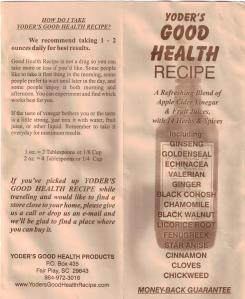
Whiskey played a major role in the decoction of tonics, as you can see in some of the above examples. Likewise strong solvents like vinegar could be used to draw out the wonderful properties of plants and create a powerful tonic. We touched on this in our post on Four Thieves Vinegar, for example. At the top of this article you can see an example of a brochure for a vinegar-based tonic (I picked this up at a nearby Amish market). The inside portion is below:

002

Several of the tonics we’ve mentioned so far specifically speak of their effect on the blood, either as “blood-thinners” or “blood toners.” These preparations were supposed to help undo the sluggishness and thickening that occurred during the winter within the body.

“Tonics known as ‘blood toners’ or ‘blood builders’ were used mainly in the spring to restore vital properties to the blood. One of the most popular was sulfur and molasses. ‘Blood purifiers’ or ‘blood thinners’ were also used in the spring and during episodes of sickness to clear the blood and organs of toxic waste, or what Southern Appalachians termed ‘pizins’” (Cavendar 65)

They also made herbal bitters which helped digestion and purified the blood. Eventually, tonics were commercialized and turned into wonder pills and patent medicines. Some examples of the many patent medicines available throughout the early twentieth century: Dr. Enuf, Peuna, Dr. Simmons’ Liver Regulator, Dr. Thatcher’s Liver & Blood Syrup, Dr. Taylor’s Family Cordial, and Thedford’s Black Draught. Some, like Dr. Enuf, were essentially caffeine and sugar energy pills claiming marvelous properties. Some legitimately helped. Most were made not in the mountains, but in St. Louis, Philadelphia, New York, or Baltimore. The Chattanooga Medicine Company made two successful medicines, however: Wine of Cardui for ‘female complaints,’ and the laxative Black Draught (Cavendar 72-3). These patent medicines (which I may cover in another post at some point) had a huge impact on Appalachian economies, especially for people trying to get out of the farming life:

“The J.R. Watkins Medical Company, founded in 1868 in Winona, Minnesota…enjoyed great success in selling their medicines in Southern Appalachia…[They] offered men, and later women, the opportunity to have their own business by becoming local sales representatives. For many, it was a way to escape farming life and become prosperous. A 1916 issue of the Watkins Almanac has a picture of a man in a hat and overalls standing beside a horse-drawn plow. His head is turned toward a Watkins truck rolling down a road in the distance. Beneath the picture is the caption ‘I wish I were a Watkins Man.’ The company’s recruitment efforts were successful, for in 1911 it had over 2,500 sales representatives across the nation. Sales representatives not only operated in towns and cities but also served the remote rural communities on horseback. Families in the rural communities often provided food and lodging for the ‘Watkins man’…Watkins Blood and Skin Purifier, for example, was recommended [in their almanacs, another source of revenue and advertisement as well as a pharmacopeia for the rural Appalachian] as a curative or preventative for influenza, catarrh, headache, boils, acne, blackheads, ‘change of life’ (menopause), languor, and diarrhea because these disorders were all thought to be caused or complicated by defiled or weak blood” (Cavendar 74-5)

As medicine became restricted and patent medicines came under increasing scientific and legal scrutiny, these “Watkins men” and their ilk slowly disappeared, but the tonics have remained popular up to the present day (as illustrated by the Yoder’s Good Health brochure above).

Some tonics also got administered to animals for their general benefit, too: “Ordinary soft soap made with wood ashes is regarded as a sort of universal tonic for hogs, so the hillman just mixes a little soap with the hog feed occasionally. ‘Soap will cure a hog no matter what ails him, if you git it to him in time,” said one of my neighbors’”(Randolph 50). In some cases, plant materials were completely unnecessary and a tonic could be made by simply using water from a natural mineral spring. I hope to cover the many miracle curing hot springs at some point in the future, but I’ll briefly mention one such spring due to its connection to tonics:

“The unique sulphur spring was promoted as a cure for a variety of illnesses, but especially for influenza…promoters boasted that one could drink the waters and bathe in them for a few weeks each summer and thus prevent catching the dreaded disease during the winter months. The water was even bottled for a while and distributed throughout the nation as a cure-all” (Steele, 63)

If you’re already seeing the word “tonic” connected to the spring water and you’re thinking cocktails, you’re in good company. Tonic water, the kind you mix with really good Old Tom gin (am I showing a bias there?), comes out of the tonic-brewing tradition. Happy hour for your health, anyone?

I hope this has been a nice—if brief—look at spring tonics in their various forms. If you know of tonic recipes or variations I’ve missed, feel free to post them in the comments section below!
Thanks for reading,

-Cory

Sources

  1. Cavendar, Anthony. Folk Medicine in Southern Appalachia (2003).
  2. Hyatt, Harry M. Folklore of Adams Co., Illinois (1935, 1965).
  3. Milne, Gerald C. Signs, Cures, & Witchery (2007).
  4. Montell, William L .Upper Cumberland Country (1993).
  5. Randolph, Vance. Ozark Magic & Folklore (1964).
  6. Steele, Phillip.Ozark Tales & Superstitions (1983).
  7. Wigginton, Eliot, ed. Foxfire 2 (1973).
  8. Wigginton, Eliot, ed. Foxfire 3 (1975).

Blog Post 172 – Ashes

“Remember, man, that thou art dust, and unto dust thou shalt return.” –Priest’s admonition during Ash Wednesday liturgy, based on Genesis 3:19.

On Wednesday, I attended the Ash Wednesday mass at a Catholic church near my workplace, which begins the Lenten season. The pull of tradition sometimes brings me back to the church rituals of my childhood, and while I’m spiritually aligned else wise now, I take comfort in some of these practices, too. The ashes used in Ash Wednesday services are a powerful ritual tool, made from the palms left from the previous year’s Palm Sunday, mixed with incense and holy water, and blessed by the priest. They mark the bearer as a member of the church, a mortal person living in a mortal world, and someone aware of death’s role in our lives. The ashes, which serve as a spiritual tool for unification with divinity and with mortality, got me to thinking about some of the other ways in which ashes can be used in folk religious or magical practices.

And so today, I thought we’d explore the very rich traditions of magical work which incorporate ashes. I shall endeavor to stay focused on the practical application of ashes, rather than the mere presence of ashes in a spell, but in some cases that line blurs (or smudges) a bit. In researching the topic, I was astounded to see how many different methods for working with ashes I found: banishing, cursing, healing, money work, omens about bad luck and loss, and even some quasi-magical gardening tips. This, to me, is an example of how an extraordinarily normal item—ashes—can be a useful magical tool if a practitioner knows a little about what to do with them. Truly, a clever witch or magical worker can read his or her environment and see it loaded with enchantment and possibility, but I digress. On to the ash spells!

 One of the most common ways to counteract bewitchment was to burn the affected object—usually a cow, butter-churn, etc.—“to ashes” which would render the witch who cast the enchantment powerless or cause her tremendous pain. Often the ashes would have to be dispersed even more extensively by being scattered to the four winds to render the spellcaster completely impotent and/or destroyed. Similarly, feathers from black fowls could be burned and the ashes sprinkled or blown over a bewitched person to remove the bewitchment.

An account of a Bell Witch-style haunting in Wiltshire, North Carolina, noted that the wicked spirit “sprinkled ashes in the beds” (Cross 243). Some hoodoo spells deploy the ashes of particularly nasty spells in the way one might lay a magical powder, sprinkling at someone’s doorstep so that they must step in the baneful trick.

Cat Yronwode mentions rubbing alfalfa ashes on one’s money to improve business, especially if the money is in a cash register. She also has this excellent and interesting recipe for a floorwash designed to bring clientele to a cathouse:

To Draw Trade to a Whorehouse: On a Friday morning, build a fire outdoors and burn a man’s worn-out left SHOE with a pinch of SUGAR in it. Put the SHOE ashes, a tablespoonful each of AMMONIA, SALT, and SUGAR, plus your own URINE, into a bucketful of water.  Mop from the sidewalk inward, to attract men (Yronwode 29).

Ashes can also be used in hoodoo love charms (perhaps in conjunction with the above business charm?), as in this method from Zora Neale Hurston:

Cut some hair from under your left arm-pit and some from the right side of the groin. Then cut some from the right arm-pit and from the left side of the groin. Burn this hair with a wish for this man to love you.  Put the ashes – made into fine dust – in his food secretly and he will love you and do as you wish (Hurston 361-2).

A magical charm called the “Chinese Snake Stone” from an account of North Carolina witchcraft tells how the amulet could be used to draw poison and how ashes were used to re-charge it after its work was done:

Directions for using The Chinese Snake Stone. Scarify the wound before applying the Stone-take it off every morning and evening-put the Stone at each time, when taken off, into a glass of milk-warm water, and let it remain a few minutes, until it discharges itself of the poison-wash the wound in a strong solution of salt water, and scarify again, if necessary. After taking the Stone from the water, rub it dry in moderately warm ashes, and apply as before. This course should be repeated for the space of nine days, when a cure will be effected (Cross 264)

In some cases, ashes have to be handled carefully in order to prevent illness from getting worse. When someone in a family is sick, for example, removing the ashes from the fireplace and taking them out of the building is said to be very bad luck, possibly even fatal to the ailing person.

A Pow-wow hair removal charm taken from older European sources recommends burning a frog to ashes and mixing them with water to make an ointment “that will, if put on any place covered with hair, destroy the hair and prevent it from growing again” (Hohman 14). I also found the same cure echoed in witchcraft practices from North Carolina.

Curandera recipes sometimes call for white ashes, which are powdery and fine and must be sifted from the gray and black ashes. Mrs. Mercedes Castorena of Sonoma gave the following recipe for dealing with empacho, a stomach and intestinal ailment:

“You crack an egg and get the yolk, being very careful not to break the yolk, because it has to be all in one piece. Then lay the sick person on the bed, put the egg on his stomach and let the egg slide all over the stomach. Wherever the spot is (where the food is stuck), the egg yolk will break. You leave the egg here. Then you take some herb called rosa de castilla, and some ashes-just the white part of the ashes-and put this on the stomach and wrap a bandage around the stomach to keep it on. Then you give them a dose of Baby Percy (a patent medicine)” (Neighbors 251).

Mrs. Castorena also mentioned a cure involving mixing avocado seed ashes with oil to treat indigestion. Ashes are also used in other home remedies from other traditions: “To cure toothache, place a bag of warm wood ashes on the side of the face where the tooth is aching” (Farr 327). Vance Randolph mentions the Ozark method of treating an itch using a mix of gunpowder, wood ashes, and sweet cream. He also talks about a method of staunching a wound using the ashes of a man’s shoe.

In the garden, ashes can be mixed into soil around fruit trees to improve their growth. My mother used to have me take our fireplace ashes and put them around our blueberry bushes at the beginning of the spring to promote big, juicy berries later on. Supposedly, doing this on Ash Wednesday ensured a pest-free garden all year long (I don’t recall if I was usually enjoined to this particular chore in conjunction with the holiday or not, but our plants were not bug-free).

Harry M. Hyatt recorded a number of beliefs about sprinkling ashes around a hen-house to prevent lice on the birds (and he also mentions the Ash Wednesday ritual for gardening success). Some of the other magical ash-lore he shared includes:

  • “Epileptic attacks are checked, if you remove the person’s undershirt immediately after an attack, let it smolder on live coals, mix a teaspoonful of these ashes in a glass of holy water, and say In the Name of the Father, Son and Holy Ghost. These ashes in holy water must be administered three times a day.”
  • “An old shoe should be burned and the ashes used in washing out the mouth of a child with thrush.”
  • Several of his informants recommended burying objects that have touched a wart in ashes in order to cure the growth
  • Dreaming about ashes is very bad luck, usually foretelling a significant loss or a death in the near future

Strangely, dreaming of fire is frequently a good sign, but the ashes tend to be a bad-luck indicator.

As you can see, even the lowly ashes from your fireplace can become useful magical aids if you know what to do with them. I hope this little exploration is useful to you! Please feel free to share your own ash lore in the comments below.
Thanks for reading,

-Cory

Sources

  1. Bivens, N.D.P. Black & White Magic of Marie Laveau (1994, new ed.)
  2. Cross, Tom. “Witchcraft in North Carolina.” Studies in Philology (Jul. 1919).
  3. Farr, T. J. “Riddles & Superstitions of Middle Tennessee.” Journal of American Folklore (Dec. 1935)
  4. Hohman, John George. The Long Lost Friend (1820).
  5. Hurston, Zora Neale. “Hoodoo in America.” Journal of American Folklore (Dec. 1931).
  6. Hyatt, Harry M. Folklore of Adams Co., Illinois (1935, 1965).
  7. Neighbors, Keith A. “Mexican-American Folk Disease.” Western Folklore (Oct. 1969).
  8. Randolph, Vance. Ozark Magic & Folklore (1964).
  9. Snow, Loudell F. “Mail Order Magic: The Commercial Exploitation of Folk Belief.” Journal of the Folklore Institute (Aug. 1979)
  10. Yronwode, Catherine. Hoodoo Herb & Root Magic (2002).

Blog Post 171 – Magical Cakes

King Cake Bagel, via Wikimedia Commons

Laissez les bon temps rouler, y’all! It’s Mardi Gras, which means a last-minute pre-Lenten extravaganza of flesh, fun, and other words starting with the sixth letter of the alphabet. In honor of the Carnival spirit of feasting (another “f” word!), I thought I’d take  a brief look at one of the things I most associate with this holiday: cake.

Cake may not have the aesthetic magical impact of a cauldron bubbling over a fire or a bag full of bones scattered in the dirt, but this bakery standby (and some of its culinary cousins) manages to surface in a number of magical practices. Since this is Mardi Gras, let’s start with one of the most obvious, the King Cake. The King Cake originates in Epiphany and Old Christmas celebrations from Catholic countries, but has also become incredibly prominent in Carnival and Mardi Gras celebrations. The one you’re most likely to find in a local bakery (I have found Hispanic bakeries frequently are my best source) will be big, doughy cakes covered in icing and lots of colored sugar—usually gold, green, and purple. Somewhere inside, a small plastic or metal baby lurks, waiting to grant luck on the one fortunate enough to get a slice with the little token in it (or unfortunate enough, if you happen to bite into the baby and chip a tooth before you know what you’re doing). The lucky association of the baby in the King Cake resembles other traditions in which a bean is baked into a cake and the recipient receives blessings, money, or good luck upon finding it. Sometimes the “King” or “Queen” of the feast would be chosen by the finding of a bean or a pea:

Samuel Pepys (whose wife was French) recorded a party in London on Epiphany night, 6 January 1659/1660: “…to my cousin Stradwick, where, after a good supper, there being there my father, mothers, brothers, and sister, my cousin Scott and his wife, Mr. Drawwater and his wife, and her brother, Mr. Stradwick, we had a brave cake brought us, and in the choosing, Pall was Queen and Mr. Stradwick was King. After that my wife and I bid adieu and came home, it being still a great frost.”[1] The choosing of King and Queen from the pie, usually by the inclusion of a bean and a pea, was a traditional English Twelfth Night festivity. (via Wikipedia’s article on “King Cake”)

Most Westerners know about the significance of candles on birthday cakes, as well as the wishing tradition that comes with blowing them all out at once. Some of the other quirky and semi-magical rituals we perform in conjunction with cake:

  • “Portions of the wedding cake are often saved to eat at anniversary parties (and at christenings) to symbolize that the marriage has lasted and matured” (Brunvand 63).
  • Brides are not supposed to bake their own wedding cakes, for fear of bad luck.
  • A newly married couple frequently joins hands to cut the wedding cake and serve the first slice, which can symbolize their union and service to one another, their joint role in serving the community and their families (in some cases members of the family are served first by the bride and groom),  or their shared prosperity and a wish that they should never know hunger together.
  • “The wedding reception provides more folklore, mostly concerning the wedding cake. One popular belief says that if the bride cuts the cake first, with the groom placing his hand over hers, their marriage will be cooperative. This ritual also ensures fertility. Some traditions urge the couple to fast, while others insist that they eat their entire meal for good luck. Trinkets in the shape of rings, horseshoes, and cupids are often baked inside the cake” (Brunvand 1548).
  • “Let a bride on her wedding-night throw a piece of wedding-cake outdoors and next morning watch how many birds eat the cake; the number of birds will be the number of her children” (Hyatt 54).
  • “If a slice of the birthday cake tips over on the plate, that person will never marry” (Brunvand 170)
  • Over-the-Hill celebrations frequently involve black or coffin-shaped cakes to symbolize (humorously, we hope) the ever approaching death of the recipient.
  • Several cultures celebrate the Passover-and-Easter holidays with special cakes, including the Jewish use of unleavened cakes in Pesach meals, the Dutch use of Paas cakes in the Easter feast, fastnaacht cakes of the Pennsylvania Dutch, and other similar baked treats.
  • Also from the Germanic tradition: “Years ago it was almost a general custom among Germans in Quincy to bake a coffee-cake and eat it with the family who had a new baby so that the child would become wealthy” (Hyatt 73).
  • From the files of American History: “Although Election Day is not a legal holiday, the event  nonetheless is associated with folk customs. For example, in New England, there is a tradition of preparing Election Day cake. This yeast-raised cake, prepared with spices, raisins, and nuts, dates back to the 1700s in Connecticut. It is tied to an era in which the trip to cast one’s vote was a journey punctuated with visits to friends and family. By the 19th century, polling places were more accessible, and the customs of Election Day cake and callers waned” (Watts 125).

Of course, Western culture hardly has a monopoly on cake-based traditions. Since we’re also entering the Chinese New Year, I can’t help but mention the delicious little mooncakes you can find in a number of Chinese bakeries at this time of year. In some cases, these sorts of little glutinous cakes might be offered to ancestors or deities (as with the tt’ok of Korean origin) or simply consumed as a symbol of prosperity and blessing during the celebrations.

According to American Folklore: An Encyclopedia, “Some American children enjoy baking a ‘thundercake’ when they first hear thunder and starting to eat it when the storm breaks (if the storm allows enough time for baking)” (Brunvand 1553). I’m not entirely sure what the significance of this weather-ritual might be, although I would speculate it brings some kind of protection or prosperity. Harry Hyatt recorded an interesting pregnancy divination based on a baking cake: “’ When I was young, whenever my bread or cake cracked open in the middle, I always was in a family way. It never failed.’ Some say the cracking open is not necessary; a raising-up more than usual in the center is sufficient”  (Hyatt 54). A variation on this technique says if the cake breaks open during baking, a baby girl is not far behind.

Cakes also can have a darker (“devil’s food?”) side. Some cakes can be used to cause harm or to undo hurtful magic by sending it back to its origins. The famous “witchcake” made from urine and grains which Tituba allegedly showed the Parris girls how to make in Salem, MA, was supposed to have caused tremendous suffering to whomever was attempting to curse the young ladies. Another rather evil-sounding cake was allegedly used to poison a child: “One instance is given [in an account from 1895] of ‘toad heads, scorpion heads, hair, nine pins and needles baked in a cake and given to a child who became deathly sick’” (“Conjuring and Conjure-Doctors in the Southern United States,” Journal of American Folklore, p. 143). Gruesome.

Still, all in all, cakes tend more towards the “angel food” side of things, and bring luck, prosperity, and joy along with other blessings. After all, it is cake, right?

So enjoy your Mardi Gras celebrations with whatever baked sweetmeat you find most appealing. I will be having pancakes with FROG jam (Fig-Raspberry-Orange-Ginger, made by our local Amish country market and SO delicious!) and hopefully laissez-ing the bon temps rouler all day long! Here’s wishing you a wonderful day!

Thanks for reading,

-Cory

Sources

  1. Brunvand, Jan. American Folklore: An Encyclopedia (1998).
  2. “Conjuring and Conjure-Doctors in the Southern United States,” Journal of American Folklore (1896).
  3. Hyatt, Harry M. Folklore of Adams Co., Illinois (1935, 1965).
  4. King Cake.” Wikipedia (2013).
  5. Milne, Gerald C. Signs, Cures, & Witchery (2007).
  6. “Tituba.” Famous American Trials: Salem Witchcraft Trials 1692. Univ. of Missouri (Kansas City, 2012).
  7. Watts, Linda S.The Encyclopedia of American Folklore (2006).

Blog Post 167 – Corpses

To get everyone in the holiday spirit, today I thought we might head down the gruesome path to the graveyard and see what we can dig up (figuratively, of course). That’s festive, right? Deck the halls and all that? While I’ve talked recently about bones and their uses in magic, and we’ve touched on the idea of working with the dead in magical practice, too, you may not know that there is a very long and widely spread habit of using corpses—in whole and in macabre part—as magical tools in their own right. Of course, there are many societies, including some Native American tribes, with strong taboos against contact with dead bodies, yet even this geis reflects a sense of respect and awe at the power of the deceased. Sometimes the spirit of the dead person is the fuel behind the magic—in which case it can be seen as a form of necromancy—and sometimes it is simply the body voided of life—any body, really—which empowers the charm.

Probably one of the most famous and nefarious examples of corpse magic is the Hand of Glory, a special candle made from the severed and pickled hand of an executed criminal which supposedly had intense magical properties. One of its talents was its reputed ability to render anyone in a house near where it was lit unconscious, thus making them easy to rob and explaining why the Hand of Glory might have been sought after by eager thieves. Here is one of the brief-but-to-the-point recorded recipes for making a Hand of Glory, from one of my favorite spooky little tomes, Kathryn Paulsen’s Witches’ Potions & Spells (WARNING! THIS IS PROVIDED AS A FOLKLORIC EXAMPLE ONLY! DO NOT DESECRATE CORPSES—IT IS HIGHLY ILLEGAL!):

During an eclipse of the moon, sever the right hand of a corpse, preferably that of an executed murderer. Dry it and preserve it in a jar to which you have added foul smelling herbs. If you light the fingers of this hand as candles, the light can only be seen by yourself and other witches, and the light will not go out until you wish it. If you bring it into a house, sleep will reign over those within.  But you must let no one know that you posses the Hand of Glory. Use this hand to give light whenever you wish to obtain something from a graveyard (Paulsen 40).

Paulsen also mentions a variation on this spell which involves filling a human shin bone with tallow and carrying it as a candle to cause enchanted sleep. The Hand of Glory and its variants date back to at least the early Modern period, showing up in 18th century texts like the Petit Albert.

Across the Atlantic and on North American soil, corpses remained a morbid part of folk magic. Here they were granted powers of healing, crime-detection, secret-keeping, and other occult traits. The bodies of the dead figure into magical systems spanning multiple cultures, including those of Native Americans, the Pennsylvania Dutch, African Americans, and mountain folk in the Appalachians and Ozarks. First Nations practices vary between tribes, with alternating levels of prohibition and interaction when it comes to handling the dead. Randolph notes that “Some hillfolk of Indian descent insist upon sprinkling a little cornmeal over a corpse, just before the burial. This is done unobtrusively, without any noise or ceremony, and many whites have attended funerals where the rite was carried out without eve* noticing it. As the mourners shuffle past the body, here and there you see one drop a tiny pinch of meal into the coffin” (Randolph 316). Such a practice more rightly belongs to burial customs than necromancy, however. In general, contact with the dead can be a powerful—but frequently fearful—thing in Native societies. For example, “[o]ne of the most remarkable of Indian sacrifices was that practised by the Hurons in the case of a person drowned or frozen to death. The flesh of the deceased was cut off and thrown into a fire made for the purpose, as an offering of propitiation to the spirits of the air or water. What remained of the body was then buried near the fire” (Parkman 4). In the Pacific Northwest, there are accounts of tribes with magical groups that engaged in highly taboo behaviors to perform their roles as community sorcerors:  “There were also a number of secret societies—for example the Cannibal Society of the Kwakiutl, whose induction ceremony was believed to involve eating parts of a corpse” (Lowenstein 120). South American Natives have their own legends about how a group of witch-monsters from Chiloe, an archipelago south of the mainland, use a fearsome object called a macun. This is a leather bowl made from human skin taken from the corpse of a virgin which reveals the presence of human victims and can be used in some stories as a mode of transportation.  It can also help the evil brujos turn into animals, open locked doors, and become invisible.

Turning from the cultural backdrop of Native Americans, whose varied practices I have only skimmed in the previous paragraph, let us now look more at the specific applications of corpse magic in some of the non-Native societies of North America. In general, what follows is broken down by magical purpose into categories (legal work, divination, cures, and curses), with a few tidbits at the end. This is a far from complete examination of the topic, however, so I hope this provides an entryway into further study for those interested.

Legal Work
Fundamentally, these sorts of spells are either somewhat divinatory—helping to provide insight into crimes which remain unsolved, for instance—or make use of the dead body to provide legal aid. To this latter end, we can look in Hohman’s Long Lost Friend to find at least one instance in which the figure of the corpse is invoked to help in court-case work:

“TO RETAIN THE RIGHT IN COURT AND COUNCIL.
Jesus Nazarenus, Rex Judeorum.
First carry these characters with you, written on paper, and then repeat the following words: “I (name) appear before the house of the Judge. Three dead men look out of the window; one having no tongue, the other having no lungs, and the third was sick, blind and dumb.” This is intended to be used when you are standing before a court in your right, and the judge not being favorably disposed toward you. While on your way to the court you must repeat the benediction already given above.” (Hohman #147)”

The use of actual corpses in legal work tends to be more in crime-detection, however. One piece of lore spread across several cultures describes leaving an egg in the hand of a murdered man when he is buried. The murderer will be compelled to some action, depending on the story, ranging from returning to the scene of the crime to confessing guilt to suffering illness and death himself. Sometimes the body will perform its own divination, unaided by other witnesses or participants. Kentucky lore says “If a corpse’s nose bleeds, it is a sign that the murderer is in the room” (Thomas #745). Puckett notes in African American lore that “the common Negro belief [is] that If you put your hand on the corpse the ghost will not harm you (or you will be afraid of no more dead people). This may be the remnant of an old ordeal, since the wounds are supposed to bleed if the murderer touches the corpse” (Puckett 88).

Dead bodies can predict a number of situations and conditions it seems, as we shall see in the next section.

Divination
A number of sources on African American lore mention that a corpse that “limber” corpses predict a death to follow them, and insist that mirrors and clocks be covered with cloth as soon as someone dies to prevent anyone else in the house from dying. Like Puckett’s note above about touching the body to prevent fear of dead people, the corpse can intrude upon the living. Touching the body can prevent both bad dreams and visits from an unruly spirit. Likewise, the suggestion of something corpse-like can announce important information (usually another death). Harry Hyatt had an informant who related a tale of ‘death-scent,’ for example:

“I started to eat my breakfast last week. I happened to put my hand to my face; it smelled like a corpse. I said, ‘I wonder who’s going to die.’ And the smell left right away; that is a sudden death. If the smell  stays, it will be longer. That day I had a call. My cousin died when I was eating my breakfast. If it is the left hand that smells, it’s a lady; right hand, a man” (Hyatt #8313).

The dead seem to know a lot about the affairs of the living, but they can also be entreated to hold their tongues. Zora Neale Hurston recorded a spell used for keeping secrets which required a corpse: “If you want a secret kept, put it in the care of the dead by writing it on a piece of paper and folding it small and slipping it into the hand of the corpse, of whispering it in the ear” (Hurston 361). In addition to catching criminals and revealing impending doom, corpses can also be employed in a variety of happier magics, such as healings.

Cures
The volume of cures ascribed to dead bodies is too voluminous to include in any book, so I will only briefly touch on it here.  One of the most popular healings ascribed to the dead is wart-charming, which we’ve looked at before.  In the Ozarks, “[t]here is a widespread belief that warts can be ‘charmed off’ by touching them with the hand of a corpse. I have seen this tried several times. The warts disappeared after a while, just as they generally do under any other treatment, or with no treatment at all. On the other side of the balance, I have met an undertaker who handles many bodies every year, and both his hands are covered with warts!” (Randolph 131). Similar to Randolph’s bit about wart-removal, this charm comes from Kentucky: “You may remove birth-marks by rubbing them with the hand of a corpse.” (Thomas #1067). It can supposedly treat other skin disorders like eczema as well. A variation on the birthmark-removal from Illinois contains a little verbal charm to accompany the act of touching the corpse: “A girl should visit the corpse of a boy and move his hand over her birthmark as she says What I have, take with you; In the Name of the Father, Son and Holy Ghost. A boy with a birthmark does this at the corpse of a girl.” (Hyatt #2685). Sometimes merely rubbing the mark or blemish with a rag and placing the rag in the coffin of a dead man is enough to remove the problem. Placing clothes and other objects from a sick person in the casket of the deceased supposedly removes everything from skin disorders to contagious diseases. Clothes taken from the corpse can also be healing: “To remove a swelling on the leg, bandage it with a piece of linen taken from a corpse” (Hyatt #5145).

Some of the other cures attributed to the dead:

  • “In other localities the body is placed on a ‘coolin’-board’ and covered with an arrangement of sheets, the one over the face being raised when the mourners address the corpse. Mourners may talk to the body to this effect: ‘Mandy, you gone an’ lef me. … I may be nex’ . . . Po’ Mandy! . . . Po’ John! .’ A plateful of salt and ashes is placed under the coolin’-board . . . whatever disease the body has goes into the ashes and salt. ‘Ashes takes up from de body de disease.’ These ashes are carried to the grave; and at the words, ‘Ashes to ashes and dust to dust,’ they are thrown into the grave.’” (Puckett 87)
  • “When in pain get some of this graveyard dirt from the breast of the corpse, cook it with lard, and make into a sort of pancake. Sprinkle this with turpentine and bind like a mustard plaster to the place that pains you. You will surely be cured.” (Puckett 287)
  • “Place in a coffin three lice from your head and the corpse will carry away the others.” (Hyatt #1438)
  • One of the more desecration-y methods for solving home problems with a little help from the dead comes from Harry Hyatt: “Pour some of the child’s urine into a bottle, hide this with a coffined corpse, and the child will stop wetting the bed. Sometimes a hole is punched through the stopper so that the urine can drip out — the cure being effected after the bottle becomes empty.” (Hyatt #6298)

In addition to being powerful curatives, bodies of the deceased can also cause tremendous harm.

Curses
It probably comes as no surprise that the use of dead bodies in magical rituals and spells generally gets a fairly negative portrayal. In the previous three sections, the spells were all designed to enact some positive change—albeit messy or sacrosanct in some cases—but now we shall look at a few of the nastier ways in which our dead friends can be used for magic. I’ll begin with a love spell, not because I inherently think love spells are evil curses (I don’t think that at all, actually), but rather because this one is exactly the kind of spell you could make a horror movie out of. It’s obsessive, possessive, and a little mean:

“A girl can take a needle which has been stuck into a dead body, cover it with dirt in which a corpse has been laid, and wrap the whole thing in a cloth cut from a winding sheet ; this is supposed to be a very powerful love charm, and a woman who owns such a thing can make any man fall in love with her. A needle which has been used to make a shroud is useful, too. If a girl thrusts such a needle into her lover’s footprint in her own dooryard, he is forced to remain with her whether he wants to or not. If he leaves the neighborhood he will get sick, and if he stays away long enough he will die.” (Randolph 169)

Randolph also examines witchcraft which falls in line with storybook expectations, harmful stuff perpetrated by willfully malevolent magical practitioners:

“Some witches are said to kill people with graveyard dirt, which is dust scraped from a grave with the left forefinger at midnight. This is mixed with the blood of a black bird; a raven or crow is best, but a black chicken will do in a pinch. The witch ties this mixture up in a rag which has touched a corpse and buries it under the doorstep of the person who is to be liquidated. The practice of burying conjure stuff under houses and doorsteps is well known. I have heard it said of a sick woman that she ‘must have stepped on somethin’ ‘ meaning that she was bewitched.” (Randolph 272)

Sometimes the negative effects of the corpse are inadvertent, however, and cursing is incidental. Several sources mentioned that pregnant women should not look upon a corpse, lest their child be marred in some way. Ozark lore says that using the comb of a dead person, particularly a comb that touched the deceased’s hair, will cause your own pate to go bald. Still other corpse curses seem related to harming the spirit of the departed him or herself. Kentucky lore says that you should “Put a lock of hair of a corpse into a hole in a tree to localize the spirit. If you remove the hair, the spirit will haunt you” (Thomas #741). Trapping a spirit seems like a dangerous game to me, but then, I’m not doing that particular spell anytime soon anyway. One of the quirkier ways of messing with the soul of the departed comes from Illinois: “As long as the funeral bill remains unpaid, the corpse will not rest in its grave” (Hyatt #15193).

In addition to the main methods discussed above, corpses also seem to have other magical uses. Here are a final pair from Hurston and Randolph involving some of the more unusual magic connected to the dead and their bodies:

“I. To Gain All Power. Go to the graveyard the night of All Saints at twelve o’clock. All of the blessed are gone from the cemetery at that time and only the damned are left. Go to a sinner’s grave1 and get nine hairs from his head and give the spirit in there a drink of whiskey. (They’ll do anything for a drink of whiskey.) Just leave a pint of liquor in there with the stopper out. Go home and burn nine red candles and the spirit will do anything you want.” (Hurston 361)

“When a backwoodsman dies, in certain sections of the Ozarks, it sometimes happens that one of his male relatives cuts a hickory stick just the length of the corpse. I have seen a hill farmer carrying one of these sticks on the day of his brother’s death, and I have seen one tied to the wagon which conveyed a corpse to the graveyard, but I have never been able to find out what became of them, or what their significance was. I first thought that the stick was simply to measure the body for a coffin, but it is something more complicated than that, and there is some sort of superstition connected with it.” (Randolph 314)

I hope this has been a worthwhile spin through the old boneyard to look at the dead from a more corporeal angle than we usually do in magic. None of this is to advocate any sort of desecration or anything illegal. While I imagine slipping a pinch of cornmeal into a coffin or wiping a handkerchief over a deceased family member’s hand before the casket is closed would at most raise some eyebrows, just about anything involving messing with the dead means legal problems. If you want to get a little help from the dearly departed, developing a relationship with them as spiritual beings is a much smarter way to go (I wrote about it recently on my other blog over at Witches & Pagans, if you’re interested).  If you have lore about dead bodies and the ways they have been used in magic, I’d love to hear them!

Thanks so much for reading!

-Cory

REFERENCES & SOURCES

  1. Gainer, Patrick W. Witches, Ghosts, & Signs. (Vandalia Press, 2008).
  2. Hohman, John George, ed. Daniel Harms. The Long Lost Friend. (Llewellyn, 2012).
  3. Hurston, Zora Neale. “Hoodoo in America.” Journal of American Folklore (Amer. Folklore Soc., 1931).
  4. Hyatt, Harry M. Folklore from Adams County, Illinois.  (Univ. of Ill. Press, 1935).
  5. Lowenstein, Tom & Piers Vitebsky. Native American Myths & Beliefs (Rosen Pub. Group, 2011).
  6. Paulsen, Kathryn. Witches’ Potions & Spells. (Peter Pauper Press, 1971).
  7. Parkman, Francis. “Indian Superstitions.” North American Review (Univ. of Northern Iowa Press, 1866).
  8. Pinckney, Roger. Blue Roots: African-American Folk Magic of the Gullah People. (Sandlapper Pub., 2003).
  9. Puckett, Newbell Niles. Folk Beliefs of the Southern Negro. (Univ. of North Carolina Press, 1926).
  10. Randolph, Vance. Ozark Magic & Folklore. (Dover, 1964).
  11. Yronwode, Catherine. Hoodoo Herb & Root Magic. (Lucky Mojo Press, 2002).

Blog Post 166 – Dem Bones, part II

The Hoodoo told me to get a black cat bone
And shake it over their heads, they’ll leave your man alone
-Ma Rainey, from “Louisiana Hoodoo Blues”

Ossuary at Sedlec. Photo by my lovely wife.

In the last post, we looked at bones as vessels for housing spirits and as divinatory tools, both methods relying on the ancestral side of bone magic to some degree. Today I’ll be going through some of the uses for bones which are less apparently ancestral and a bit more left-of-center when it comes to reasoning why the bones do what they do. A number of the spells call for animal bones of different types, some of which are of questionable legality or morality in terms of collecting them. I DO NOT RECOMMEND VIOLATING ANY LAWS—LOCAL OR FEDERAL—TO ACQUIRE BONES. The information here is intended to provide a folkloric framework for understanding magical practices in North America which feature the use of bones. Likewise, while some of these uses explicitly state their efficacy for healing illness, THIS IS NOT A MEDICAL BLOG AND THIS INFORMATION IS NOT MEDICAL ADVICE. Please leave medical decisions in the hands of qualified professionals, and do not attempt to cure your great-aunt’s glaucoma with leftover buffalo wing scraps. It will end badly for all concerned.

Now that the big-letter typing is out of the way, let’s look at some of these last two categories of bone magic, healing and charming. I should say that there will be some overlap between these categories (and maybe a bit of overlap with divination, too), but as much as possible I use the term “healing” to refer to practices centered on curing bodily ailments of man, woman, or beast, and “charming” as a way of reversing or treating conditions like luck, love, vengeance, etc. I hope that distinction is generally clear, but if it is not, my apologies.

Healing Specimens
For the most part, the bone cures I’ve found are related to preventatives or healing superficial and minor disorders like headaches. In this latter category, the magic revolves around carrying the bones as a talisman against the illness, as demonstrated in the examples below:

  • To prevent headache, carry in your pocket bone out of a hog’s head. (Farr)
  • You can cure a toothache by carrying the jawbone of a mule or donkey in your teeth and walking backwards . Likewise a “white bone button” can be held in the mouth to help cope with toothache or headache. (Randolph)
  • The bones of the turkey vulture, hung around the neck, are supposed to keep headaches at bay.  Powdered eagle bones are supposed to be useful for headaches as well, and possibly depression (McAtee).

In some cases, as in the powdered eagle bones mentioned above (DO NOT EVER KILL AN EAGLE! IT IS SO VERY ILLEGAL!), the administration of the bone-medicine may be taken internally. Vance Randolph mentions a similar—if slightly eerier—method for treating epilepsy: “A human bone, pulverized, is sometimes given internally for epilepsy just a pinch of the powder stirred into a hot toddy, or a cup of coffee.”  What makes this even more unsettling is a follow-up paragraph from Randolph on the next page:  “Old sores, syphilitic lesions, and skin cancers are sometimes treated with powder made from the bones of a person long dead. In order to obtain this material the hillfolk dig into Indian graves and Bluff Dweller burials under the ledges. The Hillman always tells strangers that he’s digging for arrowheads and the like, which can be sold to tourists ; but I have seen these old bones broken into small pieces with a hammer and ground up to be used as medicine.” Now, I’m not saying that Poltergeist (the film) is a gospel to live by, but digging around in Native graves seems like a great way to get into all kinds of trouble—legally and spiritually—in a hurry. Does no one remember the tree and that creepy clown doll attacking the kids? And why? The house is built on an “Indian burial ground.” Bad juju. Jeffery Anderson, in his marvelous overview of African American folk magic called Hoodoo, Voodoo, & Conjure: A Handbook, says that “Human bones are particularly powerful and have historically been highly sought-after items. Many have placed special value on the bones of Native Americans.”  Whether this is all due to a cultural ascription of spiritual power to Native Americans, or some deeply-felt sense that the bones of Natives are somehow more “ancient” and powerful, I do not know. It does, however, seem to be a once prominent practice that has (hopefully) been on the decline for some time now.

After that digression, let’s look at other ways in which bones allegedly can be used to cure illness. In many cases, touching the bone to an affected body part would bring about magical healing. This principle was effective for treating humans or animals, as in the examples below:

  • TO CURE ANY EXCRESCENCE OR WEN ON A HORSE. Take any bone which you accidentally find, for you dare not be looking for it, and rub the wen of the horse with it, always bearing in mind that it must be done in the decreasing moon, and the wen will certainly disappear. The bone, however, must be replaced as it was lying before (Hohman)
  • To remove a wart, get a dry bone and rub it over the wart, then throw the bone away without looking back (Farr)
  • To remove a wart, pick up a beef bone and rub the warts with the side that was next to the ground; put the bone back just as you found it and your warts will go away (Farr)
  • As a method for losing a birthmark: go to the cemetery before sunrise, find a human bone, and rub this upwards three times over your birthmark while saying In the Name of the Father, Son and Holy Ghost (Hyatt)
  • If a person with big neck (goitre) walks through a field, picks up the first animal bone found, rubs that over his swelling, buries it at its original location, departs without glancing back, the ailment will fade away as the bone decays (Hyatt)
  • To cure a tumor or abscess, get a human bone from a graveyard and rub it over the tumor or abscess, then bury the bone under a waterspout of a roof where neither sun nor moon can shine on it (Hyatt)

Several of these cures are remarkably similar, possibly betraying a common origin (most likely European). Again, we see the bones of dead human beings being used as a way of implementing magical cures, but the somewhat more curious method is the “found bone” method. Since the coincidence of finding bones, having the appropriate illness, and being able to dispose of it properly all involve an exceptional amount of serendipity, I have an easy time imagining myself being caught up in the magic of such a technique.

With a fair glance at curatives behind us, let’s now turn towards some of the most outlandish uses for bones in magic: charms.

Ossuary at Sedlec. Photo by my lovely wife.

Charm Curios
Using bones as talismans for luck and other conditions may actually be the most widely disseminated method for employing bodily remains in magic. This is a case of “magic in plain sight,” where several methods for using bones have become simple popular culture tropes. The best example is, of course, the wishbone:

  • Whoever in pulling a wishbone gets the larger part should put it over the kitchen door for luck. (Hyatt)
  • The wishbone from a canary may be worn for luck. (Hyatt)
  • When a chicken is on the menu, pull the wishbone in two with another person. The one who gets the shorter piece may put it over the front door, and the first person who walks under it will be the one whom the person is to marry. (Farr)
  • A wishbone may be hung in one of the following places for luck: over a door, over the kitchen door, and in the clothes closet. (Hyatt)
  • Lay a wishbone over your door on New Year’s Day and the first person to enter the house will be your friend that year. (Hyatt)
  • “Another old saying: if you can break a wishbone with someone and get the largest part, put it in your mailbox and you will soon get some good news in the mail. I did this last week and got a letter with a big check in I was not looking for.” (Hyatt)

Here we see the wishbone used primarily for luck, although it can also have a fortune-telling aspect as well (as in the New Year’s-friend and marriage-prediction charms). Of course, there are a number of bones other than wishbones which can prove magical or lucky. In the Ozarks, Vance Randolph claims that Hillfolk in Arkansas allegedly will hunt for large crawdaddies (also called crayfish or crawfish), which are reputed to contain two large circular “lucky-bones” that can be used to ward off syphilis. Children are sometimes given the snipe-hunt-like challenge of burying lucy-bones with the promise that they will turn into nickels in two weeks. As a parent, I would gladly pay a nickel-per-bone for such magical charms if it meant keeping my kids busy for a few hours hunting crayfish in creeks. In this case, the “lucky-bones” really act more as a magical cure, carried to ward off illness. Another Ozark tradition tells of how girls keep dried turkey bones in their bedrooms or in the rooms where they meet their lovers to inspire proposals of marriage or at least increased displays of affection. Randolph tells one story of “some village loafers ‘greening’ [sending up] a young chap because some turkey bones had been found behind the cushions of his Ford, the supposition being that they had been placed there by women who had ridden with him” (Randolph 167).

Other methods for using bones as magical curios:

  • A charm against evil spirits, made from “the breast bones of kingfishers and jays and small holed stones” (Hoadley).
  • Good luck at cards is had by touching the skull of an infant’s skeleton (Hyatt)
  • Two bones from the head of a white perch, one lying just behind each eye, are considered lucky; unusually lucky when worn by a fisherman (Hyatt)
  • You can become lucky by carrying either the jawbone or breastbone of a tree toad (Hyatt)
  • Keep a turtle bone in your pocket for luck (Hyatt)

Of couse, I can’t talk about magical bones without talking about perhaps the most controversial one:  the Black Cat Bone. This bone, taken from the body of a boiled black cat, supposedly has a variety of mystical powers, the best known being the power to make the carrier invisible. The Black Cat Bone is actually just one among many different types of highly empowered bone charms taken from ritually killed animals. Toad bones from the natterjack toad may once have been used in a similar fashion in England (check out Andrew Chumbley’s “The Leaper Between” or Robin Artisson’s “Toad Bone Treatise” for some esoteric and mind-expanding explanations of these traditions). In North America, the black cat became the primary focus of this practice, though, largely due to the dissemination of its existence by writers like Zora Neale Hurston. In her article “Hoodoo in America,” Hurston outlines the basics of the Black Cat Bone:

To be invisible. You have to catch a black cat in the evening and boil him and close the lid down on the pot tightly. At twelve o’clock at night you pass every bone through your mouth till you get to the bitter bone, and that’s the one. You have to sell yourself to the devil first. Then you can walk out of the sight of man (Hurston 387).

Similar stories exist in recorded tales from the Appalachians, as in Hubert J. Davies’ The Silver Bullet or in Patrick W. Gainer’s Witches, Ghosts, & Signs. At one time, it seems, having a Black Cat Bone was the mark of being a deeply “serious” sort of practitioner of arcane arts and sorcery. While I have no doubt that there are some individuals who would still engage in acts of animal cruelty to acquire allegedly astounding powers, the practice of boiling a cat alive for its bones at least seems to be on the wane. In fact, many places claiming to sell “Black Cat Bones” are selling nothing of the sort. Cat Yronwode sums up the current situation nicely:

“The reputation of the Black Cat Bone spell is so great thaI even today, when animal sacrifice is not condoned by society, several hoodoo supply companies offer Black Cat Bones. Out of curiosity, I bought a so-called Black Cat Bone mojo bag and a vial of Black Cat Oil from one supplier and was amused to see that the bone was the broken end of a chicken thigh bone spray-painted black, while the oil was simply mineral oil. I was relieved to learn that no cats had been killed to satisfy my curiosity – but amazed at the arrogance of the lie that was being perpetuated by the seller, who also offers so-called Bat’s Hearts, Cat’s Eyes, and Swallow’s Hearts for sale – undoubtedly all gallinaceous in origin” (Yronwode 49).

I, for one, am glad that there’s not a mass market for the actual Black Cat Bone, or rather, that the companies doing the mass marketing are at least not making a habit of boiling cats alive. Frankly, while I don’t have a problem with animal sacrifice or slaughter (I remain a farm-boy at heart), the Black Cat Bone ritual disturbs me pretty deeply. If you are reading this and considering performing that rite, let me beg you here and now to reconsider, and instead to think about creating spirit vessels using already-dead cat bones or finding someone (like Sarah Lawless) who makes bone-based charms and unguents that can do much of the same magic without the need for boiling anything alive.

With all of that being said, I hope that this has been an interesting look (a glance really) at the incredibly rich and diverse methodology behind bone magic. If you have other ways of using bones in magical practice, I’d love to hear them! Please feel free to leave a comment or send an email with your thoughts on the topic!

Thanks as always for reading!

-Cory

REFERENCES & SOURCES

  1. Anderson, Jeffery D. Hoodoo, Voodoo, & Conjure: A Handbook. (Greenwood Press, 2008).
  2. Artisson, Robin. “The Toad Bone Treatise.” Self-published (2008).
  3. Brown, Michael H., Ed.S. “The Bone Game: A Native American Ritual for Developing Personal Power or Tribal Consciousness.” Journal of Experiential Education (1990).
  4. Buckland, Raymond. Buckland’s Book of Gypsy Magic: Travelers’ Stories, Spells & Healings. (Weiser, 2010).
  5. Chumbley, Andrew. “The Leaper Between: An Historical Study of the Toad-bone Amulet.” The Cauldron (UK) (2001).
  6. Davies, Hubert J. The Silver Bullet, and Other American Witch Stories. (Jonathan Davis Publishers, 1975).
  7. Farr, T. J. “Riddles & Superstitions of Middle Tennessee.” Journal of American Folklore.  (Amer. Folklore Soc., 1935).
  8. Gainer, Patrick W. Witches, Ghosts, & Signs. (Vandalia Press, 2008).
  9. Hoadley, Michael. A Romany Tapestry. (Capall-Bann, 2001).
  10. Hohman, John George, ed. Daniel Harms. The Long Lost Friend. (Llewellyn, 2012).
  11. Howard, James H. “The Akira Buffalo Society Medicine Bundle.” Plains Anthropologist. (Plains Anthropological Soc., 1974).
  12. Hurston, Zora Neale. “Hoodoo in America.” Journal of American Folklore (Amer. Folklore Soc., 1931).
  13. Hyatt, Harry M. Folklore from Adams County, Illinois.  (Univ. of Ill. Press, 1935).
  14. Knab, Timothy. The War of the Witches: A Journey into the Otherworld of Contemporary Aztecs. (Westview Press, 1997).
  15. Martin, Kameelah L. “Conjuring Moments & Other Such Hoodoo: African American Women & Spirit Work.” Dissertation. Dept. of English, Florida State Univ. (2006).
  16. McAtee, W. L. “Odds and Ends of North American Folklore on Birds.” Midwest Folklore.  (Indiana UP, 1955).
  17. Pinckney, Roger. Blue Roots: African-American Folk Magic of the Gullah People. (Sandlapper Pub., 2003).
  18. Poenna, Carlos G. The Yoruba Domino Oracle. (Red Wheel Weiser, 2000).
  19. Randolph, Vance. Ozark Magic & Folklore. (Dover, 1964).
  20. Yronwode, Catherine. Hoodoo Herb & Root Magic. (Lucky Mojo Press, 2002).
  21. —. Throwing the Bones. (Lucky Mojo Press, 2012).

Blog Post 165 – Dem Bones, part I

Dem bones, dem bones, dem dry bones.
Now hear the word of the Lord.
-from “Dem Dry Bones,” Traditional Spiritual based on Ezekiel 37

From the Ossuary in Sedlec, Czech Republic. My wife took the photo! Isn’t it cool?!

With Halloween just past, I thought it might be a good day to briefly look at one of the most commonly used magical tools in folk sorcery: bones (and their companion skulls as well). I recently received a letter asking specifically about the practice of “Tapping the Bone,” which I will touch on briefly here or in another post, though I will likely not delve too deeply into it as that ritual performed under that name belongs to the general heading of “Traditional Witchcraft.” There are many better resources on that topic than this website, so I’ll stick primarily to the magical folk practices of North America here.

Bones as magical tools have been around for at least 12,000 years, and likely longer than that. In the Paleolithic era (‘Old’ Stone Age), figures carved out of animal bone were likely used in religious ceremonies designed to ensure a good hunt, survival in adverse circumstances, tribal fertility, or any number of other goals. The people making such carvings were hardly ignorant of natural processes, as Alexander Marshack’s discovery of lunar calendars etched into animal bones in the late twentieth century demonstrates. Some estimates place such carvings at around 30,000 years old, so people have been using bones for magic for a while now, to say the least.

Instead of spending several paragraphs exploring the history of bones in magic—which would be easy to do, but would essentially involve me repeating over and over again that skeletal remains have been a part of sorcerous operations for a very long time and are still used today—let’s instead look at how these tools were put to use in the New World. In a very broad sense, bones serve a few very specific  (and sometimes overlapping) magical functions: spirit vessels, divinatory tools, healing specimens, and charm curios.

Spirit Vessels
The use of bones and skulls as a gateway to the land of the dead, or even in some cases to underworlds not inhabited solely by the dead, seems like a natural place to start a discussion. This is very much what “Tapping the Bone” is about, in that a witch or sorcerer can use a skull to summon up a dead person’s spirit or to travel into the otherworld and gain insight or information. A number of good examples can be drawn for this practice. Mexican American families, for instance, use sugar skulls as a way of interacting with their deceased loved ones during Dia de (los) Muertos celebrations. While such a celebration is hardly necromantic, it does seem to be a popular way to facilitate a relationship with the departed. The idea that bones harbor a connection to the dead and their realms also appears in Palo Mayombe, with the phenomenon of the nganga. This is essentially a pot filled with a variety of natural objects including bones which serves as a home for a patron spirit (nkisi). In Native American traditions of the Arikara, musical instruments made from human arm bones are used as a method for summoning the fearsome ancestral spirits known as Buffalo People (James Howard, “The Arikara Buffalo Society Medicine Bundle,” Plains Anthropologist (1974)).  I have also seen references to the need to keep a skull on the altar of a working houngan, or Vodoun priest.

Whatever the specific application, the theory behind bones as gateways to the otherworld seems generally clear: they are the last remaining physical link between someone or something that has died and the world of the living. Using bones to house spirits also makes a great deal of sense, as their liminal nature (caught between life and death) makes them a comfortable space for the two worlds. The bones do not have to be human to facilitate communication, either. In The War of the Witches, narrator Timothy Knab mentions one of the curanderos with whom he is training bringing out a reed box full of “patches of fur, buzzard beaks, and claws from different animals,” which represent ancestral connections of various types, and which could be employed for divinatory and protective purposes (91).

If the remains of dead things are houses for the long-gone, keeping house is very important. Bones treated irreverently can cause all sorts of spiritual havoc. In Roger Pinckney’s Blue Roots, he mentions how African burial practices involved two funerals: one right after the death, and one several years later when bones would be disinterred, lovingly reverenced by the family of the departed, then put to a final rest to give them peace. When slaves could not perform the required funerary rites due to white sensibilities about the exhumation of the dead, it resulted in a lot of “trabblin’ spirits,” or ghosts roaming the land—which may explain why the South is so haunted (59-60).

With so many traditions recognizing the connection between ancestral and unseen spiritual forces and a pile of femurs, tibia, and clavicles, it should hardly be a surprise that the use of bones to communicate with the dead frequently leaves the altar and enters the hands of thesoothsayer.

Divinatory Tools
If you’ve ever heard of someone “throwing the bones,” you know already that a little bundle of claws, teeth, and bones can be scattered to read events of the past, present, and future. If you’ve heard of the slight variation in phrase which goes “rolling the bones,” you may instead associate the items tossed with dice and not perceive anything divinatory, but rather a game of chance played for money, like craps. Yet the two different practices and phrases are very closely related. Both rely on fate to reveal an outcome, for example. The “bones” of the dice phrase is not metaphorical, either, as dice were frequently carved from bone until the twentieth century presented cheaper alternatives like plastic.  The ankle-bones of sheep have a naturally dice-like shape, and were frequently used as substitute dice in medieval times. Likewise, dominoes were once carved from bones and can also be used for both gambling and fortune-telling purposes. Raymond Buckland, for example, alleges that Travelers (essentially the UK variant of “Gypsies,” though they are not always ethnically linked) had a domino oracle used for fun and divination.

One of the finest books on the use of bones in divination only came out in the past year or so. Cat Yronwode, who runs the Lucky Mojo Curio Company, put out a small chapbook-sized work called Throwing the Bones, which provides a brief survey of bone-based divination practices ranging from dominoes to dice to Sangoma-style bone casting. Yronwode makes a good case for understanding “bones” as including things like coins, buckeyes, doll hands, and even a stone or two. You can even buy a set of “starter bones” with the book as a kit, and learn some basics of bone-throwing that way. Another book with a good reputation (I’ve not read it myself, but have seen it recommended by a few reputable diviners) is Carlos G. Poenna’s Yoruba Domino Oracle.  Juniper over at Walking the Hedge also has a great article on crafting your own “bone” system using a variety of objects (including, of course, bones).

Using bones for divination is a very old practice—it almost certainly was done in Ancient Greece and Rome, and may have been done even in Ancient Egypt. The “casting lots” found in the Bible (as in Psalm 22 or during the crucifixion of Jesus) would likely have been done with bone dice or something similar. While doing bone-based divination may seem to be a fairly simple way to work, it can also take on complex methodologies. An article published in the Journal of Experiential Education describes a Native American system called “The Bone Game,” which was used to settle disputes between warring tribes without resorting to outright violence. In this “game,” each tribe would establish high stakes (like potentially a large number of horses or weapons), then form teams which would circulate different bones (here used in Yronwode’s sense to mean small, deeply personal natural objects, including things like nuts or seeds in some cases). Each team would try to determine which object best represented them, and then engage in a very elaborate geocaching/hide-and-seek/scavenger-hunt like ritual which resulted in one team having a victory and claiming all the stakes.

And of course, how can I talk about rolling bones without mentioning the lovely Dolly Parton song about a bone-casting hill witch called “These Old Bones,” from her album Halos & Horns?

I’ll pause here for today, and next time (hopefully) we’ll look at some of the healing methods and simple charms based on bones. I do hope that this very brief look at bones in their spirit-contact/divinatory capacity is useful. I’m sure there’s much more I could write on the topic (I have not addressed systems like runes, which may involve inscribing symbols on bone or antler pieces for fortune-telling purposes, for example), but for now I will just hope that this short article sparks your own curiosity on the subject of magical bone-picking.

Thanks for reading!
-Cory

Blog Post 164 – Superstitions and Omens, Redux

Hi everyone!

At the recent Pagan Podkin Super Moot, I had the privilege of teaching a class which I called “The Clear Moon Brings Rain,” focusing on living an “omen-ic” life. There’s a possibility that a recording of that class may surface at some point, and I really enjoyed getting to be a part of that experience, as it was mostly a directed conversation rather than a lecture-type of class, but I thought some of the notes and information I shared might be of interest to my readers.

I began with a question about the movie Practical Magic, which I love. I used the line “Broom fell; company’s coming,” to start talking about the way we learn and adopt signs and omens into our lives. Some people had not heard that particular sign prior to the movie, and some grew up with it. On some level, it seems that many people—especially those involved in a magical lifestyle of some kind—recognize that the world is essentially ‘speaking’ to them, if they are willing to listen. A prime example of living by signs transcends the purely magical and veers into the realm of science, specifically meteorology. People frequently use idiomatic expressions or folk methodologies to detect patterns in the weather around them and predict potential changes that will personally impact them. In some cases, these changes are immediate: a greenish sky and hail preceding a tornado in some parts of the country; animals freaking out prior to an earthquake in another place (like San Francisco, where PPSM3 took place). There is a wonderful infographic which displays a lot of weather lore quite succinctly, and touches on some of the scientific reasons behind each phenomenon:

Source: http://dailyinfographic.com/how-to-forecast-weather-without-gadgets-infographic

From there, we looked at why we are able—as a whole—to accept signs related to imminent weather disasters, but we resist signs with more tenuous connections, like when wasps build their nests up high prior to a long, hard winter. Several people made excellent points about detachment from our surroundings, particularly nature, and I was very pleased to hear people making the point that when we don’t directly rely upon natural phenomena to feed us or make us comfortable (due to living someplace with regular access to food, climate control, and entertainment), we ‘unlearn’ the connective language of omens in the process. However, I then posited that we should develop a new set of omens in place of the old ones: predicting traffic based on certain sounds or sights, for example. Several folks attending said that they already did exactly that, which seems to me a prime example of being ‘tapped in’ to the world around you, no matter what environment you live in.

I asked if the signs and omens, then, were universal or personal, or some combination of the two. A marvelous array of answers suggested that for most folks, reading the world around you requires familiarity with it, with at least some aspect of personal interpretation involved. Likewise, it was pointed out that symbols register differently: an owl swooping across the road in front of your car may just be a raptor on the hunt. But a second owl doing the same thing may be a tap on the shoulder from the universe. We also brought up the point that ignoring a good omen frequently lands one in hot water in mythological circumstances, so paying attention can be more valuable than blissful ignorance.

Knowing how to discern signs is also important.  A song stuck in your head may just be an infectious earworm surfacing for no reason, but if you live an “omen-ic” life, then frequently those sorts of little details can alter your perception enough to add enchantment and significance to everything. Taken to an extreme, however, omens can become superstition. While I tend to embrace the latter term, I also recognize that for most people, superstition denotes custom or tradition without substance, or a fear-motivated lifestyle, and I would absolutely agree that spending seven years in fear after breaking a mirror is not a life really lived anymore.

Near the end, we played some games involving reading omens from other people’s experiences, and I shared this passage from Toni Morrison’s Sula:

“[E]vil must be avoided, they felt, and precautions must naturally be taken to protect themselves from it. But they let it run its course, fulfill itself, and never invented ways to either alter it, to annihilate it or to prevent its happening again. So also were they with people.

What was taken by outsiders to be a slackness, slovenliness or even generosity was in fact a full recognition of the legitimacy of forces other than good ones. They did not believe doctors could heal—for them, none ever had done so. They did not believe death was accidental—life might be, but death was deliberate. They did not believe Nature was ever askew—only inconvenient. Plague and drought were as “natural” as springtime. If milk could curdle, God knonws that robins could fall” (89-90).

This comes after the return of the titular character in the novel to her hometown, where she is regarded as something of a wonder, something of a witch, and definitely not a welcome presence. So unwelcome is she, that the town endures a “plague of robins,” with hundreds of the birds roosting and dying all around the townsfolk after Sula arrives. My point in bringing up this passage was to focus on the cosmology implicit in it: Nature never askew, only problematic, and always offering hints as to what comes next; deciding when it is better to fight against Fate, and when stepping out of her way as she passes is best; and seeing great moments as personally symbolic in life. I think that Morrison’s words capture a bit of the sense of what I mean when I speak of the “omen-ic” life. It is a life lived fatefully, purposefully, and with a tremendous awareness of the vast interconnection of all the moving parts of existence. It is also a life in which fear becomes secondary to strength and wisdom—fear may be present, but it does not dominate.

All of this hardly captures the gorgeous conversation that those attending the class provided. They were deeply engaged and we had some incredibly sharp minds present. What I present here reflects more of my opinion than it does the dynamics of the group, but I hope that perhaps the conversation can continue. What are your thoughts on omens, signs, and fate? I’ve asked about such things before, of course, but it’s been a while, and perhaps you differently about them now, or perhaps not. Either way, feel free to leave comments below, or to email me and tell me about your interpretations of an “omen-ic” life.

Finally, I can’t resist the opportunity to share some more signs and omens from other sources. Here are some of the more common, and some of the most unusual, examples I’ve found (these were included in the class handout):

A Short List of Typical Signs & Omens of the Americas

1.  If you cut your nails on a Saturday, you’ll see your sweetheart on Sunday.

2. The accidental crossing as four people shake hands together means that one of them will soon marry.

3. A baby smiling in its sleep has an angel speaking to it.

4. When passing a wagon-load of hay, you should grab a handful—it will bring good luck if you do, and bad luck if you don’t.

5. If the stars are thick, it is a sign of rain.

6. Lightning in the south means dry weather.

7. If you find an inch-worm on your clothes, you will soon have new garments.

8. You should never watch a friend walk out of sight, or you will never see him/her again.

9. If two persons say the same thing at the same time, they must lock their little fingers without saying a word and make a wish.

10. Dream of a funeral and attend a wedding.

11. It is bad luck to tell a dream before breakfast.

12. Cutting a baby’s hair before it is a year old will give it bad luck (also said of letting a baby look in a mirror).

13. A baby born with a caul over its face will be a prophet or a seer.

14. A whippoorwill which alights on a house and calls is announcing a death to come.

15. Misfortunes always come in threes.

16. A bride should not look at her complete wedding attire in the mirror until after she is married, or else the marriage will end badly.

17. If sparks from a fire favor someone (move towards him/her in unnatural ways or numbers) he/she has significant magical powers.

18. Hearing raps, knocks, bells, chimes, or ticking with no apparent cause announces a death in the near future.

19. The seventh son of a seventh son will be a naturally gifted healer, seer, or witch.

20. A cat, coiled up with its head and stomach showing, means bad weather is coming; if it yawns and stretches, good weather is not far behind.

21. A rooster crowing at night brings rain in the morning.

22. Seeing a “sundog” (a halo around the sun) indicates either a drought or a radical change in weather soon.

23. Fogs in August are snows in winter.

24. If you are walking or riding at night and feel a sudden warmth or chill, it is a spirit, and you should turn your pockets inside out to keep it from doing you harm.

25. Stepping over a broom forwards is bad luck, but you can reverse it by stepping over the broom backwards.


Some Unusual Signs, Omens, & Superstitons

1.  People with short fingernails are tale-bearers.

2. If the first snake you see in spring is already dead, you will conquer your enemies.

3.  For hot-peppers to prosper, they must be planted by a red-headed or hot-tempered person.

4. You shouldn’t cut a baby’s nails in the first year of life; you should bite them off.

5. If you catch a butterfly and bite off its head, you will soon have a dress the same color as the butterfly.

6. If a bird builds a nest in your shoe or pocket, you will die within a year.

7. If you find a hairpin in the road, you shall soon have a new friend. If the pin’s tines are of equal length, the friend will be a girl; unequal means a boy.

8. It is very bad luck to be photographed with a cat.

9. If you kiss a witch, all the silver in your pockets will turn black.

10. You can’t swear and catch fish.

References:

That’s it for today! Thanks so much for reading!

-Cory

Blog Post 162 – Broom Lore

I recently helped out on a project for a local folklorist looking for information on broom lore, and wound up with easily twenty pages of notes on the topic from a wide variety of sources. I thought that today I would share a few of the commonly held beliefs regarding brooms, as well as look at some of the most unusual practices surrounding this wonderful household item.

Of course there are many instances of witches riding broomsticks in art and media, but of course brooms were only one of the preferred methods for nocturnal transportation to Sabbat rites. Other mounts included pitchforks, stangs, goats, and eggshells (and even the occasional human being fitted with a magical bridle, in the cases of alleged ‘hag-riding’) (The Historical Dictionary of Witchcraft, Bailey: 23-4). Brooms served magical folk for more than hobby-horses and transport, though. In European culture, broom magic goes back at least as far as Ancient Rome. In that culture, the broom’s sweeping function translated into a purification rite. Eli Edward Burriss notes in his Taboo, Magic, Spirits that the Romans believed a new baby and its mother were in danger of being tormented by woodland spirits—particularly one called Silvanus—and goes on to quote St. Augustine about a three-part, three-tool ritual in which several spirits were invoked to provide protection. Let’s see what the good saint himself says on the subject (from Burriss’ book, and his translation of Augustine):

‘. . . After the birth of the child, three protecting divinities are summoned lest the god Silvanus enter during the night and harass mother and child; and to give tokens of those guardian divinities three men by night surround the threshold of the house and first strike it with an ax and a pestle; then they sweep it off with a broom, that, by giving these signs of worship, the god Silvanus may be kept from entering. For trees are not cut nor pruned without iron; nor is spelt powdered without a pestle; nor is grain piled up without a broom. Now from these three objects are named three divinities: Intercidona from the intercisio of the ax; Pilumnus from the pilum; Deverra from the sweeping (verrere) of the broom; and by the protection of these divinities new-born babies are preserved against the violence of Silvanus.’ (Burriss 28)

Burriss goes on to note that the iron in several of the implements provide the expected protection from evil, but the ceremonial sweeping is what actually drives away the wicked spirit. He also notes that Sir James Frazer observed something similar in his book The Golden Bough, which included sweeping salt out of a dwelling and disposing of it in a churchyard to remove any vengeful souls of the dead from the premises (Frazer 144, Burriss 35). Charles Leland noted that Gypsies used broom straws in spells to protect a mother during childbirth (echoing St. Augustine’s writings) and also says that Romanian Gypsies would use iron and broomstraws interchangeably as protective wards placed beneath pillows at night (Gypsy Sorcery & Fortune Telling, Leland: 47-48, 136).

In the New World, brooms retain much of their old purifying & protective power, but also begin to adopt new abilities within the new culture. African American folk practices show a strong connection to brooms and domestic bonds. African American cultural tradition (as well as other cultures) have a wedding practice of “jumping the broom” to seal the ceremony. It’s common enough that in 2011 a romantic comedy film about an African American wedding was entitled Jumping the Broom. This connection to marriage and the household also involves a number of superstitions and folk spells centered on weddings and love in association with brooms. Here’s a short collection of such beliefs:

From Harry M. Hyatt’s Folklore of Adams County, Illinois

  • 9614. To sweep under the feet of someone sitting on a table signifies that person will marry before the year ends.
  • 9615. Do not let anyone sweep entirely around the chair on which you are sitting; you will remain single seven years longer.
  • 9616. The person under whose chair you sweep will marry once say some, twice say others — soon after his or her mate dies.
  • 9617. If you sweep your own feet, you will never get married.
  • 9618. Whoever breaks a broom handle will soon break someone’s heart.
  • 9619. For luck in love, a woman may wet the bushy part of her broom and sprinkle the water about the house.
  • 9935. The significance of an engaged girl dropping a broom is as follows: if the handle points to the north, she or her fiancee will break the engagement; if to the south, she will marry him and live a happy life.
  • 10129. It is very unlucky for a bride to see a broom on her wedding day before she goes to church.

From Kentucky Superstitions, by Daniel & Lindsey Thomas

  • 1614. If you let some one sweep under your feet, you will never be married.
  • 1615. If you sweep your feet with a broom, you will never be married.
  • 1619. If the broom falls across the doorway, someone will call.
  • 1620. If two people sweep a floor together, they may expect bad luck.
  • 1621. If you sweep after dark, you will bring sorrow to your heart.
  • 1625. If you sweep the house after the sun goes down, you may expect a man caller.

I should note that these are only a very small handful of the superstitions associated with brooms in these two texts. Hyatt’s book alone has easily five hundred individual entries featuring various examples of broom magic and lore.

Of course, the broom’s protective power and its association with witches also become increasingly complex in the New World. Many sources (Hyatt, Thomas, Randolph, Puckett, etc.) all say that witches will not cross over a broom, and so it can be a powerful protective charm to put one across your doorway. Similarly, one could reverse a jinx or witchcraft by stepping backwards over a broom. Brooms can also be a component of spells to reverse the evil eye, according to curandero lore:

A treatment for mal ojo (the evil eye) – “She got some kind of herb from the garden. I don’t know what kind it was. She made signs of the cross with the herb by his head and all over his body, and his feet. All this time she was saying something in Spanish, but I couldn’t understand what it was. Then she turned  him over and did the same thing on the other side. She got an egg and did the same thing with the egg, holding the egg and making signs of the cross all the way down his body and across. She told me to get a cup with some water. She cracked open the egg and put it in the water in the cup. Then she had me get a broom straw, which she cut, and made a little sign of the cross that she put on top of the egg. She told me to put the egg under his crib at night while he slept, under his head, and the next day he would be O.K. I looked at the egg the next day, and, my God, it was cooked! I was so surprised! The yolk and the white were hard and cooked like a hard-boiled egg. She told me to bring the egg to her and she could tell if it was a man or woman who had done it. If the cross went one way it was a male, and if it went the other way it was a female” (“Mexican American Folk Disease,” Keith Neighbors, Western Folklore, Vol. 28, No. 4 (Oct., 1969): 254).

Here again we have a connection to magical protection, especially for children, much as we saw in the European lore. Brooms can also cure physical ailments, like warts, as well.

One of the most interesting themes in broom lore has to do with relocating a household. If one is moving, for example, one should not take the old broom along. Likewise, when you are moving, you should break your old broom and burn it before leaving the house. The superstitious believe that a new broom should be one for the first things you bring into a new home:

  • 11288. You will be lucky, if before moving out of the old house you send a broom and a loaf of bread to your new home.
  • 11289. To have luck in the new house, take in the broom and a loaf of bread before anything else; the broom first, the bread next. Then sweep with the broom.
  • 11290. A broom and a dish pan should be the first things taken into your new home for luck.
  • 11291. A broom and a dish towel should be the first things taken into your new home for luck.
  • 11292. The woman who takes a broom and a dust pan into her new home first will always be lucky there. (Folklore of Adams County, Hyatt)

A number of superstitions also note that the first thing a person does in his or her new home should be to sweep it with a broom, then throw the ashes out the door to ensure that all bad luck is swept clean of the house before anyone sleeps there. Likewise, a new home can be blessed with good luck by throwing a broom over it.

While there’s much, much more that could be said on the topic of brooms, I’ll finish up today with a small grab-bag of the more unusual beliefs and practices involving these wonderful magical tools:

  • If a bunch of straw comes out of a broom when sweeping, name it and place it over the door, and the person named will call (“Kentucky Folk-lore,” Sadie F. Price, The Journal of American Folklore, Vol. 14, No. 52 (Jan. – Mar., 1901), 34).
  • 12368. If you sweep on New Year’s Day, your house will be dirty all year; but if you leave the dirt in a pile on the floor until the next day, clean all year.
  • 12369. To sweep on Monday causes bad luck; all week say some.
  • 12370. The bad luck that comes from sweeping on Monday can be warded off by keeping the dirt in the house until the following day.
  • 12371. The bad luck that comes from sweeping on Monday can be warded off by sprinkling salt over the dirt and burning it.
  • 12372. Sweep on Monday and you are sweeping away all your company that week. (previous five from Hyatt)
  • To draw your enemies to you (so that you may know who they are), clean out your stove, all the time keeping your wish in your mind, but don’t speak it. Then break a stick into four pieces, all of them the  Same length, and pin them together in the middle like this and set them afire in the middle. Then go to the four corners of the room, with your wish in your heart and mind, (but don’t say it), and sprinkle salt. Then, when you see your enemies coming, go outside your door and throw your broom down careless and step over it into the house and talk to them across it and they can’t come in, but they can’t help  from coming to your gate. (“Hoodoo in America,” Hurston:  393).
  • It is bad luck to sweep the dirt out of a house at night; sweep it up into a corner and sweep out in the daytime. If obliged to sweep it out at night, take a coal of fire and throw it first in front of you (“Superstitions & Beliefs of Central Georgia,” Roland Steiner, The Journal of American Folklore, Vol. 12, No. 47 (Oct. – Dec., 1899), pp. 261-271).
  • To make a guest leave, place a broom upside down behind the door (Puckett 317).
  • If a very young child, without being told, picks up a broom and starts sweeping the house, you might as well prepare for a visitor, the idea apparently being that an innocent child can see things in the future that grown-ups cannot, and knows that the house must be tidied up for the company. (Puckett 444).

And just for fun, you should listen to blues legend Robert Johnson singing “I Believe I’ll Dust My Broom.”

Some of our own NWW posts which have featured other broom lore:

Blog Post 113 – Spiritual House Cleaning
Blog Post 126 – Walpurgisnacht 2011
Blog Post 137 – Curandero Spells, part I

So there’s my brief take on magical brooms. The short, sweet version is that they’re not just for riding up to unholy Sabbats upon anymore. I hope this information is useful to you! Until next time, thanks for reading!

-Cory

Blog Post 161 – Summer Saints, part II (St. John’s Eve)

Hi all!
I realize this is rather late, and that I’ve taken a long time to get it out. I’m still working on papers and projects for the graduate seminar, which wound up being incredibly time-consuming, so I had very little time to devote to my work here. However, I hope you’ll forgive me and enjoy the articles I do manage to put out when I manage to get them up.

Today, let’s continue working on those summer saints I started in the last post. While there are plenty of saints remaining in the calendar for the season, I thought that one saint’s feast day deserved some particular attention. St. John’s Eve, which is June 23rd, is ostensibly a celebration of the life and times of John the Baptist. It falls remarkably close to Midsummer, however, and so its connotations and meanings have absorbed a good bit of the lore associated with that holiday, too. It features prominently in accounts of New Orleans Voodoo from the nineteenth century, and functions as a day of tremendous power for working all sorts of quasi-magical operations. Let’s look at two from (quasi-)anthropological perpsectives. The first is an account found in Robert Tallant’s Voodoo in New Orleans, taken from a newspaper report contemporary to the events described (allegedly 28 June 1872):

“On Monday morning (St. John’s Day) I went to the French Market for the express purpose of finding out…the exact spot where the Voudou Festival would be held this year…I took the 8 o’clock train on the Ponchartrain Railroad. Arriving at the lake I fooled around a little; saw great crowds…I hired a skiff and pulled to the mouth of Bayou St. John—the best way of getting there from the lake end—the festival took place near Bayou Tchoupitoulas. Upon arriving at the shanty I found congregated about two hundred persons of mixed colors—white, black, and mulattoes…Soon there arrived a skiff containing ten persons, among wich was the Voudou Queen, Marie Lavaux [sic]. She was hailed with hurrahs.

The people were about equally divided male and female—a few more females. The larger portion of the crowd Negroes [sic] and quadroons, but about one hundred whites, say thirty or forty men, the remainder women.

Upon the arrival of Marie Lavaux, she made a few remarks in Gumbo French [Creole, I presume the reporter means], and ended them by singing, “Saiya ma coupe ca,” to which all hands joined in the chorus of “Mamzelle marie chauffez ca.” [reporter’s itallics, not mine]…The song ended, orders were given by the queen to build a fire as near the edge of the lake as possible, which was ‘did,’ every one being compelled to furnish a piece of wood for the fire, making a wish as they threw it on. Then a large caldron [sic] was put on the fire; it was filled with water brought in a beer barrel; then salt was put in by an old man, who jabbered something in Creole; then black pepper was put in by a young quadroon girl; she sang while putting in the pepper; then a box was brought up to the fire, from which was taken a black snake; he was cut into three pieces (the Trinity), one piece was put in by Marie Lavaux, one piece by the old man who put in the salt, and one piece by the young girl who put in the pepper; then al ljoined in chorus of the same song: “Mamzelle Marie chauffez ca;” then the queen called for a ‘cat,’ it was brought, she cut its throat, and put it into the kettle.

Another repetition of the same chorus, then a black rooster was brought to the queen. She tied its feet and head together and put it in the pot alive. Reptition of the chorus. Then came an order from the queen for every one to undress, which all did, amid songs and yells. The queen then took from her pocket a shot bag full of white and colored powders. She gave orders for every one to joino hands and circle around the pot. Then she poured the powders into the pot, sang a verse of some oracle song, to which all joined in a chorus while dancing around the pot, “C’es l’amour, oui Maman c’est l’amour, etc.”…everybody went into the lake, remained in the bath about half an hour…in half an hour the horn was blown (a sea shell), and all hand shurried back to the queen, and set up another chorus to a verse she sang to the same tune as the first one.

After the song she said ‘You can now eat’” (Tallant 80-81).

A long account (even with my editing), and likely a pretty sensationalized one. Certain aspects—communal feeding, dancing, music, memorized choruses, and the direction of a guiding presence like Marie Laveau—all ring somewhat true to accounts of African Traditional Religious practices in other places, such as the thorough examination of Brooklyn Vodoun in Mama Lola. Yet other features seem glaringly off, such as the complete lack of lwa, or the insistence on nudity (a common embellishment which appeared in several accounts and which essentially exists to exoticize and sexualize an entire race—even in the 1920’s stage shows at The Cotton Club in New York featured nude Black dancers with spears and tribal makeup because white patrons enjoyed “primitive” Black culture). The St. John’s dances, however, were highly popular affairs, and I see no reason to doubt that they truly happened. In many cases, it seems whites saw what they wanted to see—or what they were directed to see, and missed a great deal of the spiritual side of the events.

In Mules & Men, Zora Neale Hurston recounts her apprenticeship with Laveau’s alleged nephew, Luke Turner, who gives a somewhat more mystical (and significantly shorter) version of events:

“Out on Lake Ponchartrain at Bayou St. John she hold a grat feast every year on the Eve of St. John’s, June 24th. It is Midsummer Eve, and the Sun give special benefits then and need great honor. The special drum be played then. It is a cowhide stretched over a half-barrel. Beat with a jaw-bone. Some say a man but I think they do not know. I think the jawbone of an ass or a cow. She hold the feast of St. John’s partly because she is a Catholic and partly because of hoodoo.

The ones around her alter fix everything for the feast. Nobody see Marie Leveau [sic] for nine days before the feast. But when the great crowd of people at the feast call upon her, she would rise out of the waters of the lake with a great communion candle burning upon her head and another in each one of her hands. She walked upon the waters to the shore. As a little boy I saw her myself. When the feast was over, she went back into the lake, and nobody saw her for nine days again” (Hurston 193).

Again, I am a bit skeptical about Turner’s claims in some ways, but he seems to get at the heart of the event in a more profound way. Laveau becomes a demi-goddess in his account, a precursor to the lwa which she would eventually become. Certain aspects of both accounts agree: the presence of music, particularly drum music; the great communal feast; the crowd chanting and calling for her to arrive. For a celebration of St. John, the focus in these accounts tends to be awfully heavy on Marie Laveau, no?

However, that is not to say that St. John should be completely left out of his own holiday. Even one of Tallant’s informants recognizes the role the saint plays in the New Orleans frenzy on his feast day:

“Alexander Augustin remembered some of the tales of old people which dated to the era of the Widow Paris [another name for Marie Laveau].

‘They would thank St. John for not meddlin’ wit’ the powers the devil gave ‘em,’ he said. ‘They had one funny way of doin’ this when they all stood up to their knees in the water and threw food in the middle of ‘em. You see, they always stood in a big circle. Then they would hold hands and sing. The food was for Papa La Bas, who was the devil. Oldtime Voodoos always talked about Papa La Bas” (Tallant 65-6).

So does that mean that John’s role—and I should here clarify that the John honored on St. John’s Eve is St. John the Baptist, who was written about in the New Testament, but who was not the author of the Gospel of St. John (different saints entirely)—is always sublimated to another spiritual force, be it Marie Laveau or Papa Le Bas (also frequently called Papa Lebat, and sometimes seen as an alternate identity for Papa Legba, although he may also be named after a New Orleans priest who tried to eradicate Voodoo only to become a lwa after his death)?

Let us briefly look at the saint behind the day, then. Since we’ve already spent so much time in New Orleans, I’ll pause to crack open my copy of Denise Alvarado’s Voodoo Hoodoo Spellbook, which says that St. John is aligned with Ogun, Agonme, and Tonne in the lwa/orisha traditions, and that he has patronage over silence, slander, bridges, and running water. While Alvarado does note that the eve of June 23rd involves observations in honor of Marie Laveau, she does a lovely job looking at the current understanding of the saint’s feast day on the 24th:

“[The] holiday coincides with summer solstice, celebrated in New Orleans every year by Mambo Sallie Ann glassman at St. John’s Bayou. To celebrate the summer, the warmth, fire, and nourishment from the sun. For opportunities, good luck, and to realign with cosmic forces” (Alvarado 74).

Both Hurston and Alvarado have noted the strong connection to the sun with this day, not surprising given its proximity to the summer solstice. Within Christian cosmology, the desert-dwelling St. John recognized Jesus before most others had, and spoke of baptizing people with fire. He saw the heavens open up, and the holy spirit—sometimes represented by fire, though in this case in the form of a radiant dove—descend to earth to acknowledge Jesus as God incarnate. A number of solar symbols appear in this myth—deserts, fire, heavens opening up, descending light, and even the metaphorical light of understanding which enables John to see Jesus’ true nature. And since Midsummer forms the balance point for the winter holidays, which included the feast of Sol Invictus (the Unconquered Sun), it makes a great deal of sense to have the fiery and solarly-aligned John the focus of such a major holiday. Plus, they guy lived off of locusts, so I think we can spare him a day on the calendar.

Turning to NWW favorite Judika Illes, we find that St. John is associated with the color red, love spells, herbs, marriage, fertility, and, of course, beheading (the method of his death). She notes that he “has dominion over healing and magical plants in general,” which makes sense as one of the famous magical herbs bears his name: St. John’s wort. A bevvy of rituals surround the acquisition and deployment  of this enchanted plant, the most famous of which Illes shares in her book:

“If you rise at dawn on Midsummer’s Day and pick a sprig of St. John’s Wort with the dew still clinging to it, tradition says you will marry within the year—but only if you do not speak, eat, or drink from the time of rising until after the plant is picked. A second part to this spell claims that if you slip the plant benath your pillow and go back to sleep—still without eating, drinking, or speaking—your true love will appear in your dream” (Illes 381).

The Encyclopedia of Mystics, Saints, & Sages also points out that in a number of European cultures, any herb gathered on St. John’s Day before dawn is inherently imbued with intense magical qualities.

Finally, let’s finish up our (rather long) snapshot of St. John with a smattering of magical lore surrounding him and his feast day from around the world:

  • “Wear a mugwort wreath around your brow on Midsummer’s Eve to banish headaches for a year” (Illes 381).
  • “Gather blossoming St. John’s Wort at midnight on St. John’s Eve. If the blossoms remain fresh in the morning, this is an auspicious sign that the rest of the year will be happy; if the blossoms have wilted, magical protective measures may be in order” (Illes 381).
  • To return an wandering lover, gather three roses on St. John’s Eve, bury two secretly  before sunrise in a grave and under a yew tree, and put the third under your pillow. Leave it for three nights, then burn it, and your lover won’t be able to stop thinking about you (Illes 381).
  • St. John is the patron of conversion/baptism and tailors, and can be petitioned for “good luck, good crops, fertility, & protection from enemies” (Malbrough 29).
  • In Russian, a priest would visit local farms on St. John’s day and make a cross of fresh tar on the fence posts while reciting a prayer to keep away witches “who were liable to go around in the shape of dogs and steal milk from the cows” (Ryan 43).
  • A Russian spell from the Enisei region of Siberia notes that gathering twelve magical herbs (unspecified) on St. John’s Eve and placing them under the pillow would induce prophetic dreaming (Ryan 47).
  • St. John could be invoked in a charm with St. Peter to diminish fevers, according to English cunning man William Kerrow (Wilby 11-12).
  • English cunning woman Ursula Kemp “recommended three leaves each of sage and St. John’s wort steeped in ale,” as a powerful potion against witchcraft (Davies 110).

So that’s a little look at St. John. And his day. That was worth the wait, right?

One thing I did learn in my long absence is that I should be careful about setting expectations with some of these posts. I originally intended to make a 3-to-5-part series on the “summer saints,” but at this point it will probably be a while before I return to the saints I had planned to cover in the remaining posts. I still will be addressing magical saints in various articles and from a few different perspectives, but I think for the moment I want to move on to other topics here. My reading and research have me exploring a number of topics, and I’d prefer to get those covered here while they’re fresh in my mind, so forgive me if I get a little bit more scattershot in terms of what gets posted here. I’ve also had requests for topics to be covered that I may essay given a bit of time and the proper resources. So, in other words, I’ve got lots to do, and the saints of summer may just have to wait a bit. I hope that’s okay with y’all.

With all of that being said, thank you so much for hanging in there with me. I’ll do my best to keep work coming your way, but I hope that what is here already is proving useful to you. I’m not going away anytime soon, even if I do seem quiet from time to time. I really love getting emails and comments, too, and I apologize for the delays in response  to those, but thank you to everyone who has written in.

I really appreciate your patience, and thanks so much for being friends to us here at New World Witchery!

Thanks for reading,

-Cory

Blog Post 160 – Summer Saints, part I

Hello everyone!

Today is the feast day of St. Anthony of Padua, one of the saints for whom I maintain an altar. There are a number of saints who have feast days during the summer months, and most of them also have some sort of magical practice associated with their specific day(s) of reverence. I know not everyone reading this is disposed to work with saints, so if they’re not your cup of tea (or sacramental wine), I completely understand if you skip this post. For those of you left reading, I hope this will be an interesting glance at the “summer saints.” I tend to think of folk Catholicism as a strong magical presence in certain areas of the New World, and one that has lingered from the early days of New France and New Spain into the modern day, so maybe some of you all out there feel the same. At any rate, on to the saints!

In this particular calendar (which I’m basing primarily on the current Roman Catholic feast day assignments), I’m only including saints who have specific magical rituals or practices associated with their holy days, as otherwise the list would be quite extensive. I also include a few of the ‘folk saints,’ ones that have not gone through the process of official canonization yet. None of these are going to be particularly in-depth examinations of the saints listed or their stories (but there may be more on that front later, hint, hint), but instead I’ll focus on telling you a one-to-two sentence biography of the saint, a little about the symbols and offeratory items involved in working with those saints, and then I’ll list any relevant folk rituals, crafts, or charms associated with that saint.

Unless otherwise noted, the spells are referenced from Judika Illes’ Encyclopedia of Mystic, Saints, & Sages (Harper One, 2011).

Joan d’Arc (Joan of Arc) – May 30th
St. Joan was only officially canonized in 1920, more than 500 years after her execution as a religious heretic. Famed as a military leader, a divinely led warrior, a mystic, and a woman of tremendous influence, Joan of Arc has become a national symbol for France and a patroness for a number of people and causes. Her official saint’s day is May 30th, but she’s also celebrated as a secular French heroine on May 8th.

Patronage: prisoners, rape victims, soldiers, horses, doves
Symbols:  horses, doves, armor, swords, a military banner
Offerings: French food (especially rustic things like bread), toy horses or knights, swords, water (esp. if offering her a candle, as she was burned at the stake, so offer refreshment if using fire in her rituals)

St. Joan Home Protection Spell:
-Ingredients-
Small (“chime”) candles, in gray, white, or silver – one for each member of the household
A knife or sharp tool to inscribe the candles

  1. Name each candle for a member of your household, and carve that person’s name into the wax
  2. Petition Joan with a prayer, once for each candle
  3. Repeat for a total of nine nights

 St. Anthony of Padua – June 13th
St. Anthony is the famous “finder of lost things,” which can include lost people, lost souls, etc. He’s also a devout helper of the poor and needy, and frequently depicted warmly jostling a child Christ in his arms.

Patronage: Anyone who’s lost anything – amputees (lost limbs), orphans (lost parents), Native Americans (lost homeland), etc. Also patron of the oppressed, draftees, expectant mothers, the infertile, the elderly, spice merchants, fishermen, travel agents, shopkeepers, and (paradoxically) thieves
Symbols: lily flowers, a baby (in the arms of a monk, especially), fish, bread
Offerings: bread, olive oil, lilies, heart-shaped Milagros, charitable donations to the poor and hungry, cigars, whiskey/rum/wine, coffee

Because he’s one of my especial favorites, I’m going to share several  of the magical workings associated with St. Anthony. I’ve mentioned the famous “Tony, Tony, please come down…” lost-object finding charm before, so I’ll skip that one today, but here are three other ways to work with St. Anthony in magical practice.

  1. Judika Illes recommends a simple way to gain St. Anthony’s blessing and protection: call his name nine times aloud in succession.
  2. A cure for male impotence, from Reginald Scot’s The Discoverie of Witchcraft:

“Item, one Katharine Loe (having a husband not so readilie disposed that waie as she wished him to be) made a waxen image to the likenes of hir husbands bewitched member, and offered it up at S. Anthonies altar; so as, through the holinesse of the masse it might be sanctified, to be more couragious, and of better disposition and abilitie, &c.” (Chapter VII)

  1. Denise Alvarado gives this spell, for getting someone to return a borrowed object to you:

“If you wish something returned to you, turn an image of St. Anthony upside down by a St. Anthony candle. Carry the amulet and pray to St. Anthony until your request is granted” (Voodoo Hoodoo Spellbook 67).

 St. Vitus – June 15th
The patron saint of Prague (and thus one for whom I have a fondness), St. Vitus is most famous for his association with a very strange disease known as St. Vitus Dance, which caused its victims to jitter and jive and generally look like they were dancing until they literally died from it. Explanations of this disease vary, with everything from ergot poisoning (that old standby of witchcraft accusations) to religious ecstasy getting the blame, but whatever the case, St. Vitus is firmly associated with this peculiar phenomenon, now known as chorea.

Patronage: actors, theater folk, dancers (of course), comedians, vagabonds, vaudevillians, brewers, tinkers, coppersmiths, travelers (and to some extend Gypsies because of this association), vintners, pharmacists, roosters, mushroom growers, epileptics (whose affliction is sometimes called St. Vitus Dance in folk medicine)
Symbols: a palm branch, a cauldron (ahem), a rooster, dogs, lions, in some circles the fly agaric mushroom is associated with him
Offerings: dancing, donations to animal shelters (he loved dogs, apparently), candles, incense, Czech glass decorations

To Gain a Year of Good Health

  1. Find a statue or church of St. Vitus (very easy if you live in Prague)
  2. Dance before it on June 15th, preferably for an entire night
  3. Finish by falling at the foot of the statue or at the door of the church, asking for the blessing of St. Vitus

Judika Illes also mentions that you can perform a form of curse by pointing at someone and saying “Let St. Vitus take you!” in order to afflict them with his strange dancing disease.

St. Lazarus – June 21st
Frequently confused with the biblical Lazarus raised from the dead by Jesus in the Gospel of John, this Lazarus is often depicted as a decrepit old man leaning on a crutch and being followed by a faithful dog (or two). He’s a leper who receives a miraculous healing in a Christian parable, and who is frequently syncretized to the Vodoun lwa of Babalu Aye (and sometimes with Papa Legba). He’s now strongly associated with helping victims of HIV and AIDS.

Patronage: sufferers of long-term illness, especially diseases like leprosy, AIDS, smallpox, etc. He guards dogs as well, and is frequently venerated as a patron of Cuba.
Symbols: a walking stick or crutch, beggar, dogs, the Hermit tarot card
Offerings: Milagros shaped like an afflicted body part, candles, water, offerings to the poor or homeless, popcorn. Do not give him wine (according to Illes: “if it spills, it hurts his sores” (428)).

For Healing of Chronic Affliction
-Ingredients-
Milagro or symbol of afflicted part
St. Lazarus candle or a new crutch/cane
A little dry dog food

  1. Take a symbol of the afflicted body part (like a milagro, or a cookie baked into the appropriate shape) to a crossroads, especially on the evening of June 21st
  2. Place the symbol, the candle (lit if you can, but DO NOT leave a burning candle unattended in a place where it could start a fire or be a road hazard), and/or the crutch all as close to the center of the crossroad as possible without it being dangerous to oncoming traffic
  3. Leave the offering at a crossroads, praying and asking St. Lazarus to come by and “pick up” your affliction to take with him
  4. Put a little dog food out for his dogs to boost his favorability toward you
  5. Return home without looking back

That takes us up through late June, and there are still a lot of days and workings to cover! You may have noticed I stopped just shy of one of the big days in New Orleans Voodoo celebrations, St. John’s Eve, which I hope to pick up in the next post. Then I’m hoping to do the saints remaning in June, July, and August, but of course the best laid plans of mice and men…

Speaking of, I’m reading Of Mice and Men (again) as one of the approximatel 20 books I’ve been assigned for my six-week summer graduate seminar, which I’ve just begun. So please do bear with me if I suddenly become a hermit and say nothing on Twitter or the blog or the podcast for a few weeks—I still exist, and will resurface once my eyeballs stop throbbing from all the reading. I will be trying to get occasional posts up, too, so do stay tuned.

Thanks for reading!
-Cory