Podcast 19 – Curses & Hexes

-SHOWNOTES FOR EPISODE 19-


Summary
This episode is all about the controversial topic of hexing and cursing.  We discuss the ethics, methods, and types of cursing, as well as some personal experience with the subject.  Then Laine talks about Goofer Dust in WitchCraft, while Cory looks at Uncrossing in Spelled Out.

Play:

Download: New World WItchery – Episode 19

-Sources-
We cite Peter Paddon’s Crooked Path series on ethics.
Many spells and recipes discussed are in Judika Illes’ Encyclopedia of 5000 Spells
Lucky Mojo’s page has excellent entries on Hot Footing & the Evil Eye
Cat Yronwode’s Hoodoo Herb & Root Magic contains information on the Live Things in You Curse

Our contest will feature products from our Compass & Key Etsy shop and Judika Illes’ book, The Weiser Field Guide to Witches.


Promos & Music
Title music:  “Homebound,” by Jag, from Cypress Grove Blues.  From Magnatune.
Promo 1 – Appalachian Witch Doctor Tales
Promo 2 – Pennies in the Well
Promo 3 – Lakefront Pagan Voice

Podcast Special – Mother Hicks

-SHOWNOTES FOR PODCAST SPECIAL-
Summary
A tale of a famous witch from Maine, adapted from Richard Dorson’s “Buying the Wind”

Play:

Download: New World Witchery Special – Mother Hicks

-Sources-
Based on tales found in Buying the Wind, by Richard Dorson.


Promos & Music
“Grifos Muertos” by Jeffery Luck Lucas, from his album What We Whisper, on Magnatune.com

Blog Post 99 – Halloween

Ghostly greetings, everyone!

As I near one hundred blog posts on this site, I thought I’d share something special for Halloween.  It’s an article I’ve been working on for a while now, part of a series I’m writing on the various holidays that make up my personal “ritual year.”  It’s long, though not as long as it will eventually be, and lacks annotation (likewise it does not contain links like my usual posts, other than in its Works Consulted at the end), but hopefully you will find it useful.

Please enjoy, and I wish you the very best Halloween (or Hallows, as I call it) you can have!

—           —           —

Children run from door to door, dressed in costumes and begging for candy.  As each door opens, there are monsters on the front porch, ghosts and ghouls waiting at the threshold with outstretched hands.  The familiar shout of “trick-or-treat!” fills the early autumn air.  Chocolate, sweets, money, and toys all get doled out to the eager masked masses (along with the occasional toothbrush from well-meaning but uninspired do-gooders).  It is Halloween, and all is well.

By now, most everyone knows that Halloween has its origins in pre-Christian festivals mostly stemming from the British Isles and honoring the dead.  Fires are lit, those who have passed on in the previous year wander the earth, and all manner of eerie activity takes place.  For a New World witch, however, the nature of this evening (or set of evenings, depending on how an individual witch practices the tradition) is more than what commonly gets called “Celtic” nostalgia.  Instead, there are a number of powerful forces at work on this night.  Some are easy to understand, and some are harder to wrap one’s head around.  But first things first, let’s get the obvious out of the way.

Halloween (or Hallows, as I call this series of days), is spooky.  It is eerie.  It is morbid, macabre, and a little bit twisted.  It’s also funny, sometimes sexy, a good bit bittersweet, and no small amount of weird.  It is supposed to be all of these things.  Others may disagree and require absolute solemnity as they honor their dearly departed, and there are probably some who would like to exorcise the entire bone-chilling side of the holiday.  But for me, and I think for most witches who do the work that has been done since the 18th century (and before) on this soil, there’s something in this time of year that requires skeletons and jack-o-lanterns, ghosts and goblins, and a good hard look at all the creepy-ookie-spooky parts of life we tend to ignore otherwise.  And then, a good laugh to shake the willies away.  This is the time of year where ghost stories, murder tales, and recounts of run-ins with the devil beg to be told.

Why do we dance with devils and the dead in tale and practice during Hallows, though?

There is, of course, the old saw that on this night “the veil between the worlds is thin.”  There are many nights throughout the year, however, when the door between this world and the next swings open and intercourse between spirits and mortals is easy.  The uniquely macabre tone of Hallows, in my opinion, has a lot more to do with its position between summer and winter, and more importantly, its position as a fulcrum between light and darkness, work and pleasure, comfort and danger.

The months preceding Halloween have been full of long days, often full of activity and work (during the previous centuries, farm work would have been going on right up to around the time of Halloween).  Suddenly, everything around us starts dying, the days become noticeably shorter, and our hard work comes to an end, more or less.  From a modern context, we don’t always understand this idea, because we aren’t working with agriculture directly for the most part, but think even of all the things that get done in summer after the work day is done:  gardens dug, lawns mowed, children taken to parks after school.  Now that the light is gone early, we—like our ancestors—have to find ways to occupy those dark evenings.

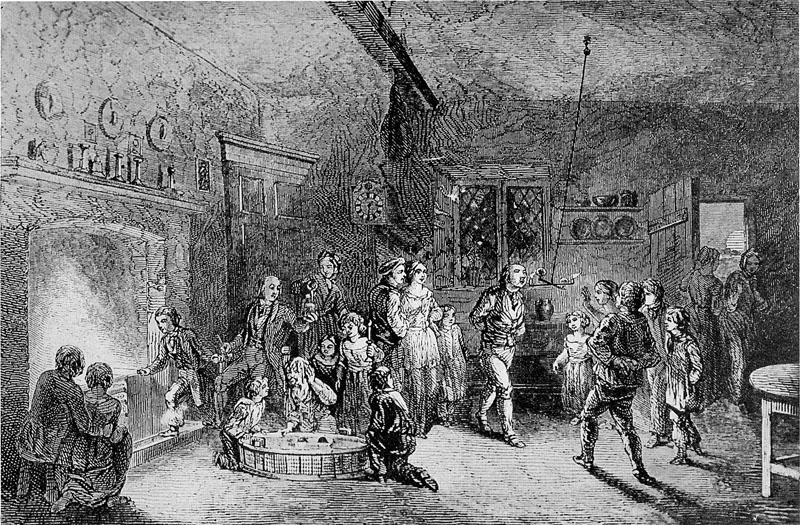
Enter the Hallows.  Most of what a New World witch can do on Halloween reflects inherited practices from the British Isles.  Because the Separatists (aka Puritans) were fiercely anti-holiday for religious reasons, the phenomenon of autumnal trick-or-treating and masked mischief didn’t really arrive in America until during the mid-19th century.  Certain pockets of Appalachian settlers—due to their Scots-Irish heritage—began holding “snap-apple” or “nutcrack” nights.  When the wave of Irish immigrants made their way to America following the potato famine in the mid-1800’s, this set of practices expanded to become a widespread phenomenon.

At this time of year, all sorts of mischief is afoot.  And all sorts of merrymaking accompanies it.  Some of the age-old practices (or at least centuries-old practices) associated with October 31st are:

Nutcrack Night – There are several divinatory rituals performed with nuts kept in the shell and placed in a fireplace which foretell of love, loss, and survival into the next year.

Snap-Apple Night – Games involving apples, such as bobbing for them or “snapping” after an apple dangled from a string using only one’s teeth, are very popular.  In some of these games, objects are hidden inside apples in order to bestow blessings on the one who manages to catch the elusive fruit.  Providing, of course, that the one catching the apple doesn’t break his or her teeth.

Guising – The practice of going out dressed in various fiendish costumes is one that shows up in many cultures.  In Halloween celebrations, the reason usually given for this is that the frightening devils, ghosts, and goblins will either be frightened by mortals dressed like them, or mistake those mortals for their own and leave them be.  This clearly taps into a major theme for the Hallows holidays:  the roving spirits, sometimes seen as the Wild Hunt (see “Roving Spirits” below)

A-Souling – The origin of trick-or-treating, going a-souling (or just souling in some places) meant traveling from house to house, singing songs or repeating rhymes in hopes of getting some sort of reward.  The most common reward was a little cake called a “soul cake.”  There is a famous song which encapsulates the practice nicely.  This practice also became part of the Christmastide celebration, in the form of caroling (see “Into the Dark” below)

Mischief-making – A nearly universal phenomenon, the idea of a holiday where good people do naughty things is quite cathartic.  Witches should understand that there is something subtler going on when the world is turned upside down and people begin acting “devilish.”  In America, we seem to appreciate this sort of phenomenon on April Fool’s Day, but less so on Halloween.  This may be because in recent years the nature of the pranks has gone from soaping shop windows and throwing streamers of paper (or toilet tissue) over trees and houses to the infamous arson found in Detroit on “Devil’s Night,” or Oct. 30th.  However, a witch playing at devilish tricks is less likely to be doing harm to his or her neighbors at this time of year, and more likely to be playing “tricks” on the natural order of things.

Ghost Stories – What would Halloween be without a good scare, right?  Ghost stories told at this time of year can be spooky, terrifying, or even rather funny.  Stories about devils, goblins, and other hellish creatures are also appropriate, as are tales of witches and witchcraft.  Telling stories about famous witches, in fact, can be a great way to combine the ancestral aspect of the holiday (as the witches of the past are spiritual ancestors if not genetic ones) and the more evocative and spooky side of Halloween.

Roving Spirits

The restless dead are fairly universal.  Many cultures have tales of vampire-or-zombie-like creatures which return from beyond the grave to wreak havoc on the living.  Still more common is the recognition that the dead come back in a less menacing form:  as ghosts or spirits to visit the living.  The living, however, often fear the dead who belong to a world that terrifies us (if only because we don’t know of many who come back from it…or so we think, more on that later).

In terms of witchcraft, however, the dead are our friends.  They are our ancestors, teachers, progenitors, and constant companions.  Any witch worth his or her blessed salt has communion with the dead—or at least spirits of some kind.

One particular group of spirits out and about on this night goes by the name of the Wild Hunt.   Fundamentally, this is the fairy court (also sometimes called the Unseelie Court or any number of other epithets) riding out into the mortal world.  The souls of the dead are being led by this party’s ride through the darkness to the point where they may cross over into the Underworld.  The problem is that the Wild Hunt isn’t exactly concerned if it gathers the souls of the dead or the souls of the living, and thus a mortal caught out by the Hunt can be in dire straits.  The tale of Tam Lin is an excellent point of reference:  the mortal Tam Lin was abducted by the Wild Hunt and must remain with them for seven years.  After that, he is to be offered up as a “tithe to Hell” by the Fairy Queen.  His lover (and the mother of his child yet unborn) saves him in a sort of reversal of the Wild Hunt, winning him back to the mortal realm

Other roving spirits may need guidance from the living on the nights of Hallows.  One of the primary traditions associated with these nights is the lighting of candles in windows to call the souls of dead ancestors home to rest and visit.  It is presumed that if they can at least get home for a while and share a little meal (see “The Dumb Supper”) they will be refreshed and able to find their way to the Underworld again.

Or so we hope…

The Dumb Supper

The famous Dumb Supper has been added to the ritual observance of many groups during the Hallows.  I attended a Wiccan-style Samhain event which featured a very moving Dumb Supper once, and the appeal was not lost on me.  The point of the Dumb Supper, at least superficially, is an act of communion with the deceased and other spirits.  This is not exactly different than a Red Meal, save that during the Dumb Supper, silence is required while the meal is served and consumed.  I’ve always understood the silence to be a method for tuning into the spiritual world around us, especially since our minds are focused on that world when we consume a communal meal.

The experience can be deeply emotional for some, as the beloved ancestors and friends who have passed on return to us and manifest themselves in order to share in our world once more.  Some people are able to hold silent conversations with the dead during this meal, and some find that the meal acts more as a prelude to spirit communication.  Either way, the Dumb Supper held at Hallows is particularly significant because beyond being a communal meal with particular ancestral spirits, the shades of all the dead are able to join in the feast.  This leads some to set apart a portion of the meal in advance for those less-than-savory ghosts and goblins that might seek to do harm to the witch or her company.  This portion is then offered as far away from the main table as possible—off her property if feasible.

There are other aspects of the Dumb Supper which are not as simple as a plate of food and a brimming cup of cider passed around in silence.  One ritual for this meal involves setting the table backwards, as well, and leaving an empty seat.  If a girl were to do this, during the course of the meal, the shade of her future husband would appear in the empty chair while they dined.  One folktale about this practice recalls how a girl performed this rite and saw her future husband, though he seemed to be in tremendous pain.  When she later met him, she knew him instantly but said nothing of the ritual.  They were married, and soon after she made a casual comment about the Dumb Supper rite she’d performed when a young girl.  The husband grew purple with rage and told her “So it was you!  I went through hell that night and back again, you foul witch!” and promptly stabbed her in the heart.   Above all things, such stories are fables about the consequences of being frivolous with magic.

Into the Dark

While the New World Witch may not find himself tied to the common “wheel of the year” associated with other denominations of magical religion, there is definitely something about Hallows that has to do with darkness and light.  The shifting tides of these forces becomes more and more apparent the further into autumn we journey each year, until it seems our whole day is but a breath between nights.  For a witch, this is a blessing in many ways:  we seem to have more liberty to be ‘oot and aboot’ in the dark of night, the moon with all its power is most easily viewed in a night sky, and it seems as though the mysterious and unknown are everywhere in the darkness.

This dark time of year is full of rituals and mischief.   From innocently childish pranks like soaping windows to the destructive fires of Detroit’s Devil’s Night, there seems to be a sense of Merry Misrule which kicks in as the daylight shrinks away from us.  The nights of Hallows are potent for this sort of behavior, not least because we also add the additional tool of disguise.  Between night and the masks, it’s no wonder a number of people simply lock their doors and don’t come out until morning during this holiday.  Which is their loss, of course.

Guising—going door to door in costume begging treats or money—has been around since at least the middle ages, and may have antecedents in ancient practices.  In Britain and parts of the American South, the practice of guising during festivals happens not just at Hallows, but Christmas as well.  Seeing as how Christmas is a fulfillment of darkness and misrule which begins at Hallows, that makes a good deal of sense to me.  Sadly, society does not like us to dress up and go door to door at Christmastime unless it’s in the form of Santa or carolers (though both are clearly connected to this practice, too).

Experiencing the dark of the year in conjunction with the rising of the dead lends a spooky air to this holiday, but inside that spookiness is a winking jester.  This is supposed to be fun, an inversion of the normal way of things where we teach our children to share and be cautious.  On Hallows, we want them dressed as monsters and ghouls, begging for candy from our neighbors, though.  And that is just as it should be.  Yes, there is certainly a place for solemnity in the darkness, but there is also a place for mirth.

Hailing the Hallows

So what might a New World witch do on Hallows that is so different from everyone else?  Quite simply, not much.  Take the kiddies trick-or-treating, indulge your sweet-tooth, attend a masked ball or party, give someone a friendly fright, and do whatever all of your non-witchy neighbors are doing.  If you wish, have a Dumb Supper and leave a candle in the window for the dead.  Go spend some time in a graveyard, leaving offerings for the dead and asking them to help you.  Do divinations with cards, shells, or whatever you like.  See if you can get your friends into it—even if you camp it up a bit, that’s okay.  It is that Merry Misrule I spoke of earlier coming out.  The dead can appreciate a good laugh, and you may be surprised how accurate your readings are if you let down the guard of seriousness which we so often keep up when working with the spirits.  Do keep some magical protection about, as some boogers are like people and have no sense of humor; it’s best to leave them be, but a little cross or star worn about the neck or a good bag of salt tied to your clothes wouldn’t hurt either.

If you absolutely must make this holiday something more dramatic than it is, I recommend looking to stories for your answers.  Read tales like “Godfather Death” or “Jack and the Devil,” and see what you can make of them.  You may come up with something worth trying, or you may just learn a new yarn to spin sometime in the future.  Share your meals and stories with the dead as best you can—leave seats and plates empty but set apart for your invisible guests, and invite them to participate in the festivities.  Play games of divination with nuts and apples, and mirrors and Ouija boards if you dare.  Sneak off to a dark corner with someone and have a little extra fun if you can, and if not, just revel in the madness of the nights of Hallows.

As a final note, Hallows is also a good time of the year for finding lost things, ferreting out thieves, and hex work, should you be so inclined to do such workings.  It is also a nice time to think about just what it means to be a witch, because you are surrounded by both the living and the dead in a very tangible way on these nights.  And a witch, above all, is someone who is of both worlds: living and dead at the same time.   What better time than Halloween to show that off?

Works Consulted (and generally just good reading):

Belk, Russell W.  “HALLOWEEN: AN EVOLVING AMERICAN CONSUMPTION RITUAL”, in Advances in Consumer Research Volume 17, pp. 508-517.

Burns, Robert.  “Halloween.”  Available online at http://www.robertburns.org/works/74.shtml.

Clar, Mimi.  “Negro Beliefs.”  Western Folklore, Vol. 18, No. 4 (Oct., 1959), pp. 332-334.

Gainer, Patrick W.  Witches, Ghosts, & Signs.  West Virginia Univ. Press, 2008.

Grimm, Jacob & Wilhelm.  The Complete Fairy Tales of the Brothers Grimm. Bantam, 2003.

Hendricks, George D. “Superstitions Collected in Denton, Texas.” Western Folklore, Vol. 15, No. 1 (Jan., 1956), pp. 1-18.

Hutton, Ronald. Stations of the Sun: A History of the Ritual Year in Britain. Oxford Paperbacks, 2001.

Milnes, Gerald C.  Signs, Cures, & Witchery. University of Tennessee Press, 2007.

Santino, Jack.  All Around the Year: Holidays & Celebrations in American Life. Univ. of Illinois Press, 1995.

—.  Halloween & Other Festivals: Life & Death. University of Tennessee Press, 1994.

Podcast Special – The Boo Hag

-SHOWNOTES FOR PODCAST SPECIAL-


Summary
This tale relates the events of a marriage that takes a turn for the worse when the husband finds out his new bride is a skin-shedding witch.

Play:

Download:  New World Witchery – Special – The Boo Hag

-Sources-
“The Boo Hag,” retold by S.E. Schlosser, in her collection Spooky North Carolina. Also available on her website.


Promos & Music
“Grifos Muertos” by Jeffery Luck Lucas, from his album What We Whisper, on Magnatune.com

Blog Post 98 – Critter Bits (Magical Animals, Part III)

So I had mentioned a couple of weeks ago that I wanted to talk a little about the use of animal parts in magic.  Animals and magic have gone hand-in-hand for a very long time.  The reading of entrails from ritually slaughtered animals has been used as a divination technique since at least the pre-Roman era.  Talismans designed to imbue the carrier with the particular power of an animal were often made from that animal’s fur, bone, or skin.  Owen Davies chronicles the frequent use of virgin parchment—a type of scroll medium made from a highly treated animal skin, usually from a creature like a lamb or goat—in the construction of ancient Near Eastern and Mediterranean grimoires (in his book appropriately entitled Grimoires).  The thought was that this particular material would endow whatever was written on it with an extra layer of power, thereby charging sigils, elevating incantations, and generally adding a little va-voom to the inscribed workings of magicians.

On North American soil, many of the old rituals and magical practices found in places like Europe and Africa took root.  Some of them changed quite a bit as they grew here, and some stayed more or less recognizable.  I thought a brief survey of the common animal curios used in witchcraft—both folklorically and practically—might be a good way of seeing the connection between critters and crafting.  Please take note now, I AM NOT ADVOCATING THE INJURY, SENSELESS SLAUGHTER, TORTURE, OR HARM OF ANY ANIMAL.  This information is for educational purposes.  If you choose to use this information in your own practice, please do so responsibly and without resorting to cruelty.  There are lots of ways to gather magical tools and ingredients from animals which are already dead (see Ms. Graveyard Dirt’s excellent site for some great examples).  Okay, now that that’s out of the way, let’s look at some of these critter bits:

1)      Rabbit’s Foot – We’ve covered this here in the podcast (on Episode #13) and the blog (in the Lucky Rabbit’s Foot entry), so I won’t spend a lot of electrons on it here.  It suffices to say that the rabbit’s foot remains one of the most popular luck charms in the canon of animal curios.  It may have significant underworld ties, and it may simply be related to speed and fertility. Whatever its originally intended meaning, it stands for good luck now, especially in gambling.

2)      Toad’s Bone/Black Cat Bone – These are some of the darkest and most disturbing of animal curios, as the rituals required to obtain them are brutal.  The Toad’s Bone is mostly found in British magical lore, and was written about extensively by Andrew Chumbley, former Magister of the Cultus Sabbati.  Scholar Ronald Hutton also details the significance of this bone to members of the Toadsmen, a secret society along the lines of Freemasonry, in his excellent history of modern witchcraft Triumph of the Moon.   This ritual artifact was obtained (at least in one version—there are multiple ways this ritual can play out, depending on what source  you look to) by burying a toad alive in an anthill and letting the ants  strip it down to the bones.  The bones are then taken to a stream and floated one by one until one bone floats agains the current.  This bone is then the magic bone, and can imbue the witch carrying it with all sorts of interesting powers from spirit summoning to invisibility.  The black cat version of this same rite is even more gruesome.  As it is recounted in Mules & Men by Zora Neale Hurston, the cat is thrown into a pot of boiling water (also alive), and cooked until all the flesh falls from the bones.  The bones are then either floated in a stream (the same as the toad’s bones) or passed under the tongue of the magician.  The magic bone in this tradition turns the user invisible, and can also be used in some powerful love spells.  Most places selling this bone today are actually selling chicken bones painted black, and hopefully few people are actually performing this ritual as it occurs in folklore.  Again, I don’t condone this rite, and present it as a curiosity of history and culture rather than a suggested magical practice.

3)      Racoon Penis Bone – This is a popular charm in hoodoo, used in luck and love magic.  The bone itself, which is usually very thin and has a curved shape, has no disturbing ritual for obtaining it, but can simply be taken from an animal killed for meat or even from a roadkill hit (though I’d suggest being very careful how you handle remains of this nature, as they can often be riddled with diseases).  Cat Yronwode suggests that this particular curio entered American magical practice by way of Native American sources, and points out that the Pawnee often placed these bones along with ears of corn into sacred bundles.  I’ve heard that in the Appalachian and Ozark Mountains, it was common for boys to give girls these bones on red thread necklaces as love tokens (though I’ve not yet found a primary source for this claim).  Raccoons are not the only animal to have this bone—or “baculum”—and in fact many mamal species have it.  Other animals like foxes and dogs also have these bones, and occasionally these will turn up in magical charms, too.

4)      Rattlesnake Rattle – Snakes in general have a lot of lore about them, but the rattlesnake is particularly of note because its rattlemakes it a unique member of its family.  The rattles themselves have been collected for years as lucky charms.  Cat Yronwode suggests uses including:

  • A charm to help musicians play well
  • A simple “Live Things in You” curse
  • A personal power token
  • A gambling charm to bring luck

Rattlesnake rattles are fairly delicate things, especially once they’ve been dessicated for use in crafts and magic.  You can occasionally find one which has been turned into a key ring or charm, but the best way to handle these is to put them in a little vial or a small box of some kind and carry that with you.

5)      Snake Fangs/Bones/Skin – As I said earlier, snakes generally have all sorts of magical connotations.  You can look back at our blog entry on them (Snakes) and find out a good bit there, but here are some highlights:

  • Fangs can be worn as necklaces or carried as tokens of protection (from snakebite in some cases)
  • The bones or skin can be powdered and added to food to cause a “Live Things in You” curse
  • The skin of a snake soaked in vinegar can be used to treat boils in the Ozark magical tradition
  • The shed skins can be powdered and added to all sorts of crossing and jinxing formulae, including goofer dust and a variant on hot foot powder

Many pet stores will happily give you any leftover snake sheds they have if you call and ask politely, and if you develop a good enough relationship, you can sometimes wrangle dead snakes and/or bones out of them, too.  Roadkilled snakes are also good, but be absolutely sure they’re dead before approaching them.

6)      Dog/Cat Hair – These curios are nice because the animals don’t have to be hurt to acquire them.  Usually black hair is used, and preferably from all-black animals.  When the two hair types are mixed together in a mojo bag or vinegar jar, they can cause people to fight “like cats and dogs.”  Black cat hair can also be used to gain good luck, and black dog hair can be used to inspire feelings of loyalty or obedience in others.  If you have a black cat or dog, you probably have plenty of this available to you on furniture, carpet, etc. (I speak from experience here).  If you don’t, you might find a friend who does and see if they will let you have some of it for use in your magical workings.  At worst, you might have to snip off a little from the animal, but thankfully that does no harm (unless it’s the middle of winter and you leave a bald patch—don’t do that).

7)      Chicken Legs/Feet/Feathers – Chickens are popular creatures for magic, mostly because they are expendable (I call them like I see them) and ubiquitous.  Black hens and their feathers are wonderful for curse-breaking, according to Cat YronwodeStarr Casas, a notable rootworker from Texas, often speaks of using chicken legs or feet during cleansing work.  Even just having chickens can be particularly magical, since they will scratch up and destroy any curses laid for you on your property.  A Pow-wow charm from John George Hohman suggests that you do the following to prevent house-fires:

Take a black chicken, in the morning or evening, cut its head off and throw it upon the ground; cut its stomach out, yet leave it altogether; then try to get a piece of a shirt which was worn by a chaste virgin during her terms, and cut out a piece as large as a common dish from that part which is bloodiest. These two things wrap up together, then try to get an egg which was laid on maunday{sic} Thursday. These three things put together in wax; then put them in a pot holding eight quarts, and bury it under the threshold of your house, with the aid of God, and as long as there remains a single stick of your house together, no conflagration will happen. If your house should happen to be on fire already in front and behind, the fire will nevertheless do no injury to you nor to your children. This is done by the power of God, and is quite certain and infallible. If fire should break out unexpectedly, then try to get a whole shirt in which your servant-maid had her terms or a sheet on which a child was born, and throw it into the fire, wrapped up in a bundle, and without saying anything. This will certainly stop it. (#114)

The chicken’s wings can also be used to make a fan which some magical folk use to direct smoke during spiritual fumigations.  So popular is this animal in magic that one of my favorite grimoires is actually called The Black Pullet (a pullet being another name for a hen).

8)      Eggs – These are often used for spiritual cleansing, across several traditions.  In Mexican folk healing (curanderismo), an egg can be used to sweep, massage, and mark a person’s body to remove the Evil Eye (mal ojo) or harmful witchcraft.  The egg can also be “read” after this process to determine things like spiritual attachments, disease, bad luck, etc.  Another Pow-wow cure with a curious resemblance to the Toad’s Bone ritual earlier mentioned directs anyone suffering from failing health to catch rain water in a pot before sunrise without speaking to anyone, boil an egg in it, poke holes in the shell, and leave the egg on an anthill to be devoured.  This will supposedly allow the ailment to be “eaten” by the ants.  Eggshells also have some magical significance.  When powdered, they become cascarilla, which is used in Afro-Caribbean magic.  Cat Yronwode also lists several really interesting spells that can be done with black hens’ eggs.  For example, boiling a black hen’s egg and feeding half to a black cat and half to a black dog while saying two people’s names will cause them to have a falling out.  There is also a rather fascinating magical detective spell that can be done by placing an egg in each of a murder victim’s hands.  After the burial, the eggs will rot and eventually burst, at which time the murderer will return and be caught.

9)      Animal Fat – This is less of a curio than an ingredient, and the different fats from different animals (often referred to as that animal’s “grease”) have distinct properties.  According to Hoodoo Herb & Root Magic, “Rattlesnake fat is a powerful ointment.  Rub it on any painful body part, or stroke the whole body downward to expel conjure poisons” (p. 162).  Ozark healers commonly used “skunk grease” to cure various rhumetoid conditions.  Vance Randolph says “The grease from skunks or civet cats, mixed with peppermint leaves, is highly praised by some hillfolk as a lubricant for rheumatic joints. It is said that the fat of a male wildcat is best of all” (OM&F, p. 108).   In Pow-wow magic, a range of animal fats is used to make a potent anti-rust treatment for firearms:

Take an ounce of bear’s fat, half an ounce of badger’s grease, half an ounce of snake’s fat, one ounce of almond oil, and a quarter of an ounce of pulverized indigo, and melt it altogether in a new vessel over a fire, stir it well, and put it afterward into some vessel. In using it, a lump as large as a common nut must be put upon a piece of woollen cloth and then rubbed on the barrel and lock of the gun, and it will keep the barrel from rusting.  (#110)

Wild animal fat has mostly gone out of use, though it can occasionally still be found, particularly in the mountain regions of America.

10)   Bear/Badger/Other Teeth – These curios are usually gambling, luck, or protection charms.  Hohman mentions the badger’s tooth as a wonderful gambling talisman.  Bear teeth appear in protective necklaces (along with claws in many cases).  One of Vance Randolph’s stories from the Ozarks recounts a man who kept a big boar’s tooth on a leather thong over his fireplace.  Whenever any of his children would get a toothache, he’d make them wear the necklace until the pain went away.  These charms are common in many places, and hardly unique to the New World (the badger is an Old World animal, after all).  Plenty of places, including the wonderful site The Bone Room, sell teeth, bones, and other animal curious for use in crafts, magical or otherwise.

I think that will end our survey for today.  There are still plenty of parts and pieces I’ve missed, including gator paws and heads, various animal skins, porcupine quills, and the myriad insect charms that could still be discussed (and hopefully will be at some future date or dates—ants alone obviously have plenty of magical uses).  If you can think of other charms, I’d love to hear them, and feel free to share your folklore regarding animal remnants and magic in the comments section!

Until next time, thanks for reading!

-Cory

Podcast Special – The Devil’s Marriage

-SHOWNOTES FOR PODCAST SPECIAL-


Summary
The story of a brother, a sister, the devil, and a helpful witch.  From the folklore of North Carolina.

Play:

Download:  New World Witchery Special – The Devils Marriage

-Sources-
Tales from Guilford County, North Carolina,” by Elsie Clews Parsons.  In The Journal of American Folklore, v. 30, no. 116, 1917.
“The Devil’s Marriage,” retold by S.E. Schlosser, in her collection Spooky South.


Promos & Music
“Grifos Muertos” by Jeffery Luck Lucas, from his album What We Whisper, on Magnatune.com

Blog Post 97 – Shop Recommendations

While we get our Etsy shop slowly up to speed (there are more products on the way soon, I promise!), I thought I’d take today to recommend a couple of sites where you can find fantastically witchy supplies.  I’ve had good, long conversations with both shop owners and found them to be incredibly knowledgeable about their products and about magic in general.  Without further ado, here they are:

Forest Grove Botanica – The store of Sarah, the Witch of Forest Grove, whom we’ve had on our show before.  Now, I’ve linked to her shop in the past, but as of yesterday, she launched her site independently, so it no longer relies on Etsy to provide transactions and listings.  And it looks like she has really been expanding her wares, too.  She’s including all sorts of wonderful products, like Witches’ Salves, herbal smokes, oils, potions, and incenses.   I’ve already placed my first order, and I’m sure I’ll be getting lots more from her in the future (especially once she gets her Art section up and running).

Alchemy Arts – This is the store I mentioned from the Chicago-land area in Podcast 17 (and which I incorrectly called “Alchemy Works,” sorry!).  I seriously spent a lot of time and money in this shop, and I wish I could have spent more of both there.  This was a phenomenal place, and the owner really knows his stuff.   If you’re in the area, stop by.  Or you can call him and he’ll help you get exactly what you need at a fair price.

If you have favorite shops you’d like to recommend, please comment and do so (if you can provide links, that’s helpful, too)!

Thanks for reading!

-Cory

Podcast 17 – Ancestors

-SHOWNOTES FOR EPISODE 17-

Summary
This episode is all about the Ancestors—who they are and why they are important.  In WitchCraft, Laine gets her hands dirty with pumpkin carving.  And in Spelled Out, Cory looks at methods of Ancestor contact.

Play:

Download:  New World Witchery – Episode 17

-Sources-
Interpreting Folk Lore, by Alan Dundes – This book has a good description of the Dumb Supper on p. 165
Ozark Magic & Folklore, by Vance Randolph – This also mentions the Dumb Supper
The Magical Power of the Saints, by Ray T. Malbrough – The source of the Ancestor Prayer Cory mentions in his segment
Witching Way of the Hollow Hill, by Robin Artisson – This book has a great description of the Red Meal
Grimoire for Modern Cunning Folk, by Peter Paddon – This one has good information on Tapping the Bone.
Alchemy Arts – The great witchy store in Chicago (which I incorrectly call “Alchemy Works” in the show)
Witchy Wearables – The great store that hosted the Podkin Super Moot
Pumpkin Bread – Recipe from Simply Recipes
Pumpkin Seeds – Recipe from Simply Recipes


Promos & Music
Title music:  “Homebound,” by Jag, from Cypress Grove Blues.  From Magnatune.
Promo 1 – Lakefront Pagan Voice
Promo 2 – Standing Stone & Garden Gate
Promo 3 – Inciting a Riot

Podcast Special – The Black Cat Murders

-SHOWNOTES FOR PODCAST SPECIAL-


Summary
A short retelling of “The Black Cat Murders” to help set the stage for Halloween!

Play:

Download:  New World Witchery Special – The Black Cat Murders

-Sources-
Witches, Ghosts, & Signs by Patrick Gainer


Promos & Music
“Grifos Muertos” by Jeffery Luck Lucas, from his album What We Whisper, on Magnatune.com

Special Episode – The Black Cat Murders

New World Witchery Special – The Black Cat Murders
A short retelling of “The Black Cat Murders” to help set the stage for Halloween! (complete shownotes at https://newworldwitchery.wordpress.com)