Podcast 7 – Weather Magic and Lore

-SHOWNOTES FOR EPISODE 7-

Summary
Today we’ll look at some weather folklore and magic.  Then, we’ll be introducing two new sections:  WitchCraft with Laine, and Magic Spelled Out with Cory.

Play:

Download:  New World Witchery – Episode 7

-Sources-
Main Topic
The Foxfire BookSpecifically the chapter on weather lore
Smoky Mountain Weather Lore – With some interesting weather folklore from the Appalachians
Buying the Wind by Richard Dorson
Grimoire for the Green Witch, by Ann Moura
Dog Predicting Earthquake – http://www.youtube.com/watch?v=1MFzcl-kZHo&feature=related
And of course, weather lore provided by our wonderful listeners!

WitchCraft
“Knitting Witchcraft” by Olivia O’Meir, in Llewellyn’s 2007 Magical Almanac
The Knitter’s Book of Yarn, by Clara Parkes
knittingdaily.com
theanticraft.com
ravelry.com

Magic Spelled Out
Earth Power, by Scott Cunningham
Encyclopedia of 5000 Spells, by Judika Iles

Promos & Music
Title music:  “Homebound,” by Jag, from Cypress Grove Blues.  From Magnatune.
WitchCraft Intro: “Down on the Farm” by Chubby Parker
Magic Spelled Out Intro: “Evil Devil Woman Blues” by Joe McCoy
Promo 1 – Witchery of One (Hooray!  Jay’s back!)
Promo 2- Pennies in the Well

Blog Post 42 – Five-finger Grass

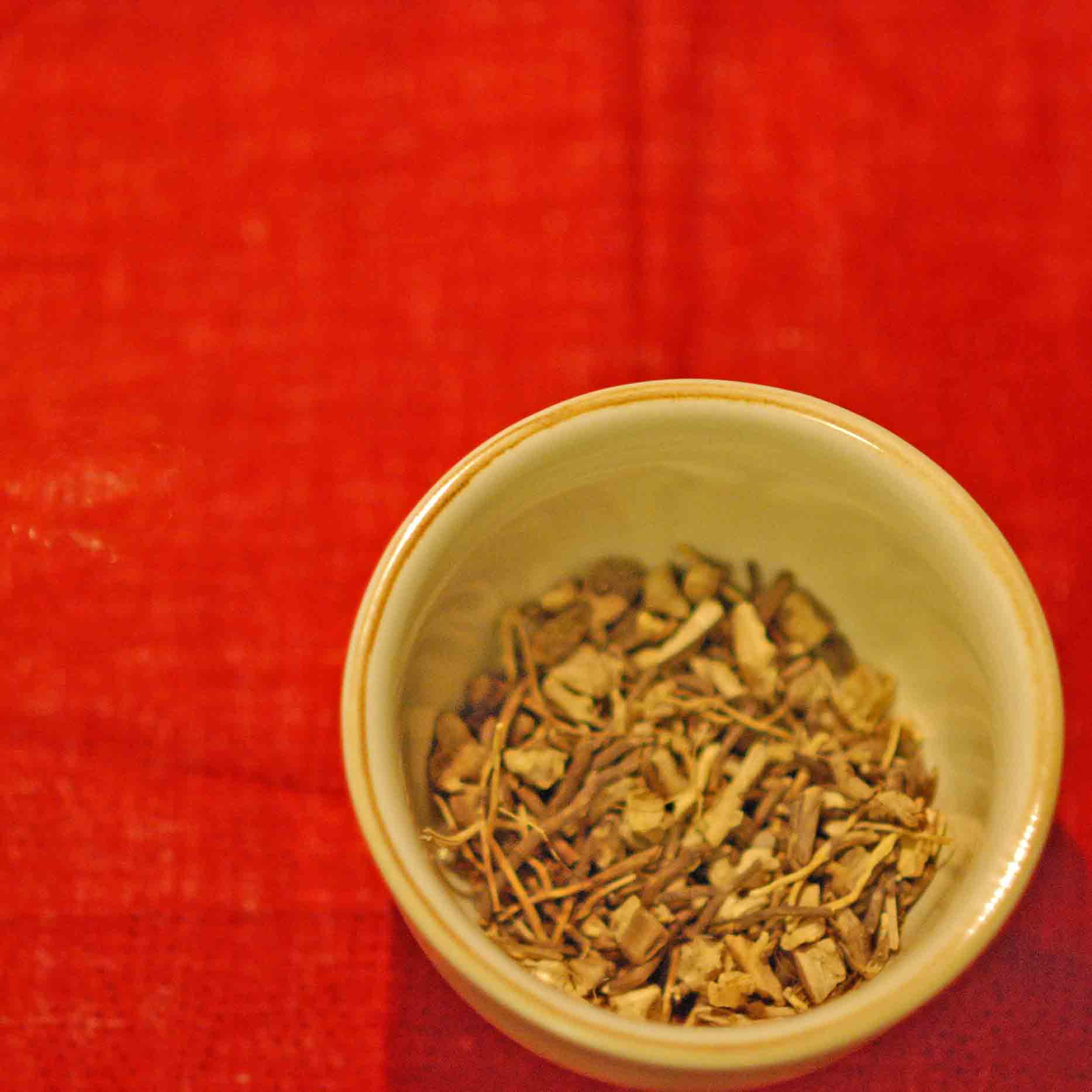
Catherine Yronwode calls this “the most popular green, leafy herb in hoodoo” (HHRM, p. 95).  It’s known by several names, including Cinquefoil and Tormentil (which is actually a particular species in the broader genus of Potentilla, which also includes Five-finger Grass).  This herb, which is not actually a grass, is one of the best to keep around.  It’s fairly easy to grow from seed, or from root cuttings as it is a rhizome.

The value of this herb has been known for a long time.  Sir Francis Bacon noted that it seemed to attract a particular type of wildlife, saying “The toad will be much under Sage, frogs will be in Cinquefoil” (The Works of Sir Francis Bacon, p. 548).  John George Hohman mentions it in his The Long Lost Friend, saying “If you call upon another to ask for a favor, take care to carry a little of the five-finger grass with you,

and you shall certainly obtain that you desired” (Hohman, #14).

This particular herb is a very positive one.  It’s used for protection because of its hand-like shape (imagine a hand held up to halt evil in its tracks), but also in love spells, money and luck workings, and even travel magic.  Here are some of the basic ways to use it:

  • Take a pinch of cinquefoil and put it behind a mirror (in the space between the mirror and its backing).  Then hang the mirror where it faces your front, or main, door.  A landlord or debt collector will be unable to force you from your home, and anyone coming to see you will be predisposed to show you kindness.
  • Carried with Comfrey Root and Lodestone in a black bag and dressed with Commanding Oil, it prevents you from getting lost in your travels (this spell is from Catherine Yronwode, HHRM, p. 95)
  • According to Judika Illes’ Encyclopedia of 5000 Spells, burning Cinquefoil as incense before bed will let you dream of your lover
  • Mixed with Deer’s Tongue and Calamus root and powdered, it can be used to dress love letters in order to encourage loving thoughts from your intended.
  • Putting a pinch of the grass in your wallet or purse will keep you lucky with your money, helping you to spend it wisely, find good bargains, and have luck when you risk it at games of chance.
  • Add it to a mojo bag with a Lucky Hand Root and an Alligator Foot or Rabbit Foot charm, then feed the bag with Hoyt’s Cologne or another lucky scent for help when you’re playing cards.
  • Made into a strong tea and used as a floor wash (or combined with another floor treatment like Chinese Wash) Five-finger Grass will remove curses put upon your household.  You can also add other protective herbs like Rue or Rosemary to help with this.

Botanical.com mentions that the herb has also had reputed healing qualities ascribed to it for quite some time.  In days of yore, it was used to heal aches and sores (esp. those which were ulcerous, such as sores in the mouth), and also to help ease coughs.  Today, they say that “the dried herb is more generally now employed, for its astringent and febrifuge properties.”

You can grow or buy this herb, and it’s definitely a good one to have around your front door (remember the protective qualities; it might even keep the Jehovah’s Witnesses away!), if there’s a sunny spot for it—it prefers full sun and does well in rock gardens.  It’s got very pretty little yellow flowers, similar to a strawberry plant’s.  However you get it, I definitely recommend having it on hand if you are going to be doing hoodoo for luck or money.  Or any number of other spells, for that matter.  I hope you’ve enjoyed this herb, and this week’s posts!

Thanks for reading!

-Cory

Blog Post 40 – Dirt Dauber Nest

With warmer days just around the bend, lots of our little insect friends are getting out and about.  One of the insects I least liked before studying hoodoo was the wasp (having wandered into a nest of them once while trying to get newborn kittens out of a barn, I feel I had some justification for my squeamishness about them).  However, hoodoo has given me a new appreciation of at least one kind of wasp:  the dirt (or mud) dauber.

This relatively harmless little black wasp (colors vary a bit, but most of the ones I’ve seen have been dark brown to black) likes to build its nests in long “pipes” from mud it gathers near puddles.  This has earned the wasp the occasional nickname of “pipe organ wasp,” and its nest is usually described as a pipe organ nest.  While the dirt dauber is a keen predator, often hunting spiders which it paralyzes and brings back to its nest for food, it seldom stings people unless provoked.  Though I don’t recommend provoking them.

However, if you can find an abandoned mud dauber nest, it’s well worth collecting it and keeping it in a sealed jar (just in case it’s not as abandoned as you thought) or plastic container.  Often, individual tubes may be abandoned and can be harvested for use as long as you’re careful not to bother any of the more active tubes.

In folk magic, these nests have all sorts of uses.  Once you’ve powdered the nest—an easy task since it crumbles readily—you can add it to hot foot workings, break-up spells, good luck hands, business drawing blends, and lots more.  Harry Middleton Hyatt lists several uses of dauber nest in his work, including:

  • Carrying around a bit of nest in your wallet or purse to draw money and luck (Vol. 2, p.1552)
  • Adding it to a vinegar jar with a couple’s name paper (names written crossing each other, of course) and red pepper and beef gall in order to break them up (Vol. 2, p. 1513)
  • Adding it to a Hot Foot working and placing it someone’s shoe to drive them off (Vol.2 , p. 1505)
  • Mixing it with Graveyard Dirt and Sugar in order to help heal a marriage (the wasps are one of the few where the male wasp stays at the nest to guard it, thus ensuring that the “family” is safe and united, which is probably why the dauber is associated with a faithful marriage) (Vol. 2, p. 1325)
  • Adding Dauber Nest to Graveyard Dirt and throwing it on train tracks to kill someone (there’s more to it than this, of course, but I’d rather not get too into that here) (Vol. 2, p. 1089)

Catherine Yronwode mentions many spells involving Dauber Nest in her book, including spells to destroy an enemy, control an errant husband, and draw new customers to a business.  This last spells involves mixing the nest with Grains of Paradise and sprinkling the powder around the business, as high as you can.  According to Yronwode, because daubers build their nests up high, it symbolizes success.

As a final bit of folklore, if you happen to have daubers building nests on your front porch, leave them there.  They will bring peace and protection to the home, and it can be fun to watch them build their nests on a summer day over a glass of iced tea.

Thanks for reading!

-Cory

Blog Post 39 – Angelica Root

Since we talked about the very masculine High John yesterday, today I thought we’d look at its feminine “counterpart,” Angelica.  The main plant bearing this name is Angelica archangelica, appropriately enough, and it has strong associations with angels and holiness.  It is often associated with the Archangel Michael, and has much of his same protective power.

Culpepper, in his medieval herbal manual, writes of this herb:  “To write a description of that which is so well known to be growing in almost every garden, I suppose is altogether needless; yet for its virtue it is of admirable use” (Culpepper 8).  This plant has been grown commonly for hundreds of years, for its medicinal, culinary, and magical properties.  It’s one of the common flavorings found in liqueurs such as Chartreuse and it has a highly aromatic quality that runs from root to leaf.

Botanical.com describes it thusly:

“The roots of the Common Angelica are long and spindle-shaped, thick and fleshy – large specimens weighing sometimes as much as three pounds – and are beset with many long, descending rootlets. The stems are stout fluted, 4 to 6 feet high and hollow. The foliage is bold and pleasing, the leaves are on long stout, hollow footstalks, often 3 feet in length, reddish purple at the much dilated, clasping bases; the blades, of a bright green colour, are much cut into, being composed of numerous small leaflets, divided into three principal groups, each of which is again subdivided into three lesser groups. The edges of the leaflets are finely toothed or serrated. The flowers, small and numerous, yellowish or greenish in colour, are grouped into large, globular umbels. They blossom in July and are succeeded by pale yellow, oblong fruits, 1/6 to a 1/4 inch in length when ripe, with membraneous edges, flattened on one side and convex on the other, which bears three prominent ribs. Both the odour and taste of the fruits are pleasantly aromatic.”

The root of the plant has potent estrogen-like compounds, which is likely one reason it has a strong connection to women.  It’s also supposed to be good for helping to break fevers and expel disease, particularly diseases of the lungs.

Magically, this plant is female, through and through.  That’s not to say men can’t use it, of course.  I bound up an Angelica root in white linen and placed it beneath our bed when my wife was pregnant to protect her and the developing baby (all turned out quite well, by the way).  But Angelica is renowned for its power to protect women and undo harmful magic.  Some of the various spells one can do with Angelica include:

  • Carrying the root to protect from harm (in general)
  • Women can carry the root, along with a picture of St. Michael the Archangel, to protect from unwanted advances (or worse) from men
  • Dress Angelica root with Blessing oil (or just olive oil over which prayers have been said, such as Psalm 23) in order to protect a newborn baby (place the anointed root in a white cloth under the baby’s bed).
  • Ground Angelica root can be mixed with salt and another protective herb, like rue, rosemary, or sulfur (not an herb, I know, but I think you follow me) and kept in a small white mojo bag to guard against hexes.  Alternatively, the mixture can be sprinkled across doorways or mixed into an Uncrossing floor wash to remove jinxes placed on one’s household.
  • A strong tisane (or tea) of the root can be made and used to sprinkle a new home or a home where negative spiritual activity has occurred in order to make the home calm and peaceful.

Additionally, Cathreine Yronwode mentions that “Angelica stem candied in sugar is an old fashioned treat said to keep children healthy” and that “When buying Angelica, be aware that its occasional alternate name Masterwort more truly belongs to Imperatoria ostruthium…Also, Hercules Club, a plant in the Aralia family, is called Angelica Tree by some, but is not related to Angelica” (Yronwode 30).

Thanks for reading!

-Cory

Blog Post 37 – Some Weekend Reading

Howdy everyone!

I thought that I’d finish up this week with another essay, this time one that I won’t actually be posting on the New World Witchery site.  Instead, I’m going to provide a link to an excellent essay I found on Pow-wow magic, and then some notes I made while reading it.

The essay itself is written by David W. Kriebel, Ph.D.  and has a distinctly academic tone.  It focuses on the history and practice of braucherei in the Pennsylvania area, as well as examining some modern practitioners (most notably Don Yoder and Silver Ravenwolf (aka Jenine Trayer).  It’s an interesting read, I think, but I’ll let you decide for yourself.

Here’s the essay:  http://www.esoteric.msu.edu/VolumeIV/Powwow.htm

Some of the thoughts I had while reading this were:

  • Why is Pow-wow fading from the magical stage so steadily?  Many spiritual and magical traditions have received increased attention in the past 30-40 years as the shiny patina of atomic-age wonder has begun to fade, yet Pow-wow still seems to be on the decline.
  • Is Pow-wow evolving into something else altogether?  Kriebel mentions Ravenwolf’s book, which has had a mixed reception at best in the magical community.  But her version of Pow-wow may just be where the practice is headed.  Is that a good thing, a bad thing, or just a thing, period?
  • The old books of Pow-wow, such as The Long Lost Friend and the Sixth and Seventh Books of Moses, get a good bit of attention in this essay.  How relevant are they to the current practice of this magical system?
  • I love the story about Mountain Mary.  It makes me wonder just how many of my local folk heroes might have been magically inclined.
  • The three levels of magical ritual (I, II, and III) which Kriebel mentions correspond well to various practices I’ve seen elsewhere (a simple charm from Hohman might be a I or a II, while Chris Bilardi’s complete brauche circuit in The Red Church is more of a III, I think).  I wonder if the idea presented here about Pow-wow would hold true for other magical systems, like hoodoo.
  • One of the best things I come away with from this essay is in his conclusion, where he notes a 90% effectiveness rating for Pow-wow curing, which is remarkably good for any healing practice.  In the end, I think that kind of a result defies any attempts to explain magic as pure superstition, but I may be wrong.  What do you think?

That’s it for this week!  Have a great weekend, and as always, thanks for reading!

-Cory

Podcast 6 – Hoodoo and an Interview with Conjure-man Papa Toad Bone

-SHOWNOTES FOR EPISODE 6-

Summary
In this episode, we discuss hoodoo and rootwork, particularly our experiences with it.  Then we have an interview with esteemed conjurer Papa Toad Bone.

Play:

Download:  New World Witchery – Episode 6

-Sources-

Websites
Lucky Mojo Co. – A site with lots of hoodoo information
Toad’s Bone Apotheca – Our guest’s marvelously funky and fantastic online curio shop
Mississippi Cunning + Conjure – A forum space for those interested in Southern magic and Traditional sorcery
Scarespite – A repository of Traditional Witchcraft and Sorcerous folklore

Promos & Music

Title music:  “Homebound,” by Jag, from Cypress Grove Blues.  From Magnatune.
Promo 1-Inciting a Riot Podcast
Promo 2- Druidcast
Promo 3- Podcast Appalachia

Podcast Special – Witch Bottles

-SHOWNOTES FOR SPECIAL – WITCH BOTTLES-

Summary
This is the first of (hopefully) many mini-episode specials in which we’ll explore particular practical topics in American Witchcraft.  Today, we’re looking at the history, lore, and making of Witch Bottles.  Plus we’ll share our own experiences with them.

Play:

Download:  New World Witchery – Podcast Special – Witch Bottles

-Sources-
*The Wikipedia entry on “witch bottles.”
*Apotropaios – An excellent site with scholarly history of many occult objects, including Witch Bottles.
*The Lucky Mojo page on “Bottle Spells” has lots of great information on the various kinds of magical bottle workings done around the world.
*The Appalachian History blog has an excellent entry on “Bottle Trees.”
*The Encyclopedia of Witches and Witchcraft, by Rosemary Ellen Guiley, has a good article on “witch bottles.”
*The Encyclopedia of 5000 Spells, by Judika Illes, is another tome with lots of magical information, including some on Witch Bottles.

Music
“Grifos Muertos” by Jeffery Luck Lucas, from his album What We Whisper, on Magnatune.com

Blog Post 26 – Gravel Root/Joe Pye Weed

Today I’d like to discuss an ingredient found in both Native American medicinal practices and Southern conjure and root work.  The flowering herb known as both Gravel Root and Joe Pye Weed can be found throughout most of the eastern half of North America, including portions of Canada, Texas, and Florida.  Its botanical name is Eupatorium purpureum, and it is also sometimes known as Purple Boneset or Queen of the Meadow.

The story behind Joe Pye Weed stems back to a Native American named, aptly enough, Joe Pye, who used the root to heal typhus.  It’s been used in tisane form—both root and flower—to help with kidney problems (though I will recommend here that if you are considering drinking ANY tea made from an herb to consult with a health professional and be SURE you know what you’re drinking).  Foxfire 11 gives some good information on the traditional medicinal use of this wild herb.

The plant itself is often found as a wildflower in fields and “waste” spaces like construction zones (though it doesn’t last as long here).  It’s a perennial so if you cultivate it instead of wildcrafting you should see it coming back regularly.  Joe Pye can reach heights around four feet, so take that into account when planting it.  It can also reseed, so you might want to thin them occasionally.  It has flowers which range from white to pinkish to lavender and purple, and butterflies love it.

Its magical uses tend to be split depending on what part of the plant you’re using.  The leaves and flowers are considered “Queen of the Meadow,” and are not particularly used in traditional hoodoo, though I’ve seen it show up in a spell for success.  Catherine Yronwode mentions putting the flowers in a glass of water next to a burning candle to attract spirits and visions.  The root, which is often the most sought-after part of the plant, is a fantastic help in job-search, success, and luck magic.  I recently used a bit of Gravel Root in a mojo hand along with High John and a copy of Psalm 65 in order to help procure some magical aid with an academic pursuit, which turned out very well.

Joe Pye Root

You can find more on this herb/root in Catherine Yronwode’s Hoodoo Herb and Root Magic, as well as the websites listed below.

Thanks for reading!

-Cory

More information:

Medicinal and identification information – http://www.altnature.com/gallery/joe_pye_weed.htm

Cultivation and propagation information – http://oldfashionedliving.com/joe-pye-weed.html

Folklore and Appalachian history – http://appalachianhistory.blogspot.com/2007/08/queen-of-meadow-cures-all.html

Blog Post 24 – Book Review

Hello everyone,

So today I’d like to offer a review of a book I’ve cited several times on the blog already, Richard Dorson’s Buying the Wind.  It’s a book of folklore divided by region and focusing on the different stories, beliefs, and practices of those who inhabit those regions.  The regions he covers are broken down as follows:

  • Maine Down-Easters
  • Pennsylvania Dutchmen
  • Southern Mountaineers
  • Louisiana Cajuns
  • Illinois Egyptians
  • Southwest Mexicans
  • Utah Mormons

Each section then goes into further detail regarding the specific folklore of the regional group examined.  For example, under Southwest Mexicans, there is a section called “Proverbios” which contains the bits of folk wisdom like:

Dar atole con el dedo.

“To give gruel with the finger.”  (To deceive with words or acts, especially to deceive one’s husband).

Entre menos burros, mas olotes.

“The fewer donkeys, the more cobs.”  (The fewer, the better…corncobs, dried as well as green, are given burros to eat).

And under Louisiana Cajuns, in the section “Riddles,” we find:

What has a tongue and does not speak?  A shoe

What has teeth but does not bite?  A comb

If a man can lift two hundred and fifty barrels of rice when it is not raining, what can he lift during a rain?  An umbrella

Each section has its own unique attributes.  Some have the songs and proverbs of their region, some have stories and even some loose versions of “spells.”  I say loose because they aren’t exactly how-to’s on spellcraft, but provide some information that could be turned into a how-to pretty easily.  For example, the Louisiana Cajuns section has information on Hoodoo, including a tale from one informant who described a luck mojo bag that “was a little bag of linen and it had like nerves and then bones.”  The nerves are from a vulture, and the bones from a snake, which both could be used in a lucky mojo hand (though I’ve never heard of nerves being used, per se, but that’s what makes these accounts so interesting—their variety).

The entire book is loaded with bits of magic like this, as well as stories of witchcraft and magic which, while more fanciful, give insight into what the occult practices of those areas might be.  In the Southern Mountaineers section, for instance, there’s an interesting account of a “witch-ball,” which is a bit of hair, wax, and other substances rolled into a ball and “shot” at a victim to curse them.  I’ve seen similar stories in other books of American folklore, especially based in the Appalachian areas, so it’s interesting to me to see how prominent such a magical tool seems to be in that area, though it is largely forgotten elsewhere.

I learned a great deal from this book—the entire section on Illinois Egyptians, for example, was a revelation to me, and has opened up a whole new area of interest for me regarding New World Witchery.  And the stories, songs, and proverbs are fantastic!  I can’t get enough of the Southern “Jack” tales!

I should point out that Dorson uses the Aarne-Thompson system of folklore classification, which divides tales into various types for ease of cross-referencing.  It is definitely a book aimed at folklorists and not particularly at a wide audience, but I think anyone can get a great deal from reading it.  And it may open up a whole new love of folklore as a field of study for some folks.

I’ve been reading a borrowed copy from my public library, and it’s just about due to go back there, which was going to be a sad loss, as I still find myself referencing Buying the Wind frequently.  But thanks to a generous donation from reader/listener Amber (many, many thanks to her!), we’ll be able to procure a copy for future reference now.  So hooray for Amber!

That’s all for now!  Thanks for reading!

-Cory

Blog Post 21– Final Call for Contest Entries!

Hi everyone!

Only a little less than three days left in our first-ever contest!  We’re giving a copy of Cat Yronwode’s Hoodoo Root & Herb Magic to one randomly chosen reader/listener who provides us with a little bit of weather folk lore from his or her family or region.  All you have to do is email us or leave a comment on Blog Post 10 – Weather Work with your general area (you can say “South” or “East Coast” if you like) and a tidbit about what folks say about the weather in your neck of the woods.  The deadline is February 28th at midnight, Central Time, so please get your submissions in before then.  We’ll be using these entries for a podcast on weather magic and folklore, so please write in!

Good luck!

Thanks for reading!

-Cory