Blog Post 155 – Radiolab and Robert Johnson at the Crossroads

Hi all!

I know this isn’t the botanical lore I was promising for the month of April, but don’t worry, there’s more of that coming. I just had to share something that my very dear and wonderful friend Kathleen alerted me to. One of my favorite non-magical podcasts in the world, Radiolab, just did a really interesting mini-show on a topic which intersects with our work here!

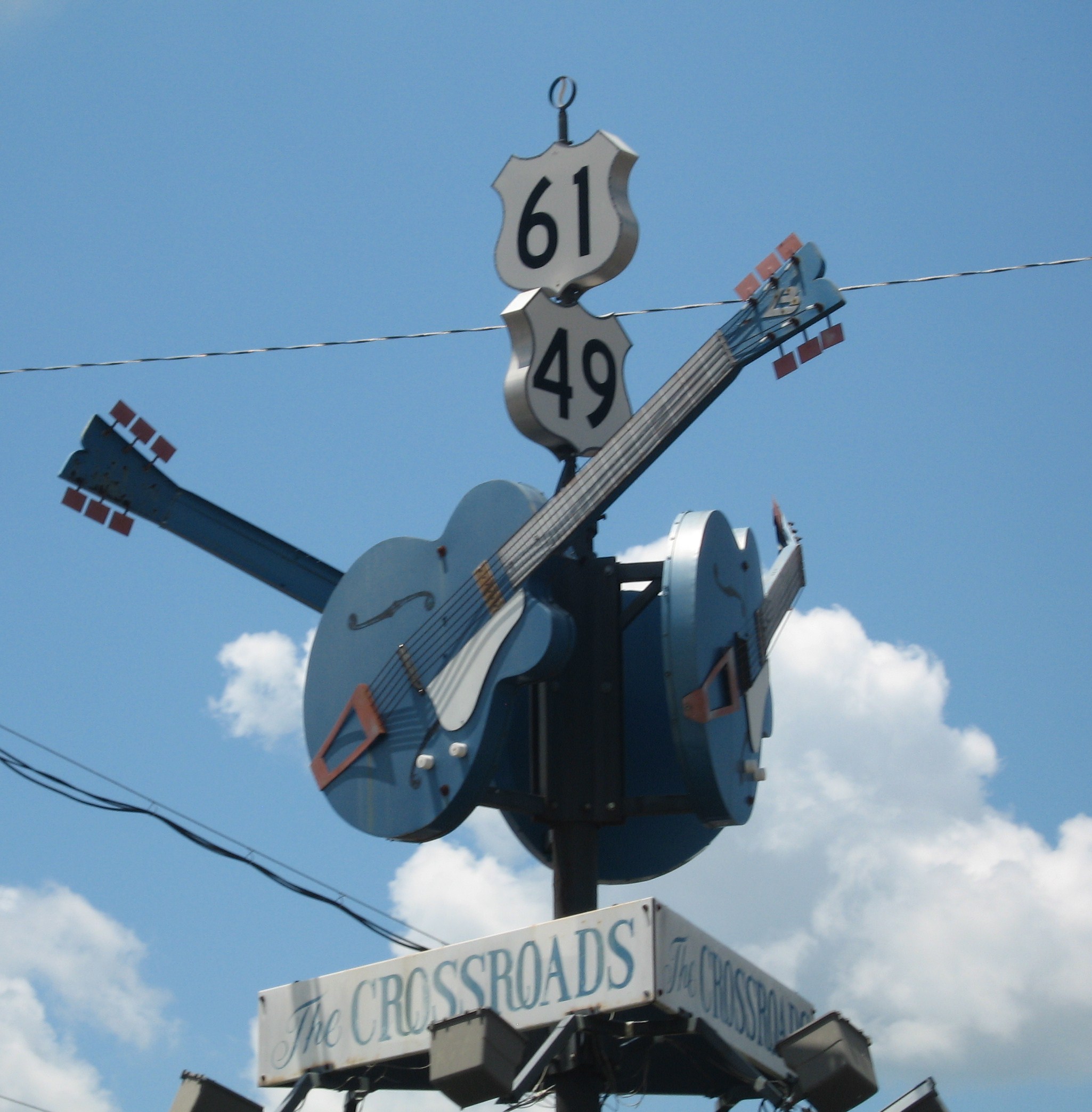
Please hop over and check out the 30 minute Radiolab short on the Crossroads, specifically the tangled crossroads legend surrounding blues players Robert Johnson (to whom the myth of selling his soul to become a great blues player is frequently ascribed) and Tommy Johnson (who may actually have done the crossroads ritual). There are fantastic interviews with music historians, blues experts, and even Tommy Johnson’s brother, all of which help shed light on the strange and gorgeous African American folk tale about gaining new power at the crossroads.

I should point out that they come at this from a scientific and historical perspective, and really are pursuing the true story about the musicians rather than doing much to get at the folkloric roots of the crossroads phenomenon. They specifically wind up ignoring the existence of the story in other African American literary and folklore sources, such as these:

  • The multiple incidents of crossoroads conjure recorded by Harry M. Hyatt between 1935-1939 (found at the bottom of the Lucky Mojo page linked above), which would have pre-dated the “creation” of this story as described in the Radiolab short
  • The numerous incidences of crossroads as places of healing, particularly trading things like a wart or a sty to a mysterious stranger, in Southern and African American folklore (which can be found in Hyatt’s work, the work of Vance Randolph, and Newbell Niles Puckett).
  • Puckett’s description of the crossroads ritual as an origin for folk hero Jack, which was published in 1926 and states:

Various legends are in vogue among the Negroes to account for the origin of this creature.  One illustrating the common theme, was told me by a root-doctor last summer.  Jack sold himself to the devil at the crossroads one night at twelve o’clock. For seven years all power was given to him to do as he pleased, but at the end of that period his soul belonged to the devil. [This eventually goes on to tell the story of Jack-o-Lantern, but the crossroads portion of it is given here as illustration of my particular point]

  • Zora Neale Hurston’s 1931 article on African American folk magic, which has the following item in it:

How to Have a Slick Hand with People.

On the dark moon of any Friday night, dress yourself in black. Sit flat in the fork of a cross road at exactly twelve o’clock and sell yourself out to the devil. After which you shall have power to do anything you wish to do (“Hoodoo in America,” 392)

  • The appearance of crossroads in European folk magic (such as that found in Charles Leland’s Gypsy Sorcery & Fortune-telling, published in 1891, long before the legends being described in the blues tales)

There are so many other appearances of crossroads in folklore that it would be daunting to tackle them here (though I will probably try to do a bigger article on them some day). My real point is just to say that while I love the Radiolab story, they definitely overlooked a large amount of crossroads material so that they could focus more on the story of two real blues musicians, which is understandable.

I really do hope you’ll give this particular show a listen. It’s great, especially in its ability to untangle the two legends from one another, and you get to hear some really hauntingly good blues, too.  Let me know what you think of it!

All the best, thanks for reading, and see you down at the crossroads…

-Cory

Blog Post 154 – Buckeyes

I imagine that I’ll get a sharp increase in visitors from Ohio with this article. Today’s featured botanical is the buckeye, which is both the name of the tree and the fruit (or nut) of that tree. It grows in a wide variety of locations, including all over Europe and North America, and is also frequently referred to as a “horse chestnut” (which is actually a very specific species within the bigger buckeye family). Since you can find a great deal of botanical information on the tree elsewhere (like at the USDA Plants database), I’ll narrow my focus here to the folklore and magical uses of the nut.

T.F. Thiselton-Dyer, author of the botanical mythography classic The Folk-lore of Plants, makes the following observations about the horse-chestnut:

“A Worcestershire name for a horse-chestnut is the ‘oblionker tree.’ According to a correspondent of Notes and Queries (5th Ser. x. 177), in the autumn, when the chestnuts are falling from their trunks, boys thread them on string and play a ‘cob-nut’ game with them. When the striker is taking aim, and preparing for a shot at his adversary’s nut, he says:—

‘Oblionker!

My first conker (conquer).’

The word oblionker apparently being a meaningless invention to rhyme with the word conquer, which has by degrees become applied to the fruit itself.” (CH XVIII)

Already I love this plant, don’t you? Essentially they seem to be used as marbles in children’s games (give them one point for that), and they also have a nice phonetic connection to the powerful hoodoo charm, John the Conqueror root, which is frequently called John de Conker (and that’s another point to the buckeye!). They actually look llike smoother versions of High John roots in some ways, so it doesn’t surprise me to find that they sometimes get substituted in for their powerful underground counterpart:

“Buckeye nuts are believed by some hoodoo “doctors” to increase a man’s sexual power. Shaped like miniature testicles, they are sometimes carried in the pants pockets as charms to bring men “good fortune in sexual matters.” In the southern and eastern regions of the United States, buckeyes are carried in mojo bags to cure or prevent such ailments as arthritis, rheumatism, and migraine headaches” (Gerina Dunwich, Herbal Magic, 86).

Cat Yronwode similarly cites buckeyes as charms for increasing male potency. Both Yronwode and Dunwitch, however, make it clear that a buckeye’s primary powers are to aid as a gambling charm and to help stave off aches and pains—particularly rheumatism and headaches. This view is heavily supported by a number of folklore sources:

From Newbell Niles Puckett, Folk Beliefs of the Southern Negro

  • Where the left hind foot of a graveyard rabbit, a buckeye, a horse chestnut, and a luck bone from a pig ham are put together for good luck [A charm for good luck] (316)
  • A buckeye carried in the pocket will surely bring one good luck (314)
  • A buckeye carried in the left pocket is generally supposed to work a cure for rheumatism as well as for piles, a belief apparently English (360)
  • Red pepper rubbed up and down the back ‘warms up de system,’ as does also a new domestic sack half full of salt into which nine grains of red pepper and four buckeyes have been put. Wear this around your waist and you will never again be bothered with chills (366)
  • In Mississippi and Alabama it is believed that if one carries buckeyes in the pocket he will have no chills through the year (366)

From Harry M. Hyatt, Folklore of Adams Co., Illinois

  • 1328. “My brother always carries a buckeye in his pocket to get money.” (28)
  • 1329. “I always carry three buckeyes in my pocket to always have money. My grandfather did this through the Civil War, my mother did this, and I am carrying three buckeyes too.” (28)
  • 4534. The person who carries a buckeye in the pocket never becomes sick. (99)
  • 4688. The person who carries a buckeye in the pocket never suffers from backache. (103)
  • 5233. A buckeye carried in your pocket or the band of your hat prevents headache. (118)
  • 5588. As a treatment for piles, a buckeye is worn: in the pocket (usually the left), or one in each pocket, or one pinned to the underclothes, or one round the neck, or one rolled in the top of each stocking. (126)
  • 5684. One buckeye is worn in one of several places as a rheumatism remedy: about the neck, on the breast, in a pocket (especially a hip pocket), round the waist, and under the bend of the knee.  Sometimes, they say buckeyes are ineffective for rheumatism, unless you begin by using an unripe one. Moreover, it is occasionally said, to lose this nut in the process of curing yourself brings bad luck. And finally, because a buckeye is also called a horse chestnut, the real chestnut is worn as a substitute, but this seems to be rare. (129)
  • 5685. Buckeyes used for curing rheumatism should always be carried in pairs. This also makes you lucky at the same time. (129)
  • 5686. “If you carry three buckeyes in a sack so they will be on your skin, good for rheumatism; if the buckeyes dry all up when wearing, then they are doing you good; but if they don’t dry all up, they are doing you no good.” (129)
  • 11073. It is lucky to keep a buckeye in your purse, on your person, or in your house. (262)
  • 13443. Keep a buckeye in your pocket while playing baseball and you will have good luck. (310)
  • 13984. You obtain good luck for a card game, if a buckeye is worn in your right pocket. (319)

From Daniel & Lucy Thomas, Kentucky Superstitions:

  • 1224 – One subject to a headache may prevent it by carrying a buckeye in his pocket (105)
  • 1288 – Carry a horse chestnut [another name for a buckeye] in the pocket, to avert piles (110)
  • 1299 – To avert rheumatism, carry a horse-chestnut in the pocket (111)
  • 2887 – You will have good luck if you carry a horse-chestnut (219)

Kentucky Superstitions also has this rather fantastic bit of lore about the good ole horse-chestnut:

  • 2889 – If one eats a buckeye, his head will turn around (219)

Vance Randolph devotes a sizeable amount of space to the folklore of buckeyes among the hillfolk of the Ozarks, also pointing out their strong associations with healing and protection from painful diseases. He relates an excellent story about just how deeply ingrained the belief in buckeye powers was in the mountains:

There is an old saying that no man was ever found dead with a buckeye in his pocket, but this is not to be taken seriously. Most people who carry buckeyes regard them as a protection against rheumatism, or hemorrhoids. One of the most successful physicians in southwest Missouri always carries a buckeye ; when it was mislaid once he was very much disturbed and let an officeful of patients wait until his pocket piece was recovered. It is very bad luck to lose a buckeye. I asked this doctor about it once. “No, I’m not superstitious,” he said grinning, “I just don’t want to get the rheumatism!” (Ozark Magic & Folklore, 153)

There is some excellent lore about the buckeye and just why it became the namesake for Ohio from the Ohio Department of Natural Resources website. They mention the lucky association, likening it to a four-leaf clover or rabbit’s foot, and links the state nickname to William Henry Harrison or alternatively to Col. Ebenezer Sproat (a simply fantastic name), both Ohioans of historic and heroic stature.

Probably my favorite bit of folklore concerning the lovely horse-chestnut comes from an online forum I found while researching this topic. You can read the full thread here, but I simply cannot fail to mention this fantastic tidbit:

There is a belief by some that only half the buckeye is poisonous, and that only squirrels know which half that might be in a particular nut. Squirrels do sometimes eat a part of the nut.

There you have it: squirrels are smarter than we are. But I’ve known that for a while (at least in my case it’s true).

At any rate, the buckeye can be carried as a lucky charm or worked into other magical preparations, and it has a huge body of lore associated with it. So much, in fact, that I’ve barely (prepare for pun) cracked the shell here. If you know of great buckeye lore and magic, I’d love to hear about it! Or if you just want to pelt me with horse-chestnuts for making bad puns, I’ll be here all day.

Thanks for reading!

-Cory

Blog Post 153 – American Ginseng

Hello dedicated (and not abandoned!) readers!

This month, I’m going to be spending a lot of time looking at various botanicals found throughout North American magical practice. What with it being springtime and all, I thought a little stroll through our native meadows, forests, fields, and fens would be a good way to get back in the swing of things, and might even open up some new avenues of exploration for somebody. As always let me emphasize that THIS IS NOT A  MEDICAL BLOG, AND THE INFORMATION HERE IS NOT INTENDED TO DIAGNOSE, TREAT, OR OTHERWISE MEDICALLY PROVIDE FOR ANY ILLNESS OR AILMENT. ALL INFORMATION IS PROVIDED AS FOLKLORE ONLY!!!

I’m starting with a plant that may or may not be familiar to most people: American Ginseng (panax quinquefolia).  This plant can be found throughout the mountainous regions of North America ranging from Canada down to the Southern states. It’s long been highly valued in Chinese medicine, and has been considered a panacea (hence its botanical Latinate name of panax) for a wide variety of complaints. You can read a good bit about the botanical and medical side of the plant at its Botanical.com entry, so I’ll focus today more on the folklore side of this incredibly useful root.

When I was growing up in the rural South, I had a good friend in high school whose father would regularly take him ginseng hunting (or “sanging”) in the hills and mountain areas a few hours away. It was a profitable side business for them, as it has been for mountain folk for nearly three centuries. In the Foxfire Book #3, which includes a whole chapter dedicated to ginseng, there’s a history dating back to the early 18th century in which Father Joseph Lafitau had local Mowhawk tribes in Canada begin gathering and curing native ginseng for sale on the Chinese market (244). At one point, ginseng was reputed to be worth its weight in gold, literally. Jude’s Herbal Home Remedies includes this tidbit about the economic value of the root: “Even Daniel Boone gathered it [ginseng] to sell because it was more profitable than hunting and trapping” (18). Unfortunately this demand led to an overzealous glut of wild harvesting, and ginseng’s botanical population dwindled steadily into the early 20th century. It’s made something of a comeback in the last 50-60 years due to stricter laws governing its harvesting, but as my story about my friend’s family demonstrates, it’s still a very common practice and hard to regulate.

Mountain communities have long known the curative and tonic value of ginseng root. Looking again to Foxfire #3, we find the following:

“The early colonists not only gathered ginseng for sale, but used it in tea to encourage the appetite or strengthen the digestion, especially of elderly persons or puny children. Ginseng plus black cherry and yellowroot made a potent tonic, especially with the addition of some home made whiskey. An early herbal suggested gathering ginseng root and steeping it with chamomile flowers for fainting females” (247)

Its primary powers are to enhance male vigor, and its described as a potent aphrodisiac in a number of sources. This may be due to either its stimulant effect on the circulatory system or the distinctively humanoid shape of the root (a factor which has earned aphrodisiac and potentcy attributions for other roots like mandrake and ginger). Preparations vary from chewing slices of the fresh root to brewing teas to even more unorthodox decoctions. One informant’s method:

“‘You can take the roots that are dry and take a sausage mill or something and grind’em up and drop a pretty good little handful down into your vial of conversation juice [moonshine]. Take this ginseng and liquor and pour out just a small little amount of that ina teacup and set it afire. Strike a match to it, you know, and it’ll burn. And I mean burn it good. And then turn it up and drink it. It’s an awful bitter dose to swallow, but if it don’t do you some good you better get to a doctor and pretty durn fast. It really is good for that [male vigor]. And it’s also good for female disorders. Very good, they tell me, for that’”(Foxfire #3 250-1)

In one example I found, the act of finding ginseng has its own value. From Folk Medicine in Southern Appalachia: “For some, the pursuit of ‘sang’ and other herbs is a therapeutic activity in itself. A ninety-year-old woman from eastern Tennessee said: ‘When I feel down in the dumps, I go sangin’” (60).

Therapeutic uses of ginseng in modern preparations reflect its historical value. Jude’s Herbal Home Remedies recommends it as a tonic and aphrodisiac, and gives this recipe for a male tonic:

“TONIC FOR MEN: Mix ½ ounce each of ginseng, shepherd’s purse, corn silk and parsley. Mix well and add 1 teaspoon of the mixture to 1 cup of boiling water. Let steep 15 minutes, covered. Strain and sweeten if desired. Drink several cups per day for 1 week. This helps to tone up the male reproductive organs. The stimulation to the prostate is helpful to all parts of the system” (120)

It also considers ginseng one of the great coffee subsitutes available in the wild. It is still considered a great digestive aid, as well. The folklore tome Kentucky Superstitions calls it “A sure remedy for all kinds of stomach trouble” (107).

In the folk magical realm, ginseng again parallels its medicinal uses, as well as adding a few new tricks to its repertoire. Cat Yronwode describes a recipe for soaking a ginseng root in Holy Oil which can then be used to anoint the male genetalia to enhance sexual performance. She also mentions it’s a key component of an old-timey gambling mojo, too. The root seems to have made its way into curanderismo practice as well, as the Curious Curandera lists the following uses for it: “Love, wishes, protection, luck, spirit communication, visions, divination, male vigor, gambling luck, to control another.” And Judika Illes, in her oft-recommended tome The Encylopedia of 5000 Spells, gives a number of great magical applications for ginseng root:

  • Tie a red thread around a ginseng root and carry with you for beauty and grace (1026)
  • Wrapping the first dollar earned at a new business around a ginseng root w/ red thread will help improve income (167)
  • Mentions its name as “Wonder of the World root,” and tells how it can be used in hoodoo to enhance longevity, libido, & performance in sexual situations (527). Also says you can carve a wish on a whole root & toss it into running water to gain what you desire (763).
  • Can be burned to break curses (598)

This incredibly verstatile root definitely has a place in a folk magician’s cupboard, though I would recommend acquiring it from legal sources. While I’m normally an advocate of wild harvesting roots for practice, in ginseng’s case three centuries of such harvesting have taken a toll, and since it grows well in cultivation I’d rather see the wild stocks remain alive and untouched for a long time to come.

If you have experience with ginseng or know of any unique magical applications for it, I’d love to hear them! Until next time, thanks for reading!

-Cory

Podcast 37 – The Audio Spellbook

-SHOWNOTES FOR EPISODE 36

Summary
This is our long-in-the-making audio spellbook episode! Listener contributions abound, as well as a few spells from your New World Witchery Hosts. Plus we announce the contest winners from our Speak-a-Spell giveaway.

Play:

Download: New World WItchery – Episode 37

-Sources-
All the spells come from listeners this time. Here’s a list of what you can hear:

1. Odom of the Evil Eye – Gambling Charm
2. Baron Chatdelamort – Chicken Foot Spell
3. Cory Hutcheson – Academic Crown of Success Mojo
4. Leathra (read by Laine) – Safe Travel Spell
5. Scarlet Page – Employment Spell
6. Nashoba – Cicada Creativity Charm
7. Jaina (read by Laine) – Prosperity Spell
8. Leathra (read by Cory) – Lost Object Teacup Spell
9. Ro – Matchbox Spell
10. Jessica – Warding and Protection Spell
11. Bev (read by Cory) – Coral Anti-Negativity Spell
12. Mama Fortuna – Cleansing Ritual Bath
13. Cory Hutcheson – Feet Water Charm
14. Cedar – Socializing Spell
15. Laine – Get a Job! Spell
16. Cory Hutcheson – Addled Brain Curse
17. John from MN – Icelandic Staves Curse

Here’s the photo from John’s Icelandic Staves spell:

Congratulations to our contest winners!

Don’t forget to follow us at Twitter!

Promos & Music

Title music:  “Homebound,” by Jag, from Cypress Grove Blues.  From Magnatune.

Additional Music from Musicalley.com (all podsafe):

1. Armand van Helden – “Witch Doctor”
2. Michael & Spider – “Enchanted”
3. Dreamline – “The Day the World Stood Still”
4. Todd Parker & the Witches – “Greetings from the Star Chamber”
5. Witcher – “Astral Phantasm”
6. Clouseaux – “Jungle Witch”
7. Witcher – “Kuin Metsaan Huuta”

Blog Post 145 – Wart Charming

The image of the fairy-tale witch often comes complete with a big, nasty wart perched at the end of her nose. The association of witches with warts could come from a variety of folk beliefs and superstitions: the close ties between warty toads and witches, the idea of a ‘devil’s mark’ which the witch uses to suckle her familiar, or even just a desire to make a something ugly out of something ‘evil.’ The association is not always a purely negative one, however. Folk magicians in the New World (as well as those in the old, though I’ll not be addressing them here) have a long-standing history of curing warts through magical means. In fact, that is frequently one of the most commonly found magical services provided by a community magician (or faith-healer, traiteur, pow-wow, etc.).

Today I thought it would be good to look at a few different methods, stories, and charms associated with wart-removal in American folk magic. I’d like to start in Pennsyvlania-Dutch country, with some of the wart charms found in Chris Bilardi’s The Red Church:

WARTS, CORNS (GEWECKS, GEWEX, WARZ)

[Do whole body Brauche treatment to eliminate any root causes of warts. Bilardi then gives an extensive treatment involving the mimicking of cutting the wart off using an imaginary knife, a process I will refrain from detailing here as it is somewhat lengthy and I’d rather encourage you to buy his book by leaving a little mystery to it…]

To remove warts using the moon: instruct the patient to go somewhere s/he can observe the moon. This is one of the very few wart charms that utilize the waxing moon. Once the moon in in sight, the afflicted wil say:

‘Was ich raib, nem ab; was ich sen, nem tsu.’
English, ‘What I rub, decrease; what I see, increase.’

The Brauche is done three nights in a row. This is begun two nights prior to the moon being full (251).

In the braucherei tradition, then, there is a sense that warts have a spiritual side, hence the full-body treatment before the specific attempt to cure the wart and the influence of lunar cycles on wart growth or removal. Yet they are also a practical matter, dealt with by simple folk magic and a relatively unassuming charm. Other methods listed in The Red Church:

  • Rubbing warts with cloths that have touched a dead body
  • Scratching a wart with a coffin nail
  • Rubbing the wart with a freshly killed eel or rooster, then burying the body part under the eaves of one’s house
  • Rubbing the wart with pebbles which are then thrown into a grave
  • Using a red string with as many knots as there are warts, rubbing each wart with a knot, then burying the string under the house’s eaves (252-3):

Moving down into the Appalachians, there are a number of variant methods for dealing with warts that parallel—if they don’t exactly duplicate—the methods described by Bilardi. In the hills of West Vriginia, we find these wart cures from Patrick W. Gainer’s Witches, Ghosts, & Signs:

  • To cure warts, wash your hands in stump water.
  • A ninth son can remove warts.
  • Drop dirt from a newly-made grave on a wart and the wart will disappear.
  • To cure warts, pick them with a pin and bury the pin.
  • To cure warts, take a hair from the tail of a gray horse and wind the hair around the warts.
  • To cure warts, steal a dishrag and rub it on the warts, then bury the dishrag. When it rots, the wart will disappear.
  • To cure warts, cut as many notches in a stick as there are warts, throw the stick in a swamp, then bury the dishrag.
  • To cure warts, rub a rock ovr the warts, wrap it in a neat package and throw it away. Whoever finds the package will get the warts.

Already we can see some patterns developing in wart cures. There are essentially three methods which appear over and over again: 1) Rubbing the wart with something and burying it to decay the wart, 2) Scratching or pricking the wart and disposing of either the scratching implement or something marked with blood from the wart, and 3) Passing the warts to someone else in a variant of magical commerce. There are exceptions or variations in each of these, of course. The corpse-touching method might be seen as a way of passing the wart to the corpse, but it may also be seen as symbolically burying it. The stump water method doesn’t fit neatly into any of these categories. And the notion of a ninth son removing warts is strange, as it does not indicate exactly how they are able to do this (I mentioned in the post on Coins that my brother-in-law’s grandfather could charm warts using pennies because he was the seventh son of a seventh son, but that may be more specific to our region).  From these three methods, most other treatments become variants, though exceptions do still occur.

Exchanging the Appalachians for the Ozarks, we find more variants of this type, and a few new tricks. From Vance Randolph’s Ozark Magic & Folklore:

  • He mentions the notched stick method referenced above, but also adds “bury the stick on the north side of the cabin and never mention it to a living soul”
  • Suggests using an onion for a wart cure: cut the onion in half, rub the wart with one half and bury it, then eat the other half. When the onion rots, the wart disappears.
  • Spitting on a hot stovelid, once for each wart, gets rid of them
  • Letting a grasshopper or katydid bite a wart will make it go away
  • Touching a wart with the hand of a corpse will remove them

Here again we have the burial method, the pricking/bleeding method (with the grasshoppers), and the transference method (with the corpse). But we also have the novel stove-top method, which is interesting to me because of the mixture of sympathetic and contagious magic it contains: the spittle on the hot stove looks like a wart sizzling away into nothingness (sympathetic) and it is the spit of the person with the wart which is evaporated (a sort of inverted contagious magic).  Randolph also includes an interesting charm associated with the corpse method:

At the funeral of a close friend, a ‘warty feller’ is supposed to touch his warts and repeat the following jingle:

They are ringing the funeral bell,
What I now grasp will soon be well,
What ill I have do take away
Like jn the grave does lay.

This is believed to benefit tumors, sores, boils, and even cancers as well as warts. (131)

In my Apples post, I cited some Kentucky lore about using that fruit to do the rubbing-and-burial method. A reader mentioned that they had heard something similar to that technique, only using potatoes (which I’ve also heard as well, especially in relation to Irish folk magic or some Appalachian charms). The book I cited, Kentucky Superstitions, mentions the potato method, and also has these interesting variants on wart charming:

  • There are a number of ‘burying’ charms, involving the interment of things like beans, steak, bacon, peach tree leaves, potatoes, walnuts, etc.
  • ‘Picking’ cures are also popular, in which a wart is bled by puncturing it with a brass pin, corn kernels, needles, etc.
  • A variety of substances, including cat’s blood, coffee grounds, dandelion juice, eggs, fish, goose feathers, chicken gizzards, etc. are also rubbed on warts to remove them
  • One of the most popular and common cures involves bleeding the wart, dabbing the blood on corn kernels, then feeding those to chickens—especially a neighbor’s hens—to remove the offending blemish
  • Lemon juice or milkweed are supposed to be good cures for warts
  • Warts can be charmed off by some people with a gift for doing so; some are able to ‘count’ warts off, others can pray them off, and still others ‘buy’ the warts off of someone
  • Warts can be magically passed to another person by leaving them at a crossroads; simply leave a paper spotted with blood from the wart in the middle of the crossing, and walk away without looking back; whoever picks up the paper picks up the warts
  • The stick-notch method or knotted cord method are two popular remedies for warts in which the number of warts is counted by notching a stick or tying a cord, then the burying it or dropping it into running water (121-30)

The corn method is something I found in several places, including Harry M. Hyatt’s Folklore of Adams County. In many cases, the corn must be fed to a neighbor’s chicken, which makes me think it is another technique for passing the warts to someone else, just in a very roundabout way. Hyatt also mentions many of these cures in his books, and offers an interesting addition to the bark-notch method of curing: “I know this works, for my daughter had a wart. She tried several things, and this took her wart away: walk up to a young apple tree — if you have a wart — walk around to the opposite side and cut two notches in the bark, then rub your wart over the two notches, then walk back the same way you came; when the bark grows over the cut places, your wart will be gone” (146).

As always, there’s much more to say on the subject of charming warts, but hopefully this gives a nice broad look at the subject. I need to be very clear, of course, that none of the charms, lore, techniques, or superstitions here are presented as medical advice—a good doctor can freeze a wart off without making you go through the trouble of finding an eel to kill or figuring out which of your neighbors might have some hungry chickens around. But for those interested, wart charming seems to be a simple way to get into traditional folk magic, and who knows, you might just have a knack for it. At the very least, hopefully the warts on that old witch’s nose in the storybook won’t seem so scary anymore.

Thanks for reading!

-Cory

Blog Post 144 – Walnuts

“As soft as silk,
As white as milk,
As bitter as gall,
A strong wall,
And a green coat covers me all”
Walnut riddle from H.M. Hyatt, Adams Co., Entry No. 14379

Continuing with the Thanksgiving ingredient theme (i.e. Apples), I thought today it would be good to look at a fairly common tree and nut that has been woven into magic for hundreds of years. I’m speaking of course of the unassuming but delicious walnut which tops brownies, finds its way into salads, and makes a delicious candied treat. Don’t worry, though, my next topic will not be mayonnaise and I am not subtly leading up to any kind of enchanted Waldorf salad.

I’d like to briefly start in the Old World and mention a legend which had some influence on 19th-century occult folklorist Charles Leland. In “Neopolitan Witchcraft” by J.B. Andrews and James Frazer, a rhyme appears which translates roughly:

Beneath the water and beneath the wind,
Beneath the walnut trees of Benevento,
Lucibello bring me where I need to go.

This charm would help a witch magically fly to her Sabbat, supposedly. The idea of witches gathering beneath a walnut tree in Benevento, Italy clearly impacted Leland, who includes a tale in his “witch gospel” Aradia called “The House of the Wind” (which is what Benevento means in English). [EDIT: See comments below for a correction on this translation] Myth Woodling, who runs a marvelous set of pages on Italian folk magic and witchcraft, has this to say about the walnut:

Walnut shells, in Italian fairy tales, were often used to contain something precious or magical. A walnut branch was said to protect one from lightening. There were stories of witches and spirits gathering under walnut trees”

In the New World, walnuts gained a number of powers and attributes, while the lore about walnuts and lightning becomes reversed, as found in Vance Randolph’s Ozark Magic & Folklore, where he tells how black walnuts are now thought to draw lightning and hillfolk refuse to plant these trees near their homes for that reason (72). Some of Randolph’s other interesting tidbits about walnuts are here:

  • “A big crop of walnuts indicates cold weather to come” (26)
  • A good season for tomatoes is a bad season for walnuts (39)
  • Fresh walnut leaves scattered about the house can deter insects (68)
  • Walnut shells must not be burned, or bad luck will come (71)
  • The juice of a green walnut can help cure ringworm (110)
  • “The shell of a black walnut is supposed to represent the human skull, and the meat is said to resemble  the brain, therefore people who show signs of mental aberration are encouraged to eat walnuts. I know of one case in which an entire family devoted most of the winter to cracking walnuts for a feebleminded boy. They kept it up for years, and I believe the poor fellow ate literally bushels of walnut goodies” (114)
  • “A mountain girl of my acquaintance placed a lock of her hair under a stone in a running stream,  believing that the water would make her hair glossy and attractive. Another way to promote the growth of hair is to bury a “twist” of it under the roots of a white walnut tree, in the light of the moon” (165)

Similar lore exists in the Bluegrass State of Kentucky, with the addition of magical wart charming ascribed to the humble walnut. Daniel & Lucy Thomas, in their Kentucky Superstitions, say that green walnuts can be rubbed on warts, then buried to charm the wart away. This makes for an interesting variant on the standard wart-charming method of cutting a fruit or vegetable in half before using it to cure the wart (but I’ll address those ideas in a different post entirely). Heading into Illinois, Henry Hyatt reports a mix of magical and medical uses for walnuts:

  • Thin walnut shells mean a light winter, while thick shells mean a heavy one
  • A black walnut carried at all times prevents headaches
  • A mixture of boiled walnut leaves, water, and sulphur makes a powerful anti-itch wash
  • Dreaming of opening or eating walnuts means money is coming soon

In this latter example, we can see the walnut being used as a divinatory aid, which makes sense when we think of the strong ‘brain’ association with the little wrinkled nut (since it has a brain, it must know something, so why not the future, right?). Hyatt also shares a lovely little love divination with walnuts:

9033. Her future husband’s occupation can be learned by a girl who grates three nuts — a hazelnut, nutmeg and walnut — mixes these grated nuts with butter and sugar, makes pills of this paste, and swallows nine of them on going to bed: if she dreams of wealth, she will marry a gentleman; of white linen, a clergyman; of darkness, a lawyer; of noises, a tradesman or laborer; of thunder and lightning, a soldier or sailor; and of rain, a servant

This sense of a walnut as a ‘knowing’ curio seems to be tied again to its brain-like appearance, but also with the idea of the little nut containing some special knowledge the way it contained magical charms in an Old World context. The tree even seems to know what is growing around it in some cases. Patrick Gainer says that the presence of a white walnut tree indicates ginseng growing underneath it (120).

Another key use of the walnut in magic has to do—or at least I think it does—with its bitterness and perhaps the deep blackness of the flesh surrounding the nut. Walnuts can strip away negativity nearly as well as eggs, lemons, salt, or any of the other major magical cleansing agents. Draja Mickaharic includes a cleansing bath which uses walnuts in order to sever ties with an unwanted person or influence. He warns that it can only be used once, and that going back to the person after ties are severed will have dire results. The basic formula involves boiling six unshelled walnuts in a pot for three hours, adding water if needed. After that time, there will be a black broth that should be added to a bathtub, and the person using the bath should immerse themselves seven times in it, saying prayers as appropriate (Spiritual Cleansing 58).The dark color absorbs all negativity, and the galling nature of the fruit works the way a lemon does to sever evil from one’s person. Cat Yronwode suggests a similar bath to Mickaharic, adding the important step of disposing of the used bathwater at a crossroads. She also indicates that walnut leaves can be used in a spell to hurt an enemy’s luck (Hoodoo Herb & Root Magic 205).

One use for a walnut I’ve never seen but which I really think would be interesting to try would be as a head for a doll baby working. Considering the brain associations and the fleshiness of the fruit, I’m not sure why this is not a common-place use of the walnut, but c’est la vie. If you happen to know why they’re not used in doll magic, I’d love to hear it! Or if you have any other uses of walnuts in New World folk magic, please feel free to share!

Thanks for reading!

-Cory

Blog Post 143 – Apples

Inside a red barn,
A white star…
-Part of a riddle, the solution to which is “an apple”

Do you remember that moment in Snow White & the Seven Dwarves when the evil Queen is using all manner of occult ephemera to poison a single apple which she will use to kill Snow White? What about all those baroque and medieval paintings of the Garden of Eden showing a dispassionate Eve holding a bitten apple in one hand? Or the Greek myth of the golden apple given to Prince Paris of Troy that he might award it to the fairest of the goddesses (thus sparking the Trojan War).

Apples appear throughout folklore and myth as symbols of magical power, sacred knowledge, and intoxicating sweetness. American lore has its own apple-toting legend in the form of John Chapman, a.k.a. Johnny Appleseed, who crossed the upper Midwest planting apple orchards as he went (Michael Pollan’s excellent book The Botany of Desire explores how Chapman—a mystical Christian practicing a philosophy called Swedenborgianism—actually planted orchards not for eating apples, but for making hard cider, thus linking him to the magical practice of brewing as well).  Today I thought I’d look at some of the magical manifestations of this ubiquitous fruit. After all, it is as American as, well, apple pie.

I’d like to start with some of the apple lore and superstitions found in Vance Randolph’s Ozark Magic & Folklore, primarily because I love one of the first tidbits I found:

  • “A bad woman can’t make good applesauce” (65)

I have no idea about the veracity, implications, or thought processes behind this statement, but it was just too wonderful to pass up. So if you can’t make good applesauce, you should clearly consider it a moral failing of some kind. Randolph also lists a number of other bits of common apple lore:

  • A goiter can be removed or reduced by rubbing it with half an apple, burying it in the cemetery, then eating the other half (148)
  • Two apple seeds, named for a boy and a girl, dropped onto a hot shovel can predict love. If they move closer together, they will marry; if they part, the love will not last (184)

I’ve covered a bit of the love magic involving apples in another post and podcast episode, but this latter method is one I’d not seen before, and has a very ‘country’ feel to it. Listener and fellow folk-magic blogger Claire shared that instead of peeling the apple in one strip, she and her childhood playmates would twist the stem, saying a letter with each twist, until the thing came loose revealing the initial of one’s future beau.

Many of Randolph’s recorded superstitions can be found in other places as well, such as these wonderful examples from Kentucky folklore:

  • Breaking an apple in two means luck in love (especially if you “name” the apple for someone special)
  • An apple peel removed in a single strip then tossed over the shoulder will land in the shape of a lover’s initial
  • Apple seeds can be counted like flower petals in the “loves me, loves me not” style
  • Apple seeds are used to tell which direction a lover will come from by spitting them in the air, or can be used to divine how long it will take before one sees a sweetheart again by slapping a handful against one’s forehead—the number that stick are the days until the lover arrives.
  • Naming apples on Halloween and then bobbing or playing ‘snap-apple’ for them predicts a future mate
  • Finding twinned apples (or any fruit really) on a tree means a marriage soon
  • Warts can be cured with apples, either by burying an apple and saying ‘As this apple decays, so let my wart go away,” or by scarring an apple tree’s bark—when the bark grows over, the wart will disappear
  • Apples gathered in moonlight will not bruise or rot
  • “If you can break an apple with your hands, you will always be your own boss”

(from Kentucky Superstitions, by Daniel & Lucy Thomas)

Vance Randolph also references the wart-removal charm which involves cutting notches in an apple tree, although in this case it’s a stranger’s apple tree and done in secret, as ‘stolen’ things have tremendous magical curing power (130).

Henry Middleton Hyatt also has several pieces of folklore about apples, some of which contradict the Kentucky beliefs above:

  • Apples which fall in moonlight get ‘soft-rot,’ while apples falling during a dark moon get ‘dry-rot’
  • If you want your next calf to be a female, bury the placenta from the most recent calf birth under an apple tree
  • Girls eat the first apple of June and count the seeds to see how many children they will have
  • Eating ‘twinned’ apples is said to cause twin births
  • Rubbing a piece of apple over a newborn’s tongue ensures that they will have a beautiful singing voice
  • Apple peels, especially those in June, can be rubbed on the face to improve complexion
  • Eating an apple on an empty stomach on Easter ensures good health
  • Menstrual flow can be regulated by boiling the inner bark (or cambium) of an apple tree
  • If you always burn your apple peelings you will never have cancer

Hyatt also reiterates the wart cures involving rubbing sliced apples over the wart and burying them, usually under the eaves of a house (Folklore of Adams County, 146).

In New England, apples also have a love association, as well as some rather more foreboding connotations. The excellent blog New England Folklore provides a wonderful rhyme for counting apple seeds here. The blog author, Peter M., also shares a bit of the darker lore of apples, including the strange coincidence of deaths with apples in New England lore. And what could be creepier than an apple tree eating a person?

Finally, looking towards the deep South and the folk magic of hoodoo, I found that the apple can be used for a variety of purposes. Cat Yronwode suggests using the apple as an agent in sweetening spells, especially those for love. She points out that it can be used as a receptacle for sweetening agents like honey or sugar and it provides sweetness itself in the spell (Hoodoo Herb & Root Magic, 32-3). Denise Alvarado mentions that the Voodoo lwa known as Papa Guede appears as a skeletal figure with a tophat and an apple in one hand in her Voodoo Hoodoo Spellbook. And then there’s this very interesting spell involving apples and court-case work:

Take green and yellow candles, enough to last for nine days, and with a sharp object write on them the names of the chief prosecution witness, the judge, and the district attorney, in that order. Burn the candles upside down to ‘upset the heads’ of these people. Bore a hole in each of three apples and put the name of each of the three above-mentioned persons in the apples. Set them before the candles while they burn the requisite nine days. At the end of nine days take the apples to the vicinity of the jail. Roll one from the entrance, one from the right side, and one from the left side, thereby rolling the prisoner out of jail (Haskins, Voodoo & Hoodoo, 185).

This spell is supposed to be used during an appeals process or after a new trial has been ordered. Perhaps it is tied to the sweetening effect mentioned by Yronwode as a way of urging a new judge or jury to look upon your case favorably?

In any case, the apple has certainly earned its place in American magical lore. If you know of other magical uses for the apple, feel free to post them here. And next time you’re eating an apple, do as the wicked queen suggests—make a wish, take a bite.

Thanks for reading!

-Cory

Blog Post 141 – Witch Hazel

Today’s entry is not about the crazed cartoon sorceress from Warner Bros. cartoons (voiced by the inimitable June Foray), but instead we’ll be looking at the remarkable fall-blooming witch hazel tree. Really, the Hamamelis virginiana is not exactly a tree, but a woody shrub which can be found growing near water sources or in forest undergrowth throughout the Eastern United States (as well as in parts of Europe). It bears gorgeous yellow flowers in fall which look almost like a deep yellow honeysuckle bloom or a spidery golden star. It has a number of medical applications (you can usually find an astringent extract of the same name in your pharmacy), and has been used as a tea, poultice, extract, and tincture to treat bleeding wounds for a long time, according to botanical.com.  The handy little book Folk Medicine in Southern Appalachia names witch hazel as a topical treatment for hemorrhoids and sunburn, and mentions it as an infusion for treating menstrual discomfort.

But you’re probably not here for the medical qualities of the plant (although I should quickly make my regular disclaimer that nothing herein contained is intended as medical/legal advice and you should see professional guidance when using any herb, plant, or botanical). So let’s look at the folklore surrounding this plant.

The name is a good jumping-off point. Wikipedia (forgive me, please) indicates that the appellation of “witch” to this plant is related to an Old English word meaning “bendable” or “pliant,” due to witch hazel’s extremely flexible branches. It also tangentially relates it to its folkloric use as a dowsing tool. Since being able to dowse for water or other hidden substances is often referred to as “witching” for such things, connecting the tree name to its application makes some sense. Essentially this could be a chicken-and-egg argument about which idea came first, so I’ll just leave the question hovering in the ether for you to contemplate.

Since we’re mentioning witch hazel’s connection to dowsing, let’s look at one method of using it in this way, from Vance Randolph’s Ozark Magic & Folklore:

“Well, I just cut me a green fork off a peach tree some fellows use witch hazel or redbud, but peach  always works better for me and take one prong in each hand. Then I walk slowly back and forth, holding the fork in front of me, parallel with the ground. When I cross an underground stream the witch stick turns in my hands, so that the main stem points down toward the water. Then I drive a stake in the ground to mark the place, and that’s where I tell ’em to dig their well” (p.83)

In this example, the informant shows a preference to peach branches over witch hazel (which I found in several other sources as well, particularly those focused on the American Southeast). Another informant of Randolph’s, one Mr. A.M. Haswell of Joplin, Missouri, espouses a staunch preference for witch hazel. Regardless of the tree, the technique remains the same. This account does not mention the holding method, which usually involves a palms-up grip, with the thumbs pointing out and away from the body. The stick ‘turning’ is a violent bobbing action, and truly accomplished dowsers can count the bobs to indicate approximately how deep the well is (thirty bobs equals thirty feet, for example).

Witch hazel can be used for other magical applications, too. A technique which seems—to me, anyway—related to its pharmaceutical properties involves using hazel branches to cure warts, scars, or blemishes. The patient takes a hazel stick, cuts three notches into it, applies some blood from the afflicted body part, and casts it into running water (Folklore of Adams County, Hyatt). One version of this method recorded in Folk Medicine by William Black involves writing one’s name on the branch and filling those grooves with blood.

The plant can also be used in protection magic. Randolph mentions that Ozark hillfolk would tie hazel twigs into little crosses and hung on their walls to guard against disease, especially in barns to safeguard the animals (p.284). This is somewhat like the rowan tree charm, which involves crosses of rowan twigs bound by red thread used as protective aids.

So as you are out on your autumn evening walks, keep an eye out for this gorgeous and rather useful magical plant.  Try your hand at dowsing, or just make some healing or protective charms. But make friends with the poor, sweet witch hazel. She gets awfully lonely, and we don’t want her out hunting wabbits, do we?


Thanks for reading!

-Cory

Blog Post 139 – Eggs

In marble walls as white as milk,
Lined with skin as soft as silk,
Within a crystal fountain clear,
A golden apple doth appear.
No doors there are to this stronghold
Yet thieves break in to steal the gold (from “Riddles,” American Folklore: An Encyclopedia, p. 1318)

This riddle (a variant of which appears in Tolkien’s The Hobbit during Bilbo’s riddle-game with Gollum) probably isn’t very hard to figure out.  Eggs are one of the food staples which exist nearly worldwide, and almost every culture has traditions dealing with eggs. They are cooked, painted, dyed, emptied and filled with dioramas, and the shells are even ground up and added to the soil to prevent garden pests.

Today we’re going to look a little at some of the magical traditions surrounding eggs, particularly the ones we find in the New World.

Much of the lore about eggs has to do with their production or bewitchment, such as these tidbits (from Folklore of Adams Co. Illinois, by Harry M. Hyatt):

  • 1772. Hit a hen on the back and she will lay an egg.
  • 1773. A hen never lays eggs near a potato patch.
  • 1774. Eggs are not laid by hens on a windy day.
  • 1823. If you set a hen in the dark of the moon, half of the chicks hatched will be deformed.
  • 1824. Set a hen at sunrise in the light of the moon and all the eggs will hatch.
  • 1825. If you set a hen to hatch in the light of the moon, more of the eggs will be hatched.
  • 1848. To procure chickens of different colors, set the eggs on Sunday morning as the congregation leaves church; the various colors in the clothing of the church-goers produces this result.
  • 1849. Chickens of various colors are procured by setting the eggs on Ash Wednesday.
  • 1892. For white diarrhea among chickens [sometimes believed to be caused by witchcraft], drop a piece of iron into their drinking water and also let them eat corn saturated with urine.

Eggs are frequently used to heal magical illnesses or to help with prophetic work. John George Hohman records several uses of eggs in magic among the Pennsylvania Dutch, including a method for curing “falling away,” a folk sickness characterized by physical weakness, by boiling an egg, putting three holes in the shell, and then leaving it on an anthill to be devoured. A common belief among several traditions says that eggs left in the hands of a murder victim will compel the murder to return and be caught before the eggs rot. A bit of folklore related to Midsummer festivals (which may be from Latin American or Slavic sources, as the book is unclear to which culture it is referring): “In one divination, a girl seeks her betrothed by reading the shape of a  egg white in a glass of water; in another, the index is a wreath floated on a stream” (“Solstices,” Amer. Folklore: An Encyclopedia, p. 1412). This seems to be related to a more general set of European folklore focused on St. John’s Day and Midsummer Eve, such as this ritual from Madeira:

On St. John’s eve at ‘Ave Maria’ the village maidens in Madeira try  their fortunes in various ways. They take a newly laid egg, break  it in a tumbler of cold water, and  place it out of doors in a secluded  place. Should the white rise in lines  that in any way represent a ship,  they will soon take a voyage. If it  at all resembles a house, it means  marriage and settling down. If a coffin or tombstone, it means death (Ecyc. of Superstitions, Folklore & the Occult Sciences, by Cora L.M. Daniels, p. 1551)

This practice may sound familiar, as it is very similar to the curandero method of egg reading done during a limpia, or spiritual cleansing. In that process (which I touched on briefly in Blog Post 137 – Curandero Spells, part I), an egg is used to rub and mark a person’s body in order to cleanse them of curses, witchcraft, bad luck, and general spiritual illness. An Ozark superstition says that if a man eats owl eggs it will cure him of alcoholism (this is not recommended, especially due to the potential environmental damage it could cause).

Eggs can also be used to cause harm as well as to cleanse it. Newbell N. Puckett records that among Southern African Americans eggs put into a couple’s bed will cause them to quarrel and fight (perhaps because they smash the eggs and get into a row about who’s going to clean it up?).  A curious German method recorded by Harry M. Hyatt uses “a glass of salt water that will hold an egg up”and a picture of a person (usually a former lover). The egg is floated in the glass, the picture put upside down over it, and the water swirled around while making a wish for ill (or good, if the conjurer is so inclined) fortune for the person (Folklore of Adams Co., 16006). Hyatt also records that a witch can give a person a ‘gift’ of three eggs in order to curse them. In his extensive masterwork on folk magic (Hoodoo-Conjuration-Witchcraft-Rootwork), Hyatt records a number of other curses using eggs, including using buzzard’s eggs to cause someone harm or this spell, which allegedly forces a straying spouse to be faithful:

WRITE YOUR HUSBAND’S NAME
AND THE NAME OF THE WOMAN HE’S FOOLING AROUND WITH
ON AN EGG.
THROW THE EGG AWAY FROM YOU
IN THE NAME OF THE FATHER,
AGAINST THE EAST CORNER OF YOUR HOUSE.
DO THIS FOR NINE CONSECUTIVE MORNINGS,
AND THAT AFFAIR WILL BE OVER.

Yes, ah learnt dis on chicken aigs.  Yo’ take a aig, if a woman is runnin’ wit yore husband, an’ yo’ git chew a aig an’ bust a aig fo’ nine mawnin’s – an’ write dere names on dat aig – an’ bust de aig in [the] east fo’ nine mawnin’s.  Throw it away from yo’ “In the Name of the Father” in de east – in de cornah of de house fo’ nine mawnin’s.  Dat bust ’em up an’ yo’ nevah will be bothahed wit ’em no mo’ – yo’ won’t have tuh worry.  Jes’ write dere names on dose aigs an’ bust ’em fo’ nine mawnin’s – yeah one each mawnin’.

(Whose house do you bust that on, your own house?)
Yore own house, yeah.
(Despite the ‘on’ of my question, these eggs are broken inside the house.  This is a rite to separate a man and woman, not to make someone move from a house.  The eggs are busted against the wall, thrown away from you so that the dangerous substance will not spatter on you.)
[Memphis, TN; A lady who once worked in Louisiana; Informant #1419. D15:3-D23:6 = 2698-2706.] (Vol. 2, p.1581)

Eggshells also have magical uses completely on their own and apart from their high-protein filling. A curious southern tradition involves using eggs as a method to deter predators from killing young chickens on a farm: “Hawks may be kept from catching your chickens by sticking a poker in the fire; by threading eggshells, from which chickens have recently hatched, on a piece of straw (or putting them in a covered tin bucket) and hanging them in the chimney” (Puckett, Folk Beliefs, p.323). Vance Randolph records that a tea made from “toasted egg shells in water” was taken by a girl near Forsyth, Missouri, for ailments unknown, but likely related to stomach issues. And I would be much remiss if I didn’t mention the magical ingredient of cascarilla, or powdered eggshell, which is used in Santeria/Lukumi as well as a few other traditions. It is usually sold in little paper cups (though it is not hard to produce yourself if you just wash and save your eggshells from a few breakfasts), and used to ward off evil and occasionally to draw sigils for ritual work.

Dreaming of eggs is supposed to be good luck, indicating everything from monetary gain to a wedding or children on the horizon. Traditions conflict about whether the eggs must be whole or broken to indicate good news, with convincing arguments presented on both sides (a fragile relationship situation—such as one affected by a lover’s quarrel–could be deemed finished by dreaming of broken eggs, or the possession of whole eggs might mean wealth, for instance). Randolph records this tidbit about the use of eggs to produce prophetic dreams:

Sometimes a mountain damsel boils an egg very hard, then removes the yolk and fills the cavity with salt. Just before bedtime she eats this salted egg. In the night, according to the old story, she will dream that somebody fetches her a gourd filled with water. The man who brings her the water is destined to be her husband. It is surprising how many young women have tried this, and how many feel that there may be something in it (Ozark Magic & Folkore, p. 174)

While this method seems popular, I think it would probably not be good for anyone’s blood pressure.

Wow, that’s a lot of material about eggs! And I’ve only scratched the surface here. There are so many more superstitions, spells, and sayings about eggs that I couldn’t begin to cover them all. So I’ll just recommend that if you want a good, easily available household tool for magic, you just can’t beat the humble egg.  Hm, speaking of beaten eggs, I wonder if there are any magical meringues out there?

Thanks for reading!

-Cory

Blog Post 134 – Brujeria and Curanderismo: A (Very Brief) Overview

I’ve been combing back through a number of different posts lately, and seeing what areas we’ve covered in some detail (hoodoo, rootwork, and Pow-wow, mostly), which ones we’ve done some basic delving into (mountain magic and general witchcraft), and which ones we’ve only just barely touched upon (pretty much everything else). I was very surprised that I’d not covered today’s topic more, as it’s one of the topics with which I have a good bit of practical experience. But for some reason, I’ve only mentioned curanderismo and its ‘darker’ sister brujeria a few times.

And so today, I thought it might be good to remedy that deficiency somewhat. We’ll be giving these traditions only the most basic of examinations, as a deeper exploration of either could easily fill several dozen books and websites. Yet there are relatively few texts or webpages which look at these practices. Partly this may be a linguistic barrier (my Spanish is intermediate-level at best), but honestly I think this may just be an area where research is thin on the ground. I’d love to be proven wrong in that, though, so if you know of some good research on these traditions, please leave a comment and/or link.

To begin, let’s look a bit at curanderismo. This is a system of magical healing, blessing, and cleansing largely centered around Catholic prayers and rituals, with a heavy infusion of folk religion and magic and a bit of herb lore in some cases. A male practitioner is a curandero, while a female practitioner is a curandera. Many of the rituals within this tradition have to do with detecting and undoing evil witchcraft (which is called brujeria by curanderos, which gets a bit confusing…more on that later). In Mexico, where this practice is centered—though there are ever-increasing numbers of practitioners in other Central and North American locations, a person might call upon a curandero if a family member seems to be plagued with some uncommon illness, or if their house seems to be exhibiting symptoms of a haunting, or if they are feeling as though a general run of bad luck has settled onto them. One of the best resources on curanderismo on the internet is Dona Concha of the Curious Curandera website. In the introductory material for one of her many excellent courses, she includes this summary of the practice:

Curanderismo is not only a form of folk healing, it also includes the practice white magic, ritual, cleansings, energy work, spirit contact, divination, and a vast amount of prayer just to name a few. While some practitioners prefer to engage only in one area, others work in all areas.
Curanderismo is a very spiritual practice with strong religious faith. Practitioners use a variety of objects including herbs, spices, eggs, lemons, limes, Holy Water, Saints, Crucifixes, prayer, candles, incense, oils and divination tools. Most include spirit assistance. Not all practitioners work in the same way. For example, one person may perform a spiritual cleansing with a raw unbroken egg while another may employ a bundle of herbs for the cleansing tool.

While a curandera might perform rituals that help remove bad luck or might contact specific spirits (usually angelic or “holy” ones), they tend to shy away from any ‘dark’ magics.

Brujeria, on the other hand, means literally “witchcraft,” and is frequently perceived in a negative light. This system, however, is not entirely dissimilar from hoodoo, with a focus on practical, earthier types of magic: love, money, sex, etc. What gives brujeria its bad reputation is its association with “magia negra” or “black magic.” While both curanderismo and brujeria can work with “magia blanca” (“white magic”) to provide cures, healing, and good luck, only brujeria works with things like spirit summoning and necromancy to achieve its aims. Brujo Negro, who runs a fantastic site on brujeria (and whose name means “black witch”), explains magia negra as an extension of the grimoire magic imported by the Spaniards during the 16th century. He also points out that the native peoples of Mexico—the Nahua, the Xolotl, etc.—did not particularly have concepts of “good” and “evil,” and so the concept of a branch of magic entirely in the service of evil would have been alien to them. Instead, the “healer physician” figure (anthropologically referred to as a “shaman” in many circles) would use his or her knowledge of natural materials and forces—herbs, roots, stones, and animal parts—to craft specialized remedies for community members struck with strange illnesses. The Spaniards did not always understand what the natives were doing, and viewed them and their practices warily.

The use of grimoire magic, talismans, spirit invocations, and other spells which did not explicitly call upon Christian paradigms to accomplish their goals led to opposition between the brujos and the curanderos. This is not all that different than the supposed wars between the benandanti and the witches of Italy, which Carlo Ginzburg has catalogued incredibly well in his book The Night Battles. In truth, both groups were likely working—in general—for the good of their communities, though the brujos might occasionally use more aggressive magic to do their work and likely were a little saltier about the spiritual side of their practice. Another group of magical practitioners (which may be the equivalent of fairy-tale witches or malevolent wizards or folklore) may well have engaged in exclusively cursing practices and malevolent magic, in which case either a brujo or curandero might be called in to do battle with the wicked sorcerer, again demonstrating that the line between the two camps is a fuzzy one at best.

The historical presence of folk magic among Hispanic communities goes back centuries, and while it shares certain commonalities with the European colonial experience along the Atlantic, it also strongly resembles the African experience in America. Contact between native peoples and the new arrivals was relatively high, and cultural exchange was fluid, if not officially indulged:

New Mexico witchcraft cases reveal a variety of features of colonial life in New Mexico that did not exist in other colonized areas of North America. For example, they show the physical proximity in which the Indians and Europeans lived and the increasingly intertwined beliefs they shared—about power, about magic, about healing, and about witches. These characteristics of New Mexico society were especially pronounced after the Spanish returned to the colony in 1706. Witchcraft was so much a part of New Mexico in the eighteenth century that Ramon A. Gutierrez has suggested that it was one of the three main issues that affected life there…Nothing comparable exists among the surviving records in British or French North America, at least as far as indigenous people are concerned” (Games 34-5).

This is not to say that relations were necessarily sunny between the natives and the conquering Spaniards, but the level of integration between Old World and New World beliefs seemed to flow both ways, with people like the Xolotl eventually adapting to the Catholic pantheon of saints and the rituals of the church, while the Spaniards sought out community healers for their ethereal gifts. Witch trials can and did erupt, but seldom with the vigor found in New England (or even old England). The veneer of Catholicism covered a variety of magical practices and set them in an ‘appropriate’ religious context, though in practice healings were still being done through the agency of plants, spirits, and other magical tools.

So just what does a curandero or bruja do nowadays? Much of what brujos and curanderas do resembles another magical practice heavily rooted in Catholicism, that of stregheria (or, more specifically, the cousin tradition of streghoneria), which come from Italy. I hope to dig into this question a bit more in other posts, but it might be good to look at some earmark practices common to one or both traditions, so that you can recognize it when you see it. In both, you are likely to find:

  • Divinatory practices – Sometimes by cards, but just as often by very specific items like eggs broken into a glass of water or the ashes left by a smoldering cigar.
  • Saint magic – Calling upon the intercessory power of saints to accomplish specific tasks. This is usually accompanied by rituals such as candle-burning and prayer.
  • Statuary or charms – This goes hand-in-hand with saint magic for the most part, though other types of charms like milagros (little pewter, silver, or gold charms shaped like hearts, body parts, animals, etc. and used as devotional offerings) are also frequently used.
  • Ritual cleansing – Especially using holy water or natural elements, like eggs, limes, lemons, etc. This can be done on a person or on a specific place.
  • Liturgical prayers – These are used outside of the orthodox liturgy, and are usually repeated several times to gain their benefit in magical settings. Examples include the “Our Father,” or “Ave Maria” prayers.
  • Novena candles – These are easily found in places with large Hispanic populations, and usually have a pillar candle encased by glass with a picture of a saint, angel, or other holy being on them. On the back they typically have short prayers (often in Spanish and English) which are recited while burning the candle.

In the individual practices, the magic may lean more heavily towards one or another of these categories. Certain folk saints are deeply revered by one group and not the other, or sometimes revered by both groups in different ways. A great example of this different-but-the-same relationship is Santa Muerte (“Holy Death”), a powerful spirit both loved and feared throughout Mexico. She’s a big enough topic for her own post at some point, so I’ll just leave that mention as a tease for the moment. As I mentioned earlier, brujeria resembles hoodoo fairly strongly, so there are lots of roots, bones, and rusty nails found in it, while herbal preparations for healing and cleansing tend to be more heavily emphasized in curanderismo.

All of this is simply the lightest scratch across the surface of a very deep subject. I hope to provide more and more information through other posts at other times, and even then I’ll only really be getting at a fairly superficial understanding of this incredible set of traditions and practices. For now, though, I hope this has been a useful magical appetizer.

Thanks for reading!

-Cory