Blog Post 98 – Critter Bits (Magical Animals, Part III)

So I had mentioned a couple of weeks ago that I wanted to talk a little about the use of animal parts in magic.  Animals and magic have gone hand-in-hand for a very long time.  The reading of entrails from ritually slaughtered animals has been used as a divination technique since at least the pre-Roman era.  Talismans designed to imbue the carrier with the particular power of an animal were often made from that animal’s fur, bone, or skin.  Owen Davies chronicles the frequent use of virgin parchment—a type of scroll medium made from a highly treated animal skin, usually from a creature like a lamb or goat—in the construction of ancient Near Eastern and Mediterranean grimoires (in his book appropriately entitled Grimoires).  The thought was that this particular material would endow whatever was written on it with an extra layer of power, thereby charging sigils, elevating incantations, and generally adding a little va-voom to the inscribed workings of magicians.

On North American soil, many of the old rituals and magical practices found in places like Europe and Africa took root.  Some of them changed quite a bit as they grew here, and some stayed more or less recognizable.  I thought a brief survey of the common animal curios used in witchcraft—both folklorically and practically—might be a good way of seeing the connection between critters and crafting.  Please take note now, I AM NOT ADVOCATING THE INJURY, SENSELESS SLAUGHTER, TORTURE, OR HARM OF ANY ANIMAL.  This information is for educational purposes.  If you choose to use this information in your own practice, please do so responsibly and without resorting to cruelty.  There are lots of ways to gather magical tools and ingredients from animals which are already dead (see Ms. Graveyard Dirt’s excellent site for some great examples).  Okay, now that that’s out of the way, let’s look at some of these critter bits:

1)      Rabbit’s Foot – We’ve covered this here in the podcast (on Episode #13) and the blog (in the Lucky Rabbit’s Foot entry), so I won’t spend a lot of electrons on it here.  It suffices to say that the rabbit’s foot remains one of the most popular luck charms in the canon of animal curios.  It may have significant underworld ties, and it may simply be related to speed and fertility. Whatever its originally intended meaning, it stands for good luck now, especially in gambling.

2)      Toad’s Bone/Black Cat Bone – These are some of the darkest and most disturbing of animal curios, as the rituals required to obtain them are brutal.  The Toad’s Bone is mostly found in British magical lore, and was written about extensively by Andrew Chumbley, former Magister of the Cultus Sabbati.  Scholar Ronald Hutton also details the significance of this bone to members of the Toadsmen, a secret society along the lines of Freemasonry, in his excellent history of modern witchcraft Triumph of the Moon.   This ritual artifact was obtained (at least in one version—there are multiple ways this ritual can play out, depending on what source  you look to) by burying a toad alive in an anthill and letting the ants  strip it down to the bones.  The bones are then taken to a stream and floated one by one until one bone floats agains the current.  This bone is then the magic bone, and can imbue the witch carrying it with all sorts of interesting powers from spirit summoning to invisibility.  The black cat version of this same rite is even more gruesome.  As it is recounted in Mules & Men by Zora Neale Hurston, the cat is thrown into a pot of boiling water (also alive), and cooked until all the flesh falls from the bones.  The bones are then either floated in a stream (the same as the toad’s bones) or passed under the tongue of the magician.  The magic bone in this tradition turns the user invisible, and can also be used in some powerful love spells.  Most places selling this bone today are actually selling chicken bones painted black, and hopefully few people are actually performing this ritual as it occurs in folklore.  Again, I don’t condone this rite, and present it as a curiosity of history and culture rather than a suggested magical practice.

3)      Racoon Penis Bone – This is a popular charm in hoodoo, used in luck and love magic.  The bone itself, which is usually very thin and has a curved shape, has no disturbing ritual for obtaining it, but can simply be taken from an animal killed for meat or even from a roadkill hit (though I’d suggest being very careful how you handle remains of this nature, as they can often be riddled with diseases).  Cat Yronwode suggests that this particular curio entered American magical practice by way of Native American sources, and points out that the Pawnee often placed these bones along with ears of corn into sacred bundles.  I’ve heard that in the Appalachian and Ozark Mountains, it was common for boys to give girls these bones on red thread necklaces as love tokens (though I’ve not yet found a primary source for this claim).  Raccoons are not the only animal to have this bone—or “baculum”—and in fact many mamal species have it.  Other animals like foxes and dogs also have these bones, and occasionally these will turn up in magical charms, too.

4)      Rattlesnake Rattle – Snakes in general have a lot of lore about them, but the rattlesnake is particularly of note because its rattlemakes it a unique member of its family.  The rattles themselves have been collected for years as lucky charms.  Cat Yronwode suggests uses including:

  • A charm to help musicians play well
  • A simple “Live Things in You” curse
  • A personal power token
  • A gambling charm to bring luck

Rattlesnake rattles are fairly delicate things, especially once they’ve been dessicated for use in crafts and magic.  You can occasionally find one which has been turned into a key ring or charm, but the best way to handle these is to put them in a little vial or a small box of some kind and carry that with you.

5)      Snake Fangs/Bones/Skin – As I said earlier, snakes generally have all sorts of magical connotations.  You can look back at our blog entry on them (Snakes) and find out a good bit there, but here are some highlights:

  • Fangs can be worn as necklaces or carried as tokens of protection (from snakebite in some cases)
  • The bones or skin can be powdered and added to food to cause a “Live Things in You” curse
  • The skin of a snake soaked in vinegar can be used to treat boils in the Ozark magical tradition
  • The shed skins can be powdered and added to all sorts of crossing and jinxing formulae, including goofer dust and a variant on hot foot powder

Many pet stores will happily give you any leftover snake sheds they have if you call and ask politely, and if you develop a good enough relationship, you can sometimes wrangle dead snakes and/or bones out of them, too.  Roadkilled snakes are also good, but be absolutely sure they’re dead before approaching them.

6)      Dog/Cat Hair – These curios are nice because the animals don’t have to be hurt to acquire them.  Usually black hair is used, and preferably from all-black animals.  When the two hair types are mixed together in a mojo bag or vinegar jar, they can cause people to fight “like cats and dogs.”  Black cat hair can also be used to gain good luck, and black dog hair can be used to inspire feelings of loyalty or obedience in others.  If you have a black cat or dog, you probably have plenty of this available to you on furniture, carpet, etc. (I speak from experience here).  If you don’t, you might find a friend who does and see if they will let you have some of it for use in your magical workings.  At worst, you might have to snip off a little from the animal, but thankfully that does no harm (unless it’s the middle of winter and you leave a bald patch—don’t do that).

7)      Chicken Legs/Feet/Feathers – Chickens are popular creatures for magic, mostly because they are expendable (I call them like I see them) and ubiquitous.  Black hens and their feathers are wonderful for curse-breaking, according to Cat YronwodeStarr Casas, a notable rootworker from Texas, often speaks of using chicken legs or feet during cleansing work.  Even just having chickens can be particularly magical, since they will scratch up and destroy any curses laid for you on your property.  A Pow-wow charm from John George Hohman suggests that you do the following to prevent house-fires:

Take a black chicken, in the morning or evening, cut its head off and throw it upon the ground; cut its stomach out, yet leave it altogether; then try to get a piece of a shirt which was worn by a chaste virgin during her terms, and cut out a piece as large as a common dish from that part which is bloodiest. These two things wrap up together, then try to get an egg which was laid on maunday{sic} Thursday. These three things put together in wax; then put them in a pot holding eight quarts, and bury it under the threshold of your house, with the aid of God, and as long as there remains a single stick of your house together, no conflagration will happen. If your house should happen to be on fire already in front and behind, the fire will nevertheless do no injury to you nor to your children. This is done by the power of God, and is quite certain and infallible. If fire should break out unexpectedly, then try to get a whole shirt in which your servant-maid had her terms or a sheet on which a child was born, and throw it into the fire, wrapped up in a bundle, and without saying anything. This will certainly stop it. (#114)

The chicken’s wings can also be used to make a fan which some magical folk use to direct smoke during spiritual fumigations.  So popular is this animal in magic that one of my favorite grimoires is actually called The Black Pullet (a pullet being another name for a hen).

8)      Eggs – These are often used for spiritual cleansing, across several traditions.  In Mexican folk healing (curanderismo), an egg can be used to sweep, massage, and mark a person’s body to remove the Evil Eye (mal ojo) or harmful witchcraft.  The egg can also be “read” after this process to determine things like spiritual attachments, disease, bad luck, etc.  Another Pow-wow cure with a curious resemblance to the Toad’s Bone ritual earlier mentioned directs anyone suffering from failing health to catch rain water in a pot before sunrise without speaking to anyone, boil an egg in it, poke holes in the shell, and leave the egg on an anthill to be devoured.  This will supposedly allow the ailment to be “eaten” by the ants.  Eggshells also have some magical significance.  When powdered, they become cascarilla, which is used in Afro-Caribbean magic.  Cat Yronwode also lists several really interesting spells that can be done with black hens’ eggs.  For example, boiling a black hen’s egg and feeding half to a black cat and half to a black dog while saying two people’s names will cause them to have a falling out.  There is also a rather fascinating magical detective spell that can be done by placing an egg in each of a murder victim’s hands.  After the burial, the eggs will rot and eventually burst, at which time the murderer will return and be caught.

9)      Animal Fat – This is less of a curio than an ingredient, and the different fats from different animals (often referred to as that animal’s “grease”) have distinct properties.  According to Hoodoo Herb & Root Magic, “Rattlesnake fat is a powerful ointment.  Rub it on any painful body part, or stroke the whole body downward to expel conjure poisons” (p. 162).  Ozark healers commonly used “skunk grease” to cure various rhumetoid conditions.  Vance Randolph says “The grease from skunks or civet cats, mixed with peppermint leaves, is highly praised by some hillfolk as a lubricant for rheumatic joints. It is said that the fat of a male wildcat is best of all” (OM&F, p. 108).   In Pow-wow magic, a range of animal fats is used to make a potent anti-rust treatment for firearms:

Take an ounce of bear’s fat, half an ounce of badger’s grease, half an ounce of snake’s fat, one ounce of almond oil, and a quarter of an ounce of pulverized indigo, and melt it altogether in a new vessel over a fire, stir it well, and put it afterward into some vessel. In using it, a lump as large as a common nut must be put upon a piece of woollen cloth and then rubbed on the barrel and lock of the gun, and it will keep the barrel from rusting.  (#110)

Wild animal fat has mostly gone out of use, though it can occasionally still be found, particularly in the mountain regions of America.

10)   Bear/Badger/Other Teeth – These curios are usually gambling, luck, or protection charms.  Hohman mentions the badger’s tooth as a wonderful gambling talisman.  Bear teeth appear in protective necklaces (along with claws in many cases).  One of Vance Randolph’s stories from the Ozarks recounts a man who kept a big boar’s tooth on a leather thong over his fireplace.  Whenever any of his children would get a toothache, he’d make them wear the necklace until the pain went away.  These charms are common in many places, and hardly unique to the New World (the badger is an Old World animal, after all).  Plenty of places, including the wonderful site The Bone Room, sell teeth, bones, and other animal curious for use in crafts, magical or otherwise.

I think that will end our survey for today.  There are still plenty of parts and pieces I’ve missed, including gator paws and heads, various animal skins, porcupine quills, and the myriad insect charms that could still be discussed (and hopefully will be at some future date or dates—ants alone obviously have plenty of magical uses).  If you can think of other charms, I’d love to hear them, and feel free to share your folklore regarding animal remnants and magic in the comments section!

Until next time, thanks for reading!

-Cory

Blog Post 80 – Horseshoes

Following in the vein of recent posts, today I’m looking at another luck charm:  the horseshoe.  One thing Laine and I discussed in Podcast 13 was that the horseshoe seems to be a rather ubiquitous talisman.  It is so ubiquitous, in fact, that many folks may not even realize it has any magical connotation at all.  In an article from Western Folklore entitled “Lucky Horseshoes,” Jeannine E. Talley writes:

The horseshoe as a bestower of luck is so frequently encountered that it has become a cliche, but at the same time an isolated belief without a context. Barnet’s comment that the mule has been “pounding it full of luck” provides not only the ‘logic’ explaining why the horseshoe is full of luck but also reveals that luck is ac-cumulative. His insistence that the old nails must be used to hang the shoe is not found in standard collections for folk belief, but is akin to the notion that if the hardware is hung with prongs down, the luck will “run out.” This instance is a prime example that collecting the item is not enough; the contextual background of any item is of equal importance since it often contains the rationale which makes the belief credible. (p. 129)

I like this particular examination of the horseshoe because it details two points:  1) the horseshoe’s luck comes from its association with the horse itself and 2) as Talley states, the luck is accumulative, so the longer a shoe has been on a horse, the luckier it is.

Of course, there are plenty of other theories about why a horseshoe might be lucky.  Robert M. Lawrence, in his article,  “The Folk-Lore of the Horseshoe” describes the horseshoe as a talismanic emblem with many possible folkloric connections, including:

  • The Jewish Passover – like blood spread on doorposts/lintels and rowan trees in Scotland
  • Serpent emblem – “In front of a church in Crendi, a town in the southern part of the island of Malta, there is to be seen a statue having at its feet a protective symbol in the shape of a half-moon encircled by a snake”
  • Moon emblem – “the brass crescent, an avowed charm against the evil eye, is very commonly attached to the elaborately decorated harnesses of Neapolitan draught horses, and is used in the East to embellish the trappings of elephants.”
  • Phallic Emblem of some kind
  • Prong-shamed talisman – like protective horns of animals (connected to African symbols)
  • Horse as Sacred Animal (as mentioned above)
  • Iron as “Virtuous” metal capable of dispelling harmful forces (Journal of American Folklore, v.9, n.35, 1896, p. 288-292)

I hope to get into some of these symbols and ideas in other posts at another time—particularly iron, which shows up a lot in fairy doctoring practices and other magical systems—so for now I think it suffices to say that horseshoes have a lot of lore to build upon and are quite lucky, though no one seems to know exactly why they are so.

So how does one use horseshoes?  First of all, the shoe needs to be one which actually has been on a horse at some point (remember all that pounding of luck into it in Jeannine Talley’s article?).  Likewise, there are some who say that hanging a horseshoe involves using a spent horseshoe nail, too.  That seems to be a slightly less stringent requirement, but if you happen to have a spare horseshoe nail with your horseshoe, why not use it?

The issue of which way the “horns” of the shoe are pointing seems to be hotly contested by those who concern themselves with such things.  Both opinions seem to have some sound reasoning behind them, which I mentioned in the most recent podcast.  The general idea boils down to whether you think the horns up are “holding in the luck” or whether the horns down are “pouring the luck out on you.”  Either way, I think this is where instinct kicks in.  If you feel like you’ve hung it the “wrong way,” you probably have and  you should switch it.  But if you feel like your luck’s in good condition and your horseshoe’s “right,” then leave it be.

As to how specifically a horseshoe might be used, Harry M. Hyatt has a few examples of horseshoes in hoodoo work:

1) From Vol.2,p.1547

NAIL A HORSESHOE UP
OVER YOUR FRONT DOOR.
NAIL A PENNY DOWN IN THE FRONT
DOOR TOO. SCRUB IT ALL THE TIME.*
THESE WILL BRING YOU GOOD LUCK.

Dey kin use a horseshoe. Yo’ take a horseshoe an’ yo’ kin nail it up
ovah yore front do’ an’ take a penny an’ nail it down in de front do’; an’
yo’ jes’ let dat penny stay dere all de time an’ yo’ scrub ovah dat penny
all de time, an’ jes’ leave it dere an’ dat’ll be good luck fo’ yo’.
[Savannah, GA; Madam Pauline; Informant #1274. C575:1-C586:10 = 2136-2167.]

2) From Vol.2,p.1443

A HORSESHOE OVER THE DOOR
KEEPS SPOOKS OUT AND BRINGS LUCK.
& A MULESHOE OVER THE DOOR OF A BUSINESS
BRINGS BUSINESS SUCCESS

Keep a horseshoe – keep it ovah de do’ to keep de spook outa dere an’
fo’ luck, specially a man who does business. He’d have a new [mule] shoe ovah
de do’ – like he do’s a business roun’ in a shop or a restaurant or somepin
lak dat, because a mule is a hard-workin’ thing, hard-workin’. All right.
An’ jes’ lak ah’d have de mule when he hitch out an’ go to his stall to
eat, people be coming to his place and say….
[Sumter, SC; Informant #1387; Cylinders C885:1-C902:4 = 2366-2383]

(Both of these can be found in Hyatt’s book or in the excellent Yahoo! Group  “HyattSpells”)

I like the first example because it combines the lucky penny with the lucky horseshoe, and places luck at your head and your feet, so every time you enter a door,  you get caught between the two and get a double dose of luck.  I also like the rationale for using a mule shoe to boost business (because the mule is so hard-working).

Finally, Vance Randolph describes the Ozark methods of horseshoe deployment in Ozark Magic & Folklore:

  • Most hillfolk of my acquaintance use a horseshoe instead of the stone (to protect chickens from hawks), and some think that a muleshoe is even better. It is frequently fastened in the firebox of the stove rather than in the oven. In the old days the muleshoe was hung up in the fireplace, or even set into the mortar at the back of the chimney (p. 43)
  • Many hillfolk think that the man who finds a horseshoe with the closed end toward him will do well to “leave it lay.” If the open end is toward the finder, he sometimes spits on it and throws it over his left shoulder, a procedure which is supposed to bring good fortune. Or he may place it in a tree or on a fence,saying: “Hang thar, all my bad luck!” In this case, whoever touches the hanging horseshoe falls heir to the misfortune of the man who placed it there (p. 62)
  • Probably the commonest way to keep witches out of the house is to nail a horseshoe over the door; this is regarded as a sort of general prophylactic against witches, bad luck, contagious disease, and other evil influences (p. 283)

So that’s the lucky horseshoe.  Another long article, so I apologize for that, but hopefully you aren’t too bored.  Skimming is probably a good skill to apply when reading these blogs.  At any rate, if you have any questions or comments about horseshoes, please feel free to post them!

As always, thanks for reading!

-Cory

Blog Post 70 – Elder

I’ve been noticing a lot of the elder trees blooming in my neck of the woods lately, so I thought I might take a stab at sharing some information on that particular plant.

Elder is a tree that has a long history with humanity.  Its uses are broad, including medicinal, culinary, and magical aspects.  Generally speaking, elder comprises anything in the genus Sambucus, with species names like nigra, canadensis, peruviana, etc. depending on region and appearance.  Elders can be very shrubby, or full-grown trees reaching up to 25 feet tall.  They have white flowers which bloom in the summer in bunches called corymbs (these are very prominent, so much so in fact that I felt compelled to write a blog post on them).  The blue-black berries, which appear in late summer and early fall, are a foodstuff used in everything from jams to vinegars.  The shoots of the elder have even been used as toys.  According to Botanical.com:

“The popular pop-gun of small boys in the country has often been made of Elder stems from which the pith has been removed, which moved Culpepper to declare: ‘It is needless to write any description of this (Elder), since every boy that plays with a pop-gun will not mistake another tree for the Elder.’ Pliny’s writings also testify that pop-guns and whistles are manufactures many centuries old!”

Medicinally, elders different parts have different uses (a quick note:  I am not a medical professional.  Please seek professional medical advice before using any plant medicinally).  The flowers have been used in tisanes to help alleviate all manner of ailments: sore throats, swollen tonsils, flu symptoms, etc.  The cooled elder tea could also be used topically on sunburns or to alleviate sore eyes.  The leaves of the elder can be used as a poultice or turned into an unguent to treat bruises, cuts, and abrasions.  The bark can be used as a potent purgative, though the inner bark is better for this than the outer.

As food, elder berries are most commonly consumed as elderberry jam.  They can also be turned into a syrup, and made into a delicious cordial for the adults in the crowd.  A sweet and slightly spicy wine can also be made from the berries, which seems to be very popular among the brew-it-yourself crowd.  I remember an old herbal book of mine which also contained a recipe for drinks like elderberry fizz and elderberry flip, which are essentially cocktails made from either the wine or the cordial.

Magically, elder has appeared in many cultures with many different purposes.  Some of the Old World magical associations with elder include:

  • Driving away evil spirits (Russian)
  • Magically removing fever (Czech)
  • Protection against witchcraft (English)
  • Good luck at weddings (Serbian)
  • Preventing theft (Sicilian)
  • Bad luck if burned (Romany)

The Danes believe that furniture made from elder wood is haunted by a spirit called Hylde-Moer (or “Elder Mother”), who may bear a connection to Mother Holle in Teutonic mythology.

On this side of the Atlantic, elder shows up in several systems.  John George Hohman’s Long Lost Friend recommends frying elder leaves with tobacco leaves in butter to make a healing salve.  In hoodoo, elder is used primarily for protection.  Hung in a bag near the entrance to the home, elder wood and flowers prevents intruders from coming in.  When mixed with the potent devil’s shoestring herb, it can prevent any unwanted guest from getting close to your home.  Catherine Yronwode’s Hoodoo Herb & Root Magic recommends elder as part of a Law-Keep-Away spell:

“Determine how many ways there are to enter the place where you conduct your business, and for each way, cut an elder stick five inches long, and get a small piece of John the Conqueror root.  On each elder stick carve five notches, one-half inch apart, then cut a sharpened point on each stick.  About fifty feet down each path leading to the place, drive a hole into the ground.  Put a piece of John the Conqueror root at the bottom of the hole, followed by an elder stick, pointed end down, with all the notches facing North.  It is said that no law officer will walk or drive over those elder pegs”  (HHRM p.90).

Yronwode also recommends drawing a circle around oneself with an elder branch and making a wish.  If you try this out, I’d love to hear your results!

There are probably dozens of other things I’m missing about elder, but hopefully this is a good start.  If you have uses of elder or experiences with the plant you’d like to share, please feel free to do so!

Thanks for reading,

-Cory

Blog Post 67 – Charms

Whew!  Sorry about that, folks.  Last week was a heckuva beast so I didn’t wind up getting to post all that much.  Or at all, other than the podcast.  I’m hoping that I’ll have more this week, especially considering that after this week, posts will be rather infrequent for the next two months due to grad school.  Anyhow, enough about me; on to the topic!

Today I thought I’d talk a little about charms.  The problem with talking about charms, though, is that it’s hard to define just what a “charm” is.  For some, they’re spoken words used along with other spell components to get results.  Others may take the view that charms are talismans or magical objects, usually fairly small, which are carried like a portable personal spell.  Some think of them as written spells, others mainly include love spells in this category, and some simply think of “charm” as another word for spells.

For my own purposes, though, I’m going to define “charm” thusly:  A spell composed of words, spoken or written.  There, now that’s settled.  So now we have the question, what’s so special about charms?  Well, for one thing, they’re usually simple.  Simple enough, in fact, that ordinary folk who might not otherwise engage in magical practice often work a charm without giving it a second thought.  There are lots of these kinds of little workings to be found throughout the various New World magical systems, but here are a few of my favorites:

Finding Lost Objects

St. Anthony Prayer (Catholic, Strega, Saint-based Hoodoo, Curanderismo)
This prayer is used when an item (or sometimes person) is lost and you need to find it in a hurry. The first version is slightly formal (though not nearly so formal as the prayer on his prayer card).  From the Lucky Mojo site:
St. Anthony, St. Anthony
Please come down
Something is lost
And can’t be found

My own family used a variant of this which was much more informal:
Tony, Tony,
Look around,
Help me find
What can’t be found
I always repeat the prayer at least once out loud and then under my breath as I search for the missing item.  I’d say I have about a 75-80% success rate with this one.  I do know that traditionally if you find your missing item, you should give to the poor in St. Anthony’s name (a practice called “St. Anthony’s Bread”).  This can be as simple as writing “Thank you St. Anthony!” on the edge of a dollar bill and giving it to a homeless person (or leaving it in a poorbox collection of some kind).

Halting a Thief

Three Lilies Charm  ( Pow-wow)
This one comes from John George Hohman’s Long Lost Friend.  I’ve had no reason to use it yet, thankfully, but I like the poetry of this one (or at least, I think it sounds very poetic).  The portions where you see the “+++” symbols indicate making the sign of the cross in the air with your hand as part of the charm:

A GOOD CHARM AGAINST THIEVES.
There are three lilies standing upon the grave of the Lord our God; the first one is the courage of God, the other is the blood of God, and the third one is the will of God. Stand still, thief! No more than Jesus Christ stepped down from the cross, no more shalt thou move from this spot; this I command thee by the four evangelists and elements of heaven, there in the river, or in the shot, or in the judgment, or in the sight. Thus I conjure you by the last judgment to stand still and not to move, until I see all the stars in heaven and the sun rises again. Thus I stop by running and jumping and command it in the name of + + +. Amen.

This must be repeated three times.

Protection

INRI Cross (Pow-wow, Hoodoo, Mountain Magic, most folk magical systems)
This one can again be found in Hohman’s book, as well as many other magical texts.  It’s a written charm, primarily used against harmful magic directed against you, as well as fire.  There are plenty of ways to use this charm, from marking it in a magical oil or water on your door to putting it on a small piece of paper and hiding it in the lintel of your doorframe.  It can also be carried with you for magical protection.  This is the version from Hohman:

A CHARM TO BE CARRIED ABOUT THE PERSON
Carry these words about you, and nothing can hit you: Ananiah, Azariah, and Missel, blessed be the Lord, for he has redeemed us from hell, and has saved us from death, and he has redeemed us out of the fiery furnace and has preserved us even in the midst of the fire; in the same manner may it please him the Lord that there be no fire.

I

N         I          R

I

The simple form of this is to just draw out that last bit, rather than worrying about the prayer before it, but the prayer can also be a powerful addition to the charm.

SATOR Square (Pow-wow, Hoodoo, Mountain Magic, Curanderismo, most folk magical systems)
Another powerful and widely found magical charm, the SATOR square is written out and used much like the INRI cross:
SATOR
AREPO
TENET
OPERA
ROTAS
These words are written out (try to make them as “square” as you can) and again posted or carried to protect you from harm, theft, fire, and any number of other ills.

St. Michael the Archangel (Catholic, Strega, Saint-based Hoodoo, Curanderismo)
This is a common prayer among Catholics facing spiritual struggles, and it’s made its way into magical practice, too.  In the film The Gangs of New York, a priest (played by Liam Neeson) recites this prayer before leading his band of Irish immigrants into battle with another gang.  It’s particularly effective if done in conjunction with the St. Michael medal or candle, but I think you can use it on its own as well.  The main target of this protective charm is evil—if you feel beleaguered by any harmful person or force (and you don’t have a problem invoking this particular spirit), this is a very potent way to deflect that trouble:

Great Archangel Michael Archangel, defend us in battle,
be our defense against the wickedness and snares of the
devil.

May God rebuke our enemies, we humbly pray; and
do thou, O Prince of the heavenly host, by the power of
God, thrust into Hell the Adversary and all other evil
spirits who prowl about the world for the ruin of
souls.  Amen.
I like to use all of these protective charms, though the SATOR square is my favorite.  I generally renew these charms once per year in conjunction with a few other key rituals (and a particular holiday, which I’ll get to eventually).

Well, I’m not quite through with charms yet, but there is plenty here to digest, so I’ll save the rest of them for another day.  Thank you all for being patient, and for being such a wonderful readership!  I’ll be trying to catch up with blog responses and emails over the next day or two, so don’t hesitate to keep up the fantastic comments!

Thanks for reading!

-Cory

Blog Post 63 – Black Pepper

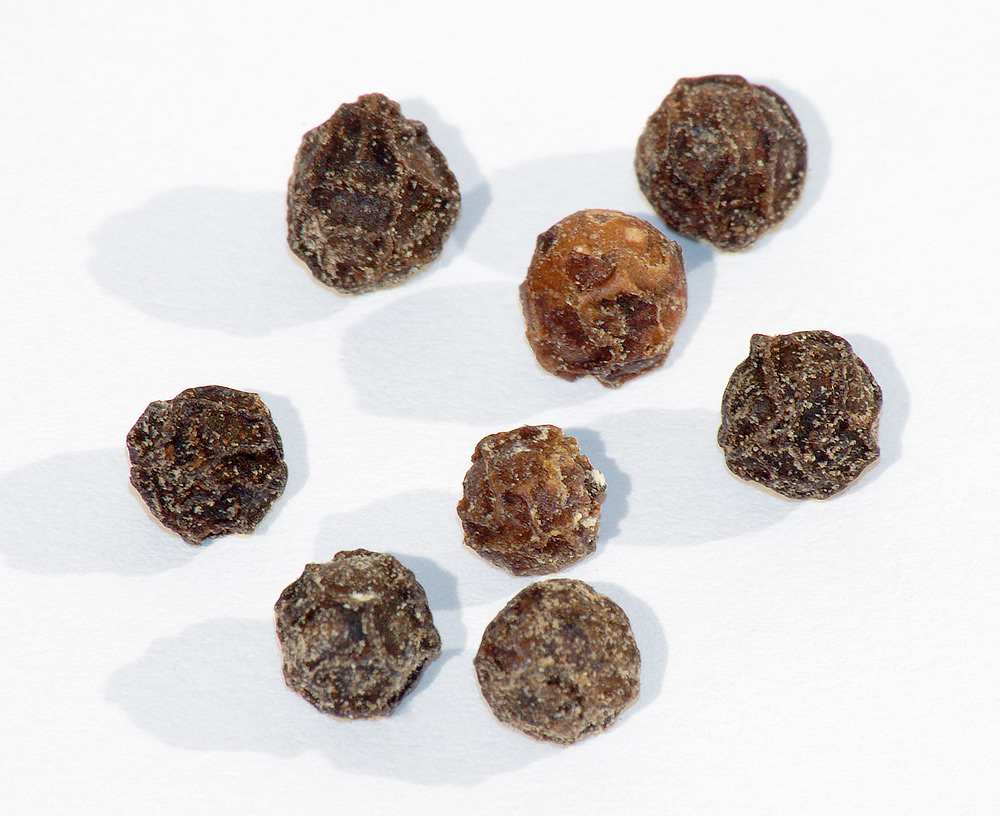
Today I thought I’d take a brief look at a magical ingredient which most everyone has on hand:  Black Pepper.  There are many uses for this dried fruit of the Piper nigrum plant.  Of course it’s valued for its ability to enhance food with a bit of heat, but it also has medicinal properties, and is very common in hoodoo practice as well.

Botanical.com lists the black peppercorn’s medicinal properties as being a febrifuge (fever reducer) and a stimulant and carminative.  For those with enflamed throats or ailments of the uvula, the site recommends using an infusion of black peppercorns as a gargle, and also suggests using the herb for constipation and urinary troubles.

In Appalachian practice, Granny women would sometimes use an infusion of black pepper to help induce labor in an expectant mother, because of its stimulatory nature.  They might also have the mother “snuff” or “quill” black pepper for the same results:

“Snuffing entailed having the mother sniff black pepper…from a plate placed under her nose; quilling involved blowing the same substances directly into the mother’s nostrils or throat with a goose quill, reed, or rolled piece of paper.  Either way, the objective was to cause a violent sneezing attack that would induce labor” (Folk Medicine of Southern Appalachia p.130).

In hoodoo, the black peppercorn is used primarily to harm or protect.  It’s often added to things like Hot-Foot powders or crossing tricks to facilitate an uncomfortable “heat” in the target’s life.  Catherine Yronwode also notes that black pepper can be used to stave off a jinx, particularly one which has been stepped in:

“To shield yourself from anyone doing these things [poisoning you through the feet via powder or other foot-track magic]…sprinkle black pepper powder or a mixture of black pepper and Fear Not to Walk Over Evil Powder in your shoes.  It is said that your track will be invisible or invulnerable to harm, and even if someone does throw for you or lift your foot track, they won’t be able to affect you in any way” (HHRM, p.53).

She also mentions that black pepper can be mixed with salt and thrown after someone when they leave your home to prevent them from ever returning or doing you harm.  Since salt and pepper are rather easy to come by in most homes, doing a spell like this is simple, and because the ingredients are so common most people don’t think twice about seeing them on the ground.  In fact, a light sprinkling of these ingredients would probably go unnoticed even in a busy apartment complex, and would be easily vacuumed up later, which makes a spell like this good for the urban root worker or witch (in my opinion, of course).  I’d combine it with the practice of leaving a broom behind the door just to double up the protection from unwanted visitors, too.

There are several potent curses which can be levied using black pepper, too.  Catherine Yronwode’s Hoodoo Herb & Root Magic book has an excellent entry on these, so I’ll not rehash everything in her entry here.  I will say that the spell she mentions involving a black candle and 99 peppercorns taken to a crossroads sounds particularly nasty, and would be well worth learning, if only to have an idea how to undo it should someone do it to you.

That’s it for today!  I wish you all a wonderful weekend.  Please don’t forget to vote in our polls, too!  They’ll be open through the weekend, and you can find them in Blog Post 61 or at the top right of the sidebar.  Thanks for voting, and as always, thanks for reading!

-Cory

Blog Post 51 – Book Review

Happy Friday, all.  Today, to make up for a rather long post yesterday, I’m just doing a quick blurb on a book I’ve not referenced much here, but which will likely be cropping up as we get into discussions of things like curanderismo and brujeria.  The book I’m looking at is called Spiritual Cleansing by Draja Mickaharic.

Mickaharic was an immigrant from Central Europe who arrived in the U.S. just as World War II was dawning.  The occult seems to have interested him from a relatively young age, and he’s produced copious volumes on various magical themes.  What strikes me as unique is that despite his Old World roots, most of his magical writings focus on what I would call New World systems, such as Caribbean, Southern, and Mexican folk magic.

Spiritual Cleansing is, according to its subtitle, “a handbook of psychic self-protection.”  Much like Dion Fortune’s Psychic Self-Defense, this book is mostly aimed at beginning practitioners or those with little experience in occult topics.  It’s chief goal is to help a person who might be facing all sorts of spiritual afflictions to remove those problems and prevent future recurrences.  Mickaharic is very insistent in this text that his work is not to be taken as medical advice (which is a sound if common legal disclaimer in works like this), but also that it is only for basic spiritual cleansing and protection.  He advises those with serious afflictions to seek out the help of a professional spiritual practitioner, and therein lies some of his charm.  He takes his subject very seriously, and his tone comes across a bit like an admonition from a grandparent.  This is probably because he was nearly 70 when the book was first published in 1982.  A more recent edition came out in 2003 with additional material, including a chapter on “Quieting the Mind.”

Mickaharic’s work is incredibly practical.  He discusses a lot of different spiritual cleansing techniques without high-flown language.  Some of the topics he addresses are:

-Dealing with Malochio (the Evil Eye)
-Cleansing oneself with spiritual baths
-Using eggs to remove negative energy
-Burning incenses to fumigate oneself for protection
-The proper use of Holy Water

One thing that some readers may be turned off by is the matter-of-fact way he says to do things.  For example, of burning incense he says “If we burn incense with no real purpose, we may find the forces  [higher powers] decide we are calling a wrong number—and they will not act in harmony with our desires…To be able to use an incense properly we must first understand these rules” ( p. 78).  He then goes into the rules as he sees them.  In another passage, he advises against using rain water for spiritual cleansing because “Rain water is difficult to use as it has variable vibrations…[and] should not be used for any spiritual work except by those who have been specifically told to use it by a spiritual practitioner” (p. 67).  I know such “this is this and that is that” statements are a big turn-off for many magical folk (and I have a feeling Laine would strongly disagree with Mickaharic on his perspective concerning rain water).  But I’d like to offer up, as some small defense of this work, that it is written for an inexperienced magical practitioner.  Someone with a better understanding of magic very well may be able to bend his “rules,” but Mickaharic is more concerned with the well-being of the reader he’s never met and wants to make sure they don’t get into anything they can’t handle.

Many of the spells and workings in this book are wonderful.  Some bear striking similarities to hoodoo work (his home sweetening spells involve burning brown sugar, which is very common in hoodoo), and many are very close to curanderismo practices (the egg cleansings in particular strike this note with me).  Some things in this book seem a little pedantic to me, of course, but then again I’ve been reading magical books for a long time.  In the end, I still think the good of this book outweighs anything bad I can say of it, and so I’m recommending it to you.  If you have an interest in spiritual cleansing and protection, or in Mexican folk magic, hoodoo, and other natural magical systems, this is a book well worth tracking down.

Have a great weekend!  Thanks for reading!

-Cory

Blog Post 42 – Five-finger Grass

Catherine Yronwode calls this “the most popular green, leafy herb in hoodoo” (HHRM, p. 95).  It’s known by several names, including Cinquefoil and Tormentil (which is actually a particular species in the broader genus of Potentilla, which also includes Five-finger Grass).  This herb, which is not actually a grass, is one of the best to keep around.  It’s fairly easy to grow from seed, or from root cuttings as it is a rhizome.

The value of this herb has been known for a long time.  Sir Francis Bacon noted that it seemed to attract a particular type of wildlife, saying “The toad will be much under Sage, frogs will be in Cinquefoil” (The Works of Sir Francis Bacon, p. 548).  John George Hohman mentions it in his The Long Lost Friend, saying “If you call upon another to ask for a favor, take care to carry a little of the five-finger grass with you,

and you shall certainly obtain that you desired” (Hohman, #14).

This particular herb is a very positive one.  It’s used for protection because of its hand-like shape (imagine a hand held up to halt evil in its tracks), but also in love spells, money and luck workings, and even travel magic.  Here are some of the basic ways to use it:

  • Take a pinch of cinquefoil and put it behind a mirror (in the space between the mirror and its backing).  Then hang the mirror where it faces your front, or main, door.  A landlord or debt collector will be unable to force you from your home, and anyone coming to see you will be predisposed to show you kindness.
  • Carried with Comfrey Root and Lodestone in a black bag and dressed with Commanding Oil, it prevents you from getting lost in your travels (this spell is from Catherine Yronwode, HHRM, p. 95)
  • According to Judika Illes’ Encyclopedia of 5000 Spells, burning Cinquefoil as incense before bed will let you dream of your lover
  • Mixed with Deer’s Tongue and Calamus root and powdered, it can be used to dress love letters in order to encourage loving thoughts from your intended.
  • Putting a pinch of the grass in your wallet or purse will keep you lucky with your money, helping you to spend it wisely, find good bargains, and have luck when you risk it at games of chance.
  • Add it to a mojo bag with a Lucky Hand Root and an Alligator Foot or Rabbit Foot charm, then feed the bag with Hoyt’s Cologne or another lucky scent for help when you’re playing cards.
  • Made into a strong tea and used as a floor wash (or combined with another floor treatment like Chinese Wash) Five-finger Grass will remove curses put upon your household.  You can also add other protective herbs like Rue or Rosemary to help with this.

Botanical.com mentions that the herb has also had reputed healing qualities ascribed to it for quite some time.  In days of yore, it was used to heal aches and sores (esp. those which were ulcerous, such as sores in the mouth), and also to help ease coughs.  Today, they say that “the dried herb is more generally now employed, for its astringent and febrifuge properties.”

You can grow or buy this herb, and it’s definitely a good one to have around your front door (remember the protective qualities; it might even keep the Jehovah’s Witnesses away!), if there’s a sunny spot for it—it prefers full sun and does well in rock gardens.  It’s got very pretty little yellow flowers, similar to a strawberry plant’s.  However you get it, I definitely recommend having it on hand if you are going to be doing hoodoo for luck or money.  Or any number of other spells, for that matter.  I hope you’ve enjoyed this herb, and this week’s posts!

Thanks for reading!

-Cory

Blog Post 40 – Dirt Dauber Nest

With warmer days just around the bend, lots of our little insect friends are getting out and about.  One of the insects I least liked before studying hoodoo was the wasp (having wandered into a nest of them once while trying to get newborn kittens out of a barn, I feel I had some justification for my squeamishness about them).  However, hoodoo has given me a new appreciation of at least one kind of wasp:  the dirt (or mud) dauber.

This relatively harmless little black wasp (colors vary a bit, but most of the ones I’ve seen have been dark brown to black) likes to build its nests in long “pipes” from mud it gathers near puddles.  This has earned the wasp the occasional nickname of “pipe organ wasp,” and its nest is usually described as a pipe organ nest.  While the dirt dauber is a keen predator, often hunting spiders which it paralyzes and brings back to its nest for food, it seldom stings people unless provoked.  Though I don’t recommend provoking them.

However, if you can find an abandoned mud dauber nest, it’s well worth collecting it and keeping it in a sealed jar (just in case it’s not as abandoned as you thought) or plastic container.  Often, individual tubes may be abandoned and can be harvested for use as long as you’re careful not to bother any of the more active tubes.

In folk magic, these nests have all sorts of uses.  Once you’ve powdered the nest—an easy task since it crumbles readily—you can add it to hot foot workings, break-up spells, good luck hands, business drawing blends, and lots more.  Harry Middleton Hyatt lists several uses of dauber nest in his work, including:

  • Carrying around a bit of nest in your wallet or purse to draw money and luck (Vol. 2, p.1552)
  • Adding it to a vinegar jar with a couple’s name paper (names written crossing each other, of course) and red pepper and beef gall in order to break them up (Vol. 2, p. 1513)
  • Adding it to a Hot Foot working and placing it someone’s shoe to drive them off (Vol.2 , p. 1505)
  • Mixing it with Graveyard Dirt and Sugar in order to help heal a marriage (the wasps are one of the few where the male wasp stays at the nest to guard it, thus ensuring that the “family” is safe and united, which is probably why the dauber is associated with a faithful marriage) (Vol. 2, p. 1325)
  • Adding Dauber Nest to Graveyard Dirt and throwing it on train tracks to kill someone (there’s more to it than this, of course, but I’d rather not get too into that here) (Vol. 2, p. 1089)

Catherine Yronwode mentions many spells involving Dauber Nest in her book, including spells to destroy an enemy, control an errant husband, and draw new customers to a business.  This last spells involves mixing the nest with Grains of Paradise and sprinkling the powder around the business, as high as you can.  According to Yronwode, because daubers build their nests up high, it symbolizes success.

As a final bit of folklore, if you happen to have daubers building nests on your front porch, leave them there.  They will bring peace and protection to the home, and it can be fun to watch them build their nests on a summer day over a glass of iced tea.

Thanks for reading!

-Cory

Blog Post 39 – Angelica Root

Since we talked about the very masculine High John yesterday, today I thought we’d look at its feminine “counterpart,” Angelica.  The main plant bearing this name is Angelica archangelica, appropriately enough, and it has strong associations with angels and holiness.  It is often associated with the Archangel Michael, and has much of his same protective power.

Culpepper, in his medieval herbal manual, writes of this herb:  “To write a description of that which is so well known to be growing in almost every garden, I suppose is altogether needless; yet for its virtue it is of admirable use” (Culpepper 8).  This plant has been grown commonly for hundreds of years, for its medicinal, culinary, and magical properties.  It’s one of the common flavorings found in liqueurs such as Chartreuse and it has a highly aromatic quality that runs from root to leaf.

Botanical.com describes it thusly:

“The roots of the Common Angelica are long and spindle-shaped, thick and fleshy – large specimens weighing sometimes as much as three pounds – and are beset with many long, descending rootlets. The stems are stout fluted, 4 to 6 feet high and hollow. The foliage is bold and pleasing, the leaves are on long stout, hollow footstalks, often 3 feet in length, reddish purple at the much dilated, clasping bases; the blades, of a bright green colour, are much cut into, being composed of numerous small leaflets, divided into three principal groups, each of which is again subdivided into three lesser groups. The edges of the leaflets are finely toothed or serrated. The flowers, small and numerous, yellowish or greenish in colour, are grouped into large, globular umbels. They blossom in July and are succeeded by pale yellow, oblong fruits, 1/6 to a 1/4 inch in length when ripe, with membraneous edges, flattened on one side and convex on the other, which bears three prominent ribs. Both the odour and taste of the fruits are pleasantly aromatic.”

The root of the plant has potent estrogen-like compounds, which is likely one reason it has a strong connection to women.  It’s also supposed to be good for helping to break fevers and expel disease, particularly diseases of the lungs.

Magically, this plant is female, through and through.  That’s not to say men can’t use it, of course.  I bound up an Angelica root in white linen and placed it beneath our bed when my wife was pregnant to protect her and the developing baby (all turned out quite well, by the way).  But Angelica is renowned for its power to protect women and undo harmful magic.  Some of the various spells one can do with Angelica include:

  • Carrying the root to protect from harm (in general)
  • Women can carry the root, along with a picture of St. Michael the Archangel, to protect from unwanted advances (or worse) from men
  • Dress Angelica root with Blessing oil (or just olive oil over which prayers have been said, such as Psalm 23) in order to protect a newborn baby (place the anointed root in a white cloth under the baby’s bed).
  • Ground Angelica root can be mixed with salt and another protective herb, like rue, rosemary, or sulfur (not an herb, I know, but I think you follow me) and kept in a small white mojo bag to guard against hexes.  Alternatively, the mixture can be sprinkled across doorways or mixed into an Uncrossing floor wash to remove jinxes placed on one’s household.
  • A strong tisane (or tea) of the root can be made and used to sprinkle a new home or a home where negative spiritual activity has occurred in order to make the home calm and peaceful.

Additionally, Cathreine Yronwode mentions that “Angelica stem candied in sugar is an old fashioned treat said to keep children healthy” and that “When buying Angelica, be aware that its occasional alternate name Masterwort more truly belongs to Imperatoria ostruthium…Also, Hercules Club, a plant in the Aralia family, is called Angelica Tree by some, but is not related to Angelica” (Yronwode 30).

Thanks for reading!

-Cory

Podcast Special – Witch Bottles

-SHOWNOTES FOR SPECIAL – WITCH BOTTLES-

Summary
This is the first of (hopefully) many mini-episode specials in which we’ll explore particular practical topics in American Witchcraft.  Today, we’re looking at the history, lore, and making of Witch Bottles.  Plus we’ll share our own experiences with them.

Play:

Download:  New World Witchery – Podcast Special – Witch Bottles

-Sources-
*The Wikipedia entry on “witch bottles.”
*Apotropaios – An excellent site with scholarly history of many occult objects, including Witch Bottles.
*The Lucky Mojo page on “Bottle Spells” has lots of great information on the various kinds of magical bottle workings done around the world.
*The Appalachian History blog has an excellent entry on “Bottle Trees.”
*The Encyclopedia of Witches and Witchcraft, by Rosemary Ellen Guiley, has a good article on “witch bottles.”
*The Encyclopedia of 5000 Spells, by Judika Illes, is another tome with lots of magical information, including some on Witch Bottles.

Music
“Grifos Muertos” by Jeffery Luck Lucas, from his album What We Whisper, on Magnatune.com