Blog Post 109 – Holidays in the Mountains

Hi there, everyone!

Today, I’m going to be sharing a little bit of holiday lore from the mountains, both the Ozarks and the Appalachians (to those readers wondering when I’ll start including the Rockies, I promise I’ll get there one day!  I’m just woefully ignorant of the traditions from that area).  There are a number of pieces of folklore associated with the winter holidays in the mountains.  Often, storytelling and family visits were the primary entertainment in the financially poor but folklore-and-culturally-rich mountains once the cold weather set in.  Christmas was not always celebrated, especially during the early years of settling, largely because many Protestants settling in the Appalachians viewed the holiday with suspicion and regarded it as a Catholic celebration.  One source records that the penalty for observing Christmas during the Puritan era was a “fine of five shillings” (WG&S, p.28).  Over time, however, as more people of mixed backgrounds settled the area, Christmas became a social holiday.  Patrick Gainer records that holidays in the mountains included:

  • Fireworks and noisemaking
  • Very little decorating prior to the widespread introduction of electricity (most homes didn’t have a Christmas tree)
  • School Christmas parties
  • Costumed visits to friends and neighbors (called “Belsnickling”—more on that in a minute)
  • Toys for children, though almost entirely homemade ones

Belsnickling

The tradition of Belsnickling is particularly interesting.  It seems to be a mumming tradition in the vein of similar British activities, but is really practiced by only the Germanic settlers in the Appalachians.  It relates to the Belsnickle (whose name may come from pelz Nicholas, or “furry Nick”), a devilish traveling companion to good St. Nick during his holiday visits who would punish the wicked children in the same way that the saint rewarded the good ones.  In some variations, it was not St. Nick who traveled with Belsnickle, but Kriss Kringle (likely a derivation from the Germanic kriskindl, or “Christ-child”).   Gerald Milnes describes the practice thusly:

“To people in the Potomac Highlands, belsnickling is the action of going from house to house in masquerade, with residents guessing the belsnicklers’ identities…Sometimes treats were offered to the belsnicklers, and sometimes belsnicklers offered treats to the household” (SC&W, p.186)

Milnes also offers a variety of pranks and tricks related to this practice:

  • Candy would be thrown on the floor, and when children dove for it, they would have their fingers switched by the belsnicklers
  • Bands of belsnicklers would wander through the countryside hooting and yelling all through the night
  • People in costume would tap on the windows of houses and scare the children inside
  • Firecrackers would be lit and thrown into people’s homes

He also relates this practice back to something deeply witchy—the Wild Hunt:

“Belsnickling and similar activities, as group practices, have obscure beginnings, but they may well go back to the old Teutonic concept of the wild hunt.  In Scandinavian and German versions of this myth, a huntsman with dogs, accompanied by spirits, hunts the wild woman.  In some versions, the huntsman, a lost soul, leads a band of wild spirits to overrun farms at Christmas time (the winter solstice)” (SC&W, p. 186).

Christmas Dinner in the Mountains

Of course, no Christmas would be complete without a feast in modern minds, but the table offerings were not quite the same for every family.  Often, up in the mountains in the early-to-midwinter, the meal would consist on the wild meat that was available rather than anything domestically raised.  In Foxfire 12, informant John Huron describes a most particular holiday meal:

“Groundhogs aren’t bad eatin’ either if you cook them right…baked and layered with onions and sweet potatoes.  That was what Charlie’s daughter, Margaret, would fix him for Christmas dinner every year.  They invited me and my wife, Sandy, and my son, Jay, over for Christmas dinner one time, and that’s what we had.  A groundhog is a lot cleaner animal than a chicken.  When you get right down to it, a chicken is a nasty critter” (FF12, p.248)

Signs and Omens on Christmas

There are a number of superstitions which have sprung up around the holiday season, too.  Often, weather and luck are intimately tied to Christmas, though sometimes the date shifts a little between December 25th (“New” Christmas) and January 6th (“Old” Christmas).  Some of the signs and omens from the Appalachians and Ozarks include:

  • It will be a fruitful year if the eaves of the house drip on Christmas (SC&W)
  • Children born on Christmas Day can understand the speech of animals (WG&S and OM&F)
  • Being the first to say “Christmas Gift” to another on Christmas Day yielded good luck (WG&S)
  • On Christmas Eve at midnight, all farm animals will bow down and speak to acknowledge Christ’s birth (SC&W and OM&F)
  • Those with the “second sight” make predictions most accurately on Christmas Eve (IaGaM)
  • “A green Christmas makes a fat graveyard” – warm weather at Christmas will lead to many deaths over the coming year (OM&F)
  • On Old Christmas, the sun actually rises twice instead of just once (OM&F)
  • Bees buzz so loudly on Old Christmas they can be heard for miles away (OM&F)
  • Elderberries always sprout on Old Christmas, no matter what the weather (OM&F)

Even with its rather slow, Puritanical start, Christmas in the mountains has become one of the most magically charged times of the year.  From eating groundhogs to playing rowdy pranks to witnessing the miraculous behavior of animals, this is certainly one of the most interesting times of the year.  And, in my humble opinion, one of the most magical.

Thanks for reading!

-Cory
Podcast 22 – Yuletide Cheer!

Summary

Happy Yule!  Today we have our favorite carols, poems, recipes, and even a little lore for the winter holidays.  Have a blessed and happy holiday season!

Play:


Download:  New World Witchery – Episode 22

-Sources-
A Visit from St. Nicholas,” attributed to Clement Clark Moore, but likely written by Henry Livingston, Jr.
The Oxen,” by Thomas Hardy.

Recipes for Tom & Jerrys, Reindeer Food, and Gingerbread cookies.

Holiday animal lore can be found here.

Promos & Music
Nearly every song can be found on CDBaby.com or iTunes.  Below I’ve attempted to link directly to the artist pages where possible.

  1. I Saw Three Ships – West of Eden
  2. Gods Rest Ye Merry Paganfolk – The Pagan Carolers
  3. Hark the Herald Angels Sing – Doug Smith
  4. Wren in the Furze – Shira Kammen
  5. Silver Bells – Steve Martin & Paul Simon (Live recording from SNL)
  6. A Soalin’/Soul Cake – Pagan Carolers
  7. Holly & The Ivy – Howl-O
  8. Good King Wenceslas – The Trail Band
  9. Cherry Tree Carol – Rose & Thistle Band
  10. Bring the Torch Jeanette Isabella – Trifolkal
  11. Boars Head Carol – Pagan Carolers
  12. Come Landlord Fill the Flowing Bowl – The Limeybirds
  13. Gloucester Wassail – Pagan Carolers
  14. Carol of the Bells – Ross Moore
  15. Stille Nacht/Silent Night – Katie McMahon
  16. Snowbird – Maidens Three
  17. Da Day Dawn – Samantha Gillogly
  18. O Tannenbaum – Antique Music Box Christmas Collection
  19. O Holy Night – Indigo Girls
  20. This Endris Night – Heather Dale
  21. Go Tell It On the Mountain – Easy Anthems
  22. Patapan – Bittersweet & Briers
  23. Welcome Yule – Renaissance Revelers
  24. Little Drummer Boy – Men of Worth
  25. Angels We Have Heard on High – Skye Pixton
  26. Auld Lang Syne – Marc Gunn

Holiday wishes from (in no particular order) Saturn Darkhope, Oraia Sphinx, Scarlet at LPV, Gillian the Iron Powaqa, Rianna Stone the Pagan Homesteader, & Kathleen at Borealis Meditation.

Blog Post 108 – Holiday Magic in the Kitchen

Today I thought I’d look at some of the holiday lore surrounding baking and cooking.  What would the holidays be without the smells of cinnamon and nutmeg and clove and allspice slowly seeping out of the hot oven?  And who imagines a holiday home without the presence of gingerbread or ginger cake of some kind?  Chocolate and peppermint add extra luxury to an already indulgent season.  In short, much of the magic of Christmastime and Yuletide seems to come from the kitchen (I’m sure many kitchen witches reading that chuckle in amusement that such sentiments even need to be typed out).

So let’s start by looking at some of the ingredients in those festive holiday treats:

Cinnamon – This handy kitchen spice has lots of magical uses.  Cat Yronwode recommends it as a business drawing and gambling botanical.  It can be used to make a wash-water which one would then use to scrub down the walkways in front of a business.  This has the effect of drawing in new clients.  In Jim Haskin’s Voodoo & Hoodoo, cinnamon is mixed with sugar and sprinkled in the shoes to increase gambling fortunes.  Draja Mickaharic describes cinnamon as “calming” with a “protective vibration” and also cites its money-making properties in his Century of Spells (which refers not to a unit of time, but rather a unit of enumeration—a century representing the roughly 100 spells found in the book).  Mickaharic also notes that “it has a claming and quieting effect on young children,” though I imagine in cookie form this may not be the case.

Cloves – Mickaharic says these are “psychically protective,” and keep “negative thoughtforms out of the place where it is burned.”  Presumably including cloves in any baked or cooked dish would involve at least heating them, thus releasing some of this power into the kitchen and home.  Yronwode says that “cloves appear in spells for money-drawing, prosperity, room-renting, and friendship” (HHRM, p. 73).  These are also used to make pomanders, clove-studded oranges rolled in orris root powder and hung as protective talismans in the home (well, protective talismans and lovely nosegays to help imbue the house with that sweet, spicy holiday scent).

Nutmeg – This botanical has a mild narcotic effect and has been a staple of magic for some time.  An old hoodoo charm found in Harry Hyatt’s work and later disseminated by other authors involves sealing a small amount of liquid mercury inside a drilled nutmeg, then carrying the charm around as a gambling mojo (this is NOT RECOMMENDED as mercury is highly poisonous—DO NOT DO IT!!!).  Mickaharic describes nutmeg as an herb which inspires conviviality and jovial behavior, and promotes an air of happy friendship in the home.

Allspice – “Good for social gatherings; increases the flow of conversation and the rapport between people” says Mickaharic (CoS, p.50).  These hard, dried berries can also be soaked for a few hours, then strung as a type of herbal rosary using a needle and thread.  Carrying this can help relieve stress and provide peace of mind.  Yronwode recommends this for business and gambling (there’s a pattern here), and also describes a floor wash one can make with ground allspice.   Mixed with cinnamon and burned as incense, Mickaharic says it “places a smooth and witty feeling” in the home.

Ginger – This fiery herb is used to “heat up” or enhance the potency of various other magical ingredients, and also provides a little kick in spells for love or money (HHRM, p.103).  The root can be used as a poppet due to its shape and sometimes-resemblance to a human body, and would be especially effective in a love or lust working.  It can also be carried for protection.

Sugar – Sweetening!  This can be used to add a “sweet” or happy vibration to the home where it is burned (though it can smell very sharp when burned, too…baking it may not have the same oomph as burning it, but will smell better in the long run).  Of course one can keep all of one’s visiting relatives’ name papers in the sugar jar in order to better provide a happy, congenial home during the holidays, but offering them lots of sugary sweets might help ply a good attitude out of them, too.

As you can see, most of these herbs have to do with prosperity and getting along with one another (and a little protection thrown in for good measure).  This makes sense during a season where money might be tight, tension runs high, and houses are full of dangerous things like fire and hot ovens.  So when doing the holiday baking, it might be worth throwing an extra pinch or two of these spices in to up the magical ante of your confections.

I mentioned gingerbread earlier, and it made me think of a couple of stories from early American folklore about bakers whose experiences with cookies certainly have a magical bent:

The Baker’s Dozen” – A piece of reputed folklore recorded by Charles M. Skinner in 1896, this story revolves around a stingy baker and his encounters with an old crone who bewitches his bakery.  Only through the magnanimous efforts of St. Nicolaus (and by swearing better behavior on a gingerbread cookie shaped like him) does he manage to break the spell.

The Gingerbread Man” – This famous story tells of a gingerbread man come to life who flees his baker and eludes capture by the people and animals of the village.  He meets his match in the swift (and often crafty, in various retellings) fox, who finally devours him.

Finally, I’ll leave you with my family recipe for gingerbread:

1 c. sugar
1 c. shortening
1 c. molasses
½ c. hot water
1 Tbs. cinnamon (or to taste)
1 Tbs. ginger (or to taste)
½ tsp. salt
1 tsp. baking soda
1 egg
7 c. flour, plus a little extra for rolling dough

Preheat oven to 350 degrees. Sift flour and mix in dry ingredients.  Add egg, molasses, and shortening and mix.  Slowly add hot water, mixing as you go.  When dough is sticky, begin to work it into a ball.  Dust a flat surface with flour and begin rolling out the dough, working it until you get it about ¼ inch thick.  Cut out shapes with cookie cutters or a knife.   Bake cookies on a lightly greased cookie sheet for about 15 minutes (or until they are crisp at the edges and fully cooked.  Cool on a wire rack, decorate, and eat!

My mother and I used to bake several batches (rather, a whole day’s worth) of gingerbread, then spend time making the finished products into houses, sleighs, people, and animals.  We gave them as gifts, decorated with royal icing and candy, and were often very popular around the holidays.  I hope you enjoy!  It’ll be like taking a little bite out of your New World Witchery host during the holiday season.

Wait, that probably sounds kind of creepy.  Enjoy anyway!

Thanks for reading!

-Cory

Blog Post 107 – More Winter Lore

Greetings everyone!

I’m putting the rest of my series on Magic Books in the American Colonies on hold, temporarily.  Partly this is because I’ve decided to get working on the Resources page I have been planning to do for a while, which means that even if the posts themselves are weeks or months apart, they will be easy to read in succession because of their indexing on that page.  But mostly it’s because I’m in a holiday mood, and that means I really want to write about winter lore.

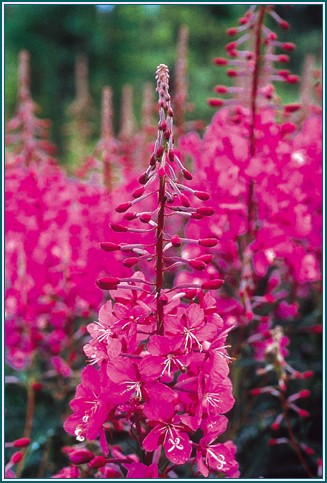
Let me start by sharing some of the links and information I missed in our show notes from the contest entries our listeners submitted.  For example, Kathleen of Borealis Meditation sent me a lovely batch of pictures featuring the fireweed (Epilobium angustifolium) from her lore submission:

In case you haven’t heard the related yuletide tale on the show, the folk wisdom goes that these shrubs, which grow after a wildfire has spread through a landscape, bloom from the bottom up.  They also go to seed from the bottom up, turning into “fluff” as they go.  When the fluff hits the top of the stalks, the first snow will fall, so the story says.

I also failed to put a link to listener and blogger Nathalie’s “24 Posts to Christmas.”  If you remember, Nathalie shared the lore about the Kuppelchen, a type of house-spirit responsible for taking care of a household and which often appears in families where magical folk are present.  In addition to this great bit of lore, Nathalie gives lots of holiday tidbits, tales, and recipes, including one for Grog—a very warming and bracing adult beverage for those cold winter days.  She also talks about things like Christmas Markets, St. Nicholas, and lead casting (which we also mentioned on the show, I think).

December is full of magical holidays, not just the mid-to-late month festivities that everyone knows about.  I’d like to throw two Catholic holidays out there (don’t worry, there won’t be any dogma, just a few of the more magical traditions associated with them).

First, there’s St. Nicholas’s Day, which is December 6th.   The night beforehand, children leave out their shoes near the door or fireplace, and in the morning, find them full of toys, candy, nuts, and fruit.  This custom, which seems to be Northern European in origin, is one I grew up with in my house.  St. Nicholas is also usually accompanied by a darker traveling companion, too, such as Ruprecht, Belsnickel, or Krampus.  This “anti-Santa” leaves punishments for naughty children, but can also be fairly benign and simply serve to balance out the whole “jolly old elf” side of the season.  I remember seeing lots of people dressed as either an angel or a devil on St. Nicholas’s Day while living in Prague, so the tradition of masking also ties into this holiday.  There is also an Appalachian tradition called “Belsnicking” which involves making masked visits to one’s neighbors during the holiday season (you can find a lot about that in Gerald Milne’s Signs, Cures, & Witchery).

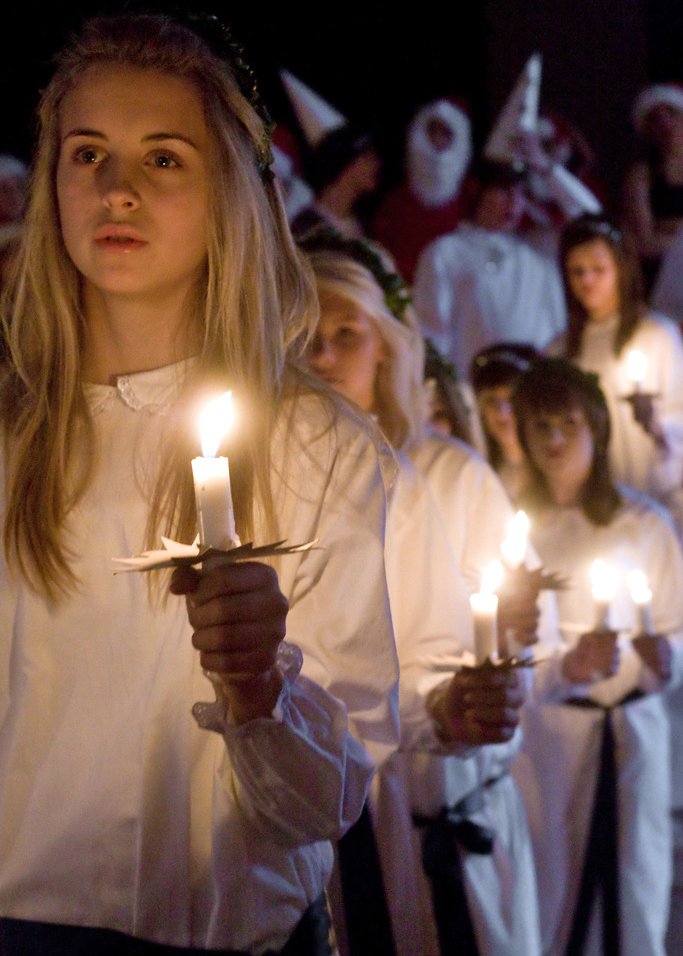
One thing I really wanted to mention, but for some reason didn’t, was St. Lucy (or Santa Lucia).  Lucy (whose name is deeply connected to the Latin “luce” or “light”) was a saint who tore out her own eyes as a demonstration of fidelity to her faith.  It’s a pretty gruesome thought, and much Christian art depicts this saint as carrying her own eyes on a silver platter.  Not exactly the type of story we think of while baking gingerbread men, right?  But St. Lucy’s Day, which falls on December 13th, is incredibly popular in Scandinavian countries.  Rather than focusing on the awful self-blinding, instead little girls wear crowns of candles and evergreens on their heads as they perform holiday parades dressed in all white gowns.  The girls then hand out sweets like gingerbread (pepparkakor) and chocolate to the people they pass, all the while, singing carols.  There’s a special type of pastry, the St. Lucia Bun, which is also made on this holiday.  In Italy, children leave out coffee or chocolate for Lucia, as well as bread and grain for her donkey.

There are still so many wonderful holiday traditions, customs, and magics out there to mention, but I’ll pause here for today.  I hope you’re enjoying the spirit of the season!

Thanks for reading!

-Cory

Podcast 21 – Winter Lore

-SHOWNOTES FOR EPISODE 21-

Summary

In this episode, we share some of the winter lore we received in our recent contest.  We look at the various wonderful traditions from around the continent (and the world), and share some of our own holiday practices.  Plus, we have a special guest!  We also discuss reclaiming the holiday season, and we have the winners of our contest!  Thank you to all who contributed!

Play:

Download:  New World Witchery – Episode 21
-Sources-
Most of our lore comes from either us or our listeners this time around. But if you’re looking for some good books on holiday customs and traditions, I can recommend:
All Around the Year, by Jack Santino
The Winter Solstice: The Sacred Traditions of Christmas, by Caitlin & John Matthews
The Return of the Light: Twelve Tales from Around the World for the Winter Solstice, by Carolyn M. Edwards
Stations of the Sun: A History of the Ritual Year in Britain, by Ronald Hutton
Pagan Christmas: The Plants, Spirits, and Rituals at the Origins of Yuletide, by Christian Ratsch
Promos & Music
Title music:  “Homebound,” by Jag, from Cypress Grove Blues.  From Magnatune.
Promo 1 – Borealis Meditations
Promo 2 – Forest Grove Botanica
Promo 3 – Appalachian Witch Doctor Tales

Blog Post 106 – Book Review

The Faeries’ Guide to Green Magick from the Garden by Jamie Wood and Lisa Steinke, illustrations by Lisa Steinke

When I was asked to review this book from the publisher*, I said yes without knowing anything about it. The title intrigued me, so I thought I’d give it a chance. I have to be honest though, anytime I hear anything about “faerie” books, I’m always a bit wary. Some books can be a bit more new agey than I like, and, dare I say it- a little fluffy. However, I was pleasantly surprised by how this book treats the subject of faeries.

To start out, the authors talk about Man and his symbiotic relationship with the earth. Talk is quickly shifted to a “go green” type of message, and how important this is in order to have any relationship with the faeries. It comes off a bit heavy handed, especially since it’s all information that any pagan already knows. However, Wood and Steinke then go on to explain how they view faeries- as the life forces of plants. They explain that plants are living beings, and that each faerie has an individual energy and personality that is a manifestation of that plant energy. They go on to say that Steinke’s lovely illustrations are her own personal interpretation of that faerie energy. I was really happy with this explanation, as it’s pretty close to my own view of faeries and they explain it in a easy to understand way.

There are a few more chapters on magickal** gardening, green gardening, and complimentary medicine. I found these to be a bit extraneous though, because they only touch on the subjects in passing. I’m glad though, because the best part of the book is what’s next- the Herbal Index. I loved this part of the book. The set up is that each herb has it’s own entry, with 33 of the most common herbs represented. Each herb has Steinke’s illustration of the faerie energy of the herb, a description of the plant, how to take care of it, and some magickal way to use the herb- whether that be an ingredient in a recipe, an ingredient in a spell, or perhaps a way to make your own beauty product. The only thing I found myself wishing for in this portion of the book was an actual picture of the plant/herb. However, since they’re so common, a quick google search will pull up plenty of pictures. I really enjoyed this portion of the book, and I think it would be great for someone new to working with herbs (like me).

Overall, I was pretty happy with The Faeries Guide to Green Magick from the Garden. It is definitely written for those new to gardening, working with faeries, and even to witchcraft in general. Sometimes the tone is almost apologetic for being about “magick”- as if they are writing to the average person who has never even thought about magick or witchcraft before, which is not who is going to be buying this book. I found this to be a bit patronizing at times.

However, the Herbal Index alone makes the book worth it to me. The descriptions, how to care for the plant, a fun way to use that particular herb, and not to mention the wonderful illustrations, all made me think it will be a good book to have in my repertoire. Again, it is for beginners, so if you’re a seasoned herbalist, this book will probably not have enough information for you. But, if you want an easy introduction into working with faeries and working with magickal herbs, then think about checking out this book.

-Laine

*In the interest of full disclosure, the publisher contacted me and asked if I would give an honest review of the book. I haven’t been paid for this review, and I didn’t pay for the book.

**Also, I’d like to note that I don’t usually make the distinction between magic and magick, but the book makes a point of explaining this, so I figured I would stick with that spelling. The same goes with the fairy/faerie spelling.

Blog Post 105 – Magic Books in the American Colonies: The Devil’s Book

In an effort to blend the subjects of recent blog posts, I thought today I’d start to look at a few of the key magical texts which would have had an influence on the American Colonies.  Much of this entry will be directed by a reading of Owen Davies’ Grimoires: A History of Magic Books and Witchcraft, Magic, & Religion in 17th-Century Massachusetts by Richard Weisman, both of which I highly recommend reading.  I am also pulling from The Silver Bullet by Hubert J. Davis and Witches, Ghosts, & Signs by Patrick Gainer.  I’ll mostly be looking at the English colonies, but the French and Spanish colonies will also enter into the discussion a bit during later articles.

In general, the magical books of the early colonies came in three flavors:  devil’s books, witch-hunting manuals, and grimoires.  The Devil’s Book was frequently thought by Puritan settlers to be the ultimate embodiment of human sin—a willful signing away of one’s soul to infernal powers.  By simply signing one’s name to such a book, a witch gained all her power and lost all her salvation (I use “her” because the popular conception of a witch tended towards the feminine, though male witches were not uncommon either).  Some of the key features of a Devil’s Book and its accompanying rituals were:

The Profaning of the Bible – The witch would have to stamp upon a Bible or otherwise deface it before being allowed to sign.  In some cases, a Bible itself was used to sign the witch into the Devil’s service.  Several Appalachian tales record instances of witches simply making an “X” in a marred Bible to indicate their pact.  In The Silver Bullet, witch Rindy Sue Gose performs this sort of ritual to seal her contract with the Devil:

“Fust, Rinday Sue cut her finger with a knife, and when hit started to bleed, she opened a little Bible and ‘peared to write sumpthin’ in hit with the blood from her finger.  The Devil then nipped her on the left shoulder to give her a witchmark so’s she could suckle her familiar.  Rindy Sue swore to give her soul to the Devil and to work for him the rest of her born days.  Then, the Devil danced with her, and then went into the woods behindst thet tree” (Davis 17).

This action echoes the profaning of the Lord’s name or the recitation of a reversed “Our Father” as a way of breaking the bonds of Christianity for a witch.  Not that you should read much into that, of course.

The Use of Blood as Ink – When witches made their mark, they often didn’t actually sign their name.  In a time when general literacy was still low (though it should be noted that literacy among Puritan men was quite high for the era), not everyone would be expected to have a “signature.”  Instead, they would have a “mark,” often an “X” which they used as an indication of their agreement to a contract.  To personalize this mark in the rituals of witchcraft, a witch wouldn’t simply take an inked quill and make a fancy “X,” though.  Instead, her blood was an indication that the pact bound her body and soul to the Devil.  Puritan minister William Perkins described the process (most business-like) as follows:

“The express and manifest compact is so termed, because it is made by solemn words on both parties.  For the satisfying hereof, he [the future witch] gives to the devil for the present, either his own handwriting, or some part of his blood as a pledge and earnest penny to bind the bargain” (Weisman 36).

The Devil sometimes used a great iron pen to draw the blood from the witch before having him sign his name, and in cases where the book was not a defaced Bible, the great book contained hundreds of other blood signatures from other witches.

Owen Davies observes in his book that the drawing up of a pact between a witch or sorcerer and an infernal representative was nothing new—look at the legend of Faust for example.  What made these New World magical compacts unique was that the witch did not draw up the document herself, but rather was lured into signing a book which she would not take possession of, but rather which remained in the custody of her magical Master.  All her magic, then, would be learned without the aid of books, at least in this model of New England Colonial witchcraft.  Indeed, the Devil presented himself or his imps to the witch as her means for accomplishing malefic magic rather than gifting her the use of dusty tomes of magical lore and spells.  In short, the Devil’s Book was merely a roster of the souls won to his service, and possessed little magical power in and of itself, at least superficially.  However, many witches might claim that a deeper reading of the Devil’s Book phenomenon reveals that the act of writing in blood on a sacred object in fact demonstrates a type of very old and powerful magic.  Thus, such a book, if it could be wrested from the Devil, would be very powerful, indeed, perhaps containing the magic of all those who had signed before.

Next time we pick up this thread, we’ll be looking at the witch-hunting books, and why they may have actually helped more witches in their spellcrafting than they actually hurt by “revealing” them.

Thanks for reading!

-Cory

Quick Update – Holiday Lore Contest Reminder

Hello everybody!

This is just a quick reminder that we’ve got our Winter Lore Contest on right now, but time is running out to get your entry in.  We’re looking for information centered around the winter holidays, specifically local or family:

  • Practices
  • Customs
  • Traditions
  • Songs
  • Recipes
  • Stories
  • Crafts

Please make sure you tell us what area you are from (generally), and if you would like us to use your name on the blog/podcast.

You have until midnight (Central Time) on Monday, December 6th to submit your lore via blog comment or email, so don’t delay!  You can still get an additional entry if you tweet, blog, or otherwise spread the word about the contest and send us the link.

The prizes are:
Two Runner-up Prizes – Signed copy of Judika Illes’ latest book, The Weiser Field Guide to Witches

One Grand Prize – A Compass & Key Hoodoo Starter Kit, with a selection of oils, botanicals, curios, and other products for budding rootworkers.

We’ve gotten a number of excellent entries, but we still would love to get some more, so please submit before time runs out!

Thanks for reading (and sharing)!

-Cory

Blog Post 104 – (A Little) More Colonial (and Native American) Magic

I thought in honor of the recent Thanksgiving festivities—at least those here in the US (and with a belated bow to the harvest feasting in Canada), I would take a brief look at some of the magical practices circulating around the time of that “first Thanksgiving.”  The people who arrived in places like Plymouth and Massachusetts Bay to settle the New World—never mind it was already quite settled by its native inhabitants—are commonly referred to as Pilgrims, and contemporarily would have been known as Separatists.  Thinking about that late autumn gathering, when the local Pawtuxet tribe and the Separatists who had survived the harsh New England winter and managed to put together enough bounty for the coming cold season gathered at the table, is a sort of fond romance or fantasy.  Often we imagine the Indians in their deerskins and the Pilgrims in their blackest hats with the shiniest buckles on them.  The staunch Calvinism of the Separatists contrasts with the “noble savage” imagery of the Natives, their shared meal demonstrating two very different worlds breaking bread together.  Yet both groups shared many things in common, including a set of magical practices aimed at protecting their homes and blessing themselves with prosperity.

The fear of malefic witchcraft—which would eventually go on to spawn the famous “witch hunts” of Colonial America—stirred hearts on both sides of the table.  Each group had its own charms, talismans, prayers, and formulas for dealing with the dangers of spiteful magic.  The Pilgrims, drawing on their English heritage, had all sorts of magical tricks up their black-and-white sleeves for defeating evil witches and devils:

“Legal actions against malefic witchcraft merely represented the final point of defense against what were perceived as destructive magical powers.  Prior to entering his complaint into the legal domain, the colonial villager could draw upon a variety of protective magical formulas to maintain some sort of equilibrium between good and evil mystical forces.  Several of these techniques—by no means an exhaustive list—were mentioned in a sermon delivered by Deodat Lawson…’The Sieve and Scyssers [Scissors]; the Bible and Key; the white of an Egge in the Glass; the Horse-shoe nailed on the threshold; a stone hung over a rack in the Stable.’” (Weisman 40)

Looking at these specific examples, we can see a few things which indicate that magic among the Pilgrims was not so uncommon.

The Sieve & Scissors – These items were commonly used in fortune telling games by young girls, particularly on exciting nights like Halloween.  They could also be used to confuse or cut a witch, magically speaking.  The Sieve and Shears appear in Aggripa’s Three Books of Occult Philosophy, as well.

The Bible & Key – The Bible was considered to have inherent magical and protective abilities, and the key likely held the symbolism of “locking away” or “locking out” any harmful witchcraft.  The use of the two together also formed the basis of a spell recounted in Reginald Scot’s Discoverie of Witchcraft:  “Popish preests …doo practice with a psalter and a keie fastned upon the 49[th] psalme, to discover a theefe” (Scot, Chapter V).

The Egg White in a Glass – This is another method of divination involving cracking an egg into a clear glass or jar of water, then reading the resulting shapes, strings, bubbles, and colors found in the glass.  Curanderismo continues to use this method as a regular part of cleansing and reading practice even today.

The Horse-shoe on the Threshold – This particular charm moves out of the realm of divination and into prosperity and protection magic.  We covered horseshoes on our Lucky Charms podcast, and you can read all about them at the Lucky W Amulet Archive page on the subject.  The iron in the shoe, plus the somewhat mystical nature of the animal associated with it, imbued this charm with the power to block witchcraft and provide good luck to those passing under it as they entered a Pilgrim’s household.

The Stone in the Stable – The stone referred to in this charm would likely have been a holed stone, one which had been naturally eroded to leave a gap by which it was then hung in places needing protection from malefic activity.  Sarah over at Forest Grove wrote a bit about these holed stones, saying “In the UK it was used as a protection charm as the locals believed that by tying their front door key or the stable door key to a hole stone they would protect the building it hung upon.”  This, much like the horseshoe, was primarily protective, but a holed stone could also be used to “see” witches and other Otherworldly entities by peering through the gap.

Looking to the Natives’ side of the table, we find that charms to provide protection and blessing were also common among the Algonquin tribes of New England (Algonquin being a language and not an actual tribe, I use the term here to blanket a wide number of groups sharing a more-or-less common landscape and tongue).  Charles Leland (admittedly a questionable source on some matters of folklore, but not without his merits) wrote of many New England Native magical practices.  He compares the workings of Native shamans with the work of Catholic priests in one passage of his book The Algonquin Legends of New England: Tales of Magic:

“For wherever Shamanism exists, there is to be found, in company with it, an older sorcery, or witchcraft, which it professes to despise, and against which it does battle. As the Catholic priest, by Bible incantations or scriptural magic, exorcises devils and charms cattle or sore throats, disowning the darker magic of older days, so the Shaman acts against the real wizard.”

Leland recounts several legends of warriors and magical Indians doing battle with terrible spirits, the dead, and other dangerous forces.  In one tale, a chief’s son, described as “a great hunter, and skilled in mysteries” decides to marry.  In his efforts to get a wife, he sets out on a journey in which he acquires many talismanic and shamanic tools.  One of them is a golden key pulled from a whale’s mouth, which the whale tells him has great protective power:  “While you have it you will be safe against man, beast, or illness. The foe shall not harm you; the spirits which haunt the wilderness shall pass you by; hunger and pain shall not know you; death shall not be in your road.”  The key, then, appears in both the European and Native magical traditions as a powerful amulet.

As a final note on the magic of Native Americans, let us turn from the groaning board of the Thanksgiving feast and look at another magical practice:  fasting.  In an 1866 article entitled “Indian Superstitions,” Francis Parkman describes the use of ritual fasting in order to acquire a Manitou, or guardian spirit:

“Each primitive Indian has his guardian manitou, to whom he looks for counsel, guidance, and protection. These spiritual allies are acquired by the following process. At the age of fourteen or fifteen, the Indian boy smears his face with black, retires to some solitary place, and remains for days without food. Superstitious expectancy and the exhaustion of famine rarely fail of their results. His sleep is haunted by visions, and the form which first or most often appears is that of his guardian manitou, a beast, a bird, a fish, a serpent, or some other object, animate or inanimate. An eagle or a bear is the vision of a destined warrior ; a wolf, of a successful hunter; while a serpent foreshadows the future medicine man, or, according to others, portends disaster…The young Indian thenceforth wears about his person the object revealed in his dream, or some portion of it—as a bone, a feather, a snake-skin, or a tuft of hair. This, in the modern language of the forest and prairie, is known as his “medicine.” The Indian yields to it a sort of wor ship, propitiates it with offerings of tobacco, thanks it in prosperity, and upbraids it in disaster. If his medicine fails to bring him the desired success, he will sometimes discard it and adopt another” (Parkman 4).

Feast or famine, magic has long been on American soil (and Canadian, Central American, & South American soils as well).  So as you eat your turkey leftovers, you could crack an egg into a glass of water, pull out some scissors and a sieve, or maybe even think about putting the food aside for a while and seeing what comes to you in your dreams.  It might add a little New World Witchery to your holiday.  Which, of course, makes me feel pretty darn thankful.

Thanks for reading!

-Cory

Podcast 20 – Magical Animals

Podcast 20 – Magical Animals
-SHOWNOTES FOR EPISODE 20-

Summary
Today we’re looking at animals and their role in magical practice.  We’ll talk about different species, shapeshifting, and familiars.  In WitchCraft, Laine talks about making Black Cat Oil.  Cory looks at one way to attune with a familiar in SpelledOut.  Don’t forget about the Winter Lore Contest!
Play:

Download:  New World Witchery – Episode 20

-Sources-
Some of the works we cite are:
Patrick Gainer’s WItches Ghosts & Signs
Vance Randolph’s Ozark Magic & Folklore
Ronald Hutton’s Triumph of the Moon
The Foxfire book series
Magical Creatures, from Elizabeth Pepper & Barbara Stacy of The Witch’s Almanac
We mention the Bible, particularly Leviticus 16 (the scapegoat). 16:8 in many translations refers to Azazel (wiki article.  Also, we mention Mark 16: 17-18 (the passage on snake-handling).
We also mention Auntie Greenleaf, whose tale can be found at Americanfolklore.net
You might also be interested in our New World Witchery blog entry on Snakes.
And, of course, we mention Judika Iles’ 5000 Spells again.

Promos & Music
Title music:  “Homebound,” by Jag, from Cypress Grove Blues.  From Magnatune.
Promo 1 – Inciting a Riot
Promo 2 – Borealis Meditations
Promo 3 – RadioLab