Blog Post 127 – Summoning Devils

In Blog Post 126 we looked a little bit at the Devil as a folkloric figure in American witchcraft.  One of the questions I received in response to that post was, “but how do I meet him?”  Is the Devil an entity anyone can just summon up?  Do you have to be careful to call the “right” devil so as not to wind up with more on your plate than you can handle?  And if you do meet the Devil, how do you come away with your soul intact (assuming you want to)?

Today I thought I’d look at some of the ways, folklorically speaking, that people have been known to get into contact with the Devil or other “dark” spirits.  Some of these are based on old European folk traditions, and some call a figure which may or may not be the Devil, but which certainly shares traits with him (trickster nature, otherworldly knowledge, granting of gifts, etc.).  A word of warning before we dive in, though: Do NOT attempt any spiritual summoning work or diabolical contact without the proper precautions—while dark spirits can be powerful allies, they also can have a dangerous side and should be treated with respect and caution.

So, with that being said, let’s look at some of the main ways to meet your devil.

Invocation & High Magic

If you’ve ever read Christopher Marlowe’s Faustus, you’ll be quite familiar with this method.  In this late 16th century play, Dr. Faustus (quite possibly based on a real person), learns the art of high magic and uses a magic circle to call forth a devil named Mephistopholes, who will act as his servitor on Earth in exchange for his soul.  He seals his pact with blood, and pretty much gets what he wants for a while (including Helen of Troy), then gets dragged off to hell for his final punishment.

In Marlowe’s version, the imp is a distinct entity, and in some versions of the legend he takes on the form of a dog or other animal to serve Faustus as a familiar.  Shakespeare, contemporary to Marlowe, also knew a bit about diabolic invocation through high magic.  In his Henry VI, part 2, Shakespeare demonstrates a different version of how such a meeting might go.  In Act I, scene iv, a conjurer named Bolingbroke summons the spirit of a devil named Asmath into a witch named Margaret Jourdain (based on a real woman and accused witch named Margery Jourdayne), then proceeds to interrogate the demon for information.  He dismisses the devil just before royal authorities break in and arrest everyone present for heresy and treason.

So here we have two methods inherited from the grimoire traditions of old Europe: direct appearance and possession.  Owen Davies gives an excellent overview of these traditions in his appropriately titled Grimoires: a history of magic books.  These late-antiquity and medieval methods of making contact with nefarious forces also found popularity in the New World, mostly through grimoires like the Grimoire Verum, Albertus Magnus’ Egyptian Secrets, and derivative texts drawn from such sources.  These tomes influenced magical systems like Pow-wow and hoodoo, though the specifically diabolic elements were often highly diminished by the time they reached the hands of folk practitioners.  The exception to this is that the seals found in the Sixth and Seventh Books of Moses were still used for magical purposes, and several of those seals are specifically designed to invoke diabolic aid from entities like Mephistopholes and Leviathan.

Should you get the urge to perform any of these types of invocations—and I reiterate my warning about being prepared and knowing what you’re doing first—here are several rituals you might try:

  • The Grimoire Verum – This text says that America is ruled by the devil Astaroth, whose sigils are included for your invocational purposes.  Please note that you should probably learn a little bit about basic Solomonic invocation and banishing from the Key of Solomon first, though the Grimoire Verum does give a little instruction in these areas as well.
  • The Sixth & Seventh Books of Moses – There is a lot less instruction here than you would find in some of the other grimoires, so if you’re not versed in summoning and dispelling, you may need to look elsewhere.
  • Dr. Faustus – Here is the text used by Marlowe for his Faustian invocation.  Bear in mind that this was designed to be staged, so use it more as a guide than a rote ritual to be followed.
  • Henry VI, part 2 – Shakespeare’s text for invocation and bansishment.  Take with the same grain of salt you used with Marlowe’s work.

Meeting the Devil

On the more folkloric side of things, the common method for contacting a devil of some kind involves a journey to a liminal or wild place where he is thought to reside.  In most cases, the Devil can be found either at a crossroads or in a forest of some kind, though there are exceptions (many modern stories of meeting the Devil involve transportation or big cities, e.g. Robert Bloch’s Hell-Bound Train, Ray Bradbury’s Something Wicked this Way Comes, and the cult film Rosemary’s Baby).  Probably the most famous ritual is the crossroads ritual, which I’ve mentioned here before.  As I’m planning to do an article on the crossroads as an independent magical space, I won’t go into great detail, but rather just say that Cat Yronwode has a great entry on the crossroads for those who are interested.

The forest or wild place meeting is a common folkloric theme across many cultures.  There are, of course, the Teutonic tales of meeting various wild spirits or devils in the forest, as in the Grimms’ tales of the Devil (see “The Devil’s Sooty Brother,” or “The Devil’s Grandmother”).  There are biblical precedents for these sorts of meetings as well—Moses encounters the burning bush in the desert, which is at least terrifying if not outright diabolic.  Three of the gospels also recount the story of Jesus being tempted in the desert (an analog for wilderness in biblical terms).  American folklore picks up this thread, and stories of meeting the devil in wilderness are quite common.  “Young Goodman Brown,” by Nathaniel Hawthorne, features such a meeting, and at least one scholar has brought the idea into the twentieth century by suggesting that “Men in Black” sightings associated with UFO’s in rural areas may be connected to devil lore.

The other alternative to the forest meeting is the graveyard meeting.  Usually in this version of the story, the person meeting the Devil must also do battle with him.  It can be a battle of wits, but just as often it is a physical wrestling match which parallels the interior struggle of the person confronting his or her fears by meeting the Devil in a graveyard in the firstplace.

So how does someone put this kind of meeting into practice?  Will devils always show up in graveyards after dark?  Will someone wandering in the forest or through a crossroads inevitably meet a Man in Black of some kind?  Sadly, I have no answers here.  All I can say is that if you’re truly moved to attempt these sorts of rituals, the Devil tends to show up in some form or fashion.  So if you’re interested in pursuing this line of contact, you could:

  • Attempt the Toad’s Bone ritual, which terminates with a graveyard wrestling session or a bout in a river
  • Give the Greased Plate method a try (mentioned in Blog Post 50 and found in The Silver Bullet, p.24)
  • See what happens if you do a Crossroads Ritual for a certain amount of time
  • Or, just wander to any of these kinds of places, swear yourself to the Devil (or in many cases, against God), and call out to the Devil to come and offer you terms of some kind—a new skill, riches, knowledge, etc. in exchange for service or something intangible like, oh, say, your soul.

One final thing I should mention is that the best-case scenario in many of these stories usually involves a person quick-witted enough to outsmart the Devil.  So always be aware of just what you say to any devil you meet, and make sure you leave loopholes for yourself if you promise them anything.  They seem to enjoy a good trick, so it’s a win-win if you can outsmart them.

Again, please be careful with this sort of magic. It has the potential to be dangerous, and at the very least it’s a little intense and can run you afoul of the law if you’re not cautious (loitering at crossroads or in graveyards tends to get the police rather grumpy).  If you do have any good experiences with this sort of work, though, please share!  I’d love to hear it!

Thanks for reading,

-Cory

Blog Post 126 – Walpurgisnacht 2011

A Hornie Fellow

Stones and bones, brooms and fire.  In the olden days, the night before May 1st was spent burning brooms or effigies of witches in big bonfires to ward off evil.  Witches were thought to gather at the Brocken, a mountain in Germany where they held their strange revels around infernal fires of their own.  Dead things might come galloping up out of their graves to follow the witches and join in their wicked revelry.  Wild storms preceded and followed the witches and the Wild Hunt on their nighttime gallivants.

It’s terrifying stuff, but like most fairy tales, people don’t really believe in it anymore.  But maybe they should.

I’ve loved Walpurgisnacht since I first started observing it as a complementary holiday to the more often observed Beltane or May Day.  I even did a post on it last year, which has been one of my most popular posts to date, actually.  This year, the group I do my social witchcraft with celebrated Walpurgisnacht together, and it may have been one of my favorite gatherings to date.

It started with a bonfire in a park about 500 feet from a big Boy Scout campout.  Or, rather, it really started the day before when I am sure I piqued the curiosity of a few neighbors by hiking into our local woods, dropping handfuls of something powdery and muttering to myself at certain locations on the forest perimeter, then emerged moments later with a big, heavy object under my arm.  I spent the rest of the day piecing together all of the elements I would need to fulfill my duties at Walpurgisnacht—sorting candles, making magical gifts for my co-coveners, bringing the appropriate skulls and bones and broom and stang down to my car under cover of darkness so I wouldn’t have to drag them out the next day while the neighbors looked on (they already had enough reason to look at me funny, why add to that?).

When I pulled into the camp, the scouts were swarming.  As I struggled to gather some firewood from a rather flooded site, a number of the boys approached, waving glo-sticks and flashlights and demanding (in a charmingly pirates-and-lost-boys way) “Who goes there?!”  Apparently some older kids had been running around trying to scare them earlier, so I had to vouch that I was not, in fact, a “robber” as they put it.

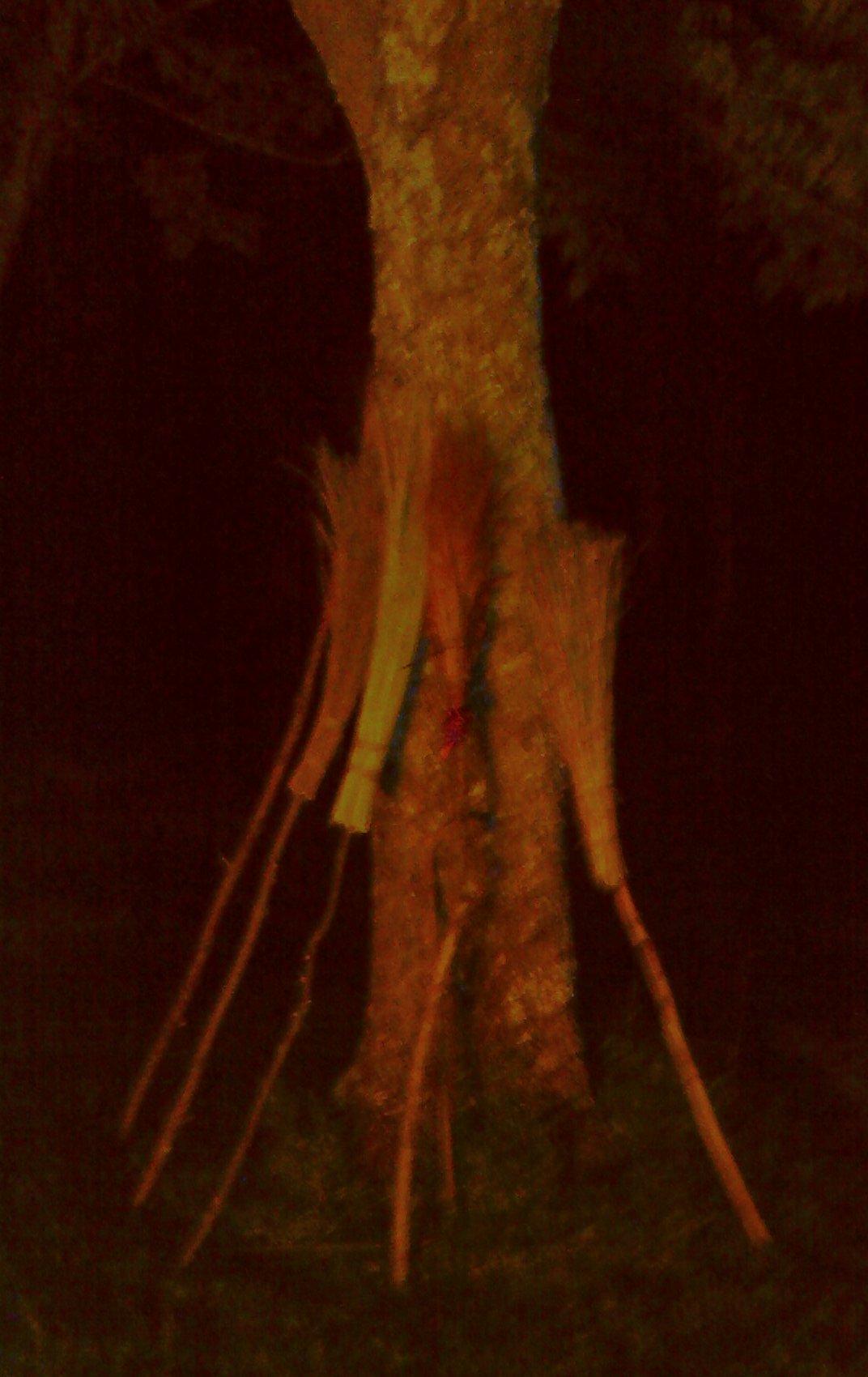
New Brooms Against an Old Tree

By the time our leader  had arrived, the scouts had pretty much removed themselves to the far side of the camp and were engaged in what looked like a snipe hunt (bless ‘em). We  got the fire going and arranged everything we would need for the night.

I can’t say too much about what happened next, but I will say that the following things may have been involved:

  • Black-strap Molasses Rum offerings
  • Leaping the fire on a broom
  • Hedge-Crosser’s Smoke from Forest Grove Botanica
  • An exchange of several magical gifts
  • I may have worn lipstick at one point
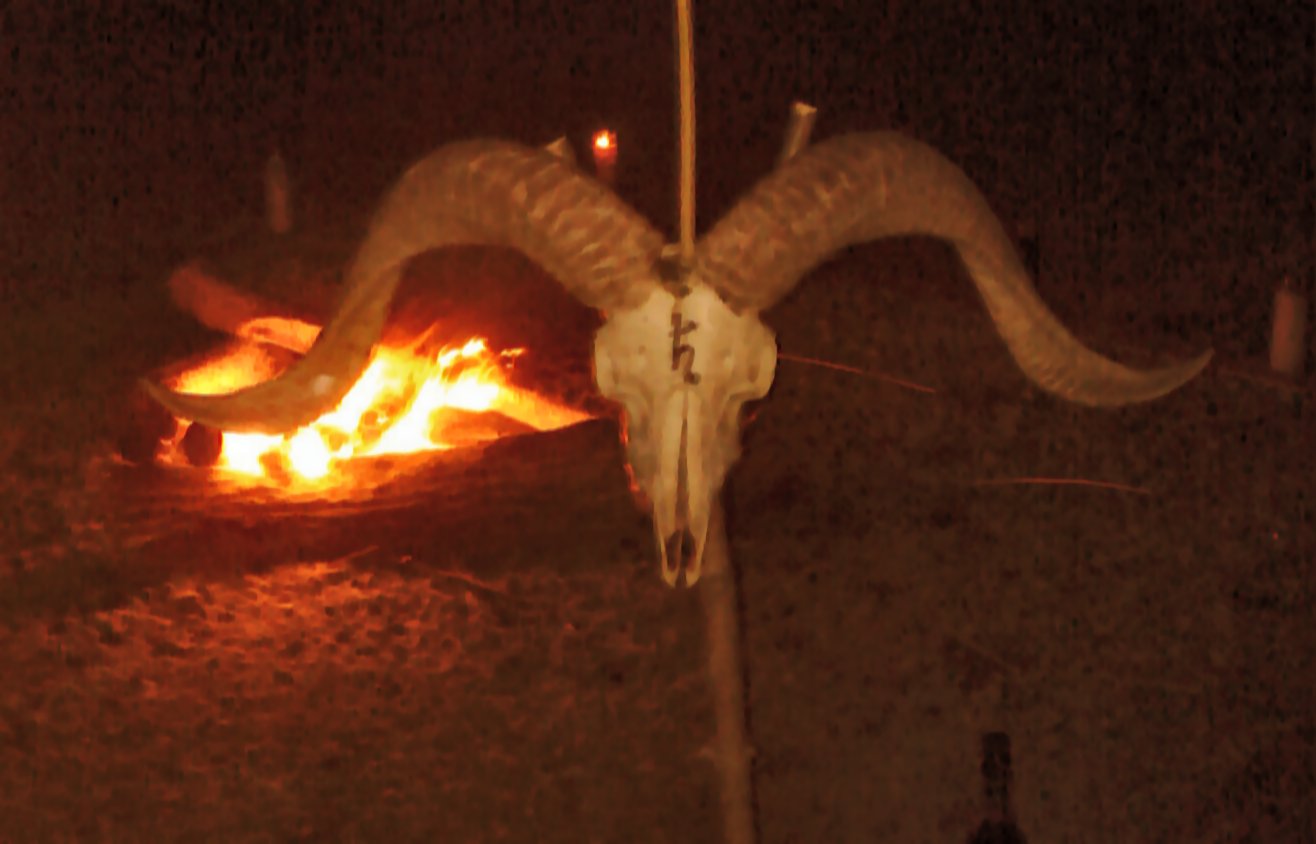
Because it's just not a party until someone breaks out the ram's skull...

Walpurgisnacht proved to be a great night for a few witches to gather around a bonfire, calling upon the dead, riding brooms, leaping through flame, and generally doing all the things the fairy tales say.  We may not have had storms on the Brocken, but the winds definitely started rising before all was said and done.  At one point, I very seriously had to say, “If you hear the sound of horses’ hooves, drop to the ground and don’t look up.”  Maybe it was just my imagination at that point, but the air certainly seemed ripe with witchery.

So, what did you do on Old May Eve? (Or the next day, for that matter.)

-Cory

Blog Post 124 – Tobacco

[A note here:  This is NOT a medical blog, and the information here should not be treated as medical information. I present only folkloric examples of practices historically done by certain people at certain times. Additionally, I am NOT condoning the use of cigarettes, snuff, or any other tobacco product, especially for minors. If you choose to put into practice anything you find here, you take responsibility for your own actions.  Leave me out of it.  Thank you!]

This particular magical herb/plant/ingredient is rather controversial. As a reformed smoker, I know the power of tobacco’s hold on a person—it’s not just the nicotine, but a whole range of psychological dependencies that develop when one is a smoker.  What I’m looking at in this post, however, is not really tobacco as a commodity sold in convenience stores using cartoon animals, but instead the plant found in the Nicotiana genus. Tobacco is a member of the nightshade family (Solanaceae), which includes other rather magical plants like belladonna, datura, and mandrake as well as common (yet mythically significant) edibles like the tomato, potato, and chili pepper.  The plant is also a potent natural insecticide—or insect deterent, rather—and an infusion of tobacco leaves in water is often sprayed in organic garden to keep pests away.

Tobacco, like corn, is deeply significant to certain Native American tribes, who incorporate tobacco into ceremonies and offerings.  Cherokee shamans, for example, would use sacred tobacco in ceremonies designed to combat “night-goers,” evil spirits or people who invaded the dreams of others.  Tobacco smoke was also used as a curative for a number of ailments, and these uses filtered into non-Native practices over time (which we’ll see in just a moment).

When tobacco met European colonists, it experienced a boom in popularity that has kept it one of the top cash crops worldwide ever since—for better or for worse.  It has been deeply wound up in the lives of most North Americans for centuries now, including in their folk medical and magical practices.  One oft-repeated use of the leaf was as a treatment for insect stings and bites, as well as other types of wounds:

  • Tobacco used as a poultice to soothe “abdominal pain…cuts, stings, bites, bruises, and even bullet wounds.” It is thought to “draw out poison” (Randolph, p. 98)
  • “TOBACCO. The leaves are put on a wound to stop bleeding or to prevent infection” (Gainer, p.109)
  • Tobacco, especially homegrown, is good for insect stings and bites (Foxfire 9, p. 66)
  • Wet leaves are wrapped on feet to prevent infection of “full sores” (Cavendar, p. 118-9)
  • Tobacco juice/tea used to wash wounds from snake/dog bites (Cavendar, p. 118-9)
  • A personal informant told me that her grandmother used to put wads of chewing tobacco on cuts, bug bites, and stings to help heal them (informant “Darlene”)

The other chief folk medicinal use for tobacco was the application of smoke to sick or troubled persons.  There were almost as many mentions of this method as there were of the poultice method.  Here are a few:

  • Tobacco smoke can be held in the mouth as a cure for a toothache (Cavendar, p. 118-19)
  • Smoke was blown into an ear for an earache, accompanied by the rhyme “Hurt, Hurt, go away/go into a bale of hay” (Cavendar, p. 118-9)
  • Tobacco smoke is blown into the clothes of colicky children to quiet them, or blown through a straw and “bubbled” in milk as a sedative (Randolph, p.98)

This method clearly derives (I think, anyway) from the Native American medical practices which Europeans adopted in the New World.

The use of tobacco has always had its controversies, of course.  Some objected to it on aesthetic grounds, thinking the act of smoking vulgar and primitive.  Others were disgusted by the smoke and smell associated with the burning leaves.  Still others thought it a waste of money or even a diabolical entrapment for hapless Christians.  One poem I found was circulated in the middle-Appalachians during the nineteenth century and covered all these points:

“Tobacco is an Indian weed,

The Devil himself sowed the seed;

Robs your pockets, burns your clothes,

And makes a chimney out of your nose” (Milne, p. 58)

The religious objections to tobacco were primarily on its use as a vice and an intoxicant.  According to Foxfire 7, the Jehovah’s Witnesses had especial objections to it, and for quite intriguing reasons:  “Smoking has always been completely out of vogue among Jehovah’s Witnesses…As the Society researched the derivations of tobacco and smoking, they found it to be associated with spiritism.”  They also related tobacco to “drugs” used by “priests in pagan ceremony and worship” (Foxfire 7, p. 152-3).

When it comes to purely magical uses of tobacco, the information I found varied a good bit.  Zora Neale Hurston mentions it as a cursing ingredient in a powerful separation spell.  She also tells a very interesting story about a man who takes shelter in an abandoned house only to be joined by a mysterious old man who begins spitting tobacco across the fire at him. When the man attempts to fight the old fellow, he finds himself thrown across the room over and over again.  In this context, there seems to be a subtle current relating the “old man” of the story to the Crossroads Man, Papa Legba, or perhaps the Devil (or maybe even all three from a certain perspective).

One article from 1890 indicated that tobacco was included in mojo bags made with the famous lucky rabbit’s foot.

Cat Yronwode recommends tobacco as an ingredient in court case and spirit contact work.  In this latter capacity, I’ve see tobacco used as an offering to various spirits, particularly crossroads entities and spirits of the dead (Central American folk-saint/crossroads spirit Maximon frequently smokes cigarettes or cigars).  Denise Alvarado’s Voodoo-Hoodoo Spellbook indicates that tobacco is frequently offered to Baron Samedi in the New Orleans Voodoo tradition.

I would also suggest that due to the calmative and drawing effects that tobacco exhibits in folk medicine, it makes a useful addition to house-cleansing and blessing incenses.  A very small pinch added to another incense blend in a well-ventilated house should draw evil spirits out of your home and welcome friendly (and particularly, ancestral) spirits into it.  If you or anyone you live with cannot abide tobacco smoke, however, consider burying a little cut tobacco leaf at the four corners of your property to produce a similar effect.

Lastly, if you choose to smoke tobacco in a ritual context, consider whispering prayers as you exhale smoke.  It makes a fantastic visual focus point to see your requests and adoration slowly rising from your mouth and into the air.  Again, I don’t condone smoking (especially not outside of a very occasional ritual setting), but if you do incorporate it into your practices, I hope that this suggestion helps.

That’s it for the devil-weed tobacco!  I hope this proves useful to some of you out there.  Please let me know if you have any other magical or folk remedy uses for tobacco leaf in the comments below.

As always, thanks for reading!

-Cory

Blog Post 123 – Corn

[A note here:  This is NOT a medical blog, and the information here should not be treated as medical information. I present only folkloric examples of practices historically done by certain people at certain times. If you choose to put into practice anything you find here, you take responsibility for your own actions.  Leave me out of it.  Thank you!]

Today’s topic may not exactly pop out at you as a magical one (I beg forgiveness in advance for the bevy of bad puns this article may include), but corn is actually spiritually and magically significant in several parts of the North American continent.

Corn, or as most of the rest of the world knows it, maize (of the species Zea mays) is a crop which was domesticated by early Mesoamerican cultures and which has been a native staple food for thousands of years now (though its widespread use throughout all of North America may only be about one millennium old).  It has proven both extremely useful and occasionally problematic.  It is fairly easy to grow, and can be processed into any number of products, from food and food additives to industrial lubricants and even plastics.  I’m not going to get into the heavily heated debate about corn as a commodity crop and its place in modern economics and agriculture, as this is not a blog about either of those topics.  I will say, however, that while corn may have its downsides, it also has much to offer culturally and culinary, especially the homegrown sweet varieties (can’t imagine a summer barbecue without it!).

Native Americans depended greatly on corn for survival, and it figured in several native mythologies.  One of the best known stories is that of Kana’ti and Selu, the Hunter and the Corn Mother, from Cherokee mythology.  In this story, mother Selu tells her children that they must drag her body over the land when she dies and that corn will sprout wherever her corpse has been.  In this respect, her tale is not so very different than the John Barleycorn legend.  Folklorist James Mooney demonstrated that this story has parallels in Huron mythology as well (he also mentions that the Iroquois grow a specific type of magical tobacco, which is the subject of an upcoming post).

Picture of a Mid-Atlantic Cornfield with a Remnant Corn Offering, via listener Chet

Listener Chet wrote in with a bit of folklore regarding the Corn Mother from the Central Atlantic coast:

“I read an article, while researching the corn maiden aspect, that covered the offering and adoration of a field spirit not only in NA culture, but all over the world…what quite a few would do is, leave a section of the field uncut, as an offering to the Maiden. I had seen these areas, the past few years where I live, and really had no idea what the uncut areas were about until I read this article. So here we are at harvest time again, and I am seeing these areas once again. So I took a pic of one (see attached corn pic). I have a feeling these farmers are not actually making an offering to the Miaden per se, but the tradition seems to have carried over, so maybe it’s bad luck, to not leave part of the field uncut.”

Chet also included a bit of information on his own practices, including his practice of reburying part of any harvest as an offering to the Corn Mother.  Big thanks to him for the local lore and for the photo!

Moving into the Appalachians, corn becomes magical and medicinal, depending upon its application.  A variety of sources indicate that tea made from corn silk (the long, slightly sticky strands which jut out from the top of the ear and which serve as pollination conduits during the corn’s growth cycle) is excellent for clearing up kidney and urinary tract ailments.  This sentiment popped up in Foxfire 9, Anthony Cavendar’s Folk Medicine in Southern Appalachia, and even Karl Herr’s Hex & Spellwork (which indicates to me that it found a home with the PA-Dutch and the mountain folk alike).  Patrick Gainer shares an interesting West Virginian folk magical technique for healing warts.  According to his Witches, Ghosts, & Signs, warts are cured by making them bleed, rubbing the blood on corn kernels, and feeding the kernels to chickens.  This could be very similar to jinx-removing practices in hoodoo which also use chickens.

Folk Medicine in Southern Appalachia rates corn as a top botanical panacea for mountain people:

“It may come as a surprise to some that Southern Appalahcians used cultigens like apples, corn, [etc.] as much as, if not more than, herbs for many illnesses.  The juice, silk, kernels, and shucks of corn, for example, wereused for a variety of illnesses” (p. 64).

Some of the cures listed in the book’s pages:

  • Corn milk/juice used to treat skin irritation
  • Warm cornmeal to treat sprains and mastitis
  • Corn fodder burned to smoke/sweat out measles

In the Ozark Mountains, Vance Randolph records a couple of bits of lore about corn, one of which is quite unique: “Some hillfolk of Indian descent insist on sprinkling a little cornmeal over a corpse, just before burial” (p. 315).  In light of Chet’s lore about burying corn as an offering to a Mother-figure and/or the land, I think this is pretty fascinating.  Is the corn an offering, and if so, is it for the actual deceased person, or for the land which will be surrounding that person soon?  Randolph also mentions a bit of weather lore, noting that the thickness of corn shucks indicates the severity of the coming winter.

Finally, I can’t discuss corn without at least mentioning the corn dolly which is so ubiquitous around Imbolc/Candlemas.  I won’t go into that particular association, as it seems to be well covered in other places, but I will say a corn dolly makes a very useful poppet for working figure magic, especially since it’s easy and cheap to find the basic materials you need (if you don’t have corn growing anywhere around you, look in the Hispanic portion of your local grocery—husks are almost always available there as tamale wrappers, and usually quite inexpensively as well).  Recent New World Witchery interviewee Dr. E mentioned the corn dolly poppet, if you’ll recall, and I think it’s an excellent way to craft a magical doll, especially one for burial or burning.  They tend to be easy to stuff with herbs and things like hair or fingernail clippings, and they can be made without requiring much skill (trust me on this, I know from experience, or rather, obvious inexperience). There are plenty of great places to learn dolly-making, but since I like the series so much I’ll go ahead and eagerly recommend the corn dolly tutorial found in Foxfire 3 (on pp. 453-460).

That’s it for corn (at least for now).  If you’ve got some magical lore regarding the use of corn, I’d love to read it!  Until next time, thanks for reading!

-Cory

Podcast 26 – Storytelling and an Interview with Dr. E

-SHOWNOTES FOR EPISODE 26-

Summary
This episode has Cory flying solo while Laine is away (she’ll be back!). He discusses storytelling, and shares three tales with some common themes from Ashanti, Bahamian, and Southern African-American sources.  Then we have a great interview with Dr. E, a conjure man and Lukumi priest.

Play:

Download:  New World Witchery – Episode 26

Sources
Some great storytelling resources:
The Story-Teller’s Start-up Book, by Margaret Read McDonald
The Storyteller’s Guide, by Bill Mooney
Hedge-Folk Tales, by Sarah Lawless (podcast)

The three tales I told today are:
“Anansi & Anene” from the Ashanti
“Fishing on Sunday” from the Bahamas
“Brer Rabbit and the Well” from the Uncle Remus tales
(all adapted from versions found in A Treasury of Afro-American Folklore, Harold Courlander, ed.)

I recommend the Year in White Podcast for more information on Lukumi practice.

And of course, Dr. E’s Sites:
The Conjure Doctor Blog
The Conjure Doctor Shop
Dr. E on AIRR (Assoc. of Independent Readers & Rootworkers)
Dr. E on Twitter
Dr. E on Facebook
The Lucky Mojo 2011 Open House Hoodoo & Rootwork Weekend, where he will be teaching a class on doll-baby construction

Promos & Music
Title music:  “Homebound,” by Jag, from Cypress Grove Blues.  From Magnatune.
Promo 1 – The Pagan Homesteader
Promo 2 – Witches’ Brewhaha
Promo 3 – Borealis Meditation

Blog Post 122 – Bibliomancy

I thought today we would take a look at one of the many divinatory systems found in the New World, and one which has remained popular through the centuries:  bibliomancy.  We discussed this topic during our most recent episode, but I have wanted to expand upon it a bit.  The practice of bibliomancy as a form of divination is common enough in the New World that many folks who wouldn’t touch any other type of magical practice might be persuaded to do at least one of the methods below.

Probably the most commonly used book for bibliomancy is the Christian (or in some cases, Hebrew) Bible.  Other texts can be used, however, and it would not be out of place to turn to a favorite book of poetry, a dictionary, an encyclopedia, or any other piece of writing.  The overarching control factor seems to be that the inquiring party must feel the book has some kind of power.  Whether that power is religious/spiritual or simply the force of knowledge or even a fondness born of favoritism does not seem to matter much; just the reverence offered the text is enough to imbue it with oracular power.

The methods for bibliomancy break down into roughly three categories:  scanning the text (either at random or specifically), using interpretive devices such as dice, and a very particular technique involving a key.

Scanning

This is probably the most familiar method, and the one which is least likely to raise eyebrows among laity.  People frequently look for signs from God or at least from somewhere else to help point them towards good decisions in times of doubt (or they like to have signs that affirm their choices, depending on your perspective).  I’ve known even the most skeptical and non-magically inclined folks to flop open a Bible and point at the page without looking in order to find what will hopefully be a relevant quote.  For those who want a little more magic in the process, however, it might help to get into a ritual mindset before posing questions to the Divine.  In Draja Mickaharic’s Magical Spells of the Minor Prophets, he notes:

“When selecting a verse that is pertinent to the situation the person finds themselves in, it is generally necessary that the person looking for the verse compose themselves and place a bible before them, either on their lap or on a table.  They then are to concentrate upon the matter that troubles them.  Once the true question is firmly in the mind of the person seeking an answer, the bible is opened randomly, and without looking at the pages, a finger is set upon some part of the page.  The verse so indicated by the person’s finger would then reveal some advice, or lead to a solution to the question that has been poised, or even reveal a solution to the problem at hand” (p.125)

There are other ways to consult a holy book for heavenly guidance, too.  Jewish folklore and magical practice interprets scriptural passages incidentally, rather than just directly, for instance.  From Jewish Magic & Superstition by Joshua Trachtenberg:

“The familiar use of Scripture in divining (Bibliomancy) was not unknown to Jews. The Romans had thus employed Vergil [sic]; the Bible was already put to this use by Christians before the eight century; in medieval Germany hymn- and prayer-books served the same purpose. But Jews did not have to borrow this device from their neighbors.  In Talmudic times it was common practice to ask children what verses they had studied that day in school, and to accept them as good or bad omens, an expedient that persisted throughout the Middle Ages.  The more usual procedure of opening the Bible at random and taking the first word or sentence that strikes the eye as a portent, was also followed.  Similarly, ‘if, upon awakening, one recalls a Biblical verses, this passage is to be regarded as a”minor prophecy,” and if it is an ominous passage, one should fast.’” [footnoted to   Pa’aneah Raza on Leviticus and Perles’ Beitrege] (p. 216)

Trachtenberg goes on to say that no special skills were required for bibliomancy and anyone can do it, and that it is also connected to the act of sortilege/casting lots (much like the Dice Method).

One of the more peculiar and interesting methods of scanning a text for magical guidance comes from New World Witchery standby Vance Randolph:

“Many hillfolk tell fortunes and predict marriages by means of certain quotations from the Bible.  For example, the twenty-first and thirty-first chapters of Proverbs have thirty-one verses each.  Chapter 21 is the man’s birthday chapter; chapter 31 is the woman’s birthday chapter.  A boy looks up his proper verse in the man’s chapter, according to the date of his birth.  A man born on the twenty-third of any month, for example, reads Proverbs 21:23—the content of this verse is supposed to be equally significant to him” (OM&F, p. 184)

In my case, the Proverb says, “The plans of the diligent lead surely to plenty, /But those of everyone who is hasty, surely to poverty.”  Patience has been a long-standing goal of mine, even from when I was very young, so I do think this method may hold some merit.  Or it may be a strange coincidence.  Either way, I really like it for its unique spin on a traditional method.

Dice

I mentioned this method in Podcast 25, too, but I thought it would be good to write it out here for those who are interested.  Connected to one of the few methods of divination not condemned by the New Testement—casting lots—the use of dice in conjunction with the Bible might raise eyebrows now, but it actually makes a great deal of sense.  And when you consider that dice were (and are) often made of bone, the vaguely necromantic side of this method begins to surface.  The method cited here comes from Judika Illes’ Encyclopedia of 5000 Spells:

Lord Thoth’s Trio

Thoth, Egyptian lunar god, is given credit for inventing books, magic, and dice.  All are combined in the following method.

  1. Formulate your question, while holding dice.
  2. Close your eyes and flip open the book.
  3. Gently, with eyes remaining closed, toss the dice onto the open book.

Read the passage indicated by the location of the fallen dice.  An alternative is to read the passage indicated by the numbers shown on the dice—thus you might begin on the sixth line, third word or similar.  If using numeral coordination, it’s not necessary for the dice to actually land on the page, although both methods can be integrated.

There’s no reason other interpretive items could not be used similarly, though the precedent doesn’t exist to my knowledge.  I can imagine, however, that a deck of cards could be likewise consulted in conjunction with the holy book of choice, and the number or value of the card taken as a guidepost in determining which verse to read.

Keys

Arrow over at the Wandering Arrow blog actually mentioned this a while ago, and it’s her post (and an email she sent me) which really sparked my entire research bender into the subject.  The overall method seems to derive from a folk Catholic practice which was outlined in Reginald Scot’s 1584 treatise on magic, The Discoverie of Witchcraft.  In this book, Scot lampoons the “popish” superstitions of the Catholics, and cites an example of their folk magic involving a scriptural text (a psalter) and a skeleton key:

“Popish preests (saith he) as the Chaldceans used the divination by sive & sheeres for the detection of theft, doo practise with a psalter and a keie fastned upon the 49. psalme, to discover a theefe. And  when the names of the suspected persons are orderlie put into the  pipe of the keie, at the reading of these words of the psalme (If thou  sawest a theefe thou diddest consent unto him) the booke will wagge, and fall out of the fingers of them that hold it, and he whose name remaineth in the keie must be the theefe.” (Ch. 5)

The Psalm cited, the 49th, is full of memento mori imagery, reminding the singer that death comes to all, and none escapes God’s eye.  The connection between this method and the sieve and shears method—both of which involve tenuously suspending something and asking questions until it begins to move—is also interesting, as the sieve and shears appear in witch folklore, too (see “The Horned Women” tale from Ireland).  Scot’s mention of this form of bibliomancy is brief, though, and a a more thorough description of the method can be found in Draja Mickaharic’s Magical Spells of the Minor Prophets:

“In the second method of divining using the bible, a key, one of those old fashioned ‘skeleton keys,’ is used in addition to the bible.  The key is placed somewhere in the bible, keyed end first, so that the turning end protrudes, sticking out of the wide end of the bible.  To keep the key in the bible in this manner, the bible must be tied closed.  This may be done with rubber bands or with string, however the person desiring to read in this manner chooses.  Irregardless of how the bible is held closed, it is important that it be tied or held tightly, as the bible will be suspended from the key when this work of divination is being done.  Once the key when this work of divination is being done.  Once the key is fixed in the bible in this manner, the bible is suspended from the fingers of both hands, usually one finger under each of the keys turning end.  In that precarious position, a question is asked, either having a yes or no answer, or several questions.” (p. 125)

In this method, the person reading must determine what yes and no are before asking the question, whether it turns or wobbles one way or the other.  Mickaharic says this is very effective, and that “the first time I did this, the bible actually jumped from my fingers when the question was answered with a no.”

This method is also backed up by practices within the hexenmeister community.  In Chris Bilardi’s Red Church, he provides an almost identical system for inserting a key into the Bible, binding it, and suspending it while asking questions.  He is more specific about which books to use, however:  “Take the key and place it into the Bible.  Some traditional places to put it are the Book of Ruth (Chapter 1), the Gospel of John (any of the Four Gospels, really), and the Epistle of James” (Red Church, p. 303).  It’s very interesting to me that the Book of Ruth shows up repeatedly in magical bible study.  That might be a topic for another day, though.

So that’s it for basic bibliomancy!  I hope this has been informative and useful to you.  If you have any other examples of this method, or stories to share about using this or similar techniques, we’d love to hear them!

Thanks for reading!

-Cory
Blog Post 121 – Watching Birds

Today we’ll be looking at birds and their place as divinatory aids in the New World, something we touched on briefly in the second post on Magical Animals.  Birds have historically been turned to by humans for secret knowledge, largely owing to their unfettered freedom to fly from place to place.  Virtually all mythologies have some tale of a great mythic bird:  the Roc in the Arabian Nights’ Entertainments, Zeus’s swan-form, the Thunderbird of some Native American stories, and the haunting Crane Dance of Japan are some of the better-known examples. A creation myth of the Haida people of the Queen Charlotte Islands says that a raven, lonely in his long flight, spit upon a clam and opened it up, freeing the first humans (see Magical Creatures by E. Pepper & B. Stacy for more on this).  What have birds to do with divination, though?  Many readers probably already know about the branch of fortune-telling known as augury, but for those who haven’t heard of it, it simply means predicting fate by observing the flights of birds.

So how does one go about performing augury?  Here things get a bit fuzzy—in some cases, the future comes as a vision released by a relaxed mind observing with detachment the loops and turns of soaring birds.  Portuguese writer Paulo Coelho incorporates this type of augury into his novella, The Alchemist when he has a young shepherd accidentally catch a glimpse of coming war while he watches two hawks diving over desert sands.  The other method, and the one which makes up a good bit of North American lore, simply involves noting the behavior of birds and interpreting it by means of known connotations.  This sort of augury has numerous manifestations, and is especially prominent in Appalachian lore.  Folklorist W. L. McAtee recorded a number of bird-related divinations in an essay from 1955:

From “Odds & Ends on North American Folklore on Birds,” by W. L. McAtee:

  • “[I]f ever a bird builds in your shoe or pocket, or any of your clothes, you may prepare to die within the year.”
  • “The loon, a favorite with folklorists, is called ‘Bad Luck Bird’ by the natives [of the Sea Islands of Georgia], who will not speak of it, or if possible even look at it when they meet it in a journey by water.”
  • “While recording the common beliefs as to the storm petrels, that ‘Their appearance portends bad weather,’ Mrs. Simcoe [McAtee’s informant] adds: ‘To kill them is unlucky. Each bird is supposed . . . to contain the soul of a dead sailor.’
  • “The Reverend J. H. Linsley in his Birds of Connecticut (1843) noted that the cry of the bittern is a cause of superstitious fear and recorded that one man hearing it ran a mile, saying, that the Devil was after him.”
  • “’A token,’ said Archibald Rutledge [another informant], writing of the Santee Country, South Carolina, ‘is an apparition foretelling death,’ and cites as examples an eagle feeding with black vultures, a wild turkey standing alone under a certain great oak tree, and an albino robin.”
  • “[An] Abundance of people here look upon [whip-poor-wills] . . . as birds of ill omen, and they are very melancholy if one of them happens to light upon their house, or near their door, and set up his cry (as they will sometimes upon the very threshold) for they firmly believe one of the family will die very soon after.”
  • “Canada Jays are supposed to embody the souls of hunters or lumbermen who die in the north woods and it, therefore, brings bad luck to kill them.”
  • “In western North Carolina, it means seven years of bad luck to kill a raven.”
  • “To end this section on a more cheerful note, we cite the Ozark fancy that ‘If a redbird flies across a girl’s path . . . she will be kissed before night.’”

Other mountain lore about birds tends to focus on weather prediction (a subject we’ve covered in our posts on Signs & Omens to some extent, but you can never have enough weather-prediction lore).  Patrick Gainer observes: “When the geese wander on the hills and fly homeward squawking, there will be a storm within twenty-four hours,” and “When the red birds call in the morning, it will rain before night.”  Vance Randolph records some Ozark lore along the same lines:

  • Chickens or turkeys standing with their backs to the wind and with ruffled feathers mean a storm’s coming.
  • A rooster crowing at nightfall portends rain through the dark hours.
  • A sudden burst of robin-song foretells of bad weather.
  • Kingfishers nesting near the water mean a dry season to come.

Birds seem indelibly linked with concepts of luck and death, too.  Anyone who’s seen the 90’s cult film The Crow probably remembers the voice-over at the movie’s opening telling a pseudomyth about how people once believed that a crow ferried souls between the land of the living and the land of the dead, and occasionally allowed one to come back for vengeance (I call this a pseudomyth not because there’s no truth in it, but rather that I’ve never been able to find exactly that myth borne out in folklore, though there are certainly close correlatives to it—corvids are often associated with death).  There are many other pieces of Appalachian lore in this vein:

  • Barn swallows bring good luck where they nest, and it is bad luck to shoot one. (Randolph, OM&F)
  • Redbirds or roosters lingering near one’s doors or windows tend to mean tragedy will come soon after. (Randolph, OM&F)
  • Whippoorwills nesting at a home mean death will soon come to it. (Randolph, OM&F)
  • If a bird flies in the window, someone in the family will die. (Gainer, WG&S)
  • It is bad luck for a hen to crow. (Gainer, WG&S)
  • “Owls are omens of great ill.  If you spot one nearby while you are inside your home, the direction in which it flies away is an indication of the fate of your household.  If it flies off to the left of the cabin, very bad luck can be expected, but if it flies off to the right, it indicates an evil influence has chosen to pass you by.”(Edain McCoy, In a Graveyard at Midnight)
  • “Many western occult traditions regard peacocks as omens of ill fortune and their feathers as tokens of bad luck.” (Pepper & Stacy, MC)

Finally, in the category of “Odds & Ends,” there are some really spectacularly unique bits of North American folklore about birds which come from all over:

  • Buzzards will vomit upon anyone guilty of incest. (Randolph, OM&F)
  • “When you hear the first robin sing in the spring, sit down on a rock and take off your left stocking.  If there is a hair in it, your sweetheart will call on you soon.” (Gainer, WG&S)
  • “If a bird flies down and gets tangled in your hair, it is an indication that the bird has linked itself with your soul, and whatever befalls the bird is likely to befall you also.” (McCoy, IaGaM)
  • Richard Dorson records a legend in Buying the Wind found amongst Illinois “Egyptians” (or what many would call “Gypsies”) about a mouse, a bird, and a sausage who all keep house together until the sausage is eaten and the mouse accidentally kills himself that feels like it must have some embedded magical meaning, though I’ve yet to figure it out.

That’s it for our bird-watching entry.  If you’ve got lore you’d like to share about birds, we’d love to hear it!  It certainly gives me a good reason to keep watching the skies, so please feel free to comment with any augury methods you’ve got.

As always, thanks so much for reading!

-Cory

Podcast 24 – Love Magic

-SHOWNOTES FOR EPISODE 24-

Summary

Tonight’s show is all about the love…magic!  We discuss different types of love spells, the ethics of casting them, the power of scent to inspire love, and the famous Love Potion #9.

Play:

Download:  New World Witchery – Episode 24

-Sources-
Earth Power – Scott Cunningham
Ozark Magic & Folklore – Vance Randolph
Mules & Men and “Hoodoo in America” – Zora Neale Hurston
Voodoo & Hoodoo – Jim Haskins
Witches, Ghosts, & Signs – Patrick W. Gainer
Buying the Wind – Richard Dorson
The Voodoo Hoodoo Spellbook – Denise Alvarado

Promos & Music
Title music:  “Homebound,” by Jag, from Cypress Grove Blues.  From Magnatune.
Promo 1 – Forest Grove Botanica
Promo 2 – Wigglian Way
Promo 3 – The Infinite & the Beyond

Blog Post 119 – A Little Love Magic

I’m sure with Valentine’s Day just around the corner, I won’t be the only one to cover today’s topic:  love magic.  Yes, I know that Valentine’s is a commercial holiday designed to sell greeting cards (or something like that), but this seems as good a time as any to introduce some of the folklore and magic surrounding that strange, powerful feeling of love which seems to rule over so much of our human existence.  We’ll also look a little at lust, though I’ll likely save a detailed discussion for a sex magic post of some kind.

I should also say that this little article only scratches the surface of the overall material on this enormous branch of magical practice.  Love spells seem to be some of the most commonly sought and most often used enchantments in the world, so any blog post on them will necessarily be rather skint on details.  Also, this particular article is a sort-of companion to our upcoming podcast episode, which will be on this topic as well.  In the episode, we’ll discuss things like the ethics of love spells, so I only really want to touch on the lore and some of the basic spell ideas here.  Of course, if you want to leave comments or send emails regarding questions of ethics, I fully support that!

So what is love magic?  Most people would probably understand a spell cast by a young man on his high school crush to make her go out with him as a type of love spell, but what about a spell cast by a wife on an errant husband to make him stay a little closer to home?  Is a spell to spice up things in the bedroom a love spell, or just a lust spell, or maybe a little of each?  As I pored over the research, I found that there are several distinct categories for love magic:

1)      General-purpose love spells, such as wearing rose quartz, hanging a “loving bell,” spells to help a girl find a beau/husband soon, etc.

2)      Love divinations, like dream interpretations, carrying a four-leaf clover in the bible, catching a bouquet at a wedding, etc.

3)      Lust magic & aphrodisiacs, like the famous Love potion #9, dried turkey bones, powdered bird tongues, vanilla, etc.

4)      Person-specific love spells, which make one particular person fall in love with another, using things like hatbands/socks, mirrors, a particularly ghoulish dead-man’s mojo, etc.

5)      Magic for staying together, common in hoodoo, such as tying a man’s nature, writing bloody initials for reconciliation, menstrual blood in food, etc.

6)      Splitting up work, designed to break a couple apart using things like the black cat/dog hair spell, Hurston’s nine needles spell, etc.

Taking these various categories—which are just my understanding of the material, by the way, and should not be taken as gospel—let’s look at some of the individual spells, beliefs, signs, and ceremonies associated with each one.

A word of warning before we begin: I DO NOT ADVOCATE THE USE OF ANY OF THESE SPELLS. I’m presenting them as matters of folkloric record only.  Many of these techniques and/or formulas can be unsanitary or downright dangerous, so please keep that in mind as you read.

General-Purpose Love Spells

This category is fairly well addressed in modern neo-Pagan magical texts, so I won’t get much into it here.  I recall learning early on from Scott Cunningham’s Earth Power and other books like it that rose quartz could be worn to draw love to you, or just inspire loving feelings in you.  Oraia from Media Astra ac Terra covers the metaphysical properties of rose quartz very well in Episode 20 of that show, so if you want more info, I’d suggest listening to her examination of it.

Cunningham’s book also contains a spell for a “Loving Bell” which involves hanging a small bell somewhere the West Wind can touch it, reciting a little chant, and waiting for the bell to “whisper” your desire for love onto the wind, calling a lover to you (p.46).

Another basic spell from Draja Mickaharic’s A Century of Spells calls for burning a candle anointed with a mixture of basil and almond oil to draw love into one’s life.

As far as North American folklore goes, general-purpose love spells are actually a bit rare.  They most often tend to be focused on getting a spouse or preventing spinsterhood (forgive the sexist language there, but these do seem to be customs targeted at women).  For instance, in Vance Randolph’s Ozark Magic & Folklore he mentiones that Ozark girls will pin pieces of a wasp’s nest inside their clothing to draw courtship from men.  Randolph also mentions a peculiar love charm that he encountered in the mountains and which reputedly brought love into a young girl’s life:

“Many mountain damsels carry love charms consisting of some pinkish, soaplike material, the composition of which I have been unable to discover; the thing is usually enclosed in a carved peach stone or cherry pit and worn on a string round the neck, or attached to an elastic garter. I recall a girl near Lanagan, Missouri, who wore a peach stone love-charm on one garter and a rabbit’s foot fastened to the other.” (p. 166)

It’s not unreasonable to think that the “pinkish, soaplike material” may well be a piece of rose quartz.  Or, it may be something else entirely.  Patrick W. Gainer records the oft-repeated superstion that if someone sweeps under or on top of a girl’s feet, she will never marry, so girls were very careful not to let that happen.  Taking the last bite of any food at the table meant that a girl should kiss the cook or else end up an old maid, too.  Gainer also says that a girl who hold’s a bride’s dress on her lap within ten minutes will marry within a year and that if a girl lends her garter to a bride on her wedding day, she can expect to marry soon, too.

Love Divination

There are so many wide-ranging methods of determining a future lover’s identity that it would likely give me carpal tunnel and send my readers into a glazed-eye coma trying to list them all.  Divining one’s future love life is probably the most common form of divination, and can be found everywhere from the playground to the wedding chapel to the funeral home.  Most folks know about catching bouquets and garters at a wedding to indicate who the next to be married will be.  Some of the more unusual methods of determining one’s romantic future are:

  • Dream of a funeral and attend a wedding
  • Count seven stars for seven nights, and you will dream of the man you will marry.
  • To dream of the man you will marry, take a thumbful of salt the night before Easter
  • Marry soon if you dream of a corpse
  • If two forks are at a place-setting on the table, the one who sits there will be married.
  • Put three holly leaves under your pillow at night and name each leaf.  The one that is turned over in the morning will be the name of your husband.
  • Put a four-leaf clover in the Bible.  The man you meet while you are carrying it will be your husband.
  • On the first day of May before sunrise, if you see a snail within a shell, your future husband will have a house.  If the snail is outside the shell, he will have none.  Sprinkle meal in front of the snail and it will form the initial of the man you are to marry.
  • Walk around a wheat field on the first day of May and you will meet your mate.
  • The white spots on your nails tell how many lovers you will have.
  • On the first day of May, look into a well and you will see the face of your future husband.

There are lots of other methods for determining a future spouse, of course, such as peeling an apple in one long strip and tossing it over your shoulder to determine the initial of one’s eventual husband or wife.  Several Halloween traditions also focus on love divination, such as throwing nuts into the fire to see if they pop or fizzle, thus reflecting the strength of the love between those who threw.  Really, we could be here all day with these, so let’s just say a little reading will reveal a plethora of divinatory options to the curious witch.

Lust & Aphrodisiacs

This is another broad and often-discussed topic, and one which folks can get into heated debates about very easily.  For instance, many people contend that certain foods—chocolate, oysters, strawberries, etc.—act as aphrodisiacs and cite medical reports to back up their claims.  Others cite counter-claims which demonstrate that any aphrodisiac effect from food is purely psychosomatic /placebo effect.  Love potions are incredibly popular, so much so that there’s an enduring pop song by the Searchers entitled “Love Potion No. 9,” which later inspired a popular film of the same name (featuring the lovely Sandra Bullock).  I’m not going to get into the ingredients for that potion here, but if you’re interested in it, the upcoming Spelled Out segment on the podcast will look at one recipe for this famous draught.
In American folklore, many ingredients can be brewed into love potions and used to drive a partner wild.  Randolph records that yarrow is used in love potions given to men, as are dodder/love vine/angel’s hair, lady’s slipper, and mistletoe.  Boys make a love potion from a wild gander’s foot, powdered and put into a girl’s coffee.  The use of bird ingredients in such potions is rampant, inlcluding the use of powdered turtle-dove tongue, chicken hearts, and rooster blood for various love and beauty blends.   Girls in the Ozarks would keep dried turkey bones in their rooms in order to seduce their beaus when the time was right, too.

Randolph also mentions that a woman can surruptetiously touch a man’s back to inspire feelings of lust in him.  Zora Neale Hurston says in her essay “Hoodoo in America” that a potent aphrodisiac charm from Jamaica includes mixing angle worm dust with High John chips and wearing this as a mojo around the waist.  Oils and powders such as “Come to Me Boy/Girl” and “Chuparosa” are also used to intoxicate a lover’s senses and make him/her crazy with lust and love.  There’s also a hoodoo formula called the “Hot Mama Douche” which is juniper berries steeped in vinegar and which is designed to bring a woman all the sex she can stand. Vanilla, dabbed behind the ears, is also reputed to drive men wild.

Person-specific Love Spells

These are the controversial, yet oft-sought after, spells which one person uses on another to command love.  There are a lot of ethical questions involved in these enchantments, and I won’t get into my perspective on them here (though I do talk a bit about it on the show).  As the folklore goes, there are a lot of ways to make someone yours through magic.  Most of them involve putting a little bit of yourself—such as urine, blood, or sweat—into them, often via food.  Wearing the other person’s clothing, especially intimate clothing that has had contact with their skin or which has encircled some part of their body (like a ring, hatband, glove, sock, etc.) will also allow you to command their love.  Some examples:

  • If a girl steals a man’s hatband and wears it as a garter, it will make him fall in love with her (Randolph, OM&F)
  • Socks and hatbands can be used to rule unruly men (Hurston, Mules & Men).
  • Turning down a man’s hatband and pinning two needles in it in a cross-wise fashion makes him love you (Haskins, Voodoo & Hoodoo)

Other spells to gain the love of a person include tying poppets/dolls together, knotting used clothes from each person together, or burying personal items from that person on your property.  In this latter vein, Zora Neale Hurston records an interesting spell using the person’s image captured in a mirror:

“To bind a lover to a place: a) This is for a girl: Let him look into a mirror but don’t you look into it. Take it home. Smash it and bury it under the front steps and wet the spot with water. He cannot leave the place. b) This is for a boy: Take three locks of her hair, throw one over your head, put one in your bosom, and one in the back of your watch. Then do the same thing with a mirror that the girl does and she is tied. You can’t undo this.” (from “Hoodoo in America”)

Similarly, getting a potential lover to walk over or under a charm specifically planted to catch his/her love can be very effective.  Hurston’s Mules & Men contains the following spell:

Use nine lumps each of starch, sugar, & steel dust wet with Jockey Club perfume and put into nine mojo bags tied with red ribbon.  Put these all around his home (or yours), especially at entrances and under rugs, and he will be unable to resist you.

As I mentioned before, the best ways to gain control of a lover tends to be to make him or her ingest something that has a bit of one’s own bodily fluid.  Randolph mentions the use of menstrual blood in drink (though I usually find that more connected to the next section, “Magic for Staying Together”), as well as using whiskey in which fingernail trimmings have been soaked.  In Folk Beliefs of the Southern Negro, Newbell Niles Puckett records a love charm which uses bathwater to similar effect: “a great love charm is made of the water in which the lover has washed, and this, mingled with the drink of the loved one, is held to soften the hardest heart.”

Magic for Staying Together

When a relationship hits a rough patch, people often do all sorts of things they wouldn’t normally do.  While some spells in this category are designed to bolster the already strong bonds between two happily enamored people, more often than not these spells are done out of desperation.  A wife wants to keep her philandering husband at home and away from other women.  A man wants to bring back a lover who has left him.  These aren’t particularly happy spells, but they do make up a good bit of the overall love spell genre, so here are a few of the more common or more interesting ones.

One spell I found repeatedly, and one which I mentioned in the previous section, was the use of menstrual blood in food.  It appeared in the folklore from multiple cultures and always with the same basic idea: a little of a woman’s menses in a man’s food or drink will make him absolutely hers and keep him from ever straying.  Urine occasionally pops up in this method, too, though it is far less common.

Other methods involve attaching something to a man’s clothes to mark him as one’s own.  In Hurston’s “Hoodoo in America” she notes in Section 9 that there is a such a ritual for regaining and binding the affection of an errant man. It is given in the “dialogue with Marie Laveau” style which is also in the N.D.P. Bivens text Black & White Magic of Marie Laveau. It involves using Van Van and Gilead buds placed in the man’s clothes or fashioned into a talisman for him to wear. A picture of Mary is then prayed over, and the man is supposed to stray no more.

Randolph’s Ozark informants revealed a number of methods for keeping or returning a straying lover, including:

  • A girl can write her initials and her sweetheart’s using the blood from the third finger of her left hand in order to reconcile with him after a fight.
  • Salting a fire brings an absent lover home, as does leaving one’s shoes in a “T” formation by the hearth.
  • A girl can clean her fingernails on Saturday, say a “mysterious old sayin’” and make a man visit her on Sunday. Mountain boys even say ‘my gal fixed her nails yesterday’ to indicate they must go courting.

Of course, sometimes it’s not enough to make someone stay a little closer to home.  One hoodoo method for controlling an errant man is to measure his penis with a piece of string (often red) while he is asleep, wet it with his semen, then tie nine knots in it.  This method takes away his “nature” and keeps him from being able to perform with anyone but the woman who has the string.  In some cases, this means that the man is unable to perform entirely unless the woman unknots the string first, which I imagine puts a damper on spontenaity in the bedroom.  However, as the proverb goes, desperate times call for desperate measures (pun very much intended).

Splitting Up

This is an area I’ve got no experience with myself, and one which I shy away from in general.  As such, my research here is a bit thinner than in other categories of love magic, but I do have one or two examples to provide.

Hurston provides a method for making couples fight like cats and dogs using the hair from—you guessed it—cats and dogs:

“To Make a Fuss and Fight. Take a small bit of the hair of a black cat and of a black dog and mix same with nine grains of red pepper seed and names of persons you wish to make fuss or fall out with each other. The names are written nine times crossed. Place this under their house, gallery or bury same at their gate. The articles can be sewed into a bag, and, if possible, place in the pillow or mattress.” (“Hoodoo in America”)

Hurston also mentions a spell using nine broken needles to break up a couple in her book, Mules & Men.

There are a number of products available for break-up work, including figural candles of a man and woman which are burned so that they separate over time.  The Lucky Mojo company sells many of these items, and also has a page outlining other breakup spells, such as feeding two halves of an egg to a black dog and a black cat, or writing a person’s name on the back of a river turtle to send him/her away from a relationship.

Whew! Love is a pretty big topic, and I’ve only given you a few examples here.  There are so many other love spells and magical techniques for gaining love, keeping love, or ending love that trying to list them all would be ridiculous.  I hope, though, that if you’re curious you’ll continue to look into this sort of magic, and let us know what you find.  If you have spells you’ve used in this vein of magic, I’d love to know those, too!  And we’ll have a podcast up soon on this topic, as well, so be listening for that.  Until next time..

Thanks for reading!

-Cory

Podcast 23 – The New Year, Anniversaries, & Birthdays

-SHOWNOTES FOR EPISODE 23-

Summary

We’re back! We tell you what’s been keeping us busy and talk a little about our upcoming plans.  Then we get into our main topic: annual celebrations, including New Year’s, Anniversaries, and Birthdays.

Play:

Download:  New World Witchery – Episode 23
-Sources-
Witches All – Elizabeth Pepper, ed.

American Folklore: An Encyclopedia – J. H. Brunvand, ed.
Ozark Magic & Folklore – Vance Randolph
Birthstones” article on Wikipedia
Also: Open Call for Submissions from Misanthrope Press!

Promos & Music
Title music:  “Homebound,” by Jag, from Cypress Grove Blues.  From Magnatune.

Promo 1 – Druidcast
Promo 3 – Pagan Homesteader