We break into our first book club of 2021, then discuss our own personal “rules of magic.” We also do our monthly cartomancy draw, and answer a listener question about using coins as offerings.
Please check out our Patreon page! You can help support the show for as little as a dollar a month, and get some awesome rewards at the same time. Even if you can’t give, spread the word and let others know, and maybe we can make New World Witchery even better than it is now.
We discuss our rules of magic. Some of the ones Cory mentions are based on a now defunct site called Hedgewytchery, by Dawn Jackson. It does look like she eventually self-published a book based on that work, however.
Thanks to Key Flame & Blade for the question this time!
We’ll be doing Ann Moura’s Green Witchcraft IIfor this year’s book club. You can get an exclusive discount at Llewellyn’s site on that or any of her Green Witchcraft books by using the code “GREENWITCH20” at checkout.
If you have feedback you’d like to share, email us or leave a comment. We’d love to hear from you!
Don’t forget to follow us at Twitter! And check out our Facebook page! For those who are interested, we also now have a page on Pinterest you might like, called “The Olde Broom.” You can follow us on Instagram or check out our new YouTube channel with back episodes of the podcast and new “Everyday Magic” videos, too (as well as most of our contest announcements)! Have something you want to say? Leave us a voice mail on our official NWW hotline: (442) 999-4824 (that’s 442-99-WITCH, if it helps).
Promos and Music:
Title and closing music are “Woman Blues,” by Paul Avgerinos, and is licensed from Audio Socket.
Please consider supporting us by purchasing our promotional items in the New World Witchery Threadless shop or by joining our Patreon supporters.
Please think about checking out our Audible Trial program. Visit Audibletrial.com/newworldwitchery to get your free trial of Audible, where you can download over 180,000 titles (including some narrated by Cory). Your purchases help support this show, and there’s no obligation to continue after the free trial
If you’re looking for a wide-ranging conversation on the topic of magic, Chaweon Koo is the person to go to! In this episode, we discuss atheist occultism, Korean shamanism, spiritual bypassing, Eminem, Dolly Parton, the “invisible hand” of esoteric power, keeping a skeptical outlook, ancestors, glamour, and just for fun, Tinder matches gone wrong.
Please check out our Patreon page! You can help support the show for as little as a dollar a month, and get some awesome rewards at the same time. Even if you can’t give, spread the word and let others know, and maybe we can make New World Witchery even better than it is now.
We’ll be doing Ann Moura’s Green Witchcraft IIfor this year’s book club. You can get an exclusive discount at Llewellyn’s site on that or any of her Green Witchcraft books by using the code “GREENWITCH20” at checkout.
We answer a listener email from “A” this time, so thank you A for writing in!
If you have feedback you’d like to share, email us or leave a comment. We’d love to hear from you!
Don’t forget to follow us at Twitter! And check out our Facebook page! For those who are interested, we also now have a page on Pinterest you might like, called “The Olde Broom.” You can follow us on Instagram or check out our new YouTube channel with back episodes of the podcast and new “Everyday Magic” videos, too (as well as most of our contest announcements)! Have something you want to say? Leave us a voice mail on our official NWW hotline: (442) 999-4824 (that’s 442-99-WITCH, if it helps).
Promos and Music:
Title and closing music are “Woman Blues,” by Paul Avgerinos, and is licensed from Audio Socket. Incidental music by HexQ, licensed from artist.
Please consider supporting us by purchasing our promotional items in the New World Witchery Threadless shop or by joining our Patreon supporters.
Please think about checking out our Audible Trial program. Visit Audibletrial.com/newworldwitchery to get your free trial of Audible, where you can download over 180,000 titles (including some narrated by Cory). Your purchases help support this show, and there’s no obligation to continue after the free trial
We open our new year with a look back at 2020’s impact on our magical practices, some final thoughts on last year’s book club (as well as a bit about this year’s club), a discussion of planning for witchery, and some new bits involving cartomancy and listener feedback.
Please check out our Patreon page! You can help support the show for as little as a dollar a month, and get some awesome rewards at the same time. Even if you can’t give, spread the word and let others know, and maybe we can make New World Witchery even better than it is now.
We’ll be doing Ann Moura’s Green Witchcraft IIfor this year’s club. You can get an exclusive discount at Llewellyn’s site on that or any of her Green Witchcraft books by using the code “GREENWITCH20” at checkout.
We answer a listener email from “A” this time, so thank you A for writing in!
If you have feedback you’d like to share, email us or leave a comment. We’d love to hear from you!
Don’t forget to follow us at Twitter! And check out our Facebook page! For those who are interested, we also now have a page on Pinterest you might like, called “The Olde Broom.” You can follow us on Instagram or check out our new YouTube channel with back episodes of the podcast and new “Everyday Magic” videos, too (as well as most of our contest announcements)! Have something you want to say? Leave us a voice mail on our official NWW hotline: (442) 999-4824 (that’s 442-99-WITCH, if it helps).
Promos and Music:
Title and closing music are “Woman Blues,” by Paul Avgerinos, and is licensed from Audio Socket.
Please consider supporting us by purchasing our promotional items in the New World Witchery Threadless shop or by joining our Patreon supporters.
Please think about checking out our Audible Trial program. Visit Audibletrial.com/newworldwitchery to get your free trial of Audible, where you can download over 180,000 titles (including some narrated by Cory). Your purchases help support this show, and there’s no obligation to continue after the free trial
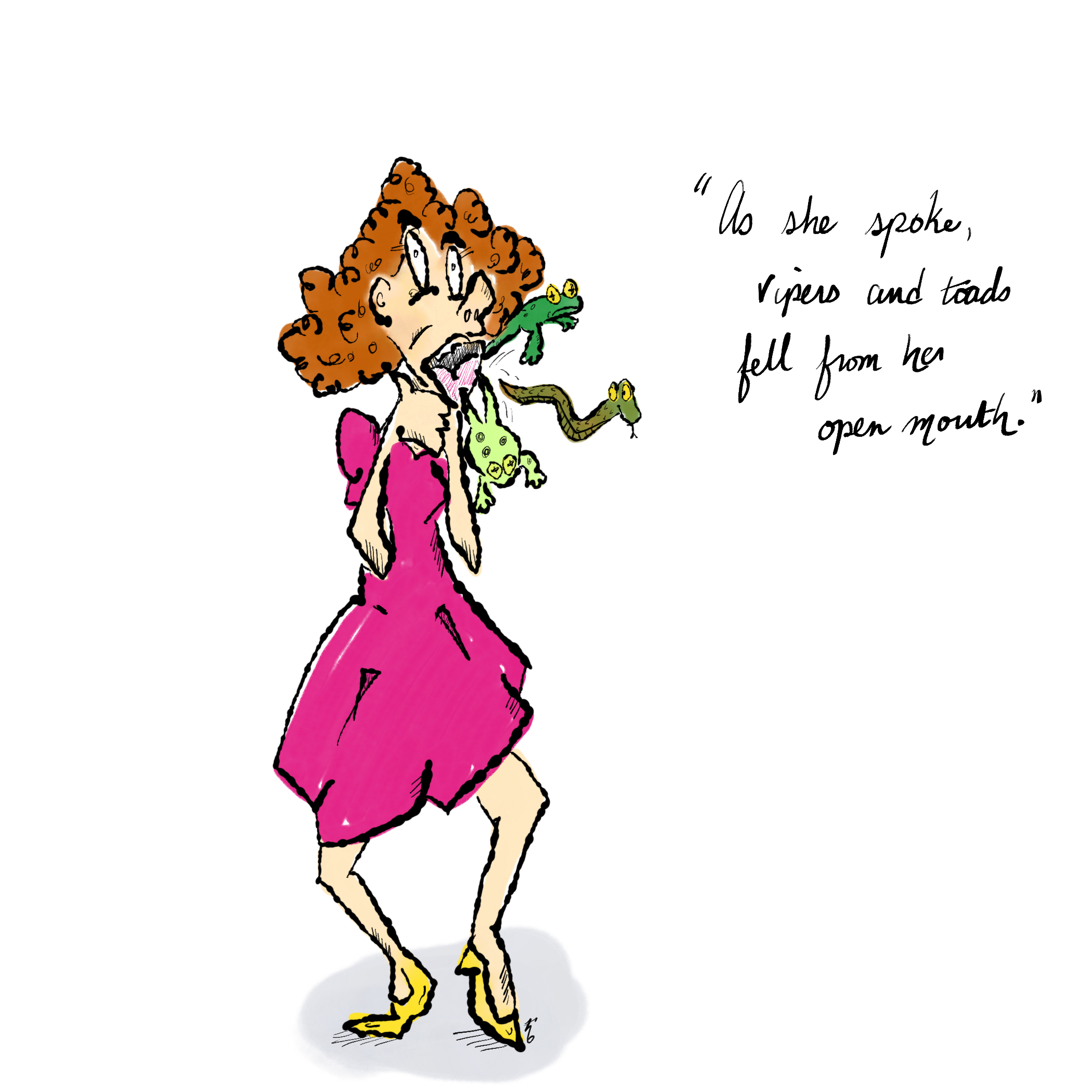
“As she spoke, vipers and toads fell from her open mouth.” – from “Diamonds and Toads (or, The Fairies)” (Illustration by Cory Thomas Hutcheson 2020)
“Just then there came a second knock at the door, and a voice called out:
Youngest daughter of the king, Open up the door for me, Don’t you know what yesterday, You said to me down by the well? Youngest daughter of the king, Open up the door for me.
The king said, “What you have promised, you must keep. Go and let the frog in.”
Witches go together with frogs and toads almost as readily as they do with broomsticks and pointy hats in the popular imagination. In the story “The Frog Prince, or Iron Heinrich” from the Brothers Grimm collection, a handsome prince has been transformed into a frog by a “wicked witch,” although we pointedly do not get her side of the story. The story “Diamonds and Toads (or The Fairies),” found in the pre-Grimm French collection done by Charles Perrault, reveals that while a good sister is rewarded by precious jewels dripping from her mouth when she speaks, an ill-mannered girl is punished by a fairy (sometimes a fairy tale proxy for a witch), who curses the girl to spew toads and vipers when she speaks.
Beyond the fairy tales, however, several folk magical practices are woven into the webbed toes of frogs and toads. This post will share a few of those bits of magical lore from North American sources and practices. I will note that there are some gruesome spells herein, including some that involve harm or death coming to these marshy denizens, and I am in NO WAY ADVOCATING that you actually do anything hurtful to frogs or toads. They are a valuable part of our ecology and virtually any spell can be adapted in ways that avoid harming them (although I have nothing against the respectful collection of their remains after their demise). In fact, I’ll even begin with this bit of North Carolina folklore to help warn you away from such cruelty:
-Every frog you kill makes your life shorter (or killing a frog or toad will lead to the death of your mother, father, or another kinsperson) (Brown, p. 54).
Another series of entries from that collection mentions that killing a frog or toad will lead your livestock to give bloody milk (p. 437-38), but conversely it recommends that an ill animal be fed a live frog in order to cure it (p. 449). That may very well have to do with the sympathetic nature of the magic, and the belief that a frog might have been used to initiate the curse, so forcing the frog into the animal is a way of doubling the hex back on itself and thus purging it from the animal’s system (we see a similar logic in the flogging of bewitched milk over hot coals, which is thought to return the harmful spell to the witch who cast it).
Along that same vein of logic, we see in a number of folkloric instances the ways in which frogs or toads are sympathetically linked through magic to the world around them. They serve as familiars to witches in many stories (including as the representations of the witch’s power in tales like “The Frog Prince” and “Diamonds and Toads”). In Shakespeare’s play Macbeth we also get a reference to a toad as a witch’s familiar, or spirit companion, an idea commonly echoed in popular accounts of witchcraft. One sixteenth-century witch named Joan Cunny from Essex, England, for example, was associated with a pair of familiars that looked like black frogs and another Essex witch named Margery Sammon kept a pair of toads named Tom and Robin as familiars (Wilby, p. 230, p. 109). These creatures could also hold familiar bonds with other living things, such as trees. For example, some American lore states that killing a tree frog in its tree is thought to also kill the tree, also indicating the “familiar” like nature of them (Brown, p. 499).
Both toads and frogs seem to operate between worlds, making them liminal agents that can run between either the land and water or between our world and the underworld. What they did in that underworld realm made them even more fearful in the folk imagination. For example, one bit of lore says that because they are thought to eat coals of fire (possibly also hellfire, given their traffic with the underworld), toads and frogs can be venomous or toxic. There are indeed toxic species of these creatures, so the belief about their dangers is not entirely untrue in the case of some poison-skinned frogs, but their dangers do not seem to be caused by the ingestion of brimstone (Brown, p. 409). A similar belief prevails about frogs eating buckshot, too, linking them to fire and iron, weapons, danger, and death. Their toxicity, however, might also be a connection to their witchier lore, especially as some frogs and toads secrete substances that can cause psychedelic reactions in humans (as evidenced by the minor fad–massively overplayed in popular media–with “licking frogs” among college students a few decades ago and even portrayed on The Simpsons).
Frogs and toads also had more positive qualities (although admittedly these qualities didn’t do much to benefit the animals themselves). For example, an oft-repeated claim seems to indicate that some medieval physicians recommended placing a live frog in one’s mouth to remove a sore throat or other ailments, a supposition that has been dubiously linked to the phrase “a frog in one’s throat” (in reality, the phrase derives from an American lozenge rather than any medieval phraseology). Transferring diseases to animals by touch or by holding them in the mouth was not all that uncommon as a folk remedy or cure, and we see it come up in folklore about maladies such as warts quite frequently. That brings me to one of the other common bits of lore about toads and frogs, which are often accused of causing warts in anyone that holds them. This is essentially bunk, but the belief in magical transference of the disease makes some sense as it is a sort of “contagious” magic. Considering just how many folk wart cures and spells there are, it’s probably not a real crisis for someone to touch a frog or toad even if there were a risk of warts (which, again, there really isn’t).
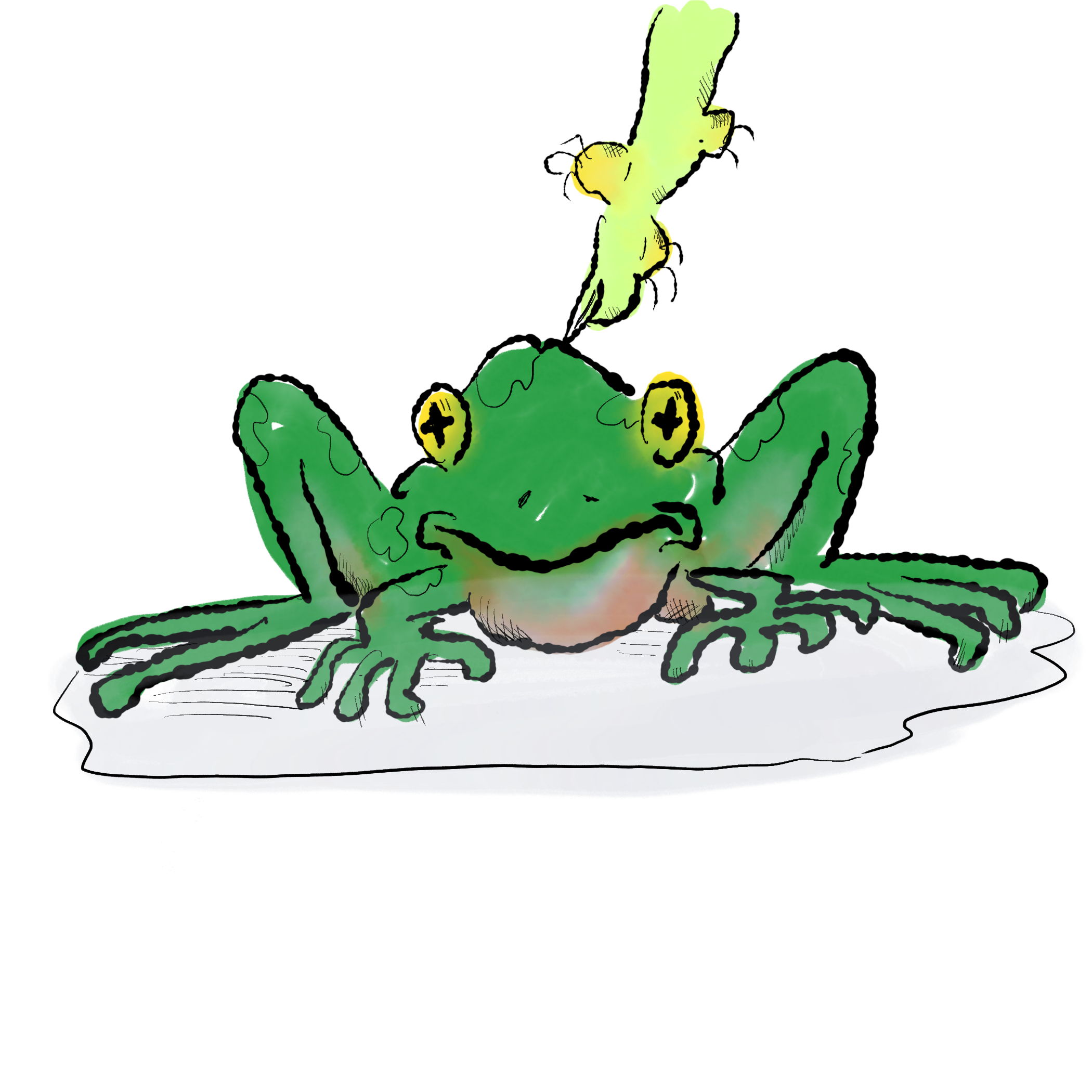
A popular folk belief says that touching frogs or toads causes warts (although that is not scientifically accurate). (Illustration by Cory Thomas Hutcheson 2020)
Curing the magical or venomous maladies of the Anuran order (which, frankly, sounds like the kind of club I’d like to join–”I’m a member of the Anuran Order, Bufo Chapter, Horned Toad House”) include the use of the “toadstone,” a type of secret gem or mineral deposit thought to be carried in the head or body of a toad and which could dispel any number of ailments. Specifically it was believed to be good against poisons, and is mentioned both in Roman lore and once again in Shakespeare as well (it may well be that this stone was actually a type of fossil).
The idea that a toad might carry in its body a powerful magical object was not limited to the toadstone, however, for within witchcraft lore a widely pervasive rite known as the “Toad’s Bone” ritual has captivated occultists for centuries and received a recent uptick in popularity due to the late Andrew Chumbley’s essay, “The Leaper Between.” Historical witchcraft writer Nigel Pennick discusses how in many parts of rural England and the British Isles, the toad’s bone rite was associated with a secret society known as the Horseman’s Word. Reputedly, those who were part of this group were a society of horse whisperers who could calm wild horses and easily help to break them, as well as treating them for certain problems. While they were esteemed for their equine skills, they were also suspected of witchcraft in many cases. They were thought to be brought into the fraternity by completing a toad’s bone rite of some kind, one that mirrored similar rites in witch lore, such as this one:
“The Norfolk witch Tilley Baldrey had her techniques published in The Eastern Counties Magazine in 1901. She tells how she became a witch through the toad-bone ritual. In standard English, ‘you catch a hopping toad and carry it in your bosom until it has rotted away to the back-bone,’ then, ‘you take it and hold it over running water at midnight until the Devil comes to you and pulls you over the water.’ This is the initiation as a witch.” (Pennick loc. 1154).
This initiatory rite resulted in the possession of the toad’s bone, which was carried as a token of power and a symbol of initiation, much in the same way that the black cat bone appears in other witch lore. Similar rituals involved crucifying a toad with thorns (usually blackthorn, although it could be hawthorn in some variants) on top of an ant hill and waiting until the ants had devoured the toad’s flesh. The bones would then be taken to a stream and submerged, and whichever floated against the current was the fabled toad’s bone.
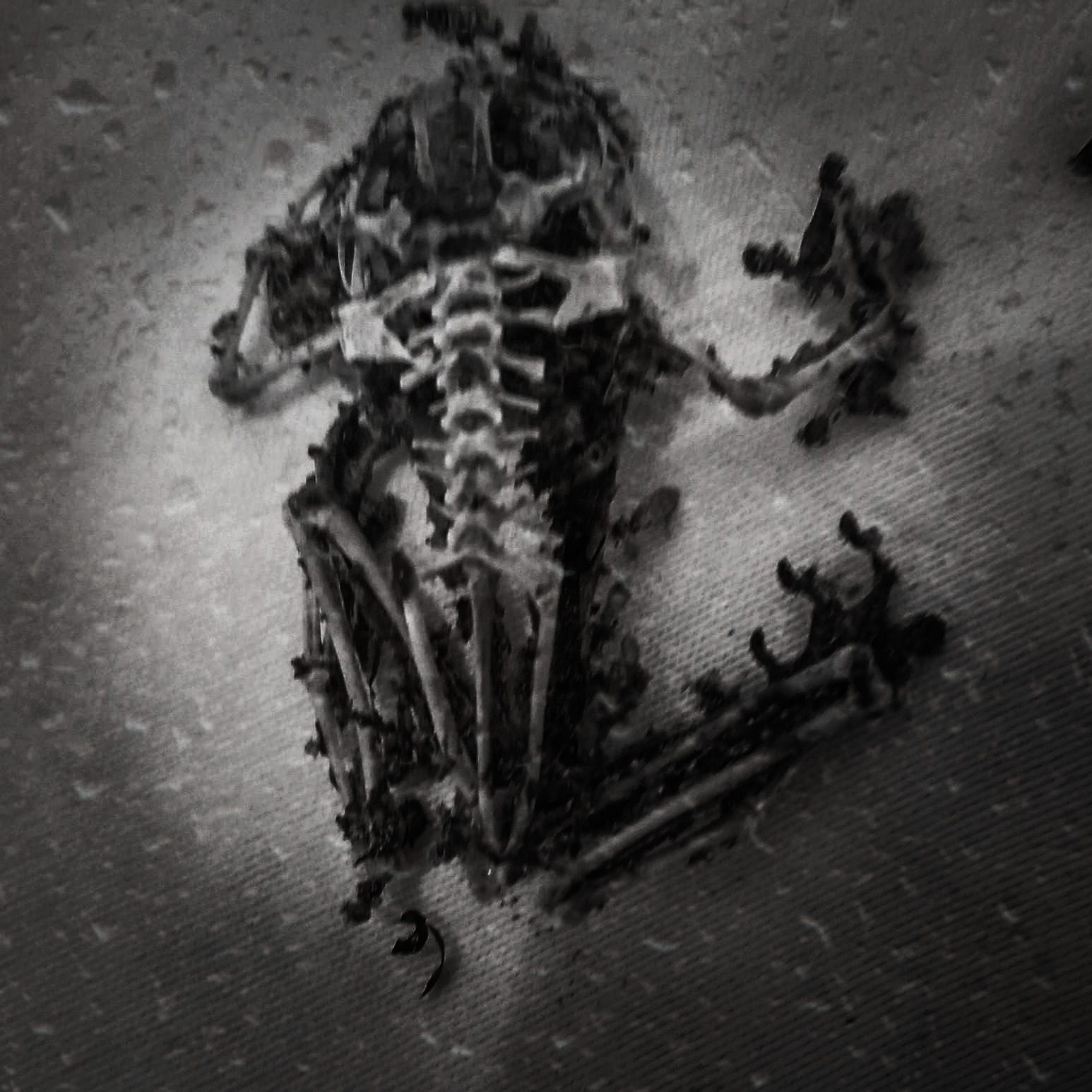
I should note once again that I adamantly do NOT encourage the use of animal torture for the procurement of magical tools. These rites may have some significance in the historical context, but you are just as likely to be able to get many of these tools–even toad and frog bones–from sources that do not require the animals to suffer (given how popular frogs’ legs are in parts of the South, contacting a frog-gigger who hunts for restaurant fare might be a better way to handle this). Waiting to find a frog skeleton is just as good, and comes with a sense of feeling like the bones were meant for you rather than extracted through cruelty and malice.
A desiccated frog skeleton found in my in-laws’ house hidden in the back of a cabinet; you never know when you’ll find these sorts of things!
As a final note about the magic of these lovely amphibians, I should note that they are also thought to be harbingers of changing weather and seasons. A belief found throughout the eastern half of the United States says that the croaking of frogs is thought to signal the end of winter (Brown, p. 323). If you’ve ever been in the South in the early summer, you’ll know the sound of “peepers” out in any even mildly wetland area pretty well. Seeing a large number of frogs (and potentially hearing them as well), is also thought to be a sign of coming rain. In this way we can see the deep connections between the watery world of the pond and the stormy sky as connected, with the toads and frogs acting as those “leapers between” as Chumbley phrased it.
This is been only a webbed toe dipped into the very deep pond of frog and toad lore, but hopefully it gives you a sense of just how much enchantment can be found in these creatures. Perhaps if the spoiled princess in the story of the golden ball had known that, she might not have been so quick to run away or fear her froggy beau. I’d still prefer not to have them jumping out of my mouth every time I speak, though. It would make teaching pretty awkward.
We are filling up on magic at the dinner table as we look to the folklore and enchanted uses of ingredients like corn, apples, potatoes, and more!
Please check out our Patreon page! You can help support the show for as little as a dollar a month, and get some awesome rewards at the same time. Even if you can’t give, spread the word and let others know, and maybe we can make New World Witchery even better than it is now.
You can hear Cory talk more about turkey bones in folk magic (as well as other dinner table necromancy) at the recent episode of Cursed! Podcast: Cory & Corpses.
If you have feedback you’d like to share, email us or leave a comment. We’d love to hear from you!
Don’t forget to follow us at Twitter! And check out our Facebook page! For those who are interested, we also now have a page on Pinterest you might like, called “The Olde Broom.” You can follow us on Instagram or check out our new YouTube channel with back episodes of the podcast and new “Everyday Magic” videos, too (as well as most of our contest announcements)! Have something you want to say? Leave us a voice mail on our official NWW hotline: (442) 999-4824 (that’s 442-99-WITCH, if it helps).
Promos & Music
Title and closing music are “Woman Blues,” by Paul Avgerinos, and is licensed from Audio Socket.
Please consider supporting us by purchasing our promotional items in the New World Witchery Threadless shop or by joining our Patreon supporters.
Please think about checking out our Audible Trial program. Visit Audibletrial.com/newworldwitchery to get your free trial of Audible, where you can download over 180,000 titles (including some narrated by Cory). Your purchases help support this show, and there’s no obligation to continue after the free trial
We dampen our spirits–in the best possible way–and take a look at the folk magic of storms, fog, rain, and other wet weather in our latest Cunningham book club episode.
Please check out our Patreon page! You can help support the show for as little as a dollar a month, and get some awesome rewards at the same time. Even if you can’t give, spread the word and let others know, and maybe we can make New World Witchery even better than it is now.
If you have feedback you’d like to share, email us or leave a comment. We’d love to hear from you!
Don’t forget to follow us at Twitter! And check out our Facebook page! For those who are interested, we also now have a page on Pinterest you might like, called “The Olde Broom.” You can follow us on Instagram or check out our new YouTube channel with back episodes of the podcast and new “Everyday Magic” videos, too (as well as most of our contest announcements)! Have something you want to say? Leave us a voice mail on our official NWW hotline: (442) 999-4824 (that’s 442-99-WITCH, if it helps).
Promos & Music
Title and closing music are “Woman Blues,” by Paul Avgerinos, and is licensed from Audio Socket.
Please consider supporting us by purchasing our promotional items in the New World Witchery Threadless shop or by joining our Patreon supporters.
Please think about checking out our Audible Trial program. Visit Audibletrial.com/newworldwitchery to get your free trial of Audible, where you can download over 180,000 titles (including some narrated by Cory). Your purchases help support this show, and there’s no obligation to continue after the free trial
We’ve got another in our Everyday Magic playlist series available! This time we’re taking a brief look at some of the folklore and magic surrounding apples.
Image/Video/Sound Sources: -Pixabay (www.pixabay.com) -Author’s original work (Cory Thomas Hutcheson) -AudioSocket (www.audiosocket.com) All media used under purchased license (AudioSocket), Creative Commons license, or public domain use Created with Wondershare Filmora
Once again we dive into Cunningham’s Earth Power folk magic books, and get a little bit of everything! We talk candles, dolls, wax figures, mirrors, stars, and more in this one!
Please check out our Patreon page! You can help support the show for as little as a dollar a month, and get some awesome rewards at the same time. Even if you can’t give, spread the word and let others know, and maybe we can make New World Witchery even better than it is now.
We’re also working with the Wylde Faun candle company to offer a special discount to our supporters! You can buy anything from their catalog and get 20% off by using the code “NewWorldWitch” at checkout!
Image by Cory Thomas Hutcheson.
If you have feedback you’d like to share, email us or leave a comment. We’d love to hear from you!
Don’t forget to follow us at Twitter! And check out our Facebook page! For those who are interested, we also now have a page on Pinterest you might like, called “The Olde Broom.” You can follow us on Instagram or check out our new YouTube channel with back episodes of the podcast and new “Everyday Magic” videos, too (as well as most of our contest announcements)! Have something you want to say? Leave us a voice mail on our official NWW hotline: (442) 999-4824 (that’s 442-99-WITCH, if it helps).
Promos & Music
Title and closing music are “Woman Blues,” by Paul Avgerinos, and is licensed from Audio Socket.
Please consider supporting us by purchasing our promotional items in the New World Witchery Threadless shop or by joining our Patreon supporters.
Please think about checking out our Audible Trial program. Visit Audibletrial.com/newworldwitchery to get your free trial of Audible, where you can download over 180,000 titles (including some narrated by Cory). Your purchases help support this show, and there’s no obligation to continue after the free trial
We talk with author and conjure worker Jake Richards about folk magic in the Southern Highlands, the many magical-cultural influences found throughout the mountains, and what people get right and wrong about Appalachia.
Please check out our Patreon page! You can help support the show for as little as a dollar a month, and get some awesome rewards at the same time. Even if you can’t give, spread the word and let others know, and maybe we can make New World Witchery even better than it is now.
We can highly recommend that you pick up a copy of Jake’s book, Backwoods Witchcraft, from Weiser Books. You can also check out his very informative blog, Little Chicago Conjure, as well
You might be interested in some of our other posts on Appalachian and Southern mountain folk magic, too:
Cory introduces the episode with a story adapted from Richard Dorson’s Buying the Wind.
We’re also working with the Wylde Faun candle company to offer a special discount to our supporters! You can buy anything from their catalog and get 20% off by using the code “NewWorldWitch” at checkout!
Image via Red Wheel/Weiser (promotional).
If you have feedback you’d like to share, email us or leave a comment. We’d love to hear from you!
Don’t forget to follow us at Twitter! And check out our Facebook page! For those who are interested, we also now have a page on Pinterest you might like, called “The Olde Broom.” You can follow us on Instagram or check out our new YouTube channel with back episodes of the podcast and new “Everyday Magic” videos, too (as well as most of our contest announcements)! Have something you want to say? Leave us a voice mail on our official NWW hotline: (442) 999-4824 (that’s 442-99-WITCH, if it helps).
Promos & Music
Title and closing music are “Woman Blues,” by Paul Avgerinos, and is licensed from Audio Socket. Incidental music is “Who’s Gonna Shoe” by Paul Avgerinos, and is also licensed from Audio Socket.
Please consider supporting us by purchasing our promotional items in the New World Witchery Threadless shop or by joining our Patreon supporters.
Please think about checking out our Audible Trial program. Visit Audibletrial.com/newworldwitchery to get your free trial of Audible, where you can download over 180,000 titles (including some narrated by Cory). Your purchases help support this show, and there’s no obligation to continue after the free trial
We use our monthly book club to look at questions surround the magic found in stones, gems, minerals, magnets, and just for fun, trees as well!
Please check out our Patreon page! You can help support the show for as little as a dollar a month, and get some awesome rewards at the same time. Even if you can’t give, spread the word and let others know, and maybe we can make New World Witchery even better than it is now.
We’re carrying on our Scott Cunningham Natural Magic book club. You can read a bit more about that at our original post on it, or catch up with some of these posts:
If you have feedback you’d like to share, email us or leave a comment. We’d love to hear from you!
Don’t forget to follow us at Twitter! And check out our Facebook page! For those who are interested, we also now have a page on Pinterest you might like, called “The Olde Broom.” You can follow us on Instagram or check out our new YouTube channel with back episodes of the podcast and new “Everyday Magic” videos, too (as well as most of our contest announcements)! Have something you want to say? Leave us a voice mail on our official NWW hotline: (442) 999-4824 (that’s 442-99-WITCH, if it helps).
Promos & Music
Title and closing music are “Woman Blues,” by Paul Avgerinos, and is licensed from Audio Socket.
Please think about checking out our Audible Trial program. Visit Audibletrial.com/newworldwitchery to get your free trial of Audible, where you can download over 180,000 titles (including some narrated by Cory). Your purchases help support this show, and there’s no obligation to continue after the free trial




 New World Witchery - The Search for American Traditional Witchcraft