Blog Post 121 – Watching Birds

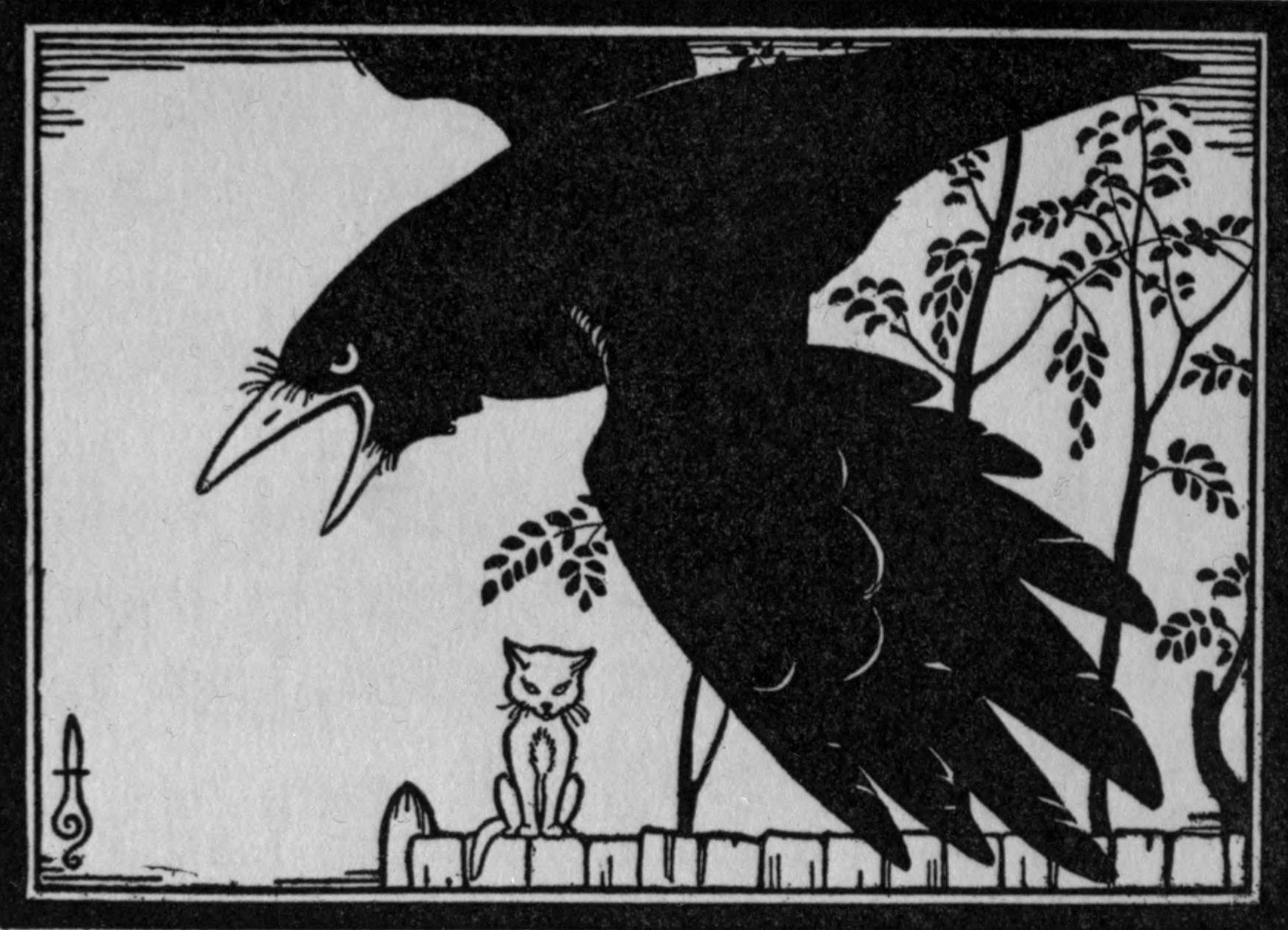
Today we’ll be looking at birds and their place as divinatory aids in the New World, something we touched on briefly in the second post on Magical Animals.  Birds have historically been turned to by humans for secret knowledge, largely owing to their unfettered freedom to fly from place to place.  Virtually all mythologies have some tale of a great mythic bird:  the Roc in the Arabian Nights’ Entertainments, Zeus’s swan-form, the Thunderbird of some Native American stories, and the haunting Crane Dance of Japan are some of the better-known examples. A creation myth of the Haida people of the Queen Charlotte Islands says that a raven, lonely in his long flight, spit upon a clam and opened it up, freeing the first humans (see Magical Creatures by E. Pepper & B. Stacy for more on this).  What have birds to do with divination, though?  Many readers probably already know about the branch of fortune-telling known as augury, but for those who haven’t heard of it, it simply means predicting fate by observing the flights of birds.

So how does one go about performing augury?  Here things get a bit fuzzy—in some cases, the future comes as a vision released by a relaxed mind observing with detachment the loops and turns of soaring birds.  Portuguese writer Paulo Coelho incorporates this type of augury into his novella, The Alchemist when he has a young shepherd accidentally catch a glimpse of coming war while he watches two hawks diving over desert sands.  The other method, and the one which makes up a good bit of North American lore, simply involves noting the behavior of birds and interpreting it by means of known connotations.  This sort of augury has numerous manifestations, and is especially prominent in Appalachian lore.  Folklorist W. L. McAtee recorded a number of bird-related divinations in an essay from 1955:

From “Odds & Ends on North American Folklore on Birds,” by W. L. McAtee:

  • “[I]f ever a bird builds in your shoe or pocket, or any of your clothes, you may prepare to die within the year.”
  • “The loon, a favorite with folklorists, is called ‘Bad Luck Bird’ by the natives [of the Sea Islands of Georgia], who will not speak of it, or if possible even look at it when they meet it in a journey by water.”
  • “While recording the common beliefs as to the storm petrels, that ‘Their appearance portends bad weather,’ Mrs. Simcoe [McAtee’s informant] adds: ‘To kill them is unlucky. Each bird is supposed . . . to contain the soul of a dead sailor.’
  • “The Reverend J. H. Linsley in his Birds of Connecticut (1843) noted that the cry of the bittern is a cause of superstitious fear and recorded that one man hearing it ran a mile, saying, that the Devil was after him.”
  • “’A token,’ said Archibald Rutledge [another informant], writing of the Santee Country, South Carolina, ‘is an apparition foretelling death,’ and cites as examples an eagle feeding with black vultures, a wild turkey standing alone under a certain great oak tree, and an albino robin.”
  • “[An] Abundance of people here look upon [whip-poor-wills] . . . as birds of ill omen, and they are very melancholy if one of them happens to light upon their house, or near their door, and set up his cry (as they will sometimes upon the very threshold) for they firmly believe one of the family will die very soon after.”
  • “Canada Jays are supposed to embody the souls of hunters or lumbermen who die in the north woods and it, therefore, brings bad luck to kill them.”
  • “In western North Carolina, it means seven years of bad luck to kill a raven.”
  • “To end this section on a more cheerful note, we cite the Ozark fancy that ‘If a redbird flies across a girl’s path . . . she will be kissed before night.’”

Other mountain lore about birds tends to focus on weather prediction (a subject we’ve covered in our posts on Signs & Omens to some extent, but you can never have enough weather-prediction lore).  Patrick Gainer observes: “When the geese wander on the hills and fly homeward squawking, there will be a storm within twenty-four hours,” and “When the red birds call in the morning, it will rain before night.”  Vance Randolph records some Ozark lore along the same lines:

  • Chickens or turkeys standing with their backs to the wind and with ruffled feathers mean a storm’s coming.
  • A rooster crowing at nightfall portends rain through the dark hours.
  • A sudden burst of robin-song foretells of bad weather.
  • Kingfishers nesting near the water mean a dry season to come.

Birds seem indelibly linked with concepts of luck and death, too.  Anyone who’s seen the 90’s cult film The Crow probably remembers the voice-over at the movie’s opening telling a pseudomyth about how people once believed that a crow ferried souls between the land of the living and the land of the dead, and occasionally allowed one to come back for vengeance (I call this a pseudomyth not because there’s no truth in it, but rather that I’ve never been able to find exactly that myth borne out in folklore, though there are certainly close correlatives to it—corvids are often associated with death).  There are many other pieces of Appalachian lore in this vein:

  • Barn swallows bring good luck where they nest, and it is bad luck to shoot one. (Randolph, OM&F)
  • Redbirds or roosters lingering near one’s doors or windows tend to mean tragedy will come soon after. (Randolph, OM&F)
  • Whippoorwills nesting at a home mean death will soon come to it. (Randolph, OM&F)
  • If a bird flies in the window, someone in the family will die. (Gainer, WG&S)
  • It is bad luck for a hen to crow. (Gainer, WG&S)
  • “Owls are omens of great ill.  If you spot one nearby while you are inside your home, the direction in which it flies away is an indication of the fate of your household.  If it flies off to the left of the cabin, very bad luck can be expected, but if it flies off to the right, it indicates an evil influence has chosen to pass you by.”(Edain McCoy, In a Graveyard at Midnight)
  • “Many western occult traditions regard peacocks as omens of ill fortune and their feathers as tokens of bad luck.” (Pepper & Stacy, MC)

Finally, in the category of “Odds & Ends,” there are some really spectacularly unique bits of North American folklore about birds which come from all over:

  • Buzzards will vomit upon anyone guilty of incest. (Randolph, OM&F)
  • “When you hear the first robin sing in the spring, sit down on a rock and take off your left stocking.  If there is a hair in it, your sweetheart will call on you soon.” (Gainer, WG&S)
  • “If a bird flies down and gets tangled in your hair, it is an indication that the bird has linked itself with your soul, and whatever befalls the bird is likely to befall you also.” (McCoy, IaGaM)
  • Richard Dorson records a legend in Buying the Wind found amongst Illinois “Egyptians” (or what many would call “Gypsies”) about a mouse, a bird, and a sausage who all keep house together until the sausage is eaten and the mouse accidentally kills himself that feels like it must have some embedded magical meaning, though I’ve yet to figure it out.

That’s it for our bird-watching entry.  If you’ve got lore you’d like to share about birds, we’d love to hear it!  It certainly gives me a good reason to keep watching the skies, so please feel free to comment with any augury methods you’ve got.

As always, thanks so much for reading!

-Cory

Blog Post 120 – Divination in the New World (an Overview)

Greetings everyone!

First of all, sorry for the complete absence of posts last week.  I got a little swamped and didn’t get as much research time as I wanted, but hopefully today’s rather long article will make up for it.

We’re going to be looking over the next few posts at divination, fortune-telling, and other methods of forecasting fate.  Before we dive into details, though, I thought it might be good to tackle the topic generally and look at the types of divination which have been historically popular in the New World, as well as some more modern methods.  .  Some of these systems are ones which I can only cover cursorily, as my experience is relatively shallow with them.  I hope to cover each of these in more detail with time, or at least provide references to help anyone wanting to learn more about them, eventually.

So what are the most popular divinatory methods in the New World?

Arithmetic Methods – Probably the most common divinatory methods used in the modern New World are astrology and numerology.  Almost anyone can tell you his or her sun sign.  A Harris Poll from 2009 shows that about 26% of adult Americans believe in astrology.  Horoscopes related to these sun signs are printed in a majority of national newspapers in the United States, and a surprising number of folks know their ideal romantic compatibility as far as sun signs are concerned.  Less well-known but still fairly prevalent is numerology, particularly the form of numerology known as alphabetic numerology.  This is closely related to Gematrian numerology—a kabbalistic practice which uses Hebrew letters as symbols for numerals to understand a sort of universal mathematics arranged by G-d for the wise to know the world.  Another arithmetic method of divination which has found a certain degree of New World success is geomancy, which depends upon mapping energetic lines upon the earth and determining information based on their patterns and intersections.  The most commonly found version of geomancy in North America is the practice of dowsing, which seeks to uncover hidden water, mineral, oil, or other deposits within the earth using surface-based detection methods.  Science generally frowns upon all of these fields, despite their incredibly intricate mathematical structures, though there have been a few efforts to validate the powers of geomancy, and some large oil companies consult dowsers periodically to help determine ideal drilling locations.

Natural Objects & Phenomena – We’ve covered this a bit already, particularly the signs & omens which seem to pervade much of American folklore, but it is worth examining a few of the other natural-object-based divinatory systems, too.  For example, in many parts of the New World, some system of augury (divination based on birds) has been practiced.  One of the most interesting versions of this can be found in a practice known as alectromancy, which studies the patterns scratched by a rooster when grain is strewn for him.  Traces of this practice can be found in one of the primary influences on later hoodoo, The Black Pullet.  Other objects commonly used in various New World magical systems are cowrie shells (small whitish shells which bear a strong resemblance to the female genitalia) and chamalongos (ritually prepared and polished pieces of coconut shells).  These can both be “cast” in the same manner as dice might be (see “Games” below), and the resulting patterns interpreted to provide answers to specific questions. Another method which has fallen out of favor in modern times—though it was tremendously popular in ancient Rome—is haruspicsy, or the reading of livers or entrails from sacrificed animals.  A modern version of this, however, lives on in the wishbone ritual from the Thanksgiving turkey.  Luck is afforded whoever takes the biggest part of a wishbone snapped in twain between two people when the bird has been cooked and eaten.  Of course, there are a vast number of natural phenomena which are interpreted as portents of the future in traditional folklore—everything from weather to insect behavior to the color of certain animals can have deep meaning to the right person.  Since we’ve touched on that idea in other places, however, I’ll simply leave it at that.

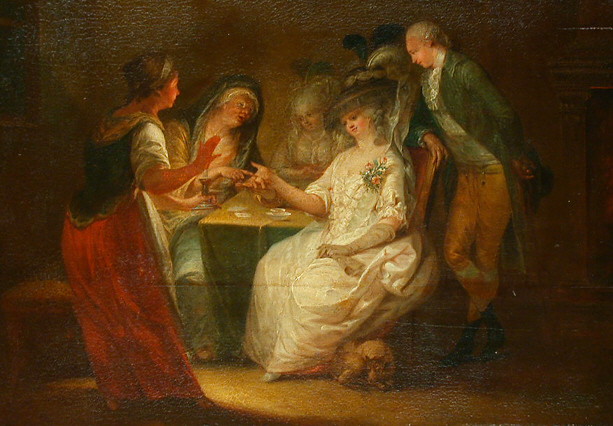
“Gypsy” Methods – I will admit I don’t like the title I’m giving this section, but please understand that by “gypsy” methods I’m not referring necessarily to Romany traditional practices.  Instead, I’m really evoking the Hollywood and fictional version of the Gypsy so often mistaken for the real thing.  But, since the methods employed by those characters are actually relevant, I thought this might be the best category in which to assemble them.  Some of the best known methods are palmistry, cartomancy, and crystal gazing.  Each of these, despite its Hollywood glamorization, is actually a legitimate method.  Palmistry uses the lines on the palm of a person’s hand to determine the overall trajectory of his or her life.  It’s been popular as a parlor entertainment for over a century in America, and likely has been on New World soil for much longer than that.  Cartomancy is probably the best known fortune-telling method in the New World other than astrology, though a much smaller number of people seem to put stock in it.  One of the fun twists to cartomancy is that while tarot is a popular method (even immortalized in American poet Sylvia Plath’s poem, “Daddy,” as a “Taroc pack” and associated with Jewishness), it has long been common for root workers in America to use simple playing cards to get answers to difficult questions.  Crystal gazing, a type of scrying which uses highly polished spheres of minerals like quartz or amethyst to relax the mind and allow visions to enter the mind of the seer, is another popularly seen method, though it is often ridiculed in modern society—poked fun at in cartoons like Bugs Bunny, Scooby Doo, and The Simpsons, for example.  Other methods which commonly get attributed to Gypsies are candle reading—though this is a bit controversial because of something known as the “Gypsy candle scam”—and tasseomancy, which involves reading the patterns left in a cup after someone has drunk tea from it.  In this latter method, coffee is also fairly popular.  The reputation of these methods has suffered a bit due to public ridicule, but they also have their staunch supporters, and in many cases are the methods magical practitioners learn first.

Games – This is a peculiar but fascinating branch of divination which has been surprisingly prevalent in the United States.  I’ve already mentioned the use of playing cards as divinatory aids, and they certainly straddle this category nicely.  Dice and dominoes have also been used to predict the future in several magical systems, particularly those originating from Africa, a practice known as cleromancy which is also referred to as “casting lots.”  It seems to be related to older methods of throwing bones—such as knuckle bones from sacrificial offerings—and interpreting the resulting patterns.  A version of cleromancy is likely the primary version of divination condoned in the Bible (hence all the references to “casting lots” for things in Joshua, I Samuel, Proverbs, Jonah, and Acts (in the last case, lots are cast to determine who the replacement apostle for Judas Iscariot will be).  Famed Wiccan author Raymond Buckland has a book on domino divination for those interested entitled, appropriately enough, Buckland’s Domino Divination.  One of the methods for divination which took off rapidly in the United States after its introduction was the Ouija board.  This system, based on the automatic writing device called the planchette and a special board containing letters, numbers, and symbols, became a central method for communicating with the other world in movements like Spiritism.  Mitch Horowitz’s Occult America devotes an entire chapter to the “talking board” and its impact on American metaphysics, not to mention its economic impact (it outsold leading board games like Monopoly at times).  Other games have brought fortune-telling to the masses through clever marketing, as well.  The Magic 8 Ball which was created by Alabe Crafts in the mid-twentieth century, combined elements of the Ouija board and the crystal ball, and despite its novelty was actually inspired by the clairvoyant mother of one of the inventors.  We spoke a bit on our previous show about “cootie catchers,” the finger-mounted puppet-like devices used by young children to predict future happiness and misfortune.  There are several games played by children in this vein, including MASH (which stands for Mansion, Alley, Shack, House) and a plethora of predictive skip-rope rhymes.  Children, it seems, know a lot about divination and incorporate it into their play regularly.

Text-based Fortune-telling – This isn’t a particularly diverse branch of divination in the Americas, but it does seem to be important.  A recent correspondence sent to me by Arrow of the Wandering Arrow blog outlined a form of bibliomancy, which is the use of the Bible (or other important book) to determine things like marital candidates and the identity of thieves.  Bibliomancy is still practiced in many places, and the techniques involved can be as simple as opening to a random passage in a book and seeing if it has any relevance to the question at hand.  Methods can also be quite complex, involving for example a key placed at a passage in the book of Ruth while the Bible is held between the hands of two people standing opposite each other as they name people they know until the key moves on its own to reveal the perfect marriage partner.  Less prevalent in North America but still quite important is the Chinese predictive system of the I Ching, or Book of Changes.  This method, which combines elements of the “Natural Objects” casting in the form of yarrow stalks with significant markings on them that get thrown to reveal patterns, relies heavily on a book of short hexagrams.  These six-line poems match up to the patterns revealed by the yarrow stalks and provide insight into a particular problem.  The I Ching has become increasingly popular in the West, largely due to Asian immigration into population centers.

Other Methods – Plenty of other methods for determining the future exist which don’t quite fit one category or another (or which I have arbitrarily decided to lump in this “Other” category because, well, I’m the one writing this article).  One bit of outdated but once profoundly influential methods of determining someone’s fate is phrenology, the study of the bumps, divots, and ridges of the scalp.  During the late 19th century there were a number of scientists who supported phrenology as a way of understanding psychology.  It has since fallen much out of favor (partly due to its connection to eugenics—the “science” of building a better person which often involved rather racist and callous methods), but still may hold a bit of interest for those who like old-fashioned divinatory techniques.  Oneiromancy remains popular, and dream-interpretation guides are readily available in most bookstores.  Many folks who do hoodoo also keep dream-interpretation books around to help predict winning lottery numbers.  The biblical precedent (see the stories of Joseph or Daniel interpreting dreams) may have a lot to do with why this technique has stayed more or less legitimate even among conservative audiences.  Necromancy is a word that conjures up (pardon the pun) specters of horror for some, but which had tremendous impact on the American spiritual landscape through Spiritist séances and mediumship.  The practice of talking to the dead is common in a number of religions, and guidance from deceased ancestors is highly valued in Vodoun, Santeria, and Obeah traditions.  On the flip-side, the practice of cold reading takes the idea of necromancy and removes the dead from the equation completely, instead allowing “psychics” to use broad statements, on-the-spot observation, and leading questions to “interpret” messages which are fraudulent, but often quite comforting (I can’t help but think of the South Park episode on this subject, which I highly recommend).  There are other great techniques being generated on New World soil all the time, too.  For instance, Juniper from Walking the Hedge has adapted the old “stones and bones” casting technique to include other objects from her life and has developed a unique and beautiful divinatory system.

There are so many methods of forecasting the future that I haven’t even touched upon here, so please don’t feel left out if I omitted your personal favorite (in fact, feel free to share a little about it in the comments section!).  Many of these methods fall in and out of favor depending on the fashion of the time—phrenology was once almost regarded as fact, but is regarded by many diviners today as at best a quaint and outdated method of uncovering information.  Some of them seem outright silly on the surface or are utter fakery (the Magic 8 Ball for the former, cold reading for the latter).  A number of these techniques, however, still hang on.  The popularity of astrology remains strong, and bibliomancy seems to be indulged quite openly, as proven by the publication of things like The Book of Answers, which I’ve seen in not only bookstores but also in greeting card shops and trendy furniture outlets.  Of course, plenty of these methods are practiced just under the radar of mainstream society, too.

Whatever your preferred method of fortune-telling, I wish you well and hope this article has been useful to you.  More will be coming on specific subcategories within this list…but you probably knew that already.

Thanks for reading!

-Cory

Blog Post 119 – A Little Love Magic

I’m sure with Valentine’s Day just around the corner, I won’t be the only one to cover today’s topic:  love magic.  Yes, I know that Valentine’s is a commercial holiday designed to sell greeting cards (or something like that), but this seems as good a time as any to introduce some of the folklore and magic surrounding that strange, powerful feeling of love which seems to rule over so much of our human existence.  We’ll also look a little at lust, though I’ll likely save a detailed discussion for a sex magic post of some kind.

I should also say that this little article only scratches the surface of the overall material on this enormous branch of magical practice.  Love spells seem to be some of the most commonly sought and most often used enchantments in the world, so any blog post on them will necessarily be rather skint on details.  Also, this particular article is a sort-of companion to our upcoming podcast episode, which will be on this topic as well.  In the episode, we’ll discuss things like the ethics of love spells, so I only really want to touch on the lore and some of the basic spell ideas here.  Of course, if you want to leave comments or send emails regarding questions of ethics, I fully support that!

So what is love magic?  Most people would probably understand a spell cast by a young man on his high school crush to make her go out with him as a type of love spell, but what about a spell cast by a wife on an errant husband to make him stay a little closer to home?  Is a spell to spice up things in the bedroom a love spell, or just a lust spell, or maybe a little of each?  As I pored over the research, I found that there are several distinct categories for love magic:

1)      General-purpose love spells, such as wearing rose quartz, hanging a “loving bell,” spells to help a girl find a beau/husband soon, etc.

2)      Love divinations, like dream interpretations, carrying a four-leaf clover in the bible, catching a bouquet at a wedding, etc.

3)      Lust magic & aphrodisiacs, like the famous Love potion #9, dried turkey bones, powdered bird tongues, vanilla, etc.

4)      Person-specific love spells, which make one particular person fall in love with another, using things like hatbands/socks, mirrors, a particularly ghoulish dead-man’s mojo, etc.

5)      Magic for staying together, common in hoodoo, such as tying a man’s nature, writing bloody initials for reconciliation, menstrual blood in food, etc.

6)      Splitting up work, designed to break a couple apart using things like the black cat/dog hair spell, Hurston’s nine needles spell, etc.

Taking these various categories—which are just my understanding of the material, by the way, and should not be taken as gospel—let’s look at some of the individual spells, beliefs, signs, and ceremonies associated with each one.

A word of warning before we begin: I DO NOT ADVOCATE THE USE OF ANY OF THESE SPELLS. I’m presenting them as matters of folkloric record only.  Many of these techniques and/or formulas can be unsanitary or downright dangerous, so please keep that in mind as you read.

General-Purpose Love Spells

This category is fairly well addressed in modern neo-Pagan magical texts, so I won’t get much into it here.  I recall learning early on from Scott Cunningham’s Earth Power and other books like it that rose quartz could be worn to draw love to you, or just inspire loving feelings in you.  Oraia from Media Astra ac Terra covers the metaphysical properties of rose quartz very well in Episode 20 of that show, so if you want more info, I’d suggest listening to her examination of it.

Cunningham’s book also contains a spell for a “Loving Bell” which involves hanging a small bell somewhere the West Wind can touch it, reciting a little chant, and waiting for the bell to “whisper” your desire for love onto the wind, calling a lover to you (p.46).

Another basic spell from Draja Mickaharic’s A Century of Spells calls for burning a candle anointed with a mixture of basil and almond oil to draw love into one’s life.

As far as North American folklore goes, general-purpose love spells are actually a bit rare.  They most often tend to be focused on getting a spouse or preventing spinsterhood (forgive the sexist language there, but these do seem to be customs targeted at women).  For instance, in Vance Randolph’s Ozark Magic & Folklore he mentiones that Ozark girls will pin pieces of a wasp’s nest inside their clothing to draw courtship from men.  Randolph also mentions a peculiar love charm that he encountered in the mountains and which reputedly brought love into a young girl’s life:

“Many mountain damsels carry love charms consisting of some pinkish, soaplike material, the composition of which I have been unable to discover; the thing is usually enclosed in a carved peach stone or cherry pit and worn on a string round the neck, or attached to an elastic garter. I recall a girl near Lanagan, Missouri, who wore a peach stone love-charm on one garter and a rabbit’s foot fastened to the other.” (p. 166)

It’s not unreasonable to think that the “pinkish, soaplike material” may well be a piece of rose quartz.  Or, it may be something else entirely.  Patrick W. Gainer records the oft-repeated superstion that if someone sweeps under or on top of a girl’s feet, she will never marry, so girls were very careful not to let that happen.  Taking the last bite of any food at the table meant that a girl should kiss the cook or else end up an old maid, too.  Gainer also says that a girl who hold’s a bride’s dress on her lap within ten minutes will marry within a year and that if a girl lends her garter to a bride on her wedding day, she can expect to marry soon, too.

Love Divination

There are so many wide-ranging methods of determining a future lover’s identity that it would likely give me carpal tunnel and send my readers into a glazed-eye coma trying to list them all.  Divining one’s future love life is probably the most common form of divination, and can be found everywhere from the playground to the wedding chapel to the funeral home.  Most folks know about catching bouquets and garters at a wedding to indicate who the next to be married will be.  Some of the more unusual methods of determining one’s romantic future are:

  • Dream of a funeral and attend a wedding
  • Count seven stars for seven nights, and you will dream of the man you will marry.
  • To dream of the man you will marry, take a thumbful of salt the night before Easter
  • Marry soon if you dream of a corpse
  • If two forks are at a place-setting on the table, the one who sits there will be married.
  • Put three holly leaves under your pillow at night and name each leaf.  The one that is turned over in the morning will be the name of your husband.
  • Put a four-leaf clover in the Bible.  The man you meet while you are carrying it will be your husband.
  • On the first day of May before sunrise, if you see a snail within a shell, your future husband will have a house.  If the snail is outside the shell, he will have none.  Sprinkle meal in front of the snail and it will form the initial of the man you are to marry.
  • Walk around a wheat field on the first day of May and you will meet your mate.
  • The white spots on your nails tell how many lovers you will have.
  • On the first day of May, look into a well and you will see the face of your future husband.

There are lots of other methods for determining a future spouse, of course, such as peeling an apple in one long strip and tossing it over your shoulder to determine the initial of one’s eventual husband or wife.  Several Halloween traditions also focus on love divination, such as throwing nuts into the fire to see if they pop or fizzle, thus reflecting the strength of the love between those who threw.  Really, we could be here all day with these, so let’s just say a little reading will reveal a plethora of divinatory options to the curious witch.

Lust & Aphrodisiacs

This is another broad and often-discussed topic, and one which folks can get into heated debates about very easily.  For instance, many people contend that certain foods—chocolate, oysters, strawberries, etc.—act as aphrodisiacs and cite medical reports to back up their claims.  Others cite counter-claims which demonstrate that any aphrodisiac effect from food is purely psychosomatic /placebo effect.  Love potions are incredibly popular, so much so that there’s an enduring pop song by the Searchers entitled “Love Potion No. 9,” which later inspired a popular film of the same name (featuring the lovely Sandra Bullock).  I’m not going to get into the ingredients for that potion here, but if you’re interested in it, the upcoming Spelled Out segment on the podcast will look at one recipe for this famous draught.
In American folklore, many ingredients can be brewed into love potions and used to drive a partner wild.  Randolph records that yarrow is used in love potions given to men, as are dodder/love vine/angel’s hair, lady’s slipper, and mistletoe.  Boys make a love potion from a wild gander’s foot, powdered and put into a girl’s coffee.  The use of bird ingredients in such potions is rampant, inlcluding the use of powdered turtle-dove tongue, chicken hearts, and rooster blood for various love and beauty blends.   Girls in the Ozarks would keep dried turkey bones in their rooms in order to seduce their beaus when the time was right, too.

Randolph also mentions that a woman can surruptetiously touch a man’s back to inspire feelings of lust in him.  Zora Neale Hurston says in her essay “Hoodoo in America” that a potent aphrodisiac charm from Jamaica includes mixing angle worm dust with High John chips and wearing this as a mojo around the waist.  Oils and powders such as “Come to Me Boy/Girl” and “Chuparosa” are also used to intoxicate a lover’s senses and make him/her crazy with lust and love.  There’s also a hoodoo formula called the “Hot Mama Douche” which is juniper berries steeped in vinegar and which is designed to bring a woman all the sex she can stand. Vanilla, dabbed behind the ears, is also reputed to drive men wild.

Person-specific Love Spells

These are the controversial, yet oft-sought after, spells which one person uses on another to command love.  There are a lot of ethical questions involved in these enchantments, and I won’t get into my perspective on them here (though I do talk a bit about it on the show).  As the folklore goes, there are a lot of ways to make someone yours through magic.  Most of them involve putting a little bit of yourself—such as urine, blood, or sweat—into them, often via food.  Wearing the other person’s clothing, especially intimate clothing that has had contact with their skin or which has encircled some part of their body (like a ring, hatband, glove, sock, etc.) will also allow you to command their love.  Some examples:

  • If a girl steals a man’s hatband and wears it as a garter, it will make him fall in love with her (Randolph, OM&F)
  • Socks and hatbands can be used to rule unruly men (Hurston, Mules & Men).
  • Turning down a man’s hatband and pinning two needles in it in a cross-wise fashion makes him love you (Haskins, Voodoo & Hoodoo)

Other spells to gain the love of a person include tying poppets/dolls together, knotting used clothes from each person together, or burying personal items from that person on your property.  In this latter vein, Zora Neale Hurston records an interesting spell using the person’s image captured in a mirror:

“To bind a lover to a place: a) This is for a girl: Let him look into a mirror but don’t you look into it. Take it home. Smash it and bury it under the front steps and wet the spot with water. He cannot leave the place. b) This is for a boy: Take three locks of her hair, throw one over your head, put one in your bosom, and one in the back of your watch. Then do the same thing with a mirror that the girl does and she is tied. You can’t undo this.” (from “Hoodoo in America”)

Similarly, getting a potential lover to walk over or under a charm specifically planted to catch his/her love can be very effective.  Hurston’s Mules & Men contains the following spell:

Use nine lumps each of starch, sugar, & steel dust wet with Jockey Club perfume and put into nine mojo bags tied with red ribbon.  Put these all around his home (or yours), especially at entrances and under rugs, and he will be unable to resist you.

As I mentioned before, the best ways to gain control of a lover tends to be to make him or her ingest something that has a bit of one’s own bodily fluid.  Randolph mentions the use of menstrual blood in drink (though I usually find that more connected to the next section, “Magic for Staying Together”), as well as using whiskey in which fingernail trimmings have been soaked.  In Folk Beliefs of the Southern Negro, Newbell Niles Puckett records a love charm which uses bathwater to similar effect: “a great love charm is made of the water in which the lover has washed, and this, mingled with the drink of the loved one, is held to soften the hardest heart.”

Magic for Staying Together

When a relationship hits a rough patch, people often do all sorts of things they wouldn’t normally do.  While some spells in this category are designed to bolster the already strong bonds between two happily enamored people, more often than not these spells are done out of desperation.  A wife wants to keep her philandering husband at home and away from other women.  A man wants to bring back a lover who has left him.  These aren’t particularly happy spells, but they do make up a good bit of the overall love spell genre, so here are a few of the more common or more interesting ones.

One spell I found repeatedly, and one which I mentioned in the previous section, was the use of menstrual blood in food.  It appeared in the folklore from multiple cultures and always with the same basic idea: a little of a woman’s menses in a man’s food or drink will make him absolutely hers and keep him from ever straying.  Urine occasionally pops up in this method, too, though it is far less common.

Other methods involve attaching something to a man’s clothes to mark him as one’s own.  In Hurston’s “Hoodoo in America” she notes in Section 9 that there is a such a ritual for regaining and binding the affection of an errant man. It is given in the “dialogue with Marie Laveau” style which is also in the N.D.P. Bivens text Black & White Magic of Marie Laveau. It involves using Van Van and Gilead buds placed in the man’s clothes or fashioned into a talisman for him to wear. A picture of Mary is then prayed over, and the man is supposed to stray no more.

Randolph’s Ozark informants revealed a number of methods for keeping or returning a straying lover, including:

  • A girl can write her initials and her sweetheart’s using the blood from the third finger of her left hand in order to reconcile with him after a fight.
  • Salting a fire brings an absent lover home, as does leaving one’s shoes in a “T” formation by the hearth.
  • A girl can clean her fingernails on Saturday, say a “mysterious old sayin’” and make a man visit her on Sunday. Mountain boys even say ‘my gal fixed her nails yesterday’ to indicate they must go courting.

Of course, sometimes it’s not enough to make someone stay a little closer to home.  One hoodoo method for controlling an errant man is to measure his penis with a piece of string (often red) while he is asleep, wet it with his semen, then tie nine knots in it.  This method takes away his “nature” and keeps him from being able to perform with anyone but the woman who has the string.  In some cases, this means that the man is unable to perform entirely unless the woman unknots the string first, which I imagine puts a damper on spontenaity in the bedroom.  However, as the proverb goes, desperate times call for desperate measures (pun very much intended).

Splitting Up

This is an area I’ve got no experience with myself, and one which I shy away from in general.  As such, my research here is a bit thinner than in other categories of love magic, but I do have one or two examples to provide.

Hurston provides a method for making couples fight like cats and dogs using the hair from—you guessed it—cats and dogs:

“To Make a Fuss and Fight. Take a small bit of the hair of a black cat and of a black dog and mix same with nine grains of red pepper seed and names of persons you wish to make fuss or fall out with each other. The names are written nine times crossed. Place this under their house, gallery or bury same at their gate. The articles can be sewed into a bag, and, if possible, place in the pillow or mattress.” (“Hoodoo in America”)

Hurston also mentions a spell using nine broken needles to break up a couple in her book, Mules & Men.

There are a number of products available for break-up work, including figural candles of a man and woman which are burned so that they separate over time.  The Lucky Mojo company sells many of these items, and also has a page outlining other breakup spells, such as feeding two halves of an egg to a black dog and a black cat, or writing a person’s name on the back of a river turtle to send him/her away from a relationship.

Whew! Love is a pretty big topic, and I’ve only given you a few examples here.  There are so many other love spells and magical techniques for gaining love, keeping love, or ending love that trying to list them all would be ridiculous.  I hope, though, that if you’re curious you’ll continue to look into this sort of magic, and let us know what you find.  If you have spells you’ve used in this vein of magic, I’d love to know those, too!  And we’ll have a podcast up soon on this topic, as well, so be listening for that.  Until next time..

Thanks for reading!

-Cory

Blog Post 112 – 5…4…3…2… (New Year’s Traditions)

With one set of holidays just behind us, we still have a little more celebration left before the deep, dark, quiet winter sets in.  Today, I’ll be sharing some of the New Year’s traditions from North America (and to some extent, from around the world).  New Year’s has a lot of obvious components: a sense of rebirth, optimism, setting goals for improvement, and even a little romance.  Let’s look at some of the big traditions associated with this glittering and festive affair.

1)      Fireworks – These are a common component of New Year’s festivals worldwide, including the Chinese New Year which occurs later in the winter.  Aside from being a celebratory demonstration of light and wonder, the noise and fire from these explosives may serve to frighten away any lingering demons or bad spirits.  And, of course, they help keep everyone awake until the crucial midnight hour.  This also ties into other noise-making activities on New Year’s Eve, such as singing, banging cymbals, and other loud demonstrations of the party spirit.

In the Appalachians, this sometimes mixed with the mumming traditions of the Christmas season and became something known as a Shanghai Parade.  Gerald Milnes describes the practice in his book, Signs, Cures, & Witchery:

“The shanghai tradition once included music played on violins, flutes, horns, and drums in the Valley [of Greenbriar Co., West Virginia].  There is even a fiddle tune called ‘Shanghai’ that is known in West Virginia and may be connected to the shanghai ritual…people also cross-dress and put on exotic, mostly homemade costumes.  Reversal is a theme, and they generally whoop it up in the spirit of old midwinger revelry” (p. 192)

Jack Santino also describes similar uses of noise-makers, including guns, in his All Around the Year:  “In Hawaii, the custom involves the traditional beliefs of the native Hawaiians, who say that the fireworks scare off demons.  In Ohio, they are used as noisemakers, often instead of a gun, since ‘shooting in the New Year’ is the tradition” (p. 13).

2)      Kissing at Midnight – This tradition is related to others more regionally or culturally specific (such as “First Footing,” discussed below), but has become a broader practice among Occidental celebrants of the New Year.  The Snopes.com page on New Year’s superstitions has this to say on the subject:

“We kiss those dearest to us at midnight not only to share a moment of celebration with our favorite people, but also to ensure those affections and ties will continue throughout the next twelve months. To fail to smooch our significant others at the stroke of twelve would be to set the stage for a year of coldness.”

The idea of setting the stage for the coming year based on what one does on New Year’s Day ties into a lot of the other superstitions and customs related to this holiday.  With kissing, the idea seems to be that if you start the New Year off with someone you love, or at least by kissing someone attractive, you will invite positive romance into your life over the coming year.

3)       First Footing – To those of Scottish extraction, this is probably a very familiar practice.  The Scottish New Year is called Hogmany, and involves several key rituals, including house-cleaning, preparing traditional meals (see “New Year’s Food” below), and First Footing.  Sarah at Forest Grove has written an excellent entry on the Hogmany traditions, and describes First Footing thusly:

“First footing is a divinatory folk tradition where the first person who sets foot in your house in the wee hours of the New Year determines the luck and happenings of the year ahead. A man is preferred over a woman, and a man of dark hair and eye over a man of light hair and blue or green eyes. Redheads are especially unlucky to be the first to set foot across your threshold in some areas of Scotland.”

In some cases this practice requires that the first-footer be not of the household.  We received several pieces of lore in our Winter Lore Contest related to the New Year, including a bit about First Footing from listener/reader Akia: “Some of her [grandmother’s} holiday superstitions included: not letting anyone out of the house or enter until an unrelated male came into the house on New Years Day.”

4)      New Year’s Food – There are a lot of traditions about just what to eat on New Year’s Day.  Some of the most common components of a New Year’s meal are:

      • Black-Eyed Peas
      • Cabbage
      • Collard Greens
      • Ham or Pork
      • Lentils
      • Whiskey (or good, strong booze in general)
      • Potato Pancakes

Most of the foods associated with the New Year are related to prosperity and wealth in some way.  For instance, lentils and potato pancakes are shaped like coins.  Black-eyed peas have fertility and abundance going for them.  Cabbage and collards look like wads of bills waiting to be spent, etc.  Some folks recommend the addition of non-edible components to the meal, such as coins for prosperity.  Patrick W. Gainer says, “It will bring good luck if on New year’s Day you cook cabbage and black-eyed peas together and put a dime in them” (p.123).   Listener and podcaster Aria Nightengale shared her New Year’s food lore during our recent contest, saying, “[W]e always eat pork and cabbage on new year’s day.  According to my Momaw, we eat pork because pigs eat moving forward not backwards, so pork will help you move forward through the new year.  I don’t know the specific purpose of the cabbage…but Momaw cooks it with a silver dollar in it for prosperity.”

There’s a distinctly Southern dish called Hoppin’ John made from black-eyed peas, onions, and ham which can usually be found simmering away on most stovetops during the New Year.  It’s so important to our traditions that many restaurants also offer some version of it on New Year’s Day.  My wife and I have a tradition of going to one specific restaurant every year where we can get good potato pancakes and hoppin’ john to help bring in the New Year with a couple of our friends.  It makes for a nice way to spend the day, and ensures that we get our black-eyed pea requirement taken care of.

There are still many more traditions we could discuss (and I hope to!), such as cleaning practices, taboos, whether or not to give gifts, etc.  But for now, I hope this has been a nice introduction to the wonderfully lore-rich practices of New Year’s celebration.  Here’s wishing you a great day, and a great ending to the year!

All the best, and thanks for reading,

-Cory

Blog Post 110 – The Ghost of Christmas Yet to Come

“ ‘I am in the presence of the Ghost of Christmas Yet To Come?’ said Scrooge.
The Spirit answered not, but pointed onward with its hand.
‘You are about to show me shadows of the things that have not happened, but will happen in the time before us,’ Scrooge pursued. ‘Is that so, Spirit?’
The upper portion of the garment was contracted for an instant in its folds, as if the Spirit had inclined its head. That was the only answer he received.”
(from Charles Dickens’ A Christmas Carol)

To mark Christmas Eve—which is probably my favorite winter holiday, simply because it’s the one I’ve always celebrated and the one I’ve always found most magical—I thought today I’d put up a few of the many fortune-telling techniques employed at this time.  While many of these are not specifically New World, they are often quite ethnically linked and so are found in a variety of ethnic communities both in the “Old Country” and the New.

Polish Customs
(you can read more about these customs here)

  • Girls who grind poppy seeds on Christmas Eve can expect a swift marriage
  • After dinner on Christmas Eve, a girl will leave the house and listen for a dog bark.  Wherever it comes from is the direction from which her future husband will arrive.
  • A maiden could go down to the river on Christmas Eve and dip her hand in the water, pulling out the first object she touched.  Wood meant her future husband might be a carpenter, leather a cobbler, iron a blacksmith, etc.
  • Straws could be placed under the tablecloth at dinner, then pulled by guests to foretell the future.  A green straw meant marriage, a yellow straw meant spinsterhood, a short straw meant an early grave.

Czech Customs
(you can read more about these customs here)

  • Every member of the family lays some bread on the floor, after which the dog is called in.  Whose bread the dog eats will go on a journey in the next year (or in some variations, be dead by that time).
  • Melted lead is dropped into cool water, and the shapes are used to interpret the future.  For example a sheep-shaped piece might indicate a future job in agriculture, or perhaps peace and rest in the near future.  I’ve heard of tin being substituted, and I imagine candle wax would be a reasonable replacement, too, if you lack the means to melt metal in your home.
  • Lighted candles could be placed in walnut shells, then floated in the bathtub.  Whoever had the shell which went the farthest would be making a long and important journey soon.
  • After dinner, guests take an apple and cut it crosswise.  If it reveals a star-shape, good fortune awaits the subject.  If it shows a cross, illness or death is coming.
  • Walnuts can also be cracked to reveal the future.  A kernel that is big and sweet reveals happiness and prosperity, while a shriveled or bitter kernel foretells sorrow or sickness.

Irish Customs
(you can read more about these customs here, here and here)

  • A sheep’s shoulder-blade could be “read” to indicate the future.  After the lamb was eaten at Christmas dinner, its shoulder would be scraped clean without using iron (preferably by the teeth or a wooden implement), and the spots left at the thinnest parts of the blade would show shapes to the reader indicating the future.
  • In a very grave ceremony, a round cake would be baked (sometimes of ashes or even cow dung) and a candle would be placed in it for each member of the family.  The order in which the candles burned out indicated the order in which family members would die.
  • The neighing of horses on Christmas Eve indicated whether there would be peace or war in the coming year.
  • A girl going to a well just before midnight on Christmas Eve could see her future spouse in the calm waters.
  • A girl could knock at a hen-house door on this night, and if the cock crowed, she would soon marry.  If not, she would remain celibate.

British Customs
(you can read more about these customs here and here)

  • Whoever lit the new Yule log with a piece of the previous year’s Yule log would have good fortune all year.  This concept was immortalized in verse by Robert Herrick’s poem, “The Yule Log.”
  • The plow was to be brought in and kept under the table all through the twelve days of Christmas in order to ensure good luck.  If you had a plow, that is.
  • A girl could place a sprig of hawthorn in a glass of water and if it sprouted on Christmas Eve, she would be sure to soon marry.

Italian Customs
(you can read more about these customs here, here, and here)

  • Each member of the family puts a heap of flour on the table and leaves the room.  The head of the family then comes in and stashes different presents or charms in the flour piles, and the family returns to find their fortune for the year based on the charm they received.
  • If Christmas Eve is moonlit, there will be bad fruit in the coming year.
  • A man in costume standing on the church steps can watch for those who attempt to enter the church on Christmas Eve but find themselves unable to do so.  The man then identifies those who did not make it into the church as witches.
  • Those born on Christmas Eve are thought to become either werewolves or witches, depending on their gender.
  • Anyone who invokes the Devil before a mirror on Christmas Eve may become a witch (not really divination, but I thought it was interesting anyway!).

If you have Christmas Eve fortune-telling or divination customs, we’d love to hear them!  I know this barely scratches the surface of all the various cultures which partake in a little bit of magic on Christmas Eve, but I must stop here.  I still have a few presents to wrap, and I think I may need to track down some lead, a plow, and maybe a mirror.
Have the very best of holidays, everyone!  Thank you all so much for reading, and all my wintry blessings go out to our readers!  May the light find you, wherever you are.

-Cory

Blog Post 104 – (A Little) More Colonial (and Native American) Magic

I thought in honor of the recent Thanksgiving festivities—at least those here in the US (and with a belated bow to the harvest feasting in Canada), I would take a brief look at some of the magical practices circulating around the time of that “first Thanksgiving.”  The people who arrived in places like Plymouth and Massachusetts Bay to settle the New World—never mind it was already quite settled by its native inhabitants—are commonly referred to as Pilgrims, and contemporarily would have been known as Separatists.  Thinking about that late autumn gathering, when the local Pawtuxet tribe and the Separatists who had survived the harsh New England winter and managed to put together enough bounty for the coming cold season gathered at the table, is a sort of fond romance or fantasy.  Often we imagine the Indians in their deerskins and the Pilgrims in their blackest hats with the shiniest buckles on them.  The staunch Calvinism of the Separatists contrasts with the “noble savage” imagery of the Natives, their shared meal demonstrating two very different worlds breaking bread together.  Yet both groups shared many things in common, including a set of magical practices aimed at protecting their homes and blessing themselves with prosperity.

The fear of malefic witchcraft—which would eventually go on to spawn the famous “witch hunts” of Colonial America—stirred hearts on both sides of the table.  Each group had its own charms, talismans, prayers, and formulas for dealing with the dangers of spiteful magic.  The Pilgrims, drawing on their English heritage, had all sorts of magical tricks up their black-and-white sleeves for defeating evil witches and devils:

“Legal actions against malefic witchcraft merely represented the final point of defense against what were perceived as destructive magical powers.  Prior to entering his complaint into the legal domain, the colonial villager could draw upon a variety of protective magical formulas to maintain some sort of equilibrium between good and evil mystical forces.  Several of these techniques—by no means an exhaustive list—were mentioned in a sermon delivered by Deodat Lawson…’The Sieve and Scyssers [Scissors]; the Bible and Key; the white of an Egge in the Glass; the Horse-shoe nailed on the threshold; a stone hung over a rack in the Stable.’” (Weisman 40)

Looking at these specific examples, we can see a few things which indicate that magic among the Pilgrims was not so uncommon.

The Sieve & Scissors – These items were commonly used in fortune telling games by young girls, particularly on exciting nights like Halloween.  They could also be used to confuse or cut a witch, magically speaking.  The Sieve and Shears appear in Aggripa’s Three Books of Occult Philosophy, as well.

The Bible & Key – The Bible was considered to have inherent magical and protective abilities, and the key likely held the symbolism of “locking away” or “locking out” any harmful witchcraft.  The use of the two together also formed the basis of a spell recounted in Reginald Scot’s Discoverie of Witchcraft:  “Popish preests …doo practice with a psalter and a keie fastned upon the 49[th] psalme, to discover a theefe” (Scot, Chapter V).

The Egg White in a Glass – This is another method of divination involving cracking an egg into a clear glass or jar of water, then reading the resulting shapes, strings, bubbles, and colors found in the glass.  Curanderismo continues to use this method as a regular part of cleansing and reading practice even today.

The Horse-shoe on the Threshold – This particular charm moves out of the realm of divination and into prosperity and protection magic.  We covered horseshoes on our Lucky Charms podcast, and you can read all about them at the Lucky W Amulet Archive page on the subject.  The iron in the shoe, plus the somewhat mystical nature of the animal associated with it, imbued this charm with the power to block witchcraft and provide good luck to those passing under it as they entered a Pilgrim’s household.

The Stone in the Stable – The stone referred to in this charm would likely have been a holed stone, one which had been naturally eroded to leave a gap by which it was then hung in places needing protection from malefic activity.  Sarah over at Forest Grove wrote a bit about these holed stones, saying “In the UK it was used as a protection charm as the locals believed that by tying their front door key or the stable door key to a hole stone they would protect the building it hung upon.”  This, much like the horseshoe, was primarily protective, but a holed stone could also be used to “see” witches and other Otherworldly entities by peering through the gap.

Looking to the Natives’ side of the table, we find that charms to provide protection and blessing were also common among the Algonquin tribes of New England (Algonquin being a language and not an actual tribe, I use the term here to blanket a wide number of groups sharing a more-or-less common landscape and tongue).  Charles Leland (admittedly a questionable source on some matters of folklore, but not without his merits) wrote of many New England Native magical practices.  He compares the workings of Native shamans with the work of Catholic priests in one passage of his book The Algonquin Legends of New England: Tales of Magic:

“For wherever Shamanism exists, there is to be found, in company with it, an older sorcery, or witchcraft, which it professes to despise, and against which it does battle. As the Catholic priest, by Bible incantations or scriptural magic, exorcises devils and charms cattle or sore throats, disowning the darker magic of older days, so the Shaman acts against the real wizard.”

Leland recounts several legends of warriors and magical Indians doing battle with terrible spirits, the dead, and other dangerous forces.  In one tale, a chief’s son, described as “a great hunter, and skilled in mysteries” decides to marry.  In his efforts to get a wife, he sets out on a journey in which he acquires many talismanic and shamanic tools.  One of them is a golden key pulled from a whale’s mouth, which the whale tells him has great protective power:  “While you have it you will be safe against man, beast, or illness. The foe shall not harm you; the spirits which haunt the wilderness shall pass you by; hunger and pain shall not know you; death shall not be in your road.”  The key, then, appears in both the European and Native magical traditions as a powerful amulet.

As a final note on the magic of Native Americans, let us turn from the groaning board of the Thanksgiving feast and look at another magical practice:  fasting.  In an 1866 article entitled “Indian Superstitions,” Francis Parkman describes the use of ritual fasting in order to acquire a Manitou, or guardian spirit:

“Each primitive Indian has his guardian manitou, to whom he looks for counsel, guidance, and protection. These spiritual allies are acquired by the following process. At the age of fourteen or fifteen, the Indian boy smears his face with black, retires to some solitary place, and remains for days without food. Superstitious expectancy and the exhaustion of famine rarely fail of their results. His sleep is haunted by visions, and the form which first or most often appears is that of his guardian manitou, a beast, a bird, a fish, a serpent, or some other object, animate or inanimate. An eagle or a bear is the vision of a destined warrior ; a wolf, of a successful hunter; while a serpent foreshadows the future medicine man, or, according to others, portends disaster…The young Indian thenceforth wears about his person the object revealed in his dream, or some portion of it—as a bone, a feather, a snake-skin, or a tuft of hair. This, in the modern language of the forest and prairie, is known as his “medicine.” The Indian yields to it a sort of wor ship, propitiates it with offerings of tobacco, thanks it in prosperity, and upbraids it in disaster. If his medicine fails to bring him the desired success, he will sometimes discard it and adopt another” (Parkman 4).

Feast or famine, magic has long been on American soil (and Canadian, Central American, & South American soils as well).  So as you eat your turkey leftovers, you could crack an egg into a glass of water, pull out some scissors and a sieve, or maybe even think about putting the food aside for a while and seeing what comes to you in your dreams.  It might add a little New World Witchery to your holiday.  Which, of course, makes me feel pretty darn thankful.

Thanks for reading!

-Cory

Blog Post 89 – The New World Witchery Guide to Cartomancy

Click to Download

Greetings everyone!

I know that I’ve been a bit scanty on blogging lately, for which I apologize most profusely.  Unfortunately, I’m likely to stay busy with many irons in many fires for quite some time to come, but I feel like you readers are wonderfully patient with me when the blog and podcast have dry spells and I want to reward that.  And so, I have put something together for those of you who have been taking an active interest in the recent cartomancy posts.

I’ve put together those posts with some additional material in an e-book, which I’m making available for download free from the site:

The New World Witchery Guide to Cartomancy

It’s a PDF and should be easily readable with Adobe Reader.  Like I said, it’s totally free.  Feel free to save it, copy from it, distribute it, etc.   Please do attribute any citations, excerpts, or references back to me, but otherwise, I hope you enjoy it!  And if you do like the book, consider making a donation here, or with the button on the sidebar.

I’m also planning to revise this material, with some additional sample readings, expanded information, a quick-reference chart, and improved graphics and release it as a chapbook sometime in the near future.  The printed chapbook will have a cost of some kind (and will probably be sold through our Compass & Key Etsy shop, which I’m hoping to revamp and relaunch soon), but I’ll try to keep it very reasonable.  The e-book will remain available through the site, however, and I intend to keep it free/donations-only for all to download.

I know it’s nothing spectacular, but I hope it is useful to some of you.  Thank you all so much again for your patience and your patronage of New World Witchery, both blog and podcast.  We really appreciate your support!

Thanks for reading, and be well!

-Cory

Blog Post 88 – Spreads (Cards, part V)

My sincere apologies for the lateness of this post, and because this may well be the only post I get out this week.  However, it should tidy up the card reading series and it comes with photo illustrations, so that’s exciting, right?

Basically, there are a few different readings you can do:

  • A one-card yes/no reading
  • A three card time-based spread (past/present/future, morning/noon/night, etc.)
  • An extended “five-card” spread (though this is a bit of a misnomer, as you’ll see in a moment)

I’m sure other people have other methods, but these are the ones I work with so I’ll be explaining from my point of view only.

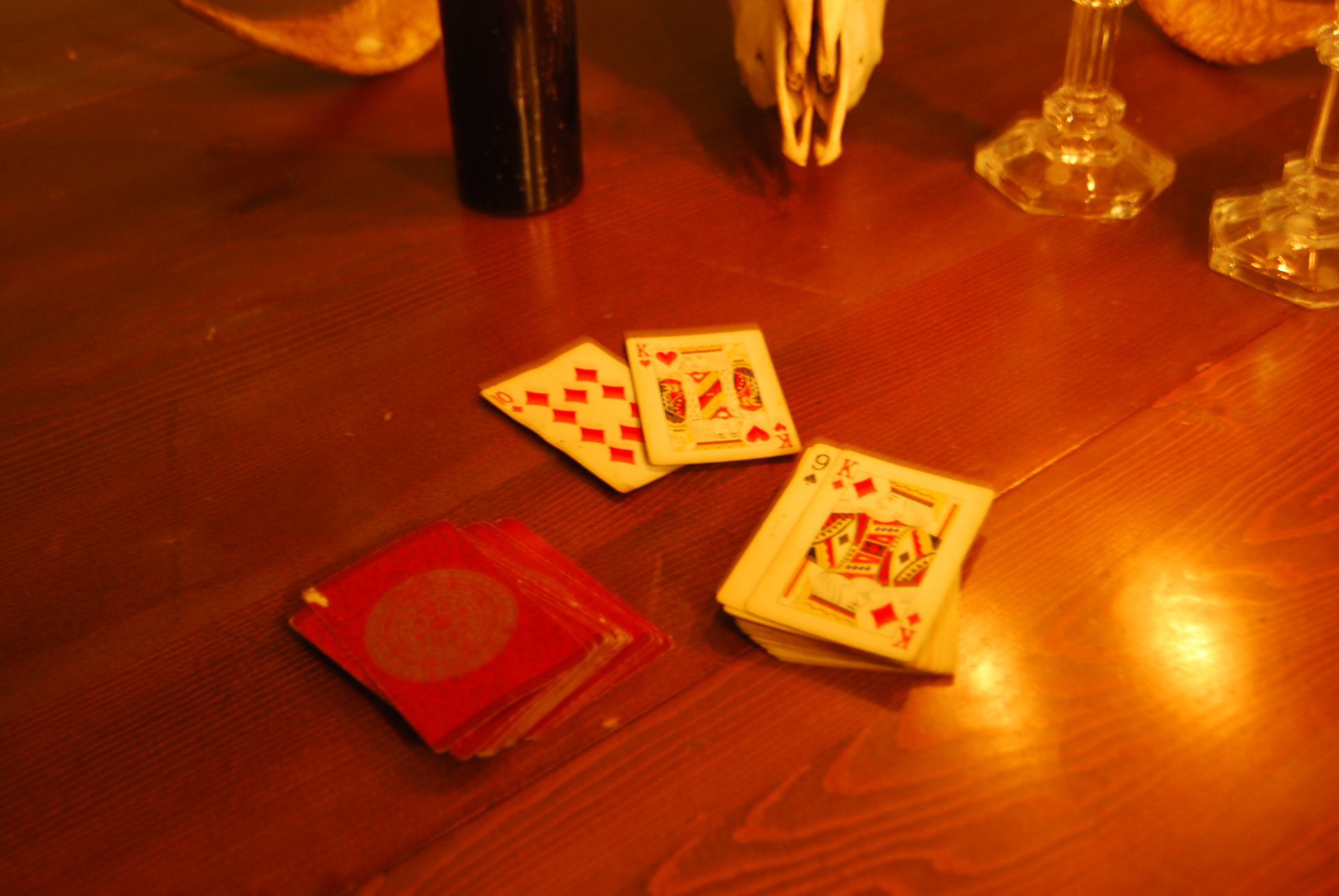
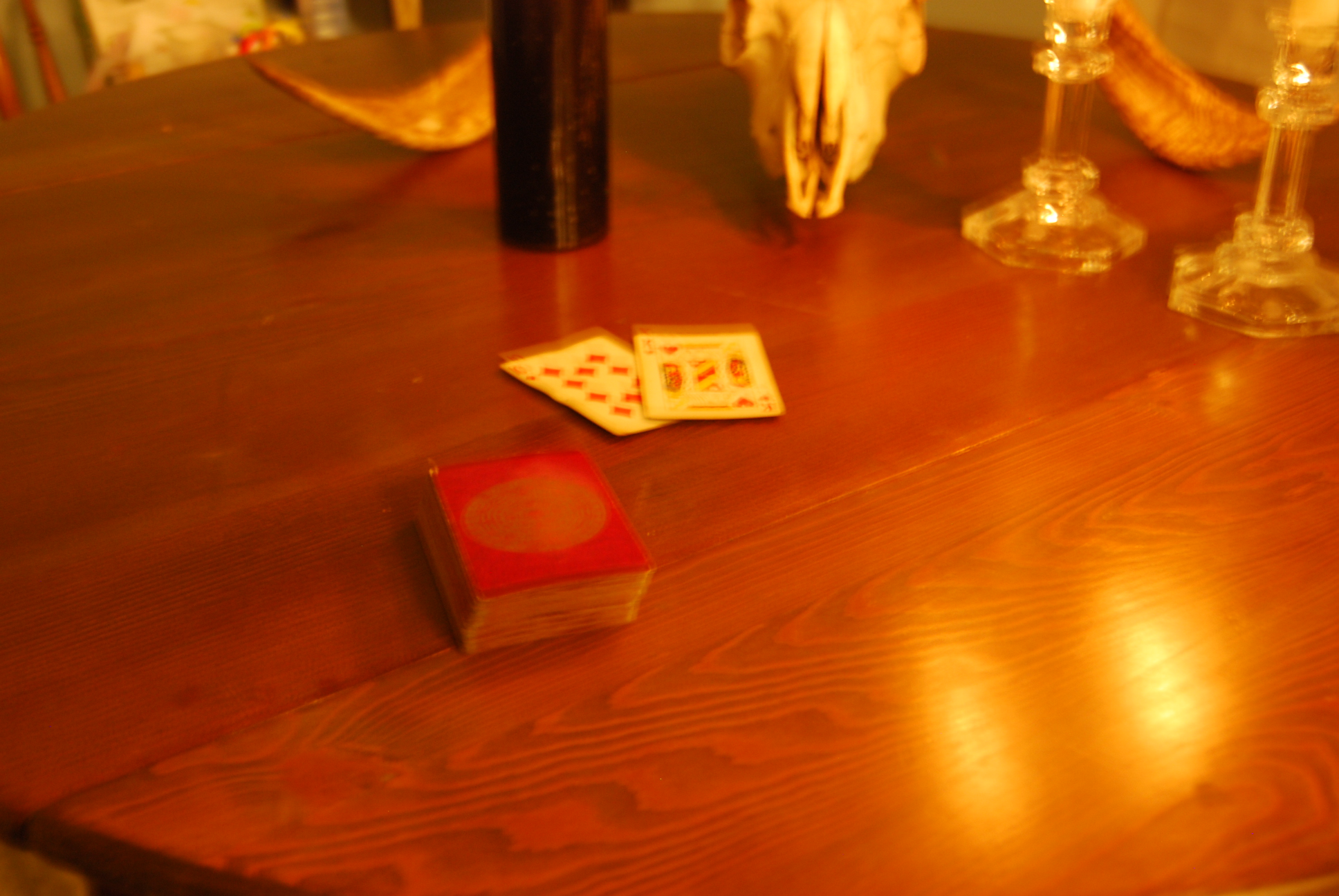
Before you do any spread, contact spirit(s) if you like.  If you don’t know how to do that or don’t feel like that will help your reading, you can bypass this step.  In the illustrations below, you’ll be seeing candles and a ram’s skull in the picture.  While these are a part of my Ancestral contact work, I’d like to be up front in saying they are in these pictures more for show than anything else.  I do sometimes contact Ancestors via the cards (mostly because my cards are handed down from my mother, so if I want to speak to her they’re a great medium for that), but generally speaking I don’t have a lot of paraphernalia during a cartomancy session.  Part of the charm of reading with playing cards is their ubiquitous and unassuming nature, so getting all the trappings and trimmings of a full Ancestor contact working out is a bit overkill.  But it looks nice in pictures.

Often, a short prayer to the effect of “Spirit(s), guide my hands as I shuffle these cards, my eyes as I read them, and my mind as I speak their meaning” will suffice.  A glass of water and maybe a candle will add to it, if you are so inclined.  But don’t feel compelled to twist yourself into knots before you’ve even begun.

Okay, onto the spreads.

One-Card Reading

Figure 1

This is the simplest kind of reading, and can be done in a minute or two.  The questioner posits a yes/no query, and the reader cuts the deck and shows the card at the split (see Fig. 1).  If it’s a red card, the answer is “yes,” and a black card means “no.”  The actual card itself can add a little more meaning to the reading, if you care to discuss it with the client, but it won’t tell you much.  For instance, in the photo, I’ve got the Eight of Diamonds.  So if the querent asked something like “Will I meet a new romantic partner soon?” the answer would be “yes,” with a slight augmentation indicating that perhaps they will meet their lover due to some office gossip, or that perhaps their new paramour will be a gossip him/herself.

This type of reading is not particularly good for deep questions.  The new love question probably is about as profound as it can get with such a cursory effort.

Three-Card Reading

Figure 2

This sort of spread is a little fuller, but it is usually linked to a period of time.  Make sure to establish that time-frame before doing the reading, asking the cards to show you yesterday/today/tomorrow, tomorrow morning/noon/night, etc.  You can be very vague and say past/present/future, but the answers will likely be equally vague.  You can also be very specific and say 1pm/2pm/3pm, but that may also short-circuit the reading.  I generally find morning/noon/night readings are my favorites with this type of spread.  In fact, I often do them in the evenings as part of staying in practice.  They take about 5-10 minutes and they help me to pay attention to different things throughout the day.

In Fig. 2, you can see a three-card spread displayed in front of the nifty ram skull (I apologize if the pips are hard to read).  The deck is shuffled, and the top three cards are laid out in a line.  Cards are read left to right, with the left-most card being the “oldest” or “earliest” card (the past or the morning, etc.).  For the sake of easy explanation, let’s say this is a typical morning/noon/night reading.  That means you’ve got:

  • Morning – Four of Diamonds: The purse/money bag; No news.
  • Noon – Five of Spades:  Illness; A corpse.
  • Night – Ten of Diamonds: A treasure chest; Sunlight; Joy.

So for this particular reading, the morning would be fairly stagnant, especially financially.  As the day progressed, things would feel like they were getting worse, or perhaps some real effort would be needed to “bury” those monetary woes.  But by the end of the day, everything’s working out, and finances are secure.  So perhaps the client will have a money scare (an overdraft charge or something like that) which they spend a good bit of time dealing with, but by the end of the day, it all works out in their favor.  Or, it could be that the actual workday (assuming a 9-to-5 schedule) will be awful, going from bad to worse, but that the evening will redeem the day, perhaps by allowing some small luxury time with friends or loved ones.

Five-Card Reading

Figure 3

This is the reading most people want, and the most detailed one I personally give (there is another type of reading where you spread out almost every card before you’re done, but I find that to be excessive, so I’ve never worked with it).  It’s called a five-card spread because in its basic completed form, five cards are displayed (as in Fig. 3).  I mentioned, though, that this is a misnomer.  In fact, you’ll actually read at least seven cards in this layout, with the potential for several more on top of that.

I start by “clearing” the deck, which is just a highly ritualized shuffle while I attempt to keep my mind blank in order to “neutralize” the cards for the client.  Then, I let the client shuffle the cards while asking and focusing on his or her question.  Queries here can be as simple or complex as the subject wants.  I know there are folks who do not like others touching their cards, so if you’re not comfortable with that, feel free to just hold hands with the client before shuffling the deck yourself.  That should at least allow you to get a bit of the client into the cards for the reading.  Once the client feels the deck has been shuffled enough (or you, if you do it that way), stop and stack the deck into a single pile.  Then the client (or you) will cut the deck (Fig. 4) and put the top half of the pile facing up on the reader’s left.  The bottom half is flipped over so that the bottom card is face up on the reader’s right (Fig. 5).  This is the “quick read” of the situation, which will examine internal and external influences on the subject.

Figure 4
Figure 5

For this sample reading, let’s assume that the reading is about the client’s current relationship/romantic life and where it’s going.  On the left or internal side is the Eight of Diamonds, and on the right or external side is the Three of Hearts.  This breaks down to mean:

  • Internal – Eight of Diamonds: Gossip; Idle chatter.
  • External – Three of Hearts: A wish granted; A full cup.

So the internal situation seems to be one of pleasant, if light, emotional content.  The external component says that the cup is full, and all is well.  Basically the cards indicate an extremely happy if rather casual romantic relationship.

The next step is to restack the deck so that the two halves are reversed.  In other words, the Eight of Diamonds will now be the bottom card and the Three of Hearts will be the “middle” card.  The reader then pulls cards in pairs starting at the top of the deck and going down until he or she reaches the signifier card (the Queen of Hearts for a woman, the King of Hearts for a man).  See the process in the following figures:

Figure 6
Figure 7
Figure 8
Figure 9

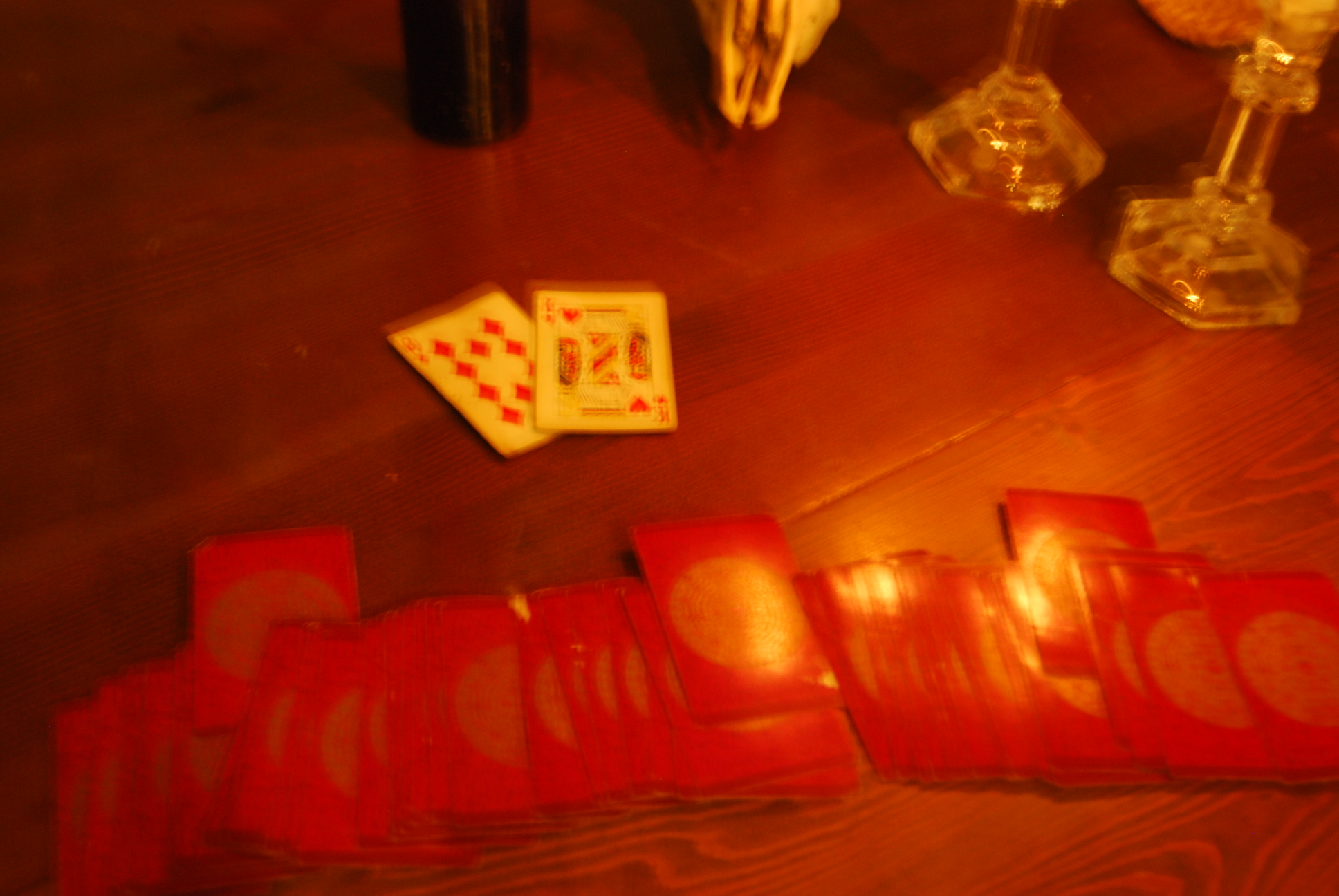
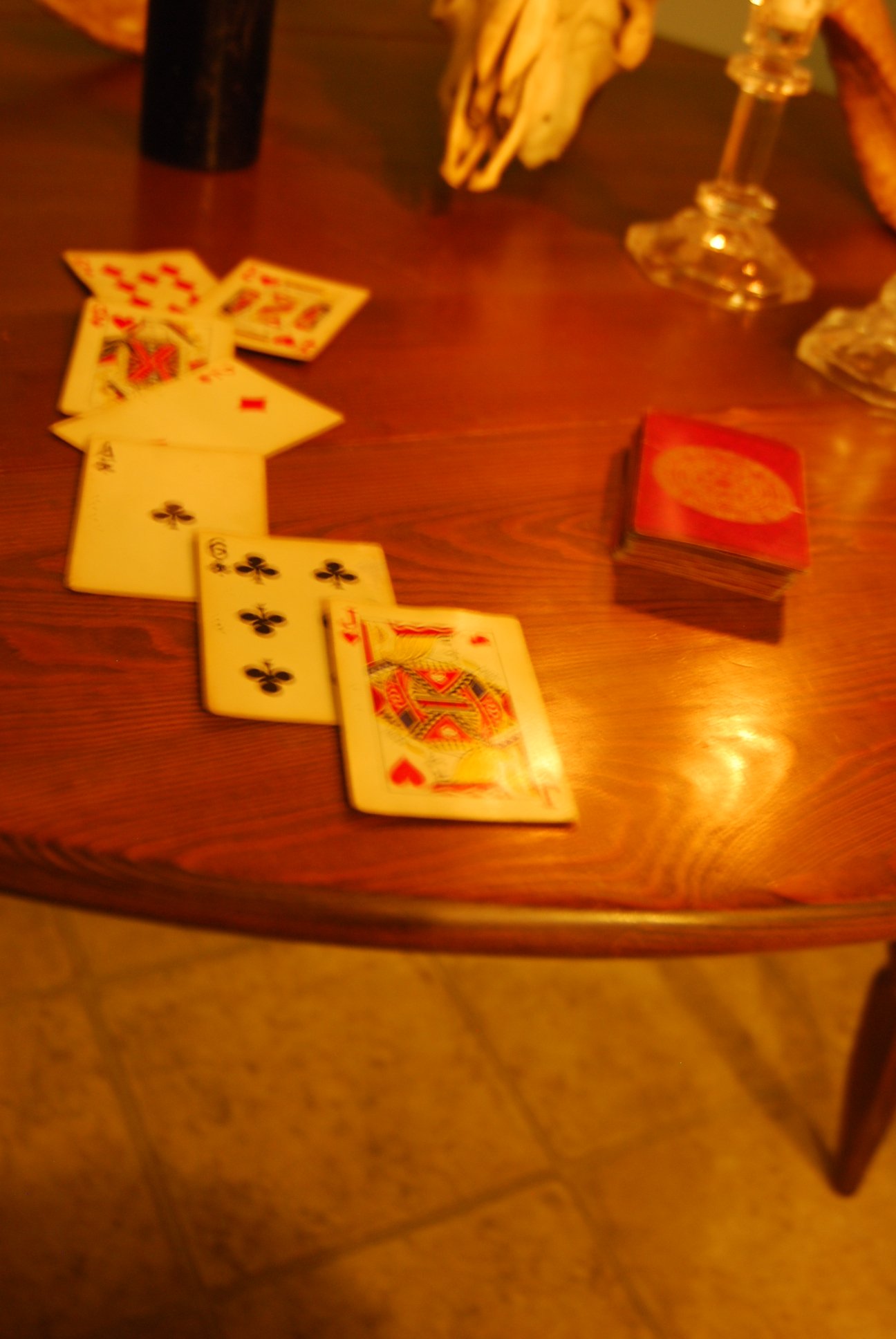
In Fig. 6 (apologies for the blurring), the cards are turned over two by two.  In Fig. 7, the signifier (in this case a King of Hearts as I’m reading for myself) has been found, with a Ten of Diamonds behind it.  That pair is set aside as it was found (with the ten behind the king, which I’ll get to in a minute).  The pile of cards overturned to find that pair is put back on top of the unturned pile to make a single deck again (Fig. 8).  This group is then splayed or sorted through by the client (or you) and three cards are selected at random (the three “pulled” cards in Fig. 9).   These three cards are then placed in a “tree” pattern coming down from the signifier pair in the order they were pulled.  You should end up with something looking like this:

Figure 10

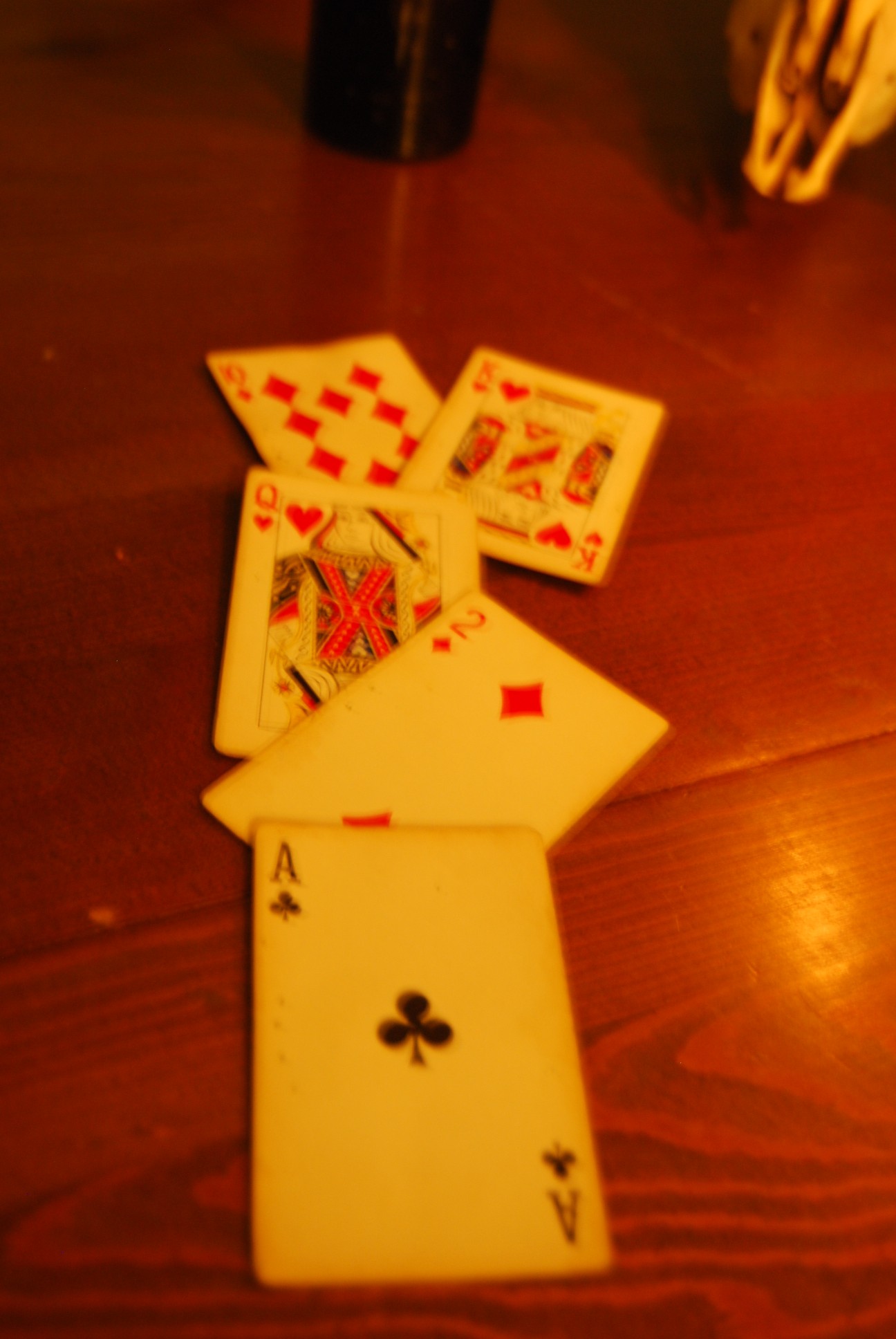
This is your basic layout for the reading.  The first thing to note is whether the signifier card is on top of or below the companion card.  If it is on top of its mate, the companion card indicates internal processes and functions, while the opposite indicates outside influences.  In this case, the Ten of Diamonds is behind the signifier card, indicating a great deal of internal happiness and contentment.  The rest of the reading has to do with the future/fortune of the subject:

  • Companion Card – Ten of Diamonds: A treasure chest; Sunlight; Joy. (internal)
  • Signifier Card – King of Hearts: The subject (male)
  • Card 1 – Queen of Hearts: Soulmate.
  • Card 2 – Two of Diamonds: Birds (as in “a little birdie told me”); Exchange of funds.
  • Card 3 – Ace of Clubs: A cave; Solitary contemplation.

First, I note that there are no spades, which indicate a relatively positive reading.  Second, the soulmate card appears almost immediately, which is a very good sign in a question about relationships.  The reader already knows that the signifier card is surrounded by good things (the interior sunshine and the near future or current soulmate).  Next down the list is the birds card.  This might mean getting some good news about the soulmate, or possibly even something more significant (think “birds and bees”).  It could theoretically mean an exchange of funds for love (an expensive date, or possibly prostitution), but there’s not much to support that in the reading otherwise.  The third card is a little bit more difficult, as it indicates a need for personal space.  So it may indicate that while things are going great now, something is going to take the relationship to the next level (the birds and their associated nesting), and that the subject will feel the need for his own space or time.  Conversely, a cave is also the most rudimentary form of home, so it could mean that the subject will be doing his own version of “nesting” soon.  All in all, this could mean moving in together, or possibly even starting a family together, sometime in the near future.

The reading can stop here, if the client and/or reader wishes, or cards can be pulled one at a time randomly from the remaining deck.

Figure 11

In this “extended” spread, the meanings become vaguer and vaguer as you go further out.  Generally speaking, I will only allow 2-3 extra cards during my readings, because after that things just start falling apart.  In Fig. 11, you can see I pulled the Six of Clubs.  That is the card for “Footprints; A clear trail.”  This basically just reinforces the current trajectory of the relationship, and for someone who’s already started a family or moved in with their significant other, probably just means “stay the course.”  The current homelife is rich and rewarding, and will continue to be so.

Figure 12

Just to tie everything up, one more card is pulled (Fig. 12), the Jack of Hearts.  This is the card signifying “A baby; A cradle; A young boy.”  If I weren’t the client, I imagine whoever I was reading for would probably get beads of sweat on his neck right about now.  All indications are that the natural ending to all this domestic and romantic bliss will be a bouncing baby not too far down the line.  It’s a tidy ending to a very positive reading, and a good place to stop.

I hope that illustrates these basic card layouts for you.  My apologies if the photos aren’t great, but hopefully you get the idea.  If you have any questions, please feel free to ask.  I reiterate that this is my own system, based on several I’ve encountered and worked with over time.  I’m happy for folks to use it, though if you quote it or share it with others, please attribute it to me.

Oh, and while I didn’t actually focus on anything during this reading, it’s eerily accurate.  My wife and I are now expecting baby #2 sometime in March!  Woo hoo!

Thanks for reading!

-Cory

Blog Post 85 – Hearts and Spades (Cards, part IV)

This post deals with the second half of the deck, the hearts and spades suits.  Again, I’ll provide a few key words or images, and then elaborate a bit.  Let’s get to it!

Hearts
This suit has to do with deep emotions as well as family, friends, and lovers.  These cards often represent people well-known to the questioner.

Ace – A kiss; A new romance; Feeling lonely.  Pulling the Ace of Hearts in a reading means that likely a new lover has entered the picture, or at the very least a formerly bland relationship has taken on new life.  Generally it’s a positive card, but next to something like a Two of Spades it can mean a period of separation and loneliness.

Two – Lovers; Coupling; The sex card.  This is the card that inspires knowing smiles and lecherous grins.  Simply put, it’s about sex.  Not so simply put, it can also be about and deeply emotionally intimate connection with someone else, including a family member (try not to mix those two meanings together…*shudder*).  So if you pulled it with say the King or Queen of Clubs, it likely means a family relationship, while a lay next to any Jack might mean a delightful tryst.

Three – A wish granted; A full cup.  The Three of Hearts means that something deeply longed for is about to appear.  This isn’t quite the fulfillment found with the Ten of Diamonds or the Ten of Hearts, but it does generally mean at least one thing will go right.

Four – A trunk or travel case; A lock.  Like with other fours, this card shows a relative stagnation.  However, in the case of the Four of Hearts, that could also mean incubation or preparation.  The image of a hope chest or a steamer trunk fits this card, with all their promised potential for excitement, romance, marriage, and just life in general.  However, getting mired down in preparation can lead to a life of lock-down, where everything is being kept just so, and never given the opportunity for use.

Five – A chapel; Fertility; A bed.  The Five of Hearts shows the healthy development of a romance, leading to family and (potentially) marriage.  Paired with something like the Queen of Diamonds, it almost certainly means a wedding of some kind.  Paired with a Jack of Hearts, be prepared for a new member of the family in nine months.  Paired with a Nine of Clubs, however, this card could just mean someone needs a good night’s sleep.

Six – A dog; Loyalty and stamina; Long-term relationships.  If the questioner gets the Six of Hearts in a reading, he or she can expect to be in it for the long haul, whatever “it” may be.  It could be a family situation, a romance, or even—if paired with something like the Two of Spades—a lengthy divorce.  However, the upside to this card is its dog imagery.  Paired with a lover card like the Two of Hearts, it indicates a sincere and faithful mate, one who loves unconditionally and who will always be there.

Seven – Hate; Fear.  This card shows a love that has grown too strong and become hate, or possibly fear and terror of another person.  If the reader sees this card with something like the Five or Nine of Spades, it’s a sign that the relationship will end in violence and help should be sought immediately.  Alternatively, with something like the Ace of Clubs, this may indicate self-loathing which needs to be overcome.  It’s also possible that the Seven of Hearts will act as a warning in a reading, alerting the subject to the presence of an enemy.

Eight – Flirtation; Pillow talk.  While the Two of Hearts is all about doing it, this card is all about talking about doing it.  The Eight of Hearts shows that giddy, fun stage of flirtation and wooing that so often appears early in the relationship.  It can also mean a sweet, tender intimacy and connecting with a partner on an emotional as well as physical level.

Nine – A little house/cottage; A new life.  When a client pulls this card, it usually has to do with the establishment of a new family or a new home.  Paired with something like the Four of Hearts or Five of Clubs, it may mean saving for a new house, or possibly moving away.  If aces show up, however, pay attention to them, as they may indicate a sudden shift in life circumstances which leads to a new life that the client doesn’t actually want.

Ten – A happy family; A fire.  With the Ten of Hearts, everything about one’s emotional and personal life seems to be falling into place.  Romances go well, family relationships are strong, and everything’s good.  Think of being gathered around a nice warm fire with friends and family, enjoying a perfect summer evening.  Be aware, however, that as with all fires, this one can burn.  Paired with an Ace of Spaces, be prepared for an upheaval in happiness.

Jack – A baby; A cradle; A young boy.  This card is one that makes plenty of clients nervous, and some extremely happy.  Because of its strong associations with a newborn child, the Jack of Hearts often tells of a pregnancy, especially when matched to something like the Five of Hearts.  This card can also have to do with calm and peace, though, even indicating a period of self-pampering in a way.  In some cases, the card simply refers to a boy or young man in the client’s life.

Queen – The client; Soulmate.  Remember how I said the King and Queen of Hearts were unusual?  That’s because they are used to represent the actual client in a reading.  If a reader has a female client, she is represented by the Queen of Hearts.  If the reader’s client is male, this card represents that perfect, ideal lover or soulmate.  One of these two cards, at least, will always show up in every extended reading (more on that when we talk about layouts).  The presence of both indicates a preexisting marriage or a deep and abiding love.

King – The client; Soulmate.  Just like the Queen of Hearts, this card can represent either a male client or a soulmate.  I know some people will ask about homosexual couples, and I will say that despite the gender pairings implied by the card faces, the meaning “soulmate” still applies to gay couples.  Since there aren’t two Kings of Hearts in a deck, a gay man will see his ideal mate represented as a Queen of Hearts.  The reverse is true if a gay woman sees a King of Hearts in her reading—she can expect to meet the girl of her dreams.

Spades

These are the cards of woe, suffering, and fighting.  Consider them warnings or signs of trouble that may yet be avoided.

Ace – Death; Sudden change.  This card is paralleled by the Death card in the tarot deck.  And like its counterpart, it doesn’t necessarily mean physical death, but instead a sudden transformation or an ending.  Much of this card’s meaning depends upon what it’s next to.  If it is with a Six of Clubs, it might mean that a business venture will come to an abrupt termination.  With Threes from Diamonds and/or Hearts, the client can stop expecting others to give them anything…they are on their own.  This card can also indicate deep isolation, and in some cases might even mean a period of contemplation, but again, it depends on context.

Two – A duel; A separation.  The Two of Spades means that someone is itching for a fight, and there’s a good chance they’ll get one.  Paired with cards like the Two or Nine of Hearts, a romantic separation is imminent.  If it sits next to a person card, like a jack, king, or queen, it’s likely there will be a falling out with that person soon.

Three – A battle; Setbacks and obstacles.  Unlike the obstacles presented by the Three of Clubs, the roadblocks that come out of this card are not about developing oneself and overcoming difficult trials.  Instead, this card is about fighting through the hardest parts and living to see another day.  Metaphorically, the Three of Spades might indicate a bitter falling out with one’s parents (if next to a King or Queen of clubs) or a difficult economic situation at one’s job (with a Six of Diamonds or Clubs).

Four – The Four Horsemen; A mire.  Seeing a four in any suit indicates feeling a little stuck, but seeing a Four of Spades means being immobilized.  It can also presage illness, poverty, violence, or even death.  It means that if the subject doesn’t make some changes—difficult as they may be to make—there could be some dire consequences.  However, there are positive ways to see this card.  If it is followed, for example, by the Five and Jack of Hearts, it may mean that someone who’s been trying to get pregnant will soon be able to, though it won’t be easy.  Overall, though, consider this a definite “warning” card.

Five – Illness; A corpse.  This suit is just full of jolly things, isn’t it?  The Five of Spades indicates sickness, disease, pain, etc.  It can also mean that there’s something that needs to be buried, like a hatchet between the client and someone he/she is feuding with.  Paired with cards like the other Fives or the Ten of Clubs, it generally means that the client will beat the illness or deal with the skeletons in his/her closet.  With a Nine or Ten of Spades, however, things get worse.

Six – A devil; Temptation; Bad decisions.  If the Queen of Clubs is the angel on your shoulder, the Six of Spades is on the other side with red pajamas and a pitchfork.  The nice thing about this card is that any temptations it brings up can be recognized and dealt with.   But sometimes it’s fun to give into temptation, too, so pay attention to the other cards.  If you see lots of red cards around this card, it may mean a little harmless vice.  With a Two of Hearts and a Five of Spades, however, it may mean that a sexual relationship is becoming destructive.

Seven – Tears; Blood; War.  I’ve already mentioned that the tears implied by the Seven of Spades can be tears of sorrow or tears of joy, depending on context.  This card may also be a warning that violence is not far away, or that something deep down inside the subject is affected by the overall reading.  But the sevens always carry a twist.  While the sevens of the other suits tend to have some potent negativity, the Seven of Spades can have a very good side.  It can imply a great deal of strength, mastery of a situation, or even coming victory and glory.  Caution is always best, though.  If this card lands with the Ace, Five, Nine, or Ten of Spades, heads will roll.

Eight – An argument; Shouting.  Communication is important, but how a person communicates is also vital.  Pulling the Eight of Spades means that the client is not making him/herself clear and likely finds him/herself constantly embattled and unable to resolve the problems in his/her life.  It can also mean long-standing arguments with those close to the client.  If it were with a Queen of Clubs and a Five of Hearts, it could be a mother-in-law, for example.

Nine – A funeral; A coffin; A ghost.  The Nine of Spades looks like a funeral procession as scene from above, with pallbearers carrying a black coffin (at least that’s one way to see it).  This could indicate some kind of grieving process, the need for ritual and order to restore balance, or just a need to put an end to things.  In some cases, this card may mean that someone or something from the past is still haunting the subject (it may even indicate a literal haunting).  Matched with something like the Jack of Clubs or Jack of Hearts, it might mean an old friend or an old flame of some kind.

Ten – A cemetery; A ruined church.  This card shows the aftermath of woe and trouble, and in that way it’s actually not all that bad.  It shows that the worst is over, and that all that’s left is to pick up the pieces and move on.  It can also be a peaceful card, a return to calm and quiet, or even to innocence in a way.  Paired with a card like the Six of Clubs, it might mean a lapse in faith and a need to reevaluate one’s beliefs about something.

Jack – A rebel; Bad news; A backstabber.  The Jack of Spades is a bad boy/girl, someone not to be trusted but who likely is very seductive and enticing.  With a card like the Six of Spades beside it, it might mean the kind of lover who is no good, but incredibly desirable.  With a Two or Eight of Diamonds, it means that gossip and slander are spreading about the client, and steps should be taken to staunch it.  The Jack of Spades can also simply mean bad news is on the horizon, so be prepared for it.

Queen –  A cruel mother; A seductress; Jealousy; A female rival.  With this particular queen, watch out!  She’s intensely powerful and knows how to use that power to get what she wants.  She is trying to take something from the subject, be it a lover, money, or happiness in general.  However, this card can also be a warning that the subject is becoming too jealous for no reason, which is almost an opposite reading in a way.  So again context is important.  Paired with a Six of Spades or an Eight of Hearts, it’s likely this woman is trying to wreck a relationship.  Paired with a Six of Hearts, though, it probably means that the subject is needlessly jealous.

King – A criminal; An executioner; Wrath; A male rival.  The King of Spades is powerful, too, and just as viscous as his queen.  He is not the just judge found in the clubs, but an executioner ready to exact a penalty for any wrongdoings.  He will take what is rightfully the client’s if he can, or attack when the client is the weakest.  If this card appears, the client should attempt to make amends for any transgressions, and turn to friends or family for support in case hard times lie ahead.

I know, another long post, but that covers all the individual cards.  I’ll be covering how to actually perform a reading with playing cards in the near future, so stay tuned (or subscribed, maybe?)!

Thanks for reading!

-Cory
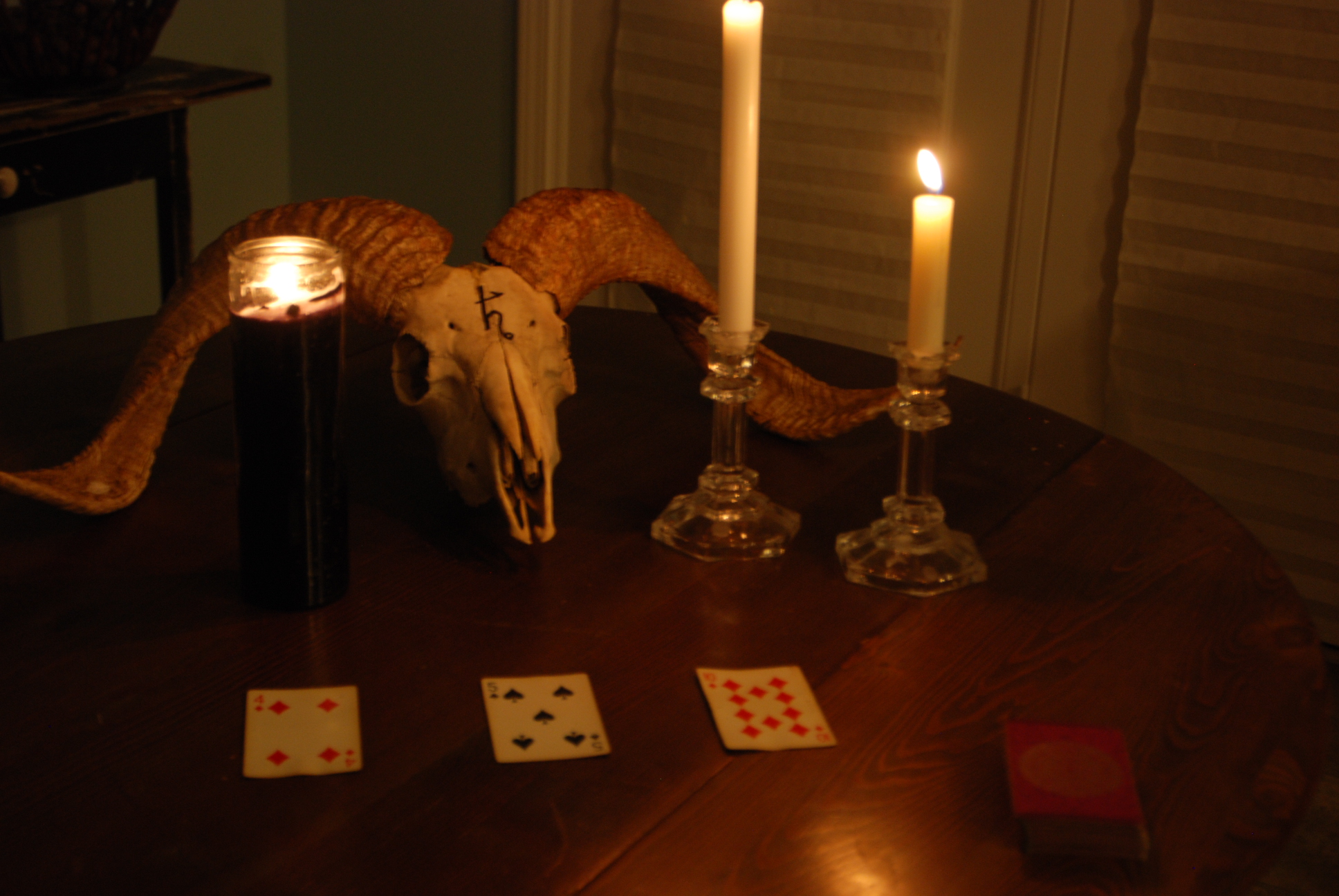
Blog Post 84 – Diamonds and Clubs (Cards, part III)

Okay, so today I’m going to look at individual cards and their significance in my readings.  I’ll basically tell you a few key words, then elaborate a bit on potential interpretations of these cards.  Most of my system comes out of years of practice using playing cards for divination, as well as for games.  I have found that in some cases, my personal work with a particular card has shown me a meaning different from the one I originally learned.  When it comes to these sorts of fortune-telling methods, practice makes perfect.

Now, onto the cards!  Let’s start with:

Diamonds

Remember that diamonds in general signify money, fortune, luck, and happiness.  They also can relate to messages or news, or social interaction.

Ace – A letter; A coin.  The Ace of Diamonds indicates some new money or new information entering the questioner’s life.  It can also have to do with a sudden shift in luck—if preceded and followed by spades, that could mean bad luck.  Additionally, due to the solitary nature of the pip, it could mean being very careful with your news, luck, or money—keeping it to yourself, as it were.

Two – Birds (as in “a little birdie told me”); Exchange of funds.  This card is about sharing, whether that’s news and gossip (like the birds), or sharing your luck or fortune with someone else.  It can indicate a partnership of some kind, but usually not a business one so much as a financial one.  For example, if it were paired with a card connected to a friend or lover, you might be moving in with that person soon (because you’ll be yoking yourself to them financially).

Three – Gifts; A fountain.  The Three of Diamonds shows generosity—sometimes even unwilling generosity.  Someone who draws this card likely “throws his/her money away,” just like one throws pennies in a fountain (if you’re singing “Three Coins in a Fountain” right now, I sympathize with you).  This may seem like a sign of irresponsibility, but it can also simply receiving a gift, or an expansion of fortunes which allows the person to be generous.

Four – The purse/money bag; No news.  With the Four of Diamonds, the reader will need to figure out if the reading is about money or information, as it changes the card’s meaning a bit.  If the question is financial, thefour indicates a stable monetary situation, but also one without any chance of growing—much like a closed purse neither receives nor spends money.  In the case of information, this card indicates a dull waiting period, possibly a prolonged one.  This can mean “no news is good news,” or that the client must wait on tenterhooks for a proper resolution to his/her situation.

Five – Good luck; Laughter.  This card shows the subject surrounded by friends, fortune, and happiness.  It’s not the all-encompassing joy found in other cards like the Ten of Diamonds but it’s generally positive nonetheless.  Depending on context, however, it can also mean something like “the last laugh,” and have slightly more sinister connotations.

Six – Streets of Gold; Good decisioins.  No, not the Yellow Brick Road, but the idea’s the same.  The client’s on the right path and merely needs to continue doing what he/she is doing and success will come.  Paired with a card like an Ace, this card may mean recent decisions have been good; paired with a King or a Queen the client is probably getting very good advice from someone.

Seven – Lies; Deceit and falsehood.  The Seven of Diamonds indicates that the questioner is being lied to by someone.  This lie may or may not have to do with money, but almost always has to do with happiness.  Perhaps the client is happy being lied to, and little white lies sustain him/her—this could certainly be the case if a Jack of Diamonds, Clubs, or Hearts were nearby.  More often, though, the lies indicate trouble to come.

Eight – Gossip; Idle chatter.  Much like the Two of Diamonds, this card means an exchange of information, although it usually is information of little value.  It can also indicate talking about money, getting good news about one’s fortunes or finances, or someone’s natural wit.  Paired with something like the Two of Spades, it might mean something like “loose lips sink ships,” and that one should hold one’s tongue for a while.

Nine – Daydreams; Peace and contentment.  Think of this card as a leisurely day spent in the sun with nothing particular to do.  It’s a card of relative idleness, but without any real negativity.  It’s a well-earned rest, a chance to plan for the future, and time to stop and smell the flowers.  Beware, though, if it’s paired with a four of any kind, as it may mean that all one’s plans are but pipe dreams, destined to disappear like clouds in an afternoon sky.  Or something like that.

Ten – A treasure chest; Sunlight; Joy.  With the Ten of Diamonds, the client can expect great happiness.  In the context of other good luck cards, this may mean an unexpected windfall or a sudden improvement in circumstances.  The Ten of Diamonds leaves little room for any sorrow or woe, and generally indicates the fulfillment of financial goals and personal derams.  Of course, as Willy Wonka said, “Do you know what happened to the boy who suddenly got everything he ever wanted?”  Oh, wait, he lived happily ever after…

Jack – Good news; A girl.  This card displays a young boy (or possibly a young girl, hence the card’s alternate meaning).  At one time these cards were known as Knaves instead of Jacks, and would have been similar to a knight’s squire.  In the context of a card reading, this Jack means that some good news is about to arrive. Or that a beautiful girl is about to arrive.  Which might also be good news, depending on  your point of view.

Queen – The good wife; A wedding; Sensuality.  This Queen is all about duty and splendor.  She could be a mother or wife in the questioner’s life who inspires joy and happiness, or provides sound financial advice.  More likely, though, she indicates someone who does what must be done or a woman with a deeply sexual side.  She can also mean a wedding (and thus a large expense and a large celebration), or in some cases a big party (for instance if she appeared alongside “friend” cards like the Queen or Jack of Clubs).

King – A bank; A civil trial; Wisdom with money.  The King of Diamonds means power through money or fortune.  Pulled with several spades, the client can expect to face some financial trials (literally in a courtroom or possibly only figuratively).  Alternately, pulled with clubs or diamonds, this card probably means that money is being invested wisely, or that there is a man in the questioner’s life who provides very good advice when it comes to luck and money.

Clubs

Clubs are work, destiny, plans and debate.  Remember that as you do your readings.

Ace – A cave; Solitary contemplation.  This card tells the reader that the subject should take some time to really evaluate his or her life.  Has he/she got goals?  Is he/she working to reach them, or should there be some reevaluation of priorities.  This is a lonely card, but not necessarily a bad one—often we need moments of intense personal reflection before we can move on to do the great things we are capable of.

Two – A handshake; Business partnership.  The Two of Clubs shows an agreement or arrangement made between two people, often for the sake of business or stability.  It can indicate a treaty or alliance of some kind, or a pairing up to overcome obstacles in the way.  Pulled with something like a Two of Spades, it may mean the impending end of a previous business partnership.

Three – A stone wall; Obstacles.  In most cases, threes indicate wishes or growth, so this card may seem odd.  However, the setbacks provided by a good obstacle also provide the impetus to overcome them oftentimes.  Usually this card means that whatever challenges the subject faces, whether they be business troubles or a lack of personal direction, he/she can and will overcome them.  Paired with something like a Three of Hearts or Diamonds, such progress is likely just around the bend.

Four – A horse and cart; A plowed field.  This card is about potential.  The Four of Clubs definitely means that for the moment nothing is happening, but that now is the time to prepare for inevitable change.  By “tilling” and “plowing” oneself or one’s business plans, the eventual outcome will be far better than one would get just sitting on one’s hands.  If this card  appears with a Nine of Clubs, that outcome is ripe and should show up very soon.

Five – A barn; A healthy body.  The Five of Clubs is encouraging.  It can represent either a full barn (which in turn stands for abundance and hard work paying off) or a strong, healthy body.  If this card were at the end of a reading full of cards which indicated illness (such as a Five or Nine of Spades), a recovery should be expected.  An inversion of that order might mean deteriorating health, however, so context is important.

Six – Footprints; A clear trail.  A person who gets this card in his/her reading probably has a definitive sense of purpose, or has recently begun some activity that he/she finds very fulfilling.  This can be a career, a hobby, or even a friendship of some kind.  If the appropriate King or Queen of Hearts comes after this card, it might be a sign that true love (“wuv…twue wuv”) is on the horizon.

Seven – Doubts/Worries.  The Seven of Clubs indicates that the client is very troubled by something.  So troubled, in fact, that it is likely hindering or debilitating the questioner in some way.  Paired with something like the Seven of Spades and/or the Ace of Clubs, he/she likely spends a lot of time alone and crying over something that he/she feels powerless to change.  The nice thing about this card (and there is a nice thing) is that for the most part, all the troubles are really in the asker’s head.  They can be overcome, but it may take a mental sea change to effect that change.

Eight – Shop talk; A table or bench.  When the work day finishes, it’s nice to crowd around a table with friends, family, and sometimes even co-workers for a drink or a meal.  Often the events of the day get rehashed, with details added or subtracted as conversation directs.  That’s what this card is all about.  It shows people getting together to share the tricks of their particular trades, make plans for times ahead, or even occasionally plumb the mysteries of the universe, depending on how much beer is at the table.

Nine – Reaping; A forest.  The Nine of Clubs shows things that have grown and how we deal with them as human beings.  In some cases, we reap what we’ve sown and prepare for hard times ahead, hoping that what we have will be enough.  Sometimes, we wander through the trees getting lost, hoping we’ll find our way back again.  A questioner finding this card may be having trouble making sense of his or her life, but there is still plenty of hope left.  Followed by something like a Ten of Hearts or Clubs, this card simply means that a dark night soon reveals a bright dawn.

Ten – A herd or flock; Clouds.  This card is abundance, completion, and satisfaction.  It is definitely all about rewards, comfort, and a job well done.  It completes the sense of accomplishment found in the Five of Clubs, and adds the element of restfulness.  The seeker’s found his or her calling, home life is happy and stable, and/or business is steady and fulfilling.  The clouds, heavy with rain on the horizion, are pouring down copiously.  This is the “pat on the back” or “Miller time” card.

Jack – A friend; A sibling.  The Jack of Clubs is a peer, whether that’s a co-worker, a good friend, or a sibling.  This is someone with whom the questioner has a mutual respect.  The Jack can also indicate business news of some kind (especially if an Ace or Two of Diamonds or an Eight of Clubs shows up), and may also indicate a young boy entering the client’s life.

Queen – A mother; A nurse; A wise woman.  This is a card indicating someone very smart, very strong, and very helpful.  The seeker probably knows exactly who this card represents when he/she sees it, and also probably knows exactly what kind of advice this person would give (think of this as a conscience card).  This card can also mean a mother hen, too, though likely only if connected to an argumentative card, like the Eight of Spades.  Conflict in the Clubs is productive, however, so even a mother hen has her place.  Finally, this card indicates nurturing.  Paired with something like an Ace of Clubs, it likely means taking the time to heal old emotional wounds before moving forward with something or someone new.

King – A father; A judge; A general.  The King of Clubs is someone with authority, someone who can give an order and get things done.  He may not always be nice about it, but he has his reasons for driving people so hard.  This person is someone wise, though perhaps also someone very stubborn and set in his ways.  For those who have issues with feeling judged all the time, this card could be troubling, but it may also mean that the questioner must face his or her fears and forge ahead.  This is a card about what must be done, and living up to expectations.

Wow, a long post today.  I hope someone out there finds this useful.  Let me know if you do!  Next post we’ll finish up the individual cards.  Until then…
Thanks for reading!

-Cory