Have you ever wanted to learn practical cartomancy (fortune-telling with playing cards)? Well here’s your chance!
We’re running a 3-class course on card reading (and more) and you can sign up at our website! Link in bio or visit http://www.newworldwitchery.com
Greetings all!
As some of you may know, Cory wrote a book some ten-plus years ago called Fifty-four Devils: The Art and Folklore of Fortune-telling with Playing Cards. Last year, he released the Tenth Anniversary revised edition, which expanded the original text to include more depth on readings, revised options for non-binary readers and clients, ways to read playing cards in conjunction with other divination methods, and even some guidance on spellwork with cards!
Early in 2025, Cory also test-ran a three-session cartomancy course for New World Witchery Patreon supporters, which got some great reviews!
Cory Hutcheson’s The Fifty-Four Devils cartomancy course was a delight from start to finish. Cory is a very knowledgeable and experienced playing card reader who has devised a method that is simple, effective and practical. He also teaches the system in a clear and engaging manner with lots of humor and charm. Besides learning the card reading system, you get history, folklore, mythology, and magic! It is a great way to expand your cartomantic reading skills -Karen C.
So now we’re opening that course to the public! Here’s the details:
Dates: July 7, July 14, July 21 (Monday evenings 7pm-9pm Central Time) – All classes are held by Zoom and recorded so if you miss one you’ll be able to watch it later
Cost: $64 per student*. That includes:
Three live and video-recorded sessions covering the history, folklore, and practice of playing card cartomancy
Access to our online classroom which will include discussion forums, practice prompts, no-pressure quizzes to self-check your learning progress, and more!
A copy of the e-book version of the Tenth Anniversary Edition of Fifty-four Devils
Additional bonus materials like video sample readings and printable PDFs
How Do I Register?
Good question! All you need to do is go to our Patreon page and purchase the post “54 Devils Cartomancy Class.” (You don’t have to be a monthly Patreon supporter to purchase this class, as you can do just a one-time purchase). When you purchase that post you’ll be able to open the entire thing and get the link to our online classroom to join us!
Registration will stay open until the first day of class, July 7th, 2025.
I already knew that Cory is an exceptional teacher and storyteller, but I was still pleasantly surprised by how skilled he was at engaging with the class and making cartomancy feel accessible and fun. The after-class lessons and quizzes he provided made me think carefully about readings and how to practically apply these new skills. -T. King
The course will be limited to a cap of fifty students for the sake of manageability. If you want to take the course but know you can’t afford it at this time, never fear! We’ll have a scholarship option available soon and open up five no-pay slots for students who will be selected at random from our pool of scholarship applicants.
If you’ve ever wanted to learn to do practical cartomancy with someone who’s been reading cards for decades while also engaging with a cartomancy learning community and getting some additional bonuses and perks, this class will be the one for you!
I hope to see you there!
Be well,
-Cory
*Please note that while the flat fee for the class is $64, some apps and platforms (such as iOS apps) may charge additional processing fees. The best way to ensure you get the $64 price is to visit the Patreon purchase site from a web browser.
We hope you’ve survived the eclipse in one piece and are looking forward to the moon waning again.
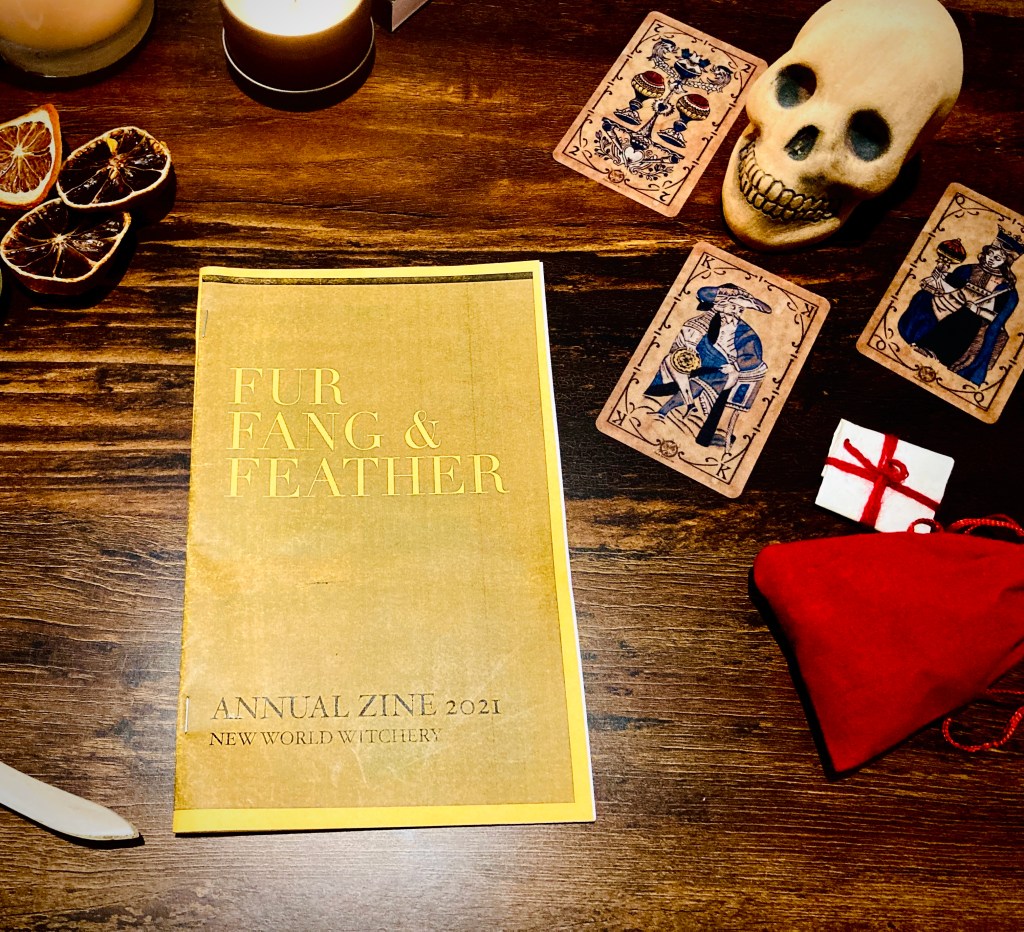
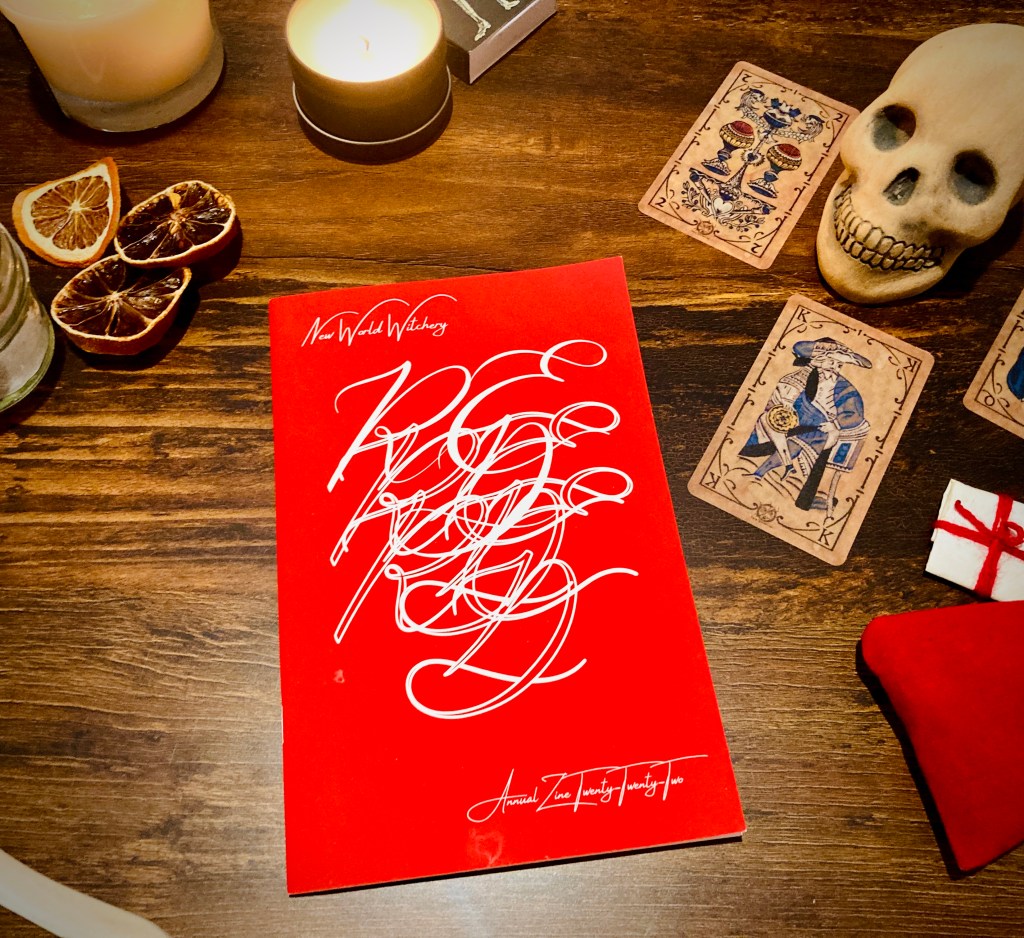
Since we’re in the celebrating spirit and all, we wanted to share with you that we’ve got something new going on. For those of you who support us on Patreon, you know that we usually produce something called an Annual ‘Zine for our patrons (typically sometime in the Spring, and yes, we know what 90s kids we are). Patrons at the $5 level get a digital copy of it, and patrons at the $10+ levels get a physical copy mailed to them. We’re in the midst of sending out our 2023 and 2024 ‘zines (we missed last year due to life circumstances but did a double ‘zine this year to make up for it), and until now we’ve made the ‘zines something available only to patrons as a bonus perk of supporting us. However, in order to support some of our efforts and the rising costs associated with our work, we have decided to put ‘zines from previous years on sale in case anyone in the general public is interested in acquiring them.
We are selling both digital copies of the ‘zines (for $5 each) and physical copies (price varying by materials). The physical copies are from our overstock, so quantities are limited there and once they are gone, they are gone. They are available on our Etsy shop (just because that’s the easiest place to sell them from). Right now we’re selling two Annual ‘Zines:
Fur, Fang, & Feather (2021) – A look at animals and magic including a personal essay from Laine, some bird folklore, animal-based charms, and a “trash familiar manifesto” from Cory. It’s 23 pages long and the physical copy is printed on good ole standard ‘zine copier paper. Digital copies are $5 and physical copies are $10 plus shipping.
RED (2022) – Our look at the folklore and magic of a crimson hue. We talk about red thread in magic, review some red-themed divination decks, look at a few (in)famous red books in magic, examine the housle or Red Meal in traditional witchcraft, and more. It’s a 31-page long ‘zine printed on recycled 80lb paper with a red paperboard cover. Digital copies are $5 and physical copies are $13 plus shipping.
These are definitely a limited-quantity offering, so if you’re interested in them please check them out sooner rather than later!
We will eventually make our 2023 and 2024 overstocks available, too, but we’re making sure everyone who was a supporter prior to the cutoff date gets a copy first. If you want to make sure you don’t miss a future ‘zine (and that you get a discount on purchasing past ‘zines), you can always join our supporters on Patreon, too!
Even if you don’t buy a ‘zine, we’re grateful to you for being a part of our readership and listenerhood (is that a word? well, it is now…). Thank you for your ongoing encouragement and support, and happy reading!
Wishbones for love? Talking to bees? Ozark folk magic!
In which Cory gives a brief (and VERY high-level) overview of Ozark folk magic, along with a few suggestions for further research and learning. Turkey wishbones for love? Talking to beehives? Moon signs and body parts? All that and more in this video!
Please note that I am NOT a native Ozarker, and can only speak as someone studying folklore. Those who would like to know more should definitely seek out the expertise and knowledge of Ozark residents over what I say here.
Images are designed by Canva. Images from Vance Randolph’s article from Life Magazine are used under the presumption of Fair Use for educational and critical purposes. Additional images via Wikimedia Commons (Public Domain).
image by Cory Thomas Hutcheson (use under CC 2.0 license)
Readers, I am probably not the person you want to invite to parties. Unless you happen to be playing Trivial Pursuit at your gathering, I’m inclined to become unnecessarily excited by any subject an unwary guest might bring up in a casual manner, and then—well, it’s all over. I’ll go on an infodumping share that can be, frankly, a lot.
One of the topics that’s sure to send me on such a tear is mushrooms. I have had a long-standing love of fungi ever since my youth. They were a favorite food growing up (along with spinach, and again, I am quite an oddity I know). They went into Italian pasta sauces, topped mashed potatoes in sautéed form, were a prime pairing on my favorite pizzas (along with pepperoni), and made a perfect substitute for French fries when fried and served with a horseradish cream sauce.
A little over a year ago, I read Merlin Sheldrake’s astoundingly good book, Entangled Life, which looks at the simply unfathomable ways that fungi impact the world in which we live. They are essentially why plants can and do live on land, provide a sort of organic internet between organisms of vastly different species, reshape our brains in both positive and terrifying ways, and lead to violent conflicts among truffle hunters in France (please do not kill dogs over mushrooms, even fancy ones).
I’ve also long known there were a few connections between fungi and the world of witchcraft. One of my favorite witch stories, “Meadowsweet’s Red Chaplet,” by Robin Artisson, is sparked by an experience with hallucinogenic mushrooms. The best example of this is the Amanita muscaria, also known as the fly agaric or red-cap mushroom. It’s ubiquitous in fairy tale illustrations with its ruddy top and white spots (and even makes a major pop culture appearance in video games via the Super Mario franchise, which does make you wonder just how real our favorite plumber’s adventures are). There are speculations that Amanita was an ingredient in witches’ flying ointments (and I’ve used some very good flying oil made by Sarah Lawless which included it as an ingredient–you should also consider listening to our interview with her on folklore and fungi from last year, too). It most certainly produced hallucinogenic effects in those who consumed it (although it can also cause violent vomiting, too). Some research suggests it was a major component of the shamanistic practices of the Northern European indigenous tribes like the Sami, too, although it is worth remembering that many of the claims about fly agaric’s ubiquitous use and powers are overstretched or impositions from the present onto the past. But red-capped agaric mushrooms do make appearances in witch lore at times. For example, I’ve identified a pair of stories from Irish and Appalachian lore that seem to point to the use of fly agaric in witch flight there, too (I write about it in my book, New World Witchery, as well).
Today, though, I want to look at some of the other mushrooms that show up in folk magic and lore, because when is it not a good time to talk about fungi? (the answer is: trick question, it is always a good time to talk about fungi).
Probably the mushroom most directly associated with folklore and magic other than the fly agaric/Amanita red-cap would be the “toadstool.” This is a bit of a misnomer, as a toadstool is a folk name given to several different broad-capped mushrooms (including Amanita at times). The name, which implies an affinity with toads of course, may also contribute a bit to some toadstool lore. In fact, a bit of lore from the Frank C. Brown collection notes that “The handling of large species of toadstool, sometimes popularly called ‘wart-toadstool,’ will cause warts to grow on the part of the hand coming in contact with it” (p. 311). Toadstools and toads are not particularly likely to give you warts, but the shaggy wart-like appearance of toadstool spots likely influences the sympathetic magical thinking here.
Toadstools also appear frequently in fairy lore, often influenced by Victorian ideas about fairies as diminutive creatures who might use such natural items as tables, umbrellas, or, of course, stools to sit on. Seventeenth century proto-science fiction author Margaret “Mad Madge” Cavendish once wrote a poem in which the Queen of Fairies used a toadstool as a banquet table, for example. Dancing or laying in a fairy ring of mushrooms was a surefire way to end up in the Otherworld, or catch the attention of the Good Folk. One of the most famous “Otherworld” journeys in literature, Alice’s Adventures in Wonderland (and Through the Looking Glass) feature the use of mushrooms to change size, although it is possible that author Lewis Carroll did not intend any psychedelic or magical connotations in his stories.
One other bit of lore about toadstools, however, gives them a slightly divinatory property. According to lore found in the mountainous regions of southeastern North America (such as the Ozarks and Appalachians), the appearance of toadstools predicts rain. Vance Randolph even says that the “sudden appearance” of such mushrooms is a “sure sign” that rain will come within the next twelve hours (p. 17).
The common puffball (Lycoperdon perlatum), sometimes called “devil’s snuffbox” in folklore image by Cory Thomas Hutcheson (use under CC 2.0 license)
Another mushroom that makes frequent folkloric appearances is one known as a “puffball” or sometimes a “devil’s snuffbox.” This is usually the common puffball (Lycoperdon perlatum), although it can be one of a few look-alike species as well. One account of lore collected in Georgia links the term “toadstool” with this mushroom, showing how folk terminology can sometimes apply to a wide variety of species:
“A toadstool is called the Devil’s snuff-box, and the Devil’s imps come at midnight to get the snuff. In the morning you can tell when the imps have been for the snuff, as you will find the toadstool broken off and scattered about. The snuff is used as one of the ingredients of a ‘cunjur-bag.’”
The “snuff” here are the powdery spores from within the puffball mushroom. If you’ve ever touched a mature puffball, you’ll know these spores can spray out in jets of powdery dust, which is the fungus trying to make more of itself. The snuff-powder clearly draws the influence and attention of devils and imps, which makes me think that the implication here is that these spirits will treat the conjure bag like a kitten would a catnip filled toy. By offering them something they want, they might be compelled to do whatever task the bag was created for.
Another bag-based spell makes use of a toadstool called “frog bread” (possibly also “frog’s bread” or “frog’s breath” based on a later entry in the same volume of lore, which also seems to indicate this is an immature form of the puffball mushroom, too). This fungus gets sewn into a sack with a frog (possibly alive, but most likely dead/preserved) along with a few other ingredients like pins, hair, and finger or toenails. In the narrative account, this bundle was then put into the bed of a woman who was suffering from a wasting sickness of some kind, and it evidently revived her enough that she was “jumping” from the bed (although this may just be the informant having some fun at the expense of Hyatt and playing off the idea of a “frog” cure making someone jump). (pp. 72-3).
Mushrooms also have a place within the healing work of at least one curandera, a woman known as Maria Sabina from Huautla de Jimenez, Mexico. She used psilocybin mushrooms during nighttime rituals, referring to both the mushrooms and the spirits with whom they connected her as “spirit children.” These rituals would likely have involved dealing with disorders such as susto, a sort of semi-catatonic state requiring a person’s soul to be reintegrated with their body. Unfortunately, Maria Sabina was “discovered” by an American anthropologist named R. Gordon Wasson, who then drove a sort of frenzy of celebrities in the 1960s to her doorstep, eventually overwhelming her and destroying her ability to do her curandera work with the fungi any more.
My family has no idea what they’ve done… image by Cory Thomas Hutcheson (use under CC 2.0 license)
Fungi have a lot to offer us, but they remind us that every boon comes with its potential bane, too. In my case, my obsession with mushrooms has grown more intense since reading Sheldrake’s book, and I’ve started identifying wild mushrooms on walks. I’ve had the privilege to read an advance copy of Nathan Hall’s The Path of the Moonlit Hedgein which the author recommends a ritual for connecting with local fungi as an animistic practice, something I’m deeply interested in trying. My family, in what can only be described as a fit of folly which they will almost certainly regret, purchased some at-home growing kits for oyster and lion’s mane mushrooms over the holidays. Already I speak to my beautiful boxes of inoculated sawdust and mycelia daily. This will not end well, I fear (although hopefully with less mind control and zombification than in other mycelium-laced stories like Mexican Gothicby Silvia Moreno-Garcia and Naughty Dog’s The Last of Us video game series).
But possibly I will convince a few of you to give mushrooms a second look when it comes to magic. They are a part of the deep history of earth, and they transcend the boundaries imposed on them. They connect with the realms of dreams and madness and death and hunger, and send shivers of flight and transformation through us (if they don’t kill us first). They are, in a word, magic.
It’s been a loooooong time since I did one of these (like seven years!). Partly that’s because a lot of our social media now fills the purpose that these cartulary posts used to, and partly it’s because I usually wind up trying to write more in-depth examinations of folk magic for the website that are finished and complete, so these peek-behind-the-curtain posts slip my mind. Oops, my bad, and sorry in that order!
For those who haven’t run into these before, a cartulary is essentially a scroll of information where new material gets added by attaching it to the bottom of existing scrolls, functioning as a sort of hodgepodge of ideas that get rolled up together because they don’t belong anywhere else. Given that the dominant reading mode for the internet is scrolling, I use these posts as a sort glimpse into my working notes on current witchcraft research, as well as showing you some things that may be of interest to you as well (since you’re here, you probably like at least some of the same witchy things I do, right?).
A lot of what’s here is piecemeal and incomplete, or at least a bit rough and unfinished, and some of it may not have to deal with witchery directly but will give you a sense of what’s going on behind the scenes between episodes/posts/books/etc. And you may discover something new that you love, too!
Let’s start with what I’m reading, which is always “everything,” I suppose. More specifically, though, I’ve got a slew of witchy books in my “just-read,” “now-reading,” and “soon-my-preciouses” piles. I was gifted a book from the Ackerly Green publishing house called The Book of Briars by my friend Heather, and I’ve been exploring the tangled world created by author C.J. Bernstein (essentially the engine behind the press) through the book The Monarch Papers: Flora & Fauna as well. This whole press and the world it’s creating are INSANE and delightful. It’s a fusion of fairy tales, lost magic, Mandela effect, murder mystery, and more. There are elements of Neil Gaiman, John Bellairs, Margaret Atwood, Charles de Lindt, and Diana Wynne Jones in these pages, and what’s even more wild is that you, the reader, can directly interact with the world as it is being written, helping to shape the story that already exists and the books yet to come.
I’ve also been working through some folklore collections that I’ve loved a lot lately. I picked up a really interesting collection called Myths of Magical Native American Women by Teresa Pijoan, who worked with tribes like the Lakota, Hopi, Cheyenne, and Creek to retain some of the tales that were potentially about to be lost with the passing of elders. Most notable are the “Salt Woman” stories, which can be very hard to find and which tell of the tragic-but-generous figure of the Salt Woman in several tribal mythologies who brought the gift of salt to the people. I also received a wonderful signed copy of the Tel que Dit stories done by podcast guest Erik Lacharity, which recounts a number of magical tales and legends from French Canadian history and lore. Many read like fairy tales, and there’s a wonderful series of stories about the folk hero/clever trickster Ti-Jean as well. For my birthday in June, I was incredibly happy to finally receive a copy of the Greenwood Handbook on The Pied Piper, which is one of my all-time favorite fairy tales/legends (it has some very strange elements of historical fact within it). It was edited by my folklore colleague Wolfgang Mieder, and goes through dozens of variants, sequels, artistic representations, and the historical context of the story as well. Finally, my kids turned me onto a whole series of graphic novels that are collections of world folklore, called the Cautionary Fables & Fairy Tales books. They feature collections like The Night Marchers (Oceanian lore), The Nixie of the Mill-pond (European lore), The Girl Who Married a Skull (African lore), and The Tamamo Fox Maiden (Asian lore). They are SO GOOD, and each volume features a variety of storytellers and artists to keep things varied and interesting. Great for both adults and kids ages 8+ (some stories are a little spicy or scary).
I also should mention that I’ve been on a bit of a mushroom kick lately, too. I’m enthusiastically listening to the audiobook for Merlin Sheldrake’s Entangled Life, which explores in depth how fungi are inextricably interwoven with every aspect of life on earth. It’s a science book, but it reads like a travelogue, a meditation, and an adventure tale at times, and I cannot recommend it highly enough. I…I think I might be bordering on obsessed with mushrooms and fungi, and actively looking to join a lichen cult if possible. In that same vein, I recently watched the Netflix documentary called Fantastic Fungi, which does a nice job giving a mile-high overview of some of the same things Sheldrake explores in much more depth.
On to the world of witchy books, of which there are so many in my life right now, I have to say I’m delighted at how many people I consider friends or colleagues are putting out good work at the moment. I’ve read and recommended Fire Lyte’s forthcoming book, The Dabbler’s Guide to Witchcraft, which essentially takes his skeptical, critical eye and looks at witchcraft in a way that can help a newcomer to separate the useful bits from the bunkum claims and absolute dreck that sometimes winds up in intro-to-the-craft type books. In a similarly scientific vein, I am absolutely in love with J.D. Walker’s book A Witch’s Guide to Wildcraft, which walks the reader through exploring their local flora both as a witch and a gardener (she’s a Master Gardener and spent thirty years running her own landscaping business, so she knows what she’s talking about).
On the more esoteric side of things, I also really loved Star Child, by Bri Saussy, which demystifies some of the complicated elements of astrology by also looking at what a parent might be able to glean from looking at the astrological placements of their child. There’s also Anatomy of a Witch, by Laura Tempest Zakroff, which dives into the sort of visceral experience of witchcraft by looking at it through the lens of a person’s body, breath, and movement (Zakroff is also a long-time professional dancer, so those elements are very important to her and it shows!).
I have to say that I wish I’d discovered Moon Dust Press long ago when my own kids were little. They didn’t exist then, but if they had my kids would have been getting lots of witchy, magical kids’ books like Sunday the Sea Witch and Brina: A Pagan Picture Book.
In terms of books in my “I shall devour you soon” pile, I’m really excited about a couple of new releases I hope to get my hands on in the next month or so. Thorn Mooney has just released her latest book, The Witch’s Path, and it aims for an audience that is a little different than most witchy books: advanced practitioners. Mooney looks at everything from group leadership to burnout, and apparently provides guidance based on individual learning styles, which I’m very excited about! I’m also hungrily eyeing Lisa Marie Basile’s latest book, City Witchery. I loved her Light Magic for Dark Times so much, and this one is tackling urban witchcraft, which I don’t see done nearly enough. I’ve got them both on pre-order so….soooooooon.
Our latest live cartomancy session!
I’ll close up with a couple of other witchy bobbins that I think are worth spinning. Firstly, for those who haven’t been watching our live cartomancy sessions, you’re missing out! They’re a load of fun! And we’ve discovered the wickedly honest power of the Mildred Payne’s Oracle of Black Enchantment from Deviant Moon. These cards are designed to look like woodcuts taken from a nightmarish and gleeful history of witchcraft, and they do NOT play around (well, they DO play around, but in the same way a cat plays with a bird it’s just caught)! We’ve gotten some of our most honest readings from them!
I also have been falling back in love with witchy podcasts, because there have been a whole spate of amazing new ones to come out this year. I can’t get enough of Invoking Witchcraft, featuring Britton and J. Allen, who remind me a lot of Laine and me because they are exploring folk magic through ongoing conversations and interviews. I was a guest on there a while back, but I’ve been totally hooked on them for months as they cover things like shoe magic, magical bathing, and whether or not to join a coven. I also ADORE the Southern Bramble podcast, which brings traditional folk witchcraft out through a queer perspective while also digging deep into its southern roots (and getting dirty and dangerous in the process). Austin and Marshall are just so engaging, funny, and also wicked that I can’t help but be drawn in! And finally, I’ve fallen for the Jewitches podcast, exploring Jewish folk magic and witchcraft with host Zo. This is a podcast that is built upon research and cultural investigation, and it deals with topics both delightful and very, very heart-breaking. Zo explores the overlap between Jewish persecutions and the early witch trials in Europe, the myth of the dybbuk box, and the horrific Blood Libel legend (which is still in circulation today). It’s really thought-provoking and also highly informative!
So those are the things that are currently getting free rent in my brain, and that are likely to influence some of the research and show-planning I do over the next few months. You’ll probably see some of these authors show up as guests on the show, or hear me talk about topics involving new veins of folk magic or curiosity that these little rabbit trails open up (who knows, maybe I’ll even have something to tell you about fungi and folk magic someday!).
The videos I’ll be sharing here are focused on getting started with folklore and folk magic research. I’m actually going to present them slightly out of order from how I posted them over on YouTube because I think they’ll make more sense in this order. The main idea here is that these videos will let you start pursuing your own line of research into folk magic and finding all sorts of great books like Hubert Davis’s The Silver Bullet and Aaron Oberon’s Southern Cunning, among so many others!
Greetings all!
A number of you probably know this already, but we’ve got a YouTube channel for New World Witchery. I had intended to make sure I was posting here every time I released a new video there, but I’ve actually been so active with the videos I have sort of let them slide here.
But fear not! Because most of the more recent videos have been themed on the same topic, and so I can share them with you here in sort of a cartulary fashion (for those who don’t remember us doing the cartulary posts, they are essentially collections of interesting ephemera and notes from my readings and research…we really need to bring those back!).
The videos I’ll be sharing here are focused on getting started with folklore and folk magic research. I’m actually going to present them slightly out of order from how I posted them over on YouTube because I think they’ll make more sense in this order. The main idea here is that these videos will let you start pursuing your own line of research into folk magic and finding all sorts of great books like Hubert Davis’s The Silver Bullet and Aaron Oberon’s Southern Cunning, among so many others!
The first video I’m sharing is a general orientation into folklore studies. It will give you a high-level overview of what the field is, some guiding principles and definitions, and then go into what magic is as related to folklore a bit as well:
Next, I’m going to point you away from the theory and heady stuff a bit and let you see some of the books I’d consider “101” or beginner books for those interested in both studying and practicing folk magic (and please note, these are all just my opinions):
And next I’m going to point you to the latest video, which looks at some books that cover folk magic in North America from a historical and regional perspective (note: these do look primarily at the post-Colonial history of folk magic here, as Indigenous Peoples’ magic is a much bigger subject that I’m not qualified to write extensively on).
And finally, since we’re talking about books and all that, I’ll throw in a video promo I did for my own book, New World Witchery(because shameless self promotion is really sexy, right?).
There are going to be a lot more videos coming in the future, including more on books and folk magic research, as well as practical topics such as those from our “Everyday Magic” series. If you’re interested in this sort of stuff, please feel free to subscribe to the channel! And if you really enjoy it, comments and shares are definitely welcome!
Thank you so much for reading (and watching)! Be well! -Cory
I realize we’ve already started discussing some of our reading selection for the first half of 2021, Ann Moura’s Green Witchcraft II, on the show (in Episodes 183 and 184 so far). But I forgot to post the reading schedule for you all to follow along! So I’m rectifying that right now by outlining the plan below. You can follow along, and interact with us on our social media (like Twitter, Instagram, or Facebook) or even just leave comments on this post as you read with us!
Reading Plan for Green Witchcraft II by Ann Moura
January: Choose book, brief background and introduction to our approach.
February: Chapter 1 – What is Green Witchcraft? (Activity – Circle Casting and/or Releasing Fears)
March: Chapters 2 & 3 – Who Are the Goddess & God? -and- Who Are the Elementals? (Activity – Meditations; Dark Moon Ritual Consecration; -or- Creating an Elemental Bottle) (Also, Appendix B on Names of Gods & Goddesses will be covered)
April: Chapters 4 & 5 – What are the Dark Powers? -and- How are the Dark Powers Used? (Activity – Meditations -or- Sidhe Moon Ritual/Companion Quest) (Also, Appendix A on Terminology will be covered)
May: Chapters 7 & 8 – What are Dark Power Herbal Magics? (Activity: Dark Power Exorcism) -and- How are Stones and Crystals Used? (Activity: Crystal/Stone Dedication Ritual)
June: Chapters 6 & 10 – How is the Celtic Ogham Used in Divination? -and- What about Familiars and the Tarot? (Activity – Elemental Tarot Spread; Passing the Midhes; -or- Dedicating a Familiar) (also, Appendices C & E on the Sforza Tarot Deck, Black Mirrors, and Ogham Sticks will be covered)
July/Wrap-up: Chapter 9 – What are Green Witchcraft Meditations? (Activity – Tree Blending) AND Final thoughts on this/retrospective
As you can see, we’re pushing through this pretty fast, but we’re also planning to try out some of the activities along the way. Sometimes we’ll do something directly from the book, and sometimes we’ll use it as a springboard into another form of practical spellwork (such as one that might show up in an episode like the one we just did on bottle spells).
Also, if you’re interested in getting the book, you can get an exclusive discount at Llewellyn’s site on that or any of her Green Witchcraft books by using the code “GREENWITCH20” at checkout.
We hope you’ll enjoy reading along with us and share your thoughts as we go!
Hi there. Black Lives Matter. They still do, and we’d like to reiterate that (not just because it’s Black History Month, although that’s a good reason, too, but because it’s a core part of what we believe as well).
Last year, we posted an article highlighting that Black Magic also matters, particularly in terms of the way Black people have deeply influenced the shape of North American folk magic for hundreds of years now. We highlighted a variety of practitioners, historical figures, and important community members we thought deserved some attention on our platform. We definitely encourage you to go back and check those folks out again, because their contributions only continue to grow in importance over time.
We decided this should also be a topic we revisit from time to time, not least because there are just so many crucial Black figures in the historical and contemporary practice of magic here (and that doesn’t even scratch the surface of those from Indigenous and other communities of Color who have been driving forces of magical creation and expression in North America, too, whom we hope to highlight more frequently as well).
This time, I’m going to share a series of deeply influential folks who have shaped not just my understanding of North American folk magic, but my understanding of literature. This list is focused on those who used the written word to preserve, share, document, enchant, and defend their magical worlds, and I have been extremely lucky to be able to read their work. This group is less focused on the practitioners of magic (although some here certainly do practice it), so I’ll likely have a more practical group to highlight the next time I post. But the words these authors have produced have been so important to me in terms of magic, history, and human feeling that I feel like they are very much worth your time to meet.
A quick note that I have endeavored here to use Bookshop.org links to benefit local bookstores where possible, and only added Amazon links when I had to. I also recommend looking to local Black booksellers to pick up these titles if you can. I should also note that the links here are affiliate links, so our site does benefit from you clicking on them (if that’s an issue please feel free to visit Bookshop.org and search for the titles instead).
And so, Black Magic Matters – Literary Edition:
Frederick Douglass
Many people wind up reading Douglass because of his autobiographical narrative, which became a lightning rod for abolitionists and enabled him to advocate fiercely for the end of slavery during his lifetime. Douglass was a literary master and knew how to turn a phrase, as well as a fierce journalist (he started the paper The North Star, which featured a number of abolitionist articles and helped drive up interest in the subject prior to the Civil War, and later went on to run two other papers as well).
One element of his narrative that people either completely miss or rabidly focus on is an account in an early edition that tells of a “root” he carries with him when dealing with the cruel slave-driver Covey:
“I found Sandy an old adviser. He told me, with great solemnity, I must go back to Covey; but that before I went, I must go with him into another part of the woods, where there was a certain root, which, if I would take some of it with me, carrying it always on my right side, would render it impossible for Mr. Covey, or any other white man, to whip me. He said he had carried it for years; and since he had done so, he had never received a blow, and never expected to while he carried it. I at first rejected the idea, that the simple carrying of a root in my pocket would have any such effect as he had said, and was not disposed to take it; but Sandy impressed the necessity with much earnestness, telling me it could do no harm, if it did no good. To please him, I at length took the root, and, according to his direction, carried it upon my right side. This was Sunday morning. I immediately started for home; and upon entering the yard gate, out came Mr. Covey on his way to meeting. He spoke to me very kindly, bade me drive the pigs from a lot near by, and passed on towards the church. Now, this singular conduct of Mr. Covey really made me begin to think that there was something in the root which Sandy had given me; and had it been on any other day than Sunday, I could have attributed the conduct to no other cause than the influence of that root; and as it was, I was half inclined to think the root to be something more than I at first had taken it to be.”
Douglass later gets into a knock-down drag-out fight with Covey and one of his assistants, but triumphs (although Covey seems to think he won, he then leaves Douglass alone following the incident). Is this folk magic? There are a number of scholars who identify this root as an element of rootwork or Hoodoo. Douglass himself is very dubious about it, and even in later writings essentially disavows the root as superstition. Still, this passage shows the way that magic entangled with the everyday life of African Americans, and also manages to bring a little of that magic to the reading lists of many young readers today.
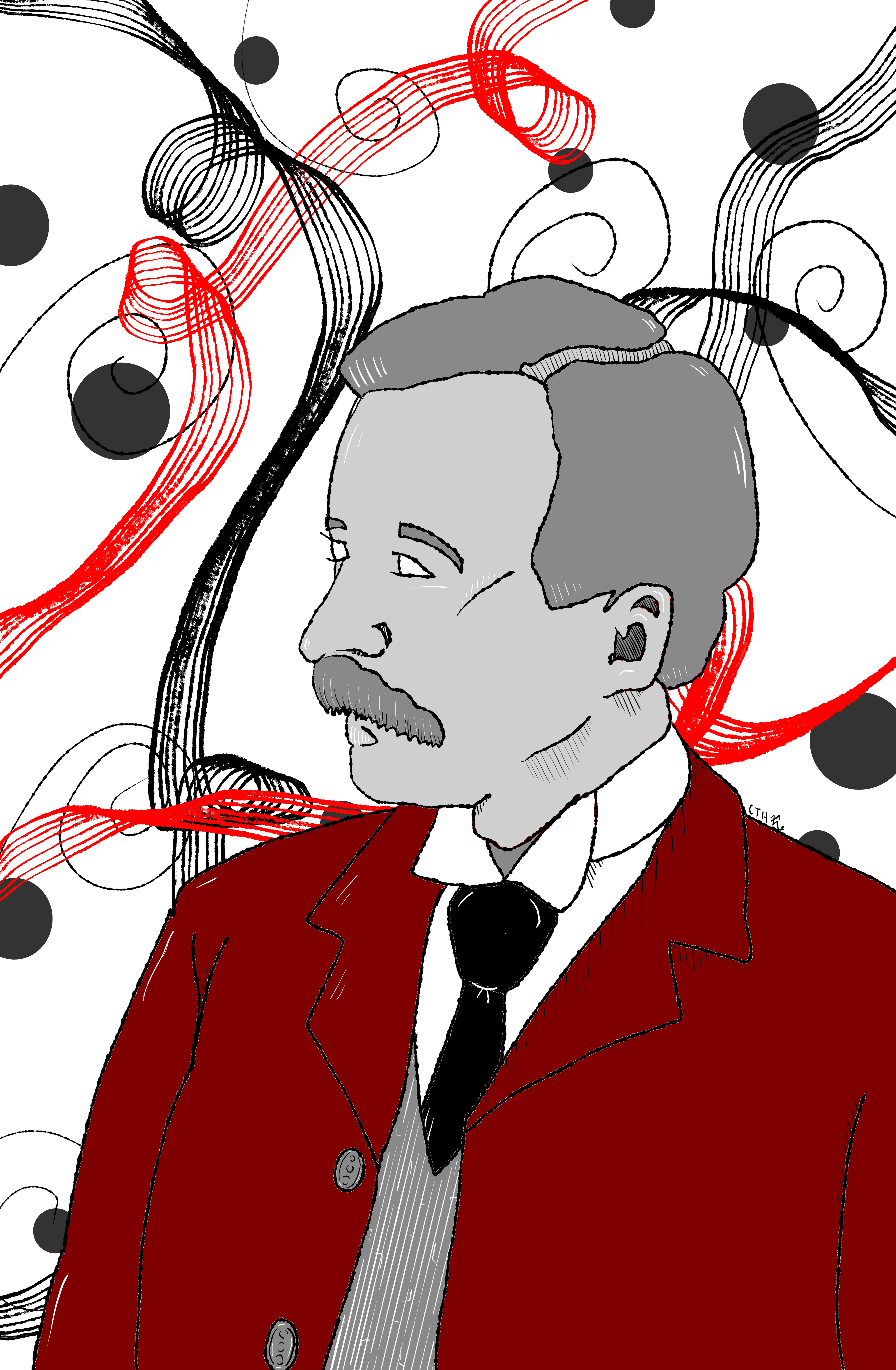
Charles W. Chesnutt was an author of color who incorporated Black folk magic into his writing frequently. He is best known for stories like “The Goophered Grapevine.” (Illustration by Cory Thomas Hutcheson, 2021)
Charles W. Chesnutt
The stories of Charles Wadell Chesnutt feature grapevines cursed by conjure-men to wither away, a man whose foot gets twisted backwards by rootwork, a fearsome wolf summoned by an evil witch to do her bidding, and all sorts of other magical goings-on as well. Chesnutt was unique as a late nineteenth-century writer who found success mining African American folklore for story ideas and incorporating them into often funny, sometimes frightening tales. He was also unique in that he identified as Black when he could “pass” as white due to his majority-white ancestry. He made racial issues a centerpiece of many stories, and very much looked to the dismantling of racism as a goal within his work and the work of other authors. His stories, often written in dialect, can feel off-putting at times and do not shy away from racially-charged language or topics, but the massive amounts of magical lore he incorporated into his fiction are captivating.
If you’ve never read Jamaican-Canadian author Nalo Hopkinson, you’re missing out. Her work is phenomenally rich, absolutely dripping with magic and character on every page. I first bumped into her through a collection of stories she edited called Mojo: Conjure Stories, which also put me onto work by Tananarive Due, Nnedima Okorafor, and Sheree Renee Thomas. Her book, Brown Girl in the Ring, tells the story of Ti-Jeanne, a young woman struggling in a collapsing world of crime and violence while also balancing the traditions and history she inherits from her rootworking grandmother. Hopkinson frequently incorporates elements of fantasy and speculative fiction into her work, while also keeping it rooted in reality (I personally think she’s essentially a magical realist writer, although I don’t usually see her described that way). She builds on the folklore of her Caribbean heritage and draws the reader into worlds equal parts enchanting and haunting.
Toni Morrison was a Nobel-prize winning author whose work exuded magic while confronting issues of Blackness and identity. (Illustration by Cory Thomas Hutcheson, 2021)
Toni Morrison
If you’ve listened to our show much, heard me talk about magic and literature at all, then you’re going to know that Toni Morrison has had an outsized impact on my understanding of the universe. I love her writing and have devoured so many of her books. They are often very painful, marvelously uplifting, and incredibly potent because Morrison is a master wordsmith and storyteller. I cannot bring up enough this passage from Sula, which very much informs my sense of cosmology:
“[E]vil must be avoided, they felt, and precautions must naturally be taken to protect themselves from it. But they let it run its course, fulfill itself, and never invented ways to either alter it, to annihilate it or to prevent its happening again. So also were they with people.
What was taken by outsiders to be a slackness, slovenliness or even generosity was in fact a full recognition of the legitimacy of forces other than good ones. They did not believe doctors could heal—for them, none ever had done so. They did not believe death was accidental—life might be, but death was deliberate. They did not believe Nature was ever askew—only inconvenient. Plague and drought were as “natural” as springtime. If milk could curdle, God knows that robins could fall”
If you want books that incorporate Black history, magic, and culture along with incredible stories and unforgettable characters, Morrison is absolutely a must-read.
Also See: “Unspeakable Things Unspoken,” a lecture Morrison gave on African American literary legacies and the ways a reader should engage with a variety of authors
Ishmael Reed
Okay, I know Reed is controversial, but that’s also because he’s bold and experimental, outspoken, brave, and loud on the page. His writing is unapologetic and nearly acidic in its satirical strength, and he takes on a lot of beloved cultural darlings in his work (most recently he wrote a scathing parody of Lin-Manuel Miranda’s Hamilton with an eye to correcting some of its historical whitewashing, for example). One thing Reed is, however, is meticulous. He unearths pieces of history and culture with the tenacity of a scholar and the literary flourish of a poet. For example, one of his best-known novels, Mumbo Jumbo, is a freewheeling tour of Black history including real-life characters like Black Herman, Marcus Garvey, and President Warren G. Harding (who was sometimes rumored to have Black ancestry). Into that history, Reed injects Hoodoo, Voodoo, Moses, jazz music, spontaneous dance outbreaks, and so much more. His books are the sort of reading that makes you long for footnotes or at least sends you out Googling all the madcap figures and facts he includes to know more (or maybe that’s just me, but I enjoy it!). Reed destigmatizes the power of magic in Black history, and he’s worth your time for that alone (but there’s so much more to enjoy, too).
I am incredibly sad that Kenan is no longer with us. I had the chance to correspond with him briefly, and he was a key part of my Master’s thesis (along with Ishmael Reed, Toni Morrison, and Octavia Butler on this list). If there’s an author I think many people haven’t heard of here, it’s Kenan, but that’s a real loss because his work is absolutely magnificent. He only published a few books in his life, but they were absolutely soaked in magic and folklore. Take, for example, this passage from his novel Let the Dead Bury the Dead, in which the history of the town of Tims Creek is interwoven with mythical stories of a devil-disguised-as-preacher who visited long ago:
“[T]he rumors were that these folk had had sexual congress with the Preacher-man. Said that his seed or whatever it was carried madness, and he had forced himself on them innocent youngens and animals and drove em mad…said in one sitting on Christmas Eve, he ate two whole chickens, an entire mess of greens, corn, cabbage, a whole hog, and a cake and a pie. He’d eat and they’d just keep bringing, wide-eyed and plumb put out by the site of it. Say somebody mumbled something bout gluttony and the Preacher just looked at him, mouth full of ham, just looked at him, and that man never said another mumbling word for the rest of his life. Said the Preacher kept a black snake and a big black bird. One woman say she heard the Preacher talking to the snake and the snake talked back. She went deaf.”
If talking snake familiars and ravenous devil-preachers don’t say “American folk magic” to you, I don’t know what to tell you. Kenan also infused his work with intersectional issues, including the difficulties of being both gay and Black in his Southern community. Kenan’s books are founded in occult ideas and make magic both intoxicating and dangerous, and I cannot recommend him nearly enough. We lost him far too soon.
The speculative fiction of Octavia Butler is world-shaking for both its bleakness and its hope. She frequently brought in deeply mythic and folkloric elements to her worlds and characters (Illustration by Cory Thomas Hutcheson, 2021)
Octavia Butler
I include the interview with Kenan and Butler above because it’s absolutely fascinating to see them both unpacking her fiction and all its deep mythological roots. If you haven’t read Butler’s work, it’s dark, full of unpleasant situations and serious trauma. At the same time, it’s empowering and encouraging, as the key players in her speculative fiction dramas are trying to make better worlds. Sometimes they are ancient goddess-like figures literally changing their shapes as they live for centuries in a game of cat-and-mouse with other immortals, and sometimes they are teenage women seeking to put post-apocalyptic humans into the stars by combining science and religion in equal measure. Butler’s writing is a magic all its own, too, and she does a phenomenal job conjuring up images that will haunt you long after you turn the page.
So if I’m honest, I’ve only read two things by Tracey Baptiste: Jumbies and her Minecraft-inspired book, The Crash. That latter one is great, but not particularly magical. Jumbies, however, is loaded with magic. She pulls from her Trinidadian heritage and tells a story filled with folk magic, roots, soucouyants, witches, loup garous, and tricksy twins. The book, while aimed at younger readers, is magnetic in its storytelling and folkloric ties, and frankly pretty terrifying! My own children had to put it down because it got so spooky, and they aren’t the type to get that easily spooked. If you have a love of folklore and magic, her writing is absolutely worth checking out. She’s got two sequels (they’re on my to-read pile, I swear!) as well.
To Read: Jumbies(and also, I’m guessing, the sequels…I’ll get back to you on that!)
Jeremy Love
The last entry on my list this time is a bit of a mystery. Jeremy Love, a comics author who has worked on several titles including (based on his rarely-updated site) Batman, wrote a webcomic series called Bayou, which was then collected into print and e-book editions. The story is absolutely rife with Southern Black folklore, including a young woman setting off through an uncanny Otherworld populated by monsters and magic in order to save her father. Love then wrote a sequel as well, which seemed like it would be part of a trilogy. However, to date there’s been no third book, and almost a decade has passed. He’s also not easy to find online, and there haven’t been many updates about him or his work. Still, I include him here because 1) the first two books are great stories with a ton of folklore and folk magical elements woven in; 2) the artwork is simply beautiful; and 3) I’m hoping that by writing about a third book it will somehow come to be.
To Read: Bayou #1 (generally easier to get as e-comics from DC directly) and Bayou #2
That’s where I’m going to leave it for now. This is just a small sampling of Black authors who have written amazing work incorporating folklore and folk magic, and I know there are so many more out there I could get into. Hopefully, though, this introduces you to a few you might enjoy and also helps to demonstrate just how much Black writers contribute. We truly wouldn’t have New World Witchery without the contributions of many of these writers, and all of them make our literary landscape so much richer and better.
If you have suggestions for Black authors for me to read (especially ones with lots of folklore in their work), I’d love to know! Please feel free to leave comments and point me in the direction of even more great Black magical writing! (Oh, but please note that once again any racist, misogynistic, or otherwise heinous comments will not be approved and may be reported as harassment. Please use the comments to lift up and elevate Black magic and Black writers).
The madness continues (both the madness of the world in general and our own strange little plot to keep revisiting Scott Cunningham’s two “Natural Magic” books, Earth Power and Earth, Air, Fire, & Water). We’ve fallen a teensy bit behind on discussing the books on the show (just by a month or so), but we’re also a bit behind on catching up with the blog posts that let everyone participate in the discussion. Back in Book Club Discussion #3, we combined our questions and comments on two sections: Air and Earth. This time we’re doing the same for questions on the sections for Fire and Water (which balances quite nicely).
Some of the questions we wound up asking of ourselves and our Patreon supporters are below, and we’d highly welcome any feedback or responses (civil, please please please!) in the comments.
Fire
What form of fire magic do you practice most often? Is it candle magic? Do you use fire as a “cleansing” force in ritual, or does it serve more of an “animating” role in your spellwork?
Where do you think incense falls in the big picture of spells? Is it just Air? Is it also Fire? Do all spell elements inherently draw upon multiple elemental energies?
Have you ever done a purification spell like the one Cunningham mentions (the ritual burning)? Did it work for you? (Feel free to share juicy details of burning an ex-boyfriend’s stuff if you like!)
Do you ever do any fire-based divination practices (like scrying)? Have you tried his “fire writing” method with bark or paper?
Cunningham warns about the potential destructive forces of Air and Fire, but is less concerned with that problem in the Earth/Water chapters. Why do you think that is? Do you work with “both sides” (or “many sides” if you prefer to be nondualistic about it) of the elements?
So many myths have fire stolen from the sky, and Cunningham also connects fire magic with solar magic. Do you do this as well? Why or why not?
Water
Cunningham warns that we should “beware the tricks of the conscious mind” when doing things like water scrying. Do you treat the conscious mind as something that works against magic, or something that has a place in the magical process?
What forms of water magic do you do most often? Spiritual baths? Wishing well magic? Water gazing/scrying?
Do you consider any weather magic to be within the realm of water magic? Why or why not?
Have you ever heard of/used the “crossing water” folklore that supposedly puts a barrier between you and evil/ghosts?
When making offerings to elemental spirits, is it more appropriate to bring something of your own or use what you find in the area? (Thinking here of Cunningham’s use of the coin to pay the tree for leaves to use in a ritual).
Should you always “pay” for the natural materials you use in magic? Can you ever simply use something and assume it’s okay/a gift/expected to be used for magic?
Have you ever taken a “water vow” as Cunningham describes it? What was it for/about, and did it feel like it was more potent because of water’s role in the vow?
We obviously get into a good bit more detail in both of our discussions (and we even have a few questions here we didn’t really cover). We would really love to hear/read your answers on some of these, though, if you’re interested in responding!
We’ll be back talking about things like Stone magic in the next book club discussion, and moving into the more detailed, “smaller” elements of magic. We hope you’re enjoying the chance to read along with us and that you’ll share your thoughts!






 New World Witchery - The Search for American Traditional Witchcraft