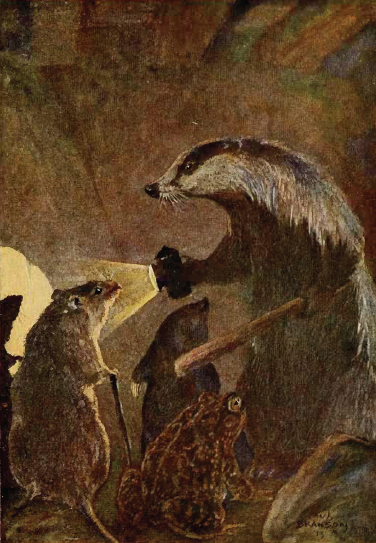
Blog Post 98 – Critter Bits (Magical Animals, Part III)

So I had mentioned a couple of weeks ago that I wanted to talk a little about the use of animal parts in magic.  Animals and magic have gone hand-in-hand for a very long time.  The reading of entrails from ritually slaughtered animals has been used as a divination technique since at least the pre-Roman era.  Talismans designed to imbue the carrier with the particular power of an animal were often made from that animal’s fur, bone, or skin.  Owen Davies chronicles the frequent use of virgin parchment—a type of scroll medium made from a highly treated animal skin, usually from a creature like a lamb or goat—in the construction of ancient Near Eastern and Mediterranean grimoires (in his book appropriately entitled Grimoires).  The thought was that this particular material would endow whatever was written on it with an extra layer of power, thereby charging sigils, elevating incantations, and generally adding a little va-voom to the inscribed workings of magicians.

On North American soil, many of the old rituals and magical practices found in places like Europe and Africa took root.  Some of them changed quite a bit as they grew here, and some stayed more or less recognizable.  I thought a brief survey of the common animal curios used in witchcraft—both folklorically and practically—might be a good way of seeing the connection between critters and crafting.  Please take note now, I AM NOT ADVOCATING THE INJURY, SENSELESS SLAUGHTER, TORTURE, OR HARM OF ANY ANIMAL.  This information is for educational purposes.  If you choose to use this information in your own practice, please do so responsibly and without resorting to cruelty.  There are lots of ways to gather magical tools and ingredients from animals which are already dead (see Ms. Graveyard Dirt’s excellent site for some great examples).  Okay, now that that’s out of the way, let’s look at some of these critter bits:

1)      Rabbit’s Foot – We’ve covered this here in the podcast (on Episode #13) and the blog (in the Lucky Rabbit’s Foot entry), so I won’t spend a lot of electrons on it here.  It suffices to say that the rabbit’s foot remains one of the most popular luck charms in the canon of animal curios.  It may have significant underworld ties, and it may simply be related to speed and fertility. Whatever its originally intended meaning, it stands for good luck now, especially in gambling.

2)      Toad’s Bone/Black Cat Bone – These are some of the darkest and most disturbing of animal curios, as the rituals required to obtain them are brutal.  The Toad’s Bone is mostly found in British magical lore, and was written about extensively by Andrew Chumbley, former Magister of the Cultus Sabbati.  Scholar Ronald Hutton also details the significance of this bone to members of the Toadsmen, a secret society along the lines of Freemasonry, in his excellent history of modern witchcraft Triumph of the Moon.   This ritual artifact was obtained (at least in one version—there are multiple ways this ritual can play out, depending on what source  you look to) by burying a toad alive in an anthill and letting the ants  strip it down to the bones.  The bones are then taken to a stream and floated one by one until one bone floats agains the current.  This bone is then the magic bone, and can imbue the witch carrying it with all sorts of interesting powers from spirit summoning to invisibility.  The black cat version of this same rite is even more gruesome.  As it is recounted in Mules & Men by Zora Neale Hurston, the cat is thrown into a pot of boiling water (also alive), and cooked until all the flesh falls from the bones.  The bones are then either floated in a stream (the same as the toad’s bones) or passed under the tongue of the magician.  The magic bone in this tradition turns the user invisible, and can also be used in some powerful love spells.  Most places selling this bone today are actually selling chicken bones painted black, and hopefully few people are actually performing this ritual as it occurs in folklore.  Again, I don’t condone this rite, and present it as a curiosity of history and culture rather than a suggested magical practice.

3)      Racoon Penis Bone – This is a popular charm in hoodoo, used in luck and love magic.  The bone itself, which is usually very thin and has a curved shape, has no disturbing ritual for obtaining it, but can simply be taken from an animal killed for meat or even from a roadkill hit (though I’d suggest being very careful how you handle remains of this nature, as they can often be riddled with diseases).  Cat Yronwode suggests that this particular curio entered American magical practice by way of Native American sources, and points out that the Pawnee often placed these bones along with ears of corn into sacred bundles.  I’ve heard that in the Appalachian and Ozark Mountains, it was common for boys to give girls these bones on red thread necklaces as love tokens (though I’ve not yet found a primary source for this claim).  Raccoons are not the only animal to have this bone—or “baculum”—and in fact many mamal species have it.  Other animals like foxes and dogs also have these bones, and occasionally these will turn up in magical charms, too.

4)      Rattlesnake Rattle – Snakes in general have a lot of lore about them, but the rattlesnake is particularly of note because its rattlemakes it a unique member of its family.  The rattles themselves have been collected for years as lucky charms.  Cat Yronwode suggests uses including:

  • A charm to help musicians play well
  • A simple “Live Things in You” curse
  • A personal power token
  • A gambling charm to bring luck

Rattlesnake rattles are fairly delicate things, especially once they’ve been dessicated for use in crafts and magic.  You can occasionally find one which has been turned into a key ring or charm, but the best way to handle these is to put them in a little vial or a small box of some kind and carry that with you.

5)      Snake Fangs/Bones/Skin – As I said earlier, snakes generally have all sorts of magical connotations.  You can look back at our blog entry on them (Snakes) and find out a good bit there, but here are some highlights:

  • Fangs can be worn as necklaces or carried as tokens of protection (from snakebite in some cases)
  • The bones or skin can be powdered and added to food to cause a “Live Things in You” curse
  • The skin of a snake soaked in vinegar can be used to treat boils in the Ozark magical tradition
  • The shed skins can be powdered and added to all sorts of crossing and jinxing formulae, including goofer dust and a variant on hot foot powder

Many pet stores will happily give you any leftover snake sheds they have if you call and ask politely, and if you develop a good enough relationship, you can sometimes wrangle dead snakes and/or bones out of them, too.  Roadkilled snakes are also good, but be absolutely sure they’re dead before approaching them.

6)      Dog/Cat Hair – These curios are nice because the animals don’t have to be hurt to acquire them.  Usually black hair is used, and preferably from all-black animals.  When the two hair types are mixed together in a mojo bag or vinegar jar, they can cause people to fight “like cats and dogs.”  Black cat hair can also be used to gain good luck, and black dog hair can be used to inspire feelings of loyalty or obedience in others.  If you have a black cat or dog, you probably have plenty of this available to you on furniture, carpet, etc. (I speak from experience here).  If you don’t, you might find a friend who does and see if they will let you have some of it for use in your magical workings.  At worst, you might have to snip off a little from the animal, but thankfully that does no harm (unless it’s the middle of winter and you leave a bald patch—don’t do that).

7)      Chicken Legs/Feet/Feathers – Chickens are popular creatures for magic, mostly because they are expendable (I call them like I see them) and ubiquitous.  Black hens and their feathers are wonderful for curse-breaking, according to Cat YronwodeStarr Casas, a notable rootworker from Texas, often speaks of using chicken legs or feet during cleansing work.  Even just having chickens can be particularly magical, since they will scratch up and destroy any curses laid for you on your property.  A Pow-wow charm from John George Hohman suggests that you do the following to prevent house-fires:

Take a black chicken, in the morning or evening, cut its head off and throw it upon the ground; cut its stomach out, yet leave it altogether; then try to get a piece of a shirt which was worn by a chaste virgin during her terms, and cut out a piece as large as a common dish from that part which is bloodiest. These two things wrap up together, then try to get an egg which was laid on maunday{sic} Thursday. These three things put together in wax; then put them in a pot holding eight quarts, and bury it under the threshold of your house, with the aid of God, and as long as there remains a single stick of your house together, no conflagration will happen. If your house should happen to be on fire already in front and behind, the fire will nevertheless do no injury to you nor to your children. This is done by the power of God, and is quite certain and infallible. If fire should break out unexpectedly, then try to get a whole shirt in which your servant-maid had her terms or a sheet on which a child was born, and throw it into the fire, wrapped up in a bundle, and without saying anything. This will certainly stop it. (#114)

The chicken’s wings can also be used to make a fan which some magical folk use to direct smoke during spiritual fumigations.  So popular is this animal in magic that one of my favorite grimoires is actually called The Black Pullet (a pullet being another name for a hen).

8)      Eggs – These are often used for spiritual cleansing, across several traditions.  In Mexican folk healing (curanderismo), an egg can be used to sweep, massage, and mark a person’s body to remove the Evil Eye (mal ojo) or harmful witchcraft.  The egg can also be “read” after this process to determine things like spiritual attachments, disease, bad luck, etc.  Another Pow-wow cure with a curious resemblance to the Toad’s Bone ritual earlier mentioned directs anyone suffering from failing health to catch rain water in a pot before sunrise without speaking to anyone, boil an egg in it, poke holes in the shell, and leave the egg on an anthill to be devoured.  This will supposedly allow the ailment to be “eaten” by the ants.  Eggshells also have some magical significance.  When powdered, they become cascarilla, which is used in Afro-Caribbean magic.  Cat Yronwode also lists several really interesting spells that can be done with black hens’ eggs.  For example, boiling a black hen’s egg and feeding half to a black cat and half to a black dog while saying two people’s names will cause them to have a falling out.  There is also a rather fascinating magical detective spell that can be done by placing an egg in each of a murder victim’s hands.  After the burial, the eggs will rot and eventually burst, at which time the murderer will return and be caught.

9)      Animal Fat – This is less of a curio than an ingredient, and the different fats from different animals (often referred to as that animal’s “grease”) have distinct properties.  According to Hoodoo Herb & Root Magic, “Rattlesnake fat is a powerful ointment.  Rub it on any painful body part, or stroke the whole body downward to expel conjure poisons” (p. 162).  Ozark healers commonly used “skunk grease” to cure various rhumetoid conditions.  Vance Randolph says “The grease from skunks or civet cats, mixed with peppermint leaves, is highly praised by some hillfolk as a lubricant for rheumatic joints. It is said that the fat of a male wildcat is best of all” (OM&F, p. 108).   In Pow-wow magic, a range of animal fats is used to make a potent anti-rust treatment for firearms:

Take an ounce of bear’s fat, half an ounce of badger’s grease, half an ounce of snake’s fat, one ounce of almond oil, and a quarter of an ounce of pulverized indigo, and melt it altogether in a new vessel over a fire, stir it well, and put it afterward into some vessel. In using it, a lump as large as a common nut must be put upon a piece of woollen cloth and then rubbed on the barrel and lock of the gun, and it will keep the barrel from rusting.  (#110)

Wild animal fat has mostly gone out of use, though it can occasionally still be found, particularly in the mountain regions of America.

10)   Bear/Badger/Other Teeth – These curios are usually gambling, luck, or protection charms.  Hohman mentions the badger’s tooth as a wonderful gambling talisman.  Bear teeth appear in protective necklaces (along with claws in many cases).  One of Vance Randolph’s stories from the Ozarks recounts a man who kept a big boar’s tooth on a leather thong over his fireplace.  Whenever any of his children would get a toothache, he’d make them wear the necklace until the pain went away.  These charms are common in many places, and hardly unique to the New World (the badger is an Old World animal, after all).  Plenty of places, including the wonderful site The Bone Room, sell teeth, bones, and other animal curious for use in crafts, magical or otherwise.

I think that will end our survey for today.  There are still plenty of parts and pieces I’ve missed, including gator paws and heads, various animal skins, porcupine quills, and the myriad insect charms that could still be discussed (and hopefully will be at some future date or dates—ants alone obviously have plenty of magical uses).  If you can think of other charms, I’d love to hear them, and feel free to share your folklore regarding animal remnants and magic in the comments section!

Until next time, thanks for reading!

-Cory

Blog Post 89 – The New World Witchery Guide to Cartomancy

Click to Download

Greetings everyone!

I know that I’ve been a bit scanty on blogging lately, for which I apologize most profusely.  Unfortunately, I’m likely to stay busy with many irons in many fires for quite some time to come, but I feel like you readers are wonderfully patient with me when the blog and podcast have dry spells and I want to reward that.  And so, I have put something together for those of you who have been taking an active interest in the recent cartomancy posts.

I’ve put together those posts with some additional material in an e-book, which I’m making available for download free from the site:

The New World Witchery Guide to Cartomancy

It’s a PDF and should be easily readable with Adobe Reader.  Like I said, it’s totally free.  Feel free to save it, copy from it, distribute it, etc.   Please do attribute any citations, excerpts, or references back to me, but otherwise, I hope you enjoy it!  And if you do like the book, consider making a donation here, or with the button on the sidebar.

I’m also planning to revise this material, with some additional sample readings, expanded information, a quick-reference chart, and improved graphics and release it as a chapbook sometime in the near future.  The printed chapbook will have a cost of some kind (and will probably be sold through our Compass & Key Etsy shop, which I’m hoping to revamp and relaunch soon), but I’ll try to keep it very reasonable.  The e-book will remain available through the site, however, and I intend to keep it free/donations-only for all to download.

I know it’s nothing spectacular, but I hope it is useful to some of you.  Thank you all so much again for your patience and your patronage of New World Witchery, both blog and podcast.  We really appreciate your support!

Thanks for reading, and be well!

-Cory

Blog Post 88 – Spreads (Cards, part V)

My sincere apologies for the lateness of this post, and because this may well be the only post I get out this week.  However, it should tidy up the card reading series and it comes with photo illustrations, so that’s exciting, right?

Basically, there are a few different readings you can do:

  • A one-card yes/no reading
  • A three card time-based spread (past/present/future, morning/noon/night, etc.)
  • An extended “five-card” spread (though this is a bit of a misnomer, as you’ll see in a moment)

I’m sure other people have other methods, but these are the ones I work with so I’ll be explaining from my point of view only.

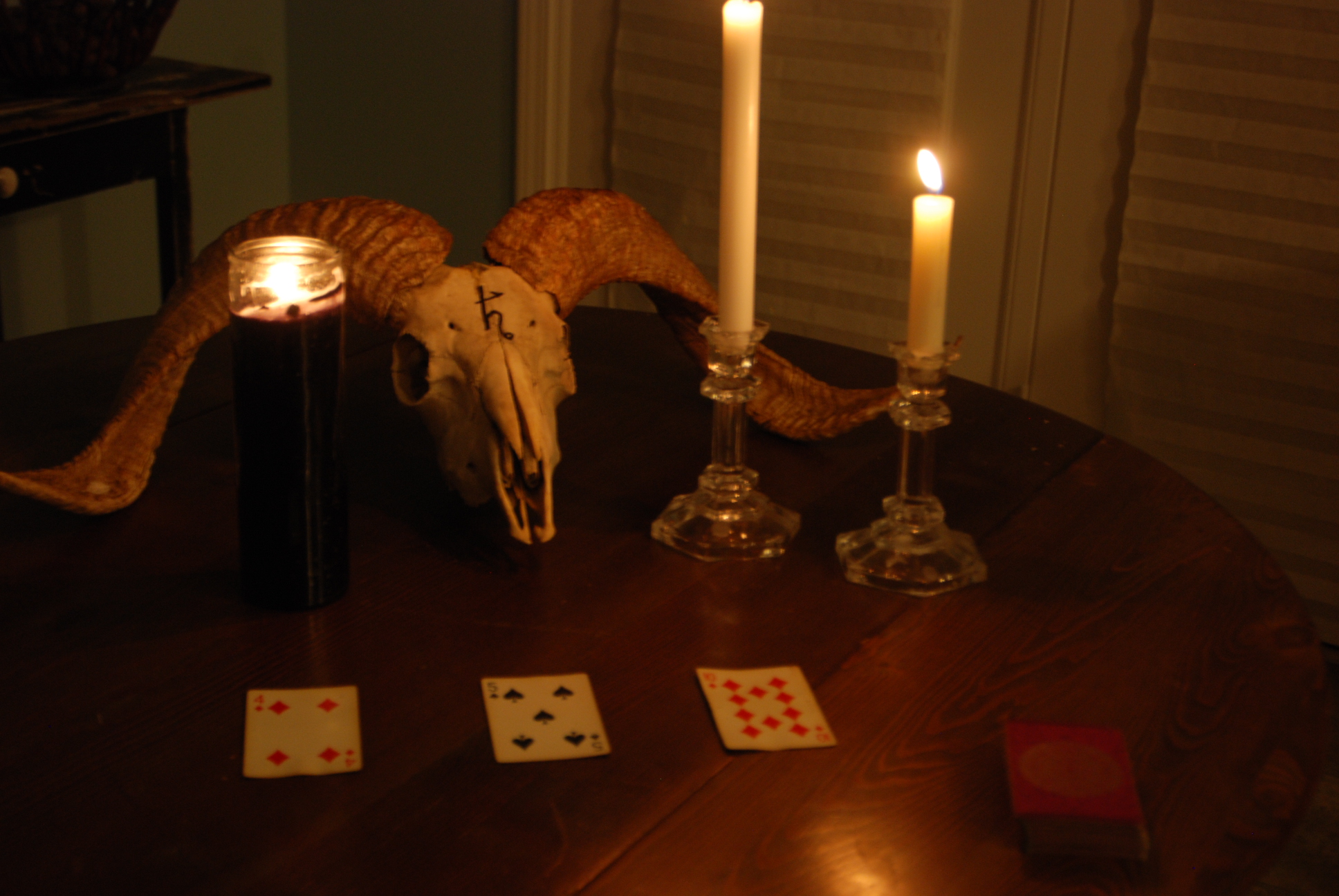
Before you do any spread, contact spirit(s) if you like.  If you don’t know how to do that or don’t feel like that will help your reading, you can bypass this step.  In the illustrations below, you’ll be seeing candles and a ram’s skull in the picture.  While these are a part of my Ancestral contact work, I’d like to be up front in saying they are in these pictures more for show than anything else.  I do sometimes contact Ancestors via the cards (mostly because my cards are handed down from my mother, so if I want to speak to her they’re a great medium for that), but generally speaking I don’t have a lot of paraphernalia during a cartomancy session.  Part of the charm of reading with playing cards is their ubiquitous and unassuming nature, so getting all the trappings and trimmings of a full Ancestor contact working out is a bit overkill.  But it looks nice in pictures.

Often, a short prayer to the effect of “Spirit(s), guide my hands as I shuffle these cards, my eyes as I read them, and my mind as I speak their meaning” will suffice.  A glass of water and maybe a candle will add to it, if you are so inclined.  But don’t feel compelled to twist yourself into knots before you’ve even begun.

Okay, onto the spreads.

One-Card Reading

Figure 1

This is the simplest kind of reading, and can be done in a minute or two.  The questioner posits a yes/no query, and the reader cuts the deck and shows the card at the split (see Fig. 1).  If it’s a red card, the answer is “yes,” and a black card means “no.”  The actual card itself can add a little more meaning to the reading, if you care to discuss it with the client, but it won’t tell you much.  For instance, in the photo, I’ve got the Eight of Diamonds.  So if the querent asked something like “Will I meet a new romantic partner soon?” the answer would be “yes,” with a slight augmentation indicating that perhaps they will meet their lover due to some office gossip, or that perhaps their new paramour will be a gossip him/herself.

This type of reading is not particularly good for deep questions.  The new love question probably is about as profound as it can get with such a cursory effort.

Three-Card Reading

Figure 2

This sort of spread is a little fuller, but it is usually linked to a period of time.  Make sure to establish that time-frame before doing the reading, asking the cards to show you yesterday/today/tomorrow, tomorrow morning/noon/night, etc.  You can be very vague and say past/present/future, but the answers will likely be equally vague.  You can also be very specific and say 1pm/2pm/3pm, but that may also short-circuit the reading.  I generally find morning/noon/night readings are my favorites with this type of spread.  In fact, I often do them in the evenings as part of staying in practice.  They take about 5-10 minutes and they help me to pay attention to different things throughout the day.

In Fig. 2, you can see a three-card spread displayed in front of the nifty ram skull (I apologize if the pips are hard to read).  The deck is shuffled, and the top three cards are laid out in a line.  Cards are read left to right, with the left-most card being the “oldest” or “earliest” card (the past or the morning, etc.).  For the sake of easy explanation, let’s say this is a typical morning/noon/night reading.  That means you’ve got:

  • Morning – Four of Diamonds: The purse/money bag; No news.
  • Noon – Five of Spades:  Illness; A corpse.
  • Night – Ten of Diamonds: A treasure chest; Sunlight; Joy.

So for this particular reading, the morning would be fairly stagnant, especially financially.  As the day progressed, things would feel like they were getting worse, or perhaps some real effort would be needed to “bury” those monetary woes.  But by the end of the day, everything’s working out, and finances are secure.  So perhaps the client will have a money scare (an overdraft charge or something like that) which they spend a good bit of time dealing with, but by the end of the day, it all works out in their favor.  Or, it could be that the actual workday (assuming a 9-to-5 schedule) will be awful, going from bad to worse, but that the evening will redeem the day, perhaps by allowing some small luxury time with friends or loved ones.

Five-Card Reading

Figure 3

This is the reading most people want, and the most detailed one I personally give (there is another type of reading where you spread out almost every card before you’re done, but I find that to be excessive, so I’ve never worked with it).  It’s called a five-card spread because in its basic completed form, five cards are displayed (as in Fig. 3).  I mentioned, though, that this is a misnomer.  In fact, you’ll actually read at least seven cards in this layout, with the potential for several more on top of that.

I start by “clearing” the deck, which is just a highly ritualized shuffle while I attempt to keep my mind blank in order to “neutralize” the cards for the client.  Then, I let the client shuffle the cards while asking and focusing on his or her question.  Queries here can be as simple or complex as the subject wants.  I know there are folks who do not like others touching their cards, so if you’re not comfortable with that, feel free to just hold hands with the client before shuffling the deck yourself.  That should at least allow you to get a bit of the client into the cards for the reading.  Once the client feels the deck has been shuffled enough (or you, if you do it that way), stop and stack the deck into a single pile.  Then the client (or you) will cut the deck (Fig. 4) and put the top half of the pile facing up on the reader’s left.  The bottom half is flipped over so that the bottom card is face up on the reader’s right (Fig. 5).  This is the “quick read” of the situation, which will examine internal and external influences on the subject.

Figure 4
Figure 5

For this sample reading, let’s assume that the reading is about the client’s current relationship/romantic life and where it’s going.  On the left or internal side is the Eight of Diamonds, and on the right or external side is the Three of Hearts.  This breaks down to mean:

  • Internal – Eight of Diamonds: Gossip; Idle chatter.
  • External – Three of Hearts: A wish granted; A full cup.

So the internal situation seems to be one of pleasant, if light, emotional content.  The external component says that the cup is full, and all is well.  Basically the cards indicate an extremely happy if rather casual romantic relationship.

The next step is to restack the deck so that the two halves are reversed.  In other words, the Eight of Diamonds will now be the bottom card and the Three of Hearts will be the “middle” card.  The reader then pulls cards in pairs starting at the top of the deck and going down until he or she reaches the signifier card (the Queen of Hearts for a woman, the King of Hearts for a man).  See the process in the following figures:

Figure 6
Figure 7
Figure 8
Figure 9

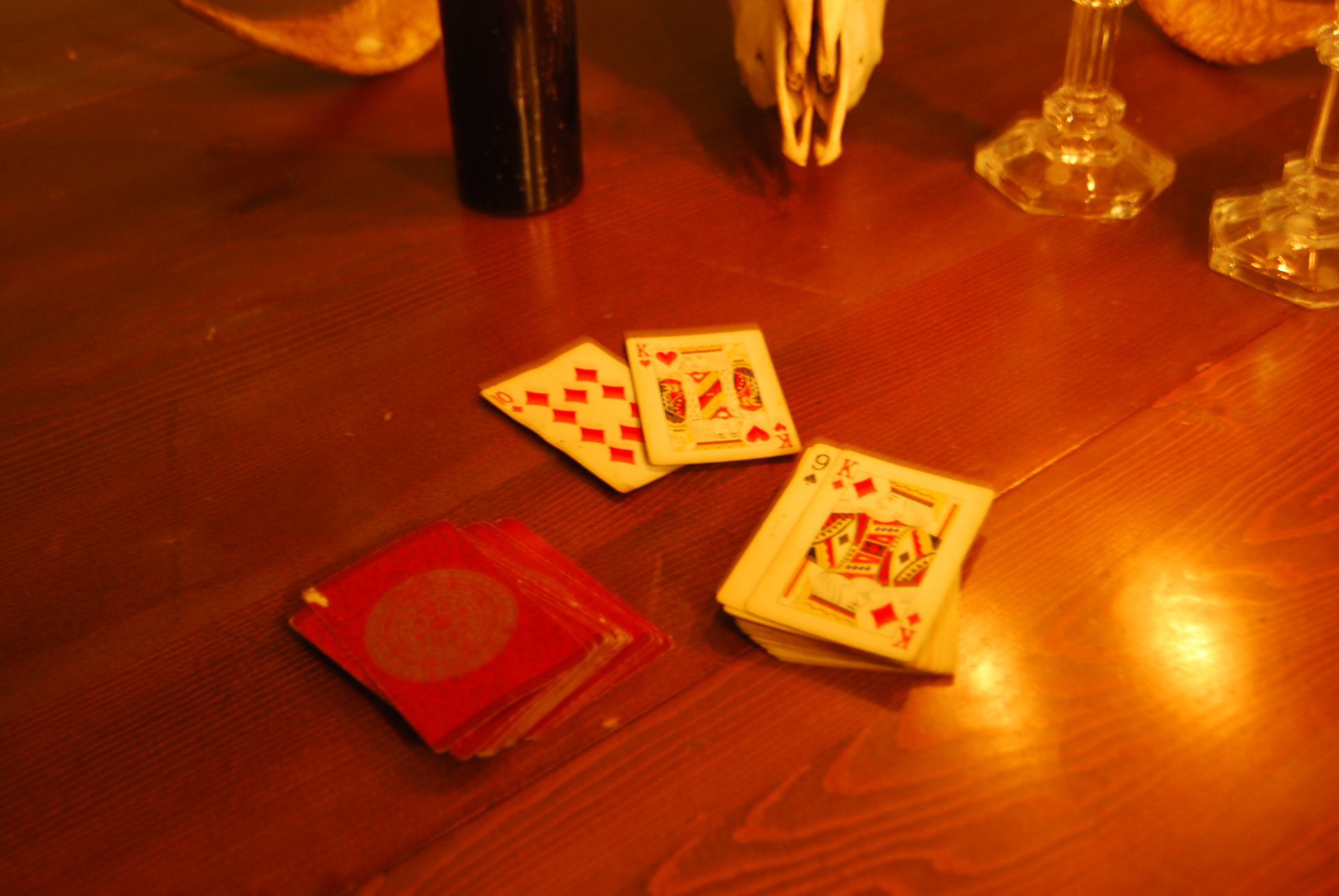
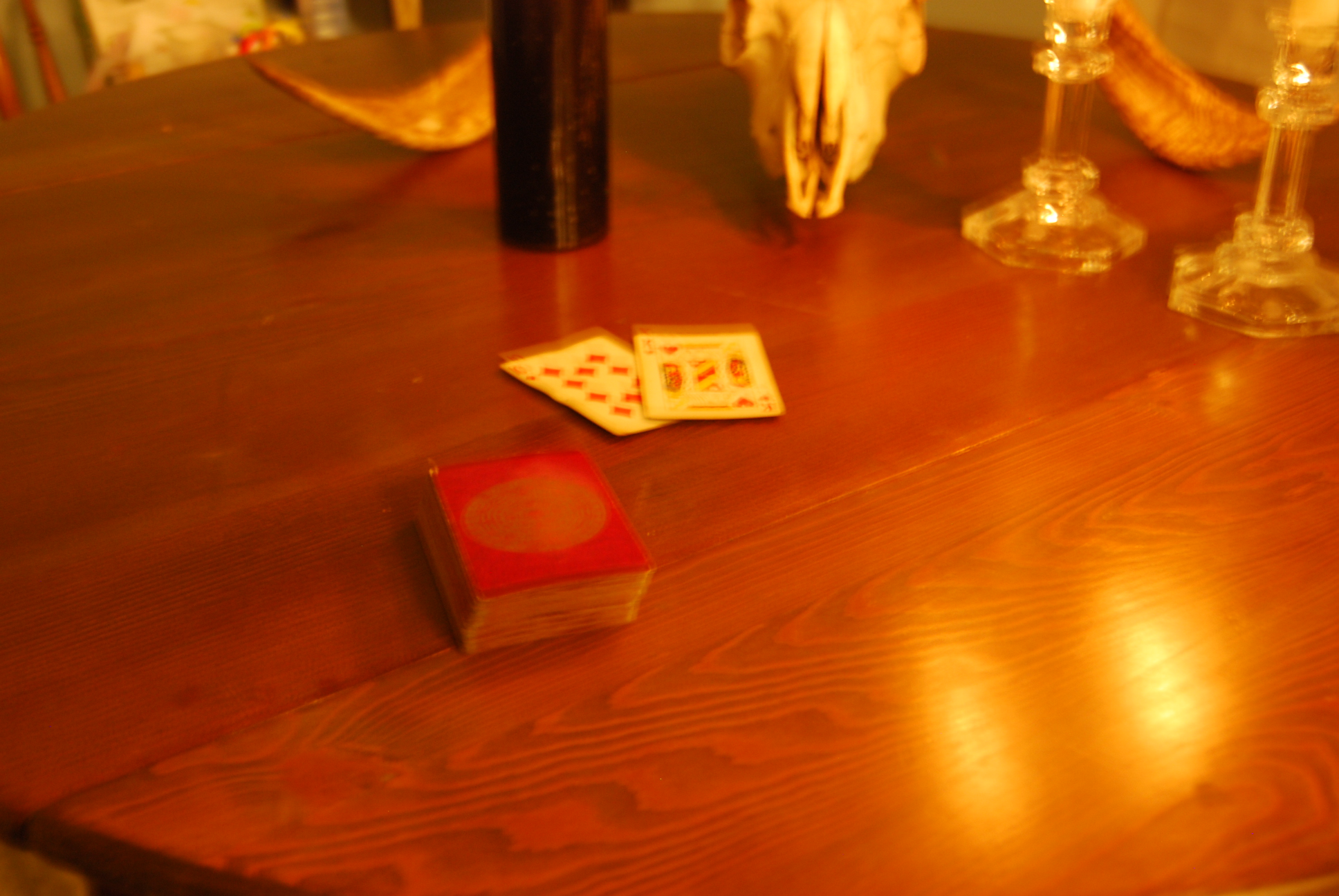
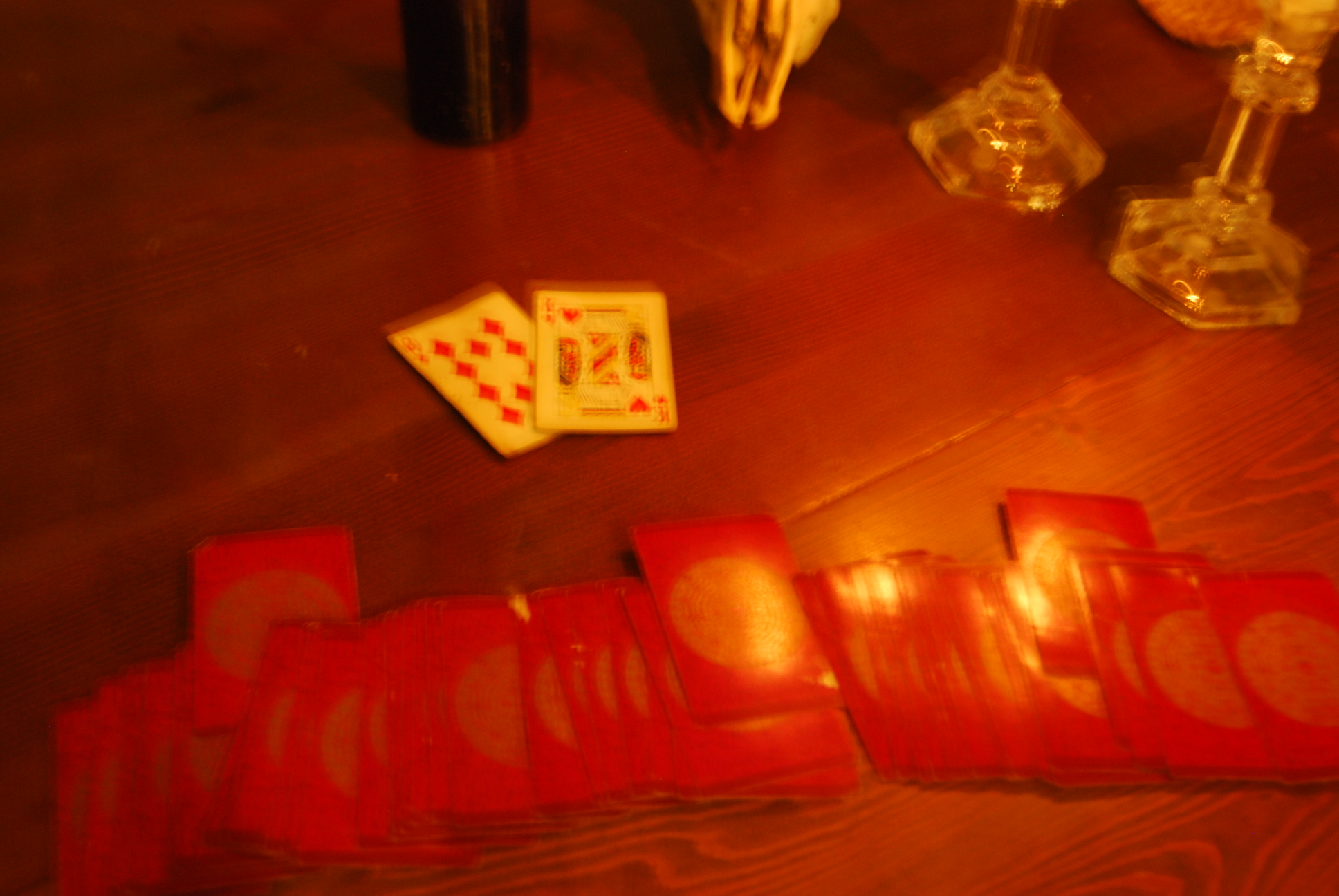
In Fig. 6 (apologies for the blurring), the cards are turned over two by two.  In Fig. 7, the signifier (in this case a King of Hearts as I’m reading for myself) has been found, with a Ten of Diamonds behind it.  That pair is set aside as it was found (with the ten behind the king, which I’ll get to in a minute).  The pile of cards overturned to find that pair is put back on top of the unturned pile to make a single deck again (Fig. 8).  This group is then splayed or sorted through by the client (or you) and three cards are selected at random (the three “pulled” cards in Fig. 9).   These three cards are then placed in a “tree” pattern coming down from the signifier pair in the order they were pulled.  You should end up with something looking like this:

Figure 10

This is your basic layout for the reading.  The first thing to note is whether the signifier card is on top of or below the companion card.  If it is on top of its mate, the companion card indicates internal processes and functions, while the opposite indicates outside influences.  In this case, the Ten of Diamonds is behind the signifier card, indicating a great deal of internal happiness and contentment.  The rest of the reading has to do with the future/fortune of the subject:

  • Companion Card – Ten of Diamonds: A treasure chest; Sunlight; Joy. (internal)
  • Signifier Card – King of Hearts: The subject (male)
  • Card 1 – Queen of Hearts: Soulmate.
  • Card 2 – Two of Diamonds: Birds (as in “a little birdie told me”); Exchange of funds.
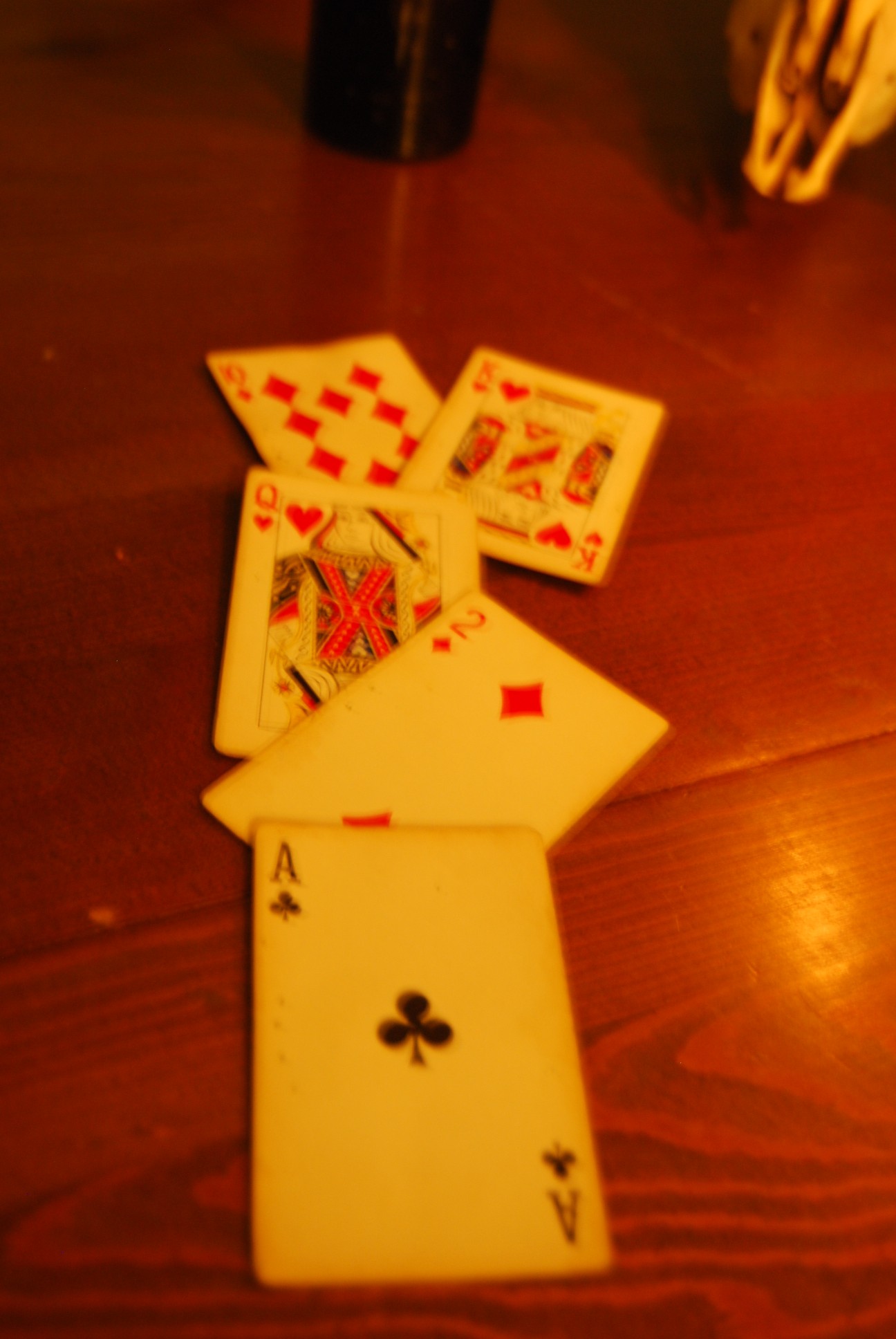
  • Card 3 – Ace of Clubs: A cave; Solitary contemplation.

First, I note that there are no spades, which indicate a relatively positive reading.  Second, the soulmate card appears almost immediately, which is a very good sign in a question about relationships.  The reader already knows that the signifier card is surrounded by good things (the interior sunshine and the near future or current soulmate).  Next down the list is the birds card.  This might mean getting some good news about the soulmate, or possibly even something more significant (think “birds and bees”).  It could theoretically mean an exchange of funds for love (an expensive date, or possibly prostitution), but there’s not much to support that in the reading otherwise.  The third card is a little bit more difficult, as it indicates a need for personal space.  So it may indicate that while things are going great now, something is going to take the relationship to the next level (the birds and their associated nesting), and that the subject will feel the need for his own space or time.  Conversely, a cave is also the most rudimentary form of home, so it could mean that the subject will be doing his own version of “nesting” soon.  All in all, this could mean moving in together, or possibly even starting a family together, sometime in the near future.

The reading can stop here, if the client and/or reader wishes, or cards can be pulled one at a time randomly from the remaining deck.

Figure 11

In this “extended” spread, the meanings become vaguer and vaguer as you go further out.  Generally speaking, I will only allow 2-3 extra cards during my readings, because after that things just start falling apart.  In Fig. 11, you can see I pulled the Six of Clubs.  That is the card for “Footprints; A clear trail.”  This basically just reinforces the current trajectory of the relationship, and for someone who’s already started a family or moved in with their significant other, probably just means “stay the course.”  The current homelife is rich and rewarding, and will continue to be so.

Figure 12

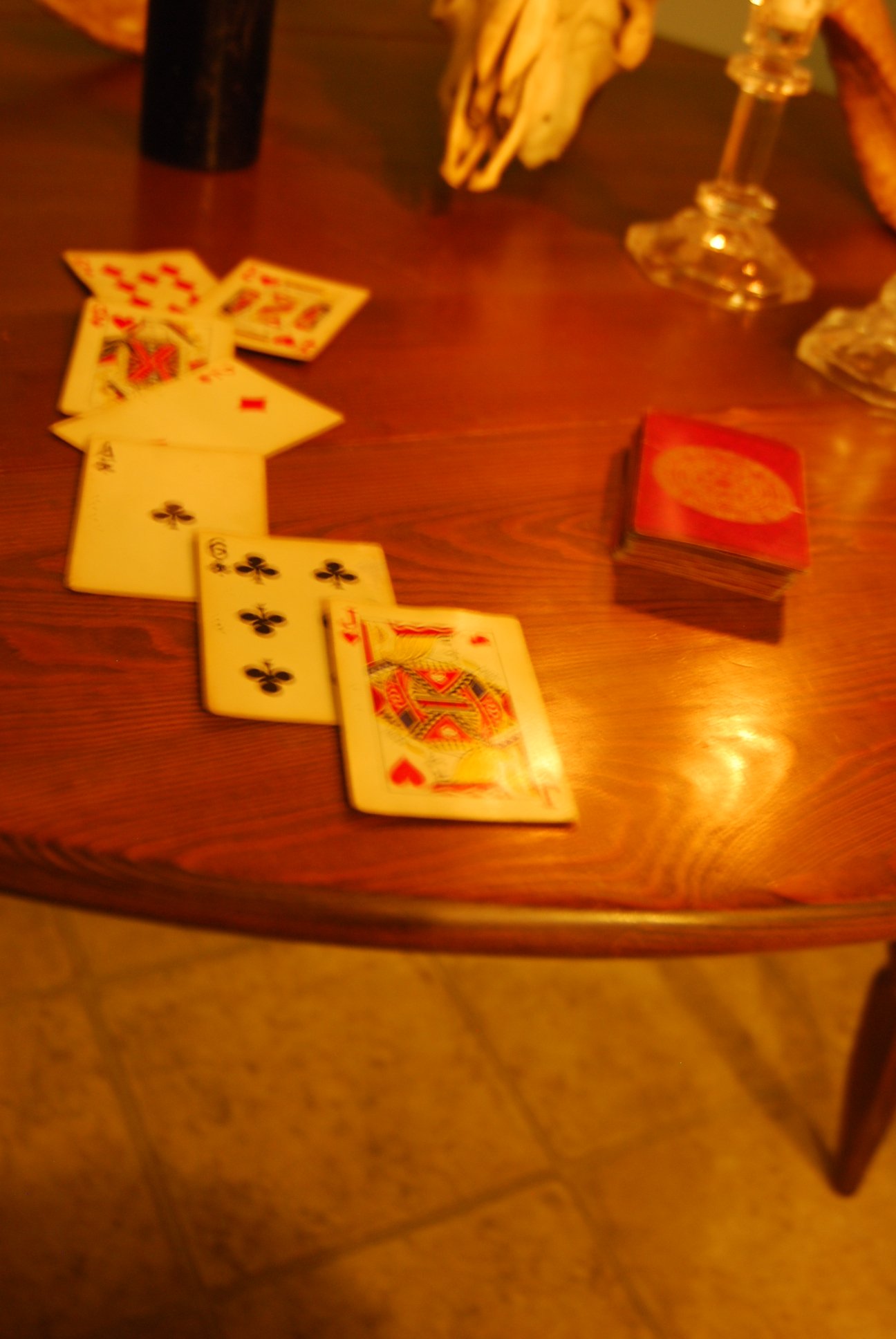
Just to tie everything up, one more card is pulled (Fig. 12), the Jack of Hearts.  This is the card signifying “A baby; A cradle; A young boy.”  If I weren’t the client, I imagine whoever I was reading for would probably get beads of sweat on his neck right about now.  All indications are that the natural ending to all this domestic and romantic bliss will be a bouncing baby not too far down the line.  It’s a tidy ending to a very positive reading, and a good place to stop.

I hope that illustrates these basic card layouts for you.  My apologies if the photos aren’t great, but hopefully you get the idea.  If you have any questions, please feel free to ask.  I reiterate that this is my own system, based on several I’ve encountered and worked with over time.  I’m happy for folks to use it, though if you quote it or share it with others, please attribute it to me.

Oh, and while I didn’t actually focus on anything during this reading, it’s eerily accurate.  My wife and I are now expecting baby #2 sometime in March!  Woo hoo!

Thanks for reading!

-Cory

Blog Post 85 – Hearts and Spades (Cards, part IV)

This post deals with the second half of the deck, the hearts and spades suits.  Again, I’ll provide a few key words or images, and then elaborate a bit.  Let’s get to it!

Hearts
This suit has to do with deep emotions as well as family, friends, and lovers.  These cards often represent people well-known to the questioner.

Ace – A kiss; A new romance; Feeling lonely.  Pulling the Ace of Hearts in a reading means that likely a new lover has entered the picture, or at the very least a formerly bland relationship has taken on new life.  Generally it’s a positive card, but next to something like a Two of Spades it can mean a period of separation and loneliness.

Two – Lovers; Coupling; The sex card.  This is the card that inspires knowing smiles and lecherous grins.  Simply put, it’s about sex.  Not so simply put, it can also be about and deeply emotionally intimate connection with someone else, including a family member (try not to mix those two meanings together…*shudder*).  So if you pulled it with say the King or Queen of Clubs, it likely means a family relationship, while a lay next to any Jack might mean a delightful tryst.

Three – A wish granted; A full cup.  The Three of Hearts means that something deeply longed for is about to appear.  This isn’t quite the fulfillment found with the Ten of Diamonds or the Ten of Hearts, but it does generally mean at least one thing will go right.

Four – A trunk or travel case; A lock.  Like with other fours, this card shows a relative stagnation.  However, in the case of the Four of Hearts, that could also mean incubation or preparation.  The image of a hope chest or a steamer trunk fits this card, with all their promised potential for excitement, romance, marriage, and just life in general.  However, getting mired down in preparation can lead to a life of lock-down, where everything is being kept just so, and never given the opportunity for use.

Five – A chapel; Fertility; A bed.  The Five of Hearts shows the healthy development of a romance, leading to family and (potentially) marriage.  Paired with something like the Queen of Diamonds, it almost certainly means a wedding of some kind.  Paired with a Jack of Hearts, be prepared for a new member of the family in nine months.  Paired with a Nine of Clubs, however, this card could just mean someone needs a good night’s sleep.

Six – A dog; Loyalty and stamina; Long-term relationships.  If the questioner gets the Six of Hearts in a reading, he or she can expect to be in it for the long haul, whatever “it” may be.  It could be a family situation, a romance, or even—if paired with something like the Two of Spades—a lengthy divorce.  However, the upside to this card is its dog imagery.  Paired with a lover card like the Two of Hearts, it indicates a sincere and faithful mate, one who loves unconditionally and who will always be there.

Seven – Hate; Fear.  This card shows a love that has grown too strong and become hate, or possibly fear and terror of another person.  If the reader sees this card with something like the Five or Nine of Spades, it’s a sign that the relationship will end in violence and help should be sought immediately.  Alternatively, with something like the Ace of Clubs, this may indicate self-loathing which needs to be overcome.  It’s also possible that the Seven of Hearts will act as a warning in a reading, alerting the subject to the presence of an enemy.

Eight – Flirtation; Pillow talk.  While the Two of Hearts is all about doing it, this card is all about talking about doing it.  The Eight of Hearts shows that giddy, fun stage of flirtation and wooing that so often appears early in the relationship.  It can also mean a sweet, tender intimacy and connecting with a partner on an emotional as well as physical level.

Nine – A little house/cottage; A new life.  When a client pulls this card, it usually has to do with the establishment of a new family or a new home.  Paired with something like the Four of Hearts or Five of Clubs, it may mean saving for a new house, or possibly moving away.  If aces show up, however, pay attention to them, as they may indicate a sudden shift in life circumstances which leads to a new life that the client doesn’t actually want.

Ten – A happy family; A fire.  With the Ten of Hearts, everything about one’s emotional and personal life seems to be falling into place.  Romances go well, family relationships are strong, and everything’s good.  Think of being gathered around a nice warm fire with friends and family, enjoying a perfect summer evening.  Be aware, however, that as with all fires, this one can burn.  Paired with an Ace of Spaces, be prepared for an upheaval in happiness.

Jack – A baby; A cradle; A young boy.  This card is one that makes plenty of clients nervous, and some extremely happy.  Because of its strong associations with a newborn child, the Jack of Hearts often tells of a pregnancy, especially when matched to something like the Five of Hearts.  This card can also have to do with calm and peace, though, even indicating a period of self-pampering in a way.  In some cases, the card simply refers to a boy or young man in the client’s life.

Queen – The client; Soulmate.  Remember how I said the King and Queen of Hearts were unusual?  That’s because they are used to represent the actual client in a reading.  If a reader has a female client, she is represented by the Queen of Hearts.  If the reader’s client is male, this card represents that perfect, ideal lover or soulmate.  One of these two cards, at least, will always show up in every extended reading (more on that when we talk about layouts).  The presence of both indicates a preexisting marriage or a deep and abiding love.

King – The client; Soulmate.  Just like the Queen of Hearts, this card can represent either a male client or a soulmate.  I know some people will ask about homosexual couples, and I will say that despite the gender pairings implied by the card faces, the meaning “soulmate” still applies to gay couples.  Since there aren’t two Kings of Hearts in a deck, a gay man will see his ideal mate represented as a Queen of Hearts.  The reverse is true if a gay woman sees a King of Hearts in her reading—she can expect to meet the girl of her dreams.

Spades

These are the cards of woe, suffering, and fighting.  Consider them warnings or signs of trouble that may yet be avoided.

Ace – Death; Sudden change.  This card is paralleled by the Death card in the tarot deck.  And like its counterpart, it doesn’t necessarily mean physical death, but instead a sudden transformation or an ending.  Much of this card’s meaning depends upon what it’s next to.  If it is with a Six of Clubs, it might mean that a business venture will come to an abrupt termination.  With Threes from Diamonds and/or Hearts, the client can stop expecting others to give them anything…they are on their own.  This card can also indicate deep isolation, and in some cases might even mean a period of contemplation, but again, it depends on context.

Two – A duel; A separation.  The Two of Spades means that someone is itching for a fight, and there’s a good chance they’ll get one.  Paired with cards like the Two or Nine of Hearts, a romantic separation is imminent.  If it sits next to a person card, like a jack, king, or queen, it’s likely there will be a falling out with that person soon.

Three – A battle; Setbacks and obstacles.  Unlike the obstacles presented by the Three of Clubs, the roadblocks that come out of this card are not about developing oneself and overcoming difficult trials.  Instead, this card is about fighting through the hardest parts and living to see another day.  Metaphorically, the Three of Spades might indicate a bitter falling out with one’s parents (if next to a King or Queen of clubs) or a difficult economic situation at one’s job (with a Six of Diamonds or Clubs).

Four – The Four Horsemen; A mire.  Seeing a four in any suit indicates feeling a little stuck, but seeing a Four of Spades means being immobilized.  It can also presage illness, poverty, violence, or even death.  It means that if the subject doesn’t make some changes—difficult as they may be to make—there could be some dire consequences.  However, there are positive ways to see this card.  If it is followed, for example, by the Five and Jack of Hearts, it may mean that someone who’s been trying to get pregnant will soon be able to, though it won’t be easy.  Overall, though, consider this a definite “warning” card.

Five – Illness; A corpse.  This suit is just full of jolly things, isn’t it?  The Five of Spades indicates sickness, disease, pain, etc.  It can also mean that there’s something that needs to be buried, like a hatchet between the client and someone he/she is feuding with.  Paired with cards like the other Fives or the Ten of Clubs, it generally means that the client will beat the illness or deal with the skeletons in his/her closet.  With a Nine or Ten of Spades, however, things get worse.

Six – A devil; Temptation; Bad decisions.  If the Queen of Clubs is the angel on your shoulder, the Six of Spades is on the other side with red pajamas and a pitchfork.  The nice thing about this card is that any temptations it brings up can be recognized and dealt with.   But sometimes it’s fun to give into temptation, too, so pay attention to the other cards.  If you see lots of red cards around this card, it may mean a little harmless vice.  With a Two of Hearts and a Five of Spades, however, it may mean that a sexual relationship is becoming destructive.

Seven – Tears; Blood; War.  I’ve already mentioned that the tears implied by the Seven of Spades can be tears of sorrow or tears of joy, depending on context.  This card may also be a warning that violence is not far away, or that something deep down inside the subject is affected by the overall reading.  But the sevens always carry a twist.  While the sevens of the other suits tend to have some potent negativity, the Seven of Spades can have a very good side.  It can imply a great deal of strength, mastery of a situation, or even coming victory and glory.  Caution is always best, though.  If this card lands with the Ace, Five, Nine, or Ten of Spades, heads will roll.

Eight – An argument; Shouting.  Communication is important, but how a person communicates is also vital.  Pulling the Eight of Spades means that the client is not making him/herself clear and likely finds him/herself constantly embattled and unable to resolve the problems in his/her life.  It can also mean long-standing arguments with those close to the client.  If it were with a Queen of Clubs and a Five of Hearts, it could be a mother-in-law, for example.

Nine – A funeral; A coffin; A ghost.  The Nine of Spades looks like a funeral procession as scene from above, with pallbearers carrying a black coffin (at least that’s one way to see it).  This could indicate some kind of grieving process, the need for ritual and order to restore balance, or just a need to put an end to things.  In some cases, this card may mean that someone or something from the past is still haunting the subject (it may even indicate a literal haunting).  Matched with something like the Jack of Clubs or Jack of Hearts, it might mean an old friend or an old flame of some kind.

Ten – A cemetery; A ruined church.  This card shows the aftermath of woe and trouble, and in that way it’s actually not all that bad.  It shows that the worst is over, and that all that’s left is to pick up the pieces and move on.  It can also be a peaceful card, a return to calm and quiet, or even to innocence in a way.  Paired with a card like the Six of Clubs, it might mean a lapse in faith and a need to reevaluate one’s beliefs about something.

Jack – A rebel; Bad news; A backstabber.  The Jack of Spades is a bad boy/girl, someone not to be trusted but who likely is very seductive and enticing.  With a card like the Six of Spades beside it, it might mean the kind of lover who is no good, but incredibly desirable.  With a Two or Eight of Diamonds, it means that gossip and slander are spreading about the client, and steps should be taken to staunch it.  The Jack of Spades can also simply mean bad news is on the horizon, so be prepared for it.

Queen –  A cruel mother; A seductress; Jealousy; A female rival.  With this particular queen, watch out!  She’s intensely powerful and knows how to use that power to get what she wants.  She is trying to take something from the subject, be it a lover, money, or happiness in general.  However, this card can also be a warning that the subject is becoming too jealous for no reason, which is almost an opposite reading in a way.  So again context is important.  Paired with a Six of Spades or an Eight of Hearts, it’s likely this woman is trying to wreck a relationship.  Paired with a Six of Hearts, though, it probably means that the subject is needlessly jealous.

King – A criminal; An executioner; Wrath; A male rival.  The King of Spades is powerful, too, and just as viscous as his queen.  He is not the just judge found in the clubs, but an executioner ready to exact a penalty for any wrongdoings.  He will take what is rightfully the client’s if he can, or attack when the client is the weakest.  If this card appears, the client should attempt to make amends for any transgressions, and turn to friends or family for support in case hard times lie ahead.

I know, another long post, but that covers all the individual cards.  I’ll be covering how to actually perform a reading with playing cards in the near future, so stay tuned (or subscribed, maybe?)!

Thanks for reading!

-Cory

Blog Post 84 – Diamonds and Clubs (Cards, part III)

Okay, so today I’m going to look at individual cards and their significance in my readings.  I’ll basically tell you a few key words, then elaborate a bit on potential interpretations of these cards.  Most of my system comes out of years of practice using playing cards for divination, as well as for games.  I have found that in some cases, my personal work with a particular card has shown me a meaning different from the one I originally learned.  When it comes to these sorts of fortune-telling methods, practice makes perfect.

Now, onto the cards!  Let’s start with:

Diamonds

Remember that diamonds in general signify money, fortune, luck, and happiness.  They also can relate to messages or news, or social interaction.

Ace – A letter; A coin.  The Ace of Diamonds indicates some new money or new information entering the questioner’s life.  It can also have to do with a sudden shift in luck—if preceded and followed by spades, that could mean bad luck.  Additionally, due to the solitary nature of the pip, it could mean being very careful with your news, luck, or money—keeping it to yourself, as it were.

Two – Birds (as in “a little birdie told me”); Exchange of funds.  This card is about sharing, whether that’s news and gossip (like the birds), or sharing your luck or fortune with someone else.  It can indicate a partnership of some kind, but usually not a business one so much as a financial one.  For example, if it were paired with a card connected to a friend or lover, you might be moving in with that person soon (because you’ll be yoking yourself to them financially).

Three – Gifts; A fountain.  The Three of Diamonds shows generosity—sometimes even unwilling generosity.  Someone who draws this card likely “throws his/her money away,” just like one throws pennies in a fountain (if you’re singing “Three Coins in a Fountain” right now, I sympathize with you).  This may seem like a sign of irresponsibility, but it can also simply receiving a gift, or an expansion of fortunes which allows the person to be generous.

Four – The purse/money bag; No news.  With the Four of Diamonds, the reader will need to figure out if the reading is about money or information, as it changes the card’s meaning a bit.  If the question is financial, thefour indicates a stable monetary situation, but also one without any chance of growing—much like a closed purse neither receives nor spends money.  In the case of information, this card indicates a dull waiting period, possibly a prolonged one.  This can mean “no news is good news,” or that the client must wait on tenterhooks for a proper resolution to his/her situation.

Five – Good luck; Laughter.  This card shows the subject surrounded by friends, fortune, and happiness.  It’s not the all-encompassing joy found in other cards like the Ten of Diamonds but it’s generally positive nonetheless.  Depending on context, however, it can also mean something like “the last laugh,” and have slightly more sinister connotations.

Six – Streets of Gold; Good decisioins.  No, not the Yellow Brick Road, but the idea’s the same.  The client’s on the right path and merely needs to continue doing what he/she is doing and success will come.  Paired with a card like an Ace, this card may mean recent decisions have been good; paired with a King or a Queen the client is probably getting very good advice from someone.

Seven – Lies; Deceit and falsehood.  The Seven of Diamonds indicates that the questioner is being lied to by someone.  This lie may or may not have to do with money, but almost always has to do with happiness.  Perhaps the client is happy being lied to, and little white lies sustain him/her—this could certainly be the case if a Jack of Diamonds, Clubs, or Hearts were nearby.  More often, though, the lies indicate trouble to come.

Eight – Gossip; Idle chatter.  Much like the Two of Diamonds, this card means an exchange of information, although it usually is information of little value.  It can also indicate talking about money, getting good news about one’s fortunes or finances, or someone’s natural wit.  Paired with something like the Two of Spades, it might mean something like “loose lips sink ships,” and that one should hold one’s tongue for a while.

Nine – Daydreams; Peace and contentment.  Think of this card as a leisurely day spent in the sun with nothing particular to do.  It’s a card of relative idleness, but without any real negativity.  It’s a well-earned rest, a chance to plan for the future, and time to stop and smell the flowers.  Beware, though, if it’s paired with a four of any kind, as it may mean that all one’s plans are but pipe dreams, destined to disappear like clouds in an afternoon sky.  Or something like that.

Ten – A treasure chest; Sunlight; Joy.  With the Ten of Diamonds, the client can expect great happiness.  In the context of other good luck cards, this may mean an unexpected windfall or a sudden improvement in circumstances.  The Ten of Diamonds leaves little room for any sorrow or woe, and generally indicates the fulfillment of financial goals and personal derams.  Of course, as Willy Wonka said, “Do you know what happened to the boy who suddenly got everything he ever wanted?”  Oh, wait, he lived happily ever after…

Jack – Good news; A girl.  This card displays a young boy (or possibly a young girl, hence the card’s alternate meaning).  At one time these cards were known as Knaves instead of Jacks, and would have been similar to a knight’s squire.  In the context of a card reading, this Jack means that some good news is about to arrive. Or that a beautiful girl is about to arrive.  Which might also be good news, depending on  your point of view.

Queen – The good wife; A wedding; Sensuality.  This Queen is all about duty and splendor.  She could be a mother or wife in the questioner’s life who inspires joy and happiness, or provides sound financial advice.  More likely, though, she indicates someone who does what must be done or a woman with a deeply sexual side.  She can also mean a wedding (and thus a large expense and a large celebration), or in some cases a big party (for instance if she appeared alongside “friend” cards like the Queen or Jack of Clubs).

King – A bank; A civil trial; Wisdom with money.  The King of Diamonds means power through money or fortune.  Pulled with several spades, the client can expect to face some financial trials (literally in a courtroom or possibly only figuratively).  Alternately, pulled with clubs or diamonds, this card probably means that money is being invested wisely, or that there is a man in the questioner’s life who provides very good advice when it comes to luck and money.

Clubs

Clubs are work, destiny, plans and debate.  Remember that as you do your readings.

Ace – A cave; Solitary contemplation.  This card tells the reader that the subject should take some time to really evaluate his or her life.  Has he/she got goals?  Is he/she working to reach them, or should there be some reevaluation of priorities.  This is a lonely card, but not necessarily a bad one—often we need moments of intense personal reflection before we can move on to do the great things we are capable of.

Two – A handshake; Business partnership.  The Two of Clubs shows an agreement or arrangement made between two people, often for the sake of business or stability.  It can indicate a treaty or alliance of some kind, or a pairing up to overcome obstacles in the way.  Pulled with something like a Two of Spades, it may mean the impending end of a previous business partnership.

Three – A stone wall; Obstacles.  In most cases, threes indicate wishes or growth, so this card may seem odd.  However, the setbacks provided by a good obstacle also provide the impetus to overcome them oftentimes.  Usually this card means that whatever challenges the subject faces, whether they be business troubles or a lack of personal direction, he/she can and will overcome them.  Paired with something like a Three of Hearts or Diamonds, such progress is likely just around the bend.

Four – A horse and cart; A plowed field.  This card is about potential.  The Four of Clubs definitely means that for the moment nothing is happening, but that now is the time to prepare for inevitable change.  By “tilling” and “plowing” oneself or one’s business plans, the eventual outcome will be far better than one would get just sitting on one’s hands.  If this card  appears with a Nine of Clubs, that outcome is ripe and should show up very soon.

Five – A barn; A healthy body.  The Five of Clubs is encouraging.  It can represent either a full barn (which in turn stands for abundance and hard work paying off) or a strong, healthy body.  If this card were at the end of a reading full of cards which indicated illness (such as a Five or Nine of Spades), a recovery should be expected.  An inversion of that order might mean deteriorating health, however, so context is important.

Six – Footprints; A clear trail.  A person who gets this card in his/her reading probably has a definitive sense of purpose, or has recently begun some activity that he/she finds very fulfilling.  This can be a career, a hobby, or even a friendship of some kind.  If the appropriate King or Queen of Hearts comes after this card, it might be a sign that true love (“wuv…twue wuv”) is on the horizon.

Seven – Doubts/Worries.  The Seven of Clubs indicates that the client is very troubled by something.  So troubled, in fact, that it is likely hindering or debilitating the questioner in some way.  Paired with something like the Seven of Spades and/or the Ace of Clubs, he/she likely spends a lot of time alone and crying over something that he/she feels powerless to change.  The nice thing about this card (and there is a nice thing) is that for the most part, all the troubles are really in the asker’s head.  They can be overcome, but it may take a mental sea change to effect that change.

Eight – Shop talk; A table or bench.  When the work day finishes, it’s nice to crowd around a table with friends, family, and sometimes even co-workers for a drink or a meal.  Often the events of the day get rehashed, with details added or subtracted as conversation directs.  That’s what this card is all about.  It shows people getting together to share the tricks of their particular trades, make plans for times ahead, or even occasionally plumb the mysteries of the universe, depending on how much beer is at the table.

Nine – Reaping; A forest.  The Nine of Clubs shows things that have grown and how we deal with them as human beings.  In some cases, we reap what we’ve sown and prepare for hard times ahead, hoping that what we have will be enough.  Sometimes, we wander through the trees getting lost, hoping we’ll find our way back again.  A questioner finding this card may be having trouble making sense of his or her life, but there is still plenty of hope left.  Followed by something like a Ten of Hearts or Clubs, this card simply means that a dark night soon reveals a bright dawn.

Ten – A herd or flock; Clouds.  This card is abundance, completion, and satisfaction.  It is definitely all about rewards, comfort, and a job well done.  It completes the sense of accomplishment found in the Five of Clubs, and adds the element of restfulness.  The seeker’s found his or her calling, home life is happy and stable, and/or business is steady and fulfilling.  The clouds, heavy with rain on the horizion, are pouring down copiously.  This is the “pat on the back” or “Miller time” card.

Jack – A friend; A sibling.  The Jack of Clubs is a peer, whether that’s a co-worker, a good friend, or a sibling.  This is someone with whom the questioner has a mutual respect.  The Jack can also indicate business news of some kind (especially if an Ace or Two of Diamonds or an Eight of Clubs shows up), and may also indicate a young boy entering the client’s life.

Queen – A mother; A nurse; A wise woman.  This is a card indicating someone very smart, very strong, and very helpful.  The seeker probably knows exactly who this card represents when he/she sees it, and also probably knows exactly what kind of advice this person would give (think of this as a conscience card).  This card can also mean a mother hen, too, though likely only if connected to an argumentative card, like the Eight of Spades.  Conflict in the Clubs is productive, however, so even a mother hen has her place.  Finally, this card indicates nurturing.  Paired with something like an Ace of Clubs, it likely means taking the time to heal old emotional wounds before moving forward with something or someone new.

King – A father; A judge; A general.  The King of Clubs is someone with authority, someone who can give an order and get things done.  He may not always be nice about it, but he has his reasons for driving people so hard.  This person is someone wise, though perhaps also someone very stubborn and set in his ways.  For those who have issues with feeling judged all the time, this card could be troubling, but it may also mean that the questioner must face his or her fears and forge ahead.  This is a card about what must be done, and living up to expectations.

Wow, a long post today.  I hope someone out there finds this useful.  Let me know if you do!  Next post we’ll finish up the individual cards.  Until then…
Thanks for reading!

-Cory

Blog Post 83 – Pips and Faces (Cards, part II)

Today I’m continuing the card-reading discussion from the last post.  I’m going to tackle this on a card-by-card basis, but I thought it might be helpful to add a little bit on enumeration and face cards as a whole.  I really should have done this on yesterday’s post, but, well, I didn’t.  So it’s going to be in today’s instead.

There are lots of different systems of interpreting the card numbers and the royals.  Some are fairly simplistic (mine definitely are) and some get incredibly detailed, looking at astrological and numerological significance in kabbalistic and ceremonial magical contexts.  I’m not a particularly good ceremonialist, so I tend to use a fairly straightforward system focusing on key concepts associated with each number.  I can probably demonstrate better than I can explain, so here’s my numbering system.

Aces – Beginnings; Primary or Solitary things

Twos – Pairs; Couples; Exchange

Threes – Growth; Wishes

Fours – Decisions; Stagnation; Choices

Fives – Groups; Bodily things; Gains/Losses

Six – Paths

Sevens – Epitome cards*; Inversions; Trouble

Eights – Talking; Ideas

Nines – Patience; Ambition; Expansion

Tens – Completion; Endings

Jacks – Youth; Children; Messages; Peers

Queens – Women or a particular woman; Beauty; Mothers; Nurses; Teachers

Kings – Men or a particular man; Wisdom; Age; Power; Judges

*A note on “epitome” cards – the Sevens of each suit represent the most concentrated form of that suit.  Often, there’s a somewhat negative connotation to this intensity.  Yet, this does not necessarily mean all good or all bad.  For example, the seven of spades can mean “tears” as an epitome card, but if those tears are near lots of red cards, they are likely tears of joy.

The number combinations can also lead to a certain amount of interpretation.  For instance, if you had several threes and nines, that would guide you towards a reading about opportunities and very quick growth (because both cards are about growth/expansion).  A seven, five, and four might indicate bad choices and losses that come out of those choices.  A king with a six might mean a teacher or elder is going to help guide the questioner in a new direction.

Royal cards (or “face cards”) also have a certain potency that the numeric cards lack.  I sometimes include aces as a face card, but this really depends on the reading and the number of other face cards around it.  It’s sort of like spiritual blackjack—it can be the highest or lowest value depending on the other cards.  The other face cards usually represent particular people or major events in the subject’s life.  Getting a king and a queen of the same suit can often indicate “parents” or the parental guidance which shaped the questioner’s life.  You’ll see more about these as we explore them in depth later on, but for now just know that royals, aces, and sevens all mean “pay attention to this reading.”  There are some divinatory systems (such as the card-reading taught in curanderismo) which also remove the queens from the deck before reading.  This dates back to a European practice based on a specific deck, but don’t be surprised if you don’t see them in someone’s reading.  As a final word on royals, there are two special royals in my system of divination:  the king and queen of hearts.  Depending on the gender of the client, one of these cards will represent him or her (the king for a man, the queen for a woman).  We’ll look at how that works later on, though.

All of these interpretations are also deeply linked to the suits, of course, and to where they fall during the reading.

Okay, now with that out of the way, we’ll be moving on to individual cards in the next post.  Please let me know if you have any questions, though!

Thanks for reading!

-Cory

Blog Post 82 – Cards, an Overview

Hello readers!

Let me first say that I know it would be fairly impossible for me to explain a divination system thoroughly in one post. So this will likely be the first of several posts addressing the use of playing cards as a magical tool.  What I would like to do is explain my personal system of card divination, as well as some of the variants and influences which have shaped my practice.   I’m not going to dive into an extensive history of playing cards or tarot cards, as those subjects are well-covered and well-documented in other sources.  However, a little of the history that sometimes slips through the cracks (especially regarding playing cards) might be worth mentioning here.

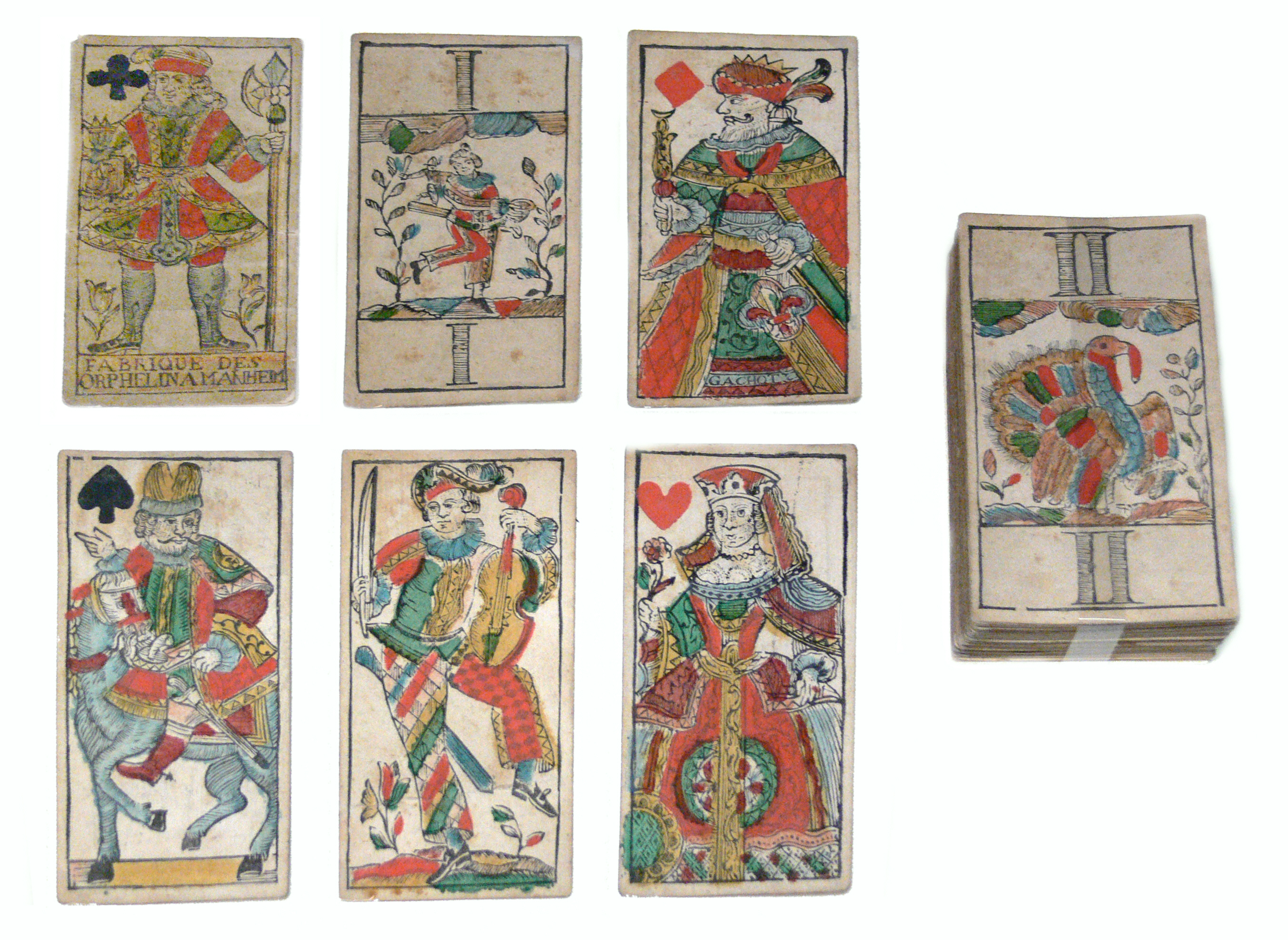
While the absolute origin of pictographic cards is unknown, many folks believe they came out of India, China, or Turkey, or with the travelling Romany people (also frequently called “Gypsies”).  What is known is that by the 1500’s, playing cards were very popular with the lower classes, and often cited as a vice by clerical and governmental documents throughout Europe.  They received wide-spread appreciation from the highest ranks, including Bohemian emperor Rudolph II and Napoleon’s spiritual advisor, Madame Lenormand.  Yet cards have almost always been popular among the lower classes, too.  Cards came to America with settlers, sailors, and soldiers.  In fact, in the late 1700’s, a popular ballad called “The Soldier’s Prayer-Book” described the suits, pips, and enumeration of playing cards in terms of biblical metaphor.  For example, the fives represent the five wounds of Christ, the nines are the nine lepers healed by Jesus, and the tens are the Ten Commandments.  While this song may have been a white-wash for gambling soldiers eager to keep one of the few portable entertainments allowed them, it does register an important point:  cards make wonderful tools for metaphoric interpretation.

So why playing cards instead of tarot cards?  For one thing, playing cards have been more or less easily accessible since the 1600’s, and are versatile.  The cards you play a game of blackjack with one day can be used to reveal the future the next.  They also travel well in a pocket and are easily replaced if they get torn or damaged.  Plantation owners in the antebellum South often thought little of slaves having decks of playing cards to amuse themselves in their few off hours (though in some places stricter masters prohibited them altogether).  William Wells Brown, who provided a slave narrative for a character named “Uncle Frank,” claimed that each plantation also had at least one fortune-teller somewhere on the premises, and at least few of them used playing cards.  Today, playing cards are an excellent way of divining even in plain sight.  No one thinks much of two people over a table full of diamonds, spades, clubs, and hearts, while a Devil or Lovers card might raise eyebrows.

My own system of playing card divination is largely based on the book It’s All in the Cards, by Chita Lawrence and the rhyme “For the Witch of Poor Memory” by Dawn Jackson, with a significant amount of additional material I’ve picked up from other books, teachers, and experiences over time.  What I outline here will be my own understanding of these cards, so please do not take it as gospel, and find a method that works for you.

Like most who practice cartomancy, I break the major meanings of the cards down by color and suits.  However, unlike a lot of other practitioners, I don’t ascribe these suits to tarot parallels or elemental attributes.  There are some connections, of course, as hearts and cups both signal emotion-based interpretations, but it’s not a hard-and-fast link.

First, black cards indicate “negative” or “no” answers, while red cards are “positive” or “yes” answers.  This is most important in short readings, which I’ll address in a later post.  Some will say that having more black cards than red is a sign of negativity, but honestly, the only truly “negative” cards in an extended reading are the spades, in my opinion.  For me, I look at the suits in the following way:

Hearts – Family, friends, love, and lovers.  Also emotions and things which are deeply felt.
Clubs – Work and business.  One’s “calling” or destiny.  Also conflict, discussion, and debate.
Diamonds – Money, luck, fortune, happiness.  Also news, letters, and socializing.
Spades – Tears, suffering, woe.  War, fighting, violence.  Also change, warning, and doubts/fears.

I’ll get into each of these suits a little more when I break down the individual cards, but this should give you some idea what I see when I do a layout for a reading.  If I see lots of diamonds and clubs, I know that someone’s got some good work he or she will be well compensated for coming around the bend.  All hearts means that the client is emotionally invested in the reading, or that he or she is dealing with deep family or friendship questions.  Spades and clubs together would be a sign that the client’s job might be in jeopardy, or that work is very unfulfilling for him or her.

In the next post, we’ll get into the actual significance of particular cards, but it is good to keep the overall meanings of the suits in mind as we go forward.  If you have any questions, please ask, and I’ll be happy to answer as best I can (from my own personal perspective…did I mention that yet?).

For today though, thanks for reading!

-Cory
Blog Post 81 – Van Van Oil

Greetings everyone!  Today, I’m going to cover another piece of our recent Lucky 13 podcast:  Van Van oil.  This is one of the most common hoodoo oils around, and actually  shows up in other places fairly often, too.  Because it is made from grasses found in Southeast Asia, it has a long history in medicine and magic from those areas.  Some of the grasses used in Van Van are also grown in West Africa, which is likely one route through which Southern conjure practices adopted this formula.

The basic ingredients in a Van Van blend are oils from:

Most of these are not easily available in bulk herb form, with the exceptions of lemongrass (which you can find at almost any Asian market) and vetiver (which can often be found in herb or metaphysical shops).  All of the oils except gingergrass are readily available from any aromatherapy or herbal extract dealer.  Gingergrass oil, which can be hard to find, is often left out of homemade Van Van recipes, or something else might be substituted for it.

The proportions heavily favor lemongrass in the recipes I’ve seen, almost to the point of exclusivity.  There are some who solely use lemongrass oil and add dried botanicals to it in order to round out the recipe.  Generally speaking, a home blender would use:

  • 5-10 parts lemongrass oil
  • 3-5 parts citronella oil
  • 2-3 parts vetiver root or oil
  • 1 part palmarosa
  • 1 part gingergrass

All of these would be carefully blended in a sterile jar, then topped with a carrier oil (sweet almond or jojoba would be excellent).  The proportions above are merely suggestions, and you would do well to contact a trained herbalist before blending these on your own.  In reality, you might be able to use just the first three oils and have some pretty solid Van Van oil, so don’t spend loads of money tracking down rare herbal ingredients unless you really feel compelled to do so.

Additions to the recipe vary by practitioner and region.  For example, in New Orleans, one might find lemon verbena added to the mix.  In fact, this may be how the formula got its name.  According to Cat Yronwode, Creole rootworkers would sometimes use lemon verbena in their blends in order to supplement the strong lemon-musk scent of the oil.  Verbena—a related herb—was often called vervain, and that was given a pidgin phoneme of “van van.”  The name does NOT have anything to do with vanilla, which is not found in any traditional recipes for this formula.  Judika Illes, whom we’ve referenced several times before, suggests adding another wild Asian grass—patchouli—to the blend, but I’ve never done this myself (I’m not a fan of patchouli, personally).  Other additions might include pyrite chips or “lucky” things like four leaf clover charms (which can also be anointed with Van Van and carried for luck).

So just what is Van Van oil for and how does it work?  Well, it’s considered a sort of ultimate luck formula, having sway over money, prosperity, gambling, love, and anything else that might need a little luck.  It’s often used to anoint talismans—like the rabbit’s foot—or mojo hands made for gambling or love.  As for how it works, lemongrass (and all citrus grasses) has a powerful “cut and clear” effect…think of how many lemon-scented cleaning agents there are.  They just make things seem cleaner (lemon also has some antibacterial/antimicrobial properties, and is a potent preservative in small doses—sliced apples are often treated with a lemon juice extract to keep them from browning).  Citronella does something similar (think of how citronella candles, torches, and oils repel nasty insects like mosquitoes).  These grasses cut and clear any negative influences, warding off bad luck. Palmarosa and gingergrass (which come from the same plant, in reality, Cymbopogon martine) are muskier, and so have a slight sexual connotation.  If you think of something being clean, bright, and sexy, it’s not hard to imagine lucky in the mix, too (think James Bond in a casino).  Vetiver is the muskiest of all, with strong earthy tones.  Earth has connections to abundance and prosperity (think of fertile black soil planted with seeds which grow into crops), plus there is a strong sexual current again.  Sex + money + nothing standing in your way?  Yeah, I’d say that’s pretty lucky.

A few quick notes:

Magico-botanical notes come primarily from Cat Yronwode’s book, Hoodoo Herb & Root Magic.

You can find Van Van oils at the Lucky Mojo Co.,  Music City Mojo, Toads Bone Apotheca, Queen of Pentacles Conjure, The Conjure Doctor, and just about any botanica or root shop around.

That’s it for today.  Thanks for reading!

-Cory

Blog Post 80 – Horseshoes

Following in the vein of recent posts, today I’m looking at another luck charm:  the horseshoe.  One thing Laine and I discussed in Podcast 13 was that the horseshoe seems to be a rather ubiquitous talisman.  It is so ubiquitous, in fact, that many folks may not even realize it has any magical connotation at all.  In an article from Western Folklore entitled “Lucky Horseshoes,” Jeannine E. Talley writes:

The horseshoe as a bestower of luck is so frequently encountered that it has become a cliche, but at the same time an isolated belief without a context. Barnet’s comment that the mule has been “pounding it full of luck” provides not only the ‘logic’ explaining why the horseshoe is full of luck but also reveals that luck is ac-cumulative. His insistence that the old nails must be used to hang the shoe is not found in standard collections for folk belief, but is akin to the notion that if the hardware is hung with prongs down, the luck will “run out.” This instance is a prime example that collecting the item is not enough; the contextual background of any item is of equal importance since it often contains the rationale which makes the belief credible. (p. 129)

I like this particular examination of the horseshoe because it details two points:  1) the horseshoe’s luck comes from its association with the horse itself and 2) as Talley states, the luck is accumulative, so the longer a shoe has been on a horse, the luckier it is.

Of course, there are plenty of other theories about why a horseshoe might be lucky.  Robert M. Lawrence, in his article,  “The Folk-Lore of the Horseshoe” describes the horseshoe as a talismanic emblem with many possible folkloric connections, including:

  • The Jewish Passover – like blood spread on doorposts/lintels and rowan trees in Scotland
  • Serpent emblem – “In front of a church in Crendi, a town in the southern part of the island of Malta, there is to be seen a statue having at its feet a protective symbol in the shape of a half-moon encircled by a snake”
  • Moon emblem – “the brass crescent, an avowed charm against the evil eye, is very commonly attached to the elaborately decorated harnesses of Neapolitan draught horses, and is used in the East to embellish the trappings of elephants.”
  • Phallic Emblem of some kind
  • Prong-shamed talisman – like protective horns of animals (connected to African symbols)
  • Horse as Sacred Animal (as mentioned above)
  • Iron as “Virtuous” metal capable of dispelling harmful forces (Journal of American Folklore, v.9, n.35, 1896, p. 288-292)

I hope to get into some of these symbols and ideas in other posts at another time—particularly iron, which shows up a lot in fairy doctoring practices and other magical systems—so for now I think it suffices to say that horseshoes have a lot of lore to build upon and are quite lucky, though no one seems to know exactly why they are so.

So how does one use horseshoes?  First of all, the shoe needs to be one which actually has been on a horse at some point (remember all that pounding of luck into it in Jeannine Talley’s article?).  Likewise, there are some who say that hanging a horseshoe involves using a spent horseshoe nail, too.  That seems to be a slightly less stringent requirement, but if you happen to have a spare horseshoe nail with your horseshoe, why not use it?

The issue of which way the “horns” of the shoe are pointing seems to be hotly contested by those who concern themselves with such things.  Both opinions seem to have some sound reasoning behind them, which I mentioned in the most recent podcast.  The general idea boils down to whether you think the horns up are “holding in the luck” or whether the horns down are “pouring the luck out on you.”  Either way, I think this is where instinct kicks in.  If you feel like you’ve hung it the “wrong way,” you probably have and  you should switch it.  But if you feel like your luck’s in good condition and your horseshoe’s “right,” then leave it be.

As to how specifically a horseshoe might be used, Harry M. Hyatt has a few examples of horseshoes in hoodoo work:

1) From Vol.2,p.1547

NAIL A HORSESHOE UP
OVER YOUR FRONT DOOR.
NAIL A PENNY DOWN IN THE FRONT
DOOR TOO. SCRUB IT ALL THE TIME.*
THESE WILL BRING YOU GOOD LUCK.

Dey kin use a horseshoe. Yo’ take a horseshoe an’ yo’ kin nail it up
ovah yore front do’ an’ take a penny an’ nail it down in de front do’; an’
yo’ jes’ let dat penny stay dere all de time an’ yo’ scrub ovah dat penny
all de time, an’ jes’ leave it dere an’ dat’ll be good luck fo’ yo’.
[Savannah, GA; Madam Pauline; Informant #1274. C575:1-C586:10 = 2136-2167.]

2) From Vol.2,p.1443

A HORSESHOE OVER THE DOOR
KEEPS SPOOKS OUT AND BRINGS LUCK.
& A MULESHOE OVER THE DOOR OF A BUSINESS
BRINGS BUSINESS SUCCESS

Keep a horseshoe – keep it ovah de do’ to keep de spook outa dere an’
fo’ luck, specially a man who does business. He’d have a new [mule] shoe ovah
de do’ – like he do’s a business roun’ in a shop or a restaurant or somepin
lak dat, because a mule is a hard-workin’ thing, hard-workin’. All right.
An’ jes’ lak ah’d have de mule when he hitch out an’ go to his stall to
eat, people be coming to his place and say….
[Sumter, SC; Informant #1387; Cylinders C885:1-C902:4 = 2366-2383]

(Both of these can be found in Hyatt’s book or in the excellent Yahoo! Group  “HyattSpells”)

I like the first example because it combines the lucky penny with the lucky horseshoe, and places luck at your head and your feet, so every time you enter a door,  you get caught between the two and get a double dose of luck.  I also like the rationale for using a mule shoe to boost business (because the mule is so hard-working).

Finally, Vance Randolph describes the Ozark methods of horseshoe deployment in Ozark Magic & Folklore:

  • Most hillfolk of my acquaintance use a horseshoe instead of the stone (to protect chickens from hawks), and some think that a muleshoe is even better. It is frequently fastened in the firebox of the stove rather than in the oven. In the old days the muleshoe was hung up in the fireplace, or even set into the mortar at the back of the chimney (p. 43)
  • Many hillfolk think that the man who finds a horseshoe with the closed end toward him will do well to “leave it lay.” If the open end is toward the finder, he sometimes spits on it and throws it over his left shoulder, a procedure which is supposed to bring good fortune. Or he may place it in a tree or on a fence,saying: “Hang thar, all my bad luck!” In this case, whoever touches the hanging horseshoe falls heir to the misfortune of the man who placed it there (p. 62)
  • Probably the commonest way to keep witches out of the house is to nail a horseshoe over the door; this is regarded as a sort of general prophylactic against witches, bad luck, contagious disease, and other evil influences (p. 283)

So that’s the lucky horseshoe.  Another long article, so I apologize for that, but hopefully you aren’t too bored.  Skimming is probably a good skill to apply when reading these blogs.  At any rate, if you have any questions or comments about horseshoes, please feel free to post them!

As always, thanks for reading!

-Cory

Blog Post 78 – More Mojos for Success

Back in Blog Post 76, I mentioned that I’d be following up with some other types of success mojos.  Academic success is fantastic, but if you’re not in school it’s probably not going to help you much.  So today I thought I’d take that scholastic success mojo hand and rework it for a few other needs.  I hope it helps!

Building upon the basic Crown of Success mojo, which would generally include a John the Conqueror root in a red flannel sack anointed with Crown of Success oil, you could vary your specific ingredients for particular results:

Better Business – Add herbs like sassafras, five-finger grass, or cinnamon, plus a lodestone and magnetic sand.  Try to use an odd number of ingredients.  Pray Psalm 8 or a similar prayer.

Gentle Judge – A court-case success hand.  Use gravel root, little John to chew/galangal, cascara sagrada  bark, sugar, and tobacco.  Pray Psalm 36 or a similar prayer.

High Rollers – This is a gambling success mojo.  Use Job’s tears, a gator paw, a badger or gator tooth, a raccoon penis bone, a rabbit’s foot, and/or a four-leaf clover charm (primarily use curios for this one).  Pray Psalm 41 or Psalm 62 or a similar prayer.

Lucky in Love – With this success hand, it’s less about attracting a new love and more about strengthening one that exists (say, for example, during the process of courtship and marriage).  Add angelica root, violets, and roses (if trying to court a woman) or vanilla, tobacco, and dragon’s blood resin (for courting a man).  You can use lavender if you’re courting someone of the same sex, as well.  Pray Psalm 139 or a similar prayer.

Make It Rain Money – Add cinnamon, collard seeds, beans or peas, lucky hand root, rice, and/or rose of Jericho (things like seeds, beans, peas, and rice all signify abundance).  Add a lucky penny or a silver dime if you like, or a silver charm like a four-leaf clover.  Pray Psalm 126 or a similar prayer.

There are so many variations on these types of mojos, so please try them out and experiment.  I’ve had a lot of success (and the irony of that is not lost on me) working with these types of hands, so I encourage everyone to give them a try.

I’d like to close this post by sharing something one of our wonderful readers mentioned to me.  Odom of the Evil Eye recently wrote me about an academic success hand he’s working on, and he included an ingredient that struck me as just perfect for that kind of work:  coffee.  He made an excellent point that as a stimulant coffee can help keep one awake and alert, and that the university coffee house is such a ubiquitous piece of the college landscape it almost serves as a shrine to this kind of work.  So good eye for that connection, Odom!

Thanks for reading,
-Cory