Blog Post 198 – Dolls

In one of our recent holiday episodes, we discussed the way that toys, dolls in particular, seem to embody the uncanny. Dolls, doll babies, dollies, poppets—whatever you call them, figural toys seem to have the power to evoke fear in people and act as powerful proxies for magical work. I decided to cover the topic in part because several podcasts I frequently download (namely LORE and Stuff You Missed in History) have recently mentioned Robert the Doll in Key West, Florida. Robert’s story is full of creepy twists and turns, but nicely captures how dolls can be both innocent (as Robert is when he acts as a best friend to his young owner, Gene) and terrifying (as Robert is when he shows up on a subsequent owner’s bed, brandishing a kitchen knife). Still, most tales of dolls and magic in the New World are not as spectacular as Robert’s. That doesn’t mean there aren’t some very interesting uses for dolls in American folk magic. There most definitely are, and in this article, we’ll look at some of the ones that I find most interesting.

Robert the Doll, in Key West, Florida. Creepy, right? By Cayobo from Key West, The Conch Republic (Robert The Doll Uploaded by LongLiveRock) [CC BY 2.0 (http://creativecommons.org/licenses/by/2.0)%5D, via Wikimedia Commons
We can start in Salem, during the famous witchcraft trials of the early 1690s. A slave from Barbados named Candy was the focus of one early investigation (although her fate was not, as far as we know, the gallows). Candy confessed her use of folk magic, including the use of a handkerchief which she transformed into a doll:

“Candy stated that her knowledge of witchcraft came from her experience in Salem and not from her home in Barbados. The magical items possessed by Candy bear closer analysis and provide evidence for a possible connection to African or Afro- Caribbean beliefs. The knotted handkerchief was obviously a doll to stick with pins or to rend to inflict pain on others. The pieces of cloth were possibly shreds of clothing to be used to identify the dolls with a particular victim, as is common in the sympathetic magic which makes up part of voodoo belief” (McMillan 104-5)

Comments about “voodoo belief” aside (here I think McMillian is simply conflating “voodoo” with the folk magic of African Caribbeans), Candy’s use of the knotted handkerchief gets at some of the main reasons that doll magic seems to be popular and widespread. Firstly, it involves easily found or acquired resources—in this case cloth from the intended target, making the materials doubly enticing. Secondly, doll magic is sympathetic magic, and the connection is easy to see. If I make a piece of someone’s long johns look like a person, particularly the person whose backside the doll so recently covered, it seems likely that those two things will share a connection.

This point, that something that looks human but isn’t has uncanny powers, gets echoed in a lot of folklore as well, some of which connects to the folk magical systems of early Americans. Imported stories, such as tales about Anansi, refer to the use of dolls as agents of trickery. One account of Anansi tells how he tricked Tiger, and Tiger avenged himself on Anansi by putting a gumdoll in a field. Anansi gets angry when the doll won’t respond to him, and strikes it, becoming stuck to it. This tale is likely best known by American audiences as the tale of Brer Rabbit and the Tar Baby, of course, which replaces Anansi with the wily trickster rabbit and uses tar in place of tree gum. An Apache tale recasts the narrative as Coyote fighting with a lump of pitch, placed in a field by a “white man” to catch the sneaky food thief. The story keeps reappearing across different cultural backdrops, with new characters but the same basic structure. In all cases, the doll in question does nothing—that is one of the reasons Brer Rabbit and his compatriots dislike the thing—but still manages to get the best of its target.

Illustration of Brer Rabbit & the Tar Baby. A. B. Frost [Public domain], via Wikimedia Commons
Dolls, much like the Tar Baby or gumdoll, don’t necessarily have to do anything to be effective in folk magic, either. Jason Miller recounts a story in his Protection & Reversal Magic in which a doll’s effect is clearly psychological, but nonetheless potent:

“A santera I know was having problems with her neighbor being loud and obnoxious at all hours of the night and leaving garbage on her lawn. She asked her madrina (her teacher) what she should do. The madrina told her to make a doll that looked like the neighbor, blindfold it, tie its arms and legs, and nail it to the tree in her yard facing her neighbor’s front door. My friend was a bit shocked and said, “Good Lord! I don’t want to hurt him! What will happen?”

“Nothing” replied her madrina, “but it will scare the living crap out of him!”” (Miller 30)

Miller’s account of the santera’s doll experience resembles other accounts in American folk history. Newbell Niles Puckett references a similar incident in his Folk Beliefs of the Southern Negro. In the cases Puckett describes, the dolls may or may not actually have a magical effect, or they might simply convey the sender’s sentiments about how they wish to see the recipeient suffer: “Very common also was the practice of putting small black caskets, often with skull and crossbones upon the cover, in front of a person’s door. Sometimes these would contain a small doll with pins run through the heart and with a burned-out candle at the head and another at the foot, doubtless a case of sympathetic magic, indicating a desire that the person be “laid out” according to the Catholic rites.” (Puckett 227-8).

Dolls that do nothing, however are not as much fun as dolls that do something. Fairy tales like “Vasalissa the Beautiful” from Russian lore offer dolls that seem to do little, but in fact act as powerful fetishes of protection to those that carry them. Vasilissa is protected by her mother’s doll, which carries a maternal blessing and performs tasks while the young girl and the old witch Baba Yaga are sleeping at night. Baba Yaga is always disappointed by Vasilissa’s completion of her tasks, which she knows must be done by magic but cannot figure out. Eventually the ancient cannibal witch decides not to eat the girl and instead sends her away with a magical gift when she learns that Vasilissa is protected by her mother’s blessing (although she never does puzzle out the secret of the doll).

Just as in fairy tales, dolls can have powerful magical agency, according to folklore. Several authors, including the aforementioned Jason Miller, suggest using dolls or poppets in spells, just as Candy was said to have done in Salem. Miller recommends a mirror box spell using a doll which will turn any harmful magic back on its sender or protect one from magical attack. Dorothy Morrison makes similar suggestions in her book on baneful magic, and even talks about using dollar store Barbie knockoffs stuffed with personal materials or herbs as a way of simplifying the doll-making process.

When it comes to making dolls, however, kids seem to have a knack for doing it with whatever’s at hand, which as I mentioned above, may be part of why dolls are both so ubiquitous and so powerful. Coming from materials which are already familiar to the doll-maker through use and contact, the relationship with the doll itself can be very deep once the figure has been created. Adults do sometimes craft dolls and other toys with what is around, but they are also likely to purchase materials:

“Folk toys are made of any convenient materials, including wood, clay, plants, paper, fabric, metal, sand, or snow. If made by children, they most often utilize recycled or “found” materials (as when rubberbands are saved to make a “Chinese jump rope”). Adults, especially those who make toys for sale, are more likely to purchase new materials as needed. Folk toys come in many varieties: Dolls are common (often made of natural materials such as nuts, apples, or corncobs dressed in scraps of fabric).” (Leeds-Hurwitz 1477)

The fabrication of toys and dolls, including ones used for ritual or magical purposes, is not limited to post-European contact in the New World, either. According to scholar Yvonne Milspaw, Native cultures would create paper-type dolls out of natural materials with magic in mind: ““Other reported uses of paper and bark cutting among Native Americans include carefully worded reports of sorcery and cut-paper dolls among some Mexican people like the Otomi” (MIlspaw 1134). Some of these traditions may have shaped latter-day practices like the creation of skeletal papier mache dolls for Day of the Dead/Dia de Muertos celebrations in Mexican and Mexican American culture.

So dolls can be made from lots of materials, and can be active or passive in the use of magic, as we’ve seen. They also frequently come with their own rules or taboos about how they can be used, deployed, or even simply treated. When it comes to folk magic, African American conjure traditions emphasized the choice of materials as a matter of import. Dolls are often crafted with local flora (and occasionally fauna) for a combination of practical and symbolic reasons. Spanish moss is frequently used to stuff or wrap doll babies in Delta-area conjure practices both because it grows ubiquitously on trees in the region and because as a plant it acts semi-parasitically (it doesn’t actually feed off of the oak trees it grows upon directly, but it can limit their growth), thereby sharing life with a host as a doll is supposed to. Even more potent than Spanish moss, however, are doll components that come directly from the intended target, such as pieces of their clothing, as illustrated by this example from African American folklore:

“My husband was very jealous of me, he was just insane jealous. He was always telling me he was going to put a spell on me. I was afraid of him. I went to a house where he didn’t want me to go, because a man was at that house he was jealous of. He was going away to get work…and told me not to go there. He went and took a piece of my bloomers and made a rag doll out of them, stuff it, worked black eyes like mine with silk thread; then put in the head — a needle, some of my hair, pins, rain water and a shingle nail, then sewed up the head. After that he took a small picture of me and put it on the left side of the rag doll, about where my heart is; then he filled the doll just full of pins and needles all over. He then put it in a pint jar and buried it under that house, where he didn’t want me to go — without anyone knowing it — and left town. I started to getting sick just as soon as he left, was sick all the time, could not find out what was wrong. I would start over to the house, but I could not make it. Something kept me from going. I went on this way for about a month, I was getting weaker and weaker, when one day some children playing around this house, digging, dug up this rag doll. They [the people at the house] knew right away it was to cast a spell over me, because they knew my picture was on the doll, and he was always saying he was going to make me suffer. We took the rag doll, jar and all, put it on the fire and burnt it all up; and I started to getting better right away and got well. And my husband got stab in about a month time; we threw the spell back on him by burning up everything, and he died and I am well.” (Hyatt 456)

A number of writers on conjure similarly describe the use of clothing from the intented target, including Yvonne Chireau, Starr Casas, Denise Alvarado, and Jefferey Anderson. While a doll sculpted from scratch certainly seems to be preferred in many magical practices, it is not the only way to operate. Much as Dorothy Morrison mentions using dollar-store plastic dolls to do work, Zora Neale Hurston records the repurposing of children’s toys for magical purposes in Southern African American hoodoo:

“To Keep a Person Down. Write name on paper with black ink. Rip open back of a doll and put the names in it. Sew it up with black thread. Put aloes, cayenne pepper in doll along with names. Tie the hands of the doll behind her and place her in a kneeling position in a corner, and keep her there where nobody will interrupt. They will be frustrated as long as she is not disturbed. Tie a black veil on her face and knot it in the back, so that the person will be blind and always do the things to keep himself from progressing” (Hurston 384).

"Voodoo Doll," featured at the Louvre, Paris. © Marie-Lan Nguyen / Wikimedia Commons, via Wikimedia Commons
“Voodoo Doll,” featured at the Louvre, Paris. © Marie-Lan Nguyen / Wikimedia Commons, via Wikimedia Commons

In addition to the lore of creepy dolls and the lore about how to use dolls magically, there seem to be a few taboos about dolls which thread through different American cultural landscapes as well. For instance, many Amish communities have strict rules about children’s dolls, insisting that they cannot have faces on them for fear of violating the “graven images” commandment in the Bible (the rule also extends to things like snowmen and usually paintings as well). Hyatt notes that one superstition about dolls involves naming: “If a girl changes the name of her doll, the doll will break.” (Hyatt, p.268). He also records a much more sinister taboo about dolls which I cannot help but share here:

“A little girl died that was three years old, and her mother put a doll and a little horse in the coffin that she always played with. I said to the mother, ‘I would not do that, for there is an old saying, never bury anything with a corpse.’ And in a few weeks this little girl’s mother and sister died.” (Hyatt 374)

This last bit of folklore is fascinating to me simply because it seems to be a powerful impulse in human beings to bury toys with children when they are tragically lost. Many early human graves contain burial goods, and children’s burial goods often seem to be toys. Dolls, though, might have a special exemption from burial because of their close resemblance to a living person, although that does not seem to be a universal taboo.

Dolls today have a lot of the same stigmas attached to them: they are objects of fear and superstition as well as simple objects of play. Magically, they can be used for a number of purposes which resemble and also modify the traditional folk uses I’ve outlined here. One of our readers shared a story with us about a sloth doll she uses to overcome issues with chronic lethargy, letting the doll absorb any feelings of laziness from her (she also shared her very terrifying experiences with an American Girls doll, so that tradition is alive and well, too). The film Toy Story and its many sequels and similar movies all play upon the idea of toys having a “secret life,” which involves humans not being around, but being the prime object of the dolls’ attention. In theaters as of the date of this post, one can also see the film The Boy, about a very Robert the Doll-esque figure which seems to have a (sinister) life of its own.

All of which is to say, dolls are a big part of magical lore and practice, and don’t seem to be going anywhere soon. And they watch you while you sleep. So sweet dreams and all.

Thanks for reading!

-Cory

References

  1. Alvarado, Denise. The Day of the Dead Handbook (CreateSpace Publishing, 2012).
  2. The Voodoo Doll Spellbook: A Compendium of Ancient Spells and Rituals (Weiser Books, 2014).
  3. Anderson, Jeffrey E. Conjure in African American Society (LSU Press, 2008).
  4. Casas, Starr. The Conjure Workbook, Vol. 1: Working the Root (Pendraig Publishing, 2013).
  5. Chireau, Yvonne P. Black Magic: Religion and the African American Conjuring Tradition (Univ. of California Press, 2006).
  6. Crowley, Daniel J. “Anansi.” In American Folklore: An Encyclopedia, ed. Jan Brunvand (New York: Garland), 1998. 50-1.
  7. Goldberg, Christine. “Witchcraft.” In American Folklore: An Encyclopedia, ed. Jan Brunvand (New York: Garland), 1998. 1560-64.
  8. Hyatt, Henry M. Folklore of Adams County, Illinois (Alma Egan Hyatt Foundation, 1935).
  9. Hurston, Zora Neale. “Hoodoo in America.” In Journal of American Folklore (Fall 1931). 317-417.
  10. Kirkland, James W. “Folk Medicine.” In American Folklore: An Encyclopedia, ed. Jan Brunvand (New York: Garland), 1998. 983-89.
  11. Leeds-Hurwitz, Wendy. “Toys, Folk.” In American Folklore: An Encyclopedia, ed. Jan Brunvand (New York: Garland), 1998. 1477-80.
  12. McMillan, Timothy. “Black Magic: Witchcraft, Race, & Resistance in Colonial New England.” In Journal of Black Studies (Sept. 1994). 99-117.
  13. Miller, Jason. Protection & Reversal Magick (Franklin Lakes, NJ: New Page Books), 2006.
  14. Milspaw, Yvonne J. “Paper Cutting.” In American Folklore: An Encyclopedia, ed. Jan Brunvand (New York: Garland), 1998. 1132-35.
  15. Morrison, Dorothy. Utterly Wicked: Curses, Hexes, & Other Unsavory Notions (St. Louis: WillowTree Press, 2010.
  16. Puckett, Newbell Niles. Folk Beliefs of the Southern Negro (New York: Dover, 1970).
  17. R. D. Personal correspondence via email. 23 Dec. 2015.
  18. Yolen, Jane, ed. “Coyote Fights a Lump of Pitch.” In Favorite Folktales from Around the World (New York: Random House, 1986).
Update – Aidan Wachter’s Talismanic Jewelry

Talismanic Jewelry by Aidan Wachter (Photo from http://www.aidanwachter.com)

If you haven’t seen Aidan Wachter Talismanic Jeweler‘s magnificent Pagan- and magical-themed creations in silver (http://www.aidanwachter.com/), you should absolutely look at what he’s got to offer. The jewelry is hand-made in his workshop, and he’s constantly working on new designs from a variety of magical sources, including angelic work, grimoires, folk magic, and runestaves. He also does work to empower and enchant his creations, which is right up our alley.

He’s even offered a special sale (his first ever!!!) to our supporters and listeners. Simply use the code “Witchery” (without the quotation marks) when you check out at his site and get 10% off of your order. Do be aware that since this is work of a highly personalized nature he is currently turning orders around to ship in about 8 weeks.

A big Thank You to Aidan for making this available to our listeners!

Poll – The Next Patreon Goal Level

We are fast approaching our next Patreon goal, which means we need to figure out what the next round of rewards should be after we hit the $500/mo. donation level. If you are interested, please take the poll above and let us know what you think would be a worthwhile incentive (or incentives) for hitting the (almost unbelievable, but thanks to you achievable) goal of $1,000/mo.

As always, thank you all for your amazing support!

Blog Post 197 – Shapeshifting

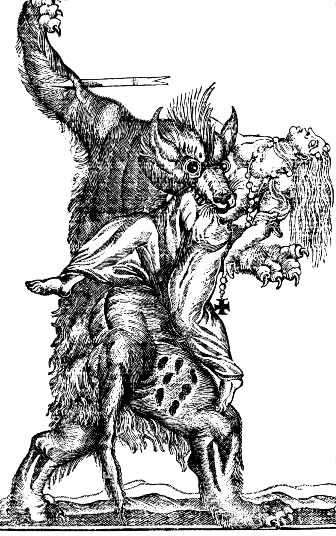
“Loup-Garou,” from The Werewolf Delusion, by Ian Woodward (1979) (via Wikimedia Commons)


[N.B. Please also check out our podcast episode on this phenomenon as well: Episode 82 – Shapeshifting]


One of the talents attributed to witches in a number of cultures is self-transformation. If you’ve plunged more than ankle-deep into witchcraft research, you’ve likely run across famed Scottish witch Isobel Gowdie’s charm, which she reputedly used to transform into a hare, which begins “An I shall go into a hare, with sorrow and sighing in mickle care…” Gowdie was not alone in her belief that through the force of her magic and her will (and perhaps some psychoactive botanical substances or a judicious application of rendered animal fat), she could change her form to that of an animal. Perhaps the most famous example of this power is the werewolf, which sometimes changes of its own volition, but more often is a victim of the shiny moonlight’s powers.

In the New World, plenty of witches also had the power of transformation. This article will look at a few key tales of shapeshifting from New World lore, and ask questions about what the stories could mean for a magically inclined person with an interest in exchanging human form for an animal’s.

Perhaps the best-known and most widespread incarnation of the shapeshifting legend east of the Mississippi is the story of the loup-garou (sometimes also rou-garou, rugaru, or a similar variation). The beast can be found just about anywhere which saw frequent contact with French Colonial influences, such as in Canadian border zones or Louisiana. Often the loup-garou is essentially a werewolf, a human being who can—through magical means often diabolical in nature—become a wolf-like beast. Some versions of the story, recorded by University of Louisiana professor Barry Ancelet, describe the beast as more of a thief than a predator for humans, stealing fishermen’s clams while they sleep. The exact nature of the creature is also indeterminate, since depending on one’s location, it can “range from the rougarou as a headless horseman to a wolf that prowls the forest at night” (Lugibihl). The actual transformation may be permanent (or even ghostly, as some accounts tell of the beast as the remnant of a cruel old man), or may only last for 101 days, after which time the loup-garou transfers its curse to another person through a bite or drinking his or her blood. A person under the curse seems to know whether he or she is suffering from the transformation, and becomes rather wan and unhealthy, but usually remains silent about the condition with others. A major variation on the loup-garou is the bearwalker, about which Richard Dorson recorded several stories in Michigan’s Upper Peninsula during the mid-20th century. As you can probably guess, the assumption of a bear form (or at least an animal form which resembles a bear more than a wolf) is more common in the lore of the borderlands on the north of the Great Lakes.

In the mid-section of the United States, particularly from the mid-Atlantic down to the upland South and across into the Midwest, the power of transformation is far less canine in nature. While the loup-garou certainly fell into the purview of New World magical lore (albeit lore largely imported from Europe), the tales of transformation one finds in places like Appalachia skew distinctly witchy in flavor. Several stories, including one which we’ve recorded here before called “The Black Cat Murders,” talk about witches transforming into cats in order to visit harm on prospective victims. Patrick Gainer recorded his version of the tale in West Virginia from Mrs. Robert Pettry, whose account included a man with a pet bear that struck off the witch-cat’s paw only to have it transform into a human hand once it was severed. This is a very common feature of witch transformation tales, and often once a witch has been injured in her animal state, she bears the marks of her injury in human form as well (which proves helpful to neighbors in identifying her). One of the remarkable points about these transformations remains that in many cases the witch has a physical human body in one place and a spectral body (with some corporeal aspects, as in the case with the bear above) that can travel around at her behest while remaining deeply linked with her. That trait appears throughout North America (again, with some Old World antecedents, including Africa as well as Europe). A tale from Virginia recorded in The Silver Bullet, by Hubert J. Davis, tells of women who turns into a cat only to have her hand whacked off with a knife. The next day, when the man who did the whacking tries to shake hands with the suspected witch, she refuses because her hand is now missing. Davis also reports a tale of a witch who becomes a cat only to be caught by a lonely mountain man, and transformed back into a woman, she marries him and bears him two children. When he begins drunkenly telling someone how they met, she turns herself and the kids into cats and kittens and they disappear forever through a hole in the wall.

Of course, not all witches turn into cats, and not al were-cats are witches, exactly, either. In Utica, New York, Davis found a tale of a witch who turned herself into a black colt that would appear in neighbors’ fields and graze among their horses. When a man sneakily catches the colt and has it shod at the blacksmith’s (I’d note the importance of iron to this story, by the way), the colt then gets put into a pasture, then disappears. However, a neighbor-woman is seen with bandages on all her hands and feet the next day. New York is also the home of famed witch Aunty Greenleaf, who reportedly would turn herself into a white deer rather than a cat or a horse. She managed to elude hunters constantly until one hunter got the idea to use melted silver for bullets and struck her in her transformed state. She, of course, took ill and died (Schlosser 2005). Another famed shapeshifting creature, however, is not a witch at all, but a Native woman who has been cursed into cat form known as the Wampus Cat (Schlosser 2004). Lest you think that all those who are animagi (to steal a term from Harry Potter) are female, an African American tale speaks of a male witch whose form is that of a boarhog, and who uses his powers of magic and transformation to gain a pretty wife with lots of land. Interestingly, a little boy in the story—often called the “Old Witch Boy”—knows the boarhog witch’s secret and reveals it to the girl’s father, resulting in the death of the hog-witch (Leeming & Page).

Some of the most pervasive and powerful witch-stories of transformation come from the American Southwest. Navajo skinwalker tales abound with narratives about evil witches who could use the pelts of animals to take on different shapes, usually to terrorize outsiders or those they did not like on the reservations. Some accounts claim that the witch who could take on the skin of another creature was the most powerful type of witch, and had mastered what was known as “The Witchery Way.” Such a creature was to be greatly feared, and trade in certain skins and furs was severely limited within Navajo culture. Skinwalkers could be recognized by some of their supernatural abilities, but more especially by their eyes: in animal form, their eyes looked human, and vice versa when in their human form. Nasario Garcia recorded many tales in New Mexico, Colorado, Texas, and California from people in the late 20th and early 21st centuries who reported knowing about or having seen witches that had taken on animal forms, just as skinwalkers do. One story related by a a man who recalled the events of the tale from when he was eight years old told of how his father had been driving an oxcart on a dark night with his son (the narrator) and a few farmhands along with him. Suddenly, two sheep appeared alongside the cart, one white and one black, and simply followed them, always matching pace with the cart. Eventually, they simply disappeared. Many others recorded by Garcia spoke of witches taking on owl forms to travel out by night, or occasionally coyote or dog forms, in which case they seemed to want to bite errant travelers (although never in such a way as to cause permanent injury or death, although most who see these creatures report being terrified).

So just what do witches do once they are transformed? In many of the stories, they seem to be up to no good. The tales of witch-cats often speak of numerous murders or unexplained deaths attributed to the shapeshifting sorcerers in the area. In some tales, witches take on cat forms to sneak into the houses of children and steal their breath (which is obviously related to the superstition about cats stealing babies’ breath). In some cases, the witches seem to be up to mischief, as in the case of Aunty Greenleaf, who likes to lead hunters on wild chases and get them lost, or cause their guns to fail. The loup-garous steals food, or worse, passes its curse on to others, sometimes even drinking the blood of another person to accomplish its nefarious task. The near-universal terror of skinwalkers in the Southwest is attributed to their powers to cause sickness and death as witches, although they seldom seem to kill or even severely maim while in animal form (although there are often reports of animal mutilation later connected to them). Richard Dorson records one tale from the Southwest in which shapeshifting witches seem to threaten each other more than the average person. He speaks of a pair of witches who make a bet about which one is faster in horse form. The loser has to stay a horse, which is accomplished by means of a magical halter. The winning witch sells the loser to a man, whose son accidentally removes the halter, and the witch transforms into a fish and swims away in a nearby river, then continues to transform until he’s a coyote. The coyote is tracked and killed by dogs in the end, and notably the witches have done no harm to anyone but themselves.

Why do shapeshifting witches get a bad rap, then? I would like to suggest that the real uneasiness among those who tell the stories is a fear that witches can be anywhere, and anyone, and just about anything. You never know when you might offend a hidden witch, who could be the cat twitching its tail by the fire or a horse in a pasture across the road. A healthy show of respect (even one tinged with fear) makes for a good insurance policy against the witch’s other fearful talents. Of course, being able to take on animal forms also means that the witch knows just how well you treat the lower orders of species, which might also inspire one to act a little better around the flocks and fields, or to pass an extra dog biscuit to the pooch curled up at your feet. Who knows, that might just be all that stands between you and a rather nasty hex, right?

Thanks for reading!

-Cory


Sources:

  1. Davis, Hubert J. 1975. The Silver Bullet, and Other American Witch Stories. Jonathan David Publishers.
  2. Dorson, Richard. 1964. Buying the Wind: American Regional Folklore. Univ. of Chicago Press.
  3. Dorson, Richard. 1972. Bloodstoppers & Bearwalkers. Harvard Univ. Press.
  4. Gainer, Patrick W. 2008. Witches, Ghosts, & Signs. West Virginia Univ. Press.
  5. Garcia, Nasario. 2007. Brujerias: Stories of Witchcraft & the Supernatural in the American Southwest & Beyond. Texas Tech Univ. Press.
  6. Leeming, David, and Jake Page. 1999. Myths, Legends, & Folktales of America: An Anthology. Oxford Univ. Press.
  7. Lugibihl, Steve. 2001. “The Rougarou: A Louisiana Folklore Legend.” The Nichollsworth. 26 April. Louisiana State University.
  8. Navajo Skinwalker Legend.” 2015. Navajo Legends Website.
  9. Pitre, Glen. 1993. Swapping Stories: Folktales from Louisiana. Louisiana State Univ. Press.
  10. Schlosser, S. E. 2004. Spooky South. Globe Pequot Press.
  11. Schlosser, S. E. 2005. Spooky New York. Globe Pequot Press.

Wilby, Emma. 2010. The Visions of Isobel Gowdie: Magic, Witchcraft, & Dark Shamanism in Seventeenth-Century Scotland. Sussex Academic Press.

Quick Update – New World Witchery, Patreon, and You!

NWWPatreonLogo

Dear Readers, Listeners, Fans, & Friends.

Five years ago, we started New World Witchery as a “search for American Traditional Witchcraft.” Since then, we’ve produced more than one hundred episodes (the official count is eighty-one as of today, but including Special Episodes, one-offs, and various other entries into our feed, we’re closer to one hundred and twenty releases). We’ve got a site with nearly two hundred entries covering a dozen different branches of American folk magic, holidays, spell ingredients, book recommendations and reviews, and lots of other points of interest for fans of all things New World and witchy. More than anything, though, we’ve got you. Our fans have been the driving force behind our work, helping to guide the subjects we cover, providing folklore and personal connections to the magical stories we tell here, and even sending us love and good energy when we’ve had personal crises. Thank you all for what you’ve done.

If you’ve listened to our latest episode, you know we’re asking for your help again. For the past five years we’ve essentially run on the “tip jar” model, leaving a link up for those who want to donate to the show on the sidebar of the site, and offering a “pay-what-you-want/donations-only” email card reading service for those who wanted to help keep the show going strong. Time has meant change, though, and now we’re trying to figure out how to level up New World Witchery to make it even better. Paying for everything from the web hosting to access to research materials and technology to improve the production value of the show (and hopefully help get rid of some of the hiccups we’ve had with shows disappearing from our feed from time to time)—all of that means we need help. Sure, we can cast some prosperity spells, but it’s crucial to make sure to follow through in the mundane even if we’ve got magic on our side, right?

With that being said, we’d like to introduce you to Patreon. It’s a site that lets you—our fans—become the direct supporters of the show in a very real way. We’ve had occasional opportunities to consider bringing sponsors on, but given our size and our audience, that just didn’t seem like the way to go, because we know that not everyone who comes to our site is looking for direct-shipped health snacks or comfy underpants (well, everyone is looking for comfy undies, but that’s not our realm of expertise). What most people seem to be interested in, though, is more content from us. With Patreon, you get that. You support us directly, and we return that support as rewards directly to you. You can find all the details of our Patreon support levels and rewards at the main Patreon site, but just to give you an idea of what is available, here’s a short list:

  • Individuals giving $5 per month get a signed copy of 54 Devils and an annual mailer pack with lots of New World Witchery goodies inside (including things like postcards and—if we get enough support—even tee shirts!)
  • Individuals giving $10 per month get the same things as $5 subscribers plus access to live chat sessions (which will also be shared with those subscribers as a special bonus podcast)
  • When we reach $250 per month in total support, we’ll add extra live chat sessions and unlock things like the annual mailer tees and digital releases of future books from Cory and/or Laine
  • If we get to $500 per month in total support, we’ll even launch a second publically available podcast focused on storytelling and folklore!

See? Lots of possibilities! And we know that not everyone can support us financially, but may still want to help. If that’s you, we totally understand! Consider sharing links to our show or our Patreon page on social media or giving us a good review on iTunes! Or even just sending us an email and letting us know you like the show, that works, too!

No matter what, we’ll keep producing the main New World Witchery show and making it available to anyone who wants it. We’ve been able to keep up essentially a once-a-month schedule throughout most of our time online, and we want to maintain that going forward. And don’t worry, we won’t make a big deal out of the Patreon thing going forward–just a sentence or two at the end of each episode. As I said at the beginning of the post, we’ve been searching for American witchcraft for half a decade now. There’s still so much left to explore. We’re not anywhere near done. With your help, we can do so much more, but no matter what, we will keep up with that exploration and sharing it with you.

Thank you for getting us this far. We love you all, and can’t wait to see what comes next!

Thanks for…well, everything!

-Cory

Blog Post 196 – Body Lore & Magic

Hans van Hayek, The Fortuneteller, 1892 (via Wikimedia)

“My ears are burning; who’s talking about me?”

“If your nose is itching, someone wants to kiss you.”

“Your feet itch? You must be about to go somewhere.”

I remember my mother often sharing the little bits of proverbial wisdom throughout my childhood.

Usually they were delivered with a wink or a wry smile, and I don’t think she took them particularly seriously, but then she also wouldn’t have been surprised to find out that any one of these tokens had borne some fruit in the real world. If you think about it, assumptions about the intimate connection between a person’s body and the world around him or her are not anything new or unusual. Plenty of people have an uncle whose bunions predict snowstorms, or a grandmother whose arthritis tells of coming rain, or headaches that detect heatwaves moving in. There are plenty of other ways one’s body might help one prepare for a day outdoors, according to American lore:

Beyond those sorts of weather-related phenomena, however, bodies are reputed to be in touch with all sorts of esoteric information. Of course, obtaining pieces of a person’s body is a primary way of gaining magical control over him or her, but that, I fear, goes beyond the scope of this article. Instead, this brief examination will focus on the body as a giver or receiver of information, rather than a source of spell ingredients. For example, often the physical features of a person imply certain characteristics about their intellect or psychology, according to American lore:

  • A fat person is believed to have a good disposition and a friendly nature
  • A big head can be the sign of great intelligence, provided it’s not too big (which would mean a person of no wit whatsoever)
  • A person with a “long head” is thought to be someone of dubious morality and “unscrupulous” character
  • A person with a broad face is thought to be warm and friendly, while a narrow face indicates shrewdness and insensitivity
  • “Dimple on the chin,/ Devil within” – A dimpled chin indicates a troublemaking personality
  • Long arms indicate someone with a “grasping” nature, someone who will do whatever it takes to geth what he or she wants
  • Trimming a baby’s fingernails will turn it into a thief
  • And of course, cold hands mean a warm heart.

What do all of these sorts of lore have in common, then? They all seem to operate off of the ever-present Doctrine of Signatures, which we’ve seen before, and which fundamentally states that like affects like. By that logic, we can see how things like “broad face” and “big head” can be indicators of abundance with regard to particular character traits (I can only assume that the same sort of logic applies to the “fat person,” in that they have general abundance in their figure and thus must have some in their disposition towards others as well). More interesting are the less direct connections between things like trimming fingernails and later thievery in life. I would suggest that because a baby is supposed to undergo very little “reduction” during the first year or so of life (a period when their hair, body, and in some cases, teeth, are all growing more abundant), that trimming something off of the baby’s hand will make it always look for something to fill the void. That, in turn, might lead the baby to fill it with other people’s things, and thus the fear of thievery is attached to the belief. Makes sense? Coming with me on that one? (It’s fine if you don’t, of course, as these sorts of lore-bits often can have multiple meanings and origins).

Some of my favorite bodily predictors come in the form of love (and lust) lore, because they seem so appropriate to connect to how we experience our fleshly existence. I always heard that if your nose itched, someone wanted to kiss you, as I noted above (which may indicate either a lustful flag of interest if one subscribes to the nose/penis symbolism that some folklorists do, or a simple sense of “rooting out” such a person, as indicated in the paragraph on itching below). Another fairly common bit of folklore says that “a hair in your mouth means someone wants to kiss you.” Hair can have very sexual connotations (which is why it frequently gets associated with sexuality in Abrahamic religions), so its presence in the mouth would be a very reasonable indicator of lustful intent. Another bit of lore deals more with what to do if your paramour wanders off: “Throwing nail parings into a fire is a way to call a lover back to you” (okay, so this is more of a spell, but it does seem as though the nail trimmings are communicating with the other person, so I’m calling it a fit).

Itches or burning sensations on the body are of particular importance, and seem to offer very particular meaning depending on where they occur. Some examples from Kentucky lore:

  • If your ears burn some one is talking ill of you, while if your hand itches you will receive a present, or shake hands with a stranger.
  • If your right foot itches, you are to go on a journey; if the left, you are going where you are not wanted.
  • When your nose itches, some one is coming. If it is when you are away from home, you may know you are wanted at home.
  • If your right eye itches, you will cry; if the left, you will laugh.

Again, we see elements of the Doctrine of Signatures, in that ears receive the voice of others in most circumstances, so if they act in an uncharacteristic manner, they must indicate an unheard voice somewhere out in the world. Feet carry us on journies, of course, so the interesting element in that superstition is the association with particular feet and the type of journey. With the long-standing stigma against “sinister” (the original meaning of that word being “left-sided”) use of limbs, the connection between the left foot and an unpleasant journey makes some sense. The less obvious one is the nose, although we may make some guesses about why a nose would be a barometer for upcoming human contact. We might think of proverbial phrases like “sticking one’s nose where it doesn’t belong” or a “nosy person,” and understand that noses are believed to be the body part which roots for information, particularly about the lives of others, and so the nasal connection does have some precedent.

In Mexican-American folklore, bodily functions are often regulated by “hot” or “cold” natures (not dissimilar from Ayurvedic medicine). Because of those temperature associations, people can figure out important information about a person’s state of well-being based on whether small signs on the body indicate larger imbalances within the person. A great example would be hair, which is thought to be “hot” while it grows. A person whose “heat” dies away quickly, however, will likely begin to go gray, as though his or her vitality were turning to ash on his or her head. Having long hair can also help one lose weight in this estimation, because longer hair burns off more energy, thus depleting the body of its energetic fat stores.

Surprisingly few death omens connected to anything body related. This likely reflects an anxiety that bodily warnings are incredibly frequent and common, and that death should be a rare and unusual occurance, rather than anything commonplace. One of the few bits of bodily lore connected to death has to do with the loss of a limb and its disposal. Supposedly, if one loses a limb through combat or other misfortune, and fails to take off any shoes or other vestments on the detatched extension, the person will experience phantom pains so long as the problem is not corrected.

Vance Randolph collected some interesting lore which borders on a divinatory method using the appearance of spots on fingernails:

“White spots on fingernails are supposed to represent lies, and little boys often hide their hands to avoid betraying falsehoods. However, there is a fortunetelling rhyme children use when counting these white spots :

A gift, a ghost, a friend, a foe, A letter to come, a journey to go.

Some people say that a large white spot means a journey.”

These sorts of counting-out rhymes often figure in children’s play, sometimes as a means of selecting play partners and sometimes with more occult connotations, as in the spot-counting rhyme above. Why white spots should indicate lies remains open to interpretation, but if I had to guess I’d assume that the spots are thought to be the actual lies trapped beneath the glass-like surface of the nail, demonstrating that lies always come up for air, sooner or later.

I’ll close today with a little tidbit from a somewhat older book (originally published in England, but likely in circulation throughout the British colonies), which is devoted to divination via dreams and moles on the body. The entire second half of the pamphlet is about moles and their meanings, and often provides startlingly specific and inalienable interpretations of mole size, shape, and position. One such indicator: “If a Mole is on the crown of the head, it shews another on the nape of the neck, and the party witty, and to have good natural parts: but that he will die poor.” I would say that indicates that a pair of moles is a bit of a mixed bag, wouldn’t you? I think I’ll go back to being a bit heavyset and being perceived as friendly, then.

Thanks for reading!

-Cory

Sources:

  1. Bronner, Simon J. Explaining Traditions. 2011.
  2. Bronner, Simon J. American Children’s Folklore. 2006.
  3. “Dreams & Moles, with their Interpretation & Signification.” Published by the Royal Society of London, 1750.
  4. Dundes, Alan. Interpreting Folklore. 1980.
  5. Hyatt, Harry M. Folklore of Adams County, Illinois. 1935.
  6. Ingham, John M. “On Mexican Folk Medicine.” American Anthropologist. 17, (1): 76-87.
  7. Price, Sadie F. “Kentucky Folklore.” The Journal of American Folklore. 14, (52): 30-38.
  8. Randolph, Vance. Ozark Magic & Folklore. 1964.
  9. Smith, Grace. “Folklore from ‘Egypt.’” Hoosier Folklore. 5, (2): 45-70.

Quick Update: Philadelphia Pagan Pride 2015

banner2015

Hello all,

This is just a quick update to let you all know I plan to be at the upcoming Philadelphia Pagan Pride day on Saturday, September 5th, 2015. I’ve mentioned it on most of the recent podcasts, but sorry for the late notice to all you website-only subscribers.

I’m planning to get there fairly early and stay for most of the day, and I’ll be happy to chat with listeners between workshops or while browsing booths and so forth. I’ll probably post a picture of me on our Twitter and Facebook accounts that morning so you know who to look for.

This year’s event has several workshops and people of interest to New World Witchery fans. Chris Orapello from Down at the Crossroads will be there, as will Urglaawe/Braucherei representative Rob Schreiwer (who has been on our show before).

The event is at Clark Park in Philadelphia, at the intersection of 43rd Ave. and Baltimore Ave. If you’re planning to come, please leave a comment, tweet me, or send me an email to let me know so I can be on the lookout for you!

Also, if you do come, please bring either some dry cat food or canned people food for the two food banks the event benefits: Forgotten Cats and the Mazzoni Center Food Bank.

Hope to see you there!

-Cory

Blog Post 195 – Old Betty Booker and Witch Bridles

John Henry Fuseli, “The Nightmare” (1781 – via Wikimedia)

Author’s Note: This post is largely based on material I gathered for an entry in the upcoming ABC-CLIO three-volume series, American Myths, Legends, & Tall Tales: An Encyclopedia of American Folklore. The views and lore presented here, however, do not explicitly reflect the views of that publisher, and are entirely my own.

American history—and more generally, legend—contains its share of witches. In most cases, we hear or read about a witch at the receiving end of a lot of harsh accusations: milk stealing, poisoning livestock, and so forth. Not infrequently, however, a witch’s story takes a slightly different turn, and she becomes something more like a protagonist than a villain, albeit one with shades of gray around her morals. One of the best examples of just such a story is from rural nineteenth-century Maine, and it tells of a woman named “Old Betty Booker,” who gets a bit of a raw deal from a local captain and brings the full brunt of her witchcraft to bear on him for a bit of gleeful justice. The account below is found in Benjamin Botkin’s collection, A Treasury of New England Folklore:

HOW OLD BETTY BOOKER RODE SKIPPER PERKINS DOWN TO YORK

These two skippers, Mitchell and Perkins, were both Kittery salts, but of the two Skipper Perkins was the worst curried. Old Betty Booker wanted some fish, and she suggested her need to the skipper, “Bring me a bit o’ hal’but, skipper, when you git in—.”

“Show me your sixpence, ma’am,” was the thrifty reply.
And with an ill-boding scowl, and a shake of—
“Her wicked head, with its wild gray hair,
And nose of a hawk, and eyes like a snake,”

She watched the skipper sail away. The sea beat him up and down. The gale tore his sails, and the fish sheered away from his trawls. His men got sick, and his schooner came home poorer than she went. Then it got bruited about that Betty Booker was making a witch-bridle for the skipper, and was going to ride him down to York some wild night, whereat, the skipper, when it came to his ears, got into a mortal terror. He was sure to be at home, always, before dusk; and his doors were barred double, and he quaked and shivered and shook until the sun came up. Finally Betty sent the skipper word that the first stormy night she would ride him to York…

[H]e waited for Betty Booker; nor was she long in coming. An unearthly wail came down the wind, and there was a scratching of a hundred witch-claws on his door, and above all sounded the cracked notes of Betty Booker’s voice—

“Bring me a bit o’ hal’but, skipper!”…

With the cry of the hag, the gale rose higher, and with rougher buffetings it smote the old door that was built to look out on the sea; and then it began to open so the skipper felt a spatter of rain on his face. He heard the wild chatter of the witches, but he still held to his pushing, until he felt himself sliding along the rough floor. He made a leap for his bed, winding himself about in its coverings; the door flew open and in trooped the witches. They pounced upon the skipper, and stripped him to his skin; and while he cowered in his fear, old Betty bridled him and got upon his back, while the other witches climbed upon hers, and off they raced through the gale to York Harbor. When he lagged, they pricked him with their claws to make him go faster; and so they rode him as long as they wished, to get him back to Kittery before cock-crow, more dead than alive.

“Don’t say sixpence, skipper, to a poor old woman again,” was Betty booker’s parting admonition, as she and her familiars vanished into the mists of the darkest part of the night.

After that the skipper took to his bed, where for three weeks he nursed his wounds and told his story to his neighbors.

Botkin reports that the legend of Old Betty Booker may have been in some part based in real witchcraft performed in the York area, or at least in the practice of regional and maritime folk magic. He notes that one of the Kittery houses was torn down and inside a “witch-bridle” was found, composed of horsehair, tow, and yellow birch. Witch-bridles were thought to be a tool essentially similar in design a horse’s bridle, which a witch could slip over the head and into the mouth of a person or animal to force it to do her bidding. Accounts from both sides of the Atlantic describe situations in which witches use the bridles to force someone (or in some instances, a neighbor’s horse or other livestock) to become a mode of transport for the witch. Belief in witch-bridling was widespread during the Colonial era, and the phenomenon even appeared during the infamous witch trials of Salem. As a mode of transportation, they are coequal to flying ointments and broomsticks in most accounts. In the collection of Irish folktales assembled by Lady Gregory and William Butler Yeats, similar stories of spectral bridling pepper legends of witches. George Lyman Kittredge’s Witchcraft in Old and New England contains an account of a man bridled in the same way as Skipper Perkins. In almost all instances, the victim remains aware of what is happening throughout the ride, but his or her memories of the event quickly fade in the morning, leaving only bruises and a battered, weary body as proof of any supernatural occurrence. The folk phenomenon of “hag riding,” which has been linked to sleep apnea and sleep paralysis in modern medical diagnosis, may offer some explanations to the stories behind the malady, if one is inclined to make such connections (I personally tend to keep the two ideas only loosely connected for my purposes, and try not to make assumptions about medical conditions two centuries hence without at least entertaining the supernatural explanation with equal credence). A person under the influence of the witch-bridle felt no control of his or her body, but remained lucid and felt the pressure of someone on top of him or her. In the medical phenomenon of sleep paralysis, sufferers report a feeling like a great weight on their bodies and an inability to control their limbs, which very much resembles the conditions described in the folklore (see Baughman motif G241.2 “Witch rides a person”).

Possibly my favorite element of the Betty Booker story is its clear assumption that Booker is not out of order for her treatment of Perkins. The story seems to recognize that Booker is in a vulnerable position in the community, and that Perkins is not doing his duty by acting in such a miserly way. Women like Old Betty provided social good in some ways, selling outbound sailors magical charms to raise winds or prevent drowning. For example, cords with knots tied in them could be used to raise winds on a becalmed ship, and dried cauls (amniotic sacs which sometimes surround a baby’s head after birth) taken from newborn infants were alleged to protect sailors from drowning. Widowed women and social outcasts were particularly susceptible to suspicions of witchcraft. In stories like that of Old Betty, witches were seen as a form of moral enforcement. The sailor’s miserly behavior goes counter to acceptable standards, and even the structure of the narrative seems to blame him for the misfortunes that follow. Maine witches in other stories often have righteous retribution as motivation for their occult activities. In one tale, a witch named Emma Alley gets slighted by a fish boat skipper in much the same way as Old Betty Booker, and curses him for his stinginess, which results in him not catching anything else for the remainder of the season.

Old Betty is associated with several other witches who lived in the “Brimstone Hill” area of Kittery, namely Mary Greenland and a woman named “Aunt” Polly Belknap. She may also have taken on other names during her tenure as resident witch, including Betsy Booker, Easter Booker (who is also referred to as Esther Booker and associated with a woman named Betty Potter, further adding to the confusion) or a character called “Black Dinah,” who reputedly used weather-pans in her magic and dowsed for buried treasure. According to George Alexander Emery, Old Betty’s home was on the land between Kittery and York, marked by “a stone wall extending north-west and south-east,” on which she and a companion raised a meager patch of vegetables and some chickens. An 1896 newspaper account from the Boston Evening Transcript recounts the Skipper Perkins story, but attributes the storm-raising and subsequent torments directed against the captain to a witch named Hetty Moye, and relocates the narrative to within fifty miles of Boston (to be fair, Maine was a part of Massachusetts until 1820, so the fine line between one state and the other can be muddled in tales from the early-to-mid nineteenth century).

Witch Woodcut (via Wikimedia Commons)

None of this is to say that Old Betty comes out with a completely clean nose in all narratives. Other tales associate her firmly with diabolical activities. In one story, she allegedly dances with the devil out on the village green to fiddle music on moonlit nights. Additionally, witches were believed to have control over weather and storms by using devices such as “weather-pans,” which a sorceress would heat up over a fire to release a tempest out at sea.

In at least one account, however, I find it extremely heartening that a witch comes out very well, even dispensing a bit of needed justice without doing too much serious harm in the process. That seems much better than days spent stealing milk or blighting cattle, in my opinion, which are often ways in which a witch might express her ire in folklore. What do you make of Old Betty? Is she the sort of witch you would include in your spiritual ancestry as an American witch? Or do you see her story as just another sensational portrayal with a slightly positive twist?

Thanks for reading!

-Cory

REFERENCES:

  1. Beck, Horace P. 1957. The Folklore of Maine. Philadelphia: Lippincott.
  2. Bliss, William Root. 1893. The Old Colony and Other Sketches. New York: Houghton Mifflin Co.
  3. Botkin, Benjamin, ed. 1947. A Treasury of New England Folklore. New York: Crown Publishers.
  4. Dorson, Richard M. 1946. Jonathan Draws the Long Bow. Cambridge, MA: Harvard Univ. Press.
  5. Dorson, Richard M. 1964. Buying the Wind: Regional Folklore in the United States. Chicago: Univ. of Chicago Press.
  6. Emery, George Alexander. 1873. The Ancient City of Georgiana and the Modern Town of York (Maine) from its Earliest Settlement to the Present Time. Boston: G.A. Emery.
  7. Gregory, Isabella Augusta, and William Butler Yeats. 1988. A Treasury of Irish Myth, Legend, & Folklore. New York: Gramercy.
  8. Kittredge, George Lyman. 1956. Witchcraft in Old and New England. New York: Russell & Russell.
  9. Muise, Peter. “The Witch Bridle: Ride ‘Em Cowgirl!” New England Folklore Blog. April 10, 2010.
  10. Sylvester, Herbert M. 1909. Maine Pioneer Settlements: Old York. Boston: W.B. Clarke Co.

“Witchcraft Today: The Belief in Supernatural Feats in a New England Town.” Oct. 10, 1896. Boston Evening Transcript.

Blog Post 194 – Plugging (Healing with Trees)

Kirkridge Shelter sign, Appalachian Trail near Fox Gap, Monroe and Northampton Counties. Photo by Nicholas A. Tonelli (Wikimedia)

Exploring American folk magic means looking under lots of stones, poking about in the weeds on the roadside, and scaring furry little critters out of their hiding spots as we try to discover the methods that have been used to solve problems throughout the years. Whether it’s using potatoes to cure warts or making your spare change break an incoming hex, the techniques of folk magic demonstrate a masterful application of resources at hand to get the results a body needs. Which brings me to the subject of this article, the practice of “plugging” to heal disease.

Largely found in the mountain regions of America, although it also appears in a few other places as well, the basic practice of plugging consists of measuring a person against a tree, boring a hole in the tree, then filling and stuffing the hole (or “plugging” it, obviously). Some folks also call the practice “pegging” rather than “plugging,” since the bored out chunk of tree forms a natural peg (and since the image of a peg may have a more biblical connotation to some practitioners, since a tent peg is used in the Book of Judges to kill an enemy of the Israelites). Once the person measured against the tree grows past the height of the hole, he or she should be cured of the disease. Of course, this means that the person must still be growing, which essentially means this method is used to help children with chronic illness rather than adults. There are a few variants in the practice, which we’ll get to, and some of those provide relief for adults, but for now let’s look at some of the typical examples:

“Drill a hole in a black oak or sourwood tree just above the head of the victim [of asthma], and put a lock of his hair in the hole. When he passes that spot in height, he will be cured. (Another person told us that if the person died, the tree would also.)” –Foxfire Book, p. 231

This is probably the most basic version of the method, although it is more specific about the tree than many versions. For the most part, the remedies simply say “a tree,” although some will indicate a preferred species to affect a cure. One Southern spell says that “chills can be driven away by boring a deep hole in the sunny side of an oak tree, blowing your breath into it, and plugging up the hole, with the result that the tree dies” (Botkin, Treasury of Southern Folklore, p. 630). Variants from the Foxfire 40th Anniversary book also say you can do the remedy with a black gum tree, and interestingly, you can use a detached form of the plugging remedy: “Take a sourwood stick the size [height] of the child when he’s two or three years old. Put it in the top of the house where it won’t get wet. When the child outgrows the stick, the asthma will be gone. This also works for hay fever, and some say it can be done with any “dry stick” by placing it “under the doorstep” (p. 349). The last examples show that the power to heal is not directly tied to a living tree, but simply to the qualities of wood, since the twigs are detached form their trunk before use in the spell.

Plugging is hardly an Appalachian phenomenon, however. A bit of lore from Indiana is very similar to the mountain method: “Measure the baby’s height on a tree and make a hole at this point in the tree. Then cut off a lock of the baby’s hair and put it in the hole. When the bark of the tree grows so as to cover the place, the baby will be well” (Grace Smith, “Folklore from ‘Egypt’,” p. 70). John George Hohman reports a version of plugging which resembles the detached plugging in the sourwood stick example above: “Cut three small twigs from a tree — each to be cut off in one cut — rub one end of each twig in the wound, and wrap them separately in a piece of white paper, and put them in a warm and dry place” (Hohman, Long-lost Friend). One collection of lore from Louisiana is rife with examples of plugging:

379. To cure a child of asthma stand him up by a post and lay a knife on his head and run it into the post. When the child grows above this knife he will no longer have asthma.
380. Negroes cure asthma by taking some of the victim’s hair, tying it up in red flannel, and putting it in the crack of the door.
381. To cure a child of asthma stand him up against a tree and bore a hole just above his head. Into this hole put some of the child’s hair and then stop it up. When the child grows above the hair he will no longer have the asthma.
382. To cure a child of croup stand him up against a tree and run a knife through his hair into the tree burying some of his hair. When the child grows above the hair he will no longer have the croup…
385. A way to cure croup is to bore a hole in the wall behind a door at the height of the child’s head. Put some of the child’s hair into the hole and cork it up. The child will no longer have croup…
389. To keep a child from having whooping-cough take him to a house that is just being built, stand him against the wall, and bore a small hole in it just above his head. Then put some of his hair into it, plug up the hole, and cut the hair off. As he grows above this he will not have the whooping-cough. (Hilda Roberts, “Louisiana Superstitions”)

Many of these are in “Superstitions from Oregon,” by Donald Hines, demonstrating that the practice is hardly a unilocal one. Henry Middleton Hyatt recorded dozens of incidents of plugging in his “Folklore of Adams Co., Illinois” collection. One such example somewhat resembles the practice of plugging without the use of a tree mentioned in the collection above:

  1. “If you have asthma, take and stand the person up against a door — the door must be an outside door — bore a hole in the door at the top of their head, save the sawdust, then put a lock of their hair in this hole, then the sawdust, then the plug. When the person grows above that hole, they will be well. Do you see that hole in the kitchen door over there? Well, that is where we tried this on my niece, and she got well.” (Hyatt).

The use of the wall or door as a substitute for a tree may stem from the fact that—at least in most homes prior to very recent times—these objects would have all been made of wood, and so might have retained the general properties of trees. Since it is unlikely that those doing the boring would know exactly what wood their walls or doors are made of (although in some older cases they might have known), I think this demonstrates the point that the type of tree used for the cure was less important than the fact that it was a tree.

While a number of these techniques do specifically apply to children, in some cases the practice was extended to adult patients as well. In several of Hyatt’s examples, plugging is used to cure excessive bleeding without any relationship to the patient’s growth:

  1. Profuse bleeding in a horse is stopped by boring a hole into a tree, putting in it some of the blood, and plugging up the hole with a wooden peg.”
  2. To check a bleeding caused by a cut, bore a hole into a soft maple tree and plug up in this hole some of the blood”

In this pair of examples, we can see a general sympathetic magical principle at work, since the stopping of the hole represents the stopping of the wound, and the symbolic transfer of the hurt to the tree. In many cases, the plugging action creates a symbiotic enchantment between the patient and the tree. Several accounts claim that if the tree sickens and dies at some point in the future, so will the person healed by its intervention.

Healing is not always the aim of the plugging, either. One Appalachian plugging says, “When you pull a tooth, drive it in an apple tree, and good luck will follow” (Gainer, 125). Likewise, the healing accomplished in some cases may not be physical, but mental. Some Appalachian lore says that putting hair from a recent haircut under a rock will prevent headaches, a sort of form of plugging (probably because birds can’t get the hair and weave it into their nests, which is believed to cause headaches or madness). Surprisingly, plugging has received little attention as a magical practice (although I somewhat suspect that its lack of marketability and a general inclination against drilling holes in things in the modern age have something to do with that). I hope this brief glimpse into the practice gives readers a chance to explore plugging a bit further, as we really only have the very tip of a rather large iceberg here. If you have additional information on plugging you’d like to share, we’d love to hear it!

Thanks for reading,

-Cory

Quick Update – Spring Lore 2015 Contest

March month of ‘many weathers’ wildly comes
In hail and snow and rain and threatning hums
And floods: while often at his cottage door
The shepherd stands to hear the distant roar…
The ploughman mawls along the doughy sloughs
And often stop their songs to clean their ploughs
From teazing twitch that in the spongy soil
Clings round the colter terryfying toil
The sower striding oer his dirty way
Sinks anckle deep in pudgy sloughs and clay
And oer his heavy hopper stoutly leans
Strewing wi swinging arms the pattering beans
Which soon as aprils milder weather gleams
Will shoot up green between the furroed seams
                ~John Clare, The Shepherd’s Calendar: “March”


Dear Listeners and Readers,

Here we are in the lovely springtime, knee-deep in the grime of new life, planting seeds to bear fruit under other moons than this one. In a few days, we will (hopefully) be releasing our March episode, which deals with that selfsame celestial sphere, and on that show we’ll be announcing our latest contest. Since you are a dedicated and devoted fan of our work, however, you get a little advance warning and some extra time to work on your entries.

So what do you have to do for this contest? We’re looking for family, regional, or local folklore on two topics. Send in your lore about:

  1. Anything related to the sun, moon, and stars. Did your family tell stories about specific stars or constellations? Did they hold moon-gazing parties or eat moon cakes? Were there special things you were supposed to do during an equinox? Share your heavenly lore with us and get an entry into the drawing!
  2. -OR –
  3. Share your lore about devils, demons, and “bad” spirits. Was there some spot supposed to be haunted by the devil near where you grew up? Were you forbidden to play Ouija boards because of demon possession? Share your most diabolical tales and enter that way as well.

You can even enter in each category! (Only one entry per category per person, please. You can share as much lore as you want, though). Simply email us with the subject line “Spring 2015 Contest” at compassandkey@gmail.com, and you’ll get your entry (or entries). Make sure to let us know where you’re from/family background, and what name (if any) you’d want us to use if we read your entry on the show.

Deadline: Midnight, April 30th (Walpurgisnacht), 2015.

Prizes:
So what is up for grabs if you decide to share a bit of your devilish or stellar side? We’ve got three potential prize packages we’re offering for this event:

  • Prize Package The FIrst – Grimoires Old: A copy of The Long Lost Friend (Hohman, Daniel Harms, ed.) & The Black Pullet (anonymous but very important grimoire in the New World)
  • Prize Package The Second – Grimoires New: A copy of Peter Paddon’s Grimoire for Modern Cunning Folk & Robert Chapman’s Pow-Wow Grimoire
  • Prize Package The Third – Get Lucky: A bottle of our Crown of Success oil, a lucky charm or two, and a copy of 54 Devils thrown in for fun (you know, lucky at cards…)

If those are appealing to you (or even if they’re not and you just want to participate), please send in your lore to compassandkey@gmail.com and know we’ll be absolutely thrilled to hear from you. Questions about the contest or lore are welcome at that address, too. Good luck!

All the best,

-Cory & Laine