Blog Post 71 – How I Spent My Summer Vacation

Hello everyone!

We’re almost at the end of this hiatus, and I haven’t posted anything really since right before I went off to grad school for the summer.  But that doesn’t mean I haven’t been up to some witchy business in the meantime.  Today I thought I’d share a few of the things I’ve been doing over the past six weeks (well, other than performing detailed exegeses of 18th-century English poetry and seeing about 27 different versions of Shakespearean performances).

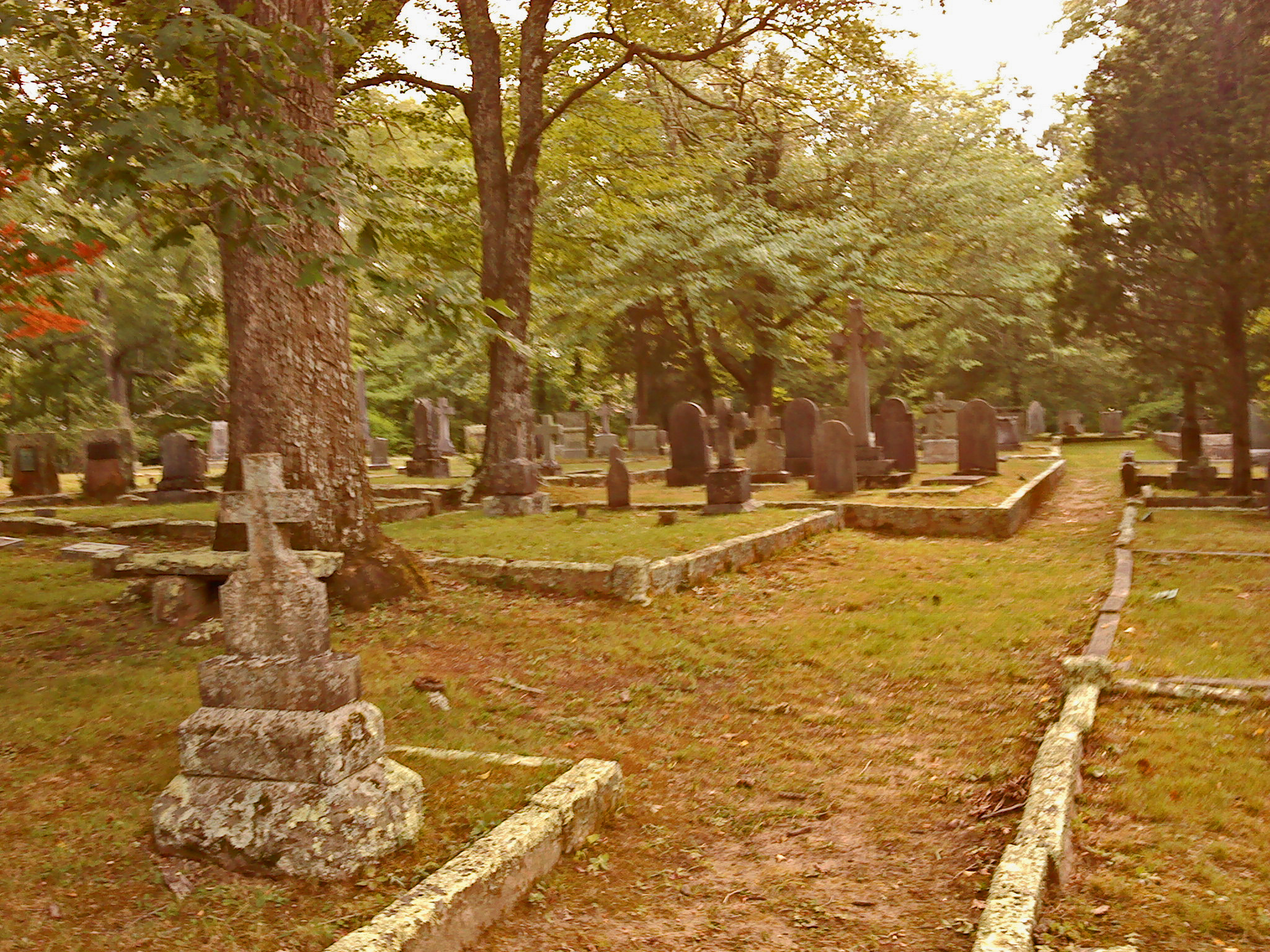
The first thing I should tell you is that I was living on campus, and this campus just happens to be a beautiful rural campus right at the edge of Appalachia.  My access to folklore primary sources was much abetted, and my opportunities to get out in the woods increased a good bit.  Secondly, my dorm was immediately across from a beautiful old cemetery.  As you can probably guess, I spent a good bit of my time there.  Here are some photos of the amazing graves and other funerary décor found in the old boneyard.The graves here date back to around the mid-nineteenth century, so they aren’t incredibly old, but many of them are gorgeous.  And they are certainly older than lots of other cemeteries in the area.
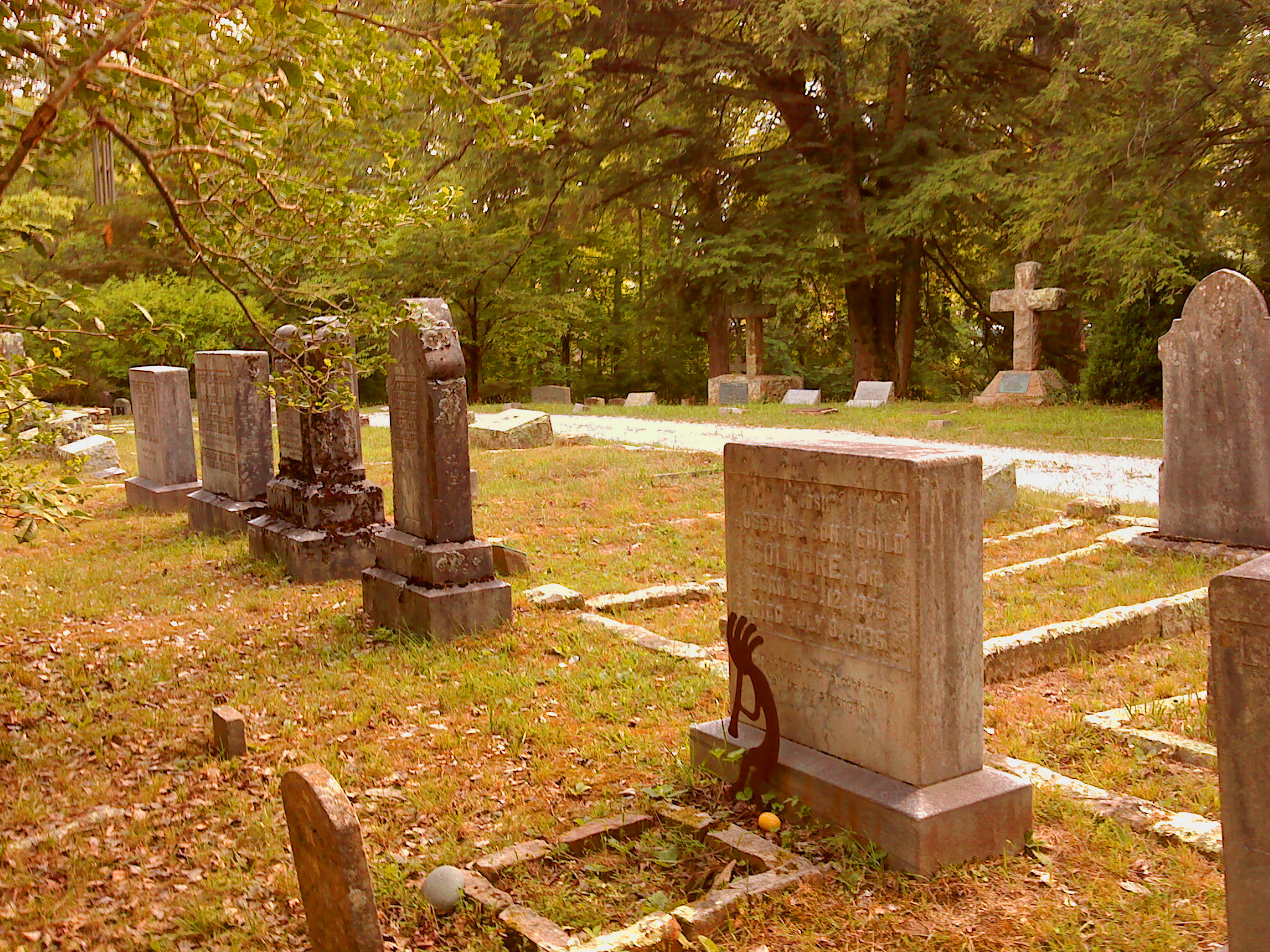
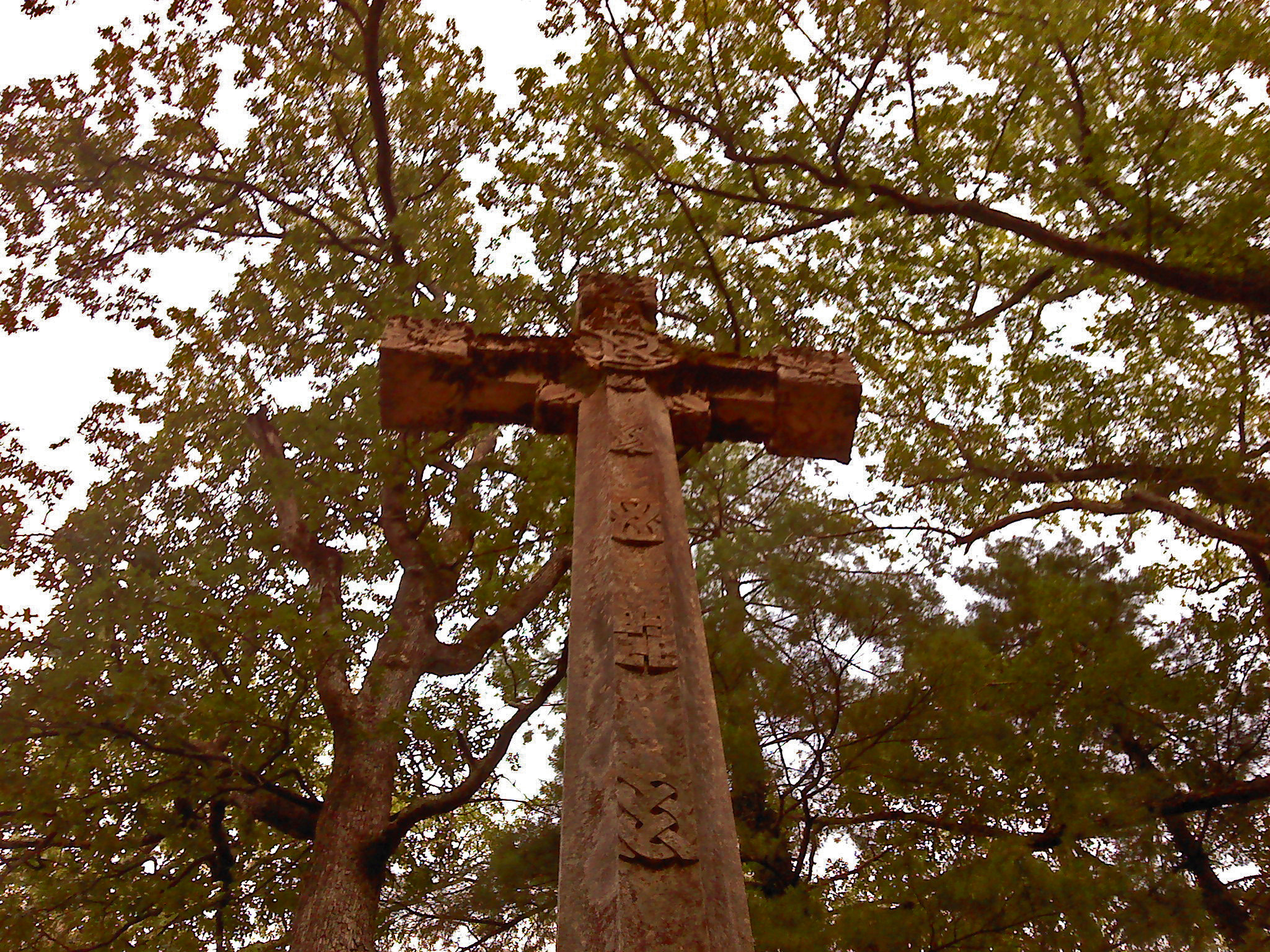
This also happens to be a religious school, so there are plenty of beautiful crosses here, too.  Since it’s as close to Appalachia as it is, the cemetery has a strong Celtic influence in the stonework.
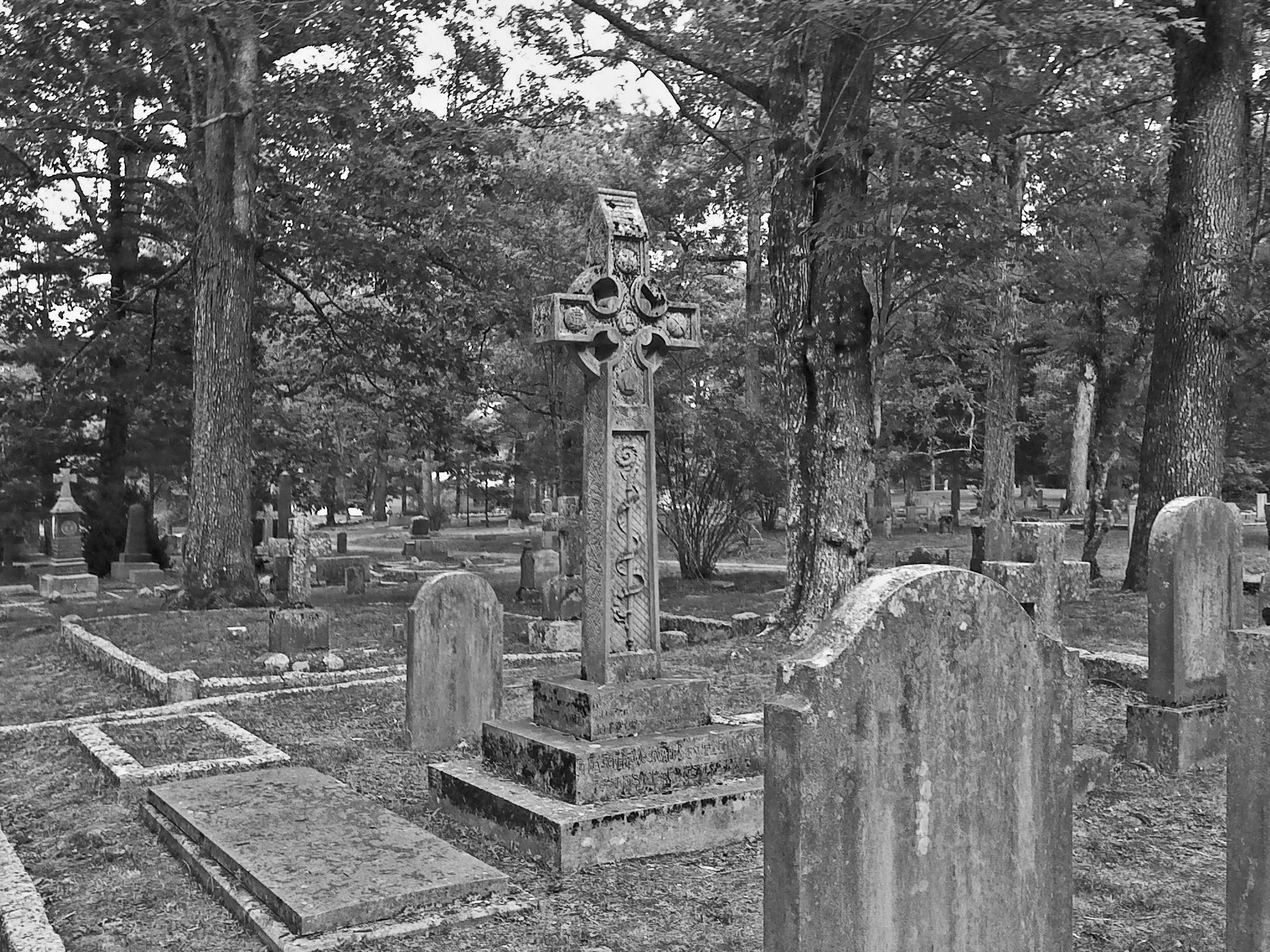
The time I spent here mostly involved taking late night (or often midnight) walking tours of the area.  Among all those graves and under a very starry sky, it was pretty amazing.  If you’re wondering whether or not I encountered “anyone,” though, I have to say the answer is no.  I did bring offerings of food and whiskey several times, leaving them near the small side gate rather than any specific grave (since I wasn’t trying to contact anyone in particular, that made sense to me).  Wildlife abounds near this cemetery, so I often heard things wandering out in the dark just beyond the light’s cast.  I even occasionally met other folks taking late night constitutionals among the headstones.
Since I wanted to do well in my schoolwork, I also made up a potent little mojo bag, which I carried in my pocket.  I anointed it daily with either Crown of Success oil or some local whiskey, depending on what seemed appropriate for the day.  As far as I can tell, it worked magnificently (though I’m still waiting to get final grades back…mojo don’t fail me now!).  I may outline just how I made this specific mojo bag later this week in case there are other students looking for a little “oomf” in their studies.

Of course, a huge portion of my time was dedicated to reading completely non-magical texts (Paradise Lost, vast quantities of Shakespeare, a number of Restoration-era authors like Swift, Pope, and Dryden, etc.), but I also had time to work my way through a few magically inclined books as well.  I’ll be posting some reviews of those as time permits this coming week, so stay tuned for those.

The beautiful natural surroundings of the school also afforded ample opportunities to get outdoors.  Though the heat was stifling some days, trees always provided comforting shade and occasional mountain breezes helped cool me off, too.  So many of the plants that grow in that area have magical connections:  elder, sumac, sweet gum, passionflower, poke berries, and blackberries all grow wild.  I did some harvesting, particularly a good bunch of sassafras, so I’ll try to get some info up on that at some point, too.

Last, but certainly not least, I also had long drives to and from school on the weekends, so I filled up my iPod with lots of witchy podcasts and caught up on some of my favorites.  I also got to hear some new ones (at least new to me) that were excellent.  If you haven’t checked out Pagan Hooligans yet, it’s a great show and the hosts are a lot of fun.  They’re recording their adventures in paganism from day one, and it’s really a refreshing perspective!  I’ve also started really listening to and enjoying Iron Powaqa Radio, which has a decidedly sassy side and always makes me smile.

So that was my summer in a nutshell, I suppose.  I’m going to be trying to get back in the swing of regular posts as soon as possible, and hopefully there will be another podcast up fairly soon, too.  Until then, thank you all for your patience and support!  Feel free to post, email, discuss, and generally share your own New World Witchery here, and we’ll look forward to hearing from you!  Thanks for reading!

All the best, and be well,

-Cory

Blog Post 70 – Elder

I’ve been noticing a lot of the elder trees blooming in my neck of the woods lately, so I thought I might take a stab at sharing some information on that particular plant.

Elder is a tree that has a long history with humanity.  Its uses are broad, including medicinal, culinary, and magical aspects.  Generally speaking, elder comprises anything in the genus Sambucus, with species names like nigra, canadensis, peruviana, etc. depending on region and appearance.  Elders can be very shrubby, or full-grown trees reaching up to 25 feet tall.  They have white flowers which bloom in the summer in bunches called corymbs (these are very prominent, so much so in fact that I felt compelled to write a blog post on them).  The blue-black berries, which appear in late summer and early fall, are a foodstuff used in everything from jams to vinegars.  The shoots of the elder have even been used as toys.  According to Botanical.com:

“The popular pop-gun of small boys in the country has often been made of Elder stems from which the pith has been removed, which moved Culpepper to declare: ‘It is needless to write any description of this (Elder), since every boy that plays with a pop-gun will not mistake another tree for the Elder.’ Pliny’s writings also testify that pop-guns and whistles are manufactures many centuries old!”

Medicinally, elders different parts have different uses (a quick note:  I am not a medical professional.  Please seek professional medical advice before using any plant medicinally).  The flowers have been used in tisanes to help alleviate all manner of ailments: sore throats, swollen tonsils, flu symptoms, etc.  The cooled elder tea could also be used topically on sunburns or to alleviate sore eyes.  The leaves of the elder can be used as a poultice or turned into an unguent to treat bruises, cuts, and abrasions.  The bark can be used as a potent purgative, though the inner bark is better for this than the outer.

As food, elder berries are most commonly consumed as elderberry jam.  They can also be turned into a syrup, and made into a delicious cordial for the adults in the crowd.  A sweet and slightly spicy wine can also be made from the berries, which seems to be very popular among the brew-it-yourself crowd.  I remember an old herbal book of mine which also contained a recipe for drinks like elderberry fizz and elderberry flip, which are essentially cocktails made from either the wine or the cordial.

Magically, elder has appeared in many cultures with many different purposes.  Some of the Old World magical associations with elder include:

  • Driving away evil spirits (Russian)
  • Magically removing fever (Czech)
  • Protection against witchcraft (English)
  • Good luck at weddings (Serbian)
  • Preventing theft (Sicilian)
  • Bad luck if burned (Romany)

The Danes believe that furniture made from elder wood is haunted by a spirit called Hylde-Moer (or “Elder Mother”), who may bear a connection to Mother Holle in Teutonic mythology.

On this side of the Atlantic, elder shows up in several systems.  John George Hohman’s Long Lost Friend recommends frying elder leaves with tobacco leaves in butter to make a healing salve.  In hoodoo, elder is used primarily for protection.  Hung in a bag near the entrance to the home, elder wood and flowers prevents intruders from coming in.  When mixed with the potent devil’s shoestring herb, it can prevent any unwanted guest from getting close to your home.  Catherine Yronwode’s Hoodoo Herb & Root Magic recommends elder as part of a Law-Keep-Away spell:

“Determine how many ways there are to enter the place where you conduct your business, and for each way, cut an elder stick five inches long, and get a small piece of John the Conqueror root.  On each elder stick carve five notches, one-half inch apart, then cut a sharpened point on each stick.  About fifty feet down each path leading to the place, drive a hole into the ground.  Put a piece of John the Conqueror root at the bottom of the hole, followed by an elder stick, pointed end down, with all the notches facing North.  It is said that no law officer will walk or drive over those elder pegs”  (HHRM p.90).

Yronwode also recommends drawing a circle around oneself with an elder branch and making a wish.  If you try this out, I’d love to hear your results!

There are probably dozens of other things I’m missing about elder, but hopefully this is a good start.  If you have uses of elder or experiences with the plant you’d like to share, please feel free to do so!

Thanks for reading,

-Cory

Blog Post 69 – Charmed Again


Today I’m going to add to Blog Post 67’s charm list and look at a few other simple, word-based spells.  Most of these are rooted in Pow-wow practices, but they are also found throughout other systems as well.  A caveat before I begin, however:  do not take these charms in place of medical advice.  They have their uses and are worth learning, but I am not a medical professional and you should not construe these bits of folk life as prescribed physiological recommendations.  If you get burned or are bleeding badly, seek professional help.

Okay, now on to the charms!

Dealing with Enemies

Overcoming an Enemy (Pow-wow)
This charm to gain advantage over someone who is trying to bully you comes from Hohman’s text, and again I have had little occasion to use it but I rather like the poetry of it:

A CHARM TO GAIN ADVANTAGE OF A MAN OF SUPERIOR STRENGTH.
I [name] breathe upon thee. Three drops of blood I take from thee: the first out of thy heart, the other out of thy liver, and the third out of thy vital powers; and in this I deprive thee of thy strength and manliness.

This particular spell veers very close to a curse, though it also falls into a “self-defense” category, I think.  You don’t, of course, get the three drops of blood from them, though I imagine if you could it would make this spell something much more powerful and possibly much more dangerous.

Healing Charms

Blood-stopping Verse (Pow-wow, Granny Magic, Mountain Magic)
This may be one of the best known mountain charms.  When spoken, this little spell stops a bleeding wound (a non-critical one that is…serious wounds require medical attention!).  There are a few variations on it, and the rules change a bit from person to person, but the words are pretty much the same:

“And when I passed by thee, and saw thee polluted in thine own blood, I said unto thee when thou wast in thy blood, Live; yea, I said unto thee when thou wast in thy blood, Live.”

Those of you who are Bible-savvy probably know this already, but this is simply a passage from Ezekiel 16:6.  It is similar, though not the same as, Psalmic magic (see below).  This charm is mentioned in The Red Church by Chris Bilardi, and has also been featured on Dave Tabler’s excellent Appalachian History blog.  The passage of this charm is typically supposed to be from male-to-female, though it seems there are ways around this restriction (such as “telling” the charm to an inanimate object while someone else in the room is listening).  As to effectiveness, all I can say is that I’ve used it three times and all three times it has worked.

Another Blood-stopping Charm (Pow-wow)
Here’s a different blood-stopping verse from Hohman’s Long Lost Friend:

TO STOP BLEEDING.
I walk through a green forest;
There I find three wells, cool and cold;
The first is called courage, p. 34
The second is called good,
And the third is called stop the blood.

Hohman actually lists about half-a-dozen blood-stopping charms, so I highly recommend looking into his book for more information on the topic.

Stopping Burns (Pow-wow, Mountain Magic)
Here are two charms used to help heal burns and alleviate the pain associated with them (both from Hohman):

HOW TO CURE A BURN.
Three holy men went out walking,
They did bless the heat and the burning;
They blessed that it might not increase;
They blessed that it might quickly cease!

+ + +

(The “+++” means that you make the sign of the cross with your hand over the burn three times)

ANOTHER REMEDY FOR BURNS.
Clear out, brand, but never in; be thou cold or hot, thou must cease to burn. May God guard thy blood and thy flesh, thy marrow and thy bones, and every artery, great or small. They all shall be guarded and protected in the name of God against inflammation and mortification, in the name of God the Father, the Son, and the Holy Ghost. Amen.

I’ve used the first of these charms a couple of times, and noticed a temporary effect.  The pain may not go away entirely but it’s a lot less and the burns didn’t scar, so that might be a good sign.  Or a placebo effect of some kind.  But I leave it up to you to figure it out for yourself.

Psalms (Curanderismo, Pow-wow, Hoodoo, Mountain Magic, most American folk magic systems)

Finally, I thought I’d list a few Psalm fragments which can be written and carried or spoken aloud in times of need.   I personally LOVE Psalmic magic.  You can feel free to use the whole Psalm or just the pertinent portions depending on your spell, but I highly recommend this method of magic.  The Bible, I seem to find more and more, is just loaded with magic, if you know where to look.  And almost no one questions you if you happen to say or write a Bible verse.  Of course, if you have problems with Judeo-Christian religion, this might not be the course for you.  You can find a great list of Psalms and their uses in the Appendix to Chris Bilardi’s The Red Church, the Curious Curandera’s Library Page, and the Lucky Mojo site has a good list, too.

Here’s a sample of Psalms as charms:
Headaches Psalm 3 – “Thou, O LORD, art a shield for me; my glory, and the lifter up of mine head”
Protection & PeacePsalm 22 – “be not thou far from me, O LORD: O my strength, haste thee to help me” (This is the Psalm Jesus sang upon the cross)
Against EnemiesPsalm 35 – “Contend, O GOD, with those that contend with me”
Success & Good FortunePsalm 65 – “Thou crownest the year with thy goodness; and thy paths drop fatness”
Safe TravelsPsalm 121 – “I will lift up mine eyes unto the hills, from whence cometh my help”

The topic of Psalm magic could be a post in itself, or a book even.  Several books, actually.  In fact, there are plenty of wonderful books on this subject, and I recommend tracking them down if you can.

That’s it for today’s charmed life.   If you have any charms to share, please feel free to do so!

Thanks for reading!

-Cory

Blog Post 68 – Be Our Guest?

So running with an idea (and a title lovingly borrowed) from Juniper over at Walking the Hedge and Standing Stone and Garden Gate, I’m putting out a call for submissions to our wonderful readers.  I know we probably have at least a couple of writers out there as well, and we’d love to have you do a guest post for New World Witchery.

We’re going to have about 6-8 weeks of low posting from me, and we’d like to be able to post at least 3 articles per week if possible.  So that means we need 18-24 well-written, proofread, researched, reasoned, resonant, and remarkable entries.  Something tells me we’ve got a few folks who might just be up to the task, so if you’re interested, here’s the submissions guide:

1)      Each article should be no less than 300 words, and no more than 2000.  500-800 words is usually ideal length, but there is some flexibility.
2)      MS Word (.doc) attachments are ideal, with inline email text being a secondary preference.
3)      Please include all links with your submission.  I may have to tweak them slightly to get them on the site, but I definitely can’t chase down links for you.  Footnotes or endnotes should be similarly included.
4)      Any artwork must be in the public domain (try Wikimedia Commons to start) or your own original picture/art with authorization to use it on the site.
5)      All work must be your own.  Citations are fine, along with short passages of material presented in a scholarly fashion, but please, no plagiarism.
6)      Please proofread your work.  Excessive typos and grammar snafus will not be corrected or posted.
7)      You retain all publication rights to your material other than the first-time online publication rights.  In other words, you’re free to submit this on a site like Witchvox or to a print publication, as long as you say that it was first published on this site.  (I’ll also assume the right to reprint passages or references to your work in future publications, but I will not publish your article in its entirety without your permission).

Of course, I’m always happy to get nice, scholarly articles on the topics of hoodoo, pow-wow, curanderismo, witchcraft, etc.  But what I’d really like is to get articles on the following topics, specifically:

  • Personal or family magical lore (such as magical practices, divinations, weather signs, etc.).  Please include your family background (such as region or ethnic heritage), too, so we know where these things come from.
  • Regional magical lore, including things like witch stories, magical places, spells, famous witches, etc.  Of course, please let us know which region you’re writing about (you don’t have to be too specific—“Appalachia” or “New England” would be sufficient).
  • Spell-work hits and misses.  Tell us about spells you’ve done, ingredients you’ve used, charms you’ve said and what your results were.
  • Botanical or animal curios and your personal experiences with them.  Are there ones you favor?  Ones you shy away from?
  • Favorite spells and practices.  Do you particularly like working with the dead?  Do you have a favorite way to communicate with the Ancestors?  Are you a sharp-shooter when it comes to love mojos?  Tell us what you do and how you got so dang good at it!
  • Magical book reviews are also welcome, especially ones dealing with North American folk magic and witchcraft (not Wicca—there are lots of reviews on Wiccan books, so we don’t really want those here).  History, folklore, and regionally specific spellbooks (like conjure or brujeria books) are all excellent candidates for review.

Other topics are welcome; just email and ask about them first.  Not every article may get published on the site, so if we don’t select yours or if we suggest some revisions first, please don’t take it personally.

“Geez!” you say.  “That’s an awful lot of work for not getting paid!”  Ah, but there’s the twist in the plot!  While we’re still a relatively poor blog and podcast, we’re gearing up for another contest.  Anyone who writes a guest article that we post on New World Witchery will be entered for that contest.   We’ve still got to work out just what we’re going to give out, but right now we’re looking at having three winners drawn at random.  If you submit multiple posts and we publish them, you get an entry for every article we put up!  Each winner will get a different, unique prize, so this could shape up to be a very interesting contest.

So, yes, technically you’re still not getting paid exactly, but you may wind up with something cool in the end.  And you’ll be adding to the wealth of knowledge found here, so you are benefitting a whole wide world of witchy folk.  Isn’t that a nice feeling?

So, if you’re interested in being a part of New World Witchery, email us your articles and maybe win a prize in the process!  In case you can’t get the email from that link, it’s compassandkey@gmail.com.

Many thanks, and we look forward to hearing from you!

-Cory

Blog Post 67 – Charms

Whew!  Sorry about that, folks.  Last week was a heckuva beast so I didn’t wind up getting to post all that much.  Or at all, other than the podcast.  I’m hoping that I’ll have more this week, especially considering that after this week, posts will be rather infrequent for the next two months due to grad school.  Anyhow, enough about me; on to the topic!

Today I thought I’d talk a little about charms.  The problem with talking about charms, though, is that it’s hard to define just what a “charm” is.  For some, they’re spoken words used along with other spell components to get results.  Others may take the view that charms are talismans or magical objects, usually fairly small, which are carried like a portable personal spell.  Some think of them as written spells, others mainly include love spells in this category, and some simply think of “charm” as another word for spells.

For my own purposes, though, I’m going to define “charm” thusly:  A spell composed of words, spoken or written.  There, now that’s settled.  So now we have the question, what’s so special about charms?  Well, for one thing, they’re usually simple.  Simple enough, in fact, that ordinary folk who might not otherwise engage in magical practice often work a charm without giving it a second thought.  There are lots of these kinds of little workings to be found throughout the various New World magical systems, but here are a few of my favorites:

Finding Lost Objects

St. Anthony Prayer (Catholic, Strega, Saint-based Hoodoo, Curanderismo)
This prayer is used when an item (or sometimes person) is lost and you need to find it in a hurry. The first version is slightly formal (though not nearly so formal as the prayer on his prayer card).  From the Lucky Mojo site:
St. Anthony, St. Anthony
Please come down
Something is lost
And can’t be found

My own family used a variant of this which was much more informal:
Tony, Tony,
Look around,
Help me find
What can’t be found
I always repeat the prayer at least once out loud and then under my breath as I search for the missing item.  I’d say I have about a 75-80% success rate with this one.  I do know that traditionally if you find your missing item, you should give to the poor in St. Anthony’s name (a practice called “St. Anthony’s Bread”).  This can be as simple as writing “Thank you St. Anthony!” on the edge of a dollar bill and giving it to a homeless person (or leaving it in a poorbox collection of some kind).

Halting a Thief

Three Lilies Charm  ( Pow-wow)
This one comes from John George Hohman’s Long Lost Friend.  I’ve had no reason to use it yet, thankfully, but I like the poetry of this one (or at least, I think it sounds very poetic).  The portions where you see the “+++” symbols indicate making the sign of the cross in the air with your hand as part of the charm:

A GOOD CHARM AGAINST THIEVES.
There are three lilies standing upon the grave of the Lord our God; the first one is the courage of God, the other is the blood of God, and the third one is the will of God. Stand still, thief! No more than Jesus Christ stepped down from the cross, no more shalt thou move from this spot; this I command thee by the four evangelists and elements of heaven, there in the river, or in the shot, or in the judgment, or in the sight. Thus I conjure you by the last judgment to stand still and not to move, until I see all the stars in heaven and the sun rises again. Thus I stop by running and jumping and command it in the name of + + +. Amen.

This must be repeated three times.

Protection

INRI Cross (Pow-wow, Hoodoo, Mountain Magic, most folk magical systems)
This one can again be found in Hohman’s book, as well as many other magical texts.  It’s a written charm, primarily used against harmful magic directed against you, as well as fire.  There are plenty of ways to use this charm, from marking it in a magical oil or water on your door to putting it on a small piece of paper and hiding it in the lintel of your doorframe.  It can also be carried with you for magical protection.  This is the version from Hohman:

A CHARM TO BE CARRIED ABOUT THE PERSON
Carry these words about you, and nothing can hit you: Ananiah, Azariah, and Missel, blessed be the Lord, for he has redeemed us from hell, and has saved us from death, and he has redeemed us out of the fiery furnace and has preserved us even in the midst of the fire; in the same manner may it please him the Lord that there be no fire.

I

N         I          R

I

The simple form of this is to just draw out that last bit, rather than worrying about the prayer before it, but the prayer can also be a powerful addition to the charm.

SATOR Square (Pow-wow, Hoodoo, Mountain Magic, Curanderismo, most folk magical systems)
Another powerful and widely found magical charm, the SATOR square is written out and used much like the INRI cross:
SATOR
AREPO
TENET
OPERA
ROTAS
These words are written out (try to make them as “square” as you can) and again posted or carried to protect you from harm, theft, fire, and any number of other ills.

St. Michael the Archangel (Catholic, Strega, Saint-based Hoodoo, Curanderismo)
This is a common prayer among Catholics facing spiritual struggles, and it’s made its way into magical practice, too.  In the film The Gangs of New York, a priest (played by Liam Neeson) recites this prayer before leading his band of Irish immigrants into battle with another gang.  It’s particularly effective if done in conjunction with the St. Michael medal or candle, but I think you can use it on its own as well.  The main target of this protective charm is evil—if you feel beleaguered by any harmful person or force (and you don’t have a problem invoking this particular spirit), this is a very potent way to deflect that trouble:

Great Archangel Michael Archangel, defend us in battle,
be our defense against the wickedness and snares of the
devil.

May God rebuke our enemies, we humbly pray; and
do thou, O Prince of the heavenly host, by the power of
God, thrust into Hell the Adversary and all other evil
spirits who prowl about the world for the ruin of
souls.  Amen.
I like to use all of these protective charms, though the SATOR square is my favorite.  I generally renew these charms once per year in conjunction with a few other key rituals (and a particular holiday, which I’ll get to eventually).

Well, I’m not quite through with charms yet, but there is plenty here to digest, so I’ll save the rest of them for another day.  Thank you all for being patient, and for being such a wonderful readership!  I’ll be trying to catch up with blog responses and emails over the next day or two, so don’t hesitate to keep up the fantastic comments!

Thanks for reading!

-Cory

Blog Post 66 – The Moon

In a lot of modern Pagan religions, such as Wicca and Druidism, there is a certain amount of emphasis placed on the moon.  Phases of our celestial companion become symbolic stand-ins for various god and goddess figures, or particular aspects of those figures (as in the famous Maiden/Mother/Crone cycle).  With the full moon upon us, I thought I might take a little look at just how American witchcraft interacts with that lovely sphere.

There is a great deal of lunar lore found in Native American legends.  In one tale from the Kalispel Tribe of Idaho, the moon is equated with the famous trickster/father figure, Coyote:

“Once there was no Moon for someone had stolen it. The people asked “Who will be the Moon?” The Yellow Fox agreed to give it a try but he was so bright it made the Earth hot at night. Then the people asked Coyote to try and he agreed. The Coyote was a good moon, not to bright – not to dim. But from his vantage point in the sky the Coyote could see what everyone was doing. Whenever he saw someone doing something dishonest he would shout “HEY! That person is stealing meat from the drying racks!” or “HEY! That person is cheating at the moccasin game!” Finally, the people who wished to do things in secret got together and said “Coyote is too noisy. Let’s take him out of the sky.” So someone else became the moon. Coyote can no longer see what everyone else is doing but he still tries to snoop into everyone else’s business” (WWU Planetarium American Indian Starlore page).

The Cherokee thought of the Moon as brother to the Sun (an instance of the moon being seen as male, which appears in several cultures).

The image of the Man in the Moon is frequently found in American folklore.  Many of these traditions hail from European lore, including poems found in Mother Goose:

THE MAN IN THE MOON
The Man in the Moon came tumbling down,
And asked the way to Norwich;
He went by the south, and burnt his mouth
With eating cold pease porridge.
(from The Real Mother Goose)

In other cultures, the moon contains figures less familiar to most Americans.  The Old Farmer’s Almanac includes examples of the moon seen as a woman with child, a toad, a giant, a rabbit, and a boy and a girl carrying a bucket (as in “Jack and Jill”).

There are also particular moons associated with particular months.  A good list of them can be found at the Farmer’s Almanac site, here.  Many are linked with agricultural cycles (such as Green Corn Planting Moon or Harvest Moon), and some are clearly linked to hunting (like the Buck Moon).

There is a plethora of magical lore associated with the moon.  My earlier posts on planting by lunar signs and weather lore both have lunar connections within them.  Likewise, the witch initiations post mentions the practice of shooting at the moon to become a witch.  Edain McCoy, in her book In a Graveyard at Midnight, also has a fun bit of moon magic:

“To remove a curse from your home, you can try shooting your shotgun out an open window at the full moon, while shouting a curse at the Devil.  However, don’t try this if you live in a city or populated area, or you will likely find the police at your door” (McCoy, p. 107)

There are also beliefs about marriage and courtship dates associated with lunar phenomena – waxing-to-full moons are best for “tomcattin’” according to Vance Randolph’s Ozark Magic & Folklore.

Of course, witches can find lots to do under a full moon.  Personally I find it to be an ideal time for:

  • Storytelling gatherings (especially around a campfire)
  • Divination and fortune-telling
  • Working with Otherworld entities like spirits, ghosts, fairies, etc.
  • Possession-based magic and shapeshifting
  • Love and beauty magic
  • Crafting magical tools and supplies

These are only my thoughts on the subject, of course, and there are plenty of great sources on lunar folklore out there.  And, of course, your mileage may vary when it comes to making the most of a full moon.  I’d love to hear what you all do with regards to lunar-linked magic.  Please feel free to share your methods, practices, ideas, and thoughts with us here!

Until next time, thanks for reading!

-Cory

Blog Post 65 – Thanks for Voting!

This is just a quick thank you to all of the folks who voted in our first polls.  We had a very substantial response to the questions I asked about improving the blog and podcast, and some heartening feedback on the question of a New World Witchery book, as well.

It looks like, on the whole, there are a lot of readers who want more practical and hands-on segments in both the blog and podcast.  For example, the question about what would improve the blog was answered “More Practice and Technique” more than any other choice, by a margin of 11 votes (out of a total of 121 votes).  Likewise, in the podcast question, 48% of respondents said they wanted more Podcast Specials or Practical Segments like Spelled Out or WitchCraft.

While I can’t guarantee that the blog will undergo drastic changes and feature a vast majority of practical elements, I will say that going forward I think I will attempt to include more hands-on and how-to information for you all.  It will be my goal to put up one practical segment per week at a minimum, eventually, and quite possibly more than that.  The podcast will likely continue to follow a similar format (other than the desire for more practical segments, most other answers were pretty evenly split across the board), but we may try to increase the length of the practical segments a bit.  And since the specials are so popular, we may try to make those a bit more frequent, too.

Finally, with the hugely positive feedback I got on the idea of a New World Witchery book (nearly two-thirds of respondents said “yes” to it, and the other third was “maybe” with only one “no” in the mix), I’m happy to say that I’ll be working on that project soon.  I’ve been asked to contribute to another author’s work on folk magic first, but I think that there may be room in the occult market for a New World Witchery book, too.

So thank you again to all who responded!  It was great to get that feedback, and I’m really looking forward to some of the directions this blog and podcast will be taking soon.  Please feel free, as always, to comment or email us with your suggestions, questions, ideas, rants, raves, and stories!  We do love hearing from you!

All the best, and thanks for reading!

-Cory

Blog Post 64 – City Spirits

Today’s post is going to be a little different.  I’m not going to cite any outside sources (at least, I don’t think I will…I may not be able to fight the urge).  Instead, I’m going to present some thoughts I have had which were spurred on by discussions about modernization last week, and in particular a comment from Crystal on Podcast 10.  She mentioned that as a city witch, she often feels the pull to get back to nature, which got me thinking:  can cities, buildings, and skylines be a part of nature, too?

Now, I know this isn’t an original thought, and that there are deeper philosophical questions here about whether people are a part of nature and therefore whether their creations are also a part of nature, but that’s not really what I’m getting at.  When I talk about “nature” above, I really mean the whole of nature, encompassing the spiritual dimension as well.  I’m thinking more in terms of whether the Otherworld might well have city elements in it.

Do buildings have specific spirits?  Like spirits of the land do?  Can you tap into a building’s spirit and use it in magic?  These are the questions that are swirling about in my head.  For example, there are definite precedents in hoodoo for using things like dirt from a courthouse or a bank or a hospital, because it’s assumed that the land upon which those structures reside will have absorbed a particular type of energetic influence which the root worker can then use for his or her own ends.  Is using that energy akin to using a little bit of the spirit of those places, or is the conjurer simply using accumulated human energy?

Even more to the point, are there places in cities that echo the kind of spiritual resonance found in locations like the Rollright Stones or Stonehenge?  After all, those structures were, at least to some extent, man-made (though I won’t begin to deny that they may be sitting on top of very particularly powerful places that have nothing to do with people).  But why can’t the Empire State Building or Beacon Hill in Boston or the Ryman Auditorium in Nashville have their own resident spirit (or spirits)?  And moreover, why not use places like that to do magic—not just in terms of collecting dirt or knick-knacks for spells, but actually deploying spells there, or finding subtle ways to contact spirits and interact with them in those locations?

For me, train stations have always had this very powerful Otherworldly significance.  I imagine that after death, there’s this sort of “waiting” place which always seems like a train platform to me.  Trains come and go, taking each person off to different post-mortem existences, or sometimes allowing them to just ride and enjoy the scenery for a bit.  There are food cars, drinks, other passengers to play cards with if being dead gets boring…er, at least, that’s how I envision it.  But lately I’m thinking that going to a train station is a lot like going to the Crossroads in traditional hoodoo practice.  I think I may try out a few things at our city train station and see how it goes.  If I do, I’ll be sure to post on that and let y’all know about it.

This is, of course, not an extensive discussion of this idea.  And there are probably lots of better sources for reading and thinking about urban magical practice than our little blog.  In fact, Velma Nightshade over at Witches Brewhaha recently did an episode discussing city witchery that’s well worth checking out (I couldn’t resist the opportunity to link to something).  But I just had to let some of these thoughts out, as they were making a lot of noise in my head and the gerbil that lives there was getting upset.

What about your thoughts and opinions?  Any strong inclinations on city magic?  Does it depend upon specific places?  Is there some way to turn a city landscape of concrete and steel into the same kind of magical place an ancient grove might be?   Do you practice this kind of city magic yourself?  Inquiring minds want to know!

Thanks for reading!

-Cory

PS – I will be closing the current polls at 5pm today, so if you still haven’t voted, please do!  See the top right of the sidebar to vote.

Blog Post 63 – Black Pepper

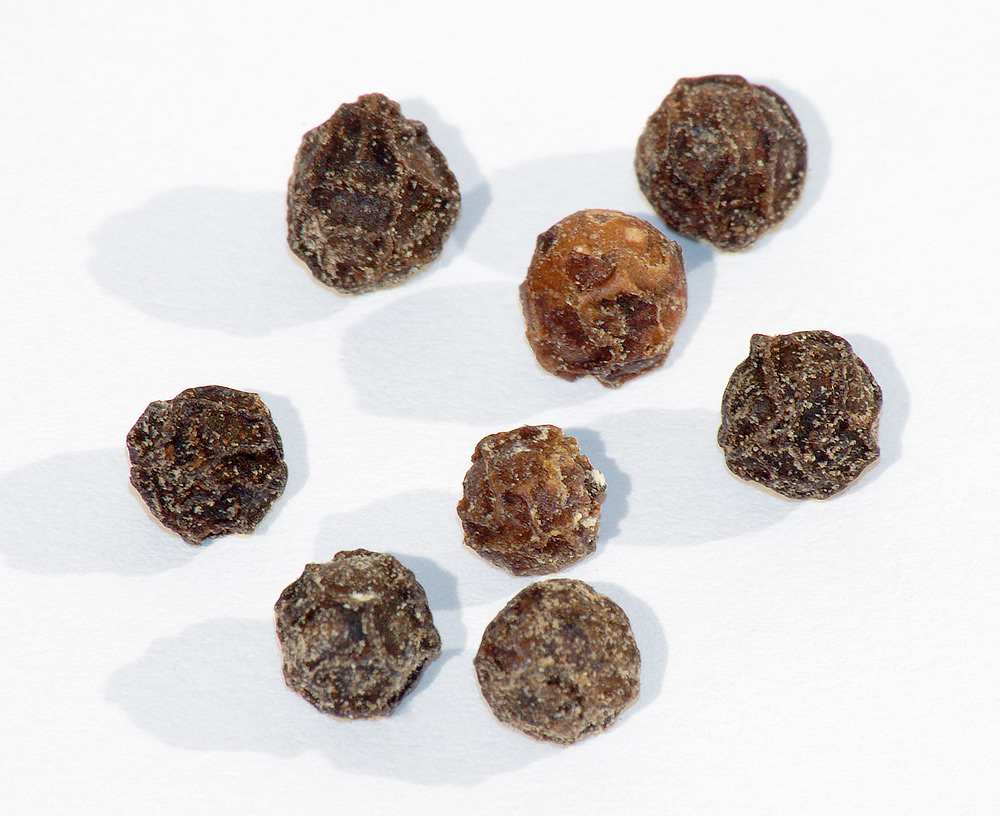
Today I thought I’d take a brief look at a magical ingredient which most everyone has on hand:  Black Pepper.  There are many uses for this dried fruit of the Piper nigrum plant.  Of course it’s valued for its ability to enhance food with a bit of heat, but it also has medicinal properties, and is very common in hoodoo practice as well.

Botanical.com lists the black peppercorn’s medicinal properties as being a febrifuge (fever reducer) and a stimulant and carminative.  For those with enflamed throats or ailments of the uvula, the site recommends using an infusion of black peppercorns as a gargle, and also suggests using the herb for constipation and urinary troubles.

In Appalachian practice, Granny women would sometimes use an infusion of black pepper to help induce labor in an expectant mother, because of its stimulatory nature.  They might also have the mother “snuff” or “quill” black pepper for the same results:

“Snuffing entailed having the mother sniff black pepper…from a plate placed under her nose; quilling involved blowing the same substances directly into the mother’s nostrils or throat with a goose quill, reed, or rolled piece of paper.  Either way, the objective was to cause a violent sneezing attack that would induce labor” (Folk Medicine of Southern Appalachia p.130).

In hoodoo, the black peppercorn is used primarily to harm or protect.  It’s often added to things like Hot-Foot powders or crossing tricks to facilitate an uncomfortable “heat” in the target’s life.  Catherine Yronwode also notes that black pepper can be used to stave off a jinx, particularly one which has been stepped in:

“To shield yourself from anyone doing these things [poisoning you through the feet via powder or other foot-track magic]…sprinkle black pepper powder or a mixture of black pepper and Fear Not to Walk Over Evil Powder in your shoes.  It is said that your track will be invisible or invulnerable to harm, and even if someone does throw for you or lift your foot track, they won’t be able to affect you in any way” (HHRM, p.53).

She also mentions that black pepper can be mixed with salt and thrown after someone when they leave your home to prevent them from ever returning or doing you harm.  Since salt and pepper are rather easy to come by in most homes, doing a spell like this is simple, and because the ingredients are so common most people don’t think twice about seeing them on the ground.  In fact, a light sprinkling of these ingredients would probably go unnoticed even in a busy apartment complex, and would be easily vacuumed up later, which makes a spell like this good for the urban root worker or witch (in my opinion, of course).  I’d combine it with the practice of leaving a broom behind the door just to double up the protection from unwanted visitors, too.

There are several potent curses which can be levied using black pepper, too.  Catherine Yronwode’s Hoodoo Herb & Root Magic book has an excellent entry on these, so I’ll not rehash everything in her entry here.  I will say that the spell she mentions involving a black candle and 99 peppercorns taken to a crossroads sounds particularly nasty, and would be well worth learning, if only to have an idea how to undo it should someone do it to you.

That’s it for today!  I wish you all a wonderful weekend.  Please don’t forget to vote in our polls, too!  They’ll be open through the weekend, and you can find them in Blog Post 61 or at the top right of the sidebar.  Thanks for voting, and as always, thanks for reading!

-Cory

Blog Post 62 – More Ideas for Urban Witchcraft

Greetings everyone!

Following on yesterday’s topic of urban conjure and rootwork, I thought today it might be fun to take a look at some spells that have roots in traditional American folk magic, but which use certain modern adaptations to accommodate contemporary life.

Courtcase Spell
In the past, courthouses were often wooden-floored buildings outfitted with spittoons for the convenience of trial attendees with a chaw of tobacco in their mouths.  Hoodoo developed a fairly ingenious way to exert some influence over a case by taking advantage of the spitting habit so prevalent in that day and age.  A defendant would keep a gob of Little John to Chew (the root known as galangal now—readily available in Asian markets) in his or her cheek, and then spit the juice onto the courthouse floor while ostensibly aiming for a spittoon nearby.  This sort of contagious magic would then bring favor in the case from anyone who walked on or near the spit.

Nowadays, spitting in court is probably a good way to lose your case.  Most courthouses are kept fairly secure, and tobacco products are seldom allowed in any government building (not that Little John is a tobacco product, but it’s supposed to look like it is, so either way, it’s out).  But there’s still a fairly simple way to work a spell in your favor:

1)      Get some dirt or water from the courthouse area – This can be dirt from a flower bed, from near the back of the building, or even from a potted plant somewhere on the premises if you can manage it.  Or, if the courthouse has a fountain out front, you can collect water from that, or fill a drinking bottle with water from the drinking fountain in the courthouse (or from the bathroom, etc.).  Barring all of these options, you  can scrape the side of the building and try to gather even just a little bit of dust from it, then mix it with soil from the closest source you can find.

2)      Take some Little John to Chew (galangal root) and work up a good bit of spit.  Spit the juice into the dirt or water, while reciting a petition or prayer appropriate to your situation (such as Psalm 35, “Contend, O Lord, with those who contend with me…”).  If you have only a little bit of dirt, you can add the dirt to some water and make a sort of “tea” out of it and the spit.  If you have only a little bit of water, you can dilute it with some more water (add a little whiskey to it to give it a kick).

3)      Take the dirt or water and go back to the courthouse.  Sprinkle your mixture in a circle around the building, as close as you can get (if you have to walk a block, sprinkling a little as you go, that’s fine—just make sure the entire building is encircled).  Whenever the judge who tries your case crosses that line, he will be disposed to favor you.

This trick relies on the same contagious magic as the older trick.  Why not just chew and spit at the front steps to the courthouse, you ask?  Well, you can’t be sure that your judge will come up those steps, and you need him to come into contact with your trick.  Unless he or she lives somewhere in the courthouse, your judge will have to cross the ring you make around the area in order to get inside, and so you should be able to affect him or her that way.

Git-Gone! Spell
Hot Footing someone to get rid of them is an old hoodoo trick.  In the past, it was accomplished by either mixing dirt from someone’s footprint with a special mixture of potent spices called “Hot Foot Powder” (see here, here, and here to buy) or by sprinkling that powder where a target would walk over it.  While it’s still possible to work the latter trick in a modern setting without much trouble, getting someone’s footprint-dirt isn’t easy anymore.  Additionally, the older version of the trick requires deployment in running water or throwing it away on a road heading out of town.

To bring a trick like this into the modern age, however, is not difficult.  City dwellers who can’t pick up dirty foot-tracks can work around that requirement by laying hold of a sock or shoe (or any article of clothing from the target, really).  Once you have something of theirs, you simply mix the Hot Foot Powder and wrap it in their clothing (or in the case of a shoe, give the sole a good sprinkling).

Deploying the trick can be done a couple of ways.  The simplest is to return the clothing to the target and hope they wear it without noticing the powder first (this is best with shoes).  Often, in apartment buildings, this kind of work is fairly easy to do because people will leave wet shoes in the hallway to dry out (much to the chagrin of their neighbors on warm days).

If giving the item of clothing back seems like it would cause raised eyebrows, or just doesn’t strike you as the best method, there are a couple of other distinctly modern deployment techniques that might be worth considering.  Since deployment in running water is a traditional method, consider chucking the Hot Footed sock into a sewer (which contains running water, after all, along with all manner of nastiness to help convince your target the time to leave is now).  Or, instead of finding a road out of town, you could go down to a train yard or a bus station and toss the sock onto a boxcar or bus heading out of the city.  In a lot of ways, a bus station is like a modern-age crossroads with the constant traffic coming and going, so sending someone away via outbound bus is actually a pretty smart way to go about your work.  I’d also suggest the same is true of airports, but sneaking things onto planes is a BAD idea, especially right now.  You’d really be asking for more trouble than a trick like this is worth.  Stick with bus stations and trains.

Send Away Your Troubles
There’s a bit of American folk magic that involves a rather sneaky method for healing common ailments.  The person with the disease (usually something like boils, warts, or corns) creates a small packet and “passes” the disease to the materials in the packet.  Then he or she drops the bundle in a road.  Whoever finds and opens it then receives the disease, and the person who passed the disease is cured of it.  Vance Randolph describes the procedure in conjunction with warts:

“Another way to ‘pass’ a wart is to spit on it, rub a bit of paper in the spittle, fold the paper, and drop it in the road; the wart is supposed to pass to the first person who picks up the paper and unfolds it. Children are always trying this, and one can find these little folded papers in the road near most any rural schoolhouse” (OM&F, p.127).

In the modern age, very few folks are walking along our roads, and few of those are going to stop to pick up a strange packet.  Motorists zooming by at high speeds never see them and people walking through cities for the most part avoid picking up litter from the walkways.  So how can one adapt this sort of spell to work today?

The United States Postal Service processes over 500 million pieces of mail per day (according to their website).  So why not put that big, churning system to work for you?  Here’s what I suggest:

1)      Just like in the old version of the spell, take a piece of paper and rub it against the afflicted part of your body.  If you want, you can even write a short petition on the paper asking that it remove illness from you and carry it far away.

2)      When you feel like you’ve imbued the paper with the disease, put it in an envelope.  Address the envelope, either by selecting a real person to send it to (which I actually don’t recommend—it just seems like an awfully trite way to get vengeance on an enemy and it certainly doesn’t make you any friends) or by writing a “dead letter.”  A dead letter is addressed to someone fictional (like Santa Claus, Professor Moriarty, Xenu, etc.) or someone dead (this could be an ancestor or just a spirit you think might be willing to help you by taking your disease off of you and into the grave).

3)      Don’t use a return address, and post the letter from a public mailbox.  You might, for example, send your disease to:

Mephistopheles
First Circle
Hell, the Universe

This letter will then carry your disease away from you and into a sort of “limbo” space.

The only downside to this method is the same one that comes with the old method:  if someone ever does open up your letter, they may catch your illness.  But all magic comes with risk, so if it sounds like a useful spell to you, please feel free to use it.

That’s it for today.  I’d love to hear from other city witches and urban rootworkers if you have suggestions for tricks that might be traditional-yet-modern.  Feel free to comment or email us.

Thanks for reading!

-Cory