Blog Post 84 – Diamonds and Clubs (Cards, part III)

Okay, so today I’m going to look at individual cards and their significance in my readings.  I’ll basically tell you a few key words, then elaborate a bit on potential interpretations of these cards.  Most of my system comes out of years of practice using playing cards for divination, as well as for games.  I have found that in some cases, my personal work with a particular card has shown me a meaning different from the one I originally learned.  When it comes to these sorts of fortune-telling methods, practice makes perfect.

Now, onto the cards!  Let’s start with:

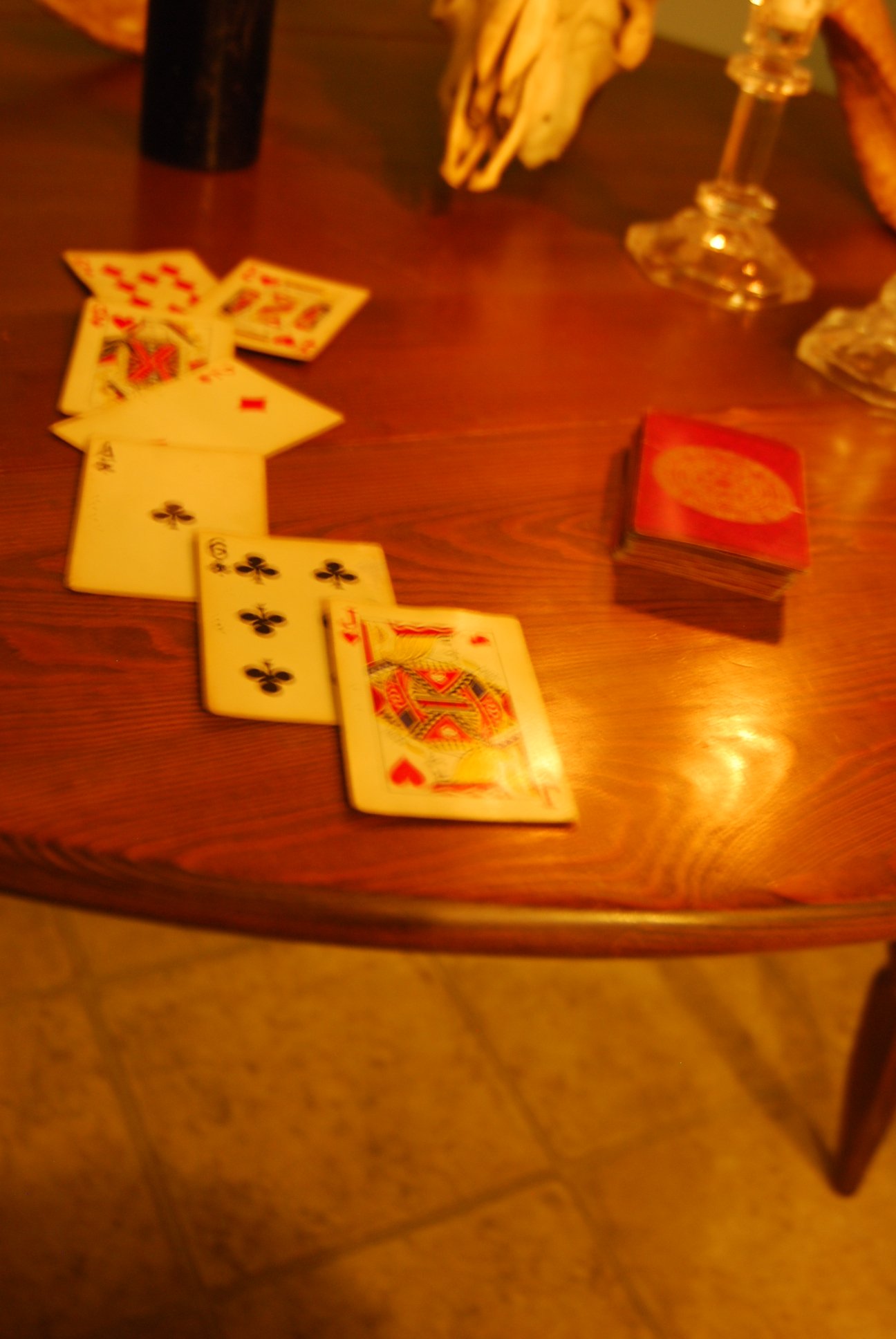
Diamonds

Remember that diamonds in general signify money, fortune, luck, and happiness.  They also can relate to messages or news, or social interaction.

Ace – A letter; A coin.  The Ace of Diamonds indicates some new money or new information entering the questioner’s life.  It can also have to do with a sudden shift in luck—if preceded and followed by spades, that could mean bad luck.  Additionally, due to the solitary nature of the pip, it could mean being very careful with your news, luck, or money—keeping it to yourself, as it were.

Two – Birds (as in “a little birdie told me”); Exchange of funds.  This card is about sharing, whether that’s news and gossip (like the birds), or sharing your luck or fortune with someone else.  It can indicate a partnership of some kind, but usually not a business one so much as a financial one.  For example, if it were paired with a card connected to a friend or lover, you might be moving in with that person soon (because you’ll be yoking yourself to them financially).

Three – Gifts; A fountain.  The Three of Diamonds shows generosity—sometimes even unwilling generosity.  Someone who draws this card likely “throws his/her money away,” just like one throws pennies in a fountain (if you’re singing “Three Coins in a Fountain” right now, I sympathize with you).  This may seem like a sign of irresponsibility, but it can also simply receiving a gift, or an expansion of fortunes which allows the person to be generous.

Four – The purse/money bag; No news.  With the Four of Diamonds, the reader will need to figure out if the reading is about money or information, as it changes the card’s meaning a bit.  If the question is financial, thefour indicates a stable monetary situation, but also one without any chance of growing—much like a closed purse neither receives nor spends money.  In the case of information, this card indicates a dull waiting period, possibly a prolonged one.  This can mean “no news is good news,” or that the client must wait on tenterhooks for a proper resolution to his/her situation.

Five – Good luck; Laughter.  This card shows the subject surrounded by friends, fortune, and happiness.  It’s not the all-encompassing joy found in other cards like the Ten of Diamonds but it’s generally positive nonetheless.  Depending on context, however, it can also mean something like “the last laugh,” and have slightly more sinister connotations.

Six – Streets of Gold; Good decisioins.  No, not the Yellow Brick Road, but the idea’s the same.  The client’s on the right path and merely needs to continue doing what he/she is doing and success will come.  Paired with a card like an Ace, this card may mean recent decisions have been good; paired with a King or a Queen the client is probably getting very good advice from someone.

Seven – Lies; Deceit and falsehood.  The Seven of Diamonds indicates that the questioner is being lied to by someone.  This lie may or may not have to do with money, but almost always has to do with happiness.  Perhaps the client is happy being lied to, and little white lies sustain him/her—this could certainly be the case if a Jack of Diamonds, Clubs, or Hearts were nearby.  More often, though, the lies indicate trouble to come.

Eight – Gossip; Idle chatter.  Much like the Two of Diamonds, this card means an exchange of information, although it usually is information of little value.  It can also indicate talking about money, getting good news about one’s fortunes or finances, or someone’s natural wit.  Paired with something like the Two of Spades, it might mean something like “loose lips sink ships,” and that one should hold one’s tongue for a while.

Nine – Daydreams; Peace and contentment.  Think of this card as a leisurely day spent in the sun with nothing particular to do.  It’s a card of relative idleness, but without any real negativity.  It’s a well-earned rest, a chance to plan for the future, and time to stop and smell the flowers.  Beware, though, if it’s paired with a four of any kind, as it may mean that all one’s plans are but pipe dreams, destined to disappear like clouds in an afternoon sky.  Or something like that.

Ten – A treasure chest; Sunlight; Joy.  With the Ten of Diamonds, the client can expect great happiness.  In the context of other good luck cards, this may mean an unexpected windfall or a sudden improvement in circumstances.  The Ten of Diamonds leaves little room for any sorrow or woe, and generally indicates the fulfillment of financial goals and personal derams.  Of course, as Willy Wonka said, “Do you know what happened to the boy who suddenly got everything he ever wanted?”  Oh, wait, he lived happily ever after…

Jack – Good news; A girl.  This card displays a young boy (or possibly a young girl, hence the card’s alternate meaning).  At one time these cards were known as Knaves instead of Jacks, and would have been similar to a knight’s squire.  In the context of a card reading, this Jack means that some good news is about to arrive. Or that a beautiful girl is about to arrive.  Which might also be good news, depending on  your point of view.

Queen – The good wife; A wedding; Sensuality.  This Queen is all about duty and splendor.  She could be a mother or wife in the questioner’s life who inspires joy and happiness, or provides sound financial advice.  More likely, though, she indicates someone who does what must be done or a woman with a deeply sexual side.  She can also mean a wedding (and thus a large expense and a large celebration), or in some cases a big party (for instance if she appeared alongside “friend” cards like the Queen or Jack of Clubs).

King – A bank; A civil trial; Wisdom with money.  The King of Diamonds means power through money or fortune.  Pulled with several spades, the client can expect to face some financial trials (literally in a courtroom or possibly only figuratively).  Alternately, pulled with clubs or diamonds, this card probably means that money is being invested wisely, or that there is a man in the questioner’s life who provides very good advice when it comes to luck and money.

Clubs

Clubs are work, destiny, plans and debate.  Remember that as you do your readings.

Ace – A cave; Solitary contemplation.  This card tells the reader that the subject should take some time to really evaluate his or her life.  Has he/she got goals?  Is he/she working to reach them, or should there be some reevaluation of priorities.  This is a lonely card, but not necessarily a bad one—often we need moments of intense personal reflection before we can move on to do the great things we are capable of.

Two – A handshake; Business partnership.  The Two of Clubs shows an agreement or arrangement made between two people, often for the sake of business or stability.  It can indicate a treaty or alliance of some kind, or a pairing up to overcome obstacles in the way.  Pulled with something like a Two of Spades, it may mean the impending end of a previous business partnership.

Three – A stone wall; Obstacles.  In most cases, threes indicate wishes or growth, so this card may seem odd.  However, the setbacks provided by a good obstacle also provide the impetus to overcome them oftentimes.  Usually this card means that whatever challenges the subject faces, whether they be business troubles or a lack of personal direction, he/she can and will overcome them.  Paired with something like a Three of Hearts or Diamonds, such progress is likely just around the bend.

Four – A horse and cart; A plowed field.  This card is about potential.  The Four of Clubs definitely means that for the moment nothing is happening, but that now is the time to prepare for inevitable change.  By “tilling” and “plowing” oneself or one’s business plans, the eventual outcome will be far better than one would get just sitting on one’s hands.  If this card  appears with a Nine of Clubs, that outcome is ripe and should show up very soon.

Five – A barn; A healthy body.  The Five of Clubs is encouraging.  It can represent either a full barn (which in turn stands for abundance and hard work paying off) or a strong, healthy body.  If this card were at the end of a reading full of cards which indicated illness (such as a Five or Nine of Spades), a recovery should be expected.  An inversion of that order might mean deteriorating health, however, so context is important.

Six – Footprints; A clear trail.  A person who gets this card in his/her reading probably has a definitive sense of purpose, or has recently begun some activity that he/she finds very fulfilling.  This can be a career, a hobby, or even a friendship of some kind.  If the appropriate King or Queen of Hearts comes after this card, it might be a sign that true love (“wuv…twue wuv”) is on the horizon.

Seven – Doubts/Worries.  The Seven of Clubs indicates that the client is very troubled by something.  So troubled, in fact, that it is likely hindering or debilitating the questioner in some way.  Paired with something like the Seven of Spades and/or the Ace of Clubs, he/she likely spends a lot of time alone and crying over something that he/she feels powerless to change.  The nice thing about this card (and there is a nice thing) is that for the most part, all the troubles are really in the asker’s head.  They can be overcome, but it may take a mental sea change to effect that change.

Eight – Shop talk; A table or bench.  When the work day finishes, it’s nice to crowd around a table with friends, family, and sometimes even co-workers for a drink or a meal.  Often the events of the day get rehashed, with details added or subtracted as conversation directs.  That’s what this card is all about.  It shows people getting together to share the tricks of their particular trades, make plans for times ahead, or even occasionally plumb the mysteries of the universe, depending on how much beer is at the table.

Nine – Reaping; A forest.  The Nine of Clubs shows things that have grown and how we deal with them as human beings.  In some cases, we reap what we’ve sown and prepare for hard times ahead, hoping that what we have will be enough.  Sometimes, we wander through the trees getting lost, hoping we’ll find our way back again.  A questioner finding this card may be having trouble making sense of his or her life, but there is still plenty of hope left.  Followed by something like a Ten of Hearts or Clubs, this card simply means that a dark night soon reveals a bright dawn.

Ten – A herd or flock; Clouds.  This card is abundance, completion, and satisfaction.  It is definitely all about rewards, comfort, and a job well done.  It completes the sense of accomplishment found in the Five of Clubs, and adds the element of restfulness.  The seeker’s found his or her calling, home life is happy and stable, and/or business is steady and fulfilling.  The clouds, heavy with rain on the horizion, are pouring down copiously.  This is the “pat on the back” or “Miller time” card.

Jack – A friend; A sibling.  The Jack of Clubs is a peer, whether that’s a co-worker, a good friend, or a sibling.  This is someone with whom the questioner has a mutual respect.  The Jack can also indicate business news of some kind (especially if an Ace or Two of Diamonds or an Eight of Clubs shows up), and may also indicate a young boy entering the client’s life.

Queen – A mother; A nurse; A wise woman.  This is a card indicating someone very smart, very strong, and very helpful.  The seeker probably knows exactly who this card represents when he/she sees it, and also probably knows exactly what kind of advice this person would give (think of this as a conscience card).  This card can also mean a mother hen, too, though likely only if connected to an argumentative card, like the Eight of Spades.  Conflict in the Clubs is productive, however, so even a mother hen has her place.  Finally, this card indicates nurturing.  Paired with something like an Ace of Clubs, it likely means taking the time to heal old emotional wounds before moving forward with something or someone new.

King – A father; A judge; A general.  The King of Clubs is someone with authority, someone who can give an order and get things done.  He may not always be nice about it, but he has his reasons for driving people so hard.  This person is someone wise, though perhaps also someone very stubborn and set in his ways.  For those who have issues with feeling judged all the time, this card could be troubling, but it may also mean that the questioner must face his or her fears and forge ahead.  This is a card about what must be done, and living up to expectations.

Wow, a long post today.  I hope someone out there finds this useful.  Let me know if you do!  Next post we’ll finish up the individual cards.  Until then…
Thanks for reading!

-Cory

Blog Post 83 – Pips and Faces (Cards, part II)

Today I’m continuing the card-reading discussion from the last post.  I’m going to tackle this on a card-by-card basis, but I thought it might be helpful to add a little bit on enumeration and face cards as a whole.  I really should have done this on yesterday’s post, but, well, I didn’t.  So it’s going to be in today’s instead.

There are lots of different systems of interpreting the card numbers and the royals.  Some are fairly simplistic (mine definitely are) and some get incredibly detailed, looking at astrological and numerological significance in kabbalistic and ceremonial magical contexts.  I’m not a particularly good ceremonialist, so I tend to use a fairly straightforward system focusing on key concepts associated with each number.  I can probably demonstrate better than I can explain, so here’s my numbering system.

Aces – Beginnings; Primary or Solitary things

Twos – Pairs; Couples; Exchange

Threes – Growth; Wishes

Fours – Decisions; Stagnation; Choices

Fives – Groups; Bodily things; Gains/Losses

Six – Paths

Sevens – Epitome cards*; Inversions; Trouble

Eights – Talking; Ideas

Nines – Patience; Ambition; Expansion

Tens – Completion; Endings

Jacks – Youth; Children; Messages; Peers

Queens – Women or a particular woman; Beauty; Mothers; Nurses; Teachers

Kings – Men or a particular man; Wisdom; Age; Power; Judges

*A note on “epitome” cards – the Sevens of each suit represent the most concentrated form of that suit.  Often, there’s a somewhat negative connotation to this intensity.  Yet, this does not necessarily mean all good or all bad.  For example, the seven of spades can mean “tears” as an epitome card, but if those tears are near lots of red cards, they are likely tears of joy.

The number combinations can also lead to a certain amount of interpretation.  For instance, if you had several threes and nines, that would guide you towards a reading about opportunities and very quick growth (because both cards are about growth/expansion).  A seven, five, and four might indicate bad choices and losses that come out of those choices.  A king with a six might mean a teacher or elder is going to help guide the questioner in a new direction.

Royal cards (or “face cards”) also have a certain potency that the numeric cards lack.  I sometimes include aces as a face card, but this really depends on the reading and the number of other face cards around it.  It’s sort of like spiritual blackjack—it can be the highest or lowest value depending on the other cards.  The other face cards usually represent particular people or major events in the subject’s life.  Getting a king and a queen of the same suit can often indicate “parents” or the parental guidance which shaped the questioner’s life.  You’ll see more about these as we explore them in depth later on, but for now just know that royals, aces, and sevens all mean “pay attention to this reading.”  There are some divinatory systems (such as the card-reading taught in curanderismo) which also remove the queens from the deck before reading.  This dates back to a European practice based on a specific deck, but don’t be surprised if you don’t see them in someone’s reading.  As a final word on royals, there are two special royals in my system of divination:  the king and queen of hearts.  Depending on the gender of the client, one of these cards will represent him or her (the king for a man, the queen for a woman).  We’ll look at how that works later on, though.

All of these interpretations are also deeply linked to the suits, of course, and to where they fall during the reading.

Okay, now with that out of the way, we’ll be moving on to individual cards in the next post.  Please let me know if you have any questions, though!

Thanks for reading!

-Cory

Blog Post 82 – Cards, an Overview

Hello readers!

Let me first say that I know it would be fairly impossible for me to explain a divination system thoroughly in one post. So this will likely be the first of several posts addressing the use of playing cards as a magical tool.  What I would like to do is explain my personal system of card divination, as well as some of the variants and influences which have shaped my practice.   I’m not going to dive into an extensive history of playing cards or tarot cards, as those subjects are well-covered and well-documented in other sources.  However, a little of the history that sometimes slips through the cracks (especially regarding playing cards) might be worth mentioning here.

While the absolute origin of pictographic cards is unknown, many folks believe they came out of India, China, or Turkey, or with the travelling Romany people (also frequently called “Gypsies”).  What is known is that by the 1500’s, playing cards were very popular with the lower classes, and often cited as a vice by clerical and governmental documents throughout Europe.  They received wide-spread appreciation from the highest ranks, including Bohemian emperor Rudolph II and Napoleon’s spiritual advisor, Madame Lenormand.  Yet cards have almost always been popular among the lower classes, too.  Cards came to America with settlers, sailors, and soldiers.  In fact, in the late 1700’s, a popular ballad called “The Soldier’s Prayer-Book” described the suits, pips, and enumeration of playing cards in terms of biblical metaphor.  For example, the fives represent the five wounds of Christ, the nines are the nine lepers healed by Jesus, and the tens are the Ten Commandments.  While this song may have been a white-wash for gambling soldiers eager to keep one of the few portable entertainments allowed them, it does register an important point:  cards make wonderful tools for metaphoric interpretation.

So why playing cards instead of tarot cards?  For one thing, playing cards have been more or less easily accessible since the 1600’s, and are versatile.  The cards you play a game of blackjack with one day can be used to reveal the future the next.  They also travel well in a pocket and are easily replaced if they get torn or damaged.  Plantation owners in the antebellum South often thought little of slaves having decks of playing cards to amuse themselves in their few off hours (though in some places stricter masters prohibited them altogether).  William Wells Brown, who provided a slave narrative for a character named “Uncle Frank,” claimed that each plantation also had at least one fortune-teller somewhere on the premises, and at least few of them used playing cards.  Today, playing cards are an excellent way of divining even in plain sight.  No one thinks much of two people over a table full of diamonds, spades, clubs, and hearts, while a Devil or Lovers card might raise eyebrows.

My own system of playing card divination is largely based on the book It’s All in the Cards, by Chita Lawrence and the rhyme “For the Witch of Poor Memory” by Dawn Jackson, with a significant amount of additional material I’ve picked up from other books, teachers, and experiences over time.  What I outline here will be my own understanding of these cards, so please do not take it as gospel, and find a method that works for you.

Like most who practice cartomancy, I break the major meanings of the cards down by color and suits.  However, unlike a lot of other practitioners, I don’t ascribe these suits to tarot parallels or elemental attributes.  There are some connections, of course, as hearts and cups both signal emotion-based interpretations, but it’s not a hard-and-fast link.

First, black cards indicate “negative” or “no” answers, while red cards are “positive” or “yes” answers.  This is most important in short readings, which I’ll address in a later post.  Some will say that having more black cards than red is a sign of negativity, but honestly, the only truly “negative” cards in an extended reading are the spades, in my opinion.  For me, I look at the suits in the following way:

Hearts – Family, friends, love, and lovers.  Also emotions and things which are deeply felt.
Clubs – Work and business.  One’s “calling” or destiny.  Also conflict, discussion, and debate.
Diamonds – Money, luck, fortune, happiness.  Also news, letters, and socializing.
Spades – Tears, suffering, woe.  War, fighting, violence.  Also change, warning, and doubts/fears.

I’ll get into each of these suits a little more when I break down the individual cards, but this should give you some idea what I see when I do a layout for a reading.  If I see lots of diamonds and clubs, I know that someone’s got some good work he or she will be well compensated for coming around the bend.  All hearts means that the client is emotionally invested in the reading, or that he or she is dealing with deep family or friendship questions.  Spades and clubs together would be a sign that the client’s job might be in jeopardy, or that work is very unfulfilling for him or her.

In the next post, we’ll get into the actual significance of particular cards, but it is good to keep the overall meanings of the suits in mind as we go forward.  If you have any questions, please ask, and I’ll be happy to answer as best I can (from my own personal perspective…did I mention that yet?).

For today though, thanks for reading!

-Cory

Blog Post 81 – Van Van Oil

Greetings everyone!  Today, I’m going to cover another piece of our recent Lucky 13 podcast:  Van Van oil.  This is one of the most common hoodoo oils around, and actually  shows up in other places fairly often, too.  Because it is made from grasses found in Southeast Asia, it has a long history in medicine and magic from those areas.  Some of the grasses used in Van Van are also grown in West Africa, which is likely one route through which Southern conjure practices adopted this formula.

The basic ingredients in a Van Van blend are oils from:

Most of these are not easily available in bulk herb form, with the exceptions of lemongrass (which you can find at almost any Asian market) and vetiver (which can often be found in herb or metaphysical shops).  All of the oils except gingergrass are readily available from any aromatherapy or herbal extract dealer.  Gingergrass oil, which can be hard to find, is often left out of homemade Van Van recipes, or something else might be substituted for it.

The proportions heavily favor lemongrass in the recipes I’ve seen, almost to the point of exclusivity.  There are some who solely use lemongrass oil and add dried botanicals to it in order to round out the recipe.  Generally speaking, a home blender would use:

  • 5-10 parts lemongrass oil
  • 3-5 parts citronella oil
  • 2-3 parts vetiver root or oil
  • 1 part palmarosa
  • 1 part gingergrass

All of these would be carefully blended in a sterile jar, then topped with a carrier oil (sweet almond or jojoba would be excellent).  The proportions above are merely suggestions, and you would do well to contact a trained herbalist before blending these on your own.  In reality, you might be able to use just the first three oils and have some pretty solid Van Van oil, so don’t spend loads of money tracking down rare herbal ingredients unless you really feel compelled to do so.

Additions to the recipe vary by practitioner and region.  For example, in New Orleans, one might find lemon verbena added to the mix.  In fact, this may be how the formula got its name.  According to Cat Yronwode, Creole rootworkers would sometimes use lemon verbena in their blends in order to supplement the strong lemon-musk scent of the oil.  Verbena—a related herb—was often called vervain, and that was given a pidgin phoneme of “van van.”  The name does NOT have anything to do with vanilla, which is not found in any traditional recipes for this formula.  Judika Illes, whom we’ve referenced several times before, suggests adding another wild Asian grass—patchouli—to the blend, but I’ve never done this myself (I’m not a fan of patchouli, personally).  Other additions might include pyrite chips or “lucky” things like four leaf clover charms (which can also be anointed with Van Van and carried for luck).

So just what is Van Van oil for and how does it work?  Well, it’s considered a sort of ultimate luck formula, having sway over money, prosperity, gambling, love, and anything else that might need a little luck.  It’s often used to anoint talismans—like the rabbit’s foot—or mojo hands made for gambling or love.  As for how it works, lemongrass (and all citrus grasses) has a powerful “cut and clear” effect…think of how many lemon-scented cleaning agents there are.  They just make things seem cleaner (lemon also has some antibacterial/antimicrobial properties, and is a potent preservative in small doses—sliced apples are often treated with a lemon juice extract to keep them from browning).  Citronella does something similar (think of how citronella candles, torches, and oils repel nasty insects like mosquitoes).  These grasses cut and clear any negative influences, warding off bad luck. Palmarosa and gingergrass (which come from the same plant, in reality, Cymbopogon martine) are muskier, and so have a slight sexual connotation.  If you think of something being clean, bright, and sexy, it’s not hard to imagine lucky in the mix, too (think James Bond in a casino).  Vetiver is the muskiest of all, with strong earthy tones.  Earth has connections to abundance and prosperity (think of fertile black soil planted with seeds which grow into crops), plus there is a strong sexual current again.  Sex + money + nothing standing in your way?  Yeah, I’d say that’s pretty lucky.

A few quick notes:

Magico-botanical notes come primarily from Cat Yronwode’s book, Hoodoo Herb & Root Magic.

You can find Van Van oils at the Lucky Mojo Co.,  Music City Mojo, Toads Bone Apotheca, Queen of Pentacles Conjure, The Conjure Doctor, and just about any botanica or root shop around.

That’s it for today.  Thanks for reading!

-Cory
Success!

Thank you all for bearing with me.  I think I’ve finally got the feed situation sorted out, and all episodes of NWW are now showing up on iTunes and Podcast Alley.  If you happen to see errors showing up in those places with these episodes, please let me know, but otherwise I think we should now have back episodes listed along with our most current ones.

Again, thanks for putting up with the crazy posting today, and hopefully not unsubscribing and writing me hate mail!  🙂

All the best to our wonderful readers and listeners,

-Cory

Episode 13 – Lucky Charms

New World Witchery – Episode 13
Lucky 13 – Charms and Talismans – WitchCraft (Money Bowls)  – Spelled Out (Van Van Oil) (complete shownotes at https://newworldwitchery.wordpress.com)

Episode 12 – Spell Failures

New World Witchery – Episode 12
Spell Failures – WitchCraft (Calligraphy) – Spelled Out (Green Devil Pay Me Spell) (complete shownotes at https://newworldwitchery.wordpress.com)

Special Episode – Spellcasting Greatest Hits

New World Witchery Special – Spellcasting Greatest Hits
Best Spells – Magical Successes – Mechanics and Theory in Spellcrafting (complete shownotes at https://newworldwitchery.wordpress.com)

Episode 11 – Magical Tools

New World Witchery – Episode 11
Magical Tools – WitchCraft – Spelled Out (complete shownotes at https://newworldwitchery.wordpress.com)

Episode 10 – Urban Conjure and an Interview with Stephanie Palm

New World Witchery – Episode 10
Urban Rootwork – Special Thanks –  Interview with Stephanie Palm – WitchCraft – Spelled Out