If you’re reading this in early 2025, lucky you! Because in January and February, there’s a beautiful procession of planets across our night sky. We mentioned this in one of our recent Folk Magician’s Notebook episodes, saying:
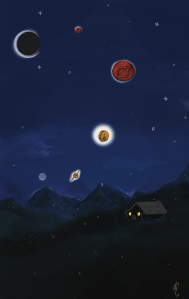
“Venus will shine brightly near the southern horizon for the whole month and should be fairly easy to spot. If you look just a bit south of Venus, you’ll also be able to see a visible (if fainter) Saturn below it which will remain there for the first half of the month (it will technically still be there even in the last half of February but will get harder to see). Looking up, you can find Jupiter glowing very brightly near the Pleiades, and if you have binoculars or a telescope you can even see some of Jupiter’s moons like Ganymede, Callisto, and Europa! Finally, look a bit to the east and find the glowing reddish dot–that’s Mars! If you still have that telescope out you can even see Phobos and Deimos, the Martian moons!. Late in the month, you can also find Mercury rising over the horizon where Saturn was (and technically you could see them both at the same time if you get the timing right–around Feb. 24th–and have a telescope). Uranus and Neptune are also in the sky, although seeing them without a telescope is very difficult, but it’s still good to know they’re there! The beginning of the month will have the least lunar light so you’ll see the most planets and moons, but most of February will be a beautiful time to watch the planetary parade in the hour or so after sunset!”
A few nights ago, I went out when the sky was clear and the moon no more than a sliver and was so awed by the experience of seeing Saturn, Venus, Jupiter, and Mars that I immediately summoned my eldest teenager away from her computer to come see. If you know much about teens, you will be duly impressed by the fact that my enthusiasm over the event was contagious and we both stood and marveled for a few moments at that astounding arc of planets overhead.
While bewitching the younger generation is a magical power unto itself, the planets have also held a special place in magical thought and practice for millennia. Astronomical and astrological observation of these movements shows up in some of our most ancient cultures, including Ancient Grecian, Mayan, Babylonian, and Chinese civilizations. Some schools of thought place charting the motions and influences of the planets firmly in the hands of an educated elite class of nobles, kings, and/or priests, but one of the joys of astronomy is that when it comes to several of these planets anyone can observe them and share in their wonder. The planets have been thought to influence people and been associated with powerful deities in popular astrological thought (just ask anyone somewhat knowledgeable about their “Saturn return” and they’ll tell you how tumultuous their mid-twenties were). They have also been a part of folk magical thought in North American as well. So I thought it might be good to take a little solar system tour and see what sorts of enchantment gets attributed to our celestial neighbors.
A quick note: in the interest of keeping things brief and brisk, I’m only going to talk about the planets commonly named in folkloric texts. That means poor, lonely Pluto gets only a brief mention and bodies like the dwarf planet Ceres are not going to get any attention. Similarly, the outer planets are going to have significantly less magical lore than the inner ones because they just aren’t easily visible. Additionally, I’m not going to talk about the Sun, Earth, Moon, comets/asteroids, or other heavenly bodies since 1) we’ve done some articles on things like comets and eclipses already and 2) I would like to sleep again someday and if I try to cover everything I will probably be writing for a very long time to come. Healthy boundaries make for good New World Witchery articles.
On to the celestial dance!
GENERAL LORE
Broadly speaking, much of the lore regarding planets comes from the more “learnéd astronomer” types and depends on written manuals of magic. We find grimoires laced with planetary lore that assigns different planets particular spirits and intelligences. However, a few standard manuals that found their way into folk magic included texts like Nicholas Culpepper’s Complete Herbal, which took the more formal astrological associations and assigned planetary correspondences to plants. Culpepper even introduces his text with the following note about why planets and plants are so intimately linked:
“And herein let me premise a word or two. The Herbs, Plants, &c. are now in the book appropriated to their proper planets. Therefore, first, consider what planet causeth the disease; that thou mayest find it in my aforesaid Judgment of Diseases.
Secondly, Consider what part of the body is afflicted by the disease, and whether it lies in the flesh, or blood, or bones, or ventricles.
Thirdly, Consider by what planet the afflicted part of the body is governed: that my Judgment of Diseases will inform you also.
Fourthly, You may oppose diseases by Herbs of the planet, opposite to the planet that causes them: as diseases of Jupiter by herbs of Mercury, and the contrary; diseases of the Luminaries by the herbs of Saturn, and the contrary; diseases of Mars by herbs of Venus, and the contrary.
Fifthly, There is a way to cure diseases sometimes by Sympathy, and so every planet cures his own disease; as the Sun and Moon by their Herbs cure the Eyes, Saturn the Spleen, Jupiter the liver, Mars the Gall and diseases of choler, and Venus diseases in the instruments of Generation.”
In the same way that Culpepper’s Herbal held a great deal of sway over folk magical thought on herbs and folk medicine, so too did many of the almanacs produced over the years influence folk magicians in their practice. So many almanacs were produced it would be daunting to list them all here, but many were valuable because they provided astrological guidance for agriculture, weather, and much more. Some of that material also derived from older grimoires and texts on “natural philosophy” that linked planets to colors, days of the week, and other correspondences that then became accepted as fact within folk magic. For example, one encyclopedia of folklore notes that:
“The Babylonians believed that
the five planets, Mercury, Venus,
Mars, Jupiter and Saturn, were
“interpreters of human fate,” and
foretold events by the rising and
setting and by their colors.”
That same source also makes the point that Uranus and Neptune weren’t known during earlier times (and even goes on to mock natural philosophers like Emanuel Swedenborg who claimed to have visits from planetary spirits, but only ones from known planets and strangely not from Uranus and Neptune).
Still, the common beliefs about planetary influence were widespread enough that many beliefs about the roles particular planets played in our lives stuck around.
MERCURY
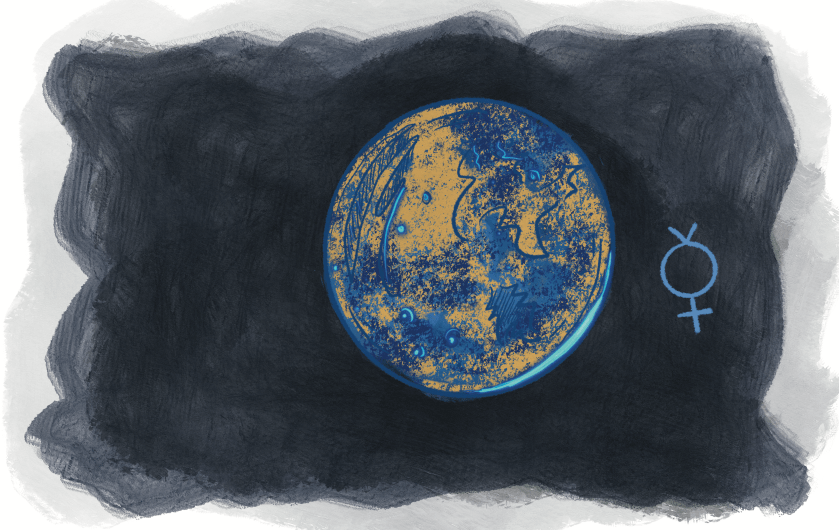
The first planet from the Sun is Mercury, taking its name from the Roman god for messengers, thieves, commerce, and travel (and by extension through his earlier Greek counterpart Hermes, a psychopomp who guided the souls of the dead on their final journey into the Underworld). Mercury has a rapid orbit, something early astronomers likely noticed, and engages in solar transits on a fairly predictable schedule. In magical thought, planetary Mercury also oversees many of the spheres that fell into the Roman god’s purview. Jewish astrologers, for example, used Ptolemaic astrological guidance to create tables assigning the planets particular traits, and Mercury held sway over “wisdom, intelligence, learning, trades, and occupations” (Trachtenberg 252). The planet is also associated with the archangel Raphael in some Jewish and Christian traditions, known as Israfil in Islam. Raphael is often depicted as a messenger angel and is one of only a few angels given a name in biblical and talmudic texts.
Mercury was associated with the color blue in astrological texts, and sometimes thought to have dominion over water or ice (at least before the discovery of Neptune, that is). It rules both Gemini and Virgo, making those two signs ones marked by intellectualism, study, wanderlust, and communication (full disclosure, the author is a Gemini with a PhD who has lived on more than one continent and who, obviously, writes). A thirteenth-century astrological manual called the Early South-English Legendary says of those ruled by Mercury that:
In books he shall be studious
And in writing curious…
He loveth ease, he loveth rest,
So is he not the worthiest ;
But yet with a little business
His heart is set upon riches [author’s transliteration]
So those ruled by Mercury may not be the most industrious, but manage to be clever enough to get more done with less–doing with one hand what others might do with two, one could say.
In folk belief, Mercury is thought to rule over aspects of the body that might be linked to the mind and movement: the brain and nervous system of course, but also the respiratory system as well as hands and arms, throat, mouth, and ears. Culpepper lists several herbs that are linked to treatments of the nerves and respiratory system as Mercurial. For example, mountain mint is ruled by Mercury and Culpepper notes it is “excellent good in all afflictions of the brain.” He says the same of herbs like dill and germander, also ruled by Mercury. Curiously, he makes a note that Mercury-ruled hazelnuts are thought to be good for the lungs by their association, but then digresses to say “if this be true, as it is, then why should the vulgar so familiarly affirm, that eating nuts causes shortness of breath, than which nothing is falser? For, how can that which strengthens the lungs, cause shortness of breath?” As someone who is the parent of a child with tree nut allergies, I can very easily see why using hazelnuts to strengthen the lungs would be a bad idea in many cases (and I note that such tree nut allergies are not a new phenomenon as they are being described in quite an old book).
Perhaps no other aspect of Mercury is so widely known in folk magical thought as its tendency to wreak havoc when it is in retrograde. Because Mercury rules areas of communication–and by proxy much of the technology we use regularly–its retrograde periods are times when many will attribute any failure in their smartphone, laptop, or relationship to that wily planet. In truth, a retrograde is simply a period of time when a planet appears to move backward because of our own perspective. Thus it might actually be better for folk magicians to think of Mercury’s retrograde as a time for reflection and contemplation (although it might also be an effective time to curse someone’s Tesla should the impulse strike you).
VENUS
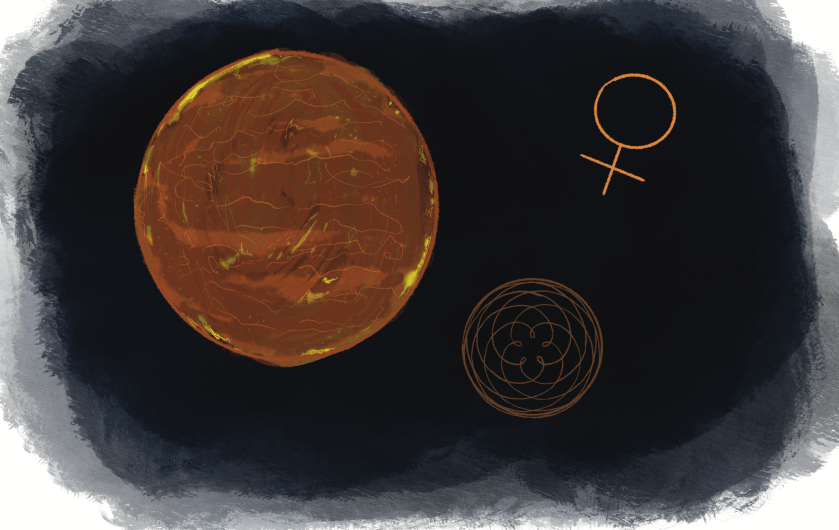
Venus is probably the planet with the most lore in our night sky, not least because it holds the honor of being both the Morning Star and the Evening Star. It is, of course, a planet and not a star but it shines very brightly and consistently appears near the horizon at both morning and evening. Folk astrologers list its color as white likely because it shines so clearly and brightly in the night sky. Interestingly, the orbital path of Venus means that it does an eight-year dance that–when mapped out–creates a pretty profound shape: a five-pointed star or five-petaled flower. These “petals of Venus” make the planet–named after the Goddess of love and beauty–a powerful influence over our emotional lives. English poet Alfred, Lord Tennyson described Venus as “the planet of Love” in his sensual poem “Maud,” describing her morning arrival as “In a bed of daffodil sky, To faint in the light of the sun she loves, To faint in his light, and to die.”
Tennyson’s association of Venus with dying also appears in his long lament, “In Memoriam: A.H.H.,” written after the death of his close friend (and possibly livelong love) Arthur Hallam. There Tennyson calls Venus “Hesper-Phosphor,” names for the morning and evening stars, and says ““Sweet Hesper-Phosphor, double name/ For what is one, the first, the last,/ Thou, like my present and my past,/ Thy place is changed; thou art the same,” meaning that death leaves his love for his friend untouched, although it may look different through grief. That mournful aspect of Venus is echoed in some Australian lore as well:
If a person thinks he sees the
planet Venus set twice in one night,
he will soon be struck with death.
(Daniels 999)
That same source also notes that the Burmese people call Venus the “stars of death” who are thought to be lights that guide the way into the underworld.
Christian symbolism adopted Venus as well, with Jesus taking on the title of “Morning Star” (and eventually passing that ascription on to Satan/Lucifer, since the Luciferian name of “Light Bringer” was already connected to Venus in Ancient Roman thought). A bit of lore from New England notes that “Pagans considered Friday a lucky day, for the ‘fortunate planet,’” because “Venus influences the world on that day.” Of course, that source also notes that Christianity turned the joy of Friday on its head because Christ died on a Friday (Cahill 38).
Folk medical astrology associates Venus with the “Instruments of Generation” as noted above, meaning pretty much anything you do with your no-no square is covered by Venutian power: sex, urination, kidneys, reproductive health more generally, etc. Culpepper notes that some of the plants ruled by Venus include alder, beans, lady’s bedstraw, birch, burdock, cherries, daisies, foxgloves, goldenrod, artichokes, lady’s mantle, mint, mugwort, peaches, pears, pennyroyal, plums, meadowsweet, some roses (although interestingly red roses fall to Jupiter), strawberries, thyme, and vervain. The last of these is also known as the “witch’s herb,” and it may be worth noting that many of the Venutian plants have witchy associations. Birch, for example, is connected to witch-goddesses like Perchta/Berchta, mugwort is good for psychic dreaming, and foxglove can cause sensations of flying due to its effects on the heart (it is lethal depending on the dosage, though, and not one to play around with, unless you’re trying to find out about those connections between Venus and death).
MARS
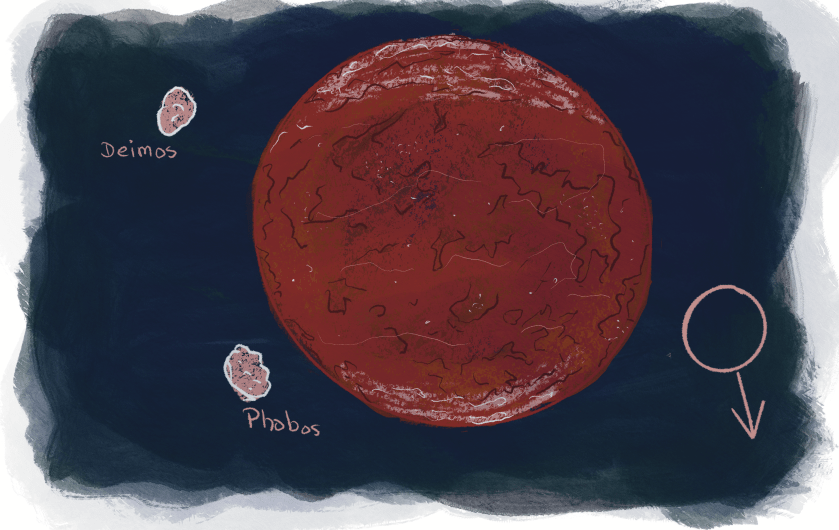
Our bright red neighbor is named after the god of war, and is seen by many as a planet of assertiveness. Astrologer (and early Harvard graduate) John Forster claimed in his 1680 almanac that Mars was “hot and dry in excess, causing [extreme] heat in Summer, and warm air in Winter, likewise Storms of Rain, Hail, Thunder, Lightning.” This hot, turbulent effect extended beyond atmospheric conditions, though. Almanacs of the period also saw a link between Martian influence and illness. An outbreak of “sweating sickness” (likely a novel viral outbreak of some kind) in 15th century England was linked to “a notable Conjunction of Saturn and Mars” (Hall 60). This association with poor health seems quite old, as a fourth century C.E. text by theologian Firmicus Maternus noted that a person born when “Mars receives rays from a waxing moon” could expect to “die violently” (Copenhaver 187). Such a link seems to have lingered on for nearly two millennia, as an informant in West Virginia was recorded in the twentieth century as noting “if the moon is afflicted by Mars…at the time fo the child’s birth, he will go blind” (Brown 126). Jewish lore associated Mars with the angel Samael, and with attributes of “blood, the sword, evil, war, enmity, envy and destruction” (Trachtenberg 251-2). That’s a lot to pile on a planet that just sits there in our night sky giving of a lovely orangey-pink glow!
Not everything was bad about Mars, though. In the Latin Picatrix–a thirteenth century magic manual translated from a likely eleventh-century predecessor–Mars is personified through the first “decan” or degree progression of Aries as “a restless black man with a large body and red eyes, holding a cutting axe in his hand and belted with a white garment, and this is of great excellence in itself. It is a face of courage, serenity, and unashamed excellence” (Copenhaver 288).
William Lilly, a well-known 17th-century occultist and astrologer, provided a series of correspondences that linked Martian influence with warm, windy weather (including thunder and lightning) as well as connecting all herbs that “ come near to [redness], whose leaves are pointed and sharp” and “whose taste is [caustic] and burning.” Among the many he highlights are most forms of thorn and chestnut, as well as nettles, spurge, onion, ginger, leeks, and pepper (Baker 346). A trip for some Thai food would be very Martial in nature, then, it seems!

JUPITER
Jupiter is of course named for the King of the Gods, the latinized name of Zeus (derived from “Ieus” or “Deus” which referred to Zeus’ status as a sky god and “pater” meaning “father”). Jupiter’s presence as a planet was seen as very fortuitous, especially when he shone brightly as he’s doing this month.
Our biggest planet is also one that has provided magicians with all the good stuff. According to the Key of Solomon Jupiter could “reveal hidden treasures,” and through the use of Jupiterian symbols one could gain “glory, honours, dignities, riches, and all kinds of good, together with great tranquility of mind” (Dillinger 90). Lilly notes that Jupiter is connected to “the Sweet or well scented Odours,” as well (Baker 347), while Culpepper’s Herbal connects Jupiter to the sense of taste. Culpepper also links Jupiter to agrimony, betony, borage, cinquefoil, and dandelion, which Culpepper notes to be “of an opening and cleansing quality, and therefore very effectual for the obstructions of the liver, gall and spleen” (which feels kind of shady given that Jupiter’s Greek counterpart, Zeus, had an eagle tearing out poor Prometheus’ liver every day).
Jewish lore connects Jupiter to to “life, peace, joy, wealth, honor,” and “sovereignty.” One source links Jupiter’s influence to weddings in Jewish culture, and comments that wedding rings were often procured and inscribed with a blessing under Jupiter’s influence (Trachtenberg 252; Daniels 1002).
Also, I’d be remiss if I didn’t mention that in rewatching Twin Peaks the celestial clock that counts down to the opening of the spooky and sorcerous Black Lodge comes when Jupiter comes into conjunction with Saturn. So there’s that.
Which, I think, means it’s time to head to our next planet!
SATURN
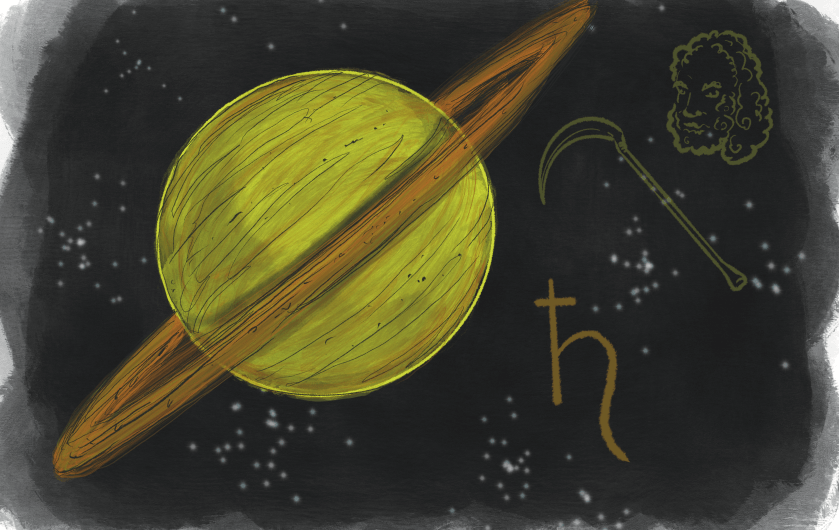
Listen, the Saturn return is no joke. The upheaval that comes in one’s late 20s can be chaotic, and there’s a reason we associate the 50s with “midlife crisis.” Saturn’s influence is often thought to be a bit dark, with one source even noting that “Saturn is a very evil planet to be born under” and stating that those who are so fated will be “wranglers, chiders, and they will never forgive until they are avenged of their wrongs” (Daniels 1001). Which actually sounds like they’d make some pretty terrific anti-heros, right?
In Trachtenberg’s Jewish Magic and Superstition, Saturn is associated with “poverty, wounds, illness, and death,” so nobody’s having a good time with this planet. This is also found in other lore, as one source records a Hindu belief that when Saturn aligns with Mars it will “produce putrid diseases” and that while it rules by itself it prompts “much theft and little charity” (Daniels 1001. The power of conjunction is a major part of Saturn’s magical lore. One astrologer from the Royal Society of England, John Flamsteed, noted that in 1682-83 that when Saturn and Jupiter formed several conjunctions, “the Common People have admired to see the two Superior Planets Saturn and Jupiter continue so near” but that “our Astrologers have affrighted them with fearful Predictions of direful events” (Stahlman 556-7).
Culpepper notes that herbs ruled by Saturn include the elm tree, the poplar tree, holly, ivy, and hemp, as well as a number of poisonous plants like hellebore, henbane, and nightshade, further linking it to death (or giving those anti-heroes some useful tools, maybe).

THE LONELY PLANETS (URANUS, NEPTUNE, & PLUTO)
The lore of the outer planets is scarce, mostly due to their discovery so late as compared to the more “visible” planets already listed. However there is a bit of lore that these planets might influence people to become “very learned, cautious and require a reason for everything. They are fond of history, and liable to have headache and stomach Troubles” (Daniels 1001).
And then there’s poor Pluto, no longer a planet officially. But somehow it’s hard not to identify a little bit with this lonely little planetoid. It always makes me think of the famous “pale blue dot” photo taken by the Voyager I spacecraft as it passed Pluto and exited our solar system (sort of, since the photo was taken in 1990 and Voyager 1 finally left the actual range of our sun’s heliosphere in 2012, which should give you an idea just how big space is). Carl Sagan suggested that the craft take that last photo, turning back to face us before its exit, and in 1994 he shared his thoughts on what those farthest reaches of space say about us:
“From this distant vantage point, the Earth might not seem of any particular interest. But for us, it’s different. Consider again that dot. That’s here. That’s home. That’s us. On it everyone you love, everyone you know, everyone you ever heard of, every human being who ever was, lived out their lives. The aggregate of our joy and suffering, thousands of confident religions, ideologies, and economic doctrines, every hunter and forager, every hero and coward, every creator and destroyer of civilization, every king and peasant, every young couple in love, every mother and father, hopeful child, inventor and explorer, every teacher of morals, every corrupt politician, every “superstar”, every “supreme leader”, every saint and sinner in the history of our species lived there – on a mote of dust suspended in a sunbeam.”
Maybe that’s not folk magic, but there’s something enchanting about that all the same.
And so we end our tour of the planets. I know this hardly scratches the surface of the many ways these planets have been incorporated into magical thought and lore, but even this quick look shows you how much there is. Knowing everything about these planets is wonderful, perhaps, but if you can try to get outside and look up while they are all dancing in our sky. That’s really the most magical thing. To me, anyway.
Happy star-gazing everyone. Thanks for reading. And be well.
-Cory
REFERENCES
- Encyclopedia of Superstitions, Folklore, and the Occult Sciences of the World, by Cora Daniels (vol.2)
- Magical Treasure Hunting in Europe and North America: A History, by Johannes Dillinger
- “Astrology in Colonial America: An Extended Query,” by William D. Stahlman in The William and Mary Quarterly, Third Series, Vol. 13, No. 4 (Oct., 1956), pp. 551-563.
- The Complete Herbal, by Nicholas Culpepper. London, 1850.
- Olde New England’s Strange Superstitions, by Robert Ellis Cahill. Massachusetts, 1990.
- Jewish Magic and Superstition: A Study in Folk Religion, by Joshua Trachtenberg. New York, 1961.
- “The Seven Planets,” by P.J. Heather. Folklore, Vol. 54, No. 3 (Sep., 1943), pp. 338-361 (https://www.jstor.org/stable/1257293)
- The Frank C. Brown Collection of North Carolina Folklore, By Frank C. Brown. Vol. 6. Wayland Hand, ed. Duke Univ. Press, 1961.
- “Almanacs and the Disenchantment of Early America,” by Peter Eisenstadt. Pennsylvania History, Vol. 65, No. 2 (Spring 1998), pp. 143-169.
- Worlds of Wonder, Days of Judgment, by David D. Hall,1989.
- The Book of Magic: From Antiquity to the Enlightenment (Penguin Classics), ed. Brian Copenhaver, 2015.
- The Cunning Man’s Handbook, by Jim Baker, 2014.

 New World Witchery - The Search for American Traditional Witchcraft