Podcast 53 – Papisticall Charmes

Summary

Tonight we’re looking at the concept of “magical Catholicism,” or folk magic using Catholic symbols. We’ll have a couple of saint stories, a brief history of the traditions, and a bevy of practical applications.

Play:

Download: Episode 53 – Papisticall Charmes

Play:

 -Sources-

Relevant blog posts (and podcasts) mentioned in this episode:

  • Blog Post 115 & 116 (Cursing Psalms)
  • Blog Post 122 (Bibliomancy)
  • Blog Post 134 (Brujeria & Curanderismo Intro)
  • Blog Post 135  (The Magical Catholic)
  • Blog Post 136 (Papisticall Charmes/More Catholic magic)
  • Blog Post 137 & 138 (Curandro Spells)
  • Blog Post 160, 161, & 176 (Saint Magic)
  • Podcast 34 (Biblical Magic)
  • Podcast Special (Magical Saints)

(All of these can be easily found by navigating to the “Magical Systems” resource page of the NWW site, then looking at the subheadings of ‘Curanderismo & Brujeria’ and ‘Other Magical Systems’)

Books worth seeking out on the topic:


Other worthwhile resources:

  1. Check out the Yahoo! Group Catholic Folk Magic
  2. The site fisheaters.com which has several pieces of information that veer towards the esoteric which are worth checking out (such as “St. Anthony’s Brief” or “Holy Oils”) [A warning: this site is very traditional, and thus its viewpoints may be controversial; browse at your own risk]
  3. I would highly recommend the Library Page of the Curious Curandera website, where you’ll find a number of free titles on magical Catholicism, including “How to Pray the Rosary,” “Saints and their Patronage,” and “Prayers for Different Needs.” There are a few (very good) pay titles, too, but it’s hard to beat the wonderful free texts. Her courses are marvelous, too!
  1. Legends of St. Expedite come from http://saintexpedite.org/history.html and luckymojo.com/saintexpedite.html
  2. The legend of Saint Charlene was adapted from an essay by Donna McGee Onebane (http://www.louisianafolklife.org/LT/Articles_Essays/CharleneRichard.html#tab2)
  1. Special thanks to Listener “V” for your spells from Cartagena!


If you have feedback you’d like to share, email us or leave a comment. We’d love to hear from you!

Don’t forget to follow us at Twitter!

 Promos & Music

Title music:  “Homebound,” by Jag, from Cypress Grove Blues.  From Magnatune.

Additional Music:

Promos:

  1. Lamplighter Blues
  2. Lakefront Pagan Voice
  3. The SaintCast

Blog Post 162 – Broom Lore

I recently helped out on a project for a local folklorist looking for information on broom lore, and wound up with easily twenty pages of notes on the topic from a wide variety of sources. I thought that today I would share a few of the commonly held beliefs regarding brooms, as well as look at some of the most unusual practices surrounding this wonderful household item.

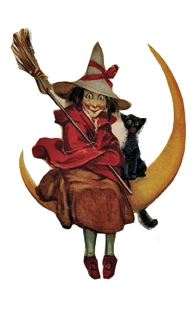
Of course there are many instances of witches riding broomsticks in art and media, but of course brooms were only one of the preferred methods for nocturnal transportation to Sabbat rites. Other mounts included pitchforks, stangs, goats, and eggshells (and even the occasional human being fitted with a magical bridle, in the cases of alleged ‘hag-riding’) (The Historical Dictionary of Witchcraft, Bailey: 23-4). Brooms served magical folk for more than hobby-horses and transport, though. In European culture, broom magic goes back at least as far as Ancient Rome. In that culture, the broom’s sweeping function translated into a purification rite. Eli Edward Burriss notes in his Taboo, Magic, Spirits that the Romans believed a new baby and its mother were in danger of being tormented by woodland spirits—particularly one called Silvanus—and goes on to quote St. Augustine about a three-part, three-tool ritual in which several spirits were invoked to provide protection. Let’s see what the good saint himself says on the subject (from Burriss’ book, and his translation of Augustine):

‘. . . After the birth of the child, three protecting divinities are summoned lest the god Silvanus enter during the night and harass mother and child; and to give tokens of those guardian divinities three men by night surround the threshold of the house and first strike it with an ax and a pestle; then they sweep it off with a broom, that, by giving these signs of worship, the god Silvanus may be kept from entering. For trees are not cut nor pruned without iron; nor is spelt powdered without a pestle; nor is grain piled up without a broom. Now from these three objects are named three divinities: Intercidona from the intercisio of the ax; Pilumnus from the pilum; Deverra from the sweeping (verrere) of the broom; and by the protection of these divinities new-born babies are preserved against the violence of Silvanus.’ (Burriss 28)

Burriss goes on to note that the iron in several of the implements provide the expected protection from evil, but the ceremonial sweeping is what actually drives away the wicked spirit. He also notes that Sir James Frazer observed something similar in his book The Golden Bough, which included sweeping salt out of a dwelling and disposing of it in a churchyard to remove any vengeful souls of the dead from the premises (Frazer 144, Burriss 35). Charles Leland noted that Gypsies used broom straws in spells to protect a mother during childbirth (echoing St. Augustine’s writings) and also says that Romanian Gypsies would use iron and broomstraws interchangeably as protective wards placed beneath pillows at night (Gypsy Sorcery & Fortune Telling, Leland: 47-48, 136).

In the New World, brooms retain much of their old purifying & protective power, but also begin to adopt new abilities within the new culture. African American folk practices show a strong connection to brooms and domestic bonds. African American cultural tradition (as well as other cultures) have a wedding practice of “jumping the broom” to seal the ceremony. It’s common enough that in 2011 a romantic comedy film about an African American wedding was entitled Jumping the Broom. This connection to marriage and the household also involves a number of superstitions and folk spells centered on weddings and love in association with brooms. Here’s a short collection of such beliefs:

From Harry M. Hyatt’s Folklore of Adams County, Illinois

  • 9614. To sweep under the feet of someone sitting on a table signifies that person will marry before the year ends.
  • 9615. Do not let anyone sweep entirely around the chair on which you are sitting; you will remain single seven years longer.
  • 9616. The person under whose chair you sweep will marry once say some, twice say others — soon after his or her mate dies.
  • 9617. If you sweep your own feet, you will never get married.
  • 9618. Whoever breaks a broom handle will soon break someone’s heart.
  • 9619. For luck in love, a woman may wet the bushy part of her broom and sprinkle the water about the house.
  • 9935. The significance of an engaged girl dropping a broom is as follows: if the handle points to the north, she or her fiancee will break the engagement; if to the south, she will marry him and live a happy life.
  • 10129. It is very unlucky for a bride to see a broom on her wedding day before she goes to church.

From Kentucky Superstitions, by Daniel & Lindsey Thomas

  • 1614. If you let some one sweep under your feet, you will never be married.
  • 1615. If you sweep your feet with a broom, you will never be married.
  • 1619. If the broom falls across the doorway, someone will call.
  • 1620. If two people sweep a floor together, they may expect bad luck.
  • 1621. If you sweep after dark, you will bring sorrow to your heart.
  • 1625. If you sweep the house after the sun goes down, you may expect a man caller.

I should note that these are only a very small handful of the superstitions associated with brooms in these two texts. Hyatt’s book alone has easily five hundred individual entries featuring various examples of broom magic and lore.

Of course, the broom’s protective power and its association with witches also become increasingly complex in the New World. Many sources (Hyatt, Thomas, Randolph, Puckett, etc.) all say that witches will not cross over a broom, and so it can be a powerful protective charm to put one across your doorway. Similarly, one could reverse a jinx or witchcraft by stepping backwards over a broom. Brooms can also be a component of spells to reverse the evil eye, according to curandero lore:

A treatment for mal ojo (the evil eye) – “She got some kind of herb from the garden. I don’t know what kind it was. She made signs of the cross with the herb by his head and all over his body, and his feet. All this time she was saying something in Spanish, but I couldn’t understand what it was. Then she turned  him over and did the same thing on the other side. She got an egg and did the same thing with the egg, holding the egg and making signs of the cross all the way down his body and across. She told me to get a cup with some water. She cracked open the egg and put it in the water in the cup. Then she had me get a broom straw, which she cut, and made a little sign of the cross that she put on top of the egg. She told me to put the egg under his crib at night while he slept, under his head, and the next day he would be O.K. I looked at the egg the next day, and, my God, it was cooked! I was so surprised! The yolk and the white were hard and cooked like a hard-boiled egg. She told me to bring the egg to her and she could tell if it was a man or woman who had done it. If the cross went one way it was a male, and if it went the other way it was a female” (“Mexican American Folk Disease,” Keith Neighbors, Western Folklore, Vol. 28, No. 4 (Oct., 1969): 254).

Here again we have a connection to magical protection, especially for children, much as we saw in the European lore. Brooms can also cure physical ailments, like warts, as well.

One of the most interesting themes in broom lore has to do with relocating a household. If one is moving, for example, one should not take the old broom along. Likewise, when you are moving, you should break your old broom and burn it before leaving the house. The superstitious believe that a new broom should be one for the first things you bring into a new home:

  • 11288. You will be lucky, if before moving out of the old house you send a broom and a loaf of bread to your new home.
  • 11289. To have luck in the new house, take in the broom and a loaf of bread before anything else; the broom first, the bread next. Then sweep with the broom.
  • 11290. A broom and a dish pan should be the first things taken into your new home for luck.
  • 11291. A broom and a dish towel should be the first things taken into your new home for luck.
  • 11292. The woman who takes a broom and a dust pan into her new home first will always be lucky there. (Folklore of Adams County, Hyatt)

A number of superstitions also note that the first thing a person does in his or her new home should be to sweep it with a broom, then throw the ashes out the door to ensure that all bad luck is swept clean of the house before anyone sleeps there. Likewise, a new home can be blessed with good luck by throwing a broom over it.

While there’s much, much more that could be said on the topic of brooms, I’ll finish up today with a small grab-bag of the more unusual beliefs and practices involving these wonderful magical tools:

  • If a bunch of straw comes out of a broom when sweeping, name it and place it over the door, and the person named will call (“Kentucky Folk-lore,” Sadie F. Price, The Journal of American Folklore, Vol. 14, No. 52 (Jan. – Mar., 1901), 34).
  • 12368. If you sweep on New Year’s Day, your house will be dirty all year; but if you leave the dirt in a pile on the floor until the next day, clean all year.
  • 12369. To sweep on Monday causes bad luck; all week say some.
  • 12370. The bad luck that comes from sweeping on Monday can be warded off by keeping the dirt in the house until the following day.
  • 12371. The bad luck that comes from sweeping on Monday can be warded off by sprinkling salt over the dirt and burning it.
  • 12372. Sweep on Monday and you are sweeping away all your company that week. (previous five from Hyatt)
  • To draw your enemies to you (so that you may know who they are), clean out your stove, all the time keeping your wish in your mind, but don’t speak it. Then break a stick into four pieces, all of them the  Same length, and pin them together in the middle like this and set them afire in the middle. Then go to the four corners of the room, with your wish in your heart and mind, (but don’t say it), and sprinkle salt. Then, when you see your enemies coming, go outside your door and throw your broom down careless and step over it into the house and talk to them across it and they can’t come in, but they can’t help  from coming to your gate. (“Hoodoo in America,” Hurston:  393).
  • It is bad luck to sweep the dirt out of a house at night; sweep it up into a corner and sweep out in the daytime. If obliged to sweep it out at night, take a coal of fire and throw it first in front of you (“Superstitions & Beliefs of Central Georgia,” Roland Steiner, The Journal of American Folklore, Vol. 12, No. 47 (Oct. – Dec., 1899), pp. 261-271).
  • To make a guest leave, place a broom upside down behind the door (Puckett 317).
  • If a very young child, without being told, picks up a broom and starts sweeping the house, you might as well prepare for a visitor, the idea apparently being that an innocent child can see things in the future that grown-ups cannot, and knows that the house must be tidied up for the company. (Puckett 444).

And just for fun, you should listen to blues legend Robert Johnson singing “I Believe I’ll Dust My Broom.”

Some of our own NWW posts which have featured other broom lore:

Blog Post 113 – Spiritual House Cleaning
Blog Post 126 – Walpurgisnacht 2011
Blog Post 137 – Curandero Spells, part I

So there’s my brief take on magical brooms. The short, sweet version is that they’re not just for riding up to unholy Sabbats upon anymore. I hope this information is useful to you! Until next time, thanks for reading!

-Cory

Podcast Special – Learning Witchcraft

Podcast Special – Learning Witchcraft

Summary: In this episode, I’ll be telling stories from American folklore about how people learn witchcraft. We’ll hear tales of initiation and apprenticeship, solitary witches, witch apprenticeships, and find out just what witches do.

Play:

Download:  New World Witchery Special – Learning Witchcraft


Stories:


Promos & Music
“Grifos Muertos” by Jeffery Luck Lucas, from his album What We Whisper, on Magnatune.com

All incidental music comes from the group Falling You, from the album Touch,  on Magnatune. Songs include:

  • “Sadness of the Witch”
  • “The Art of Possession”
  • “Less Likely to Believe”
  • “Something About Eve”
  • “Reading the Leaves”

Podcast Special – Memphis Mojo

-SHOWNOTES FOR PODCAST SPECIAL – MEMPHIS MOJO

Summary
In this episode, Cory takes you along with him on a trip to Memphis, Tennessee, to discover that city’s magical and mystical side.

Play:
Download: New World Witchery Special – Memphis Mojo

-Sources-
Places:
Ebbo Spiritual Supply
Tater Red’s on Beale St.
A. Schwab’s on Beale St.
The Center for Southern Folklore
The Crystal Grotto at the Memorial Park Cemetery

Information:
Nation Sack” from Lucky Mojo Curio Co. by Catherine Yronwode
Voodoo Village” from Haunted America Tours

You can now request Card Readings from Cory via email, if you are so inclined.

Don’t forget to follow us at Twitter!

-Music-
Memphis Minnie: “Hoodoo Lady Blues
Robert Johnson: “Come on in My Kitchen
Marideth Sisco & Blackberry Winter: “Cold, Rain, & Snow,” and “On a Hill Lone & Gray
Blind Mississippi Morris: “Mysterious Woman Blues

Blog Post 155 – Radiolab and Robert Johnson at the Crossroads

Hi all!

I know this isn’t the botanical lore I was promising for the month of April, but don’t worry, there’s more of that coming. I just had to share something that my very dear and wonderful friend Kathleen alerted me to. One of my favorite non-magical podcasts in the world, Radiolab, just did a really interesting mini-show on a topic which intersects with our work here!

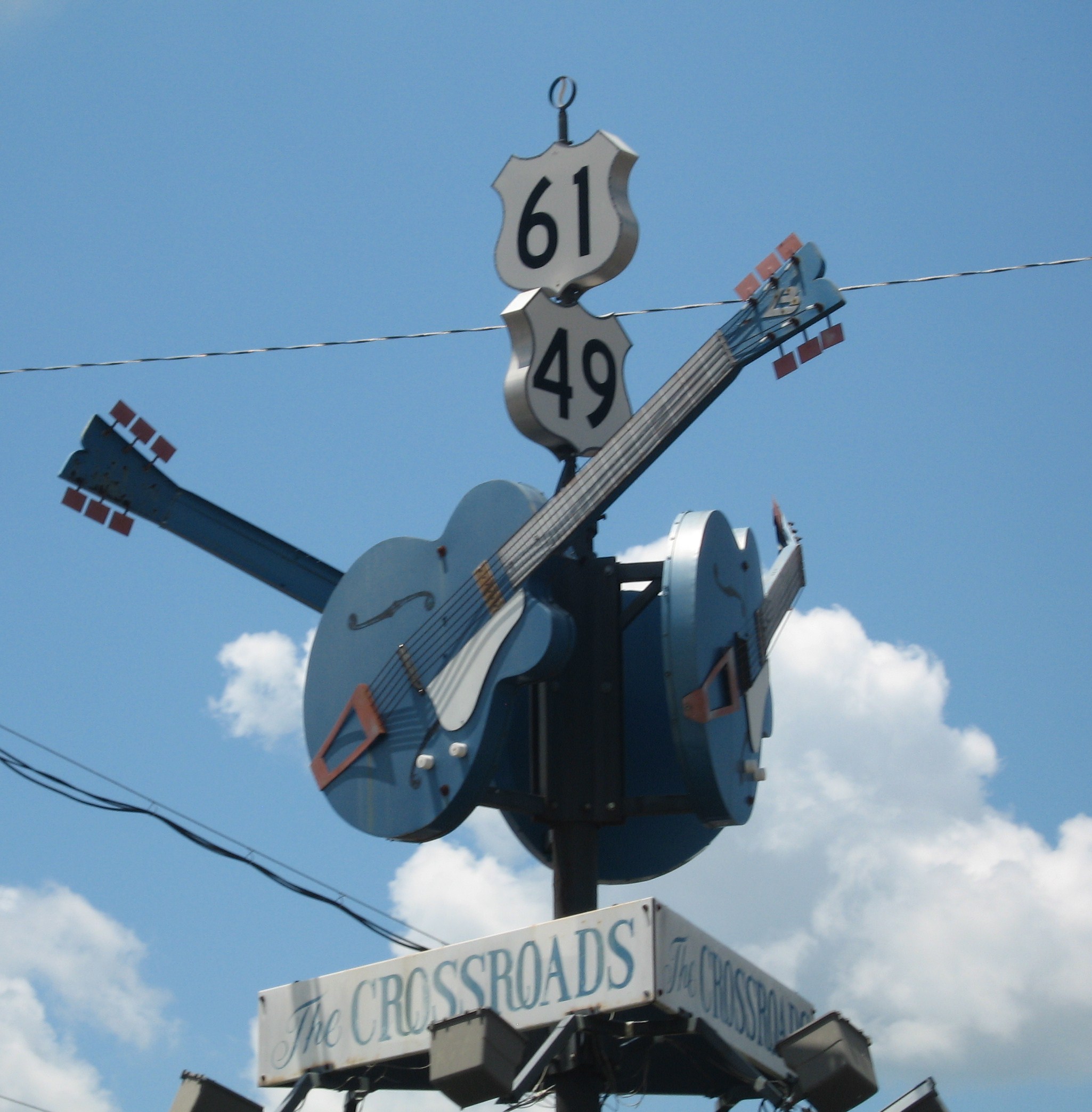
Please hop over and check out the 30 minute Radiolab short on the Crossroads, specifically the tangled crossroads legend surrounding blues players Robert Johnson (to whom the myth of selling his soul to become a great blues player is frequently ascribed) and Tommy Johnson (who may actually have done the crossroads ritual). There are fantastic interviews with music historians, blues experts, and even Tommy Johnson’s brother, all of which help shed light on the strange and gorgeous African American folk tale about gaining new power at the crossroads.

I should point out that they come at this from a scientific and historical perspective, and really are pursuing the true story about the musicians rather than doing much to get at the folkloric roots of the crossroads phenomenon. They specifically wind up ignoring the existence of the story in other African American literary and folklore sources, such as these:

  • The multiple incidents of crossoroads conjure recorded by Harry M. Hyatt between 1935-1939 (found at the bottom of the Lucky Mojo page linked above), which would have pre-dated the “creation” of this story as described in the Radiolab short
  • The numerous incidences of crossroads as places of healing, particularly trading things like a wart or a sty to a mysterious stranger, in Southern and African American folklore (which can be found in Hyatt’s work, the work of Vance Randolph, and Newbell Niles Puckett).
  • Puckett’s description of the crossroads ritual as an origin for folk hero Jack, which was published in 1926 and states:

Various legends are in vogue among the Negroes to account for the origin of this creature.  One illustrating the common theme, was told me by a root-doctor last summer.  Jack sold himself to the devil at the crossroads one night at twelve o’clock. For seven years all power was given to him to do as he pleased, but at the end of that period his soul belonged to the devil. [This eventually goes on to tell the story of Jack-o-Lantern, but the crossroads portion of it is given here as illustration of my particular point]

  • Zora Neale Hurston’s 1931 article on African American folk magic, which has the following item in it:

How to Have a Slick Hand with People.

On the dark moon of any Friday night, dress yourself in black. Sit flat in the fork of a cross road at exactly twelve o’clock and sell yourself out to the devil. After which you shall have power to do anything you wish to do (“Hoodoo in America,” 392)

  • The appearance of crossroads in European folk magic (such as that found in Charles Leland’s Gypsy Sorcery & Fortune-telling, published in 1891, long before the legends being described in the blues tales)

There are so many other appearances of crossroads in folklore that it would be daunting to tackle them here (though I will probably try to do a bigger article on them some day). My real point is just to say that while I love the Radiolab story, they definitely overlooked a large amount of crossroads material so that they could focus more on the story of two real blues musicians, which is understandable.

I really do hope you’ll give this particular show a listen. It’s great, especially in its ability to untangle the two legends from one another, and you get to hear some really hauntingly good blues, too.  Let me know what you think of it!

All the best, thanks for reading, and see you down at the crossroads…

-Cory

Podcast 41 – Spring Lore Spectacular!

-SHOWNOTES FOR EPISODE 41

Summary
This episode is all about the various springtime lore we received for our recent contest. It’s lots of bunnies, eggs, and the occasional swat on the behind in this show! Plus we have our contest winners announced.

Play:
DownloadNew World Witchery – Episode 41

-Sources-

Almost all the lore was listener submitted, but we do have a few links to share:

1. We received some great lore from Peter M, who runs a stellar blog on New England folklore. Check it out!
2. You should also check out folklore submitter Jen’s blog, Rue & Hyssop, which is delightful!
3. If you want to know more about gardening and astrology, we did several posts on the topic: Blog Posts 18, 19, & 20.
4. We mentioned two books: Old Wives’ Lore for Gardeners by Maureen & Brigit Boland, and Grimoire for the Apprentice Wizard by Oberon Zell-Ravenheart
5. In case you can’t get enough of Cory, he was also on the March episode of Inciting a Brewhaha
6. You should definitely also listen to the 2012 episode of Between the Earth and Stars by Oraia Helene. It’s amazing!

Congratulations to our Spring Lore Contest winners!

1. Jen at Rue & Hyssop won the Card Reading from Cory
2. Kelly won the copy of Etched Offerings: Voices from the Cauldron of Story
3. StarRider won the Compass & Key Apothecary prize pack

Many thanks to all who entered! We think this was a great show and couldn’t have done it without you!

You can now request Card Readings from Cory via email, if you are so inclined.

Don’t forget to follow us at Twitter!

Promos & Music
Title music:  “Homebound,” by Jag, from Cypress Grove Blues.  From Magnatune.

Promo 1 – Between the Earth & Stars
Promo 2 – Lakefront Pagan Voice
Promo 3 – Pagan in Portland

Blog Post 154 – Buckeyes

I imagine that I’ll get a sharp increase in visitors from Ohio with this article. Today’s featured botanical is the buckeye, which is both the name of the tree and the fruit (or nut) of that tree. It grows in a wide variety of locations, including all over Europe and North America, and is also frequently referred to as a “horse chestnut” (which is actually a very specific species within the bigger buckeye family). Since you can find a great deal of botanical information on the tree elsewhere (like at the USDA Plants database), I’ll narrow my focus here to the folklore and magical uses of the nut.

T.F. Thiselton-Dyer, author of the botanical mythography classic The Folk-lore of Plants, makes the following observations about the horse-chestnut:

“A Worcestershire name for a horse-chestnut is the ‘oblionker tree.’ According to a correspondent of Notes and Queries (5th Ser. x. 177), in the autumn, when the chestnuts are falling from their trunks, boys thread them on string and play a ‘cob-nut’ game with them. When the striker is taking aim, and preparing for a shot at his adversary’s nut, he says:—

‘Oblionker!

My first conker (conquer).’

The word oblionker apparently being a meaningless invention to rhyme with the word conquer, which has by degrees become applied to the fruit itself.” (CH XVIII)

Already I love this plant, don’t you? Essentially they seem to be used as marbles in children’s games (give them one point for that), and they also have a nice phonetic connection to the powerful hoodoo charm, John the Conqueror root, which is frequently called John de Conker (and that’s another point to the buckeye!). They actually look llike smoother versions of High John roots in some ways, so it doesn’t surprise me to find that they sometimes get substituted in for their powerful underground counterpart:

“Buckeye nuts are believed by some hoodoo “doctors” to increase a man’s sexual power. Shaped like miniature testicles, they are sometimes carried in the pants pockets as charms to bring men “good fortune in sexual matters.” In the southern and eastern regions of the United States, buckeyes are carried in mojo bags to cure or prevent such ailments as arthritis, rheumatism, and migraine headaches” (Gerina Dunwich, Herbal Magic, 86).

Cat Yronwode similarly cites buckeyes as charms for increasing male potency. Both Yronwode and Dunwitch, however, make it clear that a buckeye’s primary powers are to aid as a gambling charm and to help stave off aches and pains—particularly rheumatism and headaches. This view is heavily supported by a number of folklore sources:

From Newbell Niles Puckett, Folk Beliefs of the Southern Negro

  • Where the left hind foot of a graveyard rabbit, a buckeye, a horse chestnut, and a luck bone from a pig ham are put together for good luck [A charm for good luck] (316)
  • A buckeye carried in the pocket will surely bring one good luck (314)
  • A buckeye carried in the left pocket is generally supposed to work a cure for rheumatism as well as for piles, a belief apparently English (360)
  • Red pepper rubbed up and down the back ‘warms up de system,’ as does also a new domestic sack half full of salt into which nine grains of red pepper and four buckeyes have been put. Wear this around your waist and you will never again be bothered with chills (366)
  • In Mississippi and Alabama it is believed that if one carries buckeyes in the pocket he will have no chills through the year (366)

From Harry M. Hyatt, Folklore of Adams Co., Illinois

  • 1328. “My brother always carries a buckeye in his pocket to get money.” (28)
  • 1329. “I always carry three buckeyes in my pocket to always have money. My grandfather did this through the Civil War, my mother did this, and I am carrying three buckeyes too.” (28)
  • 4534. The person who carries a buckeye in the pocket never becomes sick. (99)
  • 4688. The person who carries a buckeye in the pocket never suffers from backache. (103)
  • 5233. A buckeye carried in your pocket or the band of your hat prevents headache. (118)
  • 5588. As a treatment for piles, a buckeye is worn: in the pocket (usually the left), or one in each pocket, or one pinned to the underclothes, or one round the neck, or one rolled in the top of each stocking. (126)
  • 5684. One buckeye is worn in one of several places as a rheumatism remedy: about the neck, on the breast, in a pocket (especially a hip pocket), round the waist, and under the bend of the knee.  Sometimes, they say buckeyes are ineffective for rheumatism, unless you begin by using an unripe one. Moreover, it is occasionally said, to lose this nut in the process of curing yourself brings bad luck. And finally, because a buckeye is also called a horse chestnut, the real chestnut is worn as a substitute, but this seems to be rare. (129)
  • 5685. Buckeyes used for curing rheumatism should always be carried in pairs. This also makes you lucky at the same time. (129)
  • 5686. “If you carry three buckeyes in a sack so they will be on your skin, good for rheumatism; if the buckeyes dry all up when wearing, then they are doing you good; but if they don’t dry all up, they are doing you no good.” (129)
  • 11073. It is lucky to keep a buckeye in your purse, on your person, or in your house. (262)
  • 13443. Keep a buckeye in your pocket while playing baseball and you will have good luck. (310)
  • 13984. You obtain good luck for a card game, if a buckeye is worn in your right pocket. (319)

From Daniel & Lucy Thomas, Kentucky Superstitions:

  • 1224 – One subject to a headache may prevent it by carrying a buckeye in his pocket (105)
  • 1288 – Carry a horse chestnut [another name for a buckeye] in the pocket, to avert piles (110)
  • 1299 – To avert rheumatism, carry a horse-chestnut in the pocket (111)
  • 2887 – You will have good luck if you carry a horse-chestnut (219)

Kentucky Superstitions also has this rather fantastic bit of lore about the good ole horse-chestnut:

  • 2889 – If one eats a buckeye, his head will turn around (219)

Vance Randolph devotes a sizeable amount of space to the folklore of buckeyes among the hillfolk of the Ozarks, also pointing out their strong associations with healing and protection from painful diseases. He relates an excellent story about just how deeply ingrained the belief in buckeye powers was in the mountains:

There is an old saying that no man was ever found dead with a buckeye in his pocket, but this is not to be taken seriously. Most people who carry buckeyes regard them as a protection against rheumatism, or hemorrhoids. One of the most successful physicians in southwest Missouri always carries a buckeye ; when it was mislaid once he was very much disturbed and let an officeful of patients wait until his pocket piece was recovered. It is very bad luck to lose a buckeye. I asked this doctor about it once. “No, I’m not superstitious,” he said grinning, “I just don’t want to get the rheumatism!” (Ozark Magic & Folklore, 153)

There is some excellent lore about the buckeye and just why it became the namesake for Ohio from the Ohio Department of Natural Resources website. They mention the lucky association, likening it to a four-leaf clover or rabbit’s foot, and links the state nickname to William Henry Harrison or alternatively to Col. Ebenezer Sproat (a simply fantastic name), both Ohioans of historic and heroic stature.

Probably my favorite bit of folklore concerning the lovely horse-chestnut comes from an online forum I found while researching this topic. You can read the full thread here, but I simply cannot fail to mention this fantastic tidbit:

There is a belief by some that only half the buckeye is poisonous, and that only squirrels know which half that might be in a particular nut. Squirrels do sometimes eat a part of the nut.

There you have it: squirrels are smarter than we are. But I’ve known that for a while (at least in my case it’s true).

At any rate, the buckeye can be carried as a lucky charm or worked into other magical preparations, and it has a huge body of lore associated with it. So much, in fact, that I’ve barely (prepare for pun) cracked the shell here. If you know of great buckeye lore and magic, I’d love to hear about it! Or if you just want to pelt me with horse-chestnuts for making bad puns, I’ll be here all day.

Thanks for reading!

-Cory

Blog Post 147 – Reviews and Recommendations

Hi all!

I’ve been reading a lot lately (but then, when am I not?). I’ve also managed to catch a couple of great movies as well. So I thought I’d share some of my thoughts on them with you! The excerpts below are the slightly abridged versions of the full reviews found over at Pagan Bookworm, so head over there if you want the full report.

1)      The Book of English Magic – by Philip Carr-Gomm and Richard Heygate (Overlook, 2010)

If you have spent much time studying occult literature, you know that Great Britain is rife with magical lore: fairies, Arthurian legends, druidry, cunning folk, etc. In The Book of English Magic, Philip Carr-Gomm and Richard Heygate make the not-too-audacious claim that Britain’s magical history is one of the richest—perhaps the richest—in the world. They approach their subject by examining a mix of history, folklore, and modern practices to attempt to piece together a portrait of Britain as an enchanted isle. While I think that they succeed in presenting a magical portrait of a magical land, I also think that the authors are by turns too broad and too narrow. They do a wonderful job looking into subjects like English alchemy and dowsing, providing a number of excellent resources to discover more about each topic. They also dwell overlong on the concept of druidry (not surprising considering it is one of Carr-Gomm’s chief fields of interest—he is also the author of Druid Mysteries, the Druid Plant Oracle, and the Druid Animal Oracle). The paucity of sources supporting some of their research means that while some chapters seem tight and focused, others seem only loosely woven together. They hardly plumb the depths of what is called Traditional Witchcraft, and the concept of cunning folk is given surprisingly short shrift considering how close to contemporary some of that material is. The inclusion of practical exercises gives a slightly ‘workbook’ feel at times, which deflates the momentum of the book in some places, but really does seem to serve the overall work.That being said, if one were looking for a good coffee-table introduction to the myriad magical traditions available to the student of British history, this would be an excellent starting point.

2)      The Voodoo-Hoodoo Spellbookby Denise Alvarado (Weiser, 2011)

This book is about what author Denise Alvarado calls “Voodoo-Hoodoo,” a term which irks some as the continuing inaccurate jumble of two terms which should remain distinct (Voodoo being a religion and hoodoo being a folk magical practice). However, if one takes the time to read Alvarado’s passionate book on the topic, the Voodoo-Hoodoo Spellbook, one can see that she is merely sticking to the terminology most people are familiar with and that the dog of diction has no teeth to bite when it comes to New Orleans-style magic. Instead, Alvarado presents a tradition which blends elements of Haitian Vodoun, folk Catholicism, Southern root work and hoodoo, and a touch of New Age spirituality to create a vibrant, current practice. She uses a number of good resources, often primary ones, to support her understanding of a practice she has lived with her whole life (according to her). She also frequently slips away from the facts and into personal experience, but does so in a non-authoritarian way. Her history of Mardi Gras and the magical folklore associated with them is captivating, as is her heartfelt look at the Seven African Powers. When she does slip off of the scholarly or personal track the book can get a bit messy. Her correspondence tables are not a strength, and her inclusion of New Age style tumbled gemstones in her work almost undermines her traditionalism (as it seems fairly obvious that slaves doing similar work in the 19th century would not have had polished rose quartz to work with). She is flexible and fluid towards Christianity, though here it should be pointed out that she neither says one must work with Christianity nor one must work with African Traditional spirituality. People are looking for spells, and this book definitely has those. There are spells for love, luck, money, protection, and half-a-dozen other needs. Hundreds of spells and workings are contained in this book, as well as recipes for conjure oils and powders, instructions for candle working, and a discussion of poppets and dolls in magical work. Some of them seem totally reasonable within the context of her presented practice, and some seem a little forced. This book fits nicely on the shelf next to other “hoodoo 101” texts, while offering a few doors to open for a reader looking to go deeper.

3)      Old World Witchcraft – by Raven Grimassi (Weiser 2011)

Don’t buy this book. I’m not even bothering providing a link to it. I’ve done a full review at Pagan Bookworm, but let me just say this text is badly researched, mis-cites or fails to cite sources, argues with scholars without presenting their actual point of view/argument, claims that graveyard dirt is just the powdered ash of tree leaves gathered in a cemetery, and says that you can become deeply knowledgable about a plant by studying its sigil. It’s bad history, bad herbalism, and bad witchcraft. All in all, this is a book which suffers from broken clock syndrome (as in, “a broken clock is right twice a day”). He occasionally hits on interesting ideas or brings up worthwhile concepts, but mostly he seems to be posing an elaborate fantasy as a pseudo-historical reality, with very little scholarly backbone to support his claims. When someone prods the gear works, the whole contraption just seems to fall apart.

4)      American Mystic, directed by Alex Mar (Empire 8 Productions, 2010)

Director Mar turns the camera on three different but spiritually similar people: Kublai, an African American man who belongs to the Spiritualist Church; Chuck, a Lakota Sioux sun dancer; and Morpheus, a pagan witch and Feri tradition priestess. The director captures the challenges of these faiths, including both internal and external struggles. While there is an element of novelty to the practices of each film subject, the director never lets curiosity turn into spectacle. The Sun Dance, which can be grueling for participants, is not simply a show of blood and muscle, but rather connects Chuck to his family in a powerful way. Kublai seems to struggle with just how much he believes in his own spiritual gifts. And Morpheus senses her displacement in the modern world, while at the same time she does not shy away from the society of other people.  The film does have its flaws, but keeps a sensitive and intelligent lens focused on these subjects and their deeply-felt spiritualism. This is a rare and lovely documentary on mysticism as seen at the ground level. Available on Netflix.

5)      All My Friends Are Funeral Singers, directed by Tim Rutili (IndiePix Films, 2010)

In this outstanding independent film from director (and bit player/musician) Tim Rutili, a lonely fortune-teller and magical worker named Zel (played by the radiant Angela Bettis) lives in an old country house inhabited by a wide range of unusual ghosts that only she can see. There are dead flappers, priests, blind musicians, and a strange, child-like woman named Nyla (Molly Wade) who cannot speak. Zel is not merely a medium, she is also a deeply talented magical worker. She smartly lays down a salt line in front of her bedroom door every night to keep her ghost-friends out. The director cleverly bookends each section of the film with bits of folk magic, title cards with things like “A wish made while burning onions will come true,” which lends to the overall enchantment of the piece. This is such a lovely and exceptional film that I easily overlooked its flaws in favor of being bespelled by these characters. I cannot recommend this film highly enough. Go, watch it now! Available on Netflix.

Whew! So that’s been my reading and watch list (at least, that all the ones I could write reviews about lately). What have you been getting into?

Thanks for reading!

-Cory
Blog Post 146 – Dowsing

Today’s entry deals with a very specific type of magic, one which has been associated with the word “witch” in a positive way even within deeply Christian communities for a century or more. The practice of dowsing, or “water witching” as it is sometimes called, essentially deals with the use of divination instruments to find something. Most frequently, that something is water, but on occasion it might be oil, precious metals, lost objects, or even lost people. The phenomenon of water witching is one of the most accepted mystical practices in the West today, and there are organizations devoted to its study from both scientific and metaphysical perspectives. A person can be a dowser and still be a respected member of his or her community, even a highly valued one if he or she is effective at it, though magic or divination of any other kind might be frowned upon by the neighbors. But just what is dowsing and how does it work? Here is an excellent description taken from a folklore handbook on a specific area of the Appalachian foothills:

Almost without exception, dowsers were used to ‘witch’ wells dug in the region [the Upper Cumberland area of TN/KY] before the 1930s. A dowser, or water witch, is a person perceived to have a skill for discovering underground water with the use of a divining rod, usually a small, forked limb cut from virtually any fruit-bearing tree or willow. Because a water witch’s method is not scientifically proven, reliance on this technique is considered a folk practice. However, there were at least 25,000 active diviners in the United States as late as the mid-1950s, according to folklorist Trudy Balcom, and the results of their predictions have proven as successful as those of hydrologists and geologists.

Dowsers were often called in before a new home was built, so that the house could be located near a well. To find the water, the dowser typically holds the free ends of the forked prongs, wrists turned upward. Thumbs are pointed horizontally outwards so that the loose ends of the prongs extend three to four inches beyond the thumbs. (There are variations on the manner in which the switch is held.) The dowser walks slowly toward the desired location of the well. When the witch comes upon a subterranean stream immediately below, the vertex of the fork turns toward the ground; the stronger the stream, the more forceful the downward pull. The fork often twists in the dowser’s hands when a strong stream of water is discovered. Some say that the bark will even twist off into the dowser’s hands, and a few people claim that the forked limb often begins to nod, one time for each foot of dirt and rock that will have to be excavated before water is reached (from Upper Cumberland Country, by William Lynwood Montell, 37-8).

This summary of water witching covers most of the basics: a forked rod, used to find water before digging a well, the power in the dowser, and the nodding to indicate well depth. It also addresses the issue of scientific verification, which is a sticking point for a lot of professional dowsers. Some argue that they can produce repeatable results with their methods, even going so far as to get large mining companies to acknowledge their findings. Yet many scientific studies are at best inconclusive when it comes to water witching, or even outright disprove the phenomenon (on paper, anyhow). I’m not here to argue the merits of scientific proof of spiritual phenomena, so I’ll just say that both sides have evidence of some kind, and both seem to be firmly convinced of their interpretation of that evidence. Getting back to the folklore of dowsing, I found a rather interesting footnote explaining the dowser’s use of the forked branch in the book Kentucky Superstitions, which seemed to indicate that the forked shape is related to lightning in some way (292).

Water witches proved to be incredibly valuable members of their communities, and were not only popular but highly regarded for their skill, with no diabolical associations. From Vance Randolph’s Ozark Magic & Folklore:

Nearly all of the old settlers in the Ozark country believe that certain persons can locate underground streams by ‘cunjurin’ round’ with forked sticks. These characters are called water witches or witch wigglers, and the forked switches they carry are known as witch sticks. Despite this sinister terminology, the waterfinder has no dealings with the Devil, is not regarded as dangerous by his neighbors, and has nothing to do with witchcraft proper (83)

Randolph himself takes it very seriously, indicating that it’s not something that he has seen scientifically proven, but which he has seen demonstrated over and over again, which is a fairly sharp contrast to his usual bemused skepticism with regard to the folk beliefs of those he studied. He also makes several other observations on the powers of water witches:

  • He says that the power is in the dowser, not the stick itself, but that he felt a distinct sensation upon holding a witch stick in his hands ( 84)
  • He discusses the societies built around the practice of water witching or dowsing, including ‘Water Surveyors’ Club’ of Butler, MO (86)
  • He gives the story of Fred Goudy of Everton, MO, who dowsed using copper wire instead of tree branches, and gained great fame by doing so (87)

Of note, however, is his doubt about water witches who claim to find mineral deposits or oil. He does not put stock in the ability to find anything other than water with this method, at least as far as the Ozarks are concerned:

Many hillfolk are interested in the search for lost mines and buried treasure, and some of these people have tried to use the witch stick in their quests. If a man is looking for buried gold, he fastens a gold ring to the end of his stick ; if it is silver that he expects to find, he splits the end of the wand and inserts a silver coin. Rayburn says that to locate mixed ores one uses two different metals usually a dime and a penny. Witch sticks thus equipped for treasure hunting are sometimes called ‘doodlebugs,’ but I don’t know if this is an old backwoods term or a recent importation. I have seen perhaps a dozen doodlebugs in operation but have yet to hear of any treasure being found by the doodlebuggers in the Ozarks. It is said that a switch loaded with metal will not react to water, or to any other substance save the particular metal which is attached to the stick (88)

Richard Dorson records the presence and commonality of ‘water witches’ in Illinois in his book Buying the Wind, saying that (in the early 20th century), most farmers had dowsers find wells for them, often for only a dollar or two in payment. He also reports that dowsing for oil had lately (the book was published in 1964 for a sense of temporality) become more common and profitable than dowsing for water (321-22). Veering momentarily into recent history, in a letter dated December 8, 1993, the Chevron Oil Company told Welsh dowser J.P. Taylor that “you opened our eyes to the world of dowsing…it certainly made us think there is more to it than we had previously known.”  The letter goes on to highlight how Taylor, with no prior knowledge of the specific geology of two regions, had been able to accurately identify subterranean oil and gas reservoirs. This is hardly proof positive of dowsing’s power, but it should put into perspective the acceptance with which water witching has been met, even in the past quarter-century or so.

I’d like to conclude today by going back in time and abandoning the present-day (not that it’s not a nice place to visit, but let’s go where the history is hanging out) and looking back at dowsing in the Colonial period. Peter M.’s New England Folklore blog tells a humorous and interesting story about the “Rod Men” of Middletown, VT. He also mentions a few of the late 18th-century powers ascribed to dowsers:

  • Determining lifespans
  • Finding wild plants to cure illnesses
  • Treasure-finding
  • Receiving divine messages
  • And my favorite: “Tell young women their clothes had the Devil in them, and should be removed”

So that’s it for this cursory examination of water witching. There are probably far more qualified folks to write on this phenomenon than me, so consider this a fleeting glimpse into a fascinating subject. My own experiences with dowsing have been limited to using bent copper rods and attempting it (unsuccessfully) with a broken tree branch (which was not taken from a living tree, so that might explain the problem). If you’ve had experience with water witching or treasure/mineral/oil dowsing, I’d love to hear about it! Please leave a comment below! Otherwise, here’s hoping you find what you seek in life!

Thanks for reading,

-Cory

Blog Post 135 – The Magical Catholic

Good morning everyone!

Last time I touched briefly on the practice of curanderismo, which is a Hispanic system of folk magic centered upon healing, jinx removal, and protection/cleansing rituals. I also mentioned that it takes a lot of its magical cues from Catholicism, albeit in a syncretic and flexible form of that religion. I received a comment on that post, too, which raised a thoughtful question about Catholicism in the New World and why it might have been seen as ‘magical’ or why its presence can be felt so strongly within magical traditions on this side of the Atlantic. I think that much of this attitude appeared in the Old World after the Reformation, when the broad brush of ‘papism’ or ‘pope worship’ was being used to paint the embattled Catholic Church. Some of the best illustrations of the Protestant perception of ‘the magic Catholic’ come from a tome which has informed witchcraft studies for centuries, Reginald Scot’s Discoverie of Witchcraft. In the following passage, you can see how Scot—who associated superstitious beliefs in witchcraft with the foolish ‘superstition’ of Catholicism—clearly links the priest with the sorcerer:

A papisticall charme.

Signum sanctæ crucis defendat me à malis præsentibus, præteritis, & futuris, interioribus & exterioribus:

That is, The signe of the crosse defend me from evils present, past, and to come, inward and outward. (Book XII, Chapter IX)

Scot certainly thought little of such charms, saying later in his book, “HE that can be persuaded that these things are true, or wrought indeed according to the assertion of couseners, or according to the supposition of witchmongers & papists, may soone be brought to beleeve that the moone is made of greene cheese” (Book XV, Chapter V).

To be sure, a number of Catholics have spent years—centuries in fact—fighting against these perceptions and very few mainstream Catholics would cotton to having their religion identified with sorcery or witchcraft. From a perspective of official Church doctrine and approved dogma and praxis, it is vital to note that Catholicism does not condone magic or the use of enchantments and charms, and that they fall in line largely with other Christian groups when it comes to beliefs and religious operations. They believe in Jesus as God (as well as seeing him as part of a divine trinity made up of “Father, Son, & Holy Ghost/Spirit”), they require baptism, they expect remission of wrongdoings (and, in the case of confession, admission of wrongdoing), and believe in an afterlife in which they will be judged by God for the quality of their lives and the state of their souls. There are a number of fine-pointed theological differences between Catholicism and Protestant denominations, but in many ways they are deeply similar.

What we’re looking at here, then, is not the official, dogmatic, Vatican-approved version of Catholicism, but rather a phenomenon which might be termed as ‘folk’ Catholicism. Folk religions are not exclusive to this religion, of course. There are also folk Hindus, folk Daoists, folk Shintoists, and folk Jews, all with varying degrees of adherence to official practice and varying degrees of handed-down traditions from unofficial sources. Folk Catholicism is particularly relevant to New World esoteric studies, however, because it has appeared in several different places. It shows up in the spiritual and magical practices of New Orleans (such as in the work of author Denise Alvarado). It also appears prevalently in Italian-American communities, and occasionally within Irish-American communities.  Both the Foxfire books and Gerald Milne’s Signs, Cures, & Witchery contain examples of Appalachian residents whose beliefs veer towards the enchanted from time to time via a connection with Catholicism. Milne cites the Swiss/German community of Randolph Co., NC, in one such illustration:

“In Randolph County, the Swiss/German Helvetia community observes Fastnacht prior to the beginning of Lent. It happened that in Helvetia, some of the original families were Catholic, and now their pre-Lenten observance is celebrated by all in a non-religious way. At Helvetia, an effigy of old man winter is burned on a bonfire” (SC&W, p. 195)

Milne also points out that festivals like this were a confluence of Catholic traditions (Lent) and non-Catholic ones (the midwinter effigy burning), which took on a mystical significance in their union. Probably one of the best places to look for Catholic folk magic, however, is within the context of the North (and South) American Hispanic communities, which have strong historical ties to more mainstream Catholicism, and yet which also have allowed a beautiful flowering of folk culture in tandem with Catholic expansion, resulting in a rich and fairly accessible magical storehouse.

In the previous post, I have already looked very generally at some of the techniques of curanderismo and brujeria. Both traditions draw heavily on folk Catholicism to provide their magic, including things like the Apostles Creed and Lord’s Prayer as charms against harmful magic, or using tools like holy water, scapulars (a type of loosely-worn ornament which contains religious icons or written prayers), and rosaries to effect change.  In my next post, I hope to get into the specific spells, charms, and tools used within Catholic folk magic. For now, though, I wanted to leave you with some sites and books which might be of interest to anyone pursuing the folk Catholic path.

  1. I highly recommend the Yahoo! Group Catholic Folk Magic, where curanderas, brujos, and a number of other folk magicians with a base in Catholicism share ideas and resources.
  2. You could always give The Discoverie of Witchcraft a good read. It may have been intended as satire and mockery, but it has a heck of a lot of good pseudo-Catholic magic in it, too.
  3. The moderators of the site fisheaters.com would probably balk at my reference to them here, because they mostly focus on actual Vatican-approved Catholicism. However, familiarizing yourself with these ideas and practices is good if you plan to work ‘within’ this stream, and there are actually several pieces of information that veer towards the esoteric which are worth checking out (such as “St. Anthony’s Brief” or “Holy Oils”) [A warning: this site is very traditional, and thus its viewpoints may be controversial; browse at your own risk]
  4. One book that a number of Catholics grow up with is Alban Butler’s Lives of the Saints (or at least some version of it). Why do I recommend it here? For the same reason I recommend folk and fairy tales to any aspiring magician—there is more to these tales than what’s on the page. St. Lucy’s removal of her own eyes has a distinctly magical flavor to it, in my opinion, which may explain why her celebration in Scandanavia is laced with esoteric symbolism.
  5. Finally, I would highly recommend the Library Page of the Curious Curandera website, where you’ll find a number of free titles on magical Catholicism, including “How to Pray the Rosary,” “Saints and their Patronage,” and “Prayers for Different Needs.” There are a few (very good) pay titles, too, but it’s hard to beat the wonderful free texts.

That’s all for today! I’ll try to have another post up soon with some more practical elements for you (though it is always possible I’ll get distracted and have a tangential topic). Until then, though…
Thanks for reading!

-Cory