Blog Post 126 – Walpurgisnacht 2011

A Hornie Fellow

Stones and bones, brooms and fire.  In the olden days, the night before May 1st was spent burning brooms or effigies of witches in big bonfires to ward off evil.  Witches were thought to gather at the Brocken, a mountain in Germany where they held their strange revels around infernal fires of their own.  Dead things might come galloping up out of their graves to follow the witches and join in their wicked revelry.  Wild storms preceded and followed the witches and the Wild Hunt on their nighttime gallivants.

It’s terrifying stuff, but like most fairy tales, people don’t really believe in it anymore.  But maybe they should.

I’ve loved Walpurgisnacht since I first started observing it as a complementary holiday to the more often observed Beltane or May Day.  I even did a post on it last year, which has been one of my most popular posts to date, actually.  This year, the group I do my social witchcraft with celebrated Walpurgisnacht together, and it may have been one of my favorite gatherings to date.

It started with a bonfire in a park about 500 feet from a big Boy Scout campout.  Or, rather, it really started the day before when I am sure I piqued the curiosity of a few neighbors by hiking into our local woods, dropping handfuls of something powdery and muttering to myself at certain locations on the forest perimeter, then emerged moments later with a big, heavy object under my arm.  I spent the rest of the day piecing together all of the elements I would need to fulfill my duties at Walpurgisnacht—sorting candles, making magical gifts for my co-coveners, bringing the appropriate skulls and bones and broom and stang down to my car under cover of darkness so I wouldn’t have to drag them out the next day while the neighbors looked on (they already had enough reason to look at me funny, why add to that?).

When I pulled into the camp, the scouts were swarming.  As I struggled to gather some firewood from a rather flooded site, a number of the boys approached, waving glo-sticks and flashlights and demanding (in a charmingly pirates-and-lost-boys way) “Who goes there?!”  Apparently some older kids had been running around trying to scare them earlier, so I had to vouch that I was not, in fact, a “robber” as they put it.

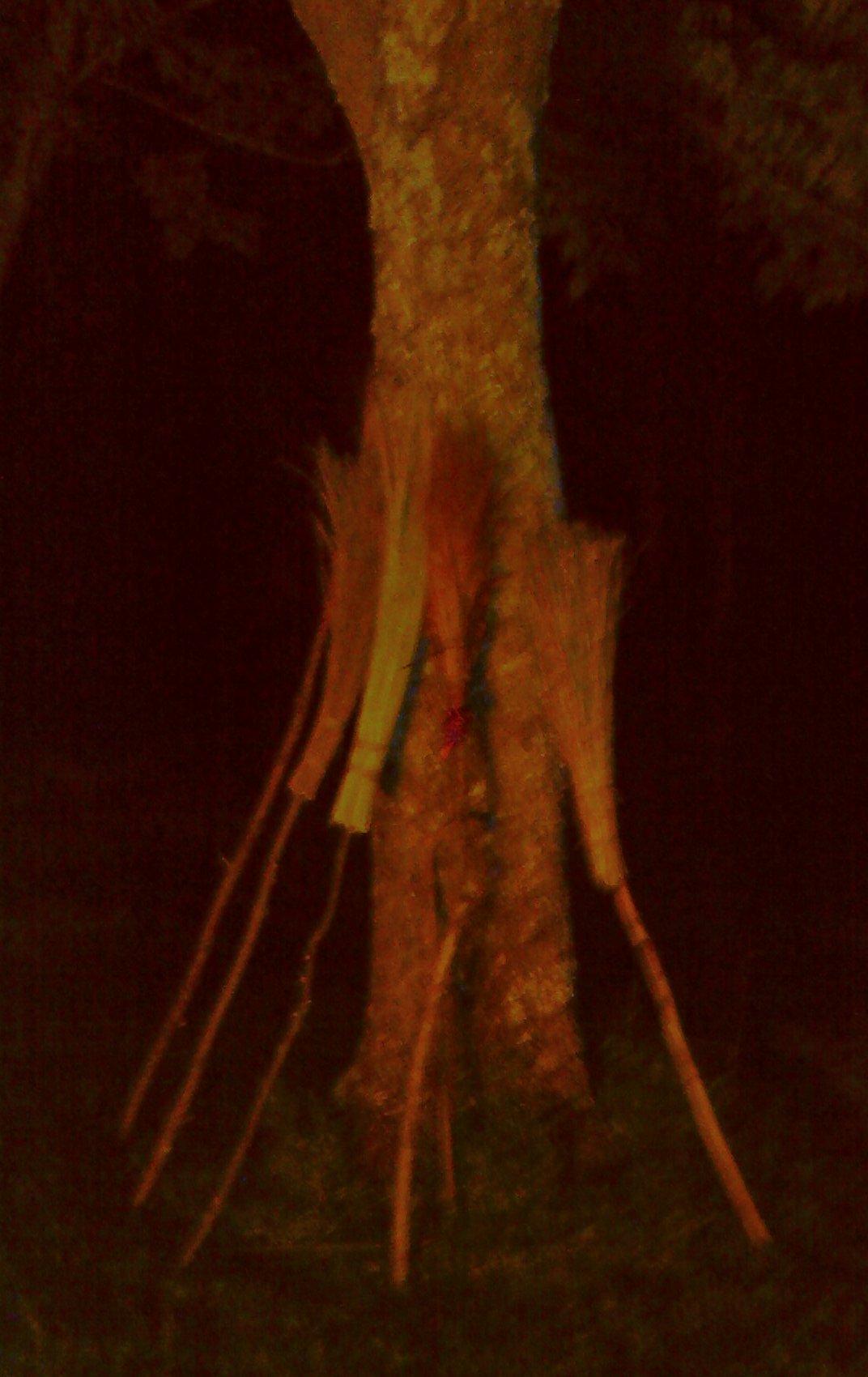
New Brooms Against an Old Tree

By the time our leader  had arrived, the scouts had pretty much removed themselves to the far side of the camp and were engaged in what looked like a snipe hunt (bless ‘em). We  got the fire going and arranged everything we would need for the night.

I can’t say too much about what happened next, but I will say that the following things may have been involved:

  • Black-strap Molasses Rum offerings
  • Leaping the fire on a broom
  • Hedge-Crosser’s Smoke from Forest Grove Botanica
  • An exchange of several magical gifts
  • I may have worn lipstick at one point
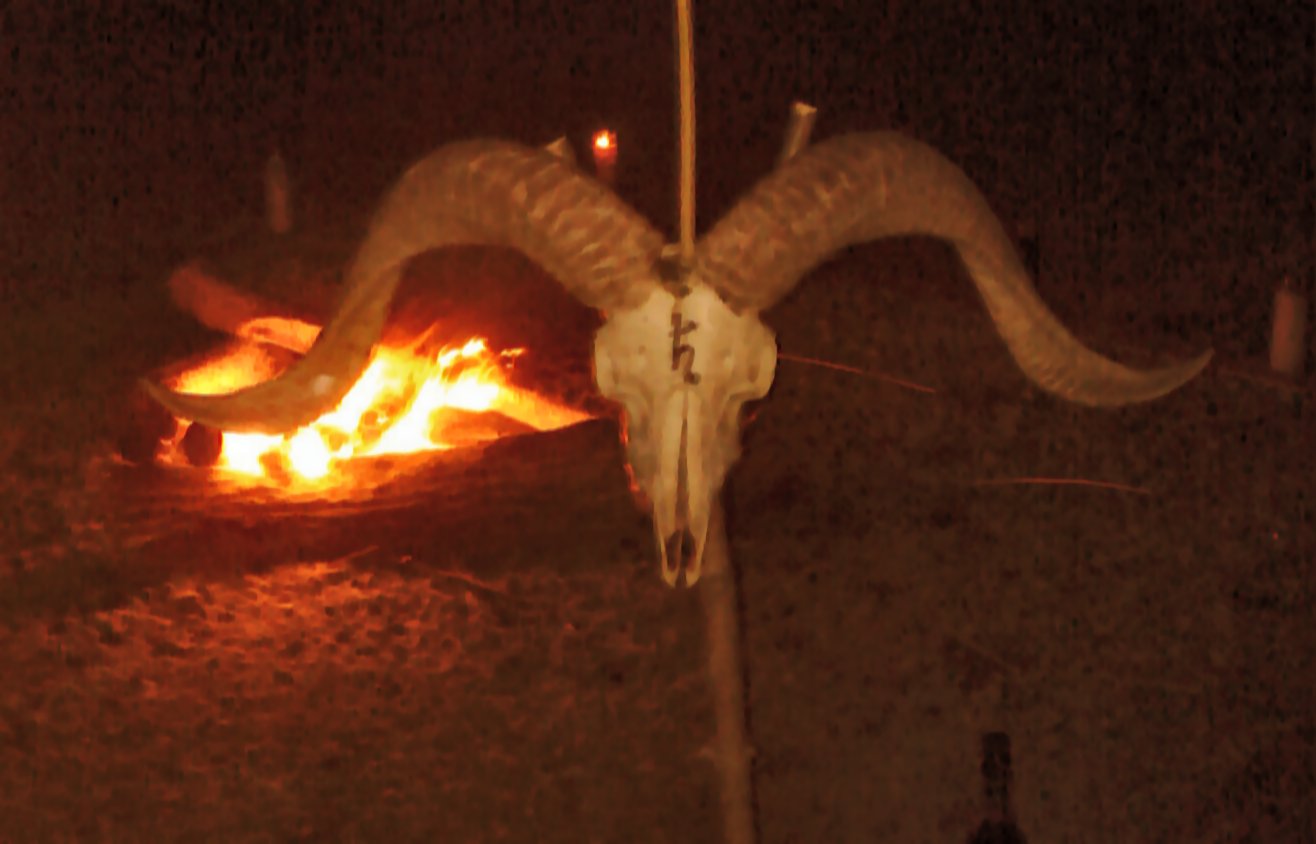
Because it's just not a party until someone breaks out the ram's skull...

Walpurgisnacht proved to be a great night for a few witches to gather around a bonfire, calling upon the dead, riding brooms, leaping through flame, and generally doing all the things the fairy tales say.  We may not have had storms on the Brocken, but the winds definitely started rising before all was said and done.  At one point, I very seriously had to say, “If you hear the sound of horses’ hooves, drop to the ground and don’t look up.”  Maybe it was just my imagination at that point, but the air certainly seemed ripe with witchery.

So, what did you do on Old May Eve? (Or the next day, for that matter.)

-Cory

Blog Post 124 – Tobacco

[A note here:  This is NOT a medical blog, and the information here should not be treated as medical information. I present only folkloric examples of practices historically done by certain people at certain times. Additionally, I am NOT condoning the use of cigarettes, snuff, or any other tobacco product, especially for minors. If you choose to put into practice anything you find here, you take responsibility for your own actions.  Leave me out of it.  Thank you!]

This particular magical herb/plant/ingredient is rather controversial. As a reformed smoker, I know the power of tobacco’s hold on a person—it’s not just the nicotine, but a whole range of psychological dependencies that develop when one is a smoker.  What I’m looking at in this post, however, is not really tobacco as a commodity sold in convenience stores using cartoon animals, but instead the plant found in the Nicotiana genus. Tobacco is a member of the nightshade family (Solanaceae), which includes other rather magical plants like belladonna, datura, and mandrake as well as common (yet mythically significant) edibles like the tomato, potato, and chili pepper.  The plant is also a potent natural insecticide—or insect deterent, rather—and an infusion of tobacco leaves in water is often sprayed in organic garden to keep pests away.

Tobacco, like corn, is deeply significant to certain Native American tribes, who incorporate tobacco into ceremonies and offerings.  Cherokee shamans, for example, would use sacred tobacco in ceremonies designed to combat “night-goers,” evil spirits or people who invaded the dreams of others.  Tobacco smoke was also used as a curative for a number of ailments, and these uses filtered into non-Native practices over time (which we’ll see in just a moment).

When tobacco met European colonists, it experienced a boom in popularity that has kept it one of the top cash crops worldwide ever since—for better or for worse.  It has been deeply wound up in the lives of most North Americans for centuries now, including in their folk medical and magical practices.  One oft-repeated use of the leaf was as a treatment for insect stings and bites, as well as other types of wounds:

  • Tobacco used as a poultice to soothe “abdominal pain…cuts, stings, bites, bruises, and even bullet wounds.” It is thought to “draw out poison” (Randolph, p. 98)
  • “TOBACCO. The leaves are put on a wound to stop bleeding or to prevent infection” (Gainer, p.109)
  • Tobacco, especially homegrown, is good for insect stings and bites (Foxfire 9, p. 66)
  • Wet leaves are wrapped on feet to prevent infection of “full sores” (Cavendar, p. 118-9)
  • Tobacco juice/tea used to wash wounds from snake/dog bites (Cavendar, p. 118-9)
  • A personal informant told me that her grandmother used to put wads of chewing tobacco on cuts, bug bites, and stings to help heal them (informant “Darlene”)

The other chief folk medicinal use for tobacco was the application of smoke to sick or troubled persons.  There were almost as many mentions of this method as there were of the poultice method.  Here are a few:

  • Tobacco smoke can be held in the mouth as a cure for a toothache (Cavendar, p. 118-19)
  • Smoke was blown into an ear for an earache, accompanied by the rhyme “Hurt, Hurt, go away/go into a bale of hay” (Cavendar, p. 118-9)
  • Tobacco smoke is blown into the clothes of colicky children to quiet them, or blown through a straw and “bubbled” in milk as a sedative (Randolph, p.98)

This method clearly derives (I think, anyway) from the Native American medical practices which Europeans adopted in the New World.

The use of tobacco has always had its controversies, of course.  Some objected to it on aesthetic grounds, thinking the act of smoking vulgar and primitive.  Others were disgusted by the smoke and smell associated with the burning leaves.  Still others thought it a waste of money or even a diabolical entrapment for hapless Christians.  One poem I found was circulated in the middle-Appalachians during the nineteenth century and covered all these points:

“Tobacco is an Indian weed,

The Devil himself sowed the seed;

Robs your pockets, burns your clothes,

And makes a chimney out of your nose” (Milne, p. 58)

The religious objections to tobacco were primarily on its use as a vice and an intoxicant.  According to Foxfire 7, the Jehovah’s Witnesses had especial objections to it, and for quite intriguing reasons:  “Smoking has always been completely out of vogue among Jehovah’s Witnesses…As the Society researched the derivations of tobacco and smoking, they found it to be associated with spiritism.”  They also related tobacco to “drugs” used by “priests in pagan ceremony and worship” (Foxfire 7, p. 152-3).

When it comes to purely magical uses of tobacco, the information I found varied a good bit.  Zora Neale Hurston mentions it as a cursing ingredient in a powerful separation spell.  She also tells a very interesting story about a man who takes shelter in an abandoned house only to be joined by a mysterious old man who begins spitting tobacco across the fire at him. When the man attempts to fight the old fellow, he finds himself thrown across the room over and over again.  In this context, there seems to be a subtle current relating the “old man” of the story to the Crossroads Man, Papa Legba, or perhaps the Devil (or maybe even all three from a certain perspective).

One article from 1890 indicated that tobacco was included in mojo bags made with the famous lucky rabbit’s foot.

Cat Yronwode recommends tobacco as an ingredient in court case and spirit contact work.  In this latter capacity, I’ve see tobacco used as an offering to various spirits, particularly crossroads entities and spirits of the dead (Central American folk-saint/crossroads spirit Maximon frequently smokes cigarettes or cigars).  Denise Alvarado’s Voodoo-Hoodoo Spellbook indicates that tobacco is frequently offered to Baron Samedi in the New Orleans Voodoo tradition.

I would also suggest that due to the calmative and drawing effects that tobacco exhibits in folk medicine, it makes a useful addition to house-cleansing and blessing incenses.  A very small pinch added to another incense blend in a well-ventilated house should draw evil spirits out of your home and welcome friendly (and particularly, ancestral) spirits into it.  If you or anyone you live with cannot abide tobacco smoke, however, consider burying a little cut tobacco leaf at the four corners of your property to produce a similar effect.

Lastly, if you choose to smoke tobacco in a ritual context, consider whispering prayers as you exhale smoke.  It makes a fantastic visual focus point to see your requests and adoration slowly rising from your mouth and into the air.  Again, I don’t condone smoking (especially not outside of a very occasional ritual setting), but if you do incorporate it into your practices, I hope that this suggestion helps.

That’s it for the devil-weed tobacco!  I hope this proves useful to some of you out there.  Please let me know if you have any other magical or folk remedy uses for tobacco leaf in the comments below.

As always, thanks for reading!

-Cory

Blog Post 123 – Corn

[A note here:  This is NOT a medical blog, and the information here should not be treated as medical information. I present only folkloric examples of practices historically done by certain people at certain times. If you choose to put into practice anything you find here, you take responsibility for your own actions.  Leave me out of it.  Thank you!]

Today’s topic may not exactly pop out at you as a magical one (I beg forgiveness in advance for the bevy of bad puns this article may include), but corn is actually spiritually and magically significant in several parts of the North American continent.

Corn, or as most of the rest of the world knows it, maize (of the species Zea mays) is a crop which was domesticated by early Mesoamerican cultures and which has been a native staple food for thousands of years now (though its widespread use throughout all of North America may only be about one millennium old).  It has proven both extremely useful and occasionally problematic.  It is fairly easy to grow, and can be processed into any number of products, from food and food additives to industrial lubricants and even plastics.  I’m not going to get into the heavily heated debate about corn as a commodity crop and its place in modern economics and agriculture, as this is not a blog about either of those topics.  I will say, however, that while corn may have its downsides, it also has much to offer culturally and culinary, especially the homegrown sweet varieties (can’t imagine a summer barbecue without it!).

Native Americans depended greatly on corn for survival, and it figured in several native mythologies.  One of the best known stories is that of Kana’ti and Selu, the Hunter and the Corn Mother, from Cherokee mythology.  In this story, mother Selu tells her children that they must drag her body over the land when she dies and that corn will sprout wherever her corpse has been.  In this respect, her tale is not so very different than the John Barleycorn legend.  Folklorist James Mooney demonstrated that this story has parallels in Huron mythology as well (he also mentions that the Iroquois grow a specific type of magical tobacco, which is the subject of an upcoming post).

Picture of a Mid-Atlantic Cornfield with a Remnant Corn Offering, via listener Chet

Listener Chet wrote in with a bit of folklore regarding the Corn Mother from the Central Atlantic coast:

“I read an article, while researching the corn maiden aspect, that covered the offering and adoration of a field spirit not only in NA culture, but all over the world…what quite a few would do is, leave a section of the field uncut, as an offering to the Maiden. I had seen these areas, the past few years where I live, and really had no idea what the uncut areas were about until I read this article. So here we are at harvest time again, and I am seeing these areas once again. So I took a pic of one (see attached corn pic). I have a feeling these farmers are not actually making an offering to the Miaden per se, but the tradition seems to have carried over, so maybe it’s bad luck, to not leave part of the field uncut.”

Chet also included a bit of information on his own practices, including his practice of reburying part of any harvest as an offering to the Corn Mother.  Big thanks to him for the local lore and for the photo!

Moving into the Appalachians, corn becomes magical and medicinal, depending upon its application.  A variety of sources indicate that tea made from corn silk (the long, slightly sticky strands which jut out from the top of the ear and which serve as pollination conduits during the corn’s growth cycle) is excellent for clearing up kidney and urinary tract ailments.  This sentiment popped up in Foxfire 9, Anthony Cavendar’s Folk Medicine in Southern Appalachia, and even Karl Herr’s Hex & Spellwork (which indicates to me that it found a home with the PA-Dutch and the mountain folk alike).  Patrick Gainer shares an interesting West Virginian folk magical technique for healing warts.  According to his Witches, Ghosts, & Signs, warts are cured by making them bleed, rubbing the blood on corn kernels, and feeding the kernels to chickens.  This could be very similar to jinx-removing practices in hoodoo which also use chickens.

Folk Medicine in Southern Appalachia rates corn as a top botanical panacea for mountain people:

“It may come as a surprise to some that Southern Appalahcians used cultigens like apples, corn, [etc.] as much as, if not more than, herbs for many illnesses.  The juice, silk, kernels, and shucks of corn, for example, wereused for a variety of illnesses” (p. 64).

Some of the cures listed in the book’s pages:

  • Corn milk/juice used to treat skin irritation
  • Warm cornmeal to treat sprains and mastitis
  • Corn fodder burned to smoke/sweat out measles

In the Ozark Mountains, Vance Randolph records a couple of bits of lore about corn, one of which is quite unique: “Some hillfolk of Indian descent insist on sprinkling a little cornmeal over a corpse, just before burial” (p. 315).  In light of Chet’s lore about burying corn as an offering to a Mother-figure and/or the land, I think this is pretty fascinating.  Is the corn an offering, and if so, is it for the actual deceased person, or for the land which will be surrounding that person soon?  Randolph also mentions a bit of weather lore, noting that the thickness of corn shucks indicates the severity of the coming winter.

Finally, I can’t discuss corn without at least mentioning the corn dolly which is so ubiquitous around Imbolc/Candlemas.  I won’t go into that particular association, as it seems to be well covered in other places, but I will say a corn dolly makes a very useful poppet for working figure magic, especially since it’s easy and cheap to find the basic materials you need (if you don’t have corn growing anywhere around you, look in the Hispanic portion of your local grocery—husks are almost always available there as tamale wrappers, and usually quite inexpensively as well).  Recent New World Witchery interviewee Dr. E mentioned the corn dolly poppet, if you’ll recall, and I think it’s an excellent way to craft a magical doll, especially one for burial or burning.  They tend to be easy to stuff with herbs and things like hair or fingernail clippings, and they can be made without requiring much skill (trust me on this, I know from experience, or rather, obvious inexperience). There are plenty of great places to learn dolly-making, but since I like the series so much I’ll go ahead and eagerly recommend the corn dolly tutorial found in Foxfire 3 (on pp. 453-460).

That’s it for corn (at least for now).  If you’ve got some magical lore regarding the use of corn, I’d love to read it!  Until next time, thanks for reading!

-Cory

Podcast 27 – Spring Cleaning

-SHOWNOTES FOR EPISODE 27-

Summary:
In this episode, we move away from the philosophical topics and back to the practical necessities of life, namely, Spring Cleaning!  We discuss various magical cleaning methods, then Laine looks at coconuts and Cory talks about floor washes.

Play:

Download:  New World Witchery – Episode 27

-Sources-
Encyclopedia of 5000 Spells, by Judika Illes
Spiritual Cleansing, by Draja Mickaharic
Floor Washes” on the Lucky Mojo site
Blog Post 113 from our own blog

Promos & Music:
Title music:  “Homebound,” by Jag, from Cypress Grove Blues.  From Magnatune.
Promo 1 – Druidcast
Promo 2 – Radiolab
Promo 3 – The Infinite & the Beyond

Podcast 26 – Storytelling and an Interview with Dr. E

-SHOWNOTES FOR EPISODE 26-

Summary
This episode has Cory flying solo while Laine is away (she’ll be back!). He discusses storytelling, and shares three tales with some common themes from Ashanti, Bahamian, and Southern African-American sources.  Then we have a great interview with Dr. E, a conjure man and Lukumi priest.

Play:

Download:  New World Witchery – Episode 26

Sources
Some great storytelling resources:
The Story-Teller’s Start-up Book, by Margaret Read McDonald
The Storyteller’s Guide, by Bill Mooney
Hedge-Folk Tales, by Sarah Lawless (podcast)

The three tales I told today are:
“Anansi & Anene” from the Ashanti
“Fishing on Sunday” from the Bahamas
“Brer Rabbit and the Well” from the Uncle Remus tales
(all adapted from versions found in A Treasury of Afro-American Folklore, Harold Courlander, ed.)

I recommend the Year in White Podcast for more information on Lukumi practice.

And of course, Dr. E’s Sites:
The Conjure Doctor Blog
The Conjure Doctor Shop
Dr. E on AIRR (Assoc. of Independent Readers & Rootworkers)
Dr. E on Twitter
Dr. E on Facebook
The Lucky Mojo 2011 Open House Hoodoo & Rootwork Weekend, where he will be teaching a class on doll-baby construction

Promos & Music
Title music:  “Homebound,” by Jag, from Cypress Grove Blues.  From Magnatune.
Promo 1 – The Pagan Homesteader
Promo 2 – Witches’ Brewhaha
Promo 3 – Borealis Meditation

Blog Post 122 – Bibliomancy

I thought today we would take a look at one of the many divinatory systems found in the New World, and one which has remained popular through the centuries:  bibliomancy.  We discussed this topic during our most recent episode, but I have wanted to expand upon it a bit.  The practice of bibliomancy as a form of divination is common enough in the New World that many folks who wouldn’t touch any other type of magical practice might be persuaded to do at least one of the methods below.

Probably the most commonly used book for bibliomancy is the Christian (or in some cases, Hebrew) Bible.  Other texts can be used, however, and it would not be out of place to turn to a favorite book of poetry, a dictionary, an encyclopedia, or any other piece of writing.  The overarching control factor seems to be that the inquiring party must feel the book has some kind of power.  Whether that power is religious/spiritual or simply the force of knowledge or even a fondness born of favoritism does not seem to matter much; just the reverence offered the text is enough to imbue it with oracular power.

The methods for bibliomancy break down into roughly three categories:  scanning the text (either at random or specifically), using interpretive devices such as dice, and a very particular technique involving a key.

Scanning

This is probably the most familiar method, and the one which is least likely to raise eyebrows among laity.  People frequently look for signs from God or at least from somewhere else to help point them towards good decisions in times of doubt (or they like to have signs that affirm their choices, depending on your perspective).  I’ve known even the most skeptical and non-magically inclined folks to flop open a Bible and point at the page without looking in order to find what will hopefully be a relevant quote.  For those who want a little more magic in the process, however, it might help to get into a ritual mindset before posing questions to the Divine.  In Draja Mickaharic’s Magical Spells of the Minor Prophets, he notes:

“When selecting a verse that is pertinent to the situation the person finds themselves in, it is generally necessary that the person looking for the verse compose themselves and place a bible before them, either on their lap or on a table.  They then are to concentrate upon the matter that troubles them.  Once the true question is firmly in the mind of the person seeking an answer, the bible is opened randomly, and without looking at the pages, a finger is set upon some part of the page.  The verse so indicated by the person’s finger would then reveal some advice, or lead to a solution to the question that has been poised, or even reveal a solution to the problem at hand” (p.125)

There are other ways to consult a holy book for heavenly guidance, too.  Jewish folklore and magical practice interprets scriptural passages incidentally, rather than just directly, for instance.  From Jewish Magic & Superstition by Joshua Trachtenberg:

“The familiar use of Scripture in divining (Bibliomancy) was not unknown to Jews. The Romans had thus employed Vergil [sic]; the Bible was already put to this use by Christians before the eight century; in medieval Germany hymn- and prayer-books served the same purpose. But Jews did not have to borrow this device from their neighbors.  In Talmudic times it was common practice to ask children what verses they had studied that day in school, and to accept them as good or bad omens, an expedient that persisted throughout the Middle Ages.  The more usual procedure of opening the Bible at random and taking the first word or sentence that strikes the eye as a portent, was also followed.  Similarly, ‘if, upon awakening, one recalls a Biblical verses, this passage is to be regarded as a”minor prophecy,” and if it is an ominous passage, one should fast.’” [footnoted to   Pa’aneah Raza on Leviticus and Perles’ Beitrege] (p. 216)

Trachtenberg goes on to say that no special skills were required for bibliomancy and anyone can do it, and that it is also connected to the act of sortilege/casting lots (much like the Dice Method).

One of the more peculiar and interesting methods of scanning a text for magical guidance comes from New World Witchery standby Vance Randolph:

“Many hillfolk tell fortunes and predict marriages by means of certain quotations from the Bible.  For example, the twenty-first and thirty-first chapters of Proverbs have thirty-one verses each.  Chapter 21 is the man’s birthday chapter; chapter 31 is the woman’s birthday chapter.  A boy looks up his proper verse in the man’s chapter, according to the date of his birth.  A man born on the twenty-third of any month, for example, reads Proverbs 21:23—the content of this verse is supposed to be equally significant to him” (OM&F, p. 184)

In my case, the Proverb says, “The plans of the diligent lead surely to plenty, /But those of everyone who is hasty, surely to poverty.”  Patience has been a long-standing goal of mine, even from when I was very young, so I do think this method may hold some merit.  Or it may be a strange coincidence.  Either way, I really like it for its unique spin on a traditional method.

Dice

I mentioned this method in Podcast 25, too, but I thought it would be good to write it out here for those who are interested.  Connected to one of the few methods of divination not condemned by the New Testement—casting lots—the use of dice in conjunction with the Bible might raise eyebrows now, but it actually makes a great deal of sense.  And when you consider that dice were (and are) often made of bone, the vaguely necromantic side of this method begins to surface.  The method cited here comes from Judika Illes’ Encyclopedia of 5000 Spells:

Lord Thoth’s Trio

Thoth, Egyptian lunar god, is given credit for inventing books, magic, and dice.  All are combined in the following method.

  1. Formulate your question, while holding dice.
  2. Close your eyes and flip open the book.
  3. Gently, with eyes remaining closed, toss the dice onto the open book.

Read the passage indicated by the location of the fallen dice.  An alternative is to read the passage indicated by the numbers shown on the dice—thus you might begin on the sixth line, third word or similar.  If using numeral coordination, it’s not necessary for the dice to actually land on the page, although both methods can be integrated.

There’s no reason other interpretive items could not be used similarly, though the precedent doesn’t exist to my knowledge.  I can imagine, however, that a deck of cards could be likewise consulted in conjunction with the holy book of choice, and the number or value of the card taken as a guidepost in determining which verse to read.

Keys

Arrow over at the Wandering Arrow blog actually mentioned this a while ago, and it’s her post (and an email she sent me) which really sparked my entire research bender into the subject.  The overall method seems to derive from a folk Catholic practice which was outlined in Reginald Scot’s 1584 treatise on magic, The Discoverie of Witchcraft.  In this book, Scot lampoons the “popish” superstitions of the Catholics, and cites an example of their folk magic involving a scriptural text (a psalter) and a skeleton key:

“Popish preests (saith he) as the Chaldceans used the divination by sive & sheeres for the detection of theft, doo practise with a psalter and a keie fastned upon the 49. psalme, to discover a theefe. And  when the names of the suspected persons are orderlie put into the  pipe of the keie, at the reading of these words of the psalme (If thou  sawest a theefe thou diddest consent unto him) the booke will wagge, and fall out of the fingers of them that hold it, and he whose name remaineth in the keie must be the theefe.” (Ch. 5)

The Psalm cited, the 49th, is full of memento mori imagery, reminding the singer that death comes to all, and none escapes God’s eye.  The connection between this method and the sieve and shears method—both of which involve tenuously suspending something and asking questions until it begins to move—is also interesting, as the sieve and shears appear in witch folklore, too (see “The Horned Women” tale from Ireland).  Scot’s mention of this form of bibliomancy is brief, though, and a a more thorough description of the method can be found in Draja Mickaharic’s Magical Spells of the Minor Prophets:

“In the second method of divining using the bible, a key, one of those old fashioned ‘skeleton keys,’ is used in addition to the bible.  The key is placed somewhere in the bible, keyed end first, so that the turning end protrudes, sticking out of the wide end of the bible.  To keep the key in the bible in this manner, the bible must be tied closed.  This may be done with rubber bands or with string, however the person desiring to read in this manner chooses.  Irregardless of how the bible is held closed, it is important that it be tied or held tightly, as the bible will be suspended from the key when this work of divination is being done.  Once the key when this work of divination is being done.  Once the key is fixed in the bible in this manner, the bible is suspended from the fingers of both hands, usually one finger under each of the keys turning end.  In that precarious position, a question is asked, either having a yes or no answer, or several questions.” (p. 125)

In this method, the person reading must determine what yes and no are before asking the question, whether it turns or wobbles one way or the other.  Mickaharic says this is very effective, and that “the first time I did this, the bible actually jumped from my fingers when the question was answered with a no.”

This method is also backed up by practices within the hexenmeister community.  In Chris Bilardi’s Red Church, he provides an almost identical system for inserting a key into the Bible, binding it, and suspending it while asking questions.  He is more specific about which books to use, however:  “Take the key and place it into the Bible.  Some traditional places to put it are the Book of Ruth (Chapter 1), the Gospel of John (any of the Four Gospels, really), and the Epistle of James” (Red Church, p. 303).  It’s very interesting to me that the Book of Ruth shows up repeatedly in magical bible study.  That might be a topic for another day, though.

So that’s it for basic bibliomancy!  I hope this has been informative and useful to you.  If you have any other examples of this method, or stories to share about using this or similar techniques, we’d love to hear them!

Thanks for reading!

-Cory
Podcast 25 – Divination and Destiny

-SHOWNOTES FOR EPISODE 25-

Summary
In this episode, we look at different divination systems from the New World.  We have a conversation about Destiny, and Laine talks about spinning wheels as magical tools. Cory discusses bibliomancy at the end of the show.

Play:

Download:  New World Witchery – Episode 25

-Sources-
New World Witchery Guide to Cartomancy
It’s All in the Cards by Chita St. Lawrence
A great collection of links on the History of Tarot at Aeclectic.net
We mentioned the “Portable Fortitude” Mojo cards which Laine bought for Cory (also on Etsy)
Cory mentioned the I Ching
Laine mentioned the fortune-telling poem, “One for Sorrow
You can read about the history of the Ouija board and the Magic 8-ball at Wikipedia
We highly recommend Juniper’s divination system at Walking the Hedge
Laine got a bit of her lore from the “Start Spinning” video with Maggie Casey
Arrow has a great series of posts on magical keys and bibliomancy at her Wandering Arrow blog

Promos & Music
Title music:  “Homebound,” by Jag, from Cypress Grove Blues.  From Magnatune.
Promo 1 – Inciting a Riot
Promo 2 – Lakefront Pagan Voice

Blog Post 121 – Watching Birds

Today we’ll be looking at birds and their place as divinatory aids in the New World, something we touched on briefly in the second post on Magical Animals.  Birds have historically been turned to by humans for secret knowledge, largely owing to their unfettered freedom to fly from place to place.  Virtually all mythologies have some tale of a great mythic bird:  the Roc in the Arabian Nights’ Entertainments, Zeus’s swan-form, the Thunderbird of some Native American stories, and the haunting Crane Dance of Japan are some of the better-known examples. A creation myth of the Haida people of the Queen Charlotte Islands says that a raven, lonely in his long flight, spit upon a clam and opened it up, freeing the first humans (see Magical Creatures by E. Pepper & B. Stacy for more on this).  What have birds to do with divination, though?  Many readers probably already know about the branch of fortune-telling known as augury, but for those who haven’t heard of it, it simply means predicting fate by observing the flights of birds.

So how does one go about performing augury?  Here things get a bit fuzzy—in some cases, the future comes as a vision released by a relaxed mind observing with detachment the loops and turns of soaring birds.  Portuguese writer Paulo Coelho incorporates this type of augury into his novella, The Alchemist when he has a young shepherd accidentally catch a glimpse of coming war while he watches two hawks diving over desert sands.  The other method, and the one which makes up a good bit of North American lore, simply involves noting the behavior of birds and interpreting it by means of known connotations.  This sort of augury has numerous manifestations, and is especially prominent in Appalachian lore.  Folklorist W. L. McAtee recorded a number of bird-related divinations in an essay from 1955:

From “Odds & Ends on North American Folklore on Birds,” by W. L. McAtee:

  • “[I]f ever a bird builds in your shoe or pocket, or any of your clothes, you may prepare to die within the year.”
  • “The loon, a favorite with folklorists, is called ‘Bad Luck Bird’ by the natives [of the Sea Islands of Georgia], who will not speak of it, or if possible even look at it when they meet it in a journey by water.”
  • “While recording the common beliefs as to the storm petrels, that ‘Their appearance portends bad weather,’ Mrs. Simcoe [McAtee’s informant] adds: ‘To kill them is unlucky. Each bird is supposed . . . to contain the soul of a dead sailor.’
  • “The Reverend J. H. Linsley in his Birds of Connecticut (1843) noted that the cry of the bittern is a cause of superstitious fear and recorded that one man hearing it ran a mile, saying, that the Devil was after him.”
  • “’A token,’ said Archibald Rutledge [another informant], writing of the Santee Country, South Carolina, ‘is an apparition foretelling death,’ and cites as examples an eagle feeding with black vultures, a wild turkey standing alone under a certain great oak tree, and an albino robin.”
  • “[An] Abundance of people here look upon [whip-poor-wills] . . . as birds of ill omen, and they are very melancholy if one of them happens to light upon their house, or near their door, and set up his cry (as they will sometimes upon the very threshold) for they firmly believe one of the family will die very soon after.”
  • “Canada Jays are supposed to embody the souls of hunters or lumbermen who die in the north woods and it, therefore, brings bad luck to kill them.”
  • “In western North Carolina, it means seven years of bad luck to kill a raven.”
  • “To end this section on a more cheerful note, we cite the Ozark fancy that ‘If a redbird flies across a girl’s path . . . she will be kissed before night.’”

Other mountain lore about birds tends to focus on weather prediction (a subject we’ve covered in our posts on Signs & Omens to some extent, but you can never have enough weather-prediction lore).  Patrick Gainer observes: “When the geese wander on the hills and fly homeward squawking, there will be a storm within twenty-four hours,” and “When the red birds call in the morning, it will rain before night.”  Vance Randolph records some Ozark lore along the same lines:

  • Chickens or turkeys standing with their backs to the wind and with ruffled feathers mean a storm’s coming.
  • A rooster crowing at nightfall portends rain through the dark hours.
  • A sudden burst of robin-song foretells of bad weather.
  • Kingfishers nesting near the water mean a dry season to come.

Birds seem indelibly linked with concepts of luck and death, too.  Anyone who’s seen the 90’s cult film The Crow probably remembers the voice-over at the movie’s opening telling a pseudomyth about how people once believed that a crow ferried souls between the land of the living and the land of the dead, and occasionally allowed one to come back for vengeance (I call this a pseudomyth not because there’s no truth in it, but rather that I’ve never been able to find exactly that myth borne out in folklore, though there are certainly close correlatives to it—corvids are often associated with death).  There are many other pieces of Appalachian lore in this vein:

  • Barn swallows bring good luck where they nest, and it is bad luck to shoot one. (Randolph, OM&F)
  • Redbirds or roosters lingering near one’s doors or windows tend to mean tragedy will come soon after. (Randolph, OM&F)
  • Whippoorwills nesting at a home mean death will soon come to it. (Randolph, OM&F)
  • If a bird flies in the window, someone in the family will die. (Gainer, WG&S)
  • It is bad luck for a hen to crow. (Gainer, WG&S)
  • “Owls are omens of great ill.  If you spot one nearby while you are inside your home, the direction in which it flies away is an indication of the fate of your household.  If it flies off to the left of the cabin, very bad luck can be expected, but if it flies off to the right, it indicates an evil influence has chosen to pass you by.”(Edain McCoy, In a Graveyard at Midnight)
  • “Many western occult traditions regard peacocks as omens of ill fortune and their feathers as tokens of bad luck.” (Pepper & Stacy, MC)

Finally, in the category of “Odds & Ends,” there are some really spectacularly unique bits of North American folklore about birds which come from all over:

  • Buzzards will vomit upon anyone guilty of incest. (Randolph, OM&F)
  • “When you hear the first robin sing in the spring, sit down on a rock and take off your left stocking.  If there is a hair in it, your sweetheart will call on you soon.” (Gainer, WG&S)
  • “If a bird flies down and gets tangled in your hair, it is an indication that the bird has linked itself with your soul, and whatever befalls the bird is likely to befall you also.” (McCoy, IaGaM)
  • Richard Dorson records a legend in Buying the Wind found amongst Illinois “Egyptians” (or what many would call “Gypsies”) about a mouse, a bird, and a sausage who all keep house together until the sausage is eaten and the mouse accidentally kills himself that feels like it must have some embedded magical meaning, though I’ve yet to figure it out.

That’s it for our bird-watching entry.  If you’ve got lore you’d like to share about birds, we’d love to hear it!  It certainly gives me a good reason to keep watching the skies, so please feel free to comment with any augury methods you’ve got.

As always, thanks so much for reading!

-Cory

Blog Post 120 – Divination in the New World (an Overview)

Greetings everyone!

First of all, sorry for the complete absence of posts last week.  I got a little swamped and didn’t get as much research time as I wanted, but hopefully today’s rather long article will make up for it.

We’re going to be looking over the next few posts at divination, fortune-telling, and other methods of forecasting fate.  Before we dive into details, though, I thought it might be good to tackle the topic generally and look at the types of divination which have been historically popular in the New World, as well as some more modern methods.  .  Some of these systems are ones which I can only cover cursorily, as my experience is relatively shallow with them.  I hope to cover each of these in more detail with time, or at least provide references to help anyone wanting to learn more about them, eventually.

So what are the most popular divinatory methods in the New World?

Arithmetic Methods – Probably the most common divinatory methods used in the modern New World are astrology and numerology.  Almost anyone can tell you his or her sun sign.  A Harris Poll from 2009 shows that about 26% of adult Americans believe in astrology.  Horoscopes related to these sun signs are printed in a majority of national newspapers in the United States, and a surprising number of folks know their ideal romantic compatibility as far as sun signs are concerned.  Less well-known but still fairly prevalent is numerology, particularly the form of numerology known as alphabetic numerology.  This is closely related to Gematrian numerology—a kabbalistic practice which uses Hebrew letters as symbols for numerals to understand a sort of universal mathematics arranged by G-d for the wise to know the world.  Another arithmetic method of divination which has found a certain degree of New World success is geomancy, which depends upon mapping energetic lines upon the earth and determining information based on their patterns and intersections.  The most commonly found version of geomancy in North America is the practice of dowsing, which seeks to uncover hidden water, mineral, oil, or other deposits within the earth using surface-based detection methods.  Science generally frowns upon all of these fields, despite their incredibly intricate mathematical structures, though there have been a few efforts to validate the powers of geomancy, and some large oil companies consult dowsers periodically to help determine ideal drilling locations.

Natural Objects & Phenomena – We’ve covered this a bit already, particularly the signs & omens which seem to pervade much of American folklore, but it is worth examining a few of the other natural-object-based divinatory systems, too.  For example, in many parts of the New World, some system of augury (divination based on birds) has been practiced.  One of the most interesting versions of this can be found in a practice known as alectromancy, which studies the patterns scratched by a rooster when grain is strewn for him.  Traces of this practice can be found in one of the primary influences on later hoodoo, The Black Pullet.  Other objects commonly used in various New World magical systems are cowrie shells (small whitish shells which bear a strong resemblance to the female genitalia) and chamalongos (ritually prepared and polished pieces of coconut shells).  These can both be “cast” in the same manner as dice might be (see “Games” below), and the resulting patterns interpreted to provide answers to specific questions. Another method which has fallen out of favor in modern times—though it was tremendously popular in ancient Rome—is haruspicsy, or the reading of livers or entrails from sacrificed animals.  A modern version of this, however, lives on in the wishbone ritual from the Thanksgiving turkey.  Luck is afforded whoever takes the biggest part of a wishbone snapped in twain between two people when the bird has been cooked and eaten.  Of course, there are a vast number of natural phenomena which are interpreted as portents of the future in traditional folklore—everything from weather to insect behavior to the color of certain animals can have deep meaning to the right person.  Since we’ve touched on that idea in other places, however, I’ll simply leave it at that.

“Gypsy” Methods – I will admit I don’t like the title I’m giving this section, but please understand that by “gypsy” methods I’m not referring necessarily to Romany traditional practices.  Instead, I’m really evoking the Hollywood and fictional version of the Gypsy so often mistaken for the real thing.  But, since the methods employed by those characters are actually relevant, I thought this might be the best category in which to assemble them.  Some of the best known methods are palmistry, cartomancy, and crystal gazing.  Each of these, despite its Hollywood glamorization, is actually a legitimate method.  Palmistry uses the lines on the palm of a person’s hand to determine the overall trajectory of his or her life.  It’s been popular as a parlor entertainment for over a century in America, and likely has been on New World soil for much longer than that.  Cartomancy is probably the best known fortune-telling method in the New World other than astrology, though a much smaller number of people seem to put stock in it.  One of the fun twists to cartomancy is that while tarot is a popular method (even immortalized in American poet Sylvia Plath’s poem, “Daddy,” as a “Taroc pack” and associated with Jewishness), it has long been common for root workers in America to use simple playing cards to get answers to difficult questions.  Crystal gazing, a type of scrying which uses highly polished spheres of minerals like quartz or amethyst to relax the mind and allow visions to enter the mind of the seer, is another popularly seen method, though it is often ridiculed in modern society—poked fun at in cartoons like Bugs Bunny, Scooby Doo, and The Simpsons, for example.  Other methods which commonly get attributed to Gypsies are candle reading—though this is a bit controversial because of something known as the “Gypsy candle scam”—and tasseomancy, which involves reading the patterns left in a cup after someone has drunk tea from it.  In this latter method, coffee is also fairly popular.  The reputation of these methods has suffered a bit due to public ridicule, but they also have their staunch supporters, and in many cases are the methods magical practitioners learn first.

Games – This is a peculiar but fascinating branch of divination which has been surprisingly prevalent in the United States.  I’ve already mentioned the use of playing cards as divinatory aids, and they certainly straddle this category nicely.  Dice and dominoes have also been used to predict the future in several magical systems, particularly those originating from Africa, a practice known as cleromancy which is also referred to as “casting lots.”  It seems to be related to older methods of throwing bones—such as knuckle bones from sacrificial offerings—and interpreting the resulting patterns.  A version of cleromancy is likely the primary version of divination condoned in the Bible (hence all the references to “casting lots” for things in Joshua, I Samuel, Proverbs, Jonah, and Acts (in the last case, lots are cast to determine who the replacement apostle for Judas Iscariot will be).  Famed Wiccan author Raymond Buckland has a book on domino divination for those interested entitled, appropriately enough, Buckland’s Domino Divination.  One of the methods for divination which took off rapidly in the United States after its introduction was the Ouija board.  This system, based on the automatic writing device called the planchette and a special board containing letters, numbers, and symbols, became a central method for communicating with the other world in movements like Spiritism.  Mitch Horowitz’s Occult America devotes an entire chapter to the “talking board” and its impact on American metaphysics, not to mention its economic impact (it outsold leading board games like Monopoly at times).  Other games have brought fortune-telling to the masses through clever marketing, as well.  The Magic 8 Ball which was created by Alabe Crafts in the mid-twentieth century, combined elements of the Ouija board and the crystal ball, and despite its novelty was actually inspired by the clairvoyant mother of one of the inventors.  We spoke a bit on our previous show about “cootie catchers,” the finger-mounted puppet-like devices used by young children to predict future happiness and misfortune.  There are several games played by children in this vein, including MASH (which stands for Mansion, Alley, Shack, House) and a plethora of predictive skip-rope rhymes.  Children, it seems, know a lot about divination and incorporate it into their play regularly.

Text-based Fortune-telling – This isn’t a particularly diverse branch of divination in the Americas, but it does seem to be important.  A recent correspondence sent to me by Arrow of the Wandering Arrow blog outlined a form of bibliomancy, which is the use of the Bible (or other important book) to determine things like marital candidates and the identity of thieves.  Bibliomancy is still practiced in many places, and the techniques involved can be as simple as opening to a random passage in a book and seeing if it has any relevance to the question at hand.  Methods can also be quite complex, involving for example a key placed at a passage in the book of Ruth while the Bible is held between the hands of two people standing opposite each other as they name people they know until the key moves on its own to reveal the perfect marriage partner.  Less prevalent in North America but still quite important is the Chinese predictive system of the I Ching, or Book of Changes.  This method, which combines elements of the “Natural Objects” casting in the form of yarrow stalks with significant markings on them that get thrown to reveal patterns, relies heavily on a book of short hexagrams.  These six-line poems match up to the patterns revealed by the yarrow stalks and provide insight into a particular problem.  The I Ching has become increasingly popular in the West, largely due to Asian immigration into population centers.

Other Methods – Plenty of other methods for determining the future exist which don’t quite fit one category or another (or which I have arbitrarily decided to lump in this “Other” category because, well, I’m the one writing this article).  One bit of outdated but once profoundly influential methods of determining someone’s fate is phrenology, the study of the bumps, divots, and ridges of the scalp.  During the late 19th century there were a number of scientists who supported phrenology as a way of understanding psychology.  It has since fallen much out of favor (partly due to its connection to eugenics—the “science” of building a better person which often involved rather racist and callous methods), but still may hold a bit of interest for those who like old-fashioned divinatory techniques.  Oneiromancy remains popular, and dream-interpretation guides are readily available in most bookstores.  Many folks who do hoodoo also keep dream-interpretation books around to help predict winning lottery numbers.  The biblical precedent (see the stories of Joseph or Daniel interpreting dreams) may have a lot to do with why this technique has stayed more or less legitimate even among conservative audiences.  Necromancy is a word that conjures up (pardon the pun) specters of horror for some, but which had tremendous impact on the American spiritual landscape through Spiritist séances and mediumship.  The practice of talking to the dead is common in a number of religions, and guidance from deceased ancestors is highly valued in Vodoun, Santeria, and Obeah traditions.  On the flip-side, the practice of cold reading takes the idea of necromancy and removes the dead from the equation completely, instead allowing “psychics” to use broad statements, on-the-spot observation, and leading questions to “interpret” messages which are fraudulent, but often quite comforting (I can’t help but think of the South Park episode on this subject, which I highly recommend).  There are other great techniques being generated on New World soil all the time, too.  For instance, Juniper from Walking the Hedge has adapted the old “stones and bones” casting technique to include other objects from her life and has developed a unique and beautiful divinatory system.

There are so many methods of forecasting the future that I haven’t even touched upon here, so please don’t feel left out if I omitted your personal favorite (in fact, feel free to share a little about it in the comments section!).  Many of these methods fall in and out of favor depending on the fashion of the time—phrenology was once almost regarded as fact, but is regarded by many diviners today as at best a quaint and outdated method of uncovering information.  Some of them seem outright silly on the surface or are utter fakery (the Magic 8 Ball for the former, cold reading for the latter).  A number of these techniques, however, still hang on.  The popularity of astrology remains strong, and bibliomancy seems to be indulged quite openly, as proven by the publication of things like The Book of Answers, which I’ve seen in not only bookstores but also in greeting card shops and trendy furniture outlets.  Of course, plenty of these methods are practiced just under the radar of mainstream society, too.

Whatever your preferred method of fortune-telling, I wish you well and hope this article has been useful to you.  More will be coming on specific subcategories within this list…but you probably knew that already.

Thanks for reading!

-Cory

Podcast 24 – Love Magic

-SHOWNOTES FOR EPISODE 24-

Summary

Tonight’s show is all about the love…magic!  We discuss different types of love spells, the ethics of casting them, the power of scent to inspire love, and the famous Love Potion #9.

Play:

Download:  New World Witchery – Episode 24

-Sources-
Earth Power – Scott Cunningham
Ozark Magic & Folklore – Vance Randolph
Mules & Men and “Hoodoo in America” – Zora Neale Hurston
Voodoo & Hoodoo – Jim Haskins
Witches, Ghosts, & Signs – Patrick W. Gainer
Buying the Wind – Richard Dorson
The Voodoo Hoodoo Spellbook – Denise Alvarado

Promos & Music
Title music:  “Homebound,” by Jag, from Cypress Grove Blues.  From Magnatune.
Promo 1 – Forest Grove Botanica
Promo 2 – Wigglian Way
Promo 3 – The Infinite & the Beyond