We move across the state of Tennessee in this episode, discussing hoodoo in Memphis, the magical scene in Nashville, and hearing stories of the Bell Witch and a hexed gun along the way.
Please check out our Patreon page! You can help support the show for as little as a dollar a month, and get some awesome rewards at the same time. Even if you can’t give, spread the word and let others know, and maybe we can make New World Witchery even better than it is now.
The account of the Bell Witch you heard is taken from Tennessee: A Guide to the State, produced by the Works Project Administration.
The story of “Billy Jesse and the Witched Gun” comes from the book Foxfire 2.
We’re also planning an excursion in early to mid-summer to see the ancient magical artifacts exhibit at the Penn Museum and we’d love for you to join us! More details will be coming soon.
If you have feedback you’d like to share, email us or leave a comment. We’d love to hear from you!
Don’t forget to follow us at Twitter! And check out our Facebook page! For those who are interested, we also now have a page on Pinterest you might like, called “The Olde Broom.” Have something you want to say? Leave us a voice mail on our official NWW hotline: (442) 999-4824 (that’s 442-99-WITCH, if it helps).
Promos & Music
Title and closing music is “Homebound,” by Bluesboy Jag, and is used under license from Magnatune.
“Tituba and Giles Corey,” by John W. Ehninger. Public Domain. (via Wikimedia Commons)
It has taken nearly seven years, two hundred articles, over one hundred podcast episodes, and the formation of an interactive community of people all interested in the systems and traditions of various magic-practicing people in North America (and beyond), but now here we are. Based on the title of this post, you may be imagining that I’m about to lay out a complete definition of “New World Witchery.” One that locks down all these various strands we’ve been chasing. Or you may be thinking nothing of the sort, and instead be stumbling upon this article first and trying to decide if the rest of the material here would ever be of interest to you. I think, then, that I am bound to disappoint, because attempting to cage “New World Witchery” in one place, form, or time will never work—it seems that so long as there is still a “New World” with practicing witches in it, that definition is going to have to remain somewhat flexible and fluid.
In one of my last posts, I attempted to answer the question of whether or not I am a witch, and in doing so I covered several key points: practical (although not entirely logical), wondrous (in the sense that the world is full of strange, marvelous, and sometimes terrifying things), and traditional (in the most literal sense of the word). I realize in attempting to create some sort of categorical definition of “New World Witchery,” I’m going to at best satisfy but a very few, but hopefully if you’ve been along for the ride thusfar, you’ll at least come on the journey with me and see what makes sense to you, or what you might change or improve. I will also note that while I am drawing on sources from history and folklore, I will not only be turning to the past. Witchcraft seems to be alive and well today, so I’m inclined to pull from contemporary sources, too. Your mileage with those sources may vary.
This article will be divided into multiple posts, mostly due to length. I’m going to link to material within each part, but the full references will be added retroactively to the posts when they have all been completed, for the sake of practicality. Speaking of which, that takes us to our first major point, and the subject of this initial post.
Hamsa Hand (via Wikimedia Commons)
Irrational Pragmatism: Witchcraft Gets the Job Done (Even if No One Knows How)
I mentioned in the previous article that in many cases, witchcraft seemed to be less about formal religion than “muttering under one’s breath in a time of need, or knowing not to burn sassafras wood.” What I see repeated over and over again in witch tales is a deeply pragmatic approach to problems. A person is marginalized by their community, or denied a favor, or needs to get some milk to keep from going hungry. The only unusual aspect of the problem-solving is that it involves magic, which operates in highly irrational ways. Dorcas Hoar and Bridget Bishop in Salem both existed at the fringes of their town’s social structure, women who needed to survive without adherence to rigid Congregational conformance and who did not have the typical family structure of the community to support them. Dorcas Hoar’s husband had died the year before the trials began, but she had been engaged in acts of divination during the decade before the trials as well, and was reputed to own magical texts. Bishop was known to be strongly opinionated and ran an unofficial tavern out of her home. Hoar managed to escape the trials with a conviction but lived to tell the tale for nearly twenty more years, but Bishop was not so lucky.
Within folkloric cases of witchcraft, those who perform magic may be accomplishing their own ends, but they are also serving a bigger social function, too. I’ve mentioned Betty Booker here previously, and her case shows that a witch can stand in for a judge and jury against those who behave shamefully in a community, as Booker does by “riding” the old skipper after his miserly behavior. In a more contemporary setting, the application of folk magic might be a way to bridge the gap of personal connection (especially in an age where we tend to communicate from behind a screen). One person communicated a bit of lore to me regarding infants and the evil eye that illustrates this point: “My mom said that if someone wants to touch/hold your baby and you don’t let them then there is a chance that person will leave casting ‘mal de ojo’ (evil eye) on your baby causing them a lifetime of bad luck, conversely, she said that letting others hold your baby is good luck.” While it is always a good idea to wash one’s hands before handling a newborn, it’s also important to integrate the new child into a community, which seems to be one of the underlying themes of this lore of baby-passing. Whatever the case, New World witchcraft meets needs, and it meets them where they are without hesitation.
Next time: Witchcraft as an Amoral (not Immoral) Act
We finally take a long-overdue look at various money magic and prosperity spells in our repertoire in this episode.
Please check out our Patreon page! You can help support the show for as little as a dollar a month, and get some awesome rewards at the same time. Even if you can’t give, spread the word and let others know, and maybe we can make New World Witchery even better than it is now.
And we also suggest that perhaps all magic comes at a price (and via mummified animal curios) by invoking the English class standby, “The Monkey’s Paw,” by W. W. Jacobs.
We’re also planning an excursion in early to mid-summer to see the ancient magical artifacts exhibit at the Penn Museum and we’d love for you to join us! More details will be coming soon.
If you have feedback you’d like to share, email us or leave a comment. We’d love to hear from you!
Don’t forget to follow us at Twitter! And check out our Facebook page! For those who are interested, we also now have a page on Pinterest you might like, called “The Olde Broom.” Have something you want to say? Leave us a voice mail on our official NWW hotline: (442) 999-4824 (that’s 442-99-WITCH, if it helps).
Promos & Music
Title and closing music is “Homebound,” by Bluesboy Jag, and is used under license from Magnatune.
We take a look at the concept of Evil as it relates to magic and witchcraft. Is there such a thing? What guides a witch’s moral compass? Do witches ever summon demons? And just what kind of shenanigans is Cory up to, anyway?
Please check out our Patreon page! You can help support the show for as little as a dollar a month, and get some awesome rewards at the same time. Even if you can’t give, spread the word and let others know, and maybe we can make New World Witchery even better than it is now.
Producers for this show: Corvus, Diana Garino, Renee Odders, Ye Olde Magic Shoppe, Raven Dark Moon, The Witches View Podcast, Sarah, Molly, Corvus, Catherine, AthenaBeth, Jen Rue of Rue & Hyssop, Shannon, Little Wren, Michael M. and Jessica (if we missed you this episode, we’ll make sure you’re in the next one!). Big thanks to everyone supporting us!
On the internet more generally, you may want to check out Dawn Jackson’s Hedgewytchery site (only available through Archive.org currently) and Fire Lyte’s recent episode on “Fluffy Bunnies.”
We also make mention of the Paranormal Activity series of films, as well as the recent Fox TV series The Exorcist.
Check out our latest podcast effort, Chasing Foxfire, which just launched in early October. If you like folklore, this show will be connecting the dots between folk tales, science, nature, pop culture, literature, and more.
If you have feedback you’d like to share, email us or leave a comment. We’d love to hear from you!
Don’t forget to follow us at Twitter! And check out our Facebook page! For those who are interested, we also now have a page on Pinterest you might like, called “The Olde Broom.” Have something you want to say? Leave us a voice mail on our official NWW hotline: (442) 999-4824 (that’s 442-99-WITCH, if it helps).
Promos & Music
Title and closing music is “Homebound,” by Bluesboy Jag, and is used under license from Magnatune.
This is the downloadable podcast version of our recent MIxlr broadcast, which featured listener ghost stories for the spooky Hallows/late Autumn season.
Please check out our Patreon page! You can help support the show for as little as a dollar a month, and get some awesome rewards at the same time. Even if you can’t give, spread the word and let others know, and maybe we can make New World Witchery even better than it is now.
Producers for this show: Corvus, Diana Garino, Renee Odders, Ye Olde Magic Shoppe, Raven Dark Moon, The Witches View Podcast, Sarah, Molly, Corvus, Catherine, AthenaBeth, Jen Rue of Rue & Hyssop, Shannon, Little Wren, Michael M. and Jessica (if we missed you this episode, we’ll make sure you’re in the next one!). Big thanks to everyone supporting us!
Almost all of our stories come from YOU, our amazing listeners. Special thanks to A. Claire, Dee, Morgan, Raschelle, James A., and our anonymous listener with the Pennsylvanian story. You are all the reason we had good stories to share! Also thanks to Ivy, who let us share her poem via the live chat, and to Victoria and HeathenLurker, who both shared their thoughts and stories via chat. Follow our Mixlr channel for future broadcasts!
Also, Cory mentions a story of “Bloody Mary” found in Pennsylvania, and some of the weird spooky roads that are targets for legend trips in the Pennsylvania area. You can find more about those in the books Spooky Pennsylvania, by S.E. Schlosser, and Weird Pennsylvania, by Matt Lake and Mark Moran.
Check out our latest podcast effort, Chasing Foxfire, which just launched in early October. If you like folklore, this show will be connecting the dots between folk tales, science, nature, pop culture, literature, and more.
If you have feedback you’d like to share, email us or leave a comment. We’d love to hear from you!
Don’t forget to follow us at Twitter! And check out our Facebook page! For those who are interested, we also now have a page on Pinterest you might like, called “The Olde Broom.” Have something you want to say? Leave us a voice mail on our official NWW hotline: (442) 999-4824 (that’s 442-99-WITCH, if it helps).
Promos & Music
Title and closing music is “Homebound,” by Bluesboy Jag, and is used under license from Magnatune.
Our last (official) #AllHallowsRead tale is “The Pale Man,” by Julius Long. A lonely man visiting a country hotel finds himself pondering a strange guest down the hall, one that keeps changing rooms and moving closer and closer.
You can read the full text of “The Pale Man,” by Julius Long, at Wikimedia. The story is listed as in the public domain.
Promos & Music
Intro music is “Grifos Muertos” by Jeffery Luck Lucas, from his album What We Whisper, used under license from Magnatune.com
Incidental music by Olssons (“Ambient One”); DR (“Sedativa V”); Byzons (“Apatheia (Or, The Story of a Girl Trapped in a World of Madness)),” all of which are used through Creative Commons license on SoundCloud.
Continuing our theme of stories from the Weird Tales magazine published in the mid-twentieth century, we share “Four Wooden Stakes,” by Victor Rowan. This #AllHallowsRead raises the dead as two old friends fight for their lives against a creature of the night.
We begin our annual #AllHallowsRead episode series with “The Night Wire,” by H.F. Arnold. Our theme this year will be stories from the American horror/sci-fi magazine, Weird Tales, which published from the 1920s to the 1950s. This story features a very creepy fog and a very creeped-out telegraph operator.
You can read the full text of “The Night Wire,” by H.F. Arnold. The story is listed as in the public domain.
Promos & Music
Intro music is “Grifos Muertos” by Jeffery Luck Lucas, from his album What We Whisper, used under license from Magnatune.com
Incidental music by DR (“Sedativa II”), Lucidique (“L’Horrible Passion”), and Canton (“Ambient Gourd”), which are used through Creative Commons license on SoundCloud.
This episode is a special condensed version of one of our bi-monthly Patreon group discussions. The conversation was just so good, and we wanted to share some highlights of it with you. We talk about the times and places we most dream about visiting as magical folk. Enjoy!
Please check out our Patreon page! You can help support the show for as little as a dollar a month, and get some awesome rewards at the same time (like the full version of this conversation, for example). Even if you can’t give, spread the word and let others know, and maybe we can make New World Witchery even better than it is now.
Producers for this show: Corvus, Diana Garino, Renee Odders, Ye Olde Magic Shoppe, Raven Dark Moon, Ivory, The Witches View Podcast, Sarah, Molly, Corvus, Catherine, AthenaBeth, Jen Rue of Rue & Hyssop, Shannon, Little Wren, Michael M., and Jessica (if we missed you this episode, we’ll make sure you’re in the next one!). Big thanks to everyone supporting us!
Play:
Download: Special Episode – Witches When and Where Roundtable
-Sources-
This show is really the result of our supporters, some of whom you can find with magical businesses, podcasts, or blogs of their own:
We should be launching our newest podcast effort, Chasing Foxfire, thismonth! If you like folklore, this show will be connecting the dots between folk tales, science, nature, pop culture, literature, and more.
If you have feedback you’d like to share, email us or leave a comment. We’d love to hear from you!
Don’t forget to follow us at Twitter! And check out our Facebook page! For those who are interested, we also now have a page on Pinterest you might like, called “The Olde Broom.” Have something you want to say? Leave us a voice mail on our official NWW hotline: (442) 999-4824 (that’s 442-99-WITCH, if it helps).
Promos & Music
Title and closing music is “Dill Pickle Rag,” by The Joy Drops, and is used under a Creative Commons License (available at Soundcloud.com). Additional music is Dvorak’s “Two Waltzes,” from Op. 54, by the Musicians from Marlboro, and is used under the Creative Commons License through the Free Music Archive.
I realize that my previous post promised a bit more exploration of the potential shape of a “New World Witchery” sort of practice, but during the drafting of that post, Ilvermorny was unveiled. I’ll get to what that means in a moment, but I wanted to just take a moment to say I am still working on the other post, and that this one may actually tie nicely into the longer discussion of New World magic (albeit from a more literary stance). I also want to note that there are most definitely *spoilers ahead* so consider this your chance to stop reading if you aren’t already somewhat familiar with what Ilvermorny is.
Platform 9 & 3/4 Sign, Kings Cross Station, London. Picture taken by fr:Steff via Wikimedia Commons.If you have managed to see the light of day at any point in the past two decades, you are probably familiar with the world of Harry Potter. Created by J.K. Rowling, the Potterverse (as all the collective official materials of the Harry Potter fictional fandom are known) has historically centered on the adventures of Harry, “The Boy Who Lived,” and his struggles against Voldemort (a.k.a. Tom Riddle), an evil and megalomaniacal wizard bent on the purge of all “impure” wizarding families and the subjugation of Muggles (as non-magical folk are known). The places most familiar to those who have read the seven primary tomes of the Potter series (and now, the eighth installment, which is actually a stage play called Harry Potter & the Cursed Child, but which even in its dramatological format has still sold more than two million copies during its first few days of release) are generally located in the United Kingdom: Platform 9 ¾, found at King’s Cross Station in the London Underground; the wizard-and-witch shopping mecca of Diagon Alley, hidden behind the Leaky Cauldron, both also in London; and, of course, Hogwarts School of Witchcraft & Wizardry, located in and about Scotland, where Harry and his friends learn their trade along with hundreds of other students (I emphasize the number for reasons that I hope will be clear soon enough). Pottermania has permeated literary and popular culture for well over a decade now, and Rowling’s most recent endeavors in her magical world make it clear that the Potterverse is not going to remain stagnant, but expand even further.
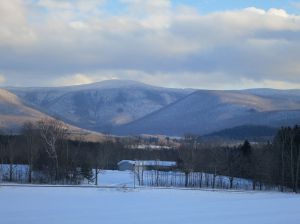
Photo of Mt. Greylock, MA, by By Ericshawwhite via Wikimedia Commons. Mt. Greylock is the home of Rowling’s Ilvermorny school.Most recently, it has expanded with some detail into North America. Rowling wrote a short story that tells the history of the founding of the North American school of magic, known as Ilvermorny, in Massachussetts during the seventeenth century. I won’t do a complete recap of the events, as I encourage you to read it for yourself (it’s less than an hour’s read, really), but the gist of the tale is that an Irish witch descended from the Slytherin line named Isolt Sayre fled the Old World with the Pilgrims on the Mayflower, and then high-tailed it into the woods to the west and eventually formed a magical family, adopting two boys (the Boot brothers) and marrying a kindly Muggle (or “No-Maj” as we apparently call non-magical people in North America, in a blinding fit of banality) named James Steward. Isolt befriends a number of North American mythical beasts and cryptids, including a river spirit in the form of a Horned Serpent and a pukwudgie whom she calls William. When she begins instructing other magical folk (including the local Native populations, mostly of the Wampanoag people), she establishes the school that eventually becomes Ilvermorny.
At a very basic level, the Ilvermorny story is a pleasant addition to the young-adult fictional world of Rowling’s imagination. Characters—despite not having much space in the narrative—generally have readily accessible personalities and even get a bit of development here and there. Rowling tries very hard to recreate the magic of Hogwarts in Massachussets, and at times, she gets pretty close to doing so, in my opinion. Given the heavy use of British and broadly European folklore and myth in the Potter series, however, her approach to North American lore and legend is strangely off-kilter. I can only really speak for North American cultural materials from the United States, here, but I imagine that Canadian and Mexican readers might also feel there is something “off” about the Ilvermorny tale. Below I will outline some of the key issues I found when reading Rowling’s backstory.
Thunderbird on Totem Pole By Dr Haggis via Wikimedia Commons. The Thunderbird is one of the four house creatures for the Ilvermorny school.House Divisions
Ilvermorny’s problems often stem from a particularly British mindset transplanted into an environment that was fundamentally un-British. Firstly, very few schools in the U.S. use the “house” structure. There are certainly exceptions to that rule, notably a high school in Kentucky, but by and large even residential boarding schools do not favor house systems anymore. Of course, Ilvermorny was founded in the 1600s, so it is very likely that a house system might have been in place for a century or so, but I doubt it would have lingered there much past the public education and Sunday school movements of the nineteenth century. Instead, individual schools foster collective school pride in competition with other schools. In some instances, there might be fraternity-like divisions within a school, but they are seldom as intense as house divisions and rivalries are generally much shallower. In some cases, such divisions are even viewed with intense scrutiny: “[O]rganizations that enclose themselves in separate houses…carry the stigma of secret societies, [and] fraternities and sororities are subject to suspicion, restriction, reform, disparagement, suspension, and at many campuses, banishment” (Bronner 242). Even at colleges, where house-like divisions are more common, they seldom take on the definite shape of the divisions found in the more British antecedents. Additionally, each of the houses at Hogwarts has a founder, with a deeper backstory about why they came together to form the school Ilvermorny has a general set of founders, but they chose not to name the houses after themselves. Rowling even makes a point of joking about how the houses are not named after the individuals behind them: ”The idea of naming the houses after themselves, as the founders, was swiftly abandoned, because Webster felt a house called ‘Webster Boot’ had no chance of ever winning anything, and instead, each chose their favourite magical beast.” The author’s clever solution to the founder problem is to form the houses around the mascots, which brings us to…
The Menagerie of Beasts
Taken *mostly* from North American folklore and legend, the house creatures are essentially mascots for their houses. Yes, each of the houses at Hogwarts has a creature associated with it, but the creature is fundamentally linked to the founder—Gryffindor is a Griffin because a Griffin represents Godric Griffindor (and there’s a whole book about the “heir of Slytherin” and the relationship to snakes through his line). The beasts in Ilvermorny actually work better as mascots because the founders remain nominally distant from their houses (Rowling’s account of the naming of the houses makes it sound like an affable after-dinner conversation). In an American secondary education environment, however, you don’t have four mascots at one school. You have four schools, with four different mascots. I will return to that concept momentarily, but first we must discuss the mascots themselves.
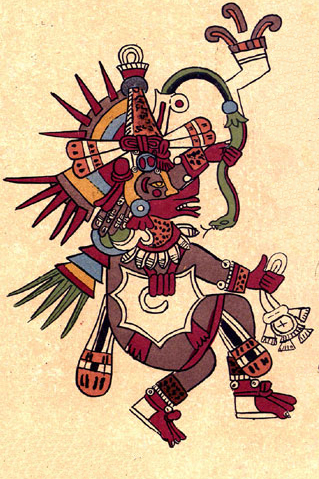
The beasts are an odd mishmash of the North American legendary landscape. All of them are at least loosely linked to Native American or Amerinidian legends of one kind or another, but are lumped together in such a way that they don’t suggest the distinct or distinguishable Native tribes whence they come. Pukwudgies, for example, would be primarily associated with areas under the Northeastern portion of the Algonquin-speaking America—largely New England, where much of the Ilvermorny story takes place. So far, so good, right? There are similar creatures depicted in other areas—the Cherokee have legends about “Little People,” and the Cree tell tales of the Mannegishi, who are a lot like Pukwudgies (Mooney 335). Choosing to call them Pukwudgies links them to a region, however, and complicates things, because then Rowling introduces the idea of the”Horned Serpent,” a much more generic term for a figure found in various forms throughout the Plains, Lakes, and Southeastern American regions, as well as having some cousins in the “plumed serpents” of the Southwestern and Central American zones. Why make one specific, and one generic? Why not settle on a specific term, like Uktena or Mishi Kenepikwa to attach it to a region or tribal affiliation in some way, the way she did with Pukwudgie? Thunderbirds are similarly broad, although at least potentially more connected to the region in which Ilvermorny is founded (although not massively so, as they feature much more prominently in regions much further west) (Cohen 92-4; Erdoes & Ortiz 218-22). Perhaps the most confusing is the Wampus Cat, which is usually limited to the Southeast and occasionally Deep South (Mooney 324; Schlosser 92-8). Again, its name is potentially generic, but folklorically it has almost no connection to the area of Massachussets where Ilvermorny is located.
By author unknown [Public domain], via Wikimedia Commons. Quetzocoatl, an example of a “plumed serpent” figure.That doesn’t mean that Rowling is wrong to draw upon these figures—it is her fictional universe, after all. It does mean, though, that she’s not really put them into any context that makes sense given the folklore at hand. This is strange, because she is very good with British folklore and fairy tales, and incorporates them frequently into her Potter series. In the case of Ilvermorny, she has Hodags (a Wisconsin-based hoax beast) and Jackalopes (mostly in the Plains and American Southwest) mingling with the creatures of New England and the Mid-Atlantic (Brunvand 831-2; Cohen 239-44) . She does not seem to realize that a Hodag would have to travel nearly a thousand miles to romp with her pukwudgies, or that a Maryland Snallygaster would need to head northwest to the tune of about four hundred miles to play with Isolt’s friendly Horned Serpent. In the end, I think that she just does not quite grasp the size and scope of America, its peoples, and their mythologies. How anyone at Ilvermorny got Wampus Cat hair for making wands during the first years of the school is a mystery, and perhaps one we will examine as she expands the Potterverse over time. Which brings me to the last point…
America is Very Big
Let’s think about some numbers. We’ll start with Hogwarts. Based on what we’ve read in the Harry Potter book series, we can estimate an average of of 10 new students per house per year for 7 years = 280 students at any given time. The U.K. population is around 65 million, which means that about .000004 percent of people in the United Kingdom are likely to be selected for Hogwarts (and I am assuming that Hogwarts is the only place young wizards and witches are educated in the U.K., so that number is the high end estimate of new witches & wizards per year). To compare, the U.S. population is around 320 million, nearly five times the size of the United Kingdom, spread out over an area roughly forty times as large. If we assume that wizarding populations are roughly the same worldwide (as one astute listener pointed out, that idea is canon from the Pottermore site), then using approximate statistics, there should be at least 1,000 young wizards and witches per year (closer to 1,300-1,400, really) for the U.S. population. Enough to fill four or five schools, that is.
Ilvermorny is a very British way of doing things, and is very out-of-joint with the American people and landscape. There’s something very Colonial and Imperialist about the way Ilvermorny is portrayed, with its founder instructing the local Natives in magic (although to her credit, Rowling does make the education more of a magical exchange; most of the magic in the story, however, is the wand-waving type, and so European magic seems to be the most prominent and dominant form). Rowling seems to be trying to create a unified and cohesive narrative about American magic, and in some places she succeeds: the idea of the Magical Congress is very sharply perceived, as is the effort to avoid an aristocracy of houses and the inclusion of a Muggle-founded house. Her efforts to concentrate everything into one time and place, and her seeming lack of understanding of American historical movements and regional interactions, undercut the story she tells, however. It’s just sloppy to dump every possible magical being from Wampus Cats and Hodags to Jackalopes and even the Snallygaster into one place, especially without giving any context. She could just as easily have started bringing in Bigfoot or Little Green Men as a part of the Potterverse, since both creatures also have antecedents in Native lore, and are perhaps as disharmonious in her setting as some of the cryptids she does include.
Mounted taxidermy “jackalope,” near Death Valley, CA. By SedesGobhani (Own work) [Public domain], via Wikimedia Commons. The jackalope is a creature found in Rowling’s Ilvermorny story (albeit strangely out-of-place)My own reading of the situation tells me that Rowling would have been much better off dividing the school into the four mascots, and then having each mascot represent a different regional school. Ilvermorny could have been the Pukwudgie school of New England and potentially parts of the Mid-Atlantic. The Wampus Cat would then have been representative of the South (possibly started by a maroon/runaway slave community—although it would also be lovely to imagine such a school represented by the Loup Garou in Louisiana). The Thunderbird would have made much more sense somewhere in the Western Plains, the Pacific Northwest, or California. And the Horned Serpent could have represented either the Middle West and Great Lakes region effectively, or been a more “plumed serpent” creature in the Southwest. Alternatively, a fifth school would have been a good thing to add, maybe including a Jackalope to represent quick-wittedness and a bright intellect with a bit of a mischievous streak in the West or upper Southwest. Rowling’s Potterverse accounts for “skinwalkers” as a type of shapeshifting Animagus slandered by charlatan “No-Maj medicine men,” so perhaps even a school founded by such an Animagi would be appropriate—particularly as it would show the magical agency of Native sorcerors in founding their own school. A fifth school division would work because the numbers for the wizarding school in the UK—Hogwarts—are roughly one-fifth of the projected numbers in the United States (and this is not even touching Canada or Mexico, which might well have their own schools—I could easily envision one by a lake in British Columbia where Ogopogo lurked in the waters much as other mythic creatures do in the lake by Hogwarts, for example) (Cohen 136-41). These schools would likely have been founded by different witches and wizards over time and during the expansion of American westward migration, and so they would not all tie up into quite so neat a package as the Ilvermorny tale or the Hogwarts history, but America is big and messy and complicated.
Yes, it would have meant a less complete story for Ilvermorny. But it would also have meant room for more expansion later. Since Ilvermorny is repeatedly described as the Great North American School of Witchcraft & Wizardry, we are left to assume that it is likely the only one. Considering we are a competitive, diverse, and geographically expansive society, any school attempting to be the sole proprietor of magical knowledge on the continent is unlikely to succeed. As historian Daniel Boorstin notes, “There has never been an effective American movement for a national university. The numerous and diverse American colleges, separated by vast distances, never formed a self-conscious community of learned men”(and women, I would add) (180). Boorstin is obviously discussing higher education, but the principle of spatial separation and scholastic individualism is mirrored in secondary education, too. We just don’t do an Oxford or a Cambridge here—we prefer numerous schools representing regional identities, and that’s something the Ilvermorny story misses. Rowling has a big imagination, and this is all fiction and her universe; she can do as she pleases. From where I sit, though, it seems she has not been able to imagine just how big and diverse America can be in its landscape, peoples, and lore.
I’d like to note that Peter Muise of the New England Folklore blog has also tackled this topic, much more succinctly than I have here, and I highly recommend you check out his take on the subject. Also, Laine & I discussed this topic extensively on our latest episode. And, of course, this is really all just for fun anyway. While I’ve obviously taken a bit of (wait for it) Umbridge at certain folkloric pieces of Rowling’s story, really it’s just there to entertain us and she seems to do that pretty well. Plus, it gives us a place to work from when discussing things we should expect to find in New World magical practices (such as diverse forms spread over a wide set of regions, with a combination of widespread and geographically particular spirits/creatures to explore). I write what I do here with fondness for Rowling’s work (and let’s face it, she doesn’t need my approval for anything!), and in the hopes that her story might inspire deeper reading for those who are interested in American folklore.





 New World Witchery - The Search for American Traditional Witchcraft
