Blog Post 39 – Angelica Root

Since we talked about the very masculine High John yesterday, today I thought we’d look at its feminine “counterpart,” Angelica.  The main plant bearing this name is Angelica archangelica, appropriately enough, and it has strong associations with angels and holiness.  It is often associated with the Archangel Michael, and has much of his same protective power.

Culpepper, in his medieval herbal manual, writes of this herb:  “To write a description of that which is so well known to be growing in almost every garden, I suppose is altogether needless; yet for its virtue it is of admirable use” (Culpepper 8).  This plant has been grown commonly for hundreds of years, for its medicinal, culinary, and magical properties.  It’s one of the common flavorings found in liqueurs such as Chartreuse and it has a highly aromatic quality that runs from root to leaf.

Botanical.com describes it thusly:

“The roots of the Common Angelica are long and spindle-shaped, thick and fleshy – large specimens weighing sometimes as much as three pounds – and are beset with many long, descending rootlets. The stems are stout fluted, 4 to 6 feet high and hollow. The foliage is bold and pleasing, the leaves are on long stout, hollow footstalks, often 3 feet in length, reddish purple at the much dilated, clasping bases; the blades, of a bright green colour, are much cut into, being composed of numerous small leaflets, divided into three principal groups, each of which is again subdivided into three lesser groups. The edges of the leaflets are finely toothed or serrated. The flowers, small and numerous, yellowish or greenish in colour, are grouped into large, globular umbels. They blossom in July and are succeeded by pale yellow, oblong fruits, 1/6 to a 1/4 inch in length when ripe, with membraneous edges, flattened on one side and convex on the other, which bears three prominent ribs. Both the odour and taste of the fruits are pleasantly aromatic.”

The root of the plant has potent estrogen-like compounds, which is likely one reason it has a strong connection to women.  It’s also supposed to be good for helping to break fevers and expel disease, particularly diseases of the lungs.

Magically, this plant is female, through and through.  That’s not to say men can’t use it, of course.  I bound up an Angelica root in white linen and placed it beneath our bed when my wife was pregnant to protect her and the developing baby (all turned out quite well, by the way).  But Angelica is renowned for its power to protect women and undo harmful magic.  Some of the various spells one can do with Angelica include:

  • Carrying the root to protect from harm (in general)
  • Women can carry the root, along with a picture of St. Michael the Archangel, to protect from unwanted advances (or worse) from men
  • Dress Angelica root with Blessing oil (or just olive oil over which prayers have been said, such as Psalm 23) in order to protect a newborn baby (place the anointed root in a white cloth under the baby’s bed).
  • Ground Angelica root can be mixed with salt and another protective herb, like rue, rosemary, or sulfur (not an herb, I know, but I think you follow me) and kept in a small white mojo bag to guard against hexes.  Alternatively, the mixture can be sprinkled across doorways or mixed into an Uncrossing floor wash to remove jinxes placed on one’s household.
  • A strong tisane (or tea) of the root can be made and used to sprinkle a new home or a home where negative spiritual activity has occurred in order to make the home calm and peaceful.

Additionally, Cathreine Yronwode mentions that “Angelica stem candied in sugar is an old fashioned treat said to keep children healthy” and that “When buying Angelica, be aware that its occasional alternate name Masterwort more truly belongs to Imperatoria ostruthium…Also, Hercules Club, a plant in the Aralia family, is called Angelica Tree by some, but is not related to Angelica” (Yronwode 30).

Thanks for reading!

-Cory

Blog Post 38 – High John

Howdy all!

I hope you had a great weekend!  This week, I’m going to be focusing on herbs, roots, and curios used in various American magical practices.  I’m starting with one of the most common and most important roots in hoodoo:  High John the Conqueror.

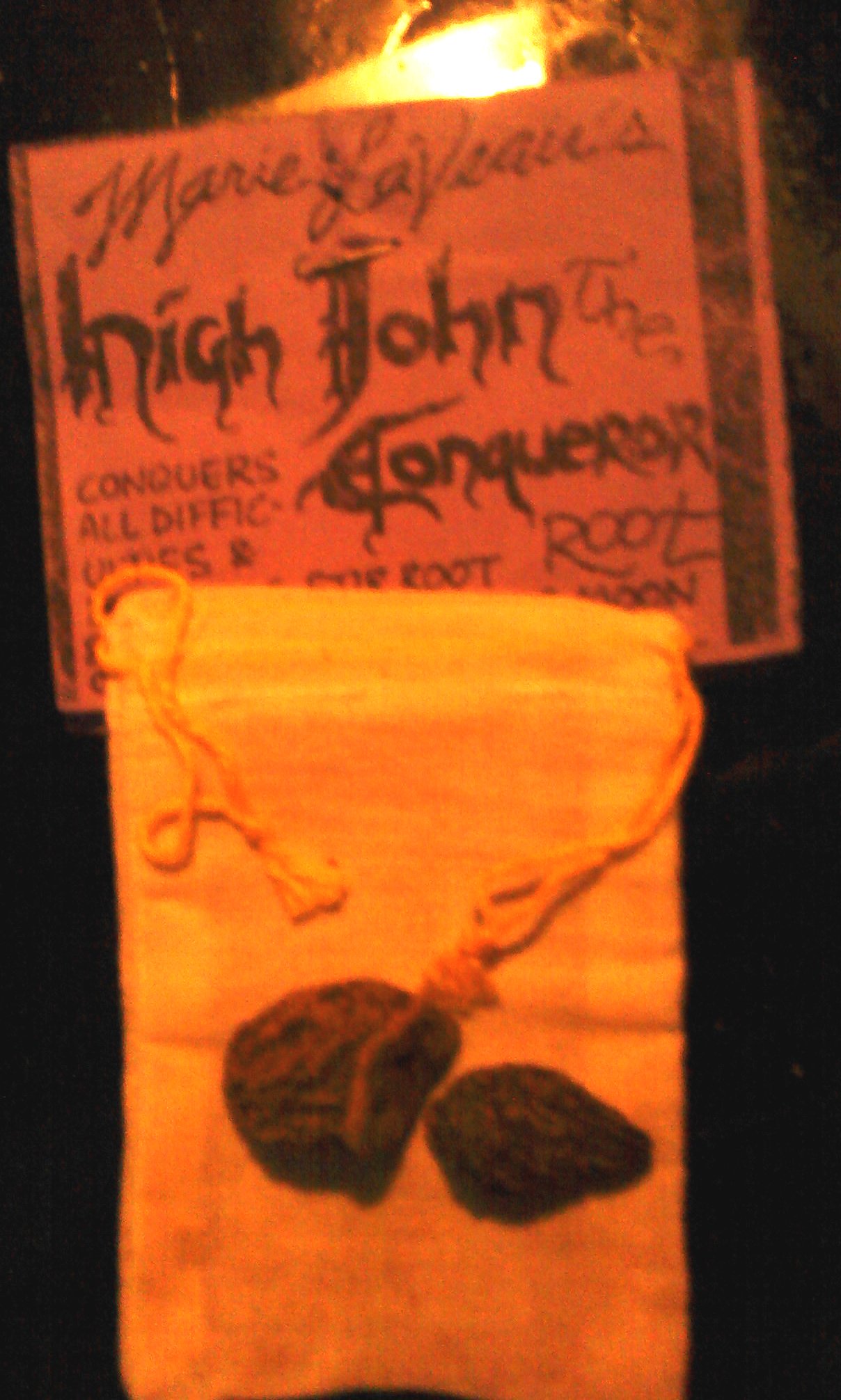
This shriveled root is part of the Ipomoea genus, and is a relative of the Morning Glory.  Its resemblance to a shrunken testicle has made it a powerful symbol of potency and virility.   I consider it to be one of the quintessential hoodoo herbs (which is the reason I included it in my “hoodoo kit” post).  Catherine Yronwode says of the root in her Hoodoo Herb and Root Magic book, “ A person possessing a John the Conqueror Root will never be long without money or a lover and will be extremely lucky in games of chance and business” (HHRM p. 111).

Some of the most common ways to use this root are to put it into a jar of neutral oil (such as safflower or olive) and let it sit for a few weeks, occasionally shaking the jar.  The resulting oil (which will have little to no smell and to which you should add some vitamin E or tincture of benzoin to prevent rancidity) can be used to anoint anything that needs more power.  Rubbed on your hands and feet, it adds personal power to everything you do.  Rubbed on money kept in your wallet, it helps you be more successful in luck and business endeavors.  Rubbed (very lightly) on the penis, it restores male virility and enhances sexual prowess.

Another key way to use this root is to keep a whole root in your pocket, either by itself or wrapped in a red cloth bag as a mojo hand.  Fed regularly (once a week at least) with whiskey or the High John Oil I just described, it keeps you empowered and potent at all times.  According to the lore, money comes easier, luck favors you, love finds you, and sex is better than ever.

You can also add John the Conqueror (by the way, you say it “John the Con-ker”) chips or oil to other mojo hands to increase their potency as well.  I like to add them to success and business workings, because they tend to work faster and require less finagling on my part after my initial efforts.

The High John root has appeared in pop culture several times, too.  Whenever hoodoo comes up in songs, a mention of this root is seldom far behind.  For example, in the Allman Brothers Band remake of Willie Dixon’s “Hoochie Coochie Man,” radio audiences of the 70’s heard the lyrics:

“Got a John the Conquerer root and got some mojo too,
We got a black cat bone, we’re gonna slip it to you.”

Considering the libertine behavior the singer boasts of elsewhere in the song, having a little magic keeping his virility charged certainly seems like a good idea (I’ll address the black cat bone reference in another post).  Muddy Waters (who worked with Willie Dixon quite a lot) also recorded a blues song featuring the hoodoo charm, entitled (appropriately) “My John the Conqueror Root.”

There are lots of places to find this root on the web, and if you have a local botanica of some kind, they will also likely carry this curio.  I highly recommend anyone looking into American magic familiarize him/herself with High John.  Who couldn’t use a magical boost from such a potent little root?

Thanks for reading!

-Cory

Blog Post 37 – Some Weekend Reading

Howdy everyone!

I thought that I’d finish up this week with another essay, this time one that I won’t actually be posting on the New World Witchery site.  Instead, I’m going to provide a link to an excellent essay I found on Pow-wow magic, and then some notes I made while reading it.

The essay itself is written by David W. Kriebel, Ph.D.  and has a distinctly academic tone.  It focuses on the history and practice of braucherei in the Pennsylvania area, as well as examining some modern practitioners (most notably Don Yoder and Silver Ravenwolf (aka Jenine Trayer).  It’s an interesting read, I think, but I’ll let you decide for yourself.

Here’s the essay:  http://www.esoteric.msu.edu/VolumeIV/Powwow.htm

Some of the thoughts I had while reading this were:

  • Why is Pow-wow fading from the magical stage so steadily?  Many spiritual and magical traditions have received increased attention in the past 30-40 years as the shiny patina of atomic-age wonder has begun to fade, yet Pow-wow still seems to be on the decline.
  • Is Pow-wow evolving into something else altogether?  Kriebel mentions Ravenwolf’s book, which has had a mixed reception at best in the magical community.  But her version of Pow-wow may just be where the practice is headed.  Is that a good thing, a bad thing, or just a thing, period?
  • The old books of Pow-wow, such as The Long Lost Friend and the Sixth and Seventh Books of Moses, get a good bit of attention in this essay.  How relevant are they to the current practice of this magical system?
  • I love the story about Mountain Mary.  It makes me wonder just how many of my local folk heroes might have been magically inclined.
  • The three levels of magical ritual (I, II, and III) which Kriebel mentions correspond well to various practices I’ve seen elsewhere (a simple charm from Hohman might be a I or a II, while Chris Bilardi’s complete brauche circuit in The Red Church is more of a III, I think).  I wonder if the idea presented here about Pow-wow would hold true for other magical systems, like hoodoo.
  • One of the best things I come away with from this essay is in his conclusion, where he notes a 90% effectiveness rating for Pow-wow curing, which is remarkably good for any healing practice.  In the end, I think that kind of a result defies any attempts to explain magic as pure superstition, but I may be wrong.  What do you think?

That’s it for this week!  Have a great weekend, and as always, thanks for reading!

-Cory

Blog Post 36 – Questions to a Braucher, Part II


Hello again!

Today we’ve got Part II of the question-and-answer article by Chris Bilardi. I won’t spend a lot of time introducing it, as I think Chris does a marvelous job of presenting his information without all of my gum-flapping beforehand 🙂 Onto the article!

How important is God in braucherei healing?

God is of paramount importance in braucherei. There is no real healing outside of God. Those two statements, I know, sound horribly pious. But, I cannot change the fact of who the real Source of this work is. Before a powwow session the braucher will ask every new ‘patient’ if they belief in God. If the response is ‘no’ the appointment ends right there. There has been some disagreement if one needs to be specifically Christian in order to be treated, or if one only needs to accept the God of the Bible. It is difficult for some to grasp the importance of this. Today we live in a very secularized, humanistic culture. Man has become the measure of all things in an imperfect existentialist universe of largely impersonal forces. Even “spiritual” power, when acknowledged, is made palatable by putting ‘it’ on the same level as electricity, for example. The healing power is “orgone”, “vril”, “animal magnetism”, “chi” – it is anything but God Almighty. But, that is not the world of a traditional braucher. This is not to say that there are no such energies, but in the view of traditional powwowers, it is the Holy Ghost that directs all power. In the Christian belief, the Holy Ghost is not a “what” but a “Who” — the Third Person of the Holy Trinity. The Pennsylvania Germans have traditionally been mainly of the Lutheran and Reformed confessions (although there are many other denominations as well), and it is within that ‘universe’ that old time practitioners had (and have) their foundation and points of reference. Therefore, it is important to note that braucherei is not a religion, but simply a multi-rooted, varied set of folk practices that have grown out of medieval Central European Christian culture. The roots of braucherei practice are many, indeed, and do have some pre-Christian antecedents. But, these pre-Christian bits and pieces are all operative, or practical. All pieces are subsumed in Christ.

Can you give the history of braucherei in a specific location?

Yes, Williams Township, Pennsylvania, specifically around the area of Easton and Raubsville.  During the 18th and 19th centuries, braucherei in this area was dominated by two families of powwowers: the Wilhelms and the Seilers (Saylors).  The patriarch of the Seilers was Johann Peter Seiler (1721 b. – 1803 d.). He and his wife Margaret (nee Maurer) were the parents of Johannes, Daniel, Frederick and Peter. Johann Seiler was a braucher and passed the practice to his youngest son Dr. Peter Saylor (1809 b. – 1868 d.). Dr. Saylor and his father, in turn taught powwowing and general medicine to John Henry Wilhelm (1816 b. – 1886 d.), who was much loved in his community and sorely missed when he passed away. At one point in his career as a braucher, a disgruntled local had Dr. Wilhelm arrested for practicing medicine without a diploma. Around this time Jacob Saylor (1793 b. – 1865 d.), grandson of Johann Peter Seiler, was practicing powwow as well. Prior to John Henry, his grandfather, Jacob Wilhelm (1744 b. – 1821 d.) was a braucher from Germany who passed along his book of charms, which remains to this day with his descendents.  John Henry’s son Eugene Wilhelm was equally loved by his community and practiced until his death in 1905. The interesting thing to note about Dr. Eugene’s practice is that he incorporated magnetic treatments into his powwowing. It was not unusual for powwow doctors to add new fads, trends, or advances in “alternative medicine” to their powwowing. When Mesmerism was the rage, many powwowers would borrow from the Mesmerists.  Dr. Arthur Wilhelm (1879 b. – 1950 d.), Dr. Eugene’s son, incorporated orthodox, allopathic medicine with homeopathy, powwow, and other “alternative” methods in his practice. One of the many things that is interesting about these two families is that the practice of braucherei has had same-gender transmission – not only among blood family members, but between families. Of course, the Saylors and the Wilhelms are related by marriage, which may have accounted for this. This method of teaching powwow differs from most noted traditions that insist on cross-gender transmission: that is, male to female; female to male.  Another interesting note is that Dr. Peter Saylor began the tradition of transferring illness, curses, and evil entities to a local peak called “The Hexenkopf” (which means “the witch’s head”) where it was believe that demons dwelled and evil witches held their Sabbaths. Usually powwow doctors will transfer illness, and other maladies, to smaller objects such as trees, rocks, pieces of metal, etc., making Dr. Henry’s receptor unique. All of the above information regarding these families can be found in Ned Heindel’s excellent book Hexenkopf: History, Healing & Hexerei. I have chosen to highlight this particular area and set of families to illustrate the consistency and persistence of powwow’s transmission as whole lineages.

Is there any difference in the healing of animals vs. the healing of humans?

There is really no differences beyond the types of illnesses – for example, humans don’t get “windgalls” – cysts in horse legs. However, many of the same charms used on humans are used on animals. There are general forms of powwow practice that can cover any illness for man or beast, such as was taught to me that I call “The General Brauche Circuit” in my book.  A notable difference in powwowing animals is that they can be nervous and wiggly and not stay still for longer sessions of powwow work – the same as human children. However, many brauchers have a knack at calming down nervous animals, so there are often no issues to be had.

How can a person get started learning braucherei?
Reading and researching is the first way to begin, unless one knows of someone who powwows and is willing to teach. By researching and keeping an ear to the ground, one will create a network that will make finding an established practitioner easier. However, once a braucher is found there is no guarantee that she or he will take on apprentices or students. Get the old powwow manuals: The Long Lost Friend, Egyptian Secrets of Albertus Magnus, Secrets of Sympathy, just to name three. Also, find books, magazines, and articles on Pennsylvania German (Dutch) folklore, such as issues of “The Pennsylvania Dutchman” (long out of print). My own book, The Red Church, contains much information and a large bibliography for those who want to go farther and do their own research. Despite all of these written sources, nothing can ever take the place of having the tradition passed on by a live human being. That last comment reminds me that spirits can, and do, teach people much when they begin this work. Sometimes this sort of teaching is not always obvious. In other cases it can be more dramatic where a braucher can have ‘visions’ or dreams where they obtain spirit guides, ‘Indian’ guides, and such. I, myself, have received some teaching at this level in the form of highly lucid dreams. Last, but certainly not the least, the Holy Bible is of paramount importance in braucherei practice. Many powwowers will not use any charms other than lines taken directly from Scripture. I highly suggest that a person who wants to be a braucher get acquainted with that book. If one does begin to practice, what s/he will notice in time is that one has a knack for certain types of healing or activity over all others.  Really read up on Pennsylvania German culture and try to immerse oneself in it as much as possible. For those who are outside of the cultural areas, which are mainly in Pennsylvania, Ohio, Indiana, and certain parts of Carolinas, West Virginia, and Canada, it will be more difficult to do this. For those who live in or near North Dakota, there are the so-called “Volga Germans” or Germans from Russia (who are not Pennsylvania Germans), and have braucherei in their culture which is virtually indistinguishable from the PA German variety. Take the time to get some familiarity with the German language, both the standard usage, and the Deitsch dialect; this will make it easier to understand the things found during research work. One last suggestion: pray for guidance, this is probably the most important of all.

I hope y’all enjoyed that! I know I did. Many thanks to Chris for contributing to us here at New World Witchery. He’s a real friend to us here, and we’re immensely grateful that he took time out of his life to put together this phenomenal essay. If you liked what you read here, please head over to Amazon (or to your book dealer of choice) and pick up a copy of his master-work on braucherei, The Red Church.

Thanks for reading!

-Cory
Blog Post 35 – Questions to a Braucher, Part I

Greetings, all!

This week, we’re very lucky to be able to host a new article by the rather brilliant author of The Red Church, Chris Bilardi.  The article will be put up in two parts over two days.  It’s a thoughtful and well-composed question-and-answer session from a traditional Pow-wow practitioner’s (or braucher’s) perspective.  If you enjoyed my introduction to Pow-wow series, have been looking for straight answers on the magical traditions of the Pennsylvania Germans, or just have an interest in folk magic and healing in general, I think you’re in for a real treat.

Now, without further delay, the article:

Questions to a Braucher

Below is a list of questions regarding the present-day practice of Pennsylvania German Braucherei, or otherwise known as Pow-Wow.

How does one find a braucher nearby and contact them?

Traditionally, one finds a braucher by word of mouth. Prior to the so-called York “Hex Murder” of the braucher Nelson Rehmeyer in 1928, there were many full-time, professional powwowers who hung out a shingle and advertised. After Rehmeyer’s murder, the Commonwealth of Pennsylvania began a sever crackdown on the practice of braucherei. With that stated, it must be said that even prior to the shocking events of 1928, most practitioners did not advertise, charge, or hang out a ‘shingle’ that they were in practice. In fact, the norm was, and still is, that of the private individual, the knowledge of whose powwowing activity is passed by word of mouth, and who practices mainly among family, friends, friends of friends, and so-on. At this point, there are still very few publically known powwow doctors. One who wishes to go to one must still keep an ear to the ground, and then make discrete inquiries. Pennsylvania Dutchmen tend to be shy (or even in some cases hostile) when the subject is broached. These reactions are a mixture of embarrassment (for fear of being seen as “backward”), and disbelief (such as some who see the practice as devil’s work, or just superstitious nonsense). It would also be accurate to say that there are many ethnic Dutchmen today who have never heard of powwowing. Reticence on speaking of a known powwower is also a way of protecting a practitioner’s privacy (and ensuring their safety).

What kind of services does a braucher perform?

What services one can get depends upon the individual practitioner. The way it tends to work is like this: each powwower finds that s/he is particularly good at one sort of activity, and then specializes in that type of activity. For example, some are only good at removing warts; others have a knack for getting rid of inflammations, and so on. There are others who will try their hand at any sort of powwowing with the belief that it does not hurt give it a whirl. Some types of powwowing, such as I was taught, in a way fall into the latter category; in this case, there is only one method that is applicable to all conditions. Services have traditionally included any of the following: pain-relieve, inflammatory problems, colic, fever, warts and other lesions, folk-illnesses such as abnemmes or opnema (“the take off” – a wasting disease), aagewachse (“Livergrown”) and rotlaufa (which falls under red inflammatory conditions); also sore throats, heart disease, persistent cough, and any other physical ailment one can think of. Some brauchers believe that they cannot ‘try’ for congenital illnesses, only those acquired throughout life. Other services can include the preparation of charms and talismans, such as the himmelsbrief or a “fire and pestilence letter” (both are written talismans that bless and ward away illness, evil spirits and catastrophes).  Some brauchers are also exorcists; they have the ability to banish ghosts, hauntings, and demonic entities. The reasoning behind these activities is that all Christians are called by Christ to do these things to the glory of God and the good of His children. Not the least of this sort of activity is the breaking of a ferhext (cursed) condition, and the destruction of all acts of witchcraft. Some powwowers have “the sight” and are able to foretell events and find lost objects.

Is this stuff witchcraft?

Short answer: no. Long answer: it depends upon what a person thinks “witchcraft” is. Braucherei is a spiritual, energetic folk practice or modality of healing; traditionally, hexerei (i.e. “witchcraft”) has always been seen as a harmful practice. This is not the witchcraft of Neo-Paganism, or Wicca. The hexe was seen as one whose main purpose for existing was to make life miserable for others: “far die leid gwele”. Fundamentally, hexerei is an abuse of spiritual power. To some people braucherei with all of its seemingly ‘odd’ prayers, hand movements, herbs, and mysterious objects is nothing but dyed-in-the-wool witchery.   For the Neo-Pagan it looks from the outside like what they’ve come to know as “witchcraft”; for the Christian who is turned off by powwow, it equally looks from the outside as what they’ve been told witchcraft is supposed to look like. The common denominator in both of these superficial views is powwow’s “shamanistic” approach to the spiritual world. One of the reasons that Dutchmen have been cautious about helping others get involved in powwow is the very real danger of someone getting tangled up with black magic. It is far too easy for a poorly trained person to use their new-found knowledge abusively. Powwow does demand a good degree of spiritual discernment.

Does one need to pay for braucherei treatment?

Another short answer: no. Unfortunately, there is a long answer here too. In the past there were practitioners (the “professionals” with their shingles hanging outside) that did charge a set fee for healing, despite claiming that their power came “from Jesus”.  Some readers of this article will doubtlessly know of some folk healing traditions that demand the exchange of money (“crossing the palm with silver”) in order for it to work. In no uncertain terms, please understand that braucherei is not one of these traditions. By tradition, if one goes to a powwow doctor, s/he might leave a donation. The powwower will not ask for a donation. I was taught that a person can leave some money underneath the powwower’s Bible. Some practitioners will, in turn, not keep this money, but donate it to their church or to a charity.  As I made note of in The Red Church, there are some activities to which there are legitimate charges, such as the creation of a himmelsbrief or fire and pestilence letter – especially if it entails calligraphic fraktur work. In other words, any activity that demands the time and resources of the powwower can be legitimately charged to the client. However, the bulk of a powwower’s time is spent in healing work, and one is to never charge for healing. It is God who is the real doctor on these occasions, and no human being can take credit (or remuneration) for that work.

That’s it for Part I.  Tomorrow I’ll put up the rest of the article, which will deal a little more with the philosophy of the practice, and advice on getting started.

Thanks for reading!

-Cory

Podcast 6 – Hoodoo and an Interview with Conjure-man Papa Toad Bone

-SHOWNOTES FOR EPISODE 6-

Summary
In this episode, we discuss hoodoo and rootwork, particularly our experiences with it.  Then we have an interview with esteemed conjurer Papa Toad Bone.

Play:

Download:  New World Witchery – Episode 6

-Sources-

Websites
Lucky Mojo Co. – A site with lots of hoodoo information
Toad’s Bone Apotheca – Our guest’s marvelously funky and fantastic online curio shop
Mississippi Cunning + Conjure – A forum space for those interested in Southern magic and Traditional sorcery
Scarespite – A repository of Traditional Witchcraft and Sorcerous folklore

Promos & Music

Title music:  “Homebound,” by Jag, from Cypress Grove Blues.  From Magnatune.
Promo 1-Inciting a Riot Podcast
Promo 2- Druidcast
Promo 3- Podcast Appalachia

Blog Post 31 – Who’s Who in Hoodoo, part deux (Intro, Part III)

Today, I’m going to tackle of few of the modern rootworkers I know and/or admire.  This is most certainly is not a comprehensive list of professional hoodoo practitioners in North America, so please don’t start throwing rotten vegetables at me for not listing one of your favorite rootworkers.  But DO feel free to leave a comment on this post with the name/contact info of any professional hoodoo you think the world should know about!

Okay, on with the show!

Modern Rootworkers

Catherine Yronwode – I believe she actually prefers “catherine yronwode,” without capitalization.  If you are reading about hoodoo on the web and you don’t know who she is yet, you should immediately head over to the Lucky Mojo page and read her online text on the history and practice of hoodoo.  She is probably one of the most prominent profiles in modern conjure work, and she runs one of the biggest supply houses for magical and occult goods specializing in traditional hoodoo recipes and formulae.  Yronwode was featured in Christine Wicker’s Not in Kansas Anymore, which profiled magical practitioners across the United States.  She was also a famous comic book artist back in the 1970’s, and judging by the colorful designs on her wares, I’d say she still has an eye for a good picture.  She’s also been instrumental in keeping hoodoo a vital, living tradition rooted in history but adapting to modern times.  Her course for prospective students of hoodoo is almost a pre-requisite for any rootworker, and her Association of Independent Readers and Rootworkers provides a stamp of quality which ensures that those seeking magical help don’t get ripped off.   Seriously, if you’re reading this and don’t know who she is, go to Lucky Mojo right now!

Dr. Christos KioniThis Florida-based rootworker is host of the Lucky Mojo Hoodoo Rootwork Hour.  He is also one of the best known professional conjure men working today, and the active owner of the MyHoodooSpace website.  Dr. K also works very hard to preserve the African Diasporic traditions (such as the ATR practices discussed in the introductory post on hoodoo earlier this week.  I think he works both with the left hand and the right (meaning he will curse if he sees a need for it), though I’m basing that on some of the discussions from his radio show and he may well have changed ideologies since then.  He was also mentioned in Not in Kansas Anymore, and actually knows where to find the grave of Zora Neale Hurston (which very few folks do).  He is definitely a big personality, but he has a friendly and warm demeanor about him, and I believe he’s got a fairly high rate of success with his work, too.  He also happens to be friends with cat yronwode (if you didn’t guess that from the name of his radio program).  As he says of himself “I can hit a straight lick with a crooked stick!”

Michaele Maurer – Miss Michaele (pronounced mi-KAY-luh, I believe) is the owner of the Hoodoo Foundry, a site dedicated to traditional rootwork.  One of the reasons I really like her practice is that she focuses on Southern-style rootwork, including a lot of Bibliomancy and using Biblical prayers and magic to accomplish her goals (not that I think all great rootworkers are Bible-thumping Christians, mind you…see Karma Zain or Papa Toad Bone for contrast).  I really value her deeply traditionalist approach, however, and I also like that she has a broad range of reading styles, including tarot, pendulum, and ceromancy (reading candle wax).  She’s not one who does jinxing or crossing work, but she does at least acknowledge that sometimes it is justified and she helps clients needing those services to find a root worker who will attempt those tricks.   She seems to be very tender-hearted and kind, and works for the good of her clients with deep sincerity.

Starr – An old-fashioned Southern hoodoo woman from Texas, Starr has been steeped in conjure work for most of her life.  She’s quite sassy and funny, and also very straightforward.  She’s another traditionalist who works closely with Christian religious figures, including Saints.  While much of her work is focused on things like spiritual cleansing, sweetening, and healing, she also does vinegar jars, hot foot workings, and as she puts it, “I will do separation and break up work on a case by case basis if so guided by the spirit.”  She also runs the Old Style Conjure site, and offers mini-courses which compliment a broader study of hoodoo quite nicely.

Karma Zain – Ms. Zain is not only a great rootworker, she’s also a bishop in the Franco-Haitian Gnostic Vodoun tradition.  I know, I’ve said I really like old-style conjurers who stick to certain historical precepts regarding the incorporation of Biblical elements, but that doesn’t mean I think all good hoodoo men and women must be Judeo-Christian.   Karma Zain proves that point, because besides being a Vodoun bishop, she’s an honest, straightforward worker who isn’t afraid to say “no” to a client if she doesn’t feel their cause warrants the action they ask for.  She’s the kind of rootworker who isn’t afraid to dig in the dirt and use the less savory curios like bone fragments and fur.  She seems like an incredibly down-to-earth and sensible woman, and one I wouldn’t want t cross!

Papa Toad Bone – This Mississippi based conjure man is the proprietor of the Toad’s Bone Apotheca, one of the funkiest and witchiest sites I’ve seen.  Just looking at his webpage makes me want to lay a trick or two or take a walk to the crossroads.  He’s also Pagan, and very much a non-Christian kind of Pagan, again proving that great conjurers needn’t be entirely wrapped up in the Biblical worldview.  I’ve known him through several different avenues over the last couple of years, and he’s always struck me as someone who really spends time with spirits and understands them incredibly well (I think he even found a great way to play card games with them, but hopefully I’ll get him to tell about that at some point).  He’s also a nitty-gritty sort of worker, spending a good deal of time out in the swamps and wild places gathering materials for his shop and clients.  Again, someone I wouldn’t want to cross, and a rootworker who gets things done.

Carolina Gonzalez – Another Pagan rootworker, Ms. Gonzalez incorporates her Latin roots into her magic, offering a particularly unique blend of brujeria, hoodoo, and witchcraft to her clients.  She runs The Hoodoo Shop on Etsy, and she’s the resident hoodoo expert for sites like The Noble Pagan and The Modern Pagan.  She’s located in the Canary Islands, proof that hoodoo is a worldwide phenomenon at this point.  Her site offers her products as well as courses and LOTS of great information from her many different areas of expertise.

Sarah Lawless – I certainly can’t leave out Sarah, a friend to New World Witchery and a heckuva witch and conjure woman in her own right.  She practices her root work out in the wilds of British Columbia, carefully adapting the fundamental practices of traditional Southern rootwork to her immediate environment.  We’ve talked to and about her a lot on this blog, so rather than sound like a rampaging fan boy, I will simply suggest you go check out her blog and store and see how magical she is for yourself.

Stephanie Palm – The wonderful proprietress of Music City Mojo, and my personal hoodoo teacher.  She is not one to pull punches or sugar-coat things, though she is also incredibly warm and friendly.  Stephanie is the High Priestess of a Traditional Witchcraft coven, as well as a devotee of Vodoun.  She’s a gifted teacher, as well as a gifted conjure woman, and she isn’t afraid to get her hands dirty in a graveyard or to lay down a jinx if the situation calls for it.  More importantly, she isn’t afraid to let someone know that the situation DOESN’T call for a jinx.  I really could go on and on about how much I adore her and how thankful I am to her for all she’s taught me, but for now I’ll just say that if you’re looking for someone who knows their stuff, she’s one to talk to.

I know there are lots more rootworkers out there, and I’d love to hear about them from all of you, so please feel free to post a comment on this blog about your favorite hoodoo men and women.

Thanks for reading!

-Cory

Blog Post 30 – Who’s Who in Hoodoo (Intro, Part II)

Today we’ll be looking at some famous personalities from the root working world.  These are not comprehensive biographies, by any means.  But they should at least give you some cursory information and enough information to look into the interesting lives of these conjure-folk further if you desire.

So, without further adieu, here’s Who’s Who in Hoodoo:

Historical Hoodoo Figures

Marie Laveau – Known as the “Voodoo Queen of New Orleans,” there is much folklore and little fact surrounding the powerful figure of Marie Laveau.  She was a free woman of color living in New Orleans during most of the 19th century, living to be nearly 100 years old herself.  She was flamboyant—holding large dances in Congo Square and appearing frequently with a large snake which she had named Gran Zombi—but surprisingly also very devout, often attending Catholic mass on a regular basis.  While she is best known for her Voodoo associations, Laveau had a tremendous gift for magic, and was said to maintain control of the city through a network of informants and a healthy dose of sorcery.  Zora Neale Hurston, who studied hoodooo (and Voodoo) with Laveau’s alleged nephew, Luke Turner, wrote about Laveau’s  intense magical power:

“The police hear so much about Marie Leveau that they come to her house in St. Anne Street to put her in jail. First one come, she stretch out her left hand and he turn round and round and never stop until some one come lead him away. Then two come together…she put them to running and barking like dogs. Four come and she put them to beating each other with night sticks. The whole station force come. They knock at her door. She know who they are before she ever look. She did work at her altar and they all went to sleep on her steps” (Hurston, Mules and Men, Part II, Chapter 2)

Today, many people—magical practitioners or not—visit her grave in New Orleans, leaving her offerings and asking her for favors, a practice not uncommon in hoodoo. (additional info gathered from Wikipedia and R.E. Guiley’s Encyclopedia of Witches and Witchcraft).

Doc Buzzard – There are many who claim the name “Doc” Buzzard, but the most famous one is a South Carolina root doctor from the late 19th and early 20th centuries. He was a famed magician and healer, and was much sought after for his cures.  He was also white, which sometimes surprises people.  There were many inheritors to the name “Doc Buzzard,” one of the best known being a rather unscrupulous character who was eventually reigned in by…

Sheriff James McTeer – According to Jack Montgomery, who spent a good bit of time interviewing McTeer:

“Sheriff McTeer recounted a…conclusion to a psychic war he had with the famous Doctor Buzzard. McTeer ordered Dr. Buzzard to stop selling potions. This particular war of curse and counter-curses ended with the drowning death of Dr. Buzzard’s son. Soon after, Dr Buzzard visited McTeer and the two men made peace and became friends of a sort.” (Montgomery, American Shamans, Chapter 1)

McTeer was a gifted hoodoo in his own way, though he was less focused on the prefabricated potions which made hoodoo a viable commercial enterprise throughout the 20th century.

Aunt Caroline Dye – A famed hoodoo woman from Arkansas, Aunt Caroline Dye was another long-lived magical practitioner (supposedly living to the ripe old age of 108).  She was cited in Harry Hyatt’s encyclopedic text on hoodoo as being a great jinx-breaker, and the Lucky Mojo page on her cites several blues songs devoted to her legendary gifts.

Henri Gamache – A pseudonym for an otherwise unnamed author, Henri Gamache is the name associated with many of the most influential texts in mid-20th century hoodoo.  His “Philosophy of Fire” as outlined in The Master Book of Candle Burning is a foundational text for conjure candle rituals, and includes a good number of psalm rituals as well.  Other key texts authored by Gamache include Terrors of the Evil Eye Exposed and Mystery of the Long Lost 8th, 9th, and 10th Books of Moses.

Moses – Speaking of Moses…  There are many who look on Moses as the first conjure man.  He was imbued with holy power by G-d, and used several commonplace tools to create miracles, not unlike the conjure men and women of recent times.  Some of his “tricks” include:

  • Transforming his staff into a serpent (Exodus 7)
  • Turning the Nile into blood (Exodus 7)
  • Summoning the Plagues of Egypt (Exodus 7-12)
  • Parting the Red Sea (Exodus 14)
  • Bringing water from the rock with his staff (Exodus 17)
  • Mounting a bronze serpent on a staff to cure venomous snake bites among the Israelites (Numbers 21)

Zora Neale Hurston was a major proponent of this view of Moses, making it a central theme in her book Moses, Man of the Mountain.  In Mules and Men, Hurston describes Moses as:

“The first man who ever learned God’s power-compelling words and it took him forty years to learn ten words.  So he made ten plagues and ten commandments.  But God gave him His rod for a present and showed him the back part of His glory.  Then too, Moses could walk out of the sight of man” (Hurston, Mules and Men, Part II, Chapter 1).

Of course, this is not the common view of Moses, but I like to at least consider the idea…but then I like to take a generally unorthodox view of lots of Judeo-Christian mythology, myself.

Zora Neale Hurston – To end, I thought I should at least mention the woman I’ve cited several times today.  Zora Neale Hurston is a folklorist from the mid-20th century whose most famous book is Their Eyes Were Watching God.  However much of her best work is in the study of hoodoo and Voodoo in books such as Mules and Men and Tell My Horse.  While many of her stories are elaborations or even (possibly) completely fictional constructs, they nonetheless provide a lot of good hoodoo techniques, recipes, and philosophies.  Taken with a hefty grain of salt, her work is a great way to explore hoodoo as it grew within the African-American community during the twentieth century.

That’s it for today.  Tomorrow I hope to get into contemporary rootworkers.  Until then…

Thanks for reading!

-Cory

Blog Post 29 – An Introduction to Hoodoo, Part I

This week I’ll be focusing on something that seems to generate a lot of interest:  hoodoo.  This is one of my personal favorites when it comes to magical systems, because it is incredibly practical and anyone can do it.  Plus, it doesn’t shy away from the less savory side of magic, but fully acknowledges that curses exist and must be dealt with (and sometimes dealt out when other attempts at justice have failed).

A (VERY Brief) History
Let’s start by getting the confusing terminology out of the way.  Often, the terms “hoodoo,” “conjure,” and “root work” or “rootwork” will appear as synonyms.  Adding to the confusion, most people also mix “voodoo” into this lexical stewpot.  Hoodoo, however, is NOT Voodoo/Vodoun—the former is a magical system not particularly affiliated with any specific religion, and the latter is a very distinct religion.  The confusion between the two stems from the fact that both are outgrowths of something called African Traditional Religion (or ATR for short).  There are other ATR’s which exist, primarily in South America and the Caribbean, but I’ll leave a discussion of those to someone more knowledgeable than myself.  When African slaves were brought to the West Indies, their native religion mixed with the folk practices of the indigenous tribes on the islands and the Christianity of their European captors.  Vodoun evolved over time, primarily in places like Haiti, as well as coming onto American soil through places like New Orleans.

Many modern Vodoun practitioners are very committed to the ATR religious powers, such as Legba, Oshun, and Yemaya (variants on spelling and pronunciation occur depending on where you are and to whom you’re speaking).  The Voodoo which grew up in New Orleans is quite different from the Vodoun in Haiti, though they do share many common elements.  Zora Neale Hurston’s excellent book Mules and Men details much of this overlap (though I advise readers to take this book with a grain of salt, as some of her folklore is a bit embellished and may not present an accurate picture of her subjects).

A big part of Voodoo, though, was a belief in magic and animism.  While Catholicism (dominant in the islands and French-and-Spanish-influenced Southern coastal regions) was fairly adoptive of these ideas so long as they were couched in terminology like “miracles” and “Saints,” slaves transplanted to Protestant-dominated areas found the religious side of Voodoo quashed.  The numerous spirits and beings found in Voodoo’s pantheon were stripped away, and what was left was a magical system detached from its religious side.  Other ATR’s also met the same fate as they moved into the white, Protestant-dominated sections of the United States.  Beliefs in “witchcrafting” and other magical practices go back to at least the beginning of the 19th century among African-American populations, completely removed from any ATR associations, or any deeply religious connection at all.  Only the practical side of the work was still available to the slaves brutally oppressed in Colonial America, as it was often their only real recourse to justice in any way.

Once this practical magic started working its mojo, so to speak, it began to grow in new ways.  It encountered new herbs via contact with another overrun people, the Native Americans.  European folklore, especially German and Anglo-Irish tales, provided new fodder for the developing system.  And the availability of particular regional curios and ingredients shaped the evolving practice.

So is it Hoodoo, Conjure, or Root Work?
In general, the terms “hoodoo,” “conjure,” and “root  work” still get used interchangeably.  “Hoodoo” is common in the gulf coastal regions, “conjure” in places like Memphis and the mid-South, and “root work” in the Atlantic coastal regions.  All terms, however, can be generally found in all places, so don’t be surprised at the overlap.  Additionally, spelling may vary (I’ve seen at least one WPA folklore collection from Tennessee showing this practice called “cunjur” instead of “conjure”).

In my own mind, I do see a slight difference in the three terms:

  • Hoodoo is the general name for the system of African-American and Southern magic using herbs, roots, and everyday objects to influence people and events in one’s life.
  • Conjure is more specifically related to working with spirits, but also uses much of the same magic hoodoo does.  It also relates to faith-healing (to me, anyway).
  • Root work has to do with the crafting of herbal and curio-filled spell objects, or with the use of such things to heal or harm a target.

There’s not a single consensus on where the actual term “hoodoo” comes from.  Some think it is a corruption of “Voodoo,” but this is not a majority opinion.  Catherine Yronwode has a great discussion of this topic on her website, outlining much of this history in more detail.

Hoodoo Now
During the early-to-mid twentieth century, hoodoo underwent another evolution.  It moved, along with Southern blacks, into cities and became urbanized.  Many merchants began to supply hoodoo practitioners with the oils, herbs, candles and other items they needed to do their work.  A number of these suppliers were Jewish, and a strong Jewish presence can still be seen in hoodoo, mostly in the use of talismans and charms imported from European grimoires like The Black Pullet.  Some, such as scholar Eoghan Ballard, have even made convincing arguments that the word “hoodoo” comes from a particular pronunciation of the word “Jewish.”

The terms Voodoo and hoodoo are still confused, even by those who are in the know.  The very reputable and knowledgeable author Jim Haskins even titled his book about hoodoo Voodoo and Hoodoo.

Modern hoodoo is still growing and changing.  Some of the major centers of hoodoo are Forestville, CA (where Cat Yronwode runs her Lucky Mojo Curio Co.), the Gullah region of South Carolina (discussed in Jack Montgomery’s American Shamans in the section on Sheriff McTeer), cities like Memphis and Savannah, and of course New Orleans.  It is also present in rural areas, like the swamps of Mississippi.  And the general practice of root work seems to have spread to other countries as well, as Sarah from the Forest Grove Botanica in Canada uses many root working techniques in her magic.

As this week goes on, we’ll get into more on those techniques, as well as the specific herbs, roots, and curios found in hoodoo.  For now, though, I think I’ll stop before I write a whole book here.

Thanks for reading!

-Cory

Blog Post 28 – Sign, Sign, Everywhere a Sign…

Do I date myself by referencing that song in the title of this blog post?  Oh well…
I thought I’d wrap up the week with a few more examples of signs, tokens, and omens from American folklore.  We’ll be up in the mountains today, both the Appalachians and the Ozarks.
From the Appalachian History blog:

News Bees

“In both Appalachian and Ozarks folklore, news bees appear as omens to those wise enough to read them.”

News bees are not actually bees, but flower flies from the Syrphidae family.  They are marked with bands of black and yellow, much like bees, but are harmless.  They do look an awful lot like sweat bees, however, which can sting a person (though not as severely as other bees or wasps).

News bees, which also go by names like “sand hornets,” “sweat flies,” or “Russian hornets” derive their folk name from the belief that these hovering insects watch the events of humanity unfold, then fly off to deliver their news to others.  According to the folklore, “There are yellow news bees, which mean that good things are in the offing– it’s good luck if you can get one to perch on your finger–and black news bees, which warn of imminent death. The black news bees fly in the windows and out again, and fly straight for the nearest cemetery; they hover making a sound like a human being talking.” (Tabler, par.2)

From Vance Randolph’s Ozark Magic and Folklore:

Some Animal Lore

“It is very generally believed that the appearance of an albino deer is a bad sign ; some hillfolk think it has something to do with witches’ work, others that it is an indication of disease among the deer, and that venison will be unwholesome for seven years” (p. 241)

“Groundhogs are hunted by boys with dogs, and young groundhogs are very good eating. But some of the old-timers frown on the modern practice of shooting groundhogs. They don’t mind if city sportsmen do it but often forbid their own children to shoot groundhogs, because it is supposed to bring bad luck” (p. 243)

Household Signs & Omens

“The Ozark housewife seldom begins to make a garment on Friday never unless she is sure that she can finish it the same day. Many a mountain man is reluctant to start any sort of job on Saturday, in the belief that he will ‘piddle around’ for six additional Saturdays before he gets it done” (p. 69)

“It is bad luck to burn floor sweepings or shavings that have been produced inside the house. An old-time Ozark housewife seldom sweeps her cabin after dark, and she never sweeps anything out at the front door” (p. 70)

The fantastic Appalachian blog Blind Pig and the Acorn has a fascinating entry on a death omen called a “belled buzzard.”

Belled Buzzards

According to the site, which cites a newspaper story about this phenomenon, in King George County, VA, a buzzard was observed flying low by houses with a bell around its neck and streamers tied to its body.  Similarly adorned birds figure in tales from the Carolinas, Tennessee, Alabama, and Arkansas.  According to the blog’s author:

“Most of the sightings or ‘hearings’ caused folks to believe the belled buzzards foretold death. One legend even tells the story of a belled buzzard harassing a man after he killed his wife-to the point of the man turning himself in for her murder” (Tipper par.2).

So if you happen to see any big birds around your neighborhood with bells, chimes, or any musical instrument on their person, take heed!

Personal Lore

Finally, today, I thought I’d share a few of the things I was brought up believing.  Most of this information is from my mother.

  • When cooking soups, stews, and sauces, she’d often include a bay leaf in the pot.  Whoever found the bay leaf was thought to be in for some good luck.
  • If rain broke out of a clear sky, my mother always said that “the Devil is beating his wife.”
  • She taught me that if your ears burn, someone’s talking about you.  If your nose itches, someone wants to kiss you.  And if your hands itch, money’s coming your way soon.
  • You should never kill a spider or a frog indoors, as it will bring bad luck, she always said.  Unless the spider was a black widow or brown recluse.  Then it seemed to be okay.
  • She always kept an aloe plant in her kitchen window, both for an easy source of bug-bite and sunburn treatment and to bless the house in general with good fortune.

Okay, that will do it for today, I think.  Please feel free to share your own lore.  I’m always eager to hear it!

Thanks for reading!

-Cory