It’s time for our annual All Hallows’ Read tradition! This year our theme is “Tarot of Terror.” We pull The Hanged Man next, and share the story “Present at a Hanging,” by Ambrose Bierce
Please check out our Patreon page! You can help support the show for as little as a dollar a month, and get some awesome rewards at the same time. Even if you can’t give, spread the word and let others know, and maybe we can make New World Witchery even better than it is now.
Don’t forget to follow us at Twitter! And check out our Facebook page! You can follow us on Instagram (main account, or you can follow Laine as well) or check out our YouTube channel with back episodes of the podcast and new “Everyday Magic” videos, too (as well as most of our contest announcements)!
Promos and Music:
Music for this episode is licensed from Audio Socket. Additional music Kevin Macleod, from Free Music Archive and used under a CC 2.0 license.
Sound effects from Freesound.org and in the Public Domain.
Please consider supporting us by purchasing our promotional items in the New World Witchery Threadless shop or by joining our Patreon supporters.
If you like us AND you like Buffy the Vampire Slayer, you will love our new show: Myth Taken: A Buffy the Vampire Slayer Podcast, now available through all the podcatchers! You can also check out Cory’s folklore show, Chasing Foxfire, where he explores the intersection of folklore and topics like history, medicine, science, nature, literature, pop culture, and more!
Please think about checking out our Audible Trial program. Visit Audibletrial.com/newworldwitchery to get your free trial of Audible, where you can download over 180,000 titles (including some narrated by Cory). Your purchases help support this show, and there’s no obligation to continue after the free trial
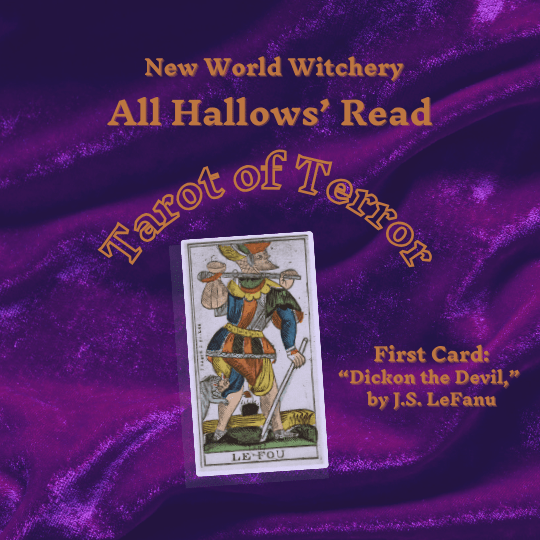
It’s time for our annual All Hallows’ Read tradition! This year our theme is “Tarot of Terror,” and our first card pulled is The Fool. We feature a story from Joseph Sheridan LeFanu entitled, “Dickon the Devil.”
Please check out our Patreon page! You can help support the show for as little as a dollar a month, and get some awesome rewards at the same time. Even if you can’t give, spread the word and let others know, and maybe we can make New World Witchery even better than it is now.
Don’t forget to follow us at Twitter! And check out our Facebook page! You can follow us on Instagram (main account, or you can follow Laine as well) or check out our YouTube channel with back episodes of the podcast and new “Everyday Magic” videos, too (as well as most of our contest announcements)!
Promos and Music:
Music for this episode is licensed from Audio Socket. Additional music Kevin Macleod, from Free Music Archive and used under a CC 2.0 license.
Sound effects from Freesound.org and in the Public Domain.
Please consider supporting us by purchasing our promotional items in the New World Witchery Threadless shop or by joining our Patreon supporters.
If you like us AND you like Buffy the Vampire Slayer, you will love our new show: Myth Taken: A Buffy the Vampire Slayer Podcast, now available through all the podcatchers! You can also check out Cory’s folklore show, Chasing Foxfire, where he explores the intersection of folklore and topics like history, medicine, science, nature, literature, pop culture, and more!
Please think about checking out our Audible Trial program. Visit Audibletrial.com/newworldwitchery to get your free trial of Audible, where you can download over 180,000 titles (including some narrated by Cory). Your purchases help support this show, and there’s no obligation to continue after the free trial
We look to the moon for the month, do our card readings, share a lycanthropic version of a familiar tale, and tell you how to become a werewolf in six (not-so) easy steps.
Please check out our Patreon page! You can help support the show for as little as a dollar a month, and get some awesome rewards at the same time. Even if you can’t give, spread the word and let others know, and maybe we can make New World Witchery even better than it is now.
You can find a transcript of this episode at our Transcripts page.
The folktale this month is “The Grandmother,” a French folktale found at the Ashliman fairy tale archive.
In our cartomancy section, Laine will read for Cory, and Cory for Laine, but we’ll also share general information on the cards we pull, too. If you are interested in playing card divination, you can check out our Cartomancy post or pick up Cory’s book, 54 Devils.
Don’t forget to follow us at Twitter! And check out our Facebook page! For those who are interested, we are also on TikTok now. You can follow us on Instagram (main account, or you can follow Laine as well) or check out our new YouTube channel with back episodes of the podcast and new “Everyday Magic” videos, too (as well as most of our contest announcements)!
Promos and Music:
Title and closing music are “Runaround (AM Radio),” by Aaron Solomon, and is licensed from Audio Socket. (License #1273). Additional incidental music Kevin Macleod, from Free Music Archive and used under a CC 2.0 license.
Sound effects from Freesound.org and in the Public Domain. Additional “rooster” sound effect from Darina Evstafeva from Pixabay.
Please consider supporting us by purchasing our promotional items in the New World Witchery Threadless shop or by joining our Patreon supporters.
If you like us AND you like Buffy the Vampire Slayer, you will love our new show: Myth Taken: A Buffy the Vampire Slayer Podcast, now available through all the podcatchers! You can also check out Cory’s folklore show, Chasing Foxfire, where he explores the intersection of folklore and topics like history, medicine, science, nature, literature, pop culture, and more!
Please think about checking out our Audible Trial program. Visit Audibletrial.com/newworldwitchery to get your free trial of Audible, where you can download over 180,000 titles (including some narrated by Cory). Your purchases help support this show, and there’s no obligation to continue after the free trial
Summary: We look into our mailbag and pull out a handful of messages from the past year to answer on the show! We discuss witchy party favors, the uses for storm water, searching for mysterious books, magical tattoos, protecting a garden from pests with magic, and more!
Please check out our Patreon page! You can help support the show for as little as a dollar a month, and get some awesome rewards at the same time. Even if you can’t give, spread the word and let others know, and maybe we can make New World Witchery even better than it is now.
Producer for this show: This episode is sponsored in part by listener This episode is sponsored in part by listener Jen Rue. In appreciation for your ongoing enthusiasm, we’ll be witching some ravens and owls with copious notes of thanks your way.
Our sources for this episode are…YOU! Thanks so much for writing in Michael, JE, Mourning Dragon, Viola, Listener “R,” and Listener “A!”
The link to the German folklore video mentioned by Listener A is here.
The transcript for this episode is available on our Transcripts page.
Some upcoming publications from us:
Please consider ordering our collaborative book Conjuring the Commonplace: A Guide to Everyday Enchantment and Junk Drawer Magic from 1000Volt Press! It’s available for purchase on Bookshop, Amazon, or from your local bookstore!
Promos and Music: Title music is “Woman Blues,” by Paul Avgerinos. All music is licensed from Audio Socket (#35954).
Please consider supporting us by purchasing our promotional items in the New World Witchery Threadless shop or by joining our Patreon supporters. If you like us AND you like Buffy the Vampire Slayer, you will love our new show: Myth Taken: A Buffy the Vampire Slayer Podcast, now available through all the podcatchers! Please think about checking out our Audible Trial program. Visit Audibletrial.com/newworldwitchery to get your free trial of Audible, where you can download over 180,000 titles (including some narrated by Cory). Your purchases help support this show, and there’s no obligation to continue after the free trial
Summary: This time around we’re chatting with filmmaker Annika Hylmo about her work documenting a middle school class that exonerated the last convicted witch in the Salem Trials, Elizabeth Johnson, Jr.
Please check out our Patreon page! You can help support the show for as little as a dollar a month, and get some awesome rewards at the same time. Even if you can’t give, spread the word and let others know, and maybe we can make New World Witchery even better than it is now.
Producer for this show: This episode is sponsored in part by listener AthenaBeth. We’ll be providing you with magical dry erase markers for all your enchanted chalk-talk needs!
The transcript for this episode is available on our Transcripts page.
Some upcoming publications from us:
Please consider ordering our collaborative book Conjuring the Commonplace: A Guide to Everyday Enchantment and Junk Drawer Magic from 1000Volt Press! It’s available for purchase on Bookshop, Amazon, or from your local bookstore!
Promos and Music: Title music is “Woman Blues,” by Paul Avgerinos. All music is licensed from Audio Socket (#35954).
Please consider supporting us by purchasing our promotional items in the New World Witchery Threadless shop or by joining our Patreon supporters. If you like us AND you like Buffy the Vampire Slayer, you will love our new show: Myth Taken: A Buffy the Vampire Slayer Podcast, now available through all the podcatchers! Please think about checking out our Audible Trial program. Visit Audibletrial.com/newworldwitchery to get your free trial of Audible, where you can download over 180,000 titles (including some narrated by Cory). Your purchases help support this show, and there’s no obligation to continue after the free trial
We look at the moon for the month, spend some time with a Joker, tell a tale about spinning straw into gold, and braid some wheat this time.
Please check out our Patreon page! You can help support the show for as little as a dollar a month, and get some awesome rewards at the same time. Even if you can’t give, spread the word and let others know, and maybe we can make New World Witchery even better than it is now.
In our cartomancy section, Laine will read for Cory, and Cory for Laine, but we’ll also share general information on the cards we pull, too. If you are interested in playing card divination, you can check out our Cartomancy post or pick up Cory’s book, 54 Devils.
Don’t forget to follow us at Twitter! And check out our Facebook page! For those who are interested, we are also on TikTok now. You can follow us on Instagram (main account, or you can follow Laine as well) or check out our new YouTube channel with back episodes of the podcast and new “Everyday Magic” videos, too (as well as most of our contest announcements)!
Promos and Music:
Title and closing music are “Runaround (AM Radio),” by Aaron Solomon, and is licensed from Audio Socket. (License #1273). Additional incidental music Kevin Macleod, from Free Music Archive and used under a CC 2.0 license.
Sound effects from Freesound.org and in the Public Domain. Additional “rooster” sound effect from Darina Evstafeva from Pixabay.
Please consider supporting us by purchasing our promotional items in the New World Witchery Threadless shop or by joining our Patreon supporters.
If you like us AND you like Buffy the Vampire Slayer, you will love our new show: Myth Taken: A Buffy the Vampire Slayer Podcast, now available through all the podcatchers! You can also check out Cory’s folklore show, Chasing Foxfire, where he explores the intersection of folklore and topics like history, medicine, science, nature, literature, pop culture, and more!
Please think about checking out our Audible Trial program. Visit Audibletrial.com/newworldwitchery to get your free trial of Audible, where you can download over 180,000 titles (including some narrated by Cory). Your purchases help support this show, and there’s no obligation to continue after the free trial
Summary: We dive into folk magic for getting a job, keeping a job, and on the job. Plus we explore about a dozen different occupations and the folklore associated with them, and talk about doing magic *as* an occupation, too.
Please check out our Patreon page! You can help support the show for as little as a dollar a month, and get some awesome rewards at the same time. Even if you can’t give, spread the word and let others know, and maybe we can make New World Witchery even better than it is now.
Producer for this show: This episode is sponsored in part by listener Conjured Cardea. We are greatly thankful for your support, and promise that the desert sasquatch we’ve sent your way to offer you our gratitude is friendly! Just, maybe don’t make direct eye contact or any sudden movements.
Thanks to our listener feedback from Listener “S” for this episode, too!
The transcript for this episode is available on our Transcripts page.
Some upcoming publications from us:
Please consider ordering our collaborative book Conjuring the Commonplace: A Guide to Everyday Enchantment and Junk Drawer Magic from 1000Volt Press! It’s available for purchase on Bookshop, Amazon, or from your local bookstore!
Promos and Music: Title music is “Woman Blues,” by Paul Avgerinos. All music is licensed from Audio Socket (#35954).
Please consider supporting us by purchasing our promotional items in the New World Witchery Threadless shop or by joining our Patreon supporters. If you like us AND you like Buffy the Vampire Slayer, you will love our new show: Myth Taken: A Buffy the Vampire Slayer Podcast, now available through all the podcatchers! Please think about checking out our Audible Trial program. Visit Audibletrial.com/newworldwitchery to get your free trial of Audible, where you can download over 180,000 titles (including some narrated by Cory). Your purchases help support this show, and there’s no obligation to continue after the free trial
We’re talking meteor showers, insect prognostications, foraging for tea, and that old lady who plays with dolls down the road.
Please check out our Patreon page! You can help support the show for as little as a dollar a month, and get some awesome rewards at the same time. Even if you can’t give, spread the word and let others know, and maybe we can make New World Witchery even better than it is now.
You can find a transcript of this episode at our Transcripts page.
The folktale this month is “The Hungarian Witch,” as collected by Ruth Ann Musick for Appalachian Journal, Spring 1974.
In our cartomancy section, Laine will read for Cory, and Cory for Laine, but we’ll also share general information on the cards we pull, too. If you are interested in playing card divination, you can check out our Cartomancy post or pick up Cory’s book, 54 Devils.
Don’t forget to follow us at Twitter! And check out our Facebook page! For those who are interested, we are also on TikTok now. You can follow us on Instagram (main account, or you can follow Laine as well) or check out our new YouTube channel with back episodes of the podcast and new “Everyday Magic” videos, too (as well as most of our contest announcements)!
Promos and Music:
Title and closing music are “Runaround (AM Radio),” by Aaron Solomon, and is licensed from Audio Socket. (License #1273). Additional incidental music Kevin Macleod, from Free Music Archive and used under a CC 2.0 license.
Sound effects from Freesound.org and in the Public Domain. Additional “rooster” sound effect from Darina Evstafeva from Pixabay.
Please consider supporting us by purchasing our promotional items in the New World Witchery Threadless shop or by joining our Patreon supporters.
If you like us AND you like Buffy the Vampire Slayer, you will love our new show: Myth Taken: A Buffy the Vampire Slayer Podcast, now available through all the podcatchers! You can also check out Cory’s folklore show, Chasing Foxfire, where he explores the intersection of folklore and topics like history, medicine, science, nature, literature, pop culture, and more!
Please think about checking out our Audible Trial program. Visit Audibletrial.com/newworldwitchery to get your free trial of Audible, where you can download over 180,000 titles (including some narrated by Cory). Your purchases help support this show, and there’s no obligation to continue after the free trial
Wait, do you not celebrate Summerween? Or even know what Summerween is? You could be forgiven for missing this, as it’s more of a tongue-in-cheek nod to those of us who can’t get enough spookiness in our lives and find that the long, languid days of summer drag out the time before Halloween. In truth, the actual name “Summerween” derives primarily from an episode of the Disney animated series Gravity Falls, which is sort of a cartoon version of the X-Files with a lot more weirdness, humor, and satire. Cousins Dipper and Mabel Pines are spending their summer with their Great Uncle (or “Grunkle”) Stan, who runs a huckster’s tourist trap museum featuring all the oddball weirdness of the Pacific Northwest. The town of Gravity Falls, Oregon (a fictional place) is known for its surplus of gnomes, zombies, creepy child televangelists, mermen, and mind demons, which leads to a number of adventures as the kids slowly unravel the area’s secrets over two seasons (I will pause momentarily to say that this is an excellent show and I always highly recommend it). In an episode from Season One, the kids and Grunkle Stan decide to celebrate Summerween, a sort of “extra” Halloween because the town loves weirdness so much. Instead of pumpkins, locals carve Jack-o-Melons out of watermelons, and most of the candy is the “garbage candy” that no one wants to eat–black licorice and circus peanuts, for example. Trick-or-treating is done in costumes, and there’s even a local urban legend about a “Summerween Trickster” who eats children that don’t show adequate Summerween spirit.
In recent years, Summerween seems to have picked up a bit of traction, and some social media accounts proudly display their own Jack-o-Melons and other Summerween decorations. All of that got me thinking, “How could we make Summerween a real, witchy thing?” Obviously there’s always going to be a bit of the wry wink-and-nod nature to the holiday, but as I unpacked it I realized it is entirely possible to add some folk magic, spookiness, and darkness even to the longest days of the year. So today, I’ll be looking at some of the components that could be used to make a Summerween happen. We’ll see that there are some fun elements of folklore you could put into play here, and maybe you can design your own Summerween festival to help you manage until the heat breaks and we can get to the lovely crisp, cool autumn days once more.
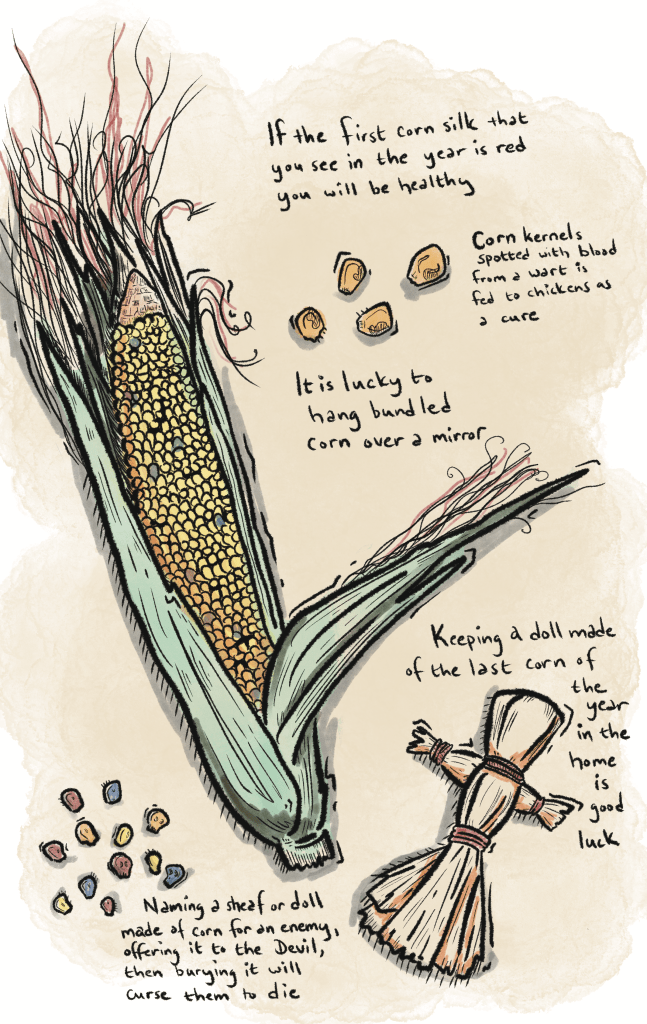
Corn has many folk magical uses. (image (c) Cory Thomas Hutcheson, 2024)
Corn
There’s more than a bushel full of folklore when it comes to corn. It’s worth remembering that outside of the United States, “corn” is used in English to refer to most grain crops, while “maize” would be specific to what Americans think of as “corn.” We’ve done a full post on corn before, but still, there is plenty of lore about corn we didn’t get to. Some has to do with growing or harvesting it, such as these beliefs:
At harvesting time, if the shucks on corn are thin, it is a sign of a warm winter.
Cut corn in the decrease of the moon [while it is waning], to keep it from spoiling.
Plant corn when poplar leaves are big as squirrel ears. [Or in some lore, when oak leaves are as big as a mouse’s ears]
When three black crows fly east over the field, harvest the corn the next day.
Tobacco should be planted with corn as an offering to keep it healthy all season.
Corn also has a lot of luck lore in connection with it, including a strong throughline connected to corn and the various colors of kernels and tassels:
If the first corn silk you see in the year is red, you will be healthy; but if it is white, you will be sickly.
If two ears of corn grow together and you get the ear at table, you will hear of a death that day.
It is lucky to hang a bunch of cornstalks over a looking-glass.
If while husking you find a blue-spotted ear of corn (sometimes known as Sally corn), you will be lucky.
It is good luck to find a red ear at a cornshucking.
Give a sick cow a red ear of corn, and she will get well.
When a person is shucking corn and a number of grains come off in his hands, he will have bad luck.
Carrying a piece of corn in your shoe or pocket is thought to bring you good luck.
To dream of gathering corn indicates you will be lucky in everything.
There are also some slightly eerier folk beliefs and workings that tie into things like charming, witchcraft, and even curses!
If a farmer fails to plant a row of corn in the corn field by oversight, some member of his family will die before the harvest time.
If corn stalks, with dirt on the roots, are hung on branches of fruit trees, the frost will not kill the blooms.
Having trouble with a bewitched gun while hunting? You can pour corn over the weapon, then feed the corn to hogs to remove the bewitchment and pass it on to them (assuming they will be slaughtered soon).
Plait your horse’s mane with corn shucks to prevent witches from riding him.
Jaybirds go to hell every Friday with a grain of corn.
Scratching a wart and rubbing the blood onto corn kernels, then feeding the kernels to chickens is supposed to make your warts go away.
To bury a sheaf of corn with a certain form of malediction and dedication to Satan, will cause your enemy to die as the corn decays. They practice this in certain parts of Ireland.
To bind up the last gleanings of the last field into the rude figure of a human being, and take it home and keep it, will insure a good corn crop the following year, and corn will be plenty until that time. [Basically make a corn dolly and keep it in your home for good luck and plentiful corn next year, a concept very akin to the butzeman of Pennsylvania German lore]. This is sometimes called a Spite Doll, according to Ozark folk magician Brandon Weston.
These last two really run the gamut of applications between making the most of your harvest for better or worse!
Watermelons
What would summer be without a cold slice of watermelon and a seed-spitting contest? Since the iconic Jack-o-Melon is a quintessential part of the Summerween experience, I thought I’d gather up a handful of entries that cover melon-based lore:
If you plant watermelons or any kind of vines three days after the change of the moon, they will do better.
Planting watermelons receives a plethora of advice about when to do it according to folklore. Ideal dates include Good Friday, in April when the south winds are blowing, on the first of May, every Saturday in May, during a New Moon, after apple trees bloom, during the lunar signs of Gemini, Cancer, or Aquarius, and before sunrise.
It is considered bad luck to point at or count your melons, which will make them fall off. Similarly, stepping over the vine before the melons are ripe will also cause them to rot or fall off the vine.
Several stories mention the idea of putting up poles around your watermelon patch with string or twine attached to them, which will work better to keep birds off than a scarecrow, according to the lore.
One bit of lore says that you can wash your face with melon rind to cure freckles.
A Pennsylvania German cure for kidney ailments involves making a tea out of watermelon seeds by steeping dried ones in boiling water and drinking it (after it’s not boiling anymore, of course–you all know how tea works).
If a child is having trouble with bed wetting, a bit of Ozark folklore says to feed them watermelon seeds before bedtime.
Gunpowder and Fireworks
We’ve already written a good bit about gunpowder, which is what makes fireworks do what they do. There’s also a long-standing tradition of “shooting in” times like the new year by firing guns loaded with just powder or blanks in the air (live ammo was sometimes used, but obviously that is highly dangerous). Gunpowder was mixed into hot-footing recipes and jinx-breaking ones, as well as used to make a barrier around someone or their property to keep them from harm. There are a few additional uses of gunpowder we could add here, too:
Pennsylvania German lore says that a cure for homesickness is to sew a good charge of gunpowder on the inside of the shirt near the neck.
In some places a dose of gunpowder was mixed with milk to help speed the delivery of a child (NOT recommended and NOT medical advice).
Another rather dangerous cure involves putting gunpowder in a bleeding wound. One entry even mentions that it should then be “exploded” (likely just ignited to create a fast cauterization, but again NOT recommended and NOT medical advice as this could cause a number of problems).
Gunpowder was sometimes made into a paste by mixing it with egg whites and used to treat acne, boils, and canker sores.
Gunpowder has anti-witchcraft properties as well. Some folks would scorch gunpowder in a pan to drive witches away, and one story tells of a man loading a gun with salt and black powder then shooting all around someone’s house to break witchcraft curse set upon the family that lived there.
Odds and Ends
Finally, I had to share a few of the creepier, eerier, or more esoteric bits of summer lore I found as I was researching. If these don’t add a little Halloween energy to your late July days, I don’t know what will!
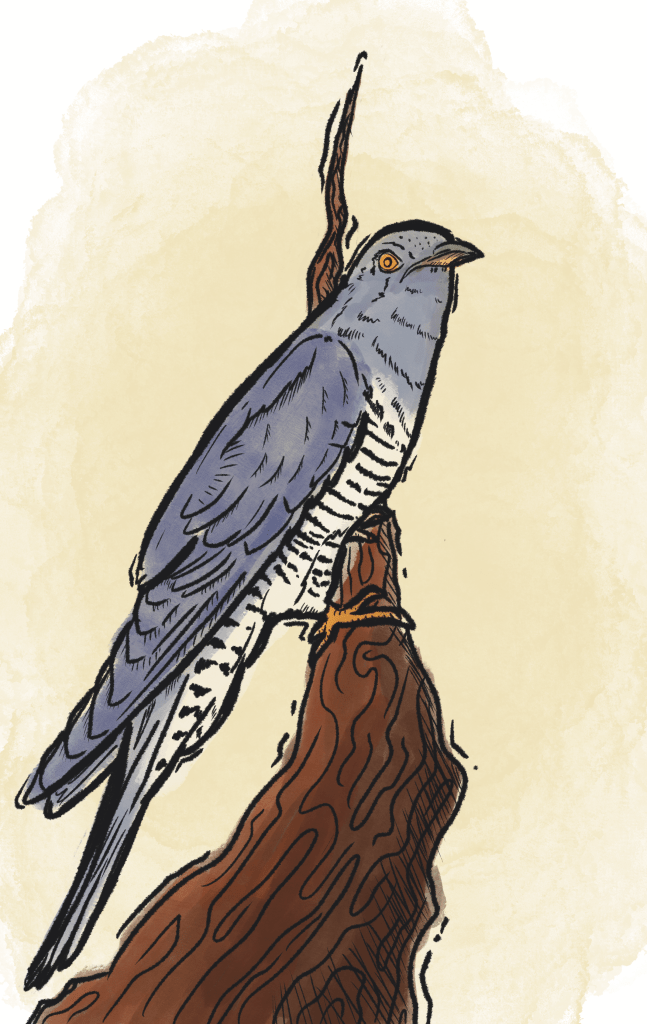
“In Exmoor, if an old woman hears a cuckoo on midsummer’s day, she will not be alive at that time next year.”
“If, on a summer morning, a flock of chickens lie low with wings outspread, sunning themselves in a row, it is a sign that they are measuring a grave.”
“Myths must not be told during the day nor in summer, for snakes will come to hear them, if told at such times.”
“In very ancient times the ladies used to carry balls of crystal in the hand to enjoy their delicious coolness in the summer, as well as to gaze in the depths to see what their lovers were doing.”
The “Dog Days” of summer (which run from July to August and historically coincided with the rising of the “Dog Star” Sirius in the sky) are dangerous times: mad dogs are thought to be more common, as is rabies in general. In some places, there is a belief that even the water in the ground will turn bitter or poisonous during this time period.
“If an old woman hears a cuckoo on midsummer’s day, she will not be alive at that time next year.” Have you ever seen a bird look so smug? (image (c) Cory Thomas Hutcheson, 2024)
There’s more than enough there to launch your own folk horror version of a Summerween festival! You could easily dress your house in corn dollies along with your Jack-o-Melons, carry crystal balls and corn kernels in your pockets, and do an evening of fireworks with photos of exes you’d like to “rocket” out of your life! There are plenty of creepy ways to make the summer yours–just make sure to wear your sunscreen!
Festivals
You don’t necessarily need to invent a Summerween from whole cloth, either. Plenty of festivals and celebrations already happen during the summer and have a magical or spooky side to them. In the Gravity Falls episode about Summerween, Grunkle Stan displays a calendar that notes the holiday seems to occur in late June, but without a fixed date you could connect your own Summerween festivities to a number of other fetes that occur over the sunnier months.
There is, of course, Midsummer and the associated St. John’s Eve. We’ve written a good bit about those before, and we have a fairly recent Folk Magician’s Notebook episode that shares tales associated with St. John’s Eve as celebrated in New Orleans. In those stories, we often hear about “Voodoo Queen” Marie Laveau hosting celebrations on Lake Pontchartrain with her enormous snake draped around her neck as she emerged from the waters. While the stories may be a bit sensationalized, Midsummer and St. John’s Eve festivities are already stuffed full of fairy lore, magic, and witchcraft that ranges from the Shakespearean to the surreal (such as gathering “fern seeds” on Midsummer Eve).
(image (c) Cory Thomas Hutcheson, 2024)
In the Ancient world, the middle of summer was also typically the celebration of Kronia (sometimes also Cronia) a festival honoring Cronus/Kronos, the progenitor of the Olympian gods later associated with Saturn in Roman mythology. If you know the story about Cronus swallowing his children at birth then you can already guess there’s some eeriness to this day, which was sort of seen as a lesser version of Saturnalia with its inversion of social order. Rather than the full flip of Saturnalia where slaves took the role of masters for a day and vice versa, during Kronia slaves were simply allowed to act as freedmen for a day, sit at their masters’ tables, and join in games, drinking, and festivities. We know little more than that of the festival, but given how little Cronus was celebrated in religious life among the Ancients, this is likely a good day to work with Saturnine forces–casting long-term spells, harvesting or culling things from your life using a sickle (symbolic of both Saturn and Cronus), or putting a metaphorical dragon in charge of guarding your treasure by doing financial security magic. Hanging sickles from your door does seem like a good way to keep tax collectors away, after all.
Also from the Ancient world, we’ve got the celebration of Fortuna, which falls typically around June 24th. The goddess of fortune–both good and bad, mind you–Fortuna is frequently shown with a ship’s rudder (to steer the ship of destiny), a ball or wheel (like the Wheel of Fortune tarot card), or a cornucopia (symbolizing the hoped for abundance she could provide, but also recognizing that a harvest must be reaped AND sown, and that everything comes in seasons and cycles). Propitiation of Fortuna can be as simple as setting up an altar to her with symbols like balls, wheels, boats, coins, money, and so forth. I like to keep bay leaves on my altar to her to recognize her role in success, and often ask that as her wheel turns I can “bend without breaking” when I need to endure a low point on that wheel. You might easily incorporate some of her symbolism in your Summerween: wheels, cornucopias, boats, and so forth, but also some of the creatures frequently shown on the Wheel of Fortune tarot card like sphinxes, lions, phoenixes/eagles, or devils. You could easily host a costume party where people dress as any of the “Fortuna” figures to get a Summerween celebration going!
Fortuna was celebrated in Ancient Rome during the Summer months. (image (c) Cory Thomas Hutcheson, 2024)
Later in the summer, we have Lammas and Lughnassah, both celebrated in early August. Fellow folk witch Via Hedera calls this time “Highsummer,” which also makes sense, and it’s a time for harvesting and heat, which also means a time for bread. Doing bread-based divinations (something we’ve written about and discussed on the show) could be a wonderful way to add some Summerween fun into your life. There’s also the “crying the neck” ritual that involves tossing a sickle at a sheaf of wheat until it is cut. This ties into the folk tradition of “John Barleycorn” and his sacrifice, burial, and resurrection as both bread and fermented bread–er, beer. Once again sickles work well for a symbol here, and a good spooky game of “chuck the sickle at the wheat sheaf” feels like an extremely Summerween sort of sport.
The summer also means regional food and folk festivals. I could hardly get into all of them, but in your area you’re likely to have some kind of festival celebrating a locally produced food. There are gala days for things like strawberries, chile peppers, garlic, and just about anything you could imagine. Finding out what is feted near you could involve digging into some history and folklore about that particular piece of produce and using it in your magical work and decor (maybe by braiding them into ristras to hang around your home for protection in the case of chile peppers or garlic, for example). Folk festivals are equally abundant. Depending on where you are, you may be connected to any of a number of ethnic festivals such as the Kutztown Folk Festival (celebrating Pennsylvania German folk culture, including a bit of magic and healing from the braucherei tradition), a variety of Scottish festivals like the Virginia Scottish Games or the Middle Tennessee Highland Games, or the Nordic Fest in Decorah, Iowa (a three-day event commemorating the town’s Norse heritage). And of course there’s Juneteenth, celebrating the Emancipation of African Americans in many parts of the United States, which comes with a wide variety of traditions for those who are invited to participate.
There are some very particular holidays that you might connect with, too. In the U.S. Virgin Islands, for example, the fourth Monday in July is Hurricane Supplication Day, in which offerings and prayers are made to protect the islands from hurricanes. For those with an Irish background, you might look to Puck Fair, a festival from County Kerry that involves making a goat king for a day and dressing both it and everyone else up in ribbons and festival decorations, ultimately culminating in a trip up the local mountain for a Reek Sunday mass (if you are so inclined). Or you might celebrate Tanabata (Star Festival) if you’re from a Japanese heritage, putting out bright decorations made from colorful origami to honor the stars on July 7th (or August 7th if you are in/from Okinawa).
Finally, even Wall Street has its own slightly spooky holidays that can connect to the Summerween spirit. Folklorist Jack Santino noted that the stock market has its own version of curses in the form of something called Triple Witching Days. According to his book All Around the Year, “On Friday, September 19, 1986, newspapers and television programs carried stories of the Wall Street phenomenon called the triple witching hour, when the stock market undergoes an hour of unusually unpredictable shifts. The term refers not to broomsticks but to a time when ‘stock index futures and options on individual stocks expire simultaneously.’ The results of this are mercurial, unpredictable swings in the underlying value of most stocks. These ‘Triple Witching Days’ occur four times a year, on the third Fridays of September, December, March, and June” (45). Santino links this to beliefs about the role of threes (with these events occurring on the third Friday of every third month) and the fact that three types of stocks expire at the same time (stock index futures, stock index options, and individual stock options). So when someone describes themselves as a “financial wizard,” perhaps we should believe them!
A later section in Santino talks about the eruption of the Satanic Panic and how many of the reported incidents related to it were tied directly to the summer solstice. He notes, “[W]hen the sheriff of a small midwestern town orders the exhumation of supposed sacrifices of ritual murders on the eve of the summer solstice (his sources told him there would be more killings on June 20 or 21), we are witnessing behavior motivated by folk belief surrounding the longest day of the year, a day traditionally associated with magic.” This passage is in reference to a Satanic Panic scare that took place on June 21, 1985, in Spencer Township, Ohio in which the head of local law enforcement followed a rumor mill that led him to excavate a rural spot that was supposedly the site of “an orgy of human sacrifice.” The digging turned up a headless doll and a rusty knife, but absolutely no bodies. The sheriff still proceeded to describe the doll as “decapitated” and indicated that the knife was somehow proof that some sort of diabolical activities must have been going on, but that the Satanists had just been a bit too clever in getting the bodies out of there before he could find them. Oh those tricksy Satanists, right?
The Satanic Panic and its horrifying legacies aside, we really do have plenty of folk material we can call upon in the summer months to put together a richly spooky and magical experience if we wish to. So today let’s dive into some of those Summerween features and see what sort of warm-weather witchery we can make!
It’s a good time to put on some scary movies! (image (c) Cory Thomas Hutcheson, 2023)
Other Ways to Celebrate
If you’re looking for other ways to enjoy the Summerween spirit, what about spooky stories with a warm-weather atmosphere? While most of our fears go bump in the night when we read a ghost story or watch a horror film, there are more than enough “daylight horror” narratives that they even have their own genre (which is, of course, “daylight horror”). Since we’re a folk magic-positive site, here are a few that have a bit of good folklore and roots-based enchantment woven in among the creaking doors and rattling chains.
The Birds (1963) – This Hitchcock film made Tippi Hedren a household name and its marketing irritated a number of grammar teachers (“The Birds is coming”). Where’s the folklore? It’s based on a story by Daphne du Maurier of Rebecca fame, and she was well-attuned to English lore. Birds, especially birds that get indoors, are often seen as a portent of death.
The Wicker Man (1973) – A distinctly daylight horror original. This film is set around Beltane and the welcoming in of summer, complete with naked dancing pagans, a Hand of Glory, and a maypole!
Wake Wood (2009) – This Irish folk horror story initially seems like a Pet Semetary variation, but gets a good bit darker and deeper than that. Pagan rituals and magic spells are used to resurrect the dead child of a grieving couple so that they can have three more days with her, only to discover that maybe they don’t exactly want her back anymore.
Midsommar (2009) – A24 and Ari Aster have become the surest ways to get me to a movie theater these days, and Midsommar is a good example of why. It’s brutal and a “don’t-look-away” story that chills your heart (and may turn your stomach), about Dani, a young woman mourning the loss of her family, who accompanies her gaslighting boyfriend on an anthropology trip to Sweden to study a pagan ritual. They, of course, get in much deeper than they had anticipated. Tons of great folk magic shows up here, including the use of menstrual blood in food as part of a love (or lust) spell, and oh, there’s another maypole, too.
Lamb (2021) – This creepy Icelandic film involves a rural family who find that their ewe has given birth to a strange creature that is half-sheep, half-human. They decide to raise the child, and a variety of twisted events begin to collapse all their suppositions about the world they live in. This one is based very much on the lore of the “monstrous birth” portending momentous change for those who were near when it happened.
Gravity Falls (2012-2016) – Yes this is a television show, and yes, it’s a Disney animated show ostensibly for kids. But there’s a lot more to this one than that. After all, this is where we get the concept of Summerween at all! If you enjoy things like the X-Files, Outer Limits, Buffy the Vampire Slayer, Riverdale, or the Twilight Zone, this show has something for you. The stories and characters are fun and make for good casual watching, but there’s also a massive connected story that covers the whole two-season series involving a handshake-deal making mind demon, a creepily adorable televangelist, aliens, portals, secret codes (which the show runs with, including secret codes in every episode that you can crack to get deeper show lore). It’s pretty phenomenal, and has even featured voices from people like Linda Cardellini (Freaks & Geeks and The Avengers), J.K. Simmons (of Spider-Man and Whiplash), Alfred Molina (also in Spider-Man), Jon Stewart (of the Daily Show fame), Weird Al Yankovic, Kyle MacLachlan (Twin Peaks), Mark Hamill (you know, Luke Skywalker?), Patton Oswalt (Ratatouille), Lance Bass (‘NSYNC), and even Matt Chapman (the person behind the internet phenomenon Homestar Runner and breakout character Strongbad). This show holds a rare 100% positive rating on Rotten Tomatoes for a good reason–it’s phenomenal, and it will definitely get you in the Summerween spirit!
And finally, if you want to put all that daylight behind you, consider making the most of the nighttime, too. From late July through mid-August, if you look up you may catch a glimpse of one of the most abundant meteor showers visible in North America, the Perseids. They are named this because they seem to originate from the constellation of Perseus (found between the slightly more recognizable Casseopeia and Taurus constellations). During the peak of the shower, which in 2024 is around the 12th and 13th of August, you might see up to one hundred meteors per hour! That’s a lot of potential wishes made on shooting stars, and definitely something a little bit magical to enjoy as you’re putting out your Jack-o-Melon candle.
Whatever you do for your Summerween, we hope it gets you through the last of the season and through until Autumn and Halloween proper. For now, though, we wish you a magical celebration and we hope you find a way to appease the Summerween Trickster before the night is through (we hear five hundred pieces of candy including Gummy Chairs and Mr. Adequate Bars will do the trick)!
Summary: We’re continuing our discussion of desert folk magic with some listener feedback, Mormon folklore about Bigfoot, a look at some regional healing and magical methods, and we learn why roping a smokestack on a train is an effective hangover cure.
Please check out our Patreon page! You can help support the show for as little as a dollar a month, and get some awesome rewards at the same time. Even if you can’t give, spread the word and let others know, and maybe we can make New World Witchery even better than it is now.
Producer for this show: This episode is sponsored in part by listener Conjured Cardea. We are greatly thankful for your support, and promise that the desert sasquatch we’ve sent your way to offer you our gratitude is friendly! Just, maybe don’t make direct eye contact or any sudden movements.
Thanks to our listener feedback from Priestess_AP and Nicole for this episode, too!
The transcript for this episode is available on our Transcripts page.
Some upcoming publications from us:
Please consider ordering our collaborative book Conjuring the Commonplace: A Guide to Everyday Enchantment and Junk Drawer Magic from 1000Volt Press! It’s available for purchase on Bookshop, Amazon, or from your local bookstore!
Promos and Music: Title music is “Woman Blues,” by Paul Avgerinos. All music is licensed from Audio Socket (#35954).
Please consider supporting us by purchasing our promotional items in the New World Witchery Threadless shop or by joining our Patreon supporters. If you like us AND you like Buffy the Vampire Slayer, you will love our new show: Myth Taken: A Buffy the Vampire Slayer Podcast, now available through all the podcatchers! Please think about checking out our Audible Trial program. Visit Audibletrial.com/newworldwitchery to get your free trial of Audible, where you can download over 180,000 titles (including some narrated by Cory). Your purchases help support this show, and there’s no obligation to continue after the free trial








 New World Witchery - The Search for American Traditional Witchcraft