Blog Post 113 – Spiritual House Cleaning

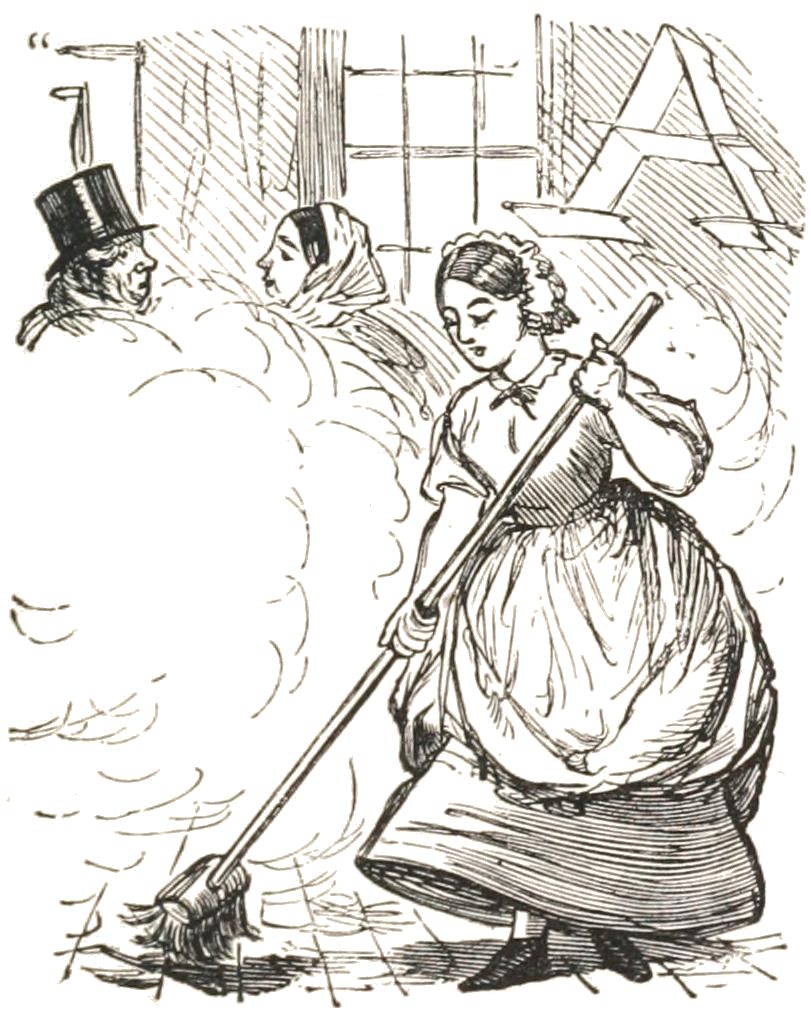
Home Sweet Home, by Douglas William Jerrold (via Wikimedia Commons)

It’s always nice to start the New Year off with a clean, well-appointed home.  In some traditions, this is not mere vanity or hygiene, but a spiritual necessity that must be done on New Year’s Eve to ensure that the home is clear and ready for the coming year.  Today, I thought I’d look at a few of the magical methods for housecleaning, as well as some of the most common cleaning agents with a magical touch.

Sweeping & Vacuuming – It has to be done.  There’s just no way of getting around it.  The floors must be kept clean, at least within reason, and usually a broom or a vacuum is employed to that end.  Workers in the conjure and hoodoo traditions tend to have specific techniques for sweeping, often going from the topmost floor of the house to the bottom and working from the back of each floor towards the front (though I’ve seen variations on that, often depending on specific needs—getting rid of a bad spirit might involve sweeping out the back door, for example).  While floor washes are the go-to method for spiritually cleansing a house and adding specific magical vibes to the area (see Mopping & Floor Washes below), you can add a degree of magic to the sweeping and vacuuming process, too.  Various powders can be sprinkled on floors and carpets and left there for a bit before sweeping.  These will absorb some spellwork and leave other magic behind.  Some good ones to try out (available at Lucky Mojo):

  • Fear Not to Walk Over Evil – A powerful anti-hex and anti-foottrack magic powder.
  • House Blessing – A simple, very peaceful powder.
  • Crown of Success or Fast Money – To encourage prosperity and abundance.
  • Chuparosa/Hummingbird – To create love and attraction between partners in the home.

Likewise, you might also opt for simple, household items to do some of your mojo work during sweeping and vacuuming.  Many spices make great conjure sweeps (and smell wonderful when taken up by a vacuum and slightly warmed by the machine’s motor—an added aromatic energy).  Some that I like to use:

  • Cinnamon – Creates a sense of prosperity and joviality.  Some use it for business success, but I find it creates more of a personal confidence and comfortability than anything purely financial.
  • Allspice – Another success spice, but also good for stimulating conversation.  I like to vacuum with cinnamon and allspice sprinkled on the carpets before guests come over to encourage a warm, friendly atmosphere.
  • Pine Needles – Good for uncrossing and refreshing a home.  Not a kitchen spice, of course, but still easily accessible.  Be careful though, as too many pine needles can gum up machinery (like vacuums) quickly!
  • Rosemary – Good for domestic bliss, as well as helping those who smell it focus and think clearly.
  • Oregano – Keeps meddlesome influences from interfering in your life.  Makes a nice “law-keep-away” substitute, and discourages nosy neighbors.
  • Garlic Skins – Kills off evil, but it will leave a distinctive odor in the air.
  • Rose Petals – Encourages love and passion when crumbled around the home and left for a bit before sweeping/vacuuming.
  • Salt – Great for stopping any hexes put upon you and removing unwanted spiritual energies from your home.  I use baking soda (a type of salt) sprinkled on carpets before vacuuming to both absorb odors and remove pesky curses.  Jim Haskins records a method of preventing unwanted guests from returning which simply involves sweeping salt after them when they leave.
  • Sugar – A little of this will add a sweetness to your home, though make sure you get it all and don’t use too much—a little sweetness may be great, but a lot of ants aren’t.

The basic method here is to sprinkle everything, let it sit for a bit (if you can stand letting it sit for 24 hours, that is lovely, but probably a little excessive—30 minutes is often plenty of time, and even a 5-minute wait will give you a quick dose of magic).

Mopping & Floor Washes – This is probably one of the best known hoodoo methods of cleansing, blessing, and enchanting a home.  Using a prepared magical floor wash to clean anything that can handle getting wet (including the walls) still makes for great spellwork.  Some of the most famous floor washes are (again from Lucky Mojo):

  • Chinese Wash – An old school formula which reputedly came out of Chinatown (though which Chinatown is not particularly clear).  It’s made from several powerful ingredients, many of which are found in Van Van (see below), with broom straws added for extra oomph.  Good for knocking out any hexes and doing purification work.
  • Van Van – We’ve covered this in Blog Post 81, but briefly this is a blend of several Asian grass extracts, chiefly lemongrass and vetiver root.  It, like Chinese Wash, cleanses and purifies.
  • Peace Water – When made in its most interesting form, peace water is beautiful to look at, with layers of blue and white/clear liquid on top of one another in a mesmerizing stasis.  When mixed up and sprinkled into a floor wash, this helps create feelings of calm, quiet, and tranquility in even very turbulent homes.
  • Rose Water – This very basic addition to a floor wash can be found in many ethnic grocery markets.  It’s not much more than a strong rose tea stabilized with alcohol, so you could easily make your own, but it’s also fairly cheap to buy.  When used in a floor wash, it helps promote feelings of love and agreement.

In addition to these specialty formulas, there are lots of common household cleaners you can use with a magical bent:

  • Pine-Sol – This commercial floor cleaner basically evolved out of hoodoo floor washes.  Cat Yronwode even suggests adding a little Van-Van to a bottle of Pine-Sol and using it as a simple substitute for Chinese Wash.  Traditional pine scent is great, of course, or you can go with…
  • Lemon Pine-Sol – Or any lemon-scented cleanser like it.  Lemons have a cut-and-clear effect on a space, and have long been associated with destroying curses and breaking hexes.  Charles Leland’s Aradia records an anti-evil-eye charm which is fundamentally a pomander made of a lemon and pins.  It leaves a lovely clean smell, too, though a fairly artificial one in most cleansers.  Feel free to add some fresh squeezed lemons to your mop bucket for a rootsier version of lemon-cleanser.
  • Ammonia Draja Mickaharic recommends a simple floor wash of ammonia and salt added to mop water, and it really makes a wonderful cleansing and protecting wash water.  It can really neutralize almost anything thrown at you, magically speaking, and it disinfects beautifully.  Mickaharic also recommends a little ammonia down every drain when you finish cleaning (just a teaspoon or so), to finish off your magical housecleaning.
  • Vinegar – Four Thieves Vinegar is popular as a counter-curse wash, and as a protective mix-in for a mop-water.  But really, any vinegar will help get rid of unwanted energies and protect the home from invaders and malicious forces.  If the scent is strong enough, it may protect you from visitors altogether.
  • Urine – This one is very traditional in hoodoo, though much frowned upon in modern use.  It has, however, been long used as a cleaning agent, and a little urine diluted in some mop water can be very powerful for “marking your territory” and protecting the home.  It can also instill a sense of good luck in the place, and ensure fidelity in your mate and passion from your lover.  If they don’t catch you doing it, of course.

There are lots of other cleaning agents out there that you can use, of course.  Almost anything scented probably has at least some tenuous connection to a magical formula, so a little homework can help you transform that bottle of Mop-N-Glo into a powerful apothecary’s potion.

Windows & Doors – You don’t do windows, you say?  Well, you should at least open them up!  Whenever you do a good house-cleansing, throwing up the windows and letting some fresh air circulate is vital to getting everything “right.”  It helps balance out all the forces in the home, allows bad spirits to leave, and refreshes the air in the house.  It’s cold to do this in winter, of course, but turning the heat off for 10 minutes and letting a little fresh air in can make all the difference in getting a home feeling good and happy again.  Likewise, the doors should be opened for a bit to let the air circulate.

When it comes to washing doors and windows, you can really use any of the same washes I talked about above in the Mopping & Floor Washes section.  You can also use a variety of other ingredients to get things right at all your entrances and exits.  For example, many folks take a little olive oil (or holy oil, which is basically blessed and sometimes lightly scented olive oil) and make a little sigil in the corner of every window, to seal that entrance against evil intrusions.  Some folks put blue bottles in the windows, or jars full of sand or marbles, in the hopes that any witches who might try to get in will be forced to count the contents of the container and be unable to do so before daybreak (when their power ends).  You can make a wash water of red brick dust, urine, and salt in warm water and use it to scrub your door to add a powerful layer of protection.  You can also sprinkle salt or brick dust lines down at the threshold and in the sills of every window to keep out unwanted spirits and spells.

Clearing the Air – Once the house has been aired out and all the windows and doors cleaned and opened for a while, some folks like to light some incense, use room sprays, or even just make a little something in the kitchen to add an element of magic to the home.  I’ve covered some of the holiday scents and their uses in Blog Post 108, and I’ve already mentioned pine and citrus scents as powerful agents for spiritual and physical cleansing.  Other odoriferous offerings to your home can include:

Fresh Bread – One of the best symbols of abundanace and prosperity.  Bake a loaf in your oven and let the scent fill the home.  Cookies are also good for this.

Floral Scents – Like jasmine, rose, or lavender.  All of these have specific uses, and add specific magical “vibrations” to an area (rose fragrances inspire love to many, for example), so look into the flowers you like and figure out what note they will set in your newly cleaned domicile.

Sweeteners – I did mention this in Blog Post 108, but I also said it’s a bit strong when burned.  If you are airing your house out, however, a little honey, brown sugar, molasses, or even table sugar might be a good thing to burn or warm on the stove, as it will provide a sublimely “sweet” feeling to the area.  Draja Mickaharic highly recommends this, and I can’t say I’m against it either.

Nailing It Down – This is a practice particular to conjure and hoodoo, though there are likely variants or similar practices in other magical systems.  The basic idea is that by pounding nails into your home’s corners (and the corners of your property), you fix it there and create a stable environment.  You also assert your ownership of the place, and help to guarantee your continued residence there.  The most commonly used nails for this are the “square-cut” kind, usually sold cheaply at hardware stores.  For doing the corners of your property, you would want to use something bigger, like old railroad spikes.  The basic idea is that you simply nail them into every corner of your home, particularly the ones along outside walls.  You can bless them with oil or holy water or anything else you feel is appropriate, or simply nail them down while saying a little prayer that you remain safe, happy, and comfortable in your home as long as the nails remain in place.  Remove them if you ever have to move away for any reason.

That’s a lot of cleaning!  But it’s always good to have a clean home, for both practical and spiritual reasons, so give some of these a go and see how they work for you!  And if you missed your New Year’s cleaning deadline, well, you can always do these things during your Spring cleaning, too.

I hope this has been useful!  Thanks for reading!

Oh, and Happy New Year!

-Cory

Blog Post 112 – 5…4…3…2… (New Year’s Traditions)

With one set of holidays just behind us, we still have a little more celebration left before the deep, dark, quiet winter sets in.  Today, I’ll be sharing some of the New Year’s traditions from North America (and to some extent, from around the world).  New Year’s has a lot of obvious components: a sense of rebirth, optimism, setting goals for improvement, and even a little romance.  Let’s look at some of the big traditions associated with this glittering and festive affair.

1)      Fireworks – These are a common component of New Year’s festivals worldwide, including the Chinese New Year which occurs later in the winter.  Aside from being a celebratory demonstration of light and wonder, the noise and fire from these explosives may serve to frighten away any lingering demons or bad spirits.  And, of course, they help keep everyone awake until the crucial midnight hour.  This also ties into other noise-making activities on New Year’s Eve, such as singing, banging cymbals, and other loud demonstrations of the party spirit.

In the Appalachians, this sometimes mixed with the mumming traditions of the Christmas season and became something known as a Shanghai Parade.  Gerald Milnes describes the practice in his book, Signs, Cures, & Witchery:

“The shanghai tradition once included music played on violins, flutes, horns, and drums in the Valley [of Greenbriar Co., West Virginia].  There is even a fiddle tune called ‘Shanghai’ that is known in West Virginia and may be connected to the shanghai ritual…people also cross-dress and put on exotic, mostly homemade costumes.  Reversal is a theme, and they generally whoop it up in the spirit of old midwinger revelry” (p. 192)

Jack Santino also describes similar uses of noise-makers, including guns, in his All Around the Year:  “In Hawaii, the custom involves the traditional beliefs of the native Hawaiians, who say that the fireworks scare off demons.  In Ohio, they are used as noisemakers, often instead of a gun, since ‘shooting in the New Year’ is the tradition” (p. 13).

2)      Kissing at Midnight – This tradition is related to others more regionally or culturally specific (such as “First Footing,” discussed below), but has become a broader practice among Occidental celebrants of the New Year.  The Snopes.com page on New Year’s superstitions has this to say on the subject:

“We kiss those dearest to us at midnight not only to share a moment of celebration with our favorite people, but also to ensure those affections and ties will continue throughout the next twelve months. To fail to smooch our significant others at the stroke of twelve would be to set the stage for a year of coldness.”

The idea of setting the stage for the coming year based on what one does on New Year’s Day ties into a lot of the other superstitions and customs related to this holiday.  With kissing, the idea seems to be that if you start the New Year off with someone you love, or at least by kissing someone attractive, you will invite positive romance into your life over the coming year.

3)       First Footing – To those of Scottish extraction, this is probably a very familiar practice.  The Scottish New Year is called Hogmany, and involves several key rituals, including house-cleaning, preparing traditional meals (see “New Year’s Food” below), and First Footing.  Sarah at Forest Grove has written an excellent entry on the Hogmany traditions, and describes First Footing thusly:

“First footing is a divinatory folk tradition where the first person who sets foot in your house in the wee hours of the New Year determines the luck and happenings of the year ahead. A man is preferred over a woman, and a man of dark hair and eye over a man of light hair and blue or green eyes. Redheads are especially unlucky to be the first to set foot across your threshold in some areas of Scotland.”

In some cases this practice requires that the first-footer be not of the household.  We received several pieces of lore in our Winter Lore Contest related to the New Year, including a bit about First Footing from listener/reader Akia: “Some of her [grandmother’s} holiday superstitions included: not letting anyone out of the house or enter until an unrelated male came into the house on New Years Day.”

4)      New Year’s Food – There are a lot of traditions about just what to eat on New Year’s Day.  Some of the most common components of a New Year’s meal are:

      • Black-Eyed Peas
      • Cabbage
      • Collard Greens
      • Ham or Pork
      • Lentils
      • Whiskey (or good, strong booze in general)
      • Potato Pancakes

Most of the foods associated with the New Year are related to prosperity and wealth in some way.  For instance, lentils and potato pancakes are shaped like coins.  Black-eyed peas have fertility and abundance going for them.  Cabbage and collards look like wads of bills waiting to be spent, etc.  Some folks recommend the addition of non-edible components to the meal, such as coins for prosperity.  Patrick W. Gainer says, “It will bring good luck if on New year’s Day you cook cabbage and black-eyed peas together and put a dime in them” (p.123).   Listener and podcaster Aria Nightengale shared her New Year’s food lore during our recent contest, saying, “[W]e always eat pork and cabbage on new year’s day.  According to my Momaw, we eat pork because pigs eat moving forward not backwards, so pork will help you move forward through the new year.  I don’t know the specific purpose of the cabbage…but Momaw cooks it with a silver dollar in it for prosperity.”

There’s a distinctly Southern dish called Hoppin’ John made from black-eyed peas, onions, and ham which can usually be found simmering away on most stovetops during the New Year.  It’s so important to our traditions that many restaurants also offer some version of it on New Year’s Day.  My wife and I have a tradition of going to one specific restaurant every year where we can get good potato pancakes and hoppin’ john to help bring in the New Year with a couple of our friends.  It makes for a nice way to spend the day, and ensures that we get our black-eyed pea requirement taken care of.

There are still many more traditions we could discuss (and I hope to!), such as cleaning practices, taboos, whether or not to give gifts, etc.  But for now, I hope this has been a nice introduction to the wonderfully lore-rich practices of New Year’s celebration.  Here’s wishing you a great day, and a great ending to the year!

All the best, and thanks for reading,

-Cory

Quick Post – Hoodoo in the Wall Street Journal

Hi all!

Not a major post today, just something I found that I thought might be interesting to you:

http://online.wsj.com/article/SB10001424052748703989004575653102537901956.html

It’s an article about hoodoo in the Wall Street Journal!  Take a look and let me know what you think!

-Cory

Blog Post 111 – The Meaning of Christmas?

Hi everyone,

This is just a short post today looking at a recent discussion from the BBC:

http://www.bbc.co.uk/worldservice/news/2010/12/101223_christmas_meaning_nh_sl.shtml

In this broadcast (which I heard via Oraia Sphinx, many thanks to her), the origins and meaning of Christmas are discussed by Bryan Fischer of the American Family Association (aka. The AFA—an evangelical group which leads many initiatives to instill religiously conservative values into Americans) and Professor of Pagan History/well-respected author Ronald Hutton of Bristol University.  While it’s not really fair to pit a scholar and historian against a spokesperson, the overall conversation is interesting, if a bit charged at times.  I’m not posting it to stir up controversy (though I suspect it may do so), but more because I thought it was interesting, and because I always enjoy hearing Hutton speak on history and theology.  Also, Fischer makes an interesting point for those of us who are American witches—can we celebrate “Christmas” without making it (at least primarily) a religious observance?  And do we need to?  Is our country so deeply tied to its Christian roots that we acknowledge Christianity by acts as mundane as writing a check with an “A.D.” date on it?  Or, as Hutton proposes, is America a collection of pocket communities each defining their own values based on their cultural, ethnic, and social histories?  Food for thought.

There’s a rather neat musical montage in the piece, too, which outlines the different angles from which Christmas (and the winter holidays in general) can be viewed.  Religious, Hopeful, Commercial, or Sad, there does seem to be a universal draw to set aside this time of year, whatever feelings it inspires.

So what about you?  Do you have a “reason for the season” that you’d like to share?  What does Christmas mean to you?

Thanks for reading!

-Cory

Blog Post 110 – The Ghost of Christmas Yet to Come

“ ‘I am in the presence of the Ghost of Christmas Yet To Come?’ said Scrooge.
The Spirit answered not, but pointed onward with its hand.
‘You are about to show me shadows of the things that have not happened, but will happen in the time before us,’ Scrooge pursued. ‘Is that so, Spirit?’
The upper portion of the garment was contracted for an instant in its folds, as if the Spirit had inclined its head. That was the only answer he received.”
(from Charles Dickens’ A Christmas Carol)

To mark Christmas Eve—which is probably my favorite winter holiday, simply because it’s the one I’ve always celebrated and the one I’ve always found most magical—I thought today I’d put up a few of the many fortune-telling techniques employed at this time.  While many of these are not specifically New World, they are often quite ethnically linked and so are found in a variety of ethnic communities both in the “Old Country” and the New.

Polish Customs
(you can read more about these customs here)

  • Girls who grind poppy seeds on Christmas Eve can expect a swift marriage
  • After dinner on Christmas Eve, a girl will leave the house and listen for a dog bark.  Wherever it comes from is the direction from which her future husband will arrive.
  • A maiden could go down to the river on Christmas Eve and dip her hand in the water, pulling out the first object she touched.  Wood meant her future husband might be a carpenter, leather a cobbler, iron a blacksmith, etc.
  • Straws could be placed under the tablecloth at dinner, then pulled by guests to foretell the future.  A green straw meant marriage, a yellow straw meant spinsterhood, a short straw meant an early grave.

Czech Customs
(you can read more about these customs here)

  • Every member of the family lays some bread on the floor, after which the dog is called in.  Whose bread the dog eats will go on a journey in the next year (or in some variations, be dead by that time).
  • Melted lead is dropped into cool water, and the shapes are used to interpret the future.  For example a sheep-shaped piece might indicate a future job in agriculture, or perhaps peace and rest in the near future.  I’ve heard of tin being substituted, and I imagine candle wax would be a reasonable replacement, too, if you lack the means to melt metal in your home.
  • Lighted candles could be placed in walnut shells, then floated in the bathtub.  Whoever had the shell which went the farthest would be making a long and important journey soon.
  • After dinner, guests take an apple and cut it crosswise.  If it reveals a star-shape, good fortune awaits the subject.  If it shows a cross, illness or death is coming.
  • Walnuts can also be cracked to reveal the future.  A kernel that is big and sweet reveals happiness and prosperity, while a shriveled or bitter kernel foretells sorrow or sickness.

Irish Customs
(you can read more about these customs here, here and here)

  • A sheep’s shoulder-blade could be “read” to indicate the future.  After the lamb was eaten at Christmas dinner, its shoulder would be scraped clean without using iron (preferably by the teeth or a wooden implement), and the spots left at the thinnest parts of the blade would show shapes to the reader indicating the future.
  • In a very grave ceremony, a round cake would be baked (sometimes of ashes or even cow dung) and a candle would be placed in it for each member of the family.  The order in which the candles burned out indicated the order in which family members would die.
  • The neighing of horses on Christmas Eve indicated whether there would be peace or war in the coming year.
  • A girl going to a well just before midnight on Christmas Eve could see her future spouse in the calm waters.
  • A girl could knock at a hen-house door on this night, and if the cock crowed, she would soon marry.  If not, she would remain celibate.

British Customs
(you can read more about these customs here and here)

  • Whoever lit the new Yule log with a piece of the previous year’s Yule log would have good fortune all year.  This concept was immortalized in verse by Robert Herrick’s poem, “The Yule Log.”
  • The plow was to be brought in and kept under the table all through the twelve days of Christmas in order to ensure good luck.  If you had a plow, that is.
  • A girl could place a sprig of hawthorn in a glass of water and if it sprouted on Christmas Eve, she would be sure to soon marry.

Italian Customs
(you can read more about these customs here, here, and here)

  • Each member of the family puts a heap of flour on the table and leaves the room.  The head of the family then comes in and stashes different presents or charms in the flour piles, and the family returns to find their fortune for the year based on the charm they received.
  • If Christmas Eve is moonlit, there will be bad fruit in the coming year.
  • A man in costume standing on the church steps can watch for those who attempt to enter the church on Christmas Eve but find themselves unable to do so.  The man then identifies those who did not make it into the church as witches.
  • Those born on Christmas Eve are thought to become either werewolves or witches, depending on their gender.
  • Anyone who invokes the Devil before a mirror on Christmas Eve may become a witch (not really divination, but I thought it was interesting anyway!).

If you have Christmas Eve fortune-telling or divination customs, we’d love to hear them!  I know this barely scratches the surface of all the various cultures which partake in a little bit of magic on Christmas Eve, but I must stop here.  I still have a few presents to wrap, and I think I may need to track down some lead, a plow, and maybe a mirror.
Have the very best of holidays, everyone!  Thank you all so much for reading, and all my wintry blessings go out to our readers!  May the light find you, wherever you are.

-Cory

Blog Post 109 – Holidays in the Mountains

Hi there, everyone!

Today, I’m going to be sharing a little bit of holiday lore from the mountains, both the Ozarks and the Appalachians (to those readers wondering when I’ll start including the Rockies, I promise I’ll get there one day!  I’m just woefully ignorant of the traditions from that area).  There are a number of pieces of folklore associated with the winter holidays in the mountains.  Often, storytelling and family visits were the primary entertainment in the financially poor but folklore-and-culturally-rich mountains once the cold weather set in.  Christmas was not always celebrated, especially during the early years of settling, largely because many Protestants settling in the Appalachians viewed the holiday with suspicion and regarded it as a Catholic celebration.  One source records that the penalty for observing Christmas during the Puritan era was a “fine of five shillings” (WG&S, p.28).  Over time, however, as more people of mixed backgrounds settled the area, Christmas became a social holiday.  Patrick Gainer records that holidays in the mountains included:

  • Fireworks and noisemaking
  • Very little decorating prior to the widespread introduction of electricity (most homes didn’t have a Christmas tree)
  • School Christmas parties
  • Costumed visits to friends and neighbors (called “Belsnickling”—more on that in a minute)
  • Toys for children, though almost entirely homemade ones

Belsnickling

The tradition of Belsnickling is particularly interesting.  It seems to be a mumming tradition in the vein of similar British activities, but is really practiced by only the Germanic settlers in the Appalachians.  It relates to the Belsnickle (whose name may come from pelz Nicholas, or “furry Nick”), a devilish traveling companion to good St. Nick during his holiday visits who would punish the wicked children in the same way that the saint rewarded the good ones.  In some variations, it was not St. Nick who traveled with Belsnickle, but Kriss Kringle (likely a derivation from the Germanic kriskindl, or “Christ-child”).   Gerald Milnes describes the practice thusly:

“To people in the Potomac Highlands, belsnickling is the action of going from house to house in masquerade, with residents guessing the belsnicklers’ identities…Sometimes treats were offered to the belsnicklers, and sometimes belsnicklers offered treats to the household” (SC&W, p.186)

Milnes also offers a variety of pranks and tricks related to this practice:

  • Candy would be thrown on the floor, and when children dove for it, they would have their fingers switched by the belsnicklers
  • Bands of belsnicklers would wander through the countryside hooting and yelling all through the night
  • People in costume would tap on the windows of houses and scare the children inside
  • Firecrackers would be lit and thrown into people’s homes

He also relates this practice back to something deeply witchy—the Wild Hunt:

“Belsnickling and similar activities, as group practices, have obscure beginnings, but they may well go back to the old Teutonic concept of the wild hunt.  In Scandinavian and German versions of this myth, a huntsman with dogs, accompanied by spirits, hunts the wild woman.  In some versions, the huntsman, a lost soul, leads a band of wild spirits to overrun farms at Christmas time (the winter solstice)” (SC&W, p. 186).

Christmas Dinner in the Mountains

Of course, no Christmas would be complete without a feast in modern minds, but the table offerings were not quite the same for every family.  Often, up in the mountains in the early-to-midwinter, the meal would consist on the wild meat that was available rather than anything domestically raised.  In Foxfire 12, informant John Huron describes a most particular holiday meal:

“Groundhogs aren’t bad eatin’ either if you cook them right…baked and layered with onions and sweet potatoes.  That was what Charlie’s daughter, Margaret, would fix him for Christmas dinner every year.  They invited me and my wife, Sandy, and my son, Jay, over for Christmas dinner one time, and that’s what we had.  A groundhog is a lot cleaner animal than a chicken.  When you get right down to it, a chicken is a nasty critter” (FF12, p.248)

Signs and Omens on Christmas

There are a number of superstitions which have sprung up around the holiday season, too.  Often, weather and luck are intimately tied to Christmas, though sometimes the date shifts a little between December 25th (“New” Christmas) and January 6th (“Old” Christmas).  Some of the signs and omens from the Appalachians and Ozarks include:

  • It will be a fruitful year if the eaves of the house drip on Christmas (SC&W)
  • Children born on Christmas Day can understand the speech of animals (WG&S and OM&F)
  • Being the first to say “Christmas Gift” to another on Christmas Day yielded good luck (WG&S)
  • On Christmas Eve at midnight, all farm animals will bow down and speak to acknowledge Christ’s birth (SC&W and OM&F)
  • Those with the “second sight” make predictions most accurately on Christmas Eve (IaGaM)
  • “A green Christmas makes a fat graveyard” – warm weather at Christmas will lead to many deaths over the coming year (OM&F)
  • On Old Christmas, the sun actually rises twice instead of just once (OM&F)
  • Bees buzz so loudly on Old Christmas they can be heard for miles away (OM&F)
  • Elderberries always sprout on Old Christmas, no matter what the weather (OM&F)

Even with its rather slow, Puritanical start, Christmas in the mountains has become one of the most magically charged times of the year.  From eating groundhogs to playing rowdy pranks to witnessing the miraculous behavior of animals, this is certainly one of the most interesting times of the year.  And, in my humble opinion, one of the most magical.

Thanks for reading!

-Cory

Blog Post 108 – Holiday Magic in the Kitchen

Today I thought I’d look at some of the holiday lore surrounding baking and cooking.  What would the holidays be without the smells of cinnamon and nutmeg and clove and allspice slowly seeping out of the hot oven?  And who imagines a holiday home without the presence of gingerbread or ginger cake of some kind?  Chocolate and peppermint add extra luxury to an already indulgent season.  In short, much of the magic of Christmastime and Yuletide seems to come from the kitchen (I’m sure many kitchen witches reading that chuckle in amusement that such sentiments even need to be typed out).

So let’s start by looking at some of the ingredients in those festive holiday treats:

Cinnamon – This handy kitchen spice has lots of magical uses.  Cat Yronwode recommends it as a business drawing and gambling botanical.  It can be used to make a wash-water which one would then use to scrub down the walkways in front of a business.  This has the effect of drawing in new clients.  In Jim Haskin’s Voodoo & Hoodoo, cinnamon is mixed with sugar and sprinkled in the shoes to increase gambling fortunes.  Draja Mickaharic describes cinnamon as “calming” with a “protective vibration” and also cites its money-making properties in his Century of Spells (which refers not to a unit of time, but rather a unit of enumeration—a century representing the roughly 100 spells found in the book).  Mickaharic also notes that “it has a claming and quieting effect on young children,” though I imagine in cookie form this may not be the case.

Cloves – Mickaharic says these are “psychically protective,” and keep “negative thoughtforms out of the place where it is burned.”  Presumably including cloves in any baked or cooked dish would involve at least heating them, thus releasing some of this power into the kitchen and home.  Yronwode says that “cloves appear in spells for money-drawing, prosperity, room-renting, and friendship” (HHRM, p. 73).  These are also used to make pomanders, clove-studded oranges rolled in orris root powder and hung as protective talismans in the home (well, protective talismans and lovely nosegays to help imbue the house with that sweet, spicy holiday scent).

Nutmeg – This botanical has a mild narcotic effect and has been a staple of magic for some time.  An old hoodoo charm found in Harry Hyatt’s work and later disseminated by other authors involves sealing a small amount of liquid mercury inside a drilled nutmeg, then carrying the charm around as a gambling mojo (this is NOT RECOMMENDED as mercury is highly poisonous—DO NOT DO IT!!!).  Mickaharic describes nutmeg as an herb which inspires conviviality and jovial behavior, and promotes an air of happy friendship in the home.

Allspice – “Good for social gatherings; increases the flow of conversation and the rapport between people” says Mickaharic (CoS, p.50).  These hard, dried berries can also be soaked for a few hours, then strung as a type of herbal rosary using a needle and thread.  Carrying this can help relieve stress and provide peace of mind.  Yronwode recommends this for business and gambling (there’s a pattern here), and also describes a floor wash one can make with ground allspice.   Mixed with cinnamon and burned as incense, Mickaharic says it “places a smooth and witty feeling” in the home.

Ginger – This fiery herb is used to “heat up” or enhance the potency of various other magical ingredients, and also provides a little kick in spells for love or money (HHRM, p.103).  The root can be used as a poppet due to its shape and sometimes-resemblance to a human body, and would be especially effective in a love or lust working.  It can also be carried for protection.

Sugar – Sweetening!  This can be used to add a “sweet” or happy vibration to the home where it is burned (though it can smell very sharp when burned, too…baking it may not have the same oomph as burning it, but will smell better in the long run).  Of course one can keep all of one’s visiting relatives’ name papers in the sugar jar in order to better provide a happy, congenial home during the holidays, but offering them lots of sugary sweets might help ply a good attitude out of them, too.

As you can see, most of these herbs have to do with prosperity and getting along with one another (and a little protection thrown in for good measure).  This makes sense during a season where money might be tight, tension runs high, and houses are full of dangerous things like fire and hot ovens.  So when doing the holiday baking, it might be worth throwing an extra pinch or two of these spices in to up the magical ante of your confections.

I mentioned gingerbread earlier, and it made me think of a couple of stories from early American folklore about bakers whose experiences with cookies certainly have a magical bent:

The Baker’s Dozen” – A piece of reputed folklore recorded by Charles M. Skinner in 1896, this story revolves around a stingy baker and his encounters with an old crone who bewitches his bakery.  Only through the magnanimous efforts of St. Nicolaus (and by swearing better behavior on a gingerbread cookie shaped like him) does he manage to break the spell.

The Gingerbread Man” – This famous story tells of a gingerbread man come to life who flees his baker and eludes capture by the people and animals of the village.  He meets his match in the swift (and often crafty, in various retellings) fox, who finally devours him.

Finally, I’ll leave you with my family recipe for gingerbread:

1 c. sugar
1 c. shortening
1 c. molasses
½ c. hot water
1 Tbs. cinnamon (or to taste)
1 Tbs. ginger (or to taste)
½ tsp. salt
1 tsp. baking soda
1 egg
7 c. flour, plus a little extra for rolling dough

Preheat oven to 350 degrees. Sift flour and mix in dry ingredients.  Add egg, molasses, and shortening and mix.  Slowly add hot water, mixing as you go.  When dough is sticky, begin to work it into a ball.  Dust a flat surface with flour and begin rolling out the dough, working it until you get it about ¼ inch thick.  Cut out shapes with cookie cutters or a knife.   Bake cookies on a lightly greased cookie sheet for about 15 minutes (or until they are crisp at the edges and fully cooked.  Cool on a wire rack, decorate, and eat!

My mother and I used to bake several batches (rather, a whole day’s worth) of gingerbread, then spend time making the finished products into houses, sleighs, people, and animals.  We gave them as gifts, decorated with royal icing and candy, and were often very popular around the holidays.  I hope you enjoy!  It’ll be like taking a little bite out of your New World Witchery host during the holiday season.

Wait, that probably sounds kind of creepy.  Enjoy anyway!

Thanks for reading!

-Cory

Blog Post 107 – More Winter Lore

Greetings everyone!

I’m putting the rest of my series on Magic Books in the American Colonies on hold, temporarily.  Partly this is because I’ve decided to get working on the Resources page I have been planning to do for a while, which means that even if the posts themselves are weeks or months apart, they will be easy to read in succession because of their indexing on that page.  But mostly it’s because I’m in a holiday mood, and that means I really want to write about winter lore.

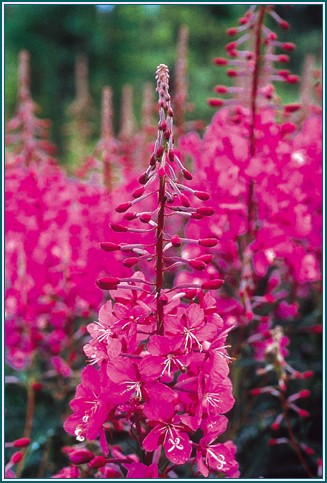
Let me start by sharing some of the links and information I missed in our show notes from the contest entries our listeners submitted.  For example, Kathleen of Borealis Meditation sent me a lovely batch of pictures featuring the fireweed (Epilobium angustifolium) from her lore submission:

In case you haven’t heard the related yuletide tale on the show, the folk wisdom goes that these shrubs, which grow after a wildfire has spread through a landscape, bloom from the bottom up.  They also go to seed from the bottom up, turning into “fluff” as they go.  When the fluff hits the top of the stalks, the first snow will fall, so the story says.

I also failed to put a link to listener and blogger Nathalie’s “24 Posts to Christmas.”  If you remember, Nathalie shared the lore about the Kuppelchen, a type of house-spirit responsible for taking care of a household and which often appears in families where magical folk are present.  In addition to this great bit of lore, Nathalie gives lots of holiday tidbits, tales, and recipes, including one for Grog—a very warming and bracing adult beverage for those cold winter days.  She also talks about things like Christmas Markets, St. Nicholas, and lead casting (which we also mentioned on the show, I think).

December is full of magical holidays, not just the mid-to-late month festivities that everyone knows about.  I’d like to throw two Catholic holidays out there (don’t worry, there won’t be any dogma, just a few of the more magical traditions associated with them).

First, there’s St. Nicholas’s Day, which is December 6th.   The night beforehand, children leave out their shoes near the door or fireplace, and in the morning, find them full of toys, candy, nuts, and fruit.  This custom, which seems to be Northern European in origin, is one I grew up with in my house.  St. Nicholas is also usually accompanied by a darker traveling companion, too, such as Ruprecht, Belsnickel, or Krampus.  This “anti-Santa” leaves punishments for naughty children, but can also be fairly benign and simply serve to balance out the whole “jolly old elf” side of the season.  I remember seeing lots of people dressed as either an angel or a devil on St. Nicholas’s Day while living in Prague, so the tradition of masking also ties into this holiday.  There is also an Appalachian tradition called “Belsnicking” which involves making masked visits to one’s neighbors during the holiday season (you can find a lot about that in Gerald Milne’s Signs, Cures, & Witchery).

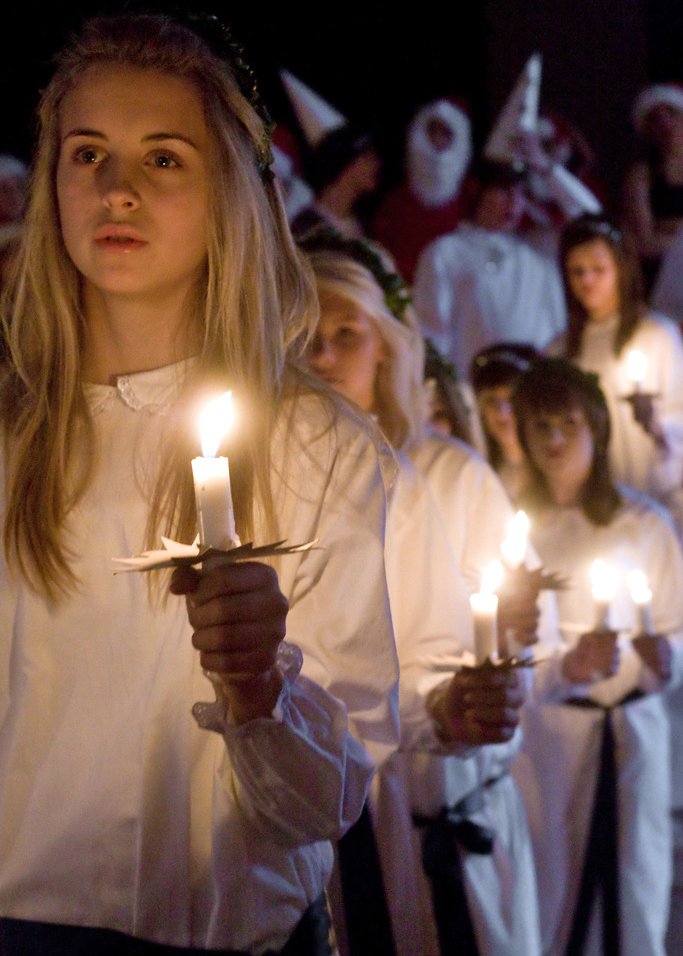
One thing I really wanted to mention, but for some reason didn’t, was St. Lucy (or Santa Lucia).  Lucy (whose name is deeply connected to the Latin “luce” or “light”) was a saint who tore out her own eyes as a demonstration of fidelity to her faith.  It’s a pretty gruesome thought, and much Christian art depicts this saint as carrying her own eyes on a silver platter.  Not exactly the type of story we think of while baking gingerbread men, right?  But St. Lucy’s Day, which falls on December 13th, is incredibly popular in Scandinavian countries.  Rather than focusing on the awful self-blinding, instead little girls wear crowns of candles and evergreens on their heads as they perform holiday parades dressed in all white gowns.  The girls then hand out sweets like gingerbread (pepparkakor) and chocolate to the people they pass, all the while, singing carols.  There’s a special type of pastry, the St. Lucia Bun, which is also made on this holiday.  In Italy, children leave out coffee or chocolate for Lucia, as well as bread and grain for her donkey.

There are still so many wonderful holiday traditions, customs, and magics out there to mention, but I’ll pause here for today.  I hope you’re enjoying the spirit of the season!

Thanks for reading!

-Cory

Blog Post 106 – Book Review

The Faeries’ Guide to Green Magick from the Garden by Jamie Wood and Lisa Steinke, illustrations by Lisa Steinke

When I was asked to review this book from the publisher*, I said yes without knowing anything about it. The title intrigued me, so I thought I’d give it a chance. I have to be honest though, anytime I hear anything about “faerie” books, I’m always a bit wary. Some books can be a bit more new agey than I like, and, dare I say it- a little fluffy. However, I was pleasantly surprised by how this book treats the subject of faeries.

To start out, the authors talk about Man and his symbiotic relationship with the earth. Talk is quickly shifted to a “go green” type of message, and how important this is in order to have any relationship with the faeries. It comes off a bit heavy handed, especially since it’s all information that any pagan already knows. However, Wood and Steinke then go on to explain how they view faeries- as the life forces of plants. They explain that plants are living beings, and that each faerie has an individual energy and personality that is a manifestation of that plant energy. They go on to say that Steinke’s lovely illustrations are her own personal interpretation of that faerie energy. I was really happy with this explanation, as it’s pretty close to my own view of faeries and they explain it in a easy to understand way.

There are a few more chapters on magickal** gardening, green gardening, and complimentary medicine. I found these to be a bit extraneous though, because they only touch on the subjects in passing. I’m glad though, because the best part of the book is what’s next- the Herbal Index. I loved this part of the book. The set up is that each herb has it’s own entry, with 33 of the most common herbs represented. Each herb has Steinke’s illustration of the faerie energy of the herb, a description of the plant, how to take care of it, and some magickal way to use the herb- whether that be an ingredient in a recipe, an ingredient in a spell, or perhaps a way to make your own beauty product. The only thing I found myself wishing for in this portion of the book was an actual picture of the plant/herb. However, since they’re so common, a quick google search will pull up plenty of pictures. I really enjoyed this portion of the book, and I think it would be great for someone new to working with herbs (like me).

Overall, I was pretty happy with The Faeries Guide to Green Magick from the Garden. It is definitely written for those new to gardening, working with faeries, and even to witchcraft in general. Sometimes the tone is almost apologetic for being about “magick”- as if they are writing to the average person who has never even thought about magick or witchcraft before, which is not who is going to be buying this book. I found this to be a bit patronizing at times.

However, the Herbal Index alone makes the book worth it to me. The descriptions, how to care for the plant, a fun way to use that particular herb, and not to mention the wonderful illustrations, all made me think it will be a good book to have in my repertoire. Again, it is for beginners, so if you’re a seasoned herbalist, this book will probably not have enough information for you. But, if you want an easy introduction into working with faeries and working with magickal herbs, then think about checking out this book.

-Laine

*In the interest of full disclosure, the publisher contacted me and asked if I would give an honest review of the book. I haven’t been paid for this review, and I didn’t pay for the book.

**Also, I’d like to note that I don’t usually make the distinction between magic and magick, but the book makes a point of explaining this, so I figured I would stick with that spelling. The same goes with the fairy/faerie spelling.

Last Call for Holiday Lore!

Hi all!

Just a very short post to remind you that the cutoff for our Winter Lore Contest is tonight at midnight (Central Time).

So if you want to enter, please email us with your lore before then!

Thanks!

-Cory